CESC Limited: Powering India's First Capital — From Victorian Calcutta to Modern Energy Giant
I. Cold Open & Episode Thesis
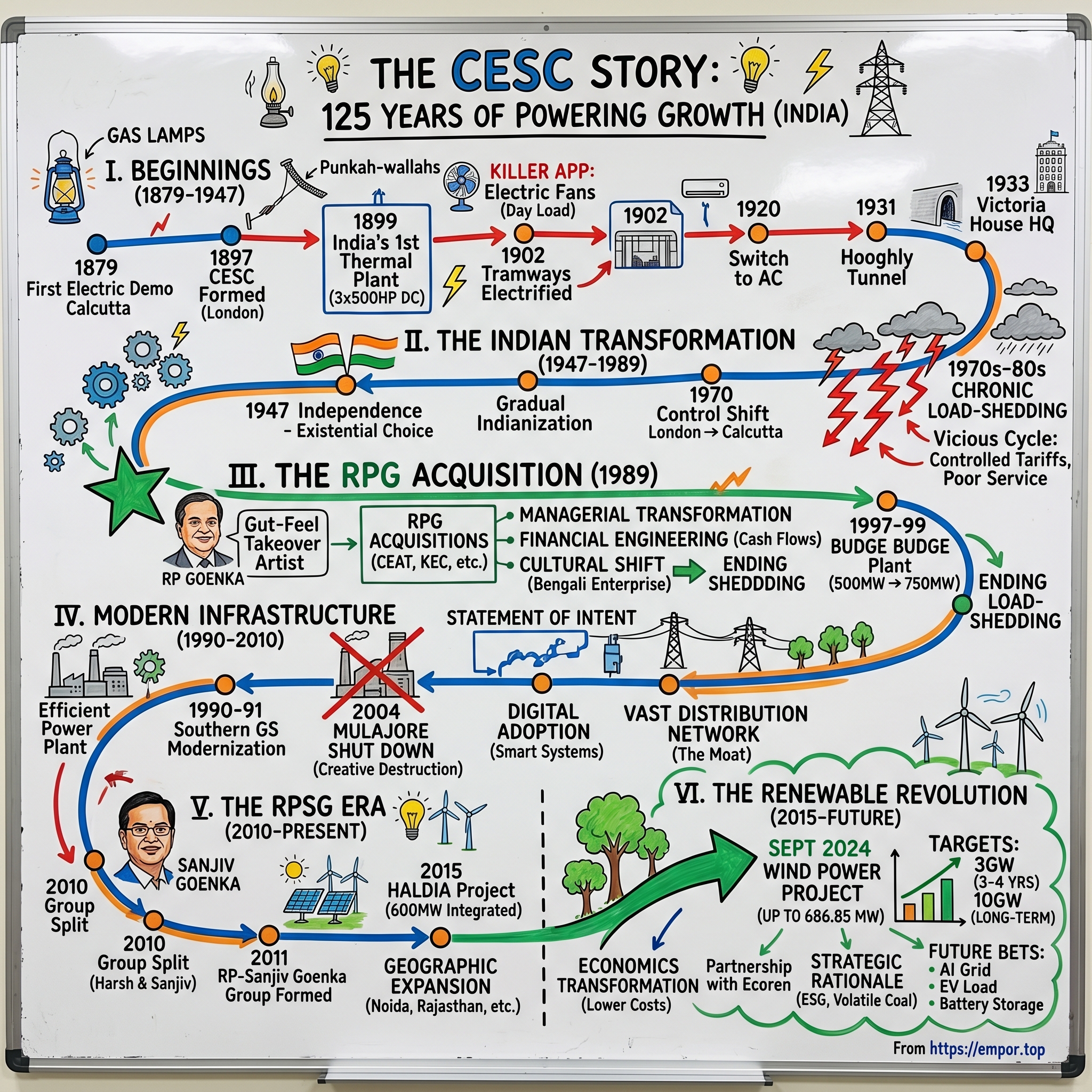
On the morning of April 17, 1899, a small crowd gathered in a lane called Emambagh, in the crowded heart of what the British Empire then called its second city. Inside a brick shed, a 1,000-kilowatt generating set — coal-fired, belt-driven, filthy, and by the standards of the day, magnificent — was brought to life. India had its first thermal power station. Calcutta had electricity as a public utility. And a company registered two years earlier in London under the unglamorous name of The Indian Electric Company had a business.[^1]
What distinguishes the company for investors is that this corporate lineage never broke. It was not nationalised, dismembered, or absorbed into a state electricity board the way almost every other colonial-era utility franchise on the subcontinent eventually was. One hundred and twenty-seven years later, the same continuous entity — now CESC Limited, listed on the NSE and BSE, controlled by the RP-Sanjiv Goenka Group from the same 1933-vintage art deco headquarters on Chowringhee — still holds the exclusive licence to distribute electricity across 567 square kilometres of Kolkata and reports consolidated annual revenue of over ₹18,570 crore.12
That survival is the story. It is also the trap.
The same characteristics that allowed CESC to survive — a regulated, cost-plus urban monopoly with a politically sensitive consumer base, protected by statute and inertia — are the characteristics that now constrain it. A regulated distribution licence in an Indian state capital is a machine for producing steady, unspectacular, highly predictable returns. It is not a machine for producing rapid growth. Despite maintaining strong distribution operating metrics, CESC has spent the last fifteen years trying to convert that reliable cash into growth — first through coal-fired generation, then through retail, then through distribution franchisees in other states, and now through a renewable energy platform called Purvah Green Power, which management targets to expand to 10 gigawatts.1
The episode thesis: CESC is a clear case study in emerging-market infrastructure survivorship — and what that survivorship costs. It is a company with proven operational efficiency in the demanding power distribution sector, trapped inside a regulatory regime that dictates when it gets paid, deploying its cash into a capital-intensive clean energy build-out whose economics depend on auction discipline outside its control.
The core question: can the defensive, regulated cash flows of Kolkata and Greater Noida fund an aggressive clean-energy platform without repeating the company's past capital allocation missteps — the retail business that consumed utility cash for two decades, the merchant thermal plant in Maharashtra that operated for most of a decade without long-term power purchase agreements, and the ₹4,636 crore in regulatory assets sitting on the balance sheet as deferred receivables from the state of West Bengal?17
The roadmap runs from British sterling capital and a tunnel dug under the Hooghly, through the socialist load-shedding years, to Rama Prasad Goenka's 1989 takeover, the 2010 family split, the regulator's 2019 veto of a corporate restructuring, and finally to a ₹4,859 crore acquisition in August 2026 to buy 1.4 gigawatt-peak of operating solar assets from ReNew.[^6]5
One more framing note before the history. Investors approaching the Indian power sector tend to arrive with one of two assumptions: either that utilities are predictable, bond-like assets, or that Indian utilities are structurally uninvestable because state distribution companies incur massive operational losses. CESC sits between those two extremes. As a private licensee inside a system dominated by loss-making state entities, it captures operational efficiencies that state utilities lose — yet it remains subject to the same state regulatory framework that challenges the sector. An investor cannot evaluate one side of that balance sheet without the other.
The history begins in the Victorian era — briefly, because that early chapter matters primarily for what it reveals about the regulatory and operational economics CESC still operates within today.
 Subscribe on LinkedIn
II. Victorian Roots & Colonial Infrastructure (1879–1947)
On July 24, 1879, a stretch of Calcutta was lit by electric light for the first time — a demonstration, a spectacle, and a civic novelty in a city that already had gaslight and was rather proud of it.[^1] It took another sixteen years for that spectacle to become a statute. The Calcutta Electric Lighting Act of 1895 created the legal container: an exclusive right to generate and supply electricity within a defined municipal area, on defined terms, to defined consumers.[^1]
That legal container remains the foundational artefact of the business. Everything CESC is today — its moat, its cash flow profile, its political exposure, and its inability to alter consumer prices unilaterally — descends from the framework encoded in the 1890s: that electricity distribution is a natural monopoly that must operate under licence, earning a permitted return rather than a market price.
The company that bought the licence
The Indian Electric Company was formed in London in 1897 and was almost immediately renamed the Calcutta Electric Supply Corporation.[^1] Incorporating in London, raising capital in sterling, managing from the metropole, and operating in Bengal reflected the standard template of late-Victorian infrastructure finance. British investors sought bond-like yields backed by imperial expansion. Colonial municipal contracts delivered that profile by offering a predictable return on deployed capital, leaving investors with engineering and currency risks while largely insulating them from demand or pricing risk.
That structure created a regulated asset base with a steady coupon rather than an entrepreneurial enterprise. It served as the direct ancestor of the cost-plus framework governing CESC in West Bengal today, where the regulator approves an eligible capital base and sets a return on it.
Engineering as strategy
The company deployed its early capital into engineering initiatives designed for operational durability.
Electrification of the Calcutta Tramways in 1902 marked its first anchor move.[^1] A tramway system provided a large, steady, non-seasonal load that smoothed the duty curve of a generating station, improving fixed-cost absorption. The underlying logic mirrors how modern distribution companies court high-volume industrial loads to optimize system utilization.
In 1931, the company completed its major engineering showpiece: a sub-river tunnel driven beneath the Hooghly River to carry high-voltage cables from generating units directly to the central load hub — described as the first sub-river utility tunnel in Asia.[^1] Beyond the engineering milestone lay a classic cost-of-capital calculation. Overhead river crossings carried high maintenance costs and physical vulnerability. A tunnel required significant up-front capital but minimized ongoing operational costs. Under a cost-plus regulatory structure where approved capital earns a return, building durable, capital-intensive infrastructure aligned directly with financial incentives — a dynamic that continues to shape regulated utility investment in India.
In 1933, the company moved into Victoria House on Chowringhee Square, a location it maintains as its registered office today.1 Few listed utilities globally have operated from the same headquarters for more than ninety years under a continuous licensing framework.
The customer base that came with the territory
The early colonial footprint established a structural advantage that continues to influence modern operating performance: load composition and network density.
A distribution licence territory is constrained by its geography. Early twentieth-century Calcutta was India's commercial capital, anchored by jute mills, trading firms, port infrastructure, administrative centres, and a dense urban core. The licensed area developed an unusually high proportion of commercial and industrial consumers alongside dense residential connections per square kilometre.
Network density remains a critical driver of distribution unit economics. High connection density generates more kilowatt-hour sales per kilometre of cable, spreading fixed capital and maintenance expenses across a broader revenue base. Shorter low-voltage lines reduce technical distribution losses, while compact geography simplifies physical supervision, lowering commercial loss from theft or non-metering. The 567-square-kilometre footprint served by CESC represents a compact geographical area with substantial load volume.
What the colonial economics actually taught
The company's first half-century demonstrated that the licence defines the enterprise. The primary asset was neither the physical plant nor the technological setup, but the exclusive statutory right to serve a designated territory alongside a negotiated formula for capital returns.
However, a licensee's economic returns remain dependent on the authority drafting the regulatory formula. Under colonial municipal governance designed to satisfy sterling bondholders, the return formulas were favorable. The transition to Indian independence fundamentally shifted who controlled the regulatory pen.
III. Nationalization Era, Power Crises & The London Transfer (1947–1989)
Consider the position of a London-managed, sterling-capitalized electricity monopoly in post-independence India after 1947. Ideological priorities in the new republic pointed toward state ownership of core utility assets. The commanding heights of the economy were to be publicly held, and electricity was central to that nation-building project.
Across most of India, state electricity boards became the standard model—vertically integrated, state-owned entities setting tariffs through political processes. One by one, private utility licensees were nationalized or allowed to wither.
CESC was an exception. While the precise reasons remain a subject of historical analysis, structural factors played a key role: the company held a statutory licence over a dense, high-consumption urban center, operated functional infrastructure, and faced state authorities consumed by immediate political and economic crises. Survival was less a deliberate strategic triumph than the result of state inaction.
Three decades of scarcity
In place of nationalization, the utility faced decades of capital starvation.
Under India's licence-permit regime, expanding generation capacity required government approval, while tariffs required official sanction. A utility unable to adjust prices or raise capital could not easily replace aging plants. Through the 1970s and 1980s, Kolkata experienced widespread load-shedding—scheduled rolling blackouts that forced industrial units to rely on expensive diesel generators. While West Bengal's broader industrial decline had multiple drivers, grid instability was a major mechanical catalyst.
This era highlights the limits of a regulated monopoly. A licence protects an operator from direct competition, but it does not protect it from regulators or governments that restrict allowed returns. CESC experienced both historical manifestations of this risk: mid-century price controls that starved capital investment, and modern regulatory delays that freeze working capital. In both cases, the underlying mechanism is identical: the regulated utility spends cash upfront and must await regulatory approval to recover its costs.
Decades of capital constraints also shaped the company's operational profile. Capital scarcity forced the organization to focus heavily on plant maintenance, grid efficiency, and asset preservation. When investment capital returned after 1989, those operational discipline habits helped drive significant reductions in distribution losses. Decades of constraint built institutional muscle for incremental operational gains.
From London to Calcutta
Management control transferred from London to India in 1970, and the entity was reconstituted as The Calcutta Electric Supply Corporation (India) Limited in 1978 — formally ending its sterling-company era.[^1]
By the late 1980s, the company possessed an exclusive statutory franchise over a major urban load center, alongside aging generation plants, a chronic supply deficit, regulated tariffs inadequate for capital replacement, and a fragmented ownership structure without a clear strategic sponsor.
From a corporate restructuring perspective, CESC represented an underpriced utility monopoly with solvable operational bottlenecks—making it an attractive target for strategic acquisition. In 1989, a new owner stepped in.
IV. Enter RPG: The "Takeover King" & The 1989 Utility Takeover
Rama Prasad Goenka — known universally as RP — belonged to a Marwari business family with deep roots in Calcutta. He established his corporate reputation through a strategy that was uncommon in India during the 1970s and 1980s: growth through acquisitions. In an economy where industrial expansion typically depended on petitioning government regulators in Delhi for licences, Goenka expanded by purchasing underperforming assets. The financial press dubbed him the "takeover king," a title that reflected both corporate intrigue and market skepticism.
In 1989 his RPG Enterprises took control of CESC, alongside Spencer's & Co.[^1] It stands as one of independent India's first major private acquisitions of control over a large utility — an asset class that across most of the country had drifted into state hands.
The fix was operational, and it worked
What followed over the next decade provides the clearest evidence in CESC's record of the group's physical infrastructure capabilities.
The operational turnaround was straightforward but capital-intensive. Modernisation of the Southern generating station in 1990–91 added efficient capacity at an existing site.[^1] Then came Budge Budge: a 750 MW thermal station commissioned in phases between 1997 and 1999.[^1] And in 2004, the company decommissioned the ancient Mulajore station — an exit that demonstrated operational discipline. Retiring a plant required writing off a familiar asset and accepting a lower reported capacity figure. Many Indian generators of that era simply did not.[^1]
The result was a structural transformation of the city's power position. Kolkata transitioned from a power-deficit metro prone to routine load-shedding to one with surplus generation. For a utility selling a homogenous commodity, operational reliability forms the foundation of consumer trust and accounts for the long-standing stability of CESC's franchise in Kolkata.
Building 750 MW of thermal capacity in India during the 1990s presented complex execution challenges: securing land, obtaining environmental clearances, securing coal linkages, and arranging project finance in a market undergoing early liberalisation — all while maintaining continuous grid operations. Management opted to sequence commissioning in phases rather than executing a single large project. This phased approach allowed cash flows from initial units to support subsequent construction, mitigating project risk. That phasing strategy recurs in the company's current renewable expansion plan.
Evaluated strictly on asset management, the 1989–2004 period established the RPG organisation's core capability in modernising and operating regulated utility assets.
Testing the wider claim: did the takeover bring disciplined capital allocation?
A broader claim often associated with promoter takeovers suggests that focused management automatically instills disciplined capital allocation across the corporate structure. CESC's historical record provides a more nuanced picture.
Spencer's Retail was attached to the CESC structure through the same acquisition. Power distribution and retail share virtually no operational overlap: they operate on different capital cycles, require different working capital management, and carry fundamentally different risk profiles. However, they shared a common balance sheet. For nearly two decades, a cash-consuming retail operation was carried alongside a cash-generating regulated utility, and was funded, directly or indirectly, by it — until it was eventually separated out.[^1]1
This historical record does not undermine the company's operational achievements — Budge Budge was completed successfully and grid reliability was restored. However, it challenges the assumption of uniform capital allocation discipline. The practice of using regulated utility cash flows to cross-subsidise higher-risk ventures under the same promoter umbrella remains relevant today. It provides a historical baseline for evaluating the company's current green energy build-out, where a regulated cash engine once again funds a business operating under a fundamentally different risk profile.
Ultimately, the takeover demonstrated strong operating and project-execution capabilities in power, alongside mixed discipline regarding the allocation of utility capital — a dynamic that continues to shape the enterprise.
V. The RPSG Group Split & Thermal Expansion Reckoning (2010–2015)
Indian business families split. It is close to a law of nature, and the interesting question is never whether but how cleanly. The Goenkas did it comparatively well.
In 2010 the RPG empire was divided between RP Goenka's sons — Harsh Goenka retaining RPG Enterprises, and Sanjiv Goenka taking the power, retail and services businesses. On July 13, 2011, the younger brother's half was formally christened the RP-Sanjiv Goenka Group, with CESC as its core.[^1]1
Understand what that meant in cash terms. Sanjiv Goenka now controlled a regulated urban utility throwing off predictable annual profit, and he had an entire group to build around it. The utility was the engine. Everything else — retail, IT services, later sports franchises and consumer brands — was going to be funded, at least in part, by what the engine produced or what it could support on a balance sheet.
For a controlling family, that is enormous strategic freedom. For a minority shareholder in the listed utility, it is the central governance question of the whole investment.
The coal decade
The first big deployment was thermal generation, and it came in two flavours that turned out to be very different bets.
Haldia Energy Limited built 600 MW — two 300 MW units — in West Bengal, commissioned in January 2015, and critically, sold its output under a long-term power purchase agreement to CESC's own Kolkata distribution business.1 This is the conservative version of the trade: build a plant, contract its entire output to a regulated affiliate, earn a regulated return. The offtake risk is essentially eliminated. What replaces it is regulatory risk — the tariff at which that power enters the Kolkata consumer's bill has to be approved, and the cost has to be passed through. Hold that thought; it becomes section seven.
Dhariwal Infrastructure Limited built an identical 600 MW at Chandrapur in Maharashtra, commissioned in 2013 — but outside the home state, outside the captive offtake relationship, and substantially exposed to the merchant market.1 This was the growth bet: replicate the generation business in another state, sell into a market that was expected to be short of power, and capture upside no regulated return would ever allow.
The Dhariwal stress test
The claim being tested: out-of-state generation expansion could replicate the stable, regulated return profile of the home business while adding growth.
The disconfirming evidence, from CESC's own record: Dhariwal spent close to a decade in financial distress.1 The merchant power market did not deliver the tariffs the thesis required — Indian state discoms, chronically short of cash, simply did not buy expensive merchant power in the volumes assumed. Coal linkages, which determine whether a plant can run at all and at what fuel cost, proved unreliable. One of the two units sat without long-term contracted offtake for years. A 300 MW coal unit that is not running still incurs fixed operations costs, still depreciates, and above all still carries project debt. Interest does not pause for want of a customer. Contracts were eventually assembled piece by piece — with Maharashtra's distribution utility, with Indian Railways, with SECI — but assembled is the right word: this was remediation, not plan.1
The verdict: the history rejects the original claim outright. Replication did not work, because what makes the Kolkata business good is not the generating technology, it is the licence and the captive demand behind it. Move a coal plant 1,500 kilometres away from the licence and you have a commodity asset competing on price against every other commodity asset in a market with structurally weak buyers.
The narrower surviving claim is the one worth carrying forward: CESC can build and run thermal plants competently, and can earn acceptable returns on them when offtake is contracted before capital is committed. The falsification test for anything the company does next — including every gigawatt of the renewable programme — is whether contracted offtake precedes capital deployment or follows it.
The demerger that the regulator killed
A note on what Haldia really is
It is worth pausing on the affiliate PPA structure, because it is both the smartest thing in CESC's architecture and the thing that most confuses outside analysts.
When Haldia sells power to CESC's Kolkata distribution business, no cash leaves the group — it moves from one pocket to another. What the transaction actually does is convert generation economics into regulated economics. The distribution licensee buys power at a tariff the regulator scrutinises and then recovers that cost from consumers as an approved pass-through. Haldia earns a return; the licensee earns its permitted return on top; the consumer pays the sum.
That is a legitimate and common structure worldwide, and it delivers something genuinely valuable: a generating asset with zero offtake risk. But it comes with two conditions attached. The first is that the regulator has to keep approving the purchase price as prudent — if it ever decides the affiliate power is expensive relative to market alternatives, the pass-through is at risk. The second is that the entire arrangement depends on the two entities remaining under common ownership in a form the regulator accepts. Which is precisely what happened next.
In 2017, management proposed a four-way restructuring: separating generation, distribution, retail and the IT/ventures businesses into distinct listed entities.5 The logic was conventional and reasonable — conglomerate discount removal, letting each business be valued on its own multiple, and giving shareholders a clean choice.
In November 2019, the West Bengal Electricity Regulatory Commission refused to permit the generation demerger — specifically the separation of Haldia Energy out of CESC — and the structure was called off.5 The regulator's concern was about tariff impact on Kolkata consumers: if the generating asset sat outside the licensee, the pricing relationship between them changes, and the captive arrangement that keeps Haldia's power cheap for Kolkata households becomes a third-party negotiation.
This episode deserves more attention than it usually gets, because of what it proves about the boundaries of the business. CESC's board could not execute a corporate restructuring of assets it wholly owned. The state regulator's jurisdiction extended into the capital structure itself. Any investor modelling future value-unlock through demerger, spin-off, or separate listing of CESC's businesses should price that 2019 precedent in — the company has tried this exact thing, and was told no.
The veto also foreshadowed the deeper problem. A regulator willing to block a corporate reorganisation to protect consumer tariffs is a regulator that will be reluctant about raising those tariffs too.
VI. Distribution Expansion & Suburban Franchisees (2016–2024)
Understanding CESC's core appeal requires examining the typical state of Indian electricity distribution, a sector defined by aggregate technical and commercial losses.
In simple operational terms, a distribution utility buys electrical energy at the transmission grid edge. A portion dissipates naturally across wires as heat. Another portion is delivered but never billed or collected—the result of under-recording meters, unapproved connections, and uncollected invoices. Combined, these factors represent aggregate technical and commercial loss: the percentage of purchased power that yields zero revenue despite upfront cash payment to generators.
Across much of India, distribution losses have historically ranged from 15% to over 20%. State distribution companies routinely sustain heavy operational deficits, generating a financial cascade: cash-starved utilities delay payments to generators, generators struggle to procure coal, and the supply chain relies on periodic state bailouts. Repeated central government intervention packages tied to operational benchmarks have failed to break this cycle, proving that distribution loss is fundamentally an execution challenge rather than a liquidity shortfall.
In contrast, CESC's Kolkata licence area operates at an aggregate technical and commercial loss rate of 6.11%.1
What 6% actually means
That 6.11% figure represents CESC's primary operational advantage. Reducing loss from 20% to 6% is not achieved through a single initiative. It requires dense, high-accuracy metering, low-voltage network topology engineered to prevent unauthorized tapping, disciplined billing cycles, and consistent collection enforcement backed by disconnections. It also relies on decades of feeder-level spatial data. Clean operational data compounds over time, establishing baseline profiles that make anomaly detection progressively more precise.
Enforcement represents the primary operational hurdle. While theft detection is an analytical exercise, prevention requires legal and field enforcement: executing disconnections, filing formal prosecutions, and resisting local political pressure. A private licensee backed by statutory authority can enforce compliance; a third-party contractor operating on behalf of a state utility often lacks the institutional cover to do so. That operational boundary directly influenced the outcome in Malegaon.
The financial mechanics are straightforward. Under a cost-plus tariff structure where allowed loss thresholds are embedded in approved rates, a utility operating below the regulatory benchmark retains the financial surplus. Efficiency gains below the permitted loss cap flow directly into equity returns.
In FY26, the Kolkata distribution business served approximately 3.6 million consumers across its 567-square-kilometre footprint, generating ₹9,732 crore in revenue and ₹852 crore in profit after tax.1 This regulated, rate-base footprint functions as the group's primary cash engine.
Extending the playbook
Noida Power Company Limited, 73.75% owned by CESC, holds the distribution licence for Greater Noida in Uttar Pradesh—a market structurally distinct from Kolkata.[^10] Greater Noida is an expanding economic corridor dominated by industrial parks, modern residential complexes, data centres, and commercial developments. In FY26, NPCL recorded ₹3,001 crore in revenue and ₹227 crore in profit after tax, maintaining an aggregate loss rate of 6.9%.1 The result demonstrated that CESC's loss-reduction methodologies could be transferred successfully into another full-licence territory.
However, consumer mix influences these operating metrics. NPCL serves a higher proportion of commercial and industrial customers than Kolkata. Industrial connections feature higher voltage levels, sophisticated metering instruments, and fewer physical points of access, making them less susceptible to commercial loss. Noida's performance reflects both operating discipline and favorable customer demographics, whereas dense, low-income residential districts present a more rigorous operational test.
Chandigarh represented an entry into privatized municipal distribution following the privatizing of the union territory's power department. The business delivered 1,746 million units of power, generating ₹1,007 crore in revenue and ₹25 crore in profit after tax at an 8.3% loss rate.1 Though its financial contribution remains modest, the asset provides an active reference case for future municipal distribution privatizations.
The franchisee experiment — and its limit
The distribution franchisee framework provides a lower-capital alternative to full licensing. The state utility retains statutory ownership of the licence and grid infrastructure, while the private operator assumes responsibility for network operations, metering, billing, and collections within a designated circle. The franchisee earns the spread between revenue collected from end-consumers and the wholesale input rate paid to the state utility.
CESC expanded into Rajasthan in 2016, securing franchisee agreements for Kota, Bikaner, and Bharatpur, followed by Malegaon in Maharashtra in 2020.1
The claim being tested: CESC's distribution operating model can turn around high-loss urban grids across diverse regulatory environments.
The evidence, split: The Rajasthan operations achieved structural improvements, lowering distribution losses to 11.4% and generating approximately ₹118 crore in operational EBITDA.1 While short of Kolkata's benchmark, the outcome demonstrated profitable loss reduction compared to the state utility's baseline.
Malegaon yielded a different result. Aggregate losses in FY26 stood at 36.3%—an improvement from historical levels above 40%, but still commercially unviable.1 The divergence was not technical; network engineering protocols matched those deployed in Kota. Instead, curtailing loss at that magnitude required aggressive disconnection of non-paying accounts and criminal prosecution of power theft in a contentious local environment where a private franchisee lacked statutory protection and administrative backing.
Contractual structure amplified the problem. Franchisee agreements typically mandate a fixed wholesale input rate payable to the state discom regardless of collection efficacy. Fixed input costs turn loss-reduction targets into an operational requirement rather than an upside incentive. When collection targets are missed, fixed input obligations make the contract structurally loss-making.
The verdict: The thesis that the distribution playbook can turn around any high-loss grid is unsubstantiated. The operational model succeeds where CESC holds direct statutory licensing authority or operates with local administrative backing for enforcement. Where both are absent, performance degrades. Consequently, the franchisee model represents a selective, location-specific operation rather than a universal growth driver.
This operational reality highlights a broader structural condition: even in Kolkata, where distribution efficiency remains high, CESC remains subject to state regulatory timing regarding cash recovery.
VII. Regulatory Friction: The WBERC Gridlock & ₹4,600+ Crore Trap
There is a line item on CESC's balance sheet larger than the combined annual profit of every operating business described so far, and it is not an operating business at all. It is a deferred receivable generated by regulatory delay.
How the machine is supposed to work
The West Bengal Electricity Regulatory Commission sets tariffs for CESC's licence area under a cost-plus framework.[^5] In principle, the model is straightforward: the regulator approves an eligible capital base, grants a return on equity of roughly 15.5%, and allows the utility to recover prudently incurred operating expenses. Fuel and power purchase costs—the largest and most volatile inputs—pass through an adjustable tariff mechanism. Each year, an annual performance review trues up the variance between projected expenses and actual operating costs.
The mechanism works on one condition: the regulator must issue its tariff orders on time.
What happens when it does not
Electricity tariffs are among the most politically sensitive prices in any Indian state. Raising residential power rates carries immediate political consequences, and regulators, despite their statutory independence, operate within that environment. In West Bengal, final true-up and tariff orders have faced multi-year delays.[^5]7
The accounting mechanism for deferred cost recovery is the regulatory asset. When CESC incurs a legitimate cost it is entitled to recover but has not yet received permission to bill, that entitlement is capitalised on the balance sheet. The amount flows through reported net income as if collected, but no cash enters the bank.
By the FY25–FY26 period, that balance had accumulated to approximately ₹4,636 crore.17
Why this is a cash problem, not an accounting quirk
The financial mechanics illustrate why this gap affects the entire balance sheet.
The coal burned at Haldia was paid for in cash. The power purchased from external generators required upfront cash payments. Payroll, network maintenance, and capital repairs all demand real money. Meanwhile, the recovery of those expenditures sits on the balance sheet as a regulatory asset—an accounting entry, not liquidity. CESC must bridge that structural cash gap through short-term borrowing.
As a result, the company carries roughly ₹4,600 crore in short-term debt to finance an asset that yields no standard interest, has an uncertain realization timeline, and remains subject to final regulatory approval. Reported earnings and return on equity appear healthy, but free cash flow conversion reveals the underlying strain, and leverage accumulates on the balance sheet.
A second-order accounting risk accompanies this balance: a regulatory asset remains an asset only as long as it is recoverable. Its balance-sheet valuation depends entirely on management's judgment that the regulator will ultimately approve the full amount for billing. Any partial disallowance would write down the asset and hit the income statement directly. This represents one of the most critical accounting judgments in the business, requiring investors to scrutinize the auditor's disclosures in annual filings rather than relying solely on reported asset values.1
Litigation as a business process
Both CESC and Haldia Energy have pursued appeals before the Appellate Tribunal for Electricity and higher judicial forums, seeking binding timelines for tariff recovery and carrying-cost allowances—the interest compensation for delayed cost recovery.[^12] When a utility must litigate repeatedly to collect cash for regulatory-approved operating costs, it highlights a structural feature of its operating territory that field-level operational efficiency cannot fully offset.
What to listen for
Primary disclosures offer clear insight into this dynamic. On quarterly investor calls, analysts routinely question management regarding the timeline for converting regulatory assets into cash. Management consistently points to pending regulatory orders rather than offering specific dates or amounts.41 This response reflects regulatory dependency rather than evasion, rendering forward guidance on this line item inherently uncertain. In evaluating recent quarterly performance, the critical metric is the relationship between the regulatory asset balance and short-term debt levels. If both figures rise in tandem, working capital pressure increases; if cash collections or regulatory resolutions lower the balance while short-term debt declines alongside it, the structural friction is resolving.
The comparison that clarifies it
A simple counterfactual clarifies the cost of regulatory friction: consider an identical utility operating in a jurisdiction where tariff orders are issued on schedule. With the same 6.11% distribution loss rate, the same Kolkata customer base, and the same generation fleet, cash would arrive as operating costs were incurred. That hypothetical entity would carry significantly less short-term debt, report superior cash conversion relative to accounting profits, and retain the capacity to fund clean energy expansion out of internal cash flow rather than incremental borrowing.
The distinction between these two models is structural rather than operational. It stems entirely from the regulatory jurisdiction governing the licence. This dynamic supports treating West Bengal regulatory exposure as a permanent structural constraint to be priced into the stock, rather than a transient disruption. It also explains why the smaller operations in Noida and Chandigarh carry strategic significance beyond their immediate profit contribution: they provide geographic and regulatory diversification away from a single state commission.
Proponents argue that the accumulated balance represents stored value—a legal claim that will eventually convert to cash with carrying costs attached. That analytical perspective is plausible, yet the balance has expanded over several consecutive years rather than unwinding. Until a regulatory order converts a substantial portion into actual billings and cash collections, the balance sheet item remains an unresolved receivable rather than a guaranteed asset.
Against this backdrop—with a balance sheet already financing over ₹4,600 crore in delayed regulatory receivables—management embarked on the largest acquisition in the company's history.
VIII. The Green Pivot: Purvah's 10 GW Ambition & the ReNew Solar Deal (2024–Present)
Every legacy utility on earth is having the same argument in its boardroom, and it has two sides. One side says the coal fleet is contracted, depreciating and cash-generative, and the job is to run it and return the money. The other says the terminal value of a coal asset is falling every year, capital markets are repricing carbon exposure, and a utility that does not build a renewable platform now will be a run-off vehicle in twenty years.
CESC picked the second side, and it created a vehicle: Purvah Green Power Private Limited.1
The stated ambition
The target is a 10 GW renewable platform by 2032, with approximately 3 GW targeted over the next three to four years.1 For perspective, CESC's entire thermal generation fleet across Haldia and Dhariwal is roughly 1,200 MW. The company is proposing to build something several times the scale of everything it has built in a century, in about six years.
The bidding record so far shows the shape of the strategy: a 175 MW SECI wind project won at ₹3.85 per kWh, a 300 MW hybrid project structured to supply CESC's own Kolkata distribution business, and a 180 MW round-the-clock renewable project through REMC.1 WBERC approved CESC's petition to procure 600 MW of wind-solar hybrid power in March 2026 — notable because it shows the regulator is willing to let the licensee contract renewable supply, which is the mechanism by which the green build-out plugs back into the captive Kolkata demand.6
That last point matters more than it looks. The single most defensible piece of the renewable strategy is the portion that supplies CESC's own licence areas, because it reproduces the Haldia structure: contracted offtake to a regulated affiliate, known counterparty, regulated pass-through. The portion sold to third parties via competitive auction is a different business entirely.
Why an incumbent builds a separate vehicle
The decision to house the renewable business in a dedicated subsidiary rather than inside CESC is not administrative tidiness. It reflects three practical realities.
Project finance for renewables is typically raised at the asset or platform level against contracted cash flows, which is cheaper and cleaner than raising it at a diversified parent. A separate platform can also, in principle, take outside equity — infrastructure funds, sovereign investors, strategic partners — without diluting the listed parent, which is how most Indian renewable platforms have funded growth. And a clean, coal-free entity is a more saleable or listable object than the same assets buried inside a company with thermal on its books.
Whether any of that optionality gets exercised is unknown; management has not disclosed a specific plan to monetise or partially sell down Purvah. But the structure preserves the option, and given that the 2019 episode demonstrated how hard it is to restructure assets sitting inside the licensee, building the new business outside it from day one looks like a lesson applied.
The ReNew transaction
In August 2026, Purvah agreed to acquire a 1.4 GWp operational solar portfolio from ReNew Solar Power at an enterprise value of ₹4,859 crore — six special purpose vehicles located in Rajasthan and Karnataka, with over 90% of capacity contracted under 25-year power purchase agreements with SECI.[^6][^7]
The asset quality here is genuinely good, and it should be said clearly. These are operating plants, not projects — construction risk is gone, generation history exists, and the counterparty is a central government intermediary rather than a state distribution utility, which materially reduces payment risk relative to the Indian sector norm. Twenty-five-year contracts on 90%-plus of capacity is about as close to a bond as renewable generation gets.
Post-transaction, Purvah's contracted platform reaches approximately 4.8 GWp — roughly 1.8 GWp operational and 3.0 GWp under construction or tied up.[^6]
Stress-testing the deal
The claim: the ReNew acquisition instantly establishes CESC as a top-tier green independent power producer with secure long-term cash flows.
On price: at ₹4,859 crore for 1.4 GWp, the implied figure is around ₹3.47 crore per MWp, which sits at or slightly below the range at which Indian operating solar portfolios have generally changed hands. On the narrow question of whether management overpaid for the asset, the evidence says no. This was not a trophy purchase at a silly multiple, and given the group's history with Spencer's, that distinction deserves acknowledgement.
On the balance sheet: the enterprise value figure means the debt comes with it. Roughly ₹4,800 crore of enterprise obligations land on a consolidated balance sheet that already carries thermal project debt and is already funding ₹4,636 crore of uncollected regulatory assets with short-term borrowing.17 Two large, separately-caused claims on the same balance sheet, at the same time. If Indian rates rise, or if the WBERC recovery slips another year, those two pressures compound rather than offset.
On returns: the harder question is not the acquisition price but the organic build programme behind it. Winning SECI auctions at tariffs in the ₹3.85 range compresses project equity returns into roughly the 10–12% band. At that level the model has very little tolerance for error — a move in the cost of debt, a module price shock, a transmission connectivity delay, or a curtailment pattern worse than assumed can take a project from adequate to value-destructive. This is the structural condition of the entire Indian renewable auction market, not a CESC-specific failing. But it means the 10 GW target is not self-evidently value-creating. Gigawatts are an input metric. Return on incremental capital is the output metric, and it is the one that has not yet been demonstrated at this scale.
The verdict: the claim survives in a narrowed form. CESC has bought real, contracted, competently-priced operating assets, and the ReNew portfolio genuinely does what management says it does in terms of scale. What is not established is that the programme — the remaining 5-plus gigawatts to be built organically at auction tariffs — earns a return above cost of capital. The Dhariwal precedent is directly relevant here and should discipline how the target is read: that was also a capacity-addition story that looked fine until the offtake economics were tested. The difference this time is that contracted offtake largely precedes the capital, which is exactly the lesson Dhariwal should have taught. Whether that discipline holds across the full build-out is the thing to watch, and the specific falsification test is simple — if Purvah begins committing capital to capacity without signed long-term PPAs, the old pattern is back.
IX. Core Economics, Moats & Management Audit
Setting aside the corporate narrative reveals what the business actually represents in FY26 terms.
The segments
Kolkata distribution forms the core: roughly ₹9,732 crore in revenue and about ₹852 crore in profit after tax while maintaining distribution losses at 6.11%.1 It is regulated, defensive, slow-growing, and the primary anchor of the group's financial credibility.
Noida Power Company Limited adds about ₹3,001 crore in revenue and ₹227 crore in profit after tax with a 6.9% loss rate—a smaller footprint, but structurally faster-growing as Greater Noida's underlying power demand expands faster than Kolkata's.1[^10]
Chandigarh contributes roughly ₹1,007 crore in revenue and ₹25 crore in profit after tax at an 8.3% loss rate—an early-stage asset with modest margins that serves strategically as a municipal privatization reference case.1
Thermal generation across Haldia and Dhariwal accounts for around 1,200 MW of capacity, now largely contracted and delivering regulated-style returns where long-term power purchase agreements exist.1
Purvah Green Power, representing the 4.8 GWp contracted renewable platform, currently generates modest earnings while requiring heavy capital deployment.[^6]
The overall shape of the enterprise is distinct: roughly ₹1,100 crore in combined distribution profit, concentrated across two licensed metropolitan areas, is funding a clean-energy growth vector whose returns lie years in the future. The valuation debate centers entirely on whether that capital deployment will prove accretive to equity value.
The 7 Powers view
Process Power — strong. Operating two separate distribution networks at loss rates under 7%, in a country where sector averages sit three times higher, reflects institutional capability rather than luck. Built over decades, this feeder-level operational discipline cannot be easily replicated by competitors.
Cornered Resource / regulated monopoly — strong, but externally governed. The exclusive licences in Kolkata and Greater Noida create formidable entry barriers; no competing operator can lay parallel distribution networks down those streets. However, as the regulatory friction in West Bengal demonstrates, the same authority that grants the licence controls allowable tariffs and cash recovery timelines. It functions as a moat subject to a statutory landlord.
Scale Economies — modest. Distribution efficiency is inherently local rather than national. Operating a dense grid in Kolkata provides little cost leverage when running a franchisee in Malegaon.
Switching Costs — total, but pricing-neutral. End-consumers in Kolkata cannot switch providers. Yet this yields no unilateral pricing power, because tariffs are set by the state commission rather than the utility. Captive demand without pricing power guarantees top-line volume, but not expanding profit margins.
Counter-Positioning — negative. CESC remains burdened by its legacy asset mix. A pure-play green independent power producer with no thermal assets carries no carbon transition drag and commands a higher market multiple. CESC's thermal fleet, despite generating steady cash, caps the valuation multiple the market will assign to its expanding renewable platform. Building clean energy does not automatically re-rate a utility that remains a coal-fired generator by asset base.
Branding and Network Economics — essentially absent. Electricity distribution is a homogeneous commodity business.
The thing the segment numbers do not show
Two analytical cautions apply when reading CESC's segment disclosures:
First, reported profit after tax in the distribution segment is a regulated outcome rather than a pure market result. Under rate-of-return regulation, profit largely reflects the permitted return on an approved capital base, adjusted for operational efficiency against statutory loss targets. Consequently, distribution earnings grow through two primary mechanisms: expanding the approved capital base via grid investment, or beating regulatory loss benchmarks.
That structure creates a classic incentive problem inherent in cost-plus regulation. A utility can increase its earnings by deploying capital to expand its rate base, regardless of whether every expenditure is strictly necessary, provided the regulator approves the investment. While CESC's network investment record appears prudent and its operational loss metrics remain elite, investors must evaluate network capital expenditure relative to incremental load growth rather than assuming an expanding rate base is inherently value-creating.
Second, loss reduction is subject to diminishing returns. Decreasing distribution losses from 20% to 6% drove a structural transformation in earnings. Further reducing losses from 6.11% to 5.5% yields negligible incremental profit. Because operational efficiency gains are largely realized, future distribution growth must depend on baseline demand growth and capital base expansion. Consequently, meaningful earnings expansion requires new growth vectors—providing the strategic rationale for the renewable pivot, regardless of execution risks.
The people
Dr. Sanjiv Goenka, chairman, designed the post-2010 corporate architecture. His management style emphasizes expansion and diversification, extending the RP-Sanjiv Goenka Group beyond utilities into consumer goods, IT services, and sports franchises. This portfolio breadth defines the central governance question for minority shareholders: the promoter controlling the listed utility's capital allocation also directs capital toward non-utility ventures across the broader group.
Shashwat Goenka, vice chairman, represents executive continuity and leads the group's renewable platform expansion.
Brajesh Singh manages generation operations, while Vineet Sikka oversees distribution—an operational division matching the distinct economic profiles of the two units.1
Promoter entities hold approximately 52.11% of the equity, with domestic mutual funds owning around 17% to 18% and foreign institutional investors holding near 11.4%.23 This majority ownership ensures strong strategic alignment and concentrated governance: while controlling shareholders retain direct financial skin in the game, minority investors have limited mechanisms to contest strategic decisions.
The capital allocation verdict
Evaluating management's long-term capital allocation requires separating operational execution from strategic deployment. The corporate record features one major operational success: transforming Kolkata's distribution grid and replicating that efficiency in Greater Noida. It includes one prolonged capital drag: funding a retail venture on the utility's balance sheet for nearly two decades. It reflects one costly strategic error since remediated: operating Dhariwal's thermal plant for years without contracted offtake. It carries one structural headwind only partially attributable to management: the balance-sheet accumulation of uncollected regulatory assets. Finally, it now includes one major, reasonably priced, but unproven bet on green energy.
That history reveals a clear divergence between operational capability and capital allocation discipline. Investors holding CESC are backing strong grid operators while accepting the risks of promoter-led capital allocation.
The activist's angle
A critical investor evaluation centers on three key questions:
First, portfolio complexity: why should a regulated utility serve as the balance-sheet anchor for a diversified conglomerate, and what governance mechanisms protect minority shareholders from cross-subsidization?
Second, regulatory receivables: what strategic measures beyond prolonged litigation can management deploy to accelerate the recovery of over ₹4,600 crore in deferred assets?
Third, segment transparency: detailed disclosure of segment-level return on capital employed—particularly for Purvah as project execution ramps up—is essential for external investors to verify whether the renewable build-out is creating genuine equity value.
X. The Investor Stress Test: Bull vs. Bear
Porter, briefly
Rivalry within the licensed distribution areas is non-existent by statutory design. Buyer power is negligible at the end-consumer level but absolute at the state regulator level, where tariff decisions occur. Supplier power is split: coal supply remains state-administered and historically constrained Dhariwal's margins, whereas solar equipment is globally competitive with falling input costs. Threat of substitutes represents the most active structural risk: distributed rooftop solar and storage enable high-margin commercial and industrial consumers to partially bypass the grid, eroding the tariff base that cross-subsidizes residential customers. Threat of entry into established municipal franchise areas remains minimal; within the competitive renewable auction market, however, entry pressure is intense, compressing winning tariffs.
Why CESC wins from here
The core distribution monopolies remain durable and highly efficient, generating over ₹1,000 crore in combined annual profit while maintaining loss levels unmatched by Indian sector peers.1 This performance reflects a fifteen-year operational track record across Kolkata and Greater Noida.
The ReNew portfolio adds immediate operating capacity at a competitive valuation, backed by 25-year power purchase agreements with Solar Energy Corporation of India as counterparty—offering among the most creditworthy offtake arrangements in the domestic renewable sector.[^6][^7]
The accumulated regulatory asset balance offers upside optionality. A favorable regulatory ruling liquidating a substantial portion of the ₹4,636 crore deferred receivable would fund a significant share of planned renewable capital expenditure without requiring fresh equity issuance.1 While the resolution timeline remains uncertain, any regulatory clearance provides immediate balance-sheet relief.
Furthermore, municipal distribution privatization across Indian urban centers offers potential long-term growth opportunities. CESC's operating benchmark in Greater Noida and its municipal experience in Chandigarh position the company to compete for future privatized distribution circles, though execution remains subject to local administrative realities.
Why the case breaks
The primary risk centers on unresolved regulatory receivables. If the West Bengal commission delays tariff orders or disallows past expenditures, short-term debt incurred to bridge working capital will continue rising, compounding interest expenses and risking direct balance-sheet write-downs. This path requires no operational degradation—only continued regulatory inaction.
Consolidated leverage increases simultaneously from capital expenditure and delayed cash collections. Integrating the ₹4,859 crore enterprise value from the ReNew transaction while funding a multi-gigawatt organic build-out places severe demands on a balance sheet already carrying heavy short-term borrowings. In a sustained high-interest-rate environment, credit ratings and debt-servicing coverage metrics face downward pressure.
Returns on capital in clean energy may compress. Executing the organic pipeline at low auction tariffs exposes the platform to equipment cost inflation and project delays, risking capital destruction. Dhariwal's history serves as an internal precedent for the financial strain caused by uncontracted or low-margin generation assets.
Franchisee expansion faces structural limits. The 36.3% loss rate in Malegaon demonstrates that distribution efficiency gains cannot be easily replicated without direct statutory authority and administrative backing.1
Finally, legacy thermal plants carry structural transition risk. While Haldia and Dhariwal operate under long-term supply arrangements, accelerating decarbonization policies could shorten their economic lifespans, triggering accelerated depreciation or asset impairments.
The technology risk nobody prices properly
Two long-term technological transitions directly impact the distribution model, operating over timeframes that capital markets often overlook.
The first is the proliferation of distributed rooftop solar combined with battery storage. Declining equipment costs enhance self-generation economics primarily for commercial and industrial consumers—the exact high-tariff segment that cross-subsidizes residential rates. If these high-margin customers partially offload from the grid, fixed network maintenance costs must be recovered from a smaller residential customer base. This dynamic creates regulatory pressure to raise residential tariffs, triggering a classic utility grid-bypassing cycle. While this trend has not materially impaired Kolkata's grid, monitoring commercial and industrial unit sales offers a clearer indicator of structural health than overall volume growth.
The second transition is the electrification of transport and heating, which expands grid demand. Electric vehicle charging increases network utilization, improving fixed-cost absorption for the distribution licensee. Operating a dense urban network serving 3.6 million consumers positions CESC to capture incremental load growth as urban transport electrifies.
The net impact of these opposing technological forces will unfold over the coming decade. However, they demonstrate that urban power distribution is not a static bond proxy, but a network asset subject to evolving technology-driven demand patterns.
Weighing it
The bull and bear theses rest on distinct analytical foundations. The durability of the urban distribution business is established by a fifteen-year operational track record. By contrast, the long-term value creation of the renewable energy expansion remains unproven, dependent on execution discipline, tariff discipline, and balance-sheet capacity. In summary, CESC operates an exceptionally efficient regulated distribution franchise, while its strategic transition into a major clean energy provider represents an evolving test of capital allocation that will ultimately be judged by return on incremental capital rather than announced capacity targets.
XI. Playbook & Strategic Lessons
Operational efficiency in power distribution serves as a durable utility moat, yet it remains difficult to replicate. Generating capacity can be built with capital and engineering contracts, but managing an urban distribution network at a 6% loss rate requires decades of metering discipline, optimized grid architecture, consistent enforcement, and institutional knowledge. When sector averages hover near 20% losses, maintaining a 6.11% loss rate creates a structural cost advantage that competitors cannot easily narrow.
Regulated monopolies can fund energy transitions—provided regulators permit timely cash recoveries. The premise that predictable, regulated cash flows offer ideal backing for long-term clean energy capital expenditure relies on a critical prerequisite: cash must actually be collected. When political or administrative friction delays tariff adjustments, a utility funds its capital transition through debt rather than operational cash flow, fundamentally altering its risk profile.
M&A pricing must reflect balance-sheet capacity, not merely asset scale. Acquiring operational solar assets eliminates construction risk and accelerates time-to-market, justifying a valuation premium. However, enterprise value encompasses both equity purchase price and assumed debt obligations—liabilities that rely on the same cash flow stream servicing existing balance-sheet debt. An acquisition can appear attractively priced on a per-megawatt basis while proving ill-timed relative to pre-existing financial commitments.
State-level regulatory risk represents a core determinant of financial performance. Retail electricity tariffs remain politically sensitive. Regulators operating in politically charged environments often defer rate increases rather than issuing explicit disallowances, turning tariff friction into working capital debt. Underwriting an Indian state-regulated utility ultimately requires assessing the political and fiscal posture of its local regulator.
The overarching strategic lesson: CESC’s 127-year history demonstrates that its core strength derives from its statutory licensing moat. Diversification beyond that core—including retail cross-subsidization, uncontracted merchant thermal plants, and high-loss franchisee territories—has historically introduced capital drag and operational losses. That pattern provides an essential framework for evaluating management's current renewable expansion.
XII. Grading & Final Verdict
Against peers
Against Consolidated Edison, the New York urban utility, CESC displays comparable operating discipline alongside a far less reliable regulatory counterparty—while Con Edison's rate cases are contested, they reach formal conclusions. Against E.ON, which executed a strategic separation of networks from generation, CESC's 2019 regulatory veto demonstrates that it lacks that structural exit path. Against Tata Power, the closest domestic peer, CESC is smaller, more concentrated in distribution, more efficient at the meter, and substantially less advanced in renewable scale. Against Torrent Power, the comparison is closest of all—another well-run private distribution licensee with embedded generation, offering a benchmark for how public markets price this specific business model. Against Adani Electricity Mumbai, CESC's licensed-area operating metrics hold up well; against Adani Green or ReNew as pure-play renewable developers, CESC's clean energy platform remains sub-scale and carries a persistent thermal valuation discount.
The positioning is clear: CESC is an efficient operator of a structurally constrained utility asset, attempting to pivot toward a growth profile that commands a higher market multiple, all while carrying the legacy of its core business.
Indian regulated utilities historically trade at low earnings multiples, a valuation discount that has applied to CESC for much of its listed history. This pricing reflects three distinct headwinds stacked on the same equity: conglomerate complexity, the regulatory asset overhang, and coal-fired generation exposure. A successful green transition addresses the third constraint by diluting thermal assets over time and introducing a growth narrative. However, it leaves the first two headwinds—conglomerate structure and deferred regulatory receivables—unresolved. Consequently, a re-rating thesis relying solely on renewable capacity expansion remains incomplete without addressing regulatory asset recovery and corporate capital allocation.
The three KPIs that matter
One: the regulatory asset balance, tracked against short-term borrowings. This metric captures working capital health in two numbers. The balance falling while short-term debt falls with it indicates the trap is opening. Both rising together signals it is closing further.1[^5]
Two: Purvah's commissioned operating capacity, versus contracted capacity. Contracted capacity reflects press releases; commissioned and generating capacity reflects an operational business. The gap between 4.8 GWp contracted and roughly 1.8 GWp operational highlights execution risk made visible.[^6]
Three: the loss trajectory at Malegaon and the franchisee circles. Sustainable loss reduction in these circles would prove the playbook scales beyond full-licence territories, materially widening addressable opportunities. Stagnation confirms that the moat is geographically bounded to places where CESC holds statutory authority.1
Where it leaves an investor
CESC represents two distinct companies inside a single listed vehicle. The first is a century-old regulated distribution operator with best-in-class loss metrics, captive urban demand, and cash flows whose primary uncertainty involves recovery timing rather than existence. The second is a five-year-old renewable developer competing in a price-sensitive auction market, funded off the balance sheet of the core utility.
The core distribution business is proven. The renewable platform is not—and the evidence that will settle the question is not the 10 GW headline target, but the return earned on the capital deployed getting there. That performance will be evaluated against a corporate track record that includes successful grid turnarounds, a decade of uncontracted merchant thermal generation, and a two-decade experiment in cross-subsidising a retail venture that had no place on a utility's balance sheet.
The tunnel beneath the Hooghly River remains operational a century after its construction, demonstrating the enduring value of durable infrastructure. Whether the current generation's capital investments earn a comparable return remains the central question investors must evaluate over the coming years.
References
-
CESC Annual Report 2025-26 — CESC Investor Portal ↩↩↩↩↩↩↩↩↩↩↩↩↩↩↩↩↩↩↩↩↩↩↩↩↩↩↩↩↩↩↩↩↩↩
-
CESC Limited Financial Results & Stock Information — NSE India ↩↩
-
CESC Limited Company Information & Corporate Governance — BSE India ↩
-
CESC Q1 FY27 Consolidated Financial Performance & Dividend Announcement — Trendlyne, 2026-08-14 ↩
-
CESC Calls Off Demerger of Haldia Energy Generation Business Following WBERC Objections — Business Standard, 2019-11-15 ↩↩↩
-
WBERC Approves CESC Petition to Procure 600 MW Wind-Solar Hybrid Power — Financial Express, 2026-03-20 ↩
-
CESC Financial Analysis & Regulatory Asset Position — Simply Wall St, 2026-08-18 ↩↩↩↩
 LinkedIn
 WhatsApp
 Reddit
 Hacker News
 Email
Email Kindle
 RSS Feed
 Spotify
 Apple Podcasts
 Amazon Music
 Audible
 YouTube