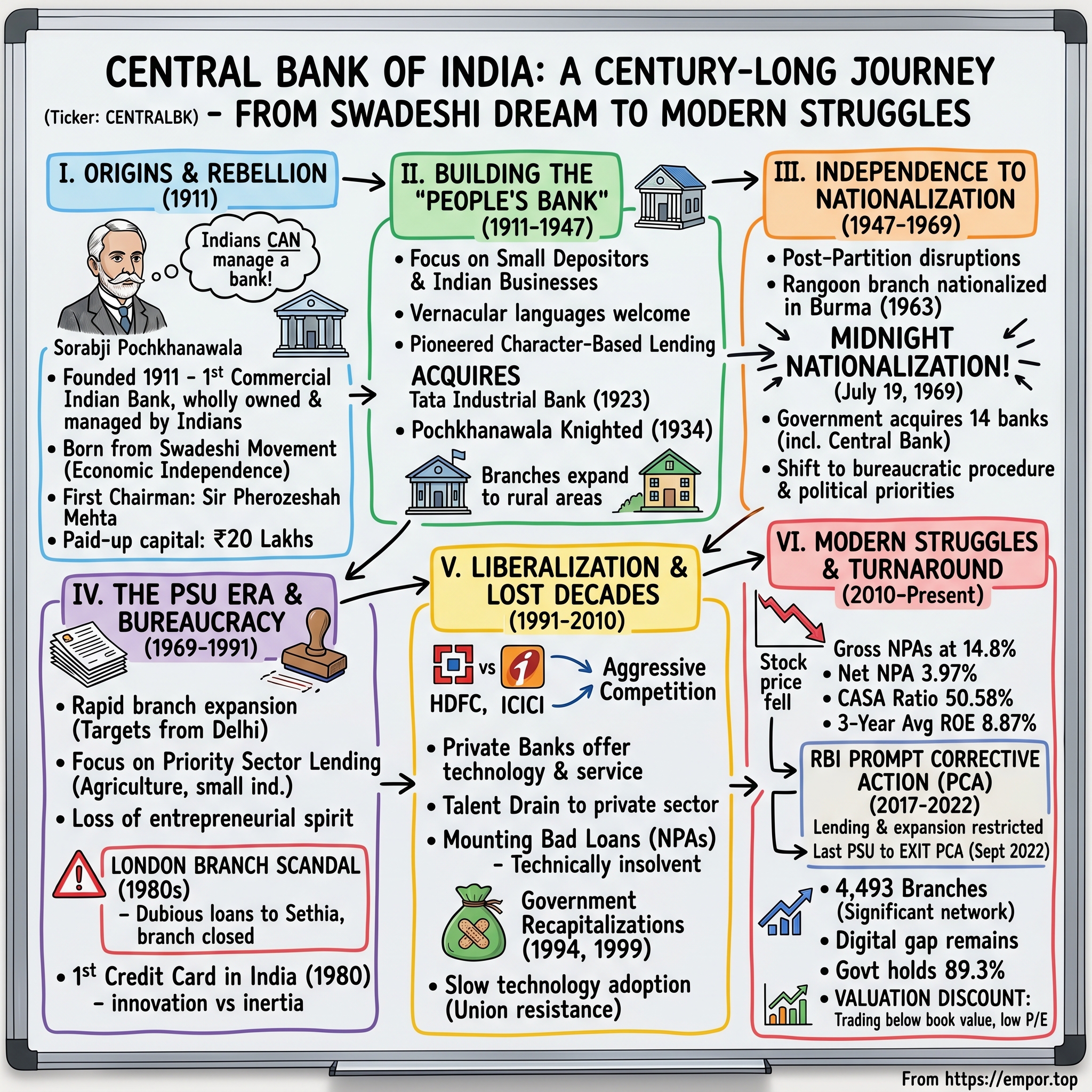
Central Bank of India: The Hundred-Year Wait
I. Introduction & Episode Preview
On a trading screen in early September 2026, Central Bank of India shows up as an oddity. The stock changes hands at roughly ₹30.40. The company is worth about ₹27,489 crore. Its reported book value per share is ₹45.20 — meaning the market is paying sixty-seven paise for every rupee of stated net worth. The trailing price-to-earnings multiple is about six. The dividend yield is just under 4%.1
Those numbers describe one of two things. Either a large, 115-year-old lender with nearly ₹4.8 lakh crore of deposits is being systematically mispriced by a market that has stopped paying attention — or the market has looked hard at this particular bank and concluded, for reasons it can articulate, that the book value is not worth a rupee.4
The honest answer, as this story will argue, is that the second explanation has the better historical record. Not because the bank is in trouble — it is emphatically not in trouble today. But because for most of the last three decades, Central Bank of India's stated book value has been a moving target: written down by bad loans, propped up by government capital, and diluted by share issuance that arrived at moments not of the bank's choosing. A bank that trades at a discount to book is only cheap if book is real and if the share count is stable. At Central Bank, historically, neither has reliably held.
Here is the founding irony that gives this story its shape. Central Bank of India was registered on December 21, 1911, as the first Indian commercial bank wholly owned and managed by Indians — the direct answer to a colonial-era insult that no Indian was competent to run a bank.2 It was, in the most literal sense, an argument about whether ownership and management quality determine whether an institution serves its depositors well.
One hundred and fifteen years later, the Government of India owns 81.19% of it.1 The bank spent five years in the Reserve Bank of India's regulatory intensive-care unit. It is currently in breach of the securities regulator's minimum public shareholding rule. NITI Aayog recommended it for outright privatisation in 2021, and nothing happened.3 The founding thesis — that who owns a bank and how they are incentivised shapes what it becomes — has been tested continuously by this institution's own history, and the results are uncomfortable for almost everyone involved.
So what is the current state of play? Better than it has been in twenty years, and that is not a small thing. In the quarter ended June 2026 — Q1 of fiscal 2027 — the bank reported net profit of ₹1,324 crore, up 13.3%; net interest income of ₹3,914 crore, up 15.7%; gross advances up an eye-catching 28.6% to ₹3,54,348 crore; and gross non-performing assets down to 2.60% from 3.13% a year earlier, with provision coverage at 95.86%.4 For a bank whose bad loans once exceeded a fifth of its book, that is a genuine transformation, verified by the regulator rather than asserted by management.
But three things sit awkwardly next to that picture, and this story will spend most of its time on them.
The first is the composition of the growth. Corporate credit grew 46.5% year on year.4 That is the fastest corporate loan growth this bank has produced since roughly 2013 — and the 2013-15 vintage of Central Bank corporate lending is precisely what nearly killed it. Fast growth in the same book that previously blew up is not automatically a red flag, but it is the single thing an investor in this name should be watching, because the failure mode is documented and specific.
The second is the funding of the growth. Over the eighteen months to mid-2026, the bank raised ₹1,500 crore in a qualified institutional placement at a discount, and the government sold down an 8.08% stake through an offer for sale.1216 Management has board approval for up to ₹7,000 crore more.29 Balance sheets that grow through issuance rather than retained earnings can produce impressive headline numbers while per-share value creation lags badly.
The third is the ownership endpoint, which nobody can price. Two contradictory stories have circulated about this bank for five years — that it will be privatised, and that it will be merged into a larger public sector entity. Both have been officially denied. Neither has been executed. Both remain live.2533
The route from here runs through the Swadeshi rebellion of 1911, through the midnight nationalisation of 1969, through the near-death experience of 2017-22 under RBI's Prompt Corrective Action framework, and out into a present where a bank with a comfortable capital ratio and its best asset quality in a generation is still being asked, quarter after quarter, to prove that the good news will survive a bad year.
 Subscribe on LinkedIn
II. Origins: The Swadeshi Bank (1911-1969)
The story that Central Bank of India tells about itself begins with a slight. Sorabji Pochkhanawala, a Parsi bank clerk in Bombay in the first decade of the twentieth century, was — as the institutional legend has it — told that no Indian was competent to manage a bank. He had spent years inside the British-run banking establishment of the Presidency towns, watching Indian capital flow through institutions Indians did not control, into ventures Indians did not choose.
He answered with paperwork. The memorandum and articles of association were drawn up, and the bank was registered on December 21, 1911 — the first Indian commercial bank wholly owned and managed by Indians.2 The paid-up capital was ₹20 lakh, which sounds quaint until you convert it into what it represented: a genuine pooling of Indian merchant capital in an economy where the commanding heights of finance were held by exchange banks headquartered in London.
Two details of the founding matter more than the capital figure. The first is the chairman. Pochkhanawala did not put himself in the chair. He recruited Sir Pherozeshah Mehta — the towering Bombay lawyer and Congress moderate, a man whose name carried more political weight in western India than any banker's could.2 It was a signal, and an early lesson in how Indian institutions get built: the balance sheet was the easy part; the legitimacy had to be borrowed from elsewhere.
The second is the board's composition — Hindu, Muslim and Parsi, deliberately. In 1911 Bombay, commercial trust ran along community lines. A bank that wanted deposits from everyone had to look like everyone. It was a marketing decision and a political one, and it produced the phrase that followed the institution for the next century: "the people's bank."
That phrase did real work. The bank funded its own expansion through the 1910s and 1920s. In 1923, it absorbed the Tata Industrial Bank — a Tata-promoted venture that had struggled to find its footing in the post-war slump — folding one of the great Indian business houses' banking ambitions into Pochkhanawala's. By 1936, the bank had an exchange arm in London, an unusual reach for an Indian-owned institution of the period. It survived the Depression, which killed dozens of Indian joint-stock banks, and it survived the war.31
Here is where a business historian has to be careful, because the temptation is to treat this as heritage and move on. It is not just heritage. The founding proposition was a specific, falsifiable claim about banking: that ownership and management quality — not scale, not access to the colonial state, not the size of the branch network — determine whether a bank serves its depositors well. Pochkhanawala's argument was that Indian owners with Indian incentives would run a better bank for Indian savers than a London-directed exchange bank would.
That claim has been re-tested, continuously and expensively, by every subsequent ownership change at this institution. It is the through-line of the entire story. And the uncomfortable finding, 115 years in, is that the claim is right — but not in the direction Pochkhanawala intended. Ownership does determine outcomes. It just turned out that "Indian-owned" and "well-governed" were not the same variable.
The entrepreneurial era ended abruptly. On July 19, 1969, Prime Minister Indira Gandhi's government promulgated an ordinance nationalising fourteen major Indian commercial banks, together controlling roughly 85% of the country's bank deposits. Central Bank of India, with the largest deposit base among the private Indian banks of the period, was among them. The ordinance was signed and announced within days; the boards found out roughly when the public did.
For an institution founded on the premise that private Indian ownership was the point, this was not a change in shareholder register. It was the removal of the thesis. The bank kept the name, kept the branches, kept the "people's bank" branding — and lost the mechanism that the branding had been describing. Sixty-plus years of state ownership followed, essentially unbroken to this day.
What the state gave in return was something real: an implicit sovereign guarantee on deposits that has never been tested and never had to be. What it took away was the accountability structure — the owner who loses money when the bank lends badly. The rest of this story is, in large part, about the consequences of that trade.
The immediate post-nationalisation era did not feel like a loss. It felt like a mission.
III. The PSU Bank Decades: Scale Without Discipline (1969-2015)
Imagine being a branch manager at Central Bank of India in 1972. Your instructions from Delhi are not about return on assets. They are about geography. Open branches where there are no banks. Lend to farmers who have never held a passbook. Hit the priority-sector targets. The metric that matters is coverage, and coverage is a thing you can count.
The system delivered on exactly what it measured. In the five years following nationalisation, the branch network of the nationalised banks expanded by around 129%, and the rural share of branches rose from roughly 18% to 36%. Central Bank, with its national footprint and its pre-existing "people's bank" identity, was one of the enthusiastic executors. This was, by the standards of the objective set, a genuine achievement. Financial access in rural India in 1969 was close to nonexistent; by the early 1980s it was a normal feature of district life.
And the bank did innovate — this is the part that gets forgotten. In 1980, Central Bank of India became the first Indian bank to issue a credit card, launching "Centralcard" and putting Visa plastic into Indian wallets years before the private-sector entrants existed.2 It maintained a UK branch network. It was, on paper, a technically forward institution.
Here is the analytical point, and it is the one that recurs in Section IX of this story when we get to GIFT City and robotics: none of it compounded. A first-mover credit card in 1980 should have seeded a payments franchise, a data advantage, a fee-income business, a relationship with India's emerging urban middle class. It seeded none of those. By the time Indian card issuance became a real profit pool in the 2000s, the business belonged to HDFC Bank, ICICI Bank, SBI Cards and Citibank. Central Bank's technical first converted into approximately zero durable franchise advantage.
Why? Because the thing that was never built alongside the branch network was underwriting and cost discipline. In a bank, distribution without credit selection is a machine for accumulating losses slowly. You can open ten thousand branches and gather cheap deposits, and if you lend that money to borrowers who do not repay it, the branches make the problem larger, not smaller. Scale amplifies whatever process you have. Central Bank scaled a process that was designed to hit coverage targets.
Then came 1991, and the real inflection that this bank missed.
Liberalisation opened Indian banking to private entrants, and by the mid-1990s HDFC Bank and ICICI Bank were building something structurally different: retail liability franchises built on service and technology rather than on physical proximity, paired with underwriting that priced risk. They were not competing with Central Bank on branch count — they never could. They were competing on the cost of acquiring a rupee of deposit and the loss rate on a rupee of loan, and on both they were better.
Market share erosion began here, and it never reversed. That sentence deserves to sit alone, because it is the most important structural fact about this institution in the modern era. Across three decades, through multiple management teams, multiple government administrations, and multiple recapitalisations, the public sector share of Indian banking assets has declined continuously and the share held by the top private banks has risen continuously. Central Bank of India has been on the losing side of that trend for its entire post-liberalisation existence. Every subsequent turnaround claim has to be assessed against that backdrop: not "can this bank grow," but "can this bank grow profitably in a market where it has been structurally losing ground for thirty years."
By the mid-2000s, Indian PSU banks had found a new growth engine, and it was corporate infrastructure lending. Power projects, roads, steel, telecom — big-ticket loans, syndicated across multiple banks, with long tenors and asset-backed comfort that looked robust in a 9%-GDP-growth economy. Central Bank participated. It participated with the same underwriting apparatus that had been built to open rural branches.
That is the setup. What happened next is the reason this bank trades at 0.67 times book today.
IV. The Near-Death Experience: NPA Crisis and PCA (2015-2022)
There is a specific kind of silence that settles over a bank when the regulator stops asking questions and starts issuing instructions. Central Bank of India entered that silence in June 2017.
The Reserve Bank of India placed the bank under its Prompt Corrective Action framework, citing high net non-performing assets and negative return on assets.5 PCA is not a warning letter. It is a set of binding restrictions on what the bank may do: constraints on fresh lending, particularly to riskier segments; a bar on dividend payments; restrictions on branch expansion and hiring; and heightened supervisory oversight of essentially every material decision. In the most direct terms, the RBI took the bank's growth levers away and told it to fix its balance sheet.
The numbers behind that decision are worth stating plainly, once, and not repeating. At the start of the decade, gross NPAs sat under 5% of advances. By the quarter ended June 2018 — a year into PCA — they had reached 22.17% of advances, among the highest of any Indian bank. That same quarter, Central Bank reported a net loss of ₹1,522 crore, roughly double the prior year's loss, driven by a doubling of provisions against bad loans.8
Twenty-two percent. Take a moment with that. It means that of every hundred rupees the bank had lent, twenty-two were not being repaid on schedule. A bank's equity is typically a single-digit percentage of its assets. When a fifth of the loan book goes bad, the arithmetic does not merely dent profits — it eats through capital and keeps going. The reason Central Bank of India still exists as an independent entity in 2026 is not that it worked its way out of this. It is that someone else paid.
That "someone else" was the Government of India. Between 2017 and 2020, the government infused roughly ₹2.5 lakh crore of capital into public sector banks, much of it through recapitalisation bonds — an instrument where the government issues bonds to the bank, the bank subscribes with the proceeds of new shares issued to the government, and capital adequacy is restored without an immediate cash outlay. Central Bank received multiple tranches. Alongside that came repeated equity issuances that steadily expanded the share count.
This is the part of the story that matters most for how an investor should read everything that follows, and it deserves to be stated without softening. Central Bank of India's survival through the crisis years was funded almost entirely by external capital. Not by earnings. Not by a franchise throwing off cash that could be retained and redeployed. By the majority shareholder writing cheques, and by dilution of everyone else. That is the precise opposite of a self-funding institution, and it establishes the base rate against which every subsequent capital raise at this bank should be evaluated.
The PCA years themselves were an exercise in shrinking. The bank cut costs, ran off risky exposures, and by 2022 was preparing to close roughly 13% of its branches — around 600 outlets — as part of a rationalisation drive, an unusual step for an institution whose entire identity had been branch coverage.23 For a bank whose one genuine structural asset was its rural distribution, closing a seventh of it was the clearest possible signal of how tight the constraints had become.
The exit came on September 20, 2022, when the RBI announced that Central Bank of India was out of the PCA framework, having provided a written commitment on compliance with minimum capital norms.6 The stock jumped as much as 15% the following session.7 Five years and three months inside the framework — one of the longest stints of any Indian bank.
Now, the discipline this story insists on: what were the exit conditions actually worth?
Modest. Gross NPAs at the point of exit had come down to around 14.9% of advances — an enormous improvement from 22%, and still a number that would be considered a solvency emergency at any private bank in India. Profitability had returned but was thin; the bank posted ₹310 crore of profit after tax in the March 2022 quarter.27 Those are the numbers of an institution that has cleared a floor, not one that has proven a franchise.
The distinction is not semantic. PCA exit is a regulatory judgment that a bank is no longer at risk of failing. It is not a judgment that the bank earns its cost of capital, or that its underwriting has been rebuilt, or that its cost structure is competitive. Between "will not fail" and "creates value for shareholders" lies an enormous amount of unproven ground, and the market's continued discount to book value in the years afterwards was a rational reflection of that gap rather than an oversight.
The forward test that comes out of this section — and it is the test that Sections VI and XI return to — is specific. Central Bank's asset quality today is genuinely excellent by its own historical standards. But every one of the years in which it has been excellent has been a benign credit year for Indian banking. Corporate India deleveraged through the late 2010s and early 2020s; the system-wide NPA cycle turned decisively favourable; recoveries through the insolvency framework added back income. A bank does not prove its underwriting in a good credit environment. It proves it in a bad one.
So the claim "Central Bank has structurally fixed its credit process" is, as of September 2026, unproven rather than refuted. The affirmative evidence — a 22% gross NPA ratio brought to 2.60% over eight years, with provision coverage near 96% — is real and regulator-verified.4 The disconfirming context is that the same institution produced a 22% NPA ratio the last time it grew its corporate book quickly, and it has not yet been tested by a downturn under its current process. Held at that confidence level, the appropriate reading is: the improvement is genuine; the durability is unestablished; and the thing that will settle it is slippage behaviour in the FY26-FY27 corporate lending vintage, three to five years from now.
Which brings us to what that vintage is actually being built out of.
V. The Business Today: Segments, Economics, Who Competes for What
Walk into a Central Bank of India branch in a district town in Bihar or Madhya Pradesh and the business model is immediately legible. There is a queue. There are passbooks. There are government scheme forms on the counter. There is, quite likely, a customer who has banked here for thirty years because their parents did and because the name has the word "Central" in it, which in rural India still reads as "the government's bank."
That is the franchise. Everything else is commentary.
Formally, the bank reports across four segments: Treasury Operations, Corporate/Wholesale Banking, Retail Banking, and Other Banking Business.20 But the economically meaningful split is between what the industry calls RAM — Retail, Agriculture and MSME — and everything else. As of the June 2026 quarter, RAM stood at ₹2,41,105 crore against gross advances of ₹3,54,348 crore, or roughly 68% of the loan book, having grown 21.4% year on year.4 Within that, retail grew fastest at around 24%, agriculture around 21%, and MSME around 18%.10
The physical network behind it: 4,606 branches and 22,346 total customer touch points as of the June 2026 quarter, with roughly two-thirds of branches in rural and semi-urban India.420 This is not a metro corporate bank that happens to have rural branches. It is a rural and semi-urban deposit-gathering machine that also does corporate lending.
The industry it sits in. Indian banking sorts into three tiers, and understanding which one you are in explains almost everything about a bank's economics. At the top are State Bank of India, HDFC Bank and ICICI Bank — institutions of genuine global scale with the technology budgets, brand strength and corporate relationships that scale buys. In the middle are the mid-sized private banks, winning share steadily on digital cost-to-serve: they acquire and service customers at a fraction of the cost per relationship that a branch-heavy incumbent requires. And then there is the tail — Central Bank of India, UCO Bank, Bank of Maharashtra, Punjab & Sind Bank, Indian Overseas Bank — mid-sized public sector lenders whose primary competitive asset is government-mandated distribution.
That last phrase is doing a lot of work, so let us be precise about it. These banks do not primarily win business by having a better product or a better price. They win it because priority-sector lending targets, financial inclusion schemes, direct benefit transfers and government business channel volume through them. It is real business. It is also business that is allocated rather than competed for, which means it does not build the kind of advantage that survives a change in allocation policy.
Running Porter's five forces over this is not flattering.
Rivalry and differentiation: deposit and loan products at PSU banks are effectively commoditised. A savings account at Central Bank and a savings account at UCO Bank differ in almost no dimension a customer can perceive. Where products are identical, competition collapses to price and distribution, and neither is a durable edge.
Buyer power on the corporate side is high. Large Indian corporates multi-bank as a matter of routine — a borrower of any size runs relationships with six or eight lenders simultaneously, playing them against each other on pricing and covenants. A mid-sized PSU bank participating in a syndicate has essentially no pricing power and often no ability to shape terms. It takes the paper it is offered.
Switching costs for retail depositors are collapsing. This is the single most underappreciated structural threat here, and it deserves a plain-language explanation. For decades, the value of a branch was that money had to physically move through it. Your branch was where your money lived. UPI — India's real-time payments rail — severed that link. A customer can now move money instantly, free, between any two banks from a phone. Digital-first banks can open an account in minutes without a customer ever entering a building. The moat around a rural branch network is not gone, because cash handling, government scheme disbursement, and trust among older customers still require physical presence. But the moat is being drained, slowly, and the drainage is one-directional.
Cost position: a bank running 4,606 branches with the staffing model of a public sector institution has a structurally higher cost-to-serve than a digital-native competitor, and a structurally lower technology spend per customer than the top-tier private banks. That shows up directly in the cost-to-income ratio, which we come to shortly.
Where the bank plausibly does win. Two things, and they are related. The first is its CASA ratio — current account and savings account deposits as a share of total deposits — at 46.61% in the June 2026 quarter.4 CASA is the cheapest money a bank can get: current accounts pay no interest, savings accounts pay very little. A bank funding itself with 47% CASA has a materially lower cost of funds than one funding itself with bulk term deposits, and in a business where the product is money, cost of input is one of the few genuine advantages available. Savings deposits grew 11.66% year on year, so the base is not stagnant.10
The second is trust, of a specific and narrow kind. Government ownership means depositors believe their money is safe regardless of what the bank's financials say. Among older, rural, first-generation banking customers, that belief is worth real basis points on deposit pricing. It is a genuine moat component. It is also, notably, a moat that belongs to the sovereign, not to the institution — which means it would evaporate the day the bank was privatised, an irony that Section VIII will develop.
Where it structurally loses. In corporate and wholesale banking it has no scale advantage against SBI, Punjab National Bank or Bank of Baroda, all of which can hold larger single-borrower exposures, offer fuller product suites, and price more aggressively. In efficiency, the cost-to-income ratio stood at 55.40% in the June 2026 quarter, with management's own FY27 target set at below 56%.4 Read that carefully: the bank is guiding to a level it has already essentially achieved, and 56% is not an efficient number for a bank in India. Setting a target at roughly where you already are is not an ambitious plan; it is a concession that structural cost reduction is hard.
On returns, the picture has genuinely improved and it would be wrong to pretend otherwise. For most of the past decade, Central Bank's return on assets sat in a fraction-of-a-percent band while peers such as Bank of Maharashtra and IDBI Bank cleared 1% — the bottom of the public sector peer set on the metric that matters most for a bank. In the June 2026 quarter, Central Bank reported ROA of 1.00% and return on equity of 14.92%, up from 14.17%.4 That is one quarter, on an annualised basis, and the full-year ROE for the prior fiscal year was around 12% against a multi-year average nearer 11%.1 The direction is right. The gap has narrowed. But a single quarter at the peer benchmark is a data point, not a track record, and the honest framing is that Central Bank has arrived at the bottom edge of respectable rather than establishing itself there.
Capital, at least, is not the constraint it once was. Capital adequacy stood at 18.28% with CET-1 at 16.54% as of June 2026, up from 17.66% a year earlier — comfortably above regulatory minimums.4 This is worth flagging because it changes how one should read the bank's stated ₹7,000 crore fundraising plan: this is not a solvency raise. Which raises the question of what, exactly, it is for.
That question runs straight into the most recent four quarters of results, where the growth story and the earnings story stopped agreeing with each other.
VI. FY26-27: The Fastest Growth in a Decade, and a Profit Quarter That Didn't Fit the Story
On July 17, 2026, at 4:30 in the afternoon India time, Kalyan Kumar dialled into a conference call hosted by Antique Stock Broking, flanked by three executive directors and the chief financial officer, to present a set of numbers that a Central Bank of India chief executive had not been able to present in fifteen years.9
Total global business up 18.29% to ₹8,33,320 crore. Deposits up 11.68% to ₹4,78,972 crore. Net interest margin above 3%, at 3.06%. Net non-performing assets at 0.49%. Credit-deposit ratio at 74.10%.410 Alongside the headline profit and advances figures already noted, this was, on almost every disclosed line, the strongest quarter the bank has produced in the post-crisis era.
And the composition is where the interesting conversation starts. Advances grew 28.6%; deposits grew 11.7%. That gap — seventeen percentage points — is the whole story of the quarter, and it tells you the bank deployed liquidity it was already carrying rather than funding growth with new deposits. The liquidity coverage ratio confirms it: LCR fell from above 210% to 156% over the year, which management characterised on the call as a deliberate move to optimise holdings of high-quality liquid assets while staying comfortably above the regulatory floor.10
That explanation is credible and the underlying logic is sound — an LCR above 200% is genuinely inefficient, representing money parked in low-yielding government securities that could be lent. But it also bounds the growth story in a way management did not emphasise: excess liquidity is a one-time fuel source. It can be converted to loans exactly once. A 28.6% advance growth rate produced partly by spending down a liquidity buffer is not a rate that repeats, and management's own FY27 guidance concedes as much.
The guidance, which is the falsifiable part. For the full fiscal year, management has guided to business growth of 14-15%, deposit growth of 11-12%, advances growth of 14-16%, net interest margin above 3%, gross NPA below 2.50%, return on assets above 1%, and cost-to-income below 56%.410 These are concrete and checkable, and they are the right things to hold the bank to over the next four quarters.
Note the internal tension in that guidance. Advances grew 28.6% in Q1; full-year guidance is 14-16%. That implies management expects growth to roughly halve over the remaining three quarters. Either the first quarter was a one-off catch-up, or the guidance is deliberately conservative. Both are defensible; investors should watch which one turns out to be true, because a bank that keeps growing advances at high-twenties percentages while guiding to mid-teens is a bank whose loan growth is not being governed by a plan.
The corporate book. Corporate credit expanded 46.52%, and on the call management attributed it to renewable energy and data centres.10 Those are, to be fair, the two most-funded sectors in India right now and the two where credit demand is genuinely structural rather than speculative. They are also both long-tenor, project-finance-shaped exposures with construction risk, offtake risk and — in the case of data centres — technology obsolescence risk that Indian bank credit committees have limited history underwriting.
The relevant historical falsification test is not whether renewables and data centres are good sectors. It is whether this specific institution's credit process has changed since it last grew corporate credit at this pace. On that, the evidence is thin in both directions. There is no public disclosure detailing a rebuilt underwriting framework, revised delegation of authority, or independent credit review function at Central Bank — nor is there disclosed evidence of failure. What can be said with confidence: the bank's provision coverage ratio of 95.86% means that if the current book does sour, the profit-and-loss impact would arrive from fresh slippage rather than from under-provisioned legacy exposures.4 Two further disclosures from the call bear watching: roughly ₹32,900 crore sitting in technical write-off accounts, and approximately ₹5,000 crore of sanctioned-but-undisbursed corporate loans that will land on the books in coming quarters.10
Now the quarter that did not fit. Three months before that upbeat July call, on April 30, 2026, Central Bank reported March-quarter results that broke the pattern. Standalone net profit fell roughly 30% year on year to ₹724 crore, against ₹1,034 crore in the comparable quarter a year earlier.1126 The driver was a one-time deferred tax charge of ₹632 crore arising from changes under the Finance Act, compounded by a sharp fall in treasury income.11
Management's framing was that this was non-recurring and that the underlying business was fine — net interest income for the quarter rose 17.8% to ₹4,002 crore, and full-year FY26 net profit still grew 15.4% to ₹4,369 crore on operating profit of ₹8,479 crore.11 The board declared a fourth interim dividend of ₹0.60 per share, taking the FY26 total to ₹1.20, and approved a capital-raising plan of up to ₹7,000 crore for FY27.29
Does the "one-off, ignore it" explanation hold?
Partly, and the honest assessment requires weighing it against the base rate rather than accepting or rejecting it wholesale. Deferred tax remeasurement driven by Finance Act changes is a genuine accounting event, not a judgment call — when statutory tax provisions change, banks carrying deferred tax assets built up from crisis-era losses must remeasure them, and the charge hits the profit and loss account in the quarter of enactment. Central Bank, having accumulated enormous losses during the PCA years, would carry an unusually large deferred tax asset and would therefore take an unusually large hit. The charge also landed at multiple public sector banks in the same quarter, which corroborates the mechanism rather than the excuse.
But two things temper the "ignore it" instruction. First, the deferred tax asset itself is a legacy of the losses, which means the charge is not really unrelated to the bank's history — it is a delayed accounting settlement of it. Second, and more substantively, the treasury income decline was not a one-off accounting artefact. Treasury income fell to ₹276 crore in the June 2026 quarter on adverse market conditions, so the weakness persisted past the quarter management described as exceptional.10 Treasury gains have been a meaningful earnings contributor for Indian PSU banks during the falling-rate years; when that reverses, the quality of core earnings gets exposed. Operating profit grew 4.4% for FY26 — a modest number sitting underneath a 15.4% headline profit increase, which is itself a signal about where the reported growth came from.
The calibrated conclusion: management's explanation of the Q4 FY26 miss is substantially correct on the tax item and incomplete on the treasury item. It is not a governance red flag. It is a reminder that this bank's reported earnings still contain moving parts — tax normalisation, treasury, and provision write-backs — that are not the same thing as a franchise compounding. Core operating profit growth, not headline net profit, is the number that reveals whether the business is improving.
One quiet number. The CASA ratio eased 27 basis points year on year to 46.61% even as deposits grew.4 It is a small move and it should not be over-read. But it points at the central operational tension in this bank's current strategy: growing the balance sheet fast requires funding, funding at speed usually means term deposits, and term deposits are expensive. The one genuine funding advantage Central Bank has is its low-cost deposit base. If the growth sprint erodes it, the bank will have traded its durable edge for a temporary growth rate. Whether the CASA ratio holds near 46-47% through FY27 while advances grow mid-teens is one of the two or three things that will most reveal what kind of institution this is becoming.
All of which raises the question of who is making these trade-offs, and what they are paid to optimise.
VII. Current Management: Incentives, Capital Allocation, Credibility
Kalyan Kumar took the chair as Managing Director and Chief Executive Officer of Central Bank of India on September 30, 2025.18 He arrived with more than twenty-six years at Union Bank of India behind him, most recently as an Executive Director — a career built inside the public sector banking system rather than laterally from the private sector or from outside banking altogether.
As of this writing, he has been in the seat for eleven months. That is not enough time to have a performance record. It is barely enough time to have implemented a strategy, let alone to have been judged on one. Any assessment of his leadership at this stage has to rest on process and disclosure discipline rather than on outcomes, and on that narrow basis the early evidence is reasonable: the Q1 FY27 call included specific, numerical, falsifiable full-year guidance across six metrics, which is more than some public sector banks offer, and management addressed the LCR decline and cost-to-income weakness directly rather than routing around them.10
But there is a structural point here that matters far more than any individual's competence, and it needs to be stated explicitly because it is routinely glossed over when Indian PSU banks are discussed in "turnaround" terms.
Public sector bank chief executives in India are appointed by the government for fixed tenures. They are compensated on government scales — a fraction of what a private-sector bank CEO earns. They hold no meaningful equity in the institution they run, and there is no employee stock option programme of consequence. When Kalyan Kumar's tenure ends, his personal wealth will be essentially unaffected by whether Central Bank of India's share price doubled or halved.
Think about what that does to the incentive structure. A private-bank CEO with a large equity stake has skin in the game aligned — imperfectly, but directionally — with minority shareholders. A PSU bank MD's incentives run toward: not having a crisis on their watch, hitting the government's policy targets, maintaining good standing with the Department of Financial Services, and being considered for the next appointment. Those are not bad incentives. They are simply not shareholder-value incentives, and they are especially not per-share value incentives.
This is a feature of the model, not a criticism of the individual. But it should temper any framing of the current turnaround in founder-like or owner-operator terms. Nobody at the top of this bank is thinking like an owner, because nobody at the top of this bank is one.
Which brings us to the capital allocation record — the place where the absence of per-share thinking shows up most clearly.
In March 2025, the bank launched a qualified institutional placement, raising ₹1,500 crore.12 The shares were allotted at ₹40.49 apiece, roughly a 5% discount to the floor price. In the three sessions that followed, the stock fell about 17%.13 That is a large, fast move, and it is what a market does when it concludes that new shares have been created at a price that transfers value from existing holders to new ones.
Then, in May 2026, the government executed an offer for sale of an 8.08% stake, raising approximately ₹2,250 crore. The floor price was set at roughly an 8.6% discount to the prevailing market price. The offer was fully subscribed, and Qatar Holding sold a further 0.4% stake alongside.1416
Set those two events side by side and a pattern emerges that connects directly to the PCA years. Central Bank of India's balance sheet has grown, through the crisis and through the recovery, on capital raised from outside rather than capital generated inside. The purpose changed — solvency in 2017-20, regulatory compliance and growth funding in 2025-26 — but the mechanism did not. Shares get issued or sold at a discount; the share count or the float expands; and the book value per share that the market is being asked to value gets recalculated on a larger base.
The promoter holding trajectory tells the story numerically: from 93.08% in March 2024 to 81.19% by June 2026, with domestic institutional holdings rising from around 2.8% to 10.95% over the same period.1 That is a substantial reconstitution of the shareholder register in a little over two years.
The board's approval of up to ₹7,000 crore of further fundraising for FY27 should be read against this history.29 Recall from Section V that capital adequacy is comfortable — CET-1 at 16.54% is not a bank scraping regulatory minimums. So this is not a solvency raise. It is growth funding and MPS-compliance mechanics. That is a materially better reason than 2017's reason. But it is still not retained earnings, and the honest test is forward-looking rather than retrospective: every future capital raise at this bank is a data point on whether the growth has become self-funding yet. If FY27's advance growth of 14-16% requires ₹7,000 crore of external capital on top of ₹4,000-odd crore of annual earnings, the answer is not yet.
On the governance side, there is a fact that most equity analysis of Indian PSU banks simply steps around. With the government holding 81.19%, there is no meaningful minority-shareholder check on this institution. AGM resolutions pass. Proxy advisory recommendations are, in practical terms, decorative. An activist investor could accumulate a position and publish a devastating critique and it would change nothing about a single vote.
That does not mean the bank is ungoverned. It means governance operates through a different channel entirely: the Reserve Bank of India as prudential regulator, the Department of Financial Services as owner-representative, and SEBI as the enforcer of listing obligations. Central Bank of India is disciplined by regulators and by politics, not by shareholders. For an investor, the practical consequence is that the usual toolkit for influencing a company — engagement, voting, activism, board representation — is unavailable. You are a passenger, and your returns depend on decisions made in Delhi and Mumbai for reasons that may have nothing to do with your capital.
And the largest of those decisions has been pending, unresolved, for five years.
VIII. The Minimum Public Shareholding Squeeze and the Privatization Question That Never Resolves
There is a deadline in this story, and it has already passed.
SEBI requires listed companies to maintain at least 25% public shareholding. The government, unable to comply across a swathe of state-owned enterprises, granted itself an extension: in July 2024, central public sector enterprises, public sector banks and financial institutions were given until August 1, 2026 to reach the 25% threshold.15
That date came and went five weeks ago. Central Bank of India's public shareholding stands at 18.81%.16 The bank is not in compliance, and the gap is not marginal — roughly six percentage points of equity, worth something in the order of ₹1,700 crore at current prices, still needs to move from government hands to public hands.
The trajectory has been real but slow. Government ownership went from around 93% in early 2024, to roughly 89% after the QIP, to 81.19% after the offer for sale.1 In January 2026, management publicly stated the intention to meet the requirement well before the August deadline through some combination of QIP, follow-on public offer or OFS.28 That did not happen.
What is happening instead: reporting in mid-2026 indicated that a further government stake sale — either an OFS or a QIP — may come in the second half of FY27, between October 2026 and March 2027, with the final decision pending with DIPAM, the government's disinvestment department. A September-quarter transaction was described as unlikely.17 So the resolution has slipped by at least two quarters past a deadline that had itself already been extended.
Context worth having: the government raised roughly ₹52,716 crore from minority stake sales in FY27 to date, against ₹16,886 crore in all of FY26.17 The disinvestment machine is running hot. Central Bank simply has not been at the front of the queue.
Now the bigger question, and the one where discipline matters most.
In June 2021, NITI Aayog — the government's own policy think tank — recommended Central Bank of India and Indian Overseas Bank for outright privatisation, as part of the disinvestment programme announced in that year's budget.3 For a certain kind of investor, that recommendation has functioned ever since as the load-bearing beam of the bull case: buy a bank at 0.6 times book, wait for privatisation, watch the multiple re-rate toward private-sector levels as new owners bring new incentives.
Test that thesis against the record, over the full span that bears on it.
Five years have passed. Neither bank has been privatised. No enabling legislation has been passed — privatising a nationalised bank requires amending the Banking Companies (Acquisition and Transfer of Undertakings) Act, and no such amendment has been introduced. In February 2026, the Finance Minister told Parliament that she was not aware of any roadmap for public sector bank mergers and that none existed.25 In March 2026, the Minister of State for Finance stated that no proposal for merger or consolidation of public sector banks was under consideration.33
That is five years of zero execution on a recommendation from an advisory body, accompanied by explicit ministerial statements that nothing is in motion. It is exactly the kind of disconfirming evidence that should narrow a privatisation thesis rather than support it. The calibrated version: privatisation of Central Bank of India remains theoretically possible and has a non-zero probability in any given year, but the base rate of PSU bank privatisation recommendations converting into transactions in India over the past five years is zero, and no observable precondition — legislation, cabinet approval, transaction advisor appointment — has been satisfied. An investor holding this stock for the privatisation catalyst is holding it for an event with no visible pathway and no scheduled date.
And there is a second, contradictory story running in parallel.
Through 2026, reports circulated that the government was evaluating a merger of Central Bank of India with UCO Bank, Bank of Maharashtra and Punjab & Sind Bank into a single larger entity — one of several consolidation configurations under discussion, with an alternative model folding the smaller banks into larger ones such as Union Bank of India, Canara Bank or Indian Bank.33 These reports have been circulating in some form since at least 2024, when UCO Bank publicly denied merger discussions involving this exact set of banks.
The two narratives are mutually exclusive in their investment implications. Privatisation would mean a change of ownership, a likely control premium, and a re-rating toward private-bank multiples. Absorption into a larger PSU would mean a share-swap ratio determined administratively, no control premium, and a Central Bank shareholder waking up as a minority holder of a different, larger state-owned bank.
The honest framing is this: the market has now been asked to price two contradictory consolidation stories about the same institution, simultaneously, for five years, without either resolving. That is not optionality. Optionality has a payoff structure. This is ambiguity, and ambiguity in a controlled company shows up as a persistent valuation discount with no resolution date — which is a reasonable description of what 0.67 times book actually represents.
One partial counterweight arrived in the Union Budget for 2026-27, which proposed establishing a High-Level Committee on Banking for a developed India, with consolidation and sector structure among the topics within its scope.32 A committee is not a decision. But it is the first institutional mechanism in years through which a decision could plausibly emerge, and its output is worth watching.
What would actually settle this? A formal announcement from the Department of Financial Services or the Cabinet — legislation introduced, a transaction advisor appointed, a swap ratio published. Nothing less. Specifically, further OFS tranches should not be read as evidence of a privatisation push. They are compliance-driven dilution, mandated by a securities regulation, and they stop the moment public shareholding touches 25%. The signal that would genuinely change the picture is government ownership falling meaningfully below roughly 75% — that is, below what MPS compliance alone requires — because that would be the first sale motivated by something other than a rulebook.
Until then, this remains a bank whose ownership endpoint is unknown, whose deadline has already been missed once, and whose most-discussed strategic catalysts have a five-year track record of not happening.
IX. Digital Bets and Adjacent Optionality — Sized to What They're Worth Today
Every legacy bank in India currently has a slide deck with a section near the back labelled "digital," and Central Bank of India is no exception. The section deserves attention proportional to its economics, which at present is not much.
In 2026, the bank inaugurated an IFSC Banking Unit at GIFT City — India's international financial services centre in Gujarat, a special jurisdiction where banks can conduct foreign-currency business under a lighter, offshore-style regulatory regime.22 In plain terms, it lets an Indian bank lend and take deposits in dollars to and from clients, do trade finance and external commercial borrowings, without those transactions sitting inside the domestic rupee regulatory perimeter. For a bank with corporate clients who need foreign-currency funding, it is a genuine capability gap being filled.
It is also, today, immaterial to the financials. No separate revenue, fee income or net interest contribution from the GIFT City unit has been disclosed. The honest way to hold this is as strategic optionality with an unproven conversion rate: worth something if it produces disclosed fee or NII contribution within two to three years, worth nothing if it remains a press-release line item and an office. The test is specific and the disclosure would be visible, so investors can check rather than assume.
The bank has also promoted "MEDHA," a robotic banking assistant deployed in branches, alongside a broader set of digital initiatives. These are technical and public-relations milestones. They are not revenue, and they should be kept cleanly separated from balance-sheet economics.
Here is where the historical falsification test bites hardest, and it is the reason this section exists at all rather than being cut. Recall the 1980 credit card. Central Bank of India was first in India to a product category that later became one of the most profitable in Indian retail banking — and it captured essentially none of that profit pool. The institution has a documented, forty-five-year record of arriving early at technical firsts and converting them poorly into durable revenue or franchise advantage. That record does not prove the GIFT City unit will fail. It does establish the prior an investor should start from: at this specific bank, a capability launch is weak evidence of a future revenue stream, because the conversion rate has historically been low.
Applied honestly, the framing is simple. Neither GIFT City nor the digital programme is a hidden growth engine. Neither belongs in a thesis. Both belong on a watch list, with a defined check: does either appear as a disclosed, material line in the segment reporting by FY29? If not, they were what the record suggests they were.
The real investment question sits elsewhere, in the tension between a genuinely repaired balance sheet and a franchise that has not yet demonstrated it can compound.
X. Bull vs. Bear: The Investment Case
Two intelligent investors can look at Central Bank of India in September 2026 and reach opposite conclusions from the same disclosures. Both cases are stronger than they were three years ago. Here they are, with the evidence attached, and then an attempt to say which parts of each survive contact with the history.
The bull case.
Start with the fact that is not disputable: the asset quality transformation is real. Gross NPAs went from 22.17% at the 2018 peak to 2.60% in mid-2026, net NPAs to 0.49%, with provision coverage at 95.86%.48 This is not a management assertion — it is a regulator-supervised, audited, independently verifiable change in the composition of the balance sheet, achieved over eight years. Whatever else is uncertain about this bank, the bad loans that nearly killed it have been recognised, provided for and largely cleared out.
Second, the valuation prices in continued dysfunction. At 0.67 times book and roughly six times earnings, with a near-4% dividend yield, the market is not paying for a turnaround.1 It is paying for a bank it expects to keep destroying value. If the bank merely stops doing that — if it holds ROA around 1% and ROE in the low teens without a credit accident — the gap between price and book closes mechanically over time through retained earnings, without requiring any re-rating.
Third, the return profile has genuinely inflected. ROE has moved from a mid-single-digit multi-year average through the crisis era to around 12% for the last full fiscal year, with the most recent quarter annualising at 14.92%.14
Fourth, growth is running ahead of peers. Advance growth of 28.6% year on year is the fastest among comparable public sector lenders in this cycle, and the RAM book — retail, agriculture, MSME, generally higher-yielding and more granular than corporate lending — grew 21.4%.4
The bear case.
First, returns are still at the bottom of a weak peer group. Central Bank arrived at 1% ROA in a single quarter, at the end of the most favourable credit cycle Indian banking has seen in fifteen years, while better-run mid-sized public sector banks have sustained that level for several years. Arriving at the peer floor at the top of a cycle is not the same as clearing it through one.
Second — and this is the argument that most directly attacks the "cheap on book" thesis — growth has been funded by dilution rather than retained earnings. When a bank raises equity at 0.67 times book, it issues shares worth less than the assets they buy, and every existing shareholder's claim on those assets shrinks. Headline balance-sheet growth of 18% can coexist with materially slower book-value-per-share growth. The bank has done this twice in eighteen months and has board approval to do more.
Third, earnings quality is not yet clean. The March 2026 quarter demonstrated that reported profit still contains large, lumpy, non-operating items, and the persistence of weak treasury income into the following quarter shows the issue was not purely a single accounting event.
Fourth, the one durable funding advantage is drifting the wrong way. A 27-basis-point CASA decline is small. It is also directionally opposed to what the bank needs, and it happened during a growth sprint — precisely the condition under which it would be expected to happen.
Fifth, the ownership endpoint is unknowable, and both live narratives have five-year records of non-execution.
Sixth, "trust the new team" is an assumption. Eleven months of tenure is not a track record, and the incentive structure gives management no personal stake in the per-share outcome.
Hamilton Helmer's 7 Powers, run over this bank. The framework asks which of seven specific mechanisms — scale economies, network economies, counter-positioning, switching costs, branding, cornered resource, process power — actually produce durable excess returns. Applied here, the result is sparse.
Scale economies: Central Bank has scale in branches but not the kind that lowers unit costs, because a branch network scales cost with revenue rather than against it. A 55.4% cost-to-income ratio is the evidence. No power.
Network economies: banking deposits do not exhibit network effects; a savings account is not more valuable because others hold one. In payments there could have been a network — UPI nationalised it. No power.
Counter-positioning: this is the mechanism by which a newcomer adopts a model the incumbent cannot copy without damaging itself. Central Bank is the incumbent being counter-positioned against, by digital-first lenders. Negative power.
Switching costs: modest and eroding. Real for older rural customers with government scheme linkages and pension credits; increasingly weak for everyone else.
Branding: partially present, and this is the strongest of the seven for this bank — but the brand asset is sovereign backing, which is rented from the government rather than owned by the institution. A brand you would lose upon a change of control is not a company asset.
Cornered resource: the closest candidate is the rural branch licence footprint and the priority-sector distribution role. It is allocated by policy and could be reallocated by policy.
Process power: this would be the ability to execute underwriting or operations better than rivals in ways that are hard to imitate. This is exactly what the 2015-18 experience says the bank did not have, and nothing publicly disclosed establishes that it has been built.
That is the structural answer to why the market discount persists. On the two frameworks combined — competitive forces from Section V and powers here — Central Bank of India has approximately one genuine advantage: cheap deposits, backed by sovereign trust, in geographies where physical presence still matters. That is a real thing. It is not a wide moat, and it is being slowly eroded by the payments infrastructure the Indian state itself built.
The activist stress test. If a skeptical long/short investor were writing this up, the attack lines would be specific: a cost-to-income target set at essentially the current level, which concedes no structural efficiency plan; a ₹7,000 crore capital-raise authorisation at a bank whose CET-1 is already above 16%, which invites the question of whether the raise serves shareholders or serves a compliance deadline; corporate credit growing at 46% at an institution whose corporate credit process caused a 22% NPA ratio the last time it ran hot; ₹32,900 crore of technical write-offs where recovery outcomes are hard for outsiders to verify; and a valuation history in which these stocks have repeatedly run ahead of fundamentals on consolidation speculation and then given it back — a pattern already flagged by observers as far back as the 2022 PSU bank rally.24 Most of these are answerable. None of them are frivolous.
The net position. The history does not reject the turnaround claim; it narrows it. What survives is a defensible, smaller version: Central Bank of India has completed a genuine balance-sheet repair, has removed the existential risk that defined it from 2015 to 2022, and now earns returns at the low end of an acceptable range. What does not survive is the larger version — that this is a structurally improved franchise on its way to private-sector economics. There is no evidence of a rebuilt competitive advantage, only of a repaired balance sheet, and those are different things. The valuation discount reflects the second claim being unproven, not the first being unrecognised.
The KPIs that will settle it. Three, and only three, are worth tracking closely:
-
Fresh slippage from the FY26-FY27 corporate vintage. Not the gross NPA ratio, which is a stock number that a fast-growing denominator flatters. Quarterly fresh slippage in absolute rupees, particularly out of the corporate book. This is the number that would reveal a repeat of the historical failure mode two to three years before the headline ratio did.
-
Book value per share, tracked across capital raises. Not total book, not total business. The per-share figure, watched specifically through each equity issuance, is the only metric that separates real value creation from balance-sheet inflation funded by dilution.
-
CASA ratio. The single proxy for whether the bank's one genuine advantage survives its growth ambition. If it holds near 46-47% while advances grow mid-teens, the funding franchise is intact. If it drifts toward the low 40s, the bank is buying growth with its own moat.
XI. Risk Radar
Not every risk that could theoretically affect an Indian bank is worth a paragraph. These five are, because each has a specific mechanism that connects to something already established in this story.
Regulatory and political risk, of a form unique to majority state-owned issuers. The minimum public shareholding deadline is currently forcing capital structure decisions at Central Bank of India for reasons entirely unrelated to what would be optimal for the business or for existing shareholders. A bank with a 16.5% CET-1 ratio does not need capital. It is nonetheless positioned for further equity issuance, because a securities regulation requires the free float to expand and the timing is set by a rulebook and a government disinvestment calendar rather than by market conditions or the bank's cost of capital.17 Private-sector banks raise equity when the price is right. This bank raises it when the deadline says so. Over multiple cycles, that difference compounds into materially worse per-share outcomes, and it is the single most reliable structural disadvantage of holding a majority-state-owned lender.
Execution risk in the growth sprint — the most important item on this list. Corporate credit growing at 46.5% is not, by itself, evidence of bad underwriting. Renewable energy and data centre financing are legitimate, in-demand sectors, and every Indian bank is chasing them. But this specific institution's documented failure mode is precisely this: growing a corporate book quickly, in a sector deemed strategically important, with an underwriting apparatus built for a different job. The 2015-18 episode is not ancient history — it is within the working memory of most people currently employed at the bank. The mechanism by which it would recur is identical: long-tenor project exposures underwritten on projected cash flows, in sectors where the projections depend on offtake agreements, tariff regimes and technology assumptions that may not hold. What makes this the top risk is that the outcome will not be visible for three to five years, which is exactly how long it took last time.
Refinancing and cost-of-capital risk. Capital adequacy is comfortable today, which materially reduces near-term risk. But the bank is growing fast, it has already authorised a large raise, and it has a demonstrated history of coming to market at unfavourable prices. A credit cycle downturn would compress capital and force a raise at a worse valuation — and at 0.67 times book, dilution is already expensive; at 0.4 times book it becomes value-destroying at scale. The risk is not insolvency. It is being compelled to issue equity at the worst possible moment, which is a pattern this bank has already lived through once.
Consolidation and ownership uncertainty as a persistent overhang. Discussed at length above; the risk-radar framing is that ambiguity without a resolution date is itself a cost. It suppresses the multiple, it deters long-horizon institutional capital that cannot underwrite an unknown corporate structure, and it means any given quarter's operating performance may be irrelevant to the eventual outcome for shareholders.
Technology and competitive disruption, on a slow fuse. UPI, account aggregators and digital-native lenders are progressively reducing the economic value of physical proximity. The mechanism is straightforward: when transactions, account opening, credit assessment and payments all move to a phone, the reason to bank with the nearest branch weakens each year. Central Bank's rural network remains genuinely valuable today — cash handling, government scheme disbursement, and the preferences of older depositors are real and sticky. But the direction of travel is one-way, and the bank's one structural advantage is the asset most exposed to it. This risk does not produce a bad quarter. It produces a slightly worse decade.
A note on what is not on this list. Central Bank of India carries contingent liabilities of roughly ₹2.2 lakh crore, which sounds alarming until one understands that for a bank this line is dominated by ordinary-course items — forward exchange contracts, guarantees, letters of credit, and disputed tax claims — rather than by hidden obligations.1 It is a normal feature of bank accounting, not a concealed risk, and treating it as one would be an error.
XII. Lessons & Legacy
Sorabji Pochkhanawala's argument in 1911 was that the identity of a bank's owners determines whether it serves its depositors. He was right. He simply could not have anticipated which way the argument would cut.
The "people's bank" ethos survived nationalisation — but it survived as branding, not as governance.30 The phrase persisted through the branch expansion drives, through the priority-sector mandates, through the corporate lending boom, and through the years when a fifth of the loan book stopped performing. What did not survive was any mechanism by which the people whose bank it supposedly was could hold it to account. Mission statements are cheap. Incentive structures are what determine outcomes, and this institution's incentive structure has, for fifty-seven years, pointed at policy delivery rather than capital efficiency.
The PCA years are the clearest evidence in the whole story, and the lesson generalises well beyond Indian banking. External capital can buy survival. Only underwriting discipline and cost control can buy compounding. Central Bank of India has repeatedly demonstrated the first — the government has recapitalised it, institutional investors have bought its placements, and the balance sheet has been restored each time. It has struggled to sustain the second, and the reason the market still applies a discount is that it has not yet seen proof of the second in a hostile environment.
There is a subtler lesson here about the phrase "cheap on book value" when applied to banks, and it is worth stating carefully because it is a genuinely common analytical error. For an industrial company, book value is a reasonably stable anchor: the factories are the factories. For a bank, book value is an estimate of assets minus liabilities where the assets are loans whose ultimate recoverability is a judgment. And for a bank that periodically issues equity below book, the per-share figure is being continuously recalculated on a shifting share count. Buying at a discount to book only works as a strategy if the book is durable and the denominator is stable. Central Bank of India's history — a book value written down by a credit crisis, restored by government capital, and repeatedly re-based by issuance — is a case study in why the shortcut fails.
Which leaves the paradox that this story does not resolve, and should not.
Government ownership of a bank is simultaneously a source of trust and a source of value destruction, and both effects are real and large at the same institution. The trust is not notional: it is why a depositor in a district town in Uttar Pradesh keeps their savings at Central Bank rather than at a higher-yielding alternative, and it is why the bank enjoys a 46.61% CASA ratio that a similarly-sized private bank would have to spend heavily to build. That advantage is worth real money every quarter.
The value destruction is equally real: no ownership alignment between management and minority shareholders, no capital discipline enforced by anyone whose money is at stake, capital structure decisions dictated by regulatory deadlines and disinvestment calendars, and a five-year unresolved question about what the institution will even be.
For an entrepreneur, the lesson is that the ownership structure you choose is not administrative detail; it is the operating system on which every subsequent decision runs, and it outlives every founder, every mission statement and every strategic plan. For an investor, the lesson is narrower and more practical: at a bank like this one, the interesting question is never whether the balance sheet has been repaired. It is whether anything has changed about why it broke — and that question is answered by incentive structures, not by quarterly results.
One hundred and fifteen years after a bank clerk in Bombay set out to prove that Indians could run a bank, the institution he built has proven something more complicated and less flattering: that ownership matters exactly as much as he thought, and that the identity of the owner matters more than the nationality.
XIII. Recent News
This section tracks material developments after publication on September 2, 2026.
As of publication, the most recent disclosed developments were the Q1 FY27 results and earnings call of July 17, 2026, and reporting that a further government stake sale to address the minimum public shareholding shortfall may be executed in the second half of FY27, subject to DIPAM approval.1017
XIV. Links & Resources
Company and primary filings - Investor Relations — Central Bank of India34 - Integrated Annual Report 2024-25 — Central Bank of India20 - Performance Analysis, quarterly investor presentation — BSE corporate filing21 - Exit from RBI PCA Framework — stock exchange disclosure, September 20226 - Shri Kalyan Kumar, MD & CEO — official profile18 - A Century of Trust, A Future of Promise — bank history publication31 - Company profile and history2
Earnings materials - Q1 FY2027 earnings call transcript9 and call highlights10 - Q1 FY27 investor slides coverage4
Regulatory and policy - RBI places Central Bank of India under Prompt Corrective Action, June 20175 - Government extends MPS deadline for CPSEs to August 202615 - NITI Aayog privatisation recommendation, June 20213 - Government position on PSU bank mergers, 20262533 - High-Level Committee on Banking, Budget 2026-2732
Capital markets - QIP launch, March 202512 and subsequent share price move13 - Offer for sale, May 20261416 - Reported plans for a further stake sale in H2 FY2717
Market data - Financial data — Screener.in1 - Shareholding pattern — Trendlyne19
References
-
Central Bank of India — Financial Data, Screener.in ↩↩↩↩↩↩↩↩↩
-
NITI Aayog recommends privatisation of Central Bank, Indian Overseas Bank — Business Today, 2021-06-07 ↩↩↩
-
Central Bank of India Q1 FY27 slides: advances surge 28.6%, NPAs fall — Investing.com, 2026-07 ↩↩↩↩↩↩↩↩↩↩↩↩↩↩↩↩↩↩
-
RBI puts Central Bank of India under corrective action as bad loans surge — Business Standard, 2017-06-14 ↩↩
-
Exit from RBI PCA Framework — Stock Exchange Disclosure, Central Bank of India, 2022-09-20 ↩↩
-
Central Bank of India soars 15% as RBI removes lender from PCA framework — Business Standard, 2022-09-21 ↩
-
CBI Q1 net loss widens to Rs 15.22 bn on 2-fold rise in bad loan provisions — Business Standard, 2018-07-30 ↩↩
-
Q1 2027 Central Bank of India Ltd Earnings Call Transcript — GuruFocus, 2026-07-17 ↩↩
-
Central Bank of India Q1 2027 Earnings Call Highlights — GuruFocus, 2026-07 ↩↩↩↩↩↩↩↩↩↩↩
-
Central Bank of India Q4FY26 net profit falls 30% on one-time tax hit — Business Standard, 2026-04-30 ↩↩↩
-
Central Bank of India launches QIP issue — Business Standard, 2025-03-25 ↩↩↩
-
Central Bank of India shares extend fall, crash 17% in 3 days after QIP — Business Standard, 2025-04-02 ↩↩
-
Central Bank of India OFS fully subscribed; Qatar Holding sells 0.4% stake — Business Standard, 2026-05-22 ↩↩
-
Govt extends deadline for meeting MPS norms for CPSEs till Aug 2026 — Business Standard, 2024-07-31 ↩↩
-
Govt raises INR 22.66 bln by selling 8.1% stake in Central Bank of India — Informist Media, 2026-05 ↩↩↩↩
-
Government may reduce stake in Central Bank of India in H2 FY27 — Informist Media, 2026 ↩↩↩↩↩
-
Integrated Annual Report 2024-25 — Central Bank of India ↩↩↩
-
Central Bank of India Opens IFSC Banking Unit at GIFT City — Daily Pioneer, 2026 ↩
-
State-owned Central Bank of India to close 13% of its branches — Business Standard, 2022-05-05 ↩
-
PNB, UCO Bank, Bank of Maharashtra & Central Bank: Have these shares run ahead of fundamentals? — Business Today, 2022-12-15 ↩
-
Centre has no roadmap for merger of public sector banks, says Nirmala Sitharaman — CAalley, 2026-02 ↩↩↩
-
Central Bank of India Q4 results: Net profit rises 28% to ₹1,034 crore — Business Standard, 2025-04-28 ↩
-
Central Bank of India records PAT of Rs 310 crore in Q4 — Business Standard, 2022-05-09 ↩
-
Central Bank of India on public shareholding norms, August 2026 deadline, growth and digital — Business Standard, 2026-01-04 ↩
-
Central Bank of India Q4 standalone net profit at ₹724 cr; declares 4th interim dividend of ₹0.60 per share — PSU Connect, 2026-04-30 ↩↩↩
-
A Century of Trust, A Future of Promise — Central Bank of India history publication, 2025 ↩↩
-
Govt to set up High Level Committee to review the banking sector — News on AIR, 2026-02-01 ↩↩
-
India may merge 12 public sector banks into just 4 by 2027 — Govt says no active proposal — The Logical Indian, 2026 ↩↩↩↩
 LinkedIn
 WhatsApp
 Reddit
 Hacker News
 Email
Email Kindle
 RSS Feed
 Spotify
 Apple Podcasts
 Amazon Music
 Audible
 YouTube