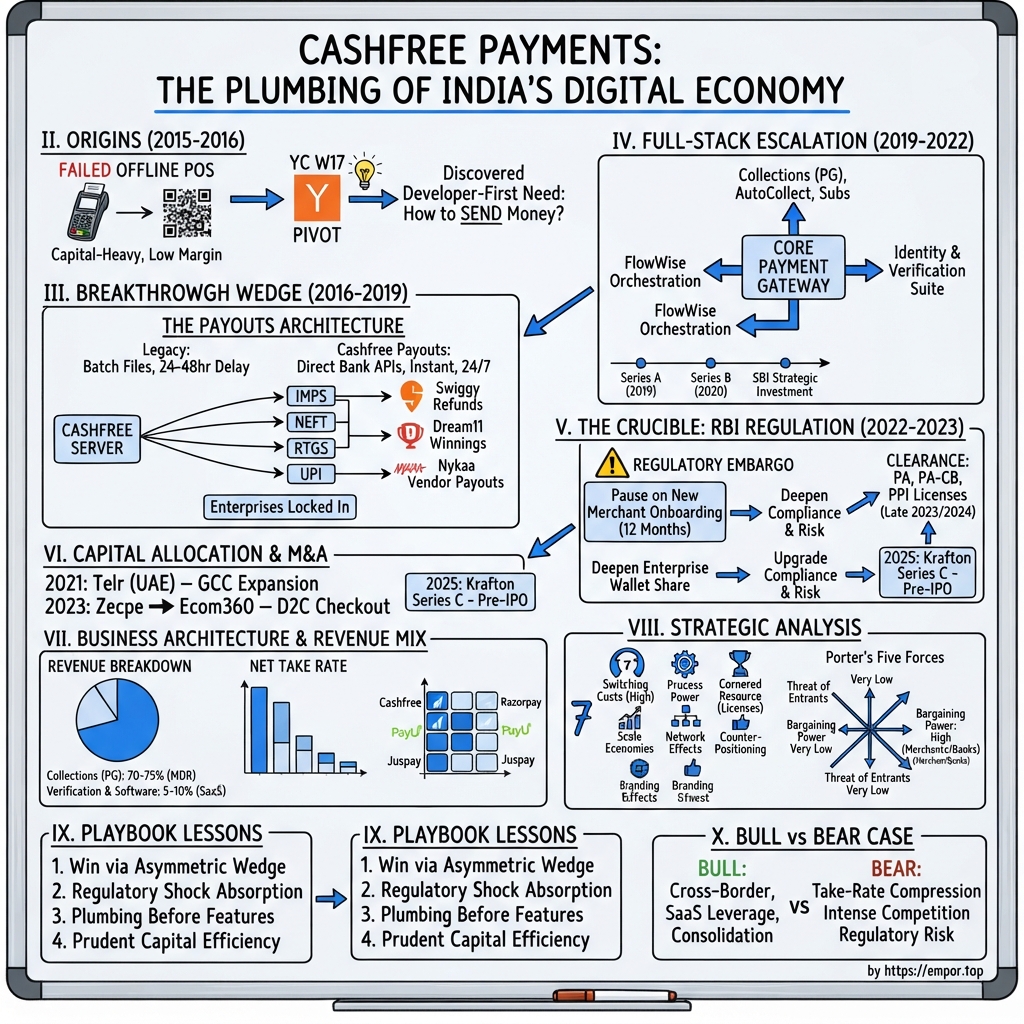
Cashfree Payments: The Plumbing of India's Digital Economy
I. Introduction & Episode Roadmap (10 min)
The moment nobody notices
There is a specific moment in Indian digital commerce that almost nobody notices: the moment money moves outward. A refund lands back in a customer's account before the return courier has left the building. Fantasy sports winnings credit at two in the morning on a Sunday. A marketplace seller in Surat receives settlement for yesterday's orders while the platform's finance team is still asleep. None of this happens through a traditional bank portal. It is an API call, executed by a licensed intermediary that most consumers have never heard of.
The scale, and the number that undercuts it
Cashfree Payments is one of the companies that built those rails. According to its public disclosures, the company processes more than $80 billion in annual payment volume across a merchant base of over 800,000 businesses, supported by a stated processing capacity of 12,000 transactions per second and more than a billion completed identity verifications.1 Its cap table includes Y Combinator, Smilegate, Apis Partners, State Bank of India, and—since February 2025—the South Korean game publisher Krafton, which led a $53 million round at a reported $700 million valuation.2
Those headline figures illustrate significant reach, but they also mark where an underwriting analysis must turn cautious. In the fiscal year ended March 2025, that $80 billion in annualized volume translated into operating revenue of ₹640 crore—roughly $74 million at approximately ₹87 to the dollar—alongside a net loss of ₹154 crore, wider than the prior year.3 The gross monetisation rate on stated volume works out to roughly nine basis points. After subtracting the processing costs Cashfree pays away to banks and payment networks, net take rates narrow to approximately three basis points. Cashfree is not a high-take-rate software business operating in the payments sector; it is a thin-margin infrastructure utility that depends entirely on volume throughput, product mix, and cost absorption.
There is nothing inherently flawed about a utility model. Infrastructure utilities can generate solid cash flows, but they must be evaluated on volume throughput, margin mix, operational discipline, and regulatory stability, rather than on the pricing power often attributed to software platforms. The analytical pitfall in Indian payment infrastructure is admiring the headline transaction volume without dividing it into net economic capture.
The counter-intuitive wedge
The initial wedge that established the company remains its most distinct strategic choice. In 2016, Indian payment startups were competing almost exclusively for checkout pages and digital collections—the pay-in. Two Bengaluru software engineers identified an overlooked friction point: disbursing money out of an enterprise was substantially harder than collecting it. Inbound payments had modern APIs, while outbound disbursements relied on corporate banking portals, manual spreadsheet uploads, and 24-to-48-hour batch settlements.
Solving programmatic payouts gave Cashfree early access to enterprise finance workflows. That wedge established a commercial relationship that the company later leveraged to cross-sell payment gateway collections—a market where it initially lacked the scale to compete directly. It was an effective land-and-expand strategy. Whether it has established a defensible, high-margin economic moat remains an open question, particularly as disclosed revenue mix data complicates the underlying margin profile.
Episode roadmap
This analysis examines five core chapters. First, the failed offline point-of-sale product that brought the company close to shutting down, followed by the Y Combinator cohort that reset its strategy. Second, the development of programmatic bulk payouts as an enterprise wedge. Third, the regulatory crucible: the full calendar year from December 2022 to December 2023 when the Reserve Bank of India prohibited Cashfree from onboarding new online merchants.4 Fourth, capital allocation decisions, including the $15 million investment in Gulf-based Telr, the acquisition of Zecpe, and the Krafton-led round. Fifth, the core financial fundamentals: unit economics, product mix, competitive dynamics, and the reconciliation between a $700 million private valuation and disclosed operational performance.
Management has publicly stated that Cashfree reached approximately ₹1,000 crore in revenue in FY26, reached monthly EBITDA profitability in March 2026, and is targeting full-year EBITDA profitability in FY27.5 The company has also announced intentions to raise more than $100 million in FY27 as a final private financing round ahead of an anticipated initial public offering within three years.6 These statements represent unaudited management claims that warrant scrutiny against disclosed financial history. If verified, they would signal an inflection point; evaluating the evidence behind them is the focus of this analysis.
 Subscribe on LinkedIn
II. Origins: The Offline POS Failure & The Y Combinator Pivot (2015–2016) (15 min)
Founding context: a cash-on-delivery problem, not an infrastructure thesis
The founding of Cashfree was not conceived as a thesis on financial infrastructure. It began as a hyperlocal-commerce concept that quickly broke down on unit economics.
Akash Sinha and Reeju Datta were introduced through mutual college contacts and began exploring concepts in mid-2015, with Sinha exploring AI-driven chat and Datta focusing on route logistics. Sinha had spent years writing software and leading engineering teams at Amazon, followed by a stint at the fintech platform BankBazaar.7 In September 2015, they converged on the most visible friction point across the Indian consumer internet: cash on delivery. Hyperlocal delivery was expanding rapidly, and virtually every order concluded with a delivery driver collecting paper currency.
The original Cashfree was designed as a software-based alternative to a physical point-of-sale terminal. A customer could pay via card or net banking just before the delivery driver arrived, sparing the merchant manual cash reconciliation. The team signed nearly 300 offline merchants across Bengaluru.7
The dead end
The model proved unsustainable, and the structural reasons for its failure offer useful context for Cashfree's subsequent evolution. Offline merchant acquisition is fundamentally a field-sales operation: an agent must physically visit a merchant, demonstrate the product, configure the setup, and provide ongoing on-site support. The cost of acquiring a small merchant is high, the revenue yield per merchant is negligible, and the capital payback period is extended. For a self-funded team of two engineers without institutional funding, that dynamic created an unsustainable operational burden. By April 2016, the founders abandoned the concept and pivoted toward an online payment gateway.7
A second, more fundamental structural dynamic explained the failure. A restaurant adopting a digital card-acceptance tool was purchasing incremental convenience; the default alternative—accepting cash—remained functional. By contrast, a digital marketplace unable to settle funds to thousands of vendors cannot operate. Scalable payments products generally solve problems where the legacy alternative is not merely inefficient, but operationally unviable.
The inflection point
The strategic pivot crystallized around Y Combinator. While secondary accounts often place Cashfree in the Winter 2017 batch, the accelerator's public records confirm the company participated in the Summer 2017 cohort, where its profile was defined by automating payouts and bank transfers for Indian enterprises.8 The initial seed funding arrived via YC's standard investment terms, reported in India at the time as backing for a Bengaluru-based payment gateway.9 This chronological distinction is significant: by the time Cashfree arrived in Mountain View, programmatic payouts had already become its core operational focus.
Y Combinator provided market-sizing discipline rather than a specific product idea. The founders have credited YC partner Michael Seibel with directing them to prioritize large addressable markets with high growth velocity over niche niches with easier differentiation, urging them to tackle high-friction enterprise problems even in crowded sectors.7 For an engineering team moving on from a localized merchant product, this provided strategic clarity. Exposure to US developer-first infrastructure platforms—most notably Stripe—also highlighted the emerging need for programmable banking rails in India's expanding digital ecosystem.
What to take from the origin, and what not to
Two elements from this formative period warrant analytical focus. First, the founders have been candid about the initial failure, acknowledging that the offline model lacked scalability and failed to align with merchant unit economics.7 Management teams that characterize early missteps as structural business-model failures rather than strategic repositioning offer clearer baselines for operational underwriting.
Second, the division of executive responsibilities has remained consistent over the company's decade-long operating history. Akash Sinha has served as chief executive officer since inception, while Reeju Datta has managed brand strategy, growth, finance, talent acquisition, and customer experience. Over time, the company built out a professional executive bench comprising a chief financial officer, chief business officer, chief technology officer, and chief revenue officer, establishing a corporate structure aligned with institutional oversight.1 Executive continuity does not guarantee execution, but it ensures that historical commitments and current operational performance can be evaluated against the same leadership team.
Finally, the transition from offline point-of-sale software to online developer APIs established a cost structure that remains evident in the company's financial profile. An API-delivered infrastructure product benefits from low marginal delivery costs and lower customer acquisition costs relative to field sales. However, it also commands limited standalone pricing power: enterprise software buyers evaluate documentation, API uptime, and transaction success rates, and integrating an alternative payment gateway requires engineering sprints rather than lengthy operational overhauls. By trading physical hardware intensity for pure software delivery, Cashfree entered a highly price-competitive commodity layer—a structural dynamic that continues to govern its unit economics.
III. The Breakthrough Wedge: Inventing "Payouts" (2016–2019) (25 min)
The industry blindspot
Understanding Cashfree's core breakthrough requires examining the workflow it replaced.
In 2016, an Indian enterprise sending disbursements to multiple recipients operated through a manual, fragmented process. A corporate finance analyst exported beneficiary lists into spreadsheets, formatted them to the precise specifications of individual bank corporate portals, uploaded the files, and awaited internal maker-checker authorization chains. From there, transactions waited for National Electronic Funds Transfer (NEFT) batch settlement windows. Failed transfers were returned as static summary files rather than real-time programmatic events, reconciliation was handled manually, and the underlying software triggering the disbursement had no visibility into settlement status. A customer refund requested on a Saturday evening rarely moved before Monday morning.
Meanwhile, inbound collections—the pay-in—had already undergone extensive modernization. Incumbents like PayU, CCAvenue, and BillDesk, alongside an emerging Razorpay, competed aggressively for checkout pages with software development kits (SDKs), hosted payment flows, and structured developer documentation. The competitive focus of Indian fintech was concentrated on checkout processing because that was where the merchant discount rate (MDR) resided, generating revenue as a visible percentage of gross transaction value.
This asymmetry stemmed from market economics rather than technical constraints. Collections generated percentage-based fees that scaled directly with payment volume, justifying substantial engineering investment. Disbursements, by contrast, commanded at most flat per-transaction fees measured in single-digit rupees. For product teams evaluating engineering allocation in 2016, prioritizing collections was a commercially rational choice. That structural incentive left enterprise disbursements largely unaddressed.
The Payouts architecture
Cashfree focused on this operational bottleneck, recognizing that outbound disbursements were commercially unglamorous precisely because they were technically and operationally demanding. The company built direct API integrations into core banking infrastructure across the Immediate Payment Service (IMPS), NEFT, Real Time Gross Settlement (RTGS), and later the Unified Payments Interface (UPI). It consolidated these rails into a unified programmatic interface capable of executing thousands of transfers in a single call, supported by automated retry logic, structured error handling, and real-time webhook callbacks.10 By 2018, the company expanded the product to link-based payouts, allowing enterprises to disburse funds to recipients via self-serve verification links without manually collecting or storing bank credentials.
In operational terms, the product converted an asynchronous corporate banking procedure into an instantaneous API call. Rather than transmitting batch files to a banking portal and manually tracking clearing cycles, enterprise software could trigger disbursements directly, receive immediate transaction-level confirmation, and programmatically manage fallbacks.
The hyper-adoption wave
Initial adoption was driven by internet platforms whose operational models depended fundamentally on real-time outbound fund flows. On-demand food delivery required instant customer refunds and daily rider payouts. Real-money gaming and fantasy sports platforms required round-the-clock withdrawal clearing, where settlement delays directly impacted user retention. Insurance platforms required programmatic claim disbursements, while digital marketplaces needed automated vendor settlements.
By its Series B financing in November 2020, Cashfree disclosed over 55,000 merchant clients and $12 billion in annual payment volume for the fiscal year ended March 2020, citing enterprise clients including CRED, BigBasket, Zomato, HDFC ERGO, Acko, and Ixigo.11 By June 2021, alongside an investment from the State Bank of India, the company reported $20 billion in annualized volume across more than 100,000 businesses, claiming to hold more than 50% market share in payment disbursals among Indian payment processors.12
That disbursal market-share metric has served as a central pillar of the company's enterprise narrative, though its analytical limitations require context. The figure originated as a self-reported company claim in a shareholder press release rather than an independently audited market dataset. While market commentary has consistently characterized Cashfree as a leader in enterprise payouts, no regulatory body publishes an official disbursal market-share series to verify the precise figure independently.13
Why the switching costs are real — and where they stop
The strategic logic underpinning payouts as a defensive wedge is grounded in workflow integration. A standard checkout gateway sits at the perimeter of an enterprise stack: it renders payment fields, captures credentials, and returns an authorization token. A payout integration, by contrast, is embedded deep within an enterprise's core financial architecture. It connects directly to enterprise resource planning (ERP) systems, vendor management ledgers, payroll workflows, and marketplace settlement logic. Migrating an outbound disbursal engine is not a front-end UI update; it is an extensive finance-operations migration carrying operational and financial risk.
However, the revenue distribution introduces an important commercial nuance. In FY25, payout commissions accounted for ₹55 crore of Cashfree's ₹640 crore in total operating revenue—roughly 8.6%. Payment gateway collections, by contrast, contributed ₹481 crore, or approximately 75% of operating revenue.3 The wedge product that established Cashfree's enterprise footprint and supported its switching-cost profile represents a modest share of the overall revenue base.
This dynamic yields two distinct analytical perspectives. A favorable interpretation views this as an effective land-and-expand strategy: payout APIs secured enterprise integration, which the company subsequently leveraged to cross-sell higher-monetizing payment gateway services. A more cautious perspective highlights that because payouts are priced on fixed per-transaction fees while collections capture percentage-based take rates, top-line revenue remains heavily concentrated in the competitive gateway segment. A defensible integration layer that insulates under 10% of revenue does not automatically confer structural pricing power to the remaining 90%.
Developer distribution, then and now
The developer-centric distribution model provided a clear initial advantage, though it has experienced steady industry-wide commoditization. Comprehensive documentation, standardized SDKs, transparent error messaging, and high platform availability allowed Cashfree to win engineering champions inside enterprises accustomed to legacy banking interfaces. In 2026, modern developer tooling represents the industry baseline across all major payment processors, and standardized reliability disclosures function as core compliance requirements rather than exclusive differentiators.14 Counter-positioning against legacy banking workflows enabled Cashfree's initial market entry; sustaining that advantage against well-capitalized fintech peers requires continued product evolution and margin discipline.
IV. The Full-Stack Escalation & Merchant Gateway War (2019–2022) (20 min)
Reversing the platform sequence
By 2019, Cashfree held a defensible position in a specialized, operationally complex niche, presenting leadership with a strategic dilemma: remain a focused payout specialist, or leverage existing enterprise integrations to enter the competitive online payment gateway market it had initially bypassed.
The case for remaining a specialist was grounded in financial discipline. A business focused solely on payouts, charging fixed per-transaction fees, could have sustained high customer retention, controlled capital requirements, and consistent profitability—consistent with the company's Series B disclosure of three consecutive profitable operating years.11 However, that path carried a clear growth ceiling: the addressable revenue pool for enterprise payouts in India represents a modest fraction of inbound collections, and a pure-play specialist risked eventual commoditization if full-stack payment aggregators bundled outbound disbursements as a zero-cost retention feature to win core gateway volumes.
Cashfree chose to compete for the broader collections market. This strategy inverted the conventional platform-expansion sequence in digital payments. Typically, payment processors establish distribution by winning checkout pages—the high-visibility, volume-intensive pay-in—before introducing treasury management and automated disbursements as secondary retention tools. Cashfree executed the reverse: leveraging deeply embedded, high-retention disbursal relationships managed by enterprise finance and engineering teams to capture inbound checkout volume controlled by commercial and growth departments. For an enterprise whose refunds, payroll, or vendor disbursements already operated on Cashfree's rails, adopting its payment gateway represented an incremental workflow extension rather than a cold migration.
Building software on top of rails
To support this expansion, Cashfree broadened its product portfolio. Alongside its core payment gateway, the company introduced Auto Collect, which provisioned virtual bank accounts to automate customer-level reconciliation for inbound bank transfers; subscription infrastructure built on e-NACH and UPI AutoPay for recurring billing; and an identity and risk verification suite designed to monetize software intelligence rather than payment settlement. Within that suite, Secure ID automated the verification of bank accounts, Permanent Account Numbers (PAN), Aadhaar, and Goods and Services Tax Identification Numbers (GSTIN), combining optical character recognition with anomaly detection for enterprise onboarding workflows.15 RiskShield deployed device intelligence and machine-learning fraud monitoring across real-time payment transactions.16 Cashfree disclosed that Secure ID crossed one billion verifications—100 crore—by September 2024, claiming the prevention of ₹50 crore in fraudulent transactions.17
The unit economics of verification software present distinct strategic characteristics. An identity verification API call incurs minimal variable delivery costs and eliminates bank interchange and card-network processing fees. By contrast, a payment gateway transaction routes the majority of the merchant discount rate to card networks and issuing banks. In FY25, other service commissions—the revenue line capturing identity verification, software solutions, and adjacent tooling—generated ₹103 crore, representing roughly 16% of total operating revenue.3 In the context of Cashfree's overall cost structure, where payment gateway processing fees alone accounted for ₹419 crore of a ₹795 crore total expense base,3 that ₹103 crore in software revenue generated a disproportionate contribution to gross profit, making it a critical metric for evaluating margin expansion.
This software layer also carries distinct competitive advantages. Identity verification and risk-management products are evaluated and purchased by corporate risk, legal, and compliance officers rather than growth teams, and these enterprise workflows undergo vendor re-tendering far less frequently than payment checkout routing. Revenue secured from enterprise compliance budgets is less vulnerable to displacement by multi-gateway routing engines and payment orchestrators. While this structural insulation reinforces the strategic case for software expansion, at 16% of total revenue, it remains a long-term transition rather than the primary driver of current financial performance.
Funding and validation
Cashfree's capitalization through this period remained conservative relative to the broader Indian fintech sector. In April 2019, the company closed a $5.5 million Series A round led by Smilegate Investment, with participation from Y Combinator and individual angel investors including George Osborne and Vellayan Subbiah.18 The financing included a secondary share sale where an early investor exited, meaning that the full $5.5 million headline amount was not allocated directly to the balance sheet as primary growth capital.19 At the time of the round, Cashfree reported an annualized processing run rate of approximately $4.5 billion and planned to expand its headcount from 45 to roughly 100 employees.18
In November 2020, Cashfree announced a $35.3 million Series B round led by Apis Growth Fund II, with follow-on participation from Y Combinator and Smilegate, bringing total institutional capital raised to approximately $42 million. The central operational disclosure accompanying the financing was that Cashfree had operated profitably for three consecutive fiscal years.11 Business Standard subsequently reported that net profit reached ₹25 crore in FY21, representing a 48% year-on-year increase.20 These historical disclosures indicate that Cashfree operated as a profitable enterprise at a smaller scale prior to regulatory licensing overhauls and the capital expenditure programs that followed.
The SBI investment: trust signal and structural conflict
In June 2021, the State Bank of India made an equity investment in Cashfree at a reported post-money valuation of roughly $200 million, while leaving the exact investment amount undisclosed.21 The strategic rationale presents clear institutional advantages alongside potential operational complexities. When the country's largest public-sector lender acquires an equity interest in an independent payment aggregator reliant on commercial banking infrastructure, the transaction serves simultaneously as an enterprise trust signal, an operational channel, and a structural conflict of interest. An institutional bank shareholder also acts as a critical upstream infrastructure supplier whose interchange rates and settlement fees directly determine the aggregator's gross margins, and whose internal merchant-acquiring initiatives may compete directly with portfolio companies. While no public evidence suggests operational friction, the corporate governance mechanisms governing this relationship—such as board representation, information rights, and protective provisions—have not been publicly disclosed.
The commercial utility of the partnership is straightforward. An aggregator's payout reliability depends directly on direct bank API integrations, where a strategic relationship with India's largest bank can secure operational prioritization and preferential clearing terms. The investment also provided substantial enterprise credibility: corporate finance executives evaluating whether to route high-volume treasury disbursements through a growth-stage fintech view State Bank of India backing as a material risk mitigant. However, whether this institutional alignment created measurable margin advantages remains unclear from disclosed financials; Cashfree's FY25 gross margin of 34.5%, closely tracking that of primary peer Razorpay, indicates that any operational edge has not yet manifested in distinct gross pricing power.
V. The Crucible: The RBI Regulatory Embargo (2022–2023) (25 min)
The regulatory paradigm shift
On 17 March 2020, the Reserve Bank of India published guidelines that fundamentally reshaped the operating environment for Indian payment intermediaries.
The regulatory framework established that non-bank payment aggregators were fiduciary custodians handling public funds rather than pure software intermediaries. Non-bank aggregators were required to obtain formal authorisation from the central bank, with initial applications due by 30 June 2021. The mandate established strict capitalisation thresholds: a minimum net worth of ₹15 crore by 31 March 2021, rising to ₹25 crore by 31 March 2023, with a permanent requirement to maintain at least ₹25 crore thereafter. Escrow mechanics were codified: merchant collections had to sit in an escrow account with a scheduled commercial bank, remitted on a Tp+0 or Tp+1 basis, and settled to merchants across defined Ts+1, Td+1, or Tr+1 timelines based on delivery structures and refund policies. Corporate governance and security standards were similarly elevated, requiring "fit and proper" director certifications, mandatory 15-day notices for changes of control, PCI-DSS compliance, prohibitions on storing customer card credentials, and annual cyber-security audits conducted by CERT-In-empanelled auditors.22
Viewed through an operational lens, the framework constructed a high capital and compliance barrier around an industry that had previously operated with minimal regulatory friction.
The freeze
The central operational challenge arrived during the licensing review. In December 2022, while application evaluations were ongoing, the RBI directed payment aggregators operating under in-principle approval—including both Cashfree and market leader Razorpay—to halt the onboarding of new online merchants until final authorisation was granted.4 Existing merchant processing continued, but new client acquisition was suspended. The regulatory embargo remained in place for a full calendar year, concluding in December 2023 when the central bank issued final payment aggregator authorisations and lifted the onboarding restriction.23
A twelve-month prohibition on acquiring new customers presents acute operational hurdles for a venture-backed growth business. Marketing campaigns, outbound enterprise sales, developer self-serve funnels, and partnership pipelines produce zero new billable accounts. Expansion becomes confined to winning a greater share of wallet inside existing accounts and tightening internal cost structures.
The financial impact was directly visible in Cashfree's reporting. Operating revenue rose from ₹613.8 crore in FY23 to ₹642.7 crore in FY24—a modest 4.7% increase, which financial media, citing regulatory filings, attributed directly to the onboarding ban.24 Net losses held steady at ₹133 crore in FY23 and ₹135 crore in FY24.24 Operating expenditures continued to expand: employee benefit costs grew from approximately ₹199 crore in FY23 to ₹245 crore in FY24, representing a 23% payroll increase during a fiscal year in which revenue grew by less than 5%.24
The strategic operational pivot
That capital allocation decision highlights two contrasting perspectives on management's strategy. A constructive interpretation suggests that leadership elected to preserve engineering and compliance talent through a temporary regulatory pause, directing capacity toward upgrading risk architecture, data localisation, and card tokenisation to central-bank standards while expanding non-aggregator software lines—such as identity verification and fraud prevention—that operated outside PA licensing requirements. This approach reflected a long-term institutional orientation. A more sceptical interpretation notes that an organisation facing a hard stop on customer acquisition expanded overhead by nearly a quarter, keeping net losses elevated while depending entirely on future top-line acceleration to absorb a higher cost base.
During this embargo period, Cashfree also pursued selective corporate development, acquiring automated checkout platform Zecpe in February 2023 and laying the groundwork for cross-border payment licences. Deploying capital to acquire operational capability during an enforced pause reflected an owner-oriented disposition, though the ultimate financial return on those assets remained contingent on post-clearance execution.
The clearance, and the year that followed
The financial performance following regulatory clearance highlighted the operational lag involved in restarting enterprise sales. In FY25—the first complete fiscal year with the final licence in place—operating revenue stood at ₹640 crore, essentially flat compared to ₹643 crore in FY24. The net loss widened by 14% to ₹154 crore, while the EBITDA loss reached ₹132 crore, widening the EBITDA margin from negative 17.42% to negative 20.63%. Total expenses rose 2% to ₹795 crore, driven in part by a 150% increase in marketing expenditure to ₹20 crore as merchant acquisition resumed, alongside ₹419 crore in payment gateway processing charges—which consumed 53% of the total expense base—and employee benefit costs of ₹243 crore.3 The business incurred approximately ₹1.24 in costs for every rupee of revenue generated.3 A full year of unrestricted onboarding did not produce immediate revenue growth.
Cashfree's management attributed the FY25 performance to the time required to rebuild the merchant pipeline from a standing start, reporting 130% growth in merchant signups during FY25 and noting that commercial transaction volumes typically lag initial merchant onboarding by several quarters.25 While this explanation aligns with enterprise software integration cycles, it represented an operating hypothesis that could not be verified within the FY25 reporting period. Consequently, management's claimed growth inflection in FY26 remains a central analytical benchmark that warrants verification against filed statutory accounts once publicly accessible.
The licence trifecta
Cashfree's regulatory positioning extended beyond the domestic payment aggregator licence. On 31 October 2023, the RBI published its cross-border payment aggregator framework (PA-CB), creating a distinct regulatory regime for entities facilitating import and export payments for goods and services. The framework mandated a ₹15 crore minimum net worth at application, scaling to ₹25 crore, alongside a ₹25 lakh per-transaction cap and enhanced due diligence for transactions exceeding ₹2.5 lakh.26 In July 2024, Cashfree became the first entity to receive that licence.27 In October 2024, the company secured a Prepaid Payment Instrument (PPI) authorisation, permitting the issuance of digital wallets and prepaid cards.28 Cashfree's public disclosures record its RBI payment aggregator certificate as number 266/2025 and its PPI certificate as 209/2024.1
A diligence item, not a scandal
A comprehensive underwriting review also requires tracking legal and compliance exposure. In September 2022, the Enforcement Directorate froze ₹46.67 crore held across multiple payment gateways as part of an investigation under the Prevention of Money Laundering Act into Chinese-controlled lending apps and the HPZ token scheme, stemming from a 2021 First Information Report in Nagaland. Of that frozen sum, ₹1.28 crore was held in accounts with Cashfree Payments India Private Limited. Cashfree stated that it provided all requested documentation to authorities within hours and affirmed that its merchant onboarding and operational protocols were fully compliant with regulatory standards.29 While the amount was financially immaterial and Cashfree was not the subject of the investigation, the incident illustrated a structural industry dynamic: payment aggregators maintain legal and reputational exposure to the conduct of their downstream merchants, establishing merchant diligence and transaction monitoring as essential licence-preservation functions rather than administrative overhead.22
VI. Capital Allocation & Strategic M&A: Telr, Zecpe & Cross-Border (20 min)
Cashfree's capital allocation history centers on two notable acquisitions and a single large late-stage financing round. Each warrants evaluation based on demonstrated economic returns rather than the strategic narratives presented at announcement.
The Telr bet: $15 million, and no disclosed return
On 30 November 2021, Cashfree announced a $15 million equity investment in Telr, a payment service provider operating across the United Arab Emirates and Saudi Arabia, with the stated objective of building a unified cross-border platform allowing Indian merchants to accept payments from the Middle East and North Africa region and vice versa.30 Public accounts diverged on the exact governance structure: Cashfree's official release stated that the transaction made it one of Telr's largest shareholders, whereas contemporaneous media reports described it as a majority stake acquisition.31 That corporate ambiguity was never resolved in subsequent filings, and Cashfree has not publicly disclosed Telr's standalone revenue, profitability, or consolidated balance-sheet contribution.
The financial scale of that transaction made the lack of subsequent reporting significant. Deploying $15 million represented a substantial capital commitment for a business that had raised approximately $42 million in total institutional funding through its Series B round in late 202011—effectively committing more than a third of its historical equity base to a single regional initiative. Nearly five years later, the transaction has yielded little publicly verifiable financial return. Cashfree does not disclose regional MENA revenue, nor does Telr appear as an identifiable line item in reported earnings. The Gulf payments landscape is fragmented across national clearing rails and local acquiring partnerships, creating a clear rationale for acquiring an established local operator while simultaneously presenting severe technical and operational integration challenges.
Cashfree's cross-border segment has expanded rapidly from a modest baseline. The company disclosed that cross-border gross transaction value grew eightfold between March 2025 and March 2026, with cross-border net revenue increasing tenfold over the same period, while management projected cross-border volume to reach approximately 25% of total revenue in subsequent years.5 However, the public record does not clarify whether this acceleration reflects delayed operational synergies from the Telr investment or the immediate commercial advantage of securing the RBI's cross-border payment aggregator (PA-CB) licence in July 2024. Given the regulatory timeline, the PA-CB authorisation represents the more direct operational catalyst, making it analytically prudent to treat the Telr equity investment as an unproven capital allocation bet rather than an enterprise driver validated by recent volume gains.
Whether Cashfree overpaid remains unanswerable without audited target financials. Structuring the transaction as an equity investment rather than a full statutory merger limited downside liabilities, but it also constrained management's ability to mandate product roadmaps and backend technical consolidation. In a fragmented regional ecosystem where the economic value of a local processor lies in direct banking relationships and merchant acquiring licences, acquiring a minority or ambiguous equity position represents a challenging operational compromise: it deployed capital without securing the corporate authority required to enforce integration.
Product M&A: Zecpe and Ecom360
The company's second transaction was smaller and more operationally focused. In February 2023—during the RBI onboarding embargo—Cashfree acquired Zecpe, a one-click checkout startup, in a transaction reported at approximately $10 million.32 The product addressed a costly bottleneck in Indian direct-to-consumer (D2C) commerce: cash-on-delivery shipments rejected at the customer's doorstep, which generate return-to-origin (RTO) shipping fees absorbed entirely by the merchant. Mitigating RTO through address pre-filling, risk-scoring algorithms, and incentives to convert orders into digital prepayments delivers direct cost savings to consumer brands.
In August 2023, Cashfree rebranded Zecpe as Ecom360, positioning it as an end-to-end e-commerce suite covering checkout, RTO mitigation, shipping tracking, and post-purchase customer workflows.33 At the time of the rebranding, the company reported that the software was deployed across approximately 1,500 D2C brands.34 The strategic rationale was coherent: it added a proprietary software layer sold into Cashfree's existing enterprise accounts, monetised through software fees rather than regulated payment discount rates during a period of merchant take-rate compression. However, its financial contribution remains modest relative to the broader enterprise; 1,500 brands represents a minor fraction of Cashfree's stated 800,000-merchant footprint, and management has not reported Ecom360 revenue separately. Executing the acquisition during the regulatory embargo—when acquiring new processing accounts was prohibited but deepening wallet share within existing accounts remained viable—represented a pragmatic deployment of capital during an operational pause.
The Krafton round: a price, not a valuation
In February 2025, Cashfree secured $53 million—approximately ₹450 crore—in a funding round led by South Korean video game publisher Krafton, with follow-on participation from existing institutional backer Apis Growth Fund II, establishing a reported post-money valuation of $700 million.2 Cashfree's management stated that proceeds would support international expansion across the UAE and the broader Middle East, as well as research into cross-border routing and fraud security.25 Krafton India's leadership framed the investment around the growth potential of Indian digital finance, stating that Cashfree's domestic infrastructure capabilities could be expanded internationally.25
Evaluating that transaction requires distinguishing headline valuations from true equity underwriting. The $700 million figure represented a private price agreed between commercial counterparties rather than a liquid market valuation. The round was finalized during a period when Cashfree's audited FY25 financials showed flat year-on-year revenue and a widening net loss. Furthermore, neither Cashfree nor its investors disclosed whether the financing involved secondary share sales, or what specific preference terms were granted to Krafton and Apis. Standard venture capital transactions of this scale in India typically incorporate preferred share classes carrying at least a 1x non-participating liquidation preference, anti-dilution protections, and specific corporate governance rights. Equating the negotiated price of senior preferred instruments with the intrinsic economic value of common equity obscures the downside protections embedded in late-stage private rounds.
Krafton's strategic posture also introduces commercial context. As a game publisher with a massive digital footprint in India, Krafton operates as a commercial partner with direct exposure to local gaming payment rails and micro-transaction clearing, rather than as an unaligned institutional asset manager. Strategic corporate investors frequently accept higher entry valuations when a portion of the expected return is realized through operational alignment and commercial priority. While this dynamic does not invalidate the $700 million price point, it renders the round a less definitive benchmark of arm's-length financial valuation than a competitive round led by pure financial institutions.
The record, scored
Assessed holistically, Cashfree's historical capital allocation reflects measurable financial discipline compared to its domestic peer group. The company raised an aggregate of $95 million to $100 million across its operating history,35 contrasting sharply with the extensive capital consumption and multi-billion-dollar cumulative financings of primary competitor Razorpay. Building an annual processing infrastructure handling $80 billion in volume on under $100 million in cumulative equity demonstrates operational efficiency. However, it also illustrates a commercial trade-off: capital efficiency allowed Cashfree to preserve equity independence, but it left the business at a $700 million private valuation competing against a market leader targeting a public listing valuation of ₹50,000 crore to ₹60,000 crore.36 In public capital markets, enterprise scale and market liquidity often command higher multiples than capital frugality.
A further governance signal occurred in January 2026, when Cashfree conducted an employee stock ownership plan (ESOP) liquidity program covering more than 400 current and former staff members, including 175 alumni.35 Extending share repurchases to departed personnel represents a shareholder-aligned practice, providing liquidity to former contributors who offer no ongoing retention benefit. However, Cashfree disclosed neither the aggregate financial size of the buyback nor the internal share price at which equity was repurchased.35 Because an internal buyback price represents an explicit corporate valuation marker, withholding those terms leaves the transaction's economic baseline undisclosed.
VII. Business Architecture, Revenue Mix & Unit Economics (30 min)
Evaluating Cashfree requires moving from strategic narrative to core unit economics, where disclosed financial results reveal the precise mechanics of the business model.
Disclosed revenue composition. In FY25, operating revenue of ₹640 crore comprised ₹481 crore from payment gateway commissions (75%), ₹55 crore from payout commissions (8.6%), and ₹103 crore from other service commissions (16%), alongside roughly ₹1 crore in other income for total revenue of ₹641 crore.3 Measured against roughly $80 billion in stated annual transaction volume—approximately ₹6.96 lakh crore at ₹87 to the dollar—that top line represents an annualized gross monetisation rate of roughly nine basis points.
Nine basis points is the governing metric of Cashfree's financial model. This is an infrastructure utility take rate rather than software pricing, determined largely by the zero-MDR mandate governing the Unified Payments Interface. Because zero-MDR rules prevent processors from capturing interchange on UPI transactions, aggregators earn nothing on UPI payment processing, even though industry data indicates UPI accounts for 60% to 65% of overall transaction throughput across Indian payment gateways.37
Net economic capture. Payment gateway processing fees remitted upstream to banks and card networks reached ₹419 crore in FY25, consuming 65% of operating revenue.3 This left a gross profit of approximately ₹221 crore, reflecting a 34.5% gross margin and a net take rate on stated volume of roughly three basis points. Against that ₹221 crore gross profit sat ₹243 crore in employee benefit expenses.3 Payroll alone exceeded total gross profit. This baseline explains Cashfree's FY25 operating deficit: the company's gross contribution margin was insufficient to cover its headcount.
Evaluating the FY26 inflection. Cashfree management has claimed FY26 revenue reached approximately ₹1,000 crore—representing roughly 55% annual growth—alongside monthly EBITDA breakeven in March 2026, a 78% fourth-quarter year-on-year rise in gross transaction volume, a 50% expansion in active merchants, a doubling of SMB volume, and accelerating cross-border throughput.56 If verified in audited regulatory filings, these figures indicate an operational step change: generating 55% top-line growth following a fiscal year where non-processing costs grew by just 2% demonstrates that fixed-cost operating leverage took effect once merchant onboarding resumed.
The underlying unit arithmetic illustrates the operational hurdle. Assuming the FY25 gross margin of 34.5% held steady, ₹1,000 crore in revenue yields approximately ₹345 crore in gross profit. Against a non-processing operating cost base of roughly ₹376 crore in FY25, this revenue level brings the business close to EBITDA breakeven—aligning with management's stated performance for March 2026. However, it also highlights the operational sensitivity: at a 34.5% gross margin, every ₹100 crore in incremental operating overhead requires roughly ₹290 crore in new revenue to absorb.
Two structural factors could improve this equation. First, revenue mix: cross-border processing and identity verification software incur minimal interchange and network pass-through charges compared to domestic card acquiring. Increasing cross-border throughput toward management's 25% target would lift blended gross margins toward 40% to 45%. Second, potential shifts in domestic merchant discount rate regulations could unlock baseline processing yields.
Revenue durability and concentration risk. Cashfree's revenue base is transactional rather than contractual. Public disclosures show no evidence of multi-year enterprise commitments, minimum processing volumes, or contracted software subscriptions. Repeat revenue stems from merchant processing habits and integrated workflows rather than contractual covenants—a less predictable form of recurrence than software subscription contracts.
Evaluating customer retention in payment processing requires volume-based cohort metrics: the proportion of processing volume retained from prior merchant cohorts and the corresponding trend in net take rates. Cashfree does not disclose these metrics, publishing aggregate merchant signups instead. Because payment aggregation volume is heavily concentrated among high-throughput digital platforms, merchant count is an uninformative indicator of revenue durability. For an enterprise whose client roster includes marquee platforms such as Swiggy, Zepto, Bajaj Finance, Cred, BigBasket, and Zomato,211 client concentration represents a critical unquantified risk that will require statutory disclosure in any future public listing prospectus.
Cost architecture and cash conversion. Cashfree's cost structure comprises four distinct tiers: variable processing fees paid to banking partners and card networks (approximately 65% of revenue, constrained by regulated interchange and network rates); employee expenses (₹243 crore in FY25, representing the primary driver of fixed operating leverage); regulatory compliance, cybersecurity, and infrastructure overhead (fixed costs that expand with central-bank oversight); and marketing and sales expenses (₹20 crore in FY25).3
Converting single-month EBITDA breakeven into durable free cash flow requires meeting three conditions. First, achieving sustained full-year EBITDA profitability, which management has targeted for FY27.6 Second, generating operating profit that absorbs non-cash and non-operating charges. Cashfree's FY25 reporting aggregated depreciation, finance costs, and other overheads into a single ₹80 crore line item,3 without disaggregating share-based compensation. Following an ESOP liquidity event covering more than 400 staff members,35 equity-based compensation represents a material economic expense that public market investors will evaluate against GAAP operating profit. Third, converting accounting profit into positive operating cash flow after working capital adjustments. Because RBI regulations mandate that merchant funds be held in segregated bank escrow accounts under strict clearing schedules,22 merchant float balances do not constitute corporate liquidity.
Analytical falsification criteria. Three operational indicators would challenge the long-term profitability thesis. First, if full-year FY27 EBITDA results fail to reach profitability, indicating that the March 2026 breakeven was a temporary period-end anomaly rather than a permanent operational crossing. Second, if top-line revenue growth decelerates below 30% while gross margins remain near 34%, halting fixed-cost absorption. Third, if cross-border net revenue growth normalizes toward domestic levels as competing aggregators secure cross-border licences, eroding the temporary margin advantage.
Scoping the addressable market. Market estimates place the Indian payment gateway sector at approximately $2.31 billion in 2026, projected to expand at an 11.7% compound annual rate to $4.01 billion by 2031.38 Cashfree's stated FY26 revenue of ₹1,000 crore translates to roughly $115 million in gross billings; however, because gross billings include pass-through network costs, direct market-share comparisons against net fee pools must be treated with caution. The realistic addressable revenue pool for domestic aggregators is confined to the net take rate captured across regulated merchant processing, enterprise payouts, verification software budgets, and cross-border trade corridors. Broad headline metrics—such as India's overall digital payment throughput, or UPI processing 23.2 billion monthly transactions valued at ₹29.9 lakh crore in May 202639—reflect unmonetised payment volume rather than addressable corporate revenue.
Competitive peer comparison. Market leader Razorpay operates at a substantially larger commercial scale: in FY25, it generated consolidated revenue of ₹3,783 crore (up 65% year-on-year) and gross profit of ₹1,277 crore, alongside a net loss of ₹1,209 crore driven primarily by one-off ESOP charges, restructuring expenses, and tax liabilities linked to its corporate reverse flip to India.40 Razorpay generated nearly six times Cashfree's FY25 revenue and holds an estimated 55% market share in online payment aggregation,13 while operating at a comparable 34.0% gross margin versus Cashfree's 34.5%, indicating that its market dominance reflects distribution scale rather than superior per-transaction unit margins.
Among other competitors, Prosus-owned PayU India reported FY25 revenue of $669 million (a 21% increase), comprising $498 million from payments (up 12%) and $171 million from digital credit (up 60%), with an adjusted EBIT loss widening to $44 million; its Indian payments unit achieved operational breakeven in the second half of the fiscal year at a negative 2% adjusted EBIT margin.41 PayU's operating history also includes the sector's most prominent failed transaction: Prosus agreed to acquire BillDesk for $4.7 billion in 2021 before terminating the deal in October 2022 when transaction conditions remained unfulfilled.4243
The broader landscape includes Pine Labs, which leads in offline-first omnichannel acquiring and represents the sector's primary public-market peer following its late 2025 listing. Meanwhile, Juspay specializes in payment orchestration—the routing software large enterprises deploy across multiple payment gateways—securing $50 million from WestBridge Capital at a $1.2 billion valuation in January 2026 after generating FY25 revenue of ₹514 crore (up 61%) and a net profit after tax of ₹62 crore.4445 Juspay operates as a payment partner, an infrastructure competitor, and the primary technical platform facilitating merchant multi-homing, which exerts continuous downward pressure on processor take rates.
Within this landscape, Cashfree occupies a distinct but constrained position: it remains the leading independent provider in enterprise payouts, holds an early regulatory advantage in cross-border payment aggregation, operates an expanding verification software suite, and ranks as a mid-tier competitor in domestic payment gateway acquiring against a market leader six times its size.
VIII. Strategic Analysis: 7 Powers & Porter's Five Forces (25 min)
Strategic frameworks are useful here only to the extent they force a distinction between advantages that materialize in audited financial results and those that exist primarily in pitch decks. Applied to Cashfree, conventional renderings of Hamilton Helmer's 7 Powers model grade the company favorably across five distinct categories. The disclosed financial baseline supports a considerably narrower verdict.
Hamilton Helmer's 7 Powers, graded against evidence
Switching costs represent Cashfree's most durable structural power, though its scope is narrower than often claimed. Where an enterprise has integrated payout APIs into its core treasury, payroll, or marketplace settlement workflows, replacing Cashfree requires overhauling a mission-critical operational system where integration failures risk misallocating corporate funds. That operational lock-in is real and defensible. However, it applies primarily to the payout and disbursal suite, which generated ₹55 crore of FY25 operating revenue.3 On the gateway collections side—accounting for 75% of revenue—switching costs are minimal. A merchant can onboard or switch secondary aggregators within weeks, and third-party orchestration platforms are specifically designed to make multi-gateway routing seamless. Rating switching costs as uniformly high across the entire enterprise conflates a sticky, low-monetizing minority with a contested, commoditized majority.
Process power rests on the claim that a decade of direct banking integrations and specialized routing algorithms yields measurably higher transaction success rates and lower latency. Cashfree reports a processing capacity of 12,000 transactions per second and connectivity across more than 600 million bank accounts.1 However, technical throughput claims do not constitute audited success-rate disclosures. No independent, audited dataset benchmarked across Indian payment aggregators is publicly available, and peer processors claim comparable operational benchmarks. Furthermore, terminal transaction success rates remain heavily dictated by issuing-bank clearing infrastructure, an upstream variable that no aggregator controls. Until benchmarked data is published, process advantages remain an unverified operational hypothesis.
Cornered resource is grounded in Cashfree's regulatory authorization stack, representing a verifiable operational barrier. Cashfree holds full RBI authorization as a payment aggregator, was the first entity to secure the cross-border (PA-CB) authorization in July 2024, and obtained a prepaid payment instrument licence in October 2024.27281 The statutory capital thresholds—maintaining a minimum net worth of ₹25 crore for domestic aggregation, with an additional ₹25 crore capital pathway for cross-border operations2226—combine with a rigorous multi-year review process to establish high entry barriers. However, regulatory licences deter unlicenced startups rather than well-capitalized incumbents. Established peers—including Razorpay, PayU, and Pine Labs—hold comparable aggregator authorisations, and subsequent cross-border licences have been granted to peer processors. Consequently, the first-mover cross-border advantage represents a depreciating asset with a measurable operational half-life, shifting the analytical focus to how much merchant volume Cashfree can lock in before regulatory parity takes effect.
Scale economies remain modest. High volume allows aggregators to negotiate tiered pricing bands with partner banks and card networks while amortizing fixed engineering and compliance overhead across a broader base. However, Cashfree operates with less commercial leverage than the market leader: counterparties that establish baseline interchange rates are tier-one banks and global card networks, giving an entity processing $80 billion less bargaining leverage than an incumbent processing $180 billion.13 Scale dynamics structurally favor the market leader, leaving Cashfree as a price-taker on upstream network fees.
Network effects are negligible. While fraud-detection datasets expand with processing volume, and RiskShield's risk algorithms benefit from analyzing broader transaction patterns,16 this represents data scale rather than a structural network effect. Adding an incremental merchant does not inherently increase the platform's value to other merchants in the manner of a two-sided marketplace.
Counter-positioning served as a decisive historical wedge that has since run its course. Attacking the market through programmatic payouts while incumbents focused on checkout pages was an effective asymmetric strategy in 2016. It no longer functions as a defensive barrier, as every major domestic processor now operates programmatic disbursal tooling.
Brand power provides measurable institutional utility. Cashfree's enterprise reputation among corporate finance and engineering teams, reinforced by State Bank of India's equity holding and an unblemished regulatory record, lowers enterprise acquisition friction. Consumer-facing brand recognition is minimal, which is standard for backend financial infrastructure.
Porter's Five Forces: three that matter
Evaluating Cashfree through Porter's Five Forces highlights three dominant pressures governing industry profitability, while two remain secondary. Threat of new entrants is constrained by regulatory capital requirements, escrow account mandates, strict governance standards, recurring cybersecurity audits, and extended central-bank review cycles.22 Threat of substitutes is negligible, supported by the structural migration toward digital payment rails across the Indian economy.
The three decisive forces exert consistent downward pressure on industry margins. Supplier power is high and structural: commercial banks and international card networks control underlying clearing networks and set the interchange rates that accounted for 65% of Cashfree's operating revenue as a direct processing cost in FY25.3 Gross margins remain capped upstream. Buyer power is substantial among enterprise clients: high-volume merchants routinely multi-home across multiple gateways, deploy smart-routing layers, and continuously renegotiate processing tiers. Buyer power is low only among mid-market merchants who prioritize an integrated payouts-plus-verification suite over marginal transaction fee savings. Competitive rivalry is intense and price-driven, contested against a market leader processing six times Cashfree's revenue, a well-funded corporate rival operating a high-margin digital credit arm, an established omnichannel incumbent, and independent orchestration platforms whose software enables merchants to shift volume dynamically to the lowest-cost provider.
Enterprise buyer power is further reinforced by operational necessity. Large digital platforms do not multi-home merely for commercial leverage; routing volume across two or more aggregators provides essential redundancy during banking outages. Because operational resilience and pricing power are realized through the same multi-gateway architecture, the structural trend among high-volume accounts pushes inexorably toward increased multi-homing.
Synthesis
The strategic assessment yields a clear operational conclusion. Cashfree possesses a defensible switching-cost advantage protecting a modest portion of total revenue, alongside a verifiable but depreciating regulatory lead in cross-border acquiring. Meanwhile, upstream supplier pricing, enterprise multi-homing, and aggressive price competition exert continuous downward pressure on baseline take rates. Sustainable margin expansion must therefore rely on higher-yielding product mix and operational fixed-cost leverage rather than standalone gateway pricing power.
IX. Playbook: Business & Investing Lessons (20 min)
Five lessons generalize across the broader technology landscape, while two apply specifically to regulated financial infrastructure.
Lessons about strategy
1. The asymmetric wedge works, but examine what it protects. Cashfree's founding insight—that the unglamorous outbound side of payments was overlooked precisely because it appeared commercially unlucrative—represents a repeatable strategic pattern. Incumbent processors cluster around visible, high-margin revenue surfaces, leaving adjacent operational bottlenecks unaddressed. However, the second half of that lesson is often overlooked: a wedge that is structurally low-priced remains low-priced. Enterprise payouts are billed on flat per-transaction fees measured in single rupees rather than percentage-based take rates, ensuring that the workflow generating high switching costs accounts for a small minority of total revenue.3 Securing a defensible enterprise wedge and capturing high-margin profit are fundamentally different operational challenges.
2. Regulatory shock absorption is an essential capability, but it carries a high carrying cost. The twelve-month onboarding freeze from December 2022 to December 2023 would have forced a shutdown at a startup financed on the presumption of uninterrupted customer acquisition.4 Cashfree navigated the embargo, preserved its core engineering organization while payroll expanded 23% against 4.7% revenue growth,24 secured final payment aggregator authorization, and became the first entity to obtain the cross-border payment aggregator licence.27 That sequence highlights the value of building institutional compliance capabilities before regulatory mandates take effect. However, the subsequent financial record illustrates the cost: the fiscal year following regulatory clearance generated flat revenue alongside a wider net loss.3 Surviving a regulatory freeze and recovering commercial momentum are separated by an extended operational lag, and absorbing that gap requires conservative balance-sheet management.
3. Core infrastructure must precede software features. The argument that operational reliability is the core product proves economically accurate in payment infrastructure. A verification API or a checkout optimization tool layered on top of unstable rails provides little value, because an enterprise's evaluation of the overall stack depends entirely on underlying settlement reliability. Consequently, Cashfree's expansion into identity verification and fraud tooling followed the stabilization of its core banking integrations, ensuring that higher-margin software revenue—which generated ₹103 crore in FY253—developed as a secondary attach layer rather than a standalone lead. For infrastructure investors, high-margin software attachments represent the direct consequence of low-margin processing reliability; selling adjacent software without controlling the underlying rails leaves a provider vulnerable to displacement.
Lessons about capital and disclosure
4. Capital efficiency has a measurable ceiling. Cashfree built an infrastructure platform handling $80 billion in annual transaction volume on approximately $95 million to $100 million in cumulative equity capital.35 Compared to domestic peers that consumed substantially more venture funding, this represents disciplined balance-sheet management. However, capital frugality and commercial scale represent distinct strategic objectives: in an industry where upstream banking costs improve with processing volume and large merchants multi-home on price, scale compounds advantages over time. Razorpay raised and deployed substantially larger pools of capital, ultimately achieving a revenue base roughly six times larger than Cashfree's.40 Capital efficiency should therefore be evaluated as a risk-mitigation strategy carrying a competitive trade-off in scale, rather than an unalloyed operational advantage.
5. Evaluate revenue mix rather than headline volume. Stated transaction volume—such as Cashfree's headline $80 billion metric—is an uninformative indicator of enterprise value because it blends high-value, low-fee corporate payouts with percentage-priced card transactions and zero-MDR UPI volume. The same aggregate volume baseline can describe either a highly profitable payment platform or a loss-making processing utility. The decisive operational metric is net economic capture per unit of volume—the specific figure that private infrastructure operators rarely disclose.
6. When public policy dictates pricing, regulatory engagement functions as a core business unit. An aggregator's primary revenue driver is governed by transaction rates it does not independently set, on digital payment rails where merchant fees are set to zero by government mandate, with cost of goods sold dictated by commercial bank interchange rates. In this operating environment, regulatory engagement is not administrative overhead; it is a critical operational function. A single policy shift under payment and settlement regulations can impact industry revenue pools far more than an internal product launch. Investors evaluating regulated infrastructure must assess executive regulatory competence—demonstrated through timely licensing execution rather than public commentary—alongside core engineering capability.
7. Track the metrics management omits. Cashfree regularly publishes merchant registrations, signup growth rates, gross processing capacity, and top-line transaction volume. It does not disclose net take rates, volume-based cohort retention, or client concentration levels. While privately held enterprises routinely protect proprietary commercial data, the selective disclosure of top-line activity over unit yield provides valuable analytical context. The operating metrics a company leaves unstated ahead of a public filing are typically those that present the most conservative picture of underlying unit economics.
Taken together, these lessons describe an enterprise whose strategic positioning and execution have frequently outpaced its underlying economics. Management identified an unserved market wedge, prioritized essential regulatory authorizations, maintained capital discipline, and acquired operational software capabilities during an enforced onboarding freeze. However, those strategic choices have yet to translate into sustained, full-year profitability at scale. That divergence between sound tactical decisions and ultimate financial capture represents a central challenge in evaluating payment infrastructure: operational milestones are visible immediately, while the resulting economic returns require years of volume absorption to materialize. Rigorous business analysis requires acknowledging disciplined execution without allowing it to substitute for audited financial results.
X. Bull vs. Bear Case & What to Watch (15 min)
Price and value. Cashfree's last observed private benchmark is the $700 million post-money valuation established in the Krafton-led financing of February 2025.2 At approximately ₹87 to the dollar, that translates to roughly ₹6,100 crore. Against FY25 operating revenue of ₹640 crore, the valuation implies an equity multiple of roughly 9.5 times gross revenue and approximately 28 times gross profit; measured against management's stated FY26 revenue of ₹1,000 crore, it implies roughly 6.1 times gross revenue and 17 to 18 times gross profit assuming steady gross margins. These metrics represent equity-value multiples rather than enterprise-value calculations. Cashfree has not publicly disclosed corporate cash holdings, outstanding debt, or lease liabilities, and its merchant escrow balances represent segregated client funds rather than corporate liquidity.22 Consequently, valuation comparisons must be evaluated strictly on an equity-value basis, with the same limitation applying to unlisted peers whose net cash positions remain undisclosed.
Capital structure limitations. A complete capital structure cannot be reconstructed from public disclosures. What is known is that the shareholder register includes the two founders, Y Combinator, Smilegate, Apis Growth Fund II, the State Bank of India, Krafton, and an employee option pool that supported an ESOP liquidity buyback covering more than 400 current and former staff members.35212 Early institutional liquidity was also recorded when an early investor exited via a secondary transaction during the Series A round.19 What remains undisclosed includes the total number of common shares outstanding, the classes and volume of preferred stock, conversion ratios, liquidation preferences and seniority tiers, participation rights, anti-dilution protections, board composition and voting arrangements, unissued option pool reserves, and the share price governing the January 2026 ESOP buyback. Without a fully diluted share count, treating $700 million as a public-style market capitalisation is an analytical convention rather than a precise measurement. Senior preferred shares carrying liquidation preferences and downside protections command higher per-share economic value than common equity, meaning that multiplying the latest preferred price across an assumed fully diluted share count overstates the implied baseline value of common equity.
Dilution ahead is defined in direction if not in exact magnitude. Management has stated an intention to raise more than $100 million in FY27 as a final private round ahead of public listing preparations, with an investment bank appointed and funding discussions underway.6 An institutional financing of that scale at any plausible valuation indicates high single-digit to low double-digit equity dilution, prior to primary share issuance at an initial public offering or subsequent option pool expansions.
A scenario-based intrinsic view. Evaluating intrinsic value from disclosed operating fundamentals rather than private pricing marks—using FY26 revenue of ₹1,000 crore and a 34.5% gross margin baseline—outlines three distinct five-year scenarios through FY31. Each scenario applies an equity discount rate of 14% to 15% appropriate for an unlisted, competitively exposed Indian financial infrastructure business, assuming low fixed capital expenditure alongside sustained engineering, cybersecurity, and compliance spending.
In a bear path, top-line revenue compounds at roughly 18% as domestic take rates face sustained pressure and cross-border margins normalize as competitors secure operational authorisations, gross margin holds near 32%, and operating margin on net revenue stabilizes around 18%. That produces approximately ₹2,300 crore in FY31 revenue and free cash flow near ₹90 crore, supporting an equity value of ₹700 crore to ₹800 crore—roughly $85 million to $95 million.
In a base path, revenue compounds at approximately 30%, cross-border throughput approaches management's 25% mix target, gross margin improves to roughly 38%, and operating margin on net revenue reaches about 30%. That produces roughly ₹3,700 crore in FY31 revenue, net revenue near ₹1,400 crore, and free cash flow around ₹280 crore, supporting an equity value in the vicinity of ₹3,000 crore to ₹3,200 crore—roughly $350 million to $370 million.
In a bull path, revenue compounds near 40%, policy revisions establish baseline merchant discount rates on high-volume UPI transactions, cross-border volume and verification software lift blended gross margin toward 45%, and operating margin on net revenue reaches 35%. That produces roughly ₹5,400 crore in FY31 revenue and free cash flow near ₹580 crore, supporting an equity value around ₹6,300 crore—roughly $720 million.
The wide valuation band reflects genuine operational uncertainty across underlying variables and should be read as an expression of variance rather than a forecast. The outcome is governed primarily by blended gross margin—where an incremental percentage point of gross margin generates significantly greater enterprise value than a percentage point of top-line volume growth—and whether operating leverage holds as headcount expands. Critically, the $700 million private valuation sits at the upper boundary of the scenario band, effectively pricing in the bull case: sustained 40% top-line growth, a permanent structural mix shift toward higher-margin software and cross-border services, and multi-year margin expansion that the company has demonstrated across a single operating month rather than a full fiscal year.
Reconciling with comparables. Constructing a peer set requires precise operational segmentation. Direct operational peers are Razorpay and PayU India, which share identical merchant profiles, monetization models, geographic exposure, and regulatory oversight. Pine Labs serves as a partial peer operating under the same regulatory regime, but its offline-first architecture, point-of-sale hardware fleet, and merchant lending modify its capital intensity and margin profile. Juspay occupies an adjacent software category, generating ₹514 crore in FY25 revenue with minimal pass-through network costs, rendering its 20-times revenue multiple incomparable to payment aggregators on a gross revenue basis. Global processors such as Stripe and Adyen are excluded entirely: both operate in mature markets with intact interchange economics and net take rates multiple times higher than India's regulated environment, making multiple comparisons an error of category rather than degree.
The only printed public market benchmark is Pine Labs. The company listed in November 2025 at ₹221 per share after revising its valuation expectations from an earlier reported $6 billion target down to an IPO valuation of up to ₹25,400 crore—roughly $2.86 billion—opening at ₹242, a 9.5% listing premium.464748 As of 17 August 2026, the stock trades near ₹162.5 with a market capitalisation of approximately ₹19,026 crore, against a 52-week trading range of ₹134.73 to ₹284.49 Based on annualized June 2026 quarter revenue of ₹736.92 crore—representing 19.65% year-on-year growth alongside net profit of ₹19.57 crore50—the public market values Pine Labs at roughly 6.5 times annualized gross revenue on an equity-value basis.
That is the single most important comparable benchmark in this analysis. Having traded for nine months, public equity markets value a listed domestic payment processor at approximately 6.5 times gross revenue on 20% annual growth and a 2.7% net profit margin. Cashfree's $700 million private mark against stated FY26 revenue implies an almost identical 6.1 times revenue multiple, but does so on unverified private growth claims without full-year profitability. Meanwhile, Razorpay's reported public listing valuation ambition of ₹50,000 crore to ₹60,000 crore against FY25 revenue of ₹3,783 crore implies an entry multiple of 13 to 16 times gross revenue,3640 roughly double the valuation multiple granted to the listed peer. The divergence between private valuation expectations and realized public market pricing represents the defining dynamic in Indian fintech capital markets, where Pine Labs' trajectory from private marks to a ₹19,026 crore market capitalisation illustrates how public market discipline typically resolves multiple expansion.
The bull case, stated fairly. The affirmative investment thesis centers on four drivers. First, cross-border monetization represents the highest-yielding growth catalyst: gross transaction volume expanded eightfold and net revenue grew tenfold between March 2025 and March 2026, leveraging the regulatory lead Cashfree established as the first recipient of the RBI's PA-CB authorisation in a segment unconstrained by zero-MDR rules.527 Scaling cross-border volume toward management's 25% revenue target would materially expand blended gross margins. Second, the software suite—headlined by Secure ID's one billion-plus verifications and RiskShield fraud intelligence—monetises software API calls without incurring interchange or network pass-through costs.117 Third, the domestic regulatory environment is shifting: on 4 August 2026, India's Parliament amended the Payment and Settlement Systems Act to establish statutory authority permitting the reintroduction of merchant discount rates on UPI transactions, while explicitly exempting retail consumers and small merchants and structuring potential fees on high-turnover enterprises at rates below standard card MDR.5152 Enterprise aggregators processing substantial corporate UPI volume stand to capture incremental margin on payment throughput that currently generates zero processing revenue.53 Fourth, operating leverage: generating claimed 55% top-line growth in FY26 against a 2% non-processing cost expansion in FY25 demonstrates the fixed-cost leverage inherent in software infrastructure once merchant onboarding constraints are removed.53
The bear case, stated fairly. The conservative thesis is anchored in persistent structural constraints. First, zero-take-rate processing is an entrenched reality rather than a temporary risk: UPI carries zero merchant discount rates while continuing to capture domestic payment share, processing 23.2 billion transactions valued at ₹29.9 lakh crore in May 2026 alone—a 24% annual volume expansion.39 While statutory amendments permit UPI MDR, establishing operational charges requires settling six complex regulatory rules governing merchant turnover thresholds, interchange tiers, and fee allocation before any revenue accrues to processors.52 Second, enterprise multi-homing is an established operational norm: high-volume merchants route transactions dynamically across multiple gateways through independent orchestration platforms like Juspay, which reached a $1.2 billion valuation while processing over $1 trillion in annualized volume.44 Third, historical performance under unrestricted conditions warrants caution: FY25 generated flat top-line revenue and a wider net loss despite a full year of normalized merchant acquisition.3 Fourth, scale asymmetry remains pronounced against well-capitalized competitors: Razorpay generates roughly six times Cashfree's revenue, PayU India cross-subsidizes processing through a digital credit division generating $171 million in revenue,41 and Pine Labs possesses listed public equity to finance acquisitions. Fifth, Cashfree's operational track record shows single-month EBITDA breakeven rather than sustained annual profitability, with its last profitable year recorded in FY21 at ₹25 crore of net profit on a significantly smaller operational footprint.20
The three KPIs that settle it. First, net revenue and blended gross margin rather than gross transaction volume. If blended gross margin expands from 34.5% toward 40% as verification software and cross-border flows scale, the operating thesis remains intact; if gross margin stagnates near 34%, the business requires substantial top-line acceleration to generate cash flow, reducing intrinsic valuation. Second, cross-border net revenue contribution measured against management's 25% target, alongside volume durability as competing aggregators obtain PA-CB licences to evaluate whether Cashfree's regulatory lead established a permanent market position or a temporary operational head start. Third, full-year audited EBITDA margin in FY27, with share-based compensation clearly disaggregated. Management has targeted full-year EBITDA profitability as its central FY27 milestone.6 Delivering audited full-year profitability with visible equity compensation converts claims into verifiable proof; failing to meet that threshold indicates that the March 2026 breakeven was a transient period-end milestone rather than a permanent operational inflection.
The catalysts. Several upcoming milestones will provide price discovery and market clarity. The planned $100 million-plus private financing round in FY27 will establish an updated negotiated price point, signaling institutional sentiment relative to the $700 million valuation.6 Razorpay's planned public listing, targeted for late 2026 following a confidential draft red herring prospectus filed in June 2026,36 will establish how public markets price a large-scale domestic payment aggregator while requiring public disclosure of audited take rates, merchant concentration, and cohort retention. Regulatory notifications defining specific UPI MDR fee structures under the amended Payment and Settlement Systems Act would directly reset domestic addressable revenue pools. Finally, a draft red herring prospectus from Cashfree would provide the first audited transparency into fully diluted capital structures, related-party agreements, customer concentration, and contingent liabilities.
Governance and public-market readiness. Cashfree's public governance record remains limited, reflecting standard private company reporting rather than specific institutional distress. Founder shareholding, voting rights, board composition, and the presence of independent directors have not been publicly detailed. Executive remuneration packages, terms governing the State Bank of India's strategic shareholding, and commercial arrangements with Krafton's domestic gaming entities remain undisclosed. Furthermore, the public record does not confirm whether Cashfree's ultimate parent entity is domiciled in India or requires an overseas corporate restructuring and reverse flip ahead of an Indian listing—an exercise that generated substantial one-off tax liabilities and restructuring charges for both Razorpay in May 2025 and Pine Labs in April 2025, contributing directly to Razorpay's ₹1,209 crore FY25 net loss.4046 These information gaps represent diligence priorities rather than evidence of misconduct, requiring statutory verification in formal registration filings. The primary verifiable governance signal remains the January 2026 ESOP liquidity program extended to 175 former employees, even as the specific transaction pricing was withheld.35
XI. Epilogue: The Long-Term Horizon (10 min)
The evolution of modern financial infrastructure
The operational distance traveled over the past decade is substantial. In 2015, two software engineers were signing up Bengaluru restaurants for an offline tool that allowed customers to pay immediately prior to delivery, incurring losses because physical merchant acquisition proved unsustainable for a self-funded team.7 By 2026, that same enterprise processes more than $80 billion in annual transaction volume, holds three separate Reserve Bank of India authorisations,1 connects to more than 600 million bank accounts, and provides core disbursal infrastructure across a meaningful share of India's consumer internet.
What that evolution demonstrates, however, is more nuanced than standard venture narratives suggest. It is less a story of uninterrupted product triumphs than one of institutional survival through a sweeping regulatory transition that transformed an open software market into a licensed fiduciary regime. Navigating that shift required absorbing the unglamorous cost of an extended regulatory freeze, resulting in two years of flat revenue and widening operating losses while a business that had operated profitably in FY21 funded its way through an onboarding pause it did not cause and could not accelerate.
The looming public-market test
The forthcoming public listing environment will test the commercial viability of the underlying category as much as Cashfree itself. Domestic equity markets are establishing how to value pure-play payment infrastructure in a jurisdiction where the dominant retail transaction rail operates without fee capture by statutory design. International benchmarks offer limited guidance, as global processors operate within intact interchange regimes that generate take rates several times higher than India's regulated environment. Pine Labs provided the initial domestic baseline, listing at an equity valuation of $2.86 billion after revising down earlier $6 billion private expectations, and trading in August 2026 at approximately ₹19,026 crore.464749 Razorpay's planned listing, which targets an entry valuation implying roughly double the revenue multiple awarded to Pine Labs,3640 will supply the next critical market signal before Cashfree formally files registration documents.
The long-term economic model may also shift at the policy level. India established the world's largest real-time retail payment network by eliminating consumer and merchant fees, and is now addressing the structural question of infrastructure cost recovery. The August 2026 statutory amendment does not immediately set processing fees; it restores regulatory authority to establish them. The specific rules governing that mechanism will do more to determine the terminal margin profile of Indian payment aggregators than any individual company strategy.
Why conservatism was the right posture
A central structural characteristic distinguishes payment infrastructure from standard enterprise software: merchant utility is asymmetric and negatively skewed. Under normal conditions, processing is invisible; during system failures, it interrupts commercial operations. That operational reality explains why infrastructure reliability builds enterprise relationships slowly yet compromises them rapidly, why incumbents rarely surrender market share abruptly, and why durable operators tend to maintain a conservative posture during periods of market exuberance. Cashfree's trajectory reflects a series of measured operational decisions—modest institutional capital, early regulatory licensing, and preserving engineering capacity through an onboarding pause—that established a resilient operational foundation. Public capital markets, however, evaluate realized financial returns alongside operational durability.
Final assessment
Cashfree approaches public market scrutiny with a distinct operational profile: smaller in gross scale than the market leader, measurably more capital-efficient than its direct peer group, holding an early regulatory advantage in cross-border payments that will face competitive normalization, and pairing a single month of EBITDA breakeven with plans to raise over $100 million in pre-IPO equity capital. The central underwriting question is not whether the processing infrastructure functions—it demonstrably does. The question is whether an intermediary capturing three basis points in net monetization can expand volume and software attach rates rapidly enough to generate durable free cash flow before upstream bank interchange and merchant multi-homing constrain the available margin window.
The evidence required to resolve that question resides in forthcoming audited filings. Audited FY27 financial statements, disaggregated take-rate reporting, and a fully disclosed capital structure in a formal prospectus will provide the transparency that private fundraising announcements have omitted. Until those disclosures are filed, Cashfree remains an enterprise that has built essential financial plumbing whose long-term economic capture remains to be proven, with its $700 million private valuation reflecting a negotiated transaction price rather than a verified market valuation.
References
-
Krafton leads Cashfree's $53M funding at $700M valuation — TechCrunch, 2025-02-04 ↩↩↩↩↩
-
Cashfree posts Rs 640 Cr revenue in FY25, losses rise 14% — Entrackr ↩↩↩↩↩↩↩↩↩↩↩↩↩↩↩↩↩↩
-
RBI lifts embargo for Razorpay, Cashfree to operate as payment aggregators — YourStory, 2023-12 ↩↩↩
-
Cashfree Payments Clocks in Close to INR 1,000 crore Revenue in FY26 — SMEStreet ↩↩↩↩↩
-
Cashfree Payments Targets Over $100 Million Funding Round in FY27 — Angel One ↩↩↩↩↩↩
-
Story of fintech startup Cashfree Payments — YourStory, 2022-04 ↩↩↩↩↩↩
-
Cashfree Automates Payouts and Bank Transfers for Indian Businesses (YC S17) — Y Combinator ↩
-
Fintech startup Cashfree raises seed funding from Y Combinator — Entrackr, 2017-10 ↩
-
YC-backed Cashfree raises $35.3 million for its payments platform — TechCrunch, 2020-11-23 ↩↩↩↩↩
-
India's largest bank SBI invests in leading digital payments firm Cashfree — PR Newswire, 2021-06-07 ↩↩
-
Razorpay Statistics 2026: Revenue, Valuation and the Road to an India IPO — Coinlaw ↩↩↩
-
Secure ID: KYC Verification Suite by Cashfree Payments — Cashfree Payments ↩
-
RiskShield: Fraud & Chargeback Protection — Cashfree Payments ↩↩
-
Cashfree Payments' Secure ID crosses 100 Cr verifications, prevents fraud worth Rs 50 Cr — YourStory, 2024-09 ↩↩
-
India's Cashfree raises $5.5M from Korea's Smilegate, Y Combinator and others — TechCrunch, 2019-04-09 ↩↩
-
PDS cashes out in $5.5m Cashfree Series A from Smilegate, Y Combi, George Osborne — Legally India, 2019-12-06 ↩↩
-
SBI-backed Cashfree records 48% growth in net profit to Rs 25 cr in FY21 — Business Standard, 2022-02-07 ↩↩
-
SBI invests in Bengaluru-based fintech start-up Cashfree — Business Today, 2021-06-07 ↩
-
Guidelines on Regulation of Payment Aggregators and Payment Gateways — Reserve Bank of India, 2020-03-17 ↩↩↩↩↩↩
-
Razorpay, Cashfree receive final RBI nod for payment aggregator biz — Business Standard, 2023-12-19 ↩
-
Cashfree posts Rs 643 Cr revenue and Rs 133 Cr loss in FY24 — Entrackr ↩↩↩↩
-
Cashfree Payments Raises USD 53 Million/INR 450 Crore in Funding Round Led by KRAFTON — Cashfree Payments, 2025-02 ↩↩↩
-
RBI's new guidelines to govern payment aggregators in cross-border transactions — JSA, 2023-11 ↩↩
-
Cashfree becomes first entity to obtain RBI cross border PA license — MediaNama, 2024-07 ↩↩↩↩
-
RBI grants PPI licenses to Cashfree, Jio Payments Solutions — MediaNama, 2024-10 ↩↩
-
Paytm, Razorpay, Cashfree, Easebuzz in soup as ED freezes Rs 46.67 cr — Business Today, 2022-09-16 ↩
-
Cashfree Payments expands its MENA presence through investment in UAE-based Payment Gateway, Telr — Cashfree Payments, 2021-11-30 ↩
-
SBI backed Cashfree acquires majority stake in UAE based payments firm, Telr — Business Today, 2021-11-30 ↩
-
SBI-Backed Cashfree Acquires Zecpe For $10 Mn To Enhance D2C Checkout Capabilities — Inc42, 2023-02 ↩
-
Cashfree Payments' Zecpe Rebrands as Ecom360 — Cashfree Payments, 2023-08-02 ↩
-
Cashfree Payments rebrands Zecpe as Ecom360 — YourStory, 2023-08 ↩
-
Cashfree Payments announces ESOP buyback for over 400 employees — Entrackr, 2026-01 ↩↩↩↩↩↩↩
-
Razorpay IPO 2026: Fintech Firm Files Confidential DRHP — Bajaj Broking, 2026-06 ↩↩↩↩
-
UPI's Monetisation Moment: Why MDR Is Back On The Table — Inc42 ↩
-
India Payment Gateway Market — Share & Industry Statistics — Mordor Intelligence ↩
-
UPI Hits new high in May 2026 with 23.2 billion transactions worth Rs 29.9 Trillion, NPCI Data Shows — ANI, 2026-06-02 ↩↩
-
Razorpay Posts 65% Revenue Jump in FY25 as IPO Preparations Advance — PL India ↩↩↩↩↩
-
PayU India's FY25 revenue up 24% to $669 million, but still chasing profit — The Head and Tale ↩↩
-
Prosus acquires Indian payments giant BillDesk for $4.7B, will merge with its PayU fintech group — TechCrunch, 2021-08-30 ↩
-
Juspay raises $50 mn from WestBridge Capital at $1.2 bn valuation — Business Standard, 2026-01-23 ↩↩
-
Juspay Becomes First Unicorn Of 2026 After Raising $50 Mn — Inc42, 2026-01 ↩
-
Indian fintech firm Pine Labs eyes $2.9 billion valuation in reduced IPO — Reuters via TradingView, 2025 ↩↩
-
Indian fintech firm Pine Labs lists at 9.5% premium in early trading — MarketScreener, 2025-11-14 ↩
-
Pine Labs Ltd Share Price Today — Choice India, 2026-08-17 ↩↩
-
India Opens Door to UPI Merchant Fees as Parliament Amends Six-Year Zero-MDR Law — Tech Times, 2026-08-04 ↩
-
MDR on UPI payments: Six rules govt must settle before charges can start — Business Standard, 2026-08-17 ↩↩
-
UPI MDR debate shifts from users to large merchants — Policy Circle ↩
 LinkedIn
 WhatsApp
 Reddit
 Hacker News
 Email
Email Kindle
 RSS Feed
 Spotify
 Apple Podcasts
 Amazon Music
 Audible
 YouTube