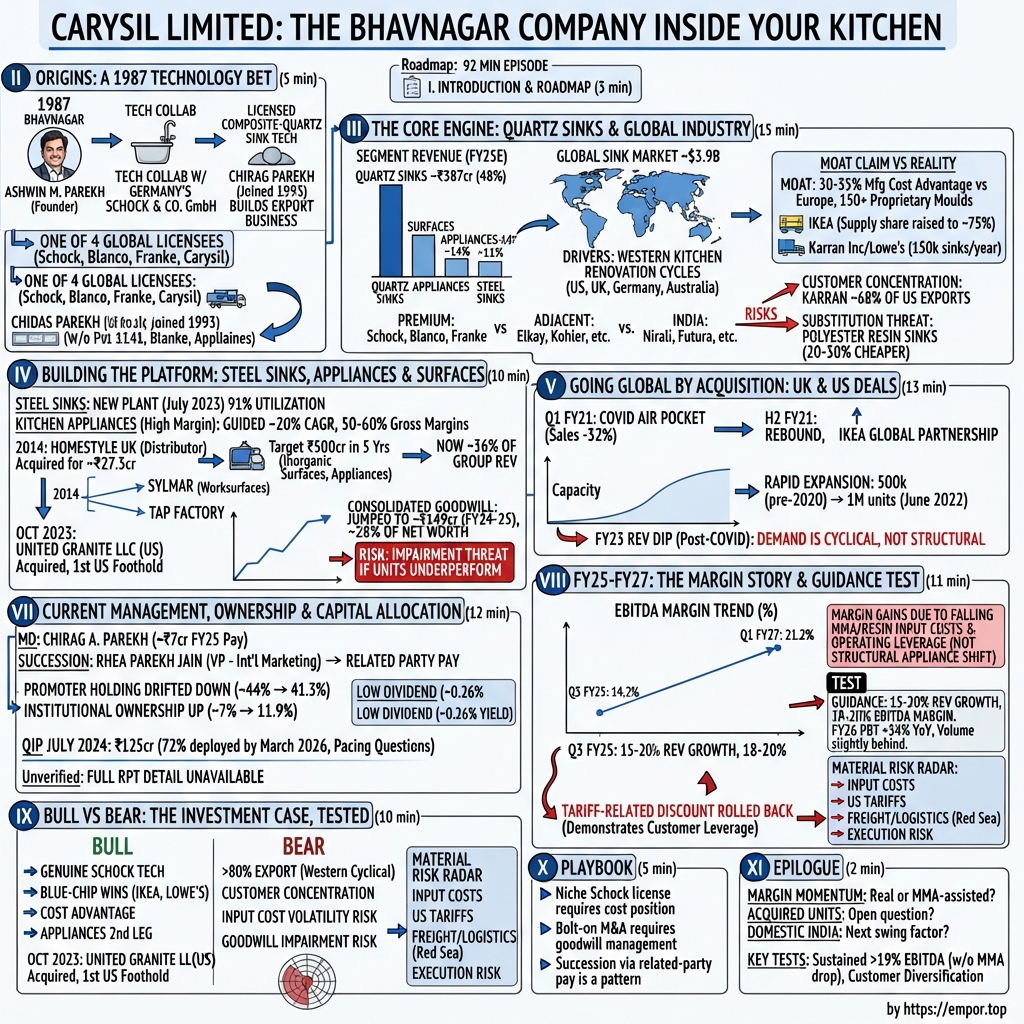
Carysil Limited: The Bhavnagar Company Inside Your Kitchen
I. Introduction & Episode Roadmap
Somewhere in a suburban kitchen outside Manchester, a homeowner runs a finger along the edge of a matte-black sink, feels the faint grain of quartz under the resin, and never once wonders where it came from. The box said IKEA. The showroom said Howdens. The Lowe's display in one of 1,800-plus American stores said Karran. None of them said Bhavnagar.
Bhavnagar is a port city on the Gulf of Khambhat in Gujarat, better known for shipbreaking yards and diamond polishing than for premium European kitchenware. And yet a factory there is one of only four places on the planet licensed to manufacture composite quartz kitchen sinks using the process developed by Germany's Schock & Co. GmbH — a process that, by Schock's own estimate, accounts for roughly 60–70% of global quartz sink production.1 The other three licensees are Schock itself, Blanco, and Franke. All German or Swiss. All European. Carysil is the only one in Asia.
That is a genuinely unusual sentence to be able to write about a mid-cap Indian manufacturer, and it is the reason this company is interesting. Carysil Limited — listed on the NSE as CARYSIL and on the BSE as 524091, and known as Acrysil Limited until it renamed itself in October 2022910 — sits at an odd intersection. It is an Indian factory with a German technology licence, a British distribution business, an American fabrication shop, a Gulf appliance operation, and a customer list that reads like a roll call of Western home-improvement retail.
In the financial year ended March 2026, that combination produced consolidated revenue of ₹924 crore and consolidated profit after tax of ₹99 crore, the latter up 53.9% year on year.2 Exports were ₹745.6 crore of that ₹924 crore — a shade over 80%.2 The company has been compounding revenue at roughly 24% a year over five years and profit at about 20%.7
So here is the tension that runs through everything that follows.
On one side: a scarce, capital-intensive technology position; a cost base that European competitors cannot match; a customer roster of blue-chip global retailers who have been increasing, not decreasing, their business; and a margin structure that improved sharply in FY26.
On the other side: a company whose demand is set almost entirely by kitchen-renovation cycles in the United States, the United Kingdom, Germany and Australia — cycles Carysil does not control and cannot forecast; a handful of very large buyers with correspondingly large bargaining power, one of whom successfully extracted a discount from Carysil during a tariff shock; roughly ₹151 crore of goodwill sitting on the balance sheet from acquisitions whose performance is uneven; and a subsidiary structure that in FY26 alone saw three legal entities struck off, deregistered, or dissolved.
The question this piece tests is not whether Carysil is a good company. It plainly is a competently run one. The question is narrower and harder: is the moat real, or is this a very well-executed contract manufacturer with an unusually good story attached?
The answer, as it usually is, is somewhere in between — and the interesting part is working out exactly where.
 Subscribe on LinkedIn
II. Origins: A 1987 Technology Bet
In 1987, an Indian industrialist deciding to license German polymer-composite manufacturing technology for kitchen sinks was, on almost every dimension, a strange decision.
India in 1987 was still four years from liberalisation. Imports were licensed. Foreign exchange was rationed. The domestic market for a premium kitchen sink — a product category that barely existed as a consumer choice in most Indian households — was effectively nil. The technology in question had been developed only eight years earlier, in 1979, by Schock & Co. GmbH, which had patented the material composition, the casting process, and the optimal ratio of quartz to resin.1 It was a German product for German kitchens.
Ashwin M. Parekh incorporated the company in Bhavnagar that year anyway, through a technical collaboration with Schock.1 The logic, insofar as it can be reconstructed, was not about the Indian market at all. It was about a manufacturing licence for a product that the world wanted and that only a handful of firms could make.
Here is what that licence actually meant, in plain terms. A composite quartz sink is not carved from stone and it is not moulded plastic. It is roughly 80% crushed natural quartz bound together with acrylic resin — methyl methacrylate, or MMA — and cast in a mould under controlled heat and pressure. The result behaves like stone: heat-resistant, stain-resistant, non-porous, and available in colours that stainless steel cannot offer. The difficulty is not conceptual. It is metallurgical and mechanical. Get the quartz-to-resin ratio wrong and the sink fades or cracks within a few years. Get the mould geometry wrong and the piece warps as it cools. Schock's patents covered exactly those variables.
Rather than build global capacity itself, Schock licensed the process to three other companies — Blanco, Franke, and Acrysil — under quality standards, geographic or product limits, and royalty arrangements.1 That decision, taken in Germany for German reasons of capital efficiency, is the single event that made the Bhavnagar factory possible. Carysil's technology position is inherited, not invented. This matters when assessing the moat: the company did not out-innovate anyone. It was let in.
What it did with that entry is the more interesting question, and the answer took a very long time to arrive.
Ashwin Parekh ran the business for decades as a small, respectable, slow-growing manufacturer. His son Chirag joined in 1993 and was appointed a director in November 2002.2 By FY2019 — thirty-two years after incorporation — consolidated revenue was ₹252 crore.7 That is not a growth story. That is a competent regional manufacturer with an interesting licence.
Ashwin Parekh died on 22 July 2019.23 The FY26 annual report opens with a tribute page describing a legacy "grounded in discipline, resilience, and continuous innovation."2 The more useful observation for an investor is that essentially the entire scale of the business that exists today was built after that point, and under his son. Revenue went from ₹252 crore in FY19 to ₹924 crore in FY26 — a 3.7x expansion in seven years, achieved through a combination of the export ramp, three UK acquisitions and one American one, and a pandemic that reorganised how the Western world spent money on its homes.72
So the founding matters chiefly as the source of the licence. The company investors own today is a much more recent construction — and the person who built it is the subject of a later section. First, the thing the licence actually produces.
III. The Core Engine: Quartz Sinks and the Global Sink Industry
Walk the Bhavnagar plant floor and the economics of this business become physical. The moulds are the story. Each one is a custom-engineered steel tool, specific to a single sink design and SKU, costing real money and lasting roughly fifteen years. Carysil holds more than 150 mould types supporting over 500 SKUs.1 A new entrant does not simply buy a licence and start selling; it buys a licence, then spends years and considerable capital building a mould library, then spends further years persuading a retailer to requalify its tooling.
That is the barrier-to-entry argument, and it is a real one. In FY26 the quartz sink segment sold 7.82 lakh units generating ₹465.85 crore of revenue at approximately 78% capacity utilisation — up from 6.45 lakh units, ₹363.61 crore, and roughly 65% utilisation in FY25.2 Quartz is comfortably the largest single line in the business, at roughly half of consolidated revenue. In the June 2026 quarter, management put the segment mix at 51% quartz, 25% surfaces, 12% stainless steel sinks, and 11.8% kitchen appliances.3
What the market actually is
The global kitchen sink market was valued at roughly $3.96 billion in 2025 and is projected to grow at around 5.3% annually through 2034.11 That is a decent, unspectacular category — and critically, it is not a consumables market. Nobody buys a sink because the old one ran out. They buy one because they are renovating a kitchen, and they renovate a kitchen when they feel wealthy, when interest rates permit a home-improvement loan, and when housing transactions are moving.
This makes Carysil, whatever its technology position, a levered play on Western home-improvement spending. Not a defensive staple. Not a consumer compounder. A cyclical.
The Indian market has a different shape. Stainless steel accounted for about 73% of the Indian kitchen sink market by material in 2024, with quartz and granite composites forecast to grow faster — roughly 8.4% annually to 2030 — from a small base.12 India is a penetration story; the West is a replacement-cycle story. They behave differently, and Carysil is exposed to both.
The competitive set, honestly drawn
At the premium end, Carysil competes with the three companies that share its technology: Schock, Blanco and Franke.1 These are established European brands with direct retail relationships and decades of consumer recognition. Carysil's advantage against them is not product superiority — they use the same process — but cost. Management and its sell-side coverage both put the gap at 30–35%, driven principally by the energy cost divide between European and Asian production.1
Two caveats belong immediately next to that number. First, it is a company and broker figure, not an independently audited one; no third-party cost teardown of Schock, Blanco or Franke is public. Second, a cost advantage against European incumbents is not the same thing as pricing power. It is the reason Carysil gets the order. It says nothing about what price Carysil gets.
At the value end sits the more interesting threat. Roughly 30–40% of the global composite sink market consists of non-Schock producers who substitute cheaper polyester resins and lower-grade quartz for the patented acrylic-and-quartz-crystal formulation.1 Carysil's management argues these products historically fail quality criteria and are prone to fading and cracking — which may well be true, and is also exactly what a licensed premium producer would say about a cheaper substitute. The relevant investor question is not whether the cheap sink is worse. It is whether the marginal buyer, standing in a big-box aisle looking at a 20–30% price gap, cares enough to pay up. In a soft housing market, some meaningful fraction does not.
And stainless steel remains the elephant. It is cheaper, easier to source, and carries decades of consumer familiarity in every geography.1 Carysil's own answer to this is instructive: rather than defend quartz against steel, it now manufactures both.
The proof points — and what they actually prove
Two commercial wins are the strongest evidence for the moat claim, and they deserve to be stated precisely.
The first is IKEA. Carysil participated in IKEA's global request-for-quotation for non-US business and won an order that raised its wallet share of IKEA's non-US quartz sink sourcing from approximately 25% to approximately 75%.24 To service it, Carysil committed roughly ₹20 crore to moulds, machinery and infrastructure.4 IKEA is one of the most demanding, most cost-disciplined supply chains in global retail. Tripling wallet share inside it, through a competitive RFQ, is genuine evidence of cost and quality position.
The second is Karran. The relationship began with an initial agreement in 2017, was renewed in FY24 through a five-year quartz sink supply contract worth approximately $68 million, and was extended in FY25 with an additional arrangement for roughly 150,000 sinks annually, displayed across 1,800-plus Lowe's stores in the United States.119 Carysil is Karran's sole supplier of quartz sinks.1 By Q1 FY26 management confirmed the supply had commenced and that orders had "exceeded our initial expectations."4
Now the qualification, which belongs here rather than in a risk appendix.
Both proof points are wins with a very small number of very large customers. Sole-supplier status to Karran is a strength when Karran is growing and a vulnerability the moment Karran decides to dual-source or Lowe's renegotiates its shelf economics. Carysil does not sell to the American consumer; it sells to Karran, which sells to Lowe's, which sells to the consumer. Two layers of intermediation sit between Carysil's factory and the person who actually chooses the sink — and each layer has its own margin to defend.
That is not a hypothetical. It has already happened once, visibly. When US tariffs on Indian goods rose, Carysil gave a discount to a large American customer to keep the business intact. By the June 2026 quarter, roughly 90% of that discount had been rolled back and prices restored to original levels.3 Management framed the rollback as a margin tailwind, which it is. But read the other direction, the same episode is direct evidence that a large customer can extract a price concession from Carysil during a shock and that Carysil will grant it. Management was candid about the mechanics on the Q1 FY26 call: on a hypothetical 50% tariff, Chirag Parekh said plainly, "somewhere we will bear, somewhere the customers will bear."4
The Lowe's arrangement carries the same signature. Carysil put $5–6 million into changing store displays for the Lowe's rollout, and management described a structure in which the customer asked Carysil's side to share 50% of a several-million-dollar cost across roughly 1,890 stores.3 That is what a large retailer's bargaining power looks like in practice: the supplier funds the shelf.
No evidence surfaced in the transcripts and filings reviewed here of Carysil losing a competitive OEM bid. But that reflects the limits of public disclosure — companies do not announce the RFQs they lose — not a confirmed clean record, and it should not be read as one.
The five-forces read
Run the standard framework and the picture is coherent rather than flattering. Threat of new entrants: low, and genuinely so — the licence, the mould library, and the requalification cost a customer bears to switch supplier are real, compounding barriers. Supplier power: medium, since quartz sand, MMA resin and specialty pigments require consistent purity and come from a restricted supplier pool, and moulds are custom-engineered such that changing mould suppliers is a lengthy re-engineering exercise.1 Threat of substitutes: medium — steel, ceramic and cheap polyester composites all bite at different price points. Competitive rivalry: moderate, and structurally differentiated by the cost asymmetry rather than fought on price.
Buyer power is where the model strains. When IKEA, Karran/Lowe's and Howdens collectively drive a large share of incremental volume, the technology advantage converts into order volume far more reliably than it converts into price. In Hamilton Helmer's vocabulary, Carysil has a credible claim to Cornered Resource (the licence) and Process Power (the mould library and casting know-how), and a decent claim to Scale Economies within its niche. It has essentially no Branding power in its export channel — 80% of that volume goes out under someone else's label, as management acknowledged as far back as 2020, when it put white-labelling including IKEA at around 80% of export business.5 And it has no Switching Costs on the consumer side at all, because there is no consumer relationship to switch.
The honest formulation is this: Carysil's moat is a supply-side moat. It protects the right to manufacture. It does not protect the right to price. That distinction determines almost everything about how the rest of the business had to be built.
IV. Building the Platform: Steel Sinks, Appliances, and Surfaces
If you cannot capture more margin on the sink, you sell the customer more of the kitchen.
That is, stripped of the corporate language, the logic of everything Carysil has done since roughly 2019. The annual report calls it "Carysil 2.0" and frames the ambition as building the "Largest Integrated Kitchen Solutions Hub in India," anchored to a stated long-term aspiration of $1 billion in revenue.2 That last number deserves to be treated as what it is — an aspiration attached to no date and no plan, sitting against FY26 revenue of ₹924 crore. Roughly a nine-fold expansion. It should carry no weight in an investment case.
The near-term version is more concrete and considerably more interesting.
Stainless steel: the quiet operational bright spot
The steel sink line is the highest-utilised asset in the portfolio and the one management appears least prone to overclaiming about. In FY26 the segment sold 167,000 units for ₹80.06 crore at approximately 93% capacity utilisation, up from 155,300 units and ₹66.96 crore at roughly 80% utilisation in FY25.2 A Phase I expansion of 70,000 units completed in Q1 FY27, taking total capacity to 250,000 units annually — and even after that addition, utilisation ran at about 94% on a weighted-average basis in the June quarter, with volumes up 16.3% year on year.32
The strategic significance is not the revenue, which is modest. It is the customer. Carysil entered OEM supply of stainless steel sinks to global brands — Kohler, Häfele, and in discussion Grohe — beginning with their Indian requirements, with the explicit possibility of extending to global requirements.42 On the Q1 FY27 call, Chirag Parekh said Kohler "has almost doubled their volumes with us."3
This is worth pausing on, because it is a different kind of validation than the quartz business provides. In quartz, Carysil is protected by a licence. In stainless steel, there is no licence and no patent — it is a commodity fabrication category with global competition. Winning Kohler's OEM business in steel is therefore evidence of manufacturing competence rather than inherited privilege. It is also, note, another concentrated OEM relationship, and it repeats the structural pattern: Carysil makes it, someone else brands it.
Management has since acquired adjacent land and begun construction of a new steel factory, with a long-term roadmap targeting 500,000 units annually.32
Kitchen appliances: the pocket that could change the margin profile
Chimneys, hobs, ovens, microwaves, food waste disposers, wine chillers, and — as of FY26 — built-in refrigerators. This is the segment most likely to matter to the long-term investment case, and the one most exposed to execution risk.
The mechanism is straightforward. Appliances carry structurally higher gross margins than cast sinks, so if the segment scales, it lifts the blended margin of the whole company without Carysil having to win a single pricing argument with IKEA. Carysil commenced Phase 1 in-house manufacturing of kitchen hoods and hobs at 50,000 units annually in FY26, with Phase 2 covering hobs, ovens, microwaves and food waste disposers targeting 100,000 units in FY27.2 Faucet assembly-cum-manufacturing was operationalised at 50,000 units annually with expansion to 100,000 planned.2
The volumes are still small in absolute terms. In Q1 FY27, appliances volume grew 12% year on year to 9,800 units, with 53% produced in-house; faucets grew 43% to 12,500 units, with 67% manufactured in-house.3 Those in-house percentages are the number to watch. An appliance that Carysil imports and rebadges earns a distribution margin. An appliance Carysil manufactures earns a manufacturing margin. The gap between those two is the entire thesis for this segment, and it is currently about half-converted.
Management was refreshingly direct about the limits when asked. On refrigerators: "we are outsourcing," and on the addressable Indian market for built-in refrigerators, "we are in a very early stage of this. Probably in the next few quarters, I'll be able to answer this more precisely."3 That is a more honest answer than most managements give about a new category, and it should be read as such — but it is also a reminder that this is an early-stage business being asked to carry a meaningful share of a growth narrative.
There is relevant history here. In FY19, Carysil announced it had begun manufacturing 3D composite wall tiles, describing itself as "the first company in Asia and second in world with this sort of technology."6 Seven years later, wall tiles appear nowhere in the segment disclosure. In the same call, management said a supply agreement with Grohe for quartz sinks had "potential to bring in about additional revenue of approximately $7 million to $8 million in the next three years."6 Grohe remains a named customer, but the company has never disclosed whether that specific revenue target was met. The lesson is not that management is dishonest; it is that Carysil has a demonstrated habit of announcing technical firsts and framework agreements that do not convert into disclosed, durable revenue lines. Applied to appliances, the appropriate posture is to size the segment on shipped units and in-house manufacturing share, not on capacity announcements.
Surfaces and the domestic push
Surfaces — engineered worktops and countertop fabrication — arrived almost entirely by acquisition and now runs at roughly a quarter of group revenue.3 It is examined in the next section, because its story is an M&A story.
The domestic India push is the second growth engine, and it is the one that finally gives Carysil a consumer relationship rather than an OEM one. Domestic sales reached approximately ₹56 crore in Q1 FY27, up nearly 40% year on year, driven by 25% volume growth and 12% average realisation growth.3 Across categories, domestic quartz sinks grew 31%, steel sinks 60%, appliances 28% and faucets 45%.3 The company plans to expand its dealer network from 4,500 to 10,000, is opening brand stores and experience centres, and is targeting domestic revenue of over ₹500 crore over the next five to six years, against roughly ₹176–178 crore today.23
The strategic case is strong. The execution case is unproven. In India, Carysil's 30–35% cost advantage over European producers is irrelevant — it is competing against Nirali, Futura, Jayna, Ruhe and Hindware on their home turf, plus Franke-branded imports at the top end, in a market where stainless steel still holds roughly three-quarters of the volume.12 Winning here requires brand and distribution, which are precisely the two capabilities the export business never forced Carysil to build.
That asymmetry — world-class at manufacturing, unproven at branding — is the through-line of the acquisition record too.
V. Going Global by Acquisition: The UK and US Deals
In December 2014, a mid-cap Indian sink manufacturer with roughly ₹150 crore of revenue bought a British company.
Acrysil agreed to acquire 100% of the share capital of Homestyle Products Ltd — a designer, manufacturer and distributor of stainless steel kitchen sinks, taps and accessories — for an enterprise value of approximately ₹27.3 crore on a cash-free, debt-free basis, initially taking a 75% stake.13 It drew almost no market attention at the time. Domestic investors were not, in 2014, spending much energy on whether an Indian small-cap could integrate a British distributor.
It turned out to be the most consequential capital allocation decision in the company's history.
Renamed Carysil Products Ltd and held under Carysil UK Limited, that business and its sister entity now form the largest overseas unit in the group. In FY26, Carysil UK Limited on a consolidated basis delivered turnover of ₹280.71 crore — 30.38% of group turnover — and profit after tax of ₹30.90 crore, or 31.22% of group profit.2 Bought for ₹27.3 crore, it now earns more than that in a single year.
The strategic logic is worth naming, because it explains the entire subsequent acquisition programme. Carysil's export model sells through other people's brands and other people's shelves. Buying a UK distributor bought something the Bhavnagar factory could never manufacture: a direct relationship with British retailers, merchants, contractors and OEMs. It converted Carysil from a supplier into a participant in the channel. Howdens — the largest kitchen manufacturer in the UK — became a customer through that route.4
The 2022–23 bolt-ons
Having proved the model once, management ran it three more times in eighteen months.
In 2023, Carysil UK Ltd acquired 100% of Tickford Orange Ltd, the holding company of Sylmar Technology Ltd, a worksurfaces business, at a valuation of approximately 0.89 times price-to-sales.1 It was renamed Carysil Surfaces Ltd. This is where the surfaces segment came from, and the commercial logic was elegant: in the UK, a kitchen sink is typically sold installed into a worktop, so owning the worktop business meant owning the moment the sink gets specified.
Carysil also acquired a 70% stake in The Tap Factory Ltd, a Yorkshire tap manufacturer — its third UK acquisition — at an undisclosed price.1415 It became Carysil Brassware Ltd. Management later explained the rationale candidly: "we acquired this company primarily to get the technology of the RO water system."3
In October 2023, Carysil USA Inc. acquired United Granite LLC, a Virginia-based countertop fabrication business with roughly $12.4 million of revenue, at approximately 0.63 times price-to-sales.161 It was Carysil's first manufacturing and fabrication foothold in the United States.
Benchmarking: cheap, on the numbers available
At 0.6–0.9 times revenue, these read as inexpensive bolt-ons rather than expensive platform bets. For context, buying a distribution or fabrication business at under one times sales is the kind of multiple typically available for businesses with modest margins, limited growth, or a motivated seller — not the kind of multiple paid for strategic trophies. On the price paid alone, it is genuinely hard to accuse this management of overpaying.
That inference should be stated at the confidence the evidence supports. Full profitability-adjusted peer comparables for small UK worksurface and US countertop fabrication businesses are not public, and Carysil disclosed neither EBITDA nor the purchase price for The Tap Factory. Cheap on price-to-sales is not the same as cheap on economics.
The disconfirming evidence
Here is where the "disciplined bolt-on M&A" claim meets its test, and the record is genuinely mixed.
Consolidated goodwill on the balance sheet stood at ₹113.84 crore as of 31 March 2026, plus a further ₹37.04 crore of net goodwill carried within intangible assets — roughly ₹151 crore against consolidated net worth of ₹608.42 crore, or about 25%.2 The company's auditors designated the carrying value of goodwill a Key Audit Matter for FY26, noting that annual impairment testing "requires significant judgment on the part of management in identifying and valuing the relevant cash generating unit," and that the Group's consolidation process "is complex on account of its presence in various geographies and multiple businesses through different ownership structure."2 No impairment has been booked. But an auditor flagging goodwill as a Key Audit Matter is an explicit signal that this is a judgment-heavy number resting on management's own cash flow forecasts and discount rates.
Then the harder facts.
Carysil Brassware Limited — The Tap Factory, acquired in 2023 — was dissolved with effect from 9 June 2026.2 In the FY26 Schedule III disclosure it contributed nil net assets and nil profit.2 Management's stated rationale for the acquisition was technology transfer for the RO water system, and by that measure it worked: the RO-integrated faucet launched in India, the first consignment sold out, and management described a 60-day order backlog.3 But the acquired entity itself no longer exists three years after purchase. Whether that reads as efficient asset-stripping of the useful IP or as a bolt-on that failed as a business depends on disclosure the company has not provided. Both readings are available; neither supports an unqualified "disciplined M&A" narrative.
Carysil Ankastre Sistemleri Ticaret Limited Şirketi, the Turkish subsidiary, was deregistered from the Istanbul Trade Registry effective 4 March 2026.2 Carysil Ceramictech Limited, incorporated in 2022, never generated revenue, had its investment fully impaired, and was voluntarily struck off effective 1 June 2026.2 The amounts are trivial — the Ceramictech investment was ₹0.05 crore.2 But three entity wind-downs in a single financial year is a pattern, not a coincidence, and it belongs in the record next to the successes.
And then the United States.
Management's own commentary has been openly candid about United Granite's difficulties. On the Q1 FY26 call, the company disclosed that United Granite recorded EBITDA of ₹1.2 crore in FY25, that Q1 FY26 EBITDA rose to ₹1.8 crore from ₹0.4 crore, and — critically — that the PAT-level loss had reduced from ₹2.2 crore in Q1 FY25 to ₹0.8 crore in Q1 FY26.4 A reduced loss is not a profit.
The FY26 annual report describes "a remarkable turnaround," reporting positive EBITDA of ₹11.4 crore in FY26 against an EBITDA loss of ₹1.3 crore in FY24.2 On the Q1 FY27 call, Chirag Parekh explained the operational fix — a strategy he summarised as "cut less make more," involving a $1 million inventory investment in high-end exotic Italian stones, which he said moved gross margins "from 35% to 50%."3
Now hold that against the Board's Report disclosure for the same year. Carysil USA Inc. on a consolidated basis reported FY26 turnover of ₹87.02 crore — 9.42% of group turnover — and profit after tax of ₹0.08 crore, equal to 0.08% of group profit.2 The Schedule III note shows United Granite LLC carrying ₹3.78 crore of net assets and contributing zero to consolidated profit.2
So: the American business is roughly a tenth of Carysil's revenue and approximately none of its profit. The EBITDA turnaround appears real. The translation into earnings has not yet happened. An investor reading only the management discussion would come away with "remarkable turnaround"; an investor reading the Board's Report subsidiary table would come away with "breakeven." Both statements are in the same document.
The calibrated conclusion: the history does not reject the claim that Carysil buys assets cheaply — the Homestyle outcome is strong affirmative evidence, and the purchase multiples are genuinely low. It does narrow the claim substantially. Carysil has demonstrated it can buy a distribution business cheaply and grow it over a decade. It has not yet demonstrated that the 2022–23 vintage of deals earns its goodwill. One of those four acquisitions has been dissolved, one is at breakeven, and the two UK entities operated into a contracting market — the FY26 annual report itself states that both Carysil Products Limited and Carysil Surfaces Limited "faced revenue headwinds as the UK market contracted."2
The KPI that resolves this is specific and checkable: profit after tax at Carysil USA Inc., disclosed annually in the Board's Report subsidiary table. If it stays near zero for another two years while goodwill stays at ₹151 crore, the impairment question stops being theoretical.
That leaves the one relationship that has unambiguously worked — and it arrived in the strangest possible year.
VI. The COVID Inflection and the IKEA Partnership (2020–2022)
April 2020. The Bhavnagar plant was shut. Ports were congested or closed. Western retail was dark. In the quarter to June 2020, Carysil's sales fell roughly a third year on year — a genuine air pocket, and for a company whose revenue was 80% export, an existential-feeling one.
Then something no one modelled happened. Locked-down households in America, Britain, Germany and Australia looked around at their kitchens for the first time in years and started spending. By the November 2020 earnings call, Chirag Parekh was describing a demand environment that had inverted: "Buoyancy in demand was visible from July 2020 onwards," he said, adding that with people confined at home, "Home is the focal point across the world."5
On that same call, Carysil announced the most consequential customer relationship in its history: a strategic partnership with IKEA Supply AG, Switzerland, for the manufacture and supply of composite quartz kitchen sinks for IKEA's global requirement, with supply expected to begin by the end of that calendar year.5
The details management gave were characteristically limited and characteristically honest about the limits. Asked how much capacity IKEA would absorb and what the margin profile looked like, Parekh declined to commit: "I will not be able to comment on what exact capacity IKEA will require."5 Asked whether the models were new, he said they were existing IKEA products with a proven track record.5 Asked what proportion of export business was white-labelled, the answer was blunt — around 80%, including IKEA, with roughly 20% under the Carysil brand.5
That same call carried two other markers. ICRA upgraded the company's external credit rating to A- from BBB+.5 And management announced a 20% capacity expansion in quartz sinks, from 500,000 to 600,000 units annually.5
Then the capacity race
What followed was the aggressive part. Capacity went from 600,000 units to 840,000 by October 2021 and to 1,000,000 units by June 2022 — a doubling in under two years, from a starting point where the company had just described 600,000 as sufficient "to meet the existing demand in the export and domestic market."5
Was that foresighted capacity planning or pandemic extrapolation? The subsequent numbers answer the question with unusual clarity. Consolidated operating margin, which had run at 22% in both FY21 and FY22, fell to 18% in FY23.7 Quartz utilisation, on the newly doubled base, was approximately 65% in FY25 — meaning a third of the plant sat idle three years after commissioning.2 Western renovation spending cooled as interest rates rose, and the demand that justified the expansion simply did not show up on schedule.
To management's credit, it has not claimed otherwise, and it has not rewritten the history. It has also, by FY26, largely grown into the capacity: utilisation recovered to approximately 78% for the full year and to about 88% in Q1 FY27, with management noting June 2026 alone ran near 90%.23 The plant that looked over-built in FY23 looks tight in FY27, and a further expansion from 1.0 million to 1.25 million units is underway at roughly ₹50 crore, targeted for completion by Q4 FY27.23
The investor takeaway is not that the expansion was wrong. It is that the demand this business serves is cyclical, that a three-year gap between building capacity and filling it is a realistic outcome in this industry, and that anyone underwriting the current 1.25-million-unit expansion should assume the same possibility rather than the extrapolation of FY26 order books. Management's own framing on the Q1 FY27 call — "when your company reaches at almost 90% capacity utilisation, you need to build another 20%, 25% of excess capacity" — is a reasonable operating heuristic and also, precisely, what was said in 2020.3
A small governance note
One dated exchange from the November 2020 call is worth recording for completeness rather than alarm. A shareholder asked why the promoter group, at roughly 44%, was not raising its stake toward 51%. Parekh pointed to warrants the promoters had subscribed to and converted the prior year — an investment of about ₹8.5 crore — and then said, straightforwardly, "I do not have immediate answer to this, but the promoters will see and keep a track on the environment."5 No firm commitment was given, and none has been made since. There is no activist investor on the register and the question has not been escalated in the intervening six years. It is noted here because promoter stake has since drifted lower, not higher — which is the subject of the next section.
VII. Current Management, Ownership, and Capital Allocation
Chirag Ashwin Parekh holds a B.B.A. from European University, Switzerland, joined the family business in 1993, was appointed a director on 2 November 2002, and is 56 years old.2 He is Chairman and Managing Director of Carysil Limited and also runs Carysil USA Inc. He personally holds 30.35% of the company's equity.2 Across the FY19, FY21, FY26 and FY27 earnings calls reviewed here, his style is consistent: expansive on opportunity, specific on operations, occasionally rambling under analyst pressure, and — usefully — willing to say "I don't know."
That last quality is rarer than it sounds. When an analyst pressed on demand for built-in refrigerators in India, the answer was that it was too early to say.3 When asked why quartz volume growth was only 6% in a quarter management was otherwise celebrating, he attributed it directly to container delays and customer-nominated shipping slipping into the following quarter, without dressing it up.3 That explanation is plausible — export businesses on FOB terms genuinely do lose quarter-end shipments to logistics — but it is management's own account, not independently confirmed, and it is the kind of explanation that becomes less credible if it recurs. It is worth probing on the next call.
He is also, at times, prone to the grander register. "Every Indian should drink a water from our Carysil faucet is our dream," he told the Q1 FY27 call.3 The $1 billion revenue aspiration in the annual report belongs to the same voice. Investors should discount these appropriately and weight the operating detail instead — which, notably, has been reliable.
Guidance discipline
Assessed on the behaviour that actually matters — setting targets and hitting them — the record is decent.
In November 2020, with revenue at ₹310 crore, management restated a public goal of ₹500 crore "in less than five years."57 Consolidated revenue reached ₹594 crore in FY23 — three years later.7 Target met, early.
The current framework is a medium-term guide of roughly 15% revenue growth with an 18–20% EBITDA margin. FY26 delivered 13.3% revenue growth and a 19.9% EBITDA margin — profit comfortably in the band, revenue marginally below it.2 Entering FY27, management maintained the 15% revenue guidance and stated it was tracking toward the upper band of the margin range.3
One friction point from the Q1 FY27 Q&A is worth flagging as a disclosure quality issue rather than a credibility one. Two separate participants asked whether the 15% guidance referred to value or volume. Parekh's answers moved from "value guidance" to "15% on the value and 15% on the volume across the categories" to "you can take volume growth 15%" — an exchange the questioner explicitly described as confusing.3 Against a Q1 in which quartz volume grew 6% while total revenue grew 16.5%, a 15% volume guidance for the full year is a materially more demanding commitment than a 15% value guidance.3 The company should clarify which it means, and investors should track quartz unit volumes rather than take either version on faith.
Ownership
Promoter holding has drifted down: 43.84% in March 2024, 41.37% in March 2025, and 41.34% as of June 2026.7 Over the same window, domestic institutional holding rose from 7.32% to 11.91% and foreign institutional holding from 0.87% to 1.63% — combined institutional ownership expanding from roughly 8.2% to 13.5%.7
The dilution was mechanical, not a promoter exit: the July 2024 QIP issued new shares to institutions. The promoter did not sell down; his percentage was diluted while institutions bought in. That is a materially different signal from a promoter reducing stake in the open market.
On pledging: the FY26 annual report discloses that shares of Carysil UK Limited — a subsidiary, not promoter-held equity — are pledged with a financial institution against finance availed by that subsidiary.2 That is ordinary subsidiary-level structured finance. A primary-source filing on promoter share pledging was not located in this research pass; the claim is therefore "not found in the records reviewed," which is not the same as confirmed zero.
Pay — the design gap
Chirag Parekh's remuneration in FY26 was ₹874.06 lakh — roughly ₹8.74 crore, including commission.2 That is 231.23 times the median employee remuneration of ₹3.78 lakh.2 His remuneration rose 24.41% during the year. Median employee remuneration rose 1.34%. Average salary increases for non-managerial employees were 8.07%, against 23.05% for managerial personnel.2 Anand Sharma, Executive Director and Group CFO, was paid ₹84.23 lakh — under a tenth of the MD's package.2
The company had 478 permanent employees as of 31 March 2026.2
The structural observation is not that the amount is outrageous by Indian promoter-CEO standards; it is that the commission component is tied to profit. FY26 profit rose 53.9%; MD pay rose 24.41%. The formula worked as designed. What it does not do — on any disclosure located here — is tie compensation to return on capital employed or to capital efficiency. For a company that has just raised equity, is running a multi-year capex programme across five product lines, and carries ₹151 crore of goodwill whose value depends on acquired units earning their cost of capital, a purely profit-linked incentive is a design gap worth naming. It rewards growing the P&L. It is indifferent to how much capital was consumed getting there. ICRA made effectively the same point in credit language, noting that the company's "ability to successfully scale up operations to generate commensurate returns" from its capex "remains critical from the credit perspective."8
Succession, arriving through the pay resolution
Rhea Parekh, Chirag Parekh's daughter, holds a Bachelor of Fine Arts from Parsons School of Design, New York. She was previously elevated to Vice President – International Marketing with an enhanced package via a related-party resolution at the FY2023-24 AGM.20 In the notice accompanying the FY2025-26 annual report, the board proposed promoting her again — to Senior Vice President (International Marketing), effective 1 October 2026, with enhanced remuneration, describing her role as "pivotal in advancing our global marketing strategies" and "integral to our organisational shift towards a centralized approach to international marketing."2
The resolution was placed as a related-party transaction under Section 188, with Chirag Parekh, Rhea Parekh and related parties barred from voting.2
The observation is not that this is improper. The disclosure is complete, the voting restriction is correct, and the marketing-centralisation rationale is coherent. The observation is about pattern recognition: two promotions in roughly two years, both surfacing as related-party remuneration items rather than as governance announcements. This is what family succession in an Indian promoter company usually looks like on the way in — a compensation line item before it is ever a leadership line item. Investors who want to understand the shape of the company in a decade should read the AGM notice, not the press release.
The capital allocation record
The 2018 preferential warrant issue to promoters, converted in 2019, put roughly ₹8.5 crore of promoter money into the company at a moment when the stock was far below current levels — promoters buying in, which is a genuine positive signal.5
The July 2024 qualified institutional placement raised ₹125 crore, allotted on 3 July 2024, for capital expenditure, working capital and general corporate purposes.2 By the quarter ended March 2026 — twenty-one months after allotment — total utilisation stood at ₹87.86 crore of ₹121.65 crore net proceeds, leaving ₹33.79 crore unutilised and parked in bank deposits, and the board extended the capital expenditure utilisation deadline to 31 March 2027.21 The company has confirmed there was no deviation from stated objects, and utilisation is reviewed quarterly by the Audit Committee under a monitoring agency.2
There is no impropriety here. There is a pacing question. A company that raises equity for expansion and then takes more than two years to deploy roughly three-quarters of it is either encountering execution friction or was not as capital-constrained as the raise implied. FY26 capital expenditure was approximately ₹68 crore, and management guided to ₹80–90 crore in FY27, of which ₹40–50 crore is for granite sink expansion, ₹20 crore for stainless steel, and ₹20 crore for faucets and appliances.23 The residual QIP balance funds a meaningful share of that. The spend is now happening; it simply started later than the raise suggested it would.
The balance sheet is comfortable. Standalone debt-to-equity improved from 0.30x to 0.24x, return on capital employed from 11.22% to 16.38%, and return on equity from 11.10% to 14.55%.2 ICRA reaffirmed [ICRA]A (Stable) for long-term facilities and [ICRA]A2+ for short-term in April 2025, with interest coverage of 6.7 times in FY24 and 5.7 times in 9M FY25.8 Worth noting for calibration: that rating has been [ICRA]A (Stable) since at least April 2022 — reaffirmed, not upgraded, through a period in which revenue grew roughly 90%.8 ICRA's stated challenges are consistent with everything above: high working capital intensity, negative free cash flow from sustained capex, and profitability vulnerable to resin price movements.8
The dividend — ₹3 per share, a 150% payout on face value, yielding roughly 0.26% — is nominal and consistent with a reinvestment-first posture.27 There is no buyback history located in the records reviewed.
Which brings us to the year in which all of this was supposed to show up in the numbers.
VIII. FY25–FY27: The Margin Story and the Guidance Test
The December 2024 quarter was the moment the market found out what a cyclical looks like when the cycle turns.
Consolidated net profit fell 18.51% year on year despite revenue growth of about 8%.17 Quartz capacity utilisation for FY25 as a whole sat at approximately 65%.2 United Granite was losing money at the PAT level.4 Freight costs were elevated and resin prices had risen sharply — ICRA recorded consolidated operating margin moderating to 16.7% in the first nine months of FY25 from 19.1% in FY24, attributing it explicitly to elevated freight and raw material costs.8
That is the honest baseline. Eighteen months before writing this, Carysil was a company with a third of its flagship plant idle, a loss-making American subsidiary, and margins compressing under input costs it could not pass through fast enough.
Then it turned, and it turned hard.
What actually happened to the margin
The March 2025 quarter rebounded on the Karran/Lowe's rollout and the IKEA share increase. FY26 then delivered the re-rating: consolidated revenue of ₹924 crore, up 13.3%; consolidated PAT of ₹99 crore, up 53.9%; PAT after minority interest of ₹98.2 crore; EBITDA margin of 19.9%, up from 17.3%.2 The March 2026 quarter alone saw consolidated net profit rise 45.86% year on year.18 By the June 2026 quarter, total income reached ₹264.8 crore against ₹227.3 crore, EBITDA rose 27% to ₹56 crore, and EBITDA margin expanded 175 basis points to 21.2% — the highest in the recent run — with PAT after minority interest up 37.7% to ₹31.4 crore.3
A 260-basis-point full-year margin expansion on 13% revenue growth is a large move. The entire investment question is what caused it.
Testing the "structural" framing
Management's position on the Q1 FY27 call was explicit and, to its credit, unprompted: "The improvement in the profitability is not given by a single factor or a one-off benefit. We are seeing benefits from operating leverage, product mix, efficiency, and scale, and we expect these factors to continue to support our margins."3
Asked directly about price increases, Parekh gave a three-part answer that is more revealing than the prepared version: operating leverage first, "the rollback of the discounts in the United States has also come back" second, and a full line of premium products in stainless steel and granite third.3
Unpack those three and they are not equally durable.
Operating leverage is real and mechanical. Quartz utilisation went from ~65% to ~78% to ~88%; steel from ~80% to ~93% to ~94%.23 Fixed costs spread over more units is the least controversial margin driver in manufacturing, and it is genuinely earned.
Product mix is real but early. Premium SKUs, PVD finishes, workstation formats and higher-ASP domestic sales in India — where realisation grew 12% in Q1 FY27 — do lift blended margin.3 But appliances and faucets together are still under 12% of revenue, and about half of appliance volume is still outsourced.3 This lever is directionally right and quantitatively small.
The discount rollback is not durable at all. It is the reversal of a concession granted under tariff pressure. Roughly 90% of it came back, landing in the final month of the March 2026 quarter.3 It flatters year-on-year comparisons for four quarters and then annualises out. And it exists only because a customer was able to extract it in the first place — meaning the same mechanism can run in reverse the next time trade policy moves.
The fourth driver, which management referenced in the annual report rather than the call, is input cost. The FY26 annual report attributes margin improvement to "operational efficiencies, better product mix, and stabilisation in freight and raw material costs."2 The Q1 FY26 call was more explicit still, with the CFO noting margin expansion "due to stabilisation of raw material and freight costs."4
That is the honest summary: Carysil's FY26 margin expansion is a genuine operating-leverage story sitting on top of an input-cost tailwind and a one-off price restoration. The operating leverage is durable as long as volumes hold. The other two are not. MMA resin is a petrochemical derivative; its price cycles, and ICRA explicitly flags Carysil's profitability as vulnerable to resin price movement with the ability to pass through cost increases described as "critical."8 The company has not disclosed any hedging programme for it.
So the language matters. "Structural transformation" is not the right description of FY26. "Cyclical recovery plus genuine operating leverage plus a one-time price restoration" is. Management, notably, has not used the word structural — it has said the drivers "will continue to support our margins," which is a forecast, not a claim about permanence. That distinction is worth preserving on the reader's behalf.
The falsification test is clean and stated by management's own numbers: sustained EBITDA margin above 19% in a period when resin prices are rising rather than stable. Until that happens, the margin story is real but assisted.
The volume question
Q1 FY27 quartz volume grew 6% year on year to 2.01 lakh units, against 22% growth in the year-earlier quarter.34 Steel volumes grew 16%, faucets 43%, appliances 12%.3 Domestic sales grew 39.8% while exports from Indian operations grew 10.6%.3
Management attributed the quartz softness to container delays and to customers' nominated shipping slipping by a week or two, pushing a large volume of end-of-quarter dispatches into Q2, and separately acknowledged that "U.K. is going through a bit of a tight phase."3 The UK acknowledgment matches the annual report's own statement that both UK subsidiaries faced revenue headwinds as that market contracted.2
Both explanations are plausible. The order book claim supports them — Parekh described the company as "probably sitting on the highest ever export order booking right now" and said the factory "has to literally run now 7 days a week."3 A supplier genuinely short of capacity does behave this way. But an order book is a management assertion; shipped volume is a fact. The gap between the two resolves itself in the September and December quarters, and that is where the reader should look.
The company also disclosed three new commercial relationships in the June quarter: an extended partnership with Home Depot in the US and Canada, a collaborative agreement with Häfele Australia and New Zealand, and first orders into Amazon USA.3 Each of these, if it scales, does something the margin story cannot: it reduces the share of incremental growth coming from IKEA and Karran. That is the diversification the bear case demands, and it is the first concrete evidence of it. It is also, so far, three announcements — and this company's record on converting announcements into disclosed revenue lines is, as established, mixed.
IX. Bull vs. Bear: The Investment Case, Tested
Why this company can keep winning
Start with what is not in dispute. Carysil holds one of four global licences to a manufacturing process that accounts for the majority of world quartz sink production, and it is the only Asian holder.1 It has converted that position into share gains at two of the most demanding customers in global home retail, tripling wallet share at IKEA through a competitive RFQ and becoming Karran's sole quartz supplier into Lowe's.21 It has a durable structural cost advantage over its three licensed peers, rooted in the energy cost differential between European and Asian manufacturing.1
It has demonstrated, in stainless steel, that its manufacturing competence extends beyond the licensed category — winning Kohler and Häfele OEM business in a category with no patent protection at all.32 It has a second growth leg in India growing at nearly 40% year on year from a small base, which for the first time gives it a direct consumer relationship.3 It has a balance sheet in good order post-QIP, with debt-to-equity at 0.24x, ROCE recovered to 16.4%, and a stable investment-grade domestic rating.28
And it operates in a category with unusually low new-entrant threat. The mould library, the tooling requalification cost a customer bears to switch supplier, and the licence itself are three separate, compounding barriers.1
Why it may not
Every one of those strengths has a specific, mechanism-level counterweight.
Cyclicality is not a footnote, it is the business model. Exports were 80.7% of FY26 revenue, concentrated in US, UK and European housing renovation.2 Carysil has already lived one full cycle of this: it doubled quartz capacity into the pandemic renovation boom and then ran that plant at roughly 65% utilisation in FY25 as Western renovation cooled with rates.2 It is now expanding capacity by a further 25% into a recovering market. The pattern is not disqualifying — it is what manufacturers in cyclical categories do — but it means the current 88% utilisation is a cycle-high datapoint, not a run-rate.
Buyer power is demonstrated, not hypothetical. The tariff discount was granted and only later rolled back.3 Carysil funded $5–6 million of Lowe's display costs, with the customer requesting a 50% share of a multi-million-dollar programme.3 Sole-supplier status to Karran is an asset until it is a dependency. Roughly 80% of export volume ships under someone else's brand.5 A supplier in this position captures volume, not price, and the FY26 margin expansion — driven by utilisation, mix, cost deflation and price restoration rather than price increases — is entirely consistent with that reading.
The margin gain leans on a reversible input. Discussed above; the specific falsifier is margin durability through a rising resin cycle.
Goodwill is a live question, not a resolved one. ₹151 crore against ₹608 crore of net worth, flagged as a Key Audit Matter, supporting a US business that generated 9.42% of group turnover and 0.08% of group profit, alongside two UK entities operating into a contracting market and one acquired entity already dissolved.2
Execution risk is concentrated in time. Simultaneous expansions are underway in quartz (1.0m to 1.25m units), stainless steel (to 250,000, roadmap to 500,000), appliances (to 100,000), faucets (to 100,000), a new steel factory on newly acquired land, a CNC surfaces fabrication unit in India, 180 retail stores over two years, and a dealer network expansion from 4,500 to 10,000 — all against a "next ₹1,000 crore" framing.23 Any one of these is manageable. All of them at once, in a company with 478 permanent employees, is a genuine bandwidth question.2
An activist would go after three things. First, the pay formula: 231x median, up 24% in a year when median pay rose 1.3%, with no disclosed link to capital efficiency in a capital-hungry business.2 Second, the QIP pacing: ₹33.79 crore still undeployed twenty-one months after a raise justified by expansion urgency, with the deadline extended.21 Third, disclosure asymmetry: the annual report's narrative section describes a "remarkable turnaround" at United Granite while the Board's Report subsidiary table shows the American operation at 0.08% of group profit.2 Neither statement is false. Presenting the first prominently and the second in a table is a choice.
The calibrated verdict on the moat
Weighing the affirmative evidence against the disconfirming record: the moat claim survives, but in a narrower form than management's framing implies.
What the evidence supports is a supply-side moat — a defensible, capital-intensive right to manufacture a technically demanding product at a cost European peers cannot match, validated by competitive RFQ wins at customers with no reason to be sentimental. That is genuinely valuable and genuinely hard to replicate.
What the evidence does not support is pricing power. Across every episode where price was tested — the tariff discount, the Lowe's display cost-share, the white-label share of exports, the absence of price increases as a stated margin driver in the best margin year in the company's history — the customer set the terms and Carysil accepted them. The history does not reject the moat. It relocates it, from the income statement's top line to its cost line.
The version of the bull case that survives this test is therefore: a low-cost manufacturer with a scarce licence, compounding volume through share gains at large customers, converting operating leverage into margin, and attempting to build a branded consumer business in India that would — if it works — give it price-setting ability it does not currently have. That is a decent business. It is not a fortress.
The KPIs that matter
Three, and only three.
One: quartz sink capacity utilisation. This is the cleanest single read on whether Western renovation demand is genuinely recovering or merely restocking, and it is disclosed quarterly in the company's results and investor presentations.22 It has run 65% (FY25) → 78% (FY26) → 88% (Q1 FY27). It will be diluted mechanically when the 250,000-unit expansion commissions in Q4 FY27; the question is how fast it climbs back.
Two: kitchen appliances and faucets revenue growth, together with the in-house manufacturing share. The segment is the entire basis for any structural margin improvement, and the in-house percentage — 53% for appliances, 67% for faucets in Q1 FY27 — is what separates a manufacturing margin from a trading margin.3 Announcements about new categories are not evidence; shipped in-house units are.
Three: profit after tax at Carysil USA Inc. and Carysil UK Limited, as disclosed in the annual Board's Report subsidiary table. This is the direct test of whether the acquired businesses are earning their goodwill, and it is the number that determines whether the impairment question ever becomes real. It is disclosed once a year, in a table most readers skip.
The risk radar, mechanism-only
Input cost volatility in MMA resin and steel, which drives the margin story directly and is unhedged on available disclosure.8 US trade policy, evidenced not as a theoretical exposure but as an actual price concession already granted and partially reversed.3 Freight and logistics on an FOB export model, already the stated cause of a quarterly volume miss.3 Goodwill impairment from the UK and US acquisitions, auditor-flagged.2 Working capital intensity and negative free cash flow through the capex programme, flagged by the rating agency.8 Execution across the simultaneous expansions above.
Notably absent from that list: technology disruption. Kitchen sinks are not being disrupted by artificial intelligence, and the risks that matter here are the old-fashioned industrial ones — input prices, freight, tariffs, housing cycles, and whether a factory in Gujarat can build five things at once.
X. Playbook: What This Company Teaches About Niche Manufacturing and Family-Run Compounders
Three lessons travel beyond Carysil.
A narrow, technically defensible process is durable only when it is paired with a cost position, not substituted for one. Carysil and Schock hold the same licence. Schock is the licensor and the brand. Carysil is the one adding capacity and winning RFQs, because it makes the same product 30–35% cheaper.1 The licence gets you into the room; the cost position wins the order. Investors evaluating any "proprietary technology" claim in manufacturing should ask which of those two the company actually has — and be sceptical when the answer is only the first. A licence without a cost advantage is a licence to compete on someone else's terms.
The corollary is uncomfortable: because the advantage is cost rather than brand, the value accrues to whoever owns the customer. Carysil's entire strategic history since 2014 — buying a UK distributor, buying a worksurfaces business, buying an American fabricator, building an Indian dealer network — reads as a fifteen-year attempt to fix exactly that problem. The results so far are mixed, and that is the honest lesson: escaping the OEM's position is genuinely hard, and buying your way out of it is expensive in goodwill.
Bolt-on M&A at sub-1x revenue can be genuinely accretive without needing transformational framing — but goodwill still has to earn its keep. The Homestyle acquisition cost ₹27.3 crore in 2014 and now generates roughly a third of group revenue and profit.132 That is an outstanding outcome achieved without a single word of "transformational" language at the time. But the same programme, run four more times in a compressed window, produced one dissolved entity, one breakeven American business, two UK units operating into a contracting market, and a struck-off Indian subsidiary that never generated revenue.2 The pattern is not that cheap acquisitions are good or bad. It is that the first one had a decade to prove itself, and the recent ones have not. Time in the portfolio is a variable investors systematically under-weight when assessing serial acquirers.
The corollary for reading annual reports: when a management discussion section describes an acquired unit's "remarkable turnaround" and the subsidiary table in the same document shows it contributing 0.08% of group profit, the table is the more reliable document. Both numbers are true; only one of them is the answer.
Family succession usually appears first as a compensation resolution, not a governance announcement. Rhea Parekh's trajectory — International Marketing Manager, then Vice President, then Senior Vice President effective October 2026, each step arriving as a related-party remuneration item requiring shareholder approval — is the standard shape of promoter succession in Indian mid-caps.202 The disclosure is complete and the process is correct. The point is that the signal is available years before any company announces a succession plan, and it is available in the least-read document the company publishes. Investors in family-run compounders who only read the results release will find out last.
XI. Epilogue
Heading into the second half of FY27, three things are simultaneously true about Carysil, and holding all three at once is the whole discipline.
The margin momentum is real. A company running its flagship plant at 65% utilisation eighteen months ago is now running it near 90% and turning down capacity constraints rather than chasing orders. That is not a narrative; it is a physical fact about a factory in Bhavnagar.
The margin momentum is also assisted. Stabilised resin and freight costs, and the restoration of a price that a customer had previously extracted, are doing work that operating leverage alone would not have done. Neither is a permanent contribution, and neither is hedged.
And the acquired businesses remain an open question. Carysil UK is a genuine success by any measure — 30% of group revenue, 31% of group profit, from a business bought for ₹27.3 crore.213 The 2022–23 vintage has not yet answered. One entity dissolved, one at breakeven on a tenth of group revenue, two navigating a contracting UK market, and ₹151 crore of goodwill sitting behind all of it under an auditor's Key Audit Matter designation.2
What would most cleanly confirm the bull case over the next twelve to eighteen months is specific and observable. Sustained EBITDA margin above 19% through a period when MMA resin prices are rising rather than falling — proving the margin gain is operating leverage and mix rather than input-cost luck. And visible diversification in the export mix beyond IKEA and Karran, with the newly announced Home Depot, Häfele ANZ and Amazon USA relationships showing up as disclosed volume rather than as call commentary.
What would falsify it is equally specific. Quartz utilisation sliding back toward the mid-70s as the 250,000-unit expansion commissions into softer Western demand. A second consecutive year of near-zero profit at Carysil USA Inc. A resin cycle that turns and takes 200 basis points of margin with it. Or another quarter in which volume growth disappoints and the explanation is again logistics.
The interesting thing about Carysil is that all of these are checkable. This is not a company whose thesis rests on unverifiable claims about future technology or unmeasurable network effects. It rests on a factory's utilisation rate, a subsidiary's profit line, and the price of a petrochemical. The evidence arrives quarterly, in documents the company already publishes.
The homeowner in Manchester will never know any of it. The investor has no such excuse.
References
-
Carysil Ltd — Initiating Coverage Report, Keynote Capitals Ltd, 2026-05-12 ↩↩↩↩↩↩↩↩↩↩↩↩↩↩↩↩↩↩↩
-
Carysil Limited Annual Report 2025-26 ↩↩↩↩↩↩↩↩↩↩↩↩↩↩↩↩↩↩↩↩↩↩↩↩↩↩↩↩↩↩↩↩↩↩↩↩↩↩↩↩↩↩↩↩↩↩↩↩↩↩↩↩↩↩↩↩↩↩↩↩↩↩↩↩↩↩↩
-
Carysil Limited Q1 FY27 Earnings Conference Call Transcript, 2026-08-11 ↩↩↩↩↩↩↩↩↩↩↩↩↩↩↩↩↩↩↩↩↩↩↩↩↩↩↩↩↩↩↩↩↩↩↩↩↩↩↩↩↩↩↩↩↩↩
-
Carysil Limited Q1 FY26 Earnings Conference Call Transcript, 2025-08-13 ↩↩↩↩↩↩↩↩↩↩
-
Acrysil Limited Q2/H1 FY2021 Earnings Call Transcript, 2020-11-06 ↩↩↩↩↩↩↩↩↩↩↩↩↩
-
Acrysil Limited Q4 FY2019 Earnings Call Transcript, 2019-05-28 ↩↩
-
Carysil Ltd — consolidated financials, shareholding and concall archive — Screener.in ↩↩↩↩↩↩↩↩↩
-
ICRA Rating Rationale — Carysil Limited, 2025-04-07 ↩↩↩↩↩↩↩↩↩
-
Acrysil announces name change to Carysil Limited — India Infoline, 2022-10-31 ↩
-
BSE Filing — Acrysil Limited renamed Carysil Limited, 2022-10 ↩
-
Kitchen Sink Market Size, Share & Industry Growth — Fortune Business Insights ↩
-
India Kitchen Sink Market Size & Share Analysis — Mordor Intelligence ↩↩
-
Acrysil Acquires Homestyle Products — Mergr M&A Deal Summary, 2014-12-02 ↩↩↩
-
Carysil acquires 3rd company in UK, The Tap Factory Ltd — MoneyLife ↩
-
Board Meeting Outcome — United Granite LLC acquisition, 2023-10-20 ↩
-
Carysil consolidated net profit declines 18.51% in the December 2024 quarter — Business Standard, 2025-02-12 ↩
-
Carysil consolidated net profit rises 45.86% in the March 2026 quarter — Business Standard, 2026-05-20 ↩
-
Carysil shares rise nearly 5% as company secures major quartz sink supply deal with Karran Inc. USA — Business Upturn ↩
-
Notice of 37th AGM for the financial year 2023-24 — Carysil Limited ↩↩
-
Carysil Deploys ₹87.86 Cr QIP Funds, Pushes CapEx Deadline to FY27 — Whalesbook Corporate News ↩↩
-
Carysil Limited Investor Relations — annual reports, results and transcripts ↩
-
Acrysil Limited Announces Demise of Shri Ashwin M. Parekh, Chairman Emeritus and Founder Promoter — MarketScreener, 2019-07-22 ↩
 LinkedIn
 WhatsApp
 Reddit
 Hacker News
 Email
Email Kindle
 RSS Feed
 Spotify
 Apple Podcasts
 Amazon Music
 Audible
 YouTube