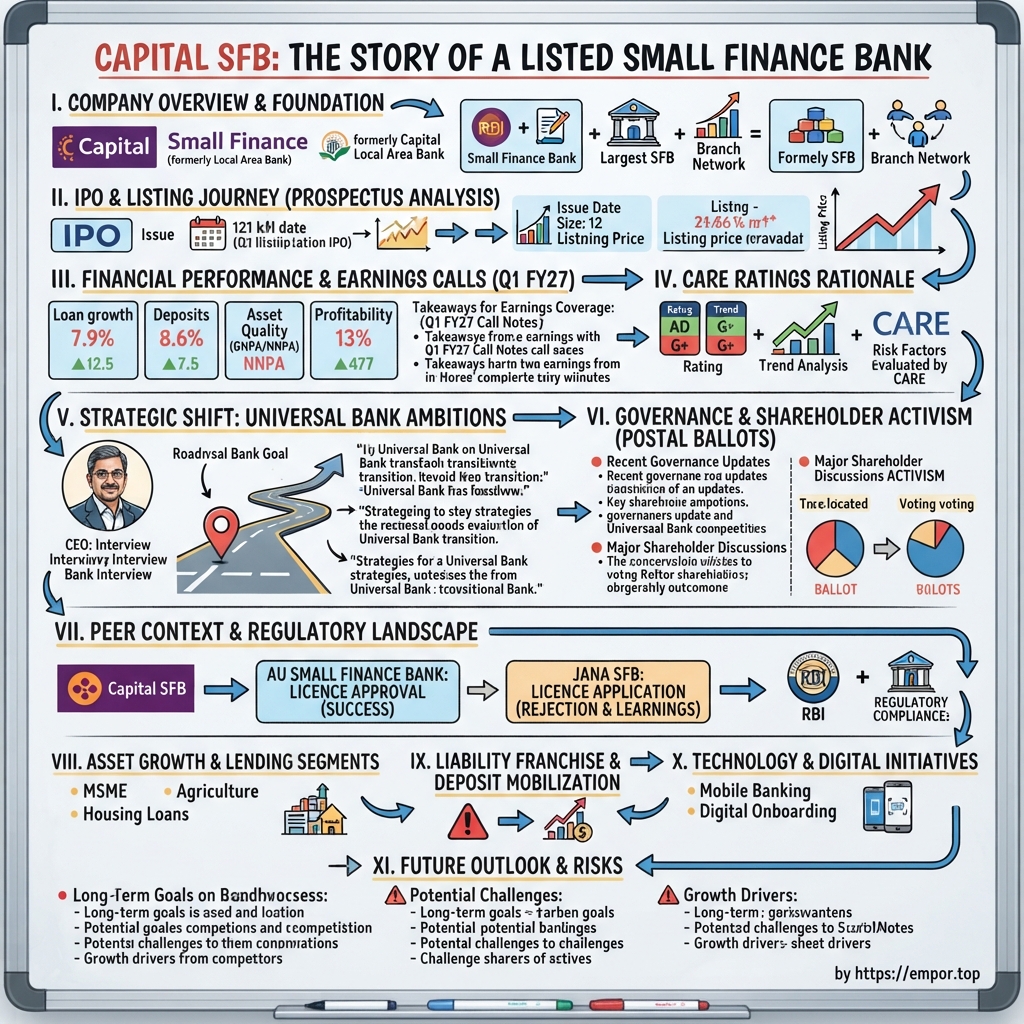
Capital Small Finance Bank: The First Small Finance Bank's Bet on Boring
I. Introduction & Episode Roadmap — 0:00–4:00
Start on the G.T. Road in Jalandhar, Punjab, in front of a building called Midas Corporate Park. Third floor. This is the registered office of a scheduled commercial bank licensed by the Reserve Bank of India — a real bank, with a real deposit franchise, real Kisan Credit Cards, real safe deposit lockers.1 It is roughly 500 kilometres from Mumbai's Bandra Kurla Complex, and in the sixty-odd years of modern Indian banking, almost nothing consequential has been decided from here.
And yet on September 8, 2026, Capital Small Finance Bank Limited trades on the National Stock Exchange under the ticker CAPITALSFB at about ₹277 a share — roughly 41% below the ₹468 at which it sold shares to the public in February 2024.2[^3] Over that same span, the bank's loan book grew from roughly ₹6,100 crore to ₹9,074 crore, deposits climbed past ₹10,500 crore, gross non-performing assets fell from 2.76% to 2.47%, and quarterly profit rose 29% year-on-year.34 Almost every operating line moved the right way. The share price moved the other way.
That gap is the story.
Here is the hook. In September 2015, the RBI handed in-principle small finance bank approvals to ten entities — a new licence category invented to push credit into corners of India the big banks had never bothered with.5 Nine of those ten were, broadly speaking, microfinance institutions: lenders whose core competence was handing out ₹30,000 unsecured loans to joint-liability groups of women. The tenth was a small deposit-taking bank in Punjab that had been quietly making loans against farmland and shop property since 1999. That tenth entity — Capital Local Area Bank — was the first of the ten to collect its final licence from the RBI and open for business as a small finance bank.5[^3]
First. And then, decisively, not biggest. AU Small Finance Bank, which started life as a Jaipur vehicle-finance NBFC, now carries a market capitalisation around ₹80,600 crore. Capital Small Finance Bank carries roughly ₹1,260 crore.62 That is a ratio of about 64 to 1 between two institutions that received their licences in the same regulatory cohort.
So the question this piece actually wants to answer is not "why isn't Capital SFB bigger?" It is sharper than that: has staying deliberately boring — regional, secured, mortgage-heavy, growth-averse by the standards of its peer group — produced an advantage that an investor can underwrite, or has it produced a small bank that is simply small? Several of the flashier microfinance-led small finance banks have since detonated. Utkarsh Small Finance Bank posted a net loss of ₹1,151 crore in FY26 — a single year's loss roughly equal to Capital SFB's entire market value.7 That is a genuine data point in Capital's favour. Whether it is a durable one is the thing to test.
The route from here: how a hyper-restricted Local Area Bank licence accidentally became the best possible training ground for the SFB era; the underwriting model that is, in a real sense, the entire company; the Punjab concentration that is simultaneously the moat and the single largest risk; the Samra family, twenty-seven years of continuity, and the first visible marker of a succession question; the IPO that arrived at the wrong moment and has not recovered; where this bank actually sits in a small finance bank cohort that has split violently in two; the "Vision 2029" roadmap and a universal-banking ambition that the bank, by its own executive director's admission, does not yet qualify for; and a bull-versus-bear reckoning that tries hard not to flatter either side.
We begin where the underwriting culture was formed — which, in lending, is nearly always where the story is.
 Subscribe on LinkedIn
II. From Local Area Bank to India's First Small Finance Bank (1999–2016) — 4:00–11:00
In the mid-1990s, the Reserve Bank of India ran an experiment that has since been almost entirely forgotten. It created a licence category called the Local Area Bank: a genuine bank, allowed to take deposits and make loans, but confined to a tiny handful of contiguous districts. It was financial inclusion by geography — the theory being that a bank that could only lend where it could physically walk would know its borrowers better than a national bank ever could.
The RBI issued very few of these licences, and most of the recipients never amounted to much. One of them was incorporated on May 31, 1999, in Phagwara, district Kapurthala, Punjab, as Capital Local Area Bank Limited, and received its certificate of commencement of business that August.[^3] Its founder was Sarvjit Singh Samra, then in his mid-thirties, an arts graduate with an MBA from Guru Nanak Dev University in Amritsar who had already spent a decade in asset finance.8 The bank's initial territory was three districts: Jalandhar, Kapurthala and Hoshiarpur. It later added Ludhiana and Amritsar — five districts in total, and that was the ceiling.3
It is worth sitting with how constraining that was. A Local Area Bank could not diversify geographically. It could not chase a boom in another state. It could not exit a bad district. Every rupee it lent, it lent to people it would keep running into. In banking, that is not a limitation so much as a forcing function: when you cannot escape your borrowers, you underwrite differently.
What the bank built in those sixteen years was a particular kind of muscle. Punjab's agrarian belt is not subsistence farming — it is irrigated, mechanised, wheat-and-paddy country plugged into the government's minimum support price system, with an entire commercial layer of arthiyas (commission agents), grain traders, and small manufacturers layered on top. Lending here means lending against land with clean title, against shop property, against receivables you can physically verify at the mandi. The bank extended agricultural loans, housing loans and MSME loans to middle-income individuals, and it did so against collateral, essentially from the beginning.4
Then, in November 2014, the RBI published its small finance bank framework, and in September 2015 it granted in-principle approval to ten applicants.5 The category was designed with microfinance in mind — the RBI wanted a regulated banking wrapper around India's sprawling MFI industry. Eight of the ten were NBFC-MFIs or microfinance-adjacent. Capital was one of only two non-microfinance institutions granted the licence.[^3]
The RBI approved Capital's conversion on March 4, 2016; the bank changed its name on April 15 and commenced operations as a small finance bank on April 24, 2016 — the first of the cohort across the line.[^3] It converted with 47 branches.4
The strategic significance of that starting position is easy to state and easy to underrate. The other converts had to learn deposits — how to open a savings account, run a branch, price a term deposit, manage a liquidity coverage ratio — while simultaneously defending a loan book built on a lending model (unsecured group lending) that the banking regulator had just invited them to outgrow. Capital had to learn almost none of that. It already had current accounts, savings accounts, term deposits, a branch network, a treasury and sixteen years of credit-cycle scar tissue. What it gained from the licence was the one thing the LAB regime had denied it: the right to cross a district line.
Two pieces of regulatory scaffolding from that era still shape the company today, and both belong here rather than in a risk appendix. First, priority-sector lending: the SFB framework originally required 75% of adjusted net bank credit to sit in priority sectors — a mandate that, for a lender already deep in agriculture and small business, was less a constraint than a description. (The RBI has since recalibrated this to 60%, with a requirement that at least half of loans stay within a ₹25 lakh ticket size — a meaningful loosening the bank's own FY26 management discussion frames as unlocking headroom.9) Second, promoter shareholding: SFB promoters normally must contribute at least 40% of initial equity and step down toward 26% over twelve to fifteen years. But the framework contains a carve-out — where an existing local area bank had already diluted promoters below 40% but above 26%, the RBI "may not insist" on the 40% minimum.[^3] Capital fell into exactly that carve-out. Its founding family never held a controlling block in the first place. That single regulatory detail explains a great deal about the ownership structure we will come to later, and it is routinely misread as evidence that the founders sold down. They did not.
The framework also carried a listing trigger: once an SFB's net worth crossed ₹500 crore, it had three years to list.10 That clock, more than any investment-banking pitch, is what eventually put Capital Small Finance Bank on a stock exchange.
By the time it got there, the bank had already made the decision that defines it. It never pivoted into microfinance. Ask what Capital Small Finance Bank actually is, and the honest answer is: a Local Area Bank's underwriting culture, released from its district cage. Which brings us to the mechanics of that culture — and to the question of whether "secured" means what management says it means.
III. The Core Business: Underwriting Cash Flows You Can See — 11:00–24:00
On the Q1 FY27 earnings call in July 2026, an analyst from TCG AMC asked a question that most bank calls never get to. Why, he wanted to know, do your agriculture loans carry a higher yield than anything else on your book? Higher yield usually means higher risk. What is the risk?
Munish Jain, the executive director, answered with a four-part list, and the list is more revealing than any slide in the investor deck. One: the bank lends to farmers whose borrowing need is between ₹5 lakh and ₹35 lakh — not to small and marginal farmers below that, and not to large ones above it. Two: it lends to "progressive" farmers cultivating ideally three crops a year, minimum two, so a single failed crop does not break the household. Three: it requires at least one, ideally two, of those crops to be a minimum-support-price crop, so that price collapse is capped by government procurement. Four: the entire agriculture book is collateralised at a loan-to-value of 50%.11
That is not a marketing answer. That is a credit policy, and it is worth translating into plain English. A 50% LTV on farmland means the borrower must pledge property worth twice what they borrow. An MSP crop requirement means the government is effectively an implicit floor under the borrower's revenue. And the ₹5 lakh minimum ticket is a deliberate exclusion — Jain said it directly, describing his target borrower as one "who is not potential to any political challenges," referencing the sub-₹3-lakh band where Indian farm-loan waivers historically land.11 The bank has designed its agricultural book to sit above the waiver line.
One sentence, and the whole company
Here is the company in a sentence: as of June 30, 2026, 97.4% of the loan portfolio was secured, and 88.82% of the non-corporate book was backed by immovable property or bank fixed deposit receipts.11 Even the loans labelled "agriculture" and "MSME" are, structurally, property-collateralised loans made to people whose bank accounts the lender can see.
Samra's own framing on that last point — the bank's insistence on being the borrower's primary banker rather than one of several — is a claim worth examining rather than repeating. The mechanism is real: if the bank holds the working-capital current account, it watches the cash cycle in real time and can act on stress before it becomes delinquency. Jain confirmed on the call that over 80% of MSME borrowers hold a working-capital facility with the bank.11 But "primary banker" is also unverifiable from outside. There is no disclosed wallet-share metric, no products-per-customer number — Jain, asked precisely that, said the answer "is not that simple" because lending sits with the firm while deposits sit with individual customer IDs.11 Take the mechanism as plausible and the claimed degree of it as unmeasured.
Three engines, and what each actually earns
The loan book at June 2026 broke into roughly 27% agriculture, 27% business loans and MSME, 25% mortgages (housing plus loan against property), 14% corporate, and 7% consumption.1 But mix alone tells you nothing about economics. Yields do.
At March 2026, agriculture carried a portfolio yield of 12.54%, loan against property 12.33%, MSME and trading 10.55%, consumption 10.77%, housing 9.85%, and corporate lending 9.69%.3 Set against a cost of deposits of 5.6% in Q1 FY27, that spread structure explains the whole profit-and-loss statement.11 The high-yield engines are agriculture and LAP; the low-yield engines are housing and corporate. Everything the bank says about margin expansion is really a statement about which of these grows fastest.
And the mix is shifting. Business loans and MSME grew 49% year-on-year in Q1 FY27 and became the single largest segment at 27% of the book, up from 22% a year earlier; agriculture shrank from roughly 30% to 27%.11 Management has been explicit that MSME and mortgages, not agriculture, are the designated growth engines. Note what that means for margins: MSME at 10.55% yields less than the agriculture it is displacing. The mix shift toward MSME is a diversification and volume story, not a yield story — and management does not claim otherwise, guiding instead to a stable net interest margin around 4.2% for FY27 with expansion deferred to FY28–FY29 on the back of a higher credit-to-deposit ratio.11
There is one wrinkle in the "zero microfinance" story that deserves daylight. The 14% corporate bucket is largely term lending to NBFCs — and a sliver of it, ₹39 crore at March 2026, was term lending to microfinance institutions, priced at 17.30%.3 That is small (under half a percent of the book) and it is senior secured lending to an intermediary rather than direct group lending. But an investor should file it accurately: the bank has zero direct microfinance exposure, not zero microfinance exposure.
The liability side, which is the actual moat candidate
Now flip the balance sheet. Deposits stood at ₹10,596 crore at June 2026, growing 16.3% year-on-year, with retail deposits above 90% of the total, a rollover ratio above 90%, and a CASA ratio of 36.7% — up from 34.7% three months earlier.111 Deposits fund roughly 95% of the bank's outside liabilities.11
This is where the geography actually earns its keep, and Jain laid out the arbitrage explicitly when a retail investor asked why deposit growth is so seasonal. Over 75% of deposits come from semi-urban and rural branches; 46% of advances are deployed in urban and metro areas.111 The bank raises money "from where the actual money is lying" — post-harvest Punjab, in the first and third fiscal quarters, when procurement payments hit farmer accounts — and lends it where risk-adjusted returns are better. That is a structural cross-subsidy, and it is more defensible than the asset-side story, because you cannot replicate a forty-year-old deposit relationship in a Hoshiarpur village by opening a branch there next Tuesday.
It also has a cost. Because harvest money arrives in Q1 and Q3, deposits outgrow advances in those quarters and lag in Q2 and Q4 — a seasonality analysts repeatedly mistake for weakness. Management's answer is that the average credit-to-deposit ratio, at 83% in Q1 FY27, is "the lowest in the small finance bank space," and that closing the gap toward the mid-to-high 80s is the single largest identified lever for margin expansion: moving assets currently parked in investments and interbank placements at 7–7.5% into advances at 10.5–11%.11 That is a legitimate, quantifiable, checkable claim. It is also an admission that the balance sheet has been running inefficiently.
Segment reporting confirms there is no second engine here. In FY26, Retail Banking generated ₹754.36 crore of revenue against ₹674.82 crore the prior year; Treasury contributed ₹221.66 crore, corporate/wholesale banking ₹127.60 crore, and other banking operations ₹43.25 crore.9 Treasury is an SLR-management function with a P&L attached, not a business. This is a retail secured lender, full stop.
The falsification pass: has "granular and secured" actually been tested?
This is the claim that carries the entire investment case, so it deserves the strongest disconfirming evidence available — and, usefully, the bank publishes some of it itself.
Buried in the Q1 FY27 deck is a table of gross and net slippages by year from FY16 to FY27, annotated with the macro event of each year.1 Read it as a stress record. Gross slippages ran 0.77% in FY16 (deficit rainfall), 1.06% in FY17 (demonetisation), 1.64% in FY20 (delayed monsoon), and then hit their worst readings in FY22 at 2.12% (heatwaves, post-Covid) and FY23 at 3.38% (deficit rainfall). Net slippages — after upgrades and recoveries — peaked at just 1.06% in FY22 and 0.78% in FY23. Credit cost peaked at 0.42% in FY22. Write-offs across the entire eleven-year span never exceeded ₹0.78 crore in a single year.13
That is a real record, not a marketing claim, and it survives its first serious test: the FY23 gross slippage of 3.38% was more than four times the FY16 level, and yet net slippage that year was 0.78% and credit cost 0.32%. Collateral did what collateral is supposed to do — loans went bad, and the bank got its money back. CARE Ratings independently noted that gross NPAs stayed below 3% for five consecutive years with minimal write-offs, and that agricultural collateral is taken at 200% of registered land value.4
Now the harder test. Punjab announced a farm loan waiver in June 2017, covering roughly 10.25 lakh small and marginal farmers.12 Capital's gross slippage in FY18 was 1.41% — elevated versus FY17, but nowhere near crisis. Does that prove the book survives waiver cycles? Only partially, and the reason matters: the 2017 waiver was targeted at small and marginal farmers, precisely the cohort Capital's ₹5 lakh minimum ticket size structurally excludes. The bank did not so much survive the waiver as sit outside its blast radius. That is good design. It is not the same as proven resilience to a broader waiver that reached higher ticket sizes, or to a sustained collapse in Punjab land values — which is the collateral this entire book rests on and which has never been meaningfully repriced downward in the bank's operating history.
CARE's own rating rationale frames the residual risk with useful bluntness. Its stated downgrade triggers are a net NPA ratio above 3% on a sustained basis and return on total assets below 0.5%.4 The agency is not treating this book as immune; it is treating it as a Punjab-concentrated portfolio one bad cycle from real stress. Net NPA has run between roughly 1.1% and 1.4% across FY23 to Q1 FY27, comfortably inside that trigger.31
The calibrated conclusion: the "granular secured book is safe" claim is supported but narrowed. The evidence — eleven years of published slippage data, negligible write-offs, no NPA sell-offs, and a documented 50% agricultural LTV — is strong enough to reject the idea that this is an untested book. It is not strong enough to support the broader claim that the model is cycle-proof, because the specific catastrophe that would test it (a collapse in Punjab agricultural land values, or a waiver reaching the ₹5–35 lakh band) has not occurred while this book existed at scale. The falsifiable forward test is narrow and specific: net NPA and agriculture-segment slippage in any future Punjab farm-distress or waiver episode. Watch that, not the aggregate.
A Porter's-lens read
Run the five forces on this business and the picture is coherent rather than flattering. Supplier power — depositors — is genuinely low: retail, granular, 90%+ rollover, relationship-priced rather than shopped. Buyer power — borrowers — is moderate: they are collateralised and sticky, but Jain concedes the bank charges "slightly above the market" and competes on turnaround time rather than price.11 Substitutes are real and under-discussed: cooperative credit societies are deeply entrenched with Punjabi farmers, gold-loan NBFCs compete for the same emergency liquidity, and digital lenders compete on speed. New entrants are the wild card — Jain's own framing is that large private banks target ticket sizes above ₹1 crore while Capital plays in the ₹10–50 lakh band, so "the competitive strategies adopted there are working in our favour."11 That is a statement about where competitors currently choose to play, not a structural barrier. It could change with one strategy deck at a larger bank.
Which is precisely why the geography question is not a footnote. It is the business.
IV. Geographic Concentration: The Central Risk and the Central Moat, at Once — 24:00–31:00
Count the branches. At June 30, 2026, Capital Small Finance Bank operated 216 branches across five states and two union territories. Of those, 175 were in Punjab. Twenty-seven were in Haryana. Rajasthan had five, Himachal Pradesh three, Jammu & Kashmir three, and Chandigarh and the National Capital Region accounted for the remainder.1
Eighty-one percent of a bank, in one state.
The bank does not hide this. Its IPO prospectus listed geographic concentration as risk factor number one, disclosing that 149 of 173 branches — 86.13% — sat in Punjab as of September 30, 2023, and that Punjab generated 84.96% of interest earned on advances in the six months to that date.[^3] CARE Ratings lists it as the first of two key weaknesses, noting Punjab constituted around 84% of the total loan portfolio at September 2023.4
So: 86.13% of branches in Punjab in late 2023, 81% in mid-2026. Advances outside Punjab reached 25% at June 2026, up from roughly 21% a year earlier and 24% a quarter earlier.11 Non-Punjab advances grew over 30% year-on-year against 22% for the book as a whole.11
Read those numbers honestly and two things are true simultaneously. Diversification is happening — the trend is real, consistent, and slightly ahead of overall growth. And diversification is happening slowly — roughly five percentage points of branch concentration reduction in eleven quarters. Management's stated target is 30%+ of branches outside Punjab by 2029, from 17.5% in September 2025.3 That implies nearly doubling the out-of-state branch share in under four years, having managed a fraction of that pace over the prior three.
Why the concentration is also the asset
Now the other side, and it is not a rhetorical concession. There is a specific, mechanical reason this bank's cost of funds is low and its credit costs are lower: it has been banking the same families, in the same districts, for a quarter of a century. Deposits outside Punjab were just 10% of the total at June 2026 — up from 8% a quarter earlier, but still a rounding error.11 Ninety percent of the funding advantage lives in the home state.
That is what a local moat actually looks like from the inside: not a brand, not technology, but the fact that a branch manager in Kapurthala knows which family's second son is reliable and which one isn't, and that the same family has kept a fixed deposit there since 2004. HDFC Bank cannot buy that with a branch opening. Neither can Capital, in Rajasthan.
Which is the honest tension. The moat, as described, is not portable. It is an artifact of tenure in a specific place. Every new branch in Haryana or Rajasthan starts with zero tenure — the same cold start any competitor faces. Management's answer is that the process travels even if the relationships don't: Jain described a branch-led acquisition model in which sales staff source locally, a cluster credit head oversees five to six branches, and an entirely separate credit manager underwrites — "the principle of four eyes," in CARE's phrasing.114 He was emphatic that this model runs identically "not only in Punjab, not only in Haryana, throughout, wherever we are."11
Process portability is a reasonable hypothesis. It is not yet an established fact. And the falsifiable test is precise: do new-state branches reach Punjab-equivalent CASA ratios and Punjab-equivalent loss rates on the same vintage timeline? The bank does not currently disclose branch-vintage cohort data — no state-wise NPA, no state-wise CASA, no state-wise cost-to-income. That absence is itself the finding. An investor underwriting "the moat travels" is, today, underwriting management's assertion rather than disclosed evidence.
The political overhang, mechanically
Punjab concentration also means Punjab politics. The mechanism that matters is not a general "farm distress" risk — it is specific. A farm loan waiver does two things to a lender: it removes a slice of receivables, and, far more damagingly, it teaches every remaining borrower that repayment is negotiable. The second effect outlasts the first by years.
Capital's structural defence, as established, is ticket size. Its agricultural borrowers sit above the band Indian waivers have historically targeted. That defence has held once, in 2017. It would not hold against a waiver designed differently, and no lender controls that design.
The second Punjab-specific mechanism is water. The state's paddy-heavy cropping pattern is drawing down its water table, and the long-run policy response — crop diversification away from paddy — would, if it ever actually happened, change the cash-flow profile of exactly the MSP-crop farmers Capital lends against. That is a slow risk, not a 2027 risk, and it belongs in the analysis as a structural qualifier on the "MSP crops floor our credit risk" argument rather than as a near-term threat.
So the honest summary of this section: the concentration is not being ignored, it is being reduced, and it is being reduced too slowly to have been proven. The people running that reduction are the next question.
V. Ownership, Management, and the Samra Family — 31:00–40:00
There is a line in Capital Small Finance Bank's FY26 annual report that most investor decks would have put in 48-point type and this one buries in a director biography: Sarvjit Singh Samra has been associated with the bank "since its inception."8 He founded it in 1999. He is still the Managing Director and CEO in 2026. Twenty-seven years, one institution, two regulatory regimes.
In Indian banking, that is genuinely uncommon. Private-sector bank CEOs are term-limited by RBI convention; the founder-run exceptions are a short list. Munish Jain, the Executive Director, has been with the bank since 2000 — first as Company Secretary and Chief Financial Officer, then Chief Operating Officer from 2014, then Executive Director from August 2023.8 The IPO prospectus noted that most senior management were founding members.[^3] When Jain answers a question about FY23 MSME gross NPAs by quoting the exact rupee figure from March 2023 (₹65.41 crore) against the exact figure at June 2026 (₹54.54 crore), that is not preparation. That is a man who has personally watched those accounts for a decade.11
Continuity is not the same as quality, though, so let us test it against behaviour.
Guidance versus outcome
Management runs a public, dated scorecard — the "Capital SFB @ 2029" tracker, published quarter after quarter with the same five targets: a loan book above ₹16,000 crore, 300+ branches, net NPA below 1%, credit cost below 0.3%, ROA above 1.6%, and ROE above 15%, all by FY29.31 Comparing the Q4 FY26 and Q1 FY27 versions of that slide, the targets are identical — no quiet downgrades, no goalpost movement.31 Against FY27 specifically, management guided to 22% advance growth and delivered 22% in Q1; guided to ROA "in the range of 1.35% to 1.4%" and printed 1.30%; guided NIM to stabilise near 4.2% and printed 4.21%.11 FY26 delivered 21% growth in both advances and deposits.11
That is a management team whose near-term numbers land where they said they would. It earns credibility on the twelve-month horizon.
The FY29 horizon is a different matter, and the gap is not small. ROE was 11.2% in Q1 FY27 against a 15%+ target; ROA 1.30% against 1.6%+; net NPA 1.14% against below 1%; branches 216 against 300+.1 Reaching ₹16,000 crore from ₹9,074 crore requires roughly 21% compounding for three straight years — achievable, since it is the current run rate. Reaching 15% ROE while doing it is the hard part, and it is arithmetic, not effort.
The ROE problem, stated plainly
Here is the single most important financial fact about this company that does not appear in any headline.
The bank's return on equity was 16.62% in FY23. Then 14.64% in FY24, 10.38% in FY25, and 10.10% in FY26.1 Over the same period, return on assets went the other way: 1.22%, 1.27%, 1.35%, 1.23%.1 The business got more profitable per rupee of assets while getting less profitable per rupee of shareholder capital.
The mechanism is leverage, or the deliberate lack of it. The February 2024 IPO raised ₹450 crore of fresh equity into a bank whose net worth had been ₹743 crore at December 2023.4[^3] Shareholders' funds went from ₹611 crore at FY23 to ₹1,197 crore at FY24 and ₹1,461 crore at FY26.3 Capital adequacy jumped to 27.4% in FY24 before settling at 22.3% in FY26 and 21.6% in Q1 FY27.31 Against a regulatory minimum of 15% for SFBs, that is a very large cushion.
Look at earnings per share and the point becomes uncomfortable. Basic EPS was ₹30.65 in FY24, ₹29.18 in FY25, and ₹31.20 in FY26.3 Three years, and per-share earnings are up 1.8% in total. The loan book grew 43% over the same span.3 Every rupee of that growth was funded by equity the bank did not need to raise all at once, and the per-share owner got nothing for it.
This is not a deteriorating business. It is the mechanical signature of a bank carrying more capital than its growth rate consumes. The cure is time — grow into the capital — and management's own math says the CD ratio moving from 83% toward the mid-to-high 80s does part of the work.11 But it is a genuine capital-allocation critique, and the honest version is this: the bank raised more equity than its demonstrated growth rate could deploy productively, and shareholders have absorbed three years of flat EPS as a result. Whether the ROE recovers toward 15% by FY29 is the single cleanest live test of management's capital-allocation credibility, and it is checkable every ninety days.
The dividend is a small counterpoint: ₹5 per share for FY26, a payout of 16.06% of earnings.8 For a bank with 21.6% capital adequacy and a stated ROE problem, a 16% payout is conservative — arguably too conservative, though a growing bank retaining capital is a defensible choice rather than an indefensible one.
The ownership structure, and why the low promoter stake is misread
Promoter and promoter-group holding stood at 18.29% at June 2026.2 At the time of the IPO prospectus, the five promoters — Sarvjit Singh Samra, Amarjit Singh Samra, Navneet Kaur Samra, Surinder Kaur Samra and Dinesh Gupta — held 22.39%.[^3] Institutional ownership has since filled much of the gap: domestic institutions at 27.48%, foreign institutions at just 0.59%, public shareholders at 53.65%.2
An 18% founder stake in a founder-run bank invites the obvious suspicion: did they cash out? The record says no. No promoter or promoter-group entity participated in the IPO's offer for sale — that entire ₹73.07 crore came from Oman India Joint Investment Fund II (836,728 shares), Amicus Capital's two vehicles (168,697 shares combined), and a group of other individual selling shareholders (555,904 shares).[^3] The promoter stake fell because the fresh issue diluted it, and because, as established, the Local Area Bank carve-out in the SFB framework meant the founders were never required to hold 40% in the first place.[^3] The bank's pre-IPO capital raises — ₹65 crore in 2017-18, ₹134 crore in 2019-20, and ₹49.5 crore from Max Life in June 2023 — each diluted them further.3[^3]
What an 18% stake does mean is that this is not a family fiefdom in voting terms. A determined institutional bloc could outvote the promoters. That cuts both ways for governance: less entrenchment, but also less of the owner-operator alignment that makes founder-led banks interesting in the first place.
The succession marker
Which brings us to the one genuinely new governance data point, and it deserves neither burial nor alarm.
On January 29, 2026, the bank issued a postal ballot notice with four resolutions. Three concerned Munish Jain — a remuneration revision and his re-appointment as Executive Director from August 28, 2026. The fourth sought approval for the payment of remuneration to Shahbaz Singh Samra, "a related party," for holding an office or place of profit at the bank.8 Shahbaz Singh Samra is listed in the FY26 related-party disclosures as a relative of Sarvjit Singh Samra.9
The results, declared March 25, 2026, are the interesting part. The Jain resolutions each drew roughly 2.11 crore votes, passing with 99.971% in favour. The Shahbaz Samra resolution drew 1,30,44,112 votes in favour and 53,872 against — 99.589%.8 Two things stand out. First, participation on the related-party resolution was roughly 38% lower, consistent with the promoter group correctly abstaining given its interest. Second, the dissent, while tiny in percentage terms, was more than eight times larger in absolute votes against than on the Jain resolutions.
The mechanics were followed properly. A practising company secretary scrutinised the e-voting.8 Nothing here is a scandal. But it is the first formal, filed marker that a second generation has an operating role at a bank the first generation has run for twenty-seven years, and the relevant question for the next three to five years is simply whether family succession gets handled with the same discipline as underwriting has been.
An activist would press on one adjacent thread. The FY26 related-party disclosures show the bank paying lease rentals of ₹0.51 crore each to Amarjit Singh Samra, Surinder Kaur Samra, Sarvjit Singh Samra and Amardeep Singh Samra, plus ₹0.25 crore to Navneet Kaur Samra — roughly ₹2.29 crore a year flowing to the founding family for property.9 Against ₹141 crore of profit that is immaterial in size, and premises leases from promoters are common in Indian regional banking. But it is a recurring related-party cash flow to a family that owns 18% of the equity, and it belongs on the disclosure ledger rather than off it.
Capital allocation, verified
One characterisation is worth checking rather than asserting. The IPO prospectus states, under a heading requiring disclosure of material acquisitions, divestments, mergers, amalgamations or revaluations in the preceding ten years, that the bank "has not acquired any business or undertaking and has not undertaken any merger, amalgamation or revaluation of assets, in the last ten years."[^3] The FY26 annual report discloses no acquisitions since. Bounded to that record — roughly FY14 through FY26 — this bank has grown entirely organically, branch by branch. It has no subsidiaries, no joint ventures, and no holding company.[^3]
That is a real and verifiable data point about risk appetite. It is also, read less charitably, a data point about ambition. The one large capital event in the bank's history is the IPO, and the market's verdict on it has been unambiguous.
VI. The 2024 IPO and the Stock's First Two Years — 40:00–47:00
The offer opened on February 7, 2024 and closed on February 9. The price band topped out at ₹468. Nineteen anchor funds took 33.53 lakh shares at that price the day before the book opened. Total size: ₹523.07 crore — ₹450 crore of fresh equity in 9,615,384 new shares, plus 1,561,329 shares from selling shareholders. The book was subscribed 4.17 times.[^3]13
On February 14, 2024, the shares listed on the NSE at ₹430.25 — an 8.07% discount to the issue price. They touched ₹462.90 during the day, fell as low as ₹421, and closed at ₹437.13
An oversubscribed IPO that lists at a discount is unusual, and it is worth understanding why this one did. The most concrete explanation sits in the prospectus rather than in market commentary. On June 17, 2023 — eight months before the IPO — the bank allotted 1,057,700 shares to Max Life Insurance at ₹468.00 per share, raising ₹49.5 crore.[^3] The IPO was priced at exactly that number. There was no step-up between the last private round and the public offering. Whatever value accrued to the business over those eight months, none of it was left on the table for a public buyer, and nothing was left for the private buyer either.
The broader context did not help. Early 2024 was not a good moment to sell an SFB story to institutions. Microfinance-led small finance banks were entering a stress cycle whose full severity would only become clear later. And a bank whose entire pitch was "we are regional, we grow in the high teens, and we do not do the risky thing" is a hard sell to a market that pays for narrative slope.
Two and a half years on, the stock trades at roughly ₹277, with a 52-week range of ₹206.55 to ₹323.70.6 At that price it changes hands at about 0.85 times its book value of ₹327 and roughly 8.4 times trailing earnings.211
What the market is actually saying
The comfortable bull reading is that this is a valuation disconnect: operations improved, price fell, therefore opportunity. The uncomfortable reading is that the market has read the same numbers and reached a defensible conclusion.
Consider what a buyer at ₹468 in February 2024 was underwriting: FY24 EPS of ₹30.65, so about 15 times earnings, for a bank then earning 14.64% on equity.31 What they got instead was FY25 EPS of ₹29.18 and FY26 EPS of ₹31.20, with ROE falling to 10.10%.31 The multiple compressed because the return profile compressed. A bank earning 10% on equity does not deserve the same multiple as a bank earning 15% on equity, and 0.85 times book against a 10-11% ROE and a roughly 11-12% cost of equity is not obviously a mispricing. It is close to arithmetic.
That framing sharpens the bull case rather than destroying it. The question is not "why is a good bank cheap?" It is: if ROE returns toward 15%, does the multiple re-rate toward or above book value? Historically, Indian bank multiples track ROE closely. That is the trade, and it is entirely contingent on the capital-deployment execution described earlier — not on any re-discovery of the business by the market.
There is a second, structurally different re-rating lever, and it is the one peers have demonstrated. When the RBI granted AU Small Finance Bank in-principle approval to become a universal bank on August 7, 2025, AU's stock rose over 7% in early trade.14 A regulatory tier change is worth real money.
Which raises the obvious question about the bank in front of us.
VII. Competitive Landscape: A Crowded, Uneven Field of Small Finance Banks — 47:00–55:00
The 2015 small finance bank cohort has, eleven years on, split into two entirely different businesses that happen to share a licence category. The split is not by size, geography or vintage. It is by what they underwrite.
On one side sit the microfinance-origin lenders. ESAF Small Finance Bank reported a net loss of ₹521 crore in FY25 and, after peaking at 8.54% in September 2025, still carried a gross NPA of 5.41% at Q4 FY26.15 Utkarsh Small Finance Bank posted a FY26 net loss of ₹1,151 crore on total assets of ₹28,869 crore, with gross NPAs of ₹1,459.90 crore — its fourth consecutive quarterly loss, driven by a contracting joint-liability-group book.7 These are not small wobbles. These are years of accumulated earnings erased.
On the other side sit the secured lenders. AU Small Finance Bank, built on vehicle finance, earned ₹2,641 crore in FY26 on revenue of ₹18,636 crore, with gross NPA of 2.10% and net NPA of 0.76% at June 2026, and a return on equity of 14.2%.6 Ujjivan and Equitas sit in between, with meaningful microfinance legacies and meaningful secured growth.
Capital Small Finance Bank sits at the extreme secured end of that spectrum, and its FY26 outcome — ₹141 crore of profit, 2.54% gross NPA, 1.24% net NPA — is a direct product of a decision made before the licence existed.3
This is the single strongest piece of evidence in the entire bull case, and it should be stated at its actual strength and no further. It is not evidence that Capital SFB has superior underwriting skill. It is evidence that Capital SFB chose a different asset class and that asset class performed better through 2024-2026. Those are different claims. A lender that never entered unsecured microfinance did not out-underwrite the microfinance lenders; it declined to compete with them. The skill claim would require comparing Capital's secured book against other secured books — and against AU's 0.76% net NPA at June 2026, Capital's 1.14% is worse, not better.61
The scale problem, quantified
Capital Small Finance Bank is the smallest listed small finance bank by market capitalisation. Its roughly ₹1,260 crore compares with AU at approximately ₹80,600 crore, Ujjivan around ₹12,600 crore, Equitas around ₹8,300 crore, Jana around ₹5,700 crore, Utkarsh around ₹2,800 crore, ESAF around ₹2,100 crore, and Suryoday around ₹1,650 crore, all as of September 8, 2026.26
Scale is not a vanity metric in banking. It shows up in three concrete places. First, cost of funds: a larger bank with a national deposit brand generally funds cheaper. Capital's 5.6% cost of deposits is respectable but not exceptional, and it is achieved through geography rather than brand.11 Second, operating leverage: Capital's cost-to-income ratio was 59.5% in Q1 FY27, and management is guiding to only "moderate" improvement in FY27 with the "larger play" deferred to FY29.111 Third — and this is the one that matters most strategically — regulatory optionality, which we come to next.
Who actually competes, on the ground
The listed-peer comparison is analytically tidy and largely irrelevant to daily operations. Ujjivan does not compete with Capital for a shop-owner's working capital line in Ludhiana.
Jain named the real competitive set on the July 2026 call, and his framing is worth taking at face value while noting what it concedes. In the MSME segment, he said, "our biggest competitive landscape is typically from the PSB space" — public sector banks. Large private banks target average tickets above ₹1 crore; Capital plays at ₹10-50 lakh, sometimes to ₹75 lakh. Against public sector banks, he claimed an advantage in service consistency in semi-urban markets and turnaround time, while charging "slightly above the market."11 In housing, he described public sector bank pricing competition as having eased after FY26's repo cuts flowed through, allowing Capital to grow housing 3% sequentially after one or two flat quarters.11
Note what that last admission contains. Capital's housing book stopped growing for two quarters because public sector banks, whose loans reprice off the external benchmark rate, cut prices faster than Capital's deposit costs fell. That is a live demonstration of the limits of the moat: in the most commoditised of its products, the bank had to concede growth to preserve yield. It is also a demonstration of intellectual honesty — management did not spin it.
Beyond banks, the un-named competitors are the ones with the deepest roots: Punjab's cooperative credit societies, which have banked farmers for generations and were the primary channel for the 2017 waiver, and gold-loan NBFCs, which offer speed Capital cannot match on small-ticket emergency credit.
The disclosure gap worth flagging: the bank publishes no market share data, no win-rate data, no customer-retention data, and no state-wise competitive metrics. Every competitive claim in this section other than the financial comparisons rests on management assertion on an earnings call. That is not disqualifying — very few Indian regional banks disclose more — but an investor should be clear that the competitive-advantage case is supported by outcomes (NPAs, CASA, growth) rather than by any direct evidence of winning against named competitors.
VIII. Vision 2029, the Universal Bank Question, and What Management Is Actually Doing Now — 55:00–63:00
Near the end of the July 24, 2026 call, an individual investor named Siddharth asked the question that had been hanging over the entire hour. Since you are meeting most of the RBI requirements for a universal bank, are you going to apply?
Munish Jain's answer was one of the more useful things any Indian bank executive said that quarter:
"We have an aspiration for the universal commercial bank, but it all will be done at the most appropriate time. My job as an executive member is to make ourselves eligible for universal commercial bank by making a full diversification and ticking all the boxes. The one box which is left to be ticked is net NPA, and we are working hard from the last 2 quarters by increasing slight PCR reaching towards 1% NNPA."11
That single sentence bounds the entire universal-bank narrative, and it needs to sit right next to the ambition rather than in a risk appendix at the end.
What the rules actually require
The RBI's Universal Banks (Licensing) Guidelines, 2025, issued on November 28, 2025, set six conditions for a small finance bank seeking to transition: scheduled status with a satisfactory five-year track record; listing on a recognised stock exchange; minimum net worth of ₹1,000 crore as at the end of the previous audited quarter; compliance with prescribed capital adequacy; net profit in the last two financial years; and gross NPA and net NPA of 3% or less and 1% or less respectively in the last two financial years.16
Score Capital Small Finance Bank against that list as of today. Scheduled status with a ten-year SFB track record: yes. Listed: yes, since February 2024. Net worth of ₹1,461 crore at March 2026: comfortably yes.3 Capital adequacy at 21.6%: yes.1 Net profit in the last two years: ₹132 crore in FY25 and ₹141 crore in FY26.3 Gross NPA of 2.58% in FY25 and 2.54% in FY26, both under 3%: yes.3
Net NPA: 1.30% at March 2025 and 1.24% at March 2026.3 Both above 1%.
Five boxes ticked, one not. And the failing box is the one that requires two consecutive fiscal years of compliance, meaning the earliest Capital could satisfy it — assuming net NPA closes FY27 below 1% — is at the end of FY28, in March 2028. Net NPA was 1.14% at June 2026, and management's own stated medium-term target is "below 1%."111
This is why the provision coverage ratio has been climbing. Asked directly by an analyst from DAM Capital why provisions had run higher for several quarters, Jain said the bank had used the availability of "decent profits" to lift PCR — from 50.17% in Q1 FY26 to 51.9% in Q4 FY26 to 54.5% in Q1 FY27 — explicitly "so that we can move towards the net NPA in that direction," adding that "a majority of that action has been done."11
That is worth naming for what it is: the bank has been deliberately depressing reported profit — provisioning above what asset quality alone required — in order to buy down a regulatory ratio. It is a defensible, arguably admirable use of an earnings buffer. It is also a direct, quantified drag on the ROA that shareholders have been waiting to see recover. Both things are true at once, and the bank disclosed it plainly when asked.
What the bar actually looks like in practice
Two live case studies from the last twelve months frame how hard this is.
AU Small Finance Bank applied on September 3, 2024, under the April 2024 voluntary-transition framework, and received in-principle approval on August 7, 2025 — eleven months of RBI review, for the largest and most diversified institution in the category.14
Jana Small Finance Bank applied in FY26, having already satisfied the gross and net NPA thresholds for two consecutive years. On October 28, 2025, the RBI returned its application for not meeting eligibility criteria. Jana said publicly it did not know which criteria it had failed and would have to ask the regulator before reapplying.17
Read those two outcomes together and the lesson is uncomfortable for Capital. Meeting the published numerical thresholds is necessary and demonstrably not sufficient. Jana cleared the asset-quality gate and was still returned. Something in the RBI's assessment — scale, diversification, governance, business model, or something never disclosed — sits above the checklist. Capital Small Finance Bank, at roughly one-fourteenth of Jana's market capitalisation and 81% concentrated in one state, faces that unpublished bar from a weaker position on at least two dimensions the regulator has historically cared about.
Jain's own phrasing acknowledged the timing risk: "at the most appropriate time, we will go for the UCB, that is for sure," adding that the bank intends to move "for the next level in a very strong and committed way so that the chances of success are much higher."11 That is a management team that has watched Jana get returned and does not intend to be next.
Why it matters economically, and why it also cuts against the thesis
If it happened, universal bank status would relieve the priority-sector mandate over time and open unsecured retail, credit cards, larger corporate lending and a broader fee base. It would likely lower funding costs through depositor perception. The AU share-price reaction suggests the market pays for it.14
But here the analysis has to be honest about the tension, because the optionality argument and the moat argument point in opposite directions. The entire investment case for this bank is that it does not do unsecured lending. A universal banking licence is, functionally, permission to start. If Capital Small Finance Bank obtains a universal licence in 2029 and uses it to build a credit-card book and an unsecured personal loan book, it will have converted the thing that makes it distinctive into the thing that broke several of its peers. Management has not signalled any such intent — the stated 2029 focus areas remain MSME, mortgages and agriculture, with 30%+ of branches outside Punjab and a credit-to-deposit ratio in the mid-to-high 80s.31 But "optionality" is only valuable if exercised well, and this bank has no track record whatsoever of underwriting unsecured credit.
Calibrated conclusion on the universal-bank thesis: it is not a formality, it is not imminent, and on the bank's own arithmetic it cannot be filed successfully before FY28 at the earliest. Treat it as a genuine but unpriced call option with a low near-term probability, not as a base-case catalyst. The confirming event is unambiguous and public: net NPA printing below 1.0% at a fiscal year end, twice.
IX. Bull Case vs. Bear Case — 63:00–71:00
The bull case, at its strongest
Strip away the narrative and the bull case rests on four verifiable things.
First, an eleven-year published record of credit behaviour through demonetisation, Covid, two deficit-rainfall years, a heatwave year and a flood year, in which net slippages never exceeded 1.06%, credit cost never exceeded 0.42%, annual write-offs never exceeded ₹0.78 crore, and — a genuinely unusual disclosure — no NPAs were ever sold to an asset reconstruction company.13 Most Indian lenders that claim clean books have manufactured part of that cleanliness through sales. This one has not.
Second, a deposit franchise that is structurally hard to attack: 90%+ retail, 90%+ rollover, 36.7% CASA, 75%+ sourced from semi-urban and rural branches where competition for deposits is thin, funding 95% of outside liabilities.111 This is the asset the bank actually owns.
Third, an unambiguously over-capitalised balance sheet — 21.6% capital adequacy against a 15% minimum — which means the ₹16,000 crore FY29 loan book target requires no equity raise, no dilution, and no dependence on capital-market conditions.1 A small bank that does not need the market's permission to grow is a meaningfully different animal from one that does.
Fourth, a valuation at roughly 0.85 times book and 8.4 times earnings that embeds substantial scepticism.2 Against AU's 4.02 times book, the discount is enormous — though AU earns 14.2% on equity to Capital's 11.2%, so a large part of that discount is arithmetic rather than opportunity.61
The bear case, at its strongest
The bear case is not "the loans are bad." The loans appear fine. The bear case is more corrosive than that.
It starts with structural sub-scale. At ₹1,260 crore of market value and ₹12,144 crore of assets, this bank is too small to matter to institutional investors, too small to build a national deposit brand, too small to fund technology at the rate AU can, and — most consequentially — too small to look like an obvious universal-bank candidate to a regulator that has already returned an application from a much larger peer.317 Sub-scale is not a phase; it is a state that requires many years of compounding to escape.
It continues with the ROE problem, which the bull case tends to describe as temporary. Three consecutive years of essentially flat EPS while the loan book grew 43% is not a rounding error; it is what happens when a bank raises equity ahead of its ability to deploy it.3 The FY29 15% ROE target requires ROA to reach 1.6% and leverage to increase materially — two things simultaneously, in a bank that has just spent two quarters deliberately over-provisioning.11
It continues with concentration that is real, slow-moving and untested against the specific catastrophe that would matter. Eighty-one percent of branches and 90% of deposits remain in Punjab.111
It continues with a governance ledger that is small in every line but non-zero in aggregate: an 18.29% promoter stake providing limited alignment, roughly ₹2.29 crore a year in lease payments to the founding family, a related-party remuneration resolution for the founder's son passed on materially lower turnout than its companion resolutions, a ₹0.01 crore RBI penalty in FY26 and a thirteen-day disclosure delay penalty.298 Individually trivial. Collectively, the kind of thing an activist compiles into a slide.
And it ends with the market's own two-and-a-half-year verdict. An oversubscribed IPO priced at the same level as a private placement eight months earlier, listing at an 8% discount and trading 41% below issue price today, is the market saying — repeatedly, with money — that it will not pay a premium for "boring and safe" while growth-chasing peers trade better.13[^3]6
Seven Powers, applied honestly
Hamilton Helmer's framework asks which of seven durable advantages a business actually possesses. Run Capital Small Finance Bank through it and most doors are closed.
Scale economies: no. This is the smallest listed SFB; if anything it suffers diseconomies against AU on technology and funding. Network economies: no. Banking deposits do not get more valuable to a customer as other customers join. Counter-positioning: partially, and this is the most interesting one. Capital's refusal to enter microfinance was counter-positioning in the classic sense — a stance incumbents in that segment could not copy without abandoning their own books. But the power has largely been spent: the microfinance peers have now been forced to shift toward secured lending anyway, and the bank's own annual report describes the whole sector moving that way.9 Counter-positioning that everyone eventually copies is a temporary advantage, not a durable power. Switching costs: yes, genuinely, on the deposit side and for primary-banking MSME relationships where the operating account, the working-capital line and the family's savings all sit in one place. This is the strongest of the seven. Branding: weak. Local trust, yes; brand power that commands price, no — Jain concedes the bank prices "slightly above the market" only by 25-35 basis points, and had to concede growth in housing when public sector banks cut rates.11 Cornered resource: arguably one — twenty-seven-year institutional knowledge of Punjab credit, embodied in a management team that has not turned over. Cornered resources embodied in people are, however, exactly the kind that walk out the door. Process power: the branch-led, four-eyes underwriting system is a candidate, and the eleven-year slippage record is evidence it works. Whether it transfers to Rajasthan is the open question of section IV.
That is one clear power (switching costs), two partial ones (cornered resource, process power), one spent one (counter-positioning), and three absent. For a small bank, that is a respectable but not formidable scorecard — and notably, none of the powers present are of the kind that widen with scale.
The activist stress test
What would a sceptical fund press management on, in public, at the AGM?
Capital allocation, first and hardest: you raised ₹450 crore in February 2024 and your EPS is 1.8% higher than it was before you raised it. Why should shareholders believe the next rupee of retained capital earns more than the last one? The follow-up is sharper: with 21.6% capital adequacy, a 16% dividend payout and a 10-11% ROE, why are you not buying back stock at 0.85 times book? (The honest answer is that RBI approval for bank buybacks is difficult and capital adequacy is a regulatory asset — but the question is legitimate and the bank has not addressed it publicly.)
Disclosure, second: you have been expanding outside Punjab for a decade and you disclose no state-wise asset quality, no branch-vintage cohort data, and no state-wise CASA. The single most important question about your business is whether the model travels, and you have chosen not to let investors check.
Governance, third: why does the bank lease premises from the promoter family, and was the Shahbaz Samra remuneration benchmarked externally?
And strategy, fourth: you have told investors for three years that you aspire to a universal banking licence. You have also told them the one criterion you fail is net NPA. Which is the plan — hitting sub-1% net NPA by FY28, or growing the current franchise? Because the provisioning required for the first is currently suppressing the returns you have promised for the second.
That last one is the genuine strategic tension in this company, and management has, to its credit, answered it more directly than most would.
X. Durable Lessons and What to Watch — 71:00–76:00
Three things generalise beyond this one small bank in Jalandhar.
Underwriting culture is set in the first cycle and persists for decades. Capital Small Finance Bank did not become a secured lender because the small finance bank licence encouraged it — the licence category was designed around microfinance. It became a secured lender because, for sixteen years, a Local Area Bank licence made it physically impossible to escape its own borrowers, and lending to people you cannot escape produces a particular kind of caution. The eight peers that converted from microfinance carried the opposite formative culture, and several of them are still paying for it — a ₹1,151 crore annual loss, in Utkarsh's case.7 When evaluating any lender, the most useful question is rarely "what is the current credit policy?" It is "what constraint shaped the first cycle this institution lived through?"
"First mover" and "cleanest book" do not compound into shareholder returns by themselves. This bank was, literally, India's first small finance bank. It has, arguably, the most conservatively constructed book in the category. It trades below book value and 41% below its IPO price. What creates re-rating in banking is return on equity and access to the next regulatory tier — and Capital has under-delivered on the first while remaining short of the second. Being right about credit risk is necessary. It is emphatically not sufficient.
Watch what management is willing to suppress. A management team that deliberately over-provisions to buy down a regulatory ratio, and then says so plainly when an analyst asks, is telling you something about its time horizon that no slide deck can. It is also telling you that the reported ROA understates the underlying earnings power — and that the reverse will be true when the provisioning normalises.
The three KPIs that actually matter
Everything above reduces to three numbers. An investor tracking this company does not need a model; they need these.
1. Net NPA — reported quarterly, and specifically the agriculture-segment slippage inside it. This is the load-bearing number for two separate theses at once: it is the direct test of whether the secured-collateral model holds through Punjab stress, and it is the single criterion standing between the bank and a universal banking application. It was 1.14% at June 2026 against a management target of below 1.0%.111 It must print below 1.0% at two consecutive fiscal year-ends for the licence path to open.
2. Return on equity, against the 15% FY29 target. This is the real-time scorecard on whether IPO-era excess capital is being deployed productively, and it is the variable that most directly drives the multiple. It was 11.2% in Q1 FY27, having fallen from 16.62% in FY23.1 The intermediate mechanism to watch is the average credit-to-deposit ratio: management has guided it from 83% toward the mid-to-high 80s, and that migration is the arithmetic bridge from today's returns to the target.11
3. The share of branches, advances and — critically — deposits outside Punjab. This is the only observable proxy for whether the moat travels. Advances outside Punjab reached 25% at June 2026; deposits reached just 10%.11 The deposit number is the more informative of the two, because sourcing low-cost, high-rollover deposits in a new state is the hard half of the model, and the half that generates the funding advantage in the first place. Management targets 30%+ of branches outside Punjab by FY29 from roughly 19% today.31
Risks worth carrying, by mechanism
Regional political risk: a Punjab farm loan waiver structured to reach above the ₹3 lakh band would hit both receivables and, more durably, repayment discipline among borrowers who watched neighbours get relief.
Execution risk in expansion: new-state branches carry full cost from day one and reach maturity slowly; management's own guidance defers meaningful operating leverage to FY29.11 A faster branch rollout would depress ROA further before improving it.
Interest-rate and repricing risk: the book is roughly 50% fixed and 50% floating, with 48.67% repricing annually, largely MCLR-linked.11 In a sharp rate-cut cycle, externally-benchmarked competitors reprice loans down faster than Capital's deposits reprice — precisely what stalled its housing book for two quarters in FY26.
Succession and governance risk: the founder is in his sixties, the second generation has entered in an operating role, and RBI tenure norms for bank CEOs are not indefinite.
Competitive risk: the ₹10-50 lakh MSME niche is uncontested by large private banks by their current choice, not by structural barrier.
XI. Epilogue — 76:00–79:00
It is September 2026, and the state of play is legible.
The most recent quarter did what management said it would. Gross advances of ₹9,074 crore, up 22%. Profit after tax of ₹41.3 crore, up 29%. Net interest margin at 4.21%, the best in five quarters. Gross NPA at 2.47% and net NPA at 1.14%, both improved. CASA at 36.7%. Branches at 216, in five states and two union territories.111 The bank has now compounded advances at roughly 22% and deposits at 19% since 2016, grown profit twelve-fold from ₹14 crore to ₹141 crore, and done all of it without a single acquisition, an unsecured lending push, or a year of losses.3[^3]
None of which has convinced the market, which values the whole institution at less than nine times last year's earnings and below the accounting value of its own equity.2
The honest characterisation of this company is that it is a "prove it" business, and it is worth being precise about what must be proven. The underwriting discipline does not need proving — eleven years of published slippage data, negligible write-offs and zero NPA sell-offs have proven it, within the bounds of the cycles that actually occurred.1 What needs proving is entirely different, and it is not about credit at all. It is about whether a bank that spent twenty-seven years learning one state can earn an acceptable return on equity while learning four more, and whether the capital it raised in 2024 was raised for a plan or merely because a listing rule required it.
Four questions will be answered by roughly FY29, and each has a public, dated, checkable answer.
Does net NPA print below 1.0% at a fiscal year end — and then do it again? Does ROE climb back toward the mid-teens as the credit-to-deposit ratio migrates into the high 80s, or does it stall near 11% and reveal that the FY23 return profile was a function of thinner capital rather than better economics? Does the deposit franchise outside Punjab grow from 10% toward something that looks like a second home state, or does it stay a rounding error while the branch count rises? And when the universal-bank application eventually goes in, does it come back approved — or returned, as Jana's was, for reasons the regulator does not have to explain?17
Sarvjit Singh Samra founded this bank in 1999 with a licence that confined him to three districts of Punjab and, in doing so, taught the institution the only lesson it has ever really needed: lend against something you can see, to people you cannot avoid. The next decade will test whether that lesson was a moat or a habit — and whether an institution built entirely on knowing one place can be worth more, to its owners, once it has to operate in several.
References
-
Investor Presentation Q1 FY27 — Capital Small Finance Bank Limited (BSE filing), 2026-07-23 ↩↩↩↩↩↩↩↩↩↩↩↩↩↩↩↩↩↩↩↩↩↩↩↩↩↩↩↩↩↩↩
-
Capital Small Finance Bank Ltd — Screener.in company page (financials, shareholding pattern) ↩↩↩↩↩↩↩↩↩
-
Investor Presentation Q4 & FY26 — Capital Small Finance Bank Limited ↩↩↩↩↩↩↩↩↩↩↩↩↩↩↩↩↩↩↩↩↩↩↩↩↩↩↩
-
Press Release — Capital Small Finance Bank Limited (Revised), CARE Ratings, 2024-03-12 ↩↩↩↩↩↩↩↩
-
Capital Local Area Bank secures first small finance bank license in India — Retail Banker International, 2016-03-08 ↩↩↩
-
AU Small Finance Bank Ltd — Screener.in company page ↩↩↩↩↩↩↩
-
Utkarsh Small Finance Bank Reports ₹1,151 Cr Net Loss for FY26 — Whalesbook ↩↩↩
-
Annual Report 2025-26 — Capital Small Finance Bank Limited (Board's Report, Corporate Governance Report, Director profiles) ↩↩↩↩↩↩↩↩
-
Annual Report 2025-26 — Capital Small Finance Bank Limited (Management Discussion & Analysis, Segment Reporting, Related Party Disclosure) ↩↩↩↩↩↩
-
Capital Small Finance Bank IPO subscription and listing coverage — Business Standard IPO page ↩
-
Transcript of Q1 FY27 Earnings Conference Call held July 24, 2026 — Capital Small Finance Bank Limited (BSE filing), 2026-07-30 ↩↩↩↩↩↩↩↩↩↩↩↩↩↩↩↩↩↩↩↩↩↩↩↩↩↩↩↩↩↩↩↩↩↩↩↩↩↩↩↩↩↩
-
Punjab govt announces loan waiver for small and marginal farmers — The Tribune, 2017-06-19 ↩
-
Capital Small Finance Bank Ltd (NSE:CAPITALSFB) Q1 2027 Earnings Call Highlights — GuruFocus, 2026 ↩↩↩
-
AU Small Finance Bank Makes History: Receives in-principle approval from the RBI to become a Universal Bank — AU Small Finance Bank, 2025-08-07 ↩↩↩
-
ESAF Small Finance Bank Q4 FY26: Return to Profitability Masks Deeper Asset Quality Concerns — MarketsMojo ↩
-
Reserve Bank of India (Universal Banks – Licensing) Guidelines, 2025 — TaxGuru, 2025-11-28 ↩
-
RBI Returns Jana Small Finance Bank's Universal Bank Application Over Eligibility Gaps — Outlook Money, 2025-10-28 ↩↩↩
 LinkedIn
 WhatsApp
 Reddit
 Hacker News
 Email
Email Kindle
 RSS Feed
 Spotify
 Apple Podcasts
 Amazon Music
 Audible
 YouTube