Camlin Fine Sciences: The Commodity Trap, the Italian Fire Sale, and the Blending Pivot
I. Introduction: The Paper Turnaround and the Ghost of Solvay
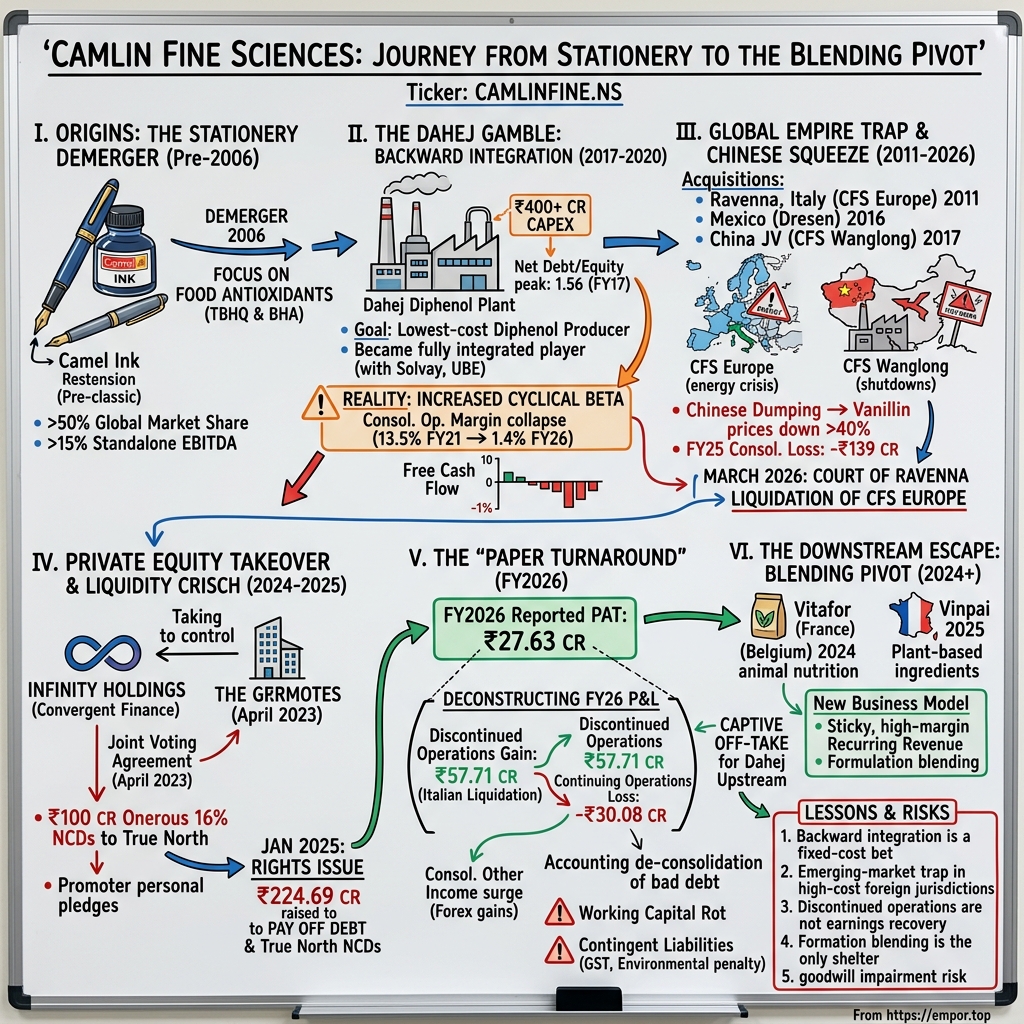
On March 17, 2026, a court in Ravenna, a city in Emilia-Romagna better known for Byzantine mosaics than for chemical plants, placed CFS Europe S.p.A. into judicial liquidation.1 For the Indian parent, Camlin Fine Sciences Limited (CFSL), it ended a long and expensive attempt to run a hydroquinone plant in a country where the energy bill could swallow the product's selling price.
The real twist came months later in Mumbai, in the accounts. Once the Italian subsidiary left the group, its liabilities left the consolidated balance sheet with it. CFSL booked a one-off gain of ₹102.91 crore on derecognising CFS Europe's net liabilities.1 That single entry turned a bad year into a reported profit. Consolidated net profit for FY2026 came in at ₹27.63 crore, while the continuing business, the plants and blending units CFSL still owns, lost ₹30.08 crore.1
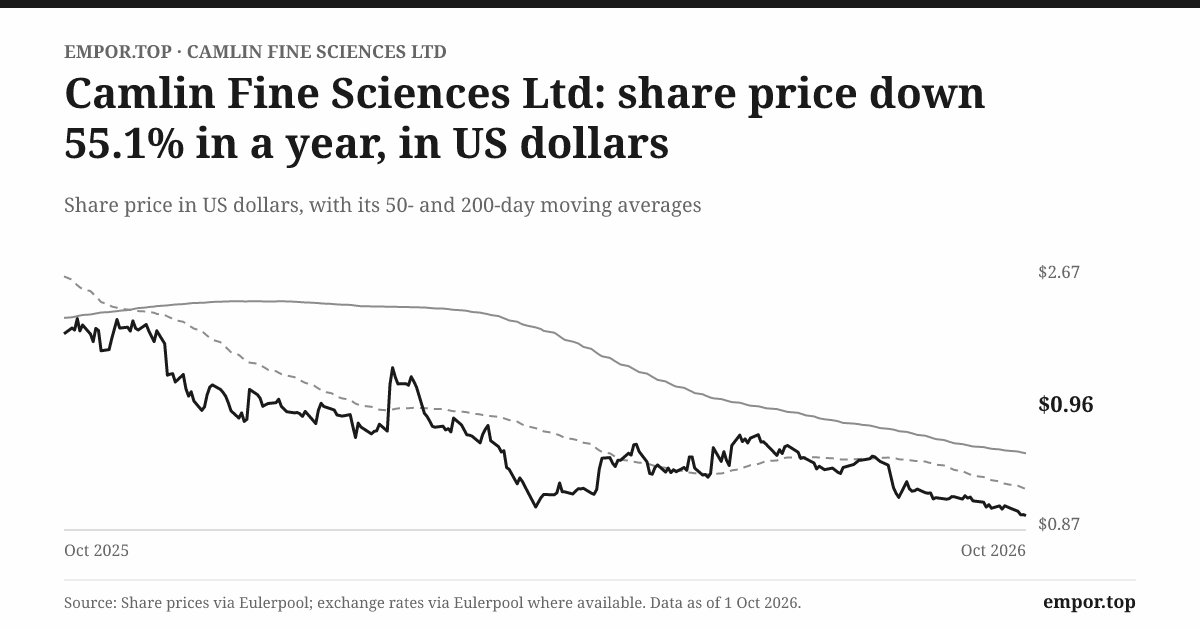
Put plainly, CFSL's best-looking result in three years came from letting a subsidiary go bankrupt. The market has not been fooled. On October 1, 2026, the shares traded at ₹92.85, down 54.4% from a 52-week high of ₹203.51. The trailing P/E of about 297x is not a sign of optimism. It is what happens when a share price is divided by almost no earnings, against a return on equity of 0.6%.2
The longer record is harsher. Across the twelve fiscal years from FY2015 to FY2026, CFSL's cumulative free cash flow, meaning cash from operations after capital spending, was about negative ₹263 crore.2 Revenue grew, the factories got bigger and the map of subsidiaries spread across five continents. The owners got almost no cash out of any of it.
That is the central question of this story. Is Camlin Fine Sciences turning into a higher-margin specialty-ingredients company, or is the FY2026 profit an accounting mirage covering for a business that has consumed capital for a decade?
The answer here is uncomfortable. CFSL is a lesson in operating leverage and in overseas expansion done badly. It learned to make food-grade antioxidants as well as almost anyone in the world. Then it spent ten years in high-capex commodity fights against Chinese scale and European energy shocks, with a balance sheet that could not afford to lose them.
The story starts with an unlikely parent: a stationery company known to generations of Indian schoolchildren for its ink, crayons and camel logo. From there it runs through:
- the move into food shelf-life chemicals, a small and profitable niche
- the Dahej megaproject, a bet that owning the raw material would end the company's dependence on European suppliers
- the overseas quicksand in Italy and China
- the arrival of Harsha Raghavan's Convergent Finance, through Infinity Holdings, as co-promoter
- a forensic look at receivables, pledges and the 16% private-credit bridge
- the move into blending through Vitafor and Vinpai, which is either the escape hatch or the next mistake
 Subscribe on LinkedIn
II. From Camel Ink to Food Preservatives: The Demerger and the Antioxidant Monopoly
Every packet of instant noodles sold in Asia raises the same small chemistry problem. The frying oil in the noodle cake wants to go rancid. Fats react with oxygen, break down into compounds that smell like old crayons, and the product spoils long before its printed expiry date. The fix is a pinch of a synthetic antioxidant: TBHQ (tertiary butylhydroquinone) or BHA (butylated hydroxyanisole). These molecules absorb the oxidation damage so the oil doesn't. They cost a few rupees per tonne of food and decide whether a brand can ship to a distant market at all.
Camlin, the stationery company, had built its name on Indian pens, inks and art colours for most of the twentieth century. Its fine-chemicals business grew out of the same chemistry habits, making specialty molecules that India had been importing. Ashish Dandekar, from the founding family, saw that antioxidants were the opportunity. They were small in volume, essential to the processed-food boom, and mostly supplied from abroad. The fine-chemicals business became a separate listed company, now Camlin Fine Sciences (incorporated in 1993, according to its corporate identity number). Dandekar stayed on as Chairman and Managing Director, which he still is today.1 The pens went one way and the preservatives went the other.
The original model: a niche with good economics
The original business model was simple and, for a while, excellent. CFSL bought basic building-block chemicals, hydroquinone and catechol, from large European producers. At its Tarapur plant in Maharashtra it turned them into shelf-life ingredients and sold them to food processors around the world.3
Most of those customers came back. CFSL's own disclosures describe 70–80% repeat volume, because once a food maker has qualified an antioxidant supplier for a recipe, it rarely shops around for the next order.3 In FY2015, CFSL earned a 31.4% return on capital employed and a 40.8% return on equity.4 Those are excellent returns for any manufacturer.
The weakness was always in the molecule
TBHQ and BHA are not patented. They are old molecules made through known processes. Being good at making them earns a margin for as long as nobody bigger decides the market is worth entering. The high returns of the early 2010s were a signal to competitors as much as a reward. Today CFSL's pricing is set per kilogram or per tonne, mostly through spot orders and contracts of one to six months, with no minimum volumes and no take-or-pay clauses.3
Customers come back to CFSL out of habit, but nothing in the contract makes them. So the repeat business is real, but it does not give CFSL the power to set prices.
The supplier problem
The bigger structural problem sat upstream. CFSL relied on merchant suppliers of hydroquinone and catechol. When those suppliers raised prices or rationed supply, CFSL's margin shrank straight away, because a small Indian formulator could not pass on every increase to multinational food buyers.
From there management drew the conclusion that shaped the next decade: integrate backward or stay at the mercy of the European suppliers. Revenue did grow strongly, compounding about 13.4% a year over the decade to FY2026, from roughly $75 million to $195 million.4 But the factories built to deliver that growth also built the trap.
III. The Dahej Gamble: Betting the Farm on Backward Integration
Picture the Dahej Special Economic Zone on the Gulf of Khambhat in the late 2010s. Its flat, salt-crusted land is lined with tank farms and pipe racks. Here CFSL built the plant that was supposed to free it from its suppliers: a diphenol unit that oxidises commodity phenol into hydroquinone and catechol, with downstream lines for vanillin. The Economic Times reported on the commissioning of the Dahej unit in September 2020.[^5]
Why own the raw material
The logic was sound. Hydroquinone and catechol feed three businesses at once:
- antioxidants such as TBHQ
- performance chemicals, including the polymerisation inhibitors that petrochemical plants use to stop monomers from gelling in their pipes
- aroma chemicals, above all synthetic vanillin, the vanilla flavour in most of the world's biscuits
If CFSL could make the building blocks itself at world scale, it would collect the supplier's margin as well as its own. Management reasoned that it would become one of the lowest-cost producers in the world.
What it cost
Building the plant pulled in debt. Debt-to-equity hit 1.56 in FY2017, as borrowings roughly doubled in a year.4 Investing cash outflows ran heavily negative through the construction years, and free cash flow was negative in six of the seven years from FY2017 to FY2023. The worst of those years was FY2023, at roughly negative $11.6 million.4
Over that stretch, cumulative free cash flow came to about negative $46 million. For a company with a market value of about $185 million today, that is a large hole.2
Historical falsification: the scale-economics illusion
The thesis: backward integration creates a cost moat and protects margins from shocks in raw-material prices.
The test: if that were true, CFSL's margins should have become more stable after Dahej started up. They became less stable.
- The consolidated operating margin peaked at 13.5% in FY2021, the first full year after commissioning.
- It fell to 4.5% in FY2024, recovered to 9.0% in FY2025, then dropped to 1.4% in FY2026.4
- Asset turnover, meaning revenue per rupee of assets, fell from 1.30 in FY2015 to 0.74 in FY2026.5
The second point means each rupee of assets now generates about half the sales it did before the integration push.
The mechanism: a merchant formulator's main cost is raw material. When prices fall, that cost falls too. An integrated diphenol plant swaps much of that variable cost for depreciation, staffing and interest, and those are fixed. They have to be paid whether the reactors run at full capacity or half capacity.
When downstream demand softened and Chinese hydroquinone and vanillin flooded the market, CFSL had two bad choices. It could run Dahej below capacity and spread its overheads over fewer tonnes, or it could sell surplus material on the merchant market at whatever price would clear. India Ratings, which downgraded CFSL in January 2026, pointed to persistent price erosion from Chinese competition in diphenols and antioxidants and to recurring inventory write-downs.6
The verdict: the record does not support the claim that Dahej is a moat. At most it shows that CFSL can make diphenols reliably, which is a real ability but one with no pricing power attached. Dahej made the company bigger and its earnings more volatile. What would change that verdict is simple to name: a few years of operating margins holding above high single digits through a full Chinese price cycle. That has not happened yet.
While Dahej was being built, CFSL was also buying factories abroad, and those deals turned out worse.
IV. The Global Empire Trap: Ravenna, Wanglong, and the Chinese Squeeze
In the summer of 2022, Russia's invasion of Ukraine pushed European gas and power prices to levels that had never seemed possible. Chemical makers across Germany and Italy cut output. In Ravenna, CFS Europe was in exactly the kind of business that cannot survive that: an energy-hungry hydroquinone process making a product whose price is set by Chinese competitors with cheap domestic coal power. Every tonne cost more to make than it sold for.
How CFSL ended up in Italy
The Ravenna plant was CFSL's answer to the same supplier problem that led to Dahej. It acquired the diphenol facility from Borregaard in 2011 to secure European hydroquinone supply. Owning the supplier must have looked like the surest way to stop being squeezed by it.
Expansion followed on other fronts:
- a controlling stake in Dresen Quimica in Mexico, giving CFSL blending and Latin American distribution
- the CFS Wanglong Flavors venture in China, built to access vanillin capacity3
On paper this was a global platform with plants in India and Europe, blenders in the Americas and a foothold in China.
China: idle since 2021
Wanglong became a write-off without much of a fight. Operations stopped in February 2021 and never restarted.1 Meanwhile, Chinese producers built large continuous-process plants for vanillin and hydroquinone, which made the global market much cheaper. The margin cushion CFSL had expected for Dahej's downstream products shrank along with it.
Italy: liquidation in 2026
Ravenna lasted longer and cost more. CFSL tried shutdowns and restructuring, but in Europe, closing a chemical site means labour negotiations and environmental obligations, not just turning off the lights.
In FY2025 the bill arrived:
- In its standalone books, CFSL wrote down ₹116.49 crore on its investment in CFS Europe and ₹30.33 crore on Wanglong.1
- At group level, it took ₹146.82 crore of impairments on its European and Chinese assets.1
- The group reported a consolidated net loss of ₹139.05 crore for the year.1
The court-ordered liquidation in March 2026 ended CFSL's legal ties to the Italian business and its liabilities.
Two smaller warning signs
Two smaller incidents point to the same problem: a sprawling subsidiary network that was hard to oversee from Mumbai.
- In FY2025, an employee embezzlement of ₹6.40 crore came to light at Britec SA, the Guatemalan subsidiary.1
- In February 2026, a fire broke out at the Brazilian blending unit.1
Neither event is fatal on its own. Together they suggest that controls did not grow as fast as the group's footprint.
What the overseas expansion proves
The record on overseas manufacturing rejects the claim that it gave CFSL a global advantage:
- Two of the three big overseas manufacturing bets ended in total write-offs.
- The third, Mexico, stayed in the distribution business, where CFSL competes on service rather than cost.
The lesson is about where CFSL had a cost advantage. Its edge was low-cost Indian chemistry. Italian energy and a stalled Chinese venture offered nothing that edge could build on.
By late 2024, two years of losses had used up the company's financial room, and the people who controlled it began to change.
V. The Private Equity Takeover: Infinity Holdings and the 16% Rescue
On December 5, 2024, CFSL issued ₹100 crore of non-convertible debentures, a form of corporate bond, to True North Credit Opportunities Fund I, carrying a 16.0% coupon.7 Sixteen percent is not what a healthy Indian manufacturer pays. It is the price of private credit for a borrower that banks have stopped lending to on ordinary terms.
Around the same time, Ashish Dandekar pledged his own shares to secure about ₹29.71 crore of short-term borrowings at 14% to 16% interest. He also gave personal guarantees on ₹157.40 crore of bank working-capital limits.1 For a founder whose family name is on the company, that is as personal as corporate finance gets.
Enter Harsha Raghavan
The rescue had started years earlier. Harsha Raghavan is a former private-equity dealmaker who founded Convergent Finance. Through Infinity Holdings, Convergent put about ₹180 crore into CFSL in 2020 through convertible warrants.3
In April 2023, Infinity and Dandekar signed a joint voting agreement and launched a mandatory open offer at ₹160 per share under SEBI's takeover rules. The offer sought up to 26% of the shares and made Infinity a co-promoter with joint control.[^9]
Promoter holding, which was around 14% in 2019, reached 48.03% by June 2026. Convergent-linked entities hold the larger part, about 36–38%, against roughly 10–12% for the Dandekar family.8 The founder still runs the company day to day, but the investor now holds the larger stake.
The crunch
Then came the money:
- Consolidated losses reached about ₹93 crore in FY2024 and ₹139 crore in FY2025.1
- Bank working-capital lines were priced at 11.85% to 12.95%.1
- In January 2026, India Ratings cut CFSL's long-term facilities to IND BBB-, one notch above junk, and the short-term rating to IND A3. It cited deteriorating operations, losses at CFS Europe, and tight liquidity.6
The rights issue that paid off the lender
In January 2025, CFSL ran a rights issue: about 2.04 crore new shares at ₹110 each, offered at five for every 41 held, raising ₹224.69 crore.7 Most of that money went straight back out. ₹169.05 crore was set aside to repay debt, including the mandatory redemption of the True North debentures.7
Shareholders put up fresh equity at ₹110. The 16% lender was paid back within weeks of lending. Shareholders, in other words, paid to take out a short-term lender rather than to build anything.
Did Convergent rescue CFSL or take advantage of it?
Both, in a way. Without Infinity's warrant money, its rights-issue participation and its standing as co-promoter, the January 2026 rating would probably have been worse. The agency itself listed co-promoter support as a strength.6
But each round of support also increased Infinity's control, at prices well below where the shares later traded. Infinity did take a real risk on a deteriorating business, and its approach looks like a disciplined investor's. For minority shareholders, though, the result is plain: the fresh equity went to repairing the balance sheet, not to growing the business.
Governance and pay
Early 2025 brought a board overhaul. Sutapa Banerjee left, and three new independent directors joined: Abeezar Faizullabhoy, Radhika Dudhat and Jens Van Nieuwenborgh. That left six independent directors on a twelve-member board.1
Pay moved in the other direction from results:
- Dandekar earned ₹2.96 crore in FY2026.
- Managing Director Nirmal Momaya earned ₹2.94 crore.
- Average managerial pay rose 13%, while continuing operations lost money.
- The ratio of Managing Director pay to median employee pay was about 53 to 1.1
None of this is illegal or unusual for an Indian mid-cap, but it is hard to square with a year of losses.
Pay was not the problem the market cared about most, though. The bigger question was what the FY2026 numbers actually showed.
VI. The Paper Turnaround: Court of Ravenna and the Illusion of FY2026 Profit
When the FY2026 annual report came out in July 2026, retail investors on social media celebrated. Earnings per share had gone from a loss of about ₹8 to a small profit. The real story is in Note 43, on discontinued operations, where the improvement turns out to come from removing the Italian subsidiary from the accounts.1
Taking the income statement apart
The reported figure is a consolidated net profit of ₹27.63 crore.1 Underneath it are three pieces:
- Discontinued operations: about +₹57.7 crore. This is the ₹102.91 crore derecognition gain, less CFS Europe's operating losses before liquidation.
- Continuing operations after tax: −₹30.08 crore.
- Continuing operations before tax and before exceptional items: −₹8.19 crore.1
That last figure is the cleanest view of the business CFSL still owns: a pre-tax loss even before any one-off charges.
Other income propped up the result
Even that −₹8.19 crore flatters the business. Consolidated other income nearly doubled, up 89.9% to ₹28.79 crore. Almost two-thirds of it, ₹18.95 crore, was foreign-exchange gains, against just ₹1.55 crore a year earlier.1
Take out currency luck and treasury income, and the continuing business lost money at the operating level by a wide margin. The quarterly figures tell the same story:
- Operating margin was below 4% in every quarter of FY2026.
- The March 2026 quarter's 20.8% net margin came entirely from the Ravenna gain.
- The June 2026 quarter was back to a loss.9
Cash: operations didn't produce it
On paper, CFSL looks like a cash machine. Over twelve years, cash from operations was about ₹688 crore, against cumulative net profit of just ₹40 crore.2 The gap comes from non-cash charges: more than ₹450 crore of depreciation, interest added back, and the large FY2025 impairments.1
In FY2026 alone, operating cash flow was ₹82.07 crore even though continuing operations made a loss.1 Shareholders never saw that cash. It went into plants and acquisitions.
The balance sheet is weakening
Receivables. Credit-impaired receivables rose about sixfold, from ₹2.26 crore to ₹13.83 crore.1
- Receivables overdue beyond their due date reached ₹162.35 crore, about 42% of the gross book of ₹387.77 crore.
- ₹30.10 crore was more than three years overdue.1
A receivable three years past due is not working capital. It is a write-off nobody has booked yet. Debtor days, the average time customers take to pay, rose from 74 to 90 in a single year.5
Debt kept off the balance sheet. ₹12.76 crore of customer receivables had been discounted with banks with full recourse. They are off the balance sheet, but if those customers don't pay, CFSL still owes the bank.1
Contingent liabilities.
- Disputed tax demands total ₹57.78 crore. Goods and services tax (GST) disputes alone rose about 239%, to ₹34.53 crore.1
- The National Green Tribunal imposed a ₹17.12 crore environmental penalty over alleged pollution at Tarapur. The Supreme Court has stayed it, and CFSL deposited 30% under protest.1
Auditor flags. In the standalone report, the auditor noted under CARO, the Indian auditor's statutory reporting order, that principal and interest due from a non-subsidiary borrower had not been collected and had been fully provided for. In the consolidated report, the auditor flagged subsidiary AlgalR Nutrapharms for delays in depositing undisputed statutory dues.1 Neither is a qualified audit opinion. Both are the kind of small items an investor should count.
Verdict
The FY2026 turnaround did not come from operations. Exiting Ravenna stops a cash drain, and that is real progress. But the profit the market is being shown comes from accounting for an exit, not from making and selling chemicals at a profit.
So the question for the remaining business is whether it can earn a living. Management's answer is in Belgium and France.
VII. The Downstream Escape: Vitafor, Vinpai, and the Blending Pivot
In November 2025, CFSL made its most unusual deal yet. It issued about 41 lakh new shares on a preferential basis at ₹247.69 each, together worth ₹101.71 crore, as a share swap to take about an 84% controlling stake in Vinpai S.A.1 Vinpai is a French ingredients company listed on Euronext Growth Paris.10 Before that, CFSL had bought Belgium's Vitafor Group, a maker of animal-nutrition ingredients, for about €5 million.3
The swap price deserves a note. CFSL used its own shares as currency at ₹247.69, close to the top of their range, and today those same shares trade at about ₹93.2 As a matter of timing, issuing expensive paper was the smartest capital decision in this story.
Why blending is a better business
Making a molecule like hydroquinone or standard vanillin is a scale game. The largest, cheapest plant wins, and that plant is usually in China.
Blending works differently. Think of it as the difference between growing wheat and running a bakery:
- A blender combines several ingredients into a custom recipe for one customer: an antioxidant pack for one pet-food line, a premix for one poultry integrator, a texturiser for one plant-based burger.
- Each recipe goes through its own qualification, so customers rarely switch.
- Batches are small, and service and technical support matter as much as price.
For CFSL, the strategic logic is also an admission. After a decade of trying to win on cost upstream, management is now trying to win on closeness to the customer downstream.
What CFSL bought
Vitafor (Belgium). About 30,700 tonnes of capacity in animal nutrition, feed ingredients and hygiene products, with direct access to European feed millers.3
Vinpai (France). Algae- and plant-based functional ingredients for dairy, processed meat and cosmetics.10 The total consideration was about €14.33 million.1
The group is now overwhelmingly international: 85.3% of FY2026 revenue came from outside India.1
Historical falsification: the synergy trap
The thesis: the blending acquisitions will give Dahej's chemicals a captive downstream buyer, stabilise how fully the plant runs, and widen margins.
The evidence:
- Vinpai came with ₹7.82 crore of credit-impaired receivables already on its books.1
- €2.56 million, about ₹27.92 crore, sat in escrow for the mandatory open offer to Vinpai's minority shareholders.1
- Vinpai brought about ₹185.94 crore of goodwill, the premium paid over the value of its net assets, onto a group balance sheet whose shareholders' equity is only around ₹1,100 crore.1
- Vitafor's feed ingredients and Vinpai's algae texturisers draw on chemistry very different from hydroquinone and vanillin. CFSL has not published how much of Dahej's output either business will actually take.
The mechanism: goodwill does not wear down quietly over time under Indian accounting rules. It sits on the balance sheet until an annual impairment test says it is worth less, and then it is written off in one go. That is exactly how CFS Europe's ₹116 crore standalone write-down arrived.
The verdict: the history narrows the thesis without rejecting it. Blending is a better business than commodity synthesis, and CFSL is right to want it. But this is the third time CFSL has bought European assets with expensive Indian capital, and the first ended in liquidation. The blending business should be treated as unproven until it shows up in the segment numbers.
The test is simple to state: segment margins for the blends and health businesses in FY2027, and whether the next audit takes any impairment on Vinpai or Vitafor.
That raises the wider question: does any of this give CFSL an advantage competitors can't easily copy?
VIII. Analysis: 7 Powers, Porter's 5 Forces, and the Bull vs. Bear Stress Test
Imagine a sceptical investor building a spreadsheet with two columns. One is Clean Science and Technology, the Indian specialty chemicals company that makes some of the same molecules, hydroquinone among them, using proprietary catalytic processes. The other is CFSL.
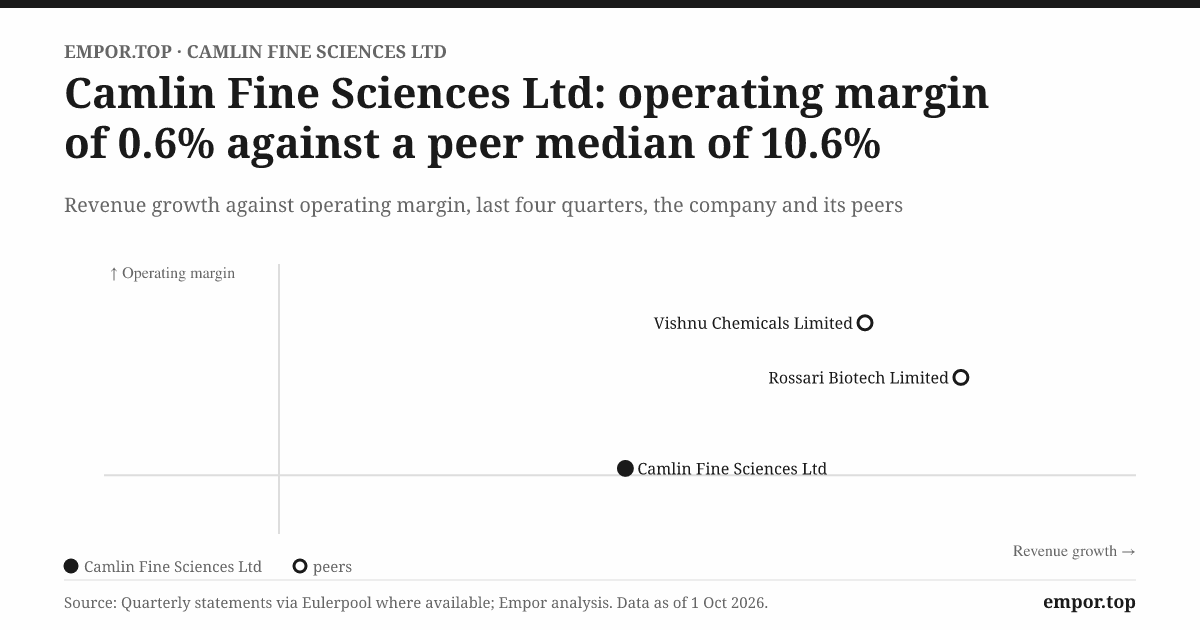
Clean Science earns EBITDA margins of about 40% and a return on capital above 25%, with no net debt. CFSL earns a 1.4% operating margin and a 1.8% return on capital, and carries about ₹612 crore of net debt.2
Clean Science trades at about 23.5 times EBITDA. CFSL trades at about 20 times its own much smaller EBITDA.2 The market is paying nearly the same multiple for a company that earns very little and one that earns a great deal. That only makes sense if investors are pricing CFSL on what it might earn after a recovery, not on what it earns now.
Clean Science's numbers matter for another reason. They show that Indian process chemistry in these molecules can earn excellent returns. CFSL's problems are not something the country or the industry forced on it. They come from its technology, its overseas assets and its debt.
Hamilton Helmer's 7 Powers
Helmer's framework asks whether a company has any lasting edge competitors cannot copy. CFSL scores poorly.
- Scale economies: impaired. Dahej is large by Indian standards, but its margins collapsed exactly when Chinese capacity grew. The plant's size has not protected its pricing.
- Network effects: none. A buyer of antioxidants gets nothing extra because other buyers use the same supplier.
- Counter-positioning: none. Nothing in CFSL's model is something a large incumbent would be unwilling to copy.
- Switching costs: weak upstream, still developing downstream.
- Food makers do need time to re-qualify a supplier, and repeat volume is high.
- But business runs on spot orders and short contracts, with no minimum volumes.3
- The stickier custom-blend business is still a minority of revenue.
- Branding: low. The adorr vanillin brand is known to flavour houses, but brand loyalty in B2B chemicals rarely survives a 20% price gap.
- Cornered resource: none. Staff turnover is about 33% a year, which works against any claim that proprietary know-how is locked inside the company.1 R&D spending was about 1.1% of standalone turnover.1
- Process power: narrow. Running hazardous oxidation chemistry safely at scale is a real skill, but Clean Science shows that rivals can match or beat it.
Verdict: CFSL has no active Power today. The best case is that switching costs build in blending over the next several years.
Porter's Five Forces
Threat of new entrants: mixed. Building a diphenol plant is expensive, which keeps new players out upstream. Blending, by contrast, is easy to enter.
Supplier power: high. Phenol and benzene prices follow oil and the petrochemical cycle, and CFSL cannot always pass those costs on.11
Buyer power: high, but not because of concentration. No customer accounts for even 10% of revenue across a base of more than 1,200 buyers in 51 countries.1 But to most of them, basic antioxidants are a commodity line item. Slow payments show who has the upper hand: ₹162 crore of overdue receivables means customers can pay CFSL late without consequences.
Substitutes: moderate to rising. Natural antioxidants such as rosemary extract and tocopherols, along with fermentation-made vanillin, are attractive to premium consumer brands looking for clean labels.3
Rivalry: intense. Chinese producers set the price.12
The bull case
- China eases. If Chinese oversupply eases, or trade remedies such as anti-dumping duties narrow the price gap, then Dahej's fixed cost base becomes a lever on the way up rather than a burden. The same operating leverage that hurt CFSL would help it.
- Blending works. If Vitafor and Vinpai grow their margins and absorb part of Dahej's output, the group's earnings become more stable.
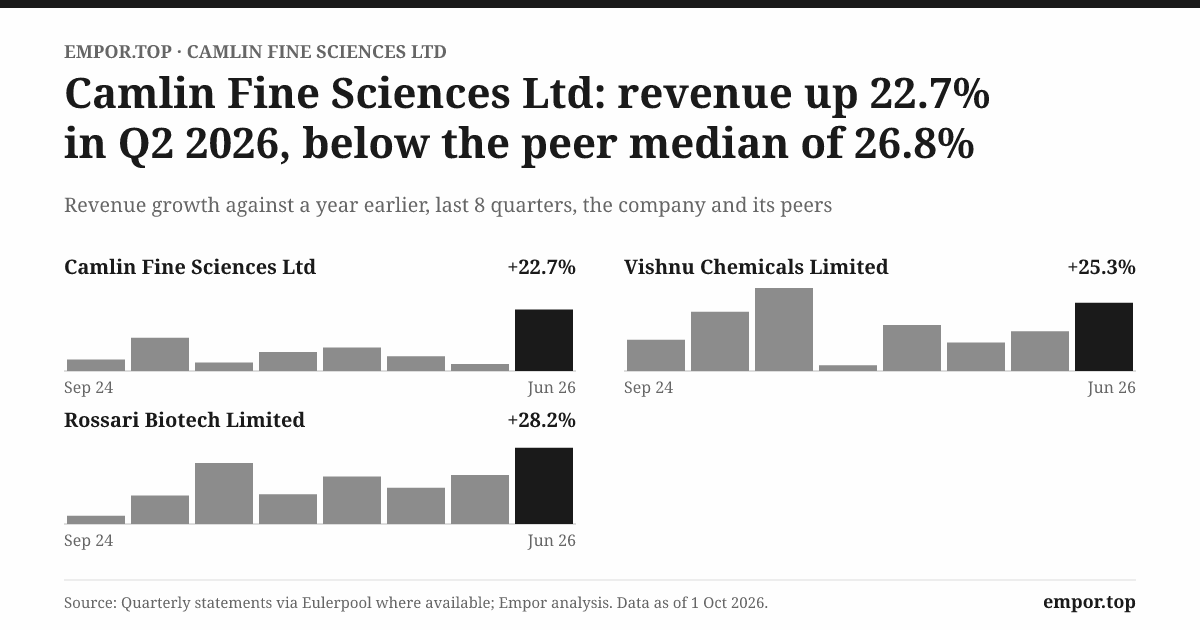
- Less cash leaks out. With Ravenna gone, the cash drain stops. Revenue rose 22.7% in the June 2026 quarter, the strongest growth in the series, which hints that volume is coming back.9
The bear case
- The liquidity cliff. About ₹972.92 crore of contractual obligations fall due within twelve months, including ₹365.48 crore of current borrowings. Against that sit cash of about ₹108.56 crore and annual operating cash flow of about ₹82 crore.1 CFSL depends on lenders continuing to roll over its debt.
- Currency mismatch. About ₹381 crore of foreign-currency borrowing is unhedged, which amplifies any adverse rupee move.1
- A second wave of write-offs. Vinpai's goodwill and the long-overdue receivables could both turn into write-offs that eat into equity.
- Pledges and dilution. Pledged promoter shares backing high-cost debt become a pressure point if the share price keeps falling. That risk sits alongside the possibility of another rights issue at a discount.
The three KPIs that matter
- Continuing-operations operating margin. It was 1.4% in FY2026 and roughly zero in the June 2026 quarter.9 It needs to reach the high single digits for operating profit to cover interest comfortably.
- Current borrowings and the pledged debt. ₹365.48 crore of short-term debt is outstanding. The test is whether it gets rolled into long-term debt and whether the promoter-pledged loans are retired.1
- Receivables more than three years overdue. These stood at ₹30.10 crore.1 Growth here would signal more write-offs to come.
Playbook: Business & Investing Lessons
1. Backward integration is not a moat. It is a bet on fixed costs. Dahej was meant to free CFSL from its European suppliers. Instead, it swapped those suppliers' prices for CFSL's own depreciation and interest bill, costs that arrive every quarter whatever Chinese vanillin sells for. Integration makes sense only when you also control the price of the product. Otherwise you simply take on more of the cycle. "Integrating into a commodity doesn't remove the cycle. It just means you own the factory that takes the loss."
2. Expensive capital should not buy high-cost factories. CFSL borrowed in India at around 12% and spent it on a plant in Italy whose survival depended on European gas prices, and a venture in China whose survival depended on a partner and a regulator it could not control. Neither offered a cost advantage, so the capital had nothing to compound on. "An Indian company buying a European chemical plant is usually buying someone else's power bill."
3. A discontinued operation is an autopsy, not a recovery. FY2026's profit came from removing the liabilities of a bankrupt subsidiary. It is right to welcome the exit. It is a mistake to put that gain into a valuation multiple. "You cannot value a business on the profit of putting your own subsidiary into bankruptcy."
4. Follow the rights-issue money. ₹225 crore was raised from shareholders, and about ₹169 crore of it went to repaying debt, including the 16% True North debentures, within weeks. When fresh equity pays off a short-term lender, the shareholder is not funding growth. They are rescuing the lender. "When equity pays off 16% debt, the shareholder isn't the owner; they're the exit."
5. In specialty chemicals, the profit is in the recipe, not the molecule. Thirty years in, CFSL is learning what its customers already knew. A food maker will switch hydroquinone suppliers for a few rupees a kilogram, but it will think hard before reformulating a product that already works. The move to blending is the right idea. The open question is whether CFSL has the balance sheet to see it through. "The money in specialty chemicals is never in making the molecule. It's in persuading the customer not to change the recipe."
X. Epilogue
Tonight, on October 1, 2026, CFSL is worth about ₹1,784 crore at ₹92.85 a share, less than half its value of a year ago. Its enterprise value is about ₹1,675 crore.2 The court in Ravenna has done its part. Now the business that remains has to show what it is.
Three events over the next year will settle the story's three central questions.
FY2027 continuing earnings. Revenue jumped 22.7% in the June quarter, yet the company still made an operating loss.9 If revenue keeps growing and margins finally follow, the turnaround becomes real. If input costs keep absorbing the growth, FY2026's profit will look like what it was: a one-off accounting gain.
The refinancing test. CFSL needs to replace the 14–16% pledged debt and term out its ₹365 crore of short-term borrowings without another discounted rights issue.1 A rating upgrade from IND BBB- would confirm it has done so. Another emergency equity raise would show it hasn't.6
The European scorecard. The next audit's impairment tests on Vinpai and Vitafor will show whether blending is a new kind of business for CFSL or a repeat of Ravenna.
The tension remains unresolved. This is a proud Indian manufacturing name, with a joint promoter group that has every reason to make the recovery work. It is also a leveraged, low-return commodity processor trying to become a food-solutions company before its creditors lose patience.
XI. Outro
The Dandekar family's business started out by making ink powders and pens in a city flooded with imported British stationery. The bet was that Indian chemistry could compete with anyone. Nearly a century later, the company bearing the Camlin name operates on five continents. It has survived Chinese price wars, an Italian bankruptcy and a 16% private-credit bridge. Its fate still depends on the question every chemist-turned-businessperson eventually faces: can it sell food science for more than the chemicals cost?
Camlin Fine Sciences is a story of excellent chemistry and expensive mistakes. It learned that going global without pricing power mostly meant paying the costs of keeping the world's packaged food on the shelf.
References
-
Camlin Fine Sciences Limited Annual Report 2025-26 — Camlin Fine Sciences Limited, 2026-07-24 ↩↩↩↩↩↩↩↩↩↩↩↩↩↩↩↩↩↩↩↩↩↩↩↩↩↩↩↩↩↩↩↩↩↩↩↩↩↩↩↩↩
-
National Stock Exchange of India Company Directory: Camlin Fine Sciences — NSE India ↩↩↩↩↩↩↩↩
-
Letter of Offer for Rights Issue — Camlin Fine Sciences Limited, 2025-01-09 ↩↩↩↩↩↩↩↩↩
-
Camlin Fine Sciences Investor Relations Portal — Camlin Fine Sciences Limited ↩↩↩↩↩
-
Camlin Fine Sciences Limited Annual Report 2024-25 — Camlin Fine Sciences Limited, 2025-07-15 ↩↩
-
India Ratings Downgrades Camlin Fine Sciences to 'IND BBB-' with Stable Outlook — India Ratings and Research, 2026-01-07 ↩↩↩↩
-
Rights Issue Portal & Statutory Filings — Camlin Fine Sciences Limited ↩↩↩
-
Shareholding Pattern Disclosures — Camlin Fine Sciences Limited ↩
-
BSE India Company Announcements: Camlin Fine Sciences Ltd (532834) — BSE India ↩↩↩↩
-
Vinpai S.A. Regulated Information and Acquisition Filing — Euronext Paris, 2025-11-20 ↩↩
-
CRISIL Rating Rationale: Camlin Fine Sciences Limited — CRISIL Ratings ↩
-
Chemical Sector Price War: Chinese Vanillin and Diphenol Dumping Pressures Indian Players — Business Standard ↩
 LinkedIn
 WhatsApp
 Reddit
 Hacker News
 Email
Email Kindle
 RSS Feed
 Spotify
 Apple Podcasts
 Amazon Music
 Audible
 YouTube