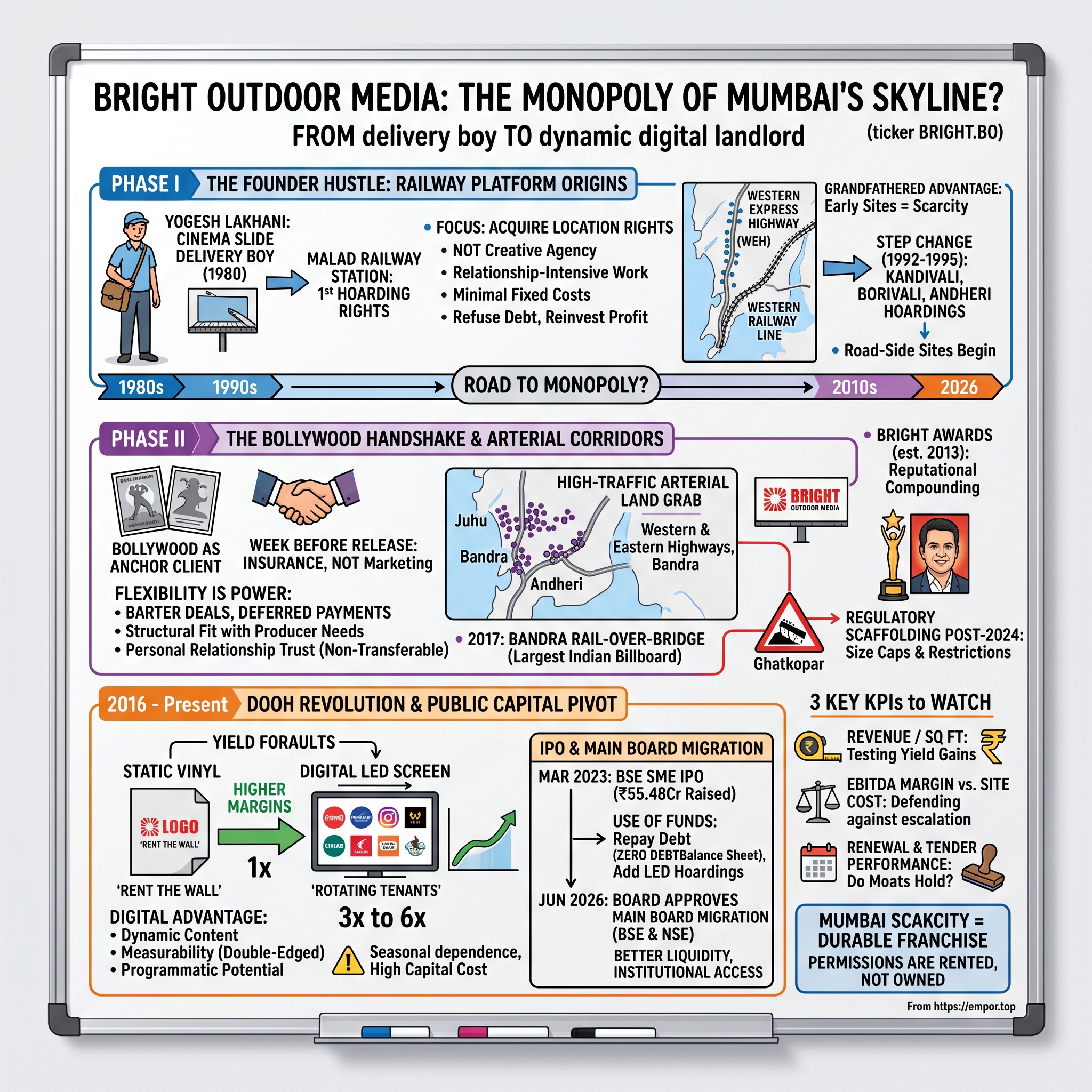
Bright Outdoor Media: The Monopoly of Mumbai's Skyline
I. Introduction & Episode Roadmap
If you have ever sat in the crawling 8 a.m. traffic on Mumbai's Western Express Highway — the artery that carries commuters from the northern suburbs down toward the airport and the financial districts beyond — you have participated in one of the most reliable economic transactions in India, and you almost certainly did not notice it.
You were paying attention. Someone was collecting the toll.
For roughly forty minutes, your eyes had nowhere useful to go. Not down at a phone, if you were driving. Not into a feed. Just forward, at the brake lights ahead, and up, at the wall of illuminated rectangles rising above the flyover — a face cream, a film release dropping Friday, a housing project promising twenty minutes to Bandra Kurla Complex, a bank, a soft drink, a cricketer holding something. Each of those rectangles occupies a piece of physical space that cannot be duplicated, cannot be scrolled past, and cannot be blocked by a browser extension. Someone owns the right to put pixels or vinyl there. Someone charges rent for it.
In Mumbai, more often than the city's advertising industry likes to admit, that someone is a company called Bright Outdoor Media Limited, and behind it stands a man named Yogesh Lakhani, who started in 1980 by hanging a board at Malad railway station.
This is a story about a business model that sounds almost embarrassingly simple — rent the wall, sell the wall — and turns out to be one of the most regulatorily entangled, relationship-dependent, and structurally protected businesses in Indian media. It is also a story that requires unusual analytical discipline, because Bright is a small, founder-controlled company that until very recently traded on the BSE's SME platform, holds no earnings conference calls, publishes no investor presentation deck, and communicates with the market largely through half-yearly press releases distributed by a newswire. The gap between what the company says about itself and what has been independently verified is, at several points in this story, wide. We will flag it where it matters.
The company as it stands today. Bright Outdoor Media trades on the BSE under the security code 54383116 with a market capitalisation of roughly ₹797 crore.1 For the financial year ended March 2026, it reported total income of ₹155.43 crore, EBITDA of ₹35.23 crore, and net profit of ₹24.05 crore, with earnings per share of ₹12.26.2 It carries essentially no debt.1 Its promoter holds close to seventy percent of the equity.1 And in June 2026, its board approved a move to shift the shares off the SME platform and onto the main boards of both BSE and the National Stock Exchange — the corporate equivalent of moving from a side street to a main road.3
For scale: India's entire out-of-home advertising market generated roughly ₹5,920 crore in 2024, according to EY's annual media and entertainment analysis.4 Bright's media and advertising revenue of ₹146.62 crore in FY26 therefore represents something in the neighbourhood of two to three percent of the national pie.5 This is not a giant. It is a specialist with a very particular geography.
The narrative arc. Forty-six years, compressed: a teenager delivering cinema slides in suburban Mumbai in 1980 builds a portfolio of railway platform boards; converts railway relationships into road-side hoarding permits through the 1990s; becomes the default media partner for Bollywood film promotion in the 2000s; incorporates as a private limited company in 2005; begins replacing static vinyl with LED screens in the second half of the 2010s; lists on the SME exchange in 2023; and is now attempting the awkward transition every founder-run Indian small cap eventually faces — from a business run on personal relationships and a mobile phone, to one run on disclosure schedules and institutional expectations.
Four themes we will keep returning to.
The first is that outdoor advertising is not really a media business. It is a real-estate business wearing a media business's clothes. The economics are those of a landlord: you acquire a right to a location, you pay a fixed fee for it, and you extract as much rent as demand permits. The scarcity is physical and municipal, not creative.
The second is the digital conversion — the shift from static vinyl to LED, which fundamentally changes the yield mathematics of a single piece of sky. We will spend real time on this, because it is the engine driving Bright's recent margin expansion and it is also the most easily overstated part of the story.
The third is regulation, which in Mumbai is not a background condition but the main event. Eight separate authorities govern outdoor advertising in the city.6 In May 2024, a billboard collapsed in Ghatkopar and killed seventeen people, and the regulatory environment has been reshaping itself ever since.6 For an incumbent with permitted sites, tighter rules can be a moat. They can also be a guillotine. Which one depends on details we will examine.
The fourth is the founder. Yogesh Lakhani is not a professional manager who arrived with a mandate. He is the business, in a way that is both the source of the franchise and its single largest concentration of risk.
A word about the word "monopoly." It appears in the framing of this story and it deserves immediate qualification, because it is the kind of word that does more analytical damage than good. Bright does not hold a monopoly on Mumbai's outdoor advertising in any competitive sense. Multiple organised media owners operate in the city, the largest municipal and transit concessions are awarded by competitive tender, and an advertiser wanting billboard space in Mumbai has genuine alternatives. What Bright plausibly holds is something narrower and more interesting: a concentrated position in a subset of high-value corridors and formats where the number of permissible sites is capped by regulation rather than by capital. That is not monopoly. It is positional scarcity, and the distinction determines whether the pricing power survives the next tender round.
We will test that distinction throughout. But first, the beginning.
 Subscribe on LinkedIn
II. Founder Hustle & The Railway Platform Origins (1980–1990s)
Picture a suburban railway platform in Mumbai in 1980. The Western Line. Wooden benches, ceiling fans that mostly stir warm air, an announcement system nobody can decipher, and a crowd density that would be a fire-code violation almost anywhere else on earth. Trains arrive every three or four minutes. Each one disgorges hundreds of people who then stand — waiting, sweating, staring at nothing in particular — for anywhere between two and twenty minutes.
Now count the eyeballs. Then count how much anyone was charging for them.
In 1980, the answer to the second question was: almost nothing. That gap is the entire origin story.
The slide delivery boy. Yogesh Jiwanlal Lakhani finished his SSC examinations and started, by the company's own account, as a delivery boy for cinema slides — the glass or acetate advertisements projected onto the screen before a film began and during the interval.7 It was the lowest rung of the advertising trade: no creative work, no client relationships, just physically moving inventory between an agency and a theatre projectionist. What it did provide was an education in the actual mechanics of the business. Who owned the display surface. Who granted permission. What the theatre owner charged. How late a payment could run before the relationship broke.
Bright Outdoor Media dates its founding to 1980 and to a single billboard at Malad railway station.7 That detail is worth pausing on, because it explains the shape of everything that followed. He did not start by opening an advertising agency and pitching clients. He started by acquiring a surface. The distinction matters enormously: an agency sells its judgment and can be replaced by a better pitch; a media owner sells access to a location that literally cannot be replicated, and can only be replaced if the buyer finds an equivalent location.
Why the timing was extraordinary — and why it can never repeat. India in 1980 was four years into an economy where television was a single state channel, private radio did not exist, and the consumer goods sector was small enough that national brand campaigns were a rarity. Advertising budgets were modest and heavily print-weighted. Outdoor advertising was the unglamorous corner: fragmented, locally negotiated, dominated by small operators who painted walls and hung cloth banners.
The capital required to enter was trivial. A permission, a structure, some paint. What it required instead was time, physical presence, and a willingness to spend years cultivating relationships with railway divisional officers and municipal clerks — the sort of work that does not scale, does not look like a business, and cannot be outsourced. This is precisely why it was available. Capital-intensive opportunities attract capital. Relationship-intensive, low-prestige opportunities attract only people willing to do the work.
The economics of a pre-liberalisation media business. It is worth being concrete about what this business actually looked like financially in its first decade, because it explains the temperament that still governs the company. There was no institutional lending available to an outdoor advertising proprietorship with no collateral. There was no venture capital in India. Working capital came from the client's advance or it did not come at all. A media owner in that era survived by keeping fixed costs almost nonexistent, by refusing to commit to site fees he could not cover from existing bookings, and by treating every rupee of profit as the deposit on the next permission.
That is a formative discipline, and it shows up forty years later in a company that carries no debt, pays a token dividend, and retains almost everything it earns.1 Investors sometimes read a debt-free balance sheet in a small Indian company as evidence of a sophisticated capital structure decision. More often it is the residue of an era when debt simply was not on offer, hardened into a preference. Both readings can be true at once, and neither is automatically the shareholder-optimal policy.
The compounding decade. Through the 1980s and into the 1990s, the flywheel was straightforward and slow. Rent a board. Sell the board. Take the cash. Buy the rights to another board. There was no external capital, no leverage worth mentioning, and no strategic plan beyond the obvious one: more sites, better sites.
The step-change came in 1992, when Lakhani secured the hoarding rights across Kandivali, Borivali and Andheri railway stations — three of the highest-footfall nodes on the Western line, covering the dense suburban belt where Mumbai's middle class actually lives.7 By 1995, by the company's account, the portfolio had grown to roughly two hundred railway hoardings, and Bright began moving off railway land and onto road sites.7
That transition — from railway to road — is the single most important strategic move in the company's first two decades, and it is easy to miss because it sounds like simple expansion. It was not. Railway advertising rights are granted by a central government entity through periodic tenders; they are competitive, renewable, and revocable. Road-side hoardings in Mumbai are governed by municipal permission attached to a specific plot, rooftop, or structure, often with a private landlord in the chain. The road-side asset is stickier, higher-priced, and — critically — far harder for a newcomer to assemble later, once the city has built out around it.
The grandfathering advantage. Here is the part that compounds silently for thirty years. Every permission Bright acquired in the 1980s and 1990s was acquired under a regulatory regime that no longer exists. Mumbai in 1985 was not policing sightline obstruction, structural load certification, luminance ratios, or minimum spacing between hoardings. A site that was permissible then may sit in a location where a new permission today would simply not be granted — because a competing hoarding is now within the minimum distance, or because the structure type is no longer allowed.
This is the quiet foundation of the investment case: the incumbent's inventory was assembled when assembly was cheap and permitted, and the regulatory ratchet since then has mostly turned in one direction. We should be careful not to overstate it — permissions expire, are re-tendered, and can be withdrawn, and we will look hard at that in Section VI. But the asymmetry is real, and it is not something a well-funded new entrant can simply buy its way past.
By the late 1990s, Bright had inventory and cash flow. What it did not yet have was a category of client willing to pay premium prices for premium visibility — and a reason for that client to keep coming back. That arrived, as so many things in Mumbai do, from the film industry.
III. The Bollywood Handshake & Securing Mumbai's Arterial Corridors (2000–2015)
There is a specific ritual in Hindi cinema that has almost nothing to do with cinema. Roughly three weeks before a major film release, the city changes clothes. The hoardings along the Western Express Highway, the panels at Bandra, the sites clustered around Andheri and Juhu where the industry actually lives and works — they all turn over at once, to the same face, the same title treatment, the same release date. For a fortnight, Mumbai becomes a single continuous film poster.
For a producer, that fortnight is existential. Hindi films have historically earned a disproportionate share of their lifetime revenue in the opening weekend. Miss the opening, and no amount of good word-of-mouth fully recovers it. Which means the media buy is not a marketing decision with a normal ROI calculation; it is closer to insurance. And insurance buyers are not price-sensitive in the way toothpaste buyers are.
Bright positioned itself directly in the path of that spend.
Why entertainment was the perfect anchor client. Consider what a film campaign needs. It needs enormous visual scale in a narrow geography — Mumbai and a handful of metros, not a national footprint. It needs the inventory to be available on an exact date that was set months earlier and may still move. It needs the media owner to accept a chaotic approval process where final artwork arrives two days before posting. And it needs, frequently, flexibility on payment, because film production financing is famously lumpy and a producer's cash position three weeks before release is not the same as it will be three weeks after.
A large corporatised media network optimised for annual FMCG contracts finds most of these requirements intolerable. Its systems are built for planned buys, standard rate cards, and thirty-day credit terms. An owner-operated business whose proprietor can approve a barter arrangement or a deferred payment over a phone call finds them entirely workable — and charges for the privilege.
That is the actual mechanism behind what gets described, in the company's own materials, as relationships and trust. It is not sentiment. It is a genuine structural fit between an unusual set of client requirements and an unusual ownership structure. The company says it has served more than five thousand corporate clients over its history and describes a dominant position in entertainment across Bollywood, regional cinema, concerts and large events.7 The client count is a company claim without independent verification; the entertainment concentration is visible to anyone who has driven through Mumbai in the week before a big Friday.
The reputational compounding loop. There is a second-order effect here that is easy to underrate. Working with film campaigns put Lakhani in a room with the most photographed people in India, repeatedly, for two decades. From 2013 the company began running its own annual awards function, the Bright Awards, which placed the media owner on stage alongside the talent rather than behind the invoice.8 The founder himself accumulated credits on the Internet Movie Database and became, in Mumbai's advertising trade, a recognisable name in his own right.
An investor should hold two thoughts about this simultaneously. The first is that it is commercially real: in a business where the same twenty production houses and studios buy every year, being personally known to the decision-makers is a durable advantage that a competitor's rate card cannot dislodge. The second is that it is entirely non-transferable. It resides in one person. We will return to this.
The cost of the entertainment franchise. There is a bill attached to this positioning, and it arrives on the balance sheet rather than the income statement. Accepting a producer's payment schedule means carrying the producer's cash flow problem. Accepting barter — media space exchanged for on-screen credits, event association, or promotional rights — means booking revenue whose cash realisation depends on a second transaction. Both practices win business that a rigidly-run competitor would decline. Both also lengthen the gap between selling a hoarding and banking the proceeds.
This is not a hypothetical concern; it is visible in the working capital profile the company carries to this day, which we examine in the next section. The analytical point is that the flexibility which built the client franchise and the receivables position that constrains the balance sheet are not two separate facts about Bright. They are the same fact, viewed from opposite ends.
Concentration as a live exposure. Entertainment dependence also imports the volatility of an industry that has been anything but stable. Hindi cinema's theatrical economics were disrupted by the pandemic shutdowns, then by the streaming platforms' willingness to buy films outright, then by a period in which the number of wide theatrical releases and their promotional budgets fluctuated sharply year to year. A media owner whose peak season depends on a full release slate inherits every one of those swings. Bright has diversified its client base toward real estate, FMCG, financial services and consumer categories over time — but real estate developers, its other fast-growing category, are themselves among the most cyclical advertisers in India. Diversifying from one cyclical sector into another is diversification of a limited kind.
Corporatisation in 2005. In 2005, the business was incorporated as a limited company.1 This was not a fundraising event or a strategic pivot; it was plumbing. But it was necessary plumbing. Multinational advertisers and their agency holding companies cannot easily contract with a sole proprietorship. They need audited accounts, a corporate counterparty, indemnity provisions, and a vendor-onboarding trail. Incorporation was the price of admission to the FMCG, telecom, banking and real estate budgets that would eventually diversify Bright away from pure entertainment dependence.
The interesting analytical question is what the company did not do with the corporate structure. It did not raise private equity. It did not roll up regional competitors. It did not build a national network to match the corporatised players. It stayed dense in one city.
The arterial land grab. Through this period the capital allocation pattern was consistent and, judged in hindsight, disciplined: operating cash went back into acquiring and holding sites along Mumbai's highest-traffic corridors — the Western and Eastern Express Highways, the Bandra and Andheri clusters, Juhu — plus continued transit inventory across railways, BEST buses, the monorail and MMRDA's freeway assets, which the company values collectively at over ₹200 crore.7
The showpiece arrived in 2017: a 120-foot by 80-foot billboard at the Bandra rail-over-bridge, which the company describes as the largest in India.7 Hold that number in mind. It is going to become extremely relevant in Section VI, because Mumbai's post-2024 regulatory framework contemplates a maximum hoarding size of 40 feet by 40 feet.9
What the pattern reveals. Strip away the glamour and the through-line is a company that made one bet, repeatedly, for thirty-five years: that scarce physical positions in a single high-value city would appreciate faster than a diversified national footprint. Through 2015, that bet largely paid — but it paid in a slow, cash-generative, unspectacular way. The company was not compounding at spectacular rates. It was accumulating land rights.
The thing that would convert accumulated land rights into a genuinely different financial profile was not a new site. It was a screen.
IV. The DOOH Revolution: Transforming Static Vinyl into Digital Cash Machines (2016–Present)
Here is the simplest way to understand what happened to the outdoor advertising business over the past decade.
Imagine you own a hotel with one room. For thirty years, you rented that room to one guest at a time, for a month at a stretch. Your revenue was the monthly rate, and your only levers were raising the rate or reducing the days the room sat empty. Then, one day, you discover that you can rent the same room to eight guests simultaneously, each of whom occupies it for ten seconds at a time, in rotation, forever.
That is the difference between a static vinyl hoarding and a digital LED billboard, and it is the single most important economic development in out-of-home advertising since the invention of the flyover.
The unit economics, in plain terms. A static hoarding carries one advertisement. The client books it for a fixed period — typically thirty to ninety days — and during that period the site is fully committed. The revenue per site per month is essentially a rental rate, and the operator's ability to grow is limited to raising rates and adding sites.
A digital LED billboard runs a loop. A standard configuration divides each minute into slots of roughly ten seconds, giving six advertising positions per minute, with one or two often reserved for the operator's own content or a premium partner. Each of those slots can be sold to a different brand. The theoretical revenue multiple against the same physical footprint is therefore substantial — the industry commonly cites a three-to-six times uplift on gross monetisation potential for a converted site.
Three qualifications matter, and the promotional version of this story tends to skip all of them.
First, a digital slot is worth less per impression than exclusive occupancy. A brand that owns the entire board for a month owns the location's identity; a brand that appears for ten seconds in every minute shares it. Buyers know this and price accordingly. The revenue multiple is real but it is not the raw slot count.
Second, the capital cost is meaningful. A large-format outdoor LED screen must survive Mumbai's monsoon, its salt air, and its heat, at brightness levels visible in direct sunlight. It requires structural reinforcement, power, connectivity, content management systems, and a replacement cycle measured in years rather than decades. A vinyl sheet costs almost nothing and lasts as long as the campaign. This is the trade: a static site is capital-light and yield-capped; a digital site is capital-heavy and yield-elastic.
Third — and this is the one that determines whether the conversion actually creates value — you need enough advertiser demand in that specific location to fill the loop. A digital board running four unsold slots out of six is worse economics than the static board it replaced, because you have added depreciation and power costs without adding revenue. Digital conversion is a bet on local demand density, not a technology upgrade.
What Bright's numbers actually show. The margin trajectory is the clearest evidence available. In the year to March 2020, on sales of ₹71 crore, operating margin was roughly nine percent.1 The pandemic year to March 2021 collapsed revenue to ₹24 crore — a brutal illustration of how completely an out-of-home business depends on people physically leaving their homes.1 Recovery followed: ₹50 crore in FY22, ₹92 crore in FY23, both at operating margins in the low teens.1
Then the step-change. In FY24, sales reached ₹107 crore and operating margin roughly doubled to twenty-one percent; FY25 delivered ₹127 crore at a similar margin; FY26 reached ₹153 crore of operating revenue with margins holding.1 On a full-year basis, FY26 total income of ₹155.43 crore came with EBITDA of ₹35.23 crore, an EBITDA margin of 22.66 percent — up 129 basis points on the prior year — and net profit of ₹24.05 crore, up 26 percent.2
The interesting detail is when within FY26 the leverage showed up. The first half was pedestrian: revenue of ₹63.31 crore, up only 9.83 percent, with EBITDA of ₹14.98 crore.10 The second half was a different business: total income of ₹92.12 crore, up 30.83 percent, with EBITDA up 42.46 percent to ₹20.25 crore.2 That is a company with roughly sixty percent of its annual revenue landing in the October-to-March window.
What that seasonality tells you. Two things, and they pull in different directions. Positively, it is consistent with an asset base whose costs are largely fixed — site fees, structures, staff — so incremental revenue in a strong half drops through to profit at a high rate. That is genuine operating leverage and it is the mathematical reason margins expanded. Less comfortably, it means the business is heavily dependent on a concentrated festive-and-release calendar. A weak second half — a soft festive season, a thin slate of film releases, a real estate advertising pullback — hits the profit line far harder than it hits the revenue line. Operating leverage is symmetric, and investors reading the FY26 second half should expect the same mechanism to work in reverse when demand disappoints.
The physical footprint — and a disclosure problem. By the half-year mark of FY26, the company described a national network of more than four hundred hoardings, some 490 display units across prime locations, a total advertising footprint of about 315,000 square feet, and more than twelve thousand square feet of newly added inventory.10 On digital specifically, the FY26 release stated that Bright owns more than fifty large-format digital LED billboards in Mumbai, out of a city total it put at more than 120.5
Take that last claim seriously but not literally. If accurate, it implies Bright controls roughly forty percent of Mumbai's large-format digital inventory — a genuinely dominant share of the highest-yield asset class in the country's most valuable OOH market. But the denominator is the company's own estimate, not an audited industry census, and no independent registry of Mumbai's large-format LED sites is publicly available. Separately, the corporate website describes more than 1,200 premium hoarding sites across Mumbai and major metros7 — a figure difficult to reconcile with the 400-plus and 490-unit numbers in the results releases without knowing whether these count owned inventory, traded inventory, or sites the company can sell as an agency. The company does not reconcile them. For an investor, that inconsistency is itself a data point: this is a business whose operating disclosure is promotional in tone and imprecise in definition.
The measurement problem, explained simply. There is a technical shift running underneath all of this that determines how much pricing power a media owner retains, and it is worth explaining without jargon.
Historically, buying a billboard was an act of faith. Nobody counted how many people saw it. The media owner quoted a rate based on the site's reputation, traffic estimates, and how badly the client wanted it. That informational fog was the media owner's friend: when nobody can measure the product precisely, the seller's judgment and relationships set the price.
Digital screens change this. A screen connected to a content management system knows exactly what played, when, and for how long. Layer on anonymised mobile location data and traffic feeds, and a buyer can estimate impressions with something approaching the confidence of an online campaign. That capability is what makes programmatic buying of outdoor inventory possible — where an advertiser's system bids for individual slots across many operators' screens automatically, the way it already does for web and app inventory.
For the media owner, this is genuinely double-edged. Measurement unlocks budgets: brand teams that would not commit to an unmeasurable medium will commit to a measurable one, which expands the total pool. But measurement also standardises. Once two screens in the same corridor can be compared on a common impression metric, the buyer's decision becomes arithmetic rather than relationship. The premium that a well-connected local operator has historically extracted for a marquee position is exactly the premium that transparency erodes. Bright's franchise is built substantially on the relationship model. The industry's direction of travel is toward the arithmetic one. That tension is not resolved, and it is a slow-moving competitive risk rather than a headline one.
Beyond the billboard. Alongside digital conversion, management has pushed into adjacent revenue: transit inventory across railways, metro and airports; and a broader "360-degree" services push spanning print, radio, public relations, influencer campaigns and on-ground activation, plus an events and MICE business that in FY26 included a Bright Real Estate Expo featuring twenty-five-plus developers and fifty-plus projects.510
The strategic logic is defensible — events and integrated services deepen the client relationship and are natural adjacencies for a firm that already sells attention in Mumbai. The analytical caution is that these are lower-barrier, lower-margin, people-intensive businesses that compete against every advertising agency in the country, and they consume management attention that the core asset business also needs. If Bright's genuine advantage is scarce physical position, revenue that does not depend on scarce physical position is, by definition, revenue earned without the advantage.
Which raises the obvious question: what has the company done with the money the core business generates? For that, we go to the capital markets.
V. Public Capital Pivot: BSE SME IPO & Main Board Migration (2023–2026)
The BSE's SME platform is a peculiar corner of Indian capital markets. It was created to give small companies a route to public capital without the full weight of main-board compliance, and it delivers exactly that — along with a minimum trading lot that keeps retail investors out, thin daily volumes, no analyst coverage, and share prices that can move violently on almost no turnover. Companies list there for money and visibility. They leave as soon as they can.
In March 2023, Bright Outdoor Media walked into that corner and made a small piece of history: by its own account, the first out-of-home media company in India to list on a stock exchange.7
The offer. The IPO was a fixed-price issue at ₹146 per share, raising approximately ₹55.48 crore, with the shares listing on the BSE SME platform on 24 March 2023.3 For a company that had generated ₹92 crore of sales in the year then ending,1 this was a substantial injection — roughly sixty percent of a year's revenue, arriving in a business that had until then grown entirely on retained earnings.
Where the money went, and whether it went where promised. The stated uses were straightforward: repay borrowings, buy LED hoardings, fund working capital, and general corporate purposes. Judged against the balance sheet, the debt repayment happened and then some. Borrowings stood at ₹13 crore at March 2024 and at essentially zero by March 2025 and March 2026.1 Management has since made zero-debt status a recurring theme in its communications.10
This deserves a fair assessment. Deleveraging a small media company to zero debt is genuinely conservative capital allocation, and it removes refinancing risk entirely — no small thing for a business with a working capital profile we are about to examine. It also means the company is not using the cheapest form of capital available to it to fund an asset conversion with attractive returns. A zero-debt balance sheet in a business with twenty-plus percent EBITDA margins, a fully owned asset base and an identified reinvestment opportunity is a choice, not automatically a virtue. It suppresses return on equity — which stood at fourteen percent in the most recent full year, against a return on capital employed of nineteen percent the year prior.1 Those two numbers, sitting apart in that direction, are the signature of a business carrying more equity than its operations need.
The working capital question. Here is the number a sceptical investor should sit with longest. At March 2026, debtor days stood at 188, and the cash conversion cycle was effectively the same.1 That means the average rupee of revenue spends more than six months as a receivable before it becomes cash.
For a business whose largest historical client category is film production — an industry with famously irregular cash flows — and whose growth categories include real estate developers, this is a coherent picture rather than a mystery. Flexible payment terms were, as we discussed, part of the competitive proposition. But it has consequences. It means reported profit converts to cash slowly. It means a downturn in the entertainment or property sectors shows up first as ageing receivables and only later as a provision. And it means the true test of FY26's profit growth is not the P&L but the cash flow statement in the annual report — specifically, how much of that ₹24 crore of net profit arrived as operating cash. Cash and bank balances stood at ₹4.19 crore at year-end against total assets of ₹221.09 crore.11 That is a thin cash buffer for a company of this profitability, and it is consistent with profit being tied up in receivables rather than sitting in the bank.
Shareholder returns, such as they are. In May 2025 the company announced a bonus issue in a 1:2 ratio, with the record date in July 2025 — one new share for every two held, which explains the jump in equity capital from ₹15 crore to ₹22 crore between March 2025 and March 2026.121 A bonus issue creates no value; it divides the same pie into more slices, and is typically done to improve liquidity and optical accessibility of the share price. For FY26 the board recommended a dividend of ₹0.50 per share — a payout ratio of about five percent.11 The dividend is a token. Nearly all earnings are being retained.
The migration. On 12 June 2026, the board approved migrating the equity shares from the BSE SME platform to the main board of BSE, and listing on the NSE main board, subject to regulatory and shareholder approvals.313 A postal ballot process followed, with the shareholder vote structured under the SEBI ICDR framework that requires votes cast by non-promoter shareholders in favour to be at least twice those against — a protective provision precisely because a promoter holding seventy percent could otherwise carry any resolution alone.14 The company framed the move in terms of a wider investor base, better liquidity and enhanced visibility.13
Does migration actually change anything? Mechanically, yes — and more than the sceptic's instinct suggests. Main-board listing removes the SME lot-size barrier, brings the stock into indices and screens that institutional and foreign portfolio investors actually use, and imposes fuller quarterly reporting and governance obligations. For a company whose current disclosure practice is a half-yearly newswire release, the compliance step-up is real and, from a minority-shareholder perspective, welcome. Foreign institutional holdings already stood at 7.05 percent and domestic institutions at 1.02 percent at March 2026, with a registered shareholder count of just 535117 — an extraordinarily narrow base, which is exactly the problem migration is meant to solve.
What migration does not change is the underlying business, the promoter's 69.76 percent control,1 or the fact that the free float is small enough that meaningful institutional positions are difficult to build or exit. Investors should be careful not to mistake a listing venue for a re-rating thesis.
Governance and management, assessed on behaviour. Dr. Yogesh Jiwanlal Lakhani serves as Chairman and Managing Director. Mukesh Sharma is CEO and has been the public voice of the integrated-services strategy.10 Shekhar Manjrekar serves as CFO. In FY26 the company appointed a new internal auditor for the following financial year.11
On credibility, the honest verdict is: insufficient evidence, with some yellow flags. Bright does not hold earnings conference calls, does not publish an investor presentation, and provides no forward guidance — which means there is no track record of targets set and either met or missed to evaluate. Management commentary is available only through press releases, and it is uniformly upbeat; the H1 FY26 release described results as strong despite revenue growth of under ten percent.10 The absence of a mechanism by which analysts can ask uncomfortable questions is itself the finding. Nor is there a public explanation for why the company's own website and its results releases carry materially different inventory counts.
One capital allocation item deserves specific attention. Bright's reported activity includes a real estate segment, which grew from ₹1.34 crore of revenue in FY25 to ₹6.41 crore in FY26,11 and the company describes holding real estate inventory on its balance sheet.10 The company is classified as engaged in outdoor hoarding and real estate trading.1 At current scale this is roughly four percent of revenue and immaterial to earnings. But property trading is a capital-absorbing, cyclical activity with no operational relationship to selling advertising space, and it is precisely the kind of adjacency that quietly consumes balance sheet in founder-controlled companies. It is small today. It is worth watching whether it stays small.
What is not disclosed, and why it matters. A short list of items that a main-board investor would normally expect and that are not readily available in Bright's public communications: a segment-level margin split between media, transit, events and real estate; the split of revenue between owned inventory and inventory traded as an agency, which determines the true gross margin structure; the weighted-average remaining tenure of the site permissions that constitute the core asset; the proportion of revenue derived from the top ten clients; the ageing profile of the receivables book; and any detail on related-party transactions or promoter share encumbrance beyond what statutory filings require.
None of these absences is evidence of a problem. Several are simply the normal reporting standard of an SME-platform issuer, where the obligations are lighter by design. But they are the exact questions on which the investment case turns, and the migration to a main board is the natural moment for them to be answered. How comprehensively the company chooses to answer them — rather than whether the shares move to a new exchange — is the more informative signal for anyone assessing management's posture toward outside shareholders.
Small caps live or die on the industry structure around them. Bright's is unusually complicated.
VI. Industry Structure, Competition & Municipal Regulatory Tightrope
At around 4:30 on the afternoon of 13 May 2024, a dust storm hit Mumbai. In Ghatkopar, in the eastern suburbs, a billboard measuring roughly 120 feet by 120 feet — mounted at a petrol pump on land belonging to the Maharashtra police housing authority — tore loose and came down. Seventeen people were killed. More than seventy were injured.6
The structure was approximately three times the maximum permissible size. It had no valid municipal permission.
It is difficult to overstate what this did to the industry. Outdoor advertising in Mumbai went, in a single afternoon, from a business nobody outside it thought about to a public safety scandal on the front page of every newspaper in the country. And the regulatory response has defined the operating environment for every media owner in the city ever since.
The structure of the market Bright operates in. Start with the geography. Mumbai accounts for roughly seventy percent of India's out-of-home advertising revenue.6 That is a staggering concentration — one city generating the large majority of a national industry — and it explains why a company can be a serious OOH player while operating almost entirely within one metropolitan region.
Now the regulatory topology, which is where it gets genuinely difficult. Authority over outdoor advertising in Mumbai is split across at least eight bodies: the Brihanmumbai Municipal Corporation, the Railways, the Mumbai Metropolitan Region Development Authority, BEST for bus and transit assets, and others.6 Each has its own tender process, its own permission format, its own fee structure, and its own renewal cycle. There is no single register of legal sites, which is precisely why illegal hoardings persist and why enforcement is so difficult.6
For an operator, this fragmentation is a two-sided coin. It creates enormous friction — you need eight sets of relationships, eight compliance workflows, and institutional memory of eight bureaucracies. But friction is also the barrier. A national competitor with excellent systems and no Mumbai-specific institutional history cannot simply enter; it has to build the same eight relationships from scratch, competing against incumbents who already hold the sites.
Who Bright actually competes against. The organised end of the Indian OOH market includes Times OOH, owned by Bennett Coleman; Jagran Engage under Jagran Prakashan; Laqshya Media Group; Selvel Media; Pioneer Publicity; and the Indian operations of the global specialist JCDecaux, alongside newer digitally-native players such as AdOnMo and the OOH specialist arms of the agency holding groups. These firms tend to be structured around either national network breadth or category dominance — airports, metro concessions, transit systems — with the largest global and national players concentrated in premium transit and airport venues.
Bright's positioning is the mirror image. It is not attempting national breadth. It is dense in one metropolitan region, deeply embedded with one client category, and increasingly weighted toward the highest-yield format. That is a defensible strategy in the market that generates most of the country's revenue. It is also a strategy with no geographic diversification whatsoever: everything that happens to Mumbai happens to Bright.
The market's growth, in context. India's OOH segment hit an all-time revenue high of ₹5,920 crore in 2024, growing ten percent, with digital OOH at ₹700 crore, or twelve percent of the total.4 EY projected the segment reaching ₹7,900 crore by 2027, with the digital share rising to seventeen percent on a 24 percent compound growth rate, while traditional OOH grows at eight percent and transit at sixteen.4 Roughly 185,000 digital screens were active across about fifty cities, with large-format premium screens representing only about fifteen percent of that inventory.4
Two conclusions follow. First, the total market is growing at a rate that is respectable but not explosive — high single digits to low teens. Bright's twenty-one percent FY26 revenue growth therefore came from taking share, converting format, or adding adjacent services, not from riding a wave. Second, the digital growth is concentrated in a large number of small screens; the large-format premium end that Bright targets is a narrow slice. That slice is where pricing power lives, but it is also where regulatory scrutiny is most intense.
The regulatory rebuild. After Ghatkopar, the BMC issued a draft outdoor advertisements policy in August 2024 and sought public feedback; the process was delayed by the Maharashtra assembly elections, and a policy was published in November 2025.915 Meanwhile, Mumbai traffic police suspended new hoarding proposals pending finalised guidelines, and a committee headed by former Allahabad High Court Chief Justice Dilip Bhosale was tasked with recommendations.6
The resulting framework, as reported, reshapes the economics of the business in several specific ways.
On size: zone-based size restrictions were removed in favour of a uniform citywide standard, with a maximum hoarding size of 40 feet by 40 feet.915 New advertisements are barred from footpaths, building terraces, traffic islands and bridge gantries.915
On spacing: the minimum distance between hoardings was reduced from 100 metres to 70 metres — a change that drew criticism for potentially increasing visual clutter rather than reducing it.15
On digital: hoardings must shut down after 11 p.m., brightness is capped at a 3:1 luminance ratio, flickering is prohibited outright, and automatic timers are mandatory on all digital and LED displays. LED displays are permitted at malls, multiplexes, shopping centres, commercial buildings and petrol stations, with a range of structural formats allowed subject to traffic police clearance. Illuminated and digital hoardings require a no-objection certificate from the Joint Commissioner of Police.9
On money and enforcement: successful bidders must post a bank guarantee equivalent to one year's advertisement fees, with insurance cover ranging from ₹5 lakh to ₹1 crore; the security deposit was raised from one month's to six months' fees; licence fees rise ten percent annually; permit validity was shortened from six months to three; an online permit system was introduced; and repeat violators face blacklisting.915
Reading the regulation honestly. The instinctive read is that tighter rules protect incumbents. Partly true — a bank guarantee, six months of deposit, mandatory insurance and blacklisting risk all favour a capitalised, compliant, zero-debt operator over an informal one, and every illegal hoarding removed is demand pushed toward legal inventory. The BMC's own advertising and hoarding fee collections tell that story: ₹234.78 crore in 2024-25, up 48.74 percent from ₹157.85 crore the year before.6 Formalisation is happening, and it is expensive.
But three elements cut the other way, and they cut deep.
The first is the size cap. If a 40-by-40-foot maximum is applied to renewals and not merely to new permissions, the largest and highest-yielding sites in the city face a ceiling far below their current dimensions. Recall Bright's own flagship at the Bandra rail-over-bridge: 120 feet by 80 feet.7 Whether legacy permitted sites are grandfathered, phased down, or forced into compliance at renewal has not been publicly clarified, and neither the BMC framework as reported nor the company's disclosures address it. This is a material unresolved overhang and investors should treat it as such rather than assume incumbency protects it.
The second is the 11 p.m. blackout. A digital screen's economic advantage is that it sells time. Removing the late-evening hours removes sellable inventory, and does so from a slot where illuminated advertising is at its most visually dominant. The cost base — depreciation, site fees, financing — does not shrink by a corresponding amount.
The third is escalation. A ten percent annual licence fee increase compounds against pricing that does not automatically follow. If advertising rates rise slower than site costs, margin compresses mechanically, regardless of how well the business is run. This is the central cost risk in the model and it is contractual, not cyclical.
Myth versus reality. Three consensus claims travel with this company. Each is worth testing against what is actually evidenced.
The myth that Bright is a Mumbai monopoly. Reality: it is one of several organised operators in a city whose highest-value concessions are awarded by competitive tender across at least eight authorities.6 The company's own reported footprint — a few hundred hoardings and roughly 490 display units10 — is a serious position in specific corridors, not control of the city. Where the monopoly language has some substance is in the large-format digital niche, where the company claims more than fifty of a city total it estimates at over 120.5 That is a company-supplied denominator with no independent audit, and investors should treat the share figure as a claim rather than a fact.
The myth that digital conversion multiplies revenue six-fold. Reality: the multiple applies to theoretical slot capacity, not to realised revenue. A shared ten-second slot commands a lower price per impression than exclusive occupancy, unsold loop positions earn nothing, and the converted site carries depreciation and power costs the vinyl board did not. Bright's actual evidence of the conversion working is the doubling of operating margin between FY23 and FY24 and its persistence since,1 which is meaningful — and considerably more modest than the headline arithmetic implies.
The myth that being first to list confers advantage. Reality: the company's claim to be India's first listed out-of-home media owner7 is a genuine milestone and a useful marketing asset, but it is not a competitive moat. It gave Bright access to ₹55.48 crore of primary capital3 and a public currency. It did not make its hoardings more valuable, and it did not stop any competitor from doing anything. Listing first mostly means listing early, which for an SME-platform company brings costs alongside benefits.
The activist's case against. A sceptical investor building a short thesis would assemble roughly this: a company with essentially all its assets in one city, exposed to a regulatory regime in active flux following a fatal accident, dependent on periodically re-tendered permissions it does not permanently own; carrying receivables of more than six months against clients in two of India's most cash-cyclical sectors; controlled by a promoter with roughly seventy percent of the equity who is also the personal embodiment of the client relationships; disclosing through press releases rather than calls, with internally inconsistent operating metrics; drifting into property trading; and trading at a valuation that already embeds continued digital-led margin expansion.
None of those points is a knockout blow. Collectively they describe a business where the operational quality question and the governance question cannot be answered separately, and where a single adverse municipal decision could impair a meaningful share of the asset base. That is the honest frame.
To weigh it properly, we need to be precise about where the advantage actually comes from.
VII. Strategic Frameworks: Porter's 5 Forces & Hamilton Helmer's 7 Powers
Strip a billboard business down to first principles and you find something closer to a toll road than to a media company. The value is not in what you make; it is in where you stand. So the analytical question is not "is outdoor advertising a good business" — sometimes yes, sometimes brutally not — but "which specific, durable, hard-to-copy mechanisms does this operator possess, and how would you know if they were eroding?"
Hamilton Helmer's framework is useful here precisely because it demands that a power be both a benefit to the holder and a barrier to the competitor. Most claimed moats fail the second test.
Cornered Resource — the strongest claim, with an expiry date attached. Bright's most credible power is possession of specific permitted locations along Mumbai's highest-traffic corridors, assembled largely under earlier and looser regulatory regimes. This qualifies as a cornered resource in the strict sense: a competitor cannot acquire an equivalent position at any price, because the physical space is finite and the regulatory framework caps how densely it can be occupied. Under a 70-metre minimum spacing rule,15 every occupied position mathematically forecloses its neighbourhood.
The critical qualification — and it is the one that separates this from a genuine cornered resource like a mineral deposit — is that Bright does not own the underlying rights in perpetuity. It holds permissions and concessions with defined terms, subject to renewal, re-tender and revocation. A mine is owned. A billboard permit is rented from the state. The power is real for the duration of the permission and only for that duration, which makes renewal performance the truest test of whether this is a moat or a lease.
Scale Economies — real, but local rather than absolute. Bright's overhead — compliance staff, structural engineering, sales, installation crews, content operations — spreads across a portfolio of hundreds of sites and screens concentrated in a single metropolitan area. Geographic density, not absolute size, is what generates the efficiency: a crew servicing twenty sites within a ten-kilometre radius is fundamentally more productive than one servicing twenty sites across five cities. It also confers credibility and balance sheet capacity in municipal tenders where bank guarantees and six-month deposits are now required.9
The limit is obvious. Against Times OOH or JCDecaux at a national level, Bright has no scale advantage at all. Its scale power exists only within Mumbai — which is, admittedly, where most of the money is.6
Process Power — the least glamorous and possibly the most underrated. Four and a half decades of navigating eight separate permitting authorities, structural certification regimes, police NOC processes and tender formats constitutes accumulated organisational knowledge that cannot be bought, hired quickly, or written down in a manual. Helmer's test for process power is that it must be slow to build and hard to observe from outside — which describes this perfectly. In a post-Ghatkopar environment where compliance failure carries criminal exposure and blacklisting risk,9 knowing exactly how to keep several hundred structures documented and certified is a genuine and growing advantage.
Powers Bright does not have. It has no meaningful network effects — a billboard does not become more valuable because other advertisers use it. It has no switching costs worth the name: an advertiser can move its budget to a competitor's site, or to Instagram, next month with zero friction. Its branding power resides in a person rather than an institution, which is a different and more fragile thing. And it has no counter-positioning: nothing about its model is painful for an incumbent to imitate.
That is three powers, not seven, and one of them has a renewal clock on it. Now Porter.
Suppliers hold the whip hand. This is the defining force in the industry and it is unambiguously unfavourable. Bright's critical inputs are permissions from municipal bodies, railways and development authorities. Those suppliers set the fee, set the term, set the technical rules, can change them unilaterally, and face no competitive pressure whatsoever. The ten percent annual licence fee escalation and the shift to six-month deposits15 are supplier power exercised in real time. Any investment case that does not centre this force is not describing the business accurately.
Buyers: moderate, and improving in the buyer's favour. Large advertisers and their agencies buy across categories and can reallocate quickly. But for a specific launch — a film opening, a property project, a category-defining campaign — a particular Mumbai location may have no true substitute, and in that narrow window the media owner has pricing power. Entertainment clients, historically Bright's core, are the least price-sensitive and the most schedule-desperate. Working against this: programmatic buying tools are gradually making DOOH inventory more comparable and more commoditised, which over time erodes the informational advantage a well-connected media owner holds over a buyer.
Substitutes: the loudest threat, and a partially overstated one. Digital advertising has taken share from every traditional medium in India, and it will keep taking share. But the substitution logic for out-of-home is weaker than for print or linear television. Outdoor cannot be skipped, blocked, muted, or scrolled past; its impression is a function of physical presence rather than platform algorithm; and it has proved unexpectedly durable as a brand-building medium precisely because online attention has become so fragmented and so cheaply gamed. The genuine substitution risk is not that brands stop buying outdoor. It is that they buy outdoor from someone offering better measurement — which is a competitive threat within the category, not a threat to the category.
New entrants: genuinely low, and getting lower. Physical space is capped, spacing rules foreclose neighbouring positions, new permissions on terraces and gantries are barred, bank guarantees and deposits raise the capital hurdle, and blacklisting punishes cutting corners.915 The realistic entry path is not building sites; it is buying an existing operator.
How Bright compares against the field. Set the competitors side by side and the trade-offs become clear. Times OOH and Jagran Engage sit inside large media groups, which gives them cross-selling reach into print and broadcast budgets and balance sheets far deeper than Bright's — but also means outdoor competes internally for capital and attention. JCDecaux brings global operating standards and a specialism in transit and street furniture concessions, formats where contract tenures are long and municipal relationships are institutional rather than personal. Laqshya and Selvel run national networks with breadth Bright cannot match. The digitally-native operators come at the category from the opposite direction, building screen networks with measurement and programmatic capability as the primary product.
Bright's differentiated position against all of them is density plus speed in one city, and a client franchise in a category — entertainment — that the corporatised players find operationally awkward to serve. Its structural disadvantages against all of them are equally clear: no geographic hedge, a thinner balance sheet for large multi-year concession commitments, and a technology and measurement stack that is not visibly a competitive strength. A competitor that decides to bid aggressively for Mumbai's prime corridors is not constrained by capital. It is constrained by the fact that the sites are already occupied — which returns us, once again, to renewal dates.
Rivalry: high, episodic, and concentrated at renewal. Day-to-day, an incumbent holding a site faces little pressure. At tender renewal, it faces all of it at once. Competitive bidding for prime municipal concessions is where margins are made and destroyed, and a well-capitalised rival willing to bid aggressively for a marquee corridor can transfer years of economics from the operator to the municipality in a single auction round.
The synthesis. Bright's advantage is location-specific, regulator-dependent, and time-limited by permission terms — genuinely difficult to replicate while it holds, and genuinely vulnerable at defined intervals. The evidence that it is currently working is the margin expansion of the past three years and the demonstrated ability to add inventory in prime corridors.13 The evidence that would show it breaking would be site losses at renewal, escalating fee ratios, or falling occupancy. That is the frame for the bull and bear cases.
VIII. Bull vs. Bear Case & 3 Critical KPIs to Watch
Every investment case eventually reduces to a single question: what has to remain true?
For Bright Outdoor Media, three things have to remain true simultaneously. The company has to keep its sites. Mumbai has to keep spending on outdoor advertising. And the digital conversion has to keep converting revenue into margin faster than costs escalate. Break any one and the case weakens considerably.
The bull case, stated at its strongest.
The core argument is that Bright owns irreplaceable positions in the city that generates most of India's out-of-home revenue,6 and is systematically upgrading those positions from single-tenant static inventory to multi-tenant digital inventory — a conversion that raises revenue per site without requiring a single additional permission. The proof point is the margin record: operating margins roughly doubled from the low teens to the low twenties between FY23 and FY24 and have held there through FY26 while revenue grew every year.1 That is not a one-off. It is three consecutive years of a business earning more on each rupee of sales.
The second leg is that the digital format itself is the fastest-growing part of a growing market — digital OOH compounding at a projected 24 percent against eight percent for traditional formats4 — and Bright is weighted toward the premium large-format end of it. If the company's claim to more than fifty of Mumbai's 120-plus large-format LED screens holds,5 it is positioned in the scarcest, highest-yield asset class in the category.
The third leg is the regulatory paradox. A framework that removes illegal inventory, imposes bank guarantees, mandates insurance and blacklists violators is expensive for everyone — and disproportionately fatal for the informal operators who have historically competed on price precisely because they were not paying compliance costs. A zero-debt balance sheet1 is a genuine competitive asset in a world of six-month deposits.
The fourth leg is structural: Mumbai's infrastructure build-out — coastal road, new metro lines, the Navi Mumbai airport corridor — creates new high-traffic locations, and new locations mean new concession tenders, with an experienced local incumbent well positioned to bid. Layered on top, migration to the main boards opens the register to institutions currently locked out by SME mechanics.3
The bear case, stated at its strongest.
The regulatory environment is not a settled tailwind; it is an open question with a fatal accident behind it. The reported size ceiling of 40 by 40 feet sits far below the dimensions of the company's own flagship inventory,97 and the treatment of legacy sites at renewal has not been publicly resolved. The 11 p.m. digital blackout removes sellable hours from precisely the assets the growth story depends on.9 And the ten percent annual licence fee escalation compresses margin automatically unless advertising rates keep pace.15
The concentration risk is total and unhedged: one metropolitan area, no geographic diversification, and a client mix weighted toward entertainment and real estate — the two sectors most likely to cut marketing budgets first in a downturn. The receivables position, at 188 days,1 means that when those clients do come under pressure, the balance sheet absorbs it before the income statement admits it.
Then there is the promoter question. A 69.76 percent holding1 means minority shareholders have no practical influence over strategy or capital allocation. The founder is simultaneously the source of the client relationships and the largest single point of failure, and there is no publicly disclosed succession plan. Governance practice — no earnings calls, no investor deck, no guidance, promotional press releases, unreconciled inventory counts across company communications — provides investors with no mechanism to test management's claims. And the drift into real estate trading, small today,11 is exactly how capital gets diverted in structures like this.
Finally, the market is not pricing in disappointment. At roughly ₹797 crore of market value against ₹24 crore of profit,1 the shares embed continued growth and continued margin expansion. There is limited valuation cushion if a renewal is lost or the second-half seasonal surge fails to arrive.
The risk radar, restricted to what is actually material. Most macro risk lists are noise for a company this size. Four exposures are not.
Regulatory and political risk is the dominant one and needs no further elaboration — it is the business's supplier, its rule-setter, and its principal source of discontinuity.
Demand cyclicality is second, and it operates through a specific mechanism rather than as generic macro sensitivity: fixed site costs plus concentrated second-half revenue means a soft festive-and-release season transmits to profit with amplification. The FY26 half-year split102 is the template for how that works in both directions.
Technology risk is real but not the one usually named. Artificial intelligence does not threaten a billboard. What it accelerates is the measurement and programmatic transparency described earlier, which compresses the informational premium that relationship-based selling has historically earned. It also lowers creative production costs for competitors, which is neutral to slightly negative.
Key-person and succession risk is the fourth and is arguably the most concentrated single exposure in the entire case. There is no publicly disclosed succession plan, and the CEO and CFO layer beneath the founder has limited public track record against which to assess depth. For a company migrating to a main board and courting institutional capital, this is a disclosure gap that a serious investor would press management on at the first opportunity — assuming an opportunity is created.
Notably absent from the list: refinancing risk, which a zero-debt balance sheet removes; supply chain risk, which is minimal for a business whose main input is municipal permission; and cybersecurity, which is limited given the company holds no meaningful consumer data.
The honest middle. Bright is a genuinely advantaged small business with a real asset base, real operating leverage, real cash generation, and an evidenced improvement in profitability. It is also a business whose advantage is rented from municipal authorities, whose disclosure quality is materially below what a main-board investor should expect, and whose fortunes are entirely levered to one city's regulatory mood. Both of those statements are true, and neither cancels the other.
Three KPIs that actually matter.
First: revenue per square foot of controlled inventory, and the share of revenue coming from digital. This is the single cleanest test of whether the digital conversion thesis is working. If digital screens genuinely monetise a location several times better than vinyl, then revenue should grow considerably faster than the physical footprint. The company discloses both variables inconsistently — total footprint of about 315,000 square feet and 490 display units at H1 FY26,10 against different counts elsewhere — so the first thing to watch is whether main-board reporting brings definitional consistency. Once it does, the ratio to track is straightforward: revenue divided by controlled square footage, and the trend in the digital share of total revenue. Yield rising while footprint holds steady is the thesis working. Revenue growing only because footprint is growing means the company is buying growth, not earning it.
Second: EBITDA margin against the site-and-concession cost ratio. Margin alone is not enough, because it can rise for the wrong reasons — a strong festive half, a lumpy event, an accounting classification. What matters is the relationship between what Bright pays landlords and municipalities for its sites and what it earns from them. With licence fees escalating contractually at ten percent a year,15 the question is whether pricing power is keeping up. If EBITDA margin holds or expands while site costs escalate, the company has demonstrated pricing power. If margin drifts down while revenue grows, it is running to stand still and the escalation clause is winning.
Third: renewal and tender outcomes on the top corridors. This is qualitative and it is the most important of the three. Bright's cornered resource is only cornered until the permission expires. Investors should track, filing by filing and announcement by announcement, what happens at renewal on the marquee sites — Western Express Highway positions, the Bandra and Andheri clusters, railway and transit concessions. Retention at stable economics validates the entire moat argument. Retention achieved only by bidding up the fee validates the rivalry concern instead. Losses on flagship sites would represent permanent impairment of the asset that makes this business interesting in the first place. Occupancy — the share of inventory actually sold — is the demand-side companion to that supply-side question.
Notice what is absent from that list: revenue growth, profit growth, and market capitalisation. Those are outputs. The three above are the inputs that determine them.
IX. Playbook & Business Lessons
Step back from the specifics of one small Indian company and the Bright story turns out to be a clean case study in something broader: what happens when a physical, unglamorous, permission-based asset base collides with a technology that changes its yield curve.
Lesson one: in an attention economy, the scarcest thing is a place people cannot look away from. The prevailing narrative of the past twenty years held that digital advertising would render physical media obsolete — infinitely targetable, infinitely measurable, infinitely cheaper. It largely did, to print and to broadcast. It has not, to outdoor. The reason is structural rather than nostalgic: online attention is infinitely reproducible, which means its supply expands to meet demand and its price per unit falls toward the cost of the next impression. Physical attention at a specific coordinate is bounded by geography and rationed by regulation. Supply cannot expand. When a medium's supply is fixed and demand grows, price rises. That is the entire economic argument for outdoor advertising, and it is why the format has survived every technological wave that was supposed to kill it.
The corollary is uncomfortable for the industry, though. If the value comes from scarcity rather than from craft, then the media owner's returns are ultimately set by whoever controls the scarcity — and in outdoor advertising, that is a municipality. The landlord's economics are excellent right up until the landlord's own landlord decides to raise the rent or shrink the plot.
Lesson two: the highest-return capital projects are usually the ones that increase yield on assets you already own. Bright did not need new permissions to grow revenue in the past three years. It needed screens on positions it already controlled. This is the general form of a pattern that recurs across asset-heavy industries — the hotel that adds a revenue management system, the warehouse that adds automation, the toll road that adds electronic collection. In each case, the incremental capital is deployed against an asset base whose scarcity value was already paid for, which is why the returns look so different from greenfield expansion. Investors evaluating any asset-heavy business should ask a simple question: is management's growth capex buying new assets, or raising yield on existing ones? The second is almost always the higher-return activity, and it is almost always the less exciting announcement.
Lesson three: the same concentration that builds a franchise limits its scale. Bright's density in one city is the source of its advantage — the relationships, the permitting knowledge, the crew efficiency, the ability to sell a road-blocking package across three adjacent hoardings.13 It is also the reason the company cannot easily become large. Those advantages do not travel: an operator arriving in Bengaluru or Delhi has no permitting history, no incumbent sites, and no local relationships, and would face precisely the barriers it enjoys at home. This is a general truth about locally-embedded businesses that gets forgotten in growth narratives. The moat and the ceiling are frequently the same wall.
Lesson four: founder centrality has a half-life, and the transition is the hard part. Everything valuable about Bright's client franchise — the flexibility, the speed, the personal access to film producers and brand owners — derives from decisions made by one person over four decades. Everything institutional capital requires — predictable disclosure, professional management depth, governance independence, succession clarity — pulls against exactly that. Companies that navigate this well typically do it by institutionalising the process while the founder is still active, so the relationships are transferred rather than lost. Companies that navigate it badly discover, at the worst possible moment, that the moat was a person. Bright is at the beginning of this transition, and moving to a main board is the first forcing function. The evidence of how it goes will show up in disclosure quality long before it shows up in revenue.
Lesson five: in regulated physical businesses, compliance is a competitive weapon, not a cost centre. The instinct in a fragmented, weakly-policed industry is to treat compliance as overhead that disciplined competitors bear and undisciplined ones avoid. Ghatkopar demonstrated the alternative reading. When enforcement arrives — and after a fatal accident it always arrives — the operators who invested in structural certification, documentation and insurance inherit the demand of those who did not. The catch is that the tightening is indiscriminate: a regime strict enough to eliminate the illegal operator may also cap the compliant one's best assets. Building compliance buffers is necessary. It is not sufficient, and it is not the same thing as being safe from the regulator.
Lesson six: disclosure quality is a leading indicator of everything else. The most practically useful signal in a small, founder-controlled company is often not in the numbers but in how the numbers are presented. A company that defines its operating metrics consistently across communications, that reconciles its own figures when they change, that explains a weak half as readily as a strong one, and that creates a forum where analysts can ask inconvenient questions, is telling you something about how it thinks about outside capital. A company that does none of those things may still be an excellent business — Bright's margin record suggests real operating competence — but it is asking investors to extend trust that has not yet been earned through behaviour. The migration to a main board will force some of this. What management volunteers beyond the minimum will be the more revealing part.
Which brings us back to a highway, and a man, and a very long game.
X. Epilogue & Outro
Forty-six years separate a single advertising board at Malad railway station from a company whose shareholders voted in the summer of 2026 on whether to move their shares onto India's main stock exchanges.714 In between: two hundred railway hoardings by the middle of the 1990s,7 a corporate structure in 2005, the arterial highway positions, the film campaigns, the LED screens, and a listing that made an outdoor media company a publicly traded security in India for the first time.7
The long view is that Bright Outdoor Media is a landlord that learned to charge by the second instead of by the month. Everything else — the Bollywood association, the awards show, the founder's public profile — is superstructure on that one economic fact. The company controls physical positions in a city that produces the majority of a national industry's revenue, and it has spent the last decade raising the rent it can charge for each of them.
Whether that continues is not primarily a question about advertising. It is a question about permissions: whether the sites are retained at renewal, whether the size and blackout rules are applied to legacy inventory, and whether municipal fee escalation outruns pricing. Those decisions will be made in municipal offices and tender rooms, not in boardrooms, and a minority shareholder has no vote in them. That is the essential character of this business, and it does not change with a listing venue.
What is genuinely interesting about outdoor advertising in 2026 is the argument it makes about attention itself. Nearly every other advertising medium has become skippable, blockable, mutable, or scrollable. The internet made impressions infinitely reproducible, and infinite reproducibility destroyed their pricing. A billboard on the Western Express Highway at 8 a.m. on a Tuesday remains one of the last places where a brand can reach a person who has no mechanism to opt out — not because the medium is clever, but because the person is stuck in traffic and their eyes have to go somewhere.
Scarcity, it turns out, was never about the technology. It was about the geography. Someone figured that out in 1980, standing on a railway platform in Malad, watching a crowd wait for a train and wondering what all that waiting was worth.
References
-
Bright Outdoor Media Ltd — Financials, Shareholding and Key Ratios — Screener.in ↩↩↩↩↩↩↩↩↩↩↩↩↩↩↩↩↩↩↩↩↩↩↩
-
Bright Outdoor Media Limited Achieves Strong FY26 Earnings Growth; EBITDA at Rs 35.23 Cr & Net Profit at Rs 24.05 Cr — Lokmat Times / ANI, 2026-05-13 ↩↩↩↩
-
Bright Outdoor Media Limited Set to Join the Main Boards of BSE & NSE — Loktej / ANI, 2026-06-15 ↩↩↩↩↩
-
OOH Advertising segment to reach INR 7,900 crore by 2027, says EY Report — Media4Growth, 2025-04-02 ↩↩↩↩↩
-
Bright Outdoor Media Limited Achieves Strong FY26 Earnings Growth — Webindia123 / ANI, 2026-05-13 ↩↩↩↩↩
-
Year after Ghatkopar hoarding collapse, IOAA pushes self-regulation policy for OOH industry — Storyboard18, 2025 ↩↩↩↩↩↩↩↩↩↩↩
-
From Billboards To The Red Carpet: Yogesh Lakhani's Rise With Bright Outdoor Media — Society Achievers ↩
-
Mumbai News: BMC Issues New Advertising Guidelines 2025 After Ghatkopar Hoarding Collapse; Bans Oversized Billboards And Caps Digital Brightness — Free Press Journal, 2025 ↩↩↩↩↩↩↩↩↩↩↩
-
Bright Outdoor Media Limited Announces Strong H1-FY 2026 Results — The Tribune / ANI, 2025-11-18 ↩↩↩↩↩↩↩↩↩↩
-
Bright Outdoor Media clocks 26 per cent profit growth in FY26 — Indiantelevision.com, 2026 ↩↩↩↩↩
-
Bright Outdoor Media Ltd Bonus Share History — Choice India ↩
-
Bright Outdoor Media expands Mira-Bhayandar advertising inventory — ScanX Trade, 2026-07-02 ↩↩↩↩
-
Bright Outdoor Media Limited — Postal Ballot Notice, Corporate Filing — BSE India, 2026 ↩↩
-
BMC's new hoarding policy sparks debate over visual clutter & safety — Social Samosa ↩↩↩↩↩↩↩↩↩↩
-
Bright Outdoor Media Ltd Live Stock Price and Corporate Disclosures (Security Code 543831) — BSE India ↩
-
Bright Outdoor Media Ltd — Corporate Governance and Shareholding — Trendlyne ↩
 LinkedIn
 WhatsApp
 Reddit
 Hacker News
 Email
Email Kindle
 RSS Feed
 Spotify
 Apple Podcasts
 Amazon Music
 Audible
 YouTube