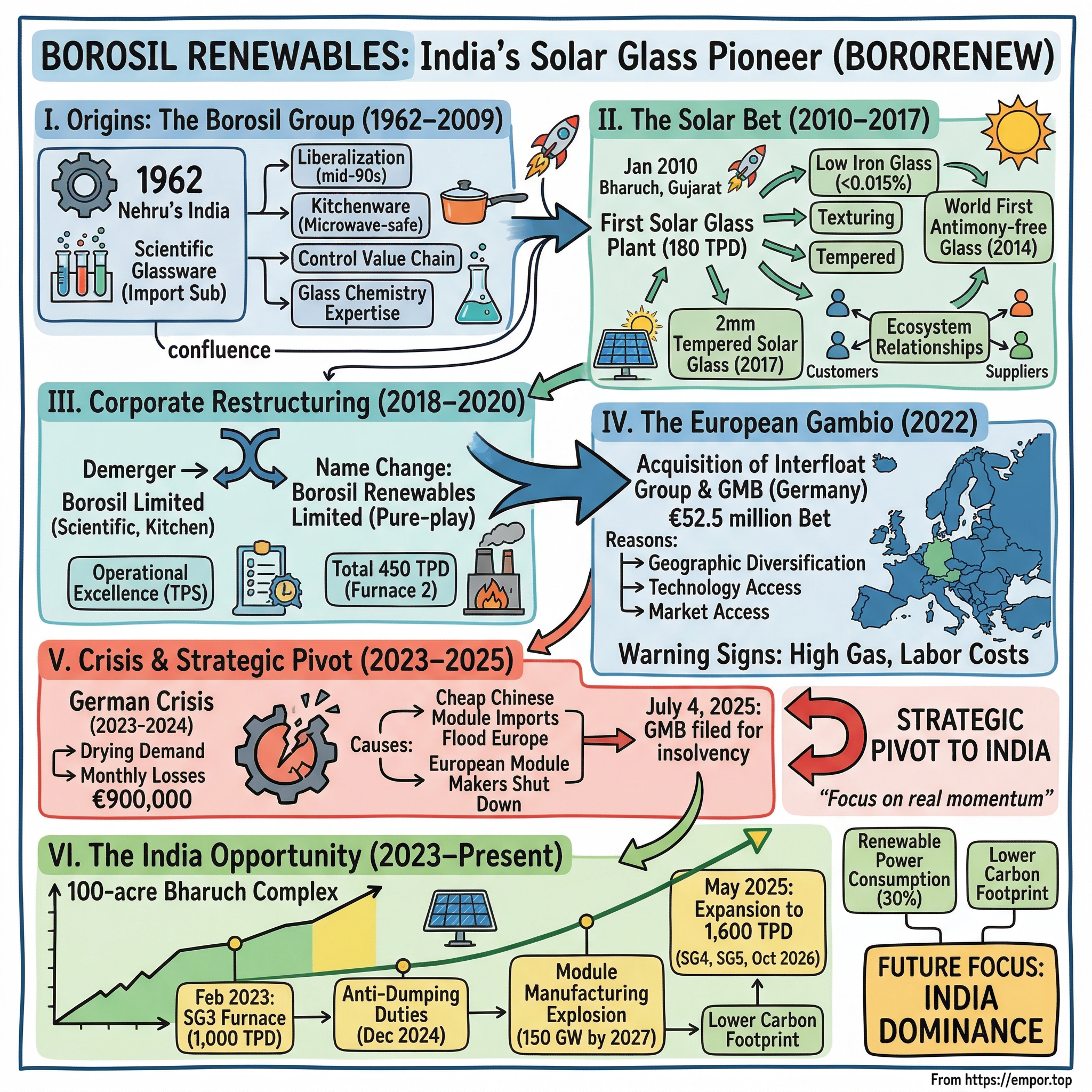
Borosil Renewables: From Lab Glass to Solar Glass Monopoly — and a German Reckoning
I. Introduction & Episode Roadmap
On the morning of July 4, 2025, a district court in Cottbus — a former coal town in Brandenburg, ninety minutes southeast of Berlin — accepted an insolvency filing from a glass factory in the village of Tschernitz.1 The factory was Europe's largest producer of solar glass. Its furnace had been running, in one form or another, for decades. And its owner was a company headquartered five thousand miles away in Mumbai, a business that had spent its first fifty years making test tubes and borosilicate casserole dishes for Indian kitchens.
Thirty-three months earlier, that Mumbai company had paid €52.5 million for the privilege of owning it.2
This is the story of Borosil Renewables — a company that did something genuinely hard, and then did something genuinely expensive. The hard part: between 2010 and 2020, it built India's first and, for years, only solar glass manufacturing line, in a market that had previously imported 100% of the specialised low-iron glass that covers every solar panel. That was real industrial capability, built patiently, in a country that had almost none of it. The expensive part: in 2022 it decided that owning a solar glass plant in Germany would de-risk its dependence on India, and instead discovered that it had bought a front-row seat to the collapse of European solar manufacturing.
The scoreboard, as of early September 2026: market capitalisation of roughly ₹7,300 crore, a share price around ₹497, book value near ₹108 per share, and a trailing price-earnings multiple just under 20x.3 FY26 consolidated revenue came in at ₹1,555.8 crore, up from ₹1,479.3 crore the prior year, with operating margins that swung from 3.9% to 28% in the space of twelve months.34 Promoter and promoter-group holding sits meaningfully below where it stood a decade ago — the residue of a series of equity raises that funded both the Indian buildout and, uncomfortably, the German bleed.
That margin swing — from barely breaking even to a 28% operating margin in a single year, in a commodity glass business — is the number that should stop a careful reader. Businesses do not discover a fourfold improvement in operating leverage by getting better at their jobs over twelve months. Something external changed. In this case, two things did: on December 4, 2024, India imposed anti-dumping duties on solar glass from China and Vietnam under a reference-price mechanism,5 and on June 2, 2026, it extended a countervailing duty on Malaysian imports for a further five years.6
So the framing question for this episode is not whether Borosil Renewables is a good business today. On current numbers it plainly is. The question is why it is a good business today — whether there is a durable cost or technology advantage underneath the profitability, or whether the entire earnings engine is a function of a trade-duty clock that has a defined expiry date and a live population of well-capitalised domestic entrants preparing to compete inside the same tariff wall. Reliance Industries, Avaada, Vishakha, Waaree Energies and a half-dozen smaller players have all announced solar glass capacity.78 Borosil's own management has told investors that Indian solar glass capacity is set to expand from roughly 18 GW-equivalent to about 58 GW-equivalent by FY27.7
Three themes run through what follows. First, import-substitution windfalls are real, but they come with expiry dates written in the gazette notification. Second, an overseas acquisition sold as diversification can concentrate risk rather than spread it — and the way management explains the resulting loss tells you more about capital allocation discipline than the loss itself. Third, and most uncomfortably for the bull case: what happens to a monopoly when the moat was dug by the government, and the government keeps handing out shovels?
To understand how a laboratory glassware maker ended up in Brandenburg, we have to start in Bombay, in 1962.
 Subscribe on LinkedIn
II. Origins: From Corning JV to Solar Glass Bet (1962–2010)
The origin story here is short, and it should be, because the interesting part is not the first five decades — it is the single capability those decades produced.
Borosil was founded in 1962 to acquire the Industrial and Engineering Apparatus Company, and it spent the next forty-odd years doing exactly what its name promised: making borosilicate glass. Test tubes. Beakers. Volumetric flasks for university chemistry departments. Later, the consumer line — the heat-resistant casserole dishes and measuring jugs that became a fixture in middle-class Indian kitchens, sold under a brand name that became genuinely well known. The Kheruka family controlled it throughout, and P.K. Kheruka has been associated with the company since incorporation, with more than five decades in the glass industry.9
For most of that period, this was an unremarkable business. Decent brand, small scale, entirely domestic, competing in categories where the technology had not changed materially since the 1930s.
But borosilicate glassware is not ordinary glass, and that distinction turns out to matter enormously. Ordinary window glass — soda-lime float glass — is made by floating molten glass on a bath of liquid tin, and it is forgiving. Borosilicate is not. It requires higher melting temperatures, tighter chemistry control, and a manufacturer who understands what happens to a furnace lining after two thousand continuous days at 1,500°C. Running a glass furnace is closer to running a small metallurgical plant than to running a factory: you light it, and then you do not turn it off for eight to twelve years, because the thermal cycling would destroy the refractory brick. Everything — raw material blending, energy management, working capital, maintenance — is organised around that constraint.
Solar glass is a different product from borosilicate, but it sits on the same capability stack. A solar panel needs a cover glass that is exceptionally low in iron (iron absorbs light, and every photon absorbed by the cover is a photon the cell never converts), textured on one face to trap light rather than reflect it, and tempered hard enough to survive hail, wind loading and twenty-five years on a roof in Rajasthan. It is not exotic physics. It is exacting process control at high temperature, at scale, continuously — which is precisely the discipline a borosilicate manufacturer already has.
That is why the pivot was plausible rather than fanciful. By the late 2000s, India had a nascent Jawaharlal Nehru National Solar Mission on the policy horizon and, on the manufacturing side, essentially nothing. Every square metre of solar glass consumed in the country was imported. There was no domestic furnace, no domestic qualification track record, no domestic supply chain for low-iron sand. For a family business sitting on decades of high-temperature glass know-how and looking at a category where the incumbent supply was 100% foreign, the strategic logic was straightforward: the entry barrier that kept everyone else out was the same barrier they had already climbed for a different product.
The read for an investor, looking backwards, is that Borosil's founding advantage was never a proprietary technology. It was an adjacency — the willingness and the institutional muscle memory to light a furnace and keep it lit, in a country where nobody else had bothered. Adjacencies of that kind are powerful precisely once. They get you first through the door. They do not, by themselves, keep anyone else out afterwards.
In January 2010, Borosil lit the furnace.
III. Building the Monopoly: India's First Solar Glass Line (2010–2020)
Picture Bharuch, Gujarat, in early 2010. It is an industrial district on the Narmada estuary, all chemical plants and truck routes and salt flats, and among them a new line has come online producing something no Indian factory had produced before: 180 tonnes per day of low-iron, textured, tempered solar glass.10
For the next several years, Borosil was not the market leader in Indian solar glass. It was the Indian solar glass market. Not the largest domestic player — the only one.
That deserves a moment of appreciation before the analysis starts, because it is genuinely the strongest thing in this company's history. Indian manufacturing has an unhappy record of announcing import-substitution projects that never reach commercial-grade output. Borosil built one that did, and then qualified it with module manufacturers, which is its own grinding process — a panel maker will not put an unproven cover glass into a product it must warranty for twenty-five years, so qualification means sample runs, accelerated weathering tests, damp-heat cycling, and a queue of engineers from the customer's side crawling over your line.
What followed was a decade of what the company presents as technology leadership. In 2013, an anti-reflective coating, described as the first in India. In 2014, what the company called the world's first antimony-free solar glass — antimony trioxide being a fining agent used to remove bubbles from the melt, and one that environmentally-conscious European buyers were increasingly unhappy about. In 2017, what it described as the world's first fully tempered 2mm solar glass — thin glass matters because bifacial modules use glass on both faces instead of a polymer backsheet, and every gram saved is a gram that does not have to be carried up a mounting structure.
Here is where the neutral posture has to assert itself. These are technically real achievements, and they are also, in investment terms, unproven. There is no disclosed revenue line attached to any of them. No price premium is broken out for antimony-free glass. No volume figure is published for the 2mm product. The company has never told shareholders what percentage of its book carries a coating-derived uplift. In the absence of that disclosure, a "world first" is a milestone, not a moat, and the correct analytical treatment is to hold the claim at the confidence its affirmative evidence supports — which is: it happened, and its commercial consequence is not disclosed.
There is a harder test available, and the company's own history supplies it. If thin, low-iron, coated solar glass were a defensible technical edge, that edge should have shown up somewhere in the world where Borosil competed on open terms without tariff protection. It did — in Europe, from 2022 onward, and the result is Section VI. The Chinese scale leaders, 信义光能 Xinyi Solar and 福莱特玻璃 Flat Glass Group, matched or exceeded these specifications at multiples of Borosil's tonnage. What broke Borosil's European unit was not a technology gap in either direction. It was price. That is the single most useful piece of disconfirming evidence available on the technology-moat claim, and it comes from Borosil's own record rather than from a competitor's marketing.
Meanwhile, the more consequential story of the 2010s was mundane and physical: adding furnaces. A second line of 240 TPD went in. The original furnace was upgraded to 210 TPD by 2020. Each addition required capital that a company of Borosil's size did not generate internally, and in December 2020 the pattern that would define the next six years announced itself: a qualified institutional placement raising ₹200 crore, issuing 1.58 crore shares at ₹126.55 each.11
That QIP is worth flagging not because ₹200 crore is a large number, but because of what it establishes. Solar glass is a capital-hungry, low-return-on-incremental-capital business during its build phase. A furnace costs hundreds of crores and takes eighteen to twenty-four months from order to first melt. Borosil's chosen funding mechanism was equity, repeatedly, and every subsequent expansion — and, later, one rescue — would run through the same channel. Shareholders got growth. They also got a steadily shrinking claim on it.
By 2020, the setup was in place: a genuine domestic first-mover position, a technology narrative of uncertain commercial value, and a demonstrated willingness to fund growth by issuing stock. What the company did not yet have was a clean corporate structure through which an investor could actually own the solar story.
IV. The Pure-Play Restructuring (2018–2020)
Corporate restructurings are the least cinematic thing in business, and this one produced no drama at all. It is in the story because of what it did to the risk profile.
In 2018, Borosil undertook a scheme of amalgamation and demerger that separated the solar glass business from the scientific, industrial and consumer glassware operations. The legacy businesses — the test tubes, the kitchenware, the laboratory equipment — were housed in a separate listed entity, Borosil Limited. The solar business kept the original listing vehicle, and in 2020 that vehicle was renamed from Borosil Glass Works to Borosil Renewables.
The timing was commercially astute. India's solar buildout was about to accelerate sharply, and a diversified glass conglomerate is a poor vehicle for capturing that: institutional investors will not pay a renewable-energy multiple for a business where two-thirds of the revenue comes from casserole dishes. A pure-play gets a cleaner story, a cleaner shareholder register, a cleaner cost of equity. Management could raise capital against a single narrative rather than a sum-of-the-parts argument. Every subsequent equity raise in this story was made easier by that decision.
But separation cuts both ways, and this is the part that the market's enthusiasm for pure-plays consistently underweights. Before 2018, a bad year in solar glass could be absorbed by a boring, cash-generative consumer glassware business with a decent brand and stable margins. After 2020, there was nothing to absorb anything. Borosil Renewables became a single-segment, single-product, single-country company whose entire economics rode on one input into one industry inside one policy regime.
Consider what that meant when the two subsequent stress events arrived. When the German subsidiary began burning roughly €0.9 million a month,1 there was no consumer division throwing off cash to cover it — the money had to come from the parent's balance sheet or from new shareholders, and it largely came from new shareholders. When Chinese imports crushed Indian solar glass prices through 2024, there was no second segment to smooth the earnings; the company simply posted losses.12 The pure-play structure did not create those problems, but it removed every buffer against them.
The honest framing is that the restructuring was a good decision for accessing capital and a risk-amplifying decision for surviving downturns, and both halves showed up in the record within five years. It also, in a way that nobody could have flagged at the time, made the next move more likely rather than less. A single-country pure-play has an obvious-sounding vulnerability — concentration — and an obvious-sounding cure.
That cure was called geographic diversification. It was for sale in Liechtenstein.
V. The German Gambit: Acquiring Interfloat/GMB (2022)
By early 2022, Europe had decided it was going to re-industrialise solar manufacturing. The energy shock following Russia's invasion of Ukraine had made energy sovereignty the continent's dominant political priority. Brussels was drafting industrial policy. Germany was talking about a domestic photovoltaic supply chain. Every conference deck in the sector had a slide about European strategic autonomy.
Into that environment, Borosil's board approved on April 25, 2022 the execution of a share purchase agreement to acquire 86% of the Interfloat Group of Liechtenstein and its German manufacturing arm, GMB Glasmanufaktur Brandenburg, for €52.5 million.2 The transaction completed in October 2022.13
What Borosil bought was not marginal. GMB, at Tschernitz in Brandenburg, was Europe's largest solar glass producer, running roughly 300 TPD, with approximately €60 million of 2021 revenue and something on the order of two-thirds of the German market. Interfloat provided the trading and distribution arm across Europe. Combined group capacity jumped roughly 66%, from about 450 TPD to about 750 TPD. On paper, an Indian mid-cap had just become the largest solar glass manufacturer outside China.
The price, taken in isolation, was not obviously foolish. Roughly €52.5 million against about €60 million of trailing revenue is approximately 0.9x sales for a capacity-constrained European incumbent with an entrenched customer base — the sort of multiple that looks reasonable for an industrial asset with a real installed base. Cheap acquisitions of good assets are how mid-caps become large-caps.
Two things about the deal's process, however, deserve to be stated plainly, because they bear on the capital-allocation question that dominates the rest of this story.
First, no independent third-party fairness opinion or peer-transaction benchmarking appears to have been publicly disclosed alongside the transaction. This is a disclosure gap rather than a finding of wrongdoing — Indian listed companies are not universally required to publish one for an overseas asset purchase, and its absence is common. But it means an outside investor has no way to know whether the €52.5 million was tested against anything other than management's own model. For the largest capital decision in the company's history, that is a material absence.
Second, and more analytically important: the entry price is almost never what determines whether an industrial acquisition works. What determines it is the follow-on. A furnace business does not sit still. It consumes cash, it requires maintenance capital, and when demand turns, the owner faces a sequence of decisions — support it, expand it, shrink it, or exit — each of which can cost more than the purchase price. Judging the GMB deal on its 0.9x revenue multiple is like judging a mortgage on the closing costs.
There is also a timing question that should have been askable in real time, not just in hindsight. The strategic rationale offered was geographic de-risking: reduce dependence on the Indian policy environment by owning demand in a second continent. But the mechanism that made European solar glass attractive in 2022 — an energy crisis plus political enthusiasm for local manufacturing — was itself a policy phenomenon, and an unlegislated one. Borosil was not diversifying away from policy dependence. It was adding a second, less certain policy dependence in a jurisdiction where it had no operating history, no political relationships, and no ability to influence the outcome. In India, the company had been sophisticated enough to petition for trade remedies and win them. In Brussels, it was a spectator.
The company's own account across this period leaned heavily on expected EU and national support materialising. It did not. What arrived instead was a wave of Chinese modules.
VI. The Unwind: European Collapse and Total Write-off (2023–2025)
The collapse of European solar manufacturing between 2023 and 2025 was not subtle, and it was not slow.
Chinese module makers, having built capacity far beyond global demand, exported the surplus at prices European factories could not match at any plausible cost structure. Module prices in Europe fell to levels that made domestic assembly economically pointless. Meyer Burger, the Swiss-German company that had been the poster child of European solar re-industrialisation, wound down its operations. And when European module makers stop making modules, the demand for European solar glass does not decline gently. It disappears, because there is no one left to sell to.
GMB, sitting in Brandenburg with a lit furnace and a fixed cost base, absorbed the full force of it. Monthly cash burn reached approximately €0.9 million — around ₹9 crore a month, roughly ₹108 crore a year against a parent company whose entire consolidated operating profit in FY24 was ₹58 crore.13 The German subsidiary was, for two full years, consuming more cash annually than the Indian business generated in operating profit.
And in the middle of this, Borosil increased GMB's capacity.
The furnace was modified to take output from 300 TPD to 350 TPD.1 The internal logic was presumably some combination of unit-cost improvement — spreading fixed costs across more tonnes — and a bet that European policy support would arrive and demand would recover, at which point additional capacity would be an asset rather than a liability. Both are coherent arguments. Neither survives contact with the actual situation, which was a demand collapse driven by a competitor's structural overcapacity, not a temporary air pocket. Producing more of a product nobody wants at a lower unit cost does not fix the problem; it increases the rate at which cash leaves. This is the decision in the whole sequence that is hardest to defend on the information available at the time, and it is the one that has received the least public explanation.
The support did not stop there. Borosil committed a further €27 million or so of additional backing to the German operations, explicitly framed around expectations of EU and national policy support.1 Total exposure to the German business reached €35.30 million as of March 31, 2025 — money committed after the purchase price, into a position that was visibly deteriorating.1 Separately, the company settled a loan guarantee of ₹99.85 crore relating to GMB.14 And there was an obligation that flowed the other way as well: Germany's development bank clawed back €4.81 million of subsidies GMB was no longer entitled to retain.
The endgame ran in two stages. On July 4, 2025, GMB filed for insolvency at the district court in Cottbus under the German Insolvency Code, and a court-appointed administrator took over from that date.1 Then, on December 22–23, 2025, the parent holding entity, Geosphere Glassworks, filed for voluntary insolvency — closing out the structure entirely.15
The accounting followed. Borosil wrote off exposure of ₹325.9 crore relating to GMB and Geosphere, treated as an exceptional item in FY26, with management explaining on the Q1 FY27 call that "we considered that as a write-off" once court proceedings indicated no recovery was probable.416 Press coverage produced a range of figures — one account cited exceptional charges of ₹213.41 crore17 — and the difference appears to reflect what is booked as an exceptional charge in a given period versus total exposure written off across the sequence. The ₹325.9 crore figure is the one management has used directly in the earnings call, and it is the one to anchor on.
Set that against the original €52.5 million purchase price — roughly ₹450 to ₹460 crore at 2022 exchange rates — and the arithmetic of the episode is stark. Over roughly thirty-three months of ownership, Borosil deployed the purchase price plus tens of millions of euros of follow-on support into an asset that ultimately returned nothing to the parent. This was not a deal that underperformed. It was a deal where the entire invested capital, plus the incremental support, was destroyed.
Now for the part that matters most for anyone underwriting this management team going forward.
Management's explanation has been consistently and exclusively macro. Chinese manufacturers flooded European markets with underpriced modules. European energy costs were prohibitive. Meyer Burger and its peers shut down. EU and federal policy support never materialised.1 Every one of those statements is true. Not one of them is an admission that Borosil's own underwriting — of the timing, of the durability of European policy intent, of the wisdom of expanding capacity into a structural glut — contained a misjudgement. The framing offered around the exit was that the decision reflected a "clear-eyed view of where the future lies and the confidence we have in India's solar manufacturing story."1 That is the language of a strategic repositioning, not of a post-mortem.
This matters because it is the only large-scale test available of this management team's capital allocation judgment outside the protected home market, and the test produced a failure with no acknowledged internal cause. When a future acquisition or major capital commitment is proposed, an investor has no documented evidence that the institution learned anything specific — no restated diligence process, no changed approval threshold, no public accounting of what the 2022 model assumed and where it was wrong. Absence of a stated lesson is not proof that none was learned. But it is also not evidence that one was, and the burden of proof on any future international move should be set accordingly.
Two counterweights belong in the same passage, in fairness. First, the balance sheet held. India Ratings affirmed Borosil at IND BBB+ with a positive outlook in the period following the German exit, and non-current borrowings fell from roughly ₹161 crore to ₹93 crore between FY25 and FY26. Whatever else the German episode destroyed, it did not leave the company financially impaired — a meaningful distinction between an expensive mistake and an existential one. Second, the market's verdict was unambiguous. When Borosil announced in July 2025 that it would sharpen its focus on India, the stock rose about 6%.18 Shareholders did not read the German exit as a scandal. They read it as the removal of a cash drain.
Both readings can be true at once: the exit was value-accretive, and the entry was value-destructive, and the same team made both decisions. What the market rewarded in July 2025 was the reversal of a choice it had applauded in 2022.
With Germany closed, everything now rides on one country, one product, and one policy regime.
VII. Refocus on India: The Capacity Race and New Rivals (2025–Present)
Here is the number that defines the current chapter, and it comes from management's own investor materials rather than from a skeptic's spreadsheet: Indian solar glass capacity is expected to rise from roughly 18 GW-equivalent to about 58 GW-equivalent by FY27, against domestic demand of approximately 50 GW.7
Read that again. Borosil's own framing of its industry describes capacity tripling in roughly two years and crossing above demand.
The company's position going into that race is strong. India capacity stands at 1,000 TPD — around 6.5 GW of module coverage — running at full utilisation.19 The board approved a ₹950 crore expansion adding two furnaces, SG-4 and SG-5, for a combined 600 TPD, which would take total capacity to 1,600 TPD or roughly 10.5 GW.19 On the July 17, 2026 earnings call, management guided that it hoped "to complete the construction and everything by December 26th and commission the project within first quarter, that is January to March 27th," with the two furnaces lit sequentially about a month apart and full revenue contribution arriving in FY28.16 Management has pointed toward roughly ₹4,000 crore of revenue by FY28 and estimated an incremental ₹80–85 crore of quarterly EBITDA once the expansion is running.19
Funding came, once again, from equity: a preferential warrant issue at ₹530 per share approved in February 2025, converted progressively across 2025 and 2026.
The moat is filling in
The competitive picture has changed more in two years than in the preceding fourteen. Reliance Industries is expected to build roughly 12 GW of solar glass capacity, principally for its own captive module lines — which converts a company that was one of Borosil's largest potential customers into a competitor that will never buy a square metre.7 Avaada is expected to start at around 7 GW through Avaada Electro. Emerge has signalled around 3 GW. Vishakha Renewables has partnered with Asahi India Glass on a plant at Mundra, reported as India's largest single solar glass facility. And on March 25, 2026, Waaree Energies — India's largest module manufacturer — approved a ₹3,900 crore investment in a 2,500 TPD solar glass plant through a subsidiary, Waaree Green Glass.8
That last one deserves emphasis. Waaree's single announced plant, at 2,500 TPD, is larger than Borosil's post-expansion capacity of 1,600 TPD, and the capital committed to it — ₹3,900 crore — is roughly four times Borosil's ₹950 crore expansion budget and more than half Borosil's entire market capitalisation.38 Beyond these, Gujarat Guardian, HNG Float Glass, Jaipur Tuffen, Gold Plus Glass, Triveni Renewables and Gobind Glass have all been associated with entry or expansion plans.
Borosil's own market share reporting has moved accordingly, and the sources genuinely disagree. Figures around 40–43% have been widely cited for the FY24–mid-2026 period,20 while the company's most recent annual report language describes it as India's largest manufacturer of low-iron textured solar glass with "over 15%" domestic share.3 The gap between those numbers is not a rounding difference — it reflects different denominators (installed domestic capacity versus total Indian consumption including imports) and, quite possibly, genuine erosion. An investor should treat the direction as clear and the level as contested, and should not build a thesis on any single share figure.
Management's answer to the oversupply question, when pressed on the Q1 FY27 call, was twofold: that a 62 GW module requirement translates into roughly 11,000 TPD of solar glass demand against local capacity of only about 2,600 TPD, leaving a large supply gap; and that "a lot of these capacities are coming from the players who are using it for captive" consumption, which limits the merchant market impact.21
Both points are substantive and both are incomplete. The supply-gap argument is real — India does still import a large share of its solar glass, and even after all announced capacity arrives, imports will not go to zero. But it measures the gap against total demand rather than against the merchant-addressable slice, and it sits awkwardly next to the company's own 58 GW-versus-50 GW capacity projection. The captive-consumption argument is genuinely double-edged: capacity built for captive use does not compete for Borosil's customers, but it removes those customers from Borosil's addressable market. Reliance and Waaree building their own glass is not neutral to Borosil. It is demand destruction on the buyer side, and the two largest module makers in the country going captive is a structural shrinkage of the merchant pool that the supply-gap framing does not capture.
The profit story is a duty story
Now the central evidence, and it is unusually clean, because Indian solar glass ran a natural experiment across FY25 and FY26.
Ahead of trade protection, Chinese exporters cut FOB prices by roughly 18%, comfortably absorbing the 10% basic customs duty that took effect in October 2024. Borosil's average selling price fell from about ₹113 per square metre in Q2 FY25 to about ₹108 in Q3 FY25 — a small-looking decline that, in a business with high fixed costs and a furnace that cannot be throttled, was enough to produce a net loss of ₹27 crore in that quarter alone.12
Then on December 4, 2024, India imposed anti-dumping duty on textured tempered coated and uncoated glass from China and Vietnam, structured as a reference price: if the landed value falls below the reference — around USD 664 per metric tonne for most producers, with slightly different levels for certain exporters including 南玻 CSG's Dongguan unit and 信义 Xinyi's Guangxi entity — the importer pays the difference.5 The duty was subsequently confirmed for a five-year term.22 A reference-price mechanism is a price floor by another name: it does not merely tax imports, it makes it impossible to undercut a defined level, which is precisely what a domestic producer needs to restore pricing power.
The response was immediate and enormous. Average ex-factory realisation rose to ₹146.7 per square metre in FY26 from ₹113.4 in FY25, and reached ₹160.30 by Q1 FY27 against ₹138.10 a year earlier.1921 Operating margin went from 3.9% to 28% across the same span.3 Then, on June 2, 2026, the Ministry of Finance extended a 9.71% countervailing duty on Malaysian solar glass imports for a further five years — Malaysia being where several Chinese producers, including 信义 Xinyi and 旗滨集团 Kibing's SBH unit, operate offshore capacity.621 The stock rose roughly 9–10% on the news, its largest single-day move of the year.23
That last detail is the tell. If Borosil's earnings power were grounded in a structural cost or technology advantage, a gazette notification about Malaysian import duties would be a modest positive. Instead it was the single biggest day of the year for the share price. The market has correctly identified where the profit pool comes from.
Two further caveats belong here rather than in a distant risk section. First, part of the current ASP is not margin at all: the CFO disclosed that ₹9.50 of the ₹160.30 realisation was a fuel surcharge invoiced to customers during the West Asian energy disruption, and stated that the company is "committed to our customers that whatever reduction happens in this oil prices or gas prices, we'll pass it on."1621 Management is guiding, in its own words, to a lower headline ASP as fuel normalises. Second, the global backdrop has not improved — 信义光能 Xinyi Solar, at roughly 30% of global solar glass share, and 福莱特玻璃 Flat Glass Group both paused new furnace ignitions in early 2026 as prices fell below cash cost. That is a glut sitting immediately outside India's tariff wall, held back by a legal instrument rather than by economics.
Finally, sized to its actual weight: in FY26 Borosil launched a rooftop solar solutions division, targeting around ₹36 crore of FY27 revenue against ₹1.3 crore delivered in Q1 FY27.1624 The CFO characterised it as "more of a trading business where you have to buy all the three components from elsewhere," with single-digit EBITDA margins against 30–35% in glass.16 At under 2% of revenue and a fraction of the margin, this is a footnote, not a second pillar. It is worth watching only as an indicator: a high-margin manufacturer entering a low-margin trading business is usually a signal about where management sees limits in the core.
The question that follows is who is making these calls, and what their record says about how the next ones will go.
VIII. Current Management, Ownership, and the Capital Allocation Report Card
The leadership of Borosil Renewables is a study in continuity interrupted, in late 2024, by an experiment.
P.K. Kheruka, Executive Chairman, has been associated with the company since incorporation and brings more than five decades in the glass industry, overseeing strategy, project setup, and both domestic and international marketing.9 That last clause is not decorative — it means the executive chairman's remit explicitly included the international dimension that produced the German acquisition. He is not a distant figure who inherited someone else's problem.
Shreevar Kheruka, the next generation, serves as Non-Executive Vice Chairman here while running Borosil Limited — the demerged glassware business — as Managing Director and CEO. Wharton-educated, roughly two decades of corporate experience, named a Young Global Leader by the World Economic Forum.9 In March 2026 he increased his personal stake through open-market purchases, moving from about 1.39% to 1.43%.25 It is a small move in absolute terms. It is also the cleanest positive governance signal in the file: promoters with genuine concerns about the near-term outlook do not add, and the purchase came after the German write-off was known, not before.
Melwyn Moses became CEO effective December 2, 2024, following board approval on November 28.26 He is the first professional, non-family chief executive in this role, and his background is deliberately operational rather than glass-specific: a mechanical engineer with roughly three decades in manufacturing transformation, previously Global HSE Head and Global Formulations Head at UPL Corporation, with earlier stints at Merisant, Zeneca and Syngenta, PepsiCo India Holdings and REIL Products, and experience spanning 31 production sites and teams of over 6,000 people.26 The appointment reads as a deliberate choice to bring in a scale-manufacturing operator at exactly the moment the company committed to a 60% capacity increase.
It also means the CEO is under two years into the job as of this writing, and — importantly for how the GMB episode is attributed — he arrived after the German acquisition and one month before the anti-dumping duty was imposed. He inherited both the disaster and the windfall. His own capital allocation record at Borosil is, at this point, a single expansion project that has not yet been commissioned. That is not a criticism; it is a statement about the quantity of evidence available.
Sunil Roongta serves as Whole-Time Director and CFO — a chartered accountant, cost accountant and company secretary with over a decade in the group — and was reappointed in the May 2026 board cycle.924 Ashok Jain, on the board since February 2020 with four decades of corporate experience, is described in company materials as having been instrumental in overseas acquisitions and fund-raising.9
The dilution ledger
Promoter and promoter-group holding stood at 58.81% as of March 2026, down from 74.28% in 2017, with more recent shareholding data showing it lower still, around 56% by August 2026.325 That is roughly an eighteen-point decline over nine years.
The important qualification: this is dilution from repeated capital raises, not promoter selling. That distinction genuinely matters, and it is to management's credit. Promoters also carry NIL share pledge as of FY26 — a clean signal on a dimension where Indian mid-caps frequently disappoint.
But there is a second distinction that the "dilution funded growth" framing obscures, and it is the sharper one. Some of this equity funded capacity in India. Some of it funded losses in Germany. One tranche of preferential allotment proceeds — ₹18,500 lakh, or ₹185 crore — was applied to a standby letter of credit backing GMB. The ₹99.85 crore loan guarantee settlement flowed the same direction.14 Shareholders were diluted to build furnaces in Bharuch, which is the deal they signed up for, and diluted to keep a furnace running in Brandenburg that was consuming ₹9 crore a month with no realistic path to profitability, which is not.
The full sequence tells its own story: the December 2020 QIP of ₹200 crore;11 a 2024 QIP that raised roughly ₹150 crore against a ₹250 crore goal — falling short of its own target, which is a market verdict worth noting;3 a June 2024 authorisation to raise up to ₹450 crore via rights issue;27 and the February 2025 warrant issue at ₹530.
And then a live tension. On May 12, 2026, the board authorised seeking shareholder approval for a further ₹750 crore fundraise to support future business expansion.24 On the July 17, 2026 earnings call, management told analysts that "for the current expansion, which is already ongoing, we are already fully funded" and that "we don't foresee any equity raise in the near future."21 Both statements can be technically reconciled — an enabling resolution is a standing authorisation, not an executed raise, and Indian boards routinely keep one alive. But a company with this specific dilution history taking a ₹750 crore enabling resolution to shareholders two months before telling analysts no raise is foreseen is a combination that deserves to be tracked rather than waved through. The relevant test is simple and observable: whether that authorisation lapses unused.
The ESOP Scheme 2017 remains active, with 5,10,100 options granted in November 2025 — modest against shares outstanding and not, on its own, an alignment or dilution concern.
The report card
The fair verdict, weighing scale, recency and consequence, is a split one.
Domestically, execution has been broadly credible. Capacity guidance has largely been delivered. The company ran a competent, well-documented trade remedy campaign and won it — which is itself a form of capability, even if it is not the kind that appears on a technology slide. The 1,000 TPD base is running at full utilisation, which means demand is real and the product qualifies.
Internationally, the record is one large decision, and it failed comprehensively, with the loss attributed entirely to external forces and funded in part by shareholder dilution. That does not make this a bad management team. It makes it a team whose demonstrated competence is bounded to a market where it has policy leverage, and whose one attempt to operate outside that boundary cost roughly the equivalent of a year and a half of current market capitalisation's worth of EBITDA. Discipline intact domestically; unproven — and recently disproven once — internationally.
The thing to watch is not whether they can build SG-4 and SG-5. It is what they do with the cash flow those furnaces generate, in a market that by the company's own projection will have more capacity than demand.
IX. Industry Structure and the Moat Stress Test
Strip away the narrative and look at the industry mechanics, because solar glass is a business where structure determines outcomes far more than management skill does.
Five forces
Threat of new entrants has undergone the single most dramatic change in this story. From 2010 to roughly 2023, it was close to zero — the combination of furnace capital, qualification cycles and an unprotected market where Chinese imports made domestic economics unattractive kept everyone out. By 2026 it is high and rising. Reliance, Avaada, Waaree, Vishakha-Asahi and a tail of smaller players have all committed capital.78 Critically, the barrier that fell was not technical. It was economic: once anti-dumping duties made Indian solar glass a 30%-margin business, the return on a furnace justified the capital, and every large industrial group with a balance sheet did the arithmetic. The protection that rescued Borosil's margins is the same protection that recruited its competitors.
Supplier power is meaningful and structural. A solar glass furnace consumes natural gas, soda ash and low-iron silica sand continuously, and it cannot be turned off. Energy is the dominant variable cost, and the company's disclosure that it invoiced customers a ₹9.50 per square metre fuel surcharge during a period of West Asian disruption is a direct measure of that exposure.21 Borosil has partially mitigated this — renewable power reached 93% of requirements in Q1 FY27, and the FY26 renewable share was reported at 29.23% for the year, indicating a rapid shift.1928 That is a genuine cost lever and one of the few operating improvements in this story that is not policy-derived.
Buyer power is rising on two fronts simultaneously. The top ten customers account for 65–68% of volumes — meaningful concentration for a single-product manufacturer.16 And those buyers are consolidating and integrating: the CFO acknowledged on the Q1 FY27 call that Indian module capacity "has run up very fast and it is far in excess of requirement," which means Borosil's customer base is heading into its own shakeout.16 Customers who are fighting for survival negotiate hard, and customers who build their own glass plants stop negotiating altogether.
Substitutes are a slower-burning issue. Thinner glass and frameless module architectures reduce glass consumption per watt; longer-term, alternative encapsulation approaches could reduce it further. None of this is imminent, but it means glass demand does not scale linearly with installed gigawatts forever.
Rivalry is intensifying on both sides of the tariff wall — domestically from the new entrants, and globally from a Chinese industry so oversupplied that its two largest players paused furnace ignitions because prices fell below cash cost.
Seven Powers
Applying Hamilton Helmer's framework clarifies what Borosil actually has.
The closest fit historically was a cornered resource: first-mover regulatory and customer qualifications, and a near-decade capacity head start in a market with no domestic alternative. The defining property of a cornered resource, though, is that it must be inaccessible to competitors on equal terms. Borosil's was not inaccessible — it was merely unattractive to acquire, because nobody wanted to build a furnace into a market flooded by Chinese imports. The moment duties changed the economics, capital-rich entrants began qualifying their own lines. A resource that competitors decline to acquire for economic reasons is not cornered; it is temporarily uncontested. That is the essential reframing this section is here to make.
Scale economies run the wrong way. 信义光能 Xinyi Solar operates at multiples of Borosil's tonnage globally; Waaree's single announced Indian plant, at 2,500 TPD, would exceed Borosil's post-expansion 1,600 TPD.819 In a business where unit cost falls with furnace size and utilisation, being the largest producer outside China is not the same as being cost-competitive with the producers inside it.
Switching costs are real but bounded. Qualifying a new glass supplier takes a module maker time and testing — that is a genuine friction, and it is why Borosil's incumbency has value through the transition. But it is a one-time cost per supplier, not a recurring one, and once a competitor passes spec at a given customer, the friction is spent. Qualification delays share loss; it does not prevent it.
There is no meaningful network economy, no branding power (module makers buy on specification and price, not on the glass brand), and no counter-positioning — the new entrants are using the same or better technology, not a business model Borosil cannot copy.
What is left is process power in the narrow, credible sense: two decades of furnace operating experience, 93% renewable power sourcing, and a demonstrated ability to run at full utilisation. That is worth something. New entrants will have yield problems, ramp delays and qualification failures that Borosil solved years ago. It is a head start measured in quarters, not a structural barrier measured in years.
The net assessment, stated plainly: the case for Borosil winning from here rests on trade-policy durability and India's genuine import-coverage gap, not on a demonstrated, policy-independent cost or technology edge. The historical evidence — Europe, where the same product competed without protection and lost decisively on price — actively argues against the technology-moat version of the claim rather than merely failing to support it. The claim survives only in a narrowed form: Borosil has an operating head start and incumbent qualifications inside a protected market, which is worth real money for as long as the protection holds and while competitors ramp.
The KPI that would confirm or falsify the narrowed claim is domestic market share through the FY27–FY28 competitive ramp. If Borosil holds share as Reliance, Waaree and Avaada come online, the operating head start is real. If share compresses toward capacity share, it was a queue position, not a moat.
X. Financial Analysis & the KPIs That Matter
The financial history of Borosil Renewables over the last four years is one of the more violent P&L sequences you will find in an established Indian manufacturer, and reading it correctly requires separating three distinct effects: the underlying business, the German drag, and the duty windfall.
The trajectory
FY23 was the last normal year before the storm: sales of ₹891 crore, operating profit of ₹143 crore, a 16% operating margin, and net profit of ₹71 crore.3 Then imports hit. FY24 revenue grew to ₹1,371 crore but operating profit collapsed to ₹58 crore — a 4.2% margin — and the company posted a net loss of ₹50 crore. FY25 was worse: ₹1,476 crore of revenue, ₹58 crore of operating profit, a 3.9% margin, and a net loss of ₹87 crore.3
Note the shape of that. Revenue grew more than 50% across two years while operating profit fell 60%. The company was selling far more glass at prices that barely covered cash costs. That is the signature of a commodity producer with no pricing power facing a competitor willing to price below cost — and it is the most direct available disconfirmation of any claim that Borosil's product commands a technical premium. When the price umbrella came down, the premium was not there.
FY26 inverted everything: revenue of ₹1,556 crore, operating profit of ₹440 crore, and a 28% operating margin.3 Revenue grew 5%. Operating profit grew more than sevenfold. Essentially the entire improvement came from realisation, not volume — the ASP move from ₹113.4 to ₹146.7 per square metre.19
Reconciling the FY26 bottom line
Press coverage of FY26 produced two irreconcilable headlines — a ₹127 crore profit and a ₹70 crore loss — and the resolution matters enough to state explicitly.
The consolidated quarterly sequence for FY26 runs: a ₹203 crore loss in Q1 (the write-off quarter), then profits of ₹62 crore, ₹100 crore and ₹169 crore.312 Those sum to approximately ₹128 crore. The company's own results disclosure reports profit attributable to owners of ₹129.08 crore for FY26 against a loss of ₹69.57 crore in FY25.24 The ₹70 crore loss headline that circulated is the FY25 comparative figure, transposed onto FY26 in some coverage. FY26 was a profit year on a consolidated basis; the roughly ₹18 crore gap between the ₹87 crore total FY25 loss and the ₹69.57 crore owners' figure reflects the minority interest in the 86%-owned German entities absorbing part of the loss.
Two quarters within that year need adjusting before anyone extrapolates. Q1 FY26's ₹203.48 crore loss was the GMB write-off quarter — it is not an operating result.29 And Q4 FY26's ₹169.1 crore profit was inflated by approximately ₹75 crore of tax shield arising from that same write-off, a point management volunteered when an analyst asked why Q1 FY27 profit of ₹87 crore looked like a decline: "if you really remove that INR 75 crores, the performance is not inferior."21 That was a straight answer to a pointed question, and it is worth crediting.
Q1 FY27 is therefore the cleanest available look at the business as currently constituted: ₹405.69 crore of revenue, up about 17% year on year, ₹87 crore of net profit, ₹142 crore of standalone EBITDA at a 35% margin, production of 1.25 crore square metres — about 10% above the prior year — on capacity of 1,000 TPD at full utilisation.31921
The balance sheet
This is the reassuring part. Total borrowings stood at ₹162 crore as of March 2026 against a market capitalisation above ₹7,000 crore — negligible leverage.3 Reported ROCE of 25.3% and ROE of 25.7% look excellent, and they are, for one year. The three-year average ROE of approximately 5% is the more honest number, and the gap between the two is precisely the story: the loss years of FY24 and FY25 still dominate the multi-year picture, and a single duty-driven year has not yet earned the right to be called the normalised level.
The company entered the German crisis with low leverage and exited it with lower leverage — non-current borrowings fell from about ₹161 crore to ₹93 crore between FY25 and FY26. That resilience is real, though it should be attributed accurately: the balance sheet survived partly because shareholders funded the losses through equity rather than lenders funding them through debt.
Valuation and the dispersion signal
At roughly ₹497 per share, Borosil trades near 19–20x trailing earnings and around 4.6x book value of ₹108.3 What is more informative than the multiple itself is the disagreement around it: sell-side and model-based views span from targets in the low ₹400s to bull cases well above ₹800. That dispersion is not noise. It is the market's honest expression of a binary underneath — whether the FY26 margin structure is a new baseline or a policy-window peak. Analysts using ₹146.7 ASP as normalised get one answer; analysts assuming duty erosion and domestic oversupply get a very different one.
The three KPIs
For an investor tracking this company, three metrics carry nearly all the information, and each is published regularly.
Average selling price per square metre. This is the single cleanest read on whether trade protection is holding. It is disclosed quarterly. Watch it net of the fuel surcharge that management has already committed to passing back.
India domestic market share. The moat-erosion gauge, measured as Reliance, Waaree, Avaada and Vishakha capacity comes online through FY27 and FY28. Because the reported figures conflict, track the trend in the company's own annual report language rather than third-party estimates.
Capacity utilisation on SG-4 and SG-5 once commissioned. Full utilisation on 1,000 TPD in a supply-short market proves nothing about 1,600 TPD in a market management itself projects will have 58 GW of capacity against 50 GW of demand. The first four quarters of the new furnaces' operation will settle the oversupply question empirically.
XI. Bull vs. Bear: The Investment Case, Stress-Tested
The bull case
India's solar buildout is not a forecast; it is happening. Installed solar capacity reached about 157 GW by Q1 FY27, with 44.6 GW added in FY26 alone and a government target of 500 GW of non-fossil capacity by 2036.19 Module manufacturing capacity has raced past 90 GW and is guided toward higher levels still. Against that, domestic solar glass capacity of roughly 2,600 TPD serves a requirement management sizes at around 11,000 TPD.21 Even if every announced project is completed on time, India will still import solar glass. In a market that short, a low-cost incumbent with qualified lines and full utilisation has room to grow volumes without fighting for share.
The protection has a defined runway. The anti-dumping duty on Chinese and Vietnamese glass was imposed for five years from December 2024,22 and the Malaysian countervailing duty was extended for five years from June 2026.6 That is a multi-year window of pricing visibility, which for a capital-intensive manufacturer is exactly what is needed to fund and commission an expansion.
The German exposure is gone — fully written off, both entities in insolvency, the monthly cash drain eliminated. Every rupee of capital from here goes into a business management actually controls, in a jurisdiction where it has demonstrated it can operate. The balance sheet came through intact, with ₹162 crore of borrowings supporting a ₹950 crore expansion. The Vice Chairman bought stock in the open market after the write-off was public. Promoter shares are unpledged.
And the operating base is not fragile: 1,000 TPD at full utilisation, 31% quarterly operating margins, 93% renewable power sourcing that structurally lowers the energy bill, and a customer base of India's largest module manufacturers who have already qualified the product.
The bear case
The bear case is not that any of the above is false. It is that the profit engine is rented.
Strip out the duty and the FY24–FY25 record shows what this business earns in open competition: a 4% operating margin and consecutive net losses on rising revenue.3 That is the counterfactual, and it is not hypothetical — it is two years of audited history from the immediate past, from the same plants, under the same management, selling the same product. Trade remedies are reviewed, they can be narrowed at sunset, they can be circumvented through third-country routing (which is precisely why a Malaysian countervailing duty was needed after the Chinese one), and they can be challenged. The pricing power is a legal instrument, not an economic one.
The domestic capacity build is the more immediate threat, and the most damaging evidence for the bull case comes from Borosil's own materials: capacity rising to roughly 58 GW-equivalent against approximately 50 GW of demand by FY27.7 When a management team's own industry projection shows supply crossing above demand, no external skeptic is needed. Waaree's 2,500 TPD plant alone, at ₹3,900 crore, exceeds Borosil's entire post-expansion capacity.8 And because Reliance and Waaree are building captive, Borosil does not merely gain competitors — it loses two of the largest buyers in the market.
The GMB episode is a recent, large-scale, fully-realised capital allocation failure explained exclusively in terms of external forces. Any future capital deployment outside the core — and there is a ₹750 crore enabling resolution live — should be underwritten against that record rather than against the current profitable quarter.24 The related shareholder cost is subtler than it looks: repeated equity issuance funded both the Indian expansion and the German losses, meaning existing holders paid for the mistake as well as the buildout.
Finally, part of the current ASP is a fuel surcharge management has promised to give back,21 and the reported ROE of 25.7% sits against a three-year average near 5%.3 The valuation embeds an assumption that FY26 is the baseline. The last three years say it might instead be the peak.
The activist lens
A skeptical long/short investor looking at this file would not attack the Indian business — recent domestic execution is defensible and the demand backdrop is genuine. The attack would concentrate on three things.
First, accountability for GMB: what did the 2022 model assume about European demand and policy support; who approved the mid-crisis capacity increase from 300 to 350 TPD and on what basis; was any independent valuation obtained; and what specific process changes followed? None of this has been publicly answered, and the absence is the point.
Second, the gap between the duty narrative and the moat narrative: management's investor materials emphasise capacity, technology firsts and market position, while the earnings bridge is dominated by realisation driven by trade policy. An activist would argue the company's own disclosure under-weights the single largest determinant of its profitability.
Third, the enabling resolution: ₹750 crore of fundraising authority sought in May 2026,24 alongside a July 2026 statement that no equity raise is foreseen,21 in a company with a nine-year record of dilution — that combination invites a demand for a specific, ring-fenced use-of-proceeds commitment.
Weighing it
The bull and bear cases here are not symmetric, and the honest conclusion is not a shrug.
The claim that Borosil has a structural, technology-based moat is rejected by the historical record — Europe tested it directly and it failed on price, and FY24–FY25 tested it domestically and produced a 4% margin. The claim that Borosil has a durable franchise is narrowed but survives: it holds a real operating head start, qualified customer relationships, genuine furnace competence and an energy cost advantage from renewable sourcing, inside a market with a large structural import gap and multi-year trade protection. That narrowed claim is not proven — it depends on an untested proposition, which is whether incumbency holds share against much better-capitalised entrants.
The event that would confirm it: Borosil holding domestic share through FY28 while running SG-4 and SG-5 near full utilisation. The event that would falsify it: ASP declining materially beyond the disclosed fuel surcharge reversal while utilisation slips — which would indicate that domestic oversupply, not imports, has become the binding constraint on price, and no duty in the gazette can fix that.
XII. Risk Radar
Policy and regulatory risk is not one risk among many here — it is the risk. Anti-dumping and countervailing duties are the proximate cause of the FY26 margin expansion. Trade remedies are subject to sunset review, mid-term review on changed circumstances, appeals before India's trade tribunal, and circumvention through re-routing. The Malaysian countervailing duty exists precisely because production shifted offshore once the China and Vietnam duties bit.6 There is no reason to assume that adaptation stops. The mechanism to watch is landed import price relative to the reference price, and the observable symptom is Borosil's own ASP.
Oversupply and demand mismatch is the risk management's own numbers describe most clearly. Capacity heading to roughly 58 GW-equivalent against approximately 50 GW of demand by FY27, in a business where furnaces cannot be idled without destroying the refractory lining, means marginal producers will sell at whatever price clears rather than shut down.7 Glass gluts do not resolve through graceful capacity exit; they resolve through price. This is exactly what happened in Europe, and Borosil watched it from the inside.
Customer disintermediation is structural rather than cyclical. Reliance's roughly 12 GW of captive capacity and Waaree's 2,500 TPD plant remove two of the largest potential buyers from the merchant market permanently.78 With the top ten customers already at 65–68% of volumes, the addressable base is both concentrated and shrinking at the top end.16
Input cost risk is inherent to continuous high-temperature manufacturing. Natural gas, soda ash and silica sand costs move with commodity and geopolitical cycles, and Borosil demonstrated its exposure by having to invoice a fuel surcharge.21 The 93% renewable power sourcing meaningfully reduces electricity exposure but does not address thermal energy for melting.19
Execution and financing risk attaches to the SG-4/SG-5 programme. Management has guided to construction completion by December 2026 and commissioning in the January–March 2027 quarter, sequentially.16 Furnace commissioning is unforgiving — ramp-up, yield stabilisation and customer requalification all take time, and slippage of a quarter is common in this industry. The project is described as fully funded, but the ₹750 crore enabling resolution suggests optionality on further raising is being preserved.2124
Concentration risk now has no offset. Post-Germany, this is a single-country, single-product company. There is no second segment, no second geography, no counter-cyclical earnings stream. The 2018 demerger removed the internal hedge; the 2025 exit removed the external one.
Accounting judgment worth noting: the ₹325.9 crore write-off and the associated approximately ₹75 crore tax shield were significant discretionary items concentrated in FY26.1621 Both were disclosed and explained, and management proactively identified the tax shield when questioned. That is good practice. But it means FY26 reported earnings contain a large non-operating component in both directions, and year-on-year comparisons through FY27 will be distorted unless adjusted.
XIII. Playbook: Business & Investing Lessons
Import-substitution windfalls are real, and they are time-boxed. For fourteen years Borosil was the only Indian solar glass manufacturer, and that position produced almost no excess profit — because without trade protection, imports set the price regardless of who else had a domestic furnace. When protection arrived, margins went to 28% within a year. And the same protection that created the profit pool immediately attracted Reliance, Waaree, Avaada and Vishakha. The lesson generalises: a first-mover position inside a market that becomes protected creates a profit pool that is, by construction, visible to everyone. Being first is worth a queue position, not a franchise.
International "de-risking" acquisitions can concentrate risk rather than spread it. Borosil bought Europe's largest solar glass plant to reduce its dependence on Indian policy, and acquired a dependence on European policy in a jurisdiction where it had no influence, no operating history and no political access. It also bought near a cyclical and political peak — energy-crisis-era enthusiasm for European manufacturing was at its maximum in 2022. Diversification needs the same underwriting rigour as any other bet: what specifically is being diversified away from, what is being diversified into, and is the new exposure genuinely uncorrelated with the old one? Chinese overcapacity was the threat to Borosil in India. It was also the threat in Germany. The two exposures were the same exposure, wearing different clothes.
Watch how management explains a loss, not just the loss itself. Every macro factor management cited for the German failure was accurate. That is what makes the explanation incomplete rather than false. A post-mortem that identifies only external causes cannot produce a process change, because there is nothing internal to fix. For an investor, the difference between "the market moved against us" and "we assumed X, X was wrong, here is what we now require before approving a cross-border deal" is the difference between a team that will make a different mistake next time and one that may make the same one.
Dilution funding a bailout is a different animal from dilution funding growth. Both show up identically in the share count. They are not the same transaction. Growth dilution buys an asset; bailout dilution buys time on an asset already impaired. When ₹185 crore of preferential allotment proceeds backstopped a letter of credit for a subsidiary burning ₹9 crore a month, and a ₹99.85 crore guarantee was settled on the same subsidiary,14 shareholders funded a decision that had already gone wrong. Reading a shareholding history requires knowing which kind of dilution each raise was.
Trade-policy-dependent margins deserve a different valuation discipline than structurally-advantaged margins. A 28% margin protected by a reference-price mechanism with a defined expiry is not the same asset as a 28% margin protected by cost position or switching costs, even though both produce identical cash flow this year. The first has a duration; the second does not. The multiple should reflect that duration, and the analyst dispersion around Borosil suggests the market has not settled on how.
Finally: certification is not commercialisation. Three "world firsts" across a decade, with no disclosed revenue or premium attached to any of them, is a pattern. It does not mean the innovations were fake. It means the company has not demonstrated an ability to convert technical achievement into pricing power — and that record should temper how any future technology claim from this management team is weighted.
XIV. Looking Forward & Key Questions
Four questions will determine how this story reads in three years, and each has an observable answer.
Can Borosil defend share as the new capacity lands? This is the central one. Between now and FY28, Reliance, Waaree, Avaada, Vishakha-Asahi and Emerge are all expected to bring solar glass capacity online, alongside Borosil's own 600 TPD.78 India's module market went through exactly this cycle — from a handful of players to dozens, with the associated collapse in returns — and management has acknowledged module capacity is now "far in excess of requirement."16 Whether solar glass re-fragments the same way depends on whether furnace operating complexity is a real barrier or merely a learning curve that well-funded entrants climb in eighteen months. The evidence from China, where dozens of producers achieved competitive cost positions, suggests it is a learning curve.
Will the duties hold their full terms? The anti-dumping duty on China and Vietnam runs five years from December 2024; the Malaysian countervailing duty runs five years from June 2026.622 That is nominal protection into 2029 and 2031. But nominal terms are not guarantees — reviews can be initiated, and downstream module manufacturers who buy the glass have their own political voice and their own margin pressure. A domestic module industry fighting for survival has an obvious interest in cheaper glass. That lobbying tension has not yet surfaced publicly, and it is worth watching for.
Does the new CEO bring different capital allocation discipline? Melwyn Moses arrived in December 2024, after the German commitment and before the duty windfall.26 His first major test is not SG-4 and SG-5 — building furnaces is what the company knows how to do. It is what happens to the cash those furnaces generate. The relevant signals will be specific: whether the ₹750 crore enabling resolution lapses unused, whether any new venture receives disclosed return thresholds, and whether the rooftop solar division stays a ₹36 crore experiment or expands into a materially capital-consuming business at single-digit margins.1624
Is there a realistic path back to international expansion? Borosil retains the ambition of being the largest solar glass producer outside China, and that ambition is difficult to fulfil from a single Indian site. But after 2025, the burden of proof on any cross-border move is materially higher, and management has not offered a revised framework for how such a decision would be made differently. The most likely answer, for now, is that India-only focus is functioning as the safeguard — not because a new discipline has been demonstrated, but because there is nothing to allocate abroad while the domestic expansion consumes the capital. That is a constraint, not a policy, and constraints expire when the capex programme completes in FY28.
The honest summary is that the next two years are a controlled experiment with a clean design. Capacity is going up. Competition is arriving. Duties are in place. If share, ASP and utilisation all hold through that, the narrowed franchise claim will have been validated by the hardest test available. If they do not, the market will learn that the last two years were a policy window rather than a structural turn.
XV. Outro
What Borosil Renewables built between 2010 and 2020 was genuinely difficult and genuinely valuable: India's first solar glass line, in a category that was 100% imported, run by a family business whose prior expertise was test tubes. That capability is real, it survived, and it is the foundation of everything the company is worth today.
What it did in 2022 was expensive in a way that goes beyond the €52.5 million entry price. The German acquisition consumed the purchase price plus tens of millions in follow-on support, ended in two insolvencies, and produced a ₹325.9 crore write-off — and, more consequentially for anyone underwriting the future, produced no public account of what the company itself got wrong.
And what it earns today is built on a foundation that is renewable in one sense and distinctly not in the other. The gazette notification of December 4, 2024 did more for Borosil's operating margin than any furnace, coating or "world first" in the company's history. That is not a criticism of the company — winning a trade case is legitimate, and the dumping was real. It is simply a description of where the money comes from.
The thing that should surprise a careful reader most, having gone through the whole record, is how precisely the quarterly profitability tracks the anti-dumping duty calendar rather than anything internal. Prices fell as Chinese exporters front-ran the duty, and the company posted a loss. The duty landed, and realisations moved from ₹113 to ₹147 to ₹160 per square metre while margins went from 4% to 31%. A countervailing duty was extended on Malaysian imports, and the stock had its biggest day of the year. Nothing about the furnaces changed across any of it.
That is the whole investment question in one sentence: whether the next chapter is written by the engineers in Bharuch, or by the Directorate General of Trade Remedies in New Delhi.
References
-
Borosil Renewables' German subsidiary GMB files for insolvency — SaurEnergy ↩↩↩↩↩↩↩↩↩
-
Board of Borosil Renewables approves execution of SPA for acquisition of Interfloat and GMB — Business Standard, 2022-04-25 ↩↩
-
Borosil Renewables Ltd — Consolidated Financials and Key Ratios (Screener.in) ↩↩↩↩↩↩↩↩↩↩↩↩↩↩↩↩↩
-
Borosil Renewables Reports ₹127 Crore FY26 Profit Amid German Unit Write-off — Whalesbook ↩↩
-
India imposes anti-dumping duty on solar glass from China, Vietnam — pv magazine India, 2024-12-06 ↩↩
-
India extends countervailing duty on Malaysian solar glass imports for five years — pv magazine, 2026-06-04 ↩↩↩↩↩
-
Borosil Renewables Gets New Rivals as Reliance, Avaada Eye Solar Glass Market — SaurEnergy ↩↩↩↩↩↩↩↩↩
-
Waaree Energies Approves Rs. 3,900 Cr Glass Plant, Raises Stake in Transpower Unit — SaurEnergy, 2026-03-25 ↩↩↩↩↩↩↩↩
-
Borosil Renewables raises ₹200 crore from QIP issue — Business Standard, 2020-12-18 ↩↩
-
Borosil Renewables slides after Q3 net loss widens to ₹27 crore on cheaper Chinese solar glass — Business Standard, 2025-02-17 ↩↩↩
-
Borosil Renewables completes acquisition of 86% in Europe's largest solar glass maker Interfloat Group — pv magazine India, 2022-10-22 ↩
-
Borosil Renewables settles ₹99.85 crore loan guarantee for GMB — India Infoline ↩↩↩
-
Borosil Renewables initiates voluntary insolvency proceedings for German subsidiary Geosphere Glassworks — SolarQuarter, 2025-12-24 ↩
-
Borosil Renewables Ltd (BORORENE) Q1 FY27 Earnings Call Transcript — AlphaStreet ↩↩↩↩↩↩↩↩↩↩↩↩
-
Borosil Renewables Returns To Profit In Q4, But Ends FY26 With ₹70 Crore Annual Loss — SaurEnergy ↩
-
Borosil Renewables up 6% on plans to sharpen focus on India solar sector — Business Standard, 2025-07-07 ↩
-
Borosil Q1 FY27 slides: 53% EBITDA growth, expansion on track — Investing.com, 2026-07-17 ↩↩↩↩↩↩↩↩↩↩
-
Companies' Share in Indian Solar Glass in 2024 — Voronoi / Visual Capitalist ↩
-
Earnings call transcript: Borosil Renewables Q1 FY27 — Investing.com, 2026-07-17 ↩↩↩↩↩↩↩↩↩↩↩↩↩↩
-
India imposes 5-year anti-dumping duty on Chinese, Vietnamese solar glass — Business Standard, 2025-05-09 ↩↩↩
-
Borosil Renewables climbs after govt levies CVD on Malaysian solar glass imports — Business Standard, 2026-06-03 ↩
-
Borosil Renewables Posts Strong FY26 Results, Plans ₹750 Crore Fundraise and New Solar Division — Whalesbook, 2026-05-12 ↩↩↩↩↩↩↩↩
-
Borosil Renewables' promoter stake rises in March 2026 — Multibagg ↩↩
-
Borosil Renewables appoints Melwyn Moses as CEO — People Matters, 2024-11-28 ↩↩↩
-
Borosil Renewables OKs raising ₹450 crore via rights issue — Business Standard, 2024-06-10 ↩
-
Borosil Renewables raises renewable energy share to 29.23% in FY26 — ScanX ↩
-
Borosil Renewables Q1 FY26 results: Loss widens to ₹203.48 crore — Business Standard, 2025-09-03 ↩
 LinkedIn
 WhatsApp
 Reddit
 Hacker News
 Email
Email Kindle
 RSS Feed
 Spotify
 Apple Podcasts
 Amazon Music
 Audible
 YouTube