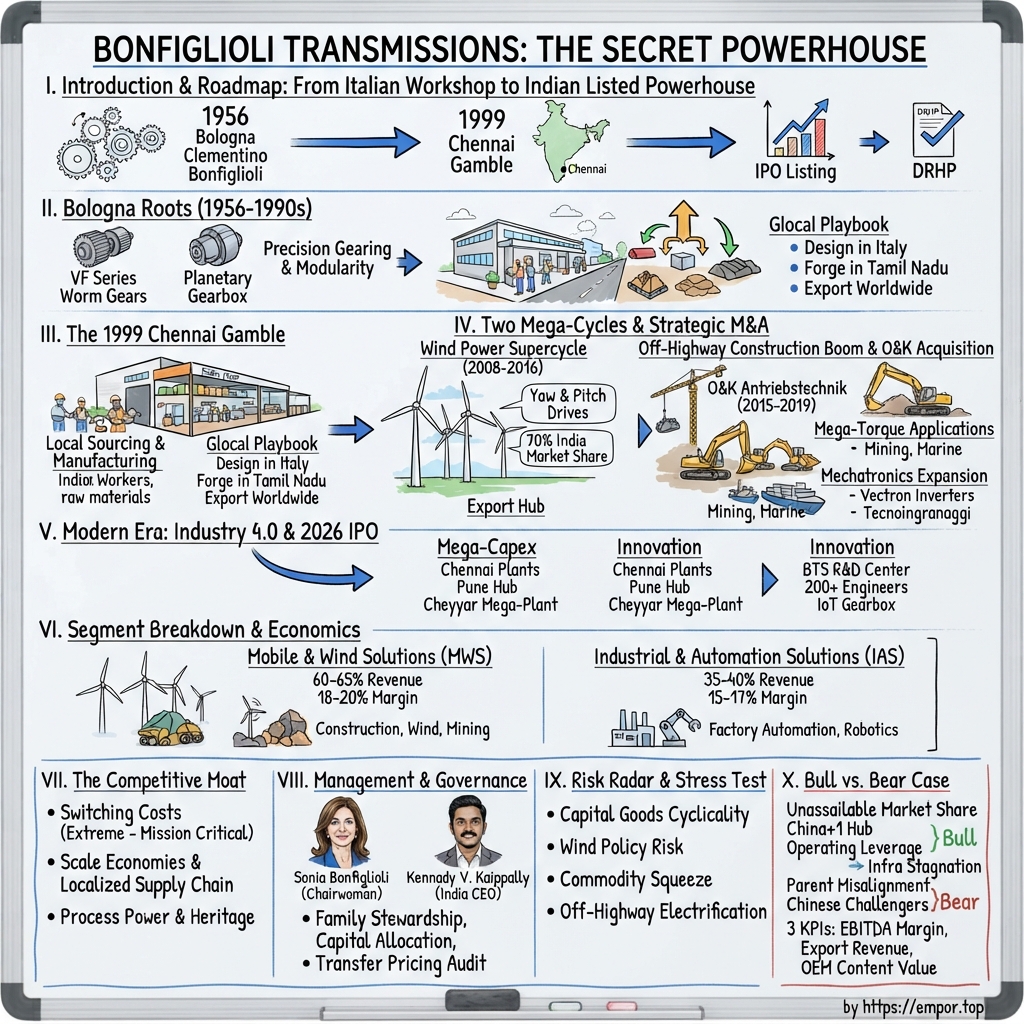
Bonfiglioli Transmissions: The Secret Powerhouse Driving Global Heavy Industry and Green Energy
I. Introduction & Episode Roadmap (00:00 – 00:10)
On 9 May 2024, Bonfiglioli Transmissions Private Limited bought back 5,792,438 of its own shares from its sole shareholder, Bonfiglioli S.p.A. of Bologna, at ₹124.30 per share.1 Nobody outside the Bonfiglioli family and a Chennai boardroom priced that transaction. There was no auction, no competing bid, and no public market. Twenty months later, the same company filed a draft prospectus proposing to sell a quarter of itself to the Indian public — and left the price blank.1
That blank is the most revealing entry in the document, framing the entire investment case. Between the buyback and the public listing lies the gap between what a controlling parent will accept from a captive subsidiary and what public markets will pay for a scarce industrial franchise. The two valuations are separated by a multiple that may well exceed five.
Neither figure represents intrinsic value. Value depends on what the Chennai business will actually earn, over what duration, at what reinvestment cost, and how much of that cash flow survives the corporate tolls the Italian parent collects along the way.
The core hook, checked against the record. The operational setup is substantial. Bonfiglioli Transmissions Limited — converted from a private to a public limited company on 16 September 2025 — manufactures gearboxes and drive systems across three plants in Tamil Nadu and Maharashtra.1
These are mission-critical, unglamorous components. A yaw drive is a geared motor that rotates a wind turbine's nacelle to keep the rotor facing the wind; a pitch drive adjusts the angle of individual blades to optimize power generation or feather under excessive load. Together they represent only one to two percent of a turbine's total capital cost, yet if either unit fails, a multi-crore asset halts immediately.
Bonfiglioli holds roughly 70% of India's domestically manufactured yaw and pitch drive market by sales value, according to the Frost & Sullivan industry report commissioned for the offer; on a broader definition that includes imports, its share of India's wind turbine drives market reached 68.3% in fiscal 2025, compared with 6.8% for Liebherr and 5.1% for DHHI.1 The company also holds an estimated 25% share of Indian gear motors rated below 15 kNm and approximately 30% of the non-captive off-highway mobility drives market.1 The draft prospectus describes the company as among India's largest technology-led power transmission and industrial drive solutions providers by revenue in the nine months ended 30 September 2025.1
Popular narratives describing Chennai as "the global epicentre for planetary gearboxes" overstate the reality. Chennai is the centre of Indian planetary drive manufacturing and an important regional supply node for the Bonfiglioli Group, but it is not the group's largest site, and the parent operates seventeen production facilities worldwide.1 Maintaining precision around that operational boundary is essential to understanding what public market investors are actually acquiring.
The listing inflection point. Bonfiglioli Transmissions filed its Draft Red Herring Prospectus with the Securities and Exchange Board of India in February 2026, proposing a pure Offer for Sale of up to 46,998,959 equity shares of ₹10 face value by its promoter, Bonfiglioli S.p.A.12 SEBI issued its observations — the regulator's formal clearance — during 11–12 June 2026.3
Axis Capital, BNP Paribas, ICICI Securities, and Jefferies India serve as the book-running lead managers, with MUFG Intime India as registrar, and the shares are proposed for listing on both the BSE and the NSE.14 Market reporting ahead of the filing estimated the parent's target raise at roughly $250 million, or ₹2,200–2,300 crore.5 Post-clearance reports described the issue size as "over ₹2,000 crore."3 As of 24 August 2026, no price band has been published, and the DRHP's price fields remain unfilled.1
Because the offer contains no fresh issue of shares, the company itself will not receive any proceeds.1 Every share sold is an existing share owned by the parent; every rupee raised flows out of India to Bologna.
A pure secondary sale is not inherently problematic — a mature business generating surplus cash has little need for dilutive primary capital — but it sharpens the core governance question: what are the parent's capital allocation priorities, and where do minority shareholders stand beneath a 75% controlling owner?
The "glocal" thesis, and where it breaks. The conventional corporate narrative suggests that Bonfiglioli achieved a rare combination: Italian design, Indian manufacturing cost advantages, and global export distribution. The regulatory disclosures support parts of this thesis while complicating the rest.
Revenue from customers outside India stood at 27.06% in the nine months ended 30 September 2025, compared with 26.41% four years earlier.1 The export mix has remained largely flat rather than expanding. Furthermore, intercompany sales to Bonfiglioli affiliates represented 14.31% of total revenue, meaning more than half of the reported export revenue is transacted internally at transfer prices established by the parent group.1
More consequentially, the Indian operating company licenses its core intellectual property from the Italian parent at a royalty of 6% of annual net sales under a one-year agreement terminable on three months' notice. That licence restricts manufacturing and distribution rights strictly to India, Pakistan, Bangladesh, Sri Lanka, and Nepal — any sales into other jurisdictions require the parent's explicit consent.1 The Indian entity is not an independent global exporter by right; it operates as a regional licensee supplying international affiliates entirely at group discretion.
Episode roadmap. The analysis that follows traces the origins of the Bologna workshop founded in 1956; the 1998–99 entry into Chennai and the localisation efforts that built its manufacturing base; the renewable energy and construction equipment cycles that elevated a component supplier into a domestic category leader; the parent-level acquisitions that form part of the broader group narrative but sit outside the Indian corporate perimeter; the segment-level economics and unit margins; the competitive moat, tested against empirical disclosures; executive compensation, board oversight, and the related-party architecture governing cash transfers to the parent; the operational risks and a skeptic's balance-sheet stress test; a scenario-based valuation framework benchmarked against listed industrial peers; and the strategic lessons supported by the public record.
 Subscribe on LinkedIn
II. Bologna Roots: Clementino Bonfiglioli & The Italian Industrial Miracle (1956–1990s) (00:10 – 00:25)
Costruzioni Meccaniche Bonfiglioli was founded on 16 April 1956 in Bologna by Clementino Bonfiglioli.6 The date matters less than the geography.
Emilia-Romagna in the mid-1950s was becoming the densest concentration of mechanical craft in Europe — the industrial region that produced Ferrari, Lamborghini, Ducati, and a packaging-machinery cluster that still equips the world's pharmaceutical and food processing lines. What powered that cluster was not any single industrial champion, but a dense network of specialized machine shops capable of holding tight tolerances, precision-cutting gear teeth, and delivering on schedule. A gearbox maker established there inherited a local supply chain and a skilled labour pool that would have required decades to assemble elsewhere.
What the business actually is. The economics of the trade Clementino entered are worth stating plainly, because they have not fundamentally changed in seventy years. A gearbox converts a motor's high-speed, low-torque rotation into low-speed, high-torque rotation — or the reverse.
The core engineering value resides in three areas. First, the geometry of the gear teeth, which determines how quietly and smoothly the unit operates under heavy shock loads. Second, the metallurgy and heat treatment of the alloy steel, which determines whether gear teeth pit and spall after five years or twenty-five. Third, the architectural packaging, which determines how much torque can fit into a restricted physical footprint. Everything else is standard assembly.
Planetary architecture — a central sun gear driving several planet gears within an internal ring gear — is the standard solution to the packaging challenge. Because mechanical load is distributed across multiple gear meshes simultaneously rather than concentrated at a single contact point, a planetary unit delivers significantly more torque per kilogram than a conventional parallel-shaft design.
That high power density makes planetary systems essential inside excavator swing drives, mobile crane winches, and wind turbine yaw and pitch mechanisms, where physical space is limited and torque requirements are severe. Bonfiglioli's commercial position in India rests almost entirely on this family of drive products, with the company described in the draft prospectus as among the leading manufacturers of planetary gearboxes in India by revenue in 2024.1
Lineage, and the limits of the record. The group's product families still reflect that manufacturing evolution, spanning the Bonfiglioli Riduttori and Bonfiglioli Trasmital lines, later complemented by Bonfiglioli Vectron in drive electronics and Tecnoingranaggi in precision gearing.6
The broader corporate chronology — including early worm-gear series, specific legacy planetary designs, and the phased rollout of European sales subsidiaries across the 1970s and 1980s — is not detailed in the Indian draft prospectus, which focuses on the operating business rather than the Italian parent company's private history.
What the regulatory disclosures do establish is the group's present global scale. The Bonfiglioli Group operates across 80 countries through 17 production facilities and seven R&D centres employing 377 people, works through more than 550 distributors and resellers, employs over 5,000 personnel worldwide, and holds 21 patents granted in the name of Bonfiglioli S.p.A.1 Group revenue for the calendar year ended 31 December 2024 reached €1,190.9 million, stated in the filing as ₹105.91 billion.1
Two details within those figures warrant close attention from prospective public market investors. First, a portfolio of 21 patents is modest for a €1.2 billion industrial engineering group — indicating that the primary competitive moat is built on proprietary process knowledge, customized tooling, and long-standing customer qualification cycles rather than broad statutory exclusivity.
Second, every single patent is owned directly by Bonfiglioli S.p.A. in Italy, not by the Indian operating company offering its shares to public investors.1 Treating seventy years of Italian engineering heritage as an intangible asset on the Indian company's balance sheet confuses an operating licence with a permanent property right.
Succession, and what is not known. The generational handover from Clementino Bonfiglioli to his successors is central to the group's corporate continuity.
Sonia Bonfiglioli serves as Chairwoman of the group and has been a director of the Indian operating company since 20 November 1998; born in November 1963, she is described in the regulatory filing as an entrepreneur.1 Her directorships span Bonfiglioli operating entities in Germany, Brazil, China, Slovakia, South Africa, Switzerland, Australia, the United States, and Vietnam, alongside BON-FI S.r.l. — the ultimate holding company above Bonfiglioli S.p.A. — as well as O&K Antriebstechnik, San Marco Group, Selcom Group, and Tecnotrans Bonfiglioli.1
While the exact timeline and internal arrangements of the family succession remain private, the disclosures document a promoter family that has retained undiluted ownership through BON-FI S.r.l. across seven decades. The Indian public offering marks the first time the promoter group is selling an equity stake in a national operating subsidiary to outside investors. Privately held family enterprises unaccustomed to public scrutiny face a distinct governance transition when introducing public minority shareholders — an adjustment that represents as significant an operational shift for the controlling family as it does for new investors.
III. The 1999 Chennai Gamble: Pioneering "Make in India" Before the Playbook Existed (1999–2008) (00:25 – 00:45)
The Indian operating company was incorporated on 23 June 1998 — not under its modern corporate name, but as Bonfiglioli Deepak Private Limited, registered in Chennai under the Companies Act, 1956.1 Within three months, the name changed to Bonfiglioli Transmissions Private Limited, confirmed by a fresh certificate of incorporation on 25 September 1998.1
The original corporate name records an element often omitted from the founding narrative: the group's entry into India began as a partnership arrangement, yet the local partner departed almost immediately. Whatever the commercial rationale, the Italian parent chose to establish full operational and equity control from the outset rather than manage a shared joint venture.
Twenty-eight years later, that early consolidation continues to define the capital structure. There is no legacy minority shareholder anywhere on the register. Prior to the public offer, Bonfiglioli S.p.A. held 100.00% of the company's 187,995,834 equity shares, including ten shares held through six named nominees.1
The registered office moved to Plot AC7–AC11, SIDCO Industrial Estate, Thirumudivakkam, on 1 February 2000, and the Thirumudivakkam facility — an 11.63-acre site owned outright — has been operational since 1999.1 Siting the first plant in Chennai rather than established automotive or industrial corridors around Pune or the National Capital Region was not an obvious choice in 1998. While Tamil Nadu offered tier-one automotive supplier density, a machine-tool tradition, and technical institutes, the target industrial customers for heavy geared products remained distributed across the country.
What localisation actually required. The strategic question is not merely why Bonfiglioli entered India, but why the conventional multinational subsidiary model frequently falters in the domestic market, and how this operation departed from the standard playbook.
The typical failure mode is straightforward. A foreign parent ships fully assembled European units at European manufacturing costs, absorbs freight and import tariffs, and prices itself out of all but the most specialized applications. Without domestic volume, the local plant never achieves operating scale, reducing the subsidiary to an import sales office with an attached warehouse.
Bonfiglioli's departure from that pattern is documented in its procurement disclosures. In the nine months ended 30 September 2025, purchases of raw materials and components from domestic suppliers represented 70.70% of total purchases, up from 64.97% in fiscal 2023 and 67.04% in fiscal 2022.1 As of 30 September 2025, the company sourced inputs from 186 suppliers in India and 69 abroad, with no single vendor exceeding 20% of total purchases.1
Qualifying a domestic supply base for precision mechanical assemblies is an arduous engineering exercise. Getting a local foundry to deliver cast-iron housings that maintain bore concentricity across thousands of production cycles, or securing alloy steel forgings with consistent heat-treatment hardenability, requires multi-year technical audits that generate no immediate revenue.
The fact that the domestic procurement share reached roughly 71% by late 2025 also highlights an ongoing exposure: nearly 29% of the component basket continues to be imported, maintaining a direct vulnerability to foreign currency fluctuations and import tariffs rather than representing a completely localized supply chain.
The distribution build. The second structural challenge in the Indian market is geographic reach. Standard industrial gearboxes rated below 15 kNm are typically purchased in small batches by thousands of disparate enterprises across chemical processing, food packaging, textiles, and material handling. Serving that fragmented demand requires a dense distributor network rather than direct enterprise sales.
As of 30 September 2025, the company worked with 44 dealers, of whom 16 had been engaged for twenty years or more and 36 operated on an exclusive basis.1 This distribution channel was supported by 13 sales offices staffed by 64 sales employees, 15 in-house service engineers, and 13 third-party authorized service facilities employing a further 26 engineers.1 The company states in its draft prospectus that it aims, on average, to respond to customer complaints by the next working day.1
An exclusive dealer network where over a third of partners have a twenty-year vintage represents a meaningful commercial asset that competitors cannot quickly replicate.
At the same time, a footprint of 44 dealers and 64 direct sales personnel remains relatively lean across the Indian subcontinent, constraining how quickly the Industry & Automation division can expand purely through channel breadth. Dealer sales contributed 19.34% of revenue in the nine months ended 30 September 2025, largely flat compared with 18.03% in fiscal 2022.1 The channel has scaled in line with the broader business rather than acting as an independent growth accelerator.
Early OEM adoption. Disclosed customer relationships illustrate the commercial foundation built over the company's first two decades. In the Industry & Automation segment, long-standing clients include ElectroMech Material Handling Systems, GMM Pfaudler, Milltec Machinery, Terex India, and Ammann India.1 In Off-Highway Mobility, key original equipment manufacturers include Action Construction Equipment, Ajax Engineering, CNH Industrial India, Hyundai Construction Equipment India, JCB India, Schwing Stetter India, and Wirtgen India.1
These manufacturers produce the cranes, asphalt pavers, concrete batching plants, and excavators deployed across Indian infrastructure projects. Every one of the top ten OEM customers in the Industry & Automation vertical had been engaged for more than ten years as of September 2025, as had eight of the top ten in Off-Highway Mobility.1
In an industrial components business, customer tenure of this duration provides tangible empirical evidence of high switching costs. Equipment manufacturers rarely redesign drivetrain mountings or qualify new transmission suppliers without compelling technical or pricing imperatives. The longevity of these OEM relationships reflects deeply embedded engineering integrations rather than routine transactional purchases.
IV. The Dual Inflection Points: The Wind Energy Boom & The O&K Acquisition (2008–2019) (00:45 – 01:10)
Inflection one: wind. India's wind sector underwent a turbulent transition during the 2010s, shifting from feed-in tariffs and accelerated-depreciation incentives to competitive reverse auctions that depressed tariff realizations and accelerated consolidation across turbine original equipment manufacturers. Several equipment makers failed to survive the shakeout. Bonfiglioli's market position, however, emerged from that cycle substantially stronger, and the underlying commercial mechanism is instructive.
Yaw and pitch drives are not commodity gearboxes. Mounted in nacelles a hundred metres above ground, they must withstand continuous, reversing dynamic loads for twenty years and cannot be serviced or replaced without mobilizing specialized crane infrastructure. Consequently, once an OEM qualifies a drive onto a specific turbine platform, it effectively locks in that supplier for the multi-decade operating life of the platform; re-qualifying an alternative supplier requires redesigning the nacelle interface and repeating extensive structural validation programs.
The company manufactures yaw and pitch drives spanning turbine ratings from 225 kW up to 5 MW, and as of 30 September 2025, its India R&D Centre in Chennai was the only test laboratory in the country equipped to test yaw and pitch drives for wind turbines.1 Among its engineering programs, the draft prospectus highlights the internal development of drive systems for 5 MW wind turbines — the higher-capacity class toward which Indian utility installations are transitioning.1
That dedicated testing facility represents one of the company's most defensible operational assets. While constructing a test laboratory is far less capital-intensive than building a manufacturing plant, its presence means that any domestic turbine OEM seeking locally validated drive systems must route validation through testing infrastructure controlled by the Bonfiglioli Group.
The draft prospectus identifies its principal Indian wind customers as Nordex India, Senvion Wind Technology, and Suzlon Energy, with seven of the vertical's top ten OEM customers engaged for more than ten years.1 While broader industry commentaries frequently reference global turbine majors like Siemens Gamesa, Vestas, GE Vernova, or Envision, the Indian entity's regulatory disclosures substantiate these three core domestic accounts, alongside drive deliveries to one renewable energy customer in the United States.1
This concentrated customer base yields commanding market shares: approximately 70% among domestic manufacturers of yaw and pitch drives by sales value in calendar 2024, and 68.3% of India's overall wind turbine drives market by value in fiscal 2025 under the Frost & Sullivan measure that accounts for imported units.1 The remainder of the market is fragmented, with Liebherr holding 6.8%, DHHI 5.1%, and a long tail of smaller global suppliers, domestic gear makers, and retrofit vendors — including Weili and Chongqing — accounting for the remaining 19.8%.1
A necessary analytical caveat accompanies these figures. The market-share data originates from an industry report commissioned and funded by the company, a circumstance the draft prospectus explicitly notes as an internal risk factor.1 That sponsorship does not invalidate the data, but it indicates that the definitional parameters — such as "domestic manufacturers" measured "by sales value" — were framed by an interested party. Accordingly, the 68.3% figure covering the total addressable market provides a more rigorous benchmark than the narrower 70% domestic slice.
Wind energy drive sales contributed ₹466.84 crore, or 31.97% of total revenue, in the nine months ended 30 September 2025, up from 29.60% in fiscal 2022.1 It represents the fastest-growing of the company's three operating divisions, as well as the vertical most directly exposed to shifting regulatory and tariff policies.
Inflection two: O&K — and whose inflection it was. In November 2015, Bonfiglioli acquired an initial 55% stake in the German heavy-planetary drive specialist O&K Antriebstechnik GmbH from the Carraro Group for €25.7 million, with Carraro retaining 45% alongside an ongoing component-supply agreement.7
On 20 November 2018, Bonfiglioli acquired the remaining 45% for €17 million to take full ownership; across that three-year partnership, O&K's consolidated revenue expanded from €36 million to approximately €65 million.8 O&K manufactures high-capacity planetary gearboxes engineered for heavy mobile cranes, open-cast mining equipment, marine vessels, and large agricultural machinery — occupying the extreme high-torque tier of the industrial spectrum.7 Sonia Bonfiglioli framed the buyout as consolidating the group's "global leadership in high-power transmission and control."8
The strategic rationale was disciplined and counter-cyclical. Acquiring a premier heavy off-highway specialist in 2015, near the trough of a global mining and construction downturn, for a cumulative €42.7 million against a business generating €65 million in annual revenue three years later, demonstrated sound capital allocation at the parent level.
Crucially, however, this was not a transaction executed by the Indian operating company. O&K Antriebstechnik is an asset held directly by the Italian parent, Bonfiglioli S.p.A.; Sonia Bonfiglioli and Massimo Sarti serve on its supervisory bodies alongside their Indian board directorships.1 The same structural separation applies to historical group acquisitions such as Vectron in drive electronics and Tecnoingranaggi in precision gearing, as well as Selcom Group S.p.A., an electronics affiliate disclosed within the promoter group.1
An investor subscribing to shares in Bonfiglioli Transmissions Limited acquires no direct equity ownership in any of these European entities. The Indian company secures access to their technology exclusively via contractual licences — and only for designated product lines within authorized regional territories.
Conflating group-level M&A with the listed Indian subsidiary's asset base is a common analytical pitfall. The O&K transaction expanded the group's torque capabilities into several million newton-metres. By contrast, the Indian operating company's localized portfolio spans a distinct and narrower range: 1,000 Nm to 3,000 kNm in Off-Highway Mobility, and 13 Nm to 1,400 kNm in Industry & Automation.1
The same analytical discipline applies to the group's mechatronics offerings. Precision gearboxes for robotics, servo motors, specialized cabling, variable frequency drives, and inverter controls are present in the Indian product catalogue, enabling the company to engineer integrated drive-and-control systems — including an electric vehicle battery-swapping mechanism described in the filing that coordinates five synchronized axes of motion.1 Yet the Indian operating entity does not own the Vectron or Tecnoingranaggi businesses; it commercializes products engineered on proprietary architectures owned in Europe. The operational and legal distinction between owning core technology and licensing it remains a defining theme of the company's public listing.
V. Modern Era: Mega-Capex, Industry 4.0 "EVO", and the 2026 Public Listing (2019–2026) (01:10 – 01:30)
The physical footprint, precisely. As of 30 September 2025, the company operated three manufacturing facilities: Thirumudivakkam and Mannur in Tamil Nadu, and Talegaon in Maharashtra, which together produced 330,057 units of gear motors and gearboxes in calendar 2024.1 Capacity utilisation, measured in machine-hours, provides the most revealing operational metric in the regulatory filing. The Thirumudivakkam machine shop operated at 83.83% of capacity during the nine months ended 30 September 2025, up from 74.08% in 2022 — approaching the practical operating ceiling for a three-shift precision machining setup.1 In contrast, assembly utilisation at the same site stood at 56.10%, while Mannur reached 73.58% and Talegaon 75.87%.1
The operational takeaway is clear: the immediate capacity constraint lies in machining, not assembly. Assembly lines can accommodate meaningful volume expansion with minimal incremental capital expenditure, delivering the operating leverage required for margin gains.
Machining capacity, however, presents a different hurdle. Sustained production growth requires investment in dedicated gear-cutting, hobbing, and grinding machinery. That heavy capital requirement would challenge the self-funding model if volume growth accelerates substantially.
The Cheyyar question. In October 2024, the promoter group announced a ₹320 crore Indian investment programme covering a 25-acre Industry & Automation facility at Cheyyar, Tamil Nadu, slated to create 150 to 200 jobs and commence operations by 2025, alongside the launch of the Bonfiglioli Technology Space in Chennai housing 180 engineers.9 Sonia Bonfiglioli targeted ₹1,900 crore in domestic turnover "by year-end."9 Yet neither the Cheyyar project nor the Technology Space appears among the listed company's operational assets or property schedules in the draft prospectus.1 Whether Cheyyar is housed in an unlisted affiliate, remains under development, or was restructured is not clarified in the filing. It remains a key diligence question for the final Red Herring Prospectus, and until disclosed, that ₹320 crore capital commitment cannot be attributed to the listing entity's balance sheet.
The R&D carve-out. The exclusion of the Technology Space is more than an administrative technicality. On 30 September 2024, the company transferred its global capability centre business — covering engineering design services, IT support, and financial consolidation functions, along with all associated physical assets, personnel, and customer contracts — to Bonfiglioli Technology Space Private Limited (BTSPL), a promoter-group affiliate, via a slump sale for ₹115.50 million.1 The transaction value was calculated on a cost approach using replacement value.1 Sonia Bonfiglioli, Massimo Sarti, Kennady V. Kaippally, and Gatham Anandhan Balaji sit on the boards of both entities.1
The regulatory disclosure makes the operational result explicit: "Our Company does not currently incur any R&D expenses."1 The India R&D Centre, staffed by over 100 engineers and operating the country's only dedicated wind-drive testing laboratory, is owned and managed by BTSPL, which bills its expenses back across group entities.1 The operating company's enterprise IT architecture, including its SAP infrastructure and cybersecurity protocols, is likewise managed by BTSPL personnel.1
A year before filing for an IPO, the operating business transferred its core engineering innovation and IT functions to a promoter-controlled vehicle at replacement cost. While there may be sound administrative and transfer-pricing grounds for centralizing shared technical services, the structural reality is unambiguous: public investors are acquiring an assembly and commercial distribution franchise that leases its product development capabilities from its controlling shareholder.
A balancing intercompany transaction followed on 15 December 2025, when the company acquired the gear components manufacturing and sales division of Bonfiglioli Drive Solutions Private Limited, another promoter affiliate, through a slump sale for ₹214.40 million at fair market value.1 Both transfers were backed by independent valuation reports, both occurred between entities under common ownership, and neither was subjected to open-market price discovery.
The financial profile. Bonfiglioli Transmissions follows a calendar fiscal year ending 31 December — an uncommon reporting cycle in India that makes direct benchmarking against March-ending capital goods peers complex.1 Revenue from continuing operations totaled ₹1,558.80 crore in 2022, ₹1,687.51 crore in 2023, and ₹1,864.08 crore in 2024, reaching ₹1,460.17 crore in the nine months ended 30 September 2025.1 Year-on-year revenue growth stood at 8.26% in 2023 and 10.46% in 2024 — steady expansion for an industrial component maker, though modest when measured against broader Indian infrastructure growth narratives.
Margins, and the 2023 lesson. Operating profitability highlights underlying cyclical sensitivity. EBITDA excluding other income was ₹254.44 crore in 2022 (a 16.32% margin), contracted to ₹244.12 crore in 2023 (14.47%), rebounded to ₹293.06 crore in 2024 (15.72%), and reached ₹253.48 crore in the nine months ended 30 September 2025 (17.36%).1 Profit after tax from continuing operations followed an identical pattern: ₹168.75 crore in 2022, dipping to ₹147.70 crore in 2023, recovering to ₹191.12 crore in 2024, and delivering ₹165.19 crore in the nine-month period.1 Consolidated net profit including discontinued operations totaled ₹194.69 crore in 2024.1
The 2023 margin contraction is the most instructive historical data point. Driven by sharp raw-material and alloy-steel inflation, it shows that while cost pass-through arrangements with equipment manufacturers are functional, they operate with an inevitable lag. Cost recoveries take several quarters to materialize. Anyone modeling uninterrupted 17% operating margins must account for how quickly margins can retreat toward 14.5% during commodity spikes.
The balance sheet, however, remains conservative. Total borrowings were zero at both 31 December 2024 and 30 September 2025, reduced from ₹110.79 crore in 2023 and ₹143.74 crore in 2022.1 Net debt stood at negative ₹162.83 crore as of September 2025, reflecting a net cash reserve.1 Net worth reached ₹925.30 crore, yielding a net asset value of ₹49.22 per share.1 Return on capital employed stood at 30.28% for 2024 and 25.18% for the unannualised nine-month period (roughly 33% on an annualised basis), while return on equity recorded 23.05% and 18.58% across the same periods.1 Working capital discipline has remained consistent, with the cash conversion cycle holding steady between 79 and 81 days across all four periods.1
The offer. The public issue is structured as a pure Offer for Sale of up to 46,998,959 equity shares by Bonfiglioli S.p.A. — representing exactly 25.00% of the 187,995,834 shares outstanding.1 That figure corresponds precisely to SEBI's minimum public shareholding requirement. The issue allocation reserves 50% for qualified institutional buyers, 15% for non-institutional investors, and 35% for retail bidders.110 The outstanding equity base was set via a one-for-two bonus issue approved by shareholders on 10 November 2025 and allotted by the board on 25 January 2026, expanding the share count from 125,330,556.1
Capital structure. The capital table is clean and free of overhang. Disclosures confirm there are no outstanding preference shares, convertible debentures, warrants, or employee stock option plans as of the DRHP filing date.1 Basic and diluted earnings per share are identical across all reporting periods, confirming the absence of dilutive instruments.1 The fully diluted share count of 187,995,834 will remain unchanged post-offer, as no fresh equity is being issued. There is no convertible debt overhang, liquidation preference tier, promoter share pledge, or dual-class voting structure. For an industrial subsidiary opening its register to public investors for the first time, the capital structure is straightforward and unencumbered.
VI. Segment Breakdown & Core Unit Economics (01:30 – 01:50)
Industry commentary often defaults to a two-segment framing — grouping mobile and wind solutions against industrial automation — but that division obscures how the business actually operates. Bonfiglioli reports across three distinct verticals. In the nine months ended 30 September 2025, Industry & Automation Solutions contributed ₹598.37 crore, or 40.98% of revenue; Wind Industry generated ₹466.84 crore, or 31.97%; Off-Highway Mobility accounted for ₹368.82 crore, or 25.26%; and other non-core sales, principally components sold to vendors, made up the remaining 1.79%.1 Combining wind and off-highway yields 57.23% of sales, but Industry & Automation remains the single largest operating vertical.
Segment-level EBITDA margins are not disclosed in the draft prospectus. While outside commentaries often assume margins of 18–20% for mobile and wind against 15–17% for industrial automation, no segment-level margin breakdown exists in the regulatory filings; the company reports only a single consolidated operating margin.
Industry & Automation: breadth as a business model. This vertical spans low-, medium-, and heavy-duty gear motors and gearboxes rated from 13 Nm to 1,400 kNm — encompassing helical, bevel, planetary, and worm units, alongside electric motors, variable frequency drives, servo motors, and precision drives for robotics.1 The vertical produced 10,227 distinct stock keeping units (SKUs) in the nine months ended 30 September 2025, while the company manufactured more than 10,500 SKUs overall.1
Generating roughly ₹600 crore in nine-month revenue across ten thousand SKUs translates to under ₹6 lakh of revenue per SKU. That arithmetic reflects a classic catalogue business, where product modularity is an operational necessity rather than a marketing concept. A single gear stage designed to interface with four motor frames, three mounting configurations, and two reduction ratios yields twenty-four distinct commercial products from a single tooling investment. Without that combinatorial discipline, working capital requirements across such a vast catalogue would quickly become unmanageable.
Revenue quality in this vertical is supported by broad end-market diversification: no single end-user industry contributed more than 10% of the vertical's revenue across any of the four reporting periods.1 Demand is distributed across material handling, chemicals, pharmaceuticals, mining, food and beverage, metal processing, machine tools, construction, textiles, and plastics. While individual orders are transactional rather than long-term contracted commitments, the revenue stream functions like an industrial base load. Replacement demand accounts for roughly 45% of India's overall gearbox market compared with 55% for new installations, ensuring that an established installed base generates recurring aftermarket orders independent of the broader capital goods cycle.1
Wind: high-volume platforms and concentrated risk. In sharp contrast to the industrial catalogue, just fifty SKUs generated ₹466.84 crore in the nine-month period — averaging more than ₹9 crore per SKU, or over 150 times the revenue density of Industry & Automation.1 That concentration reflects co-engineered, platform-locked drive systems: few variants, substantial unit volumes, and exhaustive customer validation cycles.
The commercial economics stem directly from that product architecture. Bonfiglioli engineers collaborate directly with turbine manufacturers from initial design, but intellectual property for these co-engineered products remains with the Bonfiglioli Group.1 For an OEM, that shared development makes substituting a gearbox supplier mid-platform virtually impossible. For the listed Indian subsidiary, however, it means the underlying intellectual property it helps develop belongs legally to the Italian parent rather than staying on its own balance sheet.
The aftermarket opportunity in wind also warrants analytical scrutiny. India's ageing wind turbine fleet, concentrated across Tamil Nadu and Gujarat, generates regular replacement and retrofit demand, while a 12–14 GW repowering opportunity is emerging as older sub-1 MW installations reach the end of their design life.1 However, because the draft prospectus does not disaggregate aftermarket sales from original equipment shipments, the exact scale and profitability of this recurring revenue stream remain unquantified.
Off-Highway Mobility: defining the addressable market. This vertical supplies swing and track drives, drum and mixer drives, wheel and auger drives, and cutter and hoist drives across 267 SKUs, rated from 1,000 Nm to 3,000 kNm.1 Bonfiglioli held a 24.2% share of the overall Indian off-highway drives market by value in fiscal 2025, competing alongside captive manufacturers Tata Hitachi at 15.0% and Larsen & Toubro at 4.7%, as well as non-captive suppliers SUNGBO at 13.9%, Nabtesco at 8.0%, and Doosan at 5.8%.1 The headline figure attributing a "30% market share" to Bonfiglioli applies strictly to non-captive manufacturers — a valid industry metric, but one that excludes roughly a fifth of the total market where equipment OEMs build their own drivetrains in-house.1 Captive volume is fundamentally insulated from third-party component suppliers.
The unit economics that govern the business. For a precision mechanical manufacturing business, performance is determined by material conversion, capital efficiency, and working capital stability.
Raw materials and bought-out components represent approximately 63% of revenue, according to analysis of the financial disclosures.11 With consolidated EBITDA at 17.36%, operating conversion costs, plant overheads, administrative expenses, and parent royalty fees must all fit within the remaining 20% of revenue — a narrow operating corridor where commodity price shifts or product mix changes quickly affect the bottom line.
Fixed asset turnover moderated from 8.76 times in 2022 to 7.19 times in 2024 and 5.81 times for the unannualised nine-month period — equivalent to roughly 7.7 times on an annualised basis.1 This trajectory reflects manufacturing capacity added ahead of immediate revenue needs, a normal feature of industrial expansion, though it indicates that incremental returns on newly installed assets are still ramping up.
Capital expenditure has remained modest: ₹66.16 crore in 2022, ₹102.30 crore in 2023, ₹44.92 crore in 2024, and ₹36.08 crore in the nine months ended 30 September 2025 — totaling roughly ₹250 crore, or approximately 3.4% of cumulative revenue across the period.1 Market narratives suggesting a ₹500 crore-plus domestic capex cycle are not reflected in the cash flow statements. Pre-filing reports described the parent as having deployed nearly ₹300 crore in India over three years, which aligns more closely with disclosed figures while still modestly exceeding them.5
Working capital discipline is demonstrated by a stable cash conversion cycle of 79 days maintained across all four reporting periods.1 Working capital has scaled in direct proportion to sales rather than ballooning during growth phases — avoiding the cash-flow squeeze that frequently challenges Indian capital goods manufacturers during demand upswings.
Revenue quality and customer concentration. Two operational disclosures present notable counterweights to the diversification thesis. Customer concentration has increased: revenue from the top ten customers rose to 46.35% in the nine months ended 30 September 2025, up from 43.16% in 2024, 41.08% in 2023, and 39.81% in 2022 — a 6.5-percentage-point increase over four reporting periods.1 Furthermore, the company explicitly confirms that it operates without long-term binding off-take contracts with its key customers.1 Commercial relationships are secured by technical qualification and historical tenure rather than contractual guarantees.
Supplier concentration improved over the same horizon, with the top ten vendors accounting for 41.92% of total purchases in the nine-month period compared with 48.06% in 2022, though the company similarly maintains no long-term supply agreements.1
Sales distribution channels add another layer of operational nuance. Direct OEM sales contributed 64.87% of revenue in the nine months ended 30 September 2025, authorized dealers generated 19.34%, and intercompany sales to foreign Bonfiglioli affiliates — comprising finished yaw, pitch, and swing drives exported for group distribution — represented 14.31%.1 These intercompany shipments account for more than half of the company's export turnover, with transaction values determined through group transfer-pricing protocols.
New product velocity. Revenue generated from products introduced over the preceding three years increased from 4.77% in 2022 to 7.28% in 2023, 15.98% in 2024, and 29.95% in the nine months ended 30 September 2025.1 This six-fold acceleration demonstrates that the company's access to group engineering designs translates effectively into commercial production in India. At the same time, it underlines the listed entity's ongoing reliance on product development pipelines managed through its promoter-controlled technology affiliate.
VII. The Competitive Moat: Hamilton Helmer’s 7 Powers & Porter’s 5 Forces (01:50 – 02:10)
Frameworks are worth using only where they change the answer. Three of Helmer's seven powers apply here with real force; the rest do not, and pretending otherwise obscures the analysis.
Switching costs: strong, and the evidence supports it. The asymmetry-of-failure argument is sound in principle — a component that is a small share of machine cost but a large share of downtime risk earns pricing power. But the proof is behavioural, and the filing supplies it. Every one of the top ten Industry & Automation OEM customers, eight of ten in Off-Highway Mobility and seven of ten in Wind had been engaged for more than ten years as of September 2025.1 Across the business, six of the top ten OEM customers by 2024 revenue had relationships exceeding a decade.1 Combined with more than 1,000 direct customers, that is retention evidence rather than retention assertion.1
The mechanism is co-engineering. In the off-highway and wind verticals Bonfiglioli works inside the customer's development cycle from the design stage to create customised products meeting bespoke specifications.1 Once a drive is designed into a turbine nacelle or an excavator chassis, replacing it means redesigning the interface and re-validating the structure. The filing does not disclose qualification cycle lengths; independent analysis of the business has described a co-engineering model that engages roughly thirty months before production.11 The outline's 18-to-36-month figure is directionally consistent but is not a company disclosure.
The honest limitation: switching costs protect the installed platform, not the next platform. Every new turbine model and every new excavator generation reopens the competition. This is a moat that must be re-won on a rolling basis, which is precisely why the new-product revenue trajectory matters so much.
Scale economies and cost position: real, but the specific claim is unproven. Bonfiglioli is described as the largest manufacturer of gearboxes and drives in India across its served segments, with the only comprehensive portfolio spanning all three end-markets.1 The domestic sourcing share above 70% is a durable cost advantage against importers.1 But the widely repeated claim that this delivers gear sets 15–20% cheaper than European competitors is not disclosed anywhere in the filing or in any source opened here. The cost advantage is credible; its magnitude is not established.
There is also a counter-signal. Localisation of roughly 70% means the remaining 30% of the input basket is imported, and the filing explicitly flags exposure to duties on imported materials as a risk.1 A company with a fully solved cost position would not carry that sentence.
Process power: probably present, hard to verify. Metallurgical recipes, gear-tooth micro-geometry and heat-treatment discipline are exactly the kind of accumulated, hard-to-copy know-how Helmer means. The evidence is indirect: 83.83% machine-shop utilisation with stable working capital and rising new-product revenue is what a well-run process organisation looks like.1 But 21 patents sit with the Italian parent, not the Indian company, and the Indian company incurs no R&D expense.1 Whatever process power exists here is largely licensed, not owned — which is a materially different asset for a shareholder.
Cornered resource: one genuine instance. The India R&D Centre is the only laboratory in India able to test wind yaw and pitch drives.1 That is a cornered resource in the strict sense: a preferential asset unavailable to competitors on equal terms. The complication, again, is ownership. The lab belongs to BTSPL, a group company, and was moved out of the listing entity in September 2024.1 The resource is cornered by the group; the listed company has access, not title.
Brand heritage is real but does not qualify as a Helmer power in a business-to-business market where OEM engineers qualify on test data. An "unblemished 25-year track record" is not evidenced either way; the filing discloses six criminal proceedings initiated by the company and seven tax claims against it, aggregating ₹42.04 million and ₹67.74 million respectively — routine for a company of this size, but not nothing.1
Porter, applied briefly. New entrants face high but not prohibitive barriers: the F&S analysis rates entry barriers in Indian off-highway drives as "moderate to high," citing lengthy OEM qualification, field-validation requirements and the need for a service network.1 Note "moderate to high," not "very low threat" — the industry's own commissioned report is more cautious than the bull case.
Buyer power is where the pressure genuinely sits. Rising top-ten concentration to 46.35%, no long-term binding agreements, and an explicit industry dynamic in which developers push tariffs down, OEMs push turbine prices down, and OEMs then pass that pressure onto component suppliers, squeezing margins.1 That is buyer power operating through a three-link chain, and the 2023 margin trough is what it looks like in the accounts.
Supplier power is moderate and improving, given falling top-ten supplier concentration and no single supplier above 20% — but with no definitive supply agreements, and a filing that flags interruption risk explicitly.1 The outline's "index-linked quarterly price reset contracts" is not a disclosed arrangement; what is disclosed is that price escalation exists with implementation lags during inflationary periods.11
Substitutes are genuinely low-threat. Torque multiplication is a physical requirement, and electrified off-highway powertrains still need planetary reduction — the company has built an electro-mobility team and supplies electric gearboxes and drives.1
Rivalry is intense and named. In Industry & Automation the F&S-identified competitors are SEW-Eurodrive India, Elecon Engineering, NORD Drive Systems, Premium Transmission, Shanthi Gears and Flender Drives.1 In off-highway: SUNGBO, Dana India, Comer Industries India and PMP Drive Systems India.1 In wind: ZF Wind Power Coimbatore and Liebherr India.1 The filing states that competition has intensified in recent years amid competitively priced, technologically advanced launches by incumbents and new entrants.1 "High but rational" is a comfortable phrase; the company's own risk factor is less comfortable.
VIII. Management, Governance, & Capital Allocation (02:10 – 02:25)
The board that will greet public shareholders was largely assembled in the six weeks before filing. Of eight directors — two executive, three non-executive non-independent, and three independent including one woman — two of the three independent directors joined in February 2026, as did one non-executive director.1 Ravindra Pisharody chairs the board as an independent director, having served since 1 April 2018, and holds directorships at Happy Forgings, Muthoot Finance, Savita Oil Technologies, and Kwality Wall's (India), alongside a board seat at Bonfiglioli Drive Solutions.1 The independent-director complement satisfies the statutory one-third requirement, but its recent reconstitution means the board as a collective unit has yet to establish an extensive public governance track record.
One appointment warrants diligence attention. Ananthanarayan Sundaresan, an independent director since February 2026, was previously associated with Schwing Stetter (India) and Ammann India — both disclosed customers of the company.1 While the appointment brings valuable industry expertise, it represents the type of customer relationship that public market investors will expect to see addressed in the final red herring prospectus.
Kennady V. Kaippally was appointed Managing Director on 10 November 2025 for a five-year term, having joined the company in January 2010.1 A production engineering graduate of the University of Madras with prior experience at Ashok Leyland, Delphi Automotive Systems, and Federal-Mogul Goetze, he brings thirty years of operating expertise.1 His annual compensation comprises ₹19.0 million fixed pay, ₹4.35 million variable pay, and ₹1.6 million in retiral benefits, with a long-term incentive payable once between 2025 and 2027.1
The structure of that variable compensation is particularly revealing. It is tied to the achievement of targets relating to regional EBITDA and regional working capital as a percentage of sales.1 Rather than being evaluated on Indian entity net profit, return on capital, or earnings per share, executive performance is benchmarked against broader regional group metrics. Combined with the absence of an employee stock option scheme, no member of Indian executive management holds or will hold equity, meaning none is directly incentivized on the outcomes public minority shareholders prioritize.1 Gatham Anandhan Balaji, Whole-Time Director and Chief Financial Officer, has served the company since 2000 with a brief interruption, is a chartered accountant, and certified the key performance indicator disclosures personally.1
Against that governance backdrop, operational execution remains solid: return on capital employed exceeded 24% in every period presented, the cash conversion cycle held within a two-day band across four years, total borrowings were retired to zero, and machine-shop utilisation rose from 74% to 84%.1 The management team runs its manufacturing operations with disciplined efficiency. The critical underwriting questions lie instead in governance and corporate structure.
The related-party architecture. This is where the core investment thesis requires scrutiny.
Three primary agreements govern the operational relationship with Bologna. The Licence Agreement, effective 1 January 2021, grants a non-exclusive, non-transferable, non-sublicensable licence to manufacture and sell licensed products under Bonfiglioli's trade name, trademarks, patents, drawings, design rights, and know-how, in consideration for a royalty of 6% of yearly net sales excluding intercompany sales to Bonfiglioli S.p.A. and net of discounts. The licensed territory is restricted strictly to India, Pakistan, Bangladesh, Sri Lanka, and Nepal, extendable only with the parent's explicit consent. It carries a one-year term that auto-renews annually, with either party entitled to terminate on three months' notice prior to the end of the fiscal year.1
The Intercompany Service Agreement, dated 1 January 2024, covers corporate support functions — including IT, HR, legal, finance, strategic purchasing, quality, safety, engineering, communications, and aftersales — alongside business-unit services for both operating segments. Fees typically range from 30% to 100% of the service costs incurred, calculated on fixed costs or turnover, with an arm's-length markup of 5%, invoiced quarterly. The contract carries a one-year term, auto-renews annually, and requires thirty days' notice for termination.1
Complementing these service frameworks, business transfer agreements transferred the engineering design and IT capability centre out of the operating company in September 2024, followed by the acquisition of a gear components division in December 2025.1
The financial scale of these intercompany transfers is substantial. Royalty fees paid to the parent totaled ₹65.37 crore in 2022, ₹75.24 crore in 2023, ₹82.21 crore in 2024, and ₹65.60 crore in the nine months ended 30 September 2025.1 Professional fees, comprising cost-sharing charges from the parent plus consultancy expenses, amounted to ₹35.40 crore in the nine-month period.1 Together, those two intercompany expense lines reached ₹101.00 crore against nine-month revenue of ₹1,460.17 crore — representing 6.92% of total revenue, or 45.5% of the ₹221.85 crore profit before tax reported for the period.1
Cross-checking the royalty calculation confirms the underlying arithmetic: domestic revenue represented 74.73% of ₹1,864.08 crore in 2024, or roughly ₹1,393 crore; 6% of that figure equals ₹83.6 crore, aligning closely with the ₹82.21 crore reported.1 While that precision demonstrates regulatory compliance, it highlights high earnings sensitivity. A one-percentage-point increase in the royalty rate would reduce pre-tax profit by roughly ₹14 crore and net profit by approximately ₹10 crore — equal to 5.4% of 2024 profit after tax. An increase from 6% to 8% would shave net earnings by roughly 11%. Under the current contract terms, the parent can propose fee revisions annually.
Transfer pricing is not a theoretical consideration. Disclosed contingent liabilities as of 30 September 2025 included ₹7.99 crore in disputed income tax demands and ₹0.28 crore in indirect tax matters, of which ₹3.65 crore related specifically to downward transfer-pricing adjustments on corporate support charges across assessment years 2015–16, 2017–18, 2018–19, 2020–21, and 2023–24.1 Indian tax authorities have already contested the group-charge allocation methodology across five separate assessment years. While the monetary amounts in dispute are modest, the regulatory precedent is meaningful.
Capital allocation: distributions versus reinvestment. Popular commentary often depicts the Indian subsidiary as heavily reinvesting its profits into local expansion rather than repatriating capital. The cash flow record tells a different story. Dividend payouts totaled ₹163.90 crore in 2022, ₹65.56 crore in 2023, ₹68.93 crore in 2024, and ₹92.75 crore in the nine months ended 30 September 2025.1 Over that same period, purchases of property, plant, and equipment totaled approximately ₹250 crore, whereas cumulative dividend distributions exceeded ₹391 crore.1 Factoring in the May 2024 buyback of 5,792,438 shares at ₹124.30 per share — which returned capital directly to the parent — the historical pattern is that of a mature cash generator distributing significantly more cash flow than it reinvests.1
For an industrial manufacturer generating a 30% return on capital with substantial assembly headroom, distributing surplus cash is a rational commercial choice. However, it reframes the conventional self-funding narrative: the Indian operation has funded its own growth primarily because its ongoing capital expenditure requirements have remained modest.
IX. Material Risk Radar & Activist/Skeptic Stress Test (02:25 – 02:45)
Cyclicality, quantified rather than asserted. The diversification defence is genuine on paper — three operating verticals, no individual end-market exceeding 10% of revenue within the largest division, and a direct customer base topping 1,000 accounts.1 Yet diversifying across industrial end-markets often means spreading exposure across correlated cyclical trends: construction, mining, cement, steel, and material handling all respond to the same underlying capital expenditure impulse. The 2023 financial results served as a natural experiment: while revenue grew 8.26%, EBITDA contracted in absolute terms and the operating margin dropped 185 basis points.1 Broad customer diversification could not fully insulate earnings from cost and volume pressures.
Peer performance sharpens the point. Elecon Engineering's trailing twelve-month profit declined 33% from prior peak levels,12 while Timken India's net earnings fell 10% over a three-year period.13 These are not distressed businesses; they are well-run transmission and bearing manufacturers navigating an ordinary industrial downshift. Any valuation underwriting of Bonfiglioli that assumes uninterrupted linear compounding overlooks what its closest listed peers are experiencing in real time.
Wind policy and the concentration inside the concentration. Wind represents 31.97% of total revenue and remains the company's fastest-growing operating vertical.1 The optimistic investment case hinges on India reaching 107 GW of cumulative wind capacity by 2030, with onshore installations expanding roughly 15% annually toward 8 to 10 GW per year, supported by SECI auctions, hybrid and round-the-clock power tenders, and supportive state-level policies.1
The draft prospectus, drawing on its commissioned industry report, outlines the structural vulnerabilities with notable candour. Frequent delays in SECI auctions, shifting tariff caps, and sluggish power purchase agreement signings generate recurring uncertainty that leads developers to defer large turbine commitments; aggressive tariff expectations encourage developers to demand lower equipment pricing, prompting turbine OEMs to push margin compression down onto component suppliers; ongoing import dependence for precision bearings and specialized gear elements introduces supply-chain friction; and limited aftermarket service capabilities across remote project sites elevate lifecycle maintenance costs.1 Meanwhile, offshore wind remains pre-commercial through 2029, offering meaningful commercial scale only after 2030.1
The core structural dilemma is that with a 68.3% market share in an already concentrated market, Bonfiglioli's wind division functions essentially as a leveraged bet on annual Indian wind installations. Market share has little remaining headroom to expand. Volume is the decisive driver, and volume is governed by government auction schedules and grid evacuation capacity — factors entirely outside the company's control.
Raw materials and cost pass-through. Raw materials and bought-out components represent approximately 63% of revenue, meaning a 10% rise in input costs equates to a 6.3-percentage-point gross margin contraction before any customer recovery.11 While price escalation clauses exist, they take effect with an operational lag during inflationary cycles.11 The draft prospectus highlights this sensitivity directly, warning that increases in raw material or component costs, as well as shifts in customs duties on imported inputs, could adversely affect operating results.1
Electrification: risk versus disintermediation. In off-highway machinery, vehicle electrification represents an opportunity as much as a risk. Electric drivetrains still require planetary torque reduction, and Bonfiglioli maintains a dedicated electro-mobility team producing electric gearboxes and drive systems, as well as integrated motion-control packages for electric vehicle battery-swapping stations that synchronize five axes of movement.1 The deeper structural risk is not the elimination of mechanical gearing, but value-chain disintermediation: if original equipment manufacturers begin sourcing integrated e-axles and complete central electric drivetrains directly from tier-one system integrators like Bosch Rexroth, Dana, or Nachi,1 Bonfiglioli could be relegated from a primary system partner to a sub-component supplier — a weaker commercial position with lower pricing leverage.
The skeptic's stress test.
On the pure Offer for Sale. The supportive perspective is that the Indian business comfortably funds its own operations from internal cash generation, rendering primary equity capital unnecessary while the listing establishes a liquid valuation benchmark. Operating cash flow stood at ₹141.80 crore in the nine months ended 30 September 2025 against capital expenditure of ₹36.08 crore, supported by zero debt and ₹162.83 crore in net cash reserves.1 Operationally, the company has no immediate need for fresh equity proceeds.
The skeptical perspective interprets the same disclosures differently. The Italian parent is monetizing 25% of a subsidiary it built organically, potentially at a premium valuation multiple, having transferred its core R&D capabilities out to a promoter affiliate at replacement cost twelve months earlier, while preserving a 6% royalty rate subject to annual review, an intercompany service agreement billed at cost plus 5%, ownership of all patents and co-engineered design rights, and a territorial licence restricting independent sales strictly to South Asia. Both interpretations reflect the factual record. The fundamental question for prospective investors is whether the offer price adequately reflects being on the minority side of that governance structure.
On customer concentration. The top ten customers accounted for 46.35% of total revenue in late 2025 with an upward multi-year trajectory, operating entirely without long-term binding off-take commitments.1 The loss of a single major wind or off-highway OEM would immediately impact quarterly earnings. While long customer tenure provides meaningful operational stability, historical relationship length is a commercial probability, not a legally enforceable guarantee.
On institutional readiness. A compliance disclosure illustrates the operational transition underway: in January 2026, the company submitted an adjudication application regarding an unintentional administrative delay in appointing a whole-time company secretary under Section 203(1)(ii) of the Companies Act.1 A wholly owned subsidiary that previously operated without public compliance infrastructure is now building one. The restated financial statements contain no unadjusted auditor qualifications.1
On what remains unpriced. Key parameters — including final promoter lock-in provisions, the price band, the exact post-offer promoter shareholding, and the final risk-factor catalogue in the Red Herring Prospectus — have not yet been published.1 Their absence does not signal safety. Crucially, the draft filings contain no parent commitment toward a standstill on future royalty rates or geographic territorial restrictions.
X. The Bull vs. Bear Case & 3 Critical KPIs (02:45 – 03:00)
What the reported price would embed. As of August 2026, no official price band has been published. Working from the reported ₹2,200–2,300 crore expectation for the 25% offer stake, the implied total equity valuation spans ₹8,800–9,200 crore, or approximately ₹468–489 per share.5 Because this range is derived from pre-filing market reporting rather than a regulatory filing, it should be treated as an indicative baseline.
On calendar 2024 diluted EPS of ₹10.06, that implied range translates to a price-to-earnings multiple of 46.5 to 48.6 times.1 Annualising the nine-month basic EPS of ₹8.79 yields roughly ₹11.72, corresponding to an implied P/E multiple of 39.9 to 41.7 times.1 With no outstanding convertible securities, employee option pools, or fresh primary shares, the equity-per-share arithmetic is unusually transparent.1
An enterprise-value bridge can also be constructed directly. Total debt is zero, net debt stands at negative ₹162.83 crore, and the company will receive no primary capital from the secondary sale.1 Enterprise value at the reported valuation range is therefore approximately ₹8,637–9,037 crore. Measured against annualised nine-month EBITDA excluding other income of roughly ₹338 crore, the implied EV/EBITDA multiple stands at 25.6 to 26.7 times — with the standard caveat that annualising nine months of a cyclical capital goods business is an approximation, as fourth-quarter volumes in December-ending industrial companies rarely represent a mechanical third of the preceding periods.
The historical buyback, and why it is not a valuation anchor. The draft prospectus discloses no primary issuances and no secondary equity transactions in the three years preceding the filing, meaning no regulatory weighted average cost of acquisition can be computed.1 The sole historical transaction is the May 2024 buyback at ₹124.30 per pre-bonus share.1 Adjusted for the subsequent one-for-two bonus issue, that equates to ₹82.87 per current share, or an implied equity valuation of roughly ₹1,558 crore — approximately 10.6 times 2023 net profit.
That figure cannot serve as a public market benchmark. It represented an internal transaction between the company and its sole shareholder, determined via a statutory valuation formula rather than competitive bidding, and is explicitly excluded by the draft prospectus from weighted-average acquisition cost calculations.1 It illustrates what an internal accounting appraisal generated under Indian corporate law in 2024, but provides no guidance on where a public book will clear. The instructive takeaway is the valuation divide: an internal mark of ₹1,558 crore and a market expectation near ₹9,000 crore for the same operating franchise, separated by twenty-two months, during which net earnings grew roughly 30%. Nearly the entire differential represents the premium that liquidity, franchise scarcity, and public market benchmarks confer — a pricing expansion rather than a fundamental transformation of the underlying physical assets.
A transparent intrinsic framework. Starting from calendar 2024 revenue of ₹1,864.08 crore and projecting forward to 2030 across three operating scenarios, applying an estimated 13% cost of equity for Indian capital goods and discounting back across roughly 4.35 years:
Bear Case: Revenue compounds at 6% annually to roughly ₹2,645 crore; EBITDA margin settles at 14%, near the 2023 cyclical trough, generating ₹370 crore in operating profit; after depreciation of approximately ₹70 crore and effective corporate taxes near 25%, net profit reaches roughly ₹225 crore. Applying a terminal exit multiple of 22 times — below the 26.02 times at which Elecon Engineering traded at end-2025 — yields a terminal equity value of roughly ₹4,950 crore, or approximately ₹2,900 crore discounted to present value.1
Base Case: Revenue compounds at 11% annually, matching 2024 expansion, to reach roughly ₹3,486 crore; EBITDA margin holds at 17%, near nine-month 2025 levels, delivering ₹593 crore in EBITDA and approximately ₹385 crore in net profit. At an exit multiple of 30 times — positioned between Elecon and Shanthi Gears — terminal equity value reaches roughly ₹11,550 crore, or approximately ₹6,800 crore discounted to present value.
Bull Case: Revenue compounds at 15% annually; EBITDA margin expands to 19% on assembly operating leverage and a richer mechatronics product mix; net profit approaches ₹545 crore. At an exit multiple of 38 times, terminal equity value reaches roughly ₹20,700 crore, or approximately ₹12,200 crore discounted to present value.
Factoring in the present value of projected dividend distributions at historical payout levels — roughly ₹130 crore annually, discounted back — adds approximately ₹430 crore across each scenario. The resulting intrinsic equity valuation band spans approximately ₹3,300 crore in the bear case, ₹7,200 crore in the base case, and ₹12,600 crore in the bull case.
The capital reinvestment profile supports this trajectory. Expanding top-line revenue by roughly ₹1,620 crore through 2030 at prevailing fixed-asset turnover requires approximately ₹230 crore in gross block additions, alongside roughly ₹350 crore in incremental working capital to support the 79-day cash conversion cycle — totaling under ₹600 crore over six years against operating cash flow running near ₹190 crore annually.1 Revenue expansion remains self-funding under these assumptions. Only a substantial transformation in manufacturing scale would necessitate external debt or equity capital, and none is proposed in the regulatory filings.
Valuation sensitivity is governed by three primary levers: the terminal exit multiple, the operating EBITDA margin, and the promoter royalty rate. A five-turn shift in the terminal exit multiple moves base-case present value by roughly ₹1,100 crore. A 200-basis-point swing in EBITDA margin adjusts present value by approximately ₹800 crore. An upward revision in the parent royalty rate from 6% to 8% would reduce net profit by approximately 11% and lower the base-case intrinsic valuation by roughly ₹750 crore.
The listed peer landscape. The draft prospectus identifies four listed Indian peers, whose end-2025 price-to-earnings multiples were Elecon Engineering at 26.02 times, Shanthi Gears at 37.58 times, Schaeffler India at 64.54 times, and Timken India at 50.49 times — yielding an unweighted peer average of 44.66 times.1 By late August 2026, those valuations adjusted: Elecon trades at 32.6 times with a market capitalisation of ₹9,844 crore on trailing revenue of ₹2,396 crore, net profit of ₹236 crore, and ROCE of 20.9%; Shanthi Gears trades at 62.4 times with a market value of ₹4,202 crore on revenue of ₹499 crore, profit of ₹64 crore, and ROCE of 25.6%; Schaeffler India trades at 50.1 times with a market value of ₹62,848 crore on revenue of ₹10,505 crore, profit of ₹1,253 crore, and ROCE of 27.3%; and Timken India trades at 54.5 times with a market value of ₹23,206 crore on revenue of ₹3,599 crore, profit of ₹426 crore, and ROCE of 19.0%.12141513 All four figures reflect trailing consolidated price-to-earnings ratios on reported rupee net income.
Among these, only Elecon Engineering serves as a direct industrial peer: an established domestic gearbox manufacturer of comparable scale (₹2,396 crore trailing revenue versus Bonfiglioli's roughly ₹1,950 crore annualised), serving overlapping industrial end-markets with similar capital intensity.12 Bonfiglioli generates higher returns on capital and carries a net cash balance sheet, whereas Elecon operates with a larger domestic revenue base and owns its proprietary technology outright.
Shanthi Gears represents a partial comparable — gear-focused, highly profitable, and debt-free — but at ₹499 crore in revenue it operates at roughly one-quarter of Bonfiglioli's scale, relies heavily on custom engineered-to-order industrial batches, and lacks planetary drive volume and wind sector exposure.14
Schaeffler India and Timken India function as multinational subsidiary valuation benchmarks rather than direct product competitors. Both are bearings specialists with substantial automotive revenue exposure, and Schaeffler operates at more than five times Bonfiglioli's scale.1513 Their relevance is structural: they provide the public market template for how Indian subsidiaries of European industrial parents are priced, including the governance treatment of ongoing royalty and group-service fee arrangements.
Certain companies are deliberately excluded from direct peer benchmarking: AIA Engineering, because grinding media for mining operates as a consumables business with distinct unit economics; foreign peers such as Dana, Comer Industries, and SEW-Eurodrive, which are either unlisted in India or report under overseas accounting and currency regimes; and recent Indian industrial market entrants whose initial trading multiples reflect primary issue demand rather than established operating cycles.
Reconciling intrinsic value with market expectations. The reported ₹8,800–9,200 crore target valuation sits approximately 25% above the base intrinsic model and well below the bull case. Deconstructed, this pricing embeds five key assumptions: low-double-digit annual revenue expansion sustained through 2030; operating EBITDA margins holding at or above 17.36% rather than mean-reverting toward the 14.47% trough of 2023; defending a 68.3% wind drive market share against domestic and international competitors; no adverse revisions to parent royalty terms or licensed geographic boundaries; and an exit multiple in the low thirties. Each condition is achievable, but requiring all five to hold simultaneously makes the reported valuation demanding.
Public markets may price the offer at a premium regardless, driven by structural market dynamics: franchise scarcity as the only listed pure-play wind transmission manufacturer in India; an offer size of roughly ₹2,200 crore providing institutional liquidity while maintaining a tightly held register; the multinational subsidiary valuation premium established by peers like Schaeffler and Timken; and robust institutional appetite for domestic green-energy industrial supply chains. Conversely, pricing could face pressure if broader capital goods demand softens or if institutional buyers apply an explicit governance discount to the intercompany cost structure.
Three decisive operating KPIs.
First, EBITDA margin excluding other income against the 14.47% to 17.36% historical corridor. This serves as the direct operational test of pricing power and input-cost pass-through. Maintaining margins at 17% or higher through an entire raw-material cycle validates the switching-cost moat. A reversion toward 15% would signal limited operating leverage, compressing both future earnings estimates and the valuation multiple.
Second, wind segment revenue growth relative to national installation capacity. With domestic market share at 68.3%, market penetration has little practical room to expand. The critical operational indicator is absolute wind segment revenue relative to overall Indian turbine commissioning data. If wind revenue expands more slowly than domestic megawatt installations, it indicates market share loss — most likely to lower-cost imported drives.
Third, the total related-party fee ratio. At 6.92% of revenue for the nine months ended 30 September 2025, combined royalties and intercompany service charges represent a significant claim on operating cash flow.1 Disclosed quarterly under listing regulations, this metric tracks whether value generated by the Indian subsidiary remains within the listed entity or is shifted to the controlling shareholder. Any sustained increase beyond 7.5% without an expansion in licensed territories or technology rights would mark an adverse shift in minority shareholder economics.
Export share, often cited as a core growth pillar, warrants careful interpretation. Export sales have remained steady at 26% to 27% of revenue across four reporting periods, with 14.31 percentage points consisting of intercompany shipments priced under internal group protocols.1 Expanding export turnover validates the global manufacturing thesis only if the parent expands the entity's authorized sales territory beyond South Asia; otherwise, higher shipments reflect European group sourcing decisions rather than independent commercial expansion.
The upcoming operational milestones are clear: publication of the final Red Herring Prospectus detailing the formal price band, promoter lock-in provisions, and updated risk disclosures; the full-year calendar 2025 financial statements confirming fourth-quarter margin stability; and the initial quarterly results as a listed company, which will establish the entity's public reporting discipline. Market pricing will respond to each milestone as the business transitions from a wholly owned captive subsidiary into a publicly scrutinized industrial franchise.
XI. Playbook: Business & Investing Lessons (03:00 – 03:15)
The glocal wedge is a procurement discipline, not a slogan. The transferable operational lesson from Chennai is not that multinationals ought to localise; corporate presentations routinely promise that. The lesson is that localisation is measured through supplier qualification, and building a precision manufacturing base takes decades.
Domestic sourcing rose from 67.04% of purchases in fiscal 2022 to 70.70% in the nine months ended 30 September 2025 — an advance of under four percentage points across nearly four years, during the company's twenty-sixth year in India.1 Any management team promising rapid domestic substitution for precision mechanical components is projecting an operational pace that even category leaders cannot achieve at speed.
The related analytical takeaway is that supply localisation and structural cost advantages are distinct claims. The regulatory filings document domestic sourcing depth, but provide no evidence of a quantified price advantage over imported European alternatives, while explicitly highlighting import tariff exposure as an ongoing business risk.1 Investors evaluating multinational localisation plays should demand an empirical cost bridge rather than treating domestic procurement percentages as a proxy for margin defence.
Asymmetry of failure creates pricing power, but only within a platform generation. The engineering principle is well-established: a component representing one to two percent of equipment capital cost but posing severe downtime risk commands substantial pricing power. Crucially, however, that protection attaches to the qualified equipment platform rather than securing the customer relationship indefinitely.
Bonfiglioli's decade-long OEM tenures across its three operating divisions demonstrate that platform lock-in is commercially powerful.1 At the same time, the rapid rise in revenue from newly introduced products — expanding from 4.77% of sales in 2022 to 29.95% in the nine months ended 30 September 2025 — illustrates the continuous reinvestment required to defend that position.1
A competitive moat that requires nearly thirty percent of top-line revenue to be generated by products introduced within the preceding three years must be continuously rebuilt. It operates fundamentally differently from a self-reinforcing network effect and requires underwriting models to assume steady, ongoing development spending.
Modularity converts SKU proliferation from a liability into an asset. Managing more than 10,000 SKUs in Industry & Automation alongside just fifty in the wind division is not an operational inconsistency; it represents two distinct business models housed within a single manufacturing footprint.1
The broad industrial catalogue manages complexity through modular sub-assemblies, where a single tooling investment generates dozens of commercial permutations. The platform business succeeds through concentrated engineering depth on high-volume designs, where a single wind SKU generates over ₹9 crore in nine-month revenue.1
Operating both models simultaneously — while maintaining a cash conversion cycle of 79 to 81 days across four reporting periods and raising machine-shop utilisation from 74% to 84% — represents the company's central operational accomplishment.1
Counter-cyclical acquisition works, but confirm who owns the asset. The O&K Antriebstechnik acquisition — purchasing 55% for €25.7 million in November 2015 near the trough of a mining and construction downturn, and acquiring the remaining 45% for €17 million in November 2018 as revenue expanded from €36 million to €65 million — stands as a disciplined example of counter-cyclical capital allocation.78
The investment lesson, however, diverges from the operational case: the entity that executed the buyout is the Italian parent company, not the Indian subsidiary being brought to market. Corporate storytelling and listed-entity perimeters frequently decouple in multinational subsidiary offerings, making balance-sheet ownership verification an indispensable diligence step.
Pre-IPO restructurings signal capital and capability priorities. When a controlling shareholder reorganises corporate assets in the twelve months preceding a public filing, every transfer warrants rigorous scrutiny.
The September 2024 slump sale of the engineering design, IT infrastructure, and shared-services division to a promoter-controlled affiliate at replacement cost — leaving the listing entity with no direct R&D expenditures and no proprietary patent ownership — was legal, backed by independent appraisals, and fully disclosed.1 Yet it fundamentally altered the structural profile of the business public shareholders are invited to own. Regulatory disclosure is not an endorsement of commercial alignment, and the timing of pre-offer corporate restructuring is itself a material signal.
XII. Epilogue & Future Outlook (03:15 – 03:25)
What comes next, on the evidence. The electrification of off-highway machinery is already an active product line rather than a conceptual roadmap: the company maintains a dedicated electro-mobility team, manufactures electric gearboxes and drives, and supplies complete power-and-control systems for electric vehicle battery-swapping stations that coordinate five distinct movements — vertical, horizontal, indexing, forking, and push-pull.1
India's onshore wind market is transitioning from sub-2 MW to 3–6 MW turbine architectures, a shift that increases torque loads and pushes original equipment manufacturers toward higher-capacity drive platforms.1 That structural mix shift favours an incumbent operating the only local testing laboratory in the country, providing support for revenue realization per turbine even if national installation volumes face periodic delays.
Digitalisation of drives with embedded sensors, predictive maintenance, and real-time operational monitoring represents a broader industry shift highlighted in the commissioned market study, particularly for harsh and remote wind operating environments.1 Whether Bonfiglioli captures standalone software margins from these systems, or merely supplies hardware into an OEM's proprietary monitoring platform, is not determinable from the regulatory disclosures.
Offshore wind remains a long-term development option rather than a near-term revenue driver. The domestic offshore segment remains pre-commercial through 2029, with viability gap funding, priority development zones demarcated off Gujarat and Tamil Nadu, initial turbine classes spanning 12–15 MW, and dedicated port infrastructure planned at Pipavav and Tuticorin.1
Broader market commentary referencing surgical robotics and warehouse automated guided vehicles is not substantiated in the regulatory filings. While precision drives for robotics and automation feature in the industrial catalogue, their standalone revenue contribution is not disaggregated, and external estimates suggesting mechatronics represents 5–10% of revenue growing at more than 25% annually do not reflect company disclosures.1
What the story actually is. Bonfiglioli Transmissions presents an exceptional manufacturing operation housed inside a tightly circumscribed legal and corporate architecture. Both dimensions are fundamental to evaluating the enterprise.
The operating record is well documented: three distinct verticals with no single end-market exceeding 10% of revenue in the largest division, more than 1,000 customers with decade-long commercial relationships across all three segments, a 68.3% wind drive market share supported by the country's sole domestic validation laboratory, return on capital employed exceeding 24% across every reported period, zero debt, a cash conversion cycle held within a two-day range across four years, and machine-shop utilisation at 84% with assembly headroom available for further operating leverage.1
Very few Indian industrial capital goods manufacturers demonstrate that combination of capital efficiency and manufacturing discipline, and fewer still do so with a clean balance sheet free of debt or auditor qualifications.1
The structural framework is the essential counterweight. The listed entity holds no direct patent ownership and incurs no internal research expenditures; its engineering design and enterprise IT infrastructure were transferred to a promoter-controlled affiliate at replacement cost twelve months prior to filing; and its core technology licence runs on annual one-year terms, requires a royalty of 6% of net domestic sales, and restricts manufacturing and distribution rights strictly to five South Asian territories.1
Furthermore, intellectual property generated through collaborative engineering with customer OEMs belongs to the parent group. Approximately 6.9% of revenue and 45.5% of pre-tax profit flows to the parent through royalty and corporate service charges, executive management holds no equity incentives and is evaluated on regional group metrics, and the Italian parent will retain a 75% controlling interest post-offer after selling exclusively secondary shares.1
Neither reality cancels the other. A public minority shareholder in this business is acquiring an equity stake in a high-return industrial franchise while simultaneously accepting a contractually variable claim on earnings controlled by the majority owner. That represents the central underwriting trade defined by the regulatory record.
The mechanical engineering is proven. The decisive question governing long-term shareholder returns is not whether the Chennai operations can machine planetary carriers to exacting tolerances — demonstrated by an annual output of 330,057 gearboxes and gear motors.1 Rather, it is whether the controlling family in Bologna, having operated this subsidiary as a wholly owned captive entity for twenty-eight years, will structure its ongoing commercial and licensing arrangements to share economics equitably with public minority shareholders.
The draft prospectus provides the factual foundation to frame that question. The final Red Herring Prospectus, the full-year operational disclosures, and the initial annual review of the 6% royalty agreement will provide the definitive evidence as the company transitions into the public market.
References
-
Draft Red Herring Prospectus — Bonfiglioli Transmissions Limited, filed with SEBI, 2026-02-12 ↩↩↩↩↩↩↩↩↩↩↩↩↩↩↩↩↩↩↩↩↩↩↩↩↩↩↩↩↩↩↩↩↩↩↩↩↩↩↩↩↩↩↩↩↩↩↩↩↩↩↩↩↩↩↩↩↩↩↩↩↩↩↩↩↩↩↩↩↩↩↩↩↩↩↩↩↩↩↩↩↩↩↩↩↩↩↩↩↩↩↩↩↩↩↩↩↩↩↩↩↩↩↩↩↩↩↩↩↩↩↩↩↩↩↩↩↩↩↩↩↩↩↩↩↩↩↩↩↩↩↩↩↩↩↩↩↩↩↩↩↩↩↩↩↩↩↩↩↩↩↩↩↩↩↩↩↩↩↩↩↩↩↩↩↩↩↩↩↩↩↩↩↩↩↩
-
Bonfiglioli Transmissions Limited Files DRHP for IPO with SEBI — Autocar Professional, 2026-02-12 ↩
-
SEBI Clears IPOs Of Bonfiglioli Transmissions, Bombay Coated & Special Steels And Swaraj Green Power — Free Press Journal, 2026-06 ↩↩
-
Upcoming IPO: Bonfiglioli Transmissions files DRHP with SEBI, issue to be entirely OFS — Upstox, 2026-02 ↩
-
Bonfiglioli India IPO: Parent Eyes $250M Via OFS — Whalesbook, 2026-02-09 ↩↩↩
-
Bonfiglioli takes 55% stake in gear-maker O&K for €25.7m — Drives & Controls, 2015-11-27 ↩↩↩
-
Bonfiglioli Finalizes the Acquisition of O&K Antriebstechnik GmbH — Bonfiglioli International, 2018-12-03 ↩↩↩
-
Bonfiglioli Invests ₹320 Crores in India Expansion, strengthening Local Manufacturing and Innovation — Bonfiglioli India, 2024-10-17 ↩↩
-
Bonfiglioli Transmissions files DRHP for an IPO — IPO Watch, 2026-02 ↩
-
Bonfiglioli Transmissions IPO: A Proxy for India's Industrial and Renewable CapEx Cycle — HDIN Research, 2026 ↩↩↩↩↩
-
Elecon Engineering Company Ltd — Screener.in, accessed 2026-08-24 ↩↩↩
 LinkedIn
 WhatsApp
 Reddit
 Hacker News
 Email
Email Kindle
 RSS Feed
 Spotify
 Apple Podcasts
 Amazon Music
 Audible
 YouTube