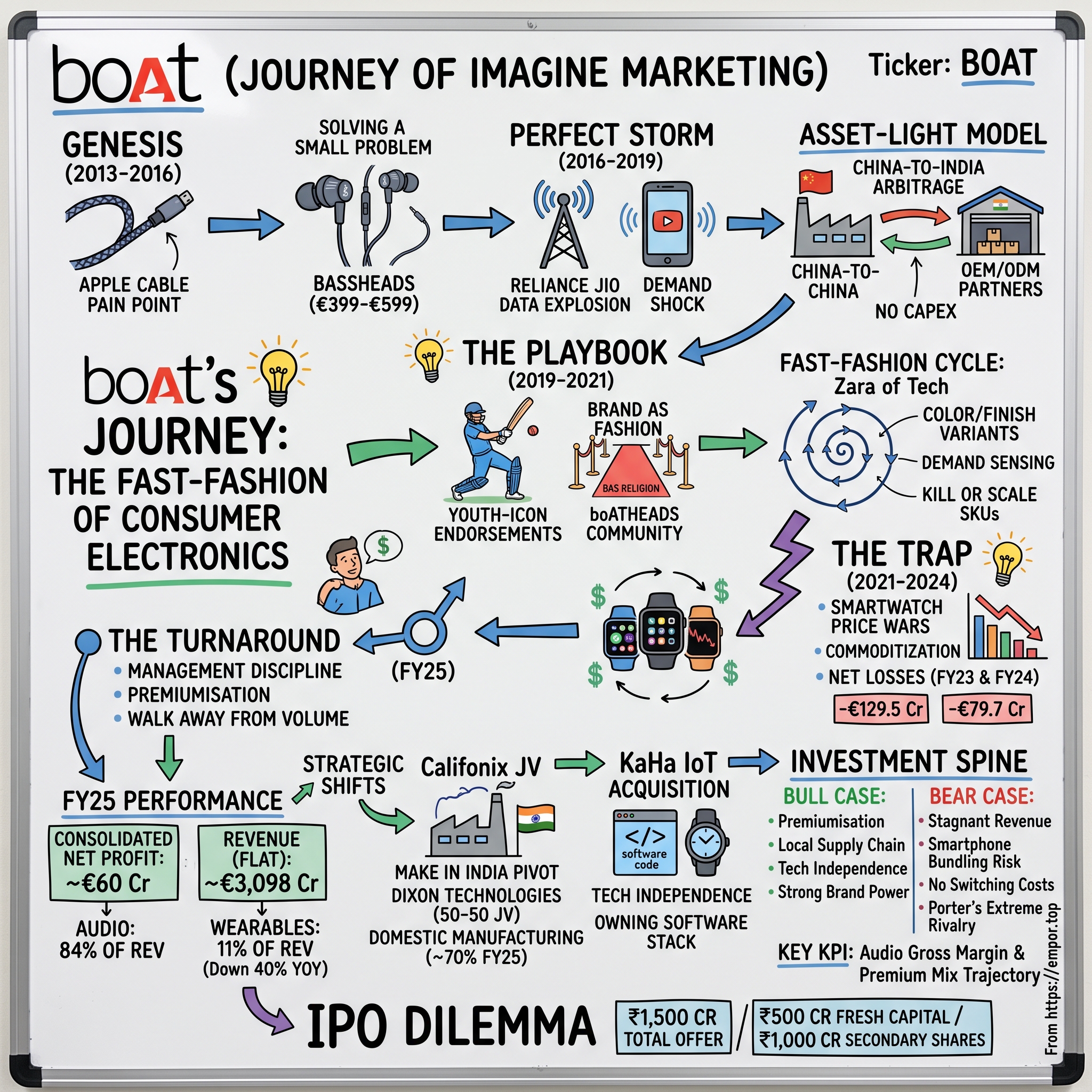
boAt (Imagine Marketing): The Fast-Fashion of Consumer Electronics
I. Introduction & Episode Roadmap
Pick up almost any pair of wireless earbuds on an Indian college campus, in a Bengaluru gig-worker's helmet, or clipped to a commuter's collar on the Mumbai local, and there is a better-than-even chance you are holding a product sold by a company most people outside India have never heard of. The brand on the case reads "boAt." The company behind it is Imagine Marketing Limited, and in the twelve years since two men pooled roughly ₹30 lakh — about ₹15 lakh each, then worth around $36,000 combined — to register it, that company has become the single largest seller of wearable audio and wrist wearables in India, and by unit volume one of the largest wearable brands on earth.3
That is a genuinely remarkable outcome, and it is worth being precise about what kind of outcome it is. boAt did not invent a new category, patent a breakthrough chip, or build a factory moat. It did something subtler and, for a public-market investor, more fraught: it took commodity hardware designed and largely built in China, wrapped it in a youth-culture brand tuned exactly to Indian taste, sold it almost entirely through Amazon and Flipkart, and rode two once-in-a-generation tailwinds — the Reliance Jio data explosion and the rise of Indian e-commerce — to national scale without owning much of anything. It is, as the outline for this story frames it, the fast-fashion of consumer electronics: fast cycles, disposable style, thin structural defenses, and a brand doing an enormous amount of the work.
The tension that makes boAt worth underwriting rather than merely admiring is that the same qualities that produced its explosive rise are the ones a long-term investor should worry about most. A brand with no switching costs, selling commoditized hardware into the most price-sensitive consumer market on earth, discovered exactly how fragile that position could be when it charged into smartwatches. It flooded the market alongside rivals Noise and Fire-Boltt, watched average selling prices collapse, and paid for it with two consecutive years of losses — a net loss of roughly ₹129.5 crore in FY23 and ₹79.7 crore in FY24 — driven by inventory write-downs, warranty costs, and marketing that no longer paid for itself.12 Then, in FY25, it did something that most fashion-cycle businesses cannot: it stopped. Management walked away from unprofitable smartwatch volume, leaned into higher-margin premium audio, and swung to a consolidated net profit of roughly ₹60 crore on revenue of about ₹3,098 crore that barely grew at all.12 Flat top line, black bottom line. That is the pivot the company now carries into a proposed public listing.
The listing itself is the reason a pre-IPO underwriting is warranted, and it comes with its own signal. Imagine Marketing — having first approached the market through the confidential filing route in 2025 — has filed an updated draft prospectus with India's securities regulator for an offering of up to ₹1,500 crore — roughly $180 million — structured as ₹500 crore of fresh capital and ₹1,000 crore of secondary shares sold by existing holders.910[^19] Two-thirds of the money raised goes to selling shareholders, not the business. That ratio, the founders' own share sales, the private valuation cap set back in 2022, and a set of auditor-flagged discrepancies buried in the filing are the things a public-market buyer needs to weigh against the genuinely impressive turnaround. Private marks and IPO demand are pricing signals. They are not proof of value, and this story keeps the two separate throughout.
Here is the roadmap. We begin in 2013 with braided charging cables and the first "BassHeads." We trace the Jio-and-4G detonation that turned earphones from a spec into a necessity, and the asset-light China-to-India arbitrage that let boAt scale without capital. We examine the fast-fashion playbook that made boAt a lifestyle label, then the smartwatch trap that nearly undid it. We work through the geopolitics that forced a manufacturing pivot and the Dixon joint venture built to answer it. We dissect the FY25 turnaround line by line, benchmark the acquisitions, run the competitive economics through Helmer and Porter, and build the bull and bear cases an investor actually has to choose between. And we close on the IPO's structure, its governance flags, and the one question that matters after listing: whether a brand without switching costs can compound, or whether it is a cyclical fashion play wearing a growth-stock costume.
 Subscribe on LinkedIn
II. The Genesis: From Apple Cables to BassHeads (2013–2016)
Every consumer brand has an origin myth, and boAt's is unusually instructive because it contains, in miniature, the entire logic of the business that followed. The two founders did not meet in a garage building something no one had seen before. They met as operators who understood distribution, and they started by solving a small, specific, almost trivial problem: Apple's charging cables kept breaking.
Consider the two men. Aman Gupta — later a household face in India as an investor-judge on the television show Shark Tank India — came out of the audio industry's commercial side. He held an MBA and had spent time at Harman International, the parent of JBL, where the relevant education was not acoustic engineering but the grubby mechanics of how audio product actually gets sold, distributed, and merchandised in a fragmented Indian retail market. He learned where the margin sat, how channel partners behaved, and how a premium Western brand priced itself out of the reach of the average Indian buyer. Sameer Mehta came from the other side of the same coin: he ran Redwood Interactive, a family business rooted in manufacturing and IT-hardware distribution, and brought the supply-chain fluency and sourcing relationships that a pure marketer would have lacked. One knew how to sell audio; the other knew how to source and move hardware. In 2013 they combined those complementary skill sets, put in roughly ₹15 lakh each, and registered Imagine Marketing.3
Their first hit tells you what kind of company this would be. Around 2015 boAt launched a rugged, braided charging and sync cable pitched squarely at a pain point every iPhone owner in India knew intimately: Apple's original Lightning cables frayed and split at the connector within months. boAt's "Indestructible" cable was thicker, braided, warrantied, and sold on Amazon — reliable where the original was flimsy, cheap where a replacement Apple cable was insultingly expensive. It became a bestseller, and it taught the founders the lesson that would define everything after: the vast Indian middle market wanted products that felt premium and durable but were priced within reach. Not the cheapest thing on the shelf, and emphatically not the most expensive — the reliable, good-looking thing in the gap between them.
That gap was widest in audio, and it was where boAt went next with the "BassHeads" wired earphones, priced roughly ₹399 to ₹599 — call it $5 to $7 at the time. To understand why this worked, picture the Indian earphone shelf in 2015 and 2016 as a barbell with nothing in the middle. At the top sat the legacy premium brands — JBL, Sony, Sennheiser — priced above ₹1,500, aspirational and largely irrelevant to a young buyer's budget. At the bottom sat a churning mass of unbranded Chinese imports at ₹150 or so, no warranty, frequently dead within a week. The entire middle — a reliable, stylish, warrantied earphone under ₹1,000 — was structurally empty, not because no one wanted it but because the incumbents were organized to serve the extremes. boAt walked into that vacuum with a recognizable brand, a warranty, thumping bass, and colorways that looked like fashion rather than electronics. It was a positioning play before it was a product play, and the product only had to be good enough to honor the positioning.
For a public-market investor, the genesis matters less for its charm than for what it reveals about the moat — or the lack of one. Nothing boAt did in these years was hard to copy. The braided cable was a design tweak; the earphone was a sourcing-and-branding exercise. What boAt had was timing, taste, and execution speed, not a defensible technology or a cost structure competitors could not match. That is a real advantage while it lasts, but it is the kind of advantage that invites imitation the moment it is proven, which is precisely what happened. Hold that thought; it becomes the central question of the entire underwriting.
III. The Perfect Storm: Jio, 4G, and the Earwear Explosion (2016–2019)
A brand can be perfectly positioned and still go nowhere if the market it is positioned for does not arrive. boAt's genius was partly its own, and partly that it had built the right product just as the single largest demand shock in the history of Indian consumer technology broke over the country. In September 2016, Reliance Jio launched, and it did to mobile data what almost nothing in commercial history has done to a resource: it made it nearly free.
The numbers are hard to overstate. Before Jio, mobile data in India was scarce and expensive, and the typical user consumed a few hundred megabytes a month, hoarding it like a rationed good. Jio flooded the market with cheap 4G, and within a couple of years the average user was consuming on the order of ten gigabytes a month — an increase of more than an order of magnitude. What that data went to was consumption: YouTube, Hotstar, Netflix, and a wave of music-streaming services. And here is the causal link that turned a telecom event into an audio bonanza. Media consumption on a phone is intensely personal. You do not watch a video or stream a song on your handset and broadcast it to the room; you put something in your ears. Every phone screen that lit up with streaming video and music created demand for a private audio output. Earphones stopped being a niche tech accessory and became, for hundreds of millions of newly-connected users, an everyday necessity — as essential to the phone as a charger.
boAt was sitting exactly where that wave crested, and it made a second decision that compounded the advantage: it went all in on e-commerce and essentially ignored physical retail. Amazon India and Flipkart were maturing into mainstream shopping destinations at the same moment, and traditional audio distribution in India — layers of distributors, dealers, and shelf space in scattered electronics shops — was slow, capital-hungry, and controlled by incumbents. boAt bypassed all of it. It optimized its Amazon and Flipkart listings, captured search intent for terms like "earphones under 1000," and turned the review count into a trust engine: a product with tens of thousands of four-star reviews sells itself to the next buyer in a way no billboard can. This was capital efficiency as strategy. boAt did not need to fund inventory sitting in a thousand shops; it needed a warehouse, a listing, and demand.
The third leg was the supply chain, and it was the most quietly consequential. boAt did not build factories. It plugged into Shenzhen's unmatched hardware ecosystem, partnering with Chinese original-design and original-equipment manufacturers — ODMs and OEMs — who could design, tool, and produce earphones at a scale and speed no Indian manufacturer could then match. In plain terms: boAt told a Chinese partner what it wanted, the partner engineered and built it, and boAt put its brand, its warranty, and its marketing on the box. This is the "asset-light arbitrage" the outline names, and its financial signature is important. It let boAt scale volume explosively with almost no capital expenditure on plant and equipment, keeping the balance sheet lean and returns on capital optically high — because there was very little capital in the business to begin with.
That asset-light model is genuinely elegant, and it is also the source of the company's deepest vulnerability, which is why it is worth stating plainly here rather than later. When your product is designed and built by contract manufacturers that will happily build the same thing for the next brand, and when it is sold through the same three marketplaces where every competitor also lists, the only thing standing between you and commoditization is the brand and the execution. For a few years, riding a demand wave, that was more than enough. The question a 2026 investor must ask is whether it is still enough now that the wave has passed and a dozen brands have learned the same playbook.
IV. The Playbook: Brand as Fashion, Bass as Religion (2019–2021)
By the turn of the decade boAt had graduated from a well-timed earphone seller into something closer to a cultural brand, and this is the stretch where its most durable asset — to the extent it has one — was actually built. The company's insight was that in a market where the hardware was interchangeable, the differentiation had to live somewhere the hardware could not: in sound signature, in identity, and in community.
Start with the sound, because it is the one product-level choice that was genuinely tailored rather than sourced. boAt tuned its drivers to what it branded "boAt Signature Sound" — a deliberately heavy, boosted low end. This was not an accident of cheap components; it was a read on the market. The music that dominates Indian listening — Bollywood soundtracks, Punjabi pop, and electronic and hip-hop tracks — rewards a thumping, bass-forward profile. An audiophile might sneer at it; the target customer loved it, and "bass" became a core part of the brand promise, embedded in the "BassHeads" name itself. It is a small thing, but it is the closest boAt came to a product characteristic that mapped to local preference in a way a generic ODM default would not.
The larger move was to convert audio gear from a boring tech spec into a fashion and lifestyle statement. boAt sent headphones down the ramp at Lakmé Fashion Week in a collaboration with designer Masaba Gupta, an act of deliberate category confusion: this is not a gadget, it is an accessory you wear. It built the "boAtheads" community as an identity rather than a customer list. And crucially, it bypassed traditional advertising almost entirely in favor of a saturation strategy of youth-icon endorsements. It signed cricketers at the peak of their fame — figures like KL Rahul, Hardik Pandya, and Shikhar Dhawan — and Bollywood and music stars including Kiara Advani, Kartik Aaryan, and later Punjabi and pan-Indian artists like AP Dhillon and Diljit Dosanjh. The logic was that a young buyer choosing between visually similar earbuds would reach for the one their favorite cricketer wore. For a while, they did.
The operating engine underneath all of this is what the outline aptly calls the Zara of consumer tech, and it deserves emphasis because it is the real competitive competence. boAt ran a fast-fashion cycle on hardware: a continuous stream of new colors, finishes, textures, and limited editions, launched fast, watched closely, and either scaled or killed based on how they sold and what social listening surfaced. If a variant moved, boAt told its Chinese partners to make more. If it stalled, boAt simply stopped ordering it. Because it did not own the tooling or the factory, it carried little fixed cost for a discontinued style — the downside of a failed SKU was mostly the leftover inventory, not a stranded production line. This is a real form of process advantage: merchandising speed and demand sensing at consumer-electronics scale, which most hardware companies, wedded to long product cycles, simply cannot do.
But investors should be careful not to over-bank this. Fast-fashion execution is a capability, not a moat in Helmer's strict sense — it can be matched by any rival willing to run the same tight loop with the same Chinese partners, and several have. And the endorsement-and-hype model that built the brand carries a subtler risk: cultural cachet is a wasting asset. A brand that becomes cool by association with this year's icons must keep spending to stay cool, and if the culture moves on, the spending buys less. The FY23–FY24 losses, as we will see, were partly the sound of that marketing engine running hot while the underlying category turned against the company. Brand is boAt's best power. It is also the one most exposed to fashion's fundamental impermanence.
V. The Wearables Trap: Smartwatches and Price Wars (2021–2024)
Success in one category is the most dangerous teacher a company can have, because it whispers that the playbook is universal. In 2021, flush with growth and fresh capital — Warburg Pincus had invested roughly $100 million in January of that year, validating boAt as India's top personal-audio brand and handing it a war chest — boAt charged into smartwatches with the confidence of a winner.3 For a brief, intoxicating period, it looked like the audio story all over again.
The setup was familiar. The smartwatch became, almost overnight, the aspirational status object for young consumers in India's tier-2 and tier-3 cities: a visible piece of technology on the wrist, priced within reach in a way an Apple Watch never would be. Volumes exploded across the industry, and boAt scaled into it with its usual speed, quickly ranking among the top smartwatch brands in India alongside domestic rivals Noise and Fire-Boltt. On a volume chart, it looked like a triumph. The company that had won earwear was now winning wrists.
Then the trap sprang, and it sprang because the smartwatch category had none of the quiet structural advantages that had made audio forgiving. The products were assembled from off-the-shelf sensors, generic displays, and commodity chipsets, which meant that every brand's watch was fundamentally the same object with a different logo. When products are that interchangeable and a dozen well-funded brands are all chasing volume, price becomes the only weapon, and a price war is not a competition — it is a mutual bleeding. Average selling prices for entry-level smartwatches collapsed from around ₹3,500 to under ₹1,500, and the margin that had made the volume look attractive evaporated with it. To hold share, boAt and its peers pushed ever-cheaper watches into the market, which only accelerated the commoditization they were all suffering from.
The financial damage was worse than a simple margin squeeze because cheap smartwatches carry hidden liabilities that cheap earphones do not. A commodity watch with a poor sensor and a short lifespan generates returns and warranty claims at rates that devastate unit economics; every unit sold cheaply and returned expensively is a double loss. And when demand cooled, boAt was left holding smartwatch inventory that had to be cleared at a discount or written down entirely. The result showed up starkly in the accounts: Imagine Marketing reported a net loss of roughly ₹129.5 crore in FY23 and a further loss of about ₹79.7 crore in FY24, the damage driven by wearable inventory clearance, elevated marketing spend, warranty and return costs, and the operating overhead of a business that had expanded for growth it did not sustain.12 The wearables segment's revenue tells the story on its own: it peaked at around ₹901.5 crore in FY23, fell to about ₹550.2 crore in FY24, and would fall again the following year.12
There is a capital-structure reading of this episode that matters for how one judges the incoming public shareholder's position. The smartwatch charge was funded, directly or indirectly, by venture money — the roughly $100 million Warburg Pincus put in during January 2021 and the follow-on capital that arrived as the company scaled.3 Venture capital rewards growth and volume, and a well-funded company under pressure to justify a rising private mark has every incentive to buy market share even at a loss, betting that scale will eventually convert to profit. That is precisely what boAt did, and it is a useful reminder that the private-market valuation the company carried into 2022 was built partly on volume that was itself destroying value. When a public buyer inherits this company, they inherit a business whose historical "growth" included a chapter of deliberately unprofitable expansion that a private financing environment tolerated and even encouraged — and they should discount any backward-looking growth rate accordingly, treating the FY25 disciplined base, not the loss-fueled peak, as the honest starting point.
The lesson here is one every investor should internalize before valuing this company, because it is the crux of the bear case. boAt's audio success was never proof of a general capability to win in any hardware category. It was the product of a specific set of conditions — an empty middle market, a demand explosion, a brand built at exactly the right time — that did not travel to smartwatches, where the market was crowded from the start and the product could not be meaningfully differentiated. The smartwatch episode was, in the cold terms of capital allocation, value destruction: hundreds of crores of losses in pursuit of vanity volume in a category that structurally could not be won on the terms boAt entered it. What redeems the story, and what the turnaround section will test, is not that boAt avoided the mistake — it did not — but that management eventually had the discipline to admit it and retreat.
VI. Geopolitics and the "Make in India" Pivot (2022–2025)
While boAt was learning its painful lesson in smartwatches, a second, slower-moving force was reshaping the ground beneath its entire business model, and this one it could not exit by killing SKUs. The company's founding advantage — designing in India and building in China — was being deliberately made expensive by the Indian state.
The trigger was geopolitical. The 2020 border clashes between India and China hardened an already-cooling relationship into open strategic rivalry, and economic policy followed. Through its Phased Manufacturing Programme, the Indian government systematically raised customs and import duties on finished electronic goods and components, the explicit intent being to make importing a finished product more expensive than assembling it domestically, and thereby to drag the electronics value chain onto Indian soil. For boAt, whose model was essentially "design here, manufacture there, import the finished box," this was a direct tax on its core operation. Layer on shipping and logistics friction and the working-capital drag of long import lead times, and the elegant asset-light arbitrage of 2016 was becoming financially unviable by 2022.
boAt's answer was the most strategically important structural decision of its history: in January 2022 it entered a 50-50 joint venture with Dixon Technologies, India's largest contract electronics manufacturer, to form a company named Califonix Tech and Manufacturing Private Limited.15 The logic is worth unpacking because it inverts the original model. Rather than continue importing finished audio products and absorbing the rising duties, boAt would design them and have them built in India through a vehicle it half-owned, tapping Dixon's manufacturing scale and its access to the government's Production Linked Incentive scheme — subsidies paid to manufacturers for hitting domestic-production targets. In one move, boAt converted a geopolitical liability into a potential advantage: local production that dodged import duties, qualified for incentives, and shortened the supply chain.
On the scale of that shift, the company's own framing and independent reporting do not fully agree, and an honest underwriting should say so rather than pick the flattering number. Management has indicated that by FY25 roughly 70% to 75% of boAt's audio and wearable products were manufactured domestically, with the Califonix JV alone accounting for more than a third of unit production. Independent reporting, however, has described a more modest figure — on the order of 35% of products assembled domestically in FY25, with a target to reach around 50% by the end of FY26.12 The gap likely reflects definitional differences — "manufactured" versus "assembled," value versus units, audio-only versus total — but the discrepancy itself is a diligence item, not a rounding error, and it is exactly the sort of claim a real prospectus and its audited disclosures should be made to reconcile. What is not in dispute is the direction: boAt is materially more localized than it was in 2020, and that localization is real strategic insulation against the duty regime.
The economic payoff, where it is visible, is genuine. Domestic assembly shortens the cash-conversion cycle — boAt does not have to fund inventory floating on a ship from Shenzhen — and it removes the duty and logistics volatility that made costs unpredictable. Part of the working-capital improvement in FY25, which we turn to next, traces to this. But two cautions belong here. First, the JV is 50-50, which means boAt shares both the economics and the control with Dixon; the manufacturing margin it "captures" is split, and its dependence has shifted from Chinese ODMs to a powerful Indian partner rather than disappearing. Second, as the auditors would later note, boAt's overseas subsidiaries carried their own financial strains during the transition — a reminder that a supply-chain pivot of this magnitude is messy underneath the strategic headline.
VII. The Turnaround: Premiumisation & The Flat-Revenue Profit Story (FY25)
If the smartwatch years were the crisis, FY25 is the exhibit management will put in front of every prospective public shareholder, and it deserves to be examined closely rather than accepted at its headline. The headline is arresting: after two years of losses, Imagine Marketing swung to a consolidated net profit of roughly ₹60 crore on revenue of about ₹3,098 crore, with EBITDA of around ₹142 crore.12[^17] On a standalone basis the company reported revenue of roughly ₹3,089.6 crore and a net profit of about ₹64.2 crore.2 The updated prospectus itself puts revenue from operations at approximately ₹3,070 crore and profit at about ₹61 crore — the small variances across figures reflect consolidated-versus-standalone and revenue-definition differences, and are worth noting precisely because a public filing should nail them down.9
The single most important fact about this turnaround is what did not drive it: growth. Revenue was essentially flat — roughly ₹3,098 crore against about ₹3,104 crore the prior year, a decline of a fraction of a percent.1 The top line did not expand at all. The entire swing from loss to profit came from the composition of that revenue and the cost discipline applied to it. This is the crux of the story, and it cuts both ways. It is genuinely impressive that management manufactured a profit out of a flat business through mix and discipline. It is also a flashing yellow light that the growth engine which justified a venture valuation has, for now, stalled.
Look at the segments, because that is where the deliberate hand of management is visible. Audio — the cash cow — contributed about 84.23% of revenue, roughly ₹2,586 crore, growing in the mid-single digits year over year and carrying the profitability of the whole enterprise on the strength of the "Airdopes" truly-wireless franchise and strong repeat purchase.12 Wearables, the segment that nearly sank the company, contributed only about 10.76% of revenue, roughly ₹330 crore, having fallen by around 40% year over year from more than ₹550 crore — and by nearly two-thirds from its FY23 peak of about ₹901.5 crore.12[^18] Read those two numbers together and the strategy is unmistakable: boAt deliberately shrank its worst business. It stopped chasing low-end smartwatch volume, ate the revenue decline, and let the mix shift back toward the audio it actually makes money on.
The margin and balance-sheet mechanics corroborate that this was discipline, not luck. Gross margin expanded materially — independent reporting puts it around the high-twenties in FY25, up from the low-twenties in FY23 — as the company pushed "premiumisation": higher-priced audio with active noise cancellation, better acoustics, and gaming-oriented low-latency products that command better unit economics than a ₹399 earphone.12 Just as tellingly, boAt nearly halved its working-capital intensity, cutting inventory from around 71 days of holding to about 36 days, which is exactly what you would expect when a company stops overproducing commodity wearables and tightens its supply chain through domestic assembly.2 Lower inventory means less cash tied up, less risk of write-downs, and a healthier cash-conversion cycle — the operational plumbing behind the reported profit.
It is worth pressing on the quality of this revenue, because a consumer-hardware rupee is not the same as a subscription rupee, and the difference bears directly on what the profit is worth. boAt's revenue is almost entirely transactional: a customer buys a pair of earbuds, and there is no contract, no subscription, and no recurring obligation binding them to the next purchase. What passes for "retention" here is not a renewal rate but a repurchase habit — whether a satisfied Airdopes owner reaches for boAt again in two years when the battery degrades — and while boAt's brand strength and review base suggest that habit is real, it is a soft, un-contracted loyalty that must be re-won at every purchase with marketing spend and a competitive product. That is why the marketing line is not discretionary fat but load-bearing structure: cut it too hard and the repurchase habit erodes. The revenue is also channel-concentrated — heavily dependent on Amazon and Flipkart, whose algorithms, fee structures, and private-label ambitions boAt does not control — and geographically concentrated in a single, maturing home market. None of this makes the revenue bad; it makes it cyclical and re-earned, which is exactly the profile that deserves a lower and more cautious multiple than recurring revenue of the same size. The FY25 profit is high-quality in the sense that it was earned by real margin discipline rather than one-off gains, but it rests on a revenue base that must be continuously defended rather than one that compounds on its own.
The path to durable profitability — as opposed to a single profitable year — is therefore the real test, and the honest reading is that FY25 is necessary evidence but not yet sufficient proof. The mechanics that produced the profit are the right ones: gross margin up on premium mix, inventory days roughly halved from about 71 to 36 to free working capital and reduce write-down risk, and marketing rationalized off the peak-loss levels.212 For that profit to become durable free cash flow at scale, several things must hold simultaneously, and any one failing would falsify the path. Gross margin must keep climbing as premiumisation continues, rather than plateauing once the easy mix-shift is captured. Marketing intensity must stay disciplined without starving the brand that the whole model depends on — a genuine tension, since the same spend that hurts margin is what sustains the repurchase habit. Working capital must not balloon again if the company reaccelerates volume. And the overseas subsidiaries whose going-concern strain the auditors flagged must stop consuming cash. The business is not capital-intensive in the factory sense — that is the asset-light model's gift — so the reinvestment need is more in inventory, brand, and product development than in plant; but that also means there is no capex moat, and the free cash flow, once it arrives at scale, must be judged against how easily a competitor could fund the same position. What would falsify the durable-profitability thesis is concrete and watchable: a renewed slide in gross margin, a return to inventory build-up, or a re-escalation of marketing spend without matching revenue — any of which would signal that FY25 was a cyclical pause in a fashion business rather than a structural step-change in a franchise.
For all that, an underwriter has to name the profit for what it is: real but thin, and earned largely by subtraction. A roughly ₹60 crore net profit on about ₹3,098 crore of revenue is a net margin near 2%. EBITDA of around ₹142 crore is an EBITDA margin in the mid-single digits. These are the economics of a good consumer distributor, not a structurally advantaged franchise — respectable, hard-won, and vulnerable to the next input-cost swing, marketing arms race, or price war. The turnaround proves management can be ruthless with underperforming SKUs and protect the bottom line. It does not, on its own, prove the business can grow the top line and expand margins simultaneously, which is the far harder thing a growth valuation demands. The FY25 result buys credibility. It does not settle the valuation question; it sharpens it.
VIII. M&A, Capital Deployment, and Technology Stack
A company's acquisition history is one of the most honest windows into how management thinks about capital, because it is where they put real money behind their beliefs. boAt's record is mixed in an informative way: a genuinely strategic capability purchase, a couple of sensible tuck-ins, and — as with the smartwatch push — evidence that ambition has at times outrun the returns.
The most material deal was KaHa Pte Ltd, a Singapore-based end-to-end IoT and connected-product development company that Imagine Marketing acquired around May 2022, in a transaction reported at roughly $40 million.14 The strategic rationale was sound and, on paper, exactly the kind of thing a hardware brand should buy rather than build: KaHa gave boAt its own software, firmware, and algorithm stack for smart wearables, reducing dependence on third-party Chinese software providers and, in theory, letting boAt build differentiated features — health tracking, connectivity, eventually AI-adjacent capabilities — that cheap white-label competitors could not. For a company whose entire vulnerability is that its hardware is interchangeable, owning the software layer is one of the few plausible routes to real differentiation. That is the bull reading.
The bear reading is written into the same prospectus that touts the capability. The very wearables business KaHa was meant to strengthen is the one boAt spent FY25 deliberately shrinking, which raises the uncomfortable question of what the acquired capability has actually earned. Worse, boAt's auditors flagged material uncertainty over the ability of two overseas subsidiaries — KaHa Pte Ltd and Imagine Marketing Singapore Pte Ltd — to meet their liabilities in FY23 and FY24, and the filing called for specific related-party disclosure regarding investments routed through the Singapore entity into KaHa across FY23 to FY25.678 A capability acquisition that later shows going-concern strain and prompts related-party scrutiny is not a clean win; it is a strategically defensible purchase whose financial execution a public investor should probe hard.
The smaller deals fit the fast-fashion-of-electronics logic. RedGear took boAt into PC-gaming accessories — keyboards, controllers, mice — a higher-margin niche that hedges the core audio business and taps the same young, digitally-native customer. TAGG and COVE were brand roll-ups in mid-tier audio and wearables, the kind of consolidation move that buys share and shelf presence in adjacent price bands. None is individually large enough to move the valuation, and their disclosed returns are thin, so an investor should treat them as portfolio housekeeping rather than value creation until a filing quantifies their contribution.
On the capital-allocation verdict, the honest scorecard is split down the middle. The smartwatch build-out of 2021–2023 was, in hindsight, a capital-destroying chase of vanity volume that cost the company two years of losses. Against that, the Califonix JV with Dixon looks like disciplined, forward-looking structural defense, and the KaHa purchase was at least the right type of bet even if its payoff is unproven and its subsidiary is troubled. What the record shows is not infallible allocators but operators capable of both expensive mistakes and genuine course corrections — which is, frankly, most real management teams. The relevant forward question is whether the FY25 discipline reflects a permanent change in how this team deploys capital, or a chastened pause that loosens again once public money is in the till and growth pressure returns.
IX. Hamilton Helmer's 7 Powers & Porter's 5 Forces Analysis
Frameworks are only useful when they force honesty, so let us use Hamilton Helmer's 7 Powers and Michael Porter's Five Forces to strip the boAt story down to its economic skeleton and ask the uncomfortable question directly: what, if anything, structurally protects this business's profits from being competed away?
Start with Helmer, and start with the one power boAt genuinely has. Brand is strong, and it is the company's real asset. "boAt" carries top-of-mind recall among young Indian consumers that no unbranded competitor can match, and that recall lets it charge a premium over white-label earbuds and win the default choice at the point of sale. The proof is in the pricing and the market share: boAt led India's overall wearables market in 2025 with a share that grew from about 27.6% to roughly 29.2%, dominating the TWS, tethered, and over-ear categories with close to a third of total shipments.13 That is brand power expressed as durable market leadership. But note the ceiling: it is a brand premium over the bottom of the market, not over premium global names, and it is sustained by continuous marketing spend rather than by anything self-reinforcing.
Scale Economies are medium-to-high and rising. As the largest domestic player, boAt commands better unit costs from component suppliers and from its manufacturing partners, and the Califonix JV concentrates volume in a way that improves purchasing leverage. This is a real advantage over sub-scale rivals, but it is a relative one — Dixon, its own manufacturing partner, and smartphone giants operate at far greater scale, so boAt's cost edge holds against small competitors and evaporates against large ones.
Now the powers boAt lacks, which is most of them, and this is where the investment thesis lives or dies. Switching Costs are essentially zero. There is no lock-in, no ecosystem, no data gravity; a customer who liked their boAt earbuds will switch to Boult or Noise for a ₹200 discount without a second thought, because the products are substitutes and the buyer has no reason to be loyal. Counter-Positioning, once real, has faded and inverted: boAt originally counter-positioned against slow, overpriced global incumbents who could not profitably chase the sub-₹1,000 market, but today boAt is the incumbent, and it is the one being attacked from below by nimbler D2C brands running the exact playbook it invented. And Network Effects, Cornered Resources, and Process Power are weak to absent: there is no network that makes boAt more valuable as more people use it, no proprietary input competitors cannot access, and no manufacturing or organizational process so hard to replicate that rivals cannot match it. The fast-fashion merchandising loop is a competence, but competences without a barrier get copied. On the Helmer scorecard, boAt has one strong power and one moderate one, propping up a business otherwise exposed on every side.
Porter's Five Forces tells the same story from the industry's angle, and it is not a flattering picture. Rivalry is extreme: boAt fights a war on multiple fronts against pure-play audio and wearable brands like Noise, Boult, and Fire-Boltt, and against smartphone giants — OnePlus, Realme, Xiaomi, Samsung — who sell earbuds and watches as accessories to their handsets. Threat of new entrants is very high, because the barriers to entry are exactly as low as boAt's own origin proves: any competent digital marketer can white-label earbuds from a Chinese ODM or an Indian EMS partner, list them on Amazon, and buy their way to visibility. Bargaining power of buyers is high, because the Indian consumer in this segment is intensely price-sensitive and faces near-infinite substitutable choices one search away, with reviews making quality differences transparent. The forces boAt is less exposed to — supplier power is diffused across many contract manufacturers, and the threat of a true substitute for personal audio is low — do not rescue it, because the binding constraints are rivalry and entry, and both are punishing. The framework verdict is blunt: boAt operates in a structurally difficult industry and defends itself almost entirely with a brand it must keep paying to maintain. That is a coherent business. It is not a fortress, and it should not be valued as one.
X. The Investment Spine: "Why Win / Why Not" Case
Everything above resolves into a single question a public-market buyer must answer before the listing: is boAt a compounding consumer franchise catching an upgrade cycle, or a cyclical fashion play that has already had its best years? The honest answer is that both cases are genuinely arguable, and the discipline is to hold them at the same time rather than pick the one that flatters a predetermined conclusion.
The bull case rests on three pillars, and the strongest is premiumisation. India's consuming class is trading up. A young buyer who bought a ₹999 earbud in 2020 is, five years and one income bracket later, a plausible buyer of a ₹2,499 active-noise-cancellation earbud today, and that upgrade is margin-expanding by its nature — the same brand, the same channel, the same customer, at a higher price and a fatter gross margin. The FY25 mix shift toward premium audio is the first hard evidence that boAt can ride this curve, and if it continues, the company could grow revenue and margin from the same customer base without needing to conquer new categories. The second pillar is local supply-chain mastery: the Califonix JV is a real structural defense against the duty and geopolitical shocks that would cripple an import-dependent competitor, and it is not easily replicated by a small entrant. The third is tech independence via KaHa — the option, if executed, to build genuinely differentiated wearable features that lift ASPs above the commodity floor. Underpinning all three is a management team that has demonstrated it will make hard, unglamorous decisions, and a leading brand in a large, young, growing market.
The bear case is not the mirror image; it is a set of structural facts the bull case has to explain away. First, top-line stagnation: FY25 revenue was flat, and flatness is not a one-year accident — it signals that the e-commerce-and-4G volume wave that built the company is over.1 Future growth increasingly requires winning in physical retail, where the offline channel is now gaining share in Indian wearables (rising from about 37.8% to 40.7% in 2025) precisely as boAt's online stronghold shrinks, and where boAt's digital-native advantages count for far less.13 Second, smartphone bundling risk: OnePlus, Samsung, Xiaomi, and their peers can pair their own earbuds and watches with their handsets, integrate them into their device ecosystems, and lock boAt out of the premium tiers it most needs to enter — the exact tiers where premiumisation is supposed to save the margin story. Third, and most fundamental, the moat problem the frameworks exposed: a fashion-driven consumer brand with zero switching costs has a natural shelf life, and if boAt loses its cultural cool to a newer, niche D2C brand — as it once took share from the incumbents — it has no structural mechanism to arrest the decline. The bear case, in one sentence, is that premiumisation is a real but finite tailwind layered on top of a business whose foundations are cyclical and copyable.
Between the two cases sits the question of how large the reachable prize actually is, and here restraint matters, because the temptation with a consumer story is to multiply a billion-plus population by an aspirational price point and call the result a market. The disciplined version is narrower. India's total wearable device market — earwear plus wrist wearables combined — shipped roughly 114 million units in 2025, and it did not grow; it shrank about 4% year over year, its second consecutive annual decline, dragged down by a 17.6% collapse in smartwatch shipments even as earwear eked out about 1.4% growth to roughly 84.7 million units.13 That is the single most sobering data point in the entire underwriting: boAt's home market, measured in units, is contracting, not expanding. The category TAM a bull might invoke — every Indian who could one day own earbuds — is real but irrelevant on a five-year horizon; the reachable market at boAt's present product range, price points, and distribution is the maturing 80-odd-million-unit earwear market where replacement cycles are lengthening and TWS penetration has already reached about 70% of the segment.13 Growth from here cannot come from selling the first pair of earbuds to new users at the rate it once did; it must come from selling a more expensive pair to the same users, which is precisely why premiumisation is not merely a margin story but the only volume-independent growth story boAt has. Against named competitors, the arithmetic is unforgiving: boAt already holds close to a third of overall wearables shipments, so its share-gain headroom is limited, and every incremental point must be taken from entrenched rivals — Noise, Boult, Fire-Boltt — who will not cede it without a price fight that damages everyone's margins. A company can lead a shrinking market and still see its revenue fall; that is the box boAt must escape by trading up its customer faster than the market shrinks beneath it.
Where does the balance of evidence sit? For an investor, the decisive tell is which case the numbers are currently supporting, and right now they support a nuanced version of both. The margin and mix data validate that premiumisation is real and underway — that is the bull case earning its keep. The flat revenue and the offline-channel shift validate that the structural growth constraints are also real and already biting — that is the bear case earning its keep. The company is neither a clear compounder nor a clear melting ice cube; it is a leading brand executing a genuine but early margin transition against a difficult competitive backdrop. The valuation question, then, is not "is the thesis true" but "how much of the optimistic version is already in the price" — which is exactly where the IPO structure comes in.
XI. The IPO Dilemma & Promoter Credibility
An IPO's structure is a message from insiders about how they see their own asset, and boAt's message repays careful reading. The proposed offering is up to ₹1,500 crore — roughly $180 million — split into just ₹500 crore of fresh primary capital and ₹1,000 crore of secondary shares sold by existing holders.910 That two-to-one tilt toward cash-out over cash-in is the first thing a public buyer should sit with. Of the money the market puts in, two-thirds flows to selling shareholders and only one-third to the company's balance sheet — and of that fresh ₹500 crore, the filing earmarks about ₹225 crore for working capital and ₹150 crore for branding and marketing, with the balance for general corporate purposes.911 This is not a company raising a growth war chest; it is a liquidity event for early backers with a modest top-up for the business.
The selling list makes the point sharper. Co-founder Aman Gupta is offering shares worth about ₹225 crore; co-founder Sameer Mehta about ₹75 crore; South Lake Investment — the Warburg Pincus vehicle — about ₹500 crore; Fireside Ventures' fund about ₹150 crore; and Qualcomm Ventures about ₹50 crore.911 The founders are taking real money off the table at the same moment they ask the public to buy in. That is not disqualifying — founders are entitled to some liquidity after twelve years, and both will remain the largest individual holders — but it is a signal to weigh, not to wave away. Before the offer, Gupta holds about 24.76% and Mehta about 24.75%, with South Lake the largest single holder at roughly 39.25%, Fireside at about 3.28%, Qualcomm at 2.28%, and Malabar around 1.2%.11 Post-issue the founders will still hold substantial equity and retain meaningful skin in the game, which is the mitigating fact. But the overall shape — a Warburg Pincus half-billion-rupee exit alongside founder sales, funded by public buyers, with two-thirds of the raise going to sellers — reads as existing investors optimizing for private-valuation realization more than as a company reaching for growth capital it urgently needs.
This is also where price and value must be kept rigorously separate, because the private record gives a specific anchor and it is easy to misuse. When boAt withdrew its first IPO attempt in 2022 — it had filed a draft red herring prospectus in January 2022 seeking to raise around ₹2,000 crore —[^14] it instead raised about ₹500 crore, roughly $60 million, through preference shares from Warburg Pincus and Malabar Investments, at a stated minimum valuation cap of around $1.2 billion.45 That $1.2 billion is a pricing observation from a small, structured, preferred-security financing in a very different market environment — not a valuation an investor should carry forward as truth. The 2022 money came in as preferred shares, which typically carry rights — liquidation preferences, potential anti-dilution or conversion protections — that public common shareholders will not receive; preferred and common are not the same economic instrument, and a headline private mark set on the former does not translate cleanly into a market capitalization for the latter. The proper public-market starting point is the fully-diluted common-equivalent share count, the operating evidence — flat revenue, ~2% net margin, mid-single-digit EBITDA margin — and the reality that the DRHP does not yet disclose the final share count, the full option pool, or the price band. Until those exist, any implied market capitalization is a rough figure, and any comparison to peers must state clearly whether it is on an equity-value or enterprise-value basis. With cash, debt, lease financing, and final primary proceeds not yet disclosed, a reliable enterprise-value bridge simply cannot be built from public information today, and it would be false precision to pretend otherwise.
A comparable-company lens should sharpen this, but only if the peer set is built honestly, and boAt's is genuinely awkward to assemble — which is itself a finding. The truest operating peers are boAt's direct Indian rivals: Noise (Nexxbase), Boult Audio, and Fire-Boltt. They share the business model almost exactly — asset-light, contract-manufactured consumer electronics, sold digitally to price-sensitive young Indians, differentiated by brand rather than technology — but every one of them is private, with no continuously-quoted multiple to borrow, so they anchor the business comparison while contributing nothing to the valuation one. The temptation is then to reach for whatever is public and liquid, and that is where discipline is required. Global audio names — a Sony, a Sennheiser, a Harman-owned JBL — are aspirational category leaders, not comparables: they own technology, patents, and premium pricing power boAt does not, and applying their economics to boAt would flatter it undeservedly. The more honest public reference points are of two kinds, and neither is a clean match. The first is Dixon Technologies itself — boAt's own JV partner — which trades on India's exchanges as a contract manufacturer; but Dixon is an enterprise-value, low-margin, high-asset-turn manufacturing business, and comparing its multiple to boAt's brand-led model would be comparing two different animals on two different bases, exactly the equity-versus-enterprise-value error to avoid. The second is the cohort of recently-listed Indian consumer and D2C names — the Nykaas, Mamaearths, and other new-economy IPOs whose post-listing volatility is the single most relevant cautionary data point: several debuted at rich revenue multiples on growth-story narratives and re-rated hard when growth slowed, which is precisely the risk a flat-revenue boAt carries into its own listing. The upshot is that no single public peer justifies a headline multiple for boAt; the comparison that matters is qualitative — boAt looks most like its private D2C rivals in economics and most like the recent-IPO cohort in its vulnerability to a growth-narrative de-rating — and any multiple applied to it should state plainly its metric, period, currency, and whether it rests on equity value or enterprise value, none of which the market can yet fix without a price band.
What would a credible intrinsic frame look like, held as a range rather than a target? Anchor on FY25: roughly ₹3,098 crore of revenue, a ₹60 crore net profit, ₹142 crore of EBITDA. A bull scenario assumes premiumisation reaccelerates revenue into low-double-digit growth while net margin climbs toward the mid-single digits as mix and scale improve — a business that in a few years earns a few hundred crore of profit and can support a premium consumer multiple. A bear scenario assumes revenue stays flat-to-low-single-digit as the wave stays spent and competition caps pricing, leaving margins near today's thin levels and justifying a multiple closer to a cyclical hardware distributor than a compounding brand. The gap between those two worlds is enormous, and it maps directly onto the Helmer/Porter verdict: the bull case pays for a brand-plus-premiumisation franchise, the bear case pays for a leading but structurally exposed distributor. A prospective IPO valuation will embed a specific view — a specific assumed growth rate, margin path, and market share — and the investor's real job is to read those embedded assumptions out of the price and ask whether the operating evidence supports them. Where the market ultimately prices the offer may also owe as much to IPO scarcity, the Shark Tank founder's public profile, a constrained free float, and listing-day momentum as to any of this — forces that move a price without touching the underlying business value, and that a disciplined buyer must refuse to mistake for the value itself.
On management credibility, the verdict is genuinely two-sided and the diligence flags are not optional. On the positive ledger, Gupta and Mehta built a national brand from ₹30 lakh, and their FY24–FY25 course correction — sacrificing smartwatch volume to rescue the bottom line — is exactly the hard-headed operating behavior that separates builders from narrative-spinners; the board has independent directors and a professional CEO in Gaurav Nayyar, whose FY25 remuneration was disclosed at about ₹2.4 crore.11 On the other side sits a set of auditor findings that a public buyer must not gloss over. The updated prospectus disclosed that the auditors flagged, across FY23 to FY25, discrepancies between the company's books and the quarterly statements it submitted to its lenders; short-term borrowings diverted to the long-term needs of subsidiaries; going-concern uncertainty at the KaHa and Imagine Marketing Singapore subsidiaries in FY23 and FY24; managerial remuneration in FY23 that breached the limits of Section 197 of the Companies Act (later regularized with shareholder approval); arrears in undisputed statutory dues in FY23 and FY25; and subsidiaries that failed to maintain required electronic accounting backups on India-based servers.678 None of these is necessarily fatal, and management has taken corrective steps on several. But collectively they describe a control environment that was, through the loss years, looser than a public company's should be, and they sit awkwardly beside the "disciplined executor" narrative. Credible operators, yes — and a governance track record that a public shareholder should price and monitor rather than take on trust.
A final set of items belongs on the diligence list precisely because they are not yet disclosed, and their absence should be read as "unknown," not as "clean." A draft prospectus, even an updated one, does not fix the final price band, the definitive fully-diluted share count, the exact size and vesting of the employee option pool, the promoter and pre-IPO investor lock-up periods, the final use-of-proceeds allocation, or the formal risk-factor section — and it certainly does not substitute for the audited numbers and underwriter diligence that accompany a red herring prospectus at the point of the offer. Each of these will materially shape the economics an investor actually buys: the lock-up schedule determines how much stock overhangs the market after listing and when insiders can sell the rest of their holdings; the option pool determines true dilution; the final proceeds allocation determines how much of the raise actually strengthens the business versus merely rotating ownership. A disciplined buyer treats every one of these as an open question to be answered by the final filing, and refuses the comfortable error of assuming that what has not been disclosed must therefore be benign. Until those disclosures exist, the analysis here rests on operating evidence and the partial capital-structure picture the drafts provide — which is the right way to underwrite a company that is real, improving, and still substantially unproven as a public entity.
XII. Epilogue & Key Takeaways
boAt is, in the end, a genuinely impressive company and a genuinely uncomfortable investment, and the discomfort is the honest part. It built a national brand out of near-nothing, caught two historic tailwinds with a product perfectly shaped for them, made an expensive mistake in smartwatches, and then did the rare thing of admitting it and cutting — trading a stalled top line for a real, if thin, profit. That arc contains most of what a founder or an investor could want to learn, and it resists the tidy grade that both would prefer.
For founders, three lessons stand out. First, solve a real, narrow pain point before chasing a category: boAt earned the right to sell audio by first fixing a broken charging cable, and the discipline of starting small and specific is what let it read the market correctly when it went big. Second, build a community and an identity, not just a spec sheet, if you intend to compete on brand rather than technology — because in a market where the hardware is interchangeable, identity is the only differentiation that travels. Third, be ruthless with underperforming SKUs: the FY25 turnaround is a monument to the truth that volume is vanity and profit is sanity, and that the courage to shrink a bad business is as valuable as the ambition to grow a good one.
For investors, the lessons are sharper because they are warnings. First, hardware brands without switching costs are cyclical fashion plays, however good the story — and the metrics that matter most are not headline revenue growth but the gross-margin trend, the inventory position, and the durability of the brand premium, because those are where the cycle shows up first. boAt's FY25 improvement in exactly those metrics is the most encouraging thing in its file; a reversal in them would be the most damning. Second, supply-chain localization has become a geopolitical necessity, not a nicety, and the unglamorous partners — Dixon, through Califonix — are the real unsung engineers of the unit economics behind Indian D2C electronics; an investor who ignores the manufacturing structure misjudges the durability of the margins.
The post-listing test writes itself, and it comes down to a handful of things worth watching more than the share price. The first KPI is the audio gross-margin and premium-mix trajectory — whether ANC, TWS, and gaming audio keep lifting the blended margin, or whether the premium tier proves shallower than hoped. The second is whether revenue can grow again at all without buying it back through the low-margin volume management just walked away from — the single hardest thing the company has to prove, and the one the flat FY25 line leaves genuinely open. The third is governance follow-through: whether the auditor-flagged control lapses of the loss years stay fixed under public scrutiny, or recur once the fresh money is spent. A stock can rise on listing-day momentum, the founder's fame, and scarcity regardless of any of this; that is price, and it moves on mood. Value will be decided by those three questions, and by whether a brand without a moat can, against a rising tide of rivals and a spent demand wave, keep being chosen. On the evidence available before any real prospectus is finalized, that remains an open question — which is exactly how an independent underwriting should leave it.
References
-
BoAt posts fivefold revenue growth to ₹3,100 cr, returns to profit in FY25 — Business Standard, 2025-11-13 ↩↩↩↩
-
boAt swings to profit in FY25 with Rs 60 crore PAT on Rs 3,098 crore revenue — BestMediaInfo, 2025 ↩↩↩↩↩
-
Warburg Pincus to invest ~$100 million in boAt, India's #1 brand in the personal audio category — Warburg Pincus, 2021-01-05 ↩↩↩↩
-
boAt raises $60 Mn from Warburg and Malabar, withdraws IPO plans — Entrackr, 2022-10-28 ↩
-
D2C unicorn boAt calls off IPO, raises Rs 500 crore via preference shares — Business Today, 2022-10-28 ↩
-
BoAt IPO: Updated DRHP flags auditor concerns over financial discrepancies — Business Standard, 2025-12-11 ↩↩
-
boAt auditors flag discrepancies and compliance gaps across FY23 to FY25 — Entrackr, 2025-12 ↩↩
-
boAt's DRHP reveals auditor concerns over financial discrepancies, subsidiary risks — Storyboard18, 2025-12 ↩↩
-
boAt parent Imagine Marketing files updated DRHP for Rs 1,500 crore IPO — Business Today, 2025-10-29 ↩↩↩↩↩
-
boAt DRHP: A Look At Shareholding Pattern & Key Executives — Inc42, 2025 ↩↩↩↩
-
India's Wearable Device Market Declined 4.0% to 114 Million Units in 2025 — IDC India, 2026-04 ↩↩↩↩
-
boAt Acquires Singapore-based Smart IoT Startup KaHa — YourStory, 2022-05-18 ↩
-
Dixon Technologies enters into joint venture with Imagine Marketing (boAt) — Business Standard, 2022-01-28 ↩
 LinkedIn
 WhatsApp
 Reddit
 Hacker News
 Email
Email Kindle
 RSS Feed
 Spotify
 Apple Podcasts
 Amazon Music
 Audible
 YouTube