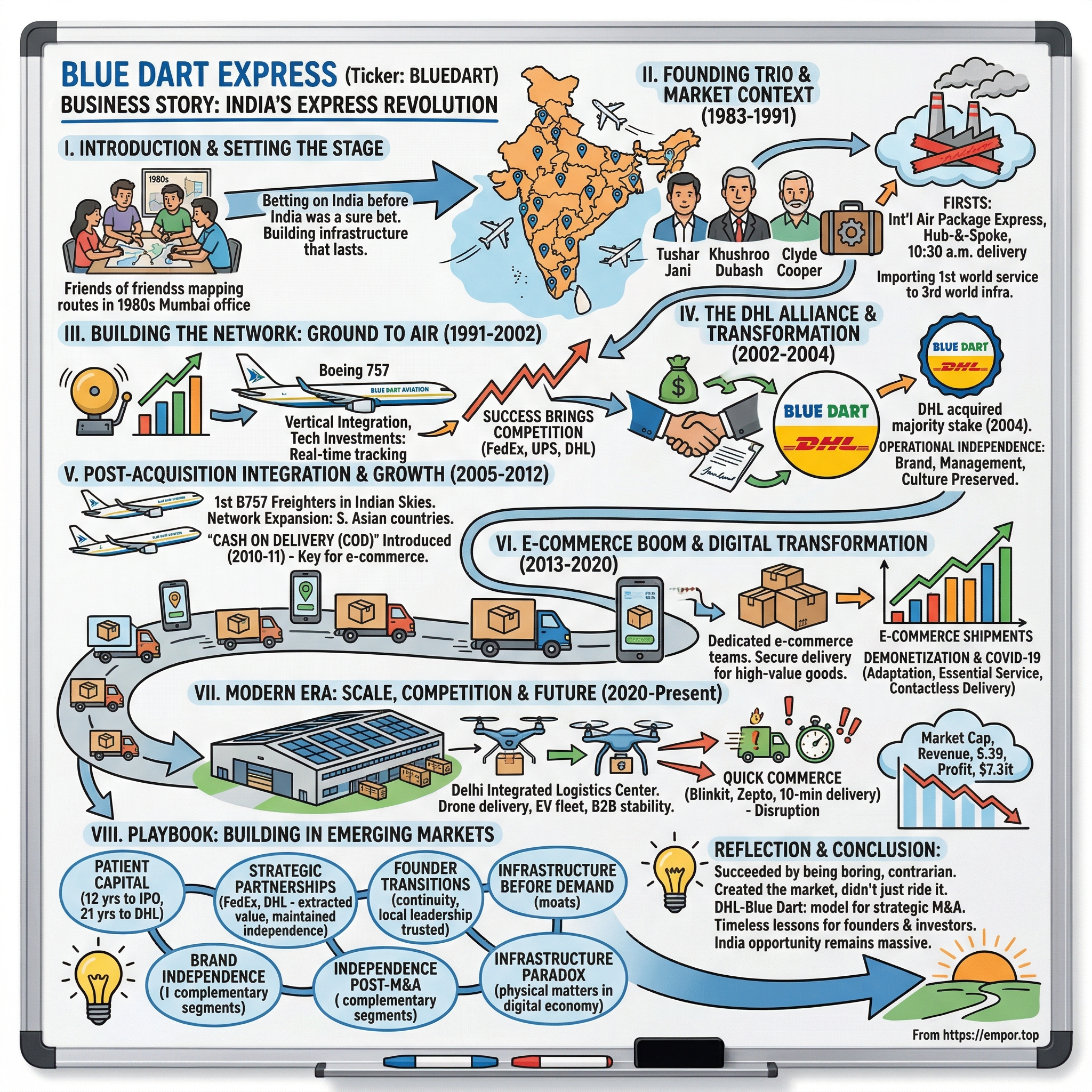
Blue Dart Express: India's Express Logistics Bet, Forty Years In
I. Introduction & Episode Roadmap
Every weeknight, somewhere between 10 p.m. and 2 a.m., a small fleet of elderly Boeing freighters lifts off from Chennai, Bengaluru, Kolkata, Delhi and Mumbai and converges on a hub. Nothing about this is glamorous. The aircraft are older than most of the pilots flying commercial routes above them. The cargo is not exotic — pharmaceutical consignments, bank documents, spare parts for a stalled production line, an e-commerce parcel that someone ordered while watching television. But the promise attached to that cargo is unusually specific: it will be there tomorrow, by a stated hour, and if it is not, someone will be able to tell you exactly where it is.
That promise is the entire business. Blue Dart Express is South Asia's largest integrated air-and-ground express operator, and it is one of the very few logistics companies anywhere in the emerging world that decided, early and expensively, to own the hardest part of the chain — its own aircraft, its own certificated airline, its own hubs, its own sortation. In the financial year ended March 2026, that architecture produced revenue of ₹6,141 crore, up from ₹5,720 crore a year earlier.1 Its parent, Deutsche Post DHL, holds 75% and describes Blue Dart's reach across more than 55,000 locations as "one of the most formidable ground distribution networks in the country."2
Here is the tension this story traces. Blue Dart built its brand on capital intensity at a moment when capital intensity has become unfashionable. The last decade in Indian logistics belonged to a different species of competitor: venture-funded, technology-led, asset-light networks that lease what Blue Dart owns, crowdsource what Blue Dart employs, and go after the same shipper with a lower price and a looser service promise. Delhivery, Xpressbees, Ecom Express, Shadowfax — none of them ever bought an aeroplane. Several of them grew faster than Blue Dart did.
The obvious question is whether owning the metal is a moat or a museum. And the honest answer, as of September 2026, is complicated in a way that should interest anyone who takes long-term ownership seriously. Blue Dart's freighter fleet — six Boeing 757-200s and two 737-800s — carries an average age of roughly 29 years, and management has chosen to defer replacing it rather than commit capital into an uncertain demand environment.3 A company whose differentiation is supposed to rest on owned aviation assets is currently running those assets well past the point at which most operators would have re-fleeted. That is a capital allocation decision, and it deserves to be examined as one.
There is a second thread. Through FY26, Blue Dart posted quarter after quarter of the least comfortable pattern in equity analysis: revenue up, profit down. Management asked investors to look through it, describing the spending as investment in an operational backbone. Then, on August 1, 2026, the June quarter arrived with revenue up about 15% and profit up 81%.4 One quarter is not a trend. But it is the first piece of evidence in a "show me" story that had been running on narrative alone.
The roadmap from here: how three men with ₹30,000 and a room under a staircase built the company that DHL eventually decided it had to own; what DHL actually bought and what it later admitted about the price; how the operating bargain of the 2005–2016 period worked; how the e-commerce decade rewrote the competitive map; where the economics stand today, tested against the strongest disconfirming evidence available; who is running the company and how they deploy capital; what the FY26 squeeze and the FY27 rebound really tell us; and finally, the case for and against, with the specific indicators that would settle it.
Start where it started — in a room too small to stand up in.
 Subscribe on LinkedIn
II. Origins in Brief: From Three Founders to DHL's India Bet (1983–2004)
In 1983, India did not have an express industry. It had the post office, it had a customs regime that treated cross-border movement as an event requiring paperwork rather than a routine business function, and it had the general condition of the License Raj, in which a private company wanting to move goods quickly had to work around the state rather than through it. Into that environment walked three men in their late twenties — Clyde Cooper, Tushar Jani and Khushroo Dubash — with a combined capital base of ₹30,000 and a 200 square foot space to work from.5
The trio were complementary rather than identical. Cooper brought operational instincts from air cargo. Jani brought the trading-family intuition for how structured logistics could change what a business was able to promise its own customers. Dubash brought the financial discipline required to keep a venture alive when the working capital cycle is unforgiving and the customer base does not yet know it needs you. Their initial commercial opening was not domestic at all: through a tie-up with Gelco Express International in the UK, they introduced India's first international air package express service.5 The insight was that Indian exporters needed to move samples and documents at speed, and nothing in the country was set up to do it.
What followed was an unusually literal case of building infrastructure before demand was proven. Blue Dart registered as a private limited company in 1991 and, in the same period, launched Dart Surfaceline — a cheaper ground product — and built Cosmat-ITM, an indigenous shipment tracking system.5 The tracking system deserves a pause. In the early 1990s, in India, giving a customer the ability to know where a package was constituted a genuine product differentiator, not a hygiene factor. It is the earliest expression of the thing Blue Dart has been selling ever since: not speed alone, but certainty.
The company went public in 1994, offering 2.55 million shares at a fourteen-times premium and raising ₹382.5 million.5 Through the liberalisation decade it became the listed proxy for the idea that India would eventually have organised logistics at all. Then came the decision that defined everything after it. In 1995 Blue Dart Aviation acquired two Boeing 737-200 freighters, and in 1996 it launched what the company describes as India's first jet express airline.5 No Indian courier had done this. It converted a service business into an asset business, with all the operating leverage and all the fragility that implies.
What is easy to miss from here is how much of the 1990s was spent solving problems that no longer exist. Moving a package by air across India in 1993 meant negotiating with airlines for hold space that could be bumped by passenger baggage, dealing with airport cargo terminals designed for bulk freight rather than parcels, and explaining to corporate customers why a service that cost several times the post office was worth it. Blue Dart's answer was to remove the dependencies one at a time — its own aircraft, its own airport infrastructure arrangements, its own tracking, its own ground fleet. Each step raised fixed costs and each step made the delivery promise more credible. The company was, in effect, buying certainty and selling it at a markup.
There is a myth worth puncturing here. Blue Dart is often described as a company the founders "built and held." They did not hold it. All three sold out completely in 2004 — the share purchase agreements covered the entire promoter group shareholding of 12,151,552 shares alongside the Schroder-advised fund's stake, and the founders signed non-compete undertakings as part of the transaction.6 The company that exists today is a founder-created business that has been run by professional managers under foreign control for more than two decades. That is not a criticism; it is a fact that should shape how much weight anyone puts on founder-mythology when assessing current strategy.
What DHL actually bought
By the early 2000s the global integrators had noticed. Blue Dart signed a sales alliance agreement with DHL in 2002, and the relationship escalated quickly. On November 11, 2004, DHL Express (Singapore) Pte. Ltd., acting in concert with Deutsche Post AG, announced a cash offer of ₹350 per fully paid-up equity share to acquire 4,745,587 shares — 20% of the voting capital — as the mandatory open offer accompanying share purchase agreements for 68.21% of the company at the same price.6 The sellers were the founding promoter group in full and Newfields Holdings, a fund advised by Schroder Capital Partners.6 The total outlay across the negotiated stake and the open offer ran to roughly ₹730 crore, and DHL ended up at 81.03% of the equity.5
Buried in the letter of offer is a detail that most retellings skip, and it matters enormously for the later story. Because India's foreign investment policy at the time restricted foreign ownership in aviation, the transaction documents contemplated that Blue Dart Express would divest up to 100% of Blue Dart Aviation to founders Tushar Jani and Khushroo Dubash, or to other identified persons, at fair value or above.6 In other words: the asset that today is described as Blue Dart's structural differentiator was, at the moment of the DHL deal, a regulatory problem to be engineered around. The freighter fleet did not sit comfortably inside a foreign-controlled listed company. That constraint shaped the ownership structure for the next twelve years.
Testing the "smart strategic deal" framing
It would be easy to narrate 2004 as a masterstroke — global integrator identifies the best asset in a soon-to-explode market and takes control before anyone else can. The company's own record does not support that reading cleanly, and the disconfirming evidence comes from DHL itself.
Two things happened after 2004 that bound the narrative. First, in 2005 DHL moved to take Blue Dart fully private, offering up to ₹550 per share for the remaining minority. The reverse book-building process that Indian delisting rules require produced a discovered price of ₹950 per share — institutional holders including Templeton, SBI and UTI mutual funds were simply unwilling to sell at DHL's number, expecting the organised logistics sector to compound over the following four or five years. DHL abandoned the buyback in November 2006.7 The minority shareholders, not the strategic acquirer, captured the re-rating that followed.
Second, and more damning to a "DHL played this perfectly" story, DHL later said so out loud. Ken Allen, then head of DHL's e-commerce solutions business and previously CEO of DHL Express, told the Economic Times that the group had "over-invested in India, and specifically in Blue Dart, for a while and tried to do things too quickly, and didn't do it with the right level of quality that we normally do."8 The right-sizing that followed had real consequences: Blue Dart reported a net loss of ₹31.92 crore in the December 2019 quarter against a profit of ₹32.02 crore a year earlier, on capacity cutbacks in the aviation business.8
Read together, these three facts — an expensive entry price, a failed attempt to buy out minorities at roughly half what the market demanded, and a parent that publicly conceded over-investment fifteen years later — narrow rather than destroy the strategic-deal thesis. DHL got a permanent, controlling position in the best-branded express network in a market it could not have built organically at that speed. It did not get it cheaply, it did not get it cleanly, and it did not manage it flawlessly. For an investor looking at Blue Dart today, the useful takeaway is not about 2004 valuation. It is that the parent has already been through one cycle of over-committing capital to this asset and then pulling back hard — which is directly relevant context for how one should read today's deferred fleet replacement.
The relationship that emerged from that turbulence was stranger and more durable than a normal parent-subsidiary arrangement, and it is where the next chapter begins.
III. Independence Under a Global Parent (2005–2016)
Most acquisitions end with the acquired brand disappearing into the acquirer's colour scheme within three years. Blue Dart's did not. More than two decades after DHL took control, the aircraft still carry Blue Dart livery, the shares still trade on the NSE and BSE, and the managing director is a career Blue Dart employee rather than a DHL transplant. That is unusual enough to be worth explaining rather than assuming.
The operating bargain that emerged after 2005 had a clear logic on both sides. DHL wanted domestic Indian reach it could not build — the tier-2 and tier-3 towns, the ground network, the pincode density that a global express integrator's metro-focused courier model never gets to. Blue Dart wanted international network access and the credibility of a AAA-class parent when bidding for multinational accounts. Neither side needed to merge the brands to get what it wanted. The listed structure survived partly by accident, after the failed 2006 delisting, and partly because it turned out to be useful: an Indian-listed, Indian-managed entity with an Indian-registered airline navigates Indian regulation more comfortably than a wholly foreign-owned subsidiary would.
The parent's stake did move once, and the move is regularly misread. In November 2012, DHL sold roughly 6% of Blue Dart through an offer for sale priced at ₹1,720 per share, raising well over ₹245 crore.9 This was not a strategic retreat and not a signal about the parent's conviction. It was compliance: SEBI's minimum public shareholding rules capped promoter ownership at 75%, and DHL was above it. The stake has sat at 75% since.1 It is worth naming precisely because promoter-stake-trimming headlines get read as sentiment in both directions, and here the cause was purely mechanical.
The aviation bet, and what it actually cost to own
The more consequential thread of this period runs through Blue Dart Aviation. Recall the constraint from the DHL transaction: aviation FDI rules meant the airline could not comfortably sit fully inside a foreign-controlled listed parent, and the 2004 documents contemplated divesting it to the founders. What happened in practice was a compromise — Blue Dart Express held 74%, with the balance outside.
That structure ended on November 24, 2016, when Blue Dart Express acquired the remaining 26% of Blue Dart Aviation's equity, making it a wholly owned subsidiary.10 The board had approved the move in April 2016; the consideration was roughly ₹70 crore. In the pre-2020 era, this is the single clearest data point on how Blue Dart deploys capital when it has genuine conviction. Given a choice between minority-sharing the economics of the airline and paying to own all of it, the company paid. The implicit view was that dedicated freighter capacity — not chartered belly space, not vendor arrangements — was the durable differentiator, and that the economics of that capacity should accrue entirely to Blue Dart shareholders.
What should an investor take from that? Two things, pointing in different directions. Positively, it demonstrates that management and the board are willing to write a cheque when they believe an asset is strategically core, and they did it at a moment when the e-commerce wave was visibly building. Less comfortably, it establishes a baseline of conviction against which today's behaviour can be measured. In 2016, owning the aircraft outright was worth paying a premium for. In 2026, replacing those same aircraft has been deferred. Either the conviction has changed, or the demand picture has, or the capital discipline has tightened. Those are different explanations with different implications, and the company has publicly offered the demand-clarity version.3
It is worth being precise about what the DHL relationship delivers operationally, because "access to a global network" can mean almost anything. In practice it means that a customer shipping from Coimbatore to Chicago can hand the consignment to Blue Dart and have it move through DHL Express's international network to more than two hundred countries, with a single point of accountability. Blue Dart does not have to build cross-border capability; DHL does not have to build Indian pincode density. The complementarity is genuine — DHL's own chief executive has framed Blue Dart as the ground distribution complement to DHL Express's metro-focused courier operations, reaching tier-2, tier-3 and rural markets its own couriers do not serve.2
The uncomfortable corollary is that a 75%-owned subsidiary transacting extensively with its parent creates related-party economics that minority shareholders cannot easily audit. How the international revenue is split, what Blue Dart pays or receives for network access, and how transfer pricing is set are matters governed by disclosure and audit rather than by arm's-length negotiation between independent parties. This is standard for majority-owned listed subsidiaries in India and is not evidence of anything improper. It is, however, a structural feature that any assessment of margin quality has to acknowledge: a portion of Blue Dart's economics is determined inside a group, not in a market.
There is one more feature of this decade worth flagging because it recurs. Blue Dart's aviation economics are structurally exposed in a way its ground economics are not. Aircraft carry heavy fixed costs — maintenance, crew, certification, hangar, insurance — that do not flex with volume. When DHL's right-sizing pushed capacity down in FY20, the result was not a modest margin compression but an outright quarterly loss.8 Owning the metal cuts both ways: it is a barrier to entry when volumes are strong and an unhedged fixed-cost block when they are not. Any assessment of the aviation moat has to price both states.
By 2016, though, none of this looked like a problem. Volumes were about to explode. The question was who would capture them — and the answer turned out to involve a set of competitors that did not exist when Blue Dart bought its first freighter.
IV. The E-Commerce Decade and the Rise of Asset-Light Rivals (2016–2023)
Picture two parcels moving through India in 2018. The first is a temperature-sensitive pharmaceutical consignment going from a Hyderabad plant to a distributor in Guwahati, and it absolutely must arrive tomorrow morning because a cold chain has a clock on it. The second is a ₹400 phone case ordered by a college student in Indore who would prefer it tomorrow but will not cancel the order if it comes on Thursday. Both are "express." They are not remotely the same business.
For most of Blue Dart's life, the first parcel was the market. Time-definite delivery for corporate India — banking documents, pharmaceutical shipments, high-value B2B freight, spare parts where downtime costs more than the freight — was a premium service sold to customers who understood why it cost what it cost. The value proposition was reliability, and reliability justified a price. Blue Dart's entire cost structure was built around it.
The e-commerce wave changed which parcel dominated the volume pool. Flipkart and Amazon spent the second half of the 2010s conditioning hundreds of millions of Indian consumers to order online, and the resulting flow of B2C parcels was vast, low-value, price-sensitive, and heavily weighted toward tier-2 and tier-3 destinations. It rewarded density and cost per shipment far more than it rewarded a guaranteed delivery hour. India's express and parcel market has been sized at roughly US$3 billion in 2023 with projections toward US$40 billion by 2030, and e-commerce already accounts for more than half of the country's express parcel volume.11
A new species of competitor
The companies built to capture that pool were architecturally different from Blue Dart. Delhivery emerged as the flagship of the technology-and-orchestration model: heavy investment in software, routing, and network design; capacity leased, contracted, or partnered rather than owned. Ecom Express built deep last-mile penetration in smaller cities. Xpressbees scaled on e-commerce parcel volume. DTDC ran a franchise-heavy footprint. Shadowfax leaned into a crowdsourced rider fleet and leased infrastructure, optimised for the wild demand variability of digital commerce.
The important thing is not that they were "cheaper." It is that they were structurally cheaper for that specific parcel. An asset-light network can add capacity in weeks by signing more partners; Blue Dart adds capacity by commissioning a hub or acquiring an aircraft. In a demand environment growing at 30% a year with unpredictable seasonality, the ability to flex capacity fast is worth more than the ability to guarantee a delivery hour — for the parcels where the hour does not matter. Blue Dart's advantage did not disappear. Its addressable share of the fastest-growing volume pool shrank relative to the total.
COVID-19 briefly obscured this. Express logistics was designated an essential service, volumes surged, and networks that had been derided as over-built suddenly looked prescient. But the pandemic also accelerated the underlying shift. It normalised online ordering for a much broader demographic, pushed enormous volume into exactly the low-value, high-frequency category where Blue Dart's premium is hardest to justify, and gave shippers both the volume and the confidence to negotiate hard on rates.
Blue Dart made a choice during this period that is easy to overlook because it produced no announcement: it largely declined to fight for the bottom of the e-commerce market. The company kept its premium positioning, kept its service-level guarantees, and let volume-hungry competitors take the price-sensitive tail. Judged on revenue growth, that looks like a failure of ambition. Judged on profitability, it looks like discipline — Blue Dart stayed consistently profitable through a decade in which several better-funded competitors did not. The right way to hold both is this: the strategy protected the income statement and conceded the growth narrative, and the share price has been arguing about which of those mattered more ever since.
COVID deserves a closer look precisely because it is so often cited as validation. Express logistics was designated an essential service, and the networks that stayed operational through the lockdowns captured demand that had nowhere else to go. For Blue Dart, whose entire architecture is built for continuity of service, this was a genuine proof point: the dedicated fleet flew when passenger belly capacity had largely evaporated, and vaccine and medical logistics played to the company's cold-chain and time-definite strengths. But the pandemic also handed the entire industry a demand shock that flattered every operator's growth rate, and it accelerated exactly the behavioural shift — mass consumer adoption of online ordering for low-value goods — that expanded the segment where Blue Dart's cost structure is least competitive. A crisis that validates your capability while enlarging your least favourable market is not an unambiguous win.
The public-market comparison arrives
Delhivery's IPO in May 2022 turned an operating debate into a valuation debate. For the first time, public investors could put an asset-light Indian logistics network and an asset-heavy one side by side and ask which model deserved the higher multiple. The comparison was not flattering to either side in a simple way — Delhivery brought scale and growth without consistent profitability, Blue Dart brought profitability without comparable growth — but it permanently changed how the sector was framed.
That framing hardened further with consolidation. In April 2025, Delhivery agreed to acquire at least 99.4% of Ecom Express for up to ₹1,407 crore, a deal the Competition Commission of India cleared on June 17, 2025.1213 Two of the largest e-commerce-focused couriers became one. For Blue Dart, this is a genuinely material development and it cuts both ways: fewer players bidding down price is helpful, but a larger consolidated competitor with more parcel density and more negotiating leverage with the e-commerce majors is not.
So what does an investor take from this decade? Blue Dart's premium positioning survived the e-commerce wave — it did not chase the bottom of the market, and it kept earning money while several competitors did not. But the growth engine of Indian logistics moved to a segment where Blue Dart competes at a structural cost disadvantage, and the company's share of incremental volume has been the casualty. That sets up the central question of the present era: what exactly is Blue Dart's business today, and where does it still hold an edge that a competitor cannot rent?
V. The Core Business Today: Industry Structure, Economics, and How Blue Dart Wins or Loses
If you opened Blue Dart's segment disclosure hoping to find a hidden compounder tucked inside the express business — a warehousing arm about to inflect, a cross-border venture nobody has priced — you will be disappointed. There isn't one. Blue Dart reports substantially as a single integrated express business: domestic air, domestic ground, B2B and B2C, with international express flowing through the DHL relationship, and Blue Dart Aviation sitting underneath as the wholly owned asset base. The story is the core network. That simplicity is analytically useful. There is nowhere for a weak core to hide.
Start with the shape of the parcel flow, because it is not what most people assume. In the June 2026 quarter, Blue Dart handled 96.15 million shipments, up about 2% year on year, while tonnage rose roughly 7% to about 364,000 tonnes.3 Read that again: tonnage grew more than three times as fast as shipment count. The mix is shifting toward heavier consignments. That is a meaningful signal — it suggests the parts of the business gaining share are surface freight and heavier B2B movements rather than the small-parcel e-commerce flow that dominates industry headlines.
The revenue split reinforces it. Air services generate roughly 60% of revenue while carrying only about 25% of the weight; ground handles 75% of the tonnage for about 40% of revenue.3 Air is the high-yield, low-volume business; ground is the volume engine. B2B contributes about 70% of revenue against roughly 30% from B2C.3 Blue Dart is, in revenue terms, still primarily a business-to-business express company that also serves e-commerce — not an e-commerce logistics company with a legacy B2B tail.
One number inside that mix deserves attention because it quantifies a slow structural loss. Banking and financial services — cheques, documents, physical instruments moving between branches and processing centres — once contributed 25% to 30% of Blue Dart's revenue. It is now 10% to 15%.3 That is digitisation doing exactly what digitisation does: dissolving a profitable, high-frequency, low-weight, time-critical revenue pool that was almost perfectly matched to Blue Dart's cost structure. The company replaced that revenue with e-commerce and B2B surface volume, which is a genuine execution achievement. But it replaced premium-yield revenue with lower-yield revenue, and that mix shift is a permanent headwind to margin that no amount of hub automation fully offsets.
How big is Blue Dart, really?
Market share here is genuinely contested, and the honest answer is that it depends entirely on how you draw the boundary. Blue Dart's own promotional material has described the company as India's leading express company with a 36% domestic market share.14 Third-party trackers looking at the broader express logistics market put Blue Dart in the low teens — around 12% — behind Delhivery at roughly 14%, with Ecom Express near 10% before its acquisition.15 Both can be true simultaneously if the first measures the organised air express segment and the second measures all express logistics including the vast ground parcel pool.
The gap between those two numbers is the investment question. Blue Dart is a large fish in the narrow, defensible pond of scheduled time-definite air express, and a mid-sized player in the enormous, contested pond of general express. Growth lives in the second pond. Pricing power lives in the first.
The competitive map, named and sized
Delhivery is now the scale leader in Indian third-party parcel logistics, and post-Ecom Express it has more density in exactly the tier-2 and tier-3 geography where incremental e-commerce growth is coming from. Xpressbees and DTDC occupy the middle. TCI Express competes directly in surface B2B express, which is precisely where Blue Dart's ground business has been growing.
And then there is the entrant that told the market something uncomfortable. Shadowfax Technologies listed on January 28, 2026, having raised ₹1,907.27 crore at an upper price band of ₹124, and debuted at roughly a 9% discount to issue price.16 On annualised FY25 earnings the IPO was priced at approximately 1,018 times — against Blue Dart at around 50 times and Delhivery near 195 times on comparable annualised bases.16 The underlying financials made the contrast starker still: Shadowfax generated ₹2,485 crore of operating revenue and about ₹6 crore of profit in FY25, versus Blue Dart's ₹5,720 crore of revenue and roughly ₹252 crore of profit, and Delhivery's ₹8,932 crore and ₹162 crore.16
What that pricing revealed is worth stating plainly: public markets have been willing to pay far more for logistics growth optionality than for logistics earnings. Blue Dart earned more absolute profit than Delhivery and Shadowfax combined and carried the lowest multiple of the three. An investor can read that as the market misunderstanding a durable franchise, or as the market correctly discounting a business whose growth is structurally slower. The muted Shadowfax debut suggests the enthusiasm for the growth-optionality trade has limits — but it does not by itself vindicate the asset-heavy model.
The moat claim under test: does owned aviation still differentiate?
This is the load-bearing claim in any bull case for Blue Dart, so it deserves the hardest available test.
The claim, stated fairly: Blue Dart operates the only meaningful dedicated domestic freighter network in India, giving it night-time capacity that does not depend on passenger airline schedules, cargo priority that belly-hold customers cannot obtain, and therefore a time-definite delivery promise competitors physically cannot replicate. DHL's own framing supports the operational reality — Blue Dart Aviation runs 26 daily domestic flights feeding the ground network.2 Daily theoretical air capacity runs between 450 and 550 tonnes, with pallet utilisation on the scheduled fleet at 85% to 90%.17 Those are high utilisation numbers; the aircraft are not sitting idle.
Now the disconfirming evidence, and it is substantial.
First, the fleet. Six Boeing 757-200 freighters and two 737-800 freighters, with the 757 fleet averaging close to 30 years old and the overall fleet around 29.318 These are not aircraft in the prime of life. They are aircraft being operated well past the age at which a Western integrator would have replaced them, in a business where an unscheduled maintenance event does not just cost money — it breaks the exact promise the customer is paying a premium for.
Second, and more important, management has chosen to defer replacement. The stated rationale is that the company wants clarity on demand patterns at its newer hubs before committing capital to a new fleet, and prefers a phased approach.18 Standalone capex has been running at ₹100–150 crore a year — a level the company itself describes as replacement and organic-growth spending on sorters, material handling equipment, IT hardware and ground facilities, not fleet renewal.17 Hub expansion projects in Bengaluru, Chennai and Mumbai were described on the Q1 FY27 call as "several quarters away."4
This is the single most important fact working against a clean "owned aviation is a compounding moat" narrative. A moat built on physical infrastructure decays unless it is continuously reinvested in. If the differentiating asset is 29 years old and the replacement decision keeps sliding, then what is being described as a durable advantage is, at least partly, a depreciating one being harvested.
Third — and this is where the analysis has to be balanced rather than merely bearish — the parent has now put money on the table. In November 2025, DHL Group committed €1 billion to India through 2030, spanning warehousing, healthcare logistics, technology and green operations.2 Reporting on the fleet question indicates that roughly €250 million of that is earmarked for Blue Dart over five years, covering fleet modernisation and ground infrastructure.18 That materially changes the funding question. It does not answer the timing question, and it is not the same thing as an announced aircraft order.
Weighing it: the historical record does not reject the aviation moat, but it narrows it considerably. The defensible version of the claim is not "Blue Dart owns aircraft, therefore it has a durable structural advantage." The defensible version is: Blue Dart holds a licensed, certificated, operating dedicated-freighter position that is genuinely hard to replicate under Indian aviation regulation, and it is currently deferring the reinvestment required to keep that position economically competitive. The confirming event is a concrete re-fleeting commitment — an announced aircraft acquisition or lease programme with a delivery schedule. The falsifying event is another two to three years of deferral accompanied by rising aviation maintenance costs, which would convert the differentiator into a cost overhang.
The threats that do not come from Delhivery
Two structural pressures on Blue Dart's B2C pool come from directions that price competition does not describe.
The first is quick commerce. Blinkit, Zepto and Swiggy Instamart have built dark-store networks that deliver in minutes using their own riders, and quick-commerce GMV in India reached roughly ₹11,000 crore in January 2026 alone on about 7.8 million orders a day.19 None of that volume touches a third-party express network. Every category that migrates from "order online, wait two days" to "order online, arrives in fifteen minutes" is a category permanently removed from Blue Dart's addressable market. This is not a share-shift threat; it is a market-shrinkage threat, and it is growing far faster than express is.
The second is insourcing. Amazon Transportation Services and Flipkart's Ekart already run captive delivery networks at enormous scale, and Amazon Now and Flipkart Minutes have each scaled past 500 dark stores.19 E-commerce majors that build their own logistics do not merely take volume off third-party couriers — they take the best volume, the dense metro routes with predictable flow, and leave the expensive long-tail pincodes for outsourced partners. That is a structurally adverse mix.
Myth versus reality
Three consensus narratives attach themselves to this company, and each deserves a fact-check.
Myth: there is a takeout option — DHL will eventually buy in the minority. The parent already tried, in 2005-06, and walked away when India's reverse book-building mechanism produced a price it would not pay.7 Nothing in the twenty years since suggests a renewed attempt; the 2012 stake sale ran in the opposite direction, and it was compliance-driven.9 An investor holding Blue Dart on the theory that a premium buyout is coming is holding an option that has been tested once and failed, with no evidence of it being re-struck. Treat the delisting scenario as an unpriced tail, not part of the base case.
Myth: a premium price position insulates the business from competition. The BFSI collapse from roughly a quarter of revenue to a low-teens share is the counterexample, and it is decisive.3 That revenue did not migrate to a cheaper courier — it ceased to exist, because cheques and physical documents stopped moving. Premium pricing protects against competitors offering the same service for less. It offers no protection at all against a customer no longer needing the service. Quick commerce and e-commerce insourcing threaten Blue Dart through the same channel.
Myth: the 2016 decision to own Blue Dart Aviation outright proves aviation was always the strategic core. The regulatory history complicates this. Foreign investment rules in aviation were the reason the airline sat partly outside the listed parent in the first place, and the 2004 transaction documents contemplated divesting it entirely to the founders.6 The move to full ownership was made possible by a changed regulatory environment as much as by strategic conviction. Both readings are partly right; only one is usually told.
Porter and Helmer, applied honestly
Run the five forces on this business and the picture is sober rather than dire. Rivalry is moderate-to-high and asymmetric: asset-light competitors can add or shed capacity in weeks, Blue Dart cannot. Threat of substitutes is real and rising — digitisation already ate most of the BFSI document pool, and quick commerce is eating a slice of small-parcel demand. Buyer power varies sharply by segment: an e-commerce major running a reverse auction on standard parcels has enormous leverage and switching costs approaching zero, while a pharmaceutical manufacturer with cold-chain requirements or a bank moving high-value instruments faces genuine switching friction and pays for it. Supplier power is mostly low, with the pointed exceptions of aircraft, aviation maintenance and fuel — and the fuel exposure is partly managed through a surcharge mechanism, which was tested when diesel prices jumped roughly 30% in mid-May 2026 and the surcharge recovery flowed through with a quarter's lag.4 Barriers to new entry in ground parcel delivery are low. Barriers in scheduled dedicated air freight are high.
Through Hamilton Helmer's 7 Powers, only one power holds up under scrutiny with real evidence behind it: cornered resource, and only in the narrow slice of DGCA-certificated dedicated freighter operations and the associated night-time airport slots and infrastructure. That is a genuine, regulatorily protected position that a well-funded startup cannot simply buy its way into next quarter. Branding is a partial second — Blue Dart does command price premiums, and the CFO has acknowledged the flip side of that positioning candidly, noting that as "a premium price player in the market... it's never easy to get price increase."4 That is an honest description of a brand that constrains as much as it protects. Scale economies exist in the hub and linehaul network but are matched or exceeded by Delhivery post-consolidation. Network economies, switching costs, counter-positioning and process power are all weak-to-absent in the parcel business; if anything, counter-positioning runs against Blue Dart, since the asset-light entrants adopted a model the incumbent cannot copy without stranding its own capital.
One footnote that should stay a footnote: Blue Dart operates more than 675 electric vehicles within a fleet exceeding 33,000 vehicles across a network of 2,500-plus facilities reaching 56,400-plus locations.3 The EV programme is real, it is well-marketed, and at roughly 2% of the fleet it is a sustainability commitment and a modest optionality on urban regulation — not a growth pillar, and it should not be sized as one.
Which brings the story to the people making these calls, and to the question of whether their record supports being trusted with the next set of them.
VI. Current Management and Capital Allocation
Balfour Manuel did not arrive at Blue Dart as a turnaround specialist parachuted in by a global parent. He walked in as a fresh MBA graduate for what he has described as a chance interview and walked out with a job — and then stayed for more than thirty-five years, running the western region, heading the B2B business, and eventually becoming Chief Executive Officer in January 2019 before being appointed Managing Director with effect from May 16, 2019. He was reappointed for a further five-year term from May 16, 2022.20
That kind of tenure produces a particular type of leader. Manuel's public framing consistently emphasises culture, consistency and a "people-first" philosophy, and his tenure has spanned the full range of stress tests available: the DHL right-sizing and aviation loss of FY20, the pandemic, the e-commerce boom, and now a margin squeeze. He has been notably willing to talk about demand drivers in concrete rather than abstract terms — in mid-2026 he pointed to semiconductor plants and data centre construction as the next wave of industrial freight demand in India, which is a more specific and more falsifiable claim than the usual "structural growth story" language.21
Incentive alignment, stated plainly
Manuel's direct shareholding in Blue Dart is approximately 0.003% of the company — worth a few crore rupees against a market capitalisation in the region of ₹12,000 crore.221 This is not a criticism of the individual; it is the norm for professional managers at subsidiaries of global groups, where compensation runs through the parent's structures rather than through founder-scale equity.
But it should be named rather than assumed away. When a bull case rests on management making a multi-year capital allocation decision — deferring or committing to a fleet replacement that will shape returns for a decade — it matters that the decision-maker's personal financial outcome is not materially tied to the share price. Alignment here runs through DHL's remuneration architecture and the company's own disclosed policies, not through personal equity upside. Investors relying on "skin in the game" as a governance comfort will not find it here.
The CFO seat has been unstable
This is a place where the surface narrative and the record diverge, and the record matters. Blue Dart appointed Sudha Pai as Chief Financial Officer with effect from September 1, 2023, recruiting her from DHL Global Forwarding India.23 She resigned on April 25, 2025 to pursue an external opportunity and was relieved at the end of that month — a tenure of roughly twenty months. The company then appointed Sagar Patil as CFO with effect from August 1, 2025; Patil is a chartered accountant with more than twenty-five years of experience who had already spent over eight years inside Blue Dart as Corporate Controller and Head of Corporate Accounts, and who had been serving as interim CFO.24
Two readings are available. The charitable one is that the company handled a departure smoothly by promoting a long-tenured internal candidate who already knew the numbers — a sign of bench strength. The less charitable one is that a twenty-month CFO tenure, followed by an interim period, in the middle of the most difficult margin environment in years, is not a picture of stability in the finance function. An activist looking at this company would note the sequence and ask what drove it. The available disclosure attributes it to an external opportunity, and there is no public indication of anything beyond that.
Board churn: oversight, not instability — but at an unusual cadence
Sharad Upasani, a former Chief Secretary of the Government of Maharashtra, chaired the Blue Dart board from December 2007 until July 21, 2024 — a seventeen-year run that gave the company an unusually stable independent chair through the entire DHL era.25 His successor, Prakash Apte, lasted less than two years: Apte resigned as Chairman and Independent Director citing health reasons, effective from the conclusion of the board meeting on April 13, 2026, stepping down simultaneously from the audit, nomination and remuneration, risk management, CSR and stakeholder relationship committees and forcing a committee reconstitution.26
Then, on July 10, 2026, Florian Ulrich Bumberger resigned as a Non-Executive, Non-Independent Director citing pre-occupation, and the board appointed Charles Simon Dobbie as an Additional Director in the same seat.27 Dobbie is a substantive appointment rather than a placeholder: a 70-year-old logistics and aviation executive with three decades of experience across aviation network design, operations hub engineering, security, customs regulation and IT development, who retired from DHL in 2023 as Global Executive Vice President for Operations, Aviation and IT, and who already sits on the Blue Dart Aviation board.27
Read the sequence together and the most plausible interpretation is that DHL is keeping operational oversight close by placing an aviation and hub-operations specialist on the board at precisely the moment when the fleet and hub questions are live. That is a reasonable governance response, not a distress signal. The independent-chair turnover is the part worth watching: seventeen years of continuity followed by a twenty-one-month chairmanship ended by ill health means the board has been through more change in two years than in the preceding fifteen, and the composition of the audit and risk committees during an active tax dispute is not a trivial matter.
Capital allocation: disciplined, or under-invested?
The record is straightforward to describe and harder to judge. Standalone capex has run at ₹100–150 crore annually, directed at automation, sorters, material handling, IT and facility renewal.17 The flagship physical investment of the recent period was the Green Integrated Ground Hub at Pataudi, Haryana, unveiled in October 2025: 50,558 square metres, an auto-sorter rated at 200,000 shipments per day, capacity to handle up to 2,283 tonnes of cargo daily, a 600 KVA rooftop solar plant, on-site EV charging, and a location 50 kilometres from Delhi airport chosen for centre-of-gravity optimisation that the company says cuts vehicle movement by around 30% and improves throughput speed by about 10%.28 It became operational during FY26 and management cited it on the Q3 call as strengthening North India connectivity.17
The dividend record is consistent — the board recommended ₹25 per share for FY26 — with a payout ratio running in the low twenties as a percentage of earnings.291 Cash generation supports it comfortably: FY26 operating cash flow of roughly ₹810 crore against free cash flow near ₹498 crore.1 Return on capital employed of about 16% and return on equity near 15.7% are respectable for an asset-heavy logistics business but are not the numbers of a company with an untouchable franchise.1
Here is the honest tension, and it belongs in the same paragraph as the praise rather than in a distant risk section. The same capital discipline that produced steady dividends and a clean balance sheet is what has left an eight-aircraft fleet averaging 29 years old. Calling this "disciplined capital allocation" is only defensible if the deferred spending is genuinely optional. If the fleet requires replacement within a defined window regardless, then what looks like discipline today is deferred capex that will land as a step-change in depreciation, interest or lease cost in some future year — and the company's aviation maintenance capex already recurs at ₹100–150 crore a year even without adding capacity.17 Investors should hold both possibilities open until a re-fleeting decision is actually announced.
The tax overhang
Two indirect-tax matters sit on the file, and they resolved very differently.
The larger one involved Blue Dart Aviation, which received a show cause notice aggregating roughly ₹420 crore under Section 73(1) of the CGST Act for April 2021 to March 2023 — alleging ₹365.58 crore paid under the wrong head (IGST instead of CGST and SGST) and ₹54.55 crore of ineligible input tax credit. By an order dated December 30, 2025, the adjudicating authority set aside approximately ₹420.78 crore of the proposed demand, confirming a residual liability of ₹64.98 lakh of tax plus ₹41.71 lakh of interest and ₹6.49 lakh of penalty, which the company discharged to close the matter.30 A demand of ₹420 crore collapsing to under ₹1.2 crore is a strong outcome and suggests the original notice reflected a place-of-supply classification dispute rather than a substantive tax leak.
The smaller one is live. On July 22, 2026, Blue Dart Express received a show cause notice from the Assistant Commissioner of State Tax under Section 73 for FY2022-23, aggregating ₹37.56 crore — ₹21.04 crore of tax, ₹14.42 crore of interest and ₹2.10 crore of penalty — alleging excess availment and under-declaration of ineligible input tax credit. The company said it would analyse the notice and respond; the amount sits as a contingent liability pending adjudication.31
The pattern is what matters more than either number. Indian logistics and aviation businesses face recurring indirect-tax friction, much of it driven by place-of-supply mechanics in a multi-state GST regime rather than by aggressive positions. The BDAL outcome supports that benign reading. But a company that receives multi-hundred-crore notices with some regularity carries genuine cash-timing risk and management-attention cost, and the ₹37.56 crore matter should be tracked to resolution rather than dismissed.
All of which sets up the question that actually moves the share price: what happened to profits in FY26, and is the recovery real?
VII. Reading the Signal: The FY26 Margin Squeeze and the Q1 FY27 Rebound
There is a specific kind of quarter that tests whether an investor actually believes what management says. It looks like this: revenue at an all-time high, and profit down double digits. Blue Dart delivered that quarter three times in FY26.
The June 2025 quarter opened the sequence with profit after tax of about ₹49 crore, down roughly 9% year on year, and the stock slid on the print.32 The December 2025 quarter was the starkest illustration of the pattern: revenue of ₹1,616 crore, described as an all-time quarterly high and up 6.9% year on year, alongside profit after tax of ₹68.33 crore, down 15.65%.33 The mechanics were visible in the cost lines rather than the top line — depreciation rose to ₹144.76 crore from ₹130.53 crore, and interest cost climbed to ₹23.78 crore from ₹21.72 crore.33 Those are the fingerprints of an infrastructure build: you commission a hub, you start depreciating it, and the volume that justifies it arrives later. Notably, a one-off favourable tax rate of about 13.5% against a normalised mid-twenties rate flattered even that reduced profit figure, which means the underlying operating deterioration was worse than the headline decline suggested.33
The March 2026 quarter closed the year on the same note: revenue of ₹1,533 crore with standalone profit after tax of ₹43 crore, down about 19%.34 For the full year, revenue of ₹6,141 crore represented growth of roughly 7.4%, while consolidated profit came in near ₹247 crore.291 Growing the top line while shrinking the bottom line for a full year is the clearest possible statement that costs were running ahead of the network's ability to monetise them.
What management said, and whether it holds up
Through the year, management's prepared-remarks language leaned on the vocabulary of deliberate investment — front-loaded spending to strengthen the operational backbone, building a resilient and future-ready logistics ecosystem. That framing is unfalsifiable on its own terms, and an investor should treat it as such.
What raises management's credibility on this specific miss is that they also produced a hard, disclosed, auditable number. The four Labour Codes — the Code on Wages 2019, the Industrial Relations Code 2020, the Code on Social Security 2020, and the Occupational Safety, Health and Working Conditions Code 2020 — were notified by the Government of India on November 21, 2025. Blue Dart recognised exceptional expenses of ₹44.36 crore in FY26 as a result, comprising ₹21.86 crore of higher employee benefit expense and ₹22.50 crore of increased freight, handling and servicing costs.35
That is a materially better disclosure than the alternative. A company hiding behind macro conditions says "cost inflation was elevated." A company willing to be held to account quantifies the item, splits it between its own payroll and its vendor cost base, and books it where analysts can see it. Against a full-year consolidated profit of roughly ₹247 crore, a ₹44 crore exceptional item explains a meaningful share of the shortfall — not all of it, since depreciation and interest were rising independently, but enough that the "we were absorbing a specific, identifiable regulatory cost step" explanation is supported by evidence rather than assertion.
The credibility test that remains open is a different one: management also told investors, repeatedly, that price increases were coming through. A tariff increase announced in October 2025 in the 9% to 12% range for individual customers was expected to realise over subsequent months, with the stated ambition of moving margins back toward post-COVID levels over the medium term.17 Whether that price realisation actually stuck is not a narrative question. It is measurable.
One further consistency check is available, and it is worth running because narrative drift is one of the more reliable early signals of trouble. Across the FY26 calls, the explanatory framework management offered did not change shape: cost pressure from a specific regulatory step, investment in hub and automation capacity ahead of volume, a stated intention to recover margin through pricing, and an acknowledgement that e-commerce pricing remained difficult. The Q3 FY26 call quantified the price action and set the expectation that realisation would flow through over subsequent months.17 The Q1 FY27 call reported that realisation and attributed the revenue growth explicitly to pricing rather than volume.4 That is the same story told twice, with the second telling containing the evidence the first one promised. It is a low bar — but management teams that miss and then quietly change the subject fail it routinely, and this one did not.
The June 2026 quarter: first evidence
On August 1, 2026, Blue Dart reported the June 2026 quarter, and the numbers broke the pattern. Revenue from operations rose 14.9% to ₹1,658 crore from ₹1,442 crore. Consolidated profit after tax rose 81.2% to ₹88.49 crore. Consolidated EBITDA came in at ₹276.6 crore, a margin of 16.5% — a sharp expansion on the prior year.336 The shares rallied on the print.37
Now decompose it, because the composition matters more than the headline. Total shipments grew only about 2%, while revenue grew nearly 15%.3 Air volumes grew 2.5% to 2.6%; ground volumes grew about 9%; e-commerce revenue grew above 10%; ground B2B grew 14%.4 The overwhelming driver of revenue growth was not volume. It was price and mix — the October tariff action landing, the fuel surcharge mechanism recovering the roughly 30% mid-May diesel spike with the full benefit expected from the second quarter, and a heavier consignment mix lifting realisation per shipment.4
That is genuinely good news about pricing power and genuinely mixed news about demand. It confirms that Blue Dart can push through a high-single-digit to low-double-digit price increase in a competitive market without losing volume — which is real evidence for the brand premium claim, not merely an assertion of it. It also confirms that the company is not winning share in the growth segment: 2% shipment growth in a market where e-commerce parcel volumes are compounding at a far higher rate means Blue Dart is being paid better for a slice of the market that is expanding slowly, not capturing the fast part.
There is a further caution embedded in the quarter. Some of the year-on-year margin expansion is a base effect: the labour-code cost step that depressed FY26 quarters rolls into the comparative base, and once it laps, the flattering comparison disappears. A rebound built on a favourable base plus a one-time tariff action is not the same thing as operating leverage from a network that has grown into its fixed costs.
So the correct conclusion is calibrated rather than celebratory: one quarter of evidence, with a favourable base and a clear pricing driver, is consistent with the investment-phase thesis but does not confirm it. The confirming evidence would be EBITDA margin holding in the mid-teens or better through the September and December 2026 quarters — periods that include the festive peak and a tougher comparison — with shipment growth accelerating rather than staying at 2%. The falsifying evidence would be margins reverting toward the FY26 range as the labour-code base effect rolls off and the tariff increase gets competed away.
That is precisely the fork the bull and bear cases turn on.
VIII. Bull vs. Bear: The Investment Case
Imagine two analysts leaving the same August 2026 earnings call. One has just watched an 81% profit increase validate a thesis they have held for eighteen uncomfortable months. The other has just watched a company grow shipments 2% in the fastest-growing large logistics market on earth. Both are looking at the same company, and both have evidence.
The bull case
A brand premium that is measurable, not assumed. The strongest single piece of evidence for Blue Dart's franchise is not a market-share statistic; it is that the company announced a 9% to 12% tariff increase and then delivered nearly 15% revenue growth on 2% shipment growth without volume collapse.173 In a market with dozens of alternatives and low switching costs for standard parcels, that only works if a meaningful cohort of customers is buying something other than price. Those customers cluster in pharmaceuticals, high-value B2B, time-critical spares and reverse logistics, where a failed delivery costs far more than the freight bill.
A genuinely hard-to-replicate air position. The dedicated freighter operation, whatever its age, exists inside a regulatory perimeter — DGCA certification, night slots, cargo terminal infrastructure — that a well-funded new entrant cannot cross quickly. Twenty-six nightly domestic flights and 450–550 tonnes of daily theoretical capacity at 85–90% pallet utilisation is a real operating asset, not a marketing claim.217
A parent with capital and a stated commitment. DHL's €1 billion India programme through 2030, with a reported €250 million tranche directed at Blue Dart for fleet modernisation and ground infrastructure, addresses the most serious structural objection to the story — that the company lacks the balance sheet appetite to renew its differentiating asset.218
Growth vectors that are not e-commerce. The B2B surface express business grew 14% in the June 2026 quarter, and Manuel has pointed to semiconductor fabrication and data centre buildout as emerging industrial freight demand.421 If India's manufacturing capex cycle is real, Blue Dart's B2B-weighted revenue mix is better positioned for it than a pure e-commerce parcel network.
Cash generation and a clean capital structure. FY26 operating cash flow near ₹810 crore, free cash flow around ₹498 crore, a low-twenties dividend payout, ROCE around 16%.1 This is a business that funds itself, pays shareholders, and does not require dilution to operate.
The bear case
A decade of shareholder returns that the operating story does not explain away. The stock traded near ₹5,105 as of the start of September 2026, against a 52-week high of ₹7,036 and a 52-week low of ₹4,628, on a market capitalisation around ₹12,114 crore.1 Over the year to the December 2025 quarter, the shares fell about 14.5% while the Sensex rose roughly 7.2%.33 Revenue has compounded steadily; total shareholder return has not followed. That gap is the single most important fact a bull has to explain, and "the market misunderstands the franchise" is a weaker explanation than "earnings growth has not kept pace with revenue growth."
The fleet is the thesis, and the fleet is old. Everything said above about the aviation moat applies in reverse. Deferring replacement of 29-year-old aircraft while asset-light competitors consolidate is a defensible short-term cash decision and an uncomfortable long-term positioning decision. The moment a maintenance event causes a visible service failure, the premium that justifies the entire model comes under question.
Volume growth of 2%. In a market where e-commerce shipment volumes have been projected to roughly triple by 2030, growing shipments at 2% means the company is being carried by price rather than participation.113 Price-led growth has a ceiling; a competitor with a lower cost base eventually tests it.
A shrinking addressable market from two directions. Quick commerce removes categories entirely, and e-commerce insourcing removes the densest, most profitable routes.19 Neither shows up as a competitor in a market-share table, and both compress the pool Blue Dart is competing for.
Negligible management equity and a churning board. A managing director holding roughly 0.003% of the company, a CFO seat that turned over inside twenty months, an independent chairmanship that changed twice in two years, and an open ₹37.56 crore GST proceeding is not a governance crisis — but it is a set of items an activist would put on one slide and ask the board to address.22232631
The risk radar items that actually bite. Three matter here and the rest do not. Fuel is a real input-cost exposure, partially but not fully hedged by the surcharge mechanism, and recovery lags by roughly a quarter — which means a sharp diesel or ATF move compresses one quarter's margin before the pass-through catches up.4 Cost of capital matters more than it looks: interest expense has been rising alongside the hub build, and a fleet replacement funded through debt or leases would land directly in the same line.33 And execution risk in the hub programme is genuine — commissioning large automated facilities on schedule, and filling them with volume fast enough to cover the depreciation they immediately start generating, is exactly what went wrong in FY26. Broader macro anxieties — geopolitics, currency, AI disruption of the core service — are not the pressure points for a domestic express network.
Valuation without growth to support it. Around 37 times trailing earnings for a business growing revenue in the high single digits and shipments in the low single digits requires the operating leverage story to be right.1 If margins revert, the multiple has no growth to hide behind.
The activist's slide
A skeptical investor pressing this board would ask five things. First: if the fleet must be replaced, publish the timeline and the funding structure, because the market is currently pricing uncertainty rather than a plan. Second: reconcile the company's own "36% domestic market share" language with third-party estimates in the low teens, and disclose a consistent definition.1415 Third: explain the ₹100–150 crore capex band that has persisted through a period of hub expansion and network investment — is it discipline or is it under-investment relative to a consolidating competitor? Fourth: given that the parent controls 75% and supplies the international network, quantify the related-party economics of the DHL relationship so minority holders can see what the alliance is worth to each side. Fifth: address why an eight-quarter stretch of profit decline preceded a quarter of exceptional recovery, and what changed structurally rather than cyclically.
None of these are accusations. They are the questions that determine whether the current price reflects a temporarily depressed high-quality franchise or a structurally decelerating one.
The verdict on the thesis claims
Take the three claims that matter and state where the evidence leaves each.
Claim one: Blue Dart's owned aviation is a durable moat. The history narrows this. The asset is genuinely hard to replicate under Indian regulation, but it has already proven capable of generating outright losses when capacity is mismanaged, as it did in FY20 under DHL's right-sizing.8 It is now being run past normal replacement age by explicit management choice.18 Verdict: intact but unproven in its strong form, and contingent on a re-fleeting decision.
Claim two: the brand premium supports pricing power. This one survives the test. The October 2025 tariff action translating into 15% revenue growth on 2% volume growth is direct, recent, same-business evidence.173 Verdict: intact, with the caveat that the CFO's own acknowledgement that price increases are "never easy" for a premium player bounds how often this lever can be pulled.4
Claim three: the FY26 investment phase is over and operating leverage is arriving. One quarter, with a favourable base effect and a pricing driver rather than a volume driver. Verdict: unproven. This is the claim that the next two prints settle.
The KPIs that matter
Three, and only three, are worth tracking.
Consolidated EBITDA margin, quarter by quarter. This is the single number that adjudicates the entire investment-phase argument. It captures whether pricing is sticking, whether the hub build is being absorbed, and whether cost inflation is being recovered — all in one line.
Shipment volume growth versus tonnage growth. Watching these two together reveals whether Blue Dart is participating in market growth or merely repricing a static book. Tonnage far ahead of shipments means heavier B2B freight is carrying the company; shipments accelerating toward tonnage would signal genuine share recovery in the parcel pool.
Aviation fleet capital commitment. Not a financial metric but an event: an announced aircraft acquisition or lease programme with a delivery schedule, and the associated capex or lease obligation. Until that lands, the durability of the core differentiator remains an open question rather than a settled fact.
Everything else — dividend, EV count, hub square-footage, award announcements — is downstream of those three.
IX. Playbook: Durable Lessons
Strip away the specifics and Blue Dart's forty-year record offers three lessons that generalise well beyond Indian logistics.
Selling control to a strategic buyer can preserve a business without preserving its upside for the seller. The 2004 transaction is often held up as a model of how to sell a company to a global strategic while keeping the brand, the management team and the listing intact — and on those terms it worked, remarkably. Blue Dart is still Blue Dart. But the full record complicates the lesson. The acquirer publicly conceded it over-invested and moved too quickly; the attempt to squeeze out minorities failed because the market repriced the asset faster than the parent did; and the subsequent right-sizing pushed the aviation business into a loss.87 The transferable insight is that a strategic parent's capital is not automatically patient capital. It is corporate capital, subject to the parent's own cycle of enthusiasm and retrenchment, and a subsidiary's minority shareholders ride that cycle without a vote on it.
Building ahead of demand and deferring until demand is proven are the same decision at different points on a cycle — and both can be right or wrong. Blue Dart has done both. In 1995 and 1996, it bought freighters and launched a jet express airline for a market that barely existed, and that bet defined the company.5 In 2016 it paid to own the airline outright when a demand wave was visibly building.10 In 2026 it is deferring fleet replacement pending demand clarity at new hubs.18 The founders' pre-1991 tension — commit capital to infrastructure the market has not yet asked for, or wait — is the identical tension management faces today. What distinguishes a good version of each choice from a bad one is not the direction of the decision but whether the company names the evidence that would change its mind. On the current deferral, management has at least articulated the trigger: clarity on hub demand patterns.
A moat built on owned infrastructure is a depreciating asset that requires continuous reinvestment to remain a moat. This is the lesson with the most direct read-through. Premium, asset-heavy, reliability-first strategies work because the customer believes the operator can do something the alternatives cannot. That belief is maintained by the physical plant. Let the plant age past the point where competitors would have replaced it, and the differentiation erodes quietly — first in maintenance cost, then in schedule reliability, then in the price the customer will pay. The competitive threat to Blue Dart's aviation position has never been that Delhivery would buy aircraft. It is that Blue Dart's aircraft would get old enough that owning them stopped being an advantage.
There is a fourth, quieter lesson embedded in the BFSI number. Blue Dart's most profitable historical revenue pool — moving physical financial documents — was destroyed by digitisation, falling from roughly 25–30% of revenue to 10–15%.3 The company survived it by growing into e-commerce and B2B surface freight. But it survived into a lower-margin mix. When a business absorbs the loss of its best revenue pool and replaces the volume, the replacement is rarely equivalent, and headline revenue continuity can mask a real deterioration in unit economics. That is worth remembering the next time quick commerce or insourcing takes another slice.
X. Recent News
August 1, 2026 — Q1 FY27 results. Revenue from operations of ₹1,658 crore, up 14.9% year on year; consolidated profit after tax of ₹88.49 crore, up 81.2%; consolidated EBITDA of ₹276.6 crore at a 16.5% margin; 96.15 million shipments and roughly 364,000 tonnes handled.336 The shares rallied on the announcement.37 The earnings call followed on August 5, 2026.4
July 22, 2026 — GST show cause notice. Blue Dart Express received a ₹37.56 crore notice from the Assistant Commissioner of State Tax under Section 73 covering FY2022-23, alleging excess availment and under-declaration of ineligible input tax credit. The matter remains at the response stage.31
July 10, 2026 — Board change. Florian Ulrich Bumberger resigned as Non-Executive, Non-Independent Director; Charles Simon Dobbie, formerly DHL's Global Executive Vice President for Operations, Aviation and IT, was appointed as Additional Director subject to shareholder approval.27
June 2026 — Fleet modernisation signalling. Reporting indicated Blue Dart is pursuing a phased approach to replacing its Boeing 757 fleet, with no aircraft induction timeline disclosed, supported by a reported €250 million allocation from DHL's India programme over five years.18
April 13, 2026 — Chairman resignation. Prakash Apte stepped down as Chairman and Independent Director citing health reasons, triggering reconstitution of the audit, nomination and remuneration, risk management, CSR and stakeholder relationship committees.26
December 30, 2025 — Blue Dart Aviation tax order. The adjudicating authority set aside approximately ₹420.78 crore of a ₹420 crore-plus GST demand covering April 2021 to March 2023, confirming a residual liability under ₹1.2 crore inclusive of interest and penalty.30
Items to track from here: the September and December 2026 quarterly results for confirmation or reversal of the margin trend; any formal Blue Dart Aviation fleet replacement or lease commitment with a delivery schedule; adjudication of the ₹37.56 crore GST notice; appointment of a permanent Non-Executive Chairman and the resulting committee composition; and whether shipment volume growth accelerates from the 2% level.
XI. Links & Resources
- Blue Dart Express investor relations — annual reports: https://blue-dart-ir-umb.azurewebsites.net/financial-information/annual-reports/
- Blue Dart Express investor relations — financial results: https://blue-dart-ir-umb.azurewebsites.net/financial-information/financial-results/
- Blue Dart Express investor relations — board of directors: https://blue-dart-ir-umb.azurewebsites.net/governance/board-of-directors/
- Blue Dart Annual Report 2024-25 (PDF): https://bluedart.com/documents/d/guest/annual-report-2024-25
- Blue Dart Q2 FY26 earnings call transcript (PDF): https://s1.q4cdn.com/104539020/files/doc_financials/2026/q2/Transcript-Q2-FY-26-Earnings-Call.pdf
- Blue Dart company milestones: https://www.bluedart.com/milestones
- Blue Dart Aviation: https://www.bluedart.com/blue-dart-aviation
- SEBI letter of offer, DHL Express (Singapore) / Blue Dart Express (2004-05): https://www.sebi.gov.in/takeover/bdellof.pdf
- Blue Dart Express key insights and shareholding — Screener.in: https://www.screener.in/company/BLUEDART/consolidated/
References
-
Blue Dart Express Ltd — Key Insights, Financials & Shareholding — Screener.in ↩↩↩↩↩↩↩↩↩↩
-
DHL Group deepens India bet with €1 billion investment, strengthens Blue Dart synergies — Business Today, 2025-11-13 ↩↩↩↩↩↩
-
Blue Dart Q1 fiscal 2027 slides: revenue up 14.9%, pricing drives growth — Investing.com, 2026-08 ↩↩↩↩↩↩↩↩↩↩↩↩↩↩↩↩
-
Earnings call transcript: Blue Dart Express Q1 FY27 results call — Investing.com, 2026-08-05 ↩↩↩↩↩↩↩↩↩↩↩
-
Letter of Offer: DHL Express (Singapore) Pte. Ltd. and Deutsche Post AG cash offer for Blue Dart Express Limited — SEBI, 2004-05 ↩↩↩↩↩
-
DHL abandons Blue Dart buyback plan as stock soars — Post & Parcel, 2006 ↩↩↩
-
DHL: 'we over-invested in Blue Dart, but we're in India to stay and get it right' — The Loadstar, 2020-01-21 ↩↩↩↩↩
-
DHL fixes Blue Dart share sale price at Rs 1,720 apiece — Business Standard, 2012-11-22 ↩↩
-
Blue Dart Aviation becomes 'Wholly Owned Subsidiary' of Blue Dart Express — Indian Transport & Logistics News, 2016 ↩↩
-
Fast-tracking growth: The evolution of India's express logistics and parcel market — IBEF, 2025-08-20 ↩↩
-
Logistics firm Delhivery to acquire Ecom Express in ₹1,407 crore deal — Business Standard, 2025-04-05 ↩
-
Delhivery share rises 2% on CCI nod to acquire Ecom Express for ₹1,407 cr — Business Standard, 2025-06-18 ↩
-
Competitive landscape of Delhivery — market share estimates for Indian express logistics ↩↩
-
Shadowfax IPO valuation: 1,018x P/E ratio compared to logistics peers — ScanX, 2026-01 ↩↩↩
-
Blue Dart Express Q3 FY2026 earnings call transcript — InvestyWise ↩↩↩↩↩↩↩↩↩↩
-
Blue Dart eyes fleet modernization to meet cargo demand — Whalesbook, 2026-06-17 ↩↩↩↩↩↩↩
-
Quick Commerce War 2026: Blinkit, Zepto, Instamart, Amazon, Flipkart — StartupFeed, 2026 ↩↩↩
-
Chips, data centres powering India's next logistics leap: Blue Dart MD — Business Standard, 2026-06-16 ↩↩
-
Blue Dart Express Limited — Management and ownership — Simply Wall St ↩↩
-
Blue Dart Express appoints Sudha Pai as CFO with effect from Sept 1 — Business Standard, 2023-06-08 ↩↩
-
Blue Dart Express appoints Sagar Patil as Chief Financial Officer — People Matters, 2025 ↩
-
Blue Dart Express management changes announcement, 2024-07-19 — StockInsights ↩
-
Blue Dart Express announces resignation of chairman Prakash Apte due to health concerns — Free Press Journal, 2026-04 ↩↩↩
-
Blue Dart appoints Charles Dobbie as director, Bumberger resigns — ScanX, 2026-07-10 ↩↩↩
-
Blue Dart unveils 50,558 sqm green integrated ground hub in Pataudi, Haryana — Business Standard, 2025-10-15 ↩
-
Blue Dart Express FY2025-26 financial results and dividend announcement — InvestyWise, 2026-05 ↩↩
-
Blue Dart Aviation gets major relief as ₹420 crore GST demand substantially dropped — ScanX, 2025-12-31 ↩↩
-
Blue Dart Express faces ₹37.56 Cr GST show cause notice — ScanX, 2026-07-23 ↩↩↩
-
Blue Dart slides as Q1 PAT declines 9% YoY to Rs 49 cr — Business Standard, 2025-07-30 ↩
-
Blue Dart Express Q3 FY26: Profit plunges 16% despite revenue growth — MarketsMojo, 2026-01 ↩↩↩↩↩
-
Blue Dart Q4 profit falls 19% to ₹43 crore despite revenue growth, final dividend declared — Free Press Journal, 2026-05 ↩
-
Blue Dart Express reports FY2025-26 annual financial results; board recommends dividend of ₹25 per share — ScanX, 2026-05 ↩
-
Blue Dart delivers robust Q1 FY27 performance; revenue climbs to ₹1,658 crore — ANI News, 2026-08-01 ↩↩
-
Blue Dart rallies after Q1 PAT spurts 81% YoY — Business Standard, 2026-08-03 ↩↩
 LinkedIn
 WhatsApp
 Reddit
 Hacker News
 Email
Email Kindle
 RSS Feed
 Spotify
 Apple Podcasts
 Amazon Music
 Audible
 YouTube