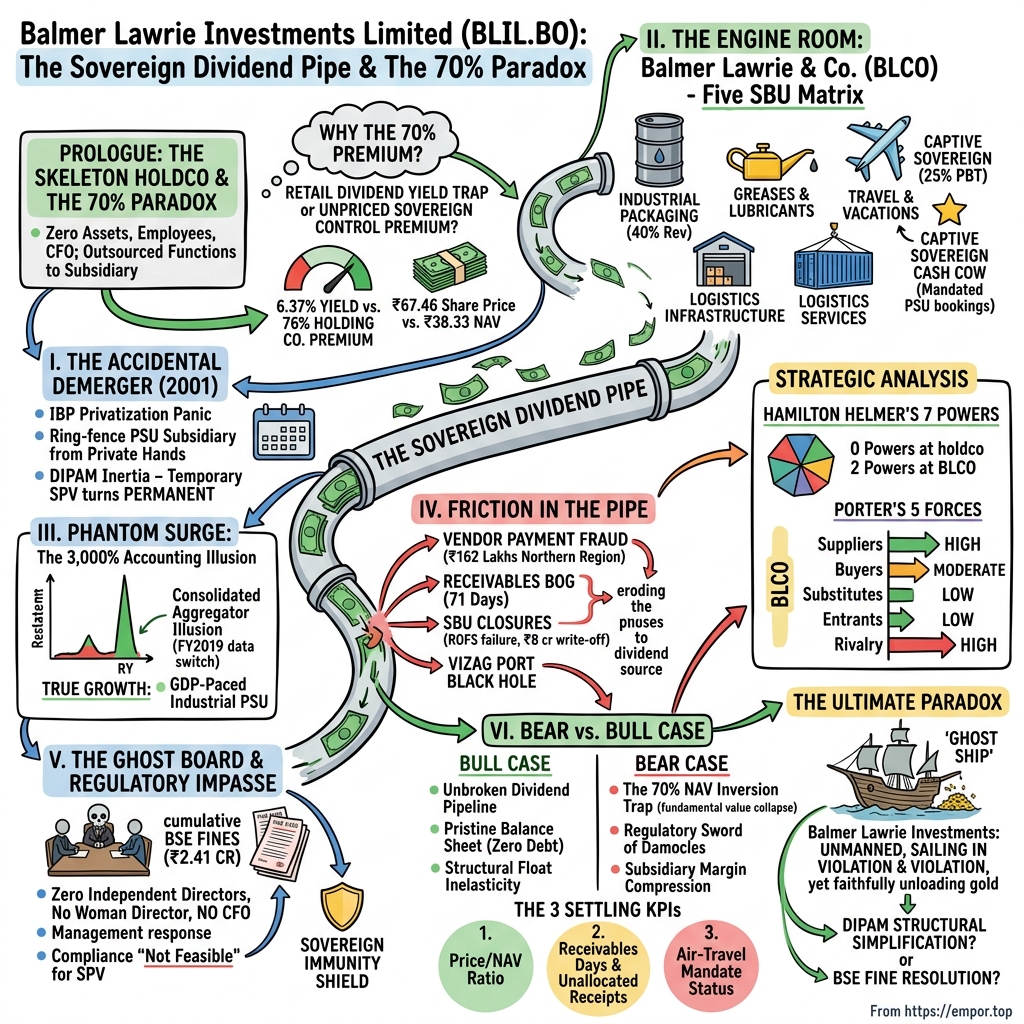
Balmer Lawrie Investments Limited: The Sovereign Dividend Pipe and the 70% Paradox
The Central Questions of the Story
Three questions run through this story.
The first is about price. Balmer Lawrie Investments Limited is a listed company that owns one thing that matters, a controlling stake in another listed company, and it trades at roughly three-quarters more than that stake and its cash are worth. In Indian markets, holding companies almost always trade at a discount to what they own. Is this premium a retail yield trap, or does it reflect some sovereign control value that the market has not priced?
The second is about rules. The company has no independent directors, no woman director, no whole-time chief financial officer, and about ₹2.4 crore of stock exchange fines it has declined to pay. How long can a listed shell run like that before SEBI, the exchange or its own ministry forces it to change?
The third is about the source of the cash. The holding company turns its income into cash almost perfectly. The operating subsidiary underneath it, Balmer Lawrie & Co., has had vendor payment fraud, a business unit closed, customers taking longer to pay, and a large profit pool that depends on a government travel booking rule. Is the pipe's clean flow hiding problems at the source?
 Subscribe on LinkedIn
I. Prologue: The Skeleton Holdco and the 70% Paradox (00:00–15:00 | 15 min)
Picture a retail investor in Kolkata in July 2026 with the new annual report of Balmer Lawrie Investments Limited (BLIL) open on a laptop. They own the stock for its dividend and want to see what the company does. They look for a list of plants and find none. They look for the pay of the chief executive and find there is no chief executive. They look for the headcount and find there is none. What they do find is a service agreement: BLIL paid its own subsidiary about ₹56 lakh in FY2025-26 for secretarial, accounting, tax and office support, and roughly another ₹21 lakh for staff seconded from it.1 The company rents its administration from the business it controls.
That is the premise of this episode. BLIL may be the strangest holding company on an Indian exchange. It is not strange because it is complicated. It is strange because it is simple, and its share price still does not match the simple sum.
What the holdco actually is
On a standalone basis BLIL has no factories, no research spending, no plant and equipment, no borrowings and no employees on its payroll.1 Its balance sheet holds two things. The first is 10,56,79,350 equity shares of Balmer Lawrie & Co. Ltd (BLCO), a 61.80% stake in the Kolkata-based public-sector conglomerate that makes steel drums, blends lubricants, runs container freight stations and books government air travel.1 The second is about ₹160 crore of cash, almost all of it in fixed deposits with public-sector banks.1
The government of India, through the Ministry of Petroleum & Natural Gas (MoPNG), owns 59.67% of BLIL.1 The rest is split among about 53,720 shareholders, mostly individuals.1 BLIL's income comes from BLCO's dividends and the interest on its deposits. Its outflows are its own dividends and a small amount of overhead.
The arithmetic of the inversion
The valuation question can be worked through step by step.
Start with the stake. At BLCO's market price in March 2026, about ₹65 a share, BLIL's 10.57 crore BLCO shares were worth roughly ₹691 crore.1 Add the ₹160 crore of standalone cash and deposits.1 That gives a net asset value of about ₹851 crore. Divided by BLIL's 22.20 crore shares, it comes to about ₹38 per share.1
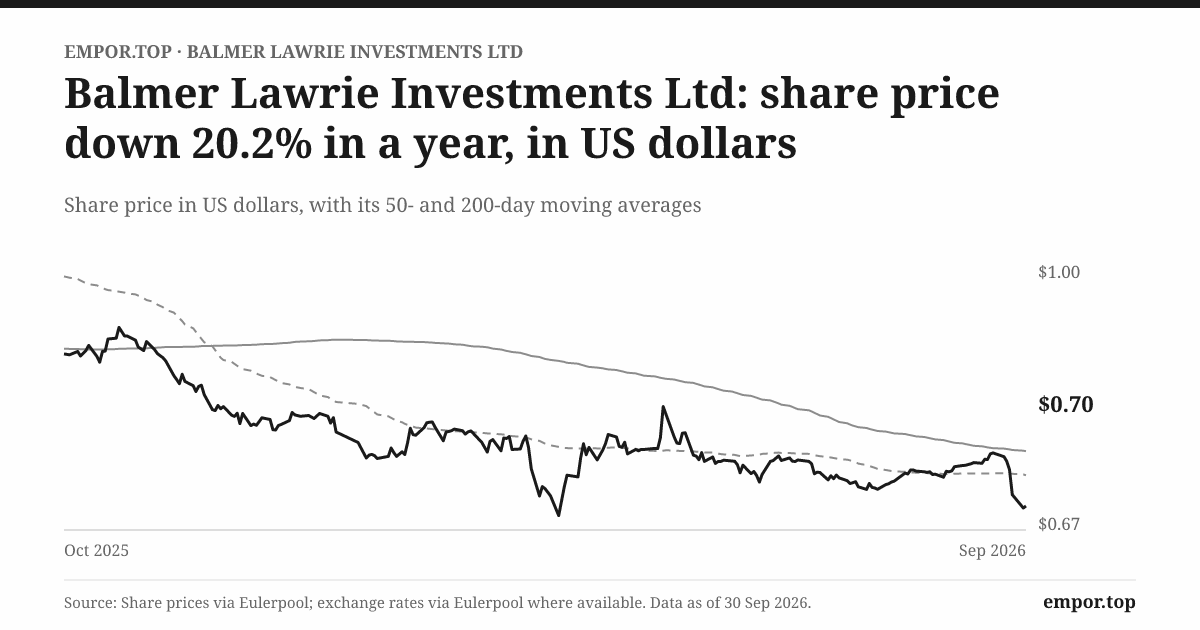
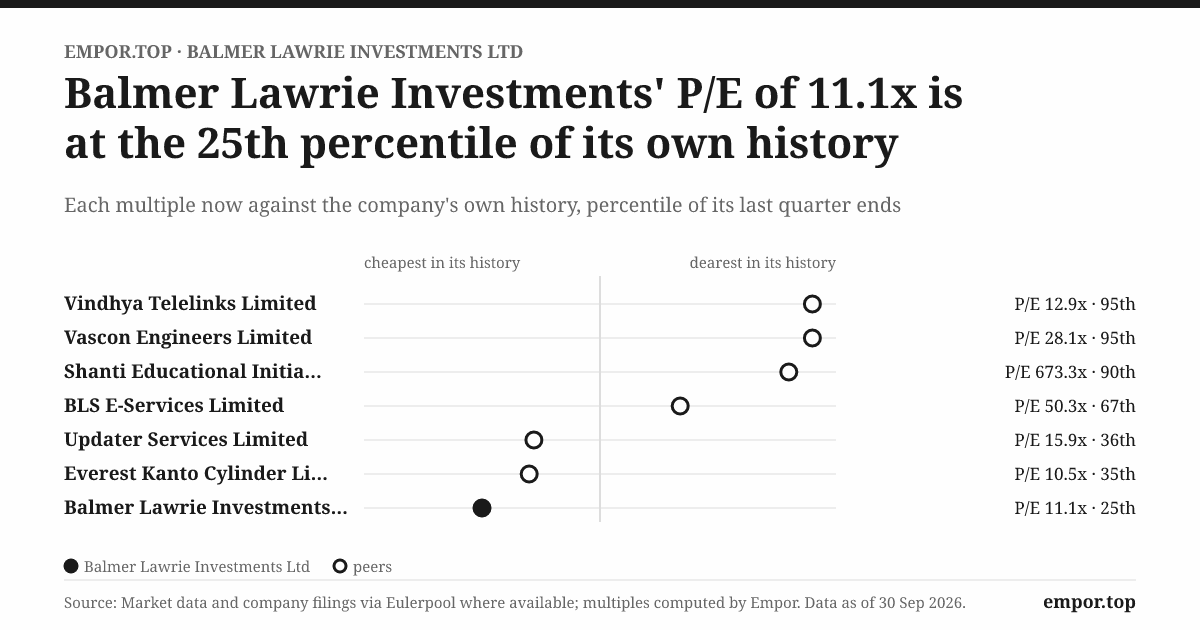
At the end of September 2026, BLIL traded at ₹67.46, for a market value of about ₹1,451 crore ($151 million).2 So the market paid about 1.76 rupees for every rupee of assets the holdco owns, a premium of roughly 76% to net asset value.
One caveat: this uses BLCO's March price. BLCO has moved since then, and the exact gap changes with it. BLIL itself traded between ₹65 and ₹81 over the past year.2 The overall picture does not depend on exact timing, though. BLCO's 61.80% stake implies about 17.1 crore BLCO shares in total, so at the March price BLCO's entire market value was around ₹1,100 crore. On that basis, the market valued the holding company, which owns less than two-thirds of BLCO, at more than all of BLCO.
The usual Indian pattern runs the other way. Listed holding companies such as Tata Investment Corporation, Bajaj Holdings and Maharashtra Scooters have tended to trade well below the value of their holdings. Discounts of 30% to 50% are commonly cited, reflecting tax leakage, lack of control and the cost of an extra layer. BLIL carries all of those costs and still trades at a premium.
Why the market does this
The likeliest explanation is the dividend. BLIL declared ₹4.30 a share for FY2025-26, an interim of ₹2.03 and a final of ₹2.27, which is a yield of about 6.4% at the September price.1 A retail investor who sees a government-controlled company paying more than a bank deposit may not work out what the underlying assets are worth. Institutions, who would, own almost none of it: foreign portfolio investors hold about 1%, and mutual funds hold 6,000 shares.1
The trade-off, stated plainly: an investor who wants BLCO's operating exposure can buy BLCO directly, with more liquidity, the same underlying business and no second layer of dividend passing. BLIL's premium means paying extra for that less efficient route.
Verdict: BLIL is not an operating business. It is a legally ring-fenced conduit for government-owned cash, and its price has moved well away from its asset backing, most plausibly because retail investors are chasing its yield. The next question is why the conduit exists at all, and that goes back to a privatisation in 2001.
II. The Accidental Demerger: How IBP's Privatisation Birthed a Sovereign Shell (15:00–35:00 | 20 min)
In 2001, New Delhi was in the middle of the most aggressive privatisation drive in India's history. The Vajpayee government had set up a disinvestment ministry and was selling state companies: hotels, Modern Foods, Bharat Aluminium, and more. One asset on the list was IBP Co. Limited, a mid-sized petroleum fuel retailer. The officials preparing the sale ran into a problem. IBP owned 61.80% of Balmer Lawrie & Co.3 Selling IBP would also sell control of a 130-year-old industrial company that the government wanted to keep.
The fix was a legal carve-out. BLIL was incorporated on 20 September 2001 as a special purpose vehicle, and under a court-sanctioned scheme of arrangement IBP's BLCO shares were moved into it.13 IBP was then sold; it went to Indian Oil Corporation in 2002. BLCO stayed under government control, now held through the new shell, and BLIL shares went to IBP's shareholders and were listed on the BSE.3
The company inside the shell
The asset being protected had a long history. Balmer Lawrie started in Calcutta in 1867 as a partnership of two Scotsmen, George Stephen Balmer and Alexander Lawrie, in the trading-house business typical of colonial Bengal: tea, shipping and agency work.4 Over the twentieth century the firm moved from trading into manufacturing and services, came into the public sector, and ended up under the administrative control of the petroleum ministry, which explains how an oil retailer came to own it.4
By the time of the IBP sale, BLCO was a diversified industrial company with a presence in drums, greases, freight and travel. None of those looked like the natural business of a private fuel retailer, and the government did not want the company to go to a private buyer as an add-on. The SPV structure let the state sell IBP while keeping BLCO.
The permanent temporary
The problem is what happened after 2002: very little. According to the company's filings, BLIL has never done an IPO, rights issue, follow-on offer or preferential allotment.1 Its paid-up capital has been fixed at ₹22.20 crore throughout.1 It has made no acquisitions and taken on no debt. The only corporate action of note in twenty-four years was a 10-for-1 stock split in June 2024, approved by postal ballot, which cut the face value from ₹10 to ₹1 to make the shares easier for small investors to buy.5 There are no warrants, options or convertibles, and no promoter pledges.1
Management's own language in its governance responses makes the point. Asked why it does not have a proper board, BLIL has said it is an SPV formed for a temporary holding purpose.1 A vehicle described as temporary has now been listed for more than two decades and has held twenty-five annual general meetings.6
The obvious simplification would be to merge BLIL into BLCO: cancel the cross-holding, give BLIL shareholders BLCO shares, and let the government hold BLCO directly. The Department of Investment and Public Asset Management (DIPAM) has pushed rationalisation across the state sector in other cases. This one has not been done. The company does not explain why, and no merger proposal appears in its disclosures to date. The likely reasons are ordinary ones: a merger needs ministry sign-off, valuation work, court or tribunal approval and shareholder votes, and it produces no revenue for anyone. Each year the shell costs little, so the easiest option is to leave it alone.
For investors, BLIL's corporate history is inactivity, not strategy. The structure exists because nobody has taken a decision to remove it, and nothing in the record suggests management has any strategic agenda of its own. BLIL's value therefore depends on what happens inside BLCO, so the next section turns to BLCO.
III. The Engine Room: Inside Balmer Lawrie & Co.'s Five-SBU Industrial Matrix (35:00–65:00 | 30 min)
Start with the product that makes the most money: a 210-litre steel drum. Flat cold-rolled steel coil is cut, rolled into a cylinder, seam-welded, corrugated for strength, fitted with ends and painted. Almost every chemical plant, lubricant blender and paint maker in India needs these barrels, and empty barrels are expensive to ship relative to their value. BLCO is India's largest maker of standard steel drums; its credit rating agencies put its share at over 30% of the organised market.17
BLCO is split into strategic business units (SBUs). In the June 2026 quarter, the first of FY2027, the five main ones reported about ₹760 crore of segment revenue and about ₹115 crore of segment profit before tax.[^8] Across a full year, consolidated revenue is roughly $315 million, a little above ₹3,000 crore at today's rates.1
1. Industrial Packaging: the scale business
Packaging is the largest unit, with about ₹309 crore of revenue in the quarter, around 40% of the total, and about ₹31 crore of profit before tax.[^8] That is a margin of about 10%.
BLCO's pricing follows its raw material. Drum contracts are indexed to cold-rolled steel prices, so when steel mills raise prices, BLCO passes the increase on after a delay.1 This protects BLCO from steel price risk over time but limits how much it can earn. It is paid for converting steel, not for anything unique about the drum. The margin comes from plant utilisation and freight savings, because factories near customers reduce the cost of moving bulky empty barrels.
2. Greases & Lubricants: the brand with a thin moat
Under the "Balmerol" brand, BLCO sells industrial greases, railway lubricants and automotive oils. The unit had about ₹115 crore of quarterly revenue and about ₹9 crore of profit before tax, a margin of roughly 8%.[^8] Its main input is base oil, largely bought from state refiners, so its profit depends on the spread between base-oil costs and finished product prices.1 BLCO competes against much larger consumer lubricant brands. In practice, Balmerol is a strong industrial and institutional brand rather than a leading retail one.
3. Logistics Services: volume without much margin
This is the freight-forwarding business: booking air and ocean cargo, customs clearance and project shipments. Revenue in the quarter was about ₹173 crore and profit before tax about ₹26 crore.[^8] Freight forwarding is a broker's business. It earns a margin on moving other companies' cargo using other companies' ships and planes, and its results move with global freight rates. Part of the post-COVID slowdown in group growth was linked to the normalisation of freight rates after the 2021-22 spike.1
4. Logistics Infrastructure: capital-heavy and uneven
The infrastructure unit runs container freight stations near ports and some cold-chain warehousing. It earned about ₹82 crore of revenue and ₹13 crore of profit before tax in the quarter.[^8] Container freight stations are a fixed-cost business: yards, cranes and bonded warehouses cost the same whether they are full or not, so profits swing sharply with port volumes and how long containers wait. This unit also holds the group's biggest investment problem, the Visakhapatnam port logistics park, covered in Section V.
5. Travel & Vacations: the government's travel desk
The fifth unit is the one to focus on. Travel & Vacations reported only about ₹79 crore of revenue in the quarter but about ₹35 crore of profit before tax.[^8] That is the largest profit of any segment, around 30% of segment profit, from about a tenth of segment revenue.
The reason is a rule, not better execution. For years, Department of Expenditure office memoranda have required central government ministries, and staff of many public bodies, to book official domestic air travel through a short list of authorised agents: Balmer Lawrie, Ashok Travels & Tours and IRCTC.8 Government officials have to use one of three booking channels, and Balmer Lawrie is one of them. Much of the travel unit's economics is effectively a service fee on government travel with guaranteed demand.
Myth vs reality: the diversification shield
Myth: Five different businesses protect BLCO from any single downturn.
Reality: Profit is concentrated. In the June quarter, packaging and travel together produced about 57% of segment profit before tax, and adding freight forwarding takes the total to about 80%.[^8] The lubricant and infrastructure units add revenue but relatively little profit. The spread across businesses does reduce revenue volatility. It does much less for profit stability, because one of the two main profit sources depends on a Finance Ministry rule.
That changes how BLCO's risk should be read. A steel downturn hurts packaging, but gradually and partly offset by pass-through pricing. A change to the travel rule could remove a large share of group profit in one step. The credit agencies still rate BLCO at the high end, [ICRA]AA+ and CARE AA+, citing government ownership, low debt and market leadership in drums.71 Those ratings measure BLCO's ability to repay debt, not how durable its profits are.
Verdict: BLCO is a mature, cash-generating industrial company whose best profits come from a cyclical conversion business and a government-protected travel desk. It is sound but not growing quickly, and part of its value depends on regulation. That makes the headline growth figures reported for BLIL look even stranger.
IV. The Phantom 3,000% Surge: Untangling the Consolidated Aggregator Illusion (65:00–85:00 | 20 min)
Imagine a quantitative stock screen run over a decade of Indian financial data. One company stands out: BLIL's revenue grew about 53% a year compounded over ten years, including a jump of more than 3,000% in FY2019. A system that trusted those numbers would rank BLIL as one of India's fastest-growing companies.
It isn't. The explanation is how the data was collected.
The entity-boundary blunder
Up to FY2018, the financial data providers behind many screens recorded BLIL's standalone accounts: the holdco only, with its dividend and interest income of about $5 million to $9 million a year. From FY2019 they switched to consolidated accounts, which include all of BLCO's operations.1 No earlier years were restated. In the data, revenue went from about $9 million to $261 million in one year, which is the 3,000% jump.1
The same break shows up across other measures. Operating margins fall from near 100% (a holdco whose income is almost pure dividends) to the low teens (a drum maker). Return on equity falls from about 40% to single digits. Debtor days spike to about 3,500 in FY2018. None of these reflect real changes in the business. They reflect two different entities being joined in one data series.
What real growth looks like
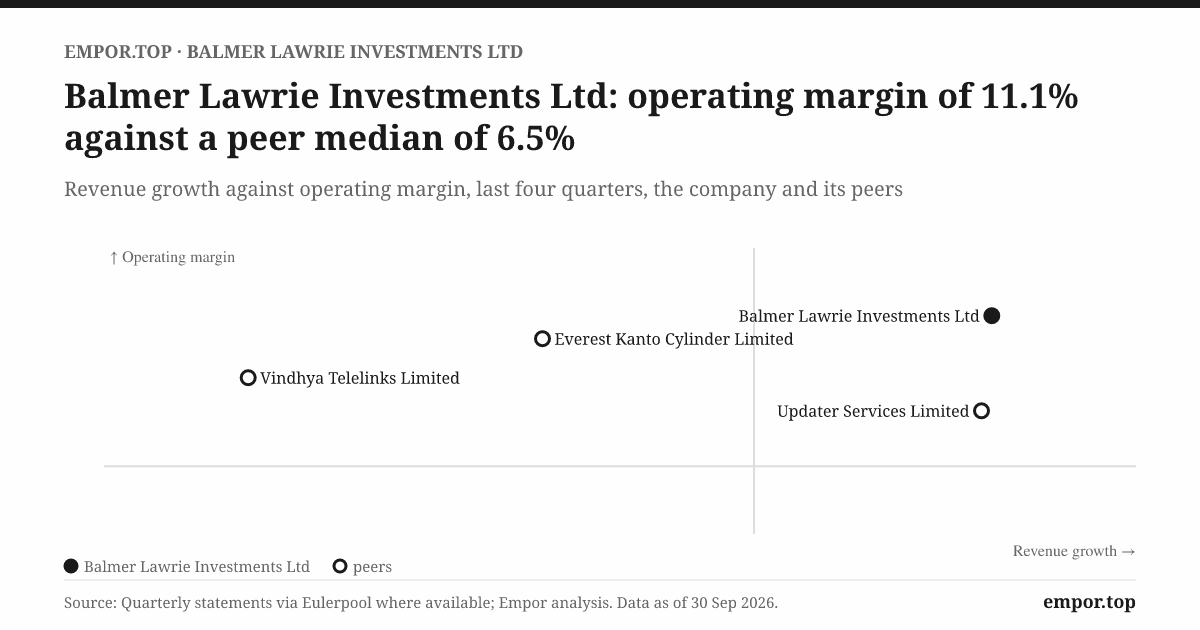
Using only consolidated years, the picture is much calmer. Consolidated revenue grew about 5.7% a year over the three years to FY2026 and about 12% a year over five years, the latter helped by starting from the COVID-affected FY2021.1 That is in line with a mature Indian industrial company growing roughly with nominal GDP. Net profit grew faster, about 17% a year over three years, as margins recovered from pandemic-era lows.1
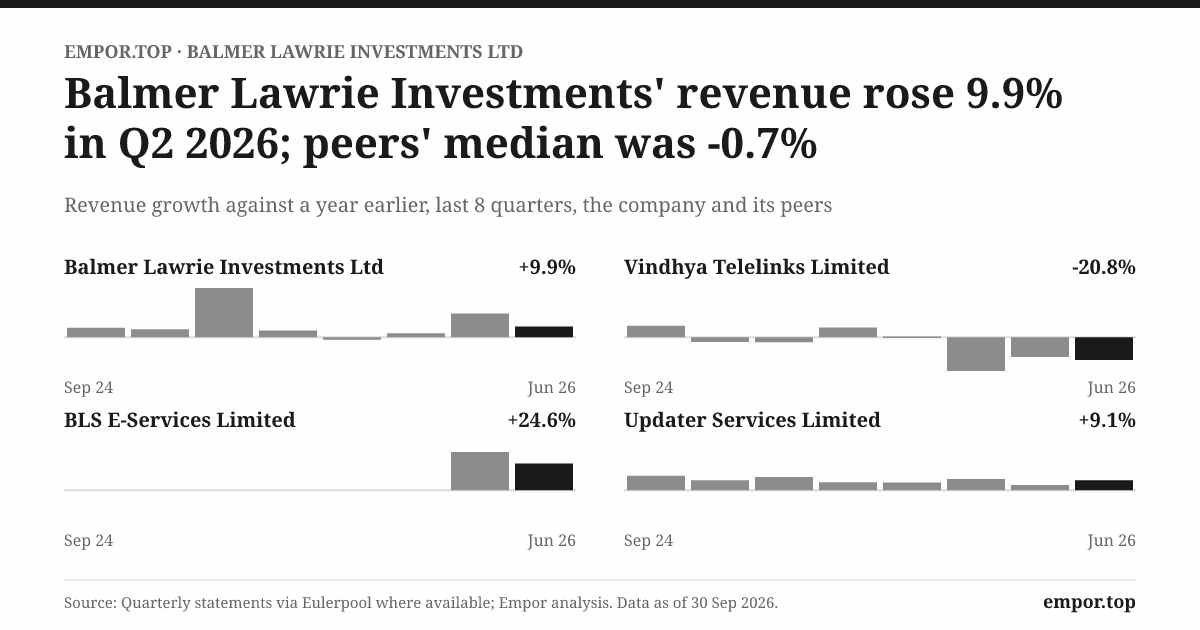
The quarterly results are consistent with this. Revenue in the June 2026 quarter was up about 10% on the year before, and net profit was up about 2%.[^8] The business is growing steadily but not quickly.
The standalone year that looked like a boom
The standalone accounts show a large increase for a different reason. BLIL's standalone total income rose about 44% in FY2025-26, from about ₹101 crore to about ₹146 crore, and standalone profit rose a similar amount to about ₹142 crore.1 This did not come from BLCO earning more. BLCO paid both an interim and a final dividend within the fiscal year, so BLIL recorded about one and a half years of dividends in one year: dividend income rose 50% to about ₹135 crore.1 Interest income fell slightly, to about ₹11 crore, as deposits were renewed at lower rates.1
This is a timing effect. Anyone treating FY2026 standalone profit as a new baseline will overstate the holdco's recurring earnings. The ₹4.30 dividend per share looks more generous than a normal year's cash flow would support if the extra timing boost does not repeat.
Profit into cash
Cash flow is where BLIL looks strongest. Over the twelve years to FY2026, the consolidated group generated about ₹1,675 crore of operating cash flow against about ₹1,181 crore of net profit, a ratio of about 142%.1 Most of the gap is depreciation, a non-cash charge of about ₹130 crore a year that reduces profit but not cash.1 The weak year was FY2022, when operating cash flow fell to about 11% of EBITDA as post-lockdown supply chains tied up cash in inventory and unbilled freight work; it recovered afterwards.1
At the standalone level, conversion is essentially complete. In FY2025-26, BLIL earned about ₹142 crore, generated about ₹139 crore of operating cash and paid out about ₹141 crore of dividends.1 It keeps almost nothing.
Verdict: The long-term growth figures are a data artefact. Actual growth is mid-single-digit revenue growth at a mature company, and the recent standalone jump is one-off dividend timing. The cash conversion, however, is real. The next question is how reliable the source of that cash is.
V. Friction in the Pipe: Vendor Fraud, SBU Closures, and the Receivables Bog (85:00–110:00 | 25 min)
In mid-2026, the statutory auditors signing BLIL's consolidated accounts in Kolkata set out, under key audit matters and a qualified opinion on internal financial controls, a list of problems at BLCO that the holdco's clean cash figures do not show.1 The holdco has no receivables, no bad debts and no operations of its own.1 All of its operating risk sits inside BLCO.
The receivables problem
Measured against revenue, consolidated receivables roughly doubled in two years, from about 36 days of sales in FY2024 to about 71 days in FY2026.1 Longer collection times can be innocent, for example a shift toward slower-paying government customers or timing at year end. The auditors' findings suggest part of it is not. They flagged balances at BLCO overdue for more than three years across several units, low response rates when customers were asked to confirm balances, long-standing unadjusted credit balances, and an "unallocated receipts" account holding customer payments that could not be matched to specific invoices.1
An unallocated receipts account means a customer has paid but the company cannot tell which invoice the payment covers. In a small amount it is routine. When auditors raise it as a control weakness, it suggests the billing and collection records are not reliable, which makes it harder to judge which receivables are good, which are doubtful and which have already been paid.
Four specific problems
1. Vendor payment fraud. An internal review at BLCO found irregular vendor payments covering FY2022-23 to FY2024-25. Branch auditors in the Northern Region identified doubtful transactions of about ₹1.6 crore, which were recorded as recoverable, fully provided for, and referred to an external forensic investigation.1 The amount is small for a ₹3,000 crore group. What matters is that it went on for three years before being found.
2. Loyalty coupon fraud. Under the Balmerol Connect Plus programme, suspected unauthorised redemptions of digital loyalty coupons of about ₹17 lakh were found in the Western Region. This led to an internal investigation and a material weakness finding in internal controls.1
3. Oilfield services closure. In May 2025, BLCO's board approved closing its Refinery & Oilfield Services unit. An impairment of about ₹8 crore was booked in FY2025-26 based on independent valuations.1 Also in the notes are about ₹3.2 crore of old creditor balances in a Kolkata division, unpaid for years because of litigation.1
4. The Visakhapatnam logistics park. BLCO holds 60% of Visakhapatnam Port Logistics Park Limited, which has made continuous operating losses and has negative net worth.1 BLCO has lent it about ₹14.6 crore, guaranteed a further ₹7.7 crore and built up about ₹9.5 crore of provisions for doubtful debts.1 BLCO still records interest income on the loan, about ₹1.4 crore last year, from a subsidiary that does not appear able to pay it.1
Testing capital allocation
Claim: BLCO is a disciplined capital allocator that returns almost all of its cash.
Evidence: Part of that is correct. Over twelve years the group paid out about 90% of its free cash flow as dividends and increased its cash holdings.1 Capital spending has been modest: net fixed assets grew about 5% a year over three years.1 The problems are in where the capital that was retained went. The Visakhapatnam park, the oilfield services unit and parts of the infrastructure business are all investments in logistics and services that have been impaired, provided for or closed. BLCO has been good at paying out cash and weaker at investing it.
The overall claim holds only in a narrower form: BLCO pays out reliably and invests little, and the investments it has made outside its core drum and travel businesses have a poor record. The measures to watch are whether receivables fall back toward the mid-30s in days, what the forensic report finds, and whether the Visakhapatnam loan eventually has to be written off.
Verdict: None of these issues threatens BLCO's solvency. Together they show weak internal controls at the company that produces all of BLIL's cash. The holdco's governance, discussed next, is weaker still.
VI. The Ghost Board: Living with ₹2.4 Crore in Fines and No CFO (110:00–130:00 | 20 min)
Every listed Indian company has to publish a secretarial audit report, Form MR-3, in which an independent company secretary confirms compliance with company law and SEBI's listing rules. BLIL's report for FY2025-26 contains five qualifications, and BLIL's written response to them is that compliance is not feasible for the company.1
The three-person board
BLIL's board has three members. The non-executive chairman is Saurav Dutta, who holds the role ex officio and is also Director (Finance) of BLCO.1 The other two are government nominee directors from the petroleum ministry, Romon Sebastian Louis and Aditya Shekhar Singh.1 None of them receives a salary, bonus, stock options or sitting fees from BLIL.1
In effect, BLCO's finance director oversees the company that owns BLCO, and ministry officials fill the remaining seats. No director represents the roughly 40% of shareholders who are not the government.
Five qualifications
The secretarial auditor listed:
- Board composition: below the required minimum size, with no independent directors and no woman director, in breach of Section 149 of the Companies Act and Regulation 17 of SEBI's LODR rules.1
- Quorum: failure to meet the quorum requirements for board meetings under Regulation 17(2A).1
- Committees: the audit, nomination and remuneration, and stakeholders' relationship committees do not meet legal requirements because there are no independent directors to sit on them.1
- CSR: the CSR committee does not meet the requirements of Section 135(1).1
- No CFO: no whole-time chief financial officer has been appointed, contrary to Section 203.1
Management's response is consistent: BLIL is an SPV formed for a temporary holding purpose, board appointments are made by the administrative ministry, and a whole-time CFO is not feasible.1
The fines
BSE levies fines each quarter on companies whose boards do not meet the listing rules. BLIL's cumulative total reached about ₹241 lakh (₹2.4 crore) by 31 March 2026, including about ₹44 lakh for FY2025-26 and about ₹38 lakh for the year before.1 BLIL has not paid them. It has filed waiver requests arguing that director appointments are outside its control, and it shows the amount as a contingent liability rather than a provision.1
The amount is not large relative to annual dividends of about ₹95 crore. It is still important. It is a growing claim against the company that the company has chosen not to settle, and it shows an exchange enforcing its rules against a government-controlled issuer that argues they cannot apply to it.
Do shareholders object?
Not noticeably. At the 25th AGM on 21 September 2026, all resolutions were passed. Votes against Saurav Dutta's reappointment were about 1.2% and against the nominee directors about 1.3%.6 With the government holding almost 60% and institutions holding almost nothing, there is no group of shareholders large enough to push back.
Testing the governance claim
Claim: Government ownership brings stability and protects minority shareholders.
Evidence: Stability, yes: dividends have been paid for two decades and there has been no dilution.1 Protection of minority shareholders, no. Minority holders have no representation on the board, the committees meant to protect them are not validly constituted, and the controlling shareholder has chosen not to comply with listing requirements for years. The record does not support the claim that government ownership aligns BLIL with minority shareholders. The accurate version is that government ownership makes BLIL predictable, and that predictability depends on a government decision that could change.
Verdict: The government treats BLIL as an administrative holding rather than a listed company with obligations to other shareholders. So far it has faced few consequences. The following section looks at whether the underlying business has any real advantages.
VII. Strategic Analysis: Hamilton Helmer's 7 Powers & Porter's 5 Forces (130:00–155:00 | 25 min)
Compare BLIL with the better-known Indian holding companies. Tata Investment Corporation holds a portfolio of stakes in Tata group companies and others. Bajaj Holdings holds large stakes in Bajaj Auto and Bajaj Finserv. Each has a group behind it, some capital allocation role and some independent directors. Each has also usually traded at a discount to its holdings. BLIL has one holding, no capital allocation role and no independent directors, and it trades at a premium. The question is what, if anything, supports that.
Hamilton Helmer's 7 Powers
Helmer's framework asks which of seven structural advantages lets a business earn above-normal returns over time: scale economies, network economies, counter-positioning, switching costs, branding, cornered resource and process power.
At the BLIL level: none of the seven. The holdco has no customers, no products and no pricing. Any advantage is BLCO's. BLIL's only distinctive feature is legal: it holds a controlling stake that the government chooses not to hold directly. That is a structural fact, not a competitive advantage.
At the BLCO level: two, both limited.
Cornered resource (moderate, fragile). The government air-travel mandate is the clearest advantage BLCO has: a protected channel that a private competitor cannot enter on its own.8 It explains why the travel unit earns such high margins on relatively little revenue.[^8] It is fragile because it exists at the government's discretion. The same ministry that created it can widen the list of agents or allow direct booking through airlines or online platforms. The resource belongs to the government; BLCO only has access to it.
Scale economies (moderate). In packaging, BLCO's national network of drum plants near chemical and lubricant clusters gives it a freight cost advantage, and its market share gives it purchasing volume in steel.17 This is a real but local advantage. It is limited by how far drums can be economically shipped, and pass-through pricing means much of the benefit goes to customers.
Not present: switching costs in lubricants or forwarding, where customers can change suppliers at the next tender; network effects; counter-positioning; process power in standardised drum making; and a consumer brand strong enough to charge premium prices. Balmerol is an established name but earns margins of only about 8%.[^8]
Porter's 5 Forces (consolidated BLCO)
- Supplier power: high. Steel coil comes from a few large Indian mills and base oil mostly from state refiners.1 BLCO buys from much larger and more concentrated suppliers.
- Buyer power: moderate to high. Drum customers are large chemical companies and oil marketers who buy by tender. In travel, the buyer is the government, which also sets the rules.
- Threat of substitutes: low to moderate. Steel drums face slow substitution from plastic drums and intermediate bulk containers for non-hazardous goods. Government travel booking could be moved to direct or digital channels by a policy change.
- Threat of new entrants: low. A national network of drum plants is expensive to build. The low margins in lubricants and forwarding also discourage entrants, which shows those businesses are not very profitable.
- Rivalry: high. Lubricants compete with Castrol, Gulf Oil and Tide Water Oil. Freight forwarding competes with global firms such as DHL and Kuehne+Nagel and many small local operators.
What the returns show
Consolidated return on capital employed was about 10.5% in FY2026, below the roughly 14% of FY2024.1 Return on equity has been around 12% to 13% for three years.1 These are acceptable returns for an Indian industrial company with a large cash balance, not the returns of a company with a strong competitive position. The numbers are consistent with the analysis above: one policy-based advantage, one local scale advantage, and several ordinary competitive businesses.
Verdict: BLIL has no advantages of its own. What it has depends on BLCO's drum scale and on the government's travel rule, and the second of these could be changed by a government memorandum. The next section sets out how bulls and bears read this.
VIII. Bear vs. Bull Case & The 3 Settling KPIs (155:00–175:00 | 20 min)
Consider an arbitrage desk looking at the obvious pair trade: short BLIL at 1.76 times net asset value and buy BLCO against it. In theory, if the premium closes, the trade profits. In practice, BLIL is hard to short. The government holds almost 60% and will not lend or sell shares, retail investors hold about a quarter and trade rarely, and institutions own about 1%.1 There are few shares available to borrow and little liquidity. The same factors that make the premium hard to trade away are what allow it to persist.
The bull case: a government-backed annuity
Reliable pass-through. BLIL passes on almost all its cash and has paid dividends every year on record, with ₹4.30 per share for FY2026.1 For an investor who values income, it works as a roughly 6% yield from a company with no debt, government control and about ₹160 crore of cash in state banks.1
Strong balance sheet. The holdco has no debt. BLCO's debt-to-equity ratio is about 0.15, it holds AA+ ratings, and its interest cover is comfortably high.17 Neither entity has refinancing risk.
Limited float. With the government holding about 60% and retail investors about 24.6%, relatively few shares trade.1 Price can stay away from asset value for long periods because few holders ever sell for arbitrage reasons.
On the bull case: The dividend is real and the balance sheet is sound. The argument does not explain why buying the dividend through BLIL is better than buying BLCO directly. Both receive BLCO's dividends, and BLIL simply passes them on. A premium based only on yield depends on buyers not comparing the two.
The bear case: the gap closes
Merger at fair value. If DIPAM or the ministry ever merges BLIL into BLCO, the swap ratio will be based on asset value, and asset value is about ₹38 a share. Converging to that level from ₹67 would mean a fall of about 43%.1 This is not a forecast. It is what a merger would imply mathematically.
Regulatory action. SEBI's standard procedures for continued listing non-compliance allow escalating steps, including freezing promoter holdings. The ₹2.4 crore of unpaid fines and five audit qualifications mean the regulator has grounds to act if it chooses.1 Its past leniency toward government-controlled companies is a pattern, not a guarantee.
Weaker cash at BLCO. The vendor fraud, material weakness findings, oilfield closure and Visakhapatnam exposure all reduce the cash available for BLCO dividends.1 If the travel mandate changed, the effect would be much larger.
On the bear case: The downside is large and depends on events. The timing is uncertain because it depends on a ministry that has left this structure alone for two decades. A short position that waits for that decision could be waiting for years while paying a 6% dividend yield to the other side.
Overall: The balance of risk is asymmetric. A merger or reversion to normal holding company valuations would take away much of the price. The upside, a higher dividend from BLCO, would benefit BLCO shareholders equally and more directly. The evidence points to BLIL's premium being paid for convenience, not for any additional value.
The three KPIs that settle it
- BLIL price to standalone net asset value. Currently about 1.76x, using BLCO's March 2026 price.12 A move toward 1.0x or below would mean the premium is closing. This matters more than any earnings figure.
- BLCO receivable days and the unallocated receipts balance. Up from about 36 days to about 71 over two years.1 A move back toward the 30s would suggest the collection problems are being fixed. Staying near 70 would mean the control weaknesses persist.
- The status of the government air-travel mandate. Currently in force.8 Any Finance Ministry memorandum allowing open booking for government travel would directly affect BLCO's most profitable unit.
IX. Playbook: Business & Investing Lessons (175:00–195:00 | 20 min)
1. The Yield Blindfold: High dividend yields can turn market logic upside down.
The moment: About 53,700 shareholders, mostly retail, hold a company priced at roughly three-quarters above the value of what it owns, because it pays about 6.4%.1 The same dividends are available one step closer to the source, at a lower price per rupee of underlying asset.
The lesson: A dividend is a distribution of value, not a source of it. When a pass-through vehicle trades at a premium to the asset it passes through, the buyer is paying extra for the same cash. The general rule for investors: before accepting a yield, work out what the underlying asset is worth.
The line: "When retail capital hunts for yield, it forgets that you cannot make a purse out of a pass-through."
2. The Permanent Temporary: In state bureaucracies, an emergency placeholder outlives its architects.
The moment: A vehicle set up in September 2001 to protect one asset during one privatisation was still listed a quarter-century later, still describing itself as temporary when asked about its board.13
The lesson: A structure created to solve a one-time problem lasts as long as removing it costs more effort than keeping it. For companies controlled by governments or families, investors should ask not only why a structure exists but who is responsible for ending it. If no one is, it will likely continue, along with any mispricing.
The line: "Nothing in corporate governance is so permanent as a temporary government SPV."
3. Look Below the Conduit: Cash conversion at the holdco is only as clean as the accounting at the plant.
The moment: In the same annual report, BLIL shows essentially complete conversion of profit into cash and dividends, while auditors report vendor fraud, unmatched customer receipts and an ₹8 crore closure charge at the subsidiary.1
The lesson: A holding company's figures describe how cash moves, not how healthy its source is. The quality of the earnings is decided at the operating level, so that is where the analysis has to happen.
The line: "A clean pipe can still carry contaminated water; never confuse pass-through speed with operating health."
4. The False Flywheel of Data Aggregation: Screeners don't read footnotes.
The moment: A reported revenue jump of more than 3,000% in FY2019, caused by data providers switching from standalone to consolidated accounts without restating earlier years.1
The lesson: Growth rates, margins and returns all depend on which entity is being measured. When a data series suddenly changes character, check whether the company changed or the measurement did.
The line: "Algorithms buy numbers; analysts read boundary conditions."
5. The Skeleton Shield: Sovereign ownership creates regulatory immunity until the fines come due.
The moment: A listed company accumulating about ₹2.4 crore of unpaid exchange fines, asking for a waiver on the basis that its owner, the government, appoints its directors, and telling its auditor a CFO is not feasible.1
The lesson: Government ownership reduces some risks, such as default and dilution, and increases others, such as governance and policy risk. Minority shareholders have no way to force change.
The line: "A private company without a board gets delisted; a state enterprise without a board asks for a waiver."
X. Epilogue & The Next Decision Points (195:00–205:00 | 10 min)
As of 30 September 2026, BLIL is where it has been for most of its history. The AGM held nine days earlier approved every resolution.6 The final dividend of ₹2.27 has been declared.1 The June-quarter results showed BLCO's revenue up about 10% and profit up modestly.[^8] The shares trade at about ₹67, about 17% below their 52-week high.2 On the surface nothing has changed. Three possible developments could change things.
First, a decision on structure. Whether the ministry and DIPAM decide to merge BLIL into BLCO. Nothing in the company's disclosures shows such a plan. If one appears, the swap ratio will be based on asset value, and the first central question, whether the premium is a retail yield trap or something more, would be settled quickly and in favour of asset value. If no plan appears, the premium can continue, sustained by the dividend and the small float.
Second, the fines. Whether BSE grants the waivers, which would signal that government-controlled holdcos can ignore board requirements, or whether SEBI takes stronger action, which would force the ministry either to appoint independent directors or finally to merge the entity. Either outcome answers the second central question. Continued inaction also answers it, in favour of the status quo.
Third, the operating issues. The findings of the external forensic review of Northern Region vendor payments, the eventual outcome of the Visakhapatnam loan, and whether receivable days fall back toward historical levels.1 Together with any change to the travel mandate, these will answer the third question: whether the cash reaching BLIL is as dependable as it appears.
The outcomes point in different directions. A merger resolves the valuation gap. Continued regulatory tolerance preserves an unusual dividend vehicle at the cost of governance credibility. Deterioration at BLCO would reduce the dividend that supports the premium. Each outcome leads away from the current state, but it is unclear which will come first, and the status quo has already lasted twenty-five years.
XI. Outro (205:00–210:00 | 5 min)
Return to the Kolkata investor with the annual report. BLIL's registered address is BLCO's head office at 21 Netaji Subhas Road, in the old commercial district where Balmer and Lawrie set up their partnership in 1867.34 The holdco has no separate office, staff, factories, independent directors or chief financial officer.1 Even so, over the years covered by the data it has passed on a steady flow of BLCO's dividends; the consolidated group alone paid out about ₹1,000 crore in the twelve years to FY2026, much of it to the government and BLIL's public shareholders.1
That is the unusual thing about BLIL. It is not a fraud, a growth company, a turnaround or a value trap in the usual sense. It is an administrative arrangement that has become a stock, priced by investors who value its dividend more than a comparison with what it owns would justify.
Balmer Lawrie Investments is the ultimate bureaucratic ghost ship: completely unmanned, sailing in perpetual violation of maritime law, yet faithfully unloading a chest of gold onto the Kolkata docks every twelve months.
References
-
Annual Report 2025-26 — Balmer Lawrie Investments Limited, 2026-07-07 ↩↩↩↩↩↩↩↩↩↩↩↩↩↩↩↩↩↩↩↩↩↩↩↩↩↩↩↩↩↩↩↩↩↩↩↩↩↩↩↩↩↩↩↩↩↩↩↩↩↩↩↩↩↩↩↩↩↩↩↩↩↩↩↩↩↩↩↩↩↩↩↩↩↩↩↩↩↩↩↩↩↩
-
Balmer Lawrie Investments Ltd share price and shareholding pattern — BSE India, 2026-09-30 ↩↩↩↩
-
About Company and History — Balmer Lawrie Investments Limited, 2026-09-30 ↩↩↩↩↩
-
Balmer Lawrie Investments Limited Profile and Holding Structure — Balmer Lawrie & Co. Ltd., 2026-09-30 ↩↩↩
-
Postal Ballot Scrutinizer Report for 10:1 Stock Split — Balmer Lawrie Investments Limited, 2024-06-11 ↩
-
Scrutinizer Report and Voting Results of 25th Annual General Meeting — Balmer Lawrie Investments Limited, 2026-09-22 ↩↩↩
-
Credit Rating Reaffirmation Disclosure for Balmer Lawrie & Co. Ltd — ICRA Limited, 2026-03-30 ↩↩↩↩
-
Office Memorandum on Guidelines for Air Travel on Official Tours — Department of Expenditure, Ministry of Finance, Government of India, 2022-06-16 ↩↩↩
 LinkedIn
 WhatsApp
 Reddit
 Hacker News
 Email
Email Kindle
 RSS Feed
 Spotify
 Apple Podcasts
 Amazon Music
 Audible
 YouTube