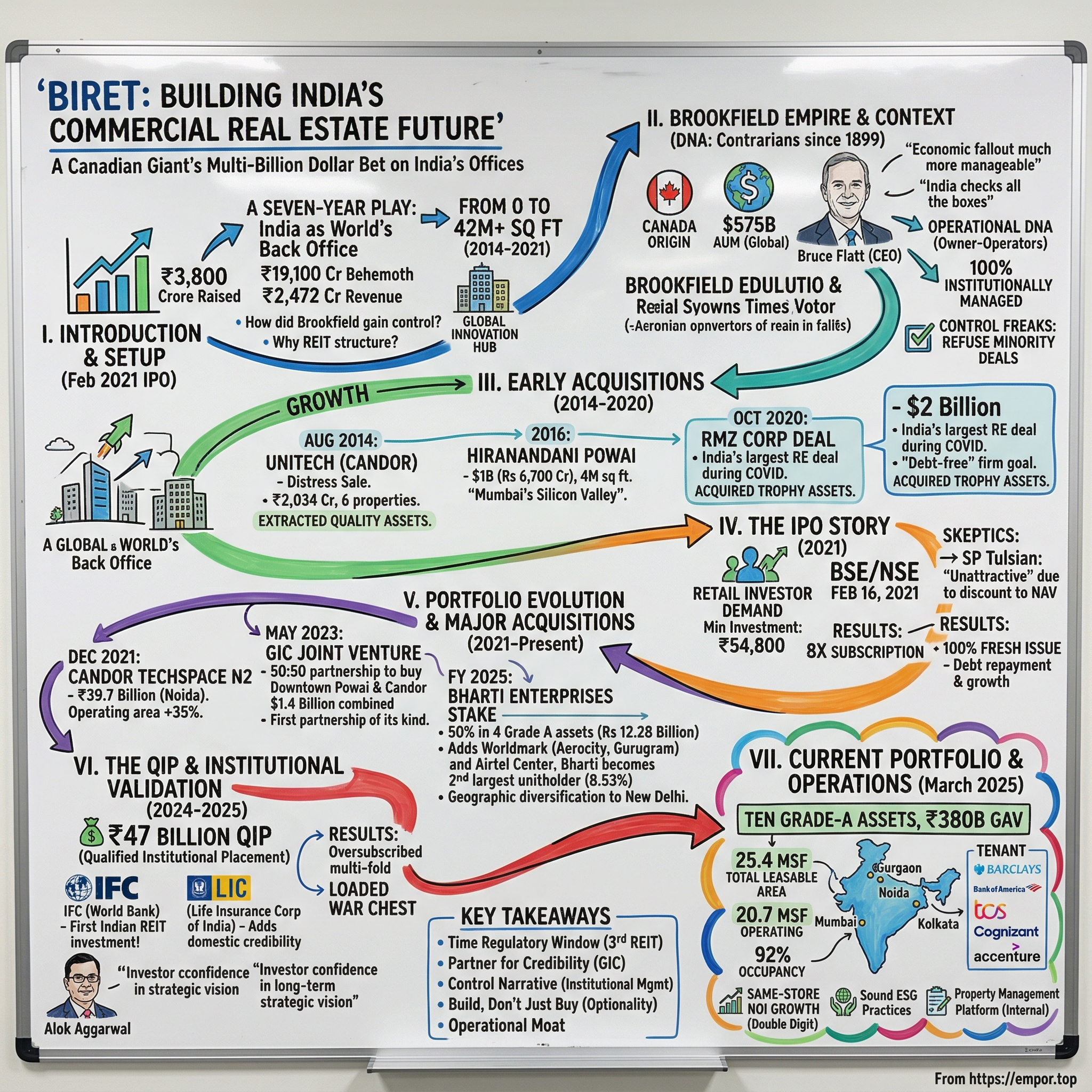
Brookfield India REIT: Building Scale Through a Sponsor's Own Pipeline
I. Introduction & Episode Roadmap
On the morning of February 16, 2021, the trading screens at India's National Stock Exchange did something almost nobody in the room had scripted: nothing much. Brookfield India Real Estate Trust had priced its initial public offering at ₹275 a unit, raised ₹3,800 crore, and drawn a 39-investor anchor book. And then it opened at ₹279 — up 1.45% — and essentially flatlined on the BSE.1 Seven months earlier, Mindspace Business Parks REIT had popped more than 10% on debut. Two years before that, Embassy Office Parks had listed at a comfortable premium and never really looked back. India's third REIT arrived to polite applause and an audible shrug.
That shrug is the right place to start this story, because Brookfield India REIT — BIRET on the NSE ticker — has spent the five and a half years since trying to answer the question the market implicitly asked on day one: what, exactly, is this thing for?
The formal answer is straightforward. BIRET is India's only 100% institutionally managed listed commercial real estate trust: no founding developer family, no promoter with a construction arm, no legacy land bank. It is sponsored by an affiliate of Brookfield Asset Management, managed by a Brookfield subsidiary, and populated with Grade-A office campuses leased to multinational tenants.2 The unglamorous answer is that BIRET is a listed balance sheet — a permanent-capital vehicle sitting downstream of one of the world's largest private real estate franchises, buying finished buildings and turning their rent into quarterly distributions.
The interesting answer, and the tension worth holding for the length of this piece, is this: is BIRET compounding real estate value for its unitholders, or is it primarily a unit-issuance machine that keeps buying its own sponsor's buildings?
The case for the second reading is not a conspiracy theory. It is arithmetic. Since listing, BIRET has grown gross asset value roughly fivefold, from about ₹11,500 crore at IPO to ₹56,500 crore by March 2026.3 It has gone from roughly 14 million square feet of completed area to a 32.6 million square foot office platform spanning seven cities, after closing India's largest single office real estate transaction ever.4 By almost any headline measure, the platform has been an enormous success.
And yet: in FY2022, its first full year as a listed trust, BIRET distributed ₹22.10 per unit.5 In FY2026 — after the fivefold asset growth, after four major acquisitions, after a record leasing year — it distributed ₹21.40 per unit.3 Five years of relentless expansion, and the cheque a unitholder received per unit was still slightly smaller than in year one.
That is not a gotcha. There are real, defensible reasons for it: a brutal occupancy downcycle in the middle, a rate shock, and the mechanical arithmetic of equity issuance. But it is the fact around which every other fact in this story has to be organised, because it is the difference between "growing" and "creating value per unit," and those are not the same verb.
Over the next fourteen sections we will work through it in order. Where the portfolio actually came from — assembled by Brookfield's private funds between 2014 and 2020, years before any of it was listed. How the REIT was constructed as a financing wrapper around those assets. The five post-IPO acquisitions that tripled the platform, one of which triggered a genuine credit-rating penalty. The near-annual capital raises that funded them, the sponsor's own decision to sell units into the market while unitholders were being asked to buy more, and a small but pointed SEBI settlement over how distributions were funded. Then the operating reality — a real occupancy collapse and a real recovery, and what re-leasing spreads through that cycle do and do not prove about pricing power. Then the competitive field, the governance architecture, the credit story, and finally the bull and bear cases, tested against the record rather than against the pitch.
Start where the buildings started: not in 2021, but in 2014.
 Subscribe on LinkedIn
II. Origins: Brookfield's Pre-REIT India Bet (2014–2020)
In June 2014, a London-listed shell called Unitech Corporate Parks PLC — an AIM-quoted vehicle that had raised money from British investors to own Indian office parks and had spent years disappointing them — announced it was selling its crown jewel. The buyer was Brookfield Asset Management. The asset was Candor Investments Ltd, an Isle of Man holding company that in turn held 100% of four Indian special economic zone office parks and 60% of two more, in Gurugram, Noida and Kolkata. The price was about $525 million, roughly ₹2,000 crore at the time.6
It was, on paper, an unremarkable transaction: a distressed-ish seller, a patient buyer, a portfolio of half-built IT parks in cities that global capital had largely written off after the 2008 crisis. Brookfield subsequently bought out the remaining 40% equity in the two partially owned projects, consolidating full control.7
Understanding why Brookfield wanted these buildings requires understanding what Brookfield is. It is not a developer. Its global real estate playbook has always been the same shape: buy large, operationally complex, cash-generating assets from sellers who need liquidity more than they need price, at a basis low enough that ordinary asset management — leasing up vacancy, refinancing debt, densifying sites — produces the return. It does not need a market to boom. It needs a market to be mispriced relative to its own cost of patient capital.
India's SEZ-era office stock in 2014 fit that description almost too neatly. The Special Economic Zone regime had been designed to give IT and IT-enabled services exporters tax incentives, and developers had responded by building enormous campus-format parks on the outskirts of Gurugram, Noida, Bengaluru and Hyderabad. Then the tax benefits started sunsetting, domestic developers ran into leverage problems, and a great deal of institutional-quality real estate ended up owned by people who could not afford to hold it. Meanwhile the underlying demand driver — global companies moving back-office, engineering and analytics work to India — had barely started.
The campus format mattered more than it might appear. A 30-acre park with a dozen buildings, its own power backup, transport, food courts and security is not merely a bigger office; it is a different product. Land assembly at that scale in Indian metros is genuinely hard, which raises the barrier to a competing supply response. And for a tenant running three thousand employees in shifts, moving out of a campus is not a lease decision, it is a logistics project. That is the origin of the tenant stickiness that shows up later in this story as a weighted average lease expiry of 6.7 years.4
Two years after Candor, Brookfield went considerably bigger. In October 2016 it agreed to acquire roughly 4 to 4.5 million square feet of office and retail space in Powai, Mumbai, from the Hiranandani Group for approximately $1 billion — described at the time as India's largest commercial property transaction.8 The Powai assets were nearly fully leased, with tenants including Tata Consultancy Services, Nomura and Deloitte. This was not a distressed buy in the Candor mould; it was a full-price acquisition of stabilised income in a supply-constrained Mumbai submarket.
The pair of deals reveals the strategy. Candor was the value play — cheap basis, lease-up work to do, tax-regime overhang. Powai was the quality anchor — expensive, but irreplaceable location and blue-chip cash flow. Together they gave Brookfield an India office platform with both an income floor and an upside option.
Here is the part that matters for anyone evaluating BIRET as an investment today: all of this happened before the REIT existed. The value creation from buying Indian office assets at post-crisis prices in 2014, and from underwriting Mumbai in 2016, accrued to Brookfield's private funds and their limited partners. What the 2021 IPO offered public unitholders was not participation in that trade. It was participation in what came after it — the stabilised yield, plus whatever incremental value future acquisitions might add.
That distinction is the single most under-appreciated fact in the BIRET story. The REIT is not a company that built something; it is a financing vehicle wrapped around assets that a private manager had already assembled over six years, sold into a listed structure at a valuation the private manager helped determine. Whether that is a good deal for public investors depends entirely on price and process — which is precisely why the related-party question in Section VIII is not a footnote.
By 2020, Brookfield had the platform. What it needed was permanent capital.
III. Creating India's Third REIT: The 2021 IPO
India got its REIT regulations in 2014, and then waited five years for anyone to use them. Embassy Office Parks finally listed in March 2019, backed by Blackstone and the Embassy Group. Mindspace, backed by K Raheja Corp and Blackstone again, followed in August 2020, mid-pandemic. By the time Brookfield filed, the template was established and the novelty had worn off.
The structure BIRET adopted was the standard Indian REIT architecture, and it is worth walking through slowly because it explains a lot of what follows. The sponsor is BSREP India Office Holdings V Pte Ltd, a Brookfield affiliate, which contributed the assets and retained a stake. The manager is Brookprop Management Services Private Ltd, another Brookfield entity, which runs the trust for a fee and whose board makes the decisions. The trustee is Axis Trustee Services, an independent third party holding assets on unitholders' behalf.2
Notice what is absent. There is no CEO who founded anything, no promoter whose personal wealth is tied to the unit price, no operating company with its own strategy. Unitholders own the buildings; a Brookfield subsidiary decides what to do with them. That is by design — it is the "100% institutionally managed" pitch — and it is genuinely a strength relative to REITs whose sponsor is also a developer with a pipeline it might prefer to sell into the vehicle at a favourable price. But it does not eliminate the conflict. It relocates it. Brookprop's incentive is to grow the trust; the assets it grows with have mostly come from Brookfield.
The offering itself ran from February 3 to 5, 2021. The price band was ₹274–275, the issue size ₹3,800 crore, and the anchor book ₹1,709.97 crore across 39 institutions — a roll call that mixed domestic heavyweights with global names.9 The book was subscribed roughly 7.94 times, driven overwhelmingly by institutional demand.10 On any normal reading, that is a successful IPO.
Then it listed and did nothing.
The tepid debut has usually been explained away as timing. It is more informative to read it as pricing. Embassy came to market first, with the scarcity premium of a new asset class. Mindspace listed into the post-COVID liquidity surge with a Hyderabad-heavy portfolio that the market liked. BIRET arrived third, with a portfolio concentrated in the National Capital Region — Gurugram, Noida — and heavily weighted to SEZ assets leased to IT and ITeS tenants, precisely the segment that a world one year into remote work was most nervous about. The IPO portfolio comprised four campuses and roughly 14 million square feet of completed and under-construction area, with an additional identified pipeline of about 8.3 million square feet held by Brookfield entities that the REIT had rights over.11
That last detail — the ROFO pipeline — was the actual pitch, and the market understood it. Investors were not being asked to pay for a static portfolio yielding roughly 8%. They were being asked to underwrite an acquisition engine, with the sponsor's private funds as the feedstock. The RHP said so plainly: the trust had call options and rights of first offer over sponsor-held assets.11
So the flat listing was not the market rejecting Brookfield. It was the market declining to pay up front for acquisitions it had not yet seen executed, in a portfolio whose tenant base looked structurally exposed to a work-from-home world. On both counts, the market's caution turned out to be well-founded in the short run and too pessimistic in the long run — which is roughly the definition of an efficient price.
The acquisition engine, at least, started almost immediately.
IV. Growth by Acquisition: The Post-IPO M&A Record (2022–2026)
Ten months after listing, in December 2021, Brookprop's board approved a deal that would define the next three years of the trust's life — and not entirely in the way management intended.
The N2 deal, and the bill that came due
The target was Seaview Developers Private Limited, the entity owning Candor TechSpace N2 in Noida: Noida's largest office park, 29.65 acres, 4.5 million square feet of gross leasable area across thirteen operating buildings, with one under construction and further development potential on site. The price for 100% of the equity was ₹3,970 crore.12 Completion followed in January 2022, and it was transformative on the metrics management cares about: operating area up roughly 35%, gross asset value up roughly 34%, in a single stroke.
The funding is where the story turns. BIRET paid for N2 with a ₹950 crore preferential issue of units at ₹294.25 — of which ₹495 crore went to third-party investors and ₹455 crore to the Brookfield Group itself — and ₹2,910 crore of property-level debt priced at 6.78%.13 Roughly 73% of the purchase price was borrowed.
In early 2022, that looked clever. Indian rates were near historic lows, the debt was cheap, and issuing more units at ₹294 when the market was lukewarm would have been dilutive. Borrowing to buy an accretive asset is what levered real estate vehicles are supposed to do.
Then the Reserve Bank of India began raising rates, and the office occupancy cycle turned at the same time.
In April 2023, CRISIL revised its outlook on BIRET's AAA corporate credit rating from Stable to Negative, citing leverage that had been pushed close to the 40% loan-to-value threshold the agency treated as its trigger — a direct, traceable consequence of how N2 had been funded.14 The rating itself was not cut. But the outlook stayed Negative for seventeen months. CRISIL did not restore Stable until September 27, 2024, and its rationale at that point makes the underlying stress legible: consolidated external gross debt of ₹12,600 crore as of June 30, 2024, a sensitised LTV around the 40% threshold, and — most tellingly — interest coverage of 1.5 times in fiscal 2024, down from 1.9 times in fiscal 2023.15
Read that coverage number carefully, because it is the most honest single statistic in this section. An interest cover of 1.5x on a portfolio of stabilised, long-leased Grade-A office buildings is not comfortable. It means that for every rupee of net operating income, two-thirds of a rupee was going to lenders. That is what a debt-funded acquisition plus a 250 basis point rate cycle plus an occupancy dip does to a levered vehicle simultaneously.
The analytically important point is not that management made a mistake — every real estate investor who borrowed at 2021 rates made the same one. It is that the mistake was specific, self-inflicted and capital-structure-driven, not a macro accident. BIRET chose the debt-heavy structure. And to management's credit, the record shows it did not repeat the choice.
Powai and G1: bringing in a co-investor
In May 2023, with the Negative outlook already in place, BIRET announced a very different kind of deal. Together with GIC, Singapore's sovereign wealth fund, it agreed to acquire two Grade-A assets — Downtown Powai in Mumbai and Candor TechSpace G1 in Sector 48, Gurugram — totalling 6.5 million square feet, at an enterprise value of approximately $1.4 billion, structured as an equal 50/50 partnership.16 The transaction lifted BIRET's gross asset value to about $3.5 billion and increased operating area by 44%.
Two things stand out. First, the structure. Instead of taking 100% of the asset with 73% debt, BIRET took 50% of the asset with an institutional partner writing the other half of the equity cheque. That is a materially more conservative capital structure, arrived at within a year of the rating agency's warning. It is fair to read this as the platform correcting course, and it is one of the more concrete pieces of evidence in BIRET's favour on capital discipline — evidence of behaviour change, not just of stated intent.
Second, the counterparty. The assets were bought from Brookfield-sponsored private funds.17 GIC's presence provided something valuable here that no amount of disclosure can substitute for: an unaffiliated institution with its own underwriting team, its own return hurdle and no reason to overpay, agreeing to the same price on the same terms. That is not a formal fairness opinion, but as a market test it is considerably better than one.
It is also worth stating what was not provided. No capitalisation rate was disclosed publicly for the Powai/G1 transaction. That means an outside investor cannot independently verify whether the price was fair, rich or cheap against comparable transactions. The GIC co-investment is strong circumstantial evidence; it is not proof.
Bharti: the seller who became a shareholder
The May 2024 transaction was structurally the most interesting of the five. BIRET acquired a 50% stake in the North Commercial Portfolio — 3.3 million square feet of fully operational commercial, office and retail assets in Delhi and Gurugram, including Worldmark Delhi, Airtel Center, Worldmark Gurugram and Pavilion Mall — from Bharti Enterprises for ₹1,228 crore.18 The consideration was not cash. BIRET issued 40.93 million new units to Bharti at ₹300 per unit.
The result: Bharti Enterprises became BIRET's second-largest unitholder, with an 8.53% stake, acquired by selling its own buildings into the trust.18 The assets had come into the Brookfield orbit through a joint venture the two groups had formed in 2022 covering roughly ₹5,000 crore of commercial real estate.19
A strategic seller converting into a strategic owner is genuinely elegant financial engineering. Bharti retained economic exposure to assets it knew intimately, BIRET conserved cash, and the alignment argument writes itself — a seller who takes paper rather than cash is implicitly saying the paper is worth at least what the buildings are.
The counterargument deserves equal weight. Paying in units at ₹300 when the unit price was around that level converts an asset purchase into a permanent claim on all future distributions. If the assets underperform, the dilution does not go away. And a counterparty who receives 8.53% of the vehicle acquires a voice in it. That is alignment; it is also concentration.
Ecoworld: the largest office deal in Indian history
On November 4, 2025, BIRET announced it would acquire up to 100% of the equity in Arliga Ecoworld Business Parks, owner of the Ecoworld campus on Bengaluru's Outer Ring Road, for ₹13,125 crore.20 The campus runs to 48 acres and 7.7 million square feet, leased to a tenant roster that reads like a directory of global capability centres: Morgan Stanley, Standard Chartered, Honeywell, Shell, KPMG, Deloitte, State Street.
The transaction was, on a 100%-acquisition basis, the largest single office real estate deal ever done in India, exceeding DLF–GIC's ₹11,900 crore transaction in 2017 and Blackstone's ₹7,467 crore purchase of Prestige's commercial assets in 2021.20 It expanded BIRET's portfolio by more than 30% in one step and gave the trust its first exposure to Bengaluru — the largest and deepest office market in India, and the one where global capability centre demand is most concentrated. Until Ecoworld, BIRET's absence from Bengaluru was the most obvious gap in its portfolio relative to Embassy and Mindspace.
The sellers were BSREP III New York FDI I (DIFC) and BSREP III New York II (DIFC) Ltd — both part of the Brookfield group. The transaction was classified as a related-party deal and executed, in the manager's language, on an arm's length basis.20 The acquisition completed in the third quarter of FY2026, with the equity purchase price for Arliga Ecoworld recorded at ₹7,006.30 crore.21
BKC: small deal, large signal
Most recently, in August 2026, BIRET signed binding agreements to acquire 264,000 square feet across three floors at Godrej BKC in Mumbai's Bandra Kurla Complex, for ₹1,700 crore on a 100% basis, in an equal joint venture with the Nuvama–Cushman & Wakefield Prime Offices Fund.22 The sellers — Project Diamond Holdings (DIFC) Limited and Project Cotton Holdings One (DIFC) Limited — are, once again, Brookfield group entities.23
The economics disclosed for this one are unusually specific, and worth noting precisely because they are the exception rather than the rule. BIRET disclosed a roughly 4% discount to gross asset value, an implied capitalisation rate of 7.4% on FY2028 net operating income rising to 8.1% by FY2030, a 7.1% DPU yield, a tenant weighted average lease expiry of 6.9 years, and 82% of the leased area under lock-in.4 BKC is Mumbai's central business district and among the most supply-constrained office submarkets in the country; buying stabilised, fully-leased space there at a disclosed discount to appraisal is a defensible trade.
The governance handling is the more revealing part. Under Regulation 19(5)(b)(i) of the SEBI REIT Regulations, unitholder approval was not mandatory for a transaction of this size — the value fell within prescribed limits. Brookprop sought it anyway, calling an extraordinary general meeting for September 3, 2026 as a matter of corporate governance.23 That is a voluntary standard-raising, and it should be counted in management's favour. It also, read a second way, tells you the manager understands exactly how the related-party pattern looks from the outside.
What the five deals actually show
The lazy version of this story is "BIRET systematically overpays for its sponsor's assets." The record does not support it. There is one documented, consequential capital-allocation misjudgment — N2's debt-heavy funding, which cost the trust a seventeen-month Negative outlook and drove interest coverage down to 1.5x. After it, the structures visibly changed: 50/50 with GIC, units-for-assets with Bharti, 50/50 with an independent fund at BKC, with disclosed appraisal-anchored pricing where the transaction was small enough to disclose cleanly.
But the pattern that has not changed is the sourcing. N2, Powai, G1, Ecoworld and BKC all came from Brookfield-affiliated vehicles; the Bharti portfolio came from a counterparty who became a large unitholder in the same transaction. In five years and five major deals, BIRET has not once bought a significant asset from an unaffiliated third party in an open, competitive process. That is not evidence of wrongdoing. It is evidence of a structural dependency, and it means every deal has to be re-underwritten on price and process individually rather than being covered by a general presumption of arm's-length dealing. We will return to it.
First, the other half of every acquisition: who paid for it.
V. Financing the Growth: Dilution, the Sponsor's Own Trades, and a Regulatory Settlement
There is a rhythm to BIRET's corporate calendar, and once you see it you cannot unsee it. Roughly once a year, sometimes twice, the trust goes back to the capital markets.
The sequence: a ₹950 crore preferential issue in 2022 to fund N2. A ₹3,500 crore institutional placement launched in July 2023, followed by a ₹400 crore preferential issue in August 2023.2425 The 40.93 million units issued to Bharti in 2024. A ₹3,500 crore qualified institutional placement in December 2024 at ₹320 per unit. A second ₹3,500 crore QIP in December 2025 to fund Ecoworld, plus ₹2,000 crore of sustainability-linked bonds. And in March 2026, board approval for an enabling resolution to raise up to a further ₹4,000 crore.26
Each raise, taken alone, has a good story attached to it. The December 2024 QIP is the best example. Priced at ₹320 against a floor of ₹327.33, it was more than three times oversubscribed with total demand above ₹10,900 crore, and it was the only REIT QIP done in India that year.27 More significantly, it marked the first-ever investment in an Indian REIT by both the International Finance Corporation and the Life Insurance Corporation of India. IFC's own project disclosure records an equity investment of ₹8,350 million — about $99.78 million, roughly a 5% stake — closing December 10, 2024, with proceeds earmarked for debt paydown and general corporate purposes, and frames its participation as "bringing patient equity capital into India's nascent REIT asset class."28
That is a real institutional endorsement, and it is not costless signalling: IFC and LIC both run their own credit and governance diligence, and neither is a momentum buyer. The December 2025 QIP for Ecoworld and the ₹2,000 crore sustainability-linked bond — described in the FY26 annual report as the largest such issuance by an Indian REIT — extend the same story of widening access to capital.329
Now hold that against the per-unit arithmetic.
As of June 30, 2026, the sponsor and sponsor group held 160,780,217 units, representing 19.37% of the trust.30 That implies roughly 830 million units outstanding. At IPO, the ₹3,800 crore primary issue at ₹275 created about 138 million new units. Gross asset value has grown roughly fivefold since listing.3 Distribution per unit has not: ₹22.10 in FY2022, ₹19.25 in FY2025, ₹21.40 in FY2026.5313
So the honest statement is this. Over five years, BIRET grew its asset base fivefold and its per-unit cash distribution not at all — it is only now, on the Q1 FY2027 run-rate, returning to where it started. The quarterly distribution of ₹5.60 declared for the June 2026 quarter, annualised, would be ₹22.40, marginally above FY2022's full-year figure.32
Management would argue, correctly, that this understates the achievement, because the intervening years contained an occupancy collapse and a rate shock that would have driven DPU down regardless, and the acquisitions are what pulled it back up. That defence has merit. But it also concedes the essential point: the acquisitions have so far funded the recovery of per-unit cash flow, not its growth. Whether they produce genuine per-unit compounding from here is the open question, and it is the question the next two fiscal years answer.
The sponsor's own trades
If the platform is compounding value, the natural expectation would be a sponsor happy to hold. The record is more complicated.
Brookfield's stake has fallen from roughly 40% in September 2024 to 19.37% as of June 2026.30 Most of that decline is arithmetic — when a trust issues ₹7,000 crore of new units to third parties and the sponsor does not participate proportionally, the sponsor's percentage falls without a single unit being sold.
But not all of it. In March 2025, two sponsor-group affiliates, BSREP India Office Holdings Pte and BSREP India Office Holdings IV Pte, sold a 5.13% unit holding — nearly 3.12 crore units — in open market transactions for ₹883 crore, at roughly ₹283 per unit.33 That is an active decision to reduce exposure, taken in the middle of a period in which public investors were repeatedly asked to add to theirs.
There is a second flag. Aggregator data compiled from exchange filings indicates that approximately 90% of the sponsor group's remaining units are pledged or otherwise encumbered — 144,695,780 units.34 The lender and the purpose are not disclosed. This warrants a precise reading: a pledge at the sponsor level is a statement about the sponsor's financing arrangements, not about the REIT's own balance sheet, and BIRET's assets are not collateral for it. What it does create is a tail risk of forced selling into the market if the pledge were ever called, and a general reminder that the sponsor's incentives are not identical to a long-only unitholder's.
Neither the stake sale nor the pledge is evidence of a problem inside the trust. Both are the kind of fact a skeptical investor is entitled to weigh against the "aligned global sponsor" framing, and neither is disclosed prominently in investor materials.
The SEBI settlement
The smallest number in this section is the one that most deserves attention.
In June 2024, SEBI issued a show cause notice to Brookprop Management Services under Section 15HB of the SEBI Act, following a thematic inspection which observed that borrowed funds had been used to facilitate the distribution of net distributable cash flow — an apparent contravention of Regulation 7(d) of the SEBI (REIT) Regulations, 2014. Brookprop filed a settlement application on July 26, 2024, without admitting or denying the findings. SEBI's panel of whole-time members approved the settlement on August 18, 2025, and Brookprop confirmed remittance of ₹20.47 lakh on September 1, 2025.3536
Twenty lakh rupees is a rounding error against a ₹56,500 crore asset base — roughly 0.00004% of gross asset value. Reading the amount as a proxy for the significance is a mistake.
The subject matter is the distribution itself. A REIT's core proposition to an investor is that the rent collected from tenants, net of costs and interest, flows out as a distribution. If borrowed money is used to top up that flow, the distribution stops being a pure measure of operating performance and starts being partly a return of capital dressed as income. Regulation 7(d) exists precisely to prevent that blurring. BIRET's own distribution composition disclosure illustrates why the boundary matters: the ₹5.60 declared for Q1 FY2027 comprised interest on shareholder loans and instruments (48%), repayment of shareholder debt (29%), dividends (17%), and other income including treasury returns (6%).32 Nearly a third of that headline number was, by the trust's own accounting, a repayment of debt the trust's subsidiaries owed upward — a structurally normal feature of Indian REIT plumbing, but not the same thing as rent.
The settlement was, in SEBI's framing, resolved without admission of liability, and there is no evidence in the public record of a repeat finding. It is not an ongoing overhang. But it belongs next to any characterisation of BIRET's distribution as reliable income, not buried in a generic risk list — and it is one of the few instances in this story where an external regulator, rather than a rating agency or an analyst, tested the platform's disclosures and found something.
Which brings us to the buildings themselves, and whether the operating performance justifies any of it.
VI. Current Portfolio, Tenants, and Operating Economics
In December 2023, Brookfield India REIT's committed occupancy was 80%.37
For a REIT, that number is close to an emergency. A commercial property portfolio at 80% occupancy is not merely earning 20% less rent; it is carrying the full fixed cost of empty floors — common area maintenance, security, power infrastructure, property tax — against a shrunken revenue base, while servicing debt sized for a fuller building. Layer in the floating-rate debt that was repricing upward through exactly that period, and you have the mechanical explanation for both the FY2025 distribution of ₹19.25 and the seventeen months of Negative outlook.
The cause was not company-specific. Between 2022 and 2024, the ITeS and business-process outsourcing tenants that had filled India's SEZ campuses for two decades reassessed their space needs in a hybrid-work world and, in many cases, gave floors back. BIRET's portfolio, NCR-heavy and SEZ-anchored, sat at the epicentre. CRISIL's September 2024 rationale captured the granularity: the SEZ portion of the portfolio was running at 79% occupancy, improved from 76%, while the recently acquired Bharti assets were at 93%.15 The problem was concentrated, identifiable, and structural to the asset type.
Then it reversed. Committed occupancy went to 87% by December 2024, and to 93% by the June 2026 quarter — up four percentage points year on year, and a five-percentage-point gain across FY2026.374 Rent-generating occupancy — the portion actually paying, as opposed to committed under signed leases not yet commenced — sat at 89–90%.32 That gap between committed and rent-generating is worth understanding: it represents leases signed but still in fit-out or rent-free periods, and it is essentially embedded, contracted revenue that has not yet arrived.
What the downcycle proved, and what it didn't
Here is the claim management makes, and it is a good one: throughout the occupancy collapse, BIRET never lost pricing power. Re-leasing spreads — the difference between the new rent on a re-let or renewed space and the old rent it replaces — stayed positive at 14–18% throughout, with an 18% average through FY2026 and 14% in the June 2026 quarter.34
That is real evidence, and it deserves to be taken seriously. A landlord facing genuine oversupply and weak demand cannot hold rents; it discounts to fill space. BIRET did not have to. In-place rent has kept climbing, reaching ₹104 per square foot per month by mid-2026, growing more than 5% annually.4 The FY26 leasing composition reinforces it: renewal rents of ₹101 per square foot over 8.4-year terms sat essentially level with new-lease rents of ₹99 per square foot over 10.6-year terms — meaning existing tenants renewing were not extracting discounts relative to what the open market would pay.4
Now test the claim against the strongest disconfirming evidence in the record, which is the occupancy series itself. A moat that survives on price while surrendering 1,200 to 1,600 basis points of occupancy over two years is not a moat against demand. It is a moat against substitution within a stable demand pool — when a tenant needs Grade-A campus space in Gurugram, BIRET can charge for it; when the tenant decides it needs a third less space in total, BIRET has no answer.
The calibrated conclusion: the pricing-power claim survives, but in a narrower form than management's framing implies. BIRET has demonstrated that in supply-constrained Grade-A submarkets it can hold and grow rent per square foot through a demand shock. It has not demonstrated — and the 2022–24 record actively contradicts — that it can hold volume through a shift in how much space its tenant industries want. Those are different economics. The first protects margin; only the second protects distributions. Since the same structural force (a change in how much office space global services firms need) could plausibly recur — and management's own commentary on artificial intelligence, discussed below, is an acknowledgement that the question is live — this is a recurring vulnerability, currently dormant, not a solved problem.
Tenants and concentration
The portfolio today spans 32.6 million square feet of office assets across India's gateway cities, held through ten office parks and one retail mall in seven cities.43 The FY26 annual report cites 37.1 million square feet of total leasable area on a consolidated basis, a broader measure that captures jointly-held assets differently; readers comparing figures across BIRET documents should check which basis is being used.
Tenant quality is genuinely high. Multinational companies account for 76% of total rentals and Fortune 500 companies for 32% of gross contracted rentals.3 Sector mix runs technology services at roughly 28%, financial services 22%, and consulting 13%.34 The top ten tenants — including Tata Consultancy Services, Accenture, Bharti Airtel, and Ecoworld's roster of Morgan Stanley, Standard Chartered, Honeywell, Shell, KPMG, Deloitte and State Street — represent about 30% of gross contracted rentals, with a weighted average lease expiry of 6.7 years.4
Thirty percent in ten names is moderate concentration — high enough that two simultaneous large exits would be felt, low enough that no single tenant can dictate terms. On the Q1 FY2027 call, management noted that technology services firms accounted for 63% of quarterly renewals with roughly eleven years of average tenure in the portfolio, and that global capability centres drove about 43% of total market leasing in the first half of calendar 2026.32 Eleven-year average tenure among renewing tech tenants is a meaningful stickiness datapoint — it is behavioural evidence, not a survey.
A necessary caveat on the negative: no instance of a large named tenant exiting or materially downsizing at BIRET appeared in the press coverage and filings reviewed for this piece, across FY2023 to FY2027 to date. That is a bounded absence in accessible secondary sources, not a certified clean record, and it should carry only the weight that a bounded absence deserves.
The pipeline that isn't
One structural feature limits how much of BIRET's future is in its own hands. SEBI's REIT regulations cap under-construction exposure at under 20% of asset value, which means a listed Indian REIT structurally cannot be a developer. BIRET's own development pipeline is correspondingly modest — a small quantum under construction and a few million square feet of future potential, almost entirely infill and densification on campuses it already owns rather than greenfield projects.
The implication is the thesis of this whole article restated in operating terms: BIRET's growth optionality is not an embedded land bank it can build out at cost. It is access to Brookfield's acquisition pipeline and to the capital markets, at whatever price both happen to clear. Management named three specific pipeline candidates on the Q1 FY2027 call — Waterstones Campus, Bluegrass Business Park, and a Bay Town Kolkata project — while flagging execution risk on each.32 Growth here is purchased, not manufactured.
That distinction is much clearer once you look at who else is buying.
VII. Industry Structure and the Competitive Field
For five years after the regulations were written, India had no REITs at all. As of late 2025, it had five — Embassy, Mindspace, Brookfield India, Nexus Select Trust and Knowledge Realty Trust — holding roughly ₹2.4 lakh crore in gross assets under management, a combined market capitalisation above ₹1.6 lakh crore, and more than 175 million square feet of Grade-A commercial and retail space.38
That is a real asset class now, and BIRET sits in the middle of it. The comparison is unflattering in places and useful throughout.
Embassy Office Parks REIT, listed March 2019, remains the scale leader in operating area at more than 50 million square feet. In FY2026 it leased 6.4 million square feet, grew net operating income 15%, distributed ₹2,396 crore or ₹25.28 per unit, and reported net asset value of ₹491.62 per unit — up 16% year on year. Portfolio occupancy stood at 90%, and it guided to double-digit growth in FY2027 for a second consecutive year.39
Mindspace Business Parks REIT is the closest structural peer and, on the operating metrics that matter most, currently the better performer. Its FY2026 portfolio ran to 39.10 million square feet with committed occupancy of 95.7%, gross asset value of ₹47,635 crore, and net asset value up 9% in six months to ₹527 per unit. Its FY2026 distribution was a record ₹24.09 per unit.4041
Set BIRET's FY2026 alongside those: 93% committed occupancy, ₹21.40 per unit distributed, ₹386.66 net asset value per unit.321 BIRET is behind Mindspace on occupancy by nearly three points and behind both peers on distribution per unit — and unlike either, its FY2026 distribution had not yet surpassed its own FY2022 level. On these numbers, the "chasing scale" framing needs amending: BIRET has closed much of the scale gap through acquisition, but has not yet closed the per-unit performance gap.
Nexus Select Trust is a different animal — India's only listed retail-mall REIT, whose demand driver is domestic consumption rather than global services employment. It is a comparison for capital allocation purposes, not for operating benchmarks.
Knowledge Realty Trust changed the picture materially. It listed on August 18, 2025 after a ₹4,800 crore issue at ₹100 per unit, opening at ₹103. Its 30 Grade-A office assets across six cities span 46.3 million square feet with 91.4% committed occupancy, and its gross asset value of ₹61,999 crore as of March 2025 made it India's largest office REIT by that measure at listing.42 A fifth REIT arriving with a portfolio larger than BIRET's, sponsored by a different institutional consortium, is exactly the kind of development that compresses any scarcity premium in the sector.
DLF, meanwhile, is the competitor that is not yet on the board. Its DCCDL joint venture with GIC — DLF holds about 67% — operates roughly 44.3 million square feet of commercial space and grew rental income 16% in FY2026 to ₹5,525 crore, of which offices contributed ₹4,550 crore and retail ₹975 crore.43 That is a rental stream comparable in scale to any listed peer, held privately, described repeatedly as "REIT-ready," with no confirmed listing timeline. If and when DCCDL lists, the comp set reshapes overnight.
The demand engine, and its dependency
Everything above rests on one demand driver: global capability centres and multinational back-office operations. It is the same force that filled BIRET's campuses in 2016–21, emptied a chunk of them in 2022–24, and refilled them in 2025–26. Indian Grade-A office is, functionally, a levered bet on global corporates continuing to move white-collar work to India.
Running Porter's five forces over the sector produces a genuinely mixed picture rather than a flattering one.
Barriers to entry are high — land assembly for campus-scale parks, the balance sheet to hold billions of dollars of stabilised assets, and the operating capability to run them are all real constraints. This is the sector's strongest structural feature.
Tenant bargaining power is moderate to high, and higher than the WALE figures suggest. A Morgan Stanley or an Accenture can multi-source across landlords and across cities — Bengaluru versus Hyderabad versus Gurugram — and its long lease is a floor on duration, not a constraint on how much space it renews into. The 2022–24 occupancy drop is exactly what that power looks like when exercised.
Supplier power is low. Construction contractors, facility managers and utilities are competitive, commoditised inputs. Capital is the real input, and BIRET's dual-AAA rating and Brookfield affiliation make it a comparatively cheap one — a genuine, quantifiable edge.
The threat of substitutes is growing and under-modelled. Flexible and co-working operators now take large blocks of Grade-A space and re-sell it in smaller, shorter units — which is both a customer and a competitor. And hybrid work is itself a substitute for square footage. Asked directly about artificial intelligence on the Q1 FY2027 call, management said it did not expect AI to affect tenants' occupancy decisions materially in the near to medium term, positioning India instead as an emerging AI talent hub.32 That is a reasonable position and it may well prove right. It is also an unfalsifiable statement about the near term made by a party with an obvious interest in the answer, and an investor should treat it as a hypothesis to monitor rather than a finding. The mechanism by which AI would hurt this business is not exotic: if automation reduces headcount growth in the IT services and BPO functions that fill these campuses, seat demand slows, and this portfolio is priced per square foot of seats.
Rivalry is moderate. Four listed office REITs plus DLF plus a long tail of private landlords, in a market where tenants are growing, is not a winner-take-most structure. It is a fragmented landlord market where scale confers a cost-of-capital advantage and very little pricing advantage.
Which raises the question of who is making the decisions.
VIII. Management, Governance, and the Related-Party Question
Alok Aggarwal ran Brookfield India REIT from its inception in 2021 through the largest acquisition in Indian office history, and then retired.44 He served as chairman of the Indian REITs Association along the way — a signal that the platform's leadership was regarded as a sector standard-setter, not just a Brookfield employee. His tenure spans the full arc examined here: the tepid listing, the N2 funding decision, the rating downgrade in outlook, the pivot to co-investment structures, the occupancy trough, the recovery, and Ecoworld.
His successor, effective July 1, 2026, is Shashank Jain. Jain joined from PwC India, where he co-led the deals practice and had led the transaction services practice within it. He brings more than 25 years across real estate, private equity and M&A advisory, is a member of the Institute of Chartered Accountants of India, and holds a diploma in business finance from ICFAI.44
Two observations about that hire, and they point in different directions.
The first is that the profile is unmistakably transactional. BIRET did not recruit a property operator, an asset manager or a leasing executive. It recruited a deals person, at the precise moment the platform is digesting a ₹13,125 crore acquisition and closing another. Whatever the board's stated reasoning, the revealed preference is clear: the next chapter is expected to involve more transactions, not fewer. For a vehicle whose bear case is that acquisitions are outrunning per-unit value creation, that is a fact worth sitting with rather than reading as unambiguously positive.
The second is that Jain had previously served as an advisor to Brookfield's real estate business in India.44 He is a known quantity to the sponsor. That is normal, sensible hiring practice, and it also means the new chief executive of a vehicle that repeatedly buys assets from Brookfield arrives with a prior advisory relationship to Brookfield. Nothing improper follows from that. It is simply another strand in a structure where the same institution occupies several seats at once.
The fee question, stated honestly
The manager's fee schedule — how Brookprop is compensated, and on what base — is set out in the offer document and in the annual report's governance section. Those exact percentages were not independently verified from the primary filings in the research for this article, and no figure will be asserted here rather than paraphrased from secondary sources.
What can be said without the numbers is the structural point, and it is the one that matters. In the standard Indian REIT architecture, manager compensation is linked to the scale of the vehicle. A manager paid on asset value or on distributions has an economic interest in the trust being larger. A unitholder's interest is in the trust being better per unit. Those objectives coincide when acquisitions are accretive and diverge when they are not. An investor who wants to hold this security should read the fee schedule directly, in the source documents, rather than take anyone's summary of it — including this one.
The related-party structure as a standing condition
Every major growth transaction in BIRET's history has had a Brookfield entity or a soon-to-be-strategic unitholder on the other side. That has now been established across five deals. The relevant analytical question is not whether this happened — it plainly did — but whether the safeguards are adequate to it.
On the affirmative side, the record is reasonable. Each transaction required related-party disclosure or unitholder approval under the SEBI framework. The Powai/G1 deal brought an unaffiliated sovereign wealth fund in at the same price on the same terms. BKC came with a disclosed discount to independent appraisal and a voluntary unitholder vote that regulation did not require. Ecoworld was expressly classified and disclosed as a related-party transaction. And critically, no pricing controversy — no regulatory finding, no litigated challenge, no analyst-documented overpayment on a specific deal — surfaced in the press coverage and filings reviewed here.
On the other side, three things temper it. First, disclosure quality has been uneven: BKC's economics were disclosed in unusual detail, while no capitalisation rate was published for the $1.4 billion Powai and G1 transaction. Second, "arm's length" in a related-party transaction is an assertion supported by an appraisal, and appraisals for large Indian office assets have wide defensible ranges. Third, and most fundamentally, there is no observed counterfactual: BIRET has never run a competitive process against unaffiliated sellers, so there is no benchmark for what it would have paid without the sponsor relationship.
Voting, audit, and what silence does and does not prove
Every located unitholder resolution since listing has passed with overwhelming majorities. The FY2026 audited financial statements were approved at the sixth annual meeting on July 20, 2026, with 99.999% of votes polled in favour.45 Earlier fund-raising resolutions cleared on comparable margins.
That figure should be read for what it is. A 99.999% approval rate in a unitholder base that is 58.98% institutional and 19.37% sponsor-held is not evidence of enthusiastic endorsement.30 It is evidence of an absence of organised dissent among large holders who mostly bought into the strategy at the outset. Indian institutional investors do occasionally vote against REIT managers; that they have not done so here is mildly informative and no more. It is certainly not a governance seal of approval.
Similarly, no auditor qualification, emphasis-of-matter paragraph or statement of material uncertainty was found in the accessible secondary coverage of BIRET's FY2023 through FY2026 annual reports. The primary audit reports were not independently examined in this research pass. That is a bounded negative finding over named documents, and it should be treated as such rather than as certification of a clean audit history.
The credibility scorecard
Weighing behaviour over time rather than statements: management made one consequential capital-structure error, absorbed a real and visible penalty for it, and demonstrably changed the funding structure of every subsequent deal — that is a genuine course correction and the strongest single piece of evidence for management quality in this record. It settled a regulatory matter that went to the integrity of the distribution, at trivial cost but on a serious subject. It has grown the platform aggressively while the sponsor's own stake declined and the sponsor sold units into the market. And it has raised its own governance bar voluntarily on the most recent deal.
That is a mixed but not evasive record. Where BIRET's management has been notably clear is in guidance: on the Q1 FY2027 call it committed to specific, falsifiable targets — committed occupancy of 96–97% within about two years, embedded organic growth of roughly 15% excluding contractual escalations and mark-to-market, bottom-line growth of 7–8%, and a total return target of 14–15%.32 Those numbers are precise enough to be graded against. Investors should grade them.
IX. Financial Performance, Leverage, and the Credit Story
The financial trajectory of the last two fiscal years reads like two different companies.
FY2025 was the recovery year. Net operating income rose 37% to ₹1,854 crore from ₹1,350 crore, on 3 million square feet of gross leasing, and the trust distributed ₹1,053.7 crore — that ₹19.25 per unit, up 8.5% on the prior year.31 The growth in NOI was overwhelmingly acquisition-driven; the growth in per-unit distribution was a fraction of it, which is the dilution effect made visible in a single year.
FY2026 was the breakout. Net operating income reached ₹2,291.3 crore, up 23.6%. Operating lease rentals rose 22.9% to ₹2,146.6 crore. Gross leasing hit a record 4 million square feet — 2.954 million square feet of new leasing plus 1.095 million of renewals. Same-store net operating income, the measure that strips out acquisitions entirely and asks whether the buildings you already owned are earning more, grew 10%. Distribution per unit reached ₹21.40.3 Consolidated revenue from operations was ₹2,971.14 crore with consolidated profit after tax of ₹536.75 crore.21
That 10% same-store number is the most important figure in this section, because it is the only one immune to the dilution critique. It says the existing portfolio — not the newly bought one — generated a tenth more operating income than the year before, through occupancy recovery, contractual escalations and positive re-leasing. That is organic value creation, and it is real.
The first quarter of FY2027, reported in August 2026, extended it. Net operating income of ₹756.6 crore was up 51.7% year on year — the headline number, driven almost entirely by consolidating Ecoworld — with same-store growth of about 8% underneath it. Operating lease rentals grew 56% to ₹714 crore. Net profit rose 67% to ₹221.3 crore. Gross leasing of 1.1 million square feet split into 709,000 square feet of new leasing and 390,000 of renewals, and 73% of leasing came from green-certified buildings.32446
The gap between "+51.7%" and "+8%" in the same quarter is the entire investment debate compressed into one line. The first number is what acquisitions do. The second is what the business does. Both are true; only the second is repeatable without issuing units.
Leverage: which number, and why it matters
BIRET's leverage figures require care, because at least three different measures circulate and they do not agree.
The Q1 FY2027 investor presentation reported loan-to-value of 25.9%, excluding shareholder instruments, against a stated internal threshold of 35%, with gross debt of ₹14,510 crore, an average interest rate of 7.3%, and approximately ₹4,300 crore of remaining acquisition capacity before hitting that threshold.4 The FY2026 annual report reported net debt to gross asset value of 34.02%.3 CRISIL, in its September 2024 rationale, worked with a sensitised LTV around the 40% threshold.15
These are not contradictions; they are different definitions — whether shareholder instruments count as debt, whether the measure is gross or net, and whether the rating agency applies its own stress assumptions. But an investor reading a 25.9% headline and a 34% annual-report figure should understand that the conservative-sounding number excludes items the more conservative measure includes.
Roughly 90% of the debt is linked to floating repo rates.32 That is the single most consequential structural feature of the balance sheet, and it deserves plain explanation. It means that when the Reserve Bank of India raises its policy rate, BIRET's interest cost rises within a quarter or two, and because interest is deducted before distributable cash is calculated, the distribution absorbs the hit almost immediately. There is no multi-year fixed-rate buffer. The 2022–24 episode was not a hypothetical illustration of this mechanism; it was the mechanism operating in real time, and it is why interest coverage fell from 1.9x to 1.5x.
Floating-rate exposure cuts both ways — it is also why falling rates flow through quickly to distributions — but it makes BIRET a more rate-sensitive security than its AAA rating and long WALE might suggest.
Ratings, and a note on where to get numbers
BIRET holds dual AAA long-term ratings from CRISIL and ICRA, both currently on Stable outlook, plus a CRISIL A1+ on its commercial paper programme.154 The AAA has never been cut. What moved was the outlook, and it moved for a reason traceable to a single decision, not to sector noise — the clearest available evidence that rating agencies have judged this platform on capital-structure discipline rather than on asset quality, which was never in question.
One methodological caution for anyone doing their own work here. Interest coverage figures for BIRET vary enormously depending on the numerator: net-operating-income-based calculations used by rating agencies produce comfortable-looking multiples, while profit-before-tax-based calculations used by retail data aggregators produce a much weaker picture — one such platform flags "low interest coverage ratio" as a headline concern.47 Both are arithmetically correct. They measure different things. The company's own investor presentation and the rating rationales are the appropriate sources for a coverage number; a screening website is not.
Valuation, and why the obvious metric misleads
As of early September 2026, BIRET traded around ₹342 per unit with a market capitalisation of approximately ₹28,394 crore, a reported price-to-earnings multiple near 53 times, return on equity of 2.75% for the last year against a three-year average of 1.72%, and a dividend yield of 1.93% on the platform's calculation.47 Independent commentary has flagged a price-to-earnings multiple roughly double the sector average as a valuation concern.48
Those figures should be handled with real care, because price-to-earnings and return on equity are close to meaningless for a REIT, and using them uncritically produces a confidently wrong conclusion. Accounting earnings for a property trust are suppressed by depreciation on buildings that are, in economic terms, appreciating — a non-cash charge that has nothing to do with the cash the buildings generate. Return on equity is similarly distorted by carrying assets at fair value on a large equity base. This is why REITs worldwide are analysed on net operating income, funds from operations, distribution yield and price relative to net asset value, not on P/E.
Run those instead. BIRET's net asset value per unit at fair value was ₹386.66 as of March 31, 2026.21 Against a market price near ₹342, the units traded at roughly an 11% discount to stated net asset value. And the ₹22.40 annualised run-rate implied by the Q1 FY2027 distribution represents a distribution yield around 6.5% on that price.
That reframes the valuation debate entirely. On a P/E basis the security looks expensive; on a discount-to-NAV and yield basis it looks unremarkable to modestly cheap, and considerably cheaper than Embassy or Mindspace on a price-to-NAV comparison given their higher NAVs per unit and higher distributions. The genuine valuation question is not "why 53 times earnings" — it is whether the stated net asset value, which rests on independent appraisals of Indian office assets at prevailing capitalisation rates, is the right number. That is a question about appraisal assumptions, not about accounting multiples.
One further datapoint on total returns actually delivered: a unitholder who bought at the ₹275 IPO price in February 2021 and held to September 2026 has seen roughly 24% of price appreciation over five and a half years, plus distributions of approximately ₹19–22 per unit annually. That is a respectable income return with modest capital appreciation — which is what a REIT is supposed to deliver, and also considerably less than the growth in the underlying platform would suggest.
X. Playbook: Lessons from Building an India REIT via Sponsor-Fed M&A
Strip away the specifics and BIRET is a case study in a particular and increasingly common financial structure: the sponsor-fed listed vehicle.
The model works like this. A large private asset manager assembles a portfolio over years, using private fund capital with a finite life and a return hurdle. It then creates a listed vehicle with permanent capital and a lower cost of equity, and sells assets from the private funds into it. The private fund gets liquidity and crystallises its return. The listed vehicle gets scale and a visible growth pipeline. Public investors get access to institutional-quality assets they could not otherwise buy, at a yield.
It is a genuinely useful structure. It is also, by construction, one where the same institution sets the price on both sides of the trade.
Three specific lessons emerge from BIRET's five-year execution of it.
First, the capital-markets toolkit is the actual competitive advantage. BIRET's edge is not superior building selection — its assets are good, but so are Embassy's and Mindspace's. Its edge is the ability to raise ₹3,500 crore at short notice, at three times oversubscription, from IFC and LIC and the largest domestic mutual funds, and to issue ₹2,000 crore of sustainability-linked bonds, and to pay for buildings with paper when a seller like Bharti will take it. The sophistication of the financing has escalated markedly since 2022: from a straightforward preferential issue to institutional placements, sovereign-fund co-investment, strategic unit consideration, ESG-linked debt, and joint ventures with third-party funds. Access to capital at that cost, in Indian real estate, is a real and durable advantage.
Second, the correction is more informative than the mistake. Any levered buyer of real assets in 2021 was going to be caught by the 2022 rate cycle. What distinguishes managers is what happens next. BIRET's answer — bring in GIC at 50%, pay Bharti in units, partner with an independent fund at BKC, use equity raises to deleverage from 34.5% to the mid-20s before re-levering for Ecoworld — is a coherent, sustained response rather than a one-off gesture. That is the most credible evidence in the record for the proposition that this management team learns.
Third, and least comfortably: the model buys speed at the cost of permanent governance overhead. BIRET reached 32.6 million square feet in five and a half years. No organically growing landlord could have done that. But because the growth came from an affiliated pipeline, no single deal ever fully clears the related-party question, and the accumulated weight of five affiliated transactions is a standing discount that must be re-earned with each one. The voluntary unitholder vote on BKC is management acknowledging exactly this.
There is a fourth lesson, implicit in the numbers, and it is the hardest. Scale and per-unit value are different objectives, and a sponsor-fed vehicle is structurally biased toward the first. The fee base grows with assets. The pipeline exists to be monetised. The equity market rewards visible growth. Nothing in that architecture automatically produces rising distributions per unit — that requires each acquisition to be genuinely accretive after the cost of the equity issued to fund it, which is a much higher bar than "the asset is good."
BIRET's own five-year DPU record is the evidence that the bar is high and has not consistently been cleared. Whether it is cleared from here is what the bull and bear cases are actually arguing about.
XI. Bull vs. Bear Case
The bull case
Start with what is verifiable rather than what is asserted.
The operating recovery is real and measured. Committed occupancy went from 80% to 93% over roughly thirty months, re-leasing spreads stayed positive at 14–18% throughout, same-store net operating income grew 10% in FY2026, and in-place rent has compounded above 5% a year.3734 These are not projections. They are reported outcomes, verified by third-party rating agencies who restored a Stable outlook on the strength of them.
The cost of capital is a genuine, quantifiable edge. Dual-AAA ratings, an average interest rate of 7.3%, first-ever Indian REIT allocations from IFC and LIC, and a QIP oversubscribed three times in a year when no other Indian REIT could complete one.427 In an asset class where returns are made on the spread between capitalisation rates and funding costs, being the cheapest borrower and the easiest equity issuer is close to the whole game.
The Bengaluru gap is closed. Ecoworld gives BIRET a 7.7 million square foot position in India's deepest office market, leased to exactly the global capability centre tenants driving current demand.20 The portfolio's historical NCR concentration — its greatest structural vulnerability during the ITeS downcycle — is now materially diluted.
Management has committed to falsifiable targets. 96–97% committed occupancy in about two years, roughly 15% embedded organic growth, 14–15% total return.32 Guidance that specific is either met or visibly missed.
Reading this through Hamilton Helmer's Seven Powers is clarifying about which advantages BIRET actually has. It has scale economies — a genuinely lower cost of capital and the ability to spread management and platform costs over 32.6 million square feet. It has switching costs, though modest and better described as relocation friction: moving three thousand employees out of a campus is expensive and disruptive, which is why renewals price near new leases. It has something adjacent to cornered resource in specific supply-constrained submarkets — you cannot build another BKC or another 48-acre Outer Ring Road campus. What it does not have is network economies (a tenant gains nothing from other tenants being in a BIRET building rather than a Mindspace one), counter-positioning (its model is replicable and is being replicated), branding (tenants sign leases on rent, location and specification, not on the landlord's logo), or process power (property management is competent but not proprietary).
Three of seven powers, two of them modest. That is a real but bounded moat — enough to defend margin in good markets and hold pricing in bad ones, not enough to defend volume or to earn excess returns indefinitely.
The bear case
An activist looking at BIRET would build the file in this order.
Start with the per-unit record. Five years, gross asset value up fivefold, and FY2026 distribution per unit of ₹21.40 against FY2022's ₹22.10.35 Every acquisition has been described as accretive. The aggregate result, measured where it matters to a unitholder, has been flat. This is the single strongest bear argument and it does not depend on any interpretation — only on two published numbers.
Then the dilution cadence. Six substantial capital raises in five years, with a seventh authorised in March 2026.26 A vehicle that returns to the equity market annually is, by definition, funding growth from investors rather than from retained cash flow. That is normal for a REIT — the structure mandates distributing most cash — but it makes each raise's pricing decisive, and BIRET has issued units at ₹294.25, ₹300, ₹320 and at QIP prices in a market that has traded below its own stated net asset value for extended periods.
Then the sponsor's behaviour. A ₹883 crore open-market sale in March 2025, a stake down from roughly 40% to 19.37%, and approximately 90% of what remains pledged.333034 The counter-argument that most of the percentage decline is dilution arithmetic is correct — but it does not cover the ₹883 crore, which was a choice.
Then the related-party pattern, which no amount of disclosure fully neutralises because there is no competitive-process counterfactual.
Then the SEBI settlement, small in rupees, precisely on-thesis in subject.
Then the balance sheet. Roughly 90% floating-rate debt, leverage back in the low-to-mid 30s on the annual report's own measure after Ecoworld, and interest coverage that fell to 1.5x the last time this combination met a rate cycle.15
Finally, the AI question, which management has answered but not resolved. If large language models compress headcount growth in Indian IT services and business process operations over the next five to ten years, the entire demand model for SEZ campus office space weakens — and BIRET has just concentrated ₹13,125 crore into exactly that thesis.
Weighing it
The two cases do not cancel. They describe different time horizons and different mechanisms, and it is possible to state which is currently better supported.
On the operating business, the evidence favours the bulls. Occupancy, re-leasing spreads, same-store NOI growth and rent per square foot are all moving in the right direction, verified externally, through a full cycle. The claim that BIRET owns good buildings in supply-constrained markets and can charge rising rent for them is intact and evidenced.
On capital allocation, the evidence narrows the claim substantially. The proposition that BIRET's acquisitions compound value per unit is not yet supported by the record — five years of flat distributions per unit against fivefold asset growth is the strongest possible disconfirming evidence, drawn from the same business under the same management. The revised, defensible version of the claim is narrower: BIRET has acquired good assets at prices that appear reasonable, funded them in ways that have grown the unit count as fast as the cash flow, and has only in the last two quarters begun producing per-unit growth from the exercise.
On governance, the record leaves the claim intact but unproven. Nothing has gone visibly wrong on pricing. Nothing has been tested by an unaffiliated competitive process either.
The falsification points are specific and near-term. If FY2027 distribution per unit lands materially above ₹22.40 and FY2028 above that again, with occupancy at 96%+ and no new equity issued to get there, the compounding claim is confirmed and the bear case collapses to a governance discount. If FY2027 DPU stalls near ₹22 while another ₹4,000 crore of units is issued, the bear case is confirmed and BIRET is, functionally, a well-run yield vehicle that grows its balance sheet rather than its unitholders' income.
The three KPIs
Everything above reduces to three things worth tracking every quarter.
Distribution per unit, measured against FY2022's ₹22.10. Not aggregate distributions, not net operating income growth — the per-unit number. It is the only metric that cannot be improved by issuing units, and it is the metric on which this platform's five-year record is weakest.
Committed occupancy against the 96–97% target. Management named the number and the timeframe. It is the cleanest available test of whether the demand recovery is durable or cyclical, and it is where the 2022–24 vulnerability would reappear first.
Same-store net operating income growth. The measure that isolates organic performance from acquisition arithmetic. Ten percent in FY2026 and about 8% in Q1 FY2027 are good numbers; if they decay toward contractual escalation levels while headline NOI keeps growing on acquisitions, the growth is being purchased rather than generated.
XII. Material Risks
Refinancing and rate risk. With roughly 90% of debt linked to floating repo rates and no meaningful fixed-rate buffer, BIRET's distributable cash is directly and quickly exposed to Indian monetary policy.32 The FY2023–24 episode already demonstrated the transmission: rates rose, interest cost rose, coverage fell to 1.5x, and the outlook on a AAA rating went Negative for seventeen months. The mechanism is proven, not theoretical, and the balance sheet has since re-levered for Ecoworld.
Tenant-demand risk. Occupancy fell more than 1,200 basis points between IPO-era levels and December 2023 without a single headline tenant collapse — the damage came from many tenants renewing into less space.37 That is the harder kind of demand risk to see coming, because it does not announce itself in a press release. Global capability centre and IT services demand remains the sole engine of the portfolio's occupancy, and the AI question sits directly on top of it.
Integration and execution risk. Ecoworld added more than 30% to the portfolio in one transaction, with BKC closing immediately behind it, under a chief executive who took the role in July 2026.44 Management has already flagged uncertainty around the timing of a tenant vacancy at Ecoworld Campus 3.32 This is the largest integration test in the platform's history, being run by a leadership team in its first year.
Related-party and governance risk. The recurring pattern of acquiring from Brookfield-affiliated sellers means the fairness of each transaction rests on appraisals and disclosure rather than on market process, and must be re-examined deal by deal.
Regulatory risk. The SEBI settlement establishes that distribution-funding rules for Indian REITs are an active enforcement area rather than a dormant one.35 The regulatory framework for this asset class is still young, and the under-construction cap, distribution rules and related-party thresholds are all subject to revision.
Sponsor-level risk. Approximately 90% of the sponsor's remaining units are pledged to undisclosed lenders for undisclosed purposes.34 This does not encumber the REIT's assets, but it is an unquantified overhang on the register.
XIII. Future Strategy and What to Watch
Four things resolve over the next several quarters, and each is a genuine test rather than a talking point.
The BKC vote and its aftermath. Unitholders convene on September 3, 2026 to approve the ₹1,700 crore Godrej BKC acquisition and its funding.23 Given the ownership structure, approval is close to a formality — which is exactly why the interesting number is not whether it passes but what proportion of the non-sponsor institutional vote is cast against or abstains. A meaningful dissent, in a register where none has ever appeared, would be the first market signal that the related-party pattern is being priced by holders rather than merely noted by analysts. Closing is expected within roughly a month of the vote, with rent commencing in FY2028.4
Occupancy against the 96–97% target. Management has a roughly two-year clock running on this. Getting from 93% to 96% is worth several percentage points of net operating income on a fixed cost base, and it is the primary mechanical driver of the guided 15% embedded growth. It is also, given the SEZ-heavy portion of the portfolio that ran at 79% as recently as mid-2024, the hardest part of the plan.
Whether leverage discipline holds. BIRET deleveraged with equity, then re-levered for Ecoworld, and now reports approximately ₹4,300 crore of remaining acquisition capacity before its 35% internal LTV threshold.4 The March 2026 enabling resolution for ₹4,000 crore of fresh equity suggests the intention is to fund the next wave with units rather than debt — which protects the credit but continues the dilution. Watching which lever gets pulled, and at what unit price, is the clearest read on whether the post-N2 correction was a durable policy or a cycle-specific response.
Whether DLF lists DCCDL. A fifth-and-sixth REIT dynamic, in which Knowledge Realty Trust has already arrived and DCCDL's 44.3 million square feet could follow, changes both the competitive landscape for assets and the relative valuation of every listed office REIT in India. No confirmed timeline exists.43
One further watch item that sits underneath all of them: the composition of the distribution. With 29% of the Q1 FY2027 payout consisting of shareholder-debt repayment and management guiding that the dividend portion should rise from 17% to the "early 20s" following corporate actions, the mix is shifting.32 Investors focused on the sustainability of income — not just its headline size — should track that composition alongside the number.
XIV. Epilogue
There is a category error that recurs whenever Indian REITs are discussed in retail commentary: treating them as bond substitutes. Safe, boring, income-producing, buy-and-forget.
Brookfield India REIT is not that, and five and a half years of evidence make the point. It is a growth vehicle. Its asset base has quintupled. It has issued equity nearly every year. It has completed the largest office transaction in Indian history and immediately started another. It carries floating-rate debt that transmits monetary policy directly into its distribution. Its per-unit income has been flat for five years while its balance sheet exploded. None of that describes a steady-state income trust; all of it describes a capital-markets-native acquisition platform that happens to distribute most of its cash flow because regulation requires it to.
Whether that is good or bad depends entirely on what an investor wants. Someone seeking a stable, predictable rental income stream has, on this record, been buying a more volatile instrument than the label implied. Someone seeking exposure to the institutionalisation of Indian commercial real estate — to global capital converting Indian office campuses into a listed asset class — has been buying exactly the right vehicle, and has watched it execute that conversion at remarkable speed.
The broader lesson generalises well beyond one Indian trust. Sponsor-affiliated listed vehicles are proliferating globally, in real estate, infrastructure, renewables and credit. They exist because permanent public capital is cheaper and more patient than private fund capital, and because large managers have assets they need to monetise. The structure is legitimate and often mutually beneficial.
But it creates a specific analytical obligation. In an ordinary company, an investor evaluates management's judgment in buying assets from strangers. In a sponsor-fed vehicle, the investor must evaluate the price at which an affiliate sold to a vehicle it controls, using an appraisal it commissioned, financed by equity it asked the public to provide. The buildings can be excellent and the process still worth scrutinising. BIRET's own record — one documented leverage misjudgment, a visible correction, a regulatory settlement over distribution funding, a sponsor selling down while the public bought in, and five consecutive affiliated transactions with no pricing controversy found — is neither an indictment nor a clean bill of health.
It is a reminder that in this structure, the financing decisions and the related-party pattern deserve at least as much diligence as the real estate. The rent roll is the easy part to underwrite. The rest of it is where the returns are actually determined.
References
-
Brookfield India REIT Sees Tepid Listing, Debuts at Rs 279 Per Share — Business Standard, 2021-02-16 ↩
-
Brookfield India REIT Reports Strongest Year Since Listing in FY2025-26 Annual Report — ScanX, 2026 ↩↩↩↩↩↩↩↩↩↩↩↩↩↩
-
Brookfield India REIT Q1 FY2027 slides: 93% occupancy, BKC acquisition — Investing.com, 2026-08 ↩↩↩↩↩↩↩↩↩↩↩↩↩↩↩↩↩
-
Brookfield Reit declares Rs 170 cr payout in Q4, Rs 690 cr for FY22 — Business Standard, 2022-05-18 ↩↩↩
-
Brookfield to buy Unitech subsidiary for Rs 2,000 cr — Business Standard, 2014-06-11 ↩
-
Unitech Corporate Parks: Proposed £205.9m sale of Candor Investments Ltd — MarketScreener, 2014 ↩
-
Brookfield, Hiranandani in India's largest commercial space deal — Business Standard, 2016-10-07 ↩
-
Brookfield to Kick Off $520M India REIT IPO on Wednesday — Mingtiandi, 2021-02 ↩
-
Brookfield India Real Estate Trust IPO subscribed 8 times — Business Standard, 2021-02-05 ↩
-
Brookfield REIT has 15 mn sq ft of call option, ROFO properties: DRHP — Business Standard, 2020-10-01 ↩↩
-
Brookfield REIT to acquire Noida-based office park for Rs 3,970 crore — Business Standard, 2021-12-17 ↩
-
Candor TechSpace N2 Acquisition Press Release — Brookfield India REIT, 2021-12 ↩
-
Crisil Gives AAA Rating to Brookfield India Real Estate Trust, Outlook Negative — MarketScreener, 2023-04 ↩
-
CRISIL Rating Rationale — Brookfield India Real Estate Trust, Outlook Revised to Stable, 2024-09-27 ↩↩↩↩↩
-
Brookfield India REIT and GIC Form Strategic Partnership to Acquire Two Grade A Assets in India — GIC Newsroom, 2023-05 ↩
-
BIRET-GIC to acquire 2 assets from Brookfield funds for $1.4 billion — Business Standard, 2023-05-19 ↩
-
Brookfield India REIT to acquire Bharti Enterprises' stake in realty JV — Business Standard, 2024-05-16 ↩↩
-
Brookfield closes a deal worth Rs 5,000 crore with Bharti Enterprises — Business Standard, 2023-05-01 ↩
-
Brookfield Reit seals India's record office real estate deal for ₹13,125 cr — Business Standard, 2025-11-05 ↩↩↩↩
-
Brookfield India REIT FY26 Results: PAT Rs. 8,148.76 mn, Rs. 21.40/Unit Distribution Declared — ScanX, 2026-05-11 ↩↩↩↩
-
Brookfield India REIT, NCW Fund to buy Mumbai office space for Rs 1,700 cr — Business Standard, 2026-08-11 ↩
-
Brookfield India REIT partners with NCW for ₹17,000 mn BKC acquisition — ScanX, 2026-08 ↩↩↩
-
Brookfield India REIT opens issue to raise Rs 3,500 cr by selling units — Business Standard, 2023-07-27 ↩
-
Brookfield India REIT to raise Rs 400 crore via preferential issue — Business Standard, 2023-08-04 ↩
-
Brookfield REIT plans ₹4,000 cr QIP to pare debt, fund future opportunities — Business Standard, 2026-03-12 ↩↩
-
Brookfield India REIT raises Rs 3,500 crore via QIP to reduce debt — Business Standard, 2024-12-13 ↩↩
-
IFC Project Disclosure — Brookfield REIT (Project 50449), 2024-12-10 ↩
-
Brookfield India REIT raises Rs 2,000 crore through sustainability-linked bonds — Business Standard, 2025-12-23 ↩
-
Brookfield India REIT public holding at 80.63% in Q1FY26 — ScanX, 2026 ↩↩↩↩
-
Brookfield REIT FY25 Results: NOI Jumps 37%, 3 MSF Gross Leasing — IPO Central, 2025-05 ↩↩
-
Earnings call transcript: Brookfield India Real Estate Trust posts strong Q1 growth — Investing.com, 2026-08 ↩↩↩↩↩↩↩↩↩↩↩↩↩
-
Brookfield Corp sells 5.13% unit holding in BIRET for Rs 883 crore — Business Standard, 2025-03-18 ↩↩
-
Brookfield India Real Estate Trust REIT Shareholding Pattern — Choice India, 2026 ↩↩↩
-
Brookprop Management Services settles case with SEBI in Brookfield REIT matter — Moneycontrol via TradingView, 2025 ↩↩
-
Brookprop Management Services Pays Rs 20.47 Lakh to Settle Case with SEBI in REIT NDCF-Brookfield Case — Moneylife, 2025 ↩
-
Brookfield REIT Q3: NOI grows 11% amid rise in occupancy, gross leasing — Business Standard, 2025-01-30 ↩↩↩↩
-
Reits and the promise of big money: India's story is just beginning — Business Standard, 2025-10-30 ↩
-
Embassy REIT Leases 6.4 MSF in FY2026 and Grows Net Operating Income by 15% — The Wire, 2026 ↩
-
Mindspace Reit Q4 NOI rises 37% on strong leasing, occupancy gains — Business Standard, 2026-04-29 ↩
-
Mindspace REIT declares record ₹24.09 unit distribution for FY26 — ScanX, 2026 ↩
-
Knowledge Realty Trust REIT IPO — Date, Price, Details — Chittorgarh, 2025-08 ↩
-
DLF-GIC JV's Rental Income Climbs 16% To ₹5,525 Crore — Free Press Journal, 2026 ↩↩
-
Brookfield India REIT names Shashank Jain as CEO, Alok Aggarwal to retire — Business Standard, 2026-03-31 ↩↩↩↩
-
Brookfield India REIT approves FY26 financials with 99.999% votes — ScanX, 2026-07-20 ↩
-
Brookfield India REIT Q1FY27 net profit jumps 67% to ₹2,213 million — ScanX, 2026-08 ↩
-
Brookfield India Real Estate Trust — Key Insights and Financials, Screener.in ↩↩
-
Brookfield India REIT Q2 FY26: Strong Operational Performance Masks Valuation Concerns — MarketsMojo, 2025 ↩
 LinkedIn
 WhatsApp
 Reddit
 Hacker News
 Email
Email Kindle
 RSS Feed
 Spotify
 Apple Podcasts
 Amazon Music
 Audible
 YouTube