Bharti Airtel: The Asset-Light Challenger that Outlasted the Oligopoly
I. Introduction & Episode Roadmap
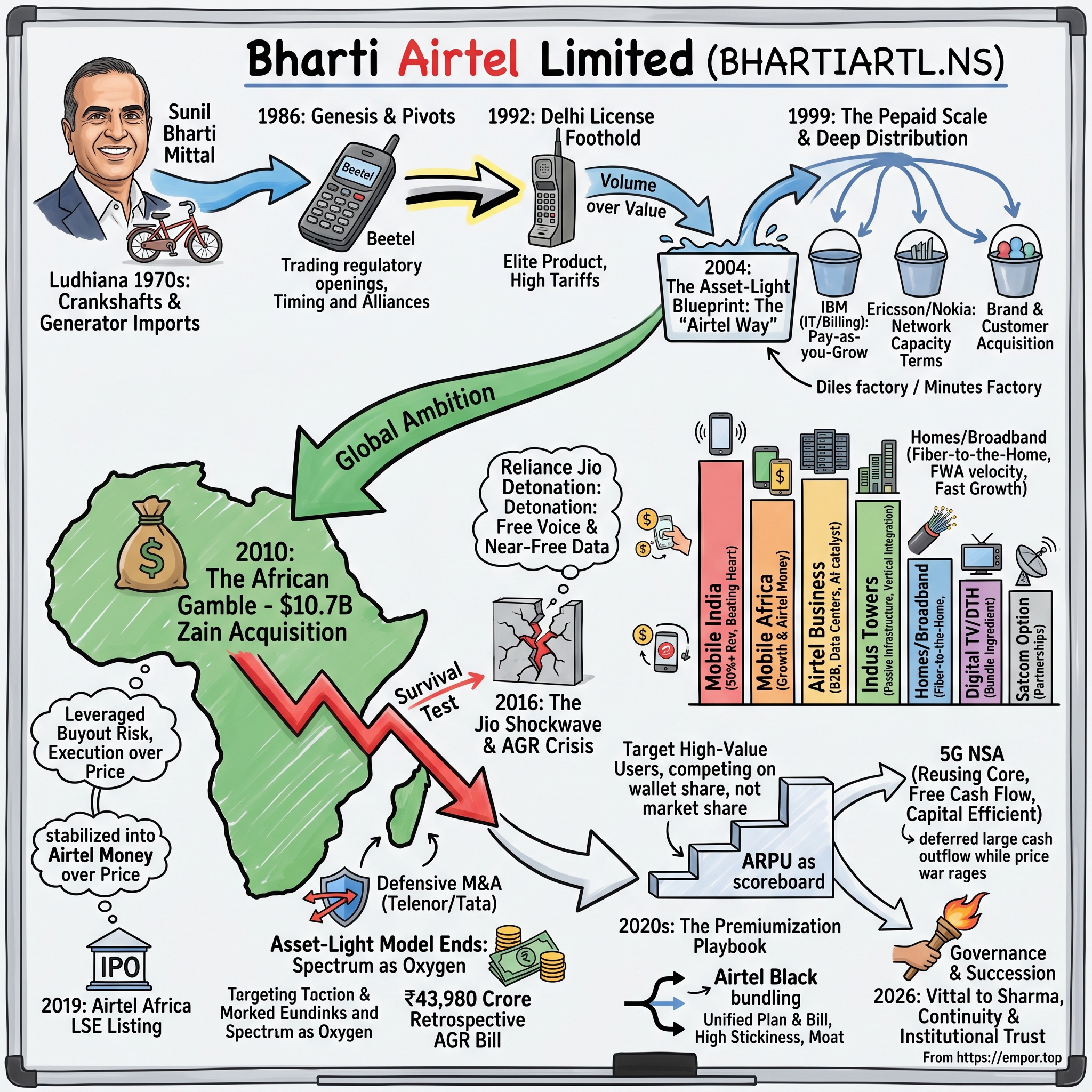
Picture a young man in Ludhiana in the late 1970s, the industrial heart of Punjab, where the air smells of machine oil and the streets are jammed with bicycles rolling off local assembly lines. He is not yet twenty. He has borrowed a modest sum from his father to buy a small stamping machine, and he is making crankshafts — the humble metal part that turns a bicycle's pedals into motion. It is unglamorous work. It is also the least likely conceivable starting point for a man who would one day preside over a telecommunications empire spanning two continents, more than 600 million customers, and a market value north of $100 billion.
That man is Sunil Bharti Mittal, and the improbability of that arc is the heart of this story. How does an entrepreneur who began with bicycle parts and a knack for spotting the next regulatory opening build a company that would survive one of the most violent price wars in corporate history — a war engineered by the richest man in Asia, funded with $35 billion of greenfield capital, that bankrupted or swallowed a dozen rivals? Bharti Airtel did not merely survive it. It emerged as the premium-priced, highest-ARPU operator in a market that consolidated from more than a dozen players down to three.
The central paradox we want to unpack is this. For its first two decades, Airtel won by being deliberately, almost radically, asset-light. It refused to own the things telecom companies were supposed to own — the IT systems, the network equipment, even for a while the towers. It rented them, structured as pay-as-you-grow contracts, and poured its energy into distribution, brand, and customer acquisition. And yet the same company would later spend billions of dollars amassing the heaviest assets in the industry: spectrum, fiber, and controlling stakes in tower infrastructure. The transition from asset-light challenger to asset-heavy consolidator is not a contradiction. It is the strategic spine of the whole saga — and understanding why the model flipped is the key to understanding whether Airtel's premium position is durable or merely a truce.
We should say plainly at the outset what this piece is and is not. It is not a cheerleading exercise, and it is not a short-seller's teardown. Airtel is a genuinely impressive operating story with a genuinely contested investment thesis, and the interesting work is in holding both truths at once — admiring the execution while interrogating the economics. Telecom is, structurally, one of the harder businesses in which to earn durable returns: the product is a commodity, the capital requirements are relentless, the regulator is omnipresent, and every generation of technology resets the game. That Airtel has prospered inside those constraints is remarkable. Whether it can keep prospering is a real question, not a rhetorical one, and we will keep returning to the evidence rather than the narrative.
Here is the road we will travel. We begin with the origin myth: generator bans, a fateful trip to Taiwan, and push-button telephones in a rotary-dial nation. We move to the legendary 2004 outsourcing playbook that let Airtel scale faster than any peer on earth. We cross the Indian Ocean to the $10.7 billion African gamble on Zain, a deal that strained the balance sheet for a decade before finding vindication in a London listing. We enter the existential crucible of 2016, when Reliance Jio arrived with free voice and near-free data, and the Supreme Court handed Airtel a retrospective bill measured in tens of thousands of crores. And we end in the present — a 2026 of institutionalized succession, industry-leading ARPU, capital-efficient 5G, and the hard question every mature telecom eventually faces: is this a compounding cash machine, or a utility on a capital treadmill dressed up as a growth story?
Let us start where it started: not with a phone, but with a bicycle.
 Subscribe on LinkedIn
II. The Genesis: Bicycle Parts, Generator Bans, and the Taiwanese Push-Button Phone
The Mittal family were not industrialists. Sunil Bharti Mittal's father was a politician, and the young Sunil's first venture — crankshafts for Ludhiana's bicycle makers — was a business of thin margins and thinner glamour. What it taught him, though, would echo through everything that followed: how to run lean, how to sell, and how to read the peculiar rhythms of doing business in a licence-permit economy where the government's pen could make or unmake a fortune overnight.
By the early 1980s, Mittal had grown restless with bicycle parts and moved into import-export. Ludhiana was a fine place to make things but a limiting place to dream, and he relocated his ambitions to a bigger stage. His breakthrough product was mundane but urgently needed: portable generator sets imported from Japan, sold into an India where the electricity grid failed so routinely that a reliable generator was less a luxury than a survival tool. For a brief window, business was excellent. Mittal was importing Japanese machines, distributing them across northern India, and learning the trader's art of matching foreign supply to desperate domestic demand. He was, in effect, running an arbitrage on India's own dysfunction — profiting by importing solutions to problems the domestic economy could not solve for itself. It was a lucrative game, and for a young man in his early twenties it must have felt like he had cracked the code.
Then came the lesson that would define his strategic instincts for life. In the mid-1980s, the government of India abruptly banned the import of generators — a move to protect a couple of politically connected domestic manufacturers who had been granted production licences. Overnight, Mittal's revenue evaporated. He was left with contacts, stranded inventory, and a hard-won conviction: in India, the regulatory ground could shift beneath you without warning, and the winners were those who saw the next opening before the crowd did. Rather than fighting for a licence he would never get, he went looking for the next thing.
He found it in Taiwan. On a trip to Taipei, Mittal saw push-button telephones — sleek, modern, in colors other than institutional black — and had the kind of realization that founding myths are made of. Back home, the telephone was a state-monopoly artifact: a heavy black rotary-dial handset, distributed by a sluggish government department, with waiting lists for a new connection that ran into years. To own a telephone in 1980s India was to have waited, sometimes for a decade, and to have known someone. Mittal grasped that the future of the Indian telephone was push-button, and that whoever brought that future in first would own the transition. In 1986 he founded Bharti Telecom and began manufacturing and selling telephone instruments, partnering with Germany's Siemens to build the "Beetel" brand, which went on to become a fixture in Indian homes.
It is easy, from the vantage of a $100 billion enterprise, to romanticize this as visionary genius. The more honest reading is that Mittal was a superb trader who understood two things most engineers and industrialists did not: that in India the binding constraint was almost never technology but policy and distribution, and that a foreigner's balance sheet could substitute for capital he did not have. He was not building factories to invent things. He was importing the future and localizing it, one regulatory window at a time. Beetel phones did not succeed because they were technically superior; they succeeded because Mittal got them into millions of Indian homes faster and cheaper than a state monopoly ever could, and because he had read correctly that the demand was there, dammed up behind years of scarcity.
The pattern is worth pausing on, because it is the same pattern that recurs for the next forty years. Mittal did not invent the push-button phone, nor the generator, nor later the mobile network. His edge was timing and structure: spot the regulatory pivot, move early, and lean on a strong foreign partner to supply the technology and capital he lacked. Siemens gave him the phones. Soon a French partner would give him something far bigger.
In 1992, the government opened bidding for the first private cellular mobile licences in India's four largest metros. This was the opening Mittal had spent his whole career training to seize. Partnering with the French conglomerate Vivendi for technical and financial muscle, Bharti won the cellular licence for Delhi — the capital, the prize circle. It was a foothold that larger, richer industrial houses had underestimated. The Airtel brand launched into a market where a mobile phone was a status symbol of the wealthy: handsets cost a fortune, and in the early years even receiving a call carried a per-minute charge. This was an elite product, and the economics of that era — high tariffs, low volumes, punishing licence fees — nearly broke every early operator. Several of Airtel's contemporaries did not survive the first decade.
What separated Airtel was a bet, later validated spectacularly, that mobile telephony in India would not stay an elite product. As handset prices fell and the government migrated operators from crippling fixed licence fees to a revenue-share model around 1999, the math flipped: suddenly the winning strategy was volume — millions of low-spending prepaid customers rather than a handful of rich postpaid ones. Airtel grasped this earlier and executed it harder than most, pioneering the deep prepaid distribution that would become its signature. What the early years reveal about Mittal, and about the company he would build, is a consistent operating philosophy: capital efficiency over capital accumulation, alliances over going it alone, and an almost predatory alertness to the moment when the rules change. That philosophy was about to be tested at a scale nobody in India had ever attempted — because winning a licence and building a national network are two very different things.
III. The Asset-Light Blueprint: The "Airtel Way" and the Landmark 2004 IBM Deal
By the turn of the millennium, the problem facing Airtel was no longer whether Indians would want mobile phones. They wanted them ravenously. The problem was arithmetic. To serve a country of a billion people, a telecom operator needed to lay thousands of kilometers of fiber, erect tens of thousands of cellular towers, and stand up billing and IT systems capable of provisioning and charging millions of new subscribers a month. Each of those things cost enormous sums of upfront capital, and each carried the risk that you would build for demand that arrived slower — or in a different shape — than you had bet.
Most telecom executives, in India and abroad, treated this as an unavoidable cost of the business. You raised debt, you bought equipment, you owned your network, and you carried the risk. Airtel's leadership looked at the same problem and asked a heretical question: what if we don't own any of it?
In 2004 Airtel signed what became the most studied outsourcing arrangement in telecom history. It handed its entire IT backbone — hardware, software, billing systems, and data centers — to IBM in a ten-year deal initially valued at roughly $750 million.[^1] The genius was not the size; it was the structure. Airtel did not pay IBM a fixed fee. It paid IBM a share of its revenue, so IBM's compensation rose only as Airtel's own customer base and revenue grew.1 When Airtel added subscribers, IBM earned more; if growth stalled, IBM absorbed part of the pain. Airtel had converted one of its largest fixed capital costs into a variable operating cost that flexed automatically with the business. As the customer base exploded from around four million subscribers in 2004 to more than 200 million a decade later, the contract's value swelled toward an estimated $2.5 billion — proof that the deal scaled exactly as intended.1
Airtel did the same thing with the physical network, and this was arguably the more audacious move. Conventional wisdom held that a telecom operator's network was the company — its crown jewel, the thing you would never let a vendor run. Airtel handed the design, build-out, and day-to-day management of its network to equipment giants Ericsson and Nokia, structured on capacity terms: Airtel paid for the erlangs and the coverage it actually used, not for a warehouse of gear sitting idle waiting for demand.1 It was the first time a major operator anywhere had outsourced the management of its core network at this scale, and rivals initially thought it reckless.
The phrase that captured the philosophy inside Airtel was the "minutes factory." Management came to see the company not as a network owner but as a factory that manufactured and sold minutes of talk time — and the discipline of a factory is to drive down the unit cost of production relentlessly. If you can lower the cost of producing a minute faster than the price of a minute falls, you make money even as tariffs collapse. That framing is why the outsourcing deals mattered so much: they converted the two biggest fixed costs in the business into variable ones that scaled with output, which is exactly what a factory obsessed with unit economics would want. The architects of this era — figures like Akhil Gupta, the long-serving deputy who structured much of the financial engineering, and Manoj Kohli, who ran the operations — turned a philosophical instinct into an operating system. India, uniquely, had a market where per-minute prices were among the lowest on earth and operators were profitable, and the reason was this obsessive attack on cost.
Consider what this freed Airtel to do. With capital no longer sunk into equipment depreciating in the ground, and management no longer consumed by running server farms and radio networks, the company could pour its scarce human and financial resources into the two things that actually won Indian customers: distribution and brand. Airtel built one of the deepest prepaid distribution networks in the country — the small shop on every corner that sold a recharge — and marketed relentlessly. The result was a capital-light growth machine that could add subscribers faster than global peers weighed down by their own balance sheets. It became the template for emerging-market telecom, copied from Africa to Southeast Asia.
But it is worth being clear-eyed, with the benefit of two decades' hindsight, about what the asset-light model did and did not buy. It bought speed and financial flexibility in the growth phase, when the game was land-grab and the enemy was your own cost of capital. What it did not buy was permanence. The assets Airtel refused to own in 2004 — spectrum, towers, fiber — would turn out to be precisely the assets that determined survival when the game changed from growth to war. The outsourcing playbook was a brilliant answer to the question of how to scale. It was not an answer to the question of how to defend. That answer would cost tens of billions of dollars and take another fifteen years to assemble — and the first, most expensive down payment on it was made not in India, but in Africa.
IV. The African Gamble: The $10.7 Billion Zain Acquisition
By 2010, the Indian mobile market that Airtel had helped pioneer was becoming a bloodbath of a different kind — not yet the Jio war, but a licensing free-for-all that had crammed as many as a dozen operators into a single market, crushing tariffs and margins. Mittal, who had built his career on reading when a market was about to turn against him, looked at India's overcrowded field and did what he had always done: he looked for the next opening. This time it was an entire continent.
The target was Zain Group's African operations — a sprawling footprint across 15 sub-Saharan countries, from Nigeria to Kenya to Zambia, serving more than 42 million subscribers across a population base of several hundred million with mobile penetration still low enough to promise years of growth.2 On March 30, 2010, Airtel announced it would acquire Zain Africa for an enterprise value of $10.7 billion, and the deal closed on June 8, 2010.23 It was the largest-ever cross-border acquisition between two emerging markets, and it vaulted Airtel into the ranks of the world's five largest wireless operators, with a footprint spanning 18 countries and roughly 179 million subscribers.2
The financial engineering told you everything about the risk being taken. Of the $10.7 billion, Airtel paid $8.3 billion upfront, another $700 million after a year, and assumed roughly $1.7 billion of Zain's existing debt.2 The upfront cash was raised almost entirely through debt — a syndicate of foreign banks and the State Bank of India, with Standard Chartered committing $1.3 billion and Barclays $900 million.2 This was a leveraged buyout in all but name, and here the analytical skepticism has to sharpen. Airtel paid an EBITDA multiple in the neighborhood of ten times for the African assets — a meaningful premium to the roughly seven-times multiple its own shares traded at in India at the time. In plain terms, Airtel used cheap debt to buy an asset more expensively than the market valued Airtel itself, on the bet that it could import its low-cost Indian operating model and transform African economics. That is a bet on execution, not on price. The price, by the standards of the era's telecom deals, was rich for an asset with real operational decay.
The strategic logic Airtel sold to investors was seductive in its simplicity: take the "minutes factory" model that had conquered India — ultra-low tariffs, outsourced networks, deep prepaid distribution — and transplant it into 15 African markets where penetration was low and incumbents were charging some of the highest per-minute rates in the world. Cut prices, expand the market, win on volume. On paper, Africa in 2010 looked like India in 2003. The reality proved far more stubborn.
And the baggage was severe. The networks Airtel inherited were, in many markets, run-down and under-invested. Churn was high, brand loyalty thin, and the regulatory environments in flagship markets like Nigeria and across East Africa were treacherous — currency volatility, licensing disputes, and repatriation frictions that made the clean arithmetic of the Indian model far messier in practice. A collapse in the Nigerian naira could wipe out a year of local operating gains when translated back into dollars or rupees, a risk that simply did not exist in the Indian business. Fifteen countries meant fifteen regulators, multiple currencies, and dozens of languages — a coordination burden the single-market Indian playbook never had to carry. Integrating a Kuwaiti-owned, pan-African business into an Indian corporate culture proved slow and expensive. For most of the decade that followed, Africa was a drag: it strained the consolidated balance sheet, contributed to ratings pressure, and diluted group margins. A skeptical investor looking at Airtel between 2010 and 2018 would have been entirely justified in calling Zain a value-destroying vanity acquisition — the kind of empire-building deal where a founder's ambition outruns the arithmetic.
That verdict, however, would have been premature. Airtel kept investing — laying fiber, localizing management, building out mobile money, and grinding down the cost base — and the African asset slowly stabilized into a genuine growth engine, helped by demographics that India could no longer offer. The single most important thing Airtel did in Africa was arguably not telecom at all: it built Airtel Money, a mobile-money and payments business that turned the phone into a bank account for tens of millions of unbanked Africans. Mobile money carries structurally different economics from voice and data — it is a fee-based financial-services business with high margins and powerful stickiness — and it became the growth story that ultimately made the African operation worth far more than its connectivity revenue alone.
The vindication came in 2019, when Airtel carved out the business as Airtel Africa plc and listed it on the London Stock Exchange, with a simultaneous listing in Lagos.4 The IPO priced shares at 80 pence and raised around $750 million, with the business carrying close to 99 million subscribers at the time of listing.4 A decade of patient, unglamorous capital expenditure had converted a distressed acquisition into a separately listed, publicly valued franchise that today serves well over 150 million customers. The listing did double duty: it put a public market price on the asset that had been buried inside Airtel's consolidated accounts, and it gave Airtel a lever to sell down its stake for cash when the domestic emergency demanded it.
The lesson for investors is double-edged, and it is a lesson about how to read Airtel's future big bets. The company's willingness to overpay for a troubled asset and then out-execute over a decade produced a win — but it was a win that required ten years of balance-sheet strain, and it nearly coincided with a domestic emergency far more dangerous than anything Africa threw at it. The pattern to internalize is that Airtel's acquisitions tend to look reckless for years before they look brilliant, which means an investor's real question is not "was the price right?" but "does this management have the patience and the balance sheet to survive the ugly middle?" Because while Airtel was still digesting Zain, back home a new competitor was quietly assembling a war chest that would make the crowded market of 2010 look, in retrospect, like the good old days.
V. The Jio Shockwave & The Great Telecom Consolidation
On September 1, 2016, the Indian telecom industry effectively ended one era and began another. Reliance Industries, the petrochemicals-to-retail colossus run by Mukesh Ambani — India's richest man — commercially launched Reliance Jio Infocomm. It was not a normal competitive entry. It was a detonation. Jio had spent an estimated $35 billion building a brand-new, nationwide, all-IP 4G network from scratch, unencumbered by any legacy 2G or 3G assets. And on launch, it gave the product away: voice calls were free, forever, and mobile data was priced at a level so low it functionally rewrote the country's relationship with the internet.
Understanding why Jio's launch was so lethal requires understanding one piece of telecom plumbing. For years, when a customer on one network called a customer on another, the caller's operator had to pay the receiver's operator a small "interconnect" fee per minute. Voice revenue was the industry's bedrock. By building an all-IP network that carried voice as data, and by making voice free, Jio detonated that entire revenue pillar and reframed the whole business around data. An incumbent like Airtel, still earning a large share of its money from voice, was being told its foundational product was now worth zero — and it had no choice but to follow, because a customer will not pay for calls when a rival gives them away.
The financial carnage was immediate and industry-wide. Data tariffs that had hovered around ₹250 per gigabyte collapsed toward a few rupees per gigabyte within a couple of years — one of the fastest and steepest price destructions in the history of any major industry. India went, almost overnight, from a country where mobile data was rationed to one where it was the cheapest in the world, and Indians became among the heaviest data consumers on the planet. That was wonderful for consumers and catastrophic for operator profits. Incumbents who had been earning healthy voice revenues watched their core business become free overnight. Industry EBITDA margins compressed brutally, and the marginal operators simply could not survive it. The market that had held more than a dozen players consolidated with shocking speed: Reliance Communications collapsed into bankruptcy, Aircel folded, Telenor and Tata Teleservices exited the consumer business, and the once-mighty Vodafone and Idea were forced to merge into a single, wounded entity, Vodafone Idea, that has been fighting for solvency ever since. In the space of roughly five years, a market of more than a dozen operators became a market of three private players plus a struggling state incumbent — one of the most violent consolidations any major industry has ever undergone.
Airtel's survival was neither luck nor inevitability. It was the product of specific, deliberate defensive maneuvers, and this is where the earlier chapters pay off. First, Airtel went on an opportunistic acquisition spree — not for growth, but for consolidation. It absorbed the consumer mobile operations of Telenor India and Tata Teleservices for essentially nominal consideration, and folded in others, hoovering up their subscribers and, more importantly, their spectrum. In a market being decided by network quality, spectrum was oxygen, and Airtel was acquiring it at distress prices while weaker rivals dumped it on the way out.
This is the moment the asset-light philosophy of 2004 formally died, and it is worth marking the inversion. The company that had once prided itself on owning as little as possible — renting its IT, its network, its towers — now understood that in a war of attrition, the durable advantages were precisely the heavy, hard-to-replicate assets: spectrum you could not manufacture, fiber you had already laid, coverage you had already built. Renting was optimal for a land grab; owning was optimal for a siege. Airtel had the strategic clarity to switch modes when the game changed, and the balance sheet — barely — to fund the switch. A less disciplined competitor might have kept optimizing for growth into the teeth of a price war and been consolidated away like the others.
Then came the second blow, this one from the state itself. In October 2019, the Supreme Court ruled decisively against the telecom operators in a fourteen-year-old dispute over the definition of "Adjusted Gross Revenue" — the base on which telcos owe licence and spectrum fees to the government. The court's expansive interpretation, layered with years of interest and penalties, produced staggering retrospective bills. Airtel's group liability landed at roughly ₹43,980 crore, to be paid down over a decade.5 For a company already bleeding from the Jio price war, it was a potentially fatal one-two punch. Vodafone Idea's far larger AGR bill would push it to the edge of collapse; Airtel had to prove its balance sheet could take the hit.
It did, through a combination of financial defense that revealed how completely the asset-light philosophy had been abandoned. Airtel raised enormous sums of fresh equity — a ₹25,000 crore rights issue in 2019 and a further ₹21,000 crore rights issue in 2021 — diluting shareholders to fortify the balance sheet. It monetized the very infrastructure it had once been so proud not to own, selling down stakes in its tower arm and in Airtel Africa to raise cash. And crucially, it did not stop investing in the network even under this pressure, continuing to pour capital into 4G coverage and quality while competitors starved. The strategic read here is important: Airtel accepted dilution and asset sales as the price of staying in the game with a competitive network. It chose network relevance over short-term balance-sheet vanity — a bet that if it survived with quality intact, it could eventually raise prices. Whether that bet would pay off depended on a pivot as consequential as any in the company's history: giving up on the volume war entirely.
VI. The Premiumization Playbook, 5G Rollout, & Airtel Black
Somewhere around 2020, Airtel's leadership arrived at a conclusion that must have been uncomfortable to accept: they could not out-cheap Jio. Jio had lower unit costs, a purpose-built network with no legacy baggage, and a parent with effectively bottomless capital and a strategic willingness to subsidize telecom to sell everything else in the Reliance ecosystem. Fighting Jio for the bottom of the market — the price-sensitive customer who would switch for a five-rupee difference — was a war Airtel could only lose slowly. So it chose a different war.
The strategy was premiumization: instead of chasing the most subscribers, chase the most valuable ones. Airtel deliberately positioned itself as the higher-quality, higher-priced network — the one that professionals, businesses, and heavy data users would pay a little more for because it dropped fewer calls and streamed more smoothly. This meant accepting that Jio would report more total subscribers while Airtel quietly won the customers who actually spent. It is a classic strategic choice — compete on wallet share, not market share — and its scoreboard is a single metric that we will return to again and again: ARPU, or average revenue per user.
The 5G rollout became the clearest expression of this discipline, and it hinged on a technical fork that is worth explaining in plain terms. There are two ways to build 5G. "Standalone" (SA) 5G means building an entirely new 5G core network from the ground up — a full rebuild of the digital plumbing, expensive and slow but capable of exotic future features like ultra-low-latency network slicing. "Non-standalone" (NSA) 5G means bolting new 5G radios onto your existing 4G core — reusing the plumbing you already have, so customers get the fast 5G speeds they can actually perceive without the operator having to rebuild everything underneath. Jio went standalone, spending heavily on a dedicated 5G core. Airtel went non-standalone, reusing its 4G core and spectrum.
The capital-allocation implications were significant. By choosing the NSA path, Airtel minimized the upfront cash it had to sink into 5G, deploying nationwide coverage while keeping capital intensity in check — and, critically, while continuing to generate free cash flow rather than burning it. For the vast majority of customers, who mainly want their video to load fast, the perceived difference between the two approaches was negligible. Airtel got comparable real-world 5G speeds at a fraction of the cash drain. The skeptic's counter is fair and worth stating: NSA is a near-term efficiency choice that may eventually require a costly upgrade to standalone for advanced enterprise use cases, so Airtel has arguably deferred rather than avoided the spend. But deferring a large cash outflow while a price war rages is itself a form of winning.
There is a second, subtler benefit to the premiumization strategy that management rarely spells out but investors should. By orienting the whole company around high-value customers, Airtel changed the kind of investor its equity attracts and the kind of story it can tell. A telecom locked in a volume war is valued like a commodity producer — on cost per subscriber and market share. A telecom with demonstrated pricing power and rising ARPU can be valued like a consumer business with a brand. The premiumization pivot was, in part, a re-rating strategy: convince the market that Airtel earns its returns through pricing power rather than through winning a share auction it was structurally positioned to lose.
The other pillar of premiumization was bundling, branded Airtel Black — a single plan and single bill combining postpaid mobile, fiber-to-the-home broadband, and DTH television. The logic is behavioral, not technological. A customer with one Airtel service is easy to poach; a customer whose home broadband, family mobile lines, and TV all arrive on one bill faces real friction to leave, because switching means untangling all of it at once — porting numbers, cancelling a broadband installation, returning a set-top box, and coordinating it across a whole household. Each additional service raises the psychological and practical cost of defection. Airtel has reported that churn among these bundled households runs dramatically lower than for standalone prepaid users — the difference between a customer who might leave this month and one who stays for years. That stickiness is the closest thing a telecom has to a moat, and it converts commodity connectivity into recurring, defensible revenue. It is also, importantly, a moat Airtel builds rather than one it was handed by the government or by physics — which makes it the most strategically satisfying of its advantages, because it is the one most within management's own control.
The proof of the whole strategy shows up in pricing power. Across 2023 and 2024, the industry — led by Airtel and tacitly followed by Jio — pushed through a series of tariff hikes, including a substantial increase in mid-2024. Airtel's consolidated ARPU climbed to ₹257 in the fourth quarter of its fiscal 2026, among the highest in the Indian industry.6 Management has been explicit and consistent across earnings calls that it wants ARPU higher still — toward ₹300 — to earn an adequate return on the capital sunk into 5G. That candor about needing higher prices is itself a data point: this is an industry that has quietly agreed it under-earns, and is raising prices to fix it. Whether customers keep paying is the open question — and it is one of several that come into focus once we take the portfolio apart segment by segment.
VII. Segment-Level Deep Dive & Core Operations
Step back from the narrative for a moment and look at the machine itself. For fiscal 2026, Bharti Airtel reported audited consolidated revenue of ₹210,973 crore — roughly $25 billion — up about 22% year over year, with consolidated EBITDA of ₹121,268 crore.6 That top line is not one business; it is a portfolio of at least seven, each with its own economics, growth rate, and strategic role. Understanding how they fit together is essential to judging whether the whole is more durable than the sum.
Mobile Services – India is the beating heart, contributing more than half of group revenue at roughly ₹112,995 crore. This is where premiumization, ARPU, and spectrum quality all converge, and it is the segment whose pricing power underwrites everything else. Its margins and its ARPU trajectory are, more than any other single thing, what move the equity.
Mobile Services – Africa, at roughly ₹56,806 crore, is the second pillar and the reason Airtel is a two-continent story rather than a purely Indian one. Housed in the separately listed Airtel Africa plc, it offers something India's maturing market increasingly cannot: structural growth, driven by rising penetration and, importantly, mobile money — a financial-services business riding on the telecom rails that carries different, often better, economics than voice and data alone. It is highly material to consolidated cash flow, and its independent listing gives it its own currency and accountability.
Airtel Business, the enterprise arm, contributes around ₹21,176 crore and is strategically weighted well above its revenue share. This is B2B connectivity, plus a growing stack of data centers under the Nxtra brand and cloud and security services. It runs at high margins and plugs Airtel into the structural tailwind of Indian enterprise digitization and AI-driven data-center demand — the same wave that has drawn Airtel deeper into partnerships with global technology players. The data-center angle deserves emphasis because it is where the AI boom touches Airtel most directly. Every large language model trained or served in India needs power, cooling, and connectivity in a physical building, and Nxtra is one of the incumbents positioned to supply that at scale. If the Indian AI and cloud build-out accelerates the way its enthusiasts expect, this is the segment most likely to surprise on the upside — and, notably, it monetizes the same fiber backbone Airtel already owns, so the incremental returns can be attractive. The bear's caution is that data centers are capital-hungry and increasingly crowded with well-funded competitors, so high margins today are no guarantee of high returns tomorrow.
Passive Infrastructure – Indus Towers is the most analytically interesting line, and a live governance question we will return to. Indus is India's largest tower company, and Airtel has steadily raised its stake to a controlling position above 51% through purchases running into 2026, consolidating its financials into the group.7 Owning the towers you also rent is a vertical-integration play — it captures the tower margin and secures the passive infrastructure your network sits on. But it also means Airtel's balance sheet now backstops a tower business exposed to the financial health of all its tenants, including the fragile Vodafone Idea.
Homes / Broadband, at roughly ₹7,775 crore, is small but the fastest-growing engine in the portfolio, expanding sharply year over year via fiber-to-the-home and, increasingly, 5G-based Fixed Wireless Access. FWA is the clever part: it uses Airtel's existing 5G spectrum to deliver home broadband over the air, reaching households where laying fiber is uneconomic, at high incremental margins because the spectrum is already paid for. This is the growth story management most wants investors to watch.
Digital TV / DTH, at around ₹3,018 crore, is the portfolio's melting ice cube — a satellite-television business in structural decline as streaming erodes linear TV. Airtel keeps it alive chiefly as a bundle ingredient for Airtel Black rather than as a business it expects to grow.
Finally, Satellite / Satcom is not yet a revenue segment at all but a strategic option. Airtel has hedged the satellite-broadband future from both directions: its parent group is a major shareholder in Eutelsat OneWeb, and in March 2025 Airtel signed an agreement with SpaceX to bring Starlink to Indian customers, subject to SpaceX securing its own Indian authorizations.[^9] The bet is that when satellite connectivity scales, Airtel will be a distributor and partner rather than a disrupted incumbent. The portfolio, taken whole, is a barbell: a cash-generating, pricing-powered core in Indian mobile, a growth wing in Africa and Homes, and a set of optionality bets — which raises the natural next question of who is steering all of it, and how.
VIII. Management Transition, Governance, and Capital Allocation
On January 1, 2026, Bharti Airtel executed a leadership handover of a kind still rare in corporate India: planned years in advance, telegraphed clearly, and completed without drama. Gopal Vittal, who had run the company as Managing Director and CEO for thirteen years, stepped into the role of Executive Vice Chairman, while Shashwat Sharma — previously Chief Operating Officer and, since 2024, the designated CEO — took over as MD & CEO on a five-year term, with the board having formalized the appointment in December 2025.[^10]8
To understand why investors cared, you have to understand what Vittal did. He took the CEO chair in 2013 and then steered Airtel through the single most dangerous stretch in its history — the Jio price war and the AGR judgment — and came out the other side with the brand intact, the balance sheet repaired, and ARPU leadership established. His tenure is, by the standard that matters most (surviving an extinction-level competitive event while rivals died), a success. The decision to elevate him rather than lose him, and to season his successor as COO and CEO-designate before handing over, signals a board that prizes continuity and institutional memory over a clean break. In an Indian corporate landscape littered with abrupt, contentious CEO exits, a succession this orderly is itself a governance asset.
The transition ran deeper than the top job. Soumen Ray was elevated to Group CFO and Akhil Garg to CFO of the India business — a bench-strengthening that suggests the changes are systemic rather than personal.8 And Sunil Bharti Mittal remains Chairman of Bharti Airtel, focused on the macro capital-allocation questions and global partnerships that have always been his domain, with Vittal also taking on the Non-Executive Chair role at Airtel Africa. The founder is stepping back from operations without stepping away from strategy.
Then there is ownership, where the structure repays scrutiny. Promoter holding sits tightly around 50%, held principally through Bharti Telecom Limited, which is itself a joint venture between the Mittal family and Singapore Telecommunications — Singtel. Singtel has been a committed strategic partner for over two decades, but it has progressively trimmed its direct Airtel stake to unlock capital for its own balance sheet.[^12] Here a skeptical investor should sit up. Is Singtel's steady selling purely tactical capital recycling by a partner that remains long-term committed, as both companies frame it — or is it the slow, polite beginning of a strategic exit? The honest answer is that the two are indistinguishable from the outside until they aren't, and it is a stake worth watching precisely because Singtel's share sales have periodically been a source of overhang on the stock. (Note: the outline's characterization of Singtel with the label "淡马锡" is a conflation — 淡马锡 is Temasek, Singapore's state investment company, not Singtel, which is a Latin-named entity.)
A word on management credibility, judged the only way that matters — by behavior over time rather than by rhetoric. Airtel's leadership has, across the past decade of earnings calls, been notably consistent in its narrative: it warned that industry pricing was unsustainable long before rivals admitted it, it flagged the need for ARPU repair repeatedly and then delivered the tariff hikes it promised, and it explained its 5G non-standalone choice in the same capital-discipline language it has used for years rather than reinventing the story to fit the latest quarter. When it has missed — a soft ARPU print, a currency-driven wobble in Africa — it has generally attributed the miss to a specific, identifiable cause rather than to vague macro headwinds. That consistency is worth something. It is the opposite of the overpromise-and-pivot pattern that erodes trust in management teams, and it is part of why the market extends Airtel the benefit of the doubt on its heavier bets.
The most encouraging evidence on management's judgment, though, is behavioral, and it is about capital allocation. A company that spent the late 2010s issuing rights shares and selling assets to survive declared, for fiscal 2026, a final dividend of ₹24 per share on its ₹5 face-value stock.6 The arc from emergency dilution to a meaningful cash return is the clearest possible signal that management believes the free-cash-flow crisis is behind it — a company does not return cash to shareholders while it still fears for its solvency. Whether that confidence is warranted — or premature, given the debt still on the books — is exactly the debate that the company's competitive position, and its critics, force us to have.
IX. The Competitive Moat: Hamilton Helmer's 7 Powers & Porter's 5 Forces
Every business claims a moat. The useful exercise is to test the claim against a framework rather than a press release, so let us run Airtel through two: Hamilton Helmer's 7 Powers and Michael Porter's Five Forces. The point is not to award a grade but to locate, precisely, where Airtel's advantages are real and durable versus where they are shared, contested, or merely rented.
Start with scale economies. Airtel spreads the fixed costs of a national 5G network, a fiber backbone, and a spectrum portfolio across a combined base — India plus Africa — of more than 600 million connections. Beyond a certain size, each additional subscriber costs almost nothing to serve, so the largest operators enjoy structurally lower unit costs than sub-scale rivals. This power is genuine, and it is exactly why the industry consolidated to three. But note the qualifier: Jio has more scale in India, so scale economics is a power Airtel shares with, and is somewhat disadvantaged on, against its principal rival. It is a moat against the third player, Vodafone Idea, more than against the first.
Switching costs are Airtel's most improving power, and they run almost entirely through Airtel Black. A single-service prepaid customer has near-zero switching cost — number portability is a few taps. But a household whose broadband, DTH, and multiple mobile lines are bundled on one bill faces the hassle of unwinding everything to leave, and the reported gap in churn between bundled and standalone customers is the empirical proof that the friction is real, not theoretical. This is a moat Airtel is actively building rather than one it was handed.
Cornered resource is the strongest and least replicable power in the whole analysis: spectrum. Radio spectrum in the sub-gigahertz and mid-band ranges is a finite national resource, auctioned by the government and physically limited by the laws of electromagnetics. There is only so much of it, no new entrant can manufacture more, and Airtel spent years and vast sums accumulating a premium portfolio of it — including through those distress-priced acquisitions during the consolidation. This is the asset the asset-light Airtel of 2004 declined to prioritize and the asset-heavy Airtel of today would never surrender, and it is the clearest example of why the strategic pivot from renting to owning was correct. Spectrum is a true cornered resource.
Brand rounds out the material powers. Airtel has cultivated a reputation as the premium, reliable network — the one worth paying a bit more for — and that perception is what lets it sustain higher ARPU than rivals selling a physically similar service. Brand in telecom is fragile (one bad network year can erode it), but Airtel's has proven durable enough to anchor real pricing power.
It is worth naming, with equal candor, the powers Airtel does not convincingly have, because an honest moat analysis is as much about absences as presences. Airtel has no network effects in the classic sense — a new customer joining Airtel does not make the service meaningfully better for existing Airtel customers, the way a new user makes a social network more valuable. It has no counter-positioning advantage — there is no business model Airtel runs that Jio is structurally unable to copy; if anything, the counter-positioning ran the other way, with Jio's all-IP greenfield network being the thing the incumbents could not costlessly replicate. And it has no process power that a well-run rival could not match with effort. What Airtel has is a specific, defensible bundle — scale against the weak, a cornered spectrum resource, self-built switching costs, and a premium brand — but not an impregnable one, and certainly not one that dominates its strongest competitor. The moat is real; it is not a fortress.
Now flip to Porter's Five Forces, applied to the Indian oligopoly. The threat of new entrants is extremely low: the capital, spectrum-licensing, and physical build-out requirements are so vast that Jio was the last plausible new entrant, and it took the resources of Reliance to pull it off. The bargaining power of buyers is low and falling: consolidation has left Indian consumers with only three private choices, so the days of switching for a trivial discount are ending as prices rise in lockstep. The most interesting force is competitive rivalry, which is high but has evolved into something unusual — a stabilizing duopoly at the top. Jio and Airtel, having bled each other for years, now appear to share an interest in raising the industry's price level rather than reigniting the price war, because both need higher ARPU to justify their 5G capital. Economists would call this tacit coordination; regulators might one day call it something less benign. For now, it is the single most important fact about the industry's profitability. And it sets up the real debate: if the war is over and prices are rising, is Airtel a cash-compounding giant — or a capital trap in disguise?
X. The Investment Story Spine: Bull vs. Bear & Activist Stress Test
Here is the neutral core question, stripped of narrative: Is Bharti Airtel a cash-flow-compounding giant at the peak of its powers, or is it a utility stock — capital-hungry, debt-laden, and dependent on regulatory forbearance — wearing the costume of a growth-tech business? Both readings fit a surprising amount of the same evidence, which is precisely why the stock is a genuine debate rather than a consensus.
The bull case rests on three linked ideas. First, ARPU expansion: Airtel has demonstrated real, repeated pricing power, and every rupee of ARPU gain drops almost entirely to profit because the network cost is already sunk. If the industry keeps marching toward ₹300, Airtel's India mobile profitability compounds mechanically, and the ongoing conversion of prepaid customers to postpaid adds a second, structural leg to that climb. Second, the Homes and FWA velocity: fixed wireless access monetizes already-owned 5G spectrum at high incremental margins, opening a large, under-penetrated home-broadband market without a proportional capital outlay. Third, capital-expenditure moderation: the peak cash drain of the 5G rollout is arguably past, and Airtel's non-standalone approach kept that peak lower than Jio's to begin with. If capex intensity falls while EBITDA rises, free cash flow surges — and the ₹24 dividend is the opening gesture of what bulls expect to become a rising stream of shareholder returns.
The bear case attacks each pillar. First, the capital treadmill: 5G monetization remains thin — Indian consumers got faster speeds but are not yet paying a 5G premium — and no sooner is one generation deployed than the industry must begin funding research and spectrum for the next. Telecoms have a long, humbling history of spending fortunes on each new "G" and struggling to earn a return before the next one arrives; the industry has arguably never earned its cost of capital across a full technology cycle, and there is little in Airtel's numbers to prove this cycle will be different. By the late 2020s, the drumbeat of 6G research and the next spectrum auction will already be audible. Second, the debt burden: for all the balance-sheet repair, Airtel still carries substantial absolute debt, swollen by spectrum purchases and deferred spectrum and AGR liabilities to the government. In a higher-for-longer interest-rate world, that debt service is a real and rising claim on the very free cash flow the bulls are counting on, and a chunk of it is owed to the same government that sets the rules. Third, tariff elasticity: the ARPU story assumes customers keep absorbing price hikes, but in a price-sensitive country where affordable connectivity is treated as a near-political entitlement, further increases may hit consumer pushback or regulatory frowns, and the ₹300 target could prove a ceiling rather than a waypoint. The bear's summary is unsentimental: strip away the growth-tech framing and you have a capital-intensive utility, permanently reinvesting to stand still, whose good years are cyclical rather than structural.
Now the activist stress test — the questions a skeptical long/short investor would press management on, because they sit at the intersection of capital allocation and governance. The sharpest is Indus Towers. Why is Airtel deploying capital to lift its stake in the tower company above 51% at exactly the moment when that tower company has been absorbing bad-debt write-offs from Vodafone Idea's inability to pay its rent?7 The uncomfortable framing is that Airtel may be using its own strong balance sheet to prop up a passive-infrastructure asset exposed to a dying tenant — capital that could instead have gone to buybacks, dividends, or debt reduction. Management's defense is that owning the towers is strategically sound and that Indus is undervalued, but an activist would demand to see the return math against the alternative uses of that cash. The second challenge is the Singtel stake trimming already discussed — a persistent supply overhang and an open question about a founding partner's long-term intentions. Neither issue is disqualifying, but both are exactly the sort of complexity and related-party entanglement that a concentrated skeptic would use to argue the stock deserves a discount, not a premium. The bull-bear spine, then, comes down to a single tension: durable pricing power in a rational duopoly, set against a heavy and recurring claim on cash from spectrum, debt, and the next technology cycle. To resolve it in real time, an investor needs to watch a very small number of things.
XI. Risk Radar & KPIs to Watch
The mistake most investors make with a company this sprawling is trying to track everything. The discipline is to track the few things that actually move the thesis — but first, the risks that could break it, and only the ones whose mechanism genuinely bites here.
The first and largest is regulatory and spectrum-pricing risk. This is not a generic box to check; for Airtel it is arguably the single biggest swing factor in the equity, because the government is simultaneously Airtel's largest creditor (through deferred spectrum and AGR liabilities), the auctioneer that sets the price of the raw material Airtel's business depends on, and the referee that could reopen or restructure past dues in either direction. A favorable AGR reassessment could add billions to equity value overnight; an aggressive future spectrum auction could drain it just as fast. The company's fate is unusually entangled with policy, and that is a structural feature, not a passing headline.
The second is refinancing and cost-of-capital risk. Airtel's large absolute debt and its multi-year deferred-payment obligations to the government mean that the interest-rate environment directly shapes how much of its EBITDA survives the journey down to free cash flow. A world of rising rates is a world where more of Airtel's operating profit is spoken for before shareholders see any of it — the mechanism that turns the bull case's "surging free cash flow" into the bear case's "debt service treadmill."
The third is technological disruption from satellite. This is the lower-probability, higher-uncertainty risk. If low-earth-orbit satellite broadband — Starlink, OneWeb, and successors — scales faster and cheaper than anyone expects, it could undercut the economics of serving rural and remote markets with terrestrial towers and fiber, the very markets where Airtel's coverage advantage is supposed to be a moat. Airtel's hedge — partnering with both major LEO players rather than fighting them — is intelligent, but a partner's economics are not an owner's economics, and a disruptive technology has a way of compressing the incumbent's margins even when the incumbent gets a seat at the table.
A fourth risk sits quietly beneath the others and deserves a mention even though it rarely makes headlines: cybersecurity and data privacy. A telecom operator is one of the largest custodians of personal data in any country — call records, location, identity, payment details for hundreds of millions of people — and it sits at the physical chokepoint of a nation's communications. A serious breach would be both a financial and a reputational event, and for a company whose entire premium positioning rests on being the trusted, reliable network, an erosion of that trust would strike at the exact asset the brand is built on. India's tightening data-protection regime raises the compliance stakes further. This is not a thesis-breaking risk in ordinary times, but it is a tail risk with an outsized ability to damage the one intangible — trust — that justifies Airtel's pricing power.
Against those risks, three KPIs carry most of the diagnostic signal, and a disciplined investor can largely ignore the rest. The first is India mobile ARPU — the purest measure of the pricing power that the entire premiumization thesis rests on; it ended fiscal 2026 at ₹257 against management's stated ambition of ₹300, and its trajectory is the truest read on whether the duopoly's pricing discipline is holding.6 The second is Homes segment subscriber growth and ARPU — the clearest gauge of whether the high-margin FWA-and-fiber growth engine is scaling as the bulls need it to, or stalling. The third is consolidated net debt to EBITDA — the one number that adjudicates the entire bull-bear fight, because it tells you in a single ratio whether Airtel is deleveraging its way toward the cash-compounder outcome or treading water against the capital treadmill. Watch those three, and you are watching the thesis itself.
XII. Epilogue & Lessons for Founders
Return, finally, to the young man with the stamping machine in Ludhiana, and measure the distance traveled. Bharti Airtel's story is, at its core, a story about strategic patience — about a company that changed its fundamental operating model not once but repeatedly, and had the discipline to change it before the environment forced a change on its own terms rather than after. The Airtel that fought its way to survival in the fragile years after 2016 is not the same Airtel that emerged in 2026 as the industry's premium cash generator, and the transformation was neither luck nor inevitability. It was a series of hard, sometimes contrarian, choices.
Three lessons stand out for founders and operators, and each cuts against a piece of conventional wisdom.
The first: asset-light is for scaling, asset-heavy is for protecting. The outsourcing playbook of 2004 was exactly right for its moment — it let Airtel grow faster than any peer while others drowned in capital costs. But the same asset-light instinct, applied a decade too long, would have left Airtel without the spectrum and infrastructure that turned out to be the only real fortifications when the price war came. The wisdom was not "own nothing" or "own everything." It was knowing which phase of the business you were in and matching your capital intensity to it.
The second: during a price war, you do not need to win the volume race if you own the wallet. Airtel lost the subscriber-count contest to Jio and won the profit contest anyway, by concentrating on the premium customers who actually spend and building switching costs around them. It is a reminder that market share and value share are different games, and that in a commoditizing industry the second is worth more than the first.
The third: structured succession breeds institutional trust. The years-long, telegraphed handover from Gopal Vittal to Shashwat Sharma — with the successor seasoned as COO and CEO-designate before taking the reins — is a model that much of corporate India, prone to founder-cult and abrupt exits, would do well to study. Institutions that can change leaders without changing course are worth more than those that cannot.
There is a fourth lesson, quieter than the others but perhaps the most useful for an investor rather than a founder: the same trait can be an asset in one decade and a liability in the next. Mittal's defining instinct — to make bold, leveraged, contrarian bets and then out-execute the doubt — produced the Delhi licence, the outsourcing revolution, and, eventually, the African franchise. That same instinct also produced ten years of balance-sheet strain and a tower consolidation that a skeptic can reasonably question today. Great operators are not defined by never taking risks that look questionable; they are defined by having the patience and the capital to survive the interval before the bet pays off, and by knowing which risks are worth surviving for. The open question about Airtel in 2026 is whether the current heavy bets — the Indus consolidation, the satellite optionality, the wager that ARPU keeps climbing — belong in the "brilliant in hindsight" column or the "empire-building" one. History says give this management the benefit of the doubt; discipline says verify it against the KPIs, quarter by quarter.
None of this settles the open question. Airtel in 2026 stands at the peak of its powers and at the center of a genuine debate — cash compounder or capital trap — that its own history refuses to resolve cleanly. What is not in doubt is that the company built by an entrepreneur who once made bicycle crankshafts has already outlasted an oligopoly that was supposed to bury it. Whether it can now convert survival into durable, compounding returns is the next chapter — and it will be written, as this one was, one ARPU rupee and one capital-allocation decision at a time.
References
-
IBM Outsourcing Deal With India's Bharti Triples To $2.5B — InformationWeek ↩↩↩
-
Bharti Airtel completes acquisition of Zain — Business Standard, 2010-06-08 ↩↩↩↩↩
-
Zain Africa Acquisition and Leverage Analysis — Harvard Business School Case Study, 2012-06-15 ↩
-
London Stock Exchange welcomes Airtel Africa — London Stock Exchange, 2019 ↩↩
-
After Vodafone Idea, Airtel files plea in Supreme Court over AGR dues — Business Standard, 2025-05-17 ↩
-
Bharti Airtel Limited — Media Release, Audited Consolidated Financial Results Q4 & FY26, 2026-05-13 ↩↩↩↩
-
Indus Towers gains as Bharti Airtel gets board nod to raise stake by up to 5% — Business Standard, 2025-11-04 ↩↩
-
Airtel names Shashwat Sharma CEO; board clears rights call — Forbes India, 2025-12 ↩↩
 LinkedIn
 WhatsApp
 Reddit
 Hacker News
 Email
Email Kindle
 RSS Feed
 Spotify
 Apple Podcasts
 Amazon Music
 Audible
 YouTube