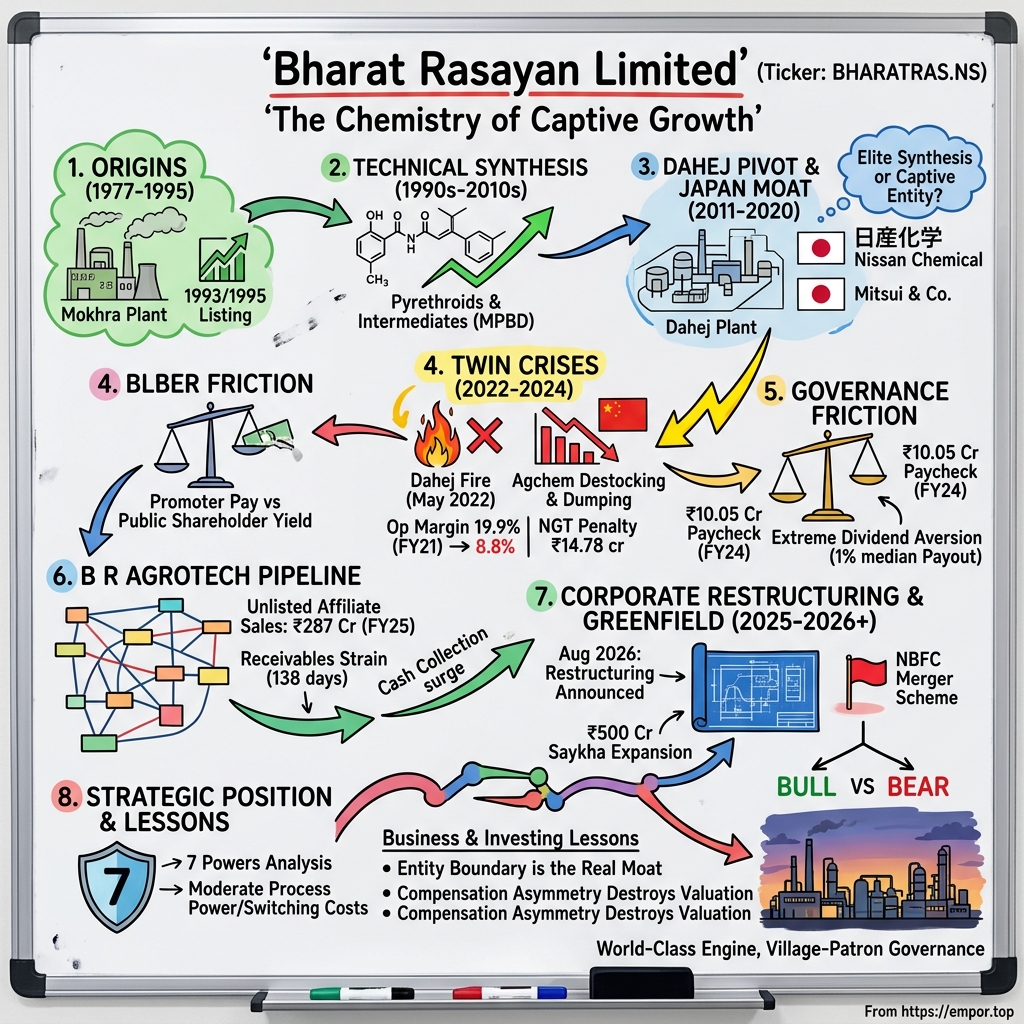
Bharat Rasayan Limited: The Chemistry of Captive Growth
I. Introduction & Episode Roadmap (00:00–15:00)
A company the market has stopped believing
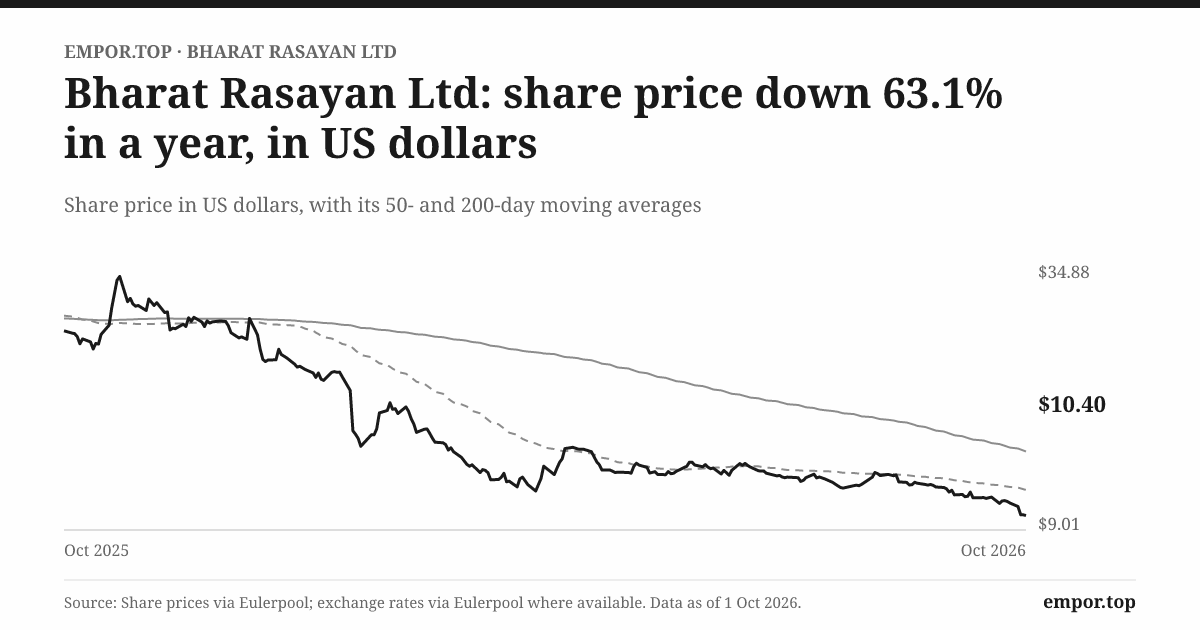
On the first day of October 2026, a share of Bharat Rasayan Limited changed hands at ₹1,000.80. That price was the low of the year. Less than twelve months earlier, after a stock split and bonus issue had cut the share into smaller pieces, the same claim on the same factories had traded at ₹2,942. The whole company was now worth about ₹1,663 crore, or roughly $173 million: less than many single Indian mid-cap chemical plants cost to build6.
Look at the factories behind that price and the number gets stranger. Bharat Rasayan makes the active ingredients that go into insecticides, herbicides and fungicides. It sells them to Syngenta, Sumitomo Chemical and Rallis India. Its joint venture partner is 日産化学 Nissan Chemical21. It has almost no debt. At the end of March 2026 it held about ₹273 crore in cash and debt mutual funds against bank borrowings of just ₹1.23 crore1. CARE Ratings gives its bank lines an AA-minus2.
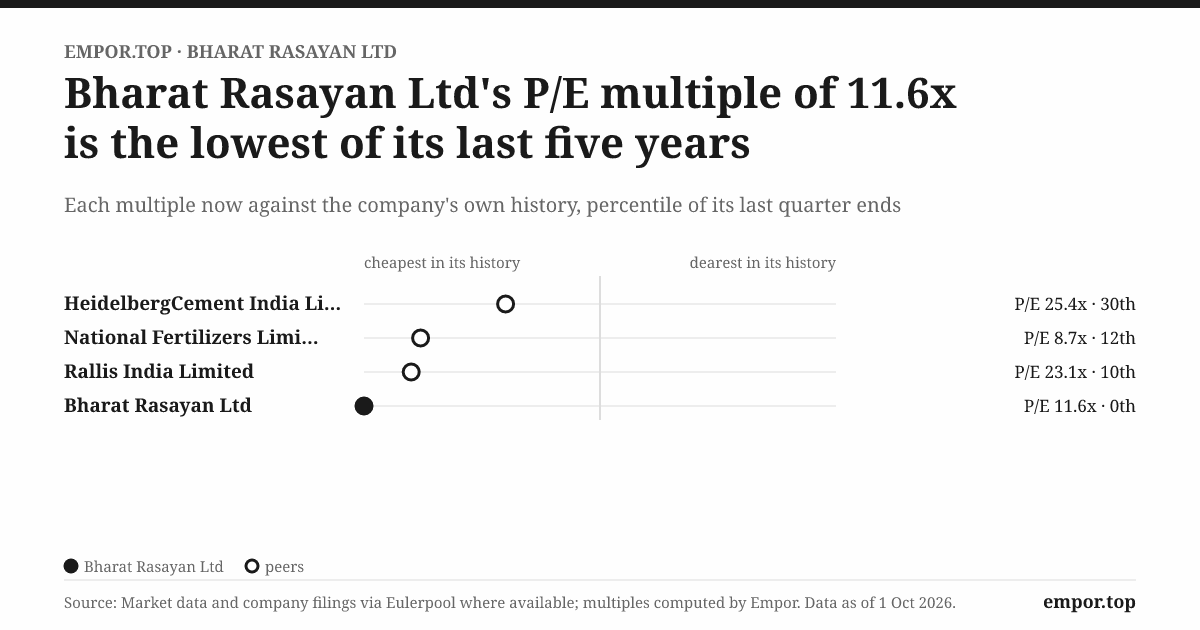
Yet the market prices it at 11.6 times trailing earnings. Over the previous five years its median multiple was 29.9 times, so the valuation has fallen by about 61%6. At 1.3 times book value and about 7.1 times EV/EBITDA, investors are paying roughly what they would pay for a plain commodity business in a bad year. Its most prominent listed peer, PI Industries, trades above 30 times earnings6.
So this is the puzzle. Is Bharat Rasayan a strong, backward-integrated chemical manufacturer bought at the bottom of a cycle? Or is it the manufacturing arm of a family group, built so that most of the cash and strategic value end up somewhere other than in the hands of public shareholders?
The shape of the answer
Over a decade, the company looks like a compounder. Revenue grew about 10.5% a year from FY2016 to FY2026, and net profit about 15.7% a year1. Across twelve fiscal years it earned roughly ₹1,334 crore of cumulative net profit, but paid out only about ₹6.9 crore in dividends over the same period1. Its promoters, the Gupta family, own 74.99% of the company, just short of the 75% ceiling that Indian listing rules allow a promoter group6.
The low valuation does not come from doubts about whether the plants work. It comes from where the money goes. Look at the sales ledger, the pay disclosures and the latest board announcements and the same family name keeps appearing on both sides of transactions. That is the story this piece follows.
Roadmap
The piece has six stops. It starts with the Gupta family's trading roots and the early-1990s listing. Next comes the move into Gujarat and the Japanese alliances. Then the two shocks: the fatal Dahej fire of May 2022 and the global agrochemical destocking of 2023–24. After that, governance: a ₹10 crore paycheck in a down year, and a sister company that bought nearly a quarter of the listed company's output. Then the most recent turn: the balance sheet cleared to zero debt, a ₹500 crore greenfield plan, and an August 2026 board decision to restructure alongside two promoter finance companies. The piece ends with frameworks, the bull and bear cases, lessons and an epilogue.
It begins in Rohtak, in the farm belt of Haryana, with a family that sold pesticides before it ever made one.
 Subscribe on LinkedIn
II. Origins of the Bharat Group & The Technical Synthesis Playbook (15:00–35:00)
Traders who went upstream
In late-1970s north India, pesticides moved along a familiar route. A farmer in Haryana or Punjab bought a bottle from the village dealer. The dealer bought from a distributor in a market town. The distributor bought from a formulator, the company that mixed the chemical into a usable product and printed the label. Almost nobody along that route made the molecule that actually killed the bollworm.
Sat Narain Gupta, Mahabir Prasad Gupta and Rajender Prasad Gupta built the Bharat Group inside this system. According to the group's own history, the business began in 1977, and its first flagship, Bharat Insecticides Limited, grew into a significant formulation and distribution brand across north India4. The brothers learned the business from the dealer's counter. They learned which products farmers came back for, how credit moved through the season, and how badly a formulator's margin suffered when the imported raw ingredient got more expensive.
That last lesson shaped everything after it. A formulator is like a bottler: it buys concentrate, dilutes it, packages it and sells it. A finished pesticide is mostly solvents, emulsifiers and carriers, and the active ingredient (the "technical") is a small share of the liquid. But that active ingredient is where the hard chemistry happens, and in a squeeze it is where the margin goes. The Guptas decided to make the concentrate themselves.
Two sets of companies, by design
That decision produced a split that still defines the company. Bharat Rasayan Limited was set up as the capital-heavy synthesis company. It held its initial public offering in February 1993 and listed on Indian exchanges in October 1995178. The brands, the farmer-facing distribution and the trade credit stayed in unlisted family companies: first Bharat Insecticides, and later B R Agrotech Limited1.
The listed company was given the reactors, the hazardous inputs, the effluent and the capital spending. The unlisted companies kept the brands and the relationships with farmers and dealers. Every later chapter of this story follows from that boundary.
What "technical synthesis" actually means
The first plant went up at Mokhra in Rohtak district. Today its installed capacity is about 4,260 tonnes a year1. The early product range centred on synthetic pyrethroids, a family of insecticides modelled on a natural compound in chrysanthemum flowers, including cypermethrin and its relatives.
Making a pyrethroid is like baking a cake where a mistake at any of a dozen steps can ruin the batch, and some of the ingredients are corrosive, flammable or toxic. Each reaction step has its own yield. If one step gives 85% instead of 92%, every later step works from a smaller base, and the cost per kilogram rises. The skill in generic agrochemical manufacturing is less about inventing molecules than about squeezing out extra yield, recovering solvents, and getting impurities low enough to pass a multinational buyer's specification sheet.
Over time Bharat Rasayan pushed further back up the chain into intermediates. The most important is Meta Phenoxy Benzaldehyde, or MPBD, a building block for several pyrethroids. By FY2025, technicals made up about 72.7% of sales, intermediates about 17.0% and formulations about 9.2%2. Making MPBD in-house meant one less key input bought from outside, and gave the company something it could sell to other pyrethroid makers.
The numbers that tell the method
By FY2016 the company had revenue of about ₹460 crore1. Over the following decade it compounded sales at about 10.5% a year, reaching about ₹1,242 crore in FY20261[^6]. That is solid growth for a business with no blockbuster product. It was achieved by adding capacity, adding molecules and keeping costs low.
Myth vs reality: the innovator story
The claim: Bharat Rasayan is a speciality chemistry company with intellectual property it can defend.
The record: R&D spending says otherwise. In FY2025 the company spent about ₹3.89 crore on research, around 0.33% of revenue. In FY2026 that rose to ₹7.68 crore, still only about 0.62%, split across two research facilities recognised by India's Department of Scientific and Industrial Research at Bahadurgarh and Dahej1[^2]. Innovator crop-protection companies routinely spend several times that share of sales. Bharat Rasayan's portfolio is made up of off-patent molecules sold per tonne, at prices tied to commodity spreads2.
The verdict: The history shrinks the claim rather than throwing it out. The company has real skill: it runs difficult, hazardous multi-step chemistry cheaply and reliably. That is process know-how, not intellectual property. It earns a good return when spreads are wide and gets squeezed when they are not. The test for any future speciality pivot is simple to state: R&D spending sustained above 1–2% of sales, and products named in filings that competitors cannot copy.
Process skill on its own does not get a company onto a Japanese supplier list. That required a bigger plant, closer to the sea.
III. Scaling Dahej and The Japanese Moat: The Nissan Chemical Alliance (35:00–60:00)
A landlocked plant meets the coast
Picture the Bharuch district of Gujarat, where the Narmada meets the Gulf of Khambhat. Over the past two decades the Dahej industrial estate there grew into one of Asia's densest chemical clusters: jetties for liquid cargo, shared effluent treatment, and plot after plot of reactors, all inside a government-designated petroleum, chemicals and petrochemicals investment region.
For a company whose first plant sat in landlocked Haryana, Dahej solved several problems at once. Imported raw materials, mostly from China, could arrive by sea and avoid a long trip by truck. Waste could go through regulated common infrastructure. Land could be leased on 99-year terms from the Gujarat Industrial Development Corporation1. Bharat Rasayan's Dahej complex now has about 29,200 tonnes a year of capacity, almost seven times the original Mokhra plant1.
The momentum years
Dahej powered Bharat Rasayan's best run. Revenue went from about ₹460 crore in FY2016 to about ₹1,120 crore in FY2020 (around $171 million)1. Operating margins rose from about 11% to a peak near 19.9% in FY20211. Return on capital employed, which measures operating profit against the capital the business uses, climbed above 40% in FY20181.
Context explains part of that peak. In the late 2010s China ran repeated environmental enforcement drives against its chemical parks, closing or restricting plants that had supplied the world cheap intermediates and technicals. Global buyers looked for other suppliers, and India was the obvious choice. Bharat Rasayan's margin peak came during a period when its biggest competitors had partly been taken out of the market by their own regulators. That should affect how much of the peak investors treat as normal. A peak earned partly from a rival's shutdown is not a baseline to expect again.
The balance sheet grew with the plant. Net property, plant and equipment went from about $22.5 million in FY2015 to $33.1 million in FY2026, a modest increase in dollars that hides heavy reinvestment and steady depreciation1. Equity grew much faster, about 24% a year over the decade, because profits were kept rather than paid out1.
Earning Japanese trust
Japanese agrochemical innovators buy in an unusual way. Before a supplier makes a commercial batch, the customer may audit its plant, examine impurity profiles down to parts per million, run trial lots and enter the supplier in regulatory dossiers. The process can take years. Once a supplier is in, the buyer rarely changes without good reason, because changing means doing the qualification work again.
Bharat Rasayan's response was a joint venture. Nissan Bharat Rasayan Private Limited is 70% owned by Nissan Chemical Corporation and 30% by Bharat Rasayan1. It is a separate manufacturing company built to produce molecules for its Japanese parent. For the listed company, the JV is both a customer and an investment: in FY2025 it bought about ₹125 crore of goods from Bharat Rasayan1[^2]. The other buyers listed by CARE, including Sumitomo Chemical and the Japanese trading house NISSEI Corporation, show how much Bharat Rasayan's order book depends on Japanese demand2.
Where the big deal happened
Now the scene that shows how the group is organised. In November 2020, 三井物産 Mitsui & Co. announced that it would invest in Bharat Insecticides Limited, the family's unlisted formulation flagship[^10]. When the deal was completed in 2021, Mitsui and 日本曹達 Nippon Soda together held a 56% majority, the promoters kept 44%, and the company was renamed Bharat Certis Agriscience1[^10].
This was a major Japanese trading house paying for an Indian agrochemical brand and its distribution network, which is about as strong a strategic endorsement as a family group can get. It happened above the listed company. Bharat Rasayan's public shareholders received no sale proceeds and had no stake in the valuation. They benefited only indirectly, through whatever supply business followed.
What the alliances really prove
The Japanese relationships are real and they matter. They show that Bharat Rasayan's plants meet some of the strictest buyers in the industry. They also have limits. The listed company owns 30% of the Nissan JV, not control. The most valuable strategic sale in the group's history went to an unlisted affiliate. And contract-style supply to large innovators usually comes with cost-plus economics, where the customer sees the cost structure and caps the margin.
So the alliances provide credibility and steadier volumes. They do not make the listed company a top-tier contract manufacturer with pricing power. The KPI that would change this view is disclosed revenue from dedicated contract-manufacturing programmes earning margins clearly above the generic technical business. The company does not break that out today.
Credibility was about to face its hardest test, on a summer afternoon at Block-D.
IV. Fire at Block-D and The Global Destocking Hangover (60:00–85:00)
May 17, 2022
On May 17, 2022, a fire and explosion tore through a production block at Bharat Rasayan's Dahej plant. Eight people died5. Within days, regulators were on site, production was disrupted and a company known mainly for quiet compounding was in the national news.
Any account of a business has to acknowledge that the cost here was measured in lives before money. For investors, the fire also exposed a risk that is always present in hazardous synthesis. The chemistry that creates the margin is the same chemistry that can kill people. Process know-how includes process safety. When the safety side fails, the know-how argument is weakened as well.
The legal tail
The regulatory consequences took years. The National Green Tribunal took up the incident, and on May 29, 2024 its principal bench ordered Bharat Rasayan to pay ₹14.78 crore in Environmental Damage Compensation[^11]1. The company paid the full amount under protest, booked it as an exceptional item in FY2026, and appealed to the Supreme Court of India1. The appeal is pending, so the money could in principle come back, but the company has already taken the hit in its accounts, which is the conservative treatment.
Compared with a company holding ₹273 crore in liquid assets, the penalty is small. Its significance lies elsewhere. Bharat Rasayan's next big project, the ₹500 crore greenfield expansion, needs environmental clearances in the same state, from regulators who remember Block-D.
The macro pincer
The fire came just as the global agrochemical cycle turned. Through 2021 and early 2022, distributors around the world overstocked, fearing pandemic shortages and Chinese plant closures. Then crop prices weakened, interest rates rose and holding inventory became expensive. Distributors stopped buying and worked through their stock. At the same time, Chinese producers brought large new capacity online and cut prices hard to keep plants running.
For a generic technicals maker, that combination is close to the worst case. Bharat Rasayan's revenue fell about 4.7% in FY2023 and another 15.4% in FY20241. In the June 2023 quarter, operating margin fell to about -0.3%, so the company made no operating profit at all31. For FY2024 as a whole, operating margin bottomed at about 8.8%, less than half the FY2021 peak, and net profit fell 23.4% to about ₹95.5 crore[^3].
Decomposing the collapse
How much of the damage came from the fire and how much from the market? The timing points mainly to the market. The fire was in May 2022, yet FY2023 still produced an operating margin near 13.9%1. The trough came in FY2024, almost two years later, when global destocking and Chinese price cuts were at their worst. The fire took away output and added cost. The destocking took away pricing. Pricing did more damage.
Myth vs reality: integration as armour
The claim: Backward integration into intermediates like MPBD protects Bharat Rasayan's margins from Chinese dumping.
The record: About half of the company's raw materials are imported, and about 85% of those imports come from China2. Integration covers some links in the chain, not the starting chemicals. Operating margin fell by about 11 percentage points from FY2021 to FY2024, which is what happens to a price-taker, not a company with protected margins1.
The verdict: The history rejects the strong version of the claim. Integration helps at the edges, but the company buys from China upstream and competes with China downstream, so Chinese pricing affects both its costs and its selling prices. The revised claim is narrower: integration lets Bharat Rasayan survive a down-cycle profitably, and it did stay profitable for every full year. The KPI to watch is operating margin through the next Chinese capacity wave. If it holds above about 12%, the integration argument gets stronger.
With profits falling by almost a quarter, a family-run company would be expected to tighten its belt. The FY2024 pay disclosures show something else.
V. The ₹10 Crore Paycheck in an Agchem Winter (85:00–105:00)
August 2024: the annual report arrives
In August 2024, Bharat Rasayan's shareholders received the FY2024 annual report. It covered the company's worst year in a decade. Profit was down 23.4%, margins had halved and working capital was tied up[^3]. The remuneration disclosures, normally a routine annexure, held the surprise.
Whole Time Director Rajender Prasad Gupta, one of the three founding brothers, received ₹1,005.42 lakh for the year, or about ₹10.05 crore[^3]. That is about 10.5% of the company's entire net profit for the year, and 201.8 times the pay of the median employee[^3]. Managing Director Sat Narain Gupta drew about ₹15–21 lakh a year over the period1[^2]. One brother took a token salary while another took more than a tenth of the profit.
The vanishing act
The following year the figure collapsed. In FY2025, R.P. Gupta's pay was ₹12.22 lakh, a fall of about 98.8%[^2]. In FY2026 it was ₹9.79 lakh, and he later moved to a non-executive directorship1. Ajay Gupta, Director (Operations), from the next generation, received about ₹97 lakh in FY2025 and about ₹109 lakh in FY20261[^2].
A single large payout followed by a near-zero year looks less like a salary and more like a one-off disbursement. It may have reflected profit-linked commission based on cumulative entitlements, or a payout tied to a role change. The company's disclosures do not explain the formula or any performance hurdle in terms a minority shareholder can test. That gap is itself the issue. Pay that can jump by a factor of eighty in one year, during a downturn, is pay that minority investors cannot predict.
Dividend aversion as a policy
The dividend record matters more than the one-off pay. Across FY2015 to FY2026, Bharat Rasayan generated about ₹586 crore of free cash flow and paid roughly ₹6.9 crore in dividends, about 1% of the free cash1. In most recent years the payout has been well under 1% of profit, around ₹70 lakh a year1. For a company with more than ₹1,200 crore of revenue, that is close to nothing.
The money has gone into three places. Some went into plants. Some sits in mutual funds; liquid holdings grew from under ₹5 crore at the end of FY2014 to about ₹273 crore at the end of FY20261. And some went into one large buyback.
The buyback and the bonus
In March–April 2021, the company repurchased 93,472 shares by tender offer at ₹11,500 each, spending about ₹107.5 crore1. Promoters did not tender in proportion, so their stake rose from about 74.83% to 74.99%6. The buyback returned cash to shareholders who chose to sell, but its lasting effect was to push family ownership right up to the regulatory limit.
In December 2025 the company split each ₹10 share into two ₹5 shares and then issued one bonus share for each[^7][^8]. The share count roughly quadrupled, from about 41.55 lakh to about 1.66 crore1. A bonus issue moves retained earnings into share capital without paying out any cash. It does make shares cheaper per unit and easier to trade, and the number of individual shareholders rose from about 15,000 in March 2025 to about 22,400 by June 20266. Many of those new holders bought near the post-split high and are now sitting on a loss of about two-thirds.
Myth vs reality: alignment by ownership
The claim: Promoters with 74.99% of the equity are naturally aligned with public shareholders.
The record: Ownership aligns terminal value: if the company becomes worth more, the family gains most of it. Cash flows tell a different story. The family can draw value through executive pay, through sales to its own companies and through restructurings it controls. Public shareholders have one cash channel, the dividend, and that has been kept at almost zero.
The verdict: The history narrows the claim. The family is aligned on not wrecking the asset; there are no pledged shares, no equity dilution and no leverage. It is not aligned on how cash is shared. The measure that would show change is a written dividend policy plus pay tied to stated hurdles in the FY2027 annual report.
Pay is a once-a-year disclosure. Sales to related parties happen every day. Those are next.
VI. The B R Agrotech Pipeline: Synergistic Engine or Captive Balance Sheet? (105:00–130:00)
Note 38
Most investors stop reading an Indian annual report at the profit and loss statement. The detail is in the notes. In Bharat Rasayan's FY2025 accounts, Note 38 on related-party transactions shows how the business really works[^2].
In FY2025, B R Agrotech Limited bought about ₹288 crore of products from Bharat Rasayan, roughly 24% of the listed company's revenue[^2]. B R Agrotech is the family's unlisted formulation and marketing company, the business that turns technicals into branded bottles for Indian farmers. At year end it owed Bharat Rasayan about ₹139 crore, roughly one-third of all trade receivables[^2].
FY2025 was presented as the recovery year, with revenue up 12.3%1. A large part of that recovery went to a buyer controlled by the same family, which paid slowly.
The web, mapped
There are two main related parties. The first is B R Agrotech, which buys technicals, turns them into formulations and sells through Indian channels. The second is the Nissan JV, which bought about ₹125 crore in FY2025 and about ₹83 crore in FY20261[^2]. Taken together, related-party sales were about 35% of revenue in FY2025 and about 24% in FY20261.
The Nissan JV flows are easier to defend, because a Japanese partner holding 70% has every reason to resist overpaying a 30% shareholder. B R Agrotech is the harder case. When the seller and buyer are controlled by the same family, the transfer price decides which company records the profit. A slightly lower price moves margin from the listed company to the private one. A slightly higher price moves it the other way and inflates listed earnings. The listed company's audit committee approves these transactions. No outside party sets the price.
Receivables as a hidden loan
Working capital shows the cost most clearly. Debtor days measure how long customers take to pay. They rose from about 75 in FY2020 to a peak of about 138 in FY2024, and were still about 130 in FY20251. When a related party owes ₹139 crore interest-free for months, the listed company is in effect lending to its promoter's private business. During that period the listed company also carried about ₹85 crore of bank borrowings1. Public shareholders were funding bank debt while the family's own company held their cash.
The FY2026 collection surge
Then the balance reversed. By March 31, 2026, B R Agrotech's balance owed to Bharat Rasayan had fallen to about ₹9 crore, so roughly ₹129 crore was collected in one year1. Sales to it fell to about ₹218 crore, or 17.5% of revenue1. Debtor days improved to about 1131. The cash came in, bank loans were almost entirely repaid, and the treasury grew.
This is the best defence the company has. The receivables were real and they were collected. The ageing schedule supports it: at March 2026 almost all receivables were under six months old, nothing was over a year old, and no credit-loss provisions were needed1.
Weighing the evidence
What does the record show? B R Agrotech was used as a buffer. When open-market demand collapsed, the family's private channel took volume on long credit and kept the Dahej reactors running. When the cycle improved, it paid. Whether that helped or hurt minority shareholders depends on transfer prices that are not disclosed against open-market comparables. The company does not publish price realisation for related-party sales against sales to third parties. Without that, earnings quality cannot be fully tested from outside.
The external counterweight
The independent half of the business is still substantial. In FY2025 the top ten external customers, including Syngenta, Sumitomo Chemical, NISSEI, Shanghai Agrotree and Rallis India, accounted for about 52.5% of total income2. The company holds more than a hundred international product registrations and exports to more than 24 countries2. Multinationals with their own procurement teams do not buy from a supplier as a favour to its promoters. That external business is the real evidence that the technicals hold up in open competition.
The settling metric is the share of revenue going to B R Agrotech in FY2027. If it falls toward 10% without total volumes falling, the captive-channel concern fades. If it rises again in the next downturn, the concern is confirmed.
Collecting ₹129 crore from a sister company was a deliberate move. The question is what the family plans to do with the balance sheet that collection cleaned up.
VII. Corporate Restructuring and the Greenfield Gamble: Saykha, Dahej III, and the NBFCs (130:00–150:00)
August 13, 2026
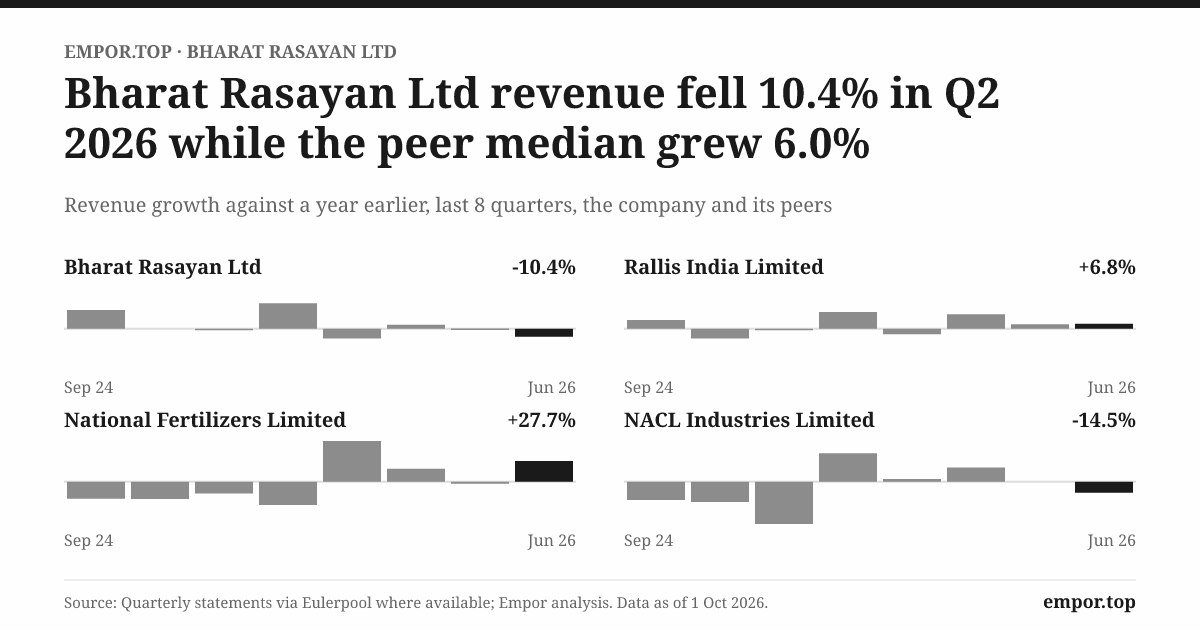
On August 13, 2026, Bharat Rasayan's board met to approve the June-quarter results. Revenue for the quarter was down about 10% from a year earlier, and operating margin was about 12.9%3. The more consequential item in the outcome filing came after the numbers. The board gave in-principle approval to a corporate restructuring involving the listed company and two promoter-owned non-bank finance companies, BRL Finlease Limited and Centum Finance Limited31.
No swap ratio was published. No valuation report was released. No scheme document was filed. The announcement was simply that the restructuring would go ahead, with details to follow.
Clearing the decks
The months before the announcement make more sense in that light. Over FY2026 the company cut its working-capital borrowings with SBI, HDFC Bank and ICICI Bank from about ₹85 crore to about ₹1.23 crore1. Debt to equity fell to effectively zero1. Liquid assets reached about ₹273 crore: around ₹250 crore in debt and arbitrage mutual funds and about ₹23 crore in cash and deposits1. CARE's December 2025 reaffirmation, AA-minus for long-term facilities and A1-plus for short-term, noted the zero term debt and interest coverage above 40 times2.
There is a straightforward operational reason for this. The company has begun its largest capital programme in a decade and needs liquidity for it.
The ₹500 crore bet
According to CARE, management plans a phased greenfield expansion in Gujarat costing about ₹500 crore over several years, on top of normal maintenance capex of ₹50–60 crore a year2. Capital work in progress, which measures assets being built but not yet in use, rose from about ₹15 crore to about ₹46 crore in FY2026 as site work started1.
That is a large commitment for a company with a market value of about ₹1,663 crore. Measured against FY2026's fixed asset base of roughly ₹300 crore, it would more than double the company's plant. The company has described the expansion only broadly; filings do not give a product list, a commissioning date or target returns. The CARE rationale describes a debt-funded share as part of the possible financing2. Investors cannot yet tell whether the new capacity will serve dedicated Japanese contract programmes, which would be the best outcome, or more generic technicals that will face Chinese prices again.
Bharat Rasayan's last big expansion, Dahej, was delivered and paid off handsomely. That record supports execution capability. It does not prove that the next plant will meet the same demand environment.
The red flag
The NBFC plan is a separate issue. BRL Finlease and Centum Finance are finance companies. Bharat Rasayan is a chemical manufacturer. Investors in specialty chemicals pay for exposure to chemistry, not to a family lending book. Combining the two, depending on the structure, could add assets that are hard to value, loans to related parties, or new equity issued to promoters at a ratio set by the family.
The board's stated aim is to simplify and align group businesses3. That is possible. Restructurings can remove cross-holdings and clean up a group. But the order of events matters to minority holders. First the balance sheet was cleared of debt. Then the cash was built up. Then a scheme was announced involving the family's finance companies. Each step can be defended individually. Together they leave an obvious question that only the scheme document can answer.
Things to read when the scheme is filed: the swap ratio, the independent valuer's assumptions, the assets and liabilities each NBFC brings, whether any promoter-group receivables or investments move onto the listed balance sheet, and whether the promoter stake rises above 75% in a way that would require a later sell-down. Under SEBI's rules, majority-of-minority voting may apply to a scheme involving promoter entities. If it does, this would be the rare decision where public holders have a real vote.
Before reaching a verdict on whether the market is right to discount all this, the competitive economics need to be argued once and properly.
VIII. Strategic Position, Moat Analysis & 7 Powers (150:00–170:00)
The war room
Line up the Indian agrochemical companies. PI Industries does custom synthesis for global innovators under long contracts and trades around 30 times earnings6. Dhanuka Agritech owns farmer-facing brands and trades around 16 times6. Sharda Cropchem, an asset-light registration and distribution business, trades around 10.5 times6. Astec LifeSciences, a generic technicals maker like Bharat Rasayan, has been making losses6.
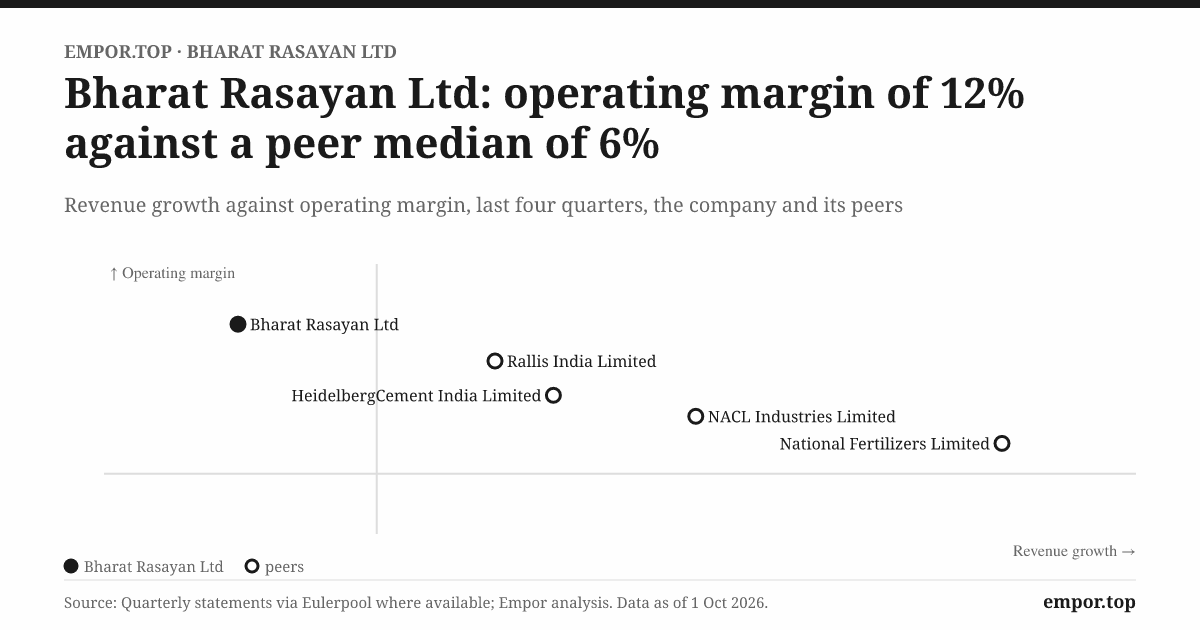
Bharat Rasayan sits between the low-multiple generic group and the contract manufacturers, with about a 13.9% operating margin, 15.3% return on capital employed and an 11.6x P/E16. The market is treating it as a generic producer. Here is whether that is fair.
Hamilton Helmer's 7 Powers
Process Power: moderate. This is the company's real advantage. Running halogenation, multi-step pyrethroid synthesis and the MPBD intermediate safely at good yields takes accumulated know-how that new entrants cannot copy quickly. The profit record is the evidence: Bharat Rasayan stayed profitable through FY2024, while Astec, in similar chemistry, did not16. The Block-D fire shows the limits of that know-how.
Switching costs: moderate. Multinational and Japanese customers qualify suppliers through long audits and include them in regulatory dossiers. Changing supplier means repeating that work. Top-ten customers stayed at a similar share of revenue, from about 55% in FY2024 to about 52.5% in FY2025, which suggests stable relationships2. But switching costs keep a supplier on the list. They do not stop the customer from cutting prices, and through 2023–24 customers did exactly that.
Scale economies: weak. Capacity of about 29,000 tonnes is significant in India but small next to Chinese chemical parks with subsidised utilities and integrated feedstock.
Counter-positioning: absent. The business model is the standard one.
Cornered resource: absent. There are no patented molecules, R&D runs below 1% of revenue, and the talent pool is the general Indian chemical engineering market.
Network effects: absent. This is plant manufacturing.
Branding: absent within the listed company. The farmer brands belong to B R Agrotech and Bharat Certis. This is the clearest effect of the entity boundary on the moat: the one power the group has built over five decades is mostly held outside the listed company.
Porter's Five Forces
Buyer power: high. The top ten customers account for about half of revenue, and companies like Syngenta and Sumitomo source the same molecules from India and China. They can switch volume between suppliers within a season.
Supplier power: high. About 85% of imported raw materials come from China2. When Chinese basic chemical prices rise, Bharat Rasayan's costs rise before its prices can follow.
Threat of substitutes: low to moderate. Commercial farming still relies on chemical crop protection. Biologicals are growing but remain marginal for the molecules Bharat Rasayan makes.
Threat of new entrants: moderate. Environmental clearances, zoning and a ₹500 crore price tag for a new plant keep casual entrants out. Established Indian chemical companies, though, regularly move into neighbouring molecules.
Rivalry: intense. Domestic generic makers compete on price, and Chinese capacity sets the global floor.
The verdict on the moat
Bharat Rasayan has a narrow moat based on process skill and qualification. It is enough to keep the company profitable through a severe cycle and to retain demanding customers. It is not enough to set prices. Two forces, buyer power and supplier power, both work against it, with China on both sides. Return on capital employed captures the story: about 40% at the FY2018 peak, under 10% at the FY2024 trough, and about 15% now1. That is a cyclical profile, not a franchise.
Over twelve years, about 76% of reported profit turned into operating cash1. The gap went into receivables and inventory, as described in Section VI. A business with real pricing power usually converts profit to cash more fully than that.
The KPIs that matter
Three measures summarise the case:
- Operating margin. About 13.9% in FY2025–26 and about 12.9% in the June 2026 quarter, recovering from the 8.8% trough but below the 17–20% of the peak years13. It is the clearest read on pricing.
- Related-party share of revenue. About 35% in FY2025, down to about 24% in FY20261. This is the governance measure.
- Debtor days. Down from 138 at the peak to 1131. This is the earnings-quality measure.
With the moat assessed, the remaining question is whether 11.6 times earnings already reflects all of this.
IX. Bull vs. Bear Case & Activist Stress Test (170:00–190:00)
The scene
Imagine an analyst from a domestic fund on a results call with a simple question. The company holds about ₹273 crore in debt funds earning mid-single-digit pre-tax returns. The stock trades at about 11 times earnings, an earnings yield of about 8.6%6. Why keep the cash in mutual funds instead of buying back cheap stock or paying a proper dividend?
Management's likely answer is that the cash is for the greenfield plant. That is a reasonable answer. It is also the answer minority holders have heard, in one form or another, for twelve years.
The bull thesis
Earnings recovery. Global distributor inventories have largely cleared. Revenue grew 12.3% in FY2025 and 5.9% in FY2026, and operating margin rebuilt from 8.8% to 13.9%1. If margins return even halfway to the 17–20% peak range, earnings would rise sharply on the same revenue.
A clean balance sheet. Net cash, AA-minus rated facilities and coverage above 40 times mean the company can fund growth without dilution or distress21.
A visible growth step. The greenfield plant could roughly double capacity over several years. If it is filled with qualified contract programmes for Japanese customers, the business mix would move toward higher-quality earnings.
A valuation at a historical low. At 11.6 times earnings, against a five-year median near 30, the market is pricing in little recovery and no re-rating6. If governance improves, the multiple has a lot of room to move.
The bear thesis
Promoter capture. Between a quarter and a third of revenue goes to related parties. The listed company carries the plant risk, the safety risk and the working capital, while the branded formulation margin sits in private family companies.
Restructuring risk. The NBFC scheme could bring financial assets onto the books of a chemical company, dilute minority holders, or both. Until the terms are published, it is an open-ended risk.
Weaker core earnings. In FY2026, other income was about ₹41 crore, about 19% of pre-tax profit1. About ₹20 crore of that was foreign exchange gains, roughly half unrealised, and about ₹16 crore was mutual fund gains1. The company runs no formal currency hedging. It relies on matching export receipts against import payments, and in FY2026 foreign currency outflows exceeded inflows by about ₹33 crore1. Strip out these items and the manufacturing business is less profitable than headline earnings suggest. That matters for the bull case, because some of the headline earnings depend on currency moves and fund marks.
China dependence. Upstream reliance on Chinese inputs and downstream competition from Chinese capacity are structural, not cyclical.
Lingering liabilities. On top of the NGT appeal, tax disputes over deductions for AY2016-17 and AY2017-18 total about ₹31 crore1. They are not large, but they are not resolved.
What the price assumes
At 7.1 times EV/EBITDA and roughly the same P/E as Sharda Cropchem, a distribution business, the market is valuing Bharat Rasayan as a generic chemical company whose cash may not reach minority holders. It is not paying for either the moat or the cash pile. The valuation leaves room for upside, but the market has decided that upside depends on governance, not on the next quarter's earnings.
The activist stress test
An activist would ask for four things:
- Arm's-length related-party pricing. Open bidding, or published price comparisons against third-party sales, for all supply to B R Agrotech.
- Stop the NBFC scheme. Keep Bharat Rasayan a pure chemical manufacturer.
- A dividend policy. For example, paying out at least a quarter of net profit as a regular dividend.
- Pay discipline. Executive pay tied to hurdles set by independent directors, with no discretionary multi-crore payouts in years when profits fall.
Why activism has little chance here. Promoters hold 74.99%. Foreign institutions hold about 0.41% and domestic institutions about 2.0%6. There is no institutional bloc that could even force a meeting. Public holders' main lever is SEBI's majority-of-minority vote on related-party schemes, and how the NBFC scheme is structured will decide whether that lever applies.
The stress test leads to a set of lessons that extend beyond this one company.
X. Playbook: Business & Investing Lessons (190:00–205:00)
Lesson 1: The entity boundary is the real moat
The moment: Late 2020 into 2021. Mitsui and Nippon Soda took majority control of Bharat Insecticides, the family's branded formulation company, at a price that reflected its strategic value[^10]1. Public shareholders in Bharat Rasayan, the listed company sharing the group name, the factories and the customer relationships, received nothing from the deal.
The principle: In promoter-led groups, the most important question is which company owns which asset. A family can put the capital-heavy, liability-bearing manufacturing in the listed company and keep the asset-light brands, the farmer relationships and the strategic premium in private companies. The group can be excellent while the listed company remains a cost centre. Before valuing a business, investors should first establish which parts of it they actually own.
The line: Before buying the group, check which company you are actually buying.
Lesson 2: Cash is king, but receivables are the court jester
The moment: March 2024 to March 2025. Debtor days hit about 138, and a sister company owed about ₹139 crore while the listed company carried bank debt1[^2]. The recovery year looked good on the profit and loss statement and much weaker on the balance sheet.
The principle: In B2B manufacturing, revenue is a claim until the cash arrives, and a related-party receivable is a claim the family can enforce or delay as it chooses. Bharat Rasayan's claims were in fact paid in FY2026, which is to its credit. Investors should note that collection depended on a decision by the controlling family, not on a contract enforced against an outside buyer.
The line: Sales to a sister company count only when the cash comes in.
Lesson 3: Downside pay asymmetry destroys multiples
The moment: FY2024. Profit fell almost a quarter in the worst agrochemical year in a decade, and one founding director took home more than a tenth of what was left[^3].
The principle: Institutional investors can live with commodity cycles; cycles end. What they will not pay for is a structure where insiders keep the upside in bad years and public holders get almost no dividend in any year. A valuation multiple reflects how much investors trust the company, and trust lost in a downturn is not regained when the cycle recovers. The multiple fell from about 30 to under 12 while the plants kept running and the balance sheet improved. The gap between earnings recovery and valuation is the cost of that lost trust.
The line: Investors forgive a bad cycle sooner than an insider payday during one.
Lesson 4: Safety is part of the process moat
The moment: May 17, 2022, Block-D, Dahej5.
The principle: For hazardous-chemistry companies, the ability to run dangerous reactions cheaply is also the ability to run them safely. A plant that cannot do both does not have a process advantage. It has a liability that has not yet been realised. Every future environmental clearance, including those for the new greenfield plant, will be judged against what happened that day.
The line: A cheap process that kills people is not an advantage.
XI. Epilogue (205:00–215:00)
Where Bharat Rasayan stands tonight
On the evening of October 1, 2026, Bharat Rasayan is in an unusual position: operationally sound, financially very strong, and almost completely distrusted by the market. The plants are running. Margins are about halfway back to their peak. The balance sheet has no debt. The share price is at its low for the year. The questions that will decide the next two years are about governance, not chemistry. Four events will settle them.
Catalyst 1: The scheme document
The most important near-term event is the filing of the definitive restructuring scheme with BRL Finlease and Centum Finance. Two outcomes are possible. In the good version, the scheme turns out to be a cleanup: it removes cross-holdings or brings in shares of Bharat Rasayan already held by the NBFCs, with no new financial business and no dilution. That could remove a long-standing discount. In the bad version, the listed company takes on a lending book, issues shares to promoters, or absorbs assets that are hard to value. That would confirm the bear case more clearly than any earnings miss. The swap ratio and the valuer's report will settle this.
Catalyst 2: The FY2027 related-party note
The next annual report will show whether B R Agrotech's share of revenue keeps falling. If it moves toward 10–15%, receivables stay small and total volumes hold, then FY2025 looks like an emergency measure for a downturn, not the normal model. If the share rises again and receivables build up, the captive-channel concern is confirmed.
Catalyst 3: How the greenfield plant is funded
If the ₹500 crore programme is funded from the ₹273 crore treasury and internal cash flow, with limited borrowing and no equity issue, it will show the cash was saved for a real purpose. If debt rises sharply while the treasury is used for something else, such as the restructuring, the order of events described in Section VII will look much worse. The product mix the company eventually discloses for the new plant matters just as much: contract programmes for Japanese innovators would justify the investment far more than additional generic tonnage.
Catalyst 4: Core margin without the extras
Over the four quarters of FY2027, investors need to see operating margin, excluding currency gains and mutual fund marks, return to 15% or higher. That would show the manufacturing business is recovering on its own merits. If margins stay stuck in the low teens while other income keeps headline profit up, the recovery is not as strong as it looks.
The tension that remains
These four tests come back to the questions the piece opened with. Is the rebound real demand or a captive channel? Was the cleaned-up balance sheet discipline or preparation for the restructuring? Was the pay spike a one-off or a pattern? Can returns hold without other income? None of them is settled yet. The family has the votes to decide each one, and the market has priced in the worst outcome on all of them.
XII. Outro (215:00–220:00)
At dusk in Dahej, the distillation columns are lit up against the Gulf of Khambhat. Somewhere in that complex a reactor is running a step in a pyrethroid synthesis, producing a molecule that will end up in a cotton field in Haryana or on a farm in Brazil after passing through a Japanese buyer's specification sheet. The chemistry works. It worked through the fire, through the destocking and through Chinese price cuts. Few Indian manufacturers can claim as much.
The question was never whether the chemistry works. It is who keeps the proceeds. A family that started out selling pesticides from a dealer's counter in Rohtak went on to build a synthesis business trusted by Nissan Chemical, Sumitomo and Syngenta, and then arranged the group so that the most valuable pieces remained in family hands. Bharat Rasayan is a world-class synthesis plant that operates with multinational trust on the factory floor but is governed like a village patron in the boardroom. Until the governance changes, the market will continue to price the stock on the governance, not on the plant.
References
-
Annual Report 2025-26 — Bharat Rasayan Limited, 2026-09-24 ↩↩↩↩↩↩↩↩↩↩↩↩↩↩↩↩↩↩↩↩↩↩↩↩↩↩↩↩↩↩↩↩↩↩↩↩↩↩↩↩↩↩↩↩↩↩↩↩↩↩↩↩↩↩↩↩↩↩↩↩↩↩↩
-
Rating Rationale: Bharat Rasayan Limited — CARE Ratings, 2025-12-18 ↩↩↩↩↩↩↩↩↩↩↩↩↩↩
-
Standalone & Consolidated Un-Audited Financial Results for Quarter Ended June 30, 2026 and Outcome of Board Meeting — Bharat Rasayan Limited, 2026-08-13 ↩↩↩↩↩
-
Bharat Rasayan Limited Official Corporate Portal — Bharat Group ↩
-
Eight dead in fire at Bharat Rasayan plant in Dahej, Gujarat — The Indian Express, 2022-05-18 ↩↩
-
Bharat Rasayan Ltd Financial Data & Screener Overview — Screener, 2026-10-01 ↩↩↩↩↩↩↩↩↩↩↩↩↩↩↩
-
Company Profile & Stock Information: Bharat Rasayan Limited — National Stock Exchange of India ↩
-
Company Information & Corporate Announcements: Bharat Rasayan Limited — BSE India ↩
 LinkedIn
 WhatsApp
 Reddit
 Hacker News
 Email
Email Kindle
 RSS Feed
 Spotify
 Apple Podcasts
 Amazon Music
 Audible
 YouTube