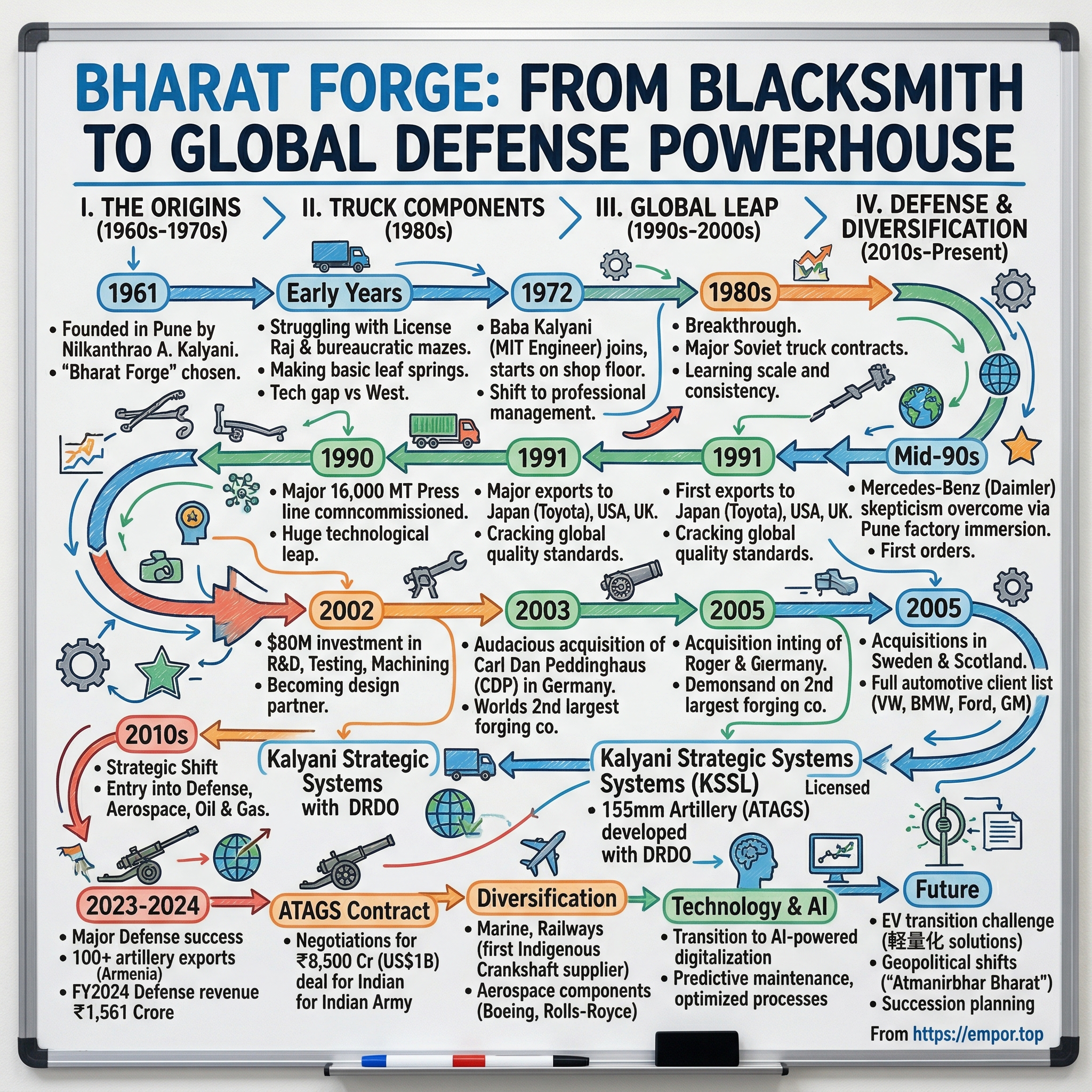
Bharat Forge: From Village Blacksmith to Global Heavy Metal & Defense Giant
I. Introduction & Cold Open: The Artillery Forge of Pune
Somewhere on the road between Yerevan and the Azerbaijani border, in the winter of 2024, an Armenian artillery crew unlimbered a howitzer built roughly 4,000 kilometres away, in a Pune industrial estate that spent most of its first fifty years making truck axles.
The gun was a 155mm system from Kalyani Strategic Systems. Its parent company shipped roughly 100 artillery guns during that calendar year, a figure confirmed publicly by its chairman that would have sounded implausible to anyone familiar with the firm's history.[^1] Armenia signed for the platform in November 2022 in a deal worth about $155.5 million, to be executed over three years — marking the first time a private Indian company had sold complete artillery systems abroad at that scale.1
The company that built those guns is Bharat Forge, and the distance it traveled to get there is the core narrative.
Bharat Forge was not founded to make weapons. Established in 1961 to manufacture forgings — crankshafts, front axle beams, and connecting rods — it produced the steel innards of Indian commercial vehicles under a licensing regime that strictly dictated production quotas.2 For three decades, the company served as a supplier to Telco and Ashok Leyland, tethered to the volatile cycles of the domestic truck industry.
As of late August 2026, the company carries a market capitalization of roughly ₹98,000 crore ($11 billion), with the stock trading around ₹2,005 per share — about 13% below its 52-week high and 82% above its 52-week low, reflecting how the market has repriced the business.3 Consolidated revenue for the fiscal year ended March 2026 was ₹16,812 crore, up 11.2%, with consolidated profit after tax of ₹1,089 crore.4 The Mundhwa plant in Pune remains the world's largest single-location forging facility, anchored by press lines of 16,000 tonnes and 12,500 tonnes.
These headline numbers mask a company navigating two simultaneous structural transitions.
The first is defensive. A meaningful portion of Bharat Forge's legacy automotive revenue derives from internal combustion engine components — crankshafts, connecting rods, and camshafts — that have no place in electric powertrains.
The second is offensive and underpins its current market valuation. Defense has grown from a minor segment into a core division with an outstanding order book of ₹11,196 crore as of June 30, 2026.5 Aerospace operations are scaling, while semiconductor component manufacturing represents its newest initiative.
Yet in the same quarter that yielded that record order book, Bharat Forge reported a consolidated net loss of ₹90 crore after taking a provision of roughly €30 million to shut down the German steel forging business acquired in 2003.5 Nine months earlier, it had written down ₹450.4 crore of its electric-mobility subsidiary.6 Both operations were previously promoted as long-term strategic pillars.
This contrast — a record defense order book alongside the retrenchment of earlier expansion initiatives — defines the investment case. Bharat Forge demonstrates strong technical capability in metallurgy, paired with a mixed capital allocation record. The key question for investors is whether the expansion in defense and non-auto segments can outpace legacy automotive risks and past capital drag.
The analysis proceeds in seven parts: first, examining the metallurgical foundations and License Raj constraints; second, reviewing the M&A-driven global expansion of the 2000s and its ultimate returns; third, detailing the non-auto pivot, defense growth, and electric-vehicle investments; fourth, conducting a capital allocation audit of the German closure, Tork Motors write-off, AAM India acquisition, and Alstom joint venture exit; fifth, evaluating corporate governance and family litigation; and finally, assessing the market structure, financial position, and bull and bear cases.
 Subscribe on LinkedIn
II. The Metallurgical Origins & License Raj Industrial Context (1961–1990)
Picture Pune in the early 1960s: not the software hub of glass towers, but a dry cantonment town on the Deccan plateau where the Mula and Mutha rivers meet and industrial estates were mostly basic sheds. India was fourteen years independent, deep in its second Five Year Plan, and governed by an economic philosophy of import substitution: if the country needed a manufactured good, it had to make it locally, behind tariff walls and under government license.
Into that environment, on June 19, 1961, Nilkanthrao A. Kalyani incorporated Bharat Forge. Commercial production began in 1966.2
The decision to focus on forging proved to be the single most consequential choice in the company's history. Understanding the mechanics of forging is essential, as the company's long-term competitive trajectory rests on this metallurgical foundation.
Casting involves pouring molten metal into a mold; machining cuts metal away. Forging does neither. It takes a solid steel billet, heats it until it glows orange and becomes plastic, and then squeezes or hammers it into shape between hardened steel dies. The vital difference lies in grain flow. Casting leaves a random internal crystal structure, while machining cuts straight through the metal's structural grain. Forging forces the grain to contour around the finished shape, much like natural wood grain following the curve of a chair leg. Consequently, forged components offer superior fatigue resistance compared to cast or machined alternatives.
This structural advantage explains why forging dominates high-consequence automotive and industrial parts—crankshafts, connecting rods, steering knuckles, front axle beams, and, as demonstrated six decades later, artillery barrels.
The entry barriers are formidable. First, capital requirements are high: a heavy press line demands substantial investment and cannot be repurposed. Second, die-making requires customized tooling tailored to how specific alloys deform at precise temperatures. Third, metallurgical expertise is largely tacit, relying on experienced shop-floor engineers who judge micro-alloy heat treatments and cooling rates through precise observation.
Nilkanthrao's son, Babasaheb Neelkanth Kalyani — universally known as Baba Kalyani — was born in January 1949, attended the Rashtriya Military School in Belgaum, and earned engineering degrees from BITS Pilani and MIT.7 He returned to a business operating under a License Raj system that severely constrained industrial initiative. Capacity expansion required explicit government approval, foreign exchange for advanced machinery was tightly rationed, and protected domestic markets limited competitive pressure.
Kalyani focused on operational variables within his direct control: shop-floor automation, statistical process control, and advanced metallurgical laboratories—disciplines rare in 1970s Indian manufacturing. This focus was less about altruism than necessity, representing the primary operational lever available under regulatory constraints.
Then, in 1990, the company made a pivotal capital commitment.
Bharat Forge commissioned a 16,000-tonne press line at Mundhwa—the first of its kind in India.2 The investment was aggressive relative to domestic demand; Indian commercial vehicle production at the time could not absorb the press's full capacity. The company had installed equipment for a market that did not yet exist locally. A second 16,000-tonne line followed in 2001.2
While conventional narratives frame this decision as pure strategic foresight, it functioned primarily as an operational forcing function. A press of that scale compelled Bharat Forge to secure export clients or face catastrophic under-utilization. By installing the press, Kalyani deliberately eliminated the option of remaining a small, purely domestic supplier. Whether this represented strategic vision or high-risk capital deployment depended entirely on execution—a gamble taken just months before India launched its 1991 economic reforms.
Testing the origin story. A common narrative holds that Bharat Forge's early domestic dominance proved the superiority of its manufacturing strategy from the start. However, the financial record of its first three decades presents a more nuanced reality. Domestic scale initially yielded a structurally vulnerable business: revenues remained tethered to India's commercial vehicle market, which routinely swung 30% to 40% peak-to-trough, while pricing power remained concentrated among a few major original equipment manufacturers. Operating as a leading forger in a protected, cyclical market with limited buyers provided stable volume, but not a durable competitive moat.
The pre-1990 record demonstrates something more specific: Bharat Forge built genuine metallurgical and process capabilities early. What it lacked was an addressable market matched to that capacity. The 16,000-tonne press represented a calculated move to force international expansion—a decision whose timing proved advantageous on the eve of national economic deregulation.
III. Going Global: The 'Dual-Shore' Expansion & European M&A Era (1990s–2000s)
In July 1991, India faced a severe balance-of-payments crisis. The government pledged gold to the Bank of England, devalued the rupee twice in three days, and began dismantling the licensing regime that had governed domestic industry for four decades.
For many domestic manufacturers, deregulation was daunting as protected markets opened to foreign imports. But for a company operating the country's largest forging press with underutilized capacity, economic opening provided essential flexibility. A devalued rupee meant steel forged in Pune could land in European automotive hubs like Stuttgart or Gothenburg at prices local competitors struggled to match.
What followed was a decade of rigorous qualification work. Component suppliers cannot instantly secure high-volume contracts with global original equipment manufacturers (OEMs). They must submit samples, undergo facility audits, satisfy Production Part Approval Process documentation, and navigate multi-year validation cycles. Bharat Forge executed this strategy throughout the 1990s, establishing positions within the global supply chains of major truck and passenger vehicle makers—including Daimler, Volkswagen, Meritor, Dana, and Volvo—by the early 2000s.
Then Baba Kalyani decided that operating solely as a low-cost exporter from India was insufficient.
The German acquisition. On November 21, 2003, Bharat Forge signed a memorandum of understanding to acquire Carl Dan Peddinghaus GmbH & Co. KG (CDP), a German forging house founded in 1839 with sales of €116 million in 2002.8 The transaction was structured as an asset purchase, effective January 1, 2004; the acquisition price was not disclosed, and management stated it was funded through internal accruals.8 Overnight, Bharat Forge became the second-largest forging company in the world.9
The expansion logic was framed around a "dual-shore" model: high-volume, cost-sensitive forging and rough machining would take place in Pune to leverage lower labor and energy expenses, while high-precision engineering and prototyping would remain in Europe near OEM design centers. Bolt-on acquisitions followed, including Kilsta AB in Sweden, an aluminum forging operation in Germany, and forging assets in the United States.
For an Indian industrial manufacturer in 2003, this international expansion represented an audacious move. The narrative of an Indian manufacturer acquiring a 164-year-old European industrial icon generated significant industry attention.
Testing the strategy against twenty years of outcomes. The initial thesis posited that European acquisitions would build an impregnable global moat and create shareholder value through dual-shoring. The company's segment reporting, however, presents a more nuanced reality.
Bharat Forge discloses a financial reconciliation dividing operations into Indian, overseas, and e-mobility segments. In the quarter ended September 30, 2025, domestic operations generated ₹2,746 crore in revenue with an EBITDA margin of 24.6%, whereas overseas operations produced ₹1,268 crore in revenue at a 3.8% EBITDA margin, resulting in a pre-tax loss of ₹81.5 crore.10 Three months later, in the quarter ended December 31, 2025, overseas operations posted a similar profile: ₹1,291 crore in revenue, an EBITDA margin of 3.8%, and a pre-tax loss of ₹91.7 crore.11 These results represented a persistent structural trend rather than an isolated downturn.
Capital commitments to foreign units continued. In March 2026, Bharat Forge invested an additional ₹160.03 crore (approximately €15 million) into Bharat Forge Global Holding GmbH, the holding entity for its German, Swedish, and French manufacturing subsidiaries.12
In August 2026, management outlined the resolution of the German steel forging business. On the Q1 FY27 earnings call, Vice Chairman and Joint Managing Director Amit Kalyani confirmed that the restructuring of Bharat Forge CDP was targeted for completion by the end of FY27, supported by a provision of approximately €30 million, stating explicitly that the entity would not survive the restructuring and that a portion of its order book would transfer to India at better margins.5 The provision was recorded as a ₹358 crore exceptional item, dragging consolidated quarterly results down to a net loss of ₹90 crore.13
This sequence underscores a notable capital allocation trajectory. Bharat Forge acquired a major German forging entity in 2003, funded and restructured it across two decades, recapitalized it in March 2026, and ultimately initiated its closure while indicating that the underlying work could be absorbed in India at higher margins. If the production can be handled in India at superior profitability in 2027, it raises fundamental questions regarding the return on invested capital generated by the German assets during their operational tenure.
The historical record does not indicate that the European strategy was a total loss. Acquiring European units established direct relationships with major OEMs, providing customer access that remains partially durable and transferable. However, the broader claim that cross-border M&A established a defensible moat and created long-term shareholder value is contradicted by segment profitability. Ultimately, purchasing CDP secured Bharat Forge a seat at the table with global OEMs, though at a total cost that required two decades and an operational shutdown to resolve.
Management has shifted its narrative accordingly, moving away from past synergy claims toward an explicit acknowledgment that the entity will not survive. While this updated posture provides greater reporting transparency for investors, it comes after twenty years of persistent financial drag.
IV. The Non-Auto Pivot: Surviving Automotive Cyclicality (2010–2018)
To understand why Bharat Forge spent the 2010s seeking to diversify beyond automotive components, one must examine its vulnerability to the North American heavy truck market.
The underlying mechanism recurs throughout the company's financial history. Class-8 heavy-duty highway trucks follow extreme cyclical swings: freight operators purchase new fleets when shipping rates are strong and defer purchases when rates drop. Because heavy trucks have multi-year operating lives, fleet replacement can be postponed during downturns, causing order books to collapse rather than decline gradually. Component suppliers sitting upstream of original equipment manufacturers experience an amplified shock: as OEMs slow assembly lines, they simultaneously drain existing component inventories before placing new orders. Consequently, supplier revenues fall further and faster than end-market vehicle demand.
Bharat Forge experienced this severe bullwhip effect in fiscal 2016 and again in recent operating results.
In the quarter ended September 30, 2025, standalone revenue fell 7.5% sequentially to ₹1,947 crore, driven by a 48% sequential and 63% year-on-year drop in North American commercial vehicle exports. Management attributed the quarterly performance directly to "the sharp decline in the North American truck production and the resulting inventory destocking."10 Over a broader timeframe, export revenue to the Americas declined from ₹1,647 crore in the first half of fiscal 2025 to ₹1,273 crore in the first half of fiscal 2026.10
Despite that 63% collapse in a primary export segment, standalone EBITDA margin for the quarter held firm at 28.0%—up 10 basis points sequentially.10 Preserving operating profitability during a severe export contraction demonstrates the structural resilience that non-automotive diversification was intended to deliver, validating one of management's core operational claims.
Achieving that margin stability, however, required fifteen years of effort and several costly missteps.
Industrial diversification. The company's strategy sought to direct forging capacity into non-automotive sectors with independent demand drivers, including oil and gas fracking components and mud pump blocks, mining, construction, railway, marine, and power generation equipment. While this industrial portfolio reduced reliance on commercial vehicles, it introduced distinct industry-specific cycles rather than eliminating cyclicality altogether. For example, during the quarter ended September 30, 2025, demand in construction, mining, and aerospace remained stable, whereas oil and gas acted as "a spoiler" due to weak crude oil prices.10 Industrial expansion ultimately functioned not as an absolute hedge against downturns, but as a portfolio of offsetting cycles.
The Alstom joint venture. The most ambitious industrial expansion targeted thermal power generation equipment. In 2009, the company established Alstom Bharat Forge Power to capitalize on expected long-term Indian power infrastructure growth. The joint venture constructed a 185,000-square-meter facility in Sanand, Gujarat, with an annual manufacturing capacity of 4,000 megawatts of supercritical turbines and generators, commencing production in 2015.14 The entity subsequently secured steam turbine island contracts from state-owned power generator NTPC.
The venture faltered under external shocks and changing market dynamics. In 2015, Alstom sold its power business to General Electric, altering Bharat Forge's joint venture partner. Simultaneously, India's thermal power equipment pipeline contracted sharply as environmental regulations tightened, coal allocation disputes stalled projects, and state utilities faced excess capacity. On November 8, 2016, Bharat Forge's board approved selling its 49% stake for $35 million.15
What the Alstom episode establishes. The outcome tested management's assumption that metallurgical heavy engineering capabilities could easily translate into complex industrial capital goods markets. Turbine manufacturing required systems integration and project execution rather than pure forging expertise, while purchasing decisions were governed by state utility procurement policies rather than product performance. After seven years of capital commitment, Bharat Forge exited the venture for a modest return relative to the scale of the purpose-built 185,000-square-meter manufacturing plant.
This episode highlighted a clear operational pattern: Bharat Forge succeeded when deploying its core metallurgical capabilities to new customer sets, but struggled when adopting unfamiliar business models. Heavy turbine island manufacturing required a fundamentally different operating model—a challenge that would reappear in its later consumer electric vehicle initiatives.
This distinction defines the key strategic question facing its next major phase: did defense expansion represent a new customer for its core manufacturing strength, or an entirely new business model?
V. The Defense Breakthrough: Kalyani Strategic Systems & Geopolitical Re-Armament (2012–Present)
The answer, it turned out, was: a new customer.
A gun barrel is a forging problem. It is a long, thick-walled steel tube that must contain a controlled explosion tens of thousands of times without failing, while maintaining dimensional precision along its bore. The metallurgy — alloy chemistry, heat treatment, residual stress management, grain structure through the wall thickness — is the same body of knowledge that makes a crankshaft survive a hundred million combustion cycles. An armoured vehicle hull is a welded steel structure problem. A recoil system is a precision hydraulics and machining problem.
None of this was new physics for a company that had spent five decades doing exactly this for trucks. What was new was the customer: the Ministry of Defence, and eventually foreign governments.
For most of independent India's history that customer was closed. Weapons manufacture was the preserve of the Ordnance Factory Board and the defence public sector undertakings — a state-owned complex with guaranteed order flow and no particular reason to be efficient. Private participation opened gradually through the 2000s under the Arms Act licensing framework, and Bharat Forge moved into the gap, eventually consolidating its defence business into Kalyani Strategic Systems Limited. By the September 2025 quarter, the company confirmed it had transferred all defence-dedicated assets of Bharat Forge into KSSL — a structural step that separates the defence business cleanly enough to be financed, partnered, or eventually valued on its own.10
The Israeli partnership. Kalyani Rafael Advanced Systems, a joint venture between KSSL and Rafael Advanced Defense Systems of Israel — 51% Indian, 49% Rafael — built a facility at Hyderabad and moved into missile sub-systems and remote weapon stations.16 In 2019 it won an order worth about $100 million for 1,000 Barak-8 MRSAM missile kits for the Indian Army and Air Force.17 It has continued to take direct MoD orders, including a missile systems contract of ₹287.51 crore.18 KRAS matters less for its revenue than for what it demonstrates: a private Indian company being trusted with missile sub-assembly work in partnership with one of the world's most capable weapons houses.
The product portfolio. Three platforms carry the story. ATAGS — the Advanced Towed Artillery Gun System — is a 155mm/52-calibre towed howitzer developed with DRDO, capable of ranges up to about 48 km.19 The MArG 155 is a truck-mounted 155mm/39-calibre system, the platform Armenia bought. And the Kalyani M4 is a mine-protected armoured personnel carrier.
The order that changed the business. On March 26, 2025, India's Ministry of Defence signed contracts worth ₹6,900 crore — roughly $805–830 million — with Bharat Forge and Tata Advanced Systems for 307 ATAGS units and 327 high-mobility 6x6 gun towing vehicles.20 It was, at the time, the largest domestically-sourced defence contract India had signed. Bharat Forge's share was 184 guns, about 60% of the artillery volume, with TASL taking the balance and the towing vehicles.19
Then, on December 30, 2025, the MoD signed ₹4,666 crore of contracts covering Close Quarter Battle carbines and heavyweight torpedoes.21 Bharat Forge's portion was ₹1,661.9 crore for 255,128 CQB carbines in 5.56x45mm for the Indian Army, deliverable by December 2030 — again roughly 60% of the programme, with PLR Systems, the Adani Defence–Israel Weapon Industries joint venture, taking the remaining 40%.22 The stock hit a 52-week high on the news. It also opened a genuinely new vertical: small arms, a high-volume manufacturing business quite different from artillery.
The order book tells the compounding story cleanly. It stood at ₹9,463 crore at the end of June 2025, ₹9,467 crore in September 2025, and then jumped to ₹11,130 crore by December 31, 2025 on ₹1,878 crore of defence order intake in a single quarter.1011 For the full year FY26, Bharat Forge took ₹4,814 crore of new orders across the group, of which ₹2,816 crore was defence, closing the year with a ₹10,961 crore defence order book.23 By June 30, 2026 it was ₹11,196 crore, after a further ₹681 crore of defence intake including what the company described as its largest naval order — 12 marine gas turbine generator sets.45
That naval order deserves a note. Marine gas turbine gensets are a different capability class from artillery — rotating machinery, thermal management, shipboard integration. Winning it suggests the defence business is broadening beyond the land-systems franchise rather than simply scaling one product.
Now stress-test the moat. The claim worth testing is that KSSL's certifications and early export wins give it a durable, defensible position in Indian private defence. The evidence supports a real position — and rejects the word "permanent."
Start with the buyer. In domestic defence, Bharat Forge sells to a single customer with absolute bargaining power, which sets the price, the specification, the delivery schedule, and the number of vendors. Look at what that customer actually did with its two largest recent awards: it split both roughly 60/40. ATAGS went to Bharat Forge and Tata Advanced Systems. The carbines went to Bharat Forge and PLR Systems. That is not an accident; it is procurement policy. The MoD deliberately maintains at least two qualified sources on major programmes, which caps any single vendor's share and preserves the state's ability to squeeze price at re-order. A certification is an entry ticket to a shortlist, not a cornered resource.
Second, competition is real and well-capitalised. Larsen & Toubro has decades of defence systems experience and vastly greater project execution scale. Tata Advanced Systems shares the ATAGS award outright. Adani Defence, through PLR, shares the carbine award. Solar Industries dominates ammunition and propellants. And the state complex has been reorganised — the old Ordnance Factory Board became seven corporatised entities including Advanced Weapons and Equipment India Limited, specifically to make it more commercially competitive.
Third, lumpiness. Defence revenue does not accrue smoothly; it steps. In the June 2025 quarter, defence revenue fell about 59% year on year to ₹264 crore while the order book was near record levels.24 Order book and revenue are not the same variable, and confusing them is the most common error in reading this company.
Fourth, export concentration. The Armenia relationship has been foundational to the export story. Small-country arms relationships are geopolitically fragile in ways that commercial contracts are not: they depend on the buyer's security situation, its financing, and third-party diplomatic pressure. The Armenia order was signed for execution over three years, and deliveries stretched well beyond that window — a reminder of how slowly these programmes convert into recognised revenue.1
Where that leaves the claim. The history does not reject the defence thesis; it narrows it sharply. What is proven: Bharat Forge converted genuine metallurgical capability into qualified, ordered, exported weapons platforms — something no other Indian private company had done at this scale in artillery. What is not proven: that this position produces monopoly economics. It is a strong number-one or number-two slot in a duopoly-by-design procurement system, with a customer that will keep it that way.
The falsifying events to watch are specific: whether Bharat Forge's share on the next major artillery or small arms re-order holds at 60% or slips; whether ATAGS deliveries — which management has said begin scaling in the second half of FY27 — hit schedule and margin; and whether export revenue diversifies beyond its current concentration into a second and third sovereign customer.
VI. The EV Transition & New Mobility: Optionality vs. Execution (2018–Present)
Every legacy auto component manufacturer eventually faces a fundamental question from investors: what happens to the business when the internal combustion engine disappears?
For several years, Bharat Forge answered that question through Kalyani Powertrain Limited—the holding vehicle for its electric mobility initiatives—alongside a lightweighting strategy centered on aluminum forgings for chassis and suspension components. The industrial logic was sound. Electric vehicles are inherently heavy due to battery packs, making every kilogram saved elsewhere valuable to vehicle manufacturers, which favors forged aluminum structural parts. A company that already supplies forged steel suspension components to major vehicle makers is well positioned to supply forged aluminum alternatives.
That core lightweighting strategy remains intact and strategic. What failed was everything surrounding it.
Tork Motors. Through Kalyani Powertrain, Bharat Forge acquired a 64.29% stake in Tork Motors, a Pune-based electric motorcycle startup. The strategic rationale was front-end technology integration: own a vehicle platform, learn what an EV original equipment manufacturer requires, and feed components into that operational insight.
The investment unravelled quickly. Bharat Forge recorded a ₹151.77 crore impairment against its Tork investment in the first half of fiscal 2025.25 On the Q1 FY25 earnings call, Vice Chairman Amit Kalyani attributed the write-down to a funding freeze and regulatory shifts in India's Faster Adoption and Manufacturing of Electric Vehicles (FAME) subsidy scheme.26 By that point, Tork had effectively halted production, dealers had filed police complaints, and motorcycle dispatches had ceased for months, prompting Bharat Forge to initiate an orderly wind-up.26
And then the larger write-down. In the quarter ended March 31, 2026, Bharat Forge took a ₹450.4 crore impairment against its investment in Kalyani Powertrain itself—writing down the broader e-mobility subsidiary rather than a single startup stake.6 Management offered a candid assessment, describing the charge as "an acceptance of the need to take a fresh look at how we address the EV opportunity as the EV adoption globally has changed significantly."6 The write-down pushed standalone quarterly results to a net loss of ₹117.76 crore.6
The disclosed financial performance of the e-mobility division illustrates the necessity of the write-down. In the quarter ended September 30, 2025, the segment generated ₹18.5 crore in revenue alongside an EBITDA loss of ₹8.5 crore.10 By the quarter ended December 31, 2025, quarterly revenue had fallen to ₹6.4 crore while EBITDA losses expanded to ₹9.8 crore.11 The business was contracting toward zero revenue while continuing to burn cash, accounting for well under 1% of consolidated revenue and generating losses across every operating metric.
What the record establishes about optionality. The central claim—that venture-style investments in EV vehicle makers generate valuable technical insight for an upstream component manufacturer—is contradicted by the operational record. Two separate impairments totaling roughly ₹600 crore, an operational shutdown, and management's admission of a failed strategy present a clear outcome.
The root cause of this failure mirrors the earlier Alstom joint venture. Retailing electric motorcycles to Indian consumers requires brand equity, dealer networks, retail financing, service infrastructure, and navigation of government subsidy rules. Bharat Forge's core competencies lie in metallurgy, heavy engineering, and business-to-business supplier qualification. The operational capabilities required to succeed in consumer two-wheelers fell outside the company's established domain. Consequently, Bharat Forge has retreated to its foundational posture: manufacturing forged and machined components—increasingly in aluminum—for third-party vehicle assemblers.
A second-order observation concerns capital allocation governance. Bharat Forge did not allow Tork to consume capital indefinitely; it recorded impairments, disclosed losses, and initiated a wind-up within a concise timeframe. When the broader EV thesis deteriorated, management took the full Kalyani Powertrain charge rather than preserving artificial carrying values on the balance sheet. While timely exit demonstrates better governance than allowing distressed projects to linger, exit discipline is distinct from entry discipline. Approximately ₹600 crore in capital was destroyed before reaching that conclusion—a pattern similar to the two-decade timeline required to resolve the German forging acquisitions.
This track record indicates a management team willing to recognize failed investments eventually, but prone to capital misallocation at entry. For a company seeking up to ₹2,500 crore in fresh capital to fund semiconductor and aerospace expansion, this distinction remains critical for investors evaluating future capital allocation.
VII. Recent M&A & Capital Deployment: The AAM India Axle Deal (2024–2025)
Set against the European shutdown and the EV write-downs, the AAM India transaction reads like a deliberate departure in capital deployment strategy.
Bharat Forge announced on October 17, 2024, that it would acquire AAM India Manufacturing Corporation Private Limited—the commercial vehicle axle business of American Axle & Manufacturing. The Competition Commission of India approved the transaction on April 22, 2025, and the deal closed on July 2, 2025, at an equity value of ₹746.46 crore, which included ₹189.48 crore of cash on the target's balance sheet.27 Net of cash, the effective outlay stood closer to ₹557 crore. The acquired assets comprised manufacturing plants in Pune and Chennai alongside the Pune Engineering and Development Centre.27 The unit was subsequently renamed K-Drive Mobility.10
Why this deal differs strategically from earlier acquisitions. Bharat Forge historically manufactured axle beams—the raw forged component. AAM India produced fully assembled axles: complete engineered systems containing housings, differentials, and the application engineering required for specific commercial vehicle platforms. The transaction shifted Bharat Forge from supplying standalone components to delivering complete systems—selling to an existing client base within a domestic market where it already enjoyed cost advantages and operational familiarities.
Comparing the structural characteristics of the acquisitions highlights this contrast. Carl Dan Peddinghaus represented an overseas business in a high-cost, unionized, energy-expensive jurisdiction, serving unfamiliar international customers in foreign currencies under an unproven cross-border operating model. AAM India is a domestic asset serving established domestic clients in rupees, with facilities located near existing operations. The primary difference lies not in technical complexity, but in the number of operational unknowns management assumed simultaneously.
Evaluating early financial performance. In the quarter ended September 30, 2025, the initial consolidation of K-Drive Mobility diluted consolidated operating margins.10 During the quarter ended December 31, 2025, K-Drive posted muted top-line growth while expanding its EBITDA margin from 3.1% to 5.1% sequentially, with management projecting margin improvements across a three-year timeframe.11
Consolidating a 5.1% EBITDA margin business into a standalone operation generating 27% to 28% margins remains dilutive to near-term corporate profitability. Management's request for a three-year operational runway is consistent with the economics of component assembly, which carries inherently lower margins than heavy forging due to higher bought-in material costs. Consequently, the transaction cannot yet be judged a complete financial success based on available disclosure. The empirical record confirms a narrower claim: Bharat Forge acquired a strategically aligned domestic asset at a reasonable valuation and began improving its margin profile. Achieving its full cost of capital remains an outcome to be measured in fiscal 2028.
The performance of domestic bolt-on M&A. In July 2022, Bharat Forge and its subsidiary BF Industrial Solutions acquired JS Autocast Foundry India—a Coimbatore-based manufacturer of machined ductile iron castings for wind, hydraulic, off-highway, and automotive applications—at an enterprise value of ₹489.63 crore.28 JS Autocast had delivered a five-year compound annual sales growth rate of 17.7% prior to the acquisition.28 In the quarter ended December 31, 2025, the business recorded revenue of ₹203 crore and EBITDA of ₹32 crore—a 15.7% margin—representing a 22% year-on-year increase in revenue and a 39% rise in EBITDA.11
These two domestic acquisitions—both adjacent to core metallurgical capabilities and executed within India—have demonstrated operational integration and improving margins. Contrast this with two decades of overseas expansion that culminated in an operational closure in Germany. The comparative record indicates that management's inorganic capital deployment yields far stronger financial returns when executed close to its home market. Whether the company's proposed ₹2,500 crore capital raise will reflect this historical lesson remains a key test for investors.
VIII. Management, Governance & The Family Capital Allocation Audit
Baba Kalyani has run this company, in one capacity or another, for roughly half a century. Amit B. Kalyani joined in 1999, holds a mechanical engineering degree from Bucknell University and is a Harvard Business School Owner/President Management programme alumnus, and now serves as Vice Chairman and Joint Managing Director with responsibility for finance, M&A, growth strategy and international operations.29 He was reappointed for a five-year term running from May 11, 2024 to May 10, 2029. The promoter group holds roughly 45% of the equity.30
On earnings calls, the division of labour is visible. Baba Kalyani's quarterly commentary is strategic and unusually plain-spoken for an Indian chairman — the Q3 FY26 report simply said "it is fair to say that the worst is behind us and things are starting to look up."11 Amit Kalyani handles the operational and financial detail, including the more uncomfortable questions about Germany and the United States.
Assessing credibility through behaviour. The most useful way to judge a management team is to compare what it said would happen with what happened.
On the positive side of the ledger: the European review was communicated with escalating specificity rather than vagueness. Through FY26 the language was "review of the European steel manufacturing footprint is on track, and we expect to have concrete measures in place by the end of this fiscal" — repeated verbatim across quarters, which is either discipline or stalling.1011 It turned out to be discipline: the concrete measure arrived, and it was a shutdown with a quantified provision and a stated timeline.5 Similarly, the Tork and KPTL impairments were taken and explained rather than deferred.
On the negative side: the underlying strategies being unwound were defended for a very long time before they were abandoned, and the reversals have been expensive. There is also a pattern of adjacencies entered with confidence and exited with charges — Alstom, Tork, KPTL, CDP. Management's current narrative includes semiconductors, aerospace, small arms, marine gas turbines and a planned Malaysian subsidiary.3132 A skeptical investor is entitled to ask which of those is the next Alstom.
The most pointed activist-style question is about the operating structure itself. Bharat Forge consolidates Indian manufacturing, a shrinking European footprint, US operations, a defence subsidiary with its own joint ventures, a foundry business, an axle assembly business, an e-mobility subsidiary being written down, and now a semiconductor venture routed through a foreign jurisdiction. Complexity has a cost: it obscures returns on individual capital deployments, and it is precisely the environment in which underperforming assets survive longer than they should. The twenty-year German episode is the proof.
The family litigation. The governance overhang is not operational. It is dynastic.
Since 2023, Baba Kalyani's sister Sugandha Hiremath and her husband Jaidev Hiremath have pursued a suit seeking enforcement of an alleged family arrangement said to have been reached in June 1994 between Baba Kalyani and their father, Neelkanth Annappa Kalyani.33 The arrangement, as the Hiremath side describes it, required the transfer of shares in the listed speciality chemicals company Hikal Limited held through Kalyani family entities. The Hiremaths hold about 34.84% of Hikal; Kalyani Investment Company and BF Investment together hold about 34.01%. Implementation of the claimed 1994 arrangement would take the Hiremath stake to roughly 68.85% and hand them majority control.33 The Kalyani side disputes that any binding agreement exists and contests the interpretation of a handwritten note prepared by Neelkanth Kalyani after a 1994 family meeting.33
The dispute escalated publicly in January 2025 when the Kalyani faction introduced fresh correspondence into the fight.34 Separate partition claims by nephew Gaurav Kalyani and niece-side family members over Kalyani trust assets have widened the front. In July 2026, India's Supreme Court referred what has been characterised as a roughly ₹1 trillion family dispute to mediation.33
What this means, and what it does not. It is important to be precise. The litigation concerns Hikal and family trust assets, not Bharat Forge's operating business, and there is no public indication that Bharat Forge's own promoter shareholding is in dispute. The direct financial exposure to Bharat Forge shareholders appears limited.
The indirect exposure is not. Three things are worth watching. First, management attention: a multi-year, multi-forum family litigation involving the chairman is a call on his time at precisely the moment the company is executing its largest-ever order book. Second, succession: the strongest argument for family control is continuity, and public litigation among the family is direct evidence against that argument in this case. Third, structure: the dispute is a reminder that Bharat Forge sits inside a web of promoter holding companies whose arrangements are not fully transparent to minority shareholders.
The claim that family ownership provides stable long-term stewardship is not rejected here — Bharat Forge's operations have run through the litigation without visible disruption — but it is meaningfully weakened. Referral to mediation is a constructive development; a negotiated settlement would remove the overhang, and a failure of mediation returning the matter to contested litigation would extend it.
IX. Strategic Moats: Porter's 5 Forces & Hamilton Helmer's 7 Powers
Strip away the narrative and consider how a well-capitalized competitor might try to undermine Bharat Forge's market position. Building a competing forge would be the wrong approach.
Scale economies — strong, but bounded. The press lines at the Mundhwa complex represent capital that is difficult to replicate and even harder to justify duplicating. A competitor would need to construct equivalent press capacity and secure sufficient qualified demand to keep lines running, competing against an incumbent already qualified across major vehicle platforms. High fixed tooling costs, in-house die-shop operations, and specialized metallurgical laboratories spread across massive production volumes generate unit costs that smaller job-shop forgers cannot match. The limit of this advantage is that scale economies apply strictly to heavy forging. They do not automatically extend to axle assembly, where the company earns modest 5.1% margins, or to semiconductor components, where it enters as an unproven player.
Process power — strong, and the company's most underrated asset. This power rests on decades of accumulated, highly tacit operational knowledge regarding how specialized steel alloys behave under extreme thermal and mechanical strain. It cannot be learned from a manual; it is the reason a rival operating identical machinery often faces higher scrap rates. Six decades of metallurgical refinement allowed gun barrel production to function as a natural technical extension rather than a new manufacturing discipline. Process power remains Bharat Forge's most durable competitive asset, explaining why its defense expansion succeeded while its thermal power equipment and electric vehicle ventures stalled: the defense division directly leveraged core metallurgical capability, whereas the failed ventures required unfamiliar operating models.
Switching costs — moderate to strong, but asymmetric. Components such as crankshafts and steering knuckles undergo years of validation before being qualified onto a vehicle platform. Original equipment manufacturers rarely replace suppliers mid-cycle, as the expense and liability of re-qualification outweigh prospective unit savings. The limitation of this protection is its asymmetry: switching costs safeguard existing vehicle platforms, not future models. Every platform redesign reopens competition. In the transition from internal combustion engines to electric vehicles, these platform renewals occur precisely where Bharat Forge's legacy content faces long-term risk.
Counter-positioning — moderate, and eroding. In defense manufacturing, the company's initial counter-positioning targeted slow, bureaucratic state-owned ordnance factories. While that operational advantage proved decisive in the mid-2010s, it has narrowed as the Ordnance Factory Board was corporatized into commercially mandated entities. Furthermore, counter-positioning offers little protection against private peers such as Larsen & Toubro, Tata Advanced Systems, and Adani Defence, all of which operate with substantial capital and commercial agility.
Cornered resource, branding, network economies — absent. Bharat Forge possesses no proprietary raw material access, commands no consumer brand premium, and benefits from no network effects.
Applying Porter's Five Forces highlights these structural dynamics across the broader market.
Threat of new entrants: very low in heavy forging, low-to-moderate in defence. High capital intensity, lengthy customer qualification cycles, and strict environmental permitting create formidable barriers in heavy forging. Defense presents a different dynamic: entry is regulated by government policy rather than capital physics. Indian procurement policy over the past decade has deliberately lowered barriers to foster a domestic private defense industrial base. Consequently, new private competitors have emerged rapidly; Adani Defence, for instance, established a major manufacturing footprint within a decade and now shares a ₹2,770 crore military carbine program.
Bargaining power of buyers: high in automotive, and higher in defence than usually acknowledged. Global vehicle manufacturers enforce structured annual price-reduction programs, requiring forging suppliers to absorb margin pressure through ongoing shop-floor productivity gains. In defense, buyer power is even more pronounced. Although conventional analysis assumes defense suppliers command high pricing power due to specialized hardware, the Indian Ministry of Defence operates as a monopsony. The ministry defines technical specifications, manages vendor qualification, enforces dual-sourcing policies, and retains the authority to cancel or re-bid procurement tenders. Bharat Forge maintains stronger pricing power in export markets, where it competes against Western defense contractors at a lower cost base; domestically, its pricing leverage remains strictly defined by government policy.
Threat of substitutes: severe for ICE forgings, low elsewhere. An electric powertrain does not substitute for an internal combustion engine crankshaft; it eliminates the component entirely. No manufacturing efficiency can offset that structural loss. The company's only mitigation is replacing lost engine volume with alternative content, such as structural aluminum components, electric drive sub-assemblies, or non-automotive revenue. By contrast, chassis, structural, and artillery forgings face no comparable threat of technical substitution.
Competitive rivalry: intense and intensifying. Domestic forging competition includes Ramkrishna Forgings, Sona BLW, Mahindra CIE, and MM Forgings, alongside international competitors like Musashi Seimitsu. In defense, rivalry involves well-capitalized conglomerates with significantly larger balance sheets. Bharat Forge is not the largest player in either arena.
The synthesis. Bharat Forge's competitive moat is narrower and more specific than corporate narratives suggest. The company is not a broadly diversified industrial conglomerate with uniform structural advantages across its business units. Instead, it is a world-class heavy forging and metallurgy specialist that has successfully deployed its core manufacturing strengths into defense land systems, while seeking further extensions into aerospace and semiconductor components.
Where core metallurgical expertise applies, the competitive moat holds. Where it does not, Bharat Forge repeatedly operates as a standard manufacturing competitor backed by an above-average balance sheet—the primary benchmark investors must apply to every new growth initiative.
X. Financial Analysis & Segment Economics
The most revealing exercise with Bharat Forge is to read the standalone and consolidated statements side by side, because the gap between them is the analysis.
For FY26, consolidated revenue was ₹16,812 crore, up 11.2%, with consolidated PAT of ₹1,089.40 crore, up 19.28%.4 Standalone revenue — essentially the Indian forging operation — was ₹8,395.68 crore, down 5.1%, with standalone PAT of ₹818.74 crore, down 38.08% after the KPTL impairment.4
Now look at the profitability structure. In the September 2025 quarter, Indian operations delivered a 24.6% EBITDA margin. Overseas operations delivered 3.8%. E-mobility delivered negative EBITDA. Consolidated came out at 17.7%.10 The standalone forging business alone was running at 28.0%.10
Read plainly: Bharat Forge's Indian operation is a high-return industrial business, and the consolidated entity has spent two decades diluting it with overseas assets earning a fraction of the domestic return. That is not a cyclical observation. It held at 3.8% overseas margins in consecutive quarters through both weak and improving demand.1011 The German shutdown is, mechanically, an attempt to close that gap by subtraction rather than improvement — which is a tacit admission that improvement was not achievable.
Where the money comes from. Bharat Forge does not report clean four-way segment revenue, so the mix has to be assembled from disclosure. In the September 2025 quarter, standalone export revenue of ₹942 crore split roughly into ₹363 crore commercial vehicles, ₹284 crore passenger vehicles and ₹295 crore industrial; domestic revenue of ₹906 crore split into ₹592 crore commercial vehicles, ₹91 crore passenger vehicles and ₹223 crore industrial.10 Automotive remains the majority of the standalone book. Industrial — which includes defence, aerospace, oil and gas, construction and mining — is the growth engine.
Geographically, exports remain America-weighted and that weighting has been painful. Americas export revenue was ₹580 crore in the September 2025 quarter against ₹855 crore a year earlier; Europe was roughly flat at ₹287 crore; Asia Pacific grew from ₹54 crore to ₹75 crore.10
Defence and aerospace sizing. Defence has become material without yet becoming dominant. The order book is ₹11,196 crore against annual consolidated revenue under ₹17,000 crore — a strong multi-year visibility ratio for an industrial company.5 Aerospace has been growing from a small base, with the company reporting roughly five-fold growth over FY21–FY26 and aerospace contributing about 26% of industrial export revenue in the March 2026 quarter. Management has guided to aerospace doubling over the following two to three years.5
The balance sheet. As of the September 2025 quarter, consolidated net debt to equity was 0.42 and net debt to EBITDA 1.40, against 0.35 and 1.16 at the end of FY25 — a modest deterioration driven partly by the AAM India consolidation.10 Consolidated cash stood at ₹2,309 crore and net ROCE at 15.5%.10 By the June 2026 quarter, standalone net debt to equity was 0.18 and consolidated net debt to EBITDA 1.42x.31 Leverage is contained; this is not a balance-sheet-stress story.
But the company has asked for more. In August 2026 the board approved raising up to ₹2,500 crore through equity or debt instruments, alongside a planned capital expenditure programme of about ₹1,800 crore over 12 to 18 months, with proceeds earmarked for semiconductor and aerospace capacity.3135 For a business with 0.18x standalone net debt to equity, raising ₹2,500 crore signals that the capital programme ahead is large relative to internal accruals. Shareholders should want granular disclosure on what the semiconductor allocation buys before it is spent, given the history reviewed above.
The most recent quarter, in full. June 2026 consolidated revenue was ₹4,640 crore, up 18.7%, with EBITDA of ₹752 crore, up 10.3%, at a 16.2% margin — down from 17.4%.531 Standalone revenue was ₹2,347 crore, up 11.5%, at a 26.2% EBITDA margin against 27.9%, with management attributing about 160 basis points of the decline to energy, input cost and logistics inflation and putting the normalised figure near 28%.31 Pre-tax profit before exceptionals was ₹456 crore; after the ₹358 crore restructuring exceptional, the group posted a ₹90 crore net loss.3113
Europe contributed ₹1,074 crore of revenue at a 3% EBITDA margin. US operations contributed ₹461 crore with EBITDA losses caused by steel plant equipment breakdown and a maintenance shutdown that halted production for nearly three months; management expects normalised margins of about 12% for the US steel operation and 15–16% for aluminium once stabilised.5 US aluminium tariffs on Canadian imports were flagged as an additional margin headwind.5
What the numbers say. Three conclusions. First, the Indian business is genuinely high-quality and has held margins near 28% through a violent export downturn — that is evidence of pricing discipline and mix management, not just cost position. Second, everything outside India has destroyed value with remarkable consistency, and management has finally stopped trying to fix the German portion. Third, the current earnings base understates the Indian business's economics and overstates the group's, which is exactly why the consolidated-versus-standalone margin gap is the number to watch.
Valuation reflects an expectation that this resolves favourably. At roughly ₹98,000 crore of market capitalisation against ₹1,089 crore of FY26 consolidated PAT, the market is paying a multiple that only makes sense if defence, aerospace and the post-restructuring European footprint deliver a materially higher earnings base within a few years.34 That is a forecast, not a fact. Brokerages covering the stock have made the same point in more measured language, flagging that the diversified portfolio is a genuine positive but is already reflected in the price, and that the commercial vehicle outlook remains the unclear variable.36
XI. The Skeptical Investor Stress Test: Bull vs. Bear Case
Consider two investors analyzing the same June 2026 earnings release. The bull sees a record ₹11,196 crore defense order book, 18.7% consolidated revenue growth, and an operational decision to exit a multi-decade unprofitable foreign venture. The bear sees a ₹90 crore net loss, a 120-basis-point contraction in consolidated operating margin, three months of operational disruptions at US plants, and a board request to raise up to ₹2,500 crore in fresh capital.
Both interpretations draw on the same financial record.
The bear case, stated properly.
First, structural substitution risk lacks a proven long-term solution. Internal combustion engine forgings—crankshafts, connecting rods, camshafts, and transmission components—have no role in electric powertrains. Bharat Forge's strategic counter-response, its electric mobility initiative, resulted in a ₹450 crore impairment charge and an e-mobility unit generating under ₹10 crore in quarterly revenue alongside operating losses.611 The bear thesis does not require rapid global EV adoption; it simply requires electrification to outpace the rate at which aluminum forgings, defense contracts, and industrial lines can replace lost engine volume. While global EV sales have slowed compared to earlier projections—a deceleration management cited when impairing Kalyani Powertrain—an extended transition timeline merely defers the eventual reduction in legacy engine component demand.
Second, foreign operations remain a drag on consolidated earnings despite the planned German restructuring. Closing Carl Dan Peddinghaus eliminates one loss-making entity, but leaves US operations that recorded EBITDA losses in the June 2026 quarter following equipment failures, as well as other European subsidiaries.5 The €30 million restructuring provision represents cash outflows over nine to twelve months as workforce reductions occur, with management targeting completion by the end of fiscal 2027.5 Multi-year industrial restructurings frequently face execution delays, particularly given complex European labor regulations.
Third, defense revenue recognition is inherently volatile. A 59% year-on-year decline in defense revenue during the June 2025 quarter—occurring even as the order book reached near-record levels—illustrates how lumpy order execution can impact quarterly results.24 Management expects revenue from the Advanced Towed Artillery Gun System program to scale in the second half of fiscal 2027.11 Any operational delay shifts projected earnings into later fiscal periods, creating valuation risks for a stock trading at elevated multiples. Furthermore, defense awards are fixed-price government contracts; the 160 basis points of input, energy, and logistics inflation that compressed standalone margins in June 2026 can similarly compress margins on defense deliveries priced in prior periods.31
Fourth, governance concerns remain active while family litigation is routed through court-mandated mediation.
Finally, the historical capital allocation track record warrants scrutiny. Over a two-year window, Bharat Forge wrote down its EV startup investment, impaired its entire e-mobility division, allocated fresh capital to its European holding company, and subsequently provisioned for the closure of its German forging business. The company is now seeking up to ₹2,500 crore in capital to expand into semiconductor equipment components—via a planned Malaysian entity partnering on lithography machine parts with three major semiconductor manufacturers, as outlined by management.3235 While this initiative leverages precision machining capabilities, it mirrors prior entries into adjacent industrial markets where execution depended on factors beyond core metallurgical expertise.
The bull case, stated properly.
First, the standalone domestic operation demonstrates exceptional cost resilience. Maintaining an EBITDA margin of 28.0% during a quarter when North American commercial vehicle exports plunged 63% year-on-year reflects strong structural cost controls and pricing discipline.10 The domestic metallurgical core remains a high-margin, highly cash-generative asset.
Second, the defense division provides higher-margin growth and multi-year revenue visibility. Management targets steady-state defense EBITDA margins of 22% to 23%, contrasting with automotive forging lines subject to annual customer price reductions.5 The ₹11,196 crore defense order book offers multi-year revenue visibility rarely seen in commercial auto components. Securing 60% contract shares across major military programs—including ATAGS artillery and Close Quarter Battle carbines—alongside an initial naval gas turbine order confirms Bharat Forge's position as a primary defense supplier to the Ministry of Defence.19225
Third, resolving loss-making overseas units provides immediate margin accretion. Shifting production from the legacy German steel operation to Indian facilities at higher domestic margins mechanically lifts consolidated profitability. Management has quantified the exit provision and set a clear restructuring timeline for completion by fiscal 2027.5
Fourth, domestic acquisitions show tangible operational progress. JS Autocast generated a 15.7% EBITDA margin with 39% year-on-year EBITDA growth, while K-Drive Mobility expanded operating margins from 3.1% to 5.1% sequentially.11
Finally, near-term operational guidance projects substantial growth. Management anticipates 25% top-line growth for domestic manufacturing operations in fiscal 2027 with matching margin expansion, describing fiscal 2027 as a pivotal growth period and fiscal 2028 as potentially stronger, contingent on geopolitical stability.2331
Weighing it.
Evaluating the investment case requires balancing contracted execution against historical capital allocation. The bull case rests on delivering against an established defense order book and realizing domestic manufacturing expansion. The bear case centers on management's history of deploying capital into non-core adjacencies that ultimately required multi-hundred-crore write-downs.
The fundamental analytical boundary lies between Bharat Forge's two distinct operating profiles. The Indian metallurgical franchise—encompassing heavy forging, defense land systems, aerospace components, and iron castings—possesses a proven competitive moat and predictable growth. Conversely, international operations and venture diversification have repeatedly diluted consolidated returns. The central question for investors is whether management will focus capital discipline around its core domestic strengths or continue expanding into unproven adjacencies.
Ultimately, market valuation reflects standalone domestic earnings potential while taking on consolidated group liabilities. That valuation gap will close either through the successful elimination of loss-making foreign drag—the stated corporate objective—or through an eventual valuation multiple adjustment if capital drag persists.
XII. Playbook: Business & Investing Lessons
Sixty-five years of corporate history produce a substantial amount of strategic noise. Four core lessons emerge from Bharat Forge's evolution, each paired with an internal counterexample that tests its practical limits.
Lesson 1: Oversized capital equipment can act as an operational forcing function, but only when targeting an expandable global market. Installing a 16,000-tonne press line in 1990 created capacity far exceeding domestic demand at the time, deliberately eliminating the option to remain a small domestic supplier.2 However, generalizing this tactic carries significant risk. The forcing function succeeded primarily because national economic deregulation arrived a year later, paired with a devalued rupee that rendered Indian steel forgings globally price-competitive. Bharat Forge executed the expansion effectively, aided by favorable macroeconomic timing. The durable takeaway is narrower: building capacity ahead of domestic demand is viable only when a clear pathway to international markets exists, accompanied by a realistic assessment of external factors outside corporate control.
Lesson 2: Cross-border manufacturing acquisitions in higher-cost jurisdictions rarely create long-term value without transferring the core cost structure. The multi-decade trajectory of Carl Dan Peddinghaus illustrates this dynamic. Bharat Forge acquired the German forging manufacturer to secure direct proximity to European original equipment manufacturer design teams. While it gained geographical access, it failed to replicate its low-cost manufacturing model due to rigid local labor structures, high energy expenses, and unionized operations. Management's decision to wind down operations and shift underlying orders to Indian facilities at higher margins highlights the fundamental limitation.5 If production could be absorbed in India at superior profitability, purchasing foreign manufacturing assets served primarily as an expensive form of customer acquisition.
By contrast, domestic bolt-on transactions demonstrate a more effective capital deployment model. The recent domestic acquisitions of JS Autocast in 2022 and AAM India in 2025 sit within the same country, currency, customer network, and cost framework as the core business.2827 Managing fewer operational variables simultaneously yielded faster integration and superior initial returns.
Lesson 3: Core capability migration generates far higher success rates than business model migration. This distinction explains the divergent outcomes across Bharat Forge's growth initiatives. When the company extended its core physical capabilities—heavy press forging, specialized metallurgy, precise heat treatment, and advanced machining—to new client bases, it achieved strong operational results. Artillery barrels, armored vehicle hulls, structural aerospace parts, and marine gas turbine generator sets all leveraged familiar metallurgical engineering. Conversely, entering unfamiliar business models created persistent challenges. Thermal power turbine manufacturing demanded complex systems integration and long-cycle project execution, while electric two-wheelers required consumer brand building, dealership network management, and retail financing administration—domains outside the company's established manufacturing strengths.
Applying this framework forward offers a clear diagnostic tool. Expanding into aerospace forgings and structural castings represents a direct capability migration with a high probability of success. Scaling small arms production to 255,000 units introduces a distinct operational model centered on high-volume precision assembly rather than heavy forging. Similarly, manufacturing semiconductor lithography equipment components leverages precision machining, yet involves customer qualification standards and quality regimes unlike anything the company has previously served, alongside execution partly through a foreign subsidiary.32
Lesson 4: Timely exit discipline is necessary, but entry discipline remains the true test of capital allocation. Management's willingness to impair Tork Motors, write down Kalyani Powertrain, and provision for the closure of Carl Dan Peddinghaus reflects better governance than indefinitely defending a non-performing position.2565 Nevertheless, evaluating these decisions requires accounting for total capital destroyed, including roughly ₹600 crore in electric-mobility write-downs, a €30 million German restructuring provision, and years of subscale operational returns.
True capital discipline must be evaluated at project entry rather than exit. Competently unwinding marginal adjacencies still results in capital destruction. The true test of whether Bharat Forge's capital allocation culture has changed is not the German shutdown, but how management deploys the proposed ₹2,500 crore in fresh capital.35
XIII. Key KPIs & Forward Watchlist
Most quarterly reporting on Bharat Forge focuses on short-term noise. Three core metrics anchor the investment thesis, offering greater analytical clarity on the company's trajectory than tracking headline figures alone.
KPI 1: Defence order book conversion — not the order book itself. The order book provides the headline; conversion rate determines the actual business. The critical relationship to monitor is quarterly defence revenue relative to the opening order book. A ₹11,196 crore order book converting at ₹400 crore to ₹500 crore per quarter represents a five-to-six-year delivery timeline.5 When the order book expands while revenue stalls — as occurred in the June 2025 quarter, when defence revenue dropped sharply despite a near-record backlog — execution, rather than demand, becomes the operational constraint.24 The primary catalyst to resolve this backlog is ATAGS artillery delivery, which management has guided to ramp up starting in the second half of fiscal 2027.11 Investors should monitor whether this production ramp occurs on schedule while sustaining the 22% to 23% steady-state defence margin targeted by management.5
KPI 2: The consolidated-versus-standalone EBITDA margin gap. This single spread measures the extent of overseas capital drag. Through fiscal 2026, the gap spanned roughly ten to twelve percentage points, with standalone margins near 28% and consolidated margins near 17%.1011 The planned closure of the German steel forging unit is intended to compress this spread, with completion targeted by the end of fiscal 2027.5 If the margin gap narrows materially across fiscal 2027 and 2028, the restructuring will have succeeded, allowing consolidated earnings to re-rate. Conversely, if the spread remains wide — because US operations, remaining European subsidiaries, or the axle assembly business absorb the operational savings — the financial drag was not isolated to Germany, invalidating the core restructuring premise.
KPI 3: Revenue share from non-ICE automotive forgings. The structural transition depends on whether defence, aerospace, industrial equipment, castings, and non-ICE automotive components expand faster than internal combustion engine content declines. Tracking this progress requires assembling data across segment disclosures: combining domestic and export industrial revenue with defence and aerospace as a proportion of total revenue. Bharat Forge details these underlying components in its quarterly analyst updates.[^38] A steady increase in this non-ICE revenue share indicates that substitution risks are being mitigated. If the share plateaus while global electric vehicle adoption accelerates, the bear case is confirmed in real time.
Two secondary developments warrant close monitoring without qualifying as standalone KPIs. First is the deployment of the proposed ₹2,500 crore capital raise: specifically, what assets it funds, the expected return on invested capital, and which subsidiary entity receives the allocation.35 Second is the outcome of court-mandated mediation in the Kalyani family dispute, a binary event that will either resolve or prolong the governance overhang.33
XIV. Epilogue: Lessons & Reflections
There is a conventional narrative often presented at industry conferences: a Pune forging shop transformed itself into a global defense exporter through strategic foresight and engineering excellence, reflecting India's broader shift from importer to domestic manufacturer.
That narrative is not incorrect, but it remains incomplete in the way corporate triumphalism usually is.
The fuller record shows that Bharat Forge spent three decades developing specialized metallurgical capabilities under a restrictive policy regime that offered limited domestic demand for such scale. Economic liberalization subsequently opened access to global markets, where a decade of rigorous customer qualification established its export presence. The company then spent two decades—and substantial capital—learning that acquiring European manufacturing assets was not equivalent to securing durable European customer economics. Later, while seeking to hedge against automotive cyclicality, management recognized that the metallurgical expertise required to engineer heavy-duty crankshafts transferred directly to manufacturing artillery barrels. Crucially, the primary customer for artillery was a sovereign state that had resolved, for macroeconomic and geopolitical reasons, to curtail foreign weapons imports.
That context defines the boundary of corporate agency. Bharat Forge's defense division expanded to its current scale because Indian procurement policy opened to private industry and mandated domestic sourcing. While the company prepared early and executed effectively, the market opportunity was created by state policy—and the state retains the power to adjust procurement quotas, mandate dual-sourcing, or alter technical requirements. That monopsony dynamic remains a permanent structural condition of the defense sector, regardless of shop-floor process power.
What Bharat Forge has demonstrated over sixty-five years is that its metallurgical expertise is genuine, adaptable across adjacent industries, and difficult for rivals to replicate. What it has failed to demonstrate is consistent capital allocation discipline. The multi-decade record across Alstom, Tork Motors, Kalyani Powertrain, and Carl Dan Peddinghaus reveals a recurring pattern of costly entries into non-core adjacencies followed by eventual impairments and exits.
The business Nilkanthrao Kalyani incorporated in Pune in 1961 has grown far larger, more technologically sophisticated, and more strategically integrated into India's industrial landscape than its founders anticipated. Yet today, the company finds itself simultaneously winding down one major international pivot, writing off a venture-led electric mobility strategy, executing a record defense order book, and seeking fresh capital to fund an expansion into semiconductor component manufacturing.
Whether the company's next decade mirrors the success of its defense expansion or the financial drag of its European acquisitions remains the central investment question. The case for optimism is bound to signed contracts in the order book; the case for caution is recorded in thirty years of balance-sheet history.
References
-
Bharat Forge's subsidiary to sell 155-mm artillery at $155 mn to Armenia — Business Standard, 2022-11-09 ↩↩
-
Bharat Forge Corporate History & Milestones — Business Standard ↩↩↩↩↩
-
Bharat Forge Ltd Share Price Today – Live NSE/BSE — INDmoney ↩↩
-
Bharat Forge FY26 Consolidated Revenue Up 11.2%, PAT Rises 19.3% — Whalesbook Corporate News ↩↩↩↩↩
-
Bharat Forge Ltd (BOM:500493) Q1 FY27 Earnings Call Highlights — Yahoo Finance / GuruFocus, 2026-08-10 ↩↩↩↩↩↩↩↩↩↩↩↩↩↩↩↩↩↩↩↩
-
Bharat Forge Takes ₹450-Crore EV Hit, Begins Europe Steel Restructuring — Autocar Professional, 2026-05 ↩↩↩↩↩↩
-
Bharat Forge announces major European acquisition — Bharat Forge Limited press release, 2003-11-22 ↩↩
-
India's Bharat Forge Acquires Germany's Peddinghaus — Forging Magazine ↩
-
Q2 FY26 Analyst Update — Bharat Forge Limited, 2025-11 ↩↩↩↩↩↩↩↩↩↩↩↩↩↩↩↩↩↩↩↩
-
Q3 FY26 Analyst Update — Bharat Forge Limited, 2026-02 ↩↩↩↩↩↩↩↩↩↩↩↩↩
-
Bharat Forge Fuels German Unit with ₹1600 Cr for Global Expansion — Whalesbook, 2026-03-11 ↩
-
Bharat Forge Q1 FY27 result: Firm reports net loss of ₹90 crore YoY; board gives nod to raise funds of up to ₹2,500 crore — Upstox, 2026-08 ↩↩
-
Production starts at Alstom-Bharat Forge's new turbine and generator manufacturing facility in India — Alstom, 2015-05 ↩
-
Divestment of Stake in Power Equipment JV with Alstom — Bharat Forge Limited press release, 2016-11-08 ↩
-
Kalyani Rafael Advanced Systems (KRAS) inaugurates Hyderabad facility — Bharat Forge Limited press release ↩
-
Kalyani Rafael Advanced Systems bags $100 million order for 1,000 Barak missile kits — ANI News, 2019-07-11 ↩
-
Kalyani Rafael Advanced Systems Pvt Ltd Secures Contract Worth Rs 2875.1 Million From MoD — Goodreturns ↩
-
India Inks $830M ATAGS Artillery Deal With Bharat Forge & TASL — Quwa, 2025-03 ↩↩↩
-
Rs 6,900 crore artillery upgrade: Defence Ministry inks contracts for weapons systems, vehicles — Deccan Herald, 2025-03-26 ↩
-
Defence Ministry signs Rs 4,666 crore contracts for procurement of CQB Carbine and Heavy Weight Torpedoes — News on AIR, 2025-12-30 ↩
-
Bharat Forge Wins ₹1,661.9 Cr CQB Carbine Order from MoD — Bajaj Broking, 2025-12-31 ↩↩
-
India's Bharat Forge Sees Strong Momentum Across Defence, Aerospace and Exports; Targets 25% Growth in FY27 — Defence Star, 2026-05 ↩↩
-
Bharat Forge Q1 PAT rises 63% YoY to Rs 284 cr — Business Standard, 2025-08-06 ↩↩↩
-
Bharat Forge Limited — Rating Press Release, CARE Ratings Ltd., 2024-12-20 ↩↩
-
Bharat Forge Writes Off Investment in Tork Motors Amidst Operational Struggles — The Machine Maker ↩↩
-
Bharat Forge Completes Acquisition of AAM India for ₹746.46 Crore — Angel One, 2025-07-02 ↩↩↩
-
Bharat Forge completes acquisition of JS Autocast Foundry India — Business Standard, 2022-07-01 ↩↩↩
-
Bharat Forge (BHARATFORG) Shareholding Pattern and Stock Analysis — Trendlyne ↩
-
Bharat Forge Q1 FY27 slides: revenue up 19%, margins pressured — Investing.com, 2026-08-10 ↩↩↩↩↩↩↩↩
-
Bharat Forge bets big on India Semiconductor Mission — Business Today, 2026-06-11 ↩↩↩
-
Supreme Court sends Kalyani siblings' ₹1 trn family dispute to mediation — Business Standard, 2026-07-13 ↩↩↩↩↩
-
Battle for ownership: Kalyani faction drops a letter 'bomb'; row escalates — Business Standard, 2025-01-13 ↩
-
Bharat Forge Reports Q1 Consolidated PBT of ₹410 Crore; Approves ₹2,500-Crore Fundraise — Sahi, 2026-08 ↩↩↩↩
-
Defence, aerospace to drive Bharat Forge; CV outlook unclear: Motilal Oswal — Business Standard, 2025-12-09 ↩
 LinkedIn
 WhatsApp
 Reddit
 Hacker News
 Email
Email Kindle
 RSS Feed
 Spotify
 Apple Podcasts
 Amazon Music
 Audible
 YouTube