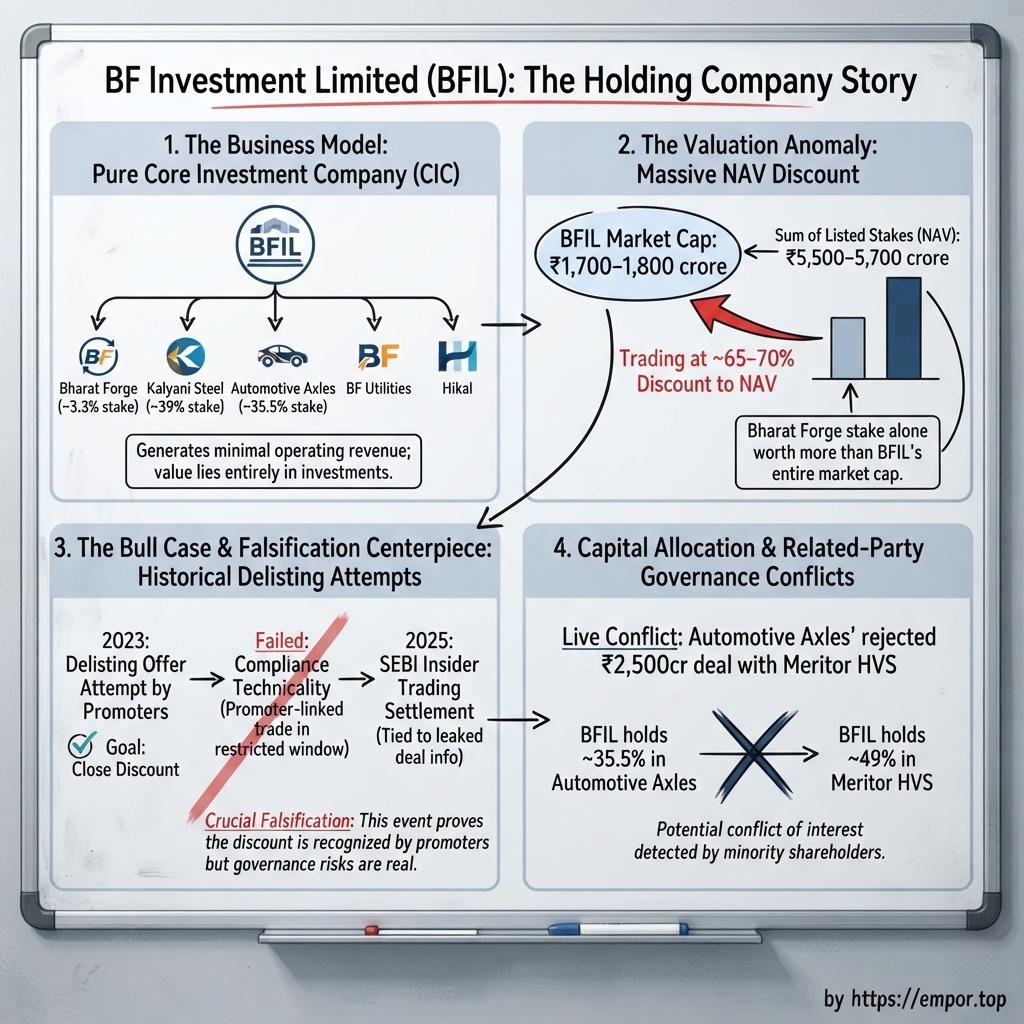
BF Investment Limited: The Kalyani Family's Vault, Trading at 30 Cents on the Dollar
I. Introduction & Episode Roadmap
Somewhere in Mundhwa, on the eastern edge of Pune, sits a registered office at a factory address. There is no factory floor that belongs to it. No production line, no order book, no customer list, no sales team. What exists is a company secretary, a small compliance function, a board that meets a handful of times a year, and a share register.
And a portfolio worth roughly ₹5,700 crore.
BF Investment Limited — ticker BFINVEST on the NSE, scrip code 533303 on the BSE — closed recently at ₹451 a share, which values the entire enterprise at about ₹1,699 crore.1 Hold those two numbers next to each other for a moment, because the gap between them is the whole story.
Here is the sharpest way to state it. BF Investment owns 15,614,676 shares of Bharat Forge Limited, the Pune forging giant that supplies crankshafts to the world's truck makers and artillery systems to the Indian Army.2 That is a 3.27% stake — a rounding error in Bharat Forge's own shareholding pattern, the kind of position that never gets a seat at the table. At Bharat Forge's recent share price of roughly ₹2,004, that sliver is worth about ₹3,100 crore.3
So BFIL's smallest-percentage listed holding, by itself, is worth close to twice what the market pays for all of BFIL.
Everything else — a 39% stake in Kalyani Steels, a 35.52% stake in Automotive Axles, positions in BF Utilities and Hikal, a 49% interest in an unlisted Cummins joint venture, a slice of an industrial park outside Pune — arrives free. Better than free, arithmetically: the market is assigning them negative value.
This is not a company. It is a Non-Deposit Taking Core Investment Company, a specific regulated species under Reserve Bank of India rules, and its entire legal purpose is to hold equity in other companies within its own promoter group.4 It manufactures nothing. In FY2026 it reported consolidated total income of about ₹78 crore — almost entirely dividends and interest — against a consolidated net profit of ₹282 crore.56 Profit nearly four times revenue, which tells you immediately that the reported "earnings" are not earned by any operation inside the company. They are the accounting shadow cast by other people's businesses.
The question this piece answers is not "is BFIL cheap." On any look-through arithmetic, it plainly is. The question is harder and more useful: why has the market refused, for fifteen years, to pay anything close to the value of what this company holds — and what happened the one time somebody actually tried to close the gap?
Because somebody did try. In the last days of December 2022, the Kalyani promoter group announced its intention to buy out every public shareholder and take BFIL private. The stock jumped 20% in a session.7 Five days later the board declined to approve the proposal, and the stock hit its lower circuit.8 The reason it failed is one of the more remarkable footnotes in Indian corporate governance — and it is the single most important piece of evidence any investor in this stock needs to weigh.
We will get there. But first, the origin of the vault itself.
 Subscribe on LinkedIn
II. Origins: Why a Forgings Conglomerate Needed a Holding Company
To understand BF Investment, you have to understand that the Kalyani Group is not really a conglomerate in the Western sense. It is a family enterprise that grew outward from a single, extremely specific industrial capability: hitting hot metal very hard, very precisely, at enormous scale.
Neelkanth Kalyani founded Bharat Forge in 1961, in an India where the auto industry barely existed and imports of engineered components were the norm. Forging is an unglamorous craft — you heat a billet of steel until it glows, then squeeze it under thousands of tonnes of press force until it takes the shape of a crankshaft or an axle beam. What makes it a real business rather than a metal-bashing shop is that the resulting part is stronger than anything cast or machined, because the grain structure of the steel flows along the contours of the component. Every truck engine on earth needs one. Every truck engine on earth needs it to not break.
His son Baba Kalyani took that capability global from the 1990s onward, and the group today describes itself as a business with more than USD 3 billion in annual turnover spanning engineering steel, automotive and non-automotive components, renewable energy and infrastructure, and specialty chemicals.9 Bharat Forge itself now runs fifteen manufacturing locations across India, Germany, Sweden, France and North America.10
That expansion left a structural problem. Over decades, the family accumulated cross-shareholdings — Bharat Forge in Kalyani Steels, holding companies in operating companies, joint ventures in affiliates. These stakes sat inside entities whose primary business was something else entirely. And one of those entities, BF Utilities Limited, had become a genuinely awkward hybrid: a company that generated electricity from windmills and ran infrastructure assets, while simultaneously holding a portfolio of group equity.11
Those two things want completely different valuations. An infrastructure business is judged on cash yields, contracted tariffs, and how much debt it can safely carry. An equity portfolio is judged on the market value of what it holds. Bolt them together and the market does what markets always do with hybrids: it discounts both halves and moves on.
So in 2009–10, BF Utilities demerged its investments division into a new vehicle under a court-approved Composite Scheme of Arrangement. That vehicle was BF Investment Limited, which listed on the BSE and NSE with effect from January 14, 2011.11 The stated logic was clean separation — let the capital-intensive infrastructure business be financed and valued on its own terms, and let the pure equity-holding business be valued on its.
Here is the uncomfortable historical verdict, delivered by fifteen years of trading data: the separation solved the first problem and not the second. BF Utilities, freed of its portfolio, has traded at nearly ten times book value.12 BF Investment, the pure portfolio, trades at 0.20 times book.1 Making the holding company more legible did not make it more valuable. If anything, it isolated the discount and made it permanent.
And BFIL is not even the only nested holding vehicle in this group. Until March 2026, an unlisted entity called KSL Holdings Private Limited owned 13.42% of BF Investment — while BF Investment simultaneously owned about 42.5% of KSL Holdings.1314 Each held a large stake in the other. That is not a scandal; it is an artefact of decades of family restructuring. But it is a useful early signal of what an investor is buying here: not a clean claim on assets, but a position inside a lattice of interlocking family entities whose internal logic is not disclosed to public shareholders.
The origin story matters mainly because it explains the wrapper. Everything that follows — the discount, the regulatory constraints, the failed exit — flows from the decision to create a listed vehicle whose only job is to hold.
So what does it hold?
III. What BFIL Actually Owns: Mapping the Portfolio
Forget the phrase "annual report" for a moment and think instead of a fund fact sheet. That is the honest way to read BF Investment. There are no segments. There is no revenue mix to analyse, no capacity utilisation to track, no order book. There is a list of positions, and each position is a separate business with its own industry, its own competitive dynamics, and its own cash generation — none of which BFIL controls.
Here is the list, in descending order of what it actually contributes to value.
Bharat Forge — 3.27%. The smallest percentage, the largest absolute value. Fifteen and a half million shares of a company capitalised at roughly ₹95,800 crore.23 This single line item dominates everything, and Section IV is devoted to it.
Kalyani Steels — approximately 39%. BFIL's largest position by ownership percentage, and effectively the anchor of the promoter block in a company where promoters collectively hold 64.70%.15 Kalyani Steels makes forging-quality and engineering-quality alloy steel from an integrated plant at Ginigera in Karnataka — the input that feeds the forging ecosystem BFIL's other holdings operate in.15
Automotive Axles — 35.52%. A joint venture dating to 1981, in which the Kalyani Group and Meritor (now owned by Cummins) each hold an identical 35.52%.16 It describes itself as India's largest independent axle manufacturer and second-largest brake manufacturer.16
BF Utilities — 3.15%, and Hikal — 2.65%.17 The corporate parent that spun BFIL out, and the group's specialty chemicals and pharmaceuticals affiliate. Small positions, worth roughly ₹140 crore combined.1218
Unlisted holdings. Meritor HVS (India) Limited, in which BFIL holds 49% alongside Cummins-owned Meritor Heavy Vehicle Systems LLC at 51%.19 KSL Holdings at about 42.5%. And roughly 15.9% of Khed Economic Infrastructure, the vehicle behind an industrial park north of Pune.13 None of these has a public price, which means none of them has a price at all until somebody transacts.
Now hold that portfolio next to BFIL's own income statement, because the mismatch is instructive.
In FY2026, BFIL reported consolidated total income of ₹77.88 crore and consolidated profit after tax of ₹282.01 crore.6 On a standalone basis — that is, the parent company alone, where dividends received from subsidiaries and associates are not eliminated — total income was ₹207.42 crore and profit after tax was ₹146.54 crore.6 So the standalone entity shows more revenue and less profit than the consolidated entity. That inversion is not an error. It is the mechanical signature of an equity-method holding company: on consolidation, the dividends BFIL actually receives get eliminated, and what appears instead is BFIL's proportionate share of the associates' own net income, which sits below the revenue line.
The first-quarter numbers for FY2027, approved on August 14, 2026, make the point almost comically clear. Consolidated total income for the quarter was ₹11.28 crore. Consolidated profit after tax was ₹145.99 crore, up 279.8% year on year — of which ₹184.77 crore was share of profit from associates and joint ventures.20 And total comprehensive income for the same three months was ₹1,655 crore.20
Read that last number carefully, because it is the most honest line in BFIL's accounts. Comprehensive income includes the mark-to-market movement on investments carried at fair value through other comprehensive income — which is to say, it captures what happened to Kalyani group share prices during the quarter. In a single quarter, price movement on the portfolio generated roughly eleven times as much "income" as the entire year's dividends and interest.
What this means for an investor: BFIL's reported profit and loss statement carries almost no information about BFIL. Analysing its revenue growth, its margins, or its earnings quality is a category error. The only three things that determine outcomes here are (a) what the underlying holdings are worth, (b) what dividends they choose to pay upward, and (c) the multiple the market applies to BFIL itself. The company has meaningful influence over exactly none of the three.
Which brings us to the position that swamps the other two.
IV. The Core Value Driver: Bharat Forge
On August 10, 2026, Bharat Forge presented its first-quarter results for FY2027, and the headline number was a loss.21
Consolidated revenue had grown 18.7% year on year to ₹4,640 crore — a genuinely strong top line. But consolidated EBITDA margin had compressed to 16.2% from 17.4%, and at the bottom, profit after tax swung to a loss of about ₹90 crore against a profit of ₹284 crore in the same quarter a year earlier.2122
The proximate cause was almost absurdly physical. A major press at the company's US steel operation broke down and disrupted forging production for close to three months. That business alone recorded a negative 0.8% EBITDA margin and a pre-tax loss of ₹760 million for the quarter.22 Layered on top were exceptional items of ₹245 million for restructuring consultancy, exchange losses of ₹285 million, and a 160-basis-point hit to standalone margins from higher energy prices, input costs and logistics inflation.22
We open the most important section of this piece with a bad quarter deliberately, because it demonstrates the structural relationship that defines BF Investment. BFIL owns 3.27% of this. It has no board seat commensurate with control, no operational input, no say over whether a press in Ohio gets replaced or repaired. When Bharat Forge has a bad three months, BFIL's net asset value falls and it finds out at the same time everyone else does.
The business behind the stake
Bharat Forge is, by capacity, one of the largest forging enterprises on earth, and its core franchise is the least glamorous and most defensible kind of manufacturing: safety-critical metal components that customers cannot afford to get wrong. Crankshafts. Front axle beams. Steering knuckles. The parts that, if they fail, the vehicle stops in a way nobody survives.
That produces a genuine competitive characteristic worth naming precisely, because it is often described loosely. It is not a network effect and it is not brand. It is qualification cost. To supply a forged crankshaft to a global truck OEM, a supplier must pass metallurgical validation, fatigue testing, process audits, and multi-year field performance review. Once qualified on a platform, the supplier tends to stay for the life of that platform, because re-qualifying a second source costs the OEM real money and real risk for a part that is a small fraction of vehicle cost. Switching costs are therefore high but slow-acting: they protect existing platforms strongly and new platform wins not at all.
The comparison set makes the boundaries of that advantage visible. CIE Automotive in Spain and Ramkrishna Forgings in India compete for the same platforms. Bharat Forge's differentiators are scale, a genuinely global manufacturing footprint, and — increasingly — a diversification into businesses that forgings peers simply do not have.
The defence story, and the honest way to read it
That diversification is the defence and aerospace business, and it has been the centre of Bharat Forge's own narrative for several years now. As of June 30, 2026, the outstanding defence order book stood at ₹11,196 crore, after the company booked ₹681 crore of new defence orders in the June quarter alone and ₹1,352 crore of new orders across all segments.2122 The quarter's marquee win was described as its largest naval order to date: an agreement with the Ministry of Defence to supply twelve marine gas turbine generator sets for Kolkata-class ships.23
An order book of that size against a company doing roughly ₹16,800 crore of annual consolidated revenue is material — it represents years of visible work.3 And artillery systems, ammunition, armoured vehicles and now marine propulsion are structurally higher-margin than truck crankshafts. On the Q1 call, Amit Kalyani framed the defence business as targeting "22-23% margin guidance… on a steady-state annual basis," attributing the quarter's outperformance to higher realisations and better product mix.23
Now apply the discipline this deserves. An order book is a promise to deliver, not delivered revenue, and Bharat Forge's own record on conversion timing is mixed by its own account. On the same call, management addressed delays in ATAGS artillery deliveries, characterising them as procedural and expected to resolve "within a few weeks."23 That is a small thing in isolation. It is not a small thing as a pattern, because it is precisely the pattern that separates a defence order book from defence revenue: a single government buyer, procedural gates, inspection regimes, and a customer that faces no penalty for taking longer than expected.
This is also where the buyer-power question belongs. Bharat Forge's defence customer is overwhelmingly the Indian government. India's indigenisation policy has actively widened the domestic vendor base — that is the explicit intent of the policy — which means being an early qualified supplier is a real advantage but not a cornered resource. Certification is not commercialisation. A ₹11,196 crore order book is evidence of demand and of qualification; it is evidence of margin realisation only after the parts ship and get paid for.
The capital structure question that matters to BFIL specifically
Here is the part of the Bharat Forge story that most write-ups of BF Investment skip, and it is the part that most directly bears on BFIL as a passive minority holder.
Bharat Forge carries meaningful debt. Borrowings stood at ₹7,309 crore against book equity implying roughly 0.77x debt-to-equity in FY2026, and that leverage has been persistent rather than transitional: ₹5,972 crore in FY2022, ₹7,313 crore in FY2023, ₹7,948 crore in FY2024.3 Through the same period it maintained a dividend payout in the 38–43% range.3
And in August 2026, alongside the loss-making quarter, the board approved raising up to ₹2,500 crore through equity and convertible securities, to fund ₹1,800 crore of capital expenditure over 12–18 months directed at defence, aerospace, data centres, semiconductors and energetics.22
Sit with what that means for BF Investment. Its single largest asset is planning to issue equity. BFIL, holding 3.27%, will not be participating in a rights issue on preferential terms; it will simply own a slightly smaller percentage of a larger company. Whether that trade is value-accretive depends entirely on whether ₹1,800 crore of capex into semiconductors and data centres earns more than the cost of the capital raised — a question BFIL's shareholders have no vote on and no information advantage about.
Testing the claim. The bull case for BFIL rests on Bharat Forge re-rating. What does the record say about that re-rating being reliable? Bharat Forge's five-year profit CAGR of 38.6% looks spectacular, but it is measured from a COVID-suppressed base, and the annual profit series tells a flatter story: ₹1,077 crore in FY2022, ₹508 crore in FY2023, ₹910 crore in FY2024, ₹913 crore in FY2025, ₹1,089 crore in FY2026.3 Four years of revenue growing from ₹10,461 crore to ₹16,812 crore produced essentially no growth in absolute net profit. Revenue up 61%; profit up 1%.
That is the disconfirming evidence the defence-re-rating thesis has to answer. The mix shift toward higher-margin defence is real and is visible in the order book. It has not yet shown up as sustained consolidated earnings growth, because cyclical weakness and operational problems in the global auto-forgings base have absorbed it. The stock nonetheless trades at roughly 95 times earnings and 10 times book.3
The calibrated conclusion: the claim that Bharat Forge is structurally re-rating is not rejected, but it is unproven and currently priced as though it were proven. For BFIL specifically, that cuts both ways. If the market is right about Bharat Forge, BFIL's largest asset is fairly valued and there is no hidden upside in the underlying — only in the discount. If the market is wrong, BFIL's discount offers a cushion that a direct Bharat Forge holder does not have, but a cushion against a fall in an asset you cannot sell separately is a thin comfort.
The KPI that settles it is not the order book. It is defence revenue actually recognised, and consolidated EBITDA margin, quarter by quarter. Watch whether the mix shift shows up in the margin line, or stays in the announcement line.
For BF Investment, though, all of this remains a spectator sport. It captures Bharat Forge's dividend and its share price, and nothing else.
V. Kalyani Steel and Automotive Axles: The Steady Half of the Portfolio
In December 2024, the shareholders of Automotive Axles Limited did something that minority shareholders in Indian promoter-controlled companies are widely assumed not to do. They said no. Loudly.
We will come to what they rejected. First, the two businesses that make up the quieter, more controllable half of BFIL's portfolio.
Kalyani Steels: the position nobody writes about
If Bharat Forge is the headline, Kalyani Steels is the ballast. BFIL owns roughly 39% of it — its largest ownership percentage anywhere in the portfolio — in a company capitalised at about ₹3,963 crore, making the stake worth on the order of ₹1,550 crore.15 That is, on its own, comfortably more than BFIL's entire market capitalisation.
The business is specialty steel: forging-quality and engineering-quality carbon and alloy steel bars, made in an integrated plant at Ginigera in Karnataka.15 The customers are, in large part, the same ecosystem Bharat Forge sells into — the crankshaft, camshaft and axle-component supply chain. Integrated means it controls its own process from raw material through to rolled bar, which matters in steel because the alternative is buying billets on the merchant market and living with someone else's spread.
The financial character is genuinely different from Bharat Forge's. FY2026 revenue of ₹1,846 crore, down slightly from ₹1,982 crore in FY2025, but net profit of ₹258 crore against ₹256 crore — flat revenue, stable profit, operating margin around 20%.15 Return on equity of 13.2% and return on capital employed of 14.8%, both comfortably above Bharat Forge's 12.2% and 12.6%.153 It trades at 14.7 times earnings and 1.9 times book.15
Read those two profiles side by side and something counterintuitive emerges. Inside BFIL's portfolio, the asset generating the better returns on capital, at a fraction of the valuation multiple, is the one nobody talks about. Kalyani Steels is not a growth story — revenue has gone sideways — but it is a demonstrably profitable, self-funding business bought by BFIL's shareholders at a discount on top of an already modest multiple.
The caution is straightforward: specialty steel demand is derived demand. It rises and falls with commercial vehicle and auto component production, which means Kalyani Steels does not diversify BFIL's cyclical exposure at all. It doubles down on it. BFIL is not a diversified holding company. It is a concentrated bet on one industrial cycle, expressed through four different companies that all serve it.
Automotive Axles: the JV with two masters
Automotive Axles has an unusual ownership structure that is central to everything interesting about it. The Kalyani Group and Meritor each hold exactly 35.52% — a deliberate, symmetric standoff with neither side able to act unilaterally.16 The company makes rear-drive axle assemblies and brakes for commercial vehicles, out of four plants, and it describes itself as India's largest independent axle maker.16 At a recent price of ₹1,688.7, its market capitalisation of roughly ₹2,550 crore makes BFIL's stake worth about ₹900 crore.24
The structure has a well-documented vulnerability: customer concentration. More than half of Automotive Axles' revenue has come from a single customer, Ashok Leyland.13 For a components maker with one dominant buyer, pricing conversations are not negotiations between equals.
Then, in 2022, the balance of power at the top changed. Cummins Inc. completed its acquisition of Meritor in a transaction valued at approximately $3.7 billion including assumed debt — and inherited Meritor's 35.52% of Automotive Axles.25 Under Indian takeover rules that triggered a mandatory open offer, and Cummins offered to acquire up to 26% of Automotive Axles, some 39.29 lakh shares, at ₹1,504.43 each — a price that stood at a substantial discount to the prevailing market price.25
That episode is worth pausing on, because it is a clean illustration of BFIL's structural position. A change of control on the other side of a joint venture — a decision made in Columbus, Indiana, about an American truck-parts business — reset who sits across the table from the Kalyani Group in an Indian JV, and BF Investment's shareholders had no input whatsoever. Their partner changed. They were informed.
The vote
Which brings us to December 18, 2024.
Automotive Axles put a related-party resolution to its shareholders: a proposed collaboration with Meritor HVS (India) Limited worth up to ₹2,500 crore for FY2026, framed by the company as enhancing "product development and market share."19 MHVSIL is one of Automotive Axles' primary distributors — and it is a 51:49 joint venture between Cummins-owned Meritor Heavy Vehicle Systems LLC and BF Investment.19
Read that again. The proposal routed up to ₹2,500 crore of activity through an entity in which BFIL holds a direct 49% — while BFIL simultaneously holds 35.52% of the company on the other side of the transaction. BF Investment sat on both sides.
Proxy advisory firm IiAS objected on exactly that ground, arguing that distribution should occur directly through Automotive Axles so that all shareholders benefit, and noting the structural asymmetry: MHVSIL and Automotive Axles share the same joint venture partners, but Meritor and the Kalyani Group hold a larger economic stake in MHVSIL than they do in Automotive Axles.19 In plain terms — if you own more of the distributor than of the manufacturer, you would rather profit accrue at the distributor.
Shareholders agreed with the objection, overwhelmingly. Roughly 79% of institutional votes and 88% of non-institutional votes were cast against the resolution.19 It failed. In March 2025, the companies returned with a narrower memorandum of understanding instead.26
Why this belongs here rather than in a risk appendix. Any investment case for BF Investment eventually leans on a version of the argument that promoter-family control is a feature: the Kalyanis are long-term owners, their interests are aligned with the assets, and family stewardship substitutes for the governance mechanisms a widely held company would need. This vote is direct, dated, quantified evidence against the strong form of that argument. Independent shareholders of a Kalyani group company examined a related-party structure involving BFIL itself and rejected it by a four-to-one margin among institutions.
The calibrated reading: this does not establish that value was extracted — the resolution failed, the system worked, and the parties scaled back. What it establishes is that the interests of BFIL and the interests of minority shareholders in the group's operating companies are not automatically identical, and that sophisticated institutional investors have already concluded as much and voted accordingly. Any claim that BFIL's governance is simply "family discipline" has to be narrowed to something more modest: family control, with active external checks that have already been exercised once.
The two positions in this section are worth roughly ₹2,450 crore combined — well over BFIL's market capitalisation, before Bharat Forge is counted at all. Which raises the obvious question of what else is in the box, and why the box itself is built the way it is.
VI. The Rest of the Portfolio and the Core Investment Company Wrapper
The remaining holdings can be dealt with quickly, and the discipline of dealing with them quickly is itself the point — in a portfolio this concentrated, the small positions deserve small paragraphs.
BF Utilities, 3.15%. BFIL's former corporate parent, now its sibling: windmill power generation and infrastructure, capitalised at about ₹1,983 crore.1217 BFIL's stake is worth roughly ₹62 crore. There is a mild irony worth noting and then dropping: BF Utilities trades at close to ten times book value while the entity it spun out trades at a fifth of book.121
Hikal, 2.65%. The group's specialty chemicals, crop protection and pharmaceuticals affiliate, capitalised at roughly ₹3,033 crore, making BFIL's stake worth about ₹80 crore.1817 Hikal has been the group's weakest listed performer by some distance — revenue of ₹1,713 crore in FY2026 against ₹2,023 crore in FY2023, and a net loss of ₹49 crore in FY2026 after five years of essentially zero revenue growth and a negative profit CAGR.18 It is a small position and it should stay a small paragraph, but it is a useful corrective to any assumption that Kalyani group companies compound by default. One of them has been shrinking for half a decade.
Meritor HVS (India), 49%. Discussed in the previous section, and unusual in that it is BFIL's second-largest ownership percentage anywhere. It has no market price. Its value is whatever the next transaction says it is, and the last time a transaction involving it was put to a public vote, that vote failed.
KSL Holdings, approximately 42.5%. An unlisted group holding entity, which until March 2026 owned 13.42% of BF Investment itself.1314 Circular, unlisted, and unpriced.
Khed Economic Infrastructure, approximately 15.9%.13 This one deserves three sentences more than its size warrants, because it is the clearest available test of how to read "land bank" optionality inside this group.
The Khed lesson
Between 2008 and 2009, roughly 1,700 hectares across four villages near Rajgurunagar in Pune district were acquired for a multi-product Special Economic Zone, developed by Khed Economic Infrastructure Private Limited alongside Bharat Forge and the Maharashtra Industrial Development Corporation.27 It was, on paper, exactly the kind of asset that gets described as hidden value on a holding company's balance sheet: a large land parcel acquired cheaply, awaiting industrial development.
From 2009 onward, development activity ceased.27 Farmers began protesting the stalled project in 2015. In April 2017 the Ministry of Commerce denotified 257 hectares; in May 2018 Chief Minister Devendra Fadnavis cancelled the SEZ outright, stating that "injustice was being done" to the affected farmers and promising the land would be returned with transfer fees waived.27 A further 643 hectares were denotified in December 2022, and in January 2023 some 6,447 acres reserved for a second phase were returned.27 Around 900 households and 2,015 people were affected.27
What survives is a smaller, non-SEZ industrial park operating as Khed City, with a working tenant base.28 That is a real asset. It is not the asset that was announced. Fifteen years elapsed between land acquisition and a materially smaller outcome, and the shortfall came from political and social resistance that was entirely foreseeable.
The lesson generalises. When you encounter unlisted "optionality" inside a holding company — land, an SEZ stake, an unlisted JV — the base rate that matters is that entity's own history of converting announced projects into realised value. Here, that history includes one large, publicly documented failure. Treat the unlisted book as modest optionality with a demonstrated tail risk of taking a decade and arriving smaller, not as embedded upside.
What a Core Investment Company actually is
Everything above sits inside a specific regulatory box, and the box explains more about BFIL's behaviour than any management statement does.
A Core Investment Company is a class of Non-Banking Financial Company defined by the RBI. To qualify, it must hold at least 90% of its net assets as investments in equity, preference shares, bonds, debentures, debt or loans in group companies — and at least 60% of net assets specifically in equity shares of those group companies.4 It cannot accept public deposits. Once its asset size crosses ₹100 crore and it holds public funds, it is designated systemically important — a CIC-ND-SI — and comes under direct RBI supervision.4 BFIL describes itself precisely this way: a non-deposit-taking Core Investment Company making strategic long-term investments in Kalyani Group enterprises.1
Translate that from regulation into strategy, because the translation is stark. BF Investment is legally prohibited from being a capital allocator.
It cannot take the ₹78 crore of dividends it collects and buy shares in an attractive company outside the Kalyani group in any material size — that would break the 90% group-investment test. It cannot become a lender. It cannot become an operating business. It cannot diversify. The regulatory framework that lets it exist as a lightly-regulated holding vehicle is the same framework that forbids it from doing anything other than holding.
This matters enormously for how an investor should think about the ₹8,520 crore of reserves on BFIL's consolidated balance sheet and its zero borrowings.1 In an ordinary company, a fortress balance sheet with no debt represents dry powder — the capacity to act. Here it represents nothing of the kind. There is nothing BFIL is permitted to do with that capacity except keep holding what it already holds and pass some cash upward as dividends.
Which is the deepest structural reason the discount exists, and the natural place to examine it directly.
VII. Why Indian Holding Companies Trade at a Discount
Let us do the arithmetic in the open, using only listed positions with observable market prices.
Bharat Forge, 15,614,676 shares at roughly ₹2,004: about ₹3,130 crore.23 Kalyani Steels, 39% of a ₹3,963 crore company: about ₹1,545 crore.15 Automotive Axles, 35.52% of roughly ₹2,550 crore: about ₹905 crore.24 BF Utilities at 3.15% and Hikal at 2.65%: about ₹142 crore combined.121817
Total: approximately ₹5,720 crore.
BF Investment's market capitalisation: ₹1,699 crore.1
That is a discount of roughly 70% to the value of the listed portfolio alone, before assigning a single rupee to the 49% of Meritor HVS India, the 42.5% of KSL Holdings, or the Khed City stake. An investor buying BFIL pays about 30 paise for each rupee of quoted, marked-to-market Kalyani group equity.
The same picture appears in the ratios. BFIL trades at 0.20 times book value and 4.36 times earnings, with a dividend yield of 2.22%.1 Book value per share is ₹2,267 against a share price of ₹451.1
Myth versus reality
The myth: this is a market inefficiency. The assets are visible, the prices are public, the arithmetic takes ninety seconds. Sooner or later the gap closes, and patient investors capture a two-to-three-times return purely from the discount narrowing.
The reality: the discount is not an error the market is making. It is the market pricing a set of specific, identifiable frictions — and every one of them is still in place.
Friction one: you cannot arbitrage it. The textbook trade is to buy the holding company and short the underlying basket, capturing the convergence regardless of direction. It does not work here. BFIL's free float is about 25%, and daily trading volumes are thin.1 Building a meaningful position moves the price against you, and unwinding it does the same. A discount that cannot be arbitraged has no mechanical force pulling it shut.
Friction two: the promoters have no obligation to hand anything over. The Kalyani group holds 74.13% of BFIL.1 There is no mechanism by which a public shareholder can compel a distribution of the underlying shares, a demerger, or a liquidation. The assets are held for the family's purposes, which include maintaining control over the operating companies. Distributing Bharat Forge shares to BFIL's public shareholders would dilute promoter control of Bharat Forge. The incentive runs in the opposite direction from the arbitrage.
Friction three: unwinding is expensive. Selling portfolio holdings to distribute cash triggers capital gains tax at the company level, and the distribution triggers dividend taxation in shareholders' hands. Value leaks at both stages. A discount partly reflects the present value of taxes that would be paid on any realisation.
Friction four: the structure itself is a cage. As established, CIC rules leave BFIL no path to becoming anything else.4
Friction five — and this is the one most often skipped: the underlying assets themselves are not obviously cheap. Bharat Forge trades at roughly 95 times earnings and 10 times book.3 BF Utilities trades near 10 times book.12 If an investor believes those valuations are full, then a 70% discount to a full valuation is a considerably less exciting proposition than a 70% discount to a cheap one. The discount is not applied to intrinsic value. It is applied to market value, and market value already embeds a great deal of optimism about the Kalyani group's defence and infrastructure narratives.
Independent coverage has periodically flagged the gap, and forum analysis of the stock has historically framed the pattern as a trading range — a holding company discount that has oscillated between roughly 50% and 70% over time, with the observation that the discount has tended to narrow when group sentiment improves and widen when it deteriorates.13 Note what that framing concedes: it treats the discount as a mean-reverting band, not as a gap that closes. The 52-week range of ₹316.00 to ₹586.95 tells the same story — an 86% spread between low and high in a single year, in a company whose underlying asset values did not move remotely that much.29 That volatility is not the discount closing. It is the discount breathing.
So the honest conclusion: the discount is a state of the asset, not a temporary condition. It has persisted through fifteen years, through two full commercial vehicle cycles, and through a spectacular re-rating in Bharat Forge itself. Buying BFIL because it is cheap relative to NAV is a defensible position only if you accept that you may hold it forever at a similar discount, collecting a 2.2% dividend yield, and that your actual return will track the Kalyani group's underlying equity performance rather than any convergence.
Unless, of course, someone forces the issue.
Someone tried.
VIII. The 2023 Delisting Attempt — and What It Actually Proved
The board of BF Investment Limited convened at 9:00 PM on the evening of January 4, 2023. The meeting concluded at 10:15 PM.30
In those seventy-five minutes, the single most valuable corporate action in BF Investment's history was abandoned — not by choice, not because the price was wrong, and not because anyone changed their mind. It was abandoned because of four hundred shares.
How it started
On December 30, 2022, BF Investment received an initial public announcement from DGM Realties Private Limited, acting as Acquirer, together with Ajinkya Investment and Trading Company and Sundaram Trading and Investment Private Limited as persons acting in concert — all Kalyani promoter group entities — routed through Axis Capital Limited as Manager to the Offer.30 Their stated intention was to acquire all equity shares held by public shareholders and consequently delist BF Investment from both the BSE and the NSE under the SEBI (Delisting of Equity Shares) Regulations, 2021.30
The market reaction was immediate and rational. Delisting offers in India proceed through reverse book building, in which public shareholders tender at prices they choose and the acquirer must accept a discovered price well above the pre-announcement level to reach the required threshold. For a stock trading at a 70% discount to its assets, the announcement was the closest thing to a guaranteed re-rating that shareholders had ever seen. BFIL shares climbed 20% to ₹350.10, locking at the upper circuit, capping a six-session run of 34%.7 By January 4, the stock had reached ₹458.35.31
How it ended
Under Regulation 10(3) of the Delisting Regulations, the board must consider a due diligence report from a peer review company secretary before approving a delisting proposal. SVD & Associates delivered that report on January 4, 2023, and the board took it on record.30
The report contained one finding. From the beneficiary position data of the company, it emerged that a member of BFIL's own promoter and promoter group had sold 400 equity shares of the company on June 29, 2022. On cross-checking against exchange data covering the buying, selling and dealing of shares by the Acquirer, promoter, promoter group and the top 25 public shareholders, the actual transaction date was established as June 30, 2022.30
Regulation 4(2) of the Delisting Regulations states that no acquirer — a definition that expressly includes the promoter and members of the promoter group — who has sold any equity shares of the company during the six months prior to the date of the initial public announcement may propose a delisting of that company.30
Six months prior to December 30, 2022 is June 30, 2022. The sale landed on the boundary.
The board's disclosure to the exchanges records the outcome in the language of process: "In view of the above and as a matter of abundant caution and good governance, the Delisting Proposal was not approved by the Board to ensure compliance with Regulation 4(2) of the Delisting Regulations."30
The next trading day, the stock hit its 10% lower circuit.8
What this actually proves
This is the disconfirming evidence at the centre of any investment case in BF Investment, and it deserves to be stated without softening.
The bull thesis for a holding company at a 70% discount always reduces to some version of: the promoters are economically aligned with us; at some point they will act to close this gap, and we will be paid. That thesis was not hypothetical here. It was tested directly, under favourable conditions, with the promoter group's own money and its own initiative. The mechanism chosen — a voluntary delisting at a premium — was the cleanest and most complete way to close the gap that exists in Indian markets.
And it failed on a compliance requirement that was entirely, trivially, within the promoter group's own control.
Consider the scale mismatch. Four hundred shares. At the pre-announcement price, a transaction worth roughly one lakh rupees — less than the cost of a single day of the investment bank's fees. That trade, by an unnamed promoter group member six months and zero days before the announcement, disqualified a buyout of a company then valued at over ₹1,100 crore.
There is no interpretation of this that is flattering to process. The six-month look-back is not an obscure provision; it is the first substantive eligibility condition in the delisting rules. Checking whether any promoter group entity had dealt in the shares is a database query. The promoter group ran a due diligence process after making a public announcement that moved the stock 20%, discovered a disqualifying fact that predated the announcement by exactly six months, and had to withdraw.
The precise nature of the failure matters for how much to weigh it. This was not fraud. It was not value extraction. It was not a change of heart disguised as a technicality. It was a control failure — nobody had a reliable system for tracking promoter group trading against a regulatory window before committing to a corporate action. And this is a company whose entire operational complexity is holding six positions and filing on time.
The coda
The story acquired a second act more than two years later.
In April 2025, SEBI confirmed a settlement in an insider trading case arising directly from this episode.31 The unpublished price-sensitive information period was established as December 4 to December 30, 2022 — that is, the delisting plan was known internally for nearly four weeks before it was announced.31
Ashish Anup Nigam, a former Executive Director at Axis Capital — the very firm engaged as Manager to the Offer — had access to that information. Following a call with Nigam, an associate named Nehal Milan Mehta placed buy orders in BF Investment shares on December 29, 2022, the day before the public announcement.31 Mehta had executed no trades at all between September 4 and December 3; after the UPSI period began, 92.10% of his trading activity was concentrated in this one stock.31 The share price moved from ₹292.10 on December 30 to ₹458.35 on January 4, and Mehta's unlawful gains were computed at ₹30.47 lakh.31
A show-cause notice was issued on September 11, 2024. The settlement was approved on February 20, 2025 and confirmed on April 9, 2025.31 Mehta paid ₹57.20 lakh in settlement charges plus ₹30.47 lakh disgorgement and ₹6.81 lakh interest; Nigam paid ₹55.90 lakh in settlement charges. Total: approximately ₹1.50 crore. Both accepted a six-month voluntary debarment from the securities market. Neither admitted nor denied the findings.31
The calibrated conclusion. This does not indict BFIL's board or the Kalyani family. The individuals who settled were employees of the external investment bank, not of the company, and the disqualifying trade was a compliance lapse rather than an act of bad faith.
But the two facts together narrow the bull thesis materially. The claim "a re-rating catalyst is coming" must be revised to: the promoter group has demonstrated both the intent to close the discount and, on its single attempt, an inability to execute the process cleanly — and the process leaked badly enough that outsiders traded on it profitably for four weeks.
That revised claim is testable, and the test is specific. Watch for any renewed delisting, buyback, or scheme-of-arrangement announcement from the Kalyani promoter group. When it comes, the questions are: has the promoter group demonstrably kept a clean six-month trading window across every group entity, and is there evidence of tighter information controls at the advisory level? Until an announcement clears those bars, the rational default is to treat the discount as durable rather than as a coiled spring.
And there is a live detail worth watching in exactly this frame. In March 2026, the promoter group restructured its own holdings in BFIL — which brings us to the people currently in charge.
IX. Current Management, Ownership, and Capital Allocation Discipline
On March 24, 2026, KSL Holdings Private Limited transferred 50,54,091 equity shares of BF Investment — 13.42% of the voting capital — to Ajinkya Investment and Trading Company and Sundaram Trading and Investment Private Limited, in an inter-se transfer among promoter group entities at ₹395 per share, valuing the block at approximately ₹181 crore.14 KSL Holdings went to zero. Sundaram Trading's stake rose to 32.63%. The combined promoter group holding was unchanged at 74.13%.1432
Note who the recipients were. Ajinkya Investment and Trading Company and Sundaram Trading and Investment Private Limited are the same two entities that stood as persons acting in concert on the December 2022 delisting announcement.30 The promoter group has quietly consolidated its BFIL ownership into the vehicles that previously attempted to take the company private.
That is an observation, not a prediction. It is consistent with a future corporate action and equally consistent with routine family estate and tax planning, and no public disclosure distinguishes between the two. What it is not is nothing — and it is precisely the kind of structural movement an investor in a 74%-controlled holding company should be tracking, because it is the only visible signal of promoter intent available.
The board
Amit B. Kalyani serves as Chairman, in a non-executive, non-independent capacity, liable to retire by rotation; his re-appointment was recommended for shareholder approval at the 17th Annual General Meeting.33 The board comprises six members: A. B. Kalyani as Chairman, M. U. Takale and B. S. Mitkari as non-independent and non-executive directors respectively, and S. G. Joglekar, V. S. Kulkarni and M. R. Vartak as independent directors.17
The same Amit Kalyani who chairs BF Investment is also a principal voice on Bharat Forge's earnings calls, where he sets defence margin guidance and discusses capacity expansion.23 This is worth naming plainly rather than treating as incidental: the person chairing the holding company is an operating executive at its largest holding. It aligns interests in one direction — he knows exactly what the assets are worth — and creates an obvious tension in another. Bharat Forge's ₹2,500 crore equity raise dilutes BF Investment's stake, and the chairman of the diluted holder is on the other side of that decision.22
Capital allocation, such as it is
For a company that cannot allocate capital, the record is short. For FY2026, the board recommended a final dividend of ₹10 per equity share on a face value of ₹5 — a 200% dividend — following consolidated profit after tax of ₹282.01 crore.633 The auditors issued an unmodified opinion on both standalone and consolidated financial statements.33
That is the whole of it. Dividends flow in from the associates; a portion flows out to shareholders; the rest accumulates as reserves that regulation prevents from being deployed anywhere new. Consolidated reserves stood at ₹8,520 crore in FY2026, against ₹6,881 crore in FY2025 and ₹4,671 crore in FY2023 — growth driven overwhelmingly by fair value gains on the portfolio, not by retained operating cash.1 Borrowings remain zero.1
The return metrics reflect exactly what this structure is. Return on equity of 3.65% in the most recent year, a three-year average of 5%, and return on capital employed of 4.86%.1 Those are not the numbers of a compounding machine. They are the numbers of a holding vehicle where the accounting equity is marked to market and the income is a dividend trickle. An investor should not read them as evidence of poor management; management has no lever to move them. But an investor should also not describe BFIL as a compounder, because on its own reported returns it demonstrably is not one.
The governance record
Then there is the woman director.
On February 27, 2026, both the NSE and the BSE emailed BF Investment notices of non-compliance with Regulation 17(1) of the SEBI Listing Regulations. Each exchange levied a fine of ₹2.71 lakh inclusive of GST — ₹5.43 lakh in total, paid on March 2, 2026, ahead of a March 14 deadline.34 Across the full period of non-compliance, the company recorded ₹14.28 lakh in regulatory fines paid to the exchanges.6
The violation: failure to maintain the required board composition after the resignation of an independent woman director created a vacancy that ran from August 15, 2025 to March 16, 2026 — roughly seven months.32 In its disclosure the company said it was "actively working to address the compliance gap" and was "in the process of identifying a suitable candidate who possesses integrity along with relevant expertise and experience."34 Mugdha Rajesh Vartak was appointed as Additional Non-Executive Independent Director with effect from March 17, 2026 — eighteen days after the fines were levied, and seven months after the seat fell vacant.32
The amount is trivial. The pattern is not, and the reason is proportionality. BF Investment is a company with no operations, no factories, no employees to speak of, no supply chain and no customers. Its entire management task is: hold six positions, file on time, and keep the board legally constituted. It took seven months and a fine from both exchanges to fill one board seat.
The credibility assessment, weighed honestly. The Kalyani family's economic incentive is genuinely aligned with closing the discount — they own 74% and would capture most of any re-rating. That is real, and it is the strongest structural argument in BFIL's favour. Against it sits a record with two documented execution failures on matters entirely within the company's own control: a 400-share trade that voided a buyout, and a seven-month vacancy that drew fines on a requirement with a fixed statutory deadline.
Neither is evidence of value extraction from minority shareholders. There is no documented instance in the records examined here of the promoter group transferring value out of BFIL at minority expense; the one related-party structure that raised that concern was voted down before it took effect. So the correct verdict is not "bad management." It is narrower and more useful: on the specific question of whether this management can execute a complex, deadline-sensitive corporate action cleanly, the available track record argues for discounting the probability, not for assuming it.
That is the honest input into a bull case. Now let us build both sides of the argument properly.
X. Bull vs. Bear: Stress-Testing the Thesis
The bull case, stated at its strongest
Buying BF Investment is buying a diversified basket of Kalyani group industrial equity at roughly thirty paise on the rupee, with no leverage anywhere in the structure.
The basket is not junk. It is led by a global forging franchise with a ₹11,196 crore defence order book and genuine qualification-based switching costs, anchored by a specialty steel business earning 14.8% on capital at 14.7 times earnings, and supported by an axle manufacturer with the largest independent share of its Indian market.211516 The holding vehicle carries zero debt and pays a 2.22% dividend yield while you wait.1 The controlling family owns 74% and has already demonstrated, with a public announcement backed by a mandated investment bank, that it would prefer to own 100%.30
Downside is cushioned by arithmetic. For BFIL to lose money from here, the underlying portfolio would have to fall dramatically and the discount would have to widen from an already extreme 70%.
The bear case, stated at its strongest
There is no catalyst, and the absence is not accidental.
The one serious attempt to force a re-rating collapsed on a self-inflicted compliance error, and the process leaked. Minority shareholders have no influence over Bharat Forge's ₹2,500 crore equity raise, Kalyani Steels' capital plans, or Automotive Axles' customer concentration. BFIL sits on both sides of a related-party relationship that independent shareholders elsewhere in the group have already rejected by a four-to-one institutional margin. The stock is thin enough that a 25% free float and low volumes make meaningful positions hard to build and harder to exit. And the reported returns — mid-single-digit ROE and ROCE — reflect the reality that this is a static vehicle, not a compounding business.1
Strip away the NAV framing and what remains is a leveraged, illiquid, undated bet on the Indian commercial vehicle and defence cycle, expressed through a structure that gives its owner no vote on any decision that matters.
Porter's Five Forces, applied to the right object
The framework only works if applied to the underlying businesses, because BFIL has no industry of its own.
Rivalry in forgings and specialty steel is intense and capital-intensive. Bharat Forge competes globally with CIE Automotive and domestically with Ramkrishna Forgings; Kalyani Steels competes in a commoditised alloy steel market where scale and integration are the differentiators. In defence, rivalry is structurally lower today — few Indian private players can build artillery systems — but Indian indigenisation policy is explicitly designed to widen the vendor base over time. Rivalry in the segment carrying the growth narrative is set to increase, by policy design.
Buyer power is the decisive force and it is high across the board. Global truck OEMs are large, sophisticated, and run annual price-down programmes. Automotive Axles derives more than half its revenue from a single customer.13 Bharat Forge's defence customer is the Ministry of Defence — a monopsony that sets specifications, controls tender timing, and can suspend or re-bid programmes. This is the force that most directly caps the group's ability to convert order books into margin.
Supplier power is moderate. Steel is the principal input, and Kalyani Steels' integration provides partial insulation within the group. But the FY2027 first quarter showed the limit: energy prices, input costs and logistics inflation together removed 160 basis points of Bharat Forge's standalone margin in a single quarter.22
Threat of substitution is real and long-dated. The forged crankshaft exists because internal combustion engines exist. Electrification substitutes away the single highest-value part in the portfolio. Bharat Forge has responded through EV axle programmes and non-automotive diversification, but this is a decade-scale erosion of the base franchise, and it is the reason the defence pivot is strategically necessary rather than merely opportunistic.
Barriers to entry in safety-critical forging are genuinely high — press capacity, metallurgical capability, and OEM qualification cycles measured in years. This is the most durable of the five forces and the real foundation of the group's franchise.
Seven Powers: which ones actually apply
Running Hamilton Helmer's framework honestly means rejecting most of it.
Switching costs — present and real, in the qualification-cost form described earlier. This is the strongest power in the portfolio.
Scale economies — present at Bharat Forge, whose press capacity and global footprint let it serve platforms that smaller forgers cannot bid for.
Cornered resource — partial, and weakening. Bharat Forge's defence qualifications and ATAGS programme position genuinely constitute a resource competitors cannot easily replicate. But a cornered resource requires that the corner hold, and Indian defence procurement policy is actively working to un-corner it.
Process power — plausibly present in metallurgy and process control, but not demonstrable from public disclosure. Where it cannot be evidenced, it should not be claimed.
Counter-positioning, network economies, branding — absent. There is no incumbent-disadvantaging business model here, no network, and OEM customers do not pay a brand premium for forgings.
And for BF Investment itself? None of the seven. BFIL possesses no power of any kind. It has no customers to lock in, no scale to exploit, no process to refine. Its only structural characteristic is a regulatory wrapper that constrains it. This is not a criticism of BFIL — it is a definitional observation. A holding company does not have powers. It has claims on entities that do.
The activist's stress test
What would a genuinely hostile investor attack?
The nested structure. A 42.5% stake in an unlisted entity that until recently owned 13.42% of you is a governance question. What is KSL Holdings for? What does it hold? An activist would demand line-item disclosure of the unlisted book and a rationale for each circular holding.
Disclosure of look-through NAV. BFIL does not publish a periodic net asset value per share. It is a fund in all but name and does not report like one. A single quarterly disclosure of look-through NAV would cost nothing and would materially reduce the information asymmetry between promoters and public shareholders. Its absence is a choice.
The related-party architecture. Being a 49% owner of one counterparty and a 35.52% owner of the other, in a proposed ₹2,500 crore arrangement, is not an edge case. It is the central structural conflict in the portfolio, and it required an outside proxy adviser and a shareholder vote to surface it.19
Accountability for the failed delisting. No public disclosure identifies which promoter group member sold the 400 shares, or what control was subsequently implemented to prevent recurrence.30 An activist would ask for both, in writing.
The honest synthesis
BF Investment is best understood as a structurally cheap, structurally un-catalysed proxy for the Kalyani industrial group.
The cheapness is arithmetic and not in dispute. The absence of a catalyst is empirical: the discount has survived fifteen years, two commercial vehicle cycles, a spectacular re-rating in the largest holding, and one direct attempt at removal by the people best placed to remove it.
Anyone underwriting a specific re-rating timeline is underwriting an event that has been attempted once and failed, by a promoter group whose demonstrated compliance execution is imperfect. Anyone comfortable holding a Kalyani group index at a persistent discount, collecting a modest dividend, and treating any re-rating as an unpriced option with no expiry date is making a coherent decision — provided they can accept that the discount may never close at all.
The risks that would break even that patient version of the case are worth naming precisely.
XI. Risk Radar
Cyclical concentration in a single industrial ecosystem. This is the dominant risk and it compounds in a way the portfolio's apparent diversification disguises. Bharat Forge, Kalyani Steels and Automotive Axles are not three independent bets. All three serve the commercial vehicle and auto-component cycle. A downturn in truck production hits forging volumes, alloy steel demand, and axle orders simultaneously. Because Bharat Forge alone exceeds BFIL's market capitalisation, a downcycle compresses BFIL's NAV and, historically, widens the discount at the same time — a double compression. The 52-week range of ₹316 to ₹586.95 is the empirical proof of how violently that mechanism operates.29
Order-book conversion risk at Bharat Forge. The ₹11,196 crore defence order book is the load-bearing element of the group's growth narrative.21 It is a promise from a single sovereign buyer, subject to procedural gates that management itself acknowledged delayed ATAGS deliveries in the June 2026 quarter.23 Slippage does not reduce the order book; it pushes revenue right and compresses the margin arithmetic the whole re-rating rests on.
Dilution at the largest holding. Bharat Forge's approved raise of up to ₹2,500 crore in equity and convertible securities directly reduces BFIL's 3.27% stake, with no offsetting participation available to BFIL.22 This risk is specific to being a small, passive holder, and it recurs every time the operating company needs growth capital.
Regulatory risk to the wrapper. Any RBI tightening of Core Investment Company norms — capital adequacy, leverage, or the definition of qualifying group investments — constrains an already narrow mandate.4 The counterpart risk is that CIC rules could also be relaxed, which is one of the few plausible paths to a structural re-rating. Neither direction is forecastable, but the exposure is real.
Related-party and governance risk. Demonstrated, not hypothetical. The Automotive Axles vote established that BFIL's cross-holdings can put it on both sides of a material transaction, and that outside institutions will contest such structures when they surface.19
Illiquidity and realisation risk. With about 25% free float and low volumes, minority shareholders cannot force a corporate action and cannot exit in size around a narrowing valuation gap.1 The discount's persistence is arguably a rational market response to this, not an irrational one.
Execution risk on any future corporate action. Given the 2023 failure and the SEBI enforcement that followed, any renewed buyback, delisting or scheme announcement warrants scepticism about completion until the process demonstrates discipline.
Concentration inside a concentration. Automotive Axles' dependence on Ashok Leyland for more than half its revenue means a single customer relationship several layers removed from BFIL materially affects a ₹900 crore line in its portfolio.13
One risk that does not apply: balance sheet and refinancing risk at BFIL itself. Zero borrowings and no operating cash requirements mean there is no scenario in which BFIL is forced to sell assets to meet obligations.1 It can hold indefinitely. Whether indefinite holding is what a shareholder signed up for is a different question.
XII. Durable Lessons: Investing in Family Holding Companies
Strip away the specifics of Pune, forgings and the Kalyani family, and BF Investment becomes a case study with four transferable lessons.
One: treat the holding company discount as a state, not a trade. Discounts of 50–70% to net asset value are a standing feature of family-controlled conglomerate structures across emerging markets. They are not mispricings awaiting correction; they are the market's price for a bundle of frictions — controlling shareholders with no obligation to distribute, tax leakage on realisation, structural inability to arbitrage, and regulatory cages. The correct default assumption is that the discount persists. The burden of proof falls on anyone claiming a specific, dated, credible catalyst — and "the promoters would benefit too" does not meet that burden, as this case demonstrated in seventy-five minutes on a January evening.
Two: look-through NAV tells you what you are not paying for, not when you will be paid. The arithmetic that a 3.27% stake exceeds the entire market capitalisation is genuinely striking and genuinely uninformative about timing. The relevant question is never "what is the gap?" It is "what is the mechanism by which the gap closes, who controls that mechanism, and what does their track record with it look like?" In BFIL's case the mechanism is a promoter-led buyout, the controller is the promoter group, and the track record is one attempt, unsuccessful, on a self-inflicted technicality.
Three: watch process, not intent. This is the lesson with the widest application. Economic alignment between promoters and minority shareholders is a necessary condition for a discount to close. It is nowhere near sufficient. What actually determines whether a corporate action completes is unglamorous operational discipline — whether someone maintains a register of promoter group trades, whether information barriers around a deal hold, whether board vacancies get filled before the statutory clock expires. The Kalyani group wanted to buy this company. It was stopped by a four-hundred-share trade nobody had checked for. When assessing any promoter-controlled situation, compliance hygiene on small matters is a legitimate leading indicator of execution capability on large ones.
Four: cross-holdings inside family structures are a genuine conflict, and minorities elsewhere in the group will act on them. Being a shareholder in both counterparties to a proposed transaction is not a technicality — it is a live conflict about where profit should accrue. The December 2024 vote at Automotive Axles is a useful data point for a broader reason: it shows that Indian institutional investors and proxy advisers now scrutinise related-party architecture in promoter groups closely enough to defeat a resolution by a four-to-one margin. That scrutiny cuts in favour of minority shareholders generally, and it complicates the operation of any family group that relies on inter-affiliate arrangements. Both effects should be priced.
A fifth observation, less a lesson than a caution about narrative: be sceptical of unlisted "optionality" on a holding company's balance sheet. Land banks, SEZ stakes, and unlisted joint ventures are the easiest items to describe as hidden value precisely because no market price contradicts the description. Khed is the corrective — an announced multi-product SEZ across 1,700 hectares that stalled for years, was cancelled by the state, returned most of its land to farmers, and re-emerged as something considerably smaller.27 The optionality was real. It was also a decade and a half long, and it ended at a fraction of the announcement.
XIII. Epilogue & What to Watch
There is a peculiar stillness to BF Investment Limited. The stock moved 86% between its 52-week low and high without the company doing anything at all.29 It reported a 279.8% jump in quarterly profit that reflected other companies' operating results.20 It recorded ₹1,655 crore of comprehensive income in three months that reflected nothing but the mood of the market toward its siblings.20
It is a mirror. And the market's fifteen-year verdict is that a mirror is worth about thirty percent of what it reflects.
For anyone following this company from here, the tracking problem reduces to three things — and only three, because in a vehicle this simple, most conventional metrics are noise.
First: Bharat Forge's defence revenue recognised and consolidated EBITDA margin. Not the order book — the order book has done its job as a demand signal and is now a known quantity. The open question is conversion. A ₹11,196 crore book that translates into recognised revenue at the 22–23% steady-state margin management has guided toward validates the entire re-rating narrative that drives BFIL's dominant asset. A book that stays a book while consolidated margins remain compressed by cyclical auto forgings, US operational problems, and input inflation falsifies it.212223 Four years in which revenue grew 61% and net profit grew 1% is the historical base rate this claim has to beat.3
Second: any renewed corporate action from the Kalyani promoter group — and specifically, how it is executed. A delisting, buyback, or scheme of arrangement is the only mechanism that closes the discount rather than merely narrowing it. The consolidation of promoter holdings into Ajinkya Investment and Sundaram Trading in March 2026 is worth watching precisely because those are the entities that filed the last attempt.1430 If an announcement comes, the diligence question is not the price. It is whether the promoter group can this time demonstrate a clean six-month trading window across every group entity, and whether information containment holds through the pre-announcement period.
Third: the discount to look-through NAV itself, tracked against its own multi-year band. BFIL does not publish this number, so it has to be computed from the five listed stakes and the observed market capitalisation. Historically the range has run roughly 50% to 70%.13 Where it sits within that band is the cleanest single read on market sentiment toward Kalyani group governance — narrowing when confidence improves, widening when it deteriorates. It is not a valuation signal. It is a sentiment thermometer, and in a company with no operations, sentiment toward the structure is one of only two variables that determine returns.
Which leaves the tension the whole story turns on.
BF Investment was created to make value visible. Separate the portfolio from the infrastructure business, list it, let the market price each on its own terms — that was the logic of the 2010 demerger, and it was sound logic. What actually happened is that the market looked directly at a portfolio of publicly quoted, marked-to-market shares, computed their value to the rupee, and decided to pay less than a third of it.
Not because the assets are hidden. Because the door is locked, and the only person with a key already tried it once — and dropped it.
References
-
BF Investment Ltd — financials, ratios, shareholding pattern — Screener ↩↩↩↩↩↩↩↩↩↩↩↩↩↩↩↩↩
-
Bharat Forge Ltd — shareholding and ownership detail — Simply Wall St ↩↩↩
-
Bharat Forge Ltd — financials, borrowings, valuation ratios — Screener ↩↩↩↩↩↩↩↩↩↩↩
-
Core Investment Companies (Reserve Bank) Directions — Master Direction text ↩↩↩↩↩
-
BF Investment Ltd — Annual Report FY2026 AGM notice (NSE filing), 2026-07-07 ↩
-
BF Investment Recommends ₹10 Dividend, Posts Strong PAT Growth — Whalesbook, 2026 ↩↩↩↩↩
-
BF Investment shares soar 20% as board to consider voluntary delisting on January 4 — Business Today, 2023-01-02 ↩↩
-
BF Investment freezes 10% lower circuit as board defers delisting proposal — Business Standard, 2023-01-05 ↩↩
-
BF Investment Ltd — investment thesis and portfolio discussion (Bharat Forge footprint and order book) — ValuePickr Forum ↩
-
BF Investment Limited — corporate website and company overview ↩↩
-
BF Utilities Ltd — financials and valuation — Screener ↩↩↩↩↩↩
-
BF Investment Ltd — portfolio holdings, unlisted stakes and holding company discount discussion — ValuePickr Forum ↩↩↩↩↩↩↩↩↩
-
BF Investment: KSL Holdings Sells Entire 13.42% Stake in Internal Shift — Whalesbook, 2026-03 ↩↩↩↩↩
-
Kalyani Steels Ltd — financials, returns and shareholding — Screener ↩↩↩↩↩↩↩↩↩
-
Automotive Axles Ltd — company overview and shareholding pattern — Screener ↩↩↩↩↩
-
BF Investment Limited — board of directors, portfolio and disclosures ↩↩↩↩↩
-
Shareholders reject Automotive Axles' proposed affiliate collaboration with Meritor HVS — Board Stewardship ↩↩↩↩↩↩↩
-
BF Investment Q1FY27 consolidated net profit up 279% — ScanX, 2026-08-14 ↩↩↩↩
-
Bharat Forge Q1 FY27 slides: revenue up 19%, margins pressured — Investing.com, 2026-08-10 ↩↩↩↩↩↩
-
Bharat Forge Q1 FY27 investor presentation detail: US operations, exceptional items, capex and fundraising — Investing.com, 2026-08-10 ↩↩↩↩↩↩↩↩↩
-
Bharat Forge Ltd (BOM:500493) Q1 FY2027 Earnings Call Highlights — Yahoo Finance, 2026-08 ↩↩↩↩↩↩
-
Automotive Axles Ltd — share price and market capitalisation — Business Standard ↩↩
-
Automotive Axles jumps after Cummins makes open offer for 26% stake — Business Standard, 2022-10-11 ↩↩
-
Automotive Axles rallies on inking MoU with Meritor HVS India — Business Standard, 2025-03-20 ↩
-
Khed Special Economic Zone cancelled, acquired land returned to farmers — Land Conflict Watch ↩↩↩↩↩↩
-
BF Investment Ltd — share price and 52-week range — Business Standard ↩↩↩
-
BF Investment Ltd — Outcome of Board Meeting on the delisting proposal, 2023-01-04 ↩↩↩↩↩↩↩↩↩↩↩
-
Axis Capital's Former ED, Associate Pay Rs1.5 Crore To Settle Insider Trading Case — Moneylife, 2025-04 ↩↩↩↩↩↩↩↩
-
BF Investment Board Approves Mrs. Mugdha Vartak as Independent Director — ScanX, 2026-03 ↩↩↩
-
BF Investment clears FY26 results, proposes 200% final dividend and board re-appointment — TipRanks ↩↩↩
-
BF Investment Limited Pays ₹5.43 Lakh Fine to NSE and BSE for Board Composition Non-Compliance — ScanX, 2026-03 ↩↩
 LinkedIn
 WhatsApp
 Reddit
 Hacker News
 Email
Email Kindle
 RSS Feed
 Spotify
 Apple Podcasts
 Amazon Music
 Audible
 YouTube