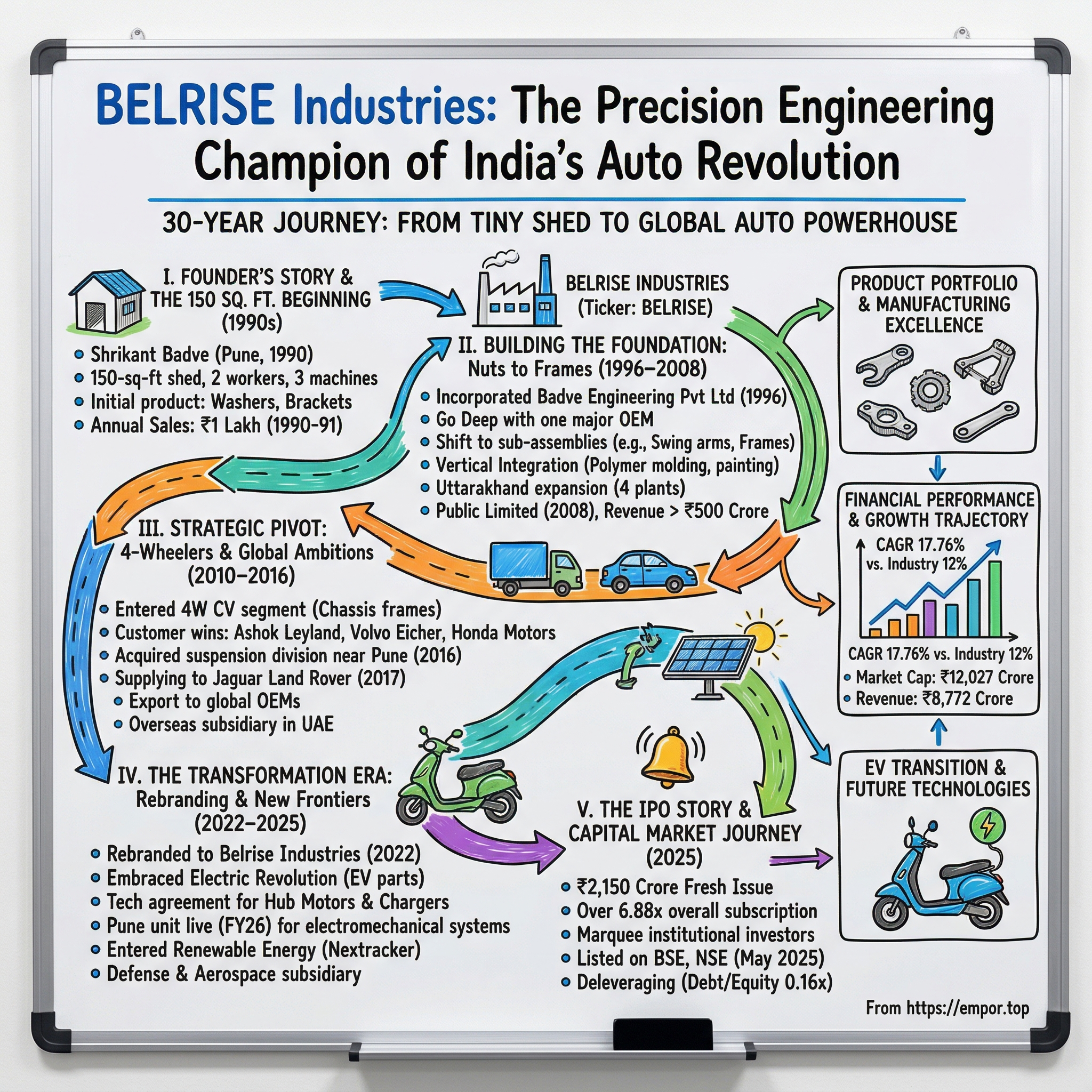
Belrise Industries: The Precision Engineering Story Behind India's Two-Wheeler Boom
I. Introduction & Episode Roadmap
There is a particular sound that a 1,200-tonne stamping press makes when it closes on a blank of high-tensile steel. It is not a bang so much as a compressed thud, felt in the sternum before it is heard. In a Belrise plant, that rhythm repeats every few seconds, all day, across dozens of assembly lines under the flicker of nearly 900 welding robots. Out of that repetition comes a component few motorcycle buyers think about: the frame—the structural skeleton that determines whether a bike holds its line at 80 kilometres an hour and whether it survives a decade of rough city roads.
Belrise Industries manufactures a substantial share of those skeletons. According to the company's prospectus, it held roughly a 24% share of India's two-wheeler metal components market as of March 2024, ranking among the top three suppliers in the segment.1 Industry coverage by Autocar Professional framed the metric in terms favored by the company's founder: one in three two-wheelers sold domestically features a Belrise frame assembly.2 It is a major footprint for an enterprise that remains largely unfamiliar to retail consumers.
However, the business's underlying economics have historically been more modest than its market presence suggests. For the fiscal year ended March 2026—its first full year as a publicly listed entity—Belrise generated consolidated revenue of ₹9,509 crore and an adjusted profit after tax of ₹502 crore, representing a net margin of 5.3%.3 Return on equity has averaged between 13% and 14% in recent years, with return on capital employed reaching 14.7% in FY26.45 While stable for a sheet-metal stamping operator, these metrics fall short of indicating a strong economic moat and lag behind listed peers like Uno Minda and Gabriel India.67
This gap between market volume and financial return forms the core analytical focus of the Belrise story. The underlying factors are structural: high revenue concentration, with CRISIL estimating that three key original equipment manufacturers account for 55% to 60% of group revenue; a UAE-based commodity trading subsidiary that historically generated nearly a fifth of total turnover at roughly one-third the margin of the core manufacturing operations; and a leveraged balance sheet where net debt-to-equity reached 1.1 times prior to May 2025.4
Following its public listing, management has moved to address all three vulnerabilities. The primary question is whether this restructuring is delivering results, and whether the company's expansion into adjacent sectors—including an aerospace and defence division built through small European acquisitions, a solar-tracker manufacturing line, and an armoured-vehicle partnership with an Israeli defence supplier—offers scalable strategic growth or capital-intensive diversification.
The analysis unfolds across six key phases:
Act I: The Shed (1988–1996). A young engineer unable to afford Pune rent relocated 230 kilometres east, manufacturing basic washers in a 150-square-foot facility equipped with three machines and two workers.
Act II: The Shadow Strategy (1996–2010). Belrise scaled by co-locating facilities beside its primary client, Bajaj Auto, generating rapid revenue growth while creating significant single-customer dependency.
Act III: Breaking the Monoculture (2010–2021). Expansion into commercial and passenger vehicle components, body-in-white structures, component exports to Jaguar Land Rover, and the creation of a UAE trading entity whose financial profile remains a point of debate among analysts.
Act IV: Rebrand, M&A and the Tier-0.5 Pivot (2022–2026). Transitioning from Badve Engineering to Belrise, shifting from standalone component fabrication to integrated system modules, alongside five acquisitions completed over a two-year window.
Act V: The Capital Markets Chapter (May 2025 onward). A ₹2,150 crore initial public offering structured entirely as fresh issue capital earmarked for debt paydown, followed fourteen months later by a ₹1,700 crore qualified institutional placement directed toward acquisitions.
Act VI: The Falsification Pass. An evaluation of where the company's competitive advantage is defensible, where it remains unproven, and what operating metrics would disprove the core investment thesis.
A note on editorial methodology before the narrative begins. Belrise management provides detailed quarterly disclosures, releasing granular operational data regarding order wins, vehicle content value, and transaction multiples that exceed standard reporting practices among domestic auto suppliers. While these disclosures provide valuable analytical input, they require independent evaluation. Where management's projections can be checked against historical reporting and operational evidence, this analysis tests them against that record.
 Subscribe on LinkedIn
II. Founder's Story & The 150-Square-Foot Shed (1988–1996)
In the late 1980s, the industrial hubs of Pimpri and Bhosari formed the core of Pune's engineering landscape. When a newly graduated engineer surveyed local rents against his ₹20,000 in savings, he found the costs well out of reach.8
That graduate, Shrikant Badve, moved 230 kilometres east to Chhatrapati Sambhajinagar—then known as Aurangabad—where the Maharashtra Industrial Development Corporation offered accessible industrial land at lower rental rates.2 In 1988, he leased a 150-square-foot shed, set up three machines, hired two workers, and began manufacturing fasteners and small sheet-metal brackets. In those early years, annual sales rarely exceeded ₹1 lakh.28
Beyond early revenues, the shop's operational reality defined its trajectory. For six years, Badve operated the enterprise single-handedly, managing sales, machinery setup, quality assurance, and distribution.2 For a small press shop lacking working capital, competitive survival depended entirely on founder-driven oversight on the factory floor, completing low-margin or fast-turnaround jobs that larger competitors bypassed. Several operational capabilities that Belrise later highlighted as competitive strengths—including in-house tooling, eight-week component takeovers, and rapid prototype development—originated in this hands-on environment.
Macroeconomic tailwinds further supported this growth. India's 1991 economic reforms dismantled licensing restrictions, expanded foreign technology partnerships, and accelerated the national transition from bicycles to motorcycles. Positioned within Maharashtra's automotive corridor, the press shop gained exposure to a multi-decade expansion in two-wheeler manufacturing.
The business reached a formal institutional milestone in September 1996, incorporating as Badve Engineering Limited—the corporate entity later rebranded as Belrise Industries.49 Incorporation allowed the informal shop to pass original equipment manufacturer (OEM) vendor audits, secure formal procurement listings, and enter multi-year supply contracts.
Public accounts often misstate the founder's academic background. Forbes records Badve's degree as a Bachelor of Engineering from Babasaheb Ambedkar Marathwada University in Aurangabad, rather than an institution in Pune.9 Establishing operations in Aurangabad was therefore a return to his university town rather than a forced relocation. Institutional recognition followed over the next two decades, including a National Award for Research and Development from the Government of India in 2004 and an entrepreneurship award from COSIDICI under the Ministry of Finance in 2016.8 Public market valuation followed years later; by late August 2026, Forbes estimated Badve's net worth at $1.6 billion.9
Traces of the early job-shop era remain in corporate collateral. Alongside core lines such as metal processing, polymer components, suspension systems, mirror assemblies, and foundry operations, Belrise's corporate website includes home appliances, security hardware, and a rose floriculture plantation.8 While these non-core activities generate immaterial revenue, do not feature in investor segment reporting, and are absent from earnings calls, they reflect an early corporate culture of taking on opportunistic fabrication work. Strict capital allocation and segment focus have only recently taken hold—a context relevant to evaluating management's simultaneous expansion into aerospace, defence, and solar tracking structures.
Two elements of this corporate history warrant analytical scrutiny.
First is the timeline and long-term growth rate. Although the business traces its origin to 1988, the primary corporate entity was established in 1996.84 Investor presentations highlight a compound annual growth rate (CAGR) of over 11.5% between fiscal 2016 and fiscal 2025, but this calculation starts from a base already exceeding ₹2,500 crore.1 While an 11.5% annual expansion represents steady performance, its significance lies in relative outperformance: over the same nine-year period, domestic two-wheeler industry volumes grew at a CAGR of approximately 1.4%.1 Belrise expanded at nearly eight times the rate of its underlying market, driven primarily by market-share acquisition and increased component content per vehicle rather than broader sector expansion.
Second is the nature of its funding model. Belrise avoided external equity dilution for more than three decades, an uncommon path for a high-volume manufacturer. However, equity preservation was offset by financial leverage. Expansion between 2015 and 2022 relied heavily on debt financing, leaving the group with an adjusted debt-to-equity ratio of roughly 1.1 times by March 2025.4 Equity retention reflected a preference for founder control rather than conservative balance-sheet management.
Ultimately, the early shop-floor operations established the manufacturing execution and cost discipline necessary to partner with major automakers—just as India's two-wheeler industry entered its fastest phase of growth.
III. The Growth Spine: Riding the Bajaj Auto Boom & Geographic Footprint (1996–2010)
Understanding the next fifteen years of Belrise requires looking at the gate of Bajaj Auto's Waluj plant in Aurangabad in the late 1990s. Bajaj was navigating the most consequential pivot in its history: shifting away from the geared scooters that had long defined the brand—most notably the Chetak, with its multi-year waiting list—and toward motorcycles such as the Boxer, Pulsar, and Discover. Each new model line demanded frames, brackets, silencers, and stampings at volumes that rapidly outpaced conventional capacity planning.
Belrise positioned itself to absorb that demand. A CRISIL rating rationale noted that the group began roughly three decades ago manufacturing small auto components "predominantly for Bajaj Auto Ltd."4 Founder Shrikant Badve has openly acknowledged this initial concentration. On the company's first-year post-IPO earnings call in May 2026—speaking as chairman of an enterprise generating ₹9,509 crore in revenue—he noted that after incorporating in 1996, and throughout its first decade, the business remained "almost entirely dependent on a single customer," adding that the relationship "was foundational to our growth."10
The operational expression of that single-customer focus was a co-location strategy Belrise maintains to this day. Its factory expansion mirrored its primary customer's footprint: opening a dedicated facility in Aurangabad in 1997, a second Aurangabad plant in 2001 to expand two-wheeler frame capacity, a facility in Ranjangaon within the Pune industrial belt in 2004, and a greenfield site in Pantnagar, Uttarakhand, in 2007 to capture regional tax and excise incentives.2
The rationale behind co-location extends beyond standard logistics. A motorcycle chassis is bulky, low-density, and prone to transit damage, making long-distance transport economically inefficient. More critically, just-in-time vehicle assembly requires line-side delivery sequences multiple times per day, synchronized directly with the specific model mix scheduled for production. Siting production adjacent to assembly lines integrates the supplier directly into the manufacturer's operational workflow. CRISIL highlighted this footprint—comprising 17 manufacturing units across 10 Indian cities as of early 2026, positioned "in close proximity to top industry players"—as a primary credit strength.4
In 2008, the business converted into a public limited company, establishing the formal structure required to raise institutional debt and pursue broader expansion.2
By the early 2010s, this co-located infrastructure helped Belrise secure broader client relationships. Around 2012, the company began supplying chassis components to a major Japanese vehicle manufacturer while commissioning an automated production line for seating sub-systems—signaling an operational pivot toward automation over manual labor.1 Financial performance reflected this scaling: manufacturing revenue crossed ₹1,000 crore in FY12 and reached ₹2,500 crore by FY16.1 This two-and-a-half-fold revenue growth over four years occurred alongside low single-digit expansion in the domestic two-wheeler market, demonstrating market-share gains and an increase in component content per vehicle.
Historical falsification: does the Bajaj relationship constitute a moat?
The standard positive thesis posits that three decades of deep operational integration with a lead original equipment manufacturer creates high switching costs that protect market share. While plausible, empirical evidence tempers this conclusion.
Co-location acts as a transmission mechanism for customer demand rather than an economic shock absorber. A facility built adjacent to a single assembly plant relies entirely on that plant's production volume; if client output drops, facility utilization declines immediately, as nearby alternative demand is absent. During the 2000s, when Bajaj lost market share in the 100cc commuter segment to Hero Honda, Belrise experienced direct volume exposure without a downside buffer. Even following subsequent diversification, CRISIL's 2026 rating assessment identified customer concentration and sector cyclicality as key weaknesses, noting that three key clients generate 55% to 60% of revenue and concluding that the group "will remain highly dependent on BAL over the medium term."4
Concentration risks also emerged during fiscal 2026 and 2027 earnings calls. On the Q3 FY26 earnings call in February 2026, analysts questioned why sequential two-wheeler revenue remained flat during a quarter when broader industry volumes expanded. Nuvama analyst Vijay Pandey noted, "I'm a bit confused at where our underperformance is coming from," to which management cited production timing lags and model mix variations.11 Six months later, during the Q1 FY27 call in August 2026, an analyst from Investec pointed out that Belrise's two- and three-wheeler revenue grew 18% against industry production growth of 20% to 25%. Executive Director Swastid Badve acknowledged the structural gap, stating that "a couple of OEMs who we do not work closely with right now have been gaining higher market share," concluding that "at the moment, it is due to a lack of the right customer mix."12
When market share shifts toward manufacturers where Belrise has limited content, supplier revenue growth trails overall industry expansion. Management stated it has since secured supply relationships with both growing competitor OEMs, projecting that associated revenues will materialize in the second half of FY27.12
A third vulnerability involves vendor rationalization, which CRISIL also flagged alongside customer concentration.4 If an automaker consolidates its supplier base across platform cycles, incumbent revenue decays gradually over multi-year model transitions rather than contracting abruptly. Co-location offers limited protection against this risk, as dedicated facilities can be matched by competitors constructing nearby plants. To counter this exposure, Belrise subsequently transitioned toward higher-value integrated component modules to increase supplier switching costs.
Verdict. Long-standing OEM integration functions as a volume-scaling platform with embedded correlation risk rather than an unassailable economic moat. However, that customer concentration provided the production scale necessary for Belrise to develop high-automation, low-cost sheet-metal manufacturing capabilities—an operational foundation the company later sought to leverage across new clients and vehicle categories.
IV. Vertical Expansion & The Four-Wheeler Pivot (2010–2021)
Every supplier that grows up inside one customer's ecosystem eventually reaches the same fork: keep taking more content from the customer you already have, or spend capital learning to serve customers who do not yet know your name. Belrise took the second road in 2010, and it took a decade and a great deal of debt to walk it.
The entry point was commercial vehicles. Chassis frames for trucks are, in engineering terms, a scale-up of what Belrise already did — heavy stampings, long members, robotic fabrication — but the tolerances, the material grades and the customer culture are different. Belrise began supplying chassis for commercial vehicles around 2012, adding names like Tata Motors and, over time, the broader CV set.1 Passenger vehicles followed, bringing body-in-white pressings — the painted structural shell of a car, the single most capital-intensive thing a stamping company can attempt.
Two moves in 2016–2017 defined the decade.
The first was the acquisition of an international OEM's suspension division near Pune in 2016, the year group revenue crossed ₹2,500 crore.12 This was Belrise's first attempt at buying capability rather than building it, and it is worth pausing on because it establishes a base rate. Suspension is a proprietary product: it carries IP, it requires validation testing measured in quarters rather than weeks, and it earns a better margin than contract stamping. Acquiring the division gave Belrise a foothold. Turning that foothold into a business took the better part of a decade — as late as the Q4 FY26 call in May 2026, management described suspensions as a segment where it had gone "from engagements with two large two-wheeler OEMs at the start of the year to four today," with three of the four customers onboarded in the preceding 18 months.1011 Ten years from acquisition to four customers is not a failure. But it is a useful calibration for anyone modelling the newer proprietary bets on a two-year ramp.
The second move was international. In 2017 Belrise set up a plant in Sanand, Gujarat, for frames and silencers and began supplying components that fed into Jaguar Land Rover.2 And in the same year it incorporated Badve Engineering Trading FZE, a wholly owned subsidiary in the Ras Al Khaimah Free Trade Zone in the UAE.24
Stack the disclosed revenue markers across this stretch and the shape of the decade is unmistakable. Manufacturing revenue moved from above ₹2,500 crore in FY16 to above ₹4,800 crore in FY22, and on to above ₹6,500 crore by FY25.1 Nearly doubling in six years while entering three new vehicle segments is not something a press shop achieves out of retained earnings. It requires plants; plants require capital; and Belrise had decided long before that the capital would not come from selling equity. That single constraint explains most of what happened to the company's profitability between FY22 and FY24, and it is the reason the IPO looked the way it did.
The other thing that arrived at the end of this period was an electric-vehicle order book. Belrise received its first orders from EV OEMs around 2022 and began supplying suspension components into electric platforms; by 2024 it had also started supplying exhaust systems for CNG vehicles.12 Two bets pointing in opposite directions on the powertrain question is exactly what a structural supplier should do when it cannot forecast the mix, and it is a defensible hedge. What Belrise conspicuously did not build in this decade was an electrical or electronics capability of its own, and that absence still defines the outer boundary of what the company can sell into an electric vehicle today.
Historical falsification: did the UAE trading arm enhance the business?
The official rationale for the trading subsidiary, as Swastid Badve explained it on the November 2025 call, is informational: "by using this commodity trading business, we are able to get deeper insights into global raw material indices."13 The business trades metals, alloys and, more recently, lithium-ion batteries, largely into African, Asian and Middle Eastern markets.1312
Now weigh it. In FY26, Belrise's consolidated revenue of ₹9,509 crore included manufacturing revenue of ₹7,735 crore — meaning trading contributed roughly ₹1,775 crore, or about 19% of the top line.10 Consolidated EBITDA was ₹1,154 crore against manufacturing EBITDA of ₹1,058 crore, which implies the trading arm generated roughly ₹96 crore of EBITDA on that ₹1,775 crore of revenue: a margin near 5.4%, against 13.7% for the manufacturing business.10 Management has separately described trading margins as "close to 6%."13
So the arithmetic is not that trading is loss-making. It is that trading contributes a fifth of revenue at roughly 40% of the core margin, and — critically — it consumes working capital and balance-sheet capacity in the process. Every rupee of consolidated revenue and every rupee of capital employed that sits in a commodity trading book depresses the reported margin and return profile of what is otherwise a decent manufacturing business. Investors looking at a 12.1% consolidated EBITDA margin are looking at a blended number that understates the factories and overstates the trading desk's strategic importance.
The disconfirming evidence against the "strategic insight" rationale is sharper still. In Q1 FY27, trading revenue fell 19% year on year because of disruption in the Middle East.12 A business whose stated purpose is to give the group visibility into global raw material markets should not itself be the line item most exposed to Middle Eastern geopolitics. And when analysts asked, in November 2025 and again in May 2026, whether the company would hive it off, the answer moved backwards: in November, Swastid Badve said "we are still evaluating if that would be a potential option that we could consider"; by May 2026, the formulation had hardened to "we have not commented on hiving off this business in any format."1310
Verdict. The claim that the UAE subsidiary enhances supply-chain integration is unproven and, on the evidence, largely rhetorical. The claim that it dilutes consolidated returns is arithmetically demonstrable. The mitigating fact is that trading is shrinking as a share of the whole — down to about 14% of revenue in Q1 FY27 as manufacturing grew 20% and trading fell — so the dilution is self-correcting even if management never acts.1 The KPI to watch is trading revenue as a percentage of consolidated revenue; if it keeps falling, the margin optics improve without any strategic decision being taken at all.
V. The Rebrand, M&A Spree, & Transformation to Tier-0.5 System Supplier (2022–2025)
In August 2022, Badve Engineering Limited rebranded as Belrise Industries Limited.2 Far from a mere cosmetic update, the name change served as a strategic positioning statement aimed at global original equipment manufacturer (OEM) procurement executives, establishing an enterprise identity suitable for safety-critical structural supply contracts.
The operational strategy behind the rebrand centers on transitioning from a traditional Tier-1 supplier to what management defines as a Tier-0.5 system supplier. While a Tier-1 vendor supplies standalone components such as stamped brackets, swing arms, or fuel tanks, a Tier-0.5 supplier delivers fully integrated sub-systems. This involves procuring external parts, sub-assembling complete modules, conducting quality testing, and delivering finished units directly to customer assembly lines in production sequence. For example, a fairing assembly that Belrise's group entities build for a major two- and three-wheeler OEM integrates over 50 individual in-house and bought-out components into a single unit.11 On one primary two-wheeler platform, management claims Belrise manufactures and assembles nearly 75% of the total vehicle content.13
This modular shift alters the economics of component supply in three distinct ways. First, it expands revenue per vehicle by capturing the value of bought-out sub-components. Second, it increases customer switching costs, as replacing a module supplier requires an OEM to re-validate an entire integrated assembly rather than a single component. Third, it transfers vendor-management overhead from the automaker to the supplier.
The financial impact of this model is visible in management's content-per-vehicle (CPV) metrics. In the two-wheeler segment, disclosed optimal CPV rose from approximately ₹12,500 in late 2024 to ₹17,300, and reached ₹20,300 following a group-entity merger—a cumulative increase of 60% to 65%.1011 Across four-wheeler and commercial vehicle lines, optimal CPV expanded from around ₹25,000 to between ₹40,000 and ₹45,000, primarily driven by the acquisition of H-One India.10
However, management acknowledges that these figures represent peak achievable content rather than company-wide averages. During an analyst call in November 2025, Executive Director Swastid Badve declined to provide an organization-level weighted average CPV, noting that varying OEM sourcing strategies make average metrics difficult to quantify at a consolidated level.13 For an investor evaluating broad-based content expansion, the absence of a tracked weighted average represents a notable disclosure gap.
The acquisition record, tested.
Belrise accelerated its M&A strategy between October 2024 and August 2026, completing six transactions over twenty-two months to expand its technical capabilities and customer reach.
Mag Filters (October 2024). Belrise acquired the business undertaking of this plastic-moulded components and air filtration specialist at book value. The purchase added a new Japanese passenger vehicle client, deepened supply penetration with an existing Japanese two-wheeler OEM, secured in-house filtration design capabilities, and brought 24 plastic moulding machines rated up to 2,200 tonnes, generating roughly ₹1,000 in incremental four-wheeler CPV.110
H-One India (March 2025). Belrise acquired the Indian subsidiary of Japan's H-One Co., a specialist in high-tensile steel stamping for Honda and other Japanese OEMs, operating plants in Greater Noida and Bhiwadi.4 While Belrise did not disclose the purchase price, transaction databases valued the deal at ₹3.8 billion.14 Management subsequently noted that both H-One and Chester Hall were acquired at mid-single-digit EV/EBITDA multiples.10
The acquisition of high-tensile steel capability marks a key technological upgrade. Standard automotive sheet steel features a yield strength of roughly 600 megapascals (MPa). High-tensile grades allow panel thickness to be reduced from two millimetres to one millimetre while increasing crash energy absorption, reducing component weight by 40% to 50%.13 The principal manufacturing challenge lies in die design to manage "spring back"—the tendency of formed high-strength steel to revert toward a flat profile once released from the press.12 With the acquisition and a subsequent Q1 FY27 technology agreement with H-One Japan, Belrise expanded its forming capability from 600 MPa to 1,470 MPa, roughly three times the Indian industry average.12
This capability yielded commercial results by Q1 FY27, when Belrise secured an order from a major Indian commercial vehicle OEM for 59 unique assemblies on a leading electric vehicle model, alongside a contract to design and build the program's tooling, fixtures, and automation. Management attributed the localization of these components—previously imported—directly to technology acquired from H-One.12
SDM, France (Q3 FY26). Belrise acquired this aerospace machining and engine-component manufacturer for €350,000 against estimated FY27 revenue of €3 million to €4 million, representing approximately 0.1 times sales.111 To lead the business, Belrise appointed the former chief executive of an Airbus subsidiary.11
Chester Hall Precision Engineering, UK (Q4 FY26). Representing a larger aerospace investment, Chester Hall machines titanium and grade-7 aluminium to tolerances of 0.1 to 0.2 microns, maintaining component rejection rates below 1%. The company serves as a single-source supplier of thrust-reverser and nacelle components for a major commercial aircraft engine platform and supplies satellite components for a prominent space program. In CY2025, Chester Hall generated £18.5 million in revenue, £2.1 million in EBITDA, and achieved a return on capital employed above 20%. Belrise acquired the entity for £13.2 million, or approximately 6 times EBITDA.3
Hyva India tipper body business (announced August 2026). Belrise agreed to acquire this division from JOST Werke's Indian subsidiary for US$5.65 million. Operating plants in Pune, Jamshedpur, and Bengaluru, the business supplies tipper bodies to India's five leading commercial vehicle OEMs. The transaction valued the unit at roughly 3.6 times CY2025 EBITDA of US$1.57 million, on an operation generating a 20% return on average capital employed, with completion scheduled for Q3 FY27.15
Across these transactions, management's disciplined valuation claims hold up under scrutiny. Executive leadership has maintained that acquisitions must be EPS and ROCE accretive from inception, favoring stable, cash-generative businesses over high-multiple targets.1210 Transaction multiples—ranging from book value and 0.1 times sales to 3.6 and 6 times EBITDA—align with this stated criteria, with two of the five acquisitions completed at book value.10
However, integration risks and initial operational costs temper this record. In Q4 FY26, Belrise Aerospace and Defense recorded a one-off operational loss of ₹9.47 crore due to machinery overhauls, legal fees, and staffing costs associated with SDM, though management expects the unit to become EBITDA-positive in FY27.3 While modest relative to Belrise's ₹9,509 crore consolidated revenue, the loss highlights the cost of integrating European aerospace operations.
Verdict. The Tier-0.5 transformation is supported by documented content-per-vehicle growth and sticky modular contract wins. While management has demonstrated acquisition price discipline, international operational integration remains in its early stages. The primary benchmark for evaluating this strategy will be whether the aerospace division achieves management's target of EBITDA profitability in FY27.
VI. Capital Markets & The ₹2,150 Crore Deleveraging IPO (May 2025)
For thirty-seven years, founder Shrikant Badve avoided selling equity to outside investors. In May 2025, he raised ₹2,150 crore while still keeping his existing shares intact.
The offer structure was central to the transaction. Belrise's initial public offering consisted entirely of a fresh issue of 238,888,888 new equity shares at ₹90 each, with a face value of ₹5, and zero offer-for-sale.16 No proceeds went to the promoter family; every rupee entered the company's balance sheet. In an Indian primary market where large public offerings frequently serve as promoter exit routes, this structure signaled a clear commitment to corporate balance-sheet strength.
The company filed its draft prospectus with SEBI on 19 November 2024.17 Bidding ran from 21 to 23 May 2025, and the book closed 41.3 times subscribed.18 Shares listed on 28 May 2025 at ₹100 on the National Stock Exchange—an 11.1% premium over the issue price—and at ₹98.50 on the BSE. The listing pop fell short of initial market expectations, as grey-market trading had indicated a 21% to 23% premium.19
The issue mechanics were standard and pricing was measured. The price band was set at ₹85 to ₹90 per share against a ₹5 face value, with a minimum bid lot of 166 shares. The offering allocated 50% to qualified institutional buyers, 35% to retail investors, and 15% to non-institutional buyers. Book-running lead managers Axis Capital, HSBC Securities and Capital Markets (India), Jefferies India, and SBI Capital Markets managed the offering, with MUFG Intime India acting as registrar.20 In its filing, Belrise presented an operational footprint of 17 manufacturing plants across 10 cities in nine states, 29 OEM customer relationships, and fiscal 2024 revenue of ₹7,484 crore with profit after tax of ₹311 crore.20
That debut provided the market's first independent valuation of the business. While institutional demand drove overall subscription past 41 times, the modest listing premium indicated that institutional buyers were primarily pricing in balance-sheet repair—a quantifiable, lower-risk deleveraging trade—rather than assigning a high growth multiple to the underlying manufacturing franchise. By August 2026, with shares trading at roughly 2.6 times the issue price, that initial caution appeared conservative. At the time of float, however, investors were paying for debt reduction, as the company had yet to demonstrate post-listing execution across its broader strategy.
The deployment of IPO capital was tracked quarterly under SEBI's monitoring framework, with CRISIL serving as the monitoring agency, establishing a verified public record of fund deployment.
The offer document earmarked ₹1,618.13 crore for debt repayment and prepayment. Ultimately, ₹1,596.02 crore was applied to clear outstanding loan balances as of 29 May 2025, fully settling the target debt within five weeks of listing. The remaining ₹22 crore, along with subsequent reallocations, expanded the general corporate purposes allocation from ₹410.49 crore to ₹469.05 crore. By 30 June 2026, Belrise had deployed ₹2,143.18 crore of the ₹2,150 crore gross proceeds, leaving ₹6.82 crore unspent. Official filings recorded no deviation in use, no auditor qualifications, and no adverse audit committee observations.16
Roughly 77% of net proceeds directly funded immediate debt reduction, establishing a clean execution record for proceeds utilization.
The balance-sheet impact appeared promptly in credit metrics. CRISIL reported group net worth expanding from ₹2,710 crore in March 2025 to approximately ₹4,971 crore by September 2025. Financial leverage and total-outside-liabilities-to-net-worth were projected to improve to 0.2–0.3 times and 0.5–0.6 times respectively by March 2026, down from 1.1 times and 1.7 times a year earlier. Interest coverage was projected to move from 3.5 times in FY25 to above 5.5 times in FY26.4 In February 2026, CRISIL reaffirmed the group's credit rating at 'CRISIL AA-/Stable' with 'CRISIL A1+' for short-term instruments, extending those ratings to fresh non-convertible debentures and commercial paper.4 By 31 March 2026, net debt had declined to ₹597.7 crore.10
The profit-and-loss impact was immediate. In Q2 FY26, management reported that applying ₹1,596 crore of IPO proceeds to debt reduction generated substantial interest cost savings, driving profit after tax up 82% year on year to ₹133 crore.13 A comparison of Q1 FY27 against Q1 FY26 highlights the dynamic: quarterly finance costs fell from ₹80.04 crore to ₹46.48 crore—a single-quarter saving of ₹33.56 crore—even as operating earnings (EBIT) declined 3.1%.1 Consequently, net profit expansion during the quarter stemmed entirely from interest savings rather than factory-level operational gains.
This distinction underscores the core analytical debate surrounding the post-IPO story. Deleveraging delivers a one-time step-up in net earnings rather than an ongoing growth engine. It propelled FY26 adjusted profit after tax up 41% year on year to ₹502 crore against revenue growth of 14.7%.3 With net debt reduced to ₹598 crore, the earnings benefit from balance-sheet restructuring is largely realized. From FY27 onward, sustained margin expansion depends on operating leverage, product mix shifts toward higher-margin proprietary components, and execution within the aerospace and defence divisions.
Fourteen months after listing, Belrise returned to capital markets. In July 2026, the company launched a qualified institutional placement (QIP) originally targeted at ₹1,200 crore, which was upsized to ₹1,700 crore on strong demand—allotting 77,272,727 shares at ₹220 per share on 17 July 2026.2122 Unlike the IPO, these proceeds were dedicated to growth. Management stated plans to deploy a significant majority of the net proceeds within the fiscal year, primarily toward inorganic opportunities and select organic expansion, focusing on aerospace, four-wheeler, and commercial-vehicle targets.12
This capital raise altered the investment profile in two key respects. First, the promoter family's equity stake decreased from approximately 66.5% pre-QIP to 61.14% by July 2026, accepting equity dilution in exchange for acquisition currency.115 Second, for investors who bought into the initial thesis of debt reduction followed by organic cash-flow compounding, Belrise transformed into an entity holding ₹1,700 crore in acquisition capital aimed at sectors it entered relatively recently. While fully disclosed and approved, this shift introduces a distinct set of operational and integration risks.
VII. Core Business Deep-Dive: Economics, Industry Structure, & Manufacturing Scale
Beyond individual plant locations, Belrise operates an extensive manufacturing network. As of August 2026, the company reported 27 manufacturing facilities across 13 cities in 10 Indian states, alongside international operations in France and the UK: six plants surrounding Pune, three each in Aurangabad, Bhiwadi, and Chennai, two each in Pantnagar and Bengaluru, and single facilities in Haridwar, Greater Noida, Bawal, Vithalapur, Indore, and Jamshedpur.1 Supporting these operations are more than 890 fabrication robots, an annual production capacity exceeding 90,000 metric tonnes per annum (MTPA), over 450 stamping presses rated up to 1,200 tonnes, and more than 120 plastic processing machines rated up to 1,800 tonnes, operated by over 2,000 permanent employees and 5,500 contract job workers.1
How the revenue actually splits.
Belrise discloses two main revenue breakdowns in its financial reporting.
The first breakdown separates manufacturing from trading. In the first quarter of fiscal 2027, manufacturing revenue reached ₹2,197.9 crore—a 20% year-on-year increase—while commodity trading revenue declined 19% to ₹348.6 crore. Consequently, trading's share of total consolidated revenue (₹2,546.5 crore) contracted to approximately 14%, down from 19% a year earlier.1
The second breakdown categorizes manufacturing revenue by vehicle segment. In the first quarter of fiscal 2027, two- and three-wheelers generated 81.4% of manufacturing revenue, commercial vehicles contributed 8.5%, passenger vehicles accounted for 4.6%, and other categories made up the remaining 5.5%.1 This distribution closely aligned with the full-year fiscal 2026 mix of 82.0% two- and three-wheelers, 8.3% commercial vehicles, 5.2% passenger vehicles, and 4.5% other.10
Powertrain classification provides further context regarding electrification exposure. In the first quarter of fiscal 2027, 70.8% of manufacturing revenue was powertrain-agnostic—comprising chassis frames, suspension systems, and body-in-white structural parts required equally by internal combustion and electric vehicles—compared to 23.7% directly classified as internal combustion engine (ICE) dependent.1
However, Belrise does not disclose product-line or entity-level profit splits. When asked directly during the May 2026 earnings call for standalone revenue and profit figures for its suspension and polymer divisions, as well as fiscal 2026 revenue and net profit for H-One India, management stated the figures were not immediately available and offered to follow up offline.10 When analysts renewed the request in August 2026 for H-One and Mag Filters performance data, executive leadership cited a policy position: "for us, it's one whole family. We continue to grow the complete business as a whole and not look at business segment wise."12 Similarly, when asked on the same call to separate aerospace and defence revenues, management stated only that it would "look at that."12 Consequently, product-level segment economics remain undisclosed.
The margin structure, and why the headline understates the factories.
In fiscal 2026, Belrise reported a consolidated EBITDA margin of 12.1%, compared to a core manufacturing EBITDA margin of 13.7%.10 The gap reflects the margin-dilutive impact of the commodity trading desk. In the first quarter of fiscal 2027, consolidated EBITDA margin compressed to 11.5% from 12.4% a year earlier, while manufacturing EBITDA margin declined to 12.7% from 13.8%.1 Management attributed the margin pressure to elevated steel and polymer costs, higher staff expenses following minimum wage adjustments, and fuel and logistics friction from Middle East supply disruptions, asserting that "the worst is behind us."12
The mechanism governing raw-material price risk relies on back-to-back pricing agreements with original equipment manufacturers (OEMs), passing input cost variations through to customers with an operational lag. Chairman Shrikant Badve emphasized in May 2026 that "raw material movements have a limited impact on our margins or overall profitability."10 While contractual pass-through clauses protect absolute rupee gross margins per part, they create short-term timing noise during sharp commodity price spikes. Furthermore, because pass-through adjustments increase the top-line revenue denominator without adding incremental profit dollars, rising raw-material prices mechanically compress percentage margins.
Consequently, key margin risks stem from unindexed cost lines. In the first quarter of fiscal 2027, employee expenses rose 42% year-on-year from ₹81.2 crore to ₹115.3 crore—significantly outpacing total revenue growth of 13%—as the company hired staff ahead of four plant ramp-ups.1 Executive Director Swastid Badve addressed the timing mismatch, noting that "when we are ramping up these facilities, we have to hire in advance, so a lot of times these fixed costs show up on our P&L much before the revenues show up."12 Additionally, fuel and transportation cost adjustments remain under active negotiation with OEM clients, with no formal resolution disclosed.10
Capital intensity and the utilisation trap.
Heavy metal stamping and deep-drawing press lines require substantial, long-term capital investments. Management guidance projects annual capital expenditure at 6% to 6.5% of manufacturing revenue, inclusive of research and development.10 Based on fiscal 2026 manufacturing revenue of ₹7,735 crore, this implies annual capital outlays of ₹460 crore to ₹500 crore for facility maintenance and expansion. Because fixed press infrastructure requires high operational throughput to cover depreciation, low capacity utilization rapidly impairs returns on capital.
This dynamic makes the operational status of acquired assets critical. In late 2025, newly acquired H-One India operated at only 40% to 45% capacity utilization. Management estimated that filling this idle press capacity could double the unit's revenue to between ₹400 crore and ₹450 crore over 24 months "with almost little or no capex."13 Securing underutilized precision stamping capacity at attractive valuations and reallocating existing order books to increase throughput represents a key driver of operational leverage.
The competitive set, honestly benchmarked.
Evaluating Belrise against listed domestic auto-component manufacturers highlights structural differences in product mix and capital efficiency. Endurance Technologies, the closest peer by revenue scale, reported fiscal 2026 sales of ₹14,596 crore and net profit of ₹952 crore, generating a return on equity (ROE) of 14.9%, a return on capital employed (ROCE) of 17.8%, and an operating margin of 13%.6 Uno Minda, featuring a more technology-weighted product portfolio, generated ₹19,658 crore in sales and ₹1,284 crore in net profit, achieving an ROE of 19.3% and an ROCE of 19.6%.7 Gabriel India, a focused ride-control specialist operating at roughly one-fifth of Belrise's revenue scale, delivered an ROE of 20.2% and an ROCE of 25.6%.23 Varroc Engineering posted revenue of ₹8,890 crore and an ROE of 15.1%.24
Compared to these peers, Belrise's fiscal 2026 metrics—a 13% ROE and a 14.5% ROCE—sit at the bottom of the group.5 This lower return profile reflects the commoditized nature of contract sheet-metal stamping relative to proprietary electronics or specialized ride control, compounded by trading desk dilution and historical debt leverage.
Management has explicitly targeted capital efficiency improvements. In November 2025, Shrikant Badve informed investors of "a sharp focus on ROCE," noting an increase from 14.4% to 15.3% over six months and stating that management expected "to take our ROCE to a high-teens number over the next 18 to 24 months."13 By the close of fiscal 2026, reported ROCE stood at 14.7%.10 Expanding return on capital toward peer levels remains the primary quantitative benchmark for evaluating management's operational execution.
VIII. Hidden Businesses & Strategic Optionality: Solar Hardware, Defence, & EV Components
In the annexures of Belrise's investor presentation sits a slide that contrasts sharply with the portfolio of a two-wheeler chassis manufacturer: a titanium aero-engine part, an aluminium head-up display housing, and a customer list featuring the world's largest aircraft manufacturer alongside leading French combat aircraft, helicopter, and robotics suppliers.1 This segment represents an area of company operations that public markets have yet to fully value in either direction.
Solar tracker structures.
A utility-scale solar tracker is a steel structure that rotates panels to follow the sun. It relies on foundational press-shop capabilities—metal stamping, robotic welding, galvanising, and surface treatment—that align directly with Belrise's core manufacturing operations.
Belrise entered the sector in 2024 through a letter of intent with Nextracker LLC, a North American tracker manufacturer contracting roughly 10 gigawatts of annual production capacity in India.225 By the second quarter of fiscal 2026, the company began delivering solar structural assemblies to a major global tracker manufacturer, fulfilling initial orders for North America while initiating commercial discussions for Indian and European expansion.13 In the first quarter of fiscal 2027, Belrise announced a brownfield expansion to manufacture sheet metal assemblies supporting approximately 2.5 gigawatts of annual supply for a leading U.S. solar tracker supplier, with production scheduled to begin in the fourth quarter of fiscal 2027 and peak annual revenue projected to exceed ₹150 crore.12
Management characterized the 2.5-gigawatt commitment as an initial entry point, describing the resulting revenue stream as recurring without projecting explicit long-term growth rates.12 Evaluated against consolidated metrics, peak revenue of ₹150 crore represents roughly 1.6% of fiscal 2026 total revenue, starting in a future quarter. However, Executive Director Swastid Badve highlighted a key operational distinction: renewable energy projects feature significantly shorter execution turnarounds than automotive programs, converting orders into revenue within quarters rather than the 18-to-24-month cycles standard for vehicle platforms.13 Faster asset turnover provides a tangible, if modest, working capital benefit.
Aerospace and defence.
Aerospace and defence represents a larger strategic shift. Belrise's current holdings include SDM in France, Chester Hall in the UK, a strategic collaboration with Israeli armour specialist Plasan Sasa, and supplier empanelment with one Israeli and two Indian defence prime contractors, alongside a medium-term management target for the division to generate at least 10% of consolidated revenue.112
The collaboration with Plasan Sasa features two core initiatives: joint engagement with India's Ministry of Defence and defence public sector undertakings to industrialize Plasan's All-Terrain Electric Mission Module (ATEMM) for operational environments such as Siachen and the Northeast, and serving as an integrated manufacturing partner within Plasan's global supply chain. Prototype development and initial component shipments were underway by February 2026.11
Director Sumedh Badve outlined the strategic rationale driving the aerospace expansion. Commercial aircraft order backlogs extend across eight to eleven years, while India remains a primary importer of aircraft despite minimal domestic manufacturing capacity. As international aerospace prime contractors and engine manufacturers execute commitments to localize production in India, the primary barrier for new suppliers is qualification—a process requiring 12 to 24 months per part and facility certification. Acquiring established, certified suppliers offers a direct path to bypass these qualification timelines.1012 Chester Hall brought existing AS/EN 9100 certification and a single-source supplier status, while SDM contributed an established European customer base led by a former Airbus subsidiary chief executive.111
However, this strategic logic faces operational counterweights derived from Belrise's historical execution record.
Historical falsification: certification is not commercialisation.
Belrise's record in translating technical entries into commercial revenue demonstrates extended timelines. The suspension division acquired in 2016 required nearly a decade to expand its client base to four original equipment manufacturers.10 Similarly, management describes its proprietary product portfolio—covering steering columns, braking systems, filtration, and suspension—as being in an initial onboarding phase focused on establishing client relationships, with major wallet-share expansion and multi-hundred-crore revenue targets projected over two to three years.11 These targets represent forward expectations rather than current operational run rates.
Evidence regarding electric vehicle (EV) powertrain expansion reveals further execution gaps. In 2023, Belrise secured manufacturing rights for EV hub motors through a technology transfer agreement with a Chinese manufacturer, outlining plans for a Pune facility to produce hub motors and charging infrastructure.2 However, across four consecutive earnings calls—spanning the second quarter of fiscal 2026 through the first quarter of fiscal 2027—management made no reference to the hub motor initiative. The company's active EV powertrain participation remains limited to copper bus bars, acquired via a promoter entity merger and supplied indirectly to a single Indian passenger vehicle manufacturer.11 Meanwhile, leading electric two-wheeler manufacturers are either vertically integrating motor production or sourcing from established electrical component suppliers.
Verdict on the optionality bets. Belrise's powertrain-agnostic core—accounting for 70.8% of manufacturing revenue—provides verified structural protection against powertrain technology shifts, leaving the business significantly less exposed than specialized exhaust or fuel-system suppliers.1 The EV hub motor initiative appears dormant in the absence of customer commitments; its omission from four consecutive earnings calls over twelve months signals a tangible pause in execution. The aerospace expansion rests on firmer operational footing due to the acquisition of profitable, certified entities at disciplined multiples. However, the division remains sub-scale, recorded an initial quarterly operational loss during consolidation, and faces a medium-term target of 10% of consolidated revenue—implying approximately ₹1,000 crore in annual sales against a current base too small to be separately reported.312 Confirming the aerospace thesis requires securing multi-year build-to-print manufacturing contracts from global aircraft or engine OEMs for domestic Indian production. While management reports ongoing discussions, commercial contracts remain the necessary benchmark for verification.
IX. Financial Analysis, Capital Allocation, & Management Credibility
The five-year revenue picture is one of steady, unspectacular compounding punctuated by a recent acceleration: ₹5,397 crore in FY22, ₹6,582 crore in FY23, ₹7,484 crore in FY24, ₹8,291 crore in FY25, ₹9,509 crore in FY26.53 Net profit ran ₹262 crore, ₹314 crore, ₹314 crore, ₹355 crore, then ₹497 crore reported and ₹502 crore adjusted.53
The shape of that series is the story. Revenue compounded at roughly 15% over the four years while profit went sideways for two of them. FY23 and FY24 produced identical ₹314 crore of net profit on ₹900 crore of incremental revenue — a period in which the business grew and its owners earned nothing extra for it. That is what high operating leverage combined with high financial leverage does. The FY26 profit jump of 41% on 14.7% revenue growth is the mirror image, and, as established, it is substantially the interest line unwinding.3
Operating margins have been remarkably stable — 12–14% at the operating level across five years.5 That stability is the back-to-back pricing model working. It also means there is no historical evidence of Belrise expanding margins through mix or pricing power. Management guides to margins remaining "broadly stable as compared to FY26 levels" — which is a candid guidance, and also an admission that the margin story is a stability story, not an expansion one.12
Cash conversion is decent but not pristine. FY26 operating cash flow was ₹876 crore against ₹1,154 crore of EBITDA, with free cash flow of ₹258 crore after investing outflows of ₹475 crore.5 The working capital cycle sits around 48 days, with debtor days of 67, inventory of 44 and payables of 63.5 When Jefferies' analyst pressed on the H1 FY26 gap between EBITDA growth and operating cash flow, management gave a three-part answer — inventory up from ₹770 crore to ₹960 crore broadly in line with revenue, capital advances for the Pune long-member facility, supplier advances during a two-wheeler supply-chain disruption, and a shift from domestic to imported steel sourcing for a European PV customer requiring longer advance cycles; plus payment of creditors as the Chennai and Bhiwadi plants ramped.13 The answer was specific and checkable rather than evasive, which is a positive credibility marker.
Management credibility, assessed against the record.
Belrise's leadership is a family operation and openly so. Shrikant Badve is Chairman and Managing Director. His wife Supriya sits on the board. Sons Sumedh — Purdue mechanical engineering, Harvard MBA — is President (Strategy), and Swastid — Wharton economics and Penn engineering — moved from Chief of Staff to General Manager during FY27.29 On every recent call, Shrikant opens, the sons deliver the substance, and the CFO Rahul Ganu reads the numbers. During the IPO process, the founder stepped back from media and let the sons handle analyst Q&A.2 Whatever one thinks of dynastic succession, the transition is being executed in public and under questioning, which is more than most Indian promoters attempt.
On promises versus outcomes, there is now a scorecard. At the FY26 results, Shrikant Badve enumerated five IPO-era commitments and claimed delivery on each: mid-teens revenue growth with stable margins (delivered — 14.7% growth, 12.1% margin versus 12.3%); doubling four-wheeler and CV revenue over two years (in progress — four-wheeler up 37% and CV up 35% in FY26); raising content per vehicle (delivered on the optimal measure); expanding proprietary segments (four customers each in suspensions and steering columns, four in high-tensile, two in braking); and simplifying the group structure (board approval obtained).10 Independently verifiable elements of that scorecard check out. Note the footnote in the company's own transcript correcting a figure Shrikant misstated on the call — 31% versus the correct 37% — which is a small but genuine mark of transcript hygiene.10
The guidance discipline is also worth noting for what management refuses to do. It declines to guide on debt, on quarterly numbers, on segment-level margins, and on plant-specific utilisation, saying so directly rather than deflecting.1312 It corrected an analyst who had built a 20% three-wheeler EBITDA estimate on a misread of the manufacturing versus consolidated margin.13 It declined to quantify the raw-material pass-through benefit on the Q1 FY27 call and offered to take it offline.12 Reasonable people can read that pattern either as disciplined boundary-setting or as convenient opacity. It is probably both.
One inconsistency deserves flagging. Belrise's filed investor materials describe it as "one of the top three players" in Indian two-wheeler metal components with 24% share, sourced to the prospectus and dated March 2024.1 On the November 2025 call, challenged by a B&K Securities analyst on how it would keep gaining share against captive and non-captive competition, Swastid Badve said: "we are number one in the sheet metal space by a large margin," and simultaneously disputed the analyst's premise that 40–50% of the market is captive, saying it "would be much, much lower" — without offering a number.13 A verbal claim of clear market leadership sitting alongside a filed disclosure of top-three status is the kind of gap that should make an investor rely on the filing.
Related-party transactions and the group-structure clean-up.
This is the governance question that mattered most at IPO, and it is being resolved — with a wrinkle.
On 31 January 2026, the board approved a scheme of amalgamation folding two promoter-owned entities, Badve Autocomps Private Limited and Eximius Infra Tech Solutions Private Limited, into the listed company.26 The commercial case is strong. The two entities are among the largest players in Indian two-wheeler plastic components with a combined share above 14%; Belrise standalone has about 10%, so the merged entity would hold roughly 25% of that segment.11 In FY25 they generated combined revenue of ₹2,117 crore and combined PAT of ₹112 crore, at EBITDA margins of 13.2% and 12.2%.26 Net of eliminations, the merger adds about ₹1,000 crore of revenue.26 Most importantly, it removes approximately ₹1,151 crore of related-party transactions from the group.26
The pricing looks favourable to public shareholders: executed at close to book value, implying about 8.3x P/E on FY25 numbers for the acquired entities against roughly 30.9x for the listed company at the time of announcement — immediately EPS-accretive. Ernst & Young acted as independent registered valuer and JM Financial provided the fairness opinion.26 The swap ratios were 140 Belrise shares for each BAPL share and 10 Belrise shares for every 135 EITSPL shares.26
The wrinkle: because the promoters own the transferor companies, the merger issues them new Belrise shares. Promoter holding was projected to rise from 66.5% pre-merger to 67.9% post-merger.26 A skeptical investor should hold two facts together. Belrise is buying assets it needs, at a multiple far below its own, from its own promoters, valued by a Big Four valuer with an independent fairness opinion — and the promoters end up owning more of the company. The valuation asymmetry runs in minority shareholders' favour, which is the opposite of the usual related-party complaint. But the mechanism is exactly the one that produces abuse when the valuation runs the other way, and it deserves to be named rather than waved through.
The timeline has also slipped. In November 2025 management said it wanted the merger done "within this fiscal year," acknowledging it could not commit to an exact date.13 Board approval came at the end of January 2026; NSE and BSE observation letters arrived in July 2026, and the scheme still requires NCLT, shareholder and creditor approvals.274 The Jan 2026 presentation put the timeline at 10–12 months subject to regulatory approvals.26 It is running to a normal Indian regulatory clock rather than to management's original hope, which is neither scandalous nor immaterial.
Finally, dividends. The board recommended a final dividend of ₹0.55 per share for FY26 — an 11% payout on the ₹5 face value, roughly ₹49 crore against ₹497 crore of profit.2810 A token first dividend, consistent with a company that intends to reinvest and acquire.
X. Strategic Position: Helmer's 7 Powers & Porter's 5 Forces Analysis
Analytical frameworks are useful primarily for distinguishing whether a corporate capability represents true strategic power—an advantage allowing a company to sustain returns above its cost of capital—or merely an operational competence that industry peers eventually replicate. Belrise demonstrates far more of the latter than the former.
Process Power — the strongest claim, real but bounded. Belrise's most credible differentiation lies in manufacturing process depth accumulated over nearly four decades. This includes more than 890 fabrication robots, greater automation in exhaust-system welding than management believes any domestic peer deploys, and extensive vertical integration spanning in-house tooling, stamping, tube processing, robotic fabrication, painting, coating, and assembly.101 The company's most distinct metallurgical claim is its capability to surface-plate stainless steel, a requirement for glossy exhaust systems on premium motorcycles.10 It pairs this with noise, vibration, and harshness engineering built across decades of exhaust design, alongside post-acquisition tooling expertise from H-One to manage spring-back in 1,470-megapascal steel.12 Yet the boundary on this power is clear: it represents operational process knowledge rather than patent-protected technology. Such capabilities remain replicable by a well-capitalized competitor over a multi-year horizon—demonstrated by Belrise itself when it broke a three-decade monopoly in two-wheeler steering columns using the same approach.10
Scale Economies — real in the core, absent elsewhere. Holding roughly a 24% share of India's two-wheeler metal components market allows Belrise to spread fixed press and tooling costs across production volumes that smaller competitors cannot match.1 In passenger cars and commercial vehicles, however, management acknowledges that its market share remains in the lower single digits.13 In aerospace, the company is a recent entrant. Belrise holds a single position of scale rather than a broad portfolio of them.
Switching Costs — moderate to high, and rising under the Tier-0.5 model. Qualifying a new chassis or body-in-white supplier requires crash validation, tooling transfers, and multi-quarter testing. For proprietary parts, management notes that original equipment manufacturers require at least nine to twelve months of testing before issuing a purchase order.11 Delivering integrated sub-assemblies raises switching costs further, as replacing a module supplier requires an automaker to re-source every component within that assembly. Yet management acknowledges that these friction costs work both ways: the same barriers that defend Belrise's existing accounts have made it harder to capture business at fast-growing competitors, explaining why two-wheeler revenue growth trailed overall industry production in the first quarter of fiscal 2027.12
Cornered Resource — low. Belrise possesses no proprietary patent portfolio, relying instead on customer relationships and facility certifications. Its aerospace acquisitions represent a targeted effort to buy cornered assets, securing a single-source position on a major commercial aircraft engine platform alongside specialized AS/EN 9100 quality certifications.31 Yet those assets remain limited to Chester Hall's scale—which generated £18.5 million in revenue—rather than altering Belrise's broader manufacturing base.
Counter-Positioning — effectively absent. Nothing in Belrise's business model imposes a collateral cost on competitors that prevents them from copying its approach. Established peers such as Endurance Technologies, Uno Minda, Minda Corporation, and JBM Auto actively pursue modular sub-assemblies. Belrise's advantage stems from an operational head start and available capital rather than structural asymmetry.
Branding and Network Economies — not applicable. Neither dynamic applies to structural automotive components, where retail consumers exert no brand preference over frame manufacturers.
Turning to broader industry structure, the competitive environment reflects a solid manufacturing operation navigating a demanding market.
Buyer power is very high, serving as the industry's defining force. Three major vehicle manufacturers account for 55% to 60% of group revenue.4 These buyers dictate contract pricing, establish cost-indexation formulas, enforce annual price reduction targets, and maintain dual-sourcing options. The contractual pass-through mechanism that shields Belrise from raw-material volatility is itself a byproduct of buyer power, functioning because automakers prefer predictable input-cost adjustments over open-ended margin negotiations.
Supplier power is low. Raw materials such as steel and polymers are procured from major producers under standard commercial terms, while contractual pass-through clauses transfer commodity price exposure to vehicle manufacturers.10
Threat of new entrants is low. Heavy capital requirements, a network of 27 co-located manufacturing plants, and lengthy customer qualification cycles present substantial entry barriers. However, these barriers are asymmetrical, deterring greenfield entrants far more effectively than established component suppliers expanding into adjacent product categories.
Threat of substitutes is moderate and narrowing. The electric vehicle transition primarily affects exhaust and fuel systems, which fall within the 23.7% of manufacturing revenue directly tied to internal combustion engines.1 The 70.8% powertrain-agnostic core remains structural and insulated. In fact, electric vehicles can increase demand for structural components because heavy battery packs place greater emphasis on chassis strength and body-in-white lightweighting—making high-tensile steel capabilities increasingly relevant.13 Over a longer timeframe, the primary substitution risk involves aluminium and composite materials displacing sheet steel in structural applications.
Rivalry among existing competitors is high. Major vehicle platform contracts are awarded through competitive tenders. Suppliers including Endurance Technologies, Varroc Engineering, Uno Minda, Minda Corporation, JBM Auto, and Sansera Engineering compete for overlapping components, and peer financial data demonstrates that no single operator commands monopoly returns.672324
In summary, Belrise's competitive position relies on manufacturing process power and scale economies within a single core segment, reinforced by moderate customer switching costs. Operating against vehicle manufacturers with superior bargaining power, this structure yields a durable business generating mid-teens returns on capital employed. It does not, however, generate the 20% or higher returns achieved by specialized auto-component makers with proprietary technology—a distinction reflected in the company's financial record.
XI. The Investment Thesis: Bull vs. Bear Case & Activist Stress Test
The spine: why this wins, and what breaks it.
Why it wins from here. The core two-wheeler franchise grew roughly eight times faster than its end market over fiscal 2016 to 2025, driven by content gains per vehicle rather than broader industry volume expansion—a mechanism capable of continuing independently of overall two-wheeler demand.1 Two-wheeler content per vehicle rose 60% to 65% in roughly eighteen months, with management stating that approximately 80% of that increase stemmed from proprietary products developed in-house or with Italian and Japanese technical partners.10 Four-wheeler and commercial vehicle revenues expanded 37% and 35% respectively in fiscal 2026, starting from a low single-digit market share base.10 Balance-sheet deleveraging is substantially complete. Meanwhile, management is applying these established fabrication capabilities to solar structures and aerospace, acquiring targets at 0.1 times sales, book value, and approximately 3.6 to 6 times EBITDA.1153
What breaks it. Customer concentration remains the principal operational vulnerability. If original equipment manufacturers where Belrise holds low content continue capturing market share from its primary clients, company revenue growth decouples from broader industry volumes—a dynamic that materialized in the first quarter of fiscal 2027.12 Second, the aerospace expansion could absorb management attention and the ₹1,700 crore raised via qualified institutional placement without achieving viable scale, operating in a sector where the company possesses only fifteen months of institutional experience and where the initial consolidation quarter generated a loss.3 Third, operating margin expansion may not materialize: management guides to stable margins, deleveraging interest savings have been realized, and unindexed expenses—including wages, fuel, and logistics—are rising faster than top-line revenue.121
The bull case, stated at its strongest.
Belrise is at an early phase of a structural product-mix transition. The proprietary component portfolio—encompassing suspension systems across five automakers, steering columns across four, high-tensile steel assemblies across four, and braking systems across two—commands higher gross margins than contract sheet-metal stamping, with each vertical currently at the initial client-entry stage rather than full wallet-share maturity.121011 Management's assertion that initial vendor qualification represents the primary entry barrier is supported by its displacement of a three-decade steering column monopoly and the addition of three suspension customers within eighteen months.10 Should these individual product lines mature into multi-hundred-crore revenue contributors as management projects, the resulting mix shift would expand consolidated operating margins.11 Furthermore, the pending group-entity merger adds approximately ₹1,000 crore of higher-margin polymer revenue while expanding Belrise's two-wheeler plastics market share from roughly 10% to 25%.1126 In parallel, H-One India operates at 40% to 45% capacity utilization, offering potential to double revenue with minimal incremental capital expenditure.13 Simultaneously, the margin-dilutive commodity trading desk represents a shrinking proportion of group turnover each quarter, mechanically improving reported returns on capital.1 Public markets have already begun reflecting this transition: by late August 2026, the stock traded near ₹232 for a market capitalization around ₹22,500 crore, representing a 69% trailing twelve-month gain and trading at roughly 2.6 times its ₹90 issue price.5
The bear case, stated at its strongest.
Market valuation presents an immediate hurdle. Trading at roughly 44 times trailing earnings and 3.96 times book value, the equity carries a growth multiple while generating a 13% return on equity.5 By comparison, peer operator Endurance Technologies trades at 41 times earnings while generating superior return metrics.6 Consequently, public markets have largely priced in initial balance-sheet repair, leaving subsequent share appreciation dependent on factory-level earnings growth.
Operational performance in early fiscal 2027 highlights underlying friction. Fiscal 2026's 41% net profit expansion was driven substantially by reduced interest expenses rather than operating gains. In the first quarter of fiscal 2027, operating profit (EBIT) declined 3.1% year-on-year, while net profit grew 8.9% primarily due to a ₹33.6 crore reduction in finance costs.1 With net debt reduced to ₹598 crore, balance-sheet deleveraging as an earnings driver is largely exhausted. Simultaneously, two-wheeler revenue growth trailed industry production growth in the first quarter of fiscal 2027 due to an unfavorable customer mix.12 Meanwhile, commodity trading revenue fell 19% owing to Middle Eastern supply disruptions, highlighting geopolitical exposure within a division whose strategic supply-chain utility management has not quantified.12 Consolidated EBITDA margin compressed by 90 basis points year-on-year.1 Furthermore, management does not disclose segment-level profit breakdowns, preventing external verification of individual division economics.12 Finally, an aerospace division with five quarters of operational history faces a management target to generate 10% of consolidated revenue—roughly ₹1,000 crore—in the medium term, requiring acquisitions that remain unidentified.12
Macroeconomic tailwinds may also prove transitory. The GST 2.0 reform of September 2025 lowered the tax rate on sub-350cc two-wheelers from 28% to 18%, covering roughly 98% of domestic market volume and reducing retail prices by ₹5,000 to ₹24,500.29 While this tax cut stimulated demand, Chairman Shrikant Badve noted that the key analytical question remains whether the policy change creates sustained multi-year growth or merely reflects a temporary pull-forward of consumer purchases.10 If the demand surge represents pull-forward buying, year-on-year comparisons in late fiscal 2027 will face difficult baselines.
The activist stress test.
An institutional evaluation of Belrise highlights four key operational and governance demands, against which management's progress varies significantly.
First: divest the UAE commodity trading subsidiary. Based on fiscal 2026 disclosures, removing roughly ₹1,775 crore of lower-margin trading turnover (generating ~5.4% EBITDA margin) would raise consolidated EBITDA margins from 12.1% toward the core manufacturing level of 13.7%—an immediate 160 basis-point margin improvement without operational disruption.10 However, across three consecutive analyst calls, management shifted from evaluating strategic options to stating explicitly that it has not commented on hiving off the trading business in any format.1310 This posture marks a clear departure from shareholder-aligned portfolio simplification.
Second: execute the group-entity merger on a definitive timeline. Board approval was granted in January 2026, and stock exchange observation letters were received in July 2026, while approvals from the National Company Law Tribunal (NCLT), shareholders, and creditors remain pending.2627 The primary benefit of the transaction is the elimination of roughly ₹1,151 crore in annual related-party transactions; until the merger completes, a corporate governance discount will persist.26
Third: disclose segment-level financial metrics. Analysts across multiple earnings calls requested separate revenue and margin figures for the suspension and polymer divisions, performance metrics for H-One India and Mag Filters, and explicit financial results for aerospace and defence. Management deferred or declined all requests.1012 For an enterprise building its equity thesis around product-mix transformation, withholding division-level economics represents a notable disclosure gap.
Fourth: justify the acquisition strategy through return on capital employed rather than entry multiples. Management defends its M&A program by citing disciplined purchase valuations—ranging from book value and 0.1 times sales to 3.6 and 6 times EBITDA—and stating that transactions are accretive from inception.1012 Low purchase multiples are a necessary condition but do not guarantee long-term value creation. The definitive benchmark remains whether consolidated return on capital employed reaches management's target of the high teens within 18 to 24 months of November 2025, compared to 14.7% at the close of fiscal 2026.10
Key operational metrics to monitor.
Evaluating Belrise's execution requires tracking three core metrics:
Manufacturing EBITDA margin. Evaluating manufacturing EBITDA margin rather than the consolidated figure eliminates distortion from commodity trading. This metric provides a clean measure of whether content expansion into Tier-0.5 modules yields tangible operating leverage, or whether plant ramp-up costs and unindexed inflation erode profitability. Manufacturing EBITDA margin stood at 13.7% in fiscal 2026 and 12.7% in the first quarter of fiscal 2027.101
Manufacturing revenue growth relative to domestic two-wheeler industry production. This comparison tests the core wallet-share thesis. While Belrise outgrew domestic two-wheeler market volumes roughly eightfold between fiscal 2016 and 2025, its manufacturing revenue growth underperformed overall industry production in the first quarter of fiscal 2027 due to client mix.112 Prolonged underperformance would indicate that content-gain momentum has stalled.
Return on capital employed (ROCE). Management established a target of reaching high-teens ROCE within 18 to 24 months of November 2025, up from 15.3% at the time of guidance and 14.7% at fiscal 2026 year-end.1310 This metric serves as the primary quantitative scorecard for determining whether acquisitions, balance-sheet deleveraging, and modular manufacturing expansion generate sustainable shareholder value.
XII. Playbook & Key Takeaways for Business & Investing
Lesson 1: Proximity is a strategy, and it is a two-way contract.
Belrise's manufacturing footprint directly mirrors the geography of its primary clients: Aurangabad alongside Waluj, Ranjangaon in the Pune industrial belt, Pantnagar, Bhiwadi, Haridwar, and Chennai. The operational logic is compelling: lower freight expenses on bulky, low-density structural components, reduced transit damage, synchronized line-side delivery, and the practical advantage of having engineering personnel available near the assembly line on short notice. CRISIL highlights this co-located network as a key operational rating strength.4
However, co-location also creates concentrated exposure. An asset built adjacent to a single customer's plant relies almost entirely on that facility's output. It amplifies customer volumes in both expansion and downturns, while making client diversification capital-intensive, as establishing supply relationships with new anchor OEMs requires constructing dedicated plants in new locations. Belrise's four-wheeler expansion required new facilities in Chennai, Bhiwadi, Bengaluru, and Haridwar, where staffing and fixed operating overhead hit the income statement prior to full commercial production.12 Strategies that deliver tight operational integration also create correlated customer risk, registering operating expenses before delivering matching revenues.
Lesson 2: Moving up the value chain changes product scope, not just pricing.
The operational transition from a Tier-1 component fabricator to a Tier-0.5 module supplier represents a core strategic takeaway. Shifting from standalone stamped brackets to an integrated 50-component fairing assembly increases vehicle content value, raises customer switching costs, and transfers sub-assembly management from the automaker to the supplier. Belrise's disclosed two-wheeler content-per-vehicle growth—expanding from ₹12,500 to approximately ₹20,300 over roughly eighteen months—illustrates the financial impact of this modular shift.1110
However, management acknowledges that content expansion achieves strategic scale only when adopted across multiple client accounts. Executive Director Swastid Badve emphasized this requirement during an analyst briefing, stating, "We don't want to introduce a product and only have it selling to one customer. We really want to make sure that it is penetrated across the industry, and that's the only way in which it will become relevant to our revenues going forward."10 Increasing component content at a single automaker reflects a successful program negotiation; scaling modular content across multiple OEMs demonstrates broader institutional capability.
Lesson 3: High fixed costs combined with financial leverage can stall profit growth.
During fiscal years 2023 and 2024, Belrise generated identical net profits of ₹314 crore despite adding ₹900 crore in top-line revenue.5 Stamping operations require substantial fixed press infrastructure; layer debt-funded plant construction on top of that base, and revenue expansion gets absorbed by interest charges and fixed overhead before reaching net income. Belrise operated under this leveraged capital structure between 2015 and 2022, ultimately utilizing a ₹2,150 crore initial public offering to rebalance its balance sheet and pay down ₹1,596 crore in outstanding debt shortly after listing.16
Debt-financed expansion created the manufacturing base supporting current revenue, but financial leverage delayed equity returns for nearly a decade until public market capital enabled balance-sheet restructuring. For capital-intensive manufacturers, evaluating growth initiatives requires inspecting how capital expenditure is funded, how debt service affects earnings conversion, and when returns accrue to equity holders.
Lesson 4: Read past top-line revenue to evaluate underlying earnings quality.
In fiscal 2026, Belrise's consolidated revenue of ₹9,509 crore included approximately ₹1,775 crore from its commodity trading desk, which operated at roughly one-third the margin of its core manufacturing operations.10 Evaluating the consolidated 12.1% EBITDA margin at face value obscures operating performance, simultaneously understating core factory margins while overstating the revenue scale of the manufacturing franchise.
Evaluating multi-segment industrial companies requires separating pass-through and trading turnover from high-value manufacturing revenue before assessing margins, growth trends, or return metrics. Furthermore, tracking management's strategic position on non-core divisions over time provides valuable context regarding corporate capital allocation and portfolio discipline.
Lesson 5: Distinguish an acquired capability from an established business.
Through recent transactions, Belrise acquired high-tensile steel forming capabilities up to 1,470 megapascals, AS/EN 9100 aerospace quality certifications, a single-source position on a commercial aero-engine platform, and a defence manufacturing partnership with an Israeli armour specialist.12111 While these acquisitions provide entry into specialized technical segments, translating technical assets into commercial revenue requires extended validation cycles.
Belrise's historical record illustrates these operational conversion timelines: the suspension business acquired in 2016 required nearly a decade to expand its client base to four automakers, whereas the acquisition of H-One India yielded a 59-assembly localization contract within fifteen months.1012 While recent execution demonstrates faster commercial integration, the aerospace and defence division remains in an early operational phase, where establishing certified production lines precedes meaningful revenue contribution.
XIII. Transcripts & Downstream Guide for the Article Writer
For analysts seeking to evaluate Belrise Industries directly from primary source materials, the corporate record offers detailed disclosures across filings, presentations, and conference calls.
The prospectus and draft prospectus (filed with SEBI 19 November 2024; offer May 2025). This filing serves as the primary source for the company's 24% market share in Indian two-wheeler metal components as of March 2024.171 It also establishes the historical context of Belrise's revenue compound annual growth rate of over 11.5% between fiscal 2016 and fiscal 2025, compared to a 1.4% growth rate for the broader domestic two-wheeler sector over the same period.1 Examining the "Objects of the Offer" section against quarterly statements of deviation tracks capital deployment following the listing, showing ₹1,596.02 crore applied to debt settlement within five weeks of the float and ₹6.82 crore of the ₹2,150 crore gross proceeds remaining unutilized as of 30 June 2026.16
The four most recent earnings call transcripts. These transcripts detail operational mechanics beyond standard presentation slides. The Q2 FY26 call on 12 November 2025 discloses the trading desk's approximately 6% EBITDA margin, H-One India's 40% to 45% initial capacity utilization, the competitive dynamics of the exhaust business, and management's initial target to reach high-teens return on capital employed within 18 to 24 months.13 The Q3 FY26 call on 2 February 2026 provides a detailed review of the group-entity merger, including the projected increase in promoter equity ownership from 66.5% to 67.9%.11 The Q4 FY26 call on 25 May 2026 outlines management's post-IPO commitment scorecard, Chester Hall's financial performance, acquisition evaluation criteria, and segment growth figures across four-wheeler and commercial vehicle divisions.10 Finally, the Q1 FY27 call on 17 August 2026 records analyst scrutiny regarding revenue growth trailing overall industry production, rising cost friction, and executive plans to deploy qualified institutional placement proceeds within the fiscal year.12
The CRISIL rating rationale of 10 February 2026. This credit assessment provides key independent benchmarks for the group. It estimates customer concentration at 55% to 60% across three primary original equipment manufacturers, explicitly notes that the business will remain highly dependent on Bajaj Auto over the medium term, details balance-sheet gearing improving from 1.1 times to an estimated 0.2 to 0.3 times, and summarizes working capital metrics.4 It also outlines specific credit rating sensitivity thresholds—including operating margins dropping below 9% or larger-than-anticipated debt-funded capital expenditure—establishing clear boundaries for ongoing financial monitoring.
The scheme of amalgamation presentation of 31 January 2026. This document provides the primary financial framework for evaluating related-party transactions, detailing fiscal 2025 performance for both promoter-owned entities, a ₹11,511.38 million (₹1,151 crore) reduction in related-party transactions, share swap ratios, valuation multiples comparing 8.3 times to 30.9 times price-to-earnings ratios, independent fairness opinions, and post-merger promoter shareholding adjustments.26
The Hyva India press release of 4 August 2026 and the Q1 FY27 investor presentation. These materials detail recent transaction economics—notably a 3.6 times EV/EBITDA purchase multiple and a roughly 20% return on average capital employed—alongside updated plant maps, powertrain exposure splits, and the breakdown between core manufacturing and commodity trading revenues.151
Evaluating this body of evidence highlights two defining features of the Belrise story. First is the operational evolution spanning nearly four decades: an enterprise that began in a 150-square-foot shed producing basic fasteners now machines precision aerospace components to sub-micron tolerances in Lancashire. Second is the accessibility of critical counter-evidence: key investment risks—including customer concentration, trading-margin dilution, undisclosed division-level earnings, and aerospace growth targets that far exceed current division revenue—are documented within official disclosures, credit rationales, and earnings call exchanges. A complete analytical assessment relies on evaluating these risk factors alongside management's execution record.
References
-
Belrise Industries Limited — Investor Presentation for the Quarter Ended 30 June 2026, 2026-08-14 (BSE filing) ↩↩↩↩↩↩↩↩↩↩↩↩↩↩↩↩↩↩↩↩↩↩↩↩↩↩↩↩↩↩↩↩↩↩↩↩↩↩↩↩↩
-
Metal, Mettle, Millions: Belrise Industries — A Story of Grit and Focus — Autocar Professional ↩↩↩↩↩↩↩↩↩↩↩↩↩↩↩
-
Belrise Industries Ltd — Press Release, Audited Results for Quarter and Year Ended 31 March 2026, 2026-05-24 (BSE filing) ↩↩↩↩↩↩↩↩↩↩↩
-
Crisil Ratings Rationale — Belrise Industries Limited, 2026-02-10 (BSE filing) ↩↩↩↩↩↩↩↩↩↩↩↩↩↩↩↩↩
-
Belrise Industries Ltd — Consolidated Financials and Key Ratios — Screener.in ↩↩↩↩↩↩↩↩↩↩↩
-
Endurance Technologies Ltd — Consolidated Financials — Screener.in ↩↩↩↩
-
Belrise Industries Limited — Q4 FY26 Earnings Conference Call Transcript, 2026-05-25 (BSE filing) ↩↩↩↩↩↩↩↩↩↩↩↩↩↩↩↩↩↩↩↩↩↩↩↩↩↩↩↩↩↩↩↩↩↩↩↩↩↩↩↩↩↩↩↩↩
-
Belrise Industries Limited — Q3 & 9M FY26 Earnings Conference Call Transcript, 2026-02-02 (BSE filing) ↩↩↩↩↩↩↩↩↩↩↩↩↩↩↩↩↩↩↩
-
Belrise Industries Limited — Q1 FY27 Earnings Conference Call Transcript, 2026-08-17 (BSE filing) ↩↩↩↩↩↩↩↩↩↩↩↩↩↩↩↩↩↩↩↩↩↩↩↩↩↩↩↩↩↩↩↩↩↩↩↩↩
-
Belrise Industries Limited — Q2 & H1 FY26 Earnings Conference Call Transcript, 2025-11-12 ↩↩↩↩↩↩↩↩↩↩↩↩↩↩↩↩↩↩↩↩↩↩↩
-
Belrise Industries Limited agreed to acquire H-One India Pvt. Ltd. from H-One Co., Ltd. for INR 3.8 billion — MarketScreener ↩
-
Belrise Industries Acquires Hyva India's Tipper Body Business — Press Release, 2026-08-04 (BSE filing) ↩↩↩
-
Belrise Industries Limited — Statement of Deviation or Variation in Utilisation of IPO Proceeds, Quarter Ended 30 June 2026, 2026-08-14 (BSE filing) ↩↩↩↩
-
Auto Component Maker Belrise Industries Files for Rs 2,150 Crore IPO — Business Standard, 2024-11-21 ↩↩
-
Belrise Industries IPO Subscribed 41.3 Times on Last Day of Offer — Business Standard, 2025-05-23 ↩
-
Belrise Industries Shares List at 11.11% Premium on NSE, Debut Below Expectations — Business Today, 2025-05-28 ↩
-
Belrise Industries to Launch Rs 2,150 Crore IPO on May 21 — Autocar Professional, 2025-05-20 ↩↩
-
Sidley Advises Jefferies on the US$175 Million Upsized QIP of Belrise Industries Limited — Sidley Austin LLP, 2026-08 ↩
-
Belrise Industries Completes ₹1,700 Crore QIP at ₹220 Per Share — Whalesbook, 2026-07-17 ↩
-
Gabriel India Ltd — Consolidated Financials — Screener.in ↩↩
-
Varroc Engineering Ltd — Consolidated Financials — Screener.in ↩↩
-
NEXTracker to Manufacture Additional Structural Components of its Solar Tracking Systems in India — Saur Energy ↩
-
Belrise Industries Limited — Presentation on Scheme of Amalgamation amongst Badve Autocomps Pvt Ltd, Eximius Infra Tech Solutions Pvt Ltd and Belrise Industries Ltd, 2026-01-31 (BSE filing) ↩↩↩↩↩↩↩↩↩↩↩↩
-
Belrise Industries Limited — Receipt of Observation Letters from NSE and BSE under Regulation 37, 2026-07-04 (BSE filing) ↩↩
-
Belrise Industries Limited — Board Recommendation of Final Dividend of Rs. 0.55 per Equity Share for FY26, 2026-08-14 (BSE filing) ↩
-
Two-Wheeler Prices May Drop by Up to Rs 24,500 as Automakers Pass On GST Cut Gain — Business Standard, 2025-09-12 ↩
 LinkedIn
 WhatsApp
 Reddit
 Hacker News
 Email
Email Kindle
 RSS Feed
 Spotify
 Apple Podcasts
 Amazon Music
 Audible
 YouTube