Bellatrix Aerospace: The Indian Space Arbitrage and the Mobility Gold Rush
I. Introduction & Episode Roadmap (0:00 – 0:15)
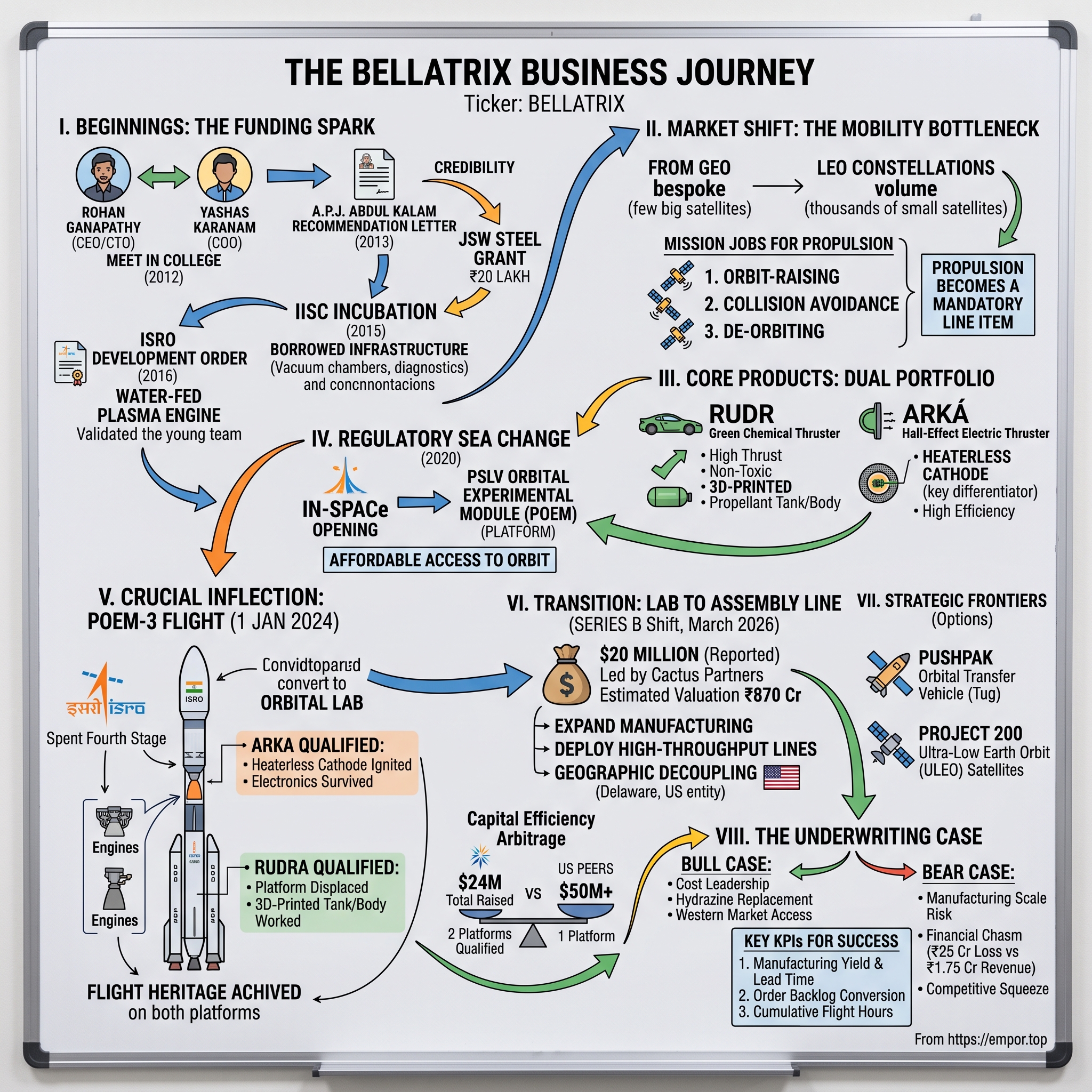
On the morning of 1 January 2024, ISRO's PSLV-C58 rocket lifted off from Sriharikota carrying the XPoSat X-ray observatory as its primary payload. What mattered for this story was not the satellite in the nose cone but the spent fourth stage of the rocket itself. Rather than becoming orbital debris, that stage was converted into a power-generating orbital laboratory called POEM-3, and bolted to it were two experimental propulsion units from a Bengaluru startup few outside the Indian space community had heard of. Over the days that followed, Bellatrix Aerospace space-qualified two radically different engines on a single flight: a heaterless Hall-effect electric thruster called Arka-200, and a green chemical thruster called Rudra 0.3.12 For a hardware company that had spent nearly a decade in the laboratory, this was the single most important event in its history — the moment its physics left the vacuum chamber and worked in the vacuum of space.
The reason that matters begins with an unglamorous fact about the satellite boom. The world is preoccupied with rockets — with who can launch cheapest and most often — but the bottleneck that actually determines whether a constellation works is not launch. It is in-space mobility. A satellite that reaches orbit but cannot steer is a multi-million-dollar object drifting toward the wrong altitude, unable to dodge debris, and unable to de-orbit itself at the end of life. Propulsion is the difference between an asset and a liability, and it is a market that has historically been served by a small number of expensive, often toxic incumbents. Bellatrix's wager is that a company doing its deep-tech engineering on Indian cost structures can build that mobility layer cheaper than anyone in the West and sell it into Western defense and commercial constellations.
That is the romance. The underwriting is harder. This is a company that, in the financial period disclosed around its latest raise, reported roughly ₹1.75 crore of revenue against a net loss of about ₹25.27 crore — a loss more than fourteen times its sales — and that, in March 2026, raised what was reported as a $20 million round led by Cactus Partners at an estimated valuation of about ₹870 crore, a 2.7x markup on its previous mark.3 Every number in that sentence deserves interrogation rather than applause. The round was labelled inconsistently across the press as both a "pre-Series B" and a "Series B"; the headline $20 million and the roughly ₹107 crore actually visible in regulatory filings do not obviously reconcile; the ₹870 crore valuation is described by reporters as an estimate, not a disclosed figure; and even the company's cumulative capital raised is reported differently in different places.34 None of this is disqualifying. All of it is the reason a pre-filing company has to be underwritten from operating evidence rather than from its own press release.
A note on method before the story, because it governs everything after. Bellatrix has no DRHP, no S-1, no prospectus — it is years from a listing, and this is not its investor-relations department. Private valuations are prices at which small parcels of preferred stock change hands between sophisticated investors with downside protections; they are pricing signals, not appraisals of what a future public common shareholder would own. Where a figure is a market price, this piece treats it as one and reasons toward value from the things that actually compound — flight heritage, order backlog conversion, manufacturing yield, gross margin, and the credibility of a path from a research lab to a profitable assembly line. Where the evidence to compute something an investor would want — a fully diluted share count, the terms of the preferred stock, a real revenue run-rate — simply does not exist yet, this piece says so rather than manufacturing false precision.
The map of what follows: two students who wrote to a former President of India and turned a recommendation letter into an incubation at the Indian Institute of Science; the physics of why in-space mobility is a bottleneck and how Bellatrix's dual electric-and-chemical portfolio addresses it; the regulatory earthquake — IN-SPACe and the POEM platform — that made a startup's flight qualification affordable; the POEM-3 flight that turned an R&D shop into a commercial vendor; the capital structure and the "frugal deep-tech" arbitrage behind the Series B; the global competitive field; the speculative frontiers of orbital tugs and ultra-low-orbit satellites; the playbook lessons; and finally the bull-versus-bear underwriting with the handful of metrics that will confirm or falsify the thesis long before any exchange bell rings.
 Subscribe on LinkedIn
II. The Founding Spark: From Student Dreamers to IISc Incubation (0:15 – 0:40)
Every deep-tech origin story is tempting to over-tell, and Bellatrix's has more temptation than most, because it contains an actual letter from an actual President. The discipline is to keep the colour proportionate to its economic weight, which — for a company whose value will be decided by manufacturing yield and backlog conversion a decade later — is modest but not zero. The founding period matters mainly for what it reveals about two things a public-market investor cannot get from a spreadsheet: the founders' technical seriousness and their relationship with capital.
Rohan M. Ganapathy and Yashas Karanam met as engineering undergraduates and began the research that would become Bellatrix around 2012, while still in college.5 Ganapathy is the technologist — he holds the dual title of CEO and CTO, which is itself a signal worth marking: he never handed the physics to someone else. Karanam runs operations as COO. Their founding insight was contrarian in the most literal sense. In the early 2010s the ambitious Indian space startups wanted to build launch vehicles — rockets are visible, heroic, and fundable. The two students noticed that almost no one was solving the far less glamorous "last mile" of getting a satellite, once dropped off in orbit, to its actual operating position and keeping it there. They chose the boring, hard, unfashionable problem. In hardware, that is usually where the durable businesses are.
The Kalam connection is the part that gets retold, and it is real, but its significance is narrower than the mythology suggests. In 2013, the late Dr. A.P.J. Abdul Kalam — aerospace scientist, architect of India's missile program, and former President — wrote the young founders a recommendation letter after being shown Ganapathy's early plasma-propulsion work.5 What that letter bought was not money and not technology; it was credibility, the scarcest currency for a student founder with no track record. It opened a door at JSW Steel, which offered a ₹20 lakh grant — a few tens of thousands of dollars — that let the pair rent a garage and work through the night on their engine after class.5 The honest reading is that Kalam's endorsement functioned as social proof in an ecosystem where nobody bets on twenty-two-year-olds; it is a nice story, but it is not a moat, and it did not spare them a decade of grinding.
The genuinely consequential move was the incubation at the Indian Institute of Science's Society for Innovation and Development, where Bellatrix began operating as a company in 2015.65 For a hardware startup, university incubation is not office space — it is access to capital equipment that would otherwise be unaffordable. Building a plasma or chemical thruster requires vacuum chambers that simulate the near-total emptiness of space, high-precision diagnostics, cleanrooms, and computing for plasma simulation. Buying that from scratch runs into the millions of dollars and years of procurement. Renting it, in effect, from IISc let two founders with a garage-sized grant do work that normally requires an institutional balance sheet. This is the first appearance of what becomes the company's defining strategy: do not build the expensive infrastructure; build the relationships that let you borrow it. It is also the origin of a genuine cornered-resource claim we will test later — Bellatrix's Rudra green propellant was developed in collaboration with Professor Charlie Oommen of IISc, meaning some of the core chemistry is entangled with a specific academic partnership rather than freely reproducible.6
The 2016 ISRO contract is where academic promise met a paying counterparty for the first time. ISRO awarded Bellatrix a developmental order to work on a microwave-based electro-thermal thruster — a water-fed plasma engine — which between roughly 2016 and 2020 the company matured into working prototypes.5 The dollar value was small and the technology has not, as of 2026, become the commercial workhorse; Arka and Rudra did. But the contract's importance was validation rather than revenue: the national space agency, the most demanding customer in the country, judged these designs worth funding. For skeptical investors evaluating a pre-revenue academic team, an ISRO development order is the difference between "clever students" and "vendor ISRO chose to back."
The years from roughly 2015 to 2019 were the classic deep-tech valley of death, and Bellatrix survived them the only way an unfunded hardware company can — by refusing to spend money it did not have. The founders lived on micro-grants, state-subsidised lab access, and the ISRO development work, stretching each rupee across a development timeline that in the West would have consumed tens of millions of venture dollars. It is worth being precise about why this matters to an underwriter rather than treating it as inspirational filler. A company that learned to build hardware while poor tends to retain that discipline when it becomes rich; capital efficiency, once it is a habit, is sticky. The flip side, which we will not lose sight of, is that a decade of scarcity also means a decade without the scale, the automated tooling, or the manufacturing organisation that the next phase demands. The founders are proven inventors. Whether they are proven manufacturers is the open question the rest of this story circles.
III. Inside the Propellant Bottleneck: Why Space Mobility is the Next Gold Rush (0:40 – 1:05)
To understand why a thruster company can matter, start with the shape of the market it serves, because that shape changed completely in the last decade. For fifty years, the archetypal satellite was a school-bus-sized geostationary platform — a handful launched per year, each a bespoke, billion-dollar object parked 36,000 km up. That world had modest propulsion demand: few satellites, each with a long, deliberate life. The world that replaced it is the opposite. Constellations of thousands of small satellites now populate low Earth orbit — Starlink, OneWeb, Amazon's Kuiper, and a growing tier of commercial imaging and communications operators including Indian names like Pixxel and GalaxEye. When the unit of demand shifts from tens of large satellites to tens of thousands of small ones, the demand for the small engine that steers each of them scales with it. Propulsion stopped being a niche and became a volume component.
Every one of those satellites needs propulsion for three distinct jobs, and it is worth separating them because they have different physics and different buyers. The first is orbit-raising: rockets, to be economical, drop satellites off in low, cheap "injection" orbits, and each satellite must then climb under its own power to its operational altitude. The second is collision avoidance and station-keeping: low Earth orbit is now crowded enough that satellites must actively dodge debris and each other, and must constantly fight the small perturbations that would otherwise let them drift. The third is de-orbiting: international rules increasingly require a satellite to remove itself from orbit at end of life — to spend its last fuel steering into the atmosphere to burn up — rather than becoming a derelict hazard. A satellite that cannot do these things is not merely less useful; in a regulatory sense it is becoming un-launchable.
The reason each of these mandates matters commercially is that they convert propulsion from an optional upgrade into a mandatory line item on the bill of materials of nearly every satellite launched. In the old GEO world, a handful of satellites a year each carried one large, bespoke propulsion system — a low-volume, high-touch business dominated by primes. In the new LEO world, a propulsion system is a commodity component that ships in the same quantities as the satellites themselves, which is what makes it, at least in principle, a manufacturable, scalable, margin-bearing product rather than a custom-engineered one-off. That is the single most important structural fact behind Bellatrix's entire thesis: the market it serves is transitioning from artisanal to industrial, and a company that can win the industrial manufacturing race — rather than merely the engineering one — captures a component sale on a very large and growing number of satellites. The whole bet is that Bellatrix can be that industrial winner. Nothing in its history yet proves it can, because its history is entirely artisanal.
It is also worth being disciplined about the size of the prize, because "the space economy is worth a trillion dollars" is the kind of TAM figure that does more harm than good in an underwriting. The reachable market for Bellatrix is not the space economy, nor even the whole satellite market; it is specifically the in-space propulsion spend of the satellites it can actually sell to. Independent estimates place the in-space propulsion market in the low single-digit billions of dollars annually today, growing toward perhaps the high single digits or low teens of billions over the next decade as constellations proliferate. But the serviceable slice is far smaller than that headline, because the largest volumes — Starlink, Kuiper — are captive and built in-house, and the primes hold the government-heavy high end. What is genuinely reachable for a cost-leading challenger is the Tier-2 and Tier-3 commercial and government-demonstrator segment, which is a fraction of the total and is contested by every peer named in Section VII. A sober framing is that Bellatrix is competing for share of a growing but crowded few-hundred-million-to-low-billions addressable slice, not for a trillion-dollar category — and any valuation that quietly assumes the larger number is pricing a fantasy.
The engineering answer to "how do you push a satellite in space" splits into two families, and Bellatrix's central strategic bet is that it should not have to choose between them. The first family is chemical propulsion: burn a propellant, throw hot gas out a nozzle, get high thrust. Chemical engines are powerful and fast — good for quick maneuvers and time-critical orbit-raising — but they are heavy and inefficient with fuel. Worse, the industry's default chemical propellant for decades has been hydrazine, which is spectacularly toxic, corrosive, expensive to handle, and facing a slow regulatory strangulation in Europe and North America. Handling hydrazine requires technicians in full hazmat suits and drives real cost into every satellite that uses it. That regulatory pressure is not a footnote; it is the entire commercial thesis behind green propulsion.
The second family is electric propulsion. Instead of burning fuel, an electric thruster uses electricity — harvested from the satellite's solar panels — to accelerate charged particles (ions) of a gas like xenon or krypton to enormous velocities. The thrust is tiny, roughly the weight of a coin, but the efficiency is extraordinary: an electric thruster sips fuel where a chemical engine gulps it, which means a satellite can be lighter, or carry more revenue-generating payload, or last far longer. The historical catch is complexity and reliability. Conventional Hall-effect thrusters (the dominant electric design) rely on a heated cathode — a component that must be warmed to high temperature to emit the electrons that ignite the plasma. That heater is a classic single point of failure: it draws power, it is fragile, and when it fails the thruster is dead.
This is where Bellatrix's two products earn their place in the story. Arka is its Hall-effect electric thruster, and its distinguishing claim is a heaterless hollow cathode — an architecture that ignites the plasma without the fragile heater element, which if it works reliably removes the most common electric-thruster failure mode while cutting power draw.1 Rudra is its green chemical thruster, built around a proprietary non-toxic monopropellant that the company positions as higher-performing than hydrazine without the handling hazards, wrapped in exotic manufacturing — a 3D-printed titanium propellant tank and a 3D-printed thruster body — that Bellatrix describes as world-firsts for small-satellite propulsion.1 Analogy for the non-specialist: Rudra is the sports car — strong, fast, thirsty — and Arka is the hybrid — slow to accelerate but able to go astonishing distances on a thimble of fuel. Most propulsion startups build only one. Bellatrix built both, which is either an elegant hedge across the two halves of the market or an overstretch of a small company's engineering bandwidth. Which of those it is depends entirely on execution, and it is the tension the rest of the underwriting returns to.
The claimed advantages here are real engineering, but a disciplined reader separates the physics from the proof. That the heaterless cathode and the green monopropellant worked in space is established, as the next-but-one section details. That they are commercially superior — cheaper per unit of delivered impulse, more reliable over a multi-year mission, manufacturable at volume with consistent quality — is a claim the market has not yet tested, because Bellatrix has not yet delivered thrusters at volume into customer satellites that have operated for years. The technology is validated. The business built on it is not. Holding both of those thoughts at once is the whole job.
IV. The Indian NewSpace Revolution: IN-SPACe and the Regulatory Sea Change (1:05 – 1:25)
A company is often as much a product of its regulatory environment as of its founders, and Bellatrix is a near-pure case. For most of its history, the Indian space sector was structurally hostile to a private propulsion startup — not through malice, but through architecture. ISRO was a vertically integrated national monopoly: it designed, built, launched, and operated, and it did so behind the closed doors appropriate to an organisation with deep defense entanglements. A private startup could not rent a test bench, could not buy a ride to space to prove its hardware, and could not access the flight telemetry that customers demand. The infrastructure that a propulsion company most needs — vacuum test facilities and, above all, access to orbit — was owned by an entity that did not sell it.
The change came in 2020, when the Indian government opened the space sector to private enterprise and created the Indian National Space Promotion and Authorization Center — IN-SPACe — as the single-window regulator and facilitator meant to give private players access to ISRO's facilities and to authorize their activities. The reform's economic significance is easy to understate. It did not hand startups money; it handed them access, which for a capital-starved hardware company is often worth more than a grant. Overnight, the vacuum chambers, the diagnostic infrastructure, and the launch manifest that had been sovereign property became, in principle, rentable. Bellatrix's entire "borrow the infrastructure" strategy — first visible in the IISc incubation — was suddenly extensible to the most expensive piece of all: getting to space.
The specific mechanism that made Bellatrix's breakthrough affordable was the PSLV Orbital Experimental Module, or POEM. ISRO's workhorse PSLV rocket has four stages, and the fourth stage, once its job of placing the primary satellite is done, historically became dead weight — junk in orbit. ISRO's insight was to keep that spent stage alive: add solar panels, attitude control, and telemetry, and the discarded stage becomes a stable, powered orbital platform on which experimental payloads can be mounted and tested. For a startup, this is transformative economics. A dedicated launch to flight-qualify a thruster could cost millions of dollars and require a satellite to host it. POEM lets a company bolt its hardware to a stage that is flying anyway, running its experiment as a hitchhiker on someone else's mission at a fraction of the cost. It is the difference between building your own test track and being allowed to test your car on a public road for the price of the fuel.
The final piece of the environment is the ecosystem itself — a genuine Bengaluru space cluster that Bellatrix both cooperates and competes with. The rocket builders, Skyroot Aerospace and Agnikul Cosmos, are potential launch partners and, in the case of the satellites they eventually deploy, potential enablers of Bellatrix's customers. The constellation and imaging operators like Pixxel are potential customers. Bellatrix's own history is entangled here: it announced a partnership with Skyroot in early 2021 and briefly explored launch-vehicle work itself before wisely refocusing — it discontinued launch-vehicle development in February 2022 to concentrate entirely on propulsion.6 That decision, in hindsight, was a good one and a revealing one: a small company that recognized it could not credibly do both rockets and engines, and chose the lane where it had a real edge. Discipline in what not to build is one of the more encouraging behavioural signals in the file.
The caution to register is that a business whose viability depends on a favourable regulatory regime is exposed to that regime changing. IN-SPACe and the POEM platform are policy choices, and policy priorities shift. Bellatrix's flight-qualification cost advantage — a real part of the "frugal deep-tech" story — rests partly on continued affordable access to ISRO infrastructure and launch cadence. If that access tightens, becomes congested, or gets repriced as the private sector grows and competes for the same slots, one of the pillars of the arbitrage narrows. The regulatory tailwind is real today; underwriting it as permanent would be a mistake.
V. Crucial Inflection: Flying POEM-3 and the Flight Heritage Breakthrough (1:25 – 1:55)
The space industry runs on a maddening catch-22, and no amount of engineering brilliance dissolves it. A commercial satellite operator, staking a multi-hundred-million-dollar constellation on its components, will not buy a thruster that has never flown — it demands "flight heritage," proof that the exact hardware has already operated successfully in the punishing environment of orbit. But a thruster cannot earn flight heritage until someone agrees to fly it. For a startup, this is the wall that stops most propulsion companies: they have working hardware and no path to the orbital demonstration that would let them sell it. Everything about Bellatrix's decade of frugal survival was, in a sense, an effort to reach the far side of that wall.
POEM-3 was the crossing. On 1 January 2024, aboard PSLV-C58, Bellatrix flew Arka-200 and Rudra 0.3 on the orbital platform, and over the mission it powered both up and validated them.12 The technical results, as the company reported them, were specific rather than vague — which is what distinguishes a real qualification from a press release. For Rudra, the green chemical thruster, firing produced a measurable displacement of the entire POEM-3 platform that matched pre-flight simulation; the 3D-printed positive-expulsion propellant tank (which Bellatrix describes as a world-first for CubeSat-class propulsion), the 3D-printed thruster body, the high-temperature catalyst, and the in-house fast-acting valves all functioned; and the roughly 1-newton green propulsion system worked without the hydrazine that its whole value proposition exists to replace.1 For Arka, the heaterless hollow cathode — the entire point of the design — ignited and functioned in vacuum, and the compact power and control electronics survived and operated. Onboard sensors validated temperature, pressure, current, and voltage against the ground-test predictions for both systems.1
It is worth marking a small chronological wrinkle that a careful reader will notice: the launch was 1 January 2024, but the Rudra firing on the platform is dated later in January in some records, reflecting that qualification happened over the course of the mission rather than in a single instant.6 This is normal — a spent stage is operated as an experiment over days and weeks — but it is the kind of detail worth getting right, because precision about what happened when is exactly what separates diligence from cheerleading.
The reason this event is the hinge of the entire investment story is that it converted an asset that could not be sold into one that can. Before POEM-3, Bellatrix was an academic R&D company with clever designs and an ISRO relationship — impressive, but structurally unsellable to commercial constellations. After POEM-3, it held flight heritage on two distinct propulsion platforms simultaneously, a feat most Western competitors reach on one system after far more capital. Management's account is that this triggered a surge of inbound commercial interest and the beginnings of an order backlog — later described, at the time of the 2026 raise, as a "multi-million-dollar order backlog."7 The causal chain the bull case depends on runs directly through this flight: heritage unlocks credibility, credibility unlocks orders, orders unlock revenue.
But the skeptic's job is to interrogate each link, and two are still weak. First, "space-qualified on POEM" is not the same as "operated for years on a paying customer's satellite." A thruster that ignites and fires over a POEM demonstration has proven its physics; it has not yet proven multi-year reliability, cycle life, or performance consistency across a production batch — which is what a constellation operator ultimately underwrites. Second, a "multi-million-dollar order backlog" is a genuinely encouraging phrase and an almost uselessly vague one. Is it firm purchase orders or non-binding letters of intent? What is the delivery schedule, the cancellation rate, the customer concentration? None of that is public.7 Flight heritage is real and it is the single most valuable thing Bellatrix owns. It is a necessary condition for the business, not a sufficient one, and the gap between "qualified" and "reliably delivering at volume to paying customers" is precisely the gap the Series B capital exists to close.
VI. The Series B Shift: Transitioning from Lab to Assembly Line (1:55 – 2:20)
In March 2026, Bellatrix announced its largest raise: reported across the press as $20 million, led by Cactus Partners, with a roster of new backers — Hero Investment Office, 35 North Ventures, Indusbridge Ventures, Monarch Holdings — joining existing investors Inflexor, Pavestone, GrowX, StartupXseed, and Survam Partners, alongside earlier strategic backing from names including BASF Venture Capital.48 The purpose was explicit and, for once, exactly what a hardware company at this stage should be doing: expand manufacturing, deploy high-throughput production lines, and strengthen the supply chain to serve constellation demand.4 This is the transition the whole company has been built toward — from hand-crafting a handful of thrusters under the supervision of PhDs to building hundreds a year on an assembly line. It is also the transition at which deep-tech hardware companies most often stumble.
Before any of this can anchor a valuation, the round itself has to be taken apart, because the headline is doing more work than the facts support. Three problems. First, the label: reporters described the round as both a "pre-Series B" and a "Series B," which usually signals a bridge or extension rather than a clean priced round — a distinction that matters for what the money and the terms actually are.34 Second, the amount: the $20 million headline sits awkwardly against the roughly ₹107 crore (on the order of $12–13 million) that appears in the regulatory filings reporters examined, with a further gap between disclosed investor tranches — Cactus at about ₹28.5 crore, Hero Enterprise Partner Ventures at about ₹25 crore, GrowX at about ₹16.26 crore, 35 North at about ₹13 crore — and the round total.37 The difference may reflect tranches, commitments not yet drawn, or dollar-rupee framing, but the point stands: the widely repeated "$20 million" should be read as an announced figure, not a verified cash-in-bank number. Third, the valuation: the ₹870 crore (roughly $105 million) mark and the "2.7x markup" are, in the reporting, estimates — not disclosed by the company.3 An estimated valuation multiplied against an unverified round size is a fragile foundation for any intrinsic conclusion, and it should be treated as sentiment, not appraisal.
The capital structure that a public-market investor actually needs is almost entirely unavailable, and honesty requires saying so rather than reverse-engineering it. What is public: a rough sequence of rounds — an early seed/pre-A, a Series A reported at $8 million around June 2022, a pre-Series B tranche of roughly $3 million around April 2025, and now this raise — and a cumulative total that is itself reported inconsistently, with at least one detailed account putting the total raised to date near $24 million.36 What is not public: the split between common and preferred shares; the liquidation preferences, participation rights, and anti-dilution protections that Cactus and the other preferred holders almost certainly negotiated; the size of any employee option pool; conversion terms; board composition; and the founders' remaining ownership. This absence is not a criticism of the company — private startups do not publish cap tables — but it has a hard consequence for valuation: the ₹870 crore "valuation" is the price of a preferred security with downside protection, and it cannot be assumed to equal the value of the common equity a future public shareholder would hold. Private preferred and public common are different instruments with different economics, and the headline mark silently conflates them.
Which brings us to the genuinely interesting economic claim, the one that survives the scrutiny above: capital efficiency as arbitrage. The comparison the company invites is with Apollo Fusion, the American electric-propulsion startup that Astra agreed to acquire in 2021. That deal is often quoted as "$145 million," but the structure is instructive: the base purchase price was about $50 million — $30 million in stock and $20 million in cash — with the balance up to roughly $145 million contingent on hitting technical and revenue earn-out milestones.9 Even the $50 million base, for a single-platform electric-propulsion company, dwarfs Bellatrix's cumulative capital of roughly $14–24 million (depending on which count you accept) — capital on which Bellatrix flight-qualified two distinct platforms.39 The arbitrage thesis is that achieving flight heritage on two systems costs $50–100 million of venture money in the US or Europe and a fraction of that in India, because engineering talent, lab access, and launch demonstration are all cheaper. On the evidence, the capital-efficiency claim is the most credible single pillar of the bull case — it is demonstrated, not merely asserted.
The strategy that operationalises the arbitrage is geographic decoupling, and its sharpest expression is the decision to stand up a propulsion manufacturing and assembly presence in the United States — Delaware — alongside the core Bengaluru operation.4 The logic is not about cost; US assembly is more expensive. It is about access to the single largest and most protected pool of demand: American defense (the Space Force) and US-flagged commercial constellations, both of which are hemmed in by ITAR export-control rules and "Buy American" procurement mandates that effectively require domestic manufacture. Bellatrix's answer is to do core engineering and component fabrication in India, where the cost advantage lives, and to assemble, integrate, and test in the US, where the high-value contracts live. If it works, it captures Western pricing on an Indian cost base. If it does not, it doubles the regulatory and operational complexity of a company that has never manufactured at volume anywhere — which is exactly the bear's rejoinder, and a fair one. The company also reports having compressed thruster lead times to under six months, a real operational metric if it holds at scale, and precisely the kind of number that matters far more than any valuation headline.7
With the round anatomised and the strategy laid out, the harder question is what the business could actually be worth — and here honesty requires framing scenarios, not a number, because the operating data to compute a defensible intrinsic value simply does not exist. A discounted-cash-flow model on a company with ₹1.75 crore of revenue and ₹25.27 crore of losses would be an exercise in dressing up assumptions as arithmetic; every dollar of value would come from terminal-year guesses about a business that has not begun.3 What is honest instead is to reason about the range of outcomes the ₹870 crore (~$105 million) estimated mark is implicitly pricing, and to state the assumptions each requires. In a bear outcome, the lab-to-line transition stalls, yields disappoint, the backlog proves soft, and Bellatrix burns through the raise before reaching self-sustaining scale — forcing a down round or a distressed sale in which, given the Apollo Fusion precedent of a ~$50 million base price for a single-platform peer, the equity might clear somewhere in the tens of millions of dollars, well below the current mark, with preferred holders' liquidation preferences absorbing much of what remains and common holders taking the residual.9 In a base outcome, Bellatrix executes the manufacturing transition competently, converts a meaningful share of its backlog, reaches perhaps low-hundreds-of-crores of annual revenue at healthy-but-not-spectacular hardware gross margins over the back half of the decade, and grows into roughly its current valuation — justifying the mark without vindicating a large step-up. In a bull outcome, the cost arbitrage compounds, Bellatrix wins Western constellation and defense designs at scale, the OTV and ULEO options begin to pay, and the company grows into a multiple of today's mark on the strength of durable, recurring component revenue and high-margin service optionality. The distribution across those three is unknowable from the outside; what is knowable is that the current price sits closer to the bull end of a defensible intrinsic range than the base, which is exactly what one expects when scarcity, narrative, and thin private float set a price.
The path to durable profitability — not adjusted or aspirational profitability, but real free cash flow — is the axis every scenario turns on, and it can be stated concretely even without a model. It requires four things to move together. Gross margin has to hold as production scales, which for a hardware company means yields must rise and scrap must fall faster than pricing pressure from cost-obsessed buyers erodes the spread. Operating expense — the R&D and the dual-jurisdiction overhead of running Bengaluru plus Delaware — has to grow slower than revenue, so that the fixed cost of engineering and compliance is amortised across enough thruster shipments to matter. Working capital and capex, both of which balloon when a company builds physical inventory and tooling, have to be financed without a dilutive emergency raise, which is precisely the risk a ₹25 crore annual loss against a ~$12–20 million raise foregrounds: the runway is measured in a small number of years, not many. And the whole thing has to reach the scale at which a component manufacturer's unit economics turn cash-generative, which in hardware typically means hundreds of units a year, not dozens. What would falsify the profitability path is visible early: flat or declining gross margins as volume rises, lead times that lengthen rather than shorten under load, a backlog that ages without converting to cash, or a bridge round raised at a flat or down valuation to plug an operating gap. None of those has happened yet. None can be ruled out either, and a company at this stage is closer to the falsification risk than to the vindication.
VII. Competitive Dynamics: The Global Propulsion Landscape (2:20 – 2:40)
Bellatrix competes in a field that is crowded at the top and thinning out below, and mapping it accurately matters because the company's cost claim is only meaningful relative to named rivals. In electric propulsion, the incumbents are largely European. ThrustMe of France has commercialised iodine-fuelled electric propulsion, an approach that sidesteps the xenon supply problem by using a propellant that is solid at rest and cheap. ENPULSION of Austria leads in Field Emission Electric Propulsion using liquid indium, a niche it effectively created. Exotrail, also French, scales Hall-effect thrusters much like Bellatrix's Arka and pairs them with mission-design software. In the United States, Phase Four pursues radiofrequency thrusters that can run on unconventional propellants, and Benchmark Space Systems has built a strong position in exactly the non-toxic chemical propulsion where Bellatrix's Rudra plays. These are the direct operating peers — same product, same customer type, same monetisation.
Building a genuinely comparable multiple from this set is where discipline matters most, and where the honest answer is disappointing: clean, current comparable multiples for the direct peers are largely unavailable, because most of them — ThrustMe, ENPULSION, Exotrail, Benchmark, Phase Four — are themselves private, with no disclosed revenue, margin, or enterprise value against which to strike a ratio. That absence is itself informative. It means the ₹870 crore mark cannot be triangulated against a peer trading range the way a public-market analyst would prefer; it can only be sanity-checked against private transactions, and those are scarce and structurally noisy. The one concrete transaction anchor is the 2021 Astra–Apollo Fusion deal, and it must be used carefully: its ~$50 million base price ($30 million stock plus $20 million cash, with up to ~$145 million contingent on earn-outs) was an acquisition price for a single-platform US peer with meaningful cash burn, struck at the frothy peak of the space-SPAC cycle — an equity-value transaction, not an enterprise-value multiple, denominated in 2021 dollars on an American cost base.9 Laying Bellatrix's ~$105 million estimated equity mark against Apollo's ~$50 million base tells you only that the market is willing to pay a two-platform, flight-proven Indian company roughly twice what an acquirer paid for a one-platform American one five years earlier — a comparison so laden with differences in stage, structure, currency, cycle, and basis that it supports a narrative and refutes false precision, nothing more. What it emphatically does not justify is applying a high, revenue-multiple valuation, because Bellatrix's revenue is ₹1.75 crore and any revenue multiple against that number produces an absurdity in either direction.3 The correct conclusion is that comparable-company valuation is, for now, indeterminate, and the intrinsic scenario framing above carries the weight the comps cannot.
The temptation to include, and the reason to mostly exclude, the category's giants is worth naming. The largest propulsion volumes in the world are captive: SpaceX builds Starlink's thrusters in-house, and Amazon's Kuiper does likewise. Those are not addressable customers; they are demonstrations of the single biggest structural constraint on Bellatrix's market, which is that the operators with the deepest pockets internalise the very component Bellatrix sells. Aerojet Rocketdyne and the legacy primes serve a different, government-heavy, high-cost end of the market. The realistic addressable customer for Bellatrix is the Tier-2 and Tier-3 constellation — the imaging startup, the regional communications operator, the government demonstrator — that lacks the scale to build propulsion in-house and is acutely cost-sensitive. That is a real market, but it is not the trillion-dollar space economy; it is a specific, contested slice of it.
Run through Hamilton Helmer's 7 Powers, Bellatrix has plausible claims to three, each of which needs its evidentiary temperature checked. The first is scale economies via geography — the ability to price below European and American rivals while holding gross margin, because the cost base is Indian. This is the strongest claim, and it is the one the capital-efficiency history genuinely supports; the qualifier is that it is a cost advantage, not yet a scale advantage, because Bellatrix has not manufactured at scale, and cost leadership that evaporates when quality problems appear at volume is not a durable power. The second is cornered resource — the proprietary heaterless-cathode design and the Rudra green-propellant chemistry developed with IISc's Professor Oommen.6 There is real IP here, but "we have proprietary technology" is the most over-claimed power in deep tech; patents in propulsion are notoriously easy to design around, and the true test is whether the IP produces a persistent performance or cost gap, which only volume data will reveal. The third is switching costs — once a satellite manufacturer has integrated a specific thruster's thermal, electrical, and mechanical footprint into its bus, swapping to a rival demands a costly redesign. This is genuine and it is the power most likely to compound, but it cuts both ways: it protects incumbents against Bellatrix just as much as it would one day protect Bellatrix, and as a challenger trying to win designs, high switching costs are currently a barrier to entry against Bellatrix, not yet a moat around it.
Porter's Five Forces sharpen where the pressure actually sits. The threat of new entrants is medium-to-high: propulsion startups are multiplying globally, but the flight-heritage requirement is a real and rising barrier that Bellatrix has already cleared and new entrants have not — a genuine, if temporary, advantage. The bargaining power of buyers is the force that should worry an underwriter most, and it is high. The largest operators build in-house, which caps Bellatrix's ceiling; the Tier-2 and Tier-3 operators it can actually sell to are themselves cost-constrained, often venture-funded, and ruthless on price, which caps Bellatrix's margins. A cost leader selling to cost-obsessed buyers can win volume and still struggle to earn a healthy spread. The bargaining power of suppliers is medium and specific: standard mechanical and electronic parts are easily sourced, but the specialised inputs — high-purity xenon for electric thrusters above all — are concentrated and volatile, a vulnerability serious enough to earn its own place in the risk radar below. The competitive verdict is not that Bellatrix is doomed or destined; it is that the company occupies a defensible cost position in a structurally low-margin slice of a real market, and the entire question is whether cost leadership plus flight heritage can be converted into durable, profitable share before better-capitalised rivals close the price gap.
VIII. The Strategic Frontiers: Pushpak OTV and Project 200 ULEO (2:40 – 3:00)
Two of Bellatrix's most-discussed initiatives are, from an underwriting standpoint, options rather than businesses — potentially valuable, entirely unproven, and important mainly as evidence of how management thinks about extending its core. They deserve honest sizing: interesting, speculative, and not where the near-term value lives.
The first is Pushpak, an orbital transfer vehicle — in plain terms, a space tugboat. The problem it addresses is real and follows directly from the ride-share economics of modern launch. A single rocket now drops dozens of satellites into one shared "drop-off" orbit, but those satellites frequently need to reach different, specific operating orbits. Today each satellite must do that journey itself, slowly, using its own limited propulsion. Pushpak's concept is a dedicated vehicle, powered by Bellatrix's green propulsion, that acts as a last-mile courier — collecting satellites from the shared drop-off point and ferrying each to its precise destination.6 The strategic elegance is that it turns Bellatrix from a component supplier into a service provider, capturing far more value per launch than a thruster sale. Bellatrix signed an agreement with NewSpace India Limited — ISRO's commercial arm — around a Pushpak OTV in October 2024, with a first integrated flight discussed for the 2026 timeframe.6 The discipline required here is to treat Pushpak as high-margin optionality layered on top of a business whose near-term revenue — on the order of 80%-plus — will come from selling propulsion systems, not from operating a tug fleet that does not yet exist. Orbital logistics is a plausible future market; it is not yet a line of revenue, and it should not be capitalised as if it were.
The second frontier, Project 200, is more ambitious and more speculative still. The idea is to build Bellatrix's own satellites capable of operating in ultra-low Earth orbit — below roughly 200-250 km, an altitude at which conventional satellites cannot survive. The physics problem is brutal: at that height, residual atmosphere creates drag that would de-orbit an ordinary satellite within days, dragging it down to burn up. The only way to hold the orbit is continuous counter-thrust — a satellite that must fire an engine constantly just to stay aloft. This is, not coincidentally, precisely the regime where an ultra-efficient electric thruster like Arka is uniquely suited, because only a fuel-sipping electric engine could provide continuous thrust for a useful mission life; some accounts describe an air-breathing variant that scavenges the thin atmosphere itself as propellant.6 The strategic rationale is genuinely clever. At one-third the usual altitude, an imaging satellite gets far sharper pictures from a smaller, cheaper camera; communications latency roughly halves, which matters for real-time applications; and a failed satellite de-orbits naturally in days, eliminating the debris liability that increasingly haunts LEO operators. Most importantly for Bellatrix's own economics, Project 200 would serve as a captive anchor customer and living testbed for its propulsion — the company eating its own cooking.
The clear-eyed reading of both frontiers is that they showcase vision and risk in equal measure. Pushpak and Project 200 are the kind of initiatives that make a founder-CTO's eyes light up and a public-market underwriter's narrow. They demand capital, time, and engineering focus that a company still trying to prove it can manufacture thrusters at volume can ill afford to divert. The generous interpretation is that they are natural, propulsion-anchored extensions that deepen the core. The skeptical interpretation is that a company with ₹25 crore of annual losses and an unproven assembly line is contemplating building its own satellites and its own space tugs — a scope of ambition that, if it distracts from the manufacturing execution that actually determines survival, is a risk rather than an asset. Both readings are legitimate. What they share is that neither belongs in a near-term valuation except as an out-of-the-money option.
IX. Playbook: Business & Investing Lessons from Bellatrix (3:00 – 3:20)
Stepping back from the specifics, Bellatrix is a case study in four transferable ideas about building high-barrier hardware, and it is worth extracting them because they are what makes the company genuinely interesting beyond its own success or failure.
The first is the frugal deep-tech model — building capital-intensive hardware on something closer to a software budget. The headline evidence is striking: flight qualification of two distinct propulsion platforms on cumulative capital that, even on the higher reported count, is a fraction of what a single Western platform typically consumes.39 The lesson is not merely "be cheap"; it is that in deep tech, capital efficiency is itself a competitive weapon, because it lets a company survive the long, revenue-less valley that kills better-funded rivals when their money runs out before their market arrives. The caution embedded in the lesson is that frugality proven in development does not automatically transfer to manufacturing, which is capital-hungry in ways R&D is not — and that transition is exactly where Bellatrix now stands.
The second is co-opetition with the sovereign state — treating government infrastructure as rentable capital equipment. Bellatrix never built a vacuum test facility or a launch capability; it used IISc's diagnostics, ISRO's POEM platform, and IN-SPACe's regulatory opening to access, at marginal cost, infrastructure worth hundreds of millions to replicate. The generalisable insight is that a deep-tech startup should ask not "how do we build the test facility" but "whose test facility can we borrow, and what relationship gets us in the door." The risk that shadows the lesson, noted earlier, is dependence: infrastructure you rent from a sovereign can be repriced or restricted by that sovereign.
The third is the multi-propellant hedge. Most propulsion startups bet the company on a single technology — pure electric, or pure chemical — and live or die on that one bet's fit with market demand. Bellatrix built both an electric line (Arka) and a green chemical line (Rudra), hedging its exposure across the high-efficiency and high-thrust halves of the market. The upside is obvious: two shots at product-market fit, and the ability to serve customers who need both. The honest counter, which a good investor keeps in view, is that a hedge is also a dilution of focus — two product lines to manufacture, qualify, and support with the resources most startups would pour into one. Whether the portfolio is prudent diversification or spread-too-thin ambition is, again, an execution question.
The fourth is geographic arbitrage — decoupling where you engineer from where you sell. Keep R&D and fabrication in a high-talent, low-cost corridor; place assembly, integration, and regulatory-facing operations in the high-value buyer's jurisdiction. Bellatrix's India-plus-Delaware structure is the textbook expression, and if executed it captures Western revenue on an Eastern cost base. The lesson's limit is that arbitrage across two of the world's most tightly controlled export-regime jurisdictions — India's SCOMET and America's ITAR/EAR — is operationally brutal, and the same structure that captures the margin also imports a compliance burden that can throttle the physical movement of the very hardware the model depends on.
The through-line of all four lessons is the same: Bellatrix has demonstrated, convincingly, that it can invent under extreme constraint. Each lesson also contains the same embedded question mark about whether the constraints that forced brilliance in development will permit success in manufacturing and scale. The playbook is real. Its final chapter is unwritten.
X. The Investment Story Spine: Bull vs. Bear Case & Key KPIs (3:20 – 3:35)
Everything above resolves into two coherent, opposing stories, and an honest underwriting holds both at full strength rather than caricaturing either.
The bull case rests on three pillars, each with real support. First, cost leadership backed by demonstrated capital efficiency: Bellatrix has flight-qualified two propulsion platforms on a fraction of Western capital, which — if it converts into unit cost — lets it deliver flight-proven, and eventually ITAR-compliant, thrusters to Western buyers below domestic prices while preserving margin.39 This is the strongest, best-evidenced claim in the story. Second, first-mover optionality in new orbital regimes: if Project 200 proves that satellites can be held continuously in ultra-low orbit, Bellatrix would have an early position in a high-value regime its own propulsion uniquely enables — speculative, but genuinely differentiated. Third, the hydrazine-replacement megatrend: as environmental regulation slowly retires toxic hydrazine across Europe and North America, Rudra's non-toxic green chemistry is positioned to capture a forced, multi-year transition in chemical propulsion.1 The bull case, in one line, is that a cost-leading, flight-proven, dual-technology propulsion company arrives exactly as demand explodes and a regulatory tailwind blows.
The bear case — the skeptical public-market investor's stress test — is equally coherent and, on today's evidence, is arguing about facts rather than fears. Start with the financial chasm: roughly ₹1.75 crore of revenue against a ₹25.27 crore loss is not a company on the edge of profitability; it is a company whose losses are an order of magnitude larger than its sales, with a valuation and a story that rest almost entirely on a future it has not yet delivered.3 Add manufacturing execution risk, which is the crux: building five exquisite thrusters in a cleanroom under PhD supervision is a different discipline from building five hundred a year on an automated line with the quality consistency a constellation demands, and history is littered with brilliant hardware companies that died at exactly this transition. Add the buyer-power squeeze: the deep-pocketed operators build in-house, and the accessible customers are cost-obsessed, so even success may mean thin margins. Add the geopolitical friction of running components between two of the world's strictest export-control regimes. And note the governance and disclosure void that a listing would eventually have to fill — cap table, preferred terms, board independence, related-party dealings, insider economics — none of which is public, all of which are diligence items rather than reassurances. The bear case, in one line, is that a pre-revenue company with a vague backlog and an unproven ability to manufacture is being valued on a narrative, and the narrative's hardest chapter has not begun.
Reconciling the two views is where the discipline lives. What would the reported ₹870 crore mark actually have to embed to be justified as value rather than price? It requires believing that the multi-million-dollar backlog converts into recurring, growing revenue; that gross margins survive the transition to volume manufacturing; that the accessible Tier-2/Tier-3 market is large enough, and Bellatrix's share of it durable enough, to reach the scale at which a hardware company throws off free cash flow; and that the company crosses the manufacturing chasm without a capital crunch that dilutes early holders. That is a demanding set of assumptions stacked on a company with ₹1.75 crore of revenue. A future public market might well price Bellatrix above a sober intrinsic range anyway — space is a scarce, narrative-rich category, Indian NewSpace carries national-champion sentiment, free float at listing would likely be thin, and thin float plus a good story reliably produces momentum that has nothing to do with cash flows. Those forces are real and they move prices. They are not business value, and conflating them is the specific error this kind of company most tempts investors to make.
The three KPIs that will confirm or falsify the underwriting long before any prospectus exists are concrete. First, manufacturing yield and lead time: the weeks to build a standard Arka-200 and the component scrap rate — the direct read on whether the lab-to-line transition is working, and the metric the entire bear case turns on. Second, order backlog conversion: what fraction of MOUs and letters of intent become binding, paid purchase orders, and how concentrated those orders are among a few customers — the read on whether flight heritage is producing real revenue or just interest. Third, cumulative flight hours: total logged operational time of Bellatrix thrusters across all customer satellites, the ultimate compounding proof of reliability that turns a first sale into a repeat franchise. Watch those three, and the story tells itself well before the accounting does.
XI. Material Risk Radar (3:35 – 3:50)
Beyond the central execution question, four specific risks deserve to be named precisely, because each could independently impair the thesis regardless of how well management performs elsewhere.
Scale-up execution risk is the master risk, and it bears restating in its concrete form. Tooling up the Bengaluru and Delaware facilities — installing automated production lines, qualifying them, hiring and training a manufacturing workforce the founders have never managed at scale — could take longer and cost more than the Series B budgeted. In hardware, delayed tooling means missed delivery windows, and in a market where customers are building constellations on schedules, a missed window can mean a cancelled order and a competitor's design win. The company's own disclosed lead-time improvement to under six months is encouraging, but a lead time achieved on low volume is not the same as one sustained at high volume, and the gap between them is where the risk lives.7
Xenon supply-chain volatility is the sharpest input risk to the electric-propulsion line. Hall-effect thrusters like Arka run on xenon, a gas produced as a byproduct of steel manufacturing and concentrated in Eastern Europe, including Ukraine and Russia. Geopolitical disruption has, in the recent past, sent xenon prices up by multiples, and a propellant cost spike flows straight through the unit economics of an electric thruster. Bellatrix's dual portfolio partially hedges this — Rudra does not need xenon — and alternative propellants like krypton exist, but a company whose cost-leadership thesis depends on tight unit economics is acutely exposed to a volatile, geographically concentrated input it does not control.
Launch cadence bottlenecks are the risk that Bellatrix can build perfect thrusters and still not book revenue, because its customers cannot fly. A thruster is only paid for when the satellite it powers reaches orbit, and satellites depend on rockets. If ISRO's PSLV and SSLV schedules slip, or if the SpaceX Transporter ride-share missions that carry many small satellites face grounding or congestion, Bellatrix's customers cannot deploy, and Bellatrix's revenue recognition slides with them. This is a dependency entirely outside the company's control, and it links Bellatrix's cash flows to the launch industry's cadence in a way no amount of manufacturing excellence can insulate.
Technology disruption is the long-horizon risk that the specific bet — Hall-effect electric and green monopropellant chemical — is out-innovated before it scales. Rival concepts abound: water-electrolysis propulsion, solid-state electrospray thrusters, iodine and RF systems already in the field from ThrustMe and Phase Four. If one of these matures into a decisively cheaper or more reliable approach before Bellatrix reaches high-volume scale, the company could find itself the low-cost producer of a technology the market is leaving behind — the worst position in hardware. The multi-propellant hedge mitigates single-technology risk within Bellatrix's own choices; it does not immunise the company against the whole category moving somewhere else.
To these four, a public-market reader should append a fifth, structural one: the disclosure and governance void. There is no filing, so there is no verified cap table, no statement of preferred-shareholder rights, no board-independence disclosure, no related-party map, no audited multi-year financials, and no formal risk-factor section. The correct posture toward that void is not to treat its silence as safety. Every one of those items is a diligence question a real filing would have to answer, and several — the terms attached to Cactus's and Hero's preferred stock, the founders' residual control, the size of any option pool — could materially change how much of the ₹870 crore headline a future common shareholder actually owns.
XII. Epilogue (3:50 – 4:00)
The most durable thing about the Bellatrix story is not any single thruster; it is what the company proves about the changing geography of deep tech. State-of-the-art in-space propulsion was, until recently, the exclusive province of superpower space agencies and lavishly funded Silicon Valley startups. Two engineering students in Coimbatore, armed with a recommendation letter, a garage, a ₹20 lakh grant, and a decade of refusing to spend money they did not have, flight-qualified two distinct propulsion systems and built a company that Western acquirers of comparable technology would have paid many times more to create.59 That is a real and slightly astonishing achievement, and it should be stated plainly before the caveats crowd back in.
But the achievement to date and the investment ahead are different propositions, and the honest close holds them apart. Everything that made Bellatrix remarkable — extreme frugality, borrowed infrastructure, invention under constraint — belongs to the development phase, which is now essentially over. The phase that will actually determine whether Bellatrix becomes a durable public company is the one it has just entered and never attempted: manufacturing at volume, converting a vague backlog into recurring revenue, holding margins against cost-obsessed buyers, and doing it all across two export-control regimes while ISRO's launch cadence and Eastern Europe's xenon supply do things it cannot control. Rohan Ganapathy and Yashas Karanam have proven they are among the best deep-tech inventors India has produced. Whether they can become manufacturing executives is a genuinely open question, and it is the only question that matters for the next chapter.
The pre-IPO verdict, then, is not a verdict at all but a watch-list. The private mark is a price, not a value; the revenue is real but tiny; the losses are large; the flight heritage is genuine and rare; the cost arbitrage is demonstrated and formidable; and the entire thesis hangs on an unproven transition from lab to line. If Bellatrix executes that transition — if yields hold, backlog converts, and flight hours accumulate across paying customers — it will have built the engine room of India's orbital economy, and the numbers will eventually force the market to price the business rather than the story. If it does not, it will join the long list of brilliant hardware companies that could invent anything except a profitable factory. The next twenty-four months of manufacturing data, not the next funding headline, will tell which it is.
References
-
Arka Shines and Rudra Roars — Bellatrix Aerospace (official updates), 2024-01 ↩↩↩↩↩↩↩
-
Bellatrix Aerospace Successfully Qualifies Propulsion Systems — SpaceWatch.Global, 2024-01 ↩↩
-
Update: Bellatrix Aerospace to raise Rs 107 Cr at 2.7x valuation premium — Entrackr, 2026-03 ↩↩↩↩↩↩↩↩↩↩↩↩
-
India's Bellatrix Aerospace nets $20 million in pre-Series B round — Reuters via Yahoo Finance, 2026-03-28 ↩↩↩↩↩
-
Bellatrix Aerospace: Reimagining space mobility and satellites-as-a-service — Forbes India, 2024-03 ↩↩↩↩↩↩
-
Bellatrix Aerospace Raises $20 Million In Pre-Series B Round Led By Cactus Partners — CIOL, 2026-03 ↩↩↩↩↩
-
Bellatrix Aerospace raises $20M in pre-Series B funding led by Cactus Partners — YourStory, 2026-03 ↩
-
Astra Acquires Apollo Fusion to Reach New Orbits — BusinessWire, 2021-06-07 ↩↩↩↩↩↩↩
 LinkedIn
 WhatsApp
 Reddit
 Hacker News
 Email
Email Kindle
 RSS Feed
 Spotify
 Apple Podcasts
 Amazon Music
 Audible
 YouTube