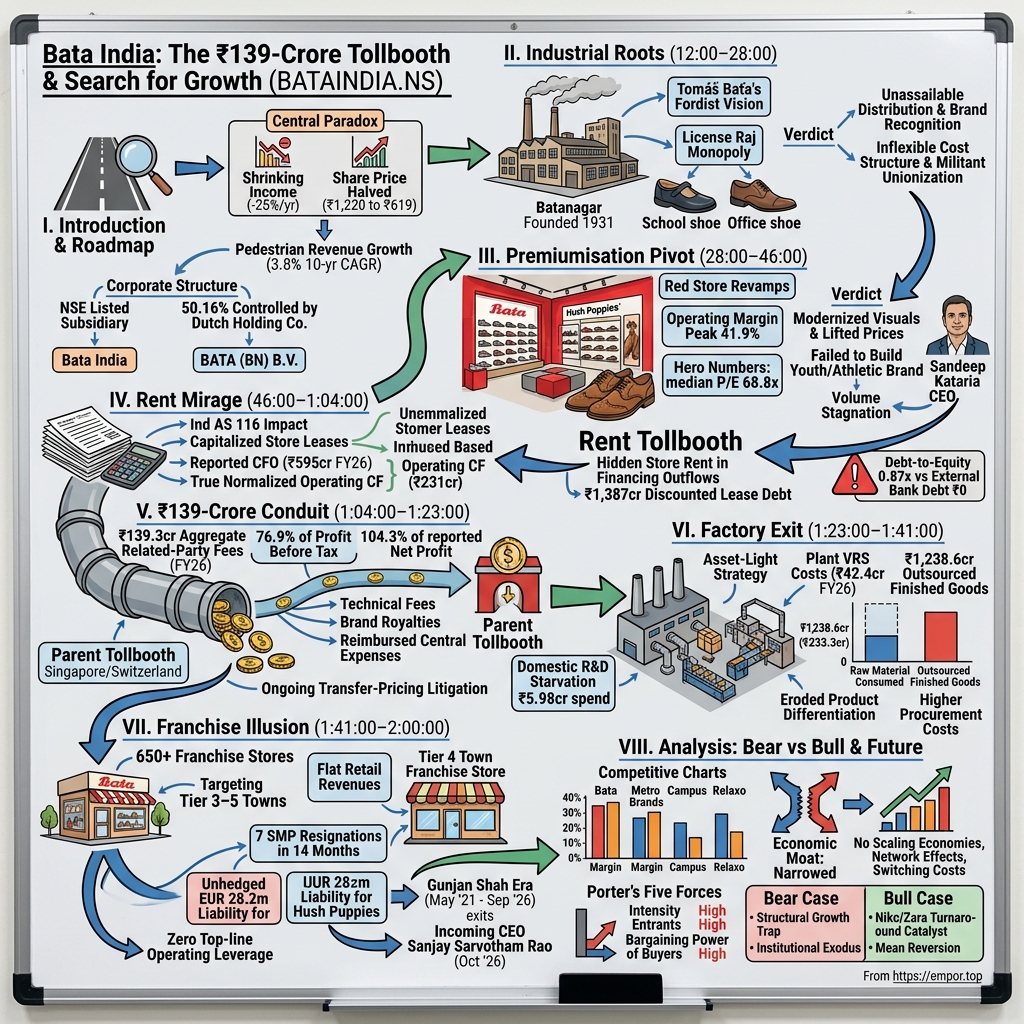
Bata India: The ₹139-Crore Tollbooth and the Search for Growth
I. Introduction & Episode Roadmap
Every May, in thousands of Indian market towns, the same ritual plays out. A parent holds a child's hand and walks into a shop with a red logo above the door. The child comes out with a pair of stiff black school shoes, a pair of white canvas trainers, and a small bottle of chalk-white liquid to keep them clean until Diwali. For a large share of Indians born in the second half of the twentieth century, that first pair of "proper" shoes came from Bata. In many households the brand name simply meant "shoes."
That shop belongs to Bata India Limited, a company incorporated in 1931 and listed on Indian exchanges long before modern disclosure rules existed.1 Today it runs a network of more than 2,000 retail touchpoints: over 1,350 company-owned, company-operated stores, more than 650 franchise stores, and shop-in-shop counters inside other retailers.1 It is one of the most recognised consumer brands in the country.
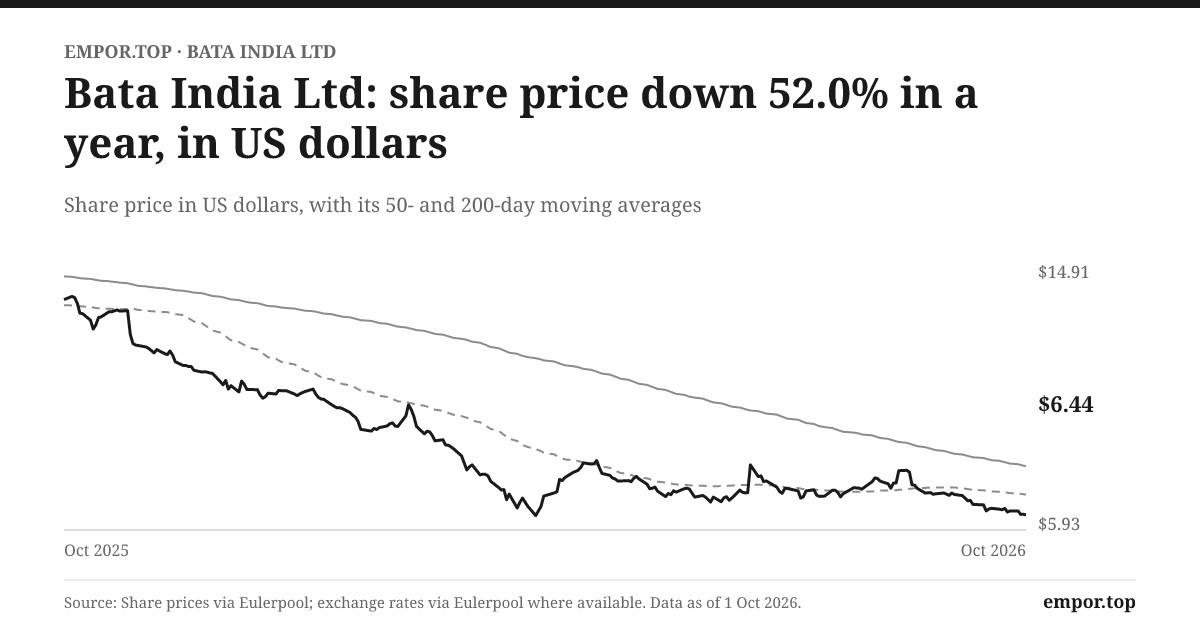
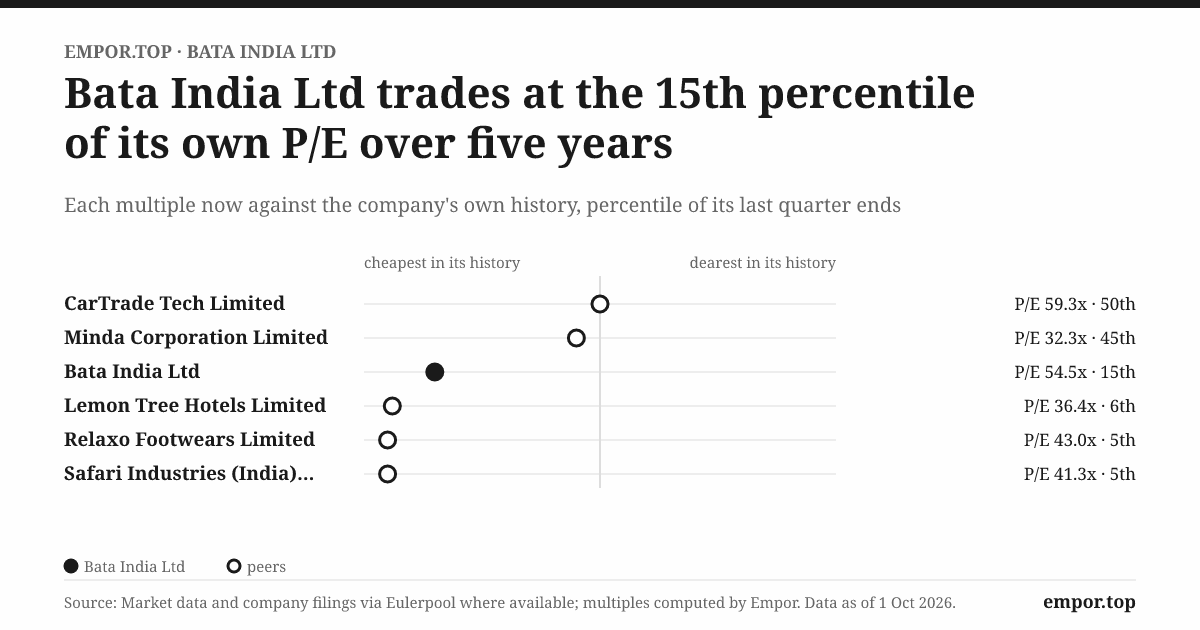
Then look at the stock. On 1 October 2026 a Bata India share traded at about ₹619, almost exactly half its 52-week high of about ₹1,220.2 Over the three years to March 2026, net profit shrank by roughly a quarter every year, from about ₹323 crore to about ₹134 crore.1 Over a full decade revenue compounded at only about 3.8% a year, a rate that probably trailed inflation, during a period when Indian discretionary spending, organised retail and branded footwear all boomed.12 Even after the fall, the market still paid about 54 times trailing earnings for the stock, against a five-year median of nearly 69 times.2
So the central puzzle is this. How does a brand that sits in nearly every Indian family's memory end up with a growth rate closer to a utility's, earnings in decline, and a valuation that still looks like a premium compounder's?
To answer it, start with who owns what. Bata India is not "Bata," the global footwear group. It is an Indian-listed operating company, 50.16% owned by a Dutch holding company, BATA (BN) B.V., whose ultimate parent is Compass Holdco Limited.1 The brands, the design centres, the technical know-how and the global sourcing network largely sit above the listed company, in Switzerland, Singapore, the Netherlands and Canada. The Indian company pays for access to them. That boundary turns out to be the most important fact in the story.
The episode follows five threads:
- The industrial roots. How the Batanagar company town and the protected post-independence market made Bata the default school and office shoe.
- The cash illusion. How a 2019 accounting change moved roughly ₹364 crore of yearly store rent out of operating cash flow, making the business look far more cash-generative than it is.
- The tollbooth. Why fees paid to affiliated group companies now exceed the listed company's entire annual net profit.
- The factory hollow-out. How Bata India turned itself from a manufacturer into a brand distributor that buys most of its finished shoes from outside suppliers, while paying workers to retire.
- The revolving door. Executive turnover, an unhedged euro licence for Hush Puppies, and a new chief executive, Sanjay Sarvotham Rao, who took charge today.
It begins on the banks of the Hooghly.
 Subscribe on LinkedIn
II. The Industrial Company Town of Batanagar
Picture the marshy riverbank south-west of Calcutta in the early 1930s. A Czech shoe company led by the Baťa family, which had turned Zlín in Moravia into a company town organised around the conveyor belt, sent people to Bengal with a plan to repeat the model. The Indian company was incorporated in 1931.1 On the Hooghly, what became Batanagar grew into more than a factory: housing, schools and services for workers clustered around tanneries and production lines. Its sister plant in Bihar was later named Bataganj.1
The question this era raises is whether vertical integration built a durable consumer franchise or an inflexible cost base that later managements would have to unwind. The honest answer is both.
The Fordist shoe
The Baťa idea was simple and radical for its time: make shoes the way Henry Ford made cars. Standardise the product, run the line hard, own the shops, and cut out the middlemen who marked up every pair. In a country where most footwear came from local cobblers and small workshops, a company that could make millions of identical, reasonably durable pairs and sell them at a printed price through its own stores had a real edge. A printed price on a shoebox meant something in a bazaar economy built on haggling.
After independence, India's licence-and-tariff regime protected domestic producers. Behind those walls Bata became the reliable choice for the things every family had to buy: school shoes, canvas plimsolls, sandals and plain leather office shoes. The edge rested less on fashion than on ubiquity and trust. A Bata store existed in almost every town that mattered, and the price was the price.
The weight of the town
The same physical presence carried a cost that showed up decades later. Owning factories in West Bengal and Bihar meant a large, unionised, permanent workforce with fixed wages, and those costs did not shrink when demand softened. Meanwhile the shoe clusters of Agra and Kanpur, along with the unorganised trade, ran on small workshops with far lower fixed costs. Once India opened up and organised retail matured, sourcing from such workshops became the cheaper way to put a shoe on a shelf.
The company's own accounts show how far that unwinding has gone. In FY2026 Bata India consumed only about ₹233 crore of raw materials in its own plants, but bought about ₹1,239 crore of finished goods from outside suppliers, more than five times as much.1 The company town that once defined Bata is now a minor part of its cost of goods.
A share register frozen in time
The capital history is also unusual. Bata India has 128.5 million shares of ₹5 face value.1 The only structural change in modern history was a two-for-one split in October 2015.1 There have been no bonus issues, no rights issues, no buybacks and no preferential allotments, and the parent's 50.16% stake carries no pledges.1 Outside shareholders have never been diluted. They have also never seen the parent buy in more or sell down: in more than a decade the controlling stake has not moved by a single share.1
The verdict on this era is fairly clear. Batanagar gave Bata India a distribution footprint and generational brand recognition no domestic rival could match for decades. The licence-era moat was real, but it was a moat of scarcity and habit. As later sections show, the company's long-run growth rate is the cost of that inheritance: about 3.8% a year over the decade to FY2026.1 An inheritance is not a strategy, and the next generation of managers tried to build one on top of it.
III. The Premiumisation Pivot: From Canvas to Hush Puppies
Imagine a Bata store in a South Delhi mall in the late 2010s. The dusty floor-to-ceiling stacks of cardboard boxes are gone. In their place are bright lighting, sneaker walls, and leather shoes from the Hush Puppies range displayed like jewellery. It is a composite rather than a single documented moment, but it captures what the company was trying to do: stop being the shoe your father bought you and become a brand you choose.
The question for this era is whether the Rajeev Gopalakrishnan and Sandeep Kataria years permanently raised Bata's brand equity, or whether higher prices covered up stagnant volumes.
The stabiliser and the brand builder
Rajeev Gopalakrishnan's tenure, from roughly 2011 to 2017, focused on discipline: pruning weak stores, keeping working capital clean, and growing retail steadily.1 It was not glamorous work, but it left a tidy, debt-free company with plenty of cash.
Sandeep Kataria took over in 2017 and pushed harder on brand and price. The portfolio leaned more on sub-brands such as Power for athletic wear, North Star for casual sneakers and Hush Puppies for premium leather, and stores were refreshed to match. The financial record from that time looks good. Revenue rose from about $368 million in FY2017 to about $430 million in FY2020, and net profit roughly doubled from about $24 million to about $46 million.12 The stock's five-year median P/E of almost 69 times reflects a market that came to treat Bata India as a premium consumer franchise.2
The clearest sign of how the group saw the Indian business came in November 2020, when Kataria was promoted to global chief executive of Bata Brands, based in Switzerland.[^3] The Indian company had become the group's proving ground. Its best operator left India to run the whole group.
A caution about the margin chart
One distortion needs to be cleared away. In the data tables, Bata India's operating margin jumps to almost 42% in FY2020.2 That does not mean the business suddenly became extraordinarily profitable. FY2020 was the year Ind AS 116 arrived. That accounting standard moved store rent out of operating expenses and into depreciation and interest, both of which sit below operating profit. The jump is mostly an accounting change, explained in full in the next section. Profit before tax, which captures all those costs, barely moved between FY2019 and FY2020.2
The falsification test
If premiumisation had truly raised the brand's standing, three things should have followed: steadier volumes, pricing power that survived the pandemic, and growth once demand returned. The record rejects most of that. Revenue in FY2026 was only about 2% above FY2020 in rupee terms, despite six years of Indian inflation and a much larger store network.12 Revenue in FY2023 was about ₹3,482 crore; three years later it was about ₹3,515 crore.1 Higher selling prices without volume growth is what a brand looks like when it is quietly giving up share.
Meanwhile the ground moved underneath it. Athletic and casual "sneakerisation" pulled young shoppers toward specialists such as Puma and Skechers and toward value players such as Campus Activewear and Relaxo. The premium mall shopper increasingly went to Metro Brands, whose multi-brand stores offered more choice in one place.[^4]
The verdict: the Kataria years modernised stores and raised average prices, and they lifted the group's view of India. But they did not create a self-sustaining youth or athletic brand. The claim that premiumisation built a lasting moat survives only in a much smaller form: Bata India learned to sell better-looking shoes at higher prices, but not to grow. Before asking why, investors need to see past the accounting that has made the business look healthier than it is.
IV. The Rent Mirage: Capitalising the Footprint into Ind AS 116
Imagine a forensic analyst with Bata India's cash-flow statements spread across a desk. Over the twelve years to FY2026, the company reported cumulative net profit of about ₹2,503 crore and cumulative cash from operations of about ₹4,770 crore, or 191% of profit.12 Taken at face value, that looks like one of the great cash machines in Indian consumer retail, a business converting almost two rupees of operating cash for every rupee of profit. Then the analyst turns to the financing section and finds the rent.
The question is whether Bata India is a superior cash generator or whether lease accounting has opened a gap between reported cash and economic reality.
How rent disappeared from operating cash flow
Here is the mechanism in plain terms. Before April 2019, store rent was an ordinary operating expense, like wages or electricity. It reduced profit and reduced operating cash flow. Ind AS 116, India's version of the global lease standard, changed that. A company now records each long lease as an asset (the right to use the store) and as a debt (the obligation to pay rent over the lease term). The yearly rent cheque is then split in two: one part counts as repaying the lease "debt," the other as interest on it. Both appear under financing activities in the cash-flow statement, not operating activities.
Nothing about the store changes. The landlord still gets paid every month. But operating cash flow now looks as if the company pays no rent at all.
For a retailer with more than 1,350 leased stores, the effect is large.
The worked calculation
Take FY2026 step by step.
- Reported cash from operations: about ₹595 crore.1
- Lease principal repaid, recorded under financing: about ₹247 crore.1
- Lease interest paid, also recorded under financing: about ₹117 crore.1
- Total rent effectively paid through the financing line: about ₹364 crore.
- Operating cash flow after rent: about ₹231 crore.
That adjusted figure is barely 39% of the headline. The other 61% is real money paid to landlords, simply recorded elsewhere. The company also paid a further ₹51 crore or so in other lease and licence costs.1
The headline ratios mislead in the same way. Cash from operations as a share of EBITDA was 83% in FY2026 and 161% in FY2025.2 Those numbers do not show unusual working-capital skill. They show rent being counted somewhere else. FY2025 had a further complication: a one-off pre-tax gain of about ₹134 crore from selling industrial land, booked under investing.1
The debt that isn't, and the debt that is
The same accounting explains a figure that confuses many readers. Stock screeners show Bata India with a debt-to-equity ratio of 0.87.2 Yet the company has no bank loans at all. Price Waterhouse, the auditor, confirmed that the company had no loans or borrowings from any lender during the year, and management states that it has no borrowings from banks or financial institutions.1 The "debt" is about ₹1,387 crore of discounted lease liabilities.1 At 31 March 2026 the company also held about ₹513 crore of cash, bank deposits and mutual funds.1
So the screener is wrong to call the company leveraged in the bank-loan sense, but the lease number is not imaginary either. Undiscounted, Bata India is contractually committed to about ₹1,705 crore of future rent, about ₹394 crore of it due within twelve months.1 A landlord cannot call in a loan, but rent cannot easily be cut when footfall falls. For a business whose revenue has grown less than 1% a year for three years, that is a fixed hurdle every year regardless of how many pairs it sells.
What it does to the valuation
Once rent is treated as the operating cost it really is, the "cash-rich compounder" picture weakens. The fact sheet's free-cash-flow yield of about 3%2 is closer to economic reality than the double-digit cash yields the raw statements might suggest. At that yield the market is paying for a recovery, not for cash already being generated.
The verdict: the claim that Bata India converts profit into cash at almost twice the usual rate is an accounting artefact of Ind AS 116. The balance sheet is genuinely safe, with no bank debt and a real cash cushion, but the business carries a rent bill of roughly ₹360 to ₹400 crore a year that cannot be negotiated away. Once rent is counted, there is less cash to go around, which makes the next question pressing: who gets that cash?
V. The ₹139-Crore Conduit: Royalty, Tech Fees, and the Parent's Tollbooth
Picture the Bata India board reviewing related-party contracts for FY2026. On one side is a company whose revenue rose by less than 1% for the year.1 On the other is a payment to Global Footwear Services Pte Ltd, a private group company in Singapore, for "technical collaboration." That fee rose by about 31% in the same year, from about ₹56 crore to about ₹74 crore.1 The Audit Committee, made up entirely of non-executive and independent directors, approves these transactions under an arm's-length framework.1 Whatever the paperwork says, the economics are clear.
The question is whether Bata India is run mainly to create value for its Indian minority shareholders or as a channel for value to flow to its overseas parent.
The four streams
In FY2026, money flowed from the listed company to group affiliates through four channels:1
- Technical collaboration fees of about ₹74 crore to Global Footwear Services in Singapore, for design, product development and sourcing know-how.
- Brand royalties of about ₹12 crore to Bata Brands S.A. in Switzerland, for the right to use the Bata name and marks.
- Reimbursed central expenses of about ₹48 crore, also to Bata Brands S.A.
- Service fees of about ₹6.5 crore to Bata Limited Canada and Bata Nederland B.V.
Together they came to about ₹139 crore.1
Now set that against the profits. Bata India's profit before tax for FY2026 was about ₹181 crore and its net profit about ₹134 crore.1 The affiliate fees therefore equalled about 77% of pre-tax profit, and about 104% of the profit left for all shareholders. In plain terms, the group companies collectively received more as fees than the listed company earned in total.
Fees are not the parent's only income. The 50.16% stake also earns dividends. In FY2026 BATA (BN) B.V. received about ₹58 crore in dividends, after about ₹142 crore in FY2025.1 With dividend payout running at about 86% of profit in FY2026,2 the parent receives its fees before profit is calculated and half the dividends after. The minority holders share the other half of the dividends, and all of the risk.
Is any of it worth paying for?
The fair counter-argument is that the fees buy something real. A local Indian brand would have to spend money of its own on design, global sourcing relationships and brand management. If Global Footwear Services designs the product line and Bata Brands maintains the trademark, a fee is simply what that costs. That argument has some weight, and the Bata name itself is worth paying for.
But three facts limit it. First, the fees rose by almost a third while sales stayed flat, so whatever the group delivered did not show up as growth. Second, Bata India's own research and development spending was only about ₹6 crore in FY2026, around 0.17% of revenue, and limited to local mould development and shop-floor quality work.1 Product creation has effectively been moved offshore, and the Indian company rents it back. Third, India's tax authorities have repeatedly challenged the pricing. Transfer-pricing adjustments covering assessment years 2011-12 to 2018-19, relating to technical collaboration fees paid to overseas affiliates, are pending before the Income Tax Appellate Tribunal in Kolkata.1 Tax officials have spent most of a decade arguing that these payments are larger than an independent party would pay. The company has not quantified the amounts involved.
A governance aside belongs here. Price Waterhouse's audit report also recorded that the audit-trail feature was unavailable for one supporting accounting system, that direct database changes to a core accounting system lacked documented controls, and that database-level changes across other systems were not logged during the year.1 Those are IT-control remarks, not findings of wrongdoing. But in a company where large sums cross to related parties, the ability to show who changed what in the books matters more than usual.
The verdict
The record does not support calling Bata India a value-maximising vehicle for all shareholders. It looks more like a well-run distribution business whose economic surplus is heavily taxed by its parent before outside investors see it. The parent can defend its fees as payment for real services, and the ITAT has not yet ruled. But when fees grow 31% in a flat year and exceed the listed company's net profit, the minority shareholder's real counterparty is the group's fee schedule. The number to watch is affiliate fees as a share of pre-tax profit: about 77% in FY2026. If the board keeps it around that level as profits recover, the tollbooth is structural. If the ratio falls sharply, the new management has won something meaningful.
Fees explain where the profit goes. They do not explain why the company stopped making its own shoes.
VI. The "Asset-Light" Factory Exit: Plant VRS and Traded Goods
Picture the old shop floors at Batanagar near Kolkata and Bataganj near Patna. Lines run below capacity. Long-serving union members queue to sign voluntary retirement papers. Meanwhile trucks of finished shoes from domestic contract manufacturers roll into regional warehouses. The Batanagar company town is being run down from the inside.
The question is whether moving from manufacturing to contract sourcing makes Bata India more agile, or whether it erodes product differentiation while the company pays heavily to exit its own workforce.
The cost of leaving
Voluntary retirement schemes are how Indian companies shrink a unionised workforce without strikes: workers receive a lump sum to leave early. Bata India booked about ₹42 crore of VRS costs as exceptional items in FY2026, after about ₹11 crore in FY2025, across its plants at Batanagar, Bataganj and Batashatak.1 That two-year total of roughly ₹53 crore is about seven times what the company spent on research and development in FY2026.
The direction is plain from the purchasing lines. Buying finished shoes from outside suppliers, about ₹1,239 crore, now dwarfs the roughly ₹233 crore of raw materials processed in-house.1 On a rough reading, well over 80% of what Bata India sells by value is made by someone else. Bata India has quietly become a brand distributor: it designs (with heavy reliance on the Singapore affiliate), it sources, and it retails.
The supplier base
Outsourcing changes the company's risk profile. The new supply chain depends on small Indian manufacturers, many of them registered micro and small enterprises protected by a law that requires buyers to pay within 45 days. At the end of FY2026 Bata India owed MSME suppliers about ₹92 crore, roughly 28% of its trade payables.1 During the year it paid about ₹8.5 crore to such suppliers after the statutory deadline, down from about ₹17 crore paid late the year before.1 Those amounts are small relative to the business, and the trend improved. But a company that has handed production to small vendors needs those vendors to stay healthy, and late payment is the wrong signal to send them.
Clean receivables, a big inventory release
Bata India's working capital tells a two-part story. Receivables are excellent. Debtor days were about 19 in FY2026,2 about 95% of receivables were current or less than six months overdue, and old disputed balances are fully provided for.1 No single customer accounts for even 10% of sales.1 Bata India is not stuffing distributors with stock on credit, which is a meaningful point in its favour.
Inventory is the more interesting signal. Inventory days fell from about 225 in FY2024 to about 106 in FY2026,2 and the company released about ₹107 crore of cash from inventories in FY2026 alone.1 Part of this is the natural result of outsourcing, since a brand distributor does not need to hold leather, rubber and work-in-progress. Part is deliberate destocking. What it is not, on the evidence, is a surge in demand: revenue was flat over the same period. Payable days fell too, from about 85 to about 49,2 which suggests suppliers are being paid faster, consistent with the MSME improvement.
The verdict
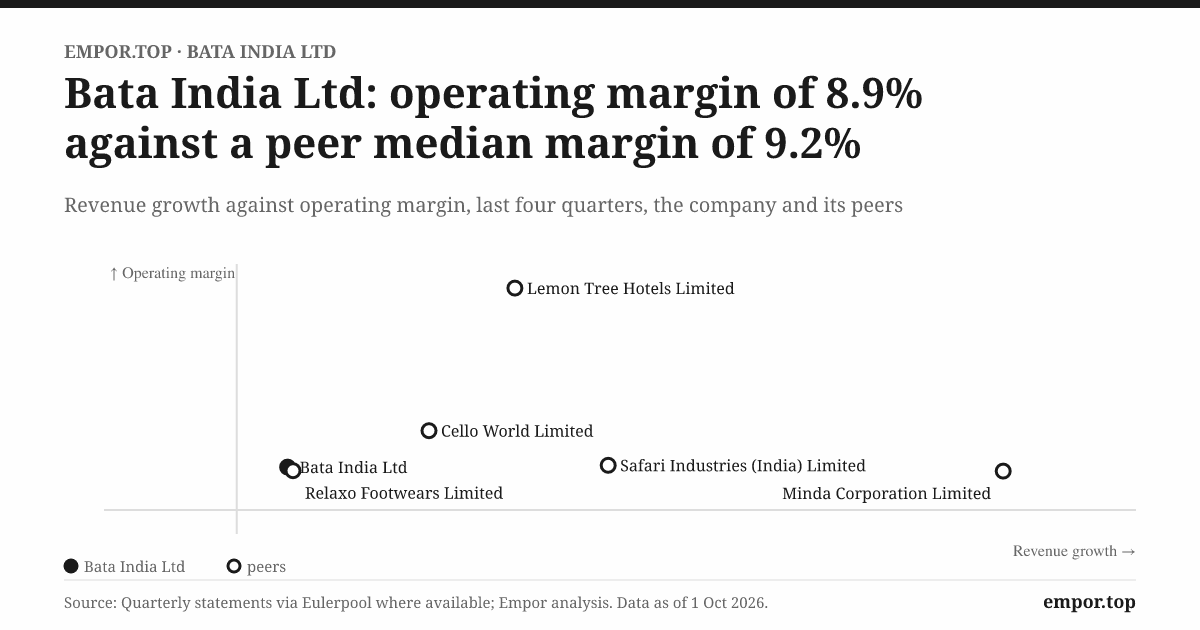
The asset-light thesis is partly confirmed and partly unproven. Confirmed: inventory is leaner, receivables are clean, and fixed factory labour is shrinking. Unproven: whether any of the savings reach shareholders. FY2026 operating margin was about 8.8% on the data provider's definition,2 profit before tax fell by more than half,2 and the cost savings were swallowed by restructuring charges, higher procurement costs and growing affiliate fees. Outsourcing also removes one possible source of differentiation. Anyone can hire the same contract manufacturers. If Bata India's shoes come from the same small factories as a D2C upstart's, what remains distinctive is the brand, the stores and the group's design. The first two had been the focus of the most recent strategy.
VII. The Franchise Illusion and the Gunjan Shah Era
Picture a newly opened franchise store in a Tier 4 town in Uttar Pradesh. It stocks mid-priced formal shoes and school shoes, and the red sign is freshly painted. Across the street, a multi-brand shop sells Campus sneakers to teenagers. In the district headquarters an hour away, a Metro Brands outlet takes the wedding shoppers. Bata has arrived in "Bharat," and found it was already contested.
The question is whether franchising into small towns expanded Bata's market, or merely added doors while the core stalled and the executive team kept changing.
The franchise thesis
Gunjan Shah became managing director and chief executive in 2021 and served until 30 September 2026.1 The central strategy of the tenure was franchising: local entrepreneurs fund and run the stores, Bata supplies the product and the brand, and the company reaches towns where its own stores would not pay. Mint reported the logic in 2023: grow the footprint in Tier 3 to Tier 5 towns without adding fixed leases.[^5] The network did grow, to more than 650 franchise stores within a total of more than 2,000 touchpoints.1
On paper this was the right answer to the rent problem of Section IV. Franchise stores add revenue without adding lease liabilities.
The revenue reality
The revenue line does not show it working. Retail revenue was about ₹2,746 crore in FY2026 against about ₹2,752 crore in FY2025, slightly down.1 Non-retail sales, mostly wholesale, rose about 4.5% to about ₹768 crore.1 Total revenue over the three years to FY2026 grew about 0.6% a year.1
There are two possible readings. The generous one is that franchising offset weakness in the established company-owned stores, and without it revenue would have fallen. The less generous one is that new franchise doors partly cannibalised existing sales and pushed inventory to partners without creating new demand. The company does not publish the split of revenue between company-owned and franchise stores, nor like-for-like growth by format, so outsiders cannot settle the question. Either way, the strategy produced no operating leverage. Store count went up while the top line stayed flat.
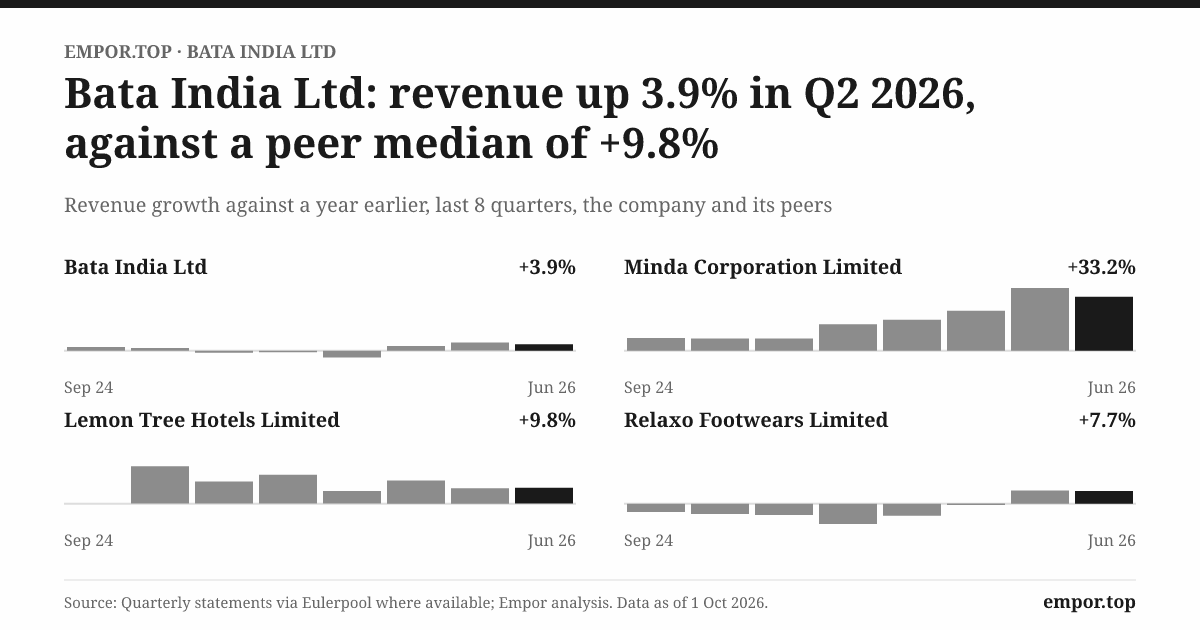
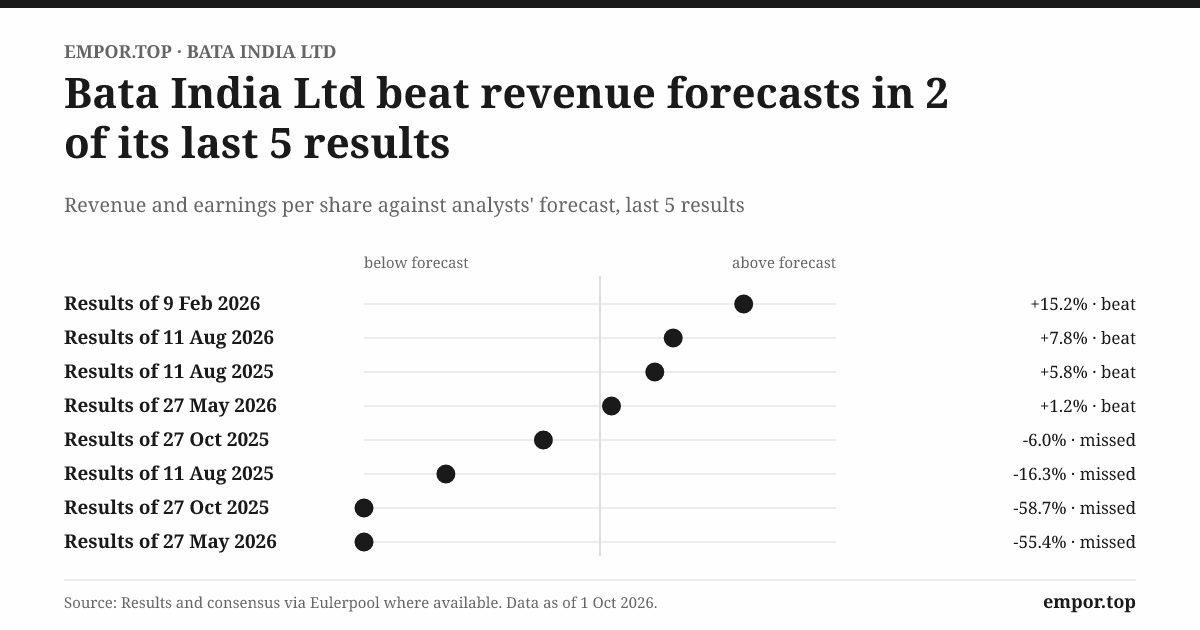
The quarterly figures show some faint signs of life at the end of the tenure. Revenue grew about 5% year on year in the March 2026 quarter and about 4% in the June 2026 quarter.2 Management described festive demand and franchise expansion on the Q3 FY2026 call,[^6] and sneaker and volume strategy on the Q2 call.3 Two good quarters after three flat years count as a hint, not a trend.
The revolving door
The second story of this era is people. CFO Anil Ramesh Somani resigned in September 2024. Durgesh Singh served as interim CFO until Amit Aggarwal was appointed in December 2024.1 During FY2026 a series of senior managers left: the head of merchandising, the head of real estate and business development, the head of internal audit, a category lead in merchandising, the global head of distribution and the head of HR.1 A replacement senior vice-president of merchandising, Uttam Kumar, left on 1 May 2026.1
That makes seven senior departures in about fourteen months, concentrated in exactly the functions a retail turnaround depends on: what to stock (merchandising), where to put stores (real estate), how to move goods (distribution) and whether the numbers are reliable (audit and finance). A company that loses its head of merchandising twice in a year is not executing a stable product strategy.
Gunjan Shah's pay for FY2026 was about ₹4.1 crore, including a small performance-linked incentive of about ₹34 lakh.1 That is about 3.1% of net profit,1 not extravagant in absolute terms. The modest bonus suggests the board did not consider it a strong year either.
The euro gamble
The tenure also left a currency exposure. Bata India renewed its exclusive licence with Wolverine World Wide for Hush Puppies in India,[^8] recording the licence as an intangible asset of about ₹258 crore against a guaranteed minimum royalty owed in euros.1 At March 2026 that liability stood at about EUR 28.2 million, roughly ₹263 crore, and it is unhedged.1 The company recorded an unrealised foreign-exchange loss of about ₹23 crore in FY2026,1 and its own sensitivity analysis says a 5% fall in the rupee against the euro would cut pre-tax profit by about ₹13 crore.1
The logic of leaving it unhedged is hard to defend from a minority shareholder's position. The royalty is a fixed foreign-currency obligation, the business earns 99.6% of its revenue in rupees,1 and hedging a known obligation is standard practice. The choice turned a premium brand licence into a currency bet in a business whose operating profit is already thin.
The verdict
Franchising achieved what it promised on the footprint and failed on the thing that mattered: growth. The executive turnover is the stronger evidence against the outgoing regime, because it hit the functions any recovery needs. Gunjan Shah's exit on 30 September 2026 and Sanjay Sarvotham Rao's arrival on 1 October 202614 close the era. Whether Rao can change the result depends on something deeper than leadership: whether Bata still has a competitive advantage to work with.
VIII. Analysis: Porter's Five Forces, Hamilton Helmer's 7 Powers, and the Bear vs. Bull Case
Line up India's listed footwear companies side by side. Metro Brands earns EBITDA margins around 30%, grows revenue at roughly 15-20% a year, and trades at around 57-61 times earnings.2[^4] Campus Activewear owns the sub-₹2,000 running shoe and trades at around 40 times earnings.2 Relaxo, the mass-market manufacturer, trades at around 37-39 times.2 Bata India, the oldest name of them all, reports an operating margin of about 8.8% and trades at about 54 times.2 The market is still paying Metro-like multiples for something that currently earns like a value retailer.
The question is whether Bata India still has an enduring moat, or whether its brand is slowly becoming a commodity.
Porter's Five Forces
Threat of new entrants: high. Contract manufacturing means a new brand needs no factory. D2C labels such as Neeman's sell through their own websites and marketplaces, and quick-commerce apps are pushing delivery times down to minutes. The outsourcing shift in Section VI means Bata now uses the same kind of supply chain as these entrants.
Bargaining power of buyers: high. No single customer accounts for 10% of sales,1 which is good for credit risk but tells you shoppers are individuals with no contract and no reason to stay. A family that bought Bata school shoes last year can buy Campus, Sparx, Red Tape or Mochi this year at no cost.
Bargaining power of suppliers: low to moderate. The contract manufacturers are fragmented and small, which gives Bata leverage. The constraint is legal (MSME payment rules) rather than economic. The exception is the group itself: the most powerful "supplier" Bata India has is its own parent, which charges for design and brand access (Section V).
Threat of substitutes: moderate to high. Office dress codes have loosened and athleisure has replaced formal leather shoes for many workers. That hurts exactly the formal-shoe category where Bata's heritage is strongest.
Rivalry: intense. Relaxo and Khadim compete hard on price at the bottom. Metro Brands offers a better multi-brand experience at the top. Global athletic brands own the aspirational sneaker. Bata sits in the middle.
Hamilton Helmer's 7 Powers
Scale economies: present but offset. More than 2,000 touchpoints give Bata purchasing and distribution scale few rivals can match. But a large share of the economic gain is eaten by fixed rent of about ₹364 crore and affiliate fees of about ₹139 crore.
Network effects: absent. One person's Bata shoes do not make another's more valuable.
Counter-positioning: absent, and reversed. Bata is the incumbent being counter-positioned against. Digital-first brands can choose channels that would cannibalise Bata's own store base if it copied them.
Switching costs: absent. Shoes are transactional purchases.
Brand: moderate and fading. Recall is close to universal and trust in durability is real; that is why the stock still carries a premium. But brand power should show up as pricing power and volume, and a decade of 3.8% revenue growth with three flat years suggests the brand now holds its existing customers rather than attracting new ones. Among Gen Z sneaker buyers, the cultural weight of the brand is low.
Cornered resource: absent at the listed level. The valuable assets, Bata's global design and the brand trademarks, belong to the group. The Indian company rents them. Hush Puppies is licensed from Wolverine. The listed company owns its store network and its relationships, not its intellectual property.
Process power: weak. With most production outsourced, there is no proprietary manufacturing advantage left.
The overall verdict: Bata India's moat has narrowed to two things, distribution reach and brand recall. Both are real. Neither currently converts into growth or margin.
The KPIs that matter
Three numbers will decide this case:
- Revenue growth, as a stand-in for same-store sales. The latest quarter grew about 4% year on year, after years near zero.2 The company reports same-store sales growth on its calls but not consistently in its annual filings.
- Affiliate fees as a share of pre-tax profit. About 77% in FY2026, up as profit fell and fees rose.1
- Return on capital employed. About 11% in FY2026, down from about 50% a decade earlier.2 Part of that decline is the lease accounting change, but the trend since FY2023 is also down, from about 22%.
The bear case
The bear sees a structural growth trap. Revenue growth of 0-3% a year probably lags inflation, which means the business is shrinking in real terms. A P/E of 54 is hard to defend on a return on equity of about 9%2; if the market comes to see that return as permanent, the multiple could compress toward the high-30s level where Relaxo trades. The parent's tollbooth persists whatever happens, since fees come off the top. And the institutions with the most choice have been leaving: foreign portfolio investors held about 6.4% in March 2026, roughly half their level in FY2020, while domestic mutual funds and insurers (about 28% combined) absorbed the selling.1
The bull case
The bull starts with the new CEO. Sanjay Sarvotham Rao comes from Nike's retail business in France and Benelux and from Inditex, where he helped launch Zara in India.14 Those are exactly the merchandising and store-throughput skills Bata lacks. Second, operating leverage: as VRS charges stop and franchise stores mature, margins should recover from FY2026's trough. FY2026 included about ₹42 crore of one-off restructuring,1 and the fact-sheet margin history shows the business earned far more before that. Third, safety: about ₹513 crore of cash and deposits and no bank debt mean almost no risk of financial distress.1 Fourth, mean reversion: if same-store growth returns to high single digits, the market has shown it will pay 60 to 70 times for this brand.
Weighing it
The bear case rests on a decade of evidence. The bull case rests on one appointment and two quarters of modest growth. That does not make the bull case wrong, but it does mean the burden of proof is on the turnaround. Even a successful turnaround runs through the fee schedule: affiliate fees that rise faster than revenue would capture much of any recovery before minority shareholders see it. The current multiple appears to assume both a volume recovery and an end to fee growth. Neither has been demonstrated.
IX. Playbook: Business & Investing Lessons
Lesson 1: The parent's tollbooth comes before the shareholder's share. The defining moment came in FY2026, when Global Footwear Services in Singapore received a 31% increase in technical fees, to about ₹74 crore, in a year when Bata India's sales were flat. When a listed subsidiary pays its parent more in fees than it earns in profit, minority investors are partners in the losses and junior to the royalty in the gains. The lesson for investors in any multinational's Indian subsidiary: read the related-party note before the income statement, and divide affiliate fees by pre-tax profit. In a subsidiary, the royalty is senior debt that never appears on the balance sheet.
Lesson 2: Cash flow can be an accounting choice. Bata India reported about ₹595 crore of operating cash flow in FY2026 and paid about ₹364 crore of rent through a different line of the same statement. The cash conversion story that looked like operating excellence was a change in where rent is recorded. For any retailer, airline or hospital chain after Ind AS 116 or IFRS 16, subtract lease principal and interest from operating cash flow before admiring it. The landlord does not care which line the cheque appears on.
Lesson 3: A brand stuck in the middle has nowhere to stand. Picture a Bata window showing ₹399 school shoes beside ₹4,999 Hush Puppies, while teenagers walk past to the Skechers store next door. Bata tried to be the family's dependable school shoe and an aspirational premium label at the same time, under one sign. Metro Brands solved the premium problem by being a multi-brand destination; Campus solved the youth problem by owning one category. A brand that means "the shoe your parents bought you" cannot simply relaunch itself as cool. It needs a separate identity or a separate store.
Lesson 4: You cannot cut your way to brand leadership. In FY2026 Bata India spent about ₹6 crore on research and development and about ₹42 crore paying factory workers to retire. Its capex was under 2% of sales. Those choices are rational for a business being harvested; they are not the choices of a business planning to grow. The lesson is blunt: when restructuring costs exceed product investment several times over, management is managing decline, whatever the strategy presentation says.
Lesson 5: Executive churn is an operating metric. Seven senior departures in fourteen months, including the head of merchandising twice, mattered more than any single quarter's margin. In retail, strategy is only as durable as the people who choose the stock. Investors who track management turnover alongside same-store sales would have seen the stagnation coming.
X. Epilogue
Tonight, 1 October 2026, Bata India has a new chief executive. Gunjan Shah stepped down on 30 September, and Sanjay Sarvotham Rao took over as managing director and chief executive this morning.14 Because Rao is a French national and Overseas Citizen of India, the appointment needs Central Government approval under Schedule V of the Companies Act; the company has applied for it.1 Shareholders approved his appointment by postal ballot in May 2026, with about 99.5% of votes in favour.1[^10]
His package signals what the board wants from him: annual fixed pay of about ₹3.6 crore, a joining payment of about ₹2 crore to compensate for equity forfeited at his previous employer, a short-term incentive of up to about ₹3.2 crore and a long-term cash incentive plan.1 That is a meaningful variable component for a turnaround, and a large share of his potential pay depends on results.
Three moments will decide what the story becomes.
The festive and wedding test. The October-December quarter is Bata's second-biggest season. Results for Q3 and Q4 of FY2027 will be the first in which Rao's merchandising choices could plausibly show up. If same-store sales growth and volumes rise into high single digits, the bull case gains its first real evidence. If they stay flat, the market will conclude that the problem is the brand's position rather than the person running it.
The fee trajectory. The FY2027 annual report will show whether technical fees to Singapore and royalties to Switzerland kept rising faster than sales. A board that caps affiliate fees relative to pre-tax profit would answer the governance question decisively. Another year of fees growing in a flat-revenue year would answer it the other way.
The euro reckoning. The roughly EUR 28 million Hush Puppies liability remains unhedged. Every move in the rupee-euro rate will flow through profit until the company changes its policy or pays down the obligation.
These map directly onto the story's central questions. Can new leadership break a decade of stagnation without sacrificing margin? Is the company run for Indian minority shareholders or for the group? Do the fixed lease and licence obligations become a drag if demand stays weak? The new chief executive inherits a clean balance sheet, a famous name and a decade of evidence that neither is enough. The open question is whether a global retail veteran can reinvent an Indian institution, or whether the tollbooths to Switzerland and Singapore will cap equity returns however well the stores perform.
XI. Outro
Go back to that May morning: the parent, the child, the stiff black shoes and the bottle of chalk-white polish. That ritual made Bata more than a company. For decades it was simply how India bought shoes. That trust is still there in the brand's recall, the town-centre locations, and the premium the market still pays.
The irony is that the trust made the company too comfortable. A business that touched almost every Indian foot for generations became so safe, and so thoroughly mined for royalties, fees and dividends, that it forgot how to run. The listed company now rents its designs, outsources its shoes, and pays a toll on its own name. Bata taught India how to wear shoes. Now India has to teach Bata how to sell them.
References
-
Bata India Limited Annual Report 2025-26 (93rd AGM Statutory Disclosures) — BSE India, 2026-06-25 ↩↩↩↩↩↩↩↩↩↩↩↩↩↩↩↩↩↩↩↩↩↩↩↩↩↩↩↩↩↩↩↩↩↩↩↩↩↩↩↩↩↩↩↩↩↩↩↩↩↩↩↩↩↩↩↩↩↩↩↩↩↩↩↩↩↩↩↩↩↩
-
Bata India Limited Consolidated Financial Statements & Valuation History — Screener, 2026-10-01 ↩↩↩↩↩↩↩↩↩↩↩↩↩↩↩↩↩↩↩↩↩↩↩↩↩↩
-
Bata India Q2 FY26 Earnings Conference Call on Volume Growth & Sneaker Strategy — Trendlyne, 2025-11-14 ↩
-
Appointment of Sanjay Sarvotham Rao as Managing Director & CEO — BSE India Corporate Announcements, 2026-05-20 ↩↩↩
 LinkedIn
 WhatsApp
 Reddit
 Hacker News
 Email
Email Kindle
 RSS Feed
 Spotify
 Apple Podcasts
 Amazon Music
 Audible
 YouTube