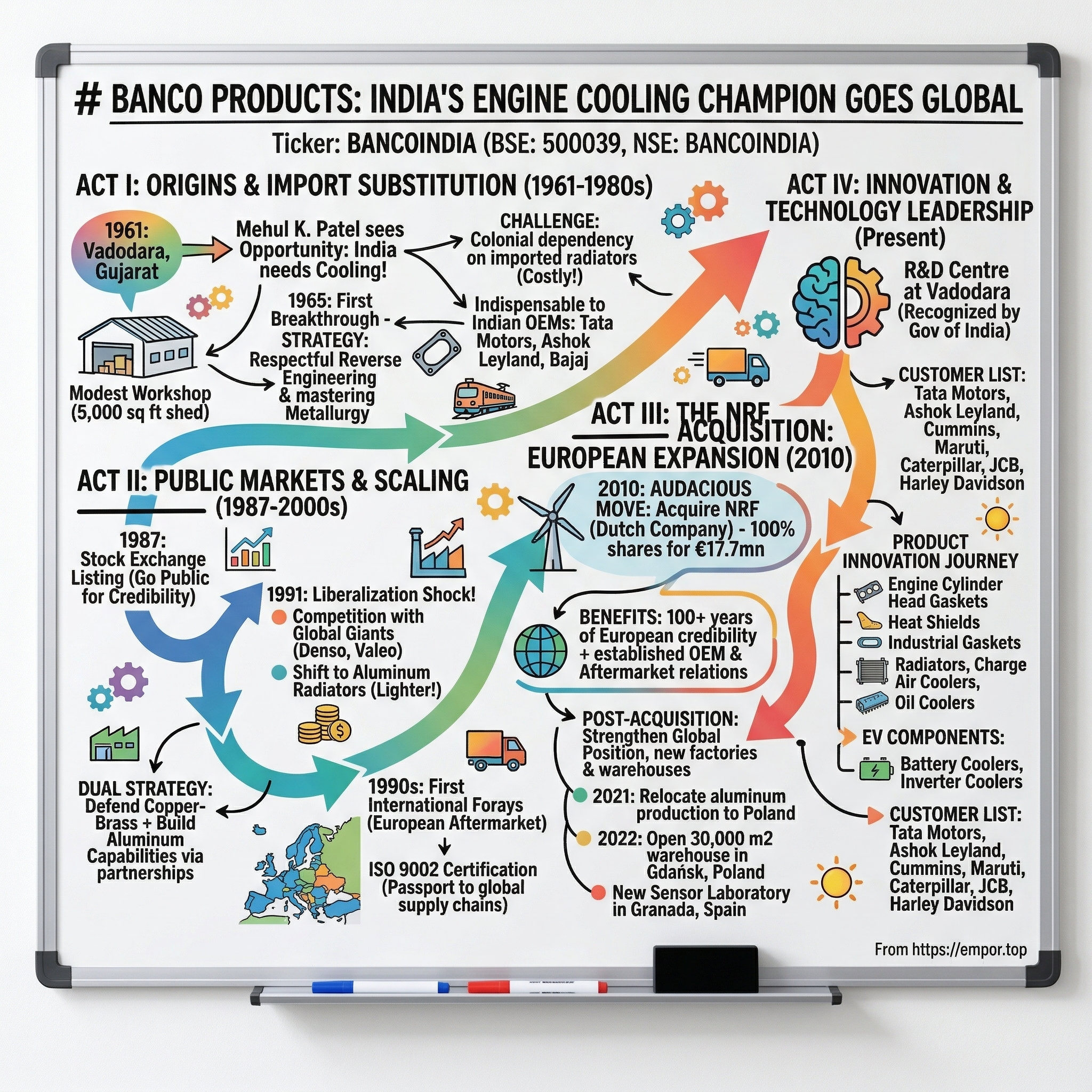
Banco Products: India's Engine Cooling Champion Goes Global
I. Introduction & Episode Teaser
On the morning of August 29, 2025, employees arriving at a heat exchanger warehouse in Valenciennes, near France's border with Belgium, found the facility destroyed by an overnight fire. No injuries were reported. The site held roughly three percent of the group's European inventory, and customer orders were rerouted within days through distribution centres in the Netherlands, Poland and Spain.1 Frank Toebes, the managing director, described the operational impact: "Of course there is a massive challenge ahead of us, including reconstruction, restocking, customer fulfilment, insurance."1
The significance of the incident lay less in the blaze itself than in who was required to report it. The parent entity that filed regulatory disclosures with the Bombay Stock Exchange, lodged a €6.56 million insurance claim, and recorded ₹21.5 crore in related exceptional items is headquartered eight thousand kilometres away—in Bil, a village near Vadodara, Gujarat.2
That parent is Banco Products (India) Limited, a business largely overlooked by retail equity investors despite commanding a market capitalization of roughly ₹8,950 crore and generating about two-thirds of its revenue in euros.34
Banco's global posture stems from a strategic acquisition in early 2010. NRF B.V., a Dutch radiator manufacturer established in Amsterdam in 1927, was caught in the insolvency of its parent company, Proliance International. After the Connecticut-based heating and cooling parts manufacturer filed for Chapter 11 bankruptcy in Delaware on July 12, 2009,[^5] NRF was auctioned as a profitable subsidiary under Section 363 of the U.S. Bankruptcy Code. Following a stalking-horse bid from a Dutch private equity firm,5 the family-controlled Indian manufacturer outbid competing suitors, acquiring NRF for €17.7 million—roughly ₹115 crore at the time.[^7]
For valuation context, when Standard Motor Products acquired Nissens Automotive—a comparable Danish thermal-management aftermarket business generating approximately €172 million in revenue—in November 2024, the purchase price reached roughly €360 million.6 Banco acquired a comparable European footprint fourteen years earlier at a steep discount by buying through a bankruptcy proceeding.
Financially, Banco reported consolidated revenue of ₹3,896 crore in FY2026, expanding from ₹3,213 crore in the prior fiscal year. Operating margins held near 18 percent, generating a net profit of ₹482 crore. Capital efficiency remained high, with return on capital employed reaching approximately 31 percent and return on equity approaching 30 percent.4 The promoter family controls 67.88 percent of the equity, with Mehul Kanubhai Patel holding a 55.59 percent direct stake.7
A rigorous evaluation of Banco requires scrutinizing three prevailing narrative claims. First, while the company maintains a debt-free balance sheet on a standalone basis, its consolidated borrowings totaled approximately ₹614 crore.48 Second, the assertion that the European operations act as a permanent margin drag—a condition that held true for nearly a decade—is contradicted by recent operational improvements. Third, despite market expectations surrounding electric vehicle thermal management, Banco has disclosed no revenue from the specialized subsidiary it incorporated five years ago for that segment.9
The company's trajectory spans four distinct phases: License Raj import substitution, an export expansion during the 1990s, the distressed international acquisition that expanded its scale, and its present iteration. Today, the family-led enterprise faces strategic choices regarding its European distribution network, its accumulated cash reserves, and the long-term phaseout of internal combustion engine technology across key international markets.
 Subscribe on LinkedIn
II. Origins & The Import Substitution Era (1961–1980s)
In 1961, fourteen years after independence, India was building an industrial base by decree under its Second and Third Five-Year Plans, which prioritized heavy engineering. The Reserve Bank of India rationed foreign exchange tightly, meaning that importing a truck radiator required a government license, extended waiting periods, and scarce hard currency.
Into that gap stepped Banco Products, incorporated in 1961 with a stated purpose that reads like a policy directive: to design and manufacture radiators and gaskets as import substitutes for India's original equipment manufacturers (OEMs), the Railways, and the Defence sector.10
Examining these two core product categories illustrates Banco's strategic trajectory, as radiators and gaskets demand fundamentally different engineering capabilities.
A radiator is a heat exchanger. Coolant absorbs heat from an engine block and circulates through a matrix of thin tubes bonded to fins, where passing air dissipates the heat. The engineering challenge centers on surface area and thermal conductivity per unit of weight, cost, and space—and, critically, on joint integrity. The assembly forms a pressurized network of thousands of soldered or brazed connections that must withstand a decade of intense road vibration. In 1961, the standard material was copper-brass: highly thermally conductive and easy to solder, but heavy and costly.
A gasket presents the opposite engineering problem. As a static seal—a precision-stamped layer of metal, graphite, or composite compressed between the cylinder head and engine block—it contains high-pressure combustion gases, coolant, and oil in separate channels. Gasket failures are catastrophic, making manufacturing primarily an exercise in materials science and precision stamping.
Banco built an enterprise that manufactured both components for the same customer base simultaneously. While the two product lines shared little technological overlap, they aligned in commercial distribution: identical OEM procurement departments, qualification standards, and aftermarket distributors. This distribution-led logic became the company's organizing principle.
By the 1980s, Banco reported supplying most major domestic OEMs across a diversified customer base.10
Historical falsification: was import substitution actually a moat?
Evaluating whether this early domestic position constituted a durable competitive advantage reveals clear limits to the import-substitution moat.
Banco's early domestic success was largely created by state policy rather than intrinsic competitive differentiation. High tariff barriers and strict import licensing insulated domestic radiator makers from foreign competition, creating a policy-dependent moat vulnerable to regulatory shifts.
That protection eroded as market liberalization reshaped the automotive industry. Maruti Udyog's joint venture with Suzuki, followed by the entry of Hyundai and other global passenger-vehicle manufacturers, established international supplier networks that bypassed domestic incumbents. This dynamic was especially clear in passenger-vehicle thermal management. Subros Limited was incorporated in 1985 as a joint venture, with the Suri family holding approximately 37 percent, Japan's Denso Corporation holding 20 percent, and Suzuki Motor Corporation holding about 12 percent.11 That ownership structure—a supplier jointly owned by its primary customer and its technology partner—was unreachable for an independent domestic manufacturer. Subros subsequently captured roughly 41 percent of both the Indian passenger-car air-conditioning market and the truck air-conditioning market.11
Banco captured no comparable share in passenger-vehicle cabin cooling. According to CMIE data cited by CARE Ratings, Banco holds the leading market share in India's radiator segment at roughly 21 percent—a substantial position, but confined to engine cooling rather than broader thermal management and cabin comfort.[^7]
This outcome does not imply operational failure, but it narrows the scope of Banco's competitive moat. Banco never secured passenger-vehicle thermal platform contracts in India. Instead, the company pivoted into industrial and commercial niches where Japanese and European joint ventures faced lower incentives to compete and where high product variety favors flexible manufacturing over raw scale. These included commercial vehicles, agricultural tractors, construction equipment, generator sets, railways, marine engines, and stationary industrial power units—low-volume, high-mix applications requiring specialized cooling packages in thousands of units rather than mass-market car platforms requiring hundreds of thousands.
This strategic pivot under competitive pressure defined the company's long-term orientation. It explains why Banco's disclosed customer roster features industrial and heavy-equipment manufacturers such as JCB India, Mahindra & Mahindra, Cummins India, and John Deere India rather than passenger car makers.[^7] Crucially, it also explains why Banco's eventual international expansion targeted replacement-parts distribution networks rather than global OEM platform contracts.
Before expanding internationally, however, Banco first had to establish its export capability.
III. Public Listing, Plant Scale & Export Foray (1987–2000s)
In 1987, Banco Products converted from a private company and listed on the Indian stock exchanges.10 In the decades since, the company has rarely returned to public equity markets for capital. It established no history of repeat share issuances; its primary capital-markets transaction was a five-for-one stock split executed on November 23, 2007.12 Rather than diluting shareholders to fund growth, management relied on internal cash generation, treating equity as a vehicle for returning capital rather than expanding the share base.
During the 1990s, two parallel developments—one metallurgical and one geographic—reshaped Banco's trajectory.
The metallurgical shift was global. Automotive manufacturers transitioned from traditional copper-brass radiators to brazed aluminium heat exchangers to reduce vehicle weight and material costs. Although aluminium has lower thermal conductivity than copper, it features roughly one-third the density of copper and is far less expensive per kilogram. Engineers compensated for lower conductivity through optimized geometry, using thinner tube walls, denser fin arrays, and larger frontal surface areas.
However, the change required a fundamental overhaul of manufacturing operations. Rather than soldering individual copper-brass joints, workers assembled an aluminium core clad with a lower-melting-point alloy and passed the unit through a controlled-atmosphere brazing furnace, melting the cladding layer to fuse all joints simultaneously. This transformed radiator production from a labor-intensive soldering operation into a capital-intensive furnace process demanding strict thermal and environmental controls.
This technological transition marked the largest structural shift in the history of heat exchangers. For Banco, mastering controlled-atmosphere aluminium brazing while leveraging lower Indian labor and capital costs created an opportunity to serve cost-conscious overseas customers.
The geographic shift followed directly. In the 1990s, Banco began exporting heat exchangers to international markets, primarily in Europe, after securing ISO-9002 certification.10 Over time, the company expanded its quality and environmental compliance credentials, adding QS 9000, ISO 9001, ISO 14001 environmental management, and IATF 16949 automotive quality certifications, alongside Star Export House recognition from the Ministry of Commerce.102 Banco also established a research and development centre at Vadodara recognised by the Department of Science.10
Industry certifications served as essential prerequisites rather than durable competitive moats, as compliance is standard across global automotive supply chains. For Banco, however, these quality credentials unlocked a crucial commercial role: operating as a private-label manufacturer for European distributors seeking low-cost alternatives to Western European production.
Throughout the 2000s, Banco built its export business on contract manufacturing. While this strategy generated steady volume, it left the company in a structurally subordinate market position. European distributors retained control over branding, product catalogs, customer relationships, end-market pricing, and sales data. In contrast, Banco absorbed raw-material price volatility and plant utilization risks while operating on contract-converter margins, facing the constant threat of substitution by lower-cost Asian competitors.
To support its domestic and growing export orders, Banco expanded its manufacturing footprint across Gujarat. Its core facility at Bhaili, near Vadodara, spans 50,000 square metres and produces over 1.5 million cooling system components a year; the company also built a dedicated special economic zone unit at Waghodia for export markets, alongside a gasket plant at Ankhi with capacity exceeding 100 million gaskets annually.10 Across five Indian plants, the company now maintains the capacity to produce 3.33 million radiators a year.[^7]
The dynamics of the independent automotive aftermarket explain the strategic limits Banco faced. Aftermarket demand is driven by the vehicle parc—the total installed fleet on the road and its average age—rather than new vehicle sales. Because radiators typically fail between year six and year fifteen, aftermarket demand is less cyclical than original equipment sales and lags new vehicle production cycles by several years. Furthermore, the aftermarket customer base consists not of corporate purchasing departments negotiating annual contracts at compressed margins, but of thousands of independent garages and distributors requiring immediate component availability.
By the late 2000s, Banco was a profitable but structurally constrained manufacturer: dominant in a domestic radiator niche, tied to cyclical commercial-vehicle and industrial demand in India, and supplying European markets as an unbranded contract manufacturer.
Then, in July 2009, a company in Connecticut filed for bankruptcy.
IV. The NRF Acquisition: The European Turnaround Bet (2010–2015)
Nederlandse Radiateuren Fabriek—the Netherlands Radiator Factory—was founded in Amsterdam in 1927 by R. Bloksma senior as a repair shop before launching its own production department in the 1930s.13
The company expanded its industrial capabilities in 1954 by opening a second facility in Mill, in the southern Netherlands. Two rapid innovations established its technical reputation: constructing the first high-capacity train radiator for Netherlands Railways—nicknamed the "Blue Angel"—and inventing the box cooler, a heat exchanger mounted inside a ship's sea chest that cools engine coolant directly against seawater without external pumps or intake piping. Nearly seventy years later, the box cooler remains standard equipment across marine engineering.13 OEM contracts with DAF and Volvo followed. NRF closed its Amsterdam site in 1962, making Mill its headquarters, and opened its first international location in Valenciennes, France, in 1980.13
That Valenciennes site was the warehouse destroyed by fire in August 2025—the company's oldest international outpost.
NRF's subsequent ownership history reflected the broader consolidation of the global heat-exchanger industry. The American firm Modine Manufacturing acquired the business in 1989 to serve as its European aftermarket hub.13 NRF began producing aluminium heat exchangers in 1998. During the 2000s, the aftermarket assets changed hands again, eventually landing inside Proliance International—a firm burdened by heavy legacy costs, a distributed U.S. manufacturing base, and a key distribution facility destroyed by a tornado eighteen months before its restructuring.[^5]
Proliance filed for Chapter 11 bankruptcy protection in Delaware on July 12, 2009.[^5] While its domestic assets were sold separately, NRF was marketed by financial advisors TM Capital and Holland Corporate Finance. Dutch private equity firm Mentha Capital submitted a stalking-horse bid under Section 363 of the U.S. Bankruptcy Code, establishing a minimum valuation for the court-supervised auction.5
Banco won the auction, acquiring NRF for €17.7 million, or approximately ₹115 crore.[^7]
Why a Gujarati radiator maker was the right buyer
The strategic logic of the transaction was remarkably clean. Banco was not a financial sponsor entering an unfamiliar market; it had spent the previous decade exporting engine-cooling parts directly into European aftermarket channels.10 Management understood the product catalog economics and customer requirements from the supplier side, effectively buying the distribution layer that had previously captured downstream margins on its own exports.
This structural alignment forms the core of Banco's expansion logic: the deal represented vertical integration executed through international M&A. Banco did not acquire NRF for its Western European manufacturing footprint. It acquired NRF to gain immediate access to an established European brand, an extensive product catalog, and a regional warehousing network, which it could then supply from its lower-cost production hub in Vadodara.
The commercial rationale hinged on aftermarket distribution dynamics. In the independent automotive aftermarket, economic value stems from parts availability and catalog depth rather than sheer unit manufacturing cost. A repair shop servicing a commercial van requires the precise replacement part immediately. As a result, performance is driven by inventory breadth; NRF's automotive catalog spans more than 13,000 product references.14 The distributor holding that local inventory captures the margin, while distant contract manufacturers earn lower converter returns—unless they own the distribution channel.
The integration record, and where the standard narrative overstates it
Market narratives often suggest that Banco seamlessly transferred labor-intensive manufacturing from Western Europe to India while expanding top-line growth. The empirical record indicates a slower, more complex integration.
The physical build-out proceeded steadily. NRF opened a U.S. warehouse and office in 2015, expanded distribution centers across Poland, the UK, and Italy in 2016, and enlarged facilities in the Netherlands, France, and Spain in 2017.15 By the mid-2010s, the group reported a combined footprint of eight manufacturing plants and nineteen distribution centers—a total comprising five Indian plants, three European facilities, and a global warehouse network.15 Subsequent operational investments added a sensor laboratory in Granada, Spain, and an aluminium production facility in Gdańsk, Poland.13
However, financial returns required more than a decade to materialize. During the initial integration, European operations weighed heavily on consolidated profitability. Consolidated operating margins stood at approximately 10 percent in FY2019 and 9 percent in FY2020, compared to standalone Indian operating margins of roughly 12 percent in FY2020.48 Excluding the domestic Indian business, implied operating margins for international operations remained in the mid-single digits. In the quarter ending September 2019, consolidated net profit fell 56.7 percent year-over-year to ₹15.91 crore on revenue of ₹373.19 crore.16
The historical record shows that for its first decade under Banco's ownership, NRF provided scale without immediate margin expansion, keeping consolidated profitability below standalone domestic levels. An evaluation of the business in 2019 showed substantial revenue growth but limited proof of margin enhancement. That financial thesis was only validated in subsequent years as operational integration matured—a structural turn examined in the following section. Ultimately, the acquisition secured an established distribution position that would have been costly to build organically.
The crucial metric for evaluating the transaction remained whether consolidated operating margins would eventually converge upward toward standalone domestic performance rather than remaining permanently depressed.
V. Core Business Deep-Dive: Industry Structure, Economics & Competitor Matrix
A single line in the audited FY2026 financial results reveals the central disclosure constraint for Banco Products: "The Company is primarily engaged in Automobile Ancillary business and therefore there is only one reportable segment."2
This single-segment reporting structure leaves investors without a published geographic breakdown, an India-versus-Europe revenue split, or dedicated segment margins. Evaluating the relative performance of the company's domestic and international operations requires subtracting standalone figures from consolidated disclosures. While this arithmetic is imperfect—intercompany sales from Vadodara to European entities are eliminated on consolidation, meaning the residual does not map cleanly onto NRF alone—it provides a clear directional picture of the business.
That subtraction highlights the structural divide. Standalone revenue reached ₹1,245 crore in FY2026 against consolidated revenue of ₹3,896 crore,48 indicating that domestic operations represent roughly one-third of group top-line revenue, while international business accounts for the remaining two-thirds. Fiscal year 2025 reflected a similar distribution, with standalone revenue at ₹1,087.48 crore out of a consolidated total operating income of ₹3,225.43 crore.[^7]
Applying the same mathematical approach to profitability challenges the long-standing market perception of the business.
Standalone operating profit in FY2026 reached ₹208 crore, representing an operating margin of about 17 percent. Meanwhile, consolidated operating profit stood at ₹684 crore on ₹3,896 crore in revenue, yielding an operating margin of roughly 17.6 percent.48 Consequently, the residual international operation generated margins at or slightly above the domestic Indian business, rather than diluting group profitability. The FY2025 disclosures reflect the same pattern, with a standalone operating margin of about 18 percent compared to a consolidated operating margin of 19 percent.48
Weighing the evidence, and revising the claim
The prevailing market narrative has long asserted that NRF operates at single- to low-double-digit EBITDA margins of 8 to 12 percent, compared to domestic margins of 20 to 25 percent, creating a permanent drag on overall returns. Evaluated against recent financial disclosures, that assumption no longer holds. While it accurately reflected performance in FY2019 and FY2020, it fails to capture the financial reality of FY2025 and FY2026.
A more accurate assessment is that the European business functioned as a substantial margin drag during its first decade under Banco's ownership before closing the gap over the subsequent four years. Although management has not fully disclosed the underlying drivers, the operating record highlights key operational mechanisms: consolidating manufacturing into lower-cost European facilities, shifting aluminium production to Poland, concentrating copper-brass output in Spain, expanding into higher-value product lines, and achieving improved fixed-cost absorption across a larger revenue base.14
The critical question that remains unproven is the structural durability of these margin gains. Four years of strong performance in an aftermarket sector buoyed by an aging global vehicle fleet, post-pandemic supply constraints, and favorable raw-material pricing do not guarantee permanent margin expansion. A definitive test will require evaluating profitability through a full European freight and consumption downturn—a stress scenario yet to occur under the current operational model.
What the customer list actually says
Banco's disclosed top-ten customers in FY2025 generated ₹406.06 crore, representing roughly 37 percent of standalone sales, led by JCB India, Mahindra & Mahindra, Cummins India, and John Deere India.[^7] The composition of this customer list underscores that Banco operates primarily as an off-highway and industrial engine cooling specialist rather than a passenger-vehicle supplier, catering to construction equipment, agricultural tractors, and industrial power units.
Credit rating disclosures from CARE Ratings reinforce this positioning, showing that cyclical commercial and passenger automobiles account for roughly 35 percent of sales, while the industrial segment contributes about 30 percent.[^7] Exports generated approximately 28 percent of standalone sales in FY2025.[^7]
A 37 percent customer concentration among the top ten buyers is typical for an industrial component manufacturer, but the nature of that concentration defines the economics of the business. Off-highway and industrial equipment manufacturers purchase in lower volumes across numerous customized configurations. This high-mix, low-volume dynamic limits a buyer's power to commoditize components, but it also caps the supplier's ability to realize high-volume scale economies. The result is a defensible, specialized niche rather than a mass-market OEM platform monopoly.
The competitive map
In India, the thermal management market divides along application lines. Subros Limited dominates cabin climate control, holding roughly 41 percent of the passenger-car air-conditioning market and 42 percent of the commercial truck air-conditioning and blower segment as of the December 2025 quarter, generating FY2026 revenue of ₹3,756 crore.1117
A side-by-side comparison of Subros and Banco highlights contrasting business models on similar revenue scales. Subros reported an operating margin of about 9 percent in FY2026 and a return on capital employed of roughly 19 percent, producing a net profit of ₹166 crore.11 Banco, operating on a comparable revenue base, generated roughly double the operating margin, approximately a third higher return on capital, and nearly three times the net profit.411 While Subros converts market dominance in passenger-vehicle cabin cooling into single-digit operating margins, Banco converts its specialized industrial niche and European aftermarket distribution network into high-teens margins.
This financial divergence illustrates the structural advantage of owning distribution channels rather than supplying captive OEM platforms. Global Tier-1 suppliers such as Mahle, Valeo, and Marelli command high-volume passenger-vehicle platform contracts where global vehicle architectures dictate supplier selection. Meanwhile, diversified domestic groups like Tata AutoComp and Uno Minda operate thermal divisions within broader automotive portfolios. Crucially, none of these major players competes directly in Banco's core profit pools.
Banco avoids direct competition in mass passenger-car platforms. Its domestic Indian franchise centers on heavy engine cooling—including radiators, charge air coolers, oil coolers, and fuel coolers—alongside engine sealing systems.4 It maintains a leading market position in engine radiators while remaining absent from passenger cabin climate systems.
In Europe, Banco faces an entirely different competitive set in the independent replacement parts market, contending with specialists like Nissens and AVA Cooling alongside the aftermarket arms of Mahle and Valeo. Valuation benchmarks for this sector were established in November 2024, when Standard Motor Products acquired Nissens Automotive for roughly €360 million, against 2023 revenue of approximately €172 million and mid-teens EBITDA margins.6 That transaction valued European thermal aftermarket franchises at approximately two times revenue while establishing mid-teens EBITDA margins as an industry benchmark—a profitability tier that Banco's international operations have now reached, providing a baseline for both the valuation of NRF and the cost of potential future acquisitions.
The input cost mechanism
Raw material costs represent the primary operational variable for the business. Banco relies heavily on imported complex aluminium strip, which accounted for roughly 40 percent of its total raw-material imports in FY2025.[^7] Global aluminium prices fluctuated significantly over recent years, rising from about $1,977 per tonne in January 2021 to a peak of $3,491 in March 2022, before stabilizing between $2,400 and $2,600 per tonne by May 2025.[^7] Price adjustments passed to OEM customers occur with a lag, causing operating margins to compress during sudden price spikes and temporarily expand as raw-material prices normalize before contract pricing resets. A portion of Banco's margin expansion in FY2025 stemmed from this contractual lag—a cyclical benefit that does not represent permanent structural gain.
Operational currency exposures are partially offset by a natural structural hedge, as foreign currency costs from raw-material imports balance against revenues from finished-goods exports.[^7] However, the company remains exposed to currency translation risk, given that approximately two-thirds of group revenue is earned in euros but reported in Indian rupees.
For investors, the central takeaway is that Banco's reported profitability depends heavily on three external factors outside management's control: European aftermarket demand, global aluminium price movements, and the euro-rupee exchange rate. Determining whether an earnings fluctuation stems from operational execution or accounting translation requires isolating these variables—a task made more challenging by the absence of granular segment reporting.
VI. Competitive Moat Analysis (7 Powers & Porter's 5 Forces)
Every heat exchanger business claims engineering differentiation, but few truly possess it. Radiators are fundamentally a solved physics problem, and the barrier to manufacturing a functional replacement is low enough that low-cost exporters from China and Turkey have spent two decades attempting to penetrate the European aftermarket.
Applying Hamilton Helmer’s 7 Powers framework to Banco Products yields a competitive profile that is narrower than promotional narratives suggest, yet more durable than skeptics acknowledge.
Cost position is the load-bearing power. The structural advantage lies not merely in low-cost manufacturing—which many overseas competitors offer—but in operating low-cost Indian production inside an owned European distribution network. An unintegrated Asian exporter must sell to third-party European distributors, forfeiting downstream channel margins. Conversely, an independent European distributor pays European manufacturing costs or arm's-length import prices. Banco captures value on both sides. The financial evidence of this vertical integration is reflected in the group's consolidated operating margin, which now matches its standalone Indian margin despite earning two-thirds of its revenue in higher-cost international markets.
Distribution power is the second structural pillar, and the more difficult to replicate. In the independent automotive aftermarket, competitive advantage rests on parts availability across a comprehensive reference catalog. NRF maintains more than 13,000 automotive product references and distributes to over 80 countries.14 Assembling and servicing a catalog of this scale requires decades of proprietary fitment data—mapping specific thermal components to exact vehicle model variants and production years—alongside substantial working capital and a regional logistics network capable of rapid delivery. NRF’s physical expansion has continued steadily, including an 11,900-square-meter aluminum production facility and warehouse complex at Kowale, near Gdańsk, Poland, which began operations in late February 2026, and an 11,465-square-meter warehouse and technical center at Quarrata, Italy, opening in 2026.1819
However, maintaining this distribution network imposes a heavy balance-sheet burden. Banco's working capital cycle reached 164 days in fiscal year 2025, driven by an inventory holding period of 172 days.[^7] While bulk aluminum procurement explains part of this tie-up, the inventory burden is fundamentally a structural requirement of maintaining a 13,000-reference catalog. Demonstrating the extent of this stretch, credit rating agency CARE Ratings explicitly identifies reducing the operating cycle below 100 days as a key trigger for a rating upgrade.[^7]
Switching costs in the OEM segment are real but modest. Co-engineering a customized cooling package for an engine and chassis architecture, validating performance, and investing in dedicated tooling creates operational friction that deters casual supplier switching. Nevertheless, OEMs retain pricing leverage during industry downcycles, and Banco’s 37 percent customer concentration among its top ten buyers ensures that these contract negotiations remain demanding.[^7]
Beyond these three elements, Banco lacks the remaining classical competitive powers. It enjoys no network effects. It possesses no consumer-facing brand equity, as repair shops select parts based on availability rather than driver brand preference. It holds no cornered resource or exclusive patent portfolio, nor does it command global scale economies comparable to Tier-1 giants like Mahle or Valeo. Furthermore, the model lacks counter-positioning protection; established competitors can replicate the strategy, as demonstrated by Standard Motor Products’ €360 million acquisition of Nissens Automotive to integrate its own distribution network.6
Porter's Five Forces Analysis
Evaluating Banco through Porter’s Five Forces highlights clear structural contrasts across its operating segments:
- Buyer Power: High in the domestic Indian OEM channel, where a concentrated group of industrial and commercial equipment manufacturers can demand price concessions during capex downcycles. Buyer power is low to moderate in the European aftermarket, where fragmented distributors and independent repair shops prioritize immediate inventory availability over price.
- Supplier Power: Moderate and mechanical. Aluminum is an exchange-traded commodity, leaving suppliers without distinct pricing leverage while exposing manufacturers to global price fluctuations.
- Threat of Substitutes: Asymmetric across product lines. Cylinder head gaskets face complete obsolescence in battery electric vehicles, whereas thermal management heat exchangers remain necessary in modified forms across alternative powertrains.
- Threat of New Entrants: Low in customized, low-volume industrial cooling niches due to long engineering qualification cycles. In the European aftermarket, entry barriers are moderate, defined by catalog depth and working capital requirements rather than specialized manufacturing technology.
- Competitive Rivalry: High in domestic passenger-vehicle thermal management—a segment Banco largely avoids—and moderate in heavy commercial vehicles, off-highway machinery, and the European replacement parts market.
Banco’s competitive edge is operational and structural rather than technological or brand-driven. The business relies on combining low-cost manufacturing with proprietary European distribution, supported by heavy working capital investment. This competitive position is unlikely to face sudden technological disruption, but it remains vulnerable to narrowing cost differentials between regions, well-capitalized competitors acquiring equivalent distribution networks, or long-term shifts in powertrain technology.
This structural landscape sets the stage for evaluating Banco's position in electric vehicle thermal management.
VII. EV Disruption, Hidden Optionality & Technical vs. Commercial Realities
Understanding the impact of vehicle electrification on Banco requires examining how heat generation shifts between internal combustion and electric powertrains.
An internal combustion engine is, thermodynamically, a heat engine that generates vehicle motion as a byproduct, releasing roughly two-thirds of fuel energy as waste heat. Some heat exits through the exhaust, while the remainder is absorbed by engine coolant and dissipated into the air through a radiator. Adding a turbocharger requires a charge air cooler to lower compressed intake air temperatures, while heavy-duty transmissions demand dedicated oil coolers. Banco manufactures each of these components.
An electric drivetrain operates at roughly 90 percent efficiency, producing significantly less waste heat in absolute terms. However, electric powertrains are far more sensitive to operating temperatures. Lithium-ion battery packs function optimally within a narrow window of 20 to 40 degrees Celsius; excessive heat risks permanent cell degradation or thermal runaway, while cold temperatures restrict fast-charging capability. Furthermore, fast-charging sessions deposit large bursts of thermal energy into the battery pack within minutes, while power electronics and electric traction motors require separate cooling circuits.
As a result, electric vehicles require a larger volume of specialized thermal management hardware: liquid-cooled battery plates (flat aluminium heat exchangers mounted against cell modules), chillers coupling the battery loop to the refrigerant circuit, inverter and motor coolers, and heat pump condensers that reclaim waste heat for cabin climate control without depleting battery range. Subros management has publicly estimated that thermal content per vehicle in an electric car is roughly 2.5 to 3 times higher than in a conventional internal combustion vehicle—a valuation benchmark that carries added weight coming from a primary competitor.17
This technological transition presents contrasting outlooks across Banco's product portfolio: highly favorable for heat exchangers, but challenging for engine seals. Cylinder head gaskets have no equivalent in battery electric vehicles. While engine sealing represents the smaller of Banco's two product divisions according to company disclosures, it remains a distinct revenue stream exposed to eventual phaseout as combustion engines decline.4
The technical record
Banco has established the foundational engineering capabilities for electric powertrains. Its Vadodara research centre is recognized by the Department of Science, and its product catalog includes battery coolers and inverter coolers alongside traditional radiators, charge air coolers, oil coolers, and fuel coolers.10 On May 17, 2021, the company incorporated a wholly owned subsidiary, Banco New Energy Cooling Systems (India) Limited, with an object clause spanning the manufacture, assembly, import, export, and distribution of electric vehicle heat exchangers across automotive, industrial, and non-automotive applications.9 In Europe, NRF's corporate structure includes a Polish subsidiary designated EV Academy.[^7]
The commercial record, tested against the same company's history
However, evaluating whether these technical capabilities translate into commercial performance requires analyzing Banco's disclosed execution.
More than five years after incorporating Banco New Energy Cooling Systems, the parent company has disclosed no revenue generated by the unit—a limitation reinforced by its single-segment financial reporting structure.2 Banco has published no EV order book, announced no platform contract with a named vehicle program, and issued no investor presentations detailing electric vehicle traction, reflecting its broader policy of omitting investor presentations entirely.20
This absence of disclosures contrasts with domestic competitors. In May 2026, Subros disclosed that thermal systems for hybrid, electric, and compressed natural gas vehicles contributed 25 percent of its total revenue, outlined a powertrain-agnostic product roadmap, and detailed an electric compressor initiative targeting ₹250 crore in peak annual revenue by FY2028.17 Commercial conversion presents concrete metrics: a dedicated revenue share, named product lines, and clear scale targets. At the same time, Subros's chief executive noted that "the ICE engine will remain, it is not going to be wiped off completely"—a competitor acknowledgment that reinforces the extended lifespan of legacy combustion platforms.17
Banco's historical track record in domestic passenger vehicles suggests similar commercial constraints. Over six decades, the company has consistently struggled to convert engineering capability into mass-market Indian passenger-car OEM contracts, leaving major domestic electric passenger-vehicle platforms to rival suppliers. There is no evidence in regulatory disclosures that this competitive dynamic has changed for electric vehicle platforms.
The calibrated conclusion
The narrative framing Banco as an immediate electric vehicle thermal management play is unsupported by empirical disclosures. While Banco maintains the metallurgical and brazing capabilities required for battery cooling plates, alongside a European aftermarket distribution network that will eventually demand replacement EV parts, neither asset contributes disclosed revenue today. Engineering capability and subsidiary incorporation indicate technical preparation rather than commercial scale.
However, two structural factors cushion Banco's legacy operations. First, its domestic business centers on off-highway and industrial applications—including excavators, tractors, generator sets, stationary engines, railways, and marine equipment—where high energy density requirements and demanding duty cycles slow the pace of electrification relative to passenger cars. Second, European aftermarket demand depends on the total installed vehicle fleet rather than new car sales; the existing internal combustion vehicle fleet in Europe will require replacement radiators, condensers, and oil coolers well into the 2040s.
Consequently, Banco's internal combustion engine revenue faces a gradual phaseout rather than immediate disruption, while its electric vehicle upside remains an unproven call option. Until Banco discloses a named electric vehicle thermal contract with quantified revenue, the commercial value of its EV strategy must be modeled at zero.
VIII. Management Credibility, Governance & Capital Allocation Stress Test
Mehul Kanubhai Patel brings more than forty years of experience in the automobile and auto-ancillary industry and directly owns 55.59 percent of Banco Products.[^7]7 With persons acting in concert—Hasumati K. Patel at 2.07 percent, Samir K. Patel at 7.01 percent, Monal S. Patel at 1.83 percent, and smaller family holdings—the promoter group controls 67.88 percent of the equity, with no pledged shares.7 His sons hold key operating roles: Sharan Patel supervises Banco Products' operations, while Shivam Patel runs Banco Gaskets.[^7] The board comprises seven members, four of whom are independent.[^7]
This structure defines Banco as a tightly family-controlled enterprise. Rather than judging that governance model in the abstract, investors must evaluate how management allocates capital and handles corporate transparency.
What the capital allocation record actually shows
Evaluating Banco's balance sheet requires distinguishing between standalone and consolidated figures.
Standalone borrowings were essentially nil at the end of FY2026 and have remained near zero for most of the past five years.8 However, consolidated borrowings totaled approximately ₹614 crore.4 This discrepancy is not an accounting quirk; it reflects where the leverage resides. Debt sits primarily within the European operation, funding the extensive inventory network that supports NRF's aftermarket catalog. Credit rating agency CARE Ratings recorded overall gearing of 0.44 times as of March 31, 2025, against a net worth of ₹1,299 crore, alongside a net debt to operating profit ratio of 0.81 times and cash and liquid investments of just ₹65.38 crore.[^7]
That liquidity figure warrants close attention. A business often characterized as sitting on net cash held ₹65.38 crore in liquidity against ₹572 crore in net debt at the group level. In fact, CARE explicitly listed becoming "net debt free at consolidated level" as a potential trigger for a rating upgrade—confirming that the consolidated group carries meaningful leverage.[^7]
A more precise assessment is that Banco maintains low leverage, generates strong cash flow—with gross cash accruals of ₹508.45 crore in FY2025 against debt repayment obligations of ₹11.45 crore over the following four quarters—and remains comfortably financed.[^7] Nevertheless, describing Banco as debt-free ignores the reality that its European working capital relies directly on bank borrowings.
Where the cash goes
Dividends represent Banco's primary vehicle for capital allocation, and payouts have expanded rapidly. On May 28, 2026, the board recommended a final dividend of ₹8 per share on a face value of ₹2—a 400 percent payout.2 Total dividends paid in FY2026 reached ₹214.50 crore, up from ₹137.34 crore in the prior fiscal year.2 At current market prices, this translates to a trailing yield of roughly 3.7 percent—an unusually high level for an Indian industrial manufacturer.4
Distributing these dividends requires moving cash from European subsidiaries back to the parent entity in Gujarat. Disclosures show that during FY2026, the Indian parent entity recognized ₹264.69 crore in total subsidiary dividends, up from ₹130.81 crore the previous year. This included ₹96.66 crore—approximately €9 million—declared by NRF Holding B.V. that remained unpaid at year-end.2 This flow distorts standalone results: standalone net profit of ₹419 crore in FY2026 rests on standalone operating profit of ₹208 crore.8 The gap consists largely of upstreamed subsidiary dividends, meaning standalone profit figures cannot be read as a pure measure of domestic Indian operating performance.
Highlighting the risk of this strategy, CARE identified high dividend outflows as an explicit rating constraint and warned that a reduction in liquidity caused by elevated distributions could trigger a rating downgrade.[^7] In effect, the rating agency signaled that dividend payouts have reached the upper boundary of financial prudence.
The acquisition record
Banco's acquisition strategy has favored small, adjacent, and low-cost targets. In February 2025, Banco signed a letter of intent to acquire the coating and plating business of Padra Coating Works LLP for ₹25 lakh—a modest sum representing a vertical-integration tuck-in.21 In May 2025, NRF acquired the Alanko turbocharger brand from a German supplier for €2.08 million, integrating new and remanufactured turbochargers into NRF's distribution network to expand its catalog coverage immediately.22
This pattern reflects a disciplined approach to buying distribution and capabilities cheaply rather than paying high multiples for top-line growth. Notably, across the audited FY2026 results, the July 2025 CARE rating rationale, and public investor disclosures, Banco has recorded no write-offs or impairments on past acquisitions. While this observation is bounded by available public filings, Banco's minimal disclosure policy limits independent verification of asset quality.
The activist stress test
A rigorous examination of Banco highlights three key governance concerns:
- Minimal Segment Reporting and Investor Disclosure: Banco reports under a single business segment despite generating roughly two-thirds of its revenue in Europe.2 Furthermore, the company provides no investor presentations or earnings call transcripts on its investor relations portal, which contains only statutory filings, shareholding patterns, and corporate policies.20 Management offers no forward guidance, leaving investors with limited visibility into a European operation generating over €300 million in revenue.
- The Credit Rating Misstep: Banco's credit rating was temporarily migrated by CRISIL to "Issuer Not Cooperating" status. On February 21, 2026, the company clarified to stock exchanges that the classification was procedural, stemming from its decision to switch rating surveillance to CARE Ratings, and confirmed that all debt obligations had been met without delay.23 CARE's AA/A1+ rating, assigned on July 1, 2025, reaffirmed Banco's credit standing.[^7] While the clarification was credible, two issues remain. First, the CARE rating covers only ₹25 crore of bank facilities—₹23 crore in fund-based and ₹2 crore in non-fund-based limits—offering a narrow window into a group carrying ₹614 crore in consolidated borrowings.[^7]4 Second, allowing a rating to lapse into non-cooperation before issuing a clarification reflects an avoidable lapse in corporate communications.
- Related-Party Transactions: Promoter-controlled entity Banco Aluminium Private Limited held an 0.81 percent stake in the company after transferring 29,000 shares to Mehul Patel on March 23, 2026.7 Transactions with promoter-affiliated entities require continuous oversight to ensure arm's-length pricing, which the company addresses through its formal related-party transaction policy.20
Assessing credibility on behavior rather than words
Banco's management has historically avoided issuing explicit forward guidance, resulting in few unfulfilled projections. The company has no track record of missed guidance because it offers none, and its regulatory filings display narrative consistency by keeping commentary minimal. Board continuity remains intact: Hiteshbhai Manubhai Patel, an electrical engineer with over 25 years of industry experience and 15 years at Banco, was appointed Additional Director and Whole-Time Director on August 8, 2026.24
However, this reticent disclosure policy leaves investors unable to independently verify critical operational drivers, including European margin sustainability, electric vehicle product development, and long-term capital allocation strategies. When an overnight fire destroyed the Valenciennes warehouse in August 2025, management provided prompt, detailed disclosures—filing a €6.56 million insurance claim, receiving an interim payout of €2.96 million, and recognizing ₹21.5 crore in exceptional items.2 While this demonstrates transparent incident reporting during a crisis, it highlights the contrast with Banco's minimal disclosure regarding its ongoing operations.
IX. Bull vs. Bear Case & Material Risk Radar
The most revealing financial chart for Banco Products is not its annual revenue line, but its quarterly performance, which resembles a volatile pulse.
In the quarter ended December 2024, consolidated revenue stood at ₹639 crore, generating an operating profit of ₹58 crore and a net profit of ₹31 crore—representing an operating margin of 9 percent and a year-over-year profit decline of more than half.416 Just three months later, in the quarter ended March 2025, revenue rose to ₹875 crore, operating profit reached ₹214 crore, and net profit surged to ₹154 crore, yielding a 24 percent operating margin.4 It was the same company operating the same assets, just one quarter apart.
European seasonality explains part of that swing, as aftermarket distributors destock during the Northern Hemisphere winter, alongside variations in aluminum pricing and inventory timing. But the underlying amplitude remains the central takeaway: this is a cyclical, working-capital-intensive business whose quarterly earnings can fluctuate by a factor of five, making any expectation of smooth linear compounding misplaced. Performance improved in the quarter ended December 2025—generating ₹789 crore in revenue at a 16 percent operating margin and ₹86 crore in net profit—yet the seasonal pattern persisted.4
The bull case, stated with its supporting evidence
The first pillar rests on the European aftermarket position, supported by a benchmark transaction in which Banco played no direct part. When Standard Motor Products acquired Nissens Automotive for roughly €360 million in late 2024, the transaction validated both the strategic logic of owning a European thermal aftermarket franchise and the market's willingness to pay approximately two times revenue for such an asset.6 Banco owns a comparable European distribution network acquired at a steep discount, which it continues to deepen through logistics expansions in Poland and Italy, as well as the acquisition of the Alanko turbocharger brand.181922
The second pillar centers on margin convergence: consolidated operating margins rose from roughly 9 percent in FY2020 to between 18 and 19 percent across FY2025 and FY2026, while total revenue expanded from ₹1,422 crore to ₹3,896 crore over the same period.4 This financial shift marks a genuine operational turnaround, demonstrating that the 2010 NRF acquisition ultimately delivered on its core thesis.
The third pillar is capital efficiency. Generating a return on capital employed of approximately 31 percent and a return on equity near 30 percent with modest leverage—in an industrial manufacturing business carrying a 164-day working capital cycle—is exceptional.4[^7] These metrics point to underlying pricing power within the replacement catalog, where a precise component required for a vehicle repair has few immediate alternatives at the point of need.
The fourth pillar involves domestic Indian demand. Rather than relying on broad assertions of infrastructure growth, the commercial mechanism is specific: Banco primarily supplies manufacturers of construction equipment, agricultural tractors, and industrial engines.[^7] These customers serve capex-heavy sectors such as highway construction, mining, irrigation, and freight transport—activities that remain cyclical but have sustained high operational volumes. Industry regulatory mandates provide an additional tailwind; for instance, mandatory truck-cabin air conditioning drove Subros's truck AC sales up 111 percent across FY2026.17 While that specific rule benefits cabin climate specialists rather than engine cooling suppliers, it highlights how tightening environmental and safety regulations consistently expand thermal content per vehicle. Tighter emission standards have driven similar content growth in heavy engine cooling for two decades. However, this trend represents a cyclical industry tailwind rather than a company-specific moat, benefiting all qualified suppliers across the sector.
The bear case, stated with equal specificity
-
European stagnation presents the primary operational risk. With roughly two-thirds of group revenue originating in Europe, the business is exposed to low structural growth and a vulnerable industrial environment. A sustained contraction in European freight activity or consumer spending directly impacts the company's largest division, testing a margin structure that has only recently improved. Downside triggers defined by credit rating agency CARE—specifically sustained consolidated revenue falling below ₹2,500 crore or operating margins dropping below 12 percent—quantify the threshold for a credit rating downgrade, providing a clear benchmark for financial headroom.[^7]
-
Working capital intensity amplifies downside pressure during a slowdown. With a working capital cycle of 164 days and 172 days of inventory, a demand contraction does not merely reduce sales; it ties up cash in a replacement parts catalog that turns over at a slower rate.[^7] When combined with just ₹65.38 crore in group liquid investments and a dividend payout that absorbed ₹214.50 crore in FY2026, financial flexibility is significantly narrower than headline balance-sheet reserves suggest.[^7]2
-
The engine sealing business faces long-term structural decline. While engine gaskets account for a smaller proportion of overall revenue than thermal heat exchangers, the segment yields high operating margins that face eventual obsolescence in a battery-electric powertrain market.4 Although the replacement cycle will unfold gradually—given that domestic commercial vehicles and off-highway machinery will rely on internal combustion engines for years—the structural trend remains clear, while offsetting revenue from electric vehicle thermal management remains undisclosed.
-
Commodity and currency lags create margin pressure during volatile quarters. Spikes in raw aluminum prices impact manufacturing costs before price adjustments pass through to OEM customer contracts.[^7] Similarly, a sharp depreciation of the euro against the Indian rupee compresses reported group revenue and earnings without reflecting any change in underlying operational performance.
-
Customer concentration and minimal disclosures compound operational risks. A 37 percent top-ten customer concentration in the standalone domestic business—focused on off-highway segments vulnerable to capital expenditure cycles—combines with a single-segment reporting structure that offers investors no granular financial visibility to detect emerging issues early.[^7]2
The risk radar, restricted to what is mechanically relevant
European operational execution remains an active risk factor, as the group manages complex facility transitions in 2026. The group is managing complex facility rollouts across 2026, with a production and logistics hub opening in Poland in late February 2026 and a new warehouse launching in Italy during the year, alongside the ongoing reconstruction of the Valenciennes facility destroyed by fire.18191 Concurrent network reconfigurations in replacement parts distribution can disrupt customer fulfillment, directly threatening the inventory availability that underpins the aftermarket franchise.
The final insurance settlement for the French warehouse fire remains open, with a total claim of €6.56 million filed and €2.96 million received in interim payments.2 While the unsettled balance represents a modest sum relative to consolidated annual earnings, it remains an open exceptional accounting entry.
Supply-chain exposure centers on imported aluminum strip, which accounts for approximately 40 percent of total raw-material imports.[^7] Trade tariff changes, maritime freight disruptions, and shipping rate spikes transmit directly into manufacturing input costs.
Regulatory risk centers on environmental standards, which present a dual impact. Historically, stricter emission regulations increased thermal hardware content per internal combustion engine—requiring charge air coolers, exhaust gas recirculation units, and higher-capacity radiators. In contrast, full battery electrification eventually eliminates internal combustion cooling loops, making the timing of that crossover the critical strategic variable.
Technological disruption from artificial intelligence has minimal direct bearing on heat-exchanger manufacturing. However, cybersecurity exposure represents a practical risk within European logistics networks, where an outage in catalog databases or order-fulfillment systems would disrupt distribution, though no operational security breaches have been reported.
Where the two cases meet
Evaluating the opposing investment arguments shows that the supporting evidence leans unevenly across key claims:
- The claim that Banco built a defensible, low-cost European aftermarket position: Supported by empirical disclosures. Sustained margin convergence, elevated returns on capital, and ongoing logistics investments confirm the strategic logic of the model, while independent M&A transactions validate the valuation of European thermal distribution assets.
- The claim that this margin profile is permanent: Unproven. Recent profitability gains occurred during a favorable four-year operating window and have yet to be tested through a prolonged European economic downturn under the current operational cost structure.
- The claim that Banco represents an active EV thermal management growth story: Unsupported by disclosed results. While technical capabilities exist, the company has reported no commercial revenue or named OEM contracts for electric vehicle platforms.
- The claim of an unencumbered, fortress balance sheet: Qualified. While the Indian parent remains essentially debt-free, consolidated group operations carry ₹614 crore in borrowings, maintain modest cash reserves, and fund substantial annual dividend distributions.
X. Strategic Playbook & Key Investing Lessons
Stepping back from the detailed financials, Banco's trajectory offers four transferable strategic insights—alongside essential cautions on how easily each can be misapplied.
Buy the channel, not the factory.
In cross-border industrial acquisitions, corporate acquirers often focus on purchasing manufacturing capacity, proprietary technology, or existing customer contracts. Banco instead targeted a product catalog and a logistics warehouse network. In the independent automotive aftermarket, the scarce asset is rarely manufacturing capability—which is widely available—but the logistics ability to deliver a specific replacement radiator to a local garage within hours of an order. Banco already possessed low-cost manufacturing in India. What it lacked, and what constrained its returns as an unbranded private-label exporter, was direct ownership of end-customer distribution.
The accompanying caution: this model requires the acquirer to already possess the complementary manufacturing base. A financial buyer acquiring NRF in 2010 without a low-cost production engine would have owned a distribution layer burdened by high European operating costs—the exact structural trap that doomed Proliance's original U.S. business model.
Distress is a valuation mechanism, not a strategy.
Acquiring an asset through a Section 363 auction within a Chapter 11 bankruptcy proceeding depresses the purchase price because a bankruptcy court prioritizes deal execution speed and closing certainty over long-term valuation optimization.5 The contrast between the €17.7 million Banco paid for NRF in 2010 and the roughly €360 million Standard Motor Products paid for Nissens Automotive in 2024 illustrates the magnitude of that initial distressed discount.[^7]6
The critical caveat—often omitted from conventional success narratives—is that deep valuation discounts compensate for substantial execution risk. Banco carried that operational risk on its balance sheet for nearly a decade. Depressed consolidated margins between 2010 and 2020 represented the real cost of that low initial purchase price. Investors who frame the deal as an immediate strategic masterstroke overlook an integration process whose financial returns remained unproven for nine years.
High-mix, low-volume is a defensible place to be pushed into.
Banco did not enter off-highway and industrial engine cooling through strategic foresight alone. It was pushed into these segments after joint ventures dominated passenger-vehicle platforms in India. However, this industrial niche offered superior long-term economics compared to the passenger-car market: fragmented buyers, customized engineering requirements that resist commoditization, lengthy qualification cycles, and the slowest pace of electric-vehicle transition across transport sectors.
The broader lesson is that losing a high-volume market can direct a business into lower-volume segments with stronger competitive protection and higher returns. Success depends on management recognizing the structural strengths of the niche and allocating capital accordingly, rather than continuing to compete in commoditized OEM channels.
Patient capital and the price of it.
A 67.88 percent promoter stake insulates management from short-term activist pressure, eliminates quarterly earnings guidance demands, and allows decade-long operational restructuring to proceed without constant public market scrutiny.7 This ownership structure created the patient timeline necessary to turn around NRF, which might have failed under short-term public earnings pressure.
The corresponding cost is that minority shareholders possess virtually no governance leverage. They cannot mandate granular geographic segment disclosures, force earnings calls, or dictate capital return policies. They remain dependent on management's operational execution and capital discipline rather than formal shareholder governance mechanisms.
XI. Investment Story Spine & Forward KPIs
Why it wins from here.
The most defensible version of the bull case is narrow and mechanical, requiring no reliance on management projections. Banco owns a European aftermarket distribution network fed by lower-cost Indian manufacturing, and consolidated financials show that this architecture generates a group operating margin near 18 percent and return on capital employed close to 30 percent.4 Replicating this network organically would prove difficult—Banco required a bankruptcy auction and a decade of operational integration to build it—and any competitor attempting an acquisition today would face high valuations comparable to the Nissens transaction.6 Meanwhile, the domestic Indian franchise focuses on off-highway and industrial applications that electrify slowly and prioritize product variety over mass volume, while the European vehicle fleet guarantees replacement demand for internal combustion thermal components for nearly two decades.
Why it may not.
Conversely, three structural vulnerabilities could undermine the thesis. First, the European business has not been stress-tested at current operating margins through a prolonged regional downturn, leaving roughly two-thirds of group revenue exposed to macro weakness. Second, the heavy working capital intensity that underpins its competitive moat also leaves the group vulnerable during a demand contraction, while group cash reserves remain modest relative to elevated dividend payouts.[^7]2 Third, Banco's minimal disclosure regime—reporting under a single business segment while providing no investor presentations, earnings calls, or formal guidance—ensures that investors will detect operational deterioration late through reported quarterly figures rather than early through management dialogue.220
This reporting opacity contributes directly to market volatility. Trading at ₹625.40 on August 31, 2026, against a 52-week range of ₹502 to ₹879.80, the stock experienced a peak-to-trough spread of roughly 75 percent over twelve months.3 That wide price swing reflects how public markets evaluate a business with limited segment visibility, forcing sharp repricing with each quarterly earnings release. Expanded corporate disclosures would not alter the underlying business fundamentals, but they could dampen stock price volatility.
The three KPIs that matter
First: the spread between consolidated and standalone operating margins. This metric provides the clearest indicator of operational health, requiring only a side-by-side comparison of published figures. When consolidated margins match or exceed standalone margins, the European distribution network is generating positive returns. If consolidated margins fall significantly below domestic levels—as occurred during FY2019 and FY2020—the integration model is regressing.48 Given single-segment reporting constraints, this differential serves as the primary window into underlying European performance.2
Second: working capital metrics, specifically inventory holding days. Credit rating agency CARE Ratings reported an operating cycle of 164 days for FY2025, driven by 172 days of inventory, while explicitly designating a reduction in the operating cycle below 100 days as a rating upgrade trigger.[^7] High inventory levels represent both the core competitive moat and a primary balance-sheet risk. A sustained rise in inventory days alongside decelerating revenue would offer the earliest indication that catalog turnover in Europe is slowing—signaling operational pressure well before it impacts reported margins.
Third: disclosed electric-vehicle thermal revenue or confirmed OEM program wins. Banco currently discloses no revenue from electric vehicle thermal management. Analytical prudence requires valuing this electric vehicle optionality at zero until management discloses a named vehicle program, customer contract, or quantified revenue figure. If formal disclosures emerge, that optionality converts into tangible asset value; if disclosures remain absent as legacy engine gasket revenue eventually declines, the long-term growth thesis will face structural impairment.
XII. Guidance for Article Writer & Primary Call Evidence
A note on where the evidence in this piece came from, and where it stops—because with a company this quiet, the boundaries of the record form an essential part of the analysis.
The most useful primary documents are not the ones investors usually reach for. Banco's audited results filings carry the substantive disclosures: the FY2026 audited results approved on May 28, 2026, contain the single-segment statement, the accounting for the NRF France warehouse fire, the subsidiary dividend upstreaming, and the final dividend recommendation.2 These filings, published on the company website and stock exchanges, serve as the primary financial record.
The July 1, 2025 CARE Ratings press release provides the most detailed third-party document on the company.[^7] It contains data that annual disclosures omit: standalone revenue, customer concentration by value, named clients, the automotive-versus-industrial revenue split, radiator market share, manufacturing capacity, the working capital cycle broken into its components, aluminium import dependence, export share, gearing, net worth, liquidity, and explicit rating upgrade and downgrade triggers. Evaluating Banco without reviewing this report leaves an analyst with an incomplete picture of the business.
The absent sources matter as much as the available ones. The investor relations portal lists annual returns, quarterly result filings, shareholding patterns, and corporate policies—but no investor presentations, earnings call transcripts, or analyst meeting disclosures.20 Consequently, there is no management commentary to test against past statements, no analyst Q&A pressing on European margins or electric vehicle timelines, and no formal guidance to measure against operational outcomes. This absence explains why this analysis relies on rating agency reports, subsidiary filings, and European operating announcements rather than corporate narrative.
That reticence defines Banco Products. A company that has spent 65 years quietly manufacturing heat exchangers in Gujarat and expanding warehouse operations across Europe has rarely felt the need to explain itself to public markets. For most of its history, the financial figures provided sufficient explanation. The central question for investors is whether that minimal disclosure model remains viable when the next European economic downturn arrives, the combustion gasket line enters long-term decline, and shareholders require clear visibility into the separate performance of its domestic and international operations.
References
-
NRF France S.A.S (Valenciennes) shutdown due to fire — NRF, 2025-08-29 ↩↩↩
-
Outcome of Board Meeting — Audited Standalone and Consolidated Financial Results for the year ended 31 March 2026 — Banco Products (India) Limited, 2026-05-28 ↩↩↩↩↩↩↩↩↩↩↩↩↩↩↩↩
-
Banco Products (India) Ltd (BANCOINDIA) — Quote — National Stock Exchange of India ↩↩
-
Banco Products (India) Ltd — Consolidated Financials and Ratio Analysis — Screener.in ↩↩↩↩↩↩↩↩↩↩↩↩↩↩↩↩↩↩↩↩↩
-
SMP Completes Acquisition of European Aftermarket Supplier Nissens Automotive — Standard Motor Products, 2024-11-01 ↩↩↩↩↩↩
-
Banco Products Promoter Entity Sells 29,000 Shares to Mr Mehul Patel — Whalesbook Corporate News, 2026-03 ↩↩↩↩↩
-
Banco Products (India) Ltd — Standalone Financials — Screener.in ↩↩↩↩↩↩↩↩
-
Banco Products (India) incorporates a wholly owned subsidiary — Banco New Energy Cooling Systems — Business Standard / Capital Market, 2021-05-18 ↩↩
-
Subros Ltd — Consolidated Financials and Ratio Analysis — Screener.in ↩↩↩↩↩
-
Banco Products — BANCOINDIA, 500039 corporate action history — Trendlyne ↩
-
NRF — a leading supplier of automotive aftermarket parts and industrial cooling solutions ↩↩↩
-
Banco Products (India) consolidated net profit declines 56.66% in the September 2019 quarter — Business Standard / Capital Market, 2019-11-14 ↩↩
-
Subros Says EV, Hybrid and CNG Thermal Systems Contribute 25% of Revenue — Autocar Professional, 2026-05-19 ↩↩↩↩↩
-
NRF expands production capacity with new factory of 11,900 m² in Poland — NRF, 2025 ↩↩↩
-
Banco Products' Subsidiary NRF Opens New 11,465 Sq Meter Warehouse in Italy — ScanX ↩↩↩
-
Banco Products Limited signed a letter of intent to acquire the Business of Coating and Plating of components of Padra Coating Works LLP — MarketScreener, 2025-02-08 ↩
-
Banco Products Clarifies Credit Rating Migration from CRISIL to CARE Ratings — ScanX, 2026-02-21 ↩
-
Banco Products (India) Ltd: Board Approves Q1 FY27 Results, Appoints New Director — InvestyWise, 2026-08-08 ↩
 LinkedIn
 WhatsApp
 Reddit
 Hacker News
 Email
Email Kindle
 RSS Feed
 Spotify
 Apple Podcasts
 Amazon Music
 Audible
 YouTube