Balu Forge Industries: The Heavy-Metal Precision Play
I. Introduction & Episode Roadmap
There is a particular sound a crankshaft makes when it is finished correctly. Not the roar of the forging hammer, which is the part everyone films for the corporate video — the 25-tonne drop, the orange billet flattening under a blow you can feel in your sternum three buildings away. The sound that matters comes later, in a temperature-controlled room, when a CBN grinding wheel takes the last few microns off a journal surface and a probe confirms that a two-metre bar of alloy steel is round to within a tolerance thinner than a human hair. Forging is theatre. Grinding is where the money is.
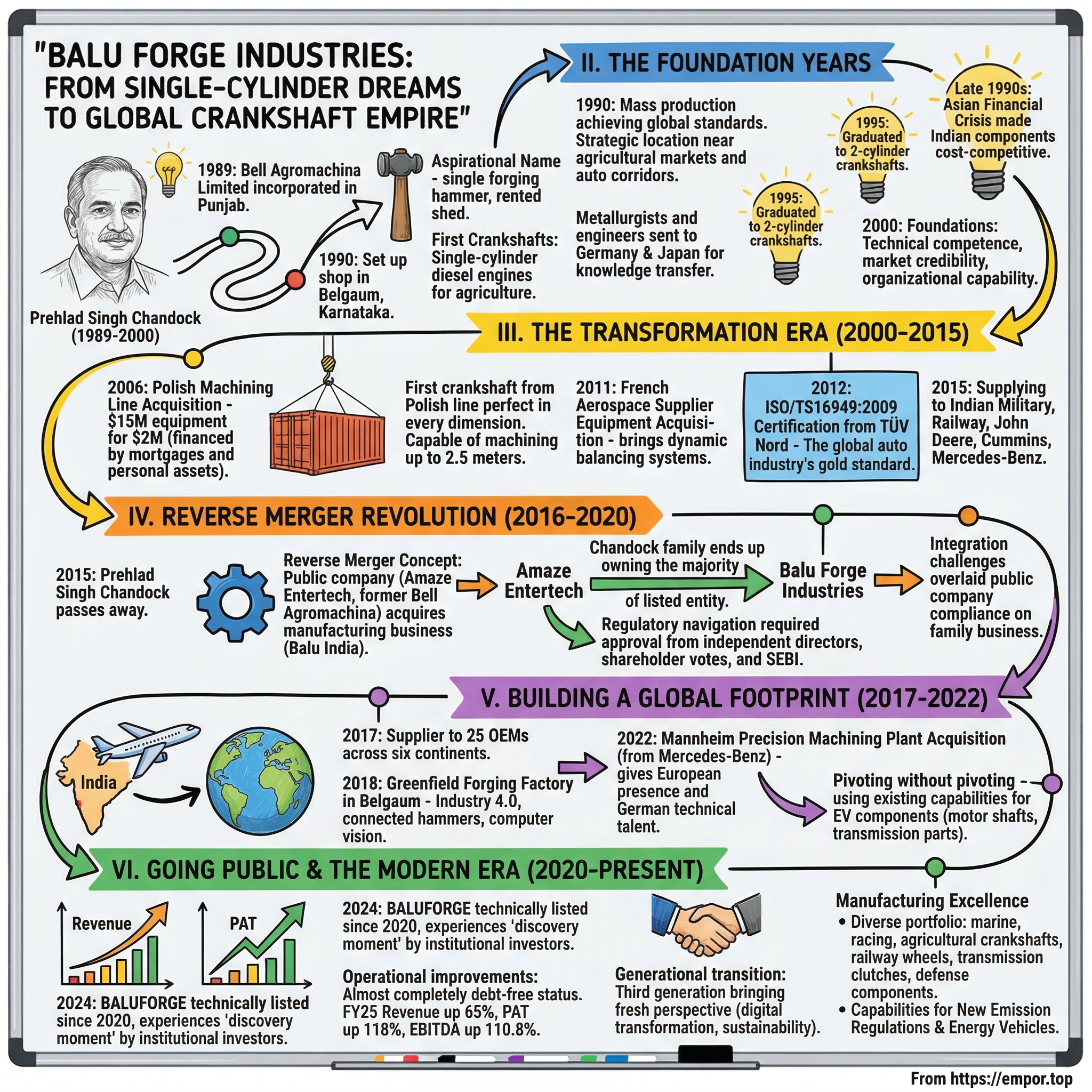
That distinction — heat and violence versus patience and metrology — is the central narrative of Balu Forge Industries. The company began in 1989 as a 3,000-square-foot machining shop in Belgaum, Karnataka, doing job work on crankshafts for local customers.1 By August 2026, it was a listed enterprise carrying a market capitalisation of roughly ₹7,650 crore, supplying more than 25 global OEMs across over 80 countries, and telling investors it had been inducted into the NATO ammunition supply chain.21
The core puzzle is a compelling one. Heavy forging is historically one of the least attractive businesses in industrial manufacturing: capital-hungry, energy-intensive, cyclical, and populated by buyers — global truck and tractor OEMs — who negotiate for a living. Yet Balu Forge reported an EBITDA margin of 27.0% for the year ended March 2026, on revenue from operations of ₹1,107.4 crore.1 That is a margin structure closer to a specialty chemicals business than to a forge. The company's explanation is that it does not really sell forgings; it sells finished, machined, inspected components, and it acquired the machines that do the finishing at distressed prices from Poland, France, Germany, Ukraine and Romania.1
That answer is plausible, but incomplete — and the incompleteness is where this story earns its keep.
The financial and valuation snapshot. For FY26 (year ended March 31, 2026), revenue from operations rose 19.9% to ₹1,107.4 crore; EBITDA was ₹299.5 crore at a 27.0% margin; profit after tax was ₹258.9 crore, up 27.0%, at a 22.7% net margin.1 Return on capital employed was 21.7% and return on equity 19.6% — both respectable, but materially below the ~30% ROCE the company reported in FY24 and FY25.1 The shares traded around ₹631 at the end of August 2026, against a book value of roughly ₹131 per share and a trailing price-to-earnings ratio near 28.5x.2 The promoter group held 53.51% as of June 2026.2
Three numbers do not fit the growth story, and an honest reading has to start with them rather than bury them.
First, growth decelerated hard. FY25 revenue grew 65%; FY26 grew 19.9%; the March 2026 quarter's revenue actually fell 2.3% year on year and 15.3% sequentially, to ₹263.6 crore.1 Management attributed the quarter to geopolitical disruption in the Middle East affecting its India–UAE logistics.1 Whatever the cause, a company that had been compounding at 60% CAGR between FY21 and FY25 posted a down quarter.3
Second, the cash did not follow the profit. Net cash from operating activities in FY26 was ₹31.7 crore — against EBITDA of ₹299.5 crore and reported PAT of ₹258.9 crore.1 Working capital consumed ₹257.2 crore during the year.1 Investing outflows were ₹354.0 crore; financing inflows were ₹314.8 crore.1 In plain English: essentially the entire capital expenditure programme was funded by outside money, not by the business.
Third, the balance sheet stopped being quite so clean. Current borrowings rose from ₹19.9 crore to ₹116.0 crore over FY26.1 In January 2026, CRISIL Ratings revised its outlook on the company's ₹76 crore of bank facilities to 'Negative' from 'Stable', reaffirming the rating at CRISIL BBB+ — citing an elongating working capital cycle and packing-credit utilisation averaging around 99% over the six months to September 2025.4 In August 2026, the board approved raising up to USD 60 million through foreign currency convertible bonds and asked shareholders to lift the overall borrowing limit to ₹1,000 crore, with an extraordinary general meeting called for September 4, 2026.521
The roadmap for what follows traces how a Belgaum job shop learned to machine before it learned to forge, and why that sequence matters. It examines the reverse-merger route by which a dormant shell called Amaze Entertech became a listed precision engineering company in 2020, and what that structure did and did not require the promoters to disclose. It assesses the asset-arbitrage playbook — buying used European and Eastern European machinery at auction and recommissioning it in Karnataka — and asks whether that approach is a genuine moat or merely a cost trick. It tests defence and aerospace optionality against the company's own record of converting approvals into revenue. And throughout, it holds the "almost debt-free compounder" narrative against a capital structure that has been topped up, year after year, with warrants, preferential allotments, and now convertible bonds.
The forging hammer is loud. Follow the cash instead.
 Subscribe on LinkedIn
II. The Foundation & Machining Inflection (1989–2015)
Belgaum — Belagavi on modern maps — sits in the northwestern corner of Karnataka, on the Maharashtra border, about 500 kilometres from both Mumbai and Bengaluru. It is not a natural home for a global export business. It is, however, a genuine foundry-and-machine-shop cluster, seeded decades ago by the hydraulics and automotive ancillary trade, with one asset that matters enormously in metalworking: a deep bench of machinists who know how to run a lathe without needing a college degree to tell them how.
In 1989, Prehlad Singh Chandock set up a 3,000-square-foot machining plant there with a small team, working as a job-work vendor for crankshafts and an ancillary supplier to companies across India.1 The business was named Balu India and constituted as a sole proprietorship — a structure worth remembering, because it remained a proprietorship three decades later when it met the public markets.3
The first component came out of the factory in 1991, and the first export shipment left in 1995.1 Read those two dates together and the founding insight becomes clear: the company went looking for foreign customers within four years of making its first part, at a moment when India's post-liberalisation industrial base was still overwhelmingly domestic. Management's own retelling dates the deliberate export push to 1994 and describes it as the decision that unlocked everything that followed.1
Why would a small Karnataka machine shop chase overseas orders? Because of what it was making. A single- or two-cylinder crankshaft for a tractor or a stationary diesel engine is a low-volume, high-variety product. Global OEMs need them, but not in quantities that justify keeping a dedicated line running in Germany or Ohio. That is the structural gap Balu India filled — the middle ground where volumes are too small for an incumbent's economics and tolerances are too tight for a generic job shop.
Buying capability instead of building it
The inflection came in 2006, setting the template for everything since. Rather than commissioning new machinery, the company acquired and installed the Ursus manufacturing plant from Ursus, the Polish tractor maker.1 Four years later it repeated the strategy, acquiring and installing a Thyssenkrupp plant from L'Horme, France.1
It is worth being precise about what this strategy was and was not. Balu was not buying businesses, customer relationships, or order books. It was buying iron — grinders, lathes, heat-treatment furnaces, and presses — from European industrial estates that were being wound down, and shipping them to Karnataka. Management has described the approach candidly: acquiring used assets through auctions, private treaties, and liquidations worldwide, then relying on an in-house team to refurbish and re-commission them.1
The economics are seductive. A CNC grinding line that would cost tens of crores new can sometimes be acquired for scrap-adjacent prices from a liquidator needing the floor space cleared. For a company with the metallurgical and controls expertise to bring that line back to life — and the patience to spend two years doing so — the reward is a production asset at a fraction of its replacement cost, flattering both capital intensity and return on capital for as long as it runs.
The catch shows up in the accounts rather than the narrative. Because these assets came onto the books at acquisition cost less depreciation rather than replacement value, the reported asset base understates the productive capacity sitting on the shop floor. The company acknowledged as much: in 2018, valuation firm Mott MacDonald assessed its fixed assets at close to ₹300 crore, but when the business was transferred into the listed entity in August 2020, it went across at written-down value and was never revalued.1 Management's explanation is technically sound — Indian Accounting Standards permit historical cost, the Companies Act does not mandate revaluation, and the Income Tax Act would not allow depreciation on a written-up component anyway.1 But the consequence for an outside analyst is unavoidable: reported asset turnover and return on capital employed are flattered by an asset base carried below economic value, making comparisons to peers who bought new equipment at full price misleading. It is a measurement problem, and investors must evaluate headline return metrics with that adjustment in mind.
Certificates, and what they were worth
By 2011, the company reported a presence in over 80 countries.1 In 2012, it obtained ISO/TS 16949:2009 accreditation from TÜV NORD — the automotive quality management standard that functions as a credential for tier-one supply.1 In 2014, it hit an operational milestone it still cites: manufacturing 1,000 crankshafts in a single day.1 By 2017, it described itself as a supplier of choice to more than 25 OEMs across five continents.1
Here the story requires a reality check. Certification is not commercialisation, and the gap between them in this industry is measured in years rather than quarters. The company's own investor materials put the research-and-application phase at two to three months and product development at three to five months, but note that the customer lifecycle for a qualified part runs 15 to 20 years.1 That long tail is genuinely valuable once locked in. It is also a formidable barrier from the outside: an OEM that has qualified a crankshaft supplier has little incentive to reopen specifications for a decade.
Consequently, the 2012 certification and the 2017 "supplier of choice" claim mattered less as immediate revenue events than as option-creation milestones. The revenue arrived much later. Consolidated revenue stood at ₹327 crore in FY23 — thirty-four years after founding.2 The company's explosive growth occurred after that point. The 1989–2015 period demonstrates that this management team was patient, technically credible, and adept at acquiring physical capability cheaply. What it did not establish was an ability to convert that capability into cash at scale, because for twenty-six years it did not need to.
The event that transformed the scale of the business was not operational. It was a corporate restructuring — and it arrived through the back door of the stock exchange.
III. The Reverse Merger Mechanics & Listing History (2016–2021)
Somewhere in the corporate filings archive sits a company called Bell Agromachina Limited, incorporated in March 1989 and founded under the late Prehlad Singh Chandock.6 For most of its life it did very little of consequence. On November 16, 2016, it was renamed Amaze Entertech Limited, dealing in a diversified grab-bag of activities primarily in information technology and allied operations, on its own or through joint ventures.6
In other words: a listed shell. Same family, same founder, a share code, a compliance calendar, and not much else.
Meanwhile, the actual business — the machine shop, the Polish and French equipment, the 80-country customer list — sat inside M/s Balu India, a sole proprietary concern belonging to Jaspalsingh Chandock. Two halves of one family enterprise: one with a stock exchange listing and no operations, one with operations and no access to public capital.
The mechanics of the merge
Putting them together required a structure rather than an initial public offering. In consideration for the succession of the business, Jaspalsingh Chandock subscribed to 4,78,40,000 equity shares of the listed company on September 24, 2020, without cash consideration — leaving the proprietor owning the majority of shares and controlling the majority of votes in the combined entity.6 The listed vehicle was renamed Balu Forge Industries Limited on September 30, 2020.6 The formal Business Succession Agreement under which Amaze Entertech agreed to acquire the business of M/s Balu India was dated August 3, 2021.6 Rating agencies date the acquisition itself to August 2020.4
Strip away the paperwork and the transaction reads simply: the operating business was contributed into a listed shell in exchange for control of that shell. No public offering. No prospectus. No underwriter's due diligence. No price discovery from institutional investors. No use-of-proceeds document. The founder's family went from owning a proprietorship to controlling a listed company without selling a share to the public.
Historical falsification pass: governance and transaction structure
The thesis claim. The reverse merger was a disciplined, low-cost route to public markets for a genuine operating business that would otherwise have spent years and crores on an IPO — a shrewd use of a dormant family asset.
The disconfirming evidence. Three elements in the record cut against reading it purely as shrewdness.
The first is the disclosure asymmetry itself. A mainboard IPO in India forces a company through a Draft Red Herring Prospectus, restated financials for multiple prior years, merchant banker diligence, and regulatory review by SEBI. A business-succession transfer into an existing listed entity forces none of that. Investors buying Balu Forge in late 2020 and 2021 were underwriting a thirty-year operating history that had never passed through that filter. That is not evidence of wrongdoing; it is evidence of a materially thinner public record than a comparable IPO-listed peer would present.
The second is the asset-valuation question already flagged: assets moved across at written-down value in August 2020 with no revaluation.1 The company has answered this question repeatedly in investor materials, which indicates that the query persists.1 The answer is defensible. The recurrence of the question is itself a data point about how the market reads the structure.
The third is the operational pattern the structure established. Because the listing raised no primary capital, every subsequent rupee of external equity had to come from elsewhere — specifically through a near-continuous sequence of preferential allotments and convertible warrants, which is examined in Section V. ICRA noted an equity infusion of around ₹470 crore over the two fiscal years to March 2025.3 CRISIL observed that the group had raised equity for two consecutive fiscal years via a mix of equity share issuance and convertible warrant issuance to both promoter and non-promoter categories, largely to support capital expenditure and working capital.4 For a company whose narrative centers on low leverage, the mechanism maintaining that clean balance sheet is repeated share issuance.
The calibrated conclusion. The record does not reject the claim that the reverse merger was an efficient listing route — it plainly was efficient, and the underlying business was real. What the record does is narrow the claim. The structure achieved public access at low cost, but it did so by skipping the diligence event that normally establishes a baseline of verified disclosure, leaving the company permanently dependent on episodic equity issuance rather than a one-time public raise. The metric that tests this going forward is simple and observable: total share count. It stood at 12,06,21,900 shares — just over 12 crore shares — after the March 2026 warrant conversions, against equity share capital of ₹120.62 crore.23 Every future tranche of warrants and every bond conversion moves that number. Per-share compounding, not aggregate growth, is where the reverse-merger legacy shows up.
By 2020, the company had also completed a quieter but strategically significant step: it obtained ISO 14001:2015 and ISO 45001:2018 certifications and became an approved vendor to the Ordnance Factory Board, establishing a specialised manufacturing unit for the defence industry.1 Few paid attention at the time. Five years later, it would be the most quoted detail in the equity story.
But before defence, there was Germany.
IV. Global Expansion & Asset Arbitrage: The Mannheim Acquisition (2017–2023)
The Mercedes-Benz truck plant at Mannheim is one of the oldest continuously operating engine facilities in the world. It builds heavy-duty commercial vehicle powertrains, and it houses — housed — a precision machining unit outfitted with the kind of equipment that European engineering firms buy when cost is genuinely secondary to capability.
In January 2022, Balu Forge announced it had acquired that unit.7
Consider what the buyer was at that moment. Balu Forge's consolidated revenue in FY23 — the year after the announcement — was ₹327 crore.2 This was a company with the annual turnover of a mid-sized Indian auto ancillary, buying the machining line out of a Daimler truck plant.
What actually changed hands
The strategic content was specific and worth understanding in plain terms. The unit's headline asset was more than ten CBN wheel grinders, most from the German machine tool maker Junker.7 CBN — cubic boron nitride — is a superhard abrasive, second only to diamond. A CBN grinding wheel can take a hardened steel crankshaft journal to a mirror finish with a dimensional consistency that conventional abrasives cannot hold across a long production run. In crankshaft manufacturing, the grinding stage is what separates a part that goes into a Class 8 truck engine from a part that goes into a generator set. Balu Forge said the acquisition placed it among a handful of companies globally with that capability, and enabled it to produce crankshafts and other precision machined components for OEMs in the Class 7 and Class 8 truck and heavy-duty vehicle category.7
The equipment was not operated in Germany. It was installed in the company's machining facilities at Belgaum.7 That is the arbitrage: European precision hardware, Indian labour, overhead and power costs, serving European and American customers.
The Mannheim deal was one node in a longer sequence. The company also acquired what it describes as one of the largest forging equipment assets from Ukraine, and — most recently — one of the world's largest closed-die forging hammers, a 25-tonne unit from Romania, now being installed at the greenfield campus.1 In 2024 it added three fully automated forging lines built with GERB technology: 16-tonne and 10-tonne forging hydraulic hammers and an 8,000-tonne forging press.1 Alongside, it invested in 7-axis and 11-axis machining capability.1
The acquisition price of the Mannheim unit was not disclosed.7
Belgaum, and the shift from machining to forging
Underneath the equipment shopping was a strategic pivot most commentary misses. Balu Forge grew up as a machining company that outsourced its forging. Its own investor material states the position plainly: the outsourcing strategy is to be gradually replaced by in-house forging capabilities.1
That reverses the usual Indian forging-industry story. Most peers forged first and moved downstream into machining to capture margin. Balu did it backwards — it owned the high-value finishing step first, and is now integrating backwards into the commoditised, energy-hungry, capital-heavy step.
The vehicle is a greenfield campus at Hattargi, Hukkeri, whose foundation was laid in 2023.1 It spans 46 acres, with machining capacity of over 58,000 metric tonnes per annum and captive forging capacity of over 100,000 MTPA.1 Combined with the existing Kakti, Belgaum units — 22,000-plus MTPA of machining across two plots totalling seven acres — the platform is designed to reach over 80,000 MTPA of machining and over 150,000 MTPA of forging.1 A fourth unit, one acre in Ras Al Khaimah in the UAE, handles powertrain sub-assemblies at over 15,000 units per annum.1 Total Karnataka footprint: three units across 53 acres.1
Historical falsification pass: asset productivity and pricing power
The thesis claim. Distressed acquisition of European machinery creates a durable cost and precision advantage that domestic peers cannot replicate.
The disconfirming evidence. Start with the arithmetic of backward integration. Bringing forging in-house does not merely add capacity; it changes the cost structure in ways management has itself flagged. Because the company historically outsourced forging and did machining in-house, power and fuel costs were never fully reflective of an integrated operation — and management has said explicitly that as forging comes in-house, power and fuel expenses are expected to increase.1 That is a direct, sourced statement that a component of the current margin structure is a function of not owning the hot end. Any investor treating 27% EBITDA margins as structural has to sit that statement next to the claim.
Second, capital intensity has already jumped. ICRA put capex at around ₹800 crore between FY24 and the first half of FY26, with the outlay projected to stay at ₹200–300 crore per annum over the near term.3 Property, plant and equipment on the balance sheet rose from ₹146.8 crore at March 2025 to ₹487.9 crore at March 2026, with a further ₹277.3 crore still sitting in capital work-in-progress.1 Management has guided that gross block will reach ₹750–800 crore by FY27.1 Whatever else "asset-light arbitrage" means, it does not mean this any more.
Third — and this is the part the bull case tends to skip — depreciation has not kept pace. FY26 depreciation and amortisation was ₹10.0 crore against PP&E of ₹487.9 crore.1 Even allowing for assets commissioned late in the year, that is a very low charge relative to the asset base, and it is a consequence of the same historical-cost accounting discussed earlier. As newly acquired capacity is fully commissioned, depreciation should rise materially, and reported net margins face a mechanical headwind that has nothing to do with demand.
Fourth, on pricing power: management's stated approach to input costs is to pass them on. The Chairman's FY26 message said the company will pass on any material increase in input costs to customers.1 CRISIL frames the same dynamic less comfortably — the ability of players in this segment to pass on input cost increases or retain the benefit of lower input costs is constrained by intense competition, and while BFIL is able to pass on price increases, a lag can hit profitability.4 Pass-through works both ways. It protects the downside and caps the upside; it is not evidence of pricing power.
The calibrated conclusion. The claim of an unassailable moat from distressed machinery does not survive. What survives is a narrower and still meaningful claim: Balu Forge has demonstrated a repeatable, three-decade-long capability in sourcing, refurbishing and commissioning used precision equipment, and that capability has let it access a capital base cheaply. That is a real cost advantage in acquisition of capacity. It is not a moat in the sense of protecting price realisation against a customer who can dual-source. The metrics that would confirm or falsify the revised claim are fixed-asset turnover as the ₹750–800 crore gross block comes online, and the EBITDA margin trajectory once in-house forging carries its own power bill.
The equipment arrived. The question of who was steering it — and how they were paying for it — became the more important story.
V. Current Management, Capital Allocation & Promoter Governance (2024–Present)
The Chandock family runs Balu Forge through a three-seat board structure, operating as a traditional family enterprise with second- and third-generation leadership sharing key operational responsibilities.
Jaspalsingh Chandock, son of the founder, serves as Chairman and Managing Director, overseeing business operations.3 He is the proprietor who transferred M/s Balu India into the listed vehicle and continues to sign earnings releases.1 His public communication style is notably restrained for a company growing at this pace; his message in the FY26 annual report offered a concise summary of financial metrics, acknowledged the Middle East logistics disruption, and outlined strategic goals for defence and aerospace, while withholding explicit forward revenue guidance.1 Read charitably, that approach reflects operational discipline. Read sceptically, it leaves external observers with few clear benchmarks against which to evaluate management performance.
Trimaan Chandock and Jaikaran Chandock, his sons, serve as Executive Directors.3 Jaikaran has taken the more public role in industrial media, framing the company's trajectory around India's expanding role in global precision component supply chains.25 Rating agencies summarize the corporate structure plainly as an enterprise run by second and third generations of the promoter family.3
Management has also asserted that the company underwent a structural professionalisation following its 2020 listing, transitioning from a family-led operation to a decentralised organization supported by industry veterans recruited from established peers.1 That claim is plausible; a dedicated 75-person research and development team is rarely maintained by a traditional jobbing shop.1 However, because public filings omit the names and prior affiliations of these senior hires, the assertion remains unverified by third parties. Investors must evaluate it as an untested assertion rather than an established fact.
The capital allocation record
In this segment of the story, corporate narrative and accounting reality diverge. This divergence represents the defining governance question surrounding the business.
In official investor Q&A documents, management maintains that all expansion initiatives follow a low-leverage framework. Funding is described as coming primarily through internal accruals, preferential share issuances, and warrants, supplemented by selective equity raises to support growth while keeping debt to a minimum.1
The actual mechanics tell a more nuanced story. In July 2024, the board approved issuing up to 93,00,000 fully convertible warrants of ₹10 each at ₹360 per warrant on a preferential basis, subject to shareholder approval at an extraordinary general meeting on August 9, 2024; the issue allocated 63,00,000 warrants to non-promoter public investors and 30,00,000 to the promoter group, alongside 45,00,000 equity shares at ₹350 to non-promoters.1226
Subsequent conversions occurred in tranches. On March 6, 2026, the company allotted 20,60,000 equity shares at ₹360 upon warrant conversion, raising ₹55.62 crore; promoter group member Jaikaran Chandock converted warrants into 15,00,000 shares for ₹40.5 crore.13 Additional tranches of 16,30,000 and 17,10,000 shares followed under the same program.1323 These issuances nudged promoter group holding from 53.76% to 54.34%, bringing total paid-up capital to ₹120.62 crore.23 By the June 2026 quarter, promoter ownership stood at 53.51%.2
In August 2026, capital raising escalated. The board approved issuing up to USD 60 million in foreign currency convertible bonds via private placement to fund long-term working capital, capital expenditure, and general corporate needs. Simultaneously, management sought shareholder approval at a September 4, 2026 EGM to raise total borrowing limits to ₹1,000 crore and create corresponding security interests.521
Historical falsification pass: capital discipline versus dilution reality
The thesis claim. Balu Forge operates as a nearly debt-free compounder that finances its own growth.
The disconfirming evidence. The cash flow statement for FY26 contradicts the self-funding narrative. Operating cash flow before tax was ₹45.5 crore, yielding net operating cash flow of ₹31.7 crore — down sharply from ₹148.0 crore in FY25.1 Meanwhile, investing outflows reached ₹354.0 crore, while financing activities provided ₹314.8 crore.1 In short, FY26 expansion was not funded by cash generated from operations; it was supported by external capital infusions paired with a strong income statement.
The balance sheet also reflected shifting dynamics. Current borrowings climbed from ₹19.9 crore to ₹116.0 crore over the fiscal year, while trade payables fell from ₹118.0 crore to ₹63.1 crore — a combination that required paying suppliers faster while accumulating short-term debt.1 Finance costs increased 50.2% to ₹16.5 crore.1 Requesting shareholder authorization for a ₹1,000 crore borrowing limit when total debt stood at ₹126.7 crore as of March 2026 is not a routine administrative motion; it creates capacity for a fundamentally different balance sheet.15
Earnings quality introduces another layer of nuance. In the March 2026 quarter, EBITDA declined 20.1% year-on-year to ₹59.9 crore, yet profit after tax rose 4.9% to ₹65.7 crore.1 The divergence was driven by non-operating income of ₹23.5 crore — a 463.4% year-on-year surge — and a tax provision of ₹9.7 crore on pre-tax profit of ₹75.4 crore, reflecting an effective tax rate near 13%.1 For the full year, tax expenses totaled ₹47.2 crore on pre-tax profit of ₹306.0 crore, or approximately 15.4%.1 While low tax rates are consistent with export incentives and international operations — overseas subsidiaries contributed ₹126.80 crore in revenue and ₹28.90 crore in net profit during the June 2026 quarter alone — investors extrapolating a 22.7% net margin should recognize that operating cash flow, non-operating income, and non-repeating tax benefits materially influence reported bottom-line results.5
The regulatory and related-party overhang
Two items in statutory filings require careful monitoring by prospective investors.
First, between January 7 and January 13, 2026, the Income Tax Department conducted search operations across key offices and manufacturing facilities. The equity market reacted sharply: the stock dropped to a 20% lower circuit, hitting ₹465.30 on the NSE — its lowest level since March 2025 — and completing an eight-session slide of roughly 27%.10 On January 13, the company announced that the search had concluded without the seizure of incriminating documents, and that promoters and executives had fully cooperated, prompting a double-digit rebound in share price.11 ICRA noted that operational activities continued without disruption.3 However, formal block assessment proceedings remain ongoing. Statutory auditors M.B. Agrawal & Co. included an emphasis of matter regarding these proceedings in their limited review report for the June 2026 quarter, noting that the ultimate financial liability remains undetermined.5
Second, related-party transactions and compliance timelines warrant scrutiny. Under an agreement dated May 26, 2026, the company agreed to purchase a property from Managing Director Jaspalsingh Chandock for ₹22.50 crore, disbursing ₹9.58 crore as an advance by June 30, 2026.5 While related-party real estate acquisitions are common in family-managed businesses, public filings omit independent third-party valuation reports to verify the agreed price. In the same filing, auditors noted ₹5.24 crore in export receivables that exceeded RBI-prescribed realization timelines.5
A final governance detail involves the shareholder roster. As of June 2026, 3.86% of the company's total equity was listed under the "Government" classification.2 Third-party records show these shares are held by the Enforcement Directorate, Raipur, making the agency one of the largest non-promoter shareholders.22 Management explained in investor disclosures that this holding resulted from secondary market enforcement actions involving independent shareholders, without company involvement, oversight, or association.1 Although the explanation is straightforward and no allegations have been brought against Balu Forge itself, the line item remains an unusual feature on the share register that institutional investors will track closely.
The calibrated conclusion. The assertion that Balu Forge is nearly debt-free holds true on historical balance sheet metrics: gearing was 0.1 times at March 2025, with total debt to EBITDA at 0.4 times.3 However, the broader narrative of self-funded expansion is disproved by the cash flow realities of FY26. Instead, management has consistently chosen equity dilution over long-term leverage, shifting the cost of capital expenditure onto existing shareholders. The proposed FCCB issuance represents a hybrid step, introducing potential debt today and equity dilution tomorrow. Key catalysts testing this strategy include the outcome of the September 4, 2026 EGM, the conversion terms of the bond offering, and whether FY27 operating cash flows realign with reported net profits.
VI. Core Business Mechanics, Industry Structure & Peer Benchmarking
To understand why the margin gap between forging and machining is so wide, picture two workshops.
In the first, a steel billet is heated to around 1,200°C and struck by a hammer or squeezed by a press into roughly the shape of a crankshaft. It is hot, loud, and enormously energy-intensive. The output is a forging — recognisably crankshaft-shaped, structurally sound, and useless. It cannot go into an engine.
In the second workshop, that forging is turned, milled, drilled, heat-treated, ground and inspected until every bearing journal and oil hole is where the engine designer specified, to tolerances often measured in single-digit microns. This stage requires CNC machines, CBN grinders, metrology equipment, and — critically — a qualification relationship with the OEM, because a crankshaft that fails in service destroys an engine.
The first workshop sells a commodity priced off steel. The second sells a qualified part priced off the cost of failure. That is the entire margin structure of this industry, and Balu Forge's central strategic choice was to live in the second workshop from the beginning.
The end-market mix, and where it is going
For most of the company's history, agriculture was the anchor. Tractors and harvesters accounted for roughly 45% of revenue in FY24, falling to about 40% in FY25 and around 36% in FY26 — not because agriculture shrank, but because everything else grew faster.1 Over the same span, defence, aerospace and railways rose from roughly 15% of revenue to about 20%, with commercial vehicles, oil and gas, heavy engineering and power generation filling in the rest.1
The order book tells a more dramatic story than the revenue statement. As of the FY26 results, defence, aerospace and railways accounted for approximately 50% of the total order book, with commercial vehicles at about 19% and the balance spread across agriculture, oil and gas, heavy engineering and power generation.18 That is a large gap between what the company is shipping and what it has booked — a gap that is either the leading indicator of a genuine mix transformation or a reminder that order books convert on the customer's schedule, not the supplier's.
Geographically the concentration is stark. ICRA records that the company derives more than 90% of revenues from export markets, direct and deemed, with marketing presence in over 80 countries.3 Customer concentration is genuinely low: the top five customers contributed around 37% of standalone revenue in FY25 and 35% in the first half of FY26.3 For a components supplier, that is a real structural strength — no single OEM can dictate terms by threatening the whole business.
One consequence of the export model that flatters the cost line: most transactions are executed on an ex-works basis, with customers arranging pickup at the factory gate, which is why freight and distribution expenses run below peers operating on delivered-duty or CIF terms.1 That is a genuine explanation for a cost-structure difference — and a useful reminder that margin comparisons across this peer set require reading the shipping terms.
The peer set, in proportion
Set Balu Forge against the Indian forging complex at FY26 scale and the picture is clarifying.
Bharat Forge reported FY26 consolidated revenue of ₹16,811.65 crore, up 11.2%, with consolidated PAT of ₹1,089.40 crore, up 19.3%.17 It is roughly fifteen times Balu Forge's size, with a defence business, a global manufacturing footprint, and relationships that go back decades. When a mega-tender comes up, Bharat Forge is the incumbent Balu Forge is trying to get onto the second-source list behind.
Ramkrishna Forgings posted FY26 revenue of ₹4,238 crore, up 5%, and EBITDA of ₹642.70 crore — but PAT collapsed 78.5% to about ₹86.5 crore.18 That collapse is instructive for anyone assuming forging margins are durable: a company nearly four times Balu Forge's revenue, with strong domestic automotive and railway positions, saw its bottom line evaporate in a single year.
Craftsman Automation reported FY26 consolidated revenue of ₹8,069 crore with net profit of ₹384 crore, spread across aluminium products, powertrain, and industrial and engineering segments.19 It is the closest analogue to Balu Forge's precision machining positioning, at seven times the scale and materially lower margins.
Balu Forge, at ₹1,107 crore, is a fraction of all three — and yet reports the highest EBITDA margin of the group. That combination should provoke curiosity rather than admiration. Part of the explanation is genuine: a niche of large-format, low-to-medium-volume heavy crankshafts, ranging from 1 kg to over 1,000 kg and up to three metres in length, where the giants have little interest in re-tooling.1 Part is structural: ex-works shipping terms, an asset base carried at historical cost, low depreciation, low effective tax, and a workforce model in which a sizeable portion of workers are engaged on contract with related costs partly classified under manufacturing expenses.1 None of those factors is illegitimate. All of them mean the margin gap versus peers is narrower on a like-for-like basis than the headline suggests.
Where Balu wins, and where it loses
Wins: Configuration flexibility. Precision machining lines the company describes as fungible across products, supporting a broad portfolio.1 Approvals across more than 180 products in defence, aerospace and railways, which is a qualification base competitors would need years to replicate.1 And a genuine cost position in acquiring capacity.
Loses: Scale, in any tender where volume commitments matter. Bargaining position, because global OEMs multi-source by policy — no tier-one buyer allocates dominant share of a safety-critical component to a single mid-cap supplier. And working capital, because winning export business at this scale has required extending credit terms that the rating agencies flag as the company's defining weakness.
The frameworks, applied honestly
Porter's Five Forces. Buyer power: high. Global OEMs are concentrated, sophisticated, and structurally committed to dual sourcing. Supplier power: moderate. Steel and alloys are commodities; the pass-through arrangement mutes but does not eliminate exposure.3 Threat of new entrants: moderate-to-low. The capital and qualification barriers are genuine — you cannot enter this business with a term loan and a website. Substitutes: this is the live risk. ICRA states it directly: because the major portion of revenue derives from a single product, crankshafts, supplied heavily into tractors and commercial vehicles, the business is exposed to the risk of engine components becoming obsolete as electrification advances — mitigated, for now, by the slower electrification pace in those specific segments.3 Rivalry: high, among Indian forged component exporters competing for the same second-source slots.
Hamilton Helmer's Seven Powers. Process Power is the strongest candidate — three decades of accumulated know-how in refurbishing acquired equipment, heat treatment and precision grinding, embodied in a dedicated in-house department for re-commissioning used assets.1 That is hard to copy quickly because it is tacit and organisational. Scale Economies are emerging but not yet earned; at ₹1,107 crore against peers at ₹4,000–17,000 crore, Balu Forge is the sub-scale player. Switching Costs exist at the part level — requalifying a crankshaft is expensive — but are weakened at the relationship level by multi-sourcing policy. Cornered Resource, Branding, Counter-Positioning, Network Economies: not present on the current evidence.
The honest summary is that Balu Forge has one real power and one emerging one, in an industry where the buyer holds the pen. That is a defensible position, not an impregnable one — and it makes the diversification into defence and aerospace less a growth option than a structural necessity.
VII. Hidden & Optionality Bets: Defense, Aerospace & NEVs
In February 2026, defence-industry reporting indicated that Balu Forge was inducted into the NATO supply chain for 155mm and 152mm shells at a reported $315 per unit.14 For a company that spent thirty-five years manufacturing crankshafts for tractors, this represented a fundamentally different category of business.
The foundation was laid quietly. Approved vendor status with the Ordnance Factory Board dated back to 2020.1 Across 2024 and 2025, the company installed a fully automated empty shell and mortar production line with an annual capacity of 360,000 shells.1 The operational link between crankshafts and artillery is closer than it appears: an artillery shell casing is a forged steel body machined to tight tolerances and heat-treated for structural integrity. Mechanically, it demands capabilities similar to those already on Balu's shop floor.
What has actually been signed
Commercial traction followed in 2026. The company entered a legally binding five-year memorandum of understanding with a NATO-affiliated entity to supply empty large-calibre ammunition shells, primarily 155mm casings, with reported monthly deliveries of 30,000 units of 155mm M107 shells and 10,000 units of 152mm shells ramping in phases from April 2026.14 In June 2026, it secured a domestic order for 30,000 units of 152mm artillery shells from a leading Indian energetics player, with volumes projected to scale beyond 100,000 shells including additional variants.24 On August 17, 2026, it announced successful commercialisation and an initial purchase order for 155mm Extended Range Full Bore – Base Bleed and Boat Tail shells, a more technically demanding product than standard rounds.15
Alongside shell machining, the company signaled ambitions in forward integration. The subsidiary formerly named Naya Energy Works Private Limited was renamed Quantum Energetics Private Limited, and its object clause was expanded to include the manufacture of high-energy explosive compounds — TNT, HMX, RDX, detonating compounds, and related energetics — subject to the receipt of necessary statutory approvals and licences.1 That final qualifier is essential: as of FY26 disclosures, this expansion remains an object clause and an intention, not an operating business.
In aerospace, progress remains early. The primary milestone was a maiden order from Alpha Aircraft Systems Inc. of the United States for precision-engineered components.1 Management noted that the company is pursuing key global certifications to qualify as an aerospace component supplier to OEMs and tier-one companies worldwide, while holding vendor approval from one customer in India.1 The contract value was not disclosed.
On new energy vehicles, the tangible footprint is minimal. Rating agency ICRA noted that the company may need to invest materially to develop products for electric vehicles, with long-term prospects tied to customers' compliance with tightening emissions requirements.3 Meanwhile, Balu Forge's own disclosures highlight advanced materials such as aluminium and titanium for aerospace assemblies rather than a concrete EV component roadmap.1 Treating electric mobility as an active revenue vector overstates the present evidence.
Historical falsification pass: the certification-to-revenue gap
The thesis claim. Defence, aerospace, and energetics provide transformational optionality that justifies re-rating the entire enterprise.
The disconfirming evidence. The company's execution history offers the clearest baseline, and it points to a slow conversion velocity. Vendor approval from the Ordnance Factory Board arrived in 2020.1 Six years later, defence, aerospace, and railways combined — including the legacy railway wheel and axle business — generated roughly 20% of FY26 revenue, up from approximately 15% two years earlier.1 A five-percentage-point expansion in revenue mix over two years demonstrates real progress, but it falls short of a rapid business transformation.
Second, customer concentration and contracting terms carry distinct risks. Defence procurement is dominated by state entities operating under strict indigenisation guidelines, periodic re-tendering, specification adjustments, and multi-year testing cycles. A five-year MoU with a NATO-affiliated entity provides strategic visibility, but an MoU remains an intent framework rather than a guaranteed purchase contract; the reported monthly volumes represent target schedules rather than disclosed minimum off-take commitments. The single domestic order announced in June 2026 covered 30,000 units.24 Set against FY26 revenue of ₹1,107.4 crore, total announced defence orders are meaningful but not yet company-transforming.
Third, physical capacity sets a clear upper boundary. At an annual capacity of 360,000 shells and a reference price of $315 per unit, a fully utilized shell line implies potential annual revenue of roughly $113 million — a substantial figure relative to current scale, but one contingent on 100% utilization, stable pricing, and unproven delivery execution over full fiscal cycles.114 Furthermore, management stated that additional capacity expansion will be funded through internal accruals — an assertion that conflicts with FY26 net operating cash flow of ₹31.7 crore.1
Fourth, the energetics business faces steep regulatory barriers. Producing military-grade explosives such as RDX and HMX in India requires stringent defence ministry clearances and industrial explosives licensing. Management properly framed this initiative as "subject to the receipt of necessary statutory approvals and licenses."1 Because no licenses have been granted or announced, sound financial analysis requires assigning zero valuation weight to the energetics segment.
The calibrated conclusion. The optionality thesis survives, but only in a disciplined form. The evidence confirms that Balu Forge successfully converted a 2020 defence qualification into commercial production and initial shell orders within five years — a timeline consistent with standard defense sector lead times. Additionally, an order book where defence, aerospace, and railways represent approximately 50% serves as a credible leading indicator. However, the evidence does not support treating defence and aerospace as an immediate earnings catalyst, nor does it justify valuing unlicenced energetics plans. The single KPI that will resolve this debate is the quarterly disclosure of realized revenue from defence, aerospace, and railways as a standalone reported segment. Until those receipts materialize in the income statement, defence optionality remains a promising booking rather than a proven business.
VIII. Skeptical Investor Stress Test: Working Capital & Risk Radar
Here is the single most uncomfortable comparison in Balu Forge's disclosures, and it is entirely internal.
The company's own investor presentation for fiscal 2026 reports trade receivable days of 108 for FY25 and 124 for FY26.1 Yet ICRA's rating rationale lists receivables at 158 days as of March 2025 and 141 days as of September 2025.3 CRISIL's evaluation places debtor levels at 158 days as of March 31, 2025, compared to 181 days a year earlier.4 In short, two independent rating agencies, reviewing the audited consolidated accounts, calculated FY25 receivables roughly fifty days higher than the company's investor presentation indicated.
Different accounting conventions can shift day counts — gross versus net figures, total income versus operating revenue, or year-end versus average balances. But a fifty-day gap exceeds simple rounding variations. Investors relying on the presentation's working capital summary face a far more optimistic picture than credit analysts observe.
What the credit analysts actually said
CRISIL's January 2026 rating action revised the company's outlook to 'Negative' from 'Stable' while reaffirming long-term ratings at CRISIL BBB+ and short-term ratings at CRISIL A2 on ₹76 crore of bank facilities.4 The agency cited a moderating credit risk profile caused by an elongating working capital cycle alongside rising operational scale.
The specific metrics warrant close inspection. As of March 31, 2025, approximately 39% of overall debtors had been outstanding for more than six months.4 Gross current assets net of cash stood at roughly 212 days in March 2025, down from 297 days a year earlier.4 Packing credit facility utilization averaged nearly 99% over the six months ending September 2025.4 Operating an export credit line at virtual capacity for six months signals tight liquidity, leaving growth constrained by available bank limits. ICRA corroborated this pattern, reporting average working capital utilization of 99% for the twelve months ended September 2025, which moderated to 68% in November 2025 only after sanctioned limits were expanded to ₹166 crore from ₹91 crore.3 At November 30, 2025, the undrawn buffer stood at ₹53 crore,3 while cash and liquid investments totaled ₹37.8 crore as of September 30, 2025.3
CRISIL established an explicit trigger for a potential rating downgrade: a sustained stretch in working capital, particularly receivables remaining above 130 days.4 While Balu Forge's presentation reported FY26 receivable days at 124, independent data providers calculated the figure at 140 days.12 Under either the agency's baseline or third-party metrics, the working capital stretch touches or exceeds CRISIL's threshold.
A further detail in CRISIL's January 12, 2026 update carries governance implications. The agency noted it was awaiting adequate information from management to complete its review, citing information availability risk as a key credit consideration.4 A public notice that a rating agency lacks required disclosures stands as an important governance indicator. It sits alongside ICRA's first-time assignment of an [ICRA]A-(Stable)/[ICRA]A2+ rating on ₹25 crore of bank limits on February 3, 2026.3 Differing rating levels and a negative outlook across two agencies highlight persistent credit evaluation uncertainty.
Why the cash is trapped
The structural driver of this cash lockup is straightforward. ICRA notes that Balu Forge extends credit terms exceeding 180 days to legacy customers, with export sales carrying longer settlement windows than domestic business.3 CRISIL adds that standard terms range from 140 to 180 days for existing clients, while extended credit is offered to secure new customers.4 Consequently, working capital intensity reached 41.0% in FY25 and 44.3% in the first half of FY26.3 The company also maintains 60 to 70 days of inventory to support its diversified product portfolio.4
The operational sequence creates heavy capital absorption: Balu Forge purchases steel, holds inventory for roughly two months during processing, ships finished components, and waits four to six months for customer payment — all while trade payables contracted to ₹63.1 crore in FY26.1 As a result, each incremental rupee of revenue ties up capital, making expansion financially demanding.
The March 2026 quarter illustrated this challenge in real time. Management noted that Middle East supply chain disruptions caused sequential volume declines and temporary increases in inventory and trade receivables, keeping working capital elevated while framing the impact as short-term and noting positive full-year operating cash flow.1 The company did report positive net operating cash flow of ₹31.7 crore for FY26.1 However, that cash generation represented just 11% of EBITDA, during a fiscal year in which capital allocation to investing activities reached ₹354 crore.1
Management's engagement with the question
Rather than hosting traditional live analyst Q&A conference calls, Balu Forge publishes a written investor question-and-answer document alongside each earnings release to address recurring inquiries.1 This format grants management complete control over topic selection and framing without live follow-up questions, though it also reflects awareness of key investor concerns.
In the FY26 release, management addressed specific operational topics: freight costs relative to peers, above-average asset turnover, unadjusted fixed asset values following the reverse merger, classification of power and fuel expenses, presentation of contract labor costs, and updates on the Income Tax search and Enforcement Directorate share transfer.1 Addressing these accounting topics indicates ongoing market scrutiny regarding reporting definitions.
However, the FY26 written Q&A omitted direct discussion of the gap between internal receivable metrics and rating agency figures, as well as the sharp decline in operating cash conversion relative to reported EBITDA. Management subsequently scheduled an analyst meeting for August 20, 2026, following first-quarter FY27 results,27 providing an opportunity for further detail on cash conversion trends.
The material risk radar
Cyclicality of end markets. Agriculture, commercial vehicles, and off-highway equipment follow cyclical demand cycles. Ramkrishna Forgings' 78% net profit decline in FY26 illustrates the earnings volatility typical of downcycles in the forging sector.18
Working capital and dilution. Capital absorption creates continuous financing requirements. The proposed foreign currency convertible bond structure introduces currency risk alongside potential equity dilution, converting dollar-denominated debt into equity at predefined conversion prices, even with export revenues serving as a natural currency hedge.521
Structural internal combustion engine substitution. ICRA highlights product concentration in crankshafts as a primary vulnerability, where electric vehicle transition poses long-term demand risk, partially mitigated by slower electrification in commercial and agricultural fleets.3 Diversification into artillery shells, turbine components, and railway axles serves as a strategic hedge that remains under development.
Geopolitical and logistics friction. Disruptions in the Middle East during the March 2026 quarter demonstrated operational vulnerability in export logistics.1 With over 90% of revenue derived from international markets across 80 countries, transit delays and port bottlenecks create ongoing inventory and cash flow risks, even when shipping under ex-works contracts.
Regulatory assessment. Statutory auditors flagged ongoing Income Tax block assessment proceedings as an area with undetermined financial liabilities.5
Shareholder register concentration. Institutional small-cap investor Ashish Kacholia held 2.14% of equity in June 2024 and 1.88% in September 2025.16 Concentrated holdings by prominent investors provide market visibility, but can also introduce secondary market liquidity risks during position adjustments.
IX. Playbook: Business & Investing Lessons
Every business story yields transferable strategic insights. Balu Forge offers four key operational lessons, each accompanied by an essential caveat.
1. Value-addition arbitrage provides a structural margin advantage. Focusing on high-precision machining rather than primary forging explains why a ₹1,107 crore company generates higher EBITDA margins than peers four to fifteen times its size.1171819 The broader lesson for industrial manufacturing is to control the specific production stage where qualification is slow and part failure is costly. Commodity inputs pass through the value chain, whereas qualified finished components command pricing spreads. The caveat is that Balu Forge is integrating backward into forging, and management has cautioned investors that power and fuel expenses will rise as a result.1 Manufacturers moving upstream into primary processing often dilute the margin profile that made them compelling. Whether Balu Forge proves to be an exception remains an open question.
2. Distressed asset acquisition is an operational capability, not a financial shortcut. While any firm can bid at a liquidation auction, few organizations can dismantle a specialized European grinding line, transport it overseas, and re-commission it to micron-level tolerances. Balu Forge established a dedicated in-house engineering team for this purpose over three decades, beginning with its Polish plant acquisition in 2006.1 That technical refurbishment capability represents the true competitive asset rather than any single piece of machinery. The caveat is that management is shifting its capital deployment strategy toward purchasing new equipment alongside used machinery.1 Acquiring new equipment at market rates requires full capital outlay, contributing to the decline in return on capital employed from roughly 30% to 21.7% between FY25 and FY26.1 As operational scale expands, asset cost arbitrage naturally compresses.
3. Choosing equity dilution over debt is a cost trade-off, not a free lunch. A company funding capital expenditure through warrants and preferential share allotments can maintain low balance sheet leverage indefinitely and describe itself as nearly debt-free. However, financial costs are simply transferred from interest expense on the income statement to share count expansion on the balance sheet. Investors evaluating debt-free compounders must measure operating performance on a per-share basis. While Balu Forge's aggregate net profit rose 27% in FY26, total share count grew concurrently through successive warrant conversions.113 The central caveat involves the proposed foreign currency convertible bond offering; if approved at the September 4, 2026 shareholder meeting, it introduces debt obligations alongside potential future equity dilution.5
4. Export niche specialization enables mid-sized suppliers to avoid crowded domestic markets—at a working capital cost. By targeting large-format, low-to-medium-volume crankshafts across 80 international markets, Balu Forge avoided competing directly for domestic OEM volume against scaled incumbents such as Bharat Forge.3 While strategically sound, securing export customers required offering extended credit terms of 140 to 180 days, extending beyond 180 days for legacy accounts.43 This dynamic illustrates a recurring structural pattern: mid-sized suppliers winning contracts from global OEMs frequently fund those relationships through tied-up working capital. Evaluating export-led expansion requires analyzing cash conversion performance alongside headline revenue growth.
A fifth lesson carries important governance implications: when a company repeatedly addresses the same accounting disclosures across consecutive earnings reports, the persistence of the questions is the primary signal. In the fiscal 2026 investor release, six of eight management responses addressed whether reported metrics accurately reflected underlying operational reality.1 Although management provided detailed answers to each inquiry, the recurring nature of the questions highlights where market uncertainty remains concentrated.
X. Analysis & Bear vs. Bull Case
The bull case
The bull case does not require heroic assumptions, which makes it compelling to examine.
It begins with demonstrated execution. Consolidated revenue compounded at roughly 60% annually between FY21 and FY25, taking the business from a sub-₹200 crore base to ₹923.6 crore, before reaching ₹1,107.4 crore in FY26.31 Over the same multi-year stretch, profit after tax expanded from ₹93.5 crore in FY24 to ₹203.9 crore in FY25, and reached ₹258.9 crore in FY26.31 This reflects four consecutive years of substantial operational delivery.
The margin structure has also proven resilient during the scale-up. ICRA calculated operating profit margins of 21.4% in FY24, 26.7% in FY25, and 29.1% in the first half of FY26, alongside the company's full-year report of 27.0% for FY26.31 Margin expansion during rapid volume growth is uncommon in industrial manufacturing, indicating that the shift toward higher-value finishing is genuine rather than a temporary pricing anomaly.
Customer and market diversification has widened concurrently. Standalone top-five customer concentration remains low at 35% to 37%, supported by a marketing footprint across more than 80 countries and end markets spanning agriculture, commercial vehicles, marine, locomotive, oil and gas, power generation, and defence.31 Few Indian mid-cap component manufacturers match that customer spread.
Physical expansion provides a second leg to the optimistic case. The 46-acre integrated campus at Hattargi targets over 80,000 metric tonnes per annum of machining capacity and over 150,000 metric tonnes per annum of captive forging, with gross block projected to reach ₹750 to ₹800 crore by FY27.1 If factory utilisation matches historic levels, productive potential will stand at a multiple of FY26 revenue.
Finally, the pivot into high-spec applications has generated tangible operational milestones rather than unfulfilled announcements: an automated 360,000-shell production line, NATO supply chain induction, a five-year memorandum of understanding, an initial domestic 152mm shell contract, commercialisation of extended-range shell variants, and a maiden aerospace order from the United States.1142415 The June 2026 quarter marked a return to top-line acceleration, delivering revenue from operations of ₹300.7 crore—up 28.9% year-on-year—with EBITDA of ₹84.8 crore and net profit of ₹66.1 crore.520 A nuance remains within the quarterly numbers: while Q1 FY26 EBITDA of ₹72.3 crore on revenue of ₹233.2 crore implied an operating margin near 31%, the June 2026 quarter's 28.2% margin represents approximately 280 basis points of year-on-year margin contraction even as sales rebounded.95 Volume growth resumed, but mix-driven margin expansion paused.
The bear case
The bear case does not assume the operational foundation is flawed. It requires only that reported financial returns prove less durable than headline numbers suggest.
Cash conversion sits at the heart of the skeptical case. Generating net operating cash flow of ₹31.7 crore against EBITDA of ₹299.5 crore in FY26 represents an operating cash conversion rate of just 11%.1 Free cash flow remained deeply negative, with third-party estimates indicating a net outflow near ₹175 crore for the year.2 While expanding industrial enterprises frequently operate with negative free cash flow, long-term value creation depends on working capital eventually turning into cash. The concern is heightened by CRISIL's finding that 39% of trade receivables were over six months old as of March 2025—an aging profile that increases collection risk.4
Top-line deceleration forms the second pillar. Revenue growth moderated from 65% in FY25 to 19.9% in FY26, punctuated by a 2.3% year-on-year contraction in the March 2026 quarter.1 Writing in January 2026, rating agency CRISIL projected full-year revenue growth of 30% to 35%.4 The actual full-year outcome of 19.9% fell well short of that expectation.1 This gap between rating agency projections based on management guidance and actual performance highlights the need for caution when evaluating forward-looking statements.
Earnings quality represents a third concern. In the March 2026 quarter, net profit grew 4.9% despite a 20.1% decline in operating EBITDA, cushioned by a 463% surge in non-operating income and an effective tax rate near 13%.1 Furthermore, annual depreciation of ₹10.0 crore against property, plant, and equipment of ₹487.9 crore remains modest, but will inevitably increase as new capital expenditure is fully commissioned.1 Both factors temporarily enhance reported net margins relative to normalized operational earnings.
Ongoing equity dilution presents a fourth headwind. Capital allocation relies on continuous capital raises, including preferential warrant issuances at ₹360, a proposed USD 60 million foreign currency convertible bond placement, and a shareholder resolution seeking to raise borrowing limits to ₹1,000 crore.12135
Governance considerations add a fifth layer of scrutiny. These include ongoing Income Tax block assessment proceedings noted with an auditor's emphasis of matter, a ₹22.50 crore property acquisition from the Managing Director, ₹5.24 crore in export receivables exceeding RBI realization timelines, rating agency notices citing delayed disclosures, and roughly 3.86% of equity held by the Enforcement Directorate, Raipur.54221 While management has provided contextual explanations for each item, their cumulative presence increases the required due diligence relative to peers with more standard governance histories.
Finally, structural product concentration remains an overarching risk. Internal combustion engine crankshafts continue to supply the vast majority of revenue, and ICRA explicitly warns that these components face long-term obsolescence risk as fleet electrification progresses.3
Weighing it
The bull and bear cases are not symmetrical, and presenting them as an equal toss-up would obscure the underlying facts.
As of August 2026, the operational thesis remains largely intact. Revenue scale, gross margins, customer diversification, and hard-won OEM qualifications are supported by audited financials and independent credit evaluations. Conversely, the financial thesis faces meaningful constraints. Balu Forge is not currently self-funding—and has not been for two fiscal years. The primary mechanism maintaining a low-debt balance sheet has been recurring equity dilution, which represents a valid capital-raising choice but differs from an internally compounding enterprise. Finally, the optionality thesis sits at an intermediate stage: manufacturing infrastructure is operational and initial contracts have been booked, but realized revenue from defence and aerospace has yet to match the order book's 50% share.
Ultimately, the primary catalyst that will confirm or disconfirm this trajectory is not another order win announcement, but the cash flow statement.
The KPIs that matter
Three specific metrics will define the company's trajectory:
1. Trade receivable days—and the proportion of aging debtors beyond six months. Credit rating agencies highlight receivable duration as a key sensitivity, with CRISIL setting 130 days as an explicit downgrade threshold and 90 to 100 days as a benchmark for positive rating momentum.4 This metric determines whether revenue expansion generates cash or absorbs capital.
2. Operating cash flow conversion relative to EBITDA. Operating cash conversion dropped to 11% in FY26.1 A sustained recovery toward 50% to 60% would support management's position that working capital absorption in FY26 resulted from temporary logistics delays. Continued low conversion would point to structural capital intensity within the export model.
3. Realized revenue from defence, aerospace, and railways. The gap between current segment revenue at roughly 20% and order book allocation near 50% represents the core optionality thesis.1 Tracking segment disclosures in upcoming quarterly reports will confirm whether contracted orders convert into cash receipts.
Excluded from this priority list are order book announcements, physical capacity additions, and headline margin figures. While those metrics have consistently expanded, they do not resolve the cash flow conversion questions facing the business.
XI. Epilogue & Future Outlook
At Hattargi, in Hukkeri taluk, 46 acres of Karnataka are being converted into an integrated campus combining a 25-tonne closed-die forging hammer acquired from Romania, an 8,000-tonne forging press, automated lines built with GERB technology, multi-axis machining centres, and a fully automated production line for artillery shell casings.1 It is, in a literal sense, a museum of European industrial decline reassembled as an Indian industrial ascent.
Whether it becomes an equally compelling business depends on factors that will not be visible on the shop floor.
The generational handover is underway and untested at scale. Trimaan and Jaikaran Chandock hold executive director roles covering operations, technology adoption, customer relationships, and market expansion.3 They inherited a business with ₹327 crore in FY23 revenue and now steer one generating over ₹1,100 crore, accompanied by a defence portfolio, an aerospace certification program, an overseas subsidiary structure, and a persistent cash conversion challenge.21 Their father built the metallurgical capability; their task is managing its financial conversion. Notably, Jaikaran Chandock was also the largest individual participant in the March 2026 warrant conversion, investing ₹40.5 crore.13 Promoters committing personal capital at a fixed price provides a genuine alignment signal, yet it also underscores how heavily the company relies on equity infusions to bridge its funding gap.
The catalyst calendar over the next twelve to twenty-four months is unusually dense. The extraordinary general meeting on September 4, 2026, will vote on the proposed 60 million dollar foreign currency convertible bond issuance and the expansion of overall borrowing limits to ₹1,000 crore.521 The Hattargi facility's ramp-up will determine whether machining capacity reaches its 80,000-tonne annual target by FY27 and whether the expanded ₹750–800 crore gross block generates an adequate return on capital.1 The five-year NATO-affiliated ammunition memorandum of understanding will either translate into disclosed purchase orders and shipments or remain an intent framework.14 The Income Tax block assessment will reach a formal resolution or remain an open contingency.5 Meanwhile, upcoming quarterly receivables data will settle whether FY26's cash conversion slowdown was a temporary Middle East logistics disruption or the structural cost of an export credit model.
The consensus narrative deserves one last fact-check. Mainstream market commentary frequently characterizes Balu Forge as a debt-free, high-ROCE, high-margin precision engineering compounder benefiting from a defence boom. Each descriptor requires qualification. Characterizing the firm as debt-free overlooks ₹126.7 crore in total borrowings as of March 2026, a six-fold rise in current debt over twelve months, and a shareholder request for ₹1,000 crore in borrowing authority.15 A reported ROCE of 21.7% in FY26 marked a decline from near 30% in prior years, supported by an asset base carried at historical acquisition cost.1 Exceptional profit margins, while real, are aided by ex-works shipping terms, modest depreciation, a low effective tax rate, and contract-labour cost classifications.1 Finally, the defence surge currently accounts for half of the order book, but only 20% of realized revenue.1
These qualifications do not diminish the company's operational achievements. Rather, they outline a distinct investment profile: a technically capable manufacturer with a rare aptitude for sourcing distressed precision assets, operating in a niche ignored by global majors, expanding faster than operating cash flows can sustain, and repeatedly tapping equity markets to fund the gap.
The founder began with a 3,000-square-foot workshop and a lathe in 1989, spending three decades refining capability before entering public markets.1 The resulting enterprise is established on operational execution and unproven on cash conversion. In heavy engineering, the drop hammer creates the spectacle, while the grinding wheel secures the margin. For Balu Forge Industries, investor discipline requires looking past project announcements to track the cash flow statement.
References
-
Balu Forge Industries Limited — Earnings Presentation, Q4 and FY26 (filed with BSE, 2026-05-30) ↩↩↩↩↩↩↩↩↩↩↩↩↩↩↩↩↩↩↩↩↩↩↩↩↩↩↩↩↩↩↩↩↩↩↩↩↩↩↩↩↩↩↩↩↩↩↩↩↩↩↩↩↩↩↩↩↩↩↩↩↩↩↩↩↩↩↩↩↩↩↩↩↩↩↩↩↩↩↩↩↩↩↩↩↩↩↩↩↩↩↩↩↩↩↩↩↩↩↩↩↩↩↩↩↩↩↩↩↩↩↩↩↩↩
-
Balu Forge Industries Ltd — Financial Summary, Ratios and Shareholding — Screener ↩↩↩↩↩↩↩↩↩↩
-
Balu Forge Industries Limited: [ICRA]A-(Stable)/[ICRA]A2+; assigned — ICRA Ratings, 2026-02-03 ↩↩↩↩↩↩↩↩↩↩↩↩↩↩↩↩↩↩↩↩↩↩↩↩↩↩↩↩↩↩
-
Balu Forge Industries Limited — Rating Update; Outlook revised to 'Negative', Ratings Reaffirmed — Crisil Ratings, 2026-01-12 ↩↩↩↩↩↩↩↩↩↩↩↩↩↩↩↩↩↩
-
Balu Forge Industries Q1 FY27: Net Profit Rises 15.9% YoY; Board Approves $60 Million Fundraise — Trade Brains, 2026-08 ↩↩↩↩↩↩↩↩↩↩↩↩↩↩↩↩↩
-
Balu Forge Industries Ltd — Company Summary and Corporate History — IIFL Capital / India Infoline ↩↩↩↩↩
-
Balu Forge Industries acquires Mercedes Benz Truck Precision Machining factory from Mannheim, Germany — India Infoline, 2022-01-18 ↩↩↩↩↩
-
Balu Forge Industries Reports 20% FY26 Revenue Growth; Defence, Aerospace & Railways Reach 50% of Order Book — Innovacia Insights, 2026 ↩
-
Balu Forge Industries Posts 33 Percent YoY Revenue Growth in Q1 FY26, Margins Expand Sharply — Modern Manufacturing India, 2025 ↩
-
Balu Forge Industries shares extend losses to fifth session; here's why — Business Standard, 2026-01-07 ↩
-
Balu Forge zooms 12% as I-T search concludes with no incriminating findings — Business Standard, 2026-01-13 ↩
-
Balu Forge Approves Issuance of Up to 93,00,000 Fully Convertible Warrants — India.com, 2024-07 ↩↩
-
Balu Forge: Board Accepts Issuance Of 20.60 Lakh Shares At ₹360 Each, Raising ₹55.62 Crore — ScanX, 2026-03 ↩↩↩↩↩
-
Balu Forge Industries Secures Landmark 5-Year NATO Deal for 155mm Artillery Shell Casings — Indian Defence Research Wing, 2026 ↩↩↩↩↩
-
Balu Forge wins multi-month contract for advanced 155 mm artillery shells — TipRanks, 2026-08-17 ↩↩
-
This Ashish Kacholia-owned stock up 86% in 27 days; zooms 169% from March low — Business Standard, 2024-07-11 ↩
-
Bharat Forge FY26 Consolidated Revenue Up 11.2%, PAT Rises 19.3% — Whalesbook Corporate News, 2026 ↩↩
-
Ramkrishna Forgings FY26 Results: PAT drops 78% YoY — ScanX, 2026 ↩↩↩
-
Craftsman Automation FY26 Results: Record ₹8,069 Crore Revenue — ScanX, 2026 ↩↩
-
Balu Forge Industries Reports 29% Revenue Growth in Q1 FY27 — The Machine Maker, 2026-08 ↩
-
Balu Forge Q1 FY27 profit ₹66 cr; $60m FCCB, EGM September 2026 — Multibagg Market Pulse, 2026-08 ↩↩↩↩
-
Enforcement Directorate Raipur — Portfolio & Shareholdings in India (2026) — Tickertape ↩↩
-
Balu Forge: Promoter Group Boosts Stake to 53.76% After Allotment — Whalesbook, 2026 ↩↩↩
-
Balu Forge Secures 152mm Artillery Shell Contract Scaling to 100,000 Units — Sahi, 2026-06 ↩↩↩
-
Balu Forge powers India's Global Push in Precision Crankshafts and Components: Jaikaran Chandock — The Machine Maker ↩
-
Balu Forge allots 45 lakh equity shares on preferential basis — Zee Business, 2024 ↩
-
Balu Forge Industries to host analyst meet on August 20 — ScanX, 2026-08 ↩
 LinkedIn
 WhatsApp
 Reddit
 Hacker News
 Email
Email Kindle
 RSS Feed
 Spotify
 Apple Podcasts
 Amazon Music
 Audible
 YouTube