Balaji Amines: The Chemistry of a Duopoly, a Family Carve-Out, and the Solapur Reinvestment
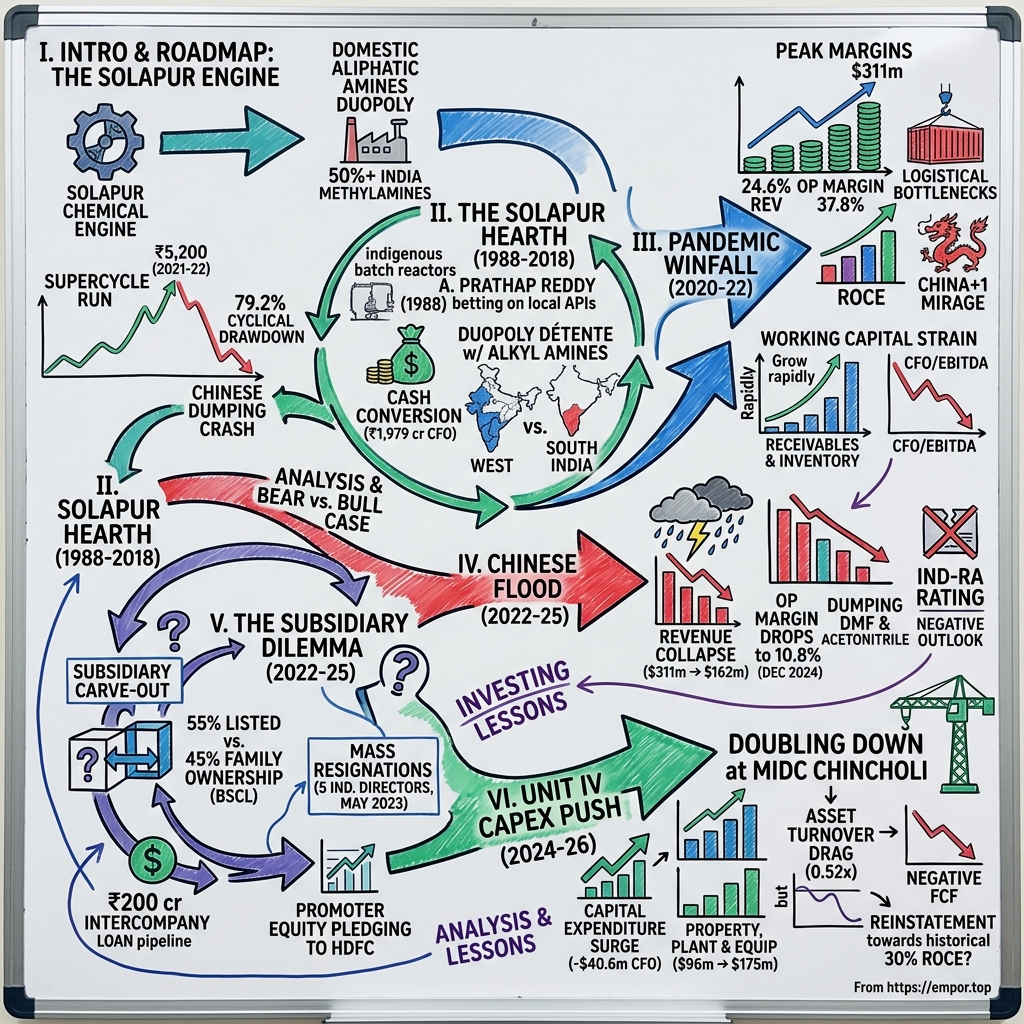
I. Introduction & Episode Roadmap
Drive east out of Solapur on the highway toward Hyderabad and the landscape is mostly sugarcane, jowar and dust. Then, somewhere past the city's industrial estate, the horizon changes. Distillation columns rise out of the fields. Spherical pressure tanks sit behind blast walls. White tanker trucks, built to carry gases that boil well below room temperature, idle at a weighbridge. This is not where most people would put the command centre of a national chemical industry. Solapur is known for textiles, for its handloom chaddars, and for a hot, dry climate. It is not a port and it is not a petrochemical hub.
Yet from this district in southwestern Maharashtra, Balaji Amines Limited runs one half of India's aliphatic amines duopoly.1 Its products are the small nitrogen-bearing molecules that almost nobody has heard of and almost every pharmaceutical factory needs: methylamines, dimethylformamide, and a family of derivatives that end up inside antidiabetic pills, antibiotics and crop-protection chemicals. Pharmaceuticals take roughly half of its volumes and agrochemicals another quarter or more.1
For three decades that was a quiet business. Then the pandemic turned it into a stock-market sensation. In the year to March 2022, revenue reached about $311 million and net profit about $49 million, with roughly a quarter of every rupee of sales left over as operating profit.2 The share price, which had been under ₹1,000 before Covid, went above ₹5,000.3 And then it fell. From peak to trough, the stock lost 79% of its value, the largest fall in its recent history, as Chinese chemical exports flooded back into Indian ports and prices for Balaji's products collapsed.3
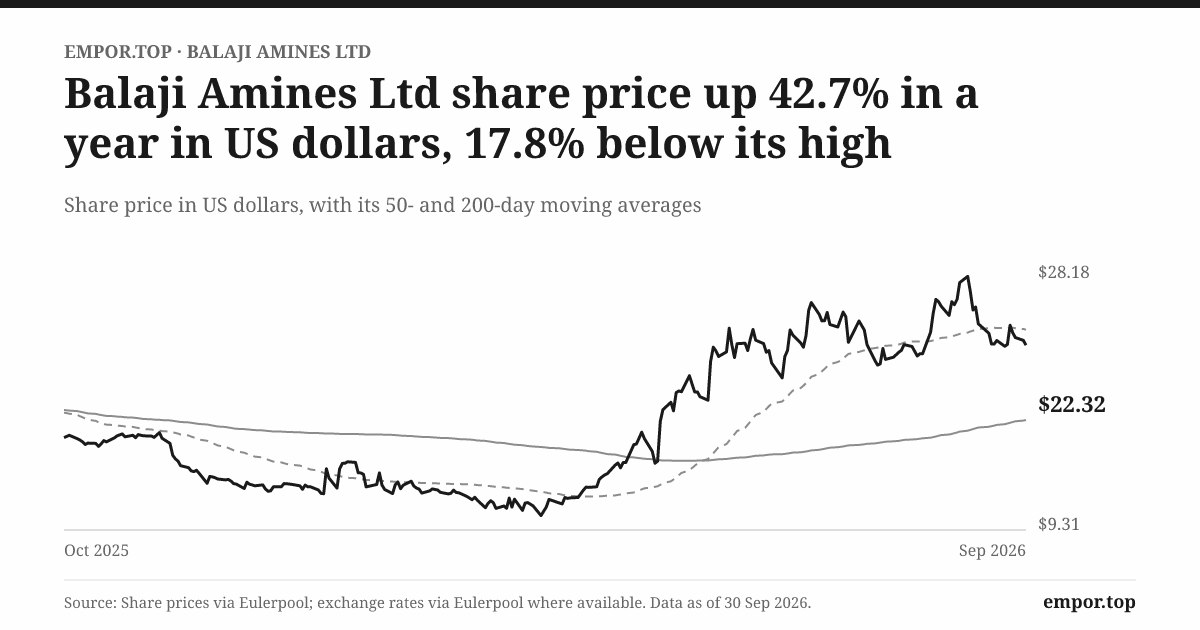
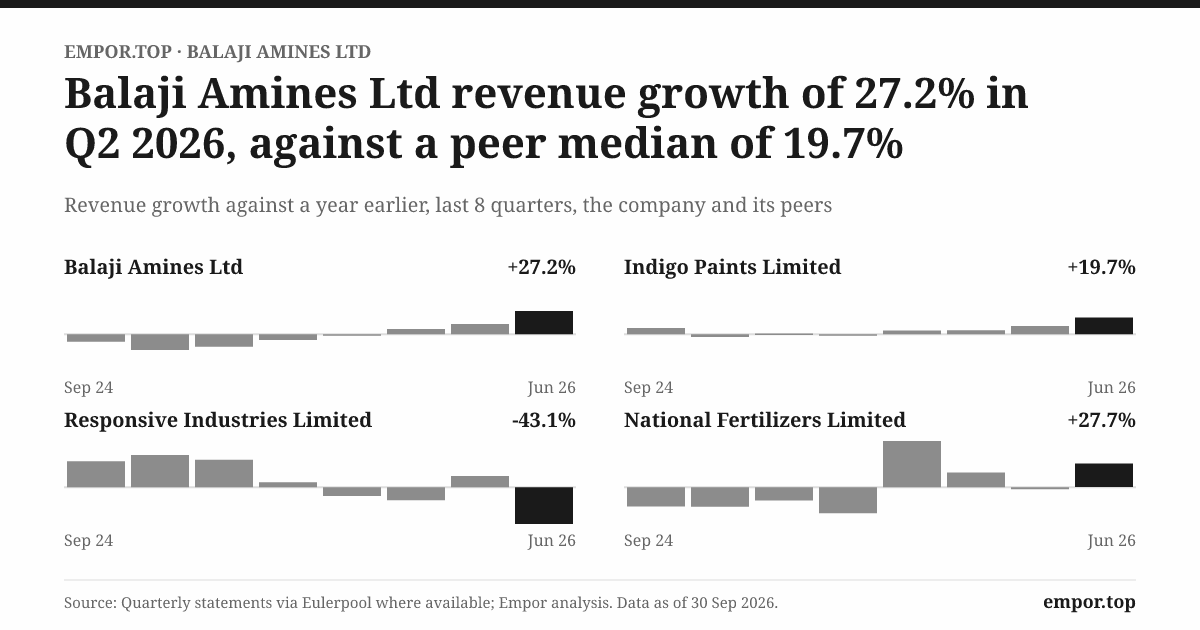
Tonight the stock trades at ₹2,142, valuing the company at about ₹6,941 crore ($724 million).45 The latest quarter, to June 2026, showed the business roaring back: revenue up 27% on the year and operating margin at 22%, double where it had been a year earlier.2 So is Balaji Amines a great cyclical business coming out of a trough, or something more complicated?
This story argues it is something more complicated, and that four puzzles sit at the heart of it.
The first is a carve-out. Balaji's most promising specialty chemistry lives in a subsidiary, Balaji Speciality Chemicals Limited (BSCL), which the listed company owns only 55% of. The other 45% or so belongs directly to the promoter families.1 Yet it is the listed company whose shareholders were asked to approve up to ₹200 crore of loans and guarantees to that subsidiary.1
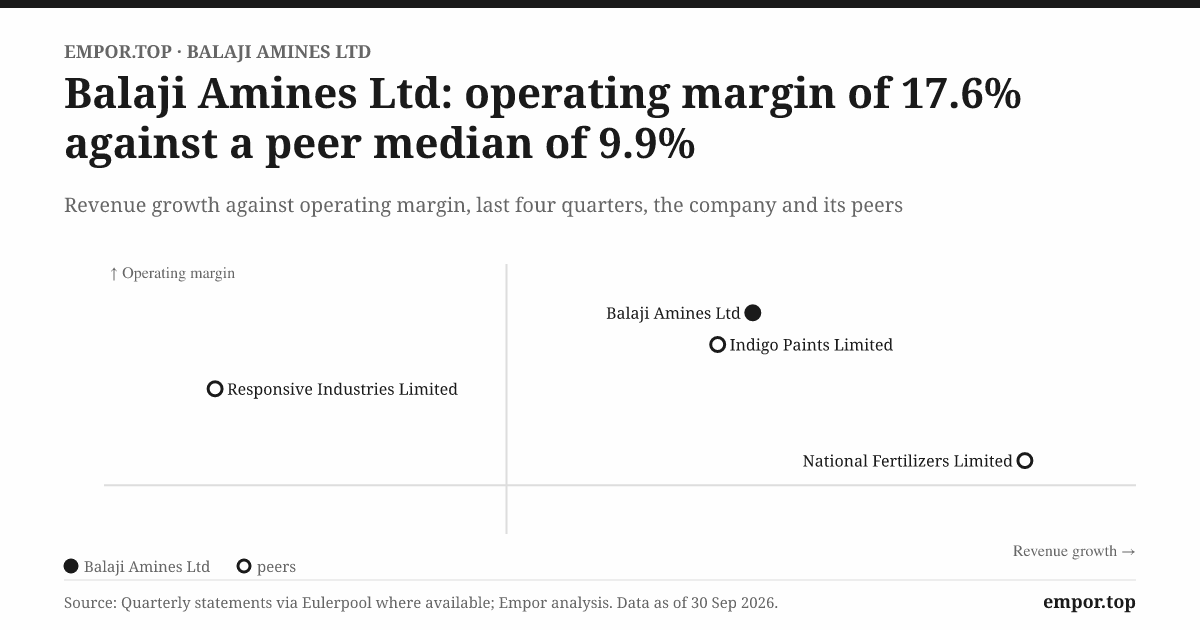
The second is the margin whiplash. Operating margin fell to about 11% in the December 2024 quarter and was above 22% by June 2026.2 Is that the new Unit IV plant earning its keep, or a restocking window that will close when the next wave of Chinese capacity arrives?
The third is a pledging paradox. A promoter pledged more shares to HDFC Bank in December 2025, bringing encumbered promoter shares to about 10% of the company, while the company itself sat on roughly ₹528 crore of cash and liquid investments.61
The fourth is capital allocation. The company has poured money into a new complex at MIDC Chincholi. Return on capital employed, above 30% at the peak, stands at about 10%.2 Can the new plant bring it back?
The route to those answers runs from a founder's first plant in 1988, through a quiet duopoly, a pandemic windfall, a Chinese price flood, a Saturday on which five independent directors left the board, a withdrawn IPO, and the commissioning of the largest plant the company has ever built. It begins with a man who decided that Indian drug makers should not have to wait for a ship from Europe.
 Subscribe on LinkedIn
II. The Solapur Hearth: Building the Aliphatic Duopoly (1988–2018)
The bet on a truck instead of a ship
In the late 1980s, an Indian bulk-drug maker in Hyderabad that needed methylamines had an unappealing choice. It could import them, which meant letters of credit, foreign exchange paperwork under a licence-raj economy, and weeks of waiting for a cargo to arrive and clear customs. Or it could buy from the handful of domestic producers, whose capacity was small. A. Prathap Reddy, a first-generation entrepreneur from the Telugu-speaking belt that straddles Maharashtra and the Deccan, saw an opening in that gap. Balaji Amines was incorporated in 1988, and its first amines plant came up at Tamalwadi in the Osmanabad district, on the Solapur–Hyderabad road.71
The logic was geographic before it was chemical. Hyderabad was becoming India's bulk-drug capital, with clusters of active pharmaceutical ingredient (API) factories at Patancheru and Bollaram. Solapur sat within a day's drive. Methylamines are gases at room temperature and must travel in pressurised tankers, which makes long journeys costly and dangerous. A producer close to its customers carries a freight and safety advantage that an overseas supplier cannot easily erase.
Prathap Reddy's style, as the company's later history shows, was that of a builder rather than a financier. He stayed as Chairman and Managing Director through the decades, bringing family members and relatives into the business. The later promoter group includes N. Rajeshwar Reddy, D. Ram Reddy, G. Hemanth Reddy and A. Srinivas Reddy, the last being Prathap Reddy's son.1 That extended-family structure will matter a great deal later in this story.
What an amine actually is
For the non-chemist, the chemistry is simpler than the names suggest. Take methanol, the simplest alcohol, and ammonia, a nitrogen compound. Heat them together at high temperature and pressure over a catalyst, and the ammonia's hydrogen atoms get swapped for small carbon groups taken from the methanol. Swap one and you get monomethylamine (MMA). Swap two and you get dimethylamine (DMA). Swap three and you get trimethylamine (TMA). The reaction always produces a mixture, so the real skill lies in the catalyst that tilts the mix toward what customers want, and in the distillation train that separates the three cleanly.
From those building blocks come the derivatives. Dimethylamine plus carbon monoxide gives dimethylformamide (DMF), a workhorse solvent. Dimethylamine is also a precursor to metformin, the world's most widely prescribed diabetes drug. Other derivatives feed antibiotics, herbicides and water-treatment chemicals. Balaji's product list grew over time to include morpholine, N-methyl pyrrolidone and a range of specialty amines.1
The duopoly that nobody planned
Balaji was not alone. Alkyl Amines Chemicals, based in western Maharashtra, had been making amines since the 1970s.8 Over the next three decades the two companies came to dominate Indian aliphatic amines. Alkyl became the stronger name in ethylamines and related derivatives. Balaji became the stronger name in methylamines and their downstream products such as DMF.81 Neither company describes the split as an agreement, and nothing in the record suggests one existed. It is better understood as what happens when two capital-heavy, hazardous-chemistry plants each find their own niche and the barriers to a third entrant stay high.
Growing without printing shares
The most unusual thing about Balaji's first three decades is visible in a single number. Paid-up equity capital has stood at ₹6.48 crore, 32.4 million shares of ₹2 face value, since a 1:1 bonus in March 2007 and a 1:5 split in November 2010.1 There have been no rights issues, no preferential allotments, no warrants and no buybacks.1 Every plant since has been paid for from profits and bank debt.
The long-run numbers show a business that compounded quietly. Over the ten years to March 2026, revenue grew about 8% a year and net profit about 11% a year in rupees.2 That is respectable rather than spectacular, and it includes both the pandemic boom and the bust that followed. The more impressive figure is cash. Across the twelve years from FY2015 to FY2026, Balaji reported cumulative net profit of about ₹1,969 crore and generated about ₹1,979 crore of cash from operations.2 That is 101 cents of cash for every rupee of accounting profit. For a chemical company that carries large inventories and extends credit to customers, it is a strong sign that the profits are real.
The balance sheet tells the same story from another angle. Debt was more than equity in FY2015, a debt-to-equity ratio above 1. By FY2024 it had fallen to almost nothing.2 Balaji paid down its lenders out of its own cash flows while continuing to build.
The hotel in the chemical town
There is, however, one early clue that sits awkwardly with the picture of a single-minded chemical builder. In Solapur, Balaji owns and runs a hotel, the Balaji Sarovar Premiere, operated under the Sarovar hospitality brand.1 It is reported as a separate segment and contributes roughly 2% of turnover, about ₹30–33 crore a year.1
A hotel is not illegal, nor is it large enough to move the investment case. Solapur lacked quality business accommodation, and a company receiving auditors, customers and technology suppliers had a plausible reason to want one. But capital put into a hotel is capital not put into a reactor, and returns on a mid-market hotel in a tier-three city are unlikely to match those of a specialty chemical plant at full capacity. The hotel is best read as an early signal about how the founders think of the listed company's balance sheet: as a pool of family-directed capital that can serve local ambitions as well as chemistry.
The verdict on these three decades is that Balaji built a genuine operating advantage from geography, process know-how and patient reinvestment, and it did so without diluting shareholders. The caveat is that the habit of placing capital in adjacent ventures began early. That habit became much more consequential when the pandemic handed the company more cash than it had ever seen.
III. The Pandemic Windfall: Peak Margins and the China+1 Mirage (2020–2022)
The world runs out of boxes
In the second half of 2020 and through 2021, global shipping broke. Containers piled up in the wrong ports. Freight rates from Asia to the world multiplied several times over. China's zero-Covid policy periodically shut down factories and port operations. For Indian drug makers, whose API supply chains ran heavily through Chinese intermediates, the effect was a scramble. Anything that could be bought from a truck in India rather than a ship from China suddenly commanded a premium.
Balaji was perfectly placed. Its customers included the largest names in Indian pharmaceuticals, with Sun Pharma, Cipla, Dr. Reddy's and Lupin among its top clients, alongside agrochemical makers such as UPL.1 Demand for paracetamol, azithromycin, and other Covid-era drugs surged. Domestic methylamines and DMF were suddenly scarce and strategic.
How Balaji actually prices
To understand what happened next, it helps to understand how Balaji sets prices. The company works on a cost-plus spread over its feedstocks: methanol, ammonia and, for some products, ethanol.1 Contracts are mostly spot or reset quarterly by formula, and there are no long-term take-or-pay commitments that would force customers to buy fixed volumes.1 In plain English, Balaji earns the gap between what it pays for inputs and what the market will bear for finished amines. When that market is tight, the gap widens fast. When it loosens, the gap narrows just as fast, and there is no contract to cushion the fall.
In the pandemic, the gap blew wide open. Revenue rose about 40% in FY2021 and then 77% in FY2022.2 Operating margin reached about 26% in FY2021 and held near 25% the following year. Net margin touched a record 18% in FY2021.2 Return on capital employed peaked near 38% in FY2022.2 For a company that had been earning mid-teens returns before the pandemic, this was an entirely different business on paper.
Profits that stayed on the shelf
But paper is the right word. In FY2021 only about 29% of EBITDA turned into operating cash, and in FY2022 about 37%.2 Where did the rest go? Into inventory bought at inflated feedstock prices and into receivables from customers who were themselves stretched. Debtor days, the average time customers take to pay, rose above 90 in FY2022.2 The lesson is that a price spike in a commodity-linked chemical business tends to inflate working capital at the same moment it inflates profit. The cash caught up only later, and only as prices fell and inventories unwound.
The market decides this is a specialty compounder
The stock market read the same numbers differently. Mid-cap Indian chemical companies became one of the defining trades of 2021, sold on a single idea: "China+1." Global buyers, burned by pandemic disruption, would diversify away from Chinese suppliers, and India's chemical makers would inherit years of growth at high margins. Balaji's share price, under ₹1,000 before Covid, rose above ₹5,000.3 At peak, investors were paying high multiples of what were, in hindsight, peak earnings.
This is where the historical record has to be weighed against the story. The China+1 narrative made a structural claim: that Indian producers had captured permanent pricing power. The mechanism actually driving Balaji's margins was not that. It was freight costs and Chinese supply interruptions, both temporary. Nothing about the chemistry had changed, no new long-term contracts had been signed, and the customers were the same price-sensitive formulators as before. A cost-plus business with quarterly resets cannot lock in a windfall.
The verdict is that the pandemic peak was overwhelmingly a supply-side event. That does not make it worthless. Balaji used the windfall to pay down almost all its debt and to fund new capacity. But anyone who valued FY2022 earnings as a new baseline was valuing a freight crisis. When the ships started running again, the spread went back to where the chemistry and competition said it should be.
IV. The Chinese Deflationary Flood: From Peak to Rating Downgrade (2022–2025)
The ships come back
By late 2022 the containers were back where they belonged, and China had a different problem. Its property sector was in retreat, domestic demand for chemicals was soft, and its chemical industry had spent years adding enormous capacity. The natural outlet was export. Cargoes of DMF, acetonitrile and other amine derivatives began arriving at Indian ports priced well below what domestic producers had been charging.9 At the same time, Indian pharmaceutical companies that had stockpiled during the pandemic began to run those stocks down rather than reorder.
For a business that earns a spread, this was a double hit: falling prices on finished goods and falling volumes as customers destocked. Revenue slid about 31% in FY2024 and a further 13% in FY2025, from roughly $311 million at the peak to about $162–165 million.2 Over the three years to FY2026, revenue shrank about 15% a year and net profit about 20% a year in rupees.2
The quarterly numbers show where the pain peaked. In the December 2024 quarter, operating margin fell to about 11%, less than half its pandemic level.2 Raw material prices had fallen too, but finished-product prices fell further. That tells you who had the pricing power in this downcycle: not Balaji.
The currency and freight exposure underneath
The flood also exposed a structural asymmetry in Balaji's trade flows. The company imports methanol, much of it from Saudi Arabia, the UAE and Iran, and these imports are worth about ₹400–600 crore a year in dollar terms.1 Exports are smaller, about 12%–15% of turnover or ₹180–220 crore, sold into around 50 countries.1 So Balaji is structurally short dollars and exposed to shipping costs on its main input. The treasury hedges selectively through forward contracts, and reported foreign-exchange gains and losses have stayed below 1% of pre-tax profit over FY2024–FY2026.1 The currency risk has so far been managed. The competitive risk is harder to hedge: when Chinese producers can land finished product in India cheaper than Balaji can make it, no forward contract helps.
A rating agency changes its mind
On 13 June 2025, India Ratings and Research kept Balaji's bank facilities at IND AA but revised the outlook from Stable to Negative.10 The agency pointed to margin contraction from Chinese dumping, delays in project execution, and weak earnings visibility at the BSCL subsidiary.101 A negative outlook is a warning rather than a downgrade, but it is a meaningful one from a lender's perspective. It said the agency no longer expected the business to recover on its own timetable.
That warning never turned into a downgrade. On 11 September 2026, Ind-Ra withdrew all its ratings on Balaji's bank facilities at the company's request, after the company submitted no-dues certificates from its lenders.111 The withdrawal is a benign event on its face, since a company with no bank loans outstanding has no need for a bank-loan rating. But it also means investors lost an independent credit read at exactly the moment a new cycle of capex and subsidiary lending was under way.
Customers who can walk
Balaji's customer base protects it against single-client disasters. No customer accounts for 10% or more of revenue, and the top ten clients together account for roughly 30%–35% of sales.1 But concentration measures only part of buyer power. These same customers are sophisticated procurement organisations that can buy from Alkyl Amines, from importers, or from Balaji, and they can reset prices every quarter. Low concentration spreads the credit risk. It does not give Balaji pricing power.
Did the stress show up in bad debts?
The obvious place for a downturn to leave scars is receivables. Debtor days did rise, from about 62 in FY2023 to about 89 in FY2026.2 That is long for a supplier of commodity-linked chemicals. Yet the quality indicators held. More than 92% of receivables were undisputed and less than six months old, expected credit loss provisions stayed under 0.5% of gross receivables, and there were no material write-offs over the three years to FY2026.1 Receivables in rupee terms actually fell, from about ₹378 crore in FY2024 to about ₹275 crore in FY2026.1
Put simply, customers paid more slowly in relative terms but they did pay. The stretch in debtor days in FY2026 partly reflects lower revenue in the denominator. The downturn damaged Balaji's margins, not its customers' creditworthiness.
The verdict on this period is uncomfortable for anyone who bought the China+1 narrative. Balaji's domestic position did not protect it from imported deflation. Its defence was logistics friction, customer relationships and the ability to wait. That makes the question of where Balaji's best future profits would accrue even more important, and the answer leads directly to a subsidiary in which the listed company owns just over half.
V. The Subsidiary Dilemma: 55% Listed, 45% Family, and a Five-Director Resignation (2022–2025)
A Saturday on the exchange tape
Most Indian companies file board changes on weekday evenings. On Saturday, 20 May 2023, Balaji Amines filed something unusual. All five of its independent directors had resigned at once.[^12] In the same batch of announcements, Gaddam Hemanth Reddy, a Whole-time Director and the company's Chief Financial Officer, resigned from the listed company to move to the subsidiary, Balaji Speciality Chemicals.[^12]1 When trading opened on Monday, the shares fell sharply.[^12]
The company's explanation was that the directors had reached the end of the maximum ten-year tenure permitted for independent directors under the Companies Act, 2013.1 That is legally plausible: the Act caps independent directors at two consecutive five-year terms, and many companies appointed a fresh set of independent directors when the Act took effect in 2014. But the manner mattered as much as the reason. A board that loses every independent voice on the same day, with the CFO leaving in parallel, needs a succession plan communicated well in advance. For institutional investors already worried about the subsidiary structure, a surprise Saturday exit was the worst way to deliver even an innocent explanation.
Why BSCL exists
To understand why that day mattered, rewind to the formation of Balaji Speciality Chemicals. BSCL was set up to make downstream specialty amines, notably ethylenediamine (EDA), piperazine and diethylenetriamine (DETA), which India largely imported. EDA is a chemical intermediate used in pharmaceuticals, agrochemicals, chelating agents and resins, and Balaji positioned BSCL as an import substitute for it.[^13]
The crucial decision was ownership. Rather than build BSCL as a wholly owned subsidiary, the listed company took 55% and the promoter families took roughly 45% directly.1 The promoter group named in that holding comprises A. Prathap Reddy, N. Rajeshwar Reddy, D. Ram Reddy, G. Hemanth Reddy and A. Srinivas Reddy.1
What does that mean in practice? Every rupee of value created at BSCL is split: 55 paise to the listed company, whose public shareholders own roughly 45% of it, and 45 paise straight to the families. Meanwhile, the listed company carries the consolidation, the guarantees and, later, the lending. Balaji has not published a full, standalone justification for why the families needed to co-invest directly rather than simply fund BSCL through the listed parent. The effect, whatever the intention, is that the promoters hold a far larger economic share of BSCL than they do of Balaji Amines itself.
The prospectus that almost monetised it
On 10 August 2022, near the top of the specialty chemicals boom, BSCL filed a Draft Red Herring Prospectus with SEBI.[^13] The plan combined a fresh issue of ₹250 crore, money that would go to BSCL, with an offer for sale of 26 million shares by existing shareholders, money that would go to the sellers.[^13]1 The selling shareholders were the promoters.1
The structure is the key point. A fresh issue funds the company. An offer for sale funds whoever is selling. An IPO at peak-cycle valuations would have let the families convert part of their private 45% into cash, at a price set during the best market for Indian specialty chemicals in a generation.
It did not happen. The chemical rally faded through 2023, and on 8 September 2023 BSCL withdrew its offer document.12[^15] The press reported the withdrawal of what had been described as a roughly ₹425 crore IPO.[^15] Neither BSCL nor Balaji publicly explained the withdrawal in detail. The obvious circumstantial explanation is the market: a specialty chemicals IPO in late 2023, with margins falling and Chinese dumping in the headlines, would have priced far below the 2022 expectation.
Musical chairs in the finance office
The executive reshuffle that accompanied the director exits moved the family's most experienced finance hand to the subsidiary. Hemanth Reddy took over at BSCL. His replacement as Whole-time Director and CFO of the listed company was Ande Srinivas Reddy, the founder's son.1 Turnover continued: Company Secretary Lakhan S. Dargad resigned in December 2024, and BSCL's own CFO, Pardeepsingh Watwani, resigned in May 2026.1
Each departure has its own story, and none on its own proves anything. Together they describe a finance and compliance function under repeated change during the very years when the related-party relationship with BSCL was deepening.
The ₹200 crore authorisation
That deepening arrived in February 2025. Balaji sent shareholders a postal ballot seeking approval for material related-party transactions with BSCL, including authority to lend or guarantee up to ₹200 crore to fund BSCL's working capital and brownfield expansion.1 It passed.
For a minority shareholder, the arithmetic is uncomfortable. If Balaji lends ₹200 crore to BSCL and BSCL succeeds, the upside is shared 55:45 with the families. If BSCL struggles, the listed company bears the credit risk on the full loan. The families contribute equity alongside, but the debt-like exposure sits with the listed entity. Consolidated borrowings rising to about ₹145 crore in FY2026, largely inside BSCL, show that the subsidiary's funding needs were real.1
It is fair to note the counter-argument. BSCL is a controlled subsidiary. Lending to it at market rates is common in Indian groups, and it may be cheaper than external bank debt. Shareholders at the 38th AGM on 10 July 2026 approved every resolution with over 99% support.1 But that vote carries less weight than it appears: promoters own about 55% of the listed company, and institutional holders own less than 5%.6 Very few independent votes exist to dissent.
The pledge that doesn't add up
Then there is the pledge. On 30 December 2025, Ande Srinivas Reddy pledged 625,000 shares, about 2% of the company, to HDFC Bank.16 The disclosed purpose was to secure credit facilities for corporate operations.1 After this pledge, encumbered promoter shares totalled about 10% of Balaji's equity, or about 17.7% of the promoter holding, as of June 2026.16
A skeptic would ask a simple question. Balaji ended FY2026 with about ₹528 crore in cash, bank balances and liquid debt investments, and its standalone books show no long-term bank debt.1 Why would the company's operations need a promoter's personal shares as collateral? One possible explanation is that the pledge secures facilities for BSCL or another entity in which the families have a larger stake. Another is that it secures personal borrowing. Balaji's disclosures do not specify which entity's facilities the pledged shares back beyond the phrase "corporate operations". Until it does, the pledge remains the clearest unanswered question in the governance file.
The verdict here is the most consequential in this story. BSCL is where Balaji's next generation of specialty chemistry lives, and the listed company owns only 55% of it while bearing most of its financing risk. The market appears to charge for that. Alkyl Amines, with a cleaner structure, trades at a meaningful premium to Balaji on earnings and cash-flow multiples, as Section VII discusses. BSCL is not the only reason for that gap, but it is the reason Balaji could remove. Meanwhile, the listed company was committing its own capital on a scale it had never tried before.
VI. The Unit IV Capex Push: Doubling Down at MIDC Chincholi (2024–2026)
Steel in the fields
MIDC Chincholi sits on the Solapur–Pune highway, one of the Maharashtra Industrial Development Corporation's estates designed to pull industry into the state's drier eastern districts. Here, Balaji built Unit IV, a greenfield complex that became the biggest capital project in its history.1 The centrepiece was a new 40,000 MTPA methylamines plant, commissioned in November 2024.1 Behind it, construction continued on plants for dimethyl ether (DME, 100,000 tonnes a year), N-methyl morpholine (5,000 tonnes a year) and acetonitrile, all scheduled for FY2027.1
The timing was bold. Balaji commissioned its largest methylamines capacity in the same quarter that its operating margin hit the cycle's low. That is either conviction or inertia, depending on how the next two years play out.
What the capex did to the ratios
The balance sheet shows the scale. Net property, plant and equipment rose from about $96 million in FY2021 to about $175 million in FY2026, growing roughly 19% a year in rupees over the last three years.2 Cash spent on investing reached about $41 million in FY2026, the most in the twelve-year record.2
Now watch what happened to the efficiency ratios. Asset turnover, meaning revenue earned for each rupee of total assets, fell from about 1.2 times in FY2022–FY2023 to about 0.5 times in FY2026.2 Put differently, every rupee of assets now generates less than half the revenue it did at the peak. Return on invested capital fell to about 8%.2 Free cash flow, which had reached about $33 million in FY2023, turned negative, at about minus $5 million in FY2024 and about minus $20 million in FY2026.2
Some of this is simply arithmetic. A new plant enters the asset base at full cost before it produces a full year's revenue. Some of it is the cycle: Unit IV came on stream into falling prices. The honest reading is that the ratios reflect both a gestation period and a weak market, and that FY2027 will be the first year to separate them.
Where the free cash went
Over the twelve years from FY2015 to FY2026, Balaji generated about ₹344 crore of cumulative free cash flow.2 Dividends absorbed about ₹191 crore of that, around 56%.2 Cash and short-term investments rose by about ₹242 crore over the same span.2 Dividend payout rose from low single digits during the boom to about 21% in FY2026, which gives shareholders a modest yield of 0.5% at today's price.24
That is a picture of a company that reinvests most of its cash and holds a large cushion, not one that returns capital aggressively. It also means that, as of FY2026, the listed company could fund the BSCL loan and the Unit IV build without issuing equity or borrowing heavily at the parent level. Consolidated borrowings rose to about ₹145 crore, a debt-to-equity ratio of just 0.07, with most of that debt sitting in BSCL.12
Clean books, clear lenders
Two findings offset the capital-efficiency worries. First, the statutory auditor, M. Anandam & Co. of Hyderabad, issued unmodified opinions on both standalone and consolidated accounts for FY2024, FY2025 and FY2026, with no adverse remarks on internal financial controls under CARO.1 Contingent liabilities are small, at under 2% of net worth, made up largely of bank guarantees, letters of credit and about ₹12 crore of disputed tax demands.1 Second, lenders issued no-dues certificates in mid-2026, which led to the withdrawal of the bank-loan ratings.111
The verdict is that Unit IV has secured Balaji's position as the largest domestic methylamines producer and lowered its marginal cost, but it has also halved asset turnover and pushed free cash flow negative. The plant is a volume bet in a market where the price is set at the port. Whether that bet pays depends on the durability of Balaji's competitive position, which is the subject of the next section.
VII. Strategic Moats & The Competitive Landscape: Porter's 5 Forces and Helmer's 7 Powers
The war-game
Imagine two procurement managers at a Hyderabad API plant. One is ordering dimethylamine for a metformin line. The other is sourcing DMF as a reaction solvent. They have three suppliers on their approved list: Balaji, Alkyl Amines and an importer with Chinese product sitting in a bonded warehouse at Nhava Sheva. Every quarter they run the same exercise: ask all three for quotes, split the order to keep everyone honest, and push the domestic suppliers to match the import price minus a little for convenience. That quarterly exercise is Balaji's competitive reality, and every framework below is really a way of asking how much of the spread Balaji can hold when that manager picks up the phone.
Hamilton Helmer's 7 Powers
Scale economies: moderate. A continuous amination plant has high fixed costs, so the cost per tonne drops sharply as utilisation rises above about 80%. Within India, Balaji's new Unit IV capacity makes it the largest methylamines producer.1 But the scale that matters when Chinese product lands is global scale, and Chinese chemical majors such as 万华化学 Wanhua Chemical operate at sizes far beyond any Indian amines producer. Balaji's scale protects it from domestic entrants, not from imports.
Process power: substantial but narrow. Three and a half decades of catalyst and yield tuning is real know-how. The hazardous nature of the chemistry, involving pressurised ammonia and flammable amines, raises the bar for new entrants, who need environmental clearances and explosives-safety licensing from the Petroleum and Explosives Safety Organisation. Yet the underlying chemistry is well understood globally, and Balaji's R&D spending is modest, about 0.2%–0.5% of turnover.1 Its process edge lies in execution, not in proprietary technology that others cannot replicate.
Switching costs: moderate. Pharmaceutical customers that file Drug Master Files with regulators must document their input suppliers, and changing a supplier of a key intermediate can require re-validation. That creates some stickiness. But the evidence from the downturn is that customers dual-source routinely, keeping both Balaji and Alkyl qualified. Switching costs protect Balaji from being dropped outright; they do not stop customers from shifting volume or squeezing price.
Cornered resource: weak. Methanol is a traded global commodity, and much of it is imported.1 Ammonia comes from state-owned domestic suppliers under term contracts.1 Neither is exclusive to Balaji.
Network effects, counter-positioning and branding: absent or weak. Chemicals are bought to specification. No customer pays more because other customers buy from Balaji, no incumbent is paralysed by Balaji's model, and brand matters only as a proxy for consistent purity and reliable delivery.
Taken together, Balaji has two real powers, process and domestic scale, and one partial one, switching costs. That is a respectable moat against another Indian entrant. It is a thin moat against a subsidised foreign exporter.
Porter's 5 Forces
Buyer power: high. No single customer is large, but the top ten, including India's biggest drug makers, take about a third of sales and all can dual-source.1 The downturn proved the point: realisations fell faster than feedstock costs.
Supplier power: moderate to high. Methanol imports from the Gulf and Iran expose Balaji to freight shocks and geopolitical disruptions in the Red Sea and Strait of Hormuz.1 The cost-plus model passes feedstock changes through with a lag, which protects margins over time but not quarter to quarter.
Threat of new entrants: low. Capital intensity, hazardous chemistry licensing and environmental approvals make a new Indian amines plant a multi-year, multi-hundred-crore project with no guarantee of utilisation.
Threat of substitutes: low. There is no practical substitute for methylamines in the synthesis routes that use them.
Rivalry: duopolistic at home, brutal at the border. Within India, Balaji and Alkyl have historically behaved rationally. The real rivalry comes from imports, and it switches on whenever global capacity is loose.
Benchmarking Alkyl Amines
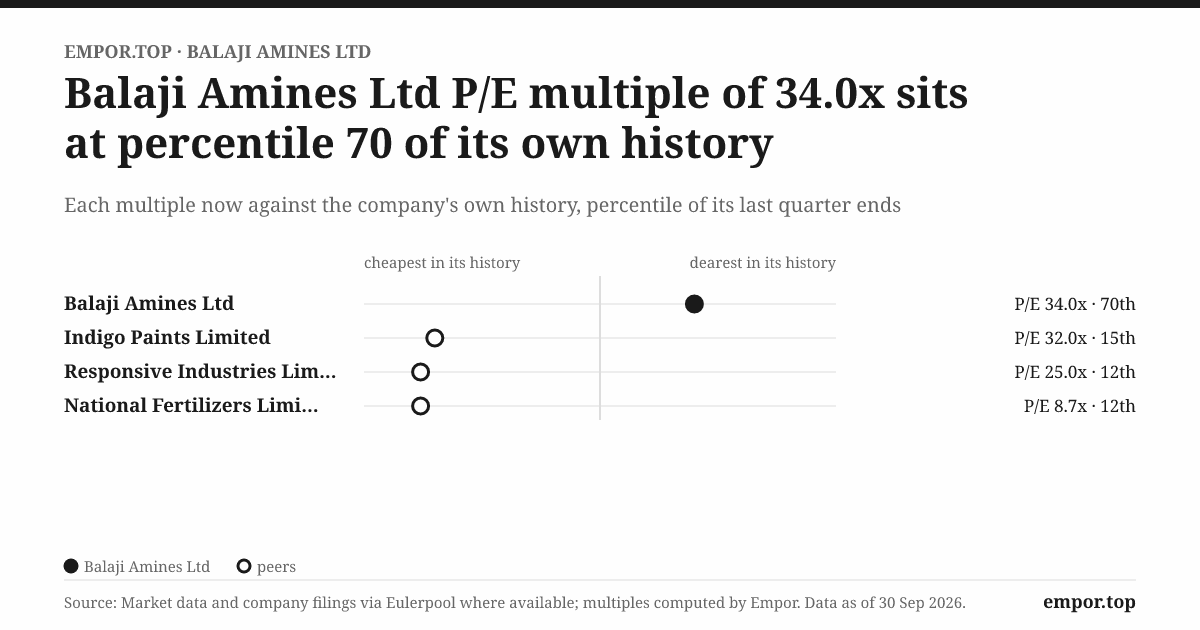
The obvious comparison is Alkyl Amines, the other half of the duopoly. The market values Alkyl at roughly ₹9,051 crore against Balaji's ₹6,941 crore, and pays more for each rupee of earnings: about 40–42 times trailing earnings versus Balaji's 34, and about 27 times EV/EBITDA versus Balaji's 19.148
There are fair reasons for part of that premium. Alkyl's strength in ethylamines and specialty derivatives gives it a somewhat different product mix.8 But the other obvious difference is structure. Alkyl has no operating subsidiary in which its promoters own a large direct stake alongside the listed company.8 The market is likely charging Balaji for its governance setup, even if nobody can say precisely how much of the gap that explains.
Myth vs reality
The myth is that an Indian amines duopoly is a specialty chemical franchise with durable pricing power. The reality is that it is a well-run, low-cost domestic manufacturer of commodity-linked intermediates whose pricing power ends at the port. That is not a bad business. It is a cyclical one, and it should be valued as such. With that framework set, the question becomes what investors are paying for today and what has to happen for them to be right.
VIII. Analysis & Bear vs. Bull Case
Results day
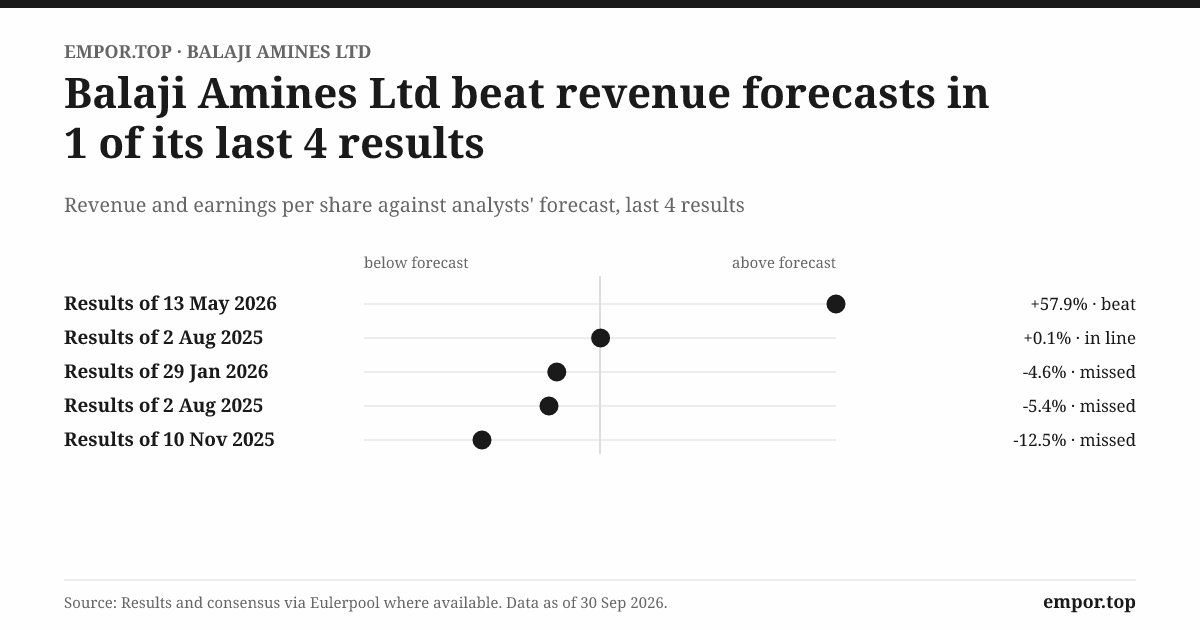
In the summer of 2026, Balaji's June-quarter results reached broker terminals and reignited the debate. Revenue was about $48 million, up 27% on the year. Operating profit more than doubled, and operating margin reached about 22%, the highest in three years.2 Net profit nearly doubled.2 The March 2026 quarter had already shown margins above 20%, so this was the second strong quarter in a row.2
The market was already paying for recovery. Balaji trades at 34 times trailing earnings, above its five-year median of about 31.4 Return on equity over the last twelve months is about 9.5%.4 Put those together and the market is paying a premium multiple for below-average current returns. That only makes sense if investors expect earnings to rise substantially from here. The earnings yield at today's price is about 2.9%, well below what an Indian investor can earn on a government bond.4
The bull case: a compounder reloading
The bull case starts with operating leverage. Unit IV added a large block of fixed cost and capacity. If utilisation climbs, each additional tonne sold carries a high incremental margin because the plant is already paid for. The March and June 2026 quarters, with margins above 20%, are the first evidence that this is happening.2
Second, import substitution. The DME and acetonitrile plants target products India largely imports.1 DME is used as a propellant and has been discussed as a blend with LPG, while high-purity acetonitrile is a solvent used in pharmaceutical and electronics manufacturing. If these plants come on stream in FY2027 and win domestic share, they add revenue lines that did not exist before.
Third, the BSCL option. If the board ever proposes to merge BSCL into Balaji on fair swap terms, the structural discount could narrow. The listed company would own 100% of the specialty business, and the related-party overhang would disappear.
Fourth, pricing discipline. If global freight and Chinese export pricing normalise upward, Balaji and Alkyl could hold higher domestic prices.
Testing the bull case
Each of these claims deserves a test against the record.
Operating leverage is real, but it has happened before, and it reversed. The FY2021–FY2022 margin surge also looked like leverage, and it disappeared within two years when prices fell. The same cost-plus model that amplifies margins on the way up amplifies them on the way down. So the history narrows the claim: Unit IV raises Balaji's earnings power at any given spread, but it does not change the spread.
Import substitution is a plausible claim but unproven. The plants have not yet produced commercial revenue, and BSCL, Balaji's previous import-substitution bet, is exactly the entity that India Ratings flagged for weak earnings visibility.10 A plant is not a market share.
The BSCL merger is an option with no exercise date. Balaji has made no public commitment to it. The promoters' 2022 attempt to monetise their BSCL stake through an IPO points, if anything, in the opposite direction: a preference for crystallising value outside the listed company.[^13]
The bear case: the governance value trap
The bear case begins with a second wave of Chinese capacity. If Chinese producers add more downstream amine derivatives, Balaji's margins could settle in the low-to-mid teens, where they sat for most of FY2024–FY2025.2 In that world, Unit IV's extra capacity means more tonnes at thin spreads, and returns stay near today's levels.
Second, value leakage through BSCL. The bear sees a pattern: a partially owned subsidiary housing the highest-value chemistry, a listed company providing ₹200 crore of lending authority, a finance chief moved from the listed entity to the subsidiary, and a withdrawn IPO that would have paid the families. Even without any wrongdoing, the structure means the listed company's shareholders capture only part of the upside of the business they are financing.
Third, the pledge. Encumbered promoter shares equal about 10% of the company.6 If the share price fell sharply, as it has before, lenders could demand more collateral or sell. With a one-year volatility near 55% and a 79% drawdown in recent memory, that is not a hypothetical risk.4
Fourth, the absence of institutions. Foreign investors hold about 3.2%, domestic institutions about 1.6%, and mutual funds just 0.1% across seven schemes.61 Retail and HNI investors hold about 41%.6 A stock owned mainly by promoters and retail has no deep-pocketed buyers of last resort in a sell-off, and no large holders pushing the board on governance.
The activist's letter
A skeptical activist would focus on three demands. Merge BSCL on independent valuation terms, or explain in detail why the current structure serves minority shareholders. Release the pledged shares, or disclose which entity's facilities they secure. And publish plant-level utilisation for Unit IV, so investors can judge the return on the largest capital project in the company's history. None of these would require new capital; all would require the families to give up some flexibility.
The three numbers that matter
Consolidated operating margin. The latest quarter reached about 22.4%, up from about 11.4% a year earlier.2 Holding margins at or above 20% through FY2027 would suggest Unit IV has changed Balaji's cost position. A slide back toward the low teens would say the spike was a restocking window.
BSCL debt and intercompany flows. Consolidated borrowings rose to about ₹145 crore in FY2026, mostly inside BSCL, against a ₹200 crore lending authorisation.1 Whether that figure rises or falls is the cleanest read on whether BSCL is funding itself or leaning on the listed parent.
Promoter encumbrance. Pledged shares stand at about 10% of equity as of June 2026, up after the December 2025 pledge.61 A fall toward zero would remove a tail risk and a governance question at once.
The verdict: Balaji is an operationally capable manufacturer with a structural governance discount. Until the BSCL question is resolved and the pledges are released, the stock's upside is likely to track the chemical cycle rather than any lasting re-rating. That leaves four lessons that extend well beyond Solapur.
IX. Playbook: Business & Investing Lessons
Lesson 1: The sidecar gets the best seat. In August 2022, the families behind Balaji Amines tried to sell 26 million of their shares in Balaji Speciality Chemicals to the public, at the top of the market, while the listed parent had funded the business alongside them.[^13] The wider lesson for investors is to look for where a founder's newest, highest-return ideas are housed. If the answer is an entity where the founder's economic share is larger than in the listed company, the listed company's shareholders are financing someone else's upside. "When the founders build the future in a sidecar, public shareholders are paying for the engine and riding in the caboose."
Lesson 2: A domestic moat ends at the dock. Balaji's operating margin went from about 26% at the pandemic peak to about 11% in December 2024, not because a rival built a plant down the road, but because Chinese cargoes arrived at Indian ports.2 For founders in commodity-linked industries, the competitor that matters is often the importer, and the variable that matters is the landed cost of the imported product. Duopoly at home is only as strong as the friction at the border. "A chemical moat does not stop at your competitor's factory gate; it stops at the shipping port."
Lesson 3: An unchanged share count is not a clean governance record. Balaji has not issued a single new share since 2010.1 Yet on one Saturday in May 2023, its entire independent board left, and within three years promoter shares were pledged to a bank.[^12]6 Share-count discipline tells investors how a company raises money. Board independence and related-party structure tell them who the money serves. Investors who reward the first without checking the second are grading the wrong exam. "Preserving the share count proves frugality; protecting the board proves stewardship."
Lesson 4: Heavy chemistry punishes ratios before it rewards them. Balaji's fixed assets nearly doubled over five years, asset turnover more than halved, and return on capital employed fell from about 38% to about 10%.2 That is what a large greenfield plant looks like in its first years. The lesson is to judge a capex cycle by what the plant earns at full utilisation and a normal spread, not by the ratio in the year it opens. But the corollary is that investors must demand the evidence: utilisation, realisations and plant-level returns. "In continuous-process chemistry, the trough in the ratios is the price of admission, not proof of decay. Proof arrives only when the plant runs full."
X. Epilogue
Tonight Balaji Amines trades at ₹2,142 a share, about 17% below its 52-week high and more than double its 52-week low.4 The market values it at about ₹6,941 crore. The company sits between two eras: a bruising three-year downturn that halved its revenue and cut its returns to a third of their peak, and a volume expansion that could either restore those returns or lock them in at today's level.
Three moments will decide which.
The BSCL decision. The board could propose a scheme of amalgamation that folds BSCL into Balaji Amines on independently valued swap terms. That would give public shareholders full ownership of the specialty business and remove the related-party lending. Alternatively, BSCL could refile for an IPO with promoter share sales, confirming that the families see the subsidiary as their own path to liquidity. Either outcome would clarify the story. The status quo, which leaves the listed company as lender to a partly private entity, is the outcome that leaves the discount in place.
The Unit IV test. The September and December 2026 quarterly results will show whether margins can hold above 20% as Unit IV ramps up and whether the new DME, NMM and acetonitrile plants reach commercial production during FY2027 as scheduled.1 Two strong quarters are a beginning. Four would be a trend. A return to 13% margins would mean the June 2026 quarter was a restocking bounce.
The pledge release. A filing on the exchanges showing that Ande Srinivas Reddy's shares have been released by HDFC Bank would close the most visible governance question in the file. A further pledge would widen it.
Behind all three sits the question the market has been asking since that Saturday in May 2023. Balaji has shown it can make methylamines as well as anyone in India, turn profit into cash over a decade, and pay off its lenders. What it has not shown is that the public shareholders who own 45% of the listed company will share fully in the next generation of its chemistry. Until that is resolved, the business will be valued as a family asset with a listing attached, rather than as a listed company with a family at the helm.
XI. Outro
Back in Solapur, the Balaji Sarovar Premiere hosts its evening guests: chemical buyers, equipment vendors and auditors in town for the year-end close. A few kilometres away, the distillation columns at Chincholi hum through the night. The two assets say a great deal about the company that built them: one a monument to disciplined chemistry, the other a reminder that the founders have always had broader ideas about what the company's money is for.
Before dawn, a white tanker marked with the Balaji name pulls out onto the highway toward Hyderabad, carrying pressurised methylamine that will become metformin tablets on pharmacy shelves around the world. That truck is Balaji's moat in physical form: close, reliable, hard to replicate. The harder journey is the one the company has not yet taken. Balaji Amines has mastered the hazardous art of continuous amination. Now it must master the far more delicate chemistry of treating public capital as an equal partner.
References
-
Balaji Amines Limited Investor Relations — Balaji Amines Limited, 2026-09-30 ↩↩↩↩↩↩↩↩↩↩↩↩↩↩↩↩↩↩↩↩↩↩↩↩↩↩↩↩↩↩↩↩↩↩↩↩↩↩↩↩↩↩↩↩↩↩↩↩↩↩↩↩↩↩↩↩↩↩↩
-
Annual Reports & Corporate Disclosures — Balaji Amines Limited ↩↩↩↩↩↩↩↩↩↩↩↩↩↩↩↩↩↩↩↩↩↩↩↩↩↩↩↩↩↩↩↩↩↩
-
Balaji Amines Financial Analysis & Corporate Announcements — Moneycontrol ↩↩↩
-
Balaji Amines Limited Equity Profile (BALAMINES) — National Stock Exchange of India ↩↩↩↩↩↩↩↩
-
Balaji Amines Limited Stock Information (530999) — BSE India ↩
-
Balaji Amines Shareholding Pattern & SAST Pledging Disclosures — Trendlyne ↩↩↩↩↩↩↩↩↩
-
Ministry of Corporate Affairs Portal & Company Master Data — Ministry of Corporate Affairs, Government of India ↩
-
Alkyl Amines Chemicals Limited Investor Relations — Alkyl Amines Chemicals Limited ↩↩↩↩↩
-
Indian Chemical Sector Struggles with Post-Covid Margin Squeeze and Chinese Dumping — Business Standard ↩
-
India Ratings Revises Balaji Amines Outlook to Negative — India Ratings and Research, 2025-06-13 ↩↩↩
-
Balaji Amines Limited Rating History & Press Releases — India Ratings and Research ↩↩
-
Status of Public Issues & Offer Document Withdrawals Tracker — Securities and Exchange Board of India ↩
 LinkedIn
 WhatsApp
 Reddit
 Hacker News
 Email
Email Kindle
 RSS Feed
 Spotify
 Apple Podcasts
 Amazon Music
 Audible
 YouTube