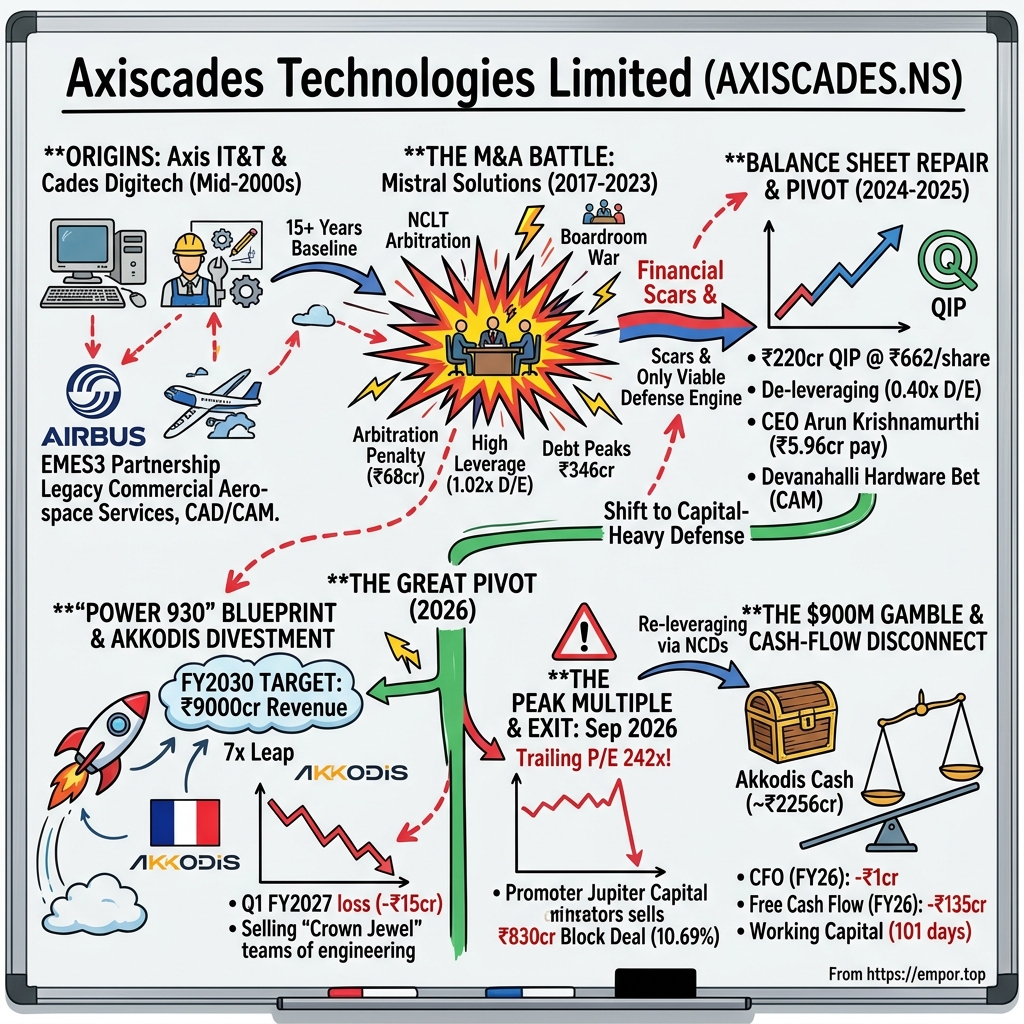
Axiscades Technologies: The $900M Aerospace Pivot, the Promoter's Exit, and the Cash-Flow Disconnect
I. Prologue & Episode Roadmap (10 min)
On the last Tuesday of September 2026, the block-deal window on Dalal Street did something that usually takes a company decades. In one session, about 4.55 million shares of a Bengaluru engineering-services firm changed hands at roughly ₹1,824 apiece. The seller was the company's controlling shareholder. The buyers were two of India's better-known domestic money managers. When the trades cleared, the promoter had taken about ₹830 crore off the table and was no longer the majority owner of the company it had controlled for a generation.1112
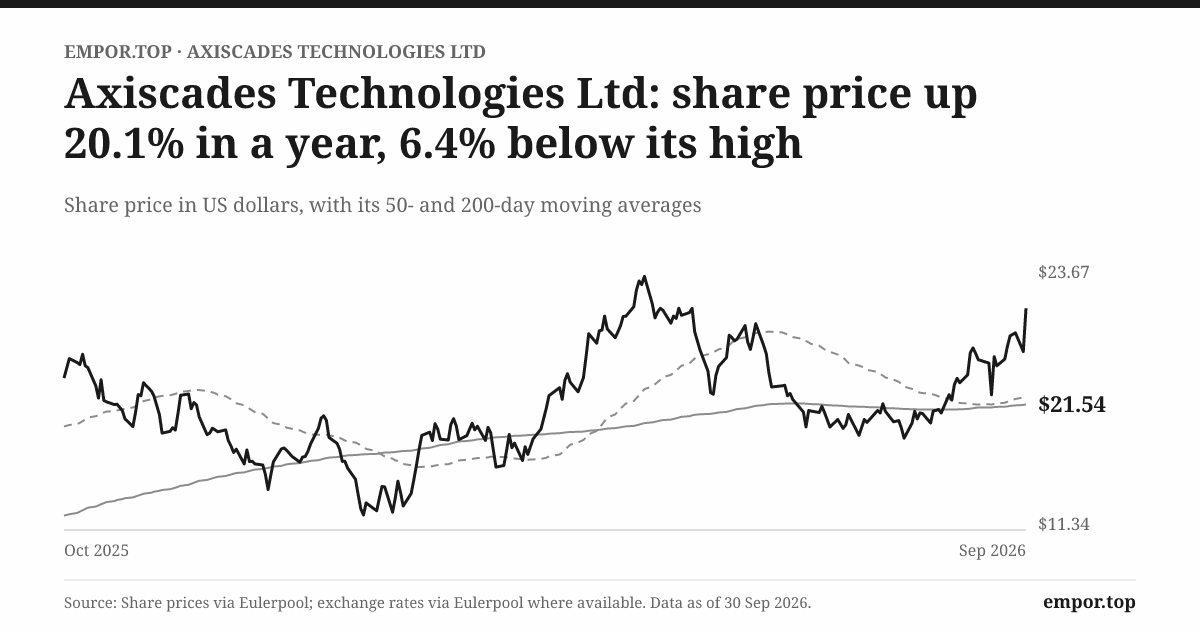
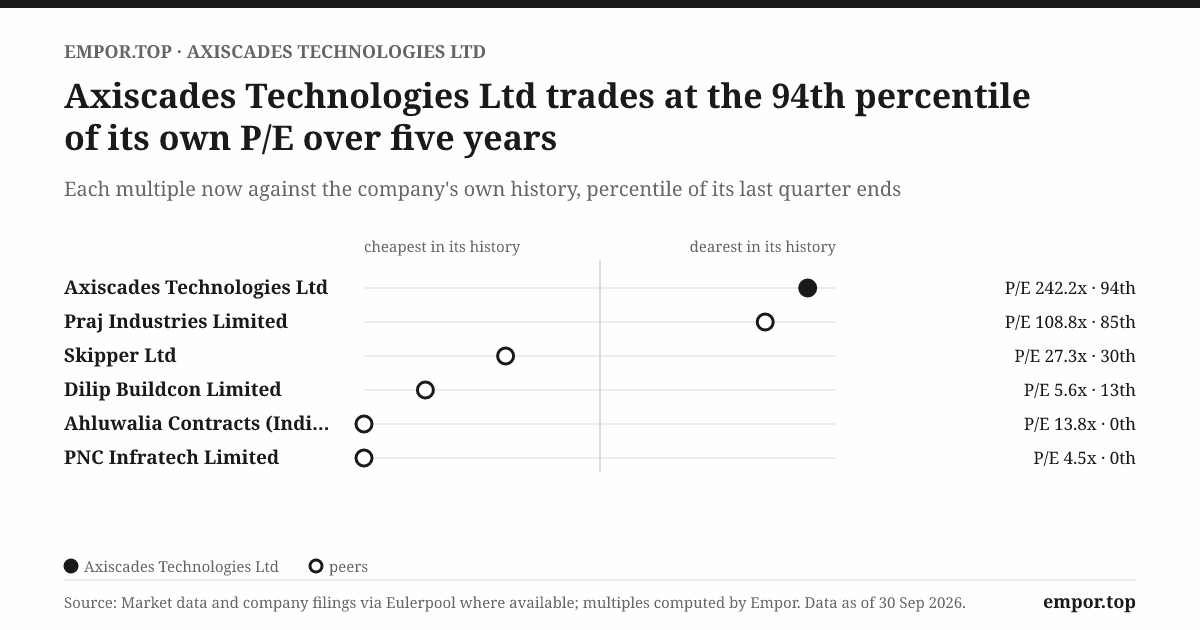
The company was Axiscades Technologies. For most of its life it was the kind of business that never makes headlines: a drafting-table shop that drew stress models of aircraft fuselages for Airbus, wired cabin harnesses on screens, and billed European aerospace companies for the hours of Indian engineers. By the close of September 30, 2026, the market valued that shop at about ₹8,791 crore, roughly $917 million.89 The price was about 242 times trailing earnings, against a five-year median of about 70.8 The shares sat within 5% of their 52-week high, nearly double their 52-week low.9
The multiple alone would be a story. What makes Axiscades worth two hours is the timing. The market handed it that valuation in the same season that its latest quarterly profit turned into a loss.
Here is the sequence. In June 2026, management unveiled "Power 930," a plan to go from about ₹1,159 crore of revenue in FY2026 to ₹9,000 crore by FY2030.13 Weeks earlier, the company had agreed to sell its commercial engineering business, the Airbus-anchored practice that built the firm, to Akkodis, the engineering arm of the Adecco Group, for a headline value of about ₹2,256 crore, or roughly $237 million.2 In late August it agreed to buy 90% of a company called Cloud Wave Technologies.3 In late September it borrowed ₹200 crore through debentures to pay for it.4 A week later, the promoter sold.11
So here is the puzzle this episode tries to solve. Is Axiscades pulling off one of the bolder reinventions in Indian mid-cap history, turning a low-margin outsourced engineering vendor into a homegrown defence electronics, radar and precision-manufacturing company? Or is a hot "defence indigenisation" narrative covering a business whose cash has stopped arriving, whose working capital is getting trapped, and whose controlling shareholder chose this moment to lighten up?
The route through it:
- The origins in Bengaluru: Axis IT&T, Cades Digitech, and the Airbus relationship.
- The five-year fight over Mistral Solutions, the arbitration, and the 2022 settlement.
- The economics of Indian engineering services, and why a 71% fixed-price mix changes everything.
- The 2024–2026 balance-sheet repair: the ₹220 crore QIP, the Devanahalli factory bet, and the return of debt.
- The Akkodis sale and "Power 930": selling the foundation to fund a hardware ambition.
- The 242x multiple and the September block deal.
- The lessons, the competitive analysis, and the moments that will decide the next chapter.
The story starts with the unglamorous part: a room full of engineers drawing somebody else's airplane.
 Subscribe on LinkedIn
II. The Drafting Table: Axis IT&T, Cades Digitech, and the Airbus Lifeline (1990s–2016) (15 min)
Picture a Bengaluru engineering floor in the mid-2000s. Rows of workstations, screens filled with the grey wireframes of a fuselage section, each rib and frame tagged with a load case. Access is badge-controlled and the network is locked down because the drawings belong to a European customer. The engineers are mostly young mechanical graduates. Their job is to answer one question over and over again: will this part of the airplane hold? None of them will ever see their name on the aircraft. That is the business model.
Two small companies, one umbrella
In the early 2000s, while Infosys, Wipro and TCS were building enormous businesses on enterprise software and ERP rollouts, a smaller group of Indian firms took on a different kind of outsourcing: engineering research and development, or ER&D. Instead of maintaining a bank's code, they designed parts, ran simulations and produced manufacturing drawings for industrial and aerospace companies.
Axis IT&T began in CAD/CAM (computer-aided design and manufacturing) and in digitising engineering drawings. It later merged with Cades Digitech, an aerospace design house, and the combined company became AXISCADES Engineering Technologies before taking its current name.115 The listed company still carries that lineage in its registration.15
Control eventually passed to Jupiter Capital Private Limited, the investment vehicle promoted by Rajeev Chandrasekhar, the entrepreneur and later politician who had built BPL Mobile.18 Jupiter pulled several technology and engineering interests under one umbrella and has been the controlling shareholder ever since. It becomes the central character again in Section VIII.
What it means to be an Airbus supplier
The asset that defined Axiscades for fifteen years was its standing with Airbus. The company says it has been an accredited supplier under Airbus's engineering supplier programme for more than fifteen years, working on airframe structures, systems installation and manufacturing engineering.15
For a non-specialist, the work breaks down like this. Stress analysis is the mathematics of making sure a panel, bracket or frame survives the loads of flight. EWIS, electrical wiring interconnection systems, is the routing of the kilometres of cable that run through a modern airliner. Cabin retrofit engineering redesigns interiors for airlines that want new seats or galleys, and each change has to be certified. It is careful, well-documented work, and it takes years to become trusted with it. Suppliers have to pass aerospace quality audits such as AS9100 and then work through qualification programmes that can take several years. A generalist IT firm cannot turn up and bid on the next job.
That is the bull case for the old Axiscades in a single sentence: certification is a wall, and walls keep competitors out.
The concentration problem
The same wall worked in both directions. In recent years the top five customers have provided about 56% of revenue and the top ten about 75%, with Airbus as the anchor.57 In FY2015 the whole company had revenue of about $52 million.5 A firm that size, with more than half its revenue coming from a handful of aerospace buyers, does not set prices. It accepts them.
Myth vs. reality: the certification moat
The myth: marquee OEM accreditation gives a supplier pricing power and steady margins.
The record: from FY2015 to FY2018, while the Airbus accreditation stayed in place, Axiscades' operating margin fell from about 10% to about half a percent. Net profit went from a gain of roughly $3 million to a loss of about $1.3 million.58 Revenue grew over the same period, so the problem was not lost work. The problem was the price of the work.
The mechanism: aerospace OEMs benchmark their vendors hard. They rarely switch engineering suppliers in the middle of a programme, because re-qualification is painful. But that switching cost protects the buyer's supply chain, not the supplier's margin. When rate cards come up for renewal, or when aircraft programmes slip and engineering hours are deferred, the buyer holds nearly all the bargaining power. The supplier's certification only earns it the right to be squeezed.
The verdict: the history narrows the claim sharply. Airbus qualification gave Axiscades a durable revenue base, and that base was real and lasted fifteen years. It did not give Axiscades economic rent. Certification was the entry ticket to the game. It never let Axiscades set the price.
This matters for everything that follows, because by 2017 management had reached the same conclusion. Drawing other people's airplanes was a crowded trade, and automation was coming for the simpler drafting hours. The company needed something it could own. It found that in an embedded-electronics firm on the other side of Bengaluru, and getting it took five years of fighting.
III. The Five-Year Hostage Crisis: The Mistral Solutions Buyout & Arbitration (2017–2023) (18 min)
December 2022. The deal documents are laid out on a boardroom table. The parties across from each other are not strangers negotiating a new deal. They are counterparties who have been in litigation for years: the Axiscades board and the founders of Mistral Solutions. The signatures that day would end a dispute that had outlived the pandemic, several aviation cycles and much of the original strategic logic. Axiscades would finally own 100% of Mistral.10 It would also pay for the delay.
Why Mistral
By 2017, the case for Mistral was easy to make. Mechanical CAD work was becoming a commodity. Mistral was among the better-regarded names in Indian embedded electronics: radar signal-processing boards, naval sonar subsystems, telemetry, electronics for unmanned aerial vehicles, and reference designs for semiconductor systems-on-chip.110 Its customers were the core of India's defence establishment: DRDO laboratories, Bharat Electronics (BEL) and ISRO.17
A simple way to see the difference: Axiscades' old business drew the shape of a system, while Mistral built its nervous system, the circuit boards and firmware that make a radar see or a drone fly. Electronics that sit inside a certified defence platform are much harder to replace than a drafting contractor.
Axiscades structured the deal in four tranches, with equity bought in stages between 2017 and 2020.10 The logic was to spread the cash cost across several years and let Mistral's earnings help fund later payments. On paper it was prudent.
How it went wrong
A staged earn-in works only if both sides agree on how each later tranche will be valued. They did not. After 2018, India's credit markets tightened sharply following the shadow-banking scare, and Axiscades delayed tranche payments.10 The Mistral founders went to arbitration and to the National Company Law Tribunal, alleging breach and seeking higher valuations for the remaining stake.10
Then COVID-19 hit. Commercial aviation, Axiscades' core market, came close to a standstill, and consolidated revenue fell about 22% in FY2021.5 For roughly five years management was running a shrinking aerospace business, a defence subsidiary it did not fully control, and a legal fight over the price of the rest of it, all at once. Integration froze. Legal fees grew. Axiscades lost net money in FY2018, FY2019 and FY2021.5
The bill
The tribunal's final award required Axiscades to pay the remaining consideration with 12% annual interest.10 The settlement closed in December 2022, and the cost appeared in FY2023. An exceptional charge of about ₹68 crore (about $8 million) turned the year into a small net loss of roughly $650,000.510 Borrowings roughly quadrupled to about ₹346 crore, and debt-to-equity went from about 0.2x to just over 1.0x in a single year.5 The cash flow statement shows the same story: about $25 million going out for investment and about $16.5 million coming in from financing that year.5
A 12% compounding rate on a disputed obligation is expensive. It is close to what a mid-rated Indian corporate would pay for unsecured credit, charged here on money the company would have had to pay anyway. The delay did not save cash. It postponed the cash and added interest.
Myth vs. reality: "a patient, staged acquisition"
The claim: staging the Mistral purchase was careful capital allocation that limited risk.
The record: staging turned a single valuation into four negotiations. The deal then sat in dispute for five years, cost a ₹68 crore exceptional charge, and took leverage above 1x. That is not how a disciplined acquirer's record reads.
The counterweight: Mistral is also the reason Axiscades has a defence story at all. Without it there would be no radar boards, no DRDO relationships and no basis for a defence-electronics multiple.
The verdict: the history rejects the claim that the deal was well executed and leaves intact, though smaller, the claim that the asset was strategically right. Axiscades bought the right company and paid too much for it through the process rather than the headline price. That distinction matters later, because the company is now buying again (Cloud Wave) on a similar template: staged or leveraged purchases of promoter-owned private technology firms. The test is whether the next deal's terms are unambiguous and its funding comfortably covered. Section VII takes that up.
With Mistral fully owned and leverage above 1x, the company needed two things: a professional operator and fresh equity. It had brought in the first a year earlier. The second came in January 2024.
IV. The Balance Sheet Overhaul: Arun Krishnamurthi, the ₹220 Crore QIP, and Capital Allocation (2021–2025) (16 min)
Mumbai, January 2024. The QIP roadshow runs through the familiar circuit of fund-house conference rooms in Lower Parel and BKC. The pitch from Axiscades' chief executive is clean: the Mistral fight is over, defence is India's hottest industrial theme, and with debt paid down the company can grow as a lighter, higher-return engineering platform. Within days, institutions put ₹220 crore behind that pitch.6
The operator
Arun Krishnamurthi became Managing Director and CEO in late 2021.1 He came from India's large IT-services world, with senior roles at Wipro and Virtusa, and brought a services executive's instincts: account mining, delivery metrics, and an interest in larger, multi-year deals.1 Dr. Sampath Ravinarayanan serves as non-executive chairman, and independent directors make up half the board, with independent chairs on the audit, nomination-and-remuneration and stakeholder committees.5
His pay tells you how the board valued a professional operator. Mr. Krishnamurthi's total remuneration was about ₹6 crore, nearly all fixed salary, which was roughly 8% of FY2025 consolidated net profit of about ₹75 crore.5 That is high for an Indian mid-cap engineering firm, where CEO pay usually absorbs a much smaller share of profit. The more telling detail is the structure: almost all of it was fixed. Pay that does not move with results is a governance choice, and shareholders approved it without meaningful dissent. AGM and postal-ballot resolutions in 2024 and 2025 passed with more than 98% support.5
The raise
The QIP issued about 3.32 million shares at ₹662 each (face value ₹5), raising ₹220 crore.6 Jupiter Capital's stake fell from about 66% to about 60%.68 The money went where it was needed, to prepay the expensive debentures and term loans left over from the Mistral buyout. Interest expense fell from about ₹58 crore in FY2024 to about ₹34 crore in FY2025.56 Debt-to-equity fell to about 0.4x, and CARE Ratings later listed the QIP among the company's credit strengths.57
Note one detail: ₹662 per share. On September 30, 2026, the stock closed around ₹2,067.9 QIP investors roughly tripled their money in under three years. Seen that way, the raise was underpriced, which is a cost to existing holders that nobody at the time would have called one.
The pivot inside the pivot: Devanahalli
The QIP story was about lightness. What happened next was not. In March 2025 Axiscades began work on a Centre for Advanced Manufacturing at the Devanahalli Aerospace Park near Bengaluru's airport, a facility for precision aerospace and defence hardware.14 Capital work-in-progress went from nothing in FY2024 to about ₹8 crore in FY2025 and about ₹53 crore in FY2026, and net property, plant and equipment rose to about $36 million.5
Think of it as moving from renting out engineers' time to owning machine tools. Machines have to be bought before they earn anything, and a factory's economics depend on how busy it is. Services companies scale by hiring. Manufacturers scale by filling capacity.
Did capital allocation stay disciplined?
The claim (January 2024): the equity raise would reset Axiscades as a deleveraged, asset-light growth platform.
The record: by March 2026, borrowings were back to about ₹388 crore, above the level the QIP had been raised to cut, and debt-to-equity had climbed back to about 0.5x.5 Borrowings were roughly 50% higher than a year earlier, driven by working-capital lines and factory spending.5 About ₹42 crore of the total was lease liabilities, so bank and market debt was closer to ₹346 crore. Even that figure matched the post-Mistral peak.5
The verdict: the QIP did what it was meant to do. It prevented a debt problem. But within two years, management had re-levered the balance sheet to fund a capital-heavy strategy it had not pitched to QIP investors. That is not reckless on its own, but it is a change of strategy, and the market deserved to hear it described that way. The FY2026 cash flow statement then showed just how capital-heavy the new model could be.
V. The Fixed-Price Quagmire: Working Capital, Debtor Days, and the Great FY2026 Cash Bleed (18 min)
Imagine the audit committee's review of the FY2026 accounts. The income statement looks fine: revenue up about 12% to roughly ₹1,159 crore, operating margin around 11.5%, and net profit of about ₹72 crore, only slightly below the prior year.5 Then the committee reaches the cash flow statement. Operating cash flow is negative, about minus ₹1 crore. After capital spending, free cash flow is about minus ₹135 crore.5 The profits were booked, but the cash did not arrive.
A decade of cash that beat profit
To see why that page is so unusual, look at the long record. Across the twelve years from FY2015 to FY2026, Axiscades reported about ₹250 crore of cumulative net profit and about ₹518 crore of operating cash flow, which is 208% of its reported profit.58 Part of that came from large depreciation and amortisation charges, and part from years such as FY2021, when a shrinking business released working capital. Either way, the long-standing view of Axiscades was that its reported earnings understated its cash generation.
FY2026 overturned that view in one year.
How the revenue gets booked
The explanation starts with how Axiscades contracts. About 71% of revenue now comes from fixed-price contracts and only about 29% from time-and-materials work.57
The difference is like the difference between hiring a plumber by the hour and hiring a builder for a fixed-price extension. Under time-and-materials billing, the client pays monthly for hours worked, so cash follows effort closely. Under fixed price, the supplier commits to delivering a result for a set amount and is paid at milestones: design review, prototype, qualification, acceptance. In between, accounting rules let the company recognise revenue as it incurs cost (the "percentage-of-completion" method), but that revenue sits on the balance sheet as unbilled revenue or contract assets until the milestone is signed off. At Axiscades, those balances make up more than 20% of receivables.5
Fixed price has two costs. The supplier carries the overrun risk, since estimates can be revised downward. It also carries the timing risk, because cash arrives only when the buyer says the milestone is complete.
The defence customer's calendar
Now add who the buyer is. Mistral's customers are DRDO labs, defence PSUs such as BEL, and ISRO.7 Their approval processes are thorough and slow: technical acceptance, then committee sign-off, then disbursement against a budget allocation. Receivables from these buyers routinely take more than 180 days to collect.5
The effect shows up in the ratios. Debtor days went from about 107 in FY2025 to about 130 in FY2026, not far below the 2018 peak of 162.8 Working-capital days went from 48 to 75.8 Trade receivables ended the year at about ₹331 crore.5 Inventory for defence subsystems also absorbed cash.5 The cash conversion cycle actually shortened slightly, from about 111 to about 101 days, because supplier payments were no longer being stretched: days payable roughly fell from 100 to 63.8 The company lost the cushion of paying its own suppliers late at the same time as its customers were paying it later.
The treasury drains
Operating cash flow ended at about ₹1 crore negative. Add roughly ₹71 crore of capital spending, including the Devanahalli work, and free cash flow fell from about +₹50 crore in FY2025 to about –₹135 crore.5 Cash from operations as a share of EBITDA went from about 55% to about –10%.8 Cash and short-term investments fell from about ₹215 crore to about ₹50 crore in twelve months.5 The company entered FY2027, the year of its biggest restructuring, with the smallest cash cushion it had held in years.
Myth vs. reality: "Axiscades converts profit into cash"
The claim: a 208% twelve-year conversion ratio shows reported earnings are conservative.
The disconfirming evidence: the ratio was earned by a services business that billed hours. The business Axiscades is becoming, fixed-price defence programmes plus a factory, collects slowly, holds inventory and needs capital spending before it earns revenue.
The generous reading: FY2026 could be timing. A few large Mistral milestones slipped across the year-end, and a strong collection quarter would reverse much of the drain.7
The verdict: the history leaves the generous reading possible but unproven, and it rejects using the twelve-year ratio as evidence for the new business. The number to watch is operating cash flow in the H1 FY2027 statement and whether debtor days fall back toward 105. If they stay above 130, the cash drain is how the new model works, not a bad year.
Of the whole story, this is the most important point to take from the ratios. Axiscades had just shown, on its own numbers, that its defence business uses cash. Three months later, it agreed to sell the business that produced cash.
VI. "Power 930" and the Akkodis Divestment: Selling the Crown Jewel to Chase a Pipe Dream? (18 min)
June 2026. Two things reach the market in quick succession. The first is a board outcome filed with the exchanges: Axiscades has agreed to transfer its commercial aerospace engineering business, the practice built around Airbus, to Akkodis, the Adecco Group's engineering and technology arm, in a staged deal worth about ₹2,256 crore, or roughly $237 million.2 The second is a strategy with a memorable name. "Power 930" targets ₹9,000 crore of revenue and about ₹960 crore of net profit by FY2030.13 Put together, they amount to selling the business Axiscades has been for twenty years to fund the one it wants to become.
The arithmetic of ambition
Power 930 asks revenue to grow nearly eightfold in four years, from about ₹1,159 crore, which is a compound rate of about 50–70% a year depending on how the divested base is counted.13 Axiscades' own record is about 12% a year over ten years and about 17.5% over the last five, and that five-year figure includes the Mistral consolidation and a rebound from the pandemic.8 The target also implies a net margin of about 10.7%. The company has not reached a full-year net margin above about 7.6% in the twelve years on record.5
So Power 930 needs both a growth rate several times the company's history and a margin it has never achieved, and it starts from a smaller base once the commercial business leaves. Management says the gap will be closed by high-margin indigenous defence technology, naval combat systems, radar signal processing, avionics and acquisitions, all carried by India's "Make in India" defence procurement push.13 These are management's targets. The company has not disclosed an order book that covers them.
What Akkodis is actually buying
Akkodis is buying engineers and relationships: hundreds of tier-one aerospace engineers and the client workflows attached to them, including the core Airbus work.2 Filings show the transfer is structured partly through a slump sale and partly through a new vehicle, Akkodis Axiscades Aerospace Engineering Private Limited, incorporated in September 2026.25 Axiscades' workforce had grown from about 1,873 in early 2025 to about 2,812 by the third quarter of FY2026, before commercial-engineering staff were ring-fenced for the transfer.5
The price is generous by the standards of the old business. For context, the entire listed company was worth a fraction of today's market value when the deal was announced. For a business with thin margins and heavy customer concentration, ₹2,256 crore is a strong exit. The terms that matter most, though, are those "staged tranches." The research record and the credit agency both describe the consideration as paid over time.27 Headline value and cash received are different numbers, and the company has not published a schedule that would let an outside investor reconcile them.
Q1 FY2027: the first look at the remainder
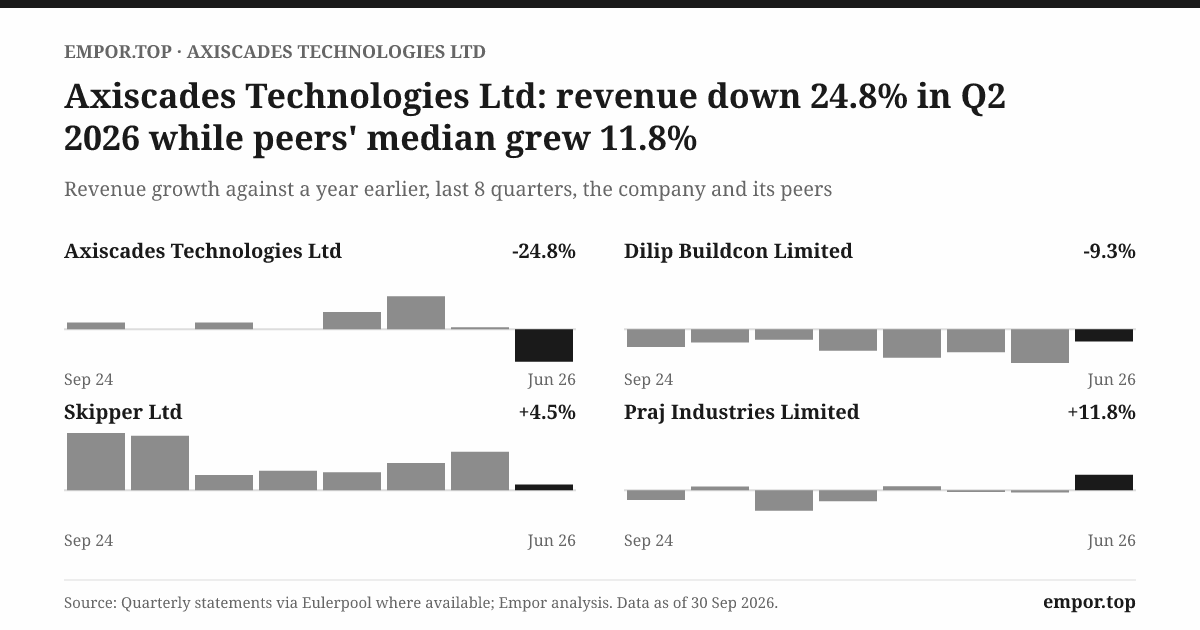
The quarter ended June 30, 2026 gave the first view of the new shape. Revenue fell about 25% from a year earlier to about $19.4 million (roughly ₹183 crore).5 Operating profit went to almost exactly zero, about –$7,000, from a 10% margin a year earlier.5 Other income, which had inflated profit in the June 2025 quarter, turned slightly negative, and the quarter ended with a net loss of about ₹15 crore.5 Axiscades has not provided a clean split of how much of the decline came from ring-fencing the divested business and how much came from the businesses it is keeping.
The trailing P/E of 242x is largely this quarter at work. Replace a profitable June 2025 quarter with a loss-making June 2026 quarter in the trailing twelve months, and the earnings denominator shrinks.
The rating agency's yellow card
On June 23, 2026, CARE Ratings reaffirmed Axiscades' bank facilities at CARE A- (long term) and CARE A2+ (short term), and placed all of them on Rating Watch with Developing Implications.7 "Developing" means the agency could not yet tell whether the change would improve or weaken credit quality. Its concerns were specific: execution of the carve-out, how the proceeds would be deployed, and whether new acquisitions and the order book could replace the revenue being sold.7 Among the named constraints were moderate scale, sensitivity of margins to fixed-price overruns and currency, and high customer concentration.7
The verdict on the trade
Selling the commercial business does two useful things. It brings in cash that does not dilute shareholders, enough in principle to repay all of the company's debt several times over, and it exits a business the Section II history showed never had pricing power. Those benefits are real.
It also removes the part of Axiscades that had predictable cash flow and leaves the part that Section V showed consumes cash. Whether the trade works depends on whether the remaining company can show standalone defence margins and cash conversion before the proceeds are spent. The key figure is organic revenue and EBITDA margin for the continuing business in Q3 FY2027. Management had other plans for the proceeds, and it did not wait for them to arrive.
VII. The Cloud Wave Acquisition & Re-Leveraging via NCDs (September 2026) (12 min)
September 22, 2026. The board approves the private placement of ₹200 crore of secured, redeemable non-convertible debentures, unrated and unlisted.4 The stated purpose is to pay for 90% of Cloud Wave Technologies Private Limited, a deal announced at the end of August at an enterprise value of about ₹260 crore.34 Less than a month earlier, the credit agency had put the company on watch in part because of planned acquisitions.7
What Cloud Wave is meant to add
Management presents Cloud Wave as a capability purchase: defence cloud infrastructure, secure communications and aerospace data analytics.3 Strategically, it fits the Power 930 story. Defence platforms increasingly need secure data systems in addition to boards and firmware. Axiscades has not disclosed Cloud Wave's revenue, profitability or order book in the materials that accompanied the deal, so the purchase price cannot be tested against earnings.3 At ₹260 crore for a business the company has not sized publicly, investors are being asked to trust the acquirer.
Debt before proceeds
The financing order is the analytically interesting part. Axiscades had agreed to receive about ₹2,256 crore from Akkodis. Rather than waiting for those tranches, it issued ₹200 crore of new secured debt.4 Added to the roughly ₹388 crore of borrowings at March 2026, that takes gross debt to nearly ₹590 crore, before any Akkodis cash is used to repay anything.45 At the same time, operating profit, which covered interest about 4.2 times in FY2026, had just gone to zero for a quarter.5
There may be sensible reasons: tranche timing, a seller who wanted certainty, a bridge to be repaid from proceeds. The company has not said which. What the record shows is the order of events: borrow first, receive the cash later.
The echo of 2017
A skeptic's version of this section is short. In 2017 Axiscades bought a privately held technology company in stages, funded partly with debt, before its existing business was on solid footing. The result was five years of dispute and leverage above 1x. In 2026 it bought a privately held technology company, funded with debt, before its existing business had shown standalone profits after the carve-out.
The differences matter too. The company is larger, it has a credit rating, it has an incoming source of cash, and it bought 90% outright rather than through a formula for future tranches. So the history does not say Cloud Wave will turn out like Mistral. It narrows the question to three things investors can check: whether the NCDs are repaid from Akkodis proceeds within a year, whether any earn-out or deferred terms are clearly defined, and whether Cloud Wave's contribution appears in the reported numbers.
Management told the market in 2024 that deleveraging was the plan. By September 2026 it was borrowing to buy growth. One week later, the controlling shareholder answered the valuation question in its own way.
VIII. The Peak Multiple & The Great Block Deal: Jupiter Capital's ₹830 Crore Exit (September 2026) (15 min)
Back to where the story began: September 29, 2026, the block window. About 4.55 million shares traded at around ₹1,824 each, about 11% of the company, sold by Jupiter Capital for about ₹830 crore.11 Abakkus Asset Manager and Kotak Mahindra Mutual Fund together took about 8%.12 Promoter ownership fell from about 58% to about 47%.11 The company that Rajeev Chandrasekhar's vehicle had controlled with a clear majority is now, on paper, a promoter-led company with a minority promoter.
What the market was paying
The day after the trade, Axiscades was priced at about 242 times trailing earnings, 57 times EV/EBITDA, nearly 13 times book value and about 8.6 times sales.8 Its free cash flow yield was slightly negative.8 Its own five-year median P/E is about 70.8
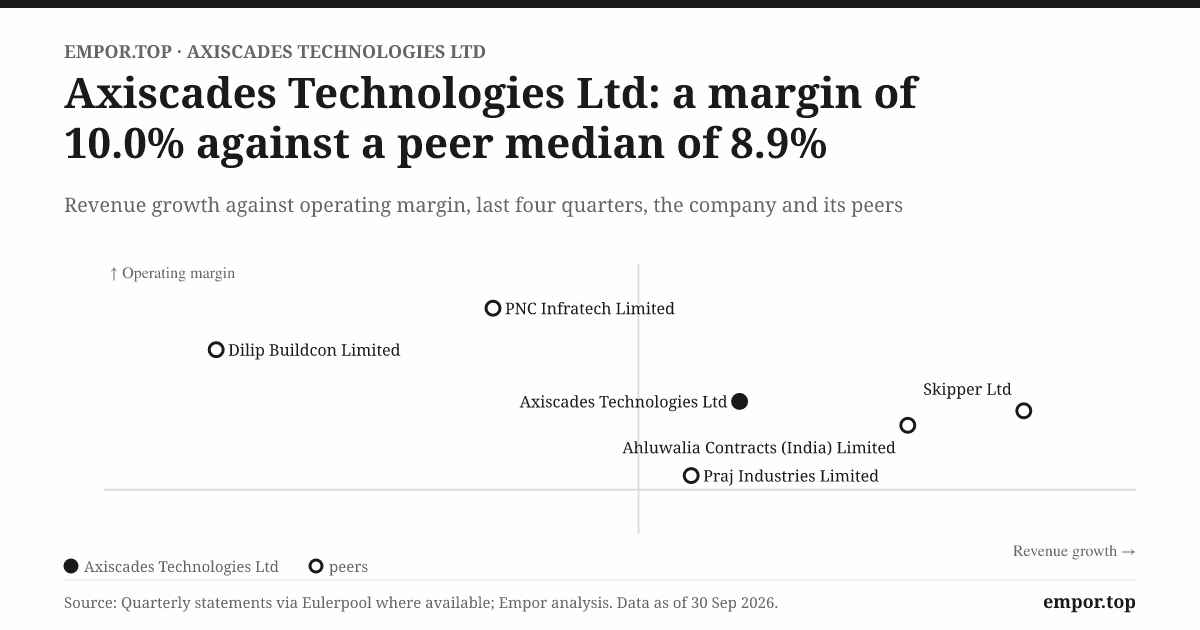
Peers help frame this. Among listed engineering-services companies, Tata Technologies, L&T Technology Services and Cyient traded in roughly the 28x–55x earnings range, with operating margins in the mid-to-high teens, which is better than Axiscades' 11.5%.8 Defence electronics names such as Data Patterns and Astra Microwave traded around 50x–75x.8 Axiscades was priced well above even the defence group, on a revenue base that was still mostly engineering services and a latest quarter that showed an operating loss.
What does 242x assume? Take the trailing EPS of about ₹8.5 and a share price of about ₹2,067.8 If the stock were to trade at Data Patterns' roughly 75x at the same price, earnings would need to roughly triple. Power 930's ₹960 crore profit target would imply earnings about thirteen times FY2026's roughly ₹72 crore.513 The market is not paying for what Axiscades is today. It is paying for a large part of the Power 930 plan being delivered.
The slow exit, then the fast one
The promoter's holding declined for five years before the block deal, from about 68% in March 2021 to about 58% by March 2026.8 Much of that was passive dilution through the QIP and ESOP issuance. September 29 was not passive. It was a sale of a tenth of the company at close to the highest valuation in its listed history.
Two readings
The generous reading: a promoter that has run the company for two decades is handing it to professional management and institutional owners. The block deal widens the institutional base, improves trading liquidity, and follows a strategic reset that the promoter supports. Selling part of a large, concentrated stake after a sharp re-rating is ordinary portfolio management, and Jupiter still holds nearly half the company.
The skeptical reading: the seller knows the business better than anyone. It sold three months after Power 930, one week after new debt, during the first loss-making quarter in years, and at a multiple more than three times the stock's own five-year median. The buyers took on execution risk at the same moment the seller reduced it. Retail investors also arrived late: public shareholders numbered about 17,900 in September 2023 and more than 46,000 by June 2026.8
The verdict
A single block sale does not prove a loss of confidence. Promoters sell for tax, liquidity and personal reasons, and Jupiter has not stated its reasons. But the evidence here is a trade, not a statement, and trades are harder to spin. At the price Jupiter accepted, it judged ₹830 crore in cash more valuable than the same stake held through the Power 930 years. The December 2026 shareholding filing will show which reading was right: a standstill supports the first, and another block sale supports the second.
IX. Playbook: Business & Investing Lessons (12 min)
Lesson 1: A certification is a key to the building, not a lease on the land. For fifteen years Axiscades held one of the most coveted qualifications in aerospace engineering, and in FY2018 its operating margin was about half a percent. Qualification kept rivals out. It did nothing to hold back Airbus's procurement team at rate-card renewal. For founders, the lesson is that a barrier to entry protects your position only against competitors, not against your customer. For investors, it is to measure a supplier's moat by gross margin across a downturn, not by the logos in its deck. Being qualified to build an airplane's wings gets you a seat at the table; it doesn't give you the power to set the price.
Lesson 2: Read the promoter's trade before the promoter's plan. In June 2026, Axiscades set out a plan to grow roughly eightfold by 2030. In September, its controlling shareholder sold a tenth of the company at 242 times earnings. Both can be true at once: the plan may be sincere and the sale may be prudent. But they cannot carry the same weight as evidence. A plan costs nothing to announce, while a sale fixes a price in cash. When management promises 50% compound growth to 2030 but the controlling shareholder sells a 10% block at 240 times earnings, believe the trade, not the transcript.
Lesson 3: A cash-conversion ratio expires when the business model changes. For twelve years, Axiscades generated about twice as much operating cash as it reported in profit. In its first full year as a fixed-price, factory-owning defence supplier, it generated none. The ratio described a company that billed hours, and that company is now being sold to Akkodis. Investors who relied on it were measuring the past. A historical cash-conversion ratio belongs to the business you used to run, not the one you are building.
Lesson 4: In a staged acquisition, the formula is the deal. Axiscades chose Mistral well and paid for it badly. It did not overpay on the headline price. It lost five years to arguing about what later tranches were worth, and a tribunal then applied 12% interest to the difference. The ₹68 crore exceptional charge and the jump in leverage came from contract drafting, not from the asset. The same company has just bought Cloud Wave. In a staged earn-out, an ambiguous valuation formula is an unexploded bomb on your balance sheet.
X. Analysis: Strategic Moat, Porter's 5 Forces, & Bull vs. Bear Case (14 min)
Picture an analyst's screen with four columns: Bharat Electronics, Data Patterns, Astra Microwave and Axiscades. The rows are operating margin, cash conversion cycle, order-book cover and valuation. Axiscades has the lowest margin in the group, the weakest recent cash conversion, no disclosed order book to compare, and the highest earnings multiple. The rest of this section is about whether that valuation column is missing something.
Hamilton Helmer's 7 Powers
- Scale economies: weak. About ₹1,159 crore of FY2026 revenue, and less after the carve-out, compares with BEL's revenue of more than ₹20,000 crore.5 In defence electronics, scale spreads R&D, testing and qualification costs, and Axiscades is small.
- Switching costs: moderate, and real. Once a Mistral board is designed into a naval console or a UAV payload and qualified, replacing it means re-certification. This is the strongest power Axiscades has. It applies to specific programmes, not to the company as a whole.
- Cornered resource: narrow. Mistral's signal-processing IP and its long relationships with DRDO labs matter, but they sit largely in people's knowledge, and people can leave. The company has not disclosed defence-segment attrition.
- Counter-positioning: absent. BEL, HAL and the large ER&D firms face no structural barrier to doing what Axiscades is doing. Several already are.
- Network effects, brand, process power: not present in any measurable way.
The verdict is one real power, programme-level switching costs, which is valuable but narrow. Section II showed that switching costs in aerospace favoured the buyer. The same caution applies to defence, as the next part shows.
Porter's Five Forces
- Buyer power: extremely high. Before the carve-out, the buyers were Airbus and a few OEMs. After it, they are the Ministry of Defence, DRDO, BEL and ISRO. Government buyers set milestones, audit costs, levy liquidated damages and pay on their own schedule. The 130 debtor days reflect this directly.8 Indigenisation policy helps domestic suppliers as a group, but it also expands the domestic vendor base, which means more Indian competitors bidding for the same programmes.
- Supplier power: moderate to high. FPGA engineers, RF designers and embedded-software specialists are in short supply across India's defence and semiconductor build-out, and their pay is rising.
- Threat of substitutes: high in the business being sold, lower in the business being kept. Generative design and automated simulation threaten routine CAD hours, which is part of why selling the commercial practice makes sense. Mission-critical defence hardware is much less exposed.
- Threat of new entrants: moderate. Security clearances and qualification cycles keep out start-ups, but not L&T Technology Services, Tata Technologies or private defence groups.
- Rivalry: intense. Data Patterns, Astra Microwave and Paras Defence are focused defence-electronics companies with better margins and more sovereign programme history.
The KPIs that matter
Three indicators decide this story: 1. Operating (EBITDA) margin of the continuing business. Latest reading: about 0% in Q1 FY2027, down from 10% a year earlier.5 2. Debtor days. Latest reading: about 130 in FY2026, up from 107.8 3. Net debt after Akkodis proceeds. Latest reading: about ₹338 crore at March 2026, before the ₹200 crore NCDs were added.54
The bull case
- The Akkodis proceeds arrive as cash, clear all debt including the NCDs, and fund defence capex without dilution.2
- Mistral's programme positions become platforms for India's indigenisation push, and Devanahalli wins precision-hardware orders that fill capacity.14
- Cloud Wave adds a data and secure-communications layer that raises content per platform.3
- The company emerges as a smaller, cleaner defence technology business with a net-cash balance sheet, and the multiple is then applied to a better business.
The bear case
- The carve-out removes the steady revenue base. Q1 FY2027 has already shown the remaining business at breakeven operating profit.5
- Defence hardware keeps absorbing working capital. Debtor days stay above 130 and free cash flow stays negative.8
- Proceeds go into acquisitions before the debt is repaid, and history shows this acquirer's deals can take years to digest.
- The most informed shareholder sold at 242x.11
- If Power 930 falls well short, the multiple does not need to collapse to hurt. A move back to the stock's own five-year median of about 70x on flat earnings would take away most of the current valuation.8
An activist's questions
A skeptical long/short investor would ask management five things. What is the cash schedule for the Akkodis consideration, and what is conditional? Why borrow ₹200 crore before those tranches arrive? What revenue and margin does Cloud Wave bring? What is the order book of the continuing business, and how many years of revenue does it cover? And why is the CEO's pay almost entirely fixed at a company whose plan depends on performance? These are not hostile questions. They are the disclosures any investor needs to judge a 242x multiple.
The analysis leaves the market at a crossroads. The next few quarters will tell investors which way the company is going.
XI. Epilogue: The Next Moments that Decide the Story (8 min)
Tonight, Axiscades stands between two companies. One is being handed over to Akkodis: twenty years of airframe drawings, Airbus workflows and hundreds of engineers who learned their trade on European aircraft. The other is still being assembled: Mistral's boards, a factory taking shape at Devanahalli, a newly acquired cloud business, and a 2030 plan that projects growth the company has never come close to. The market has priced the second company as if the transition were already complete. The controlling shareholder has sold part of its stake at that price.
Three moments will decide how this reads a year from now.
First, the Akkodis cash. The deal is worth about ₹2,256 crore on paper.2 What matters is how much arrives as cash, when, and where it goes. If it pays off the roughly ₹388 crore of existing borrowings and the ₹200 crore of new debentures, and leaves a net-cash balance sheet, the CARE watch probably resolves in the company's favour and the Mistral-era leverage fears end.7 If it goes first into more acquisitions, the Section VII questions become the central issue.
Second, the margins of the continuing business in the second half of FY2027. The June quarter showed an operating margin of about zero and a ₹15 crore loss.5 A defence-technology company deserving a premium multiple would need to show standalone EBITDA margins above 15%, together with operating cash flow that is positive and not just reported profit. A few quarters of that would give Power 930 its first real support. Continued breakeven quarters would make the carve-out look like a sale of the profitable part of the company.
Third, the promoter's next filing. The December 2026 shareholding pattern will show whether Jupiter Capital still holds about 47%.11 If it does, the September sale looks like a one-time rebalancing. If it has fallen further, the market will read it as a gradual exit from control.
Each of these corresponds to one of the story's central questions: whether the pivot can be funded, whether the new business can produce cash, and whether the people closest to it believe in it. None has been answered yet. The stock price already assumes the answers are favourable.
XII. Outro (4 min)
Go back to the Bengaluru engineering floor of the mid-2000s: the grey wireframes, the badge doors, the young engineers checking whether somebody else's wing would hold. Axiscades was founded on the belief that mastering the stress points of an Airbus airframe would protect it permanently. It took twenty years to learn otherwise. In global aerospace, the engineering-services trade helps build everyone's aircraft but owns no part of the business that flies them.
Now Axiscades has decided to own the hardware. To pay for it, it sold the business it was built on, at the peak of the market, during a quarter with no operating profit, and its promoter reduced its stake the same week. Stress engineers have a term for the point where a structure's load moves from the part that was designed to carry it onto parts that were not: load redistribution. Axiscades is now going through its own version of that test, with the weight of a ₹8,800 crore valuation resting on its newest parts.
References
-
Axiscades Technologies Limited Corporate & Investor Portal — Axiscades IR ↩↩↩↩↩↩↩
-
BSE Corporate Disclosures: Outcome of Board Meeting & Agreement for Transfer of Commercial Aerospace Business to Akkodis — BSE India, 2026-06-12 ↩↩↩↩↩↩↩
-
BSE Corporate Disclosures: Acquisition of Majority Stake in Cloud Wave Technologies Private Limited — BSE India, 2026-08-28 ↩↩↩↩↩
-
BSE Corporate Filings: Private Placement of ₹200 Crore Secured Redeemable Non-Convertible Debentures — BSE India, 2026-09-22 ↩↩↩↩↩↩
-
BSE Corporate Filings: Notice of 36th Annual General Meeting and FY2026 Annual Report — BSE India, 2026-09-05 ↩↩↩↩↩↩↩↩↩↩↩↩↩↩↩↩↩↩↩↩↩↩↩↩↩↩↩↩↩↩↩↩↩↩↩↩↩↩↩↩↩↩
-
NSE Corporate Announcements: Placement Document for Qualified Institutions Placement (₹220 Crore QIP) — National Stock Exchange of India, 2024-01-15 ↩↩↩↩
-
CARE Ratings Credit Report: Axiscades Technologies Limited Rating Watch with Developing Implications — CARE Ratings, 2026-06-23 ↩↩↩↩↩↩↩↩↩↩↩↩
-
Consolidated Financial Results & Shareholding Pattern for AXISCADES Technologies Ltd — Screener.in ↩↩↩↩↩↩↩↩↩↩↩↩↩↩↩↩↩↩↩↩↩↩↩
-
Axiscades Technologies Ltd Financial Statements and Stock Performance — National Stock Exchange of India ↩↩↩
-
Axiscades Completes Acquisition of Mistral Solutions Following Arbitration Settlement — Economic Times, 2022-12-19 ↩↩↩↩↩↩↩
-
Jupiter Capital Sells 10.7% Stake in Axiscades Technologies in ₹830 Crore Block Deal — Moneycontrol, 2026-09-29 ↩↩↩↩↩↩
-
Abakkus and Kotak Mutual Fund Pick Up Stakes in Axiscades Technologies via Block Window — CNBC TV18, 2026-09-29 ↩↩
-
Axiscades Unveils 'Power 930' Plan Targeting ₹9,000 Crore Revenue by FY30 — Business Standard, 2026-06-15 ↩↩↩↩↩
-
Axiscades Begins Work on Aerospace and Defense Manufacturing Facility at Devanahalli — Hindu BusinessLine, 2025-03-24 ↩↩
-
Ministry of Corporate Affairs (MCA) Portal: Registered Filings for Axiscades Technologies & Mistral Solutions — MCA India ↩↩
 LinkedIn
 WhatsApp
 Reddit
 Hacker News
 Email
Email Kindle
 RSS Feed
 Spotify
 Apple Podcasts
 Amazon Music
 Audible
 YouTube