Avartan: The Magnet-Free Motor’s First Real Test
I. The Nomination Meets the Numbers
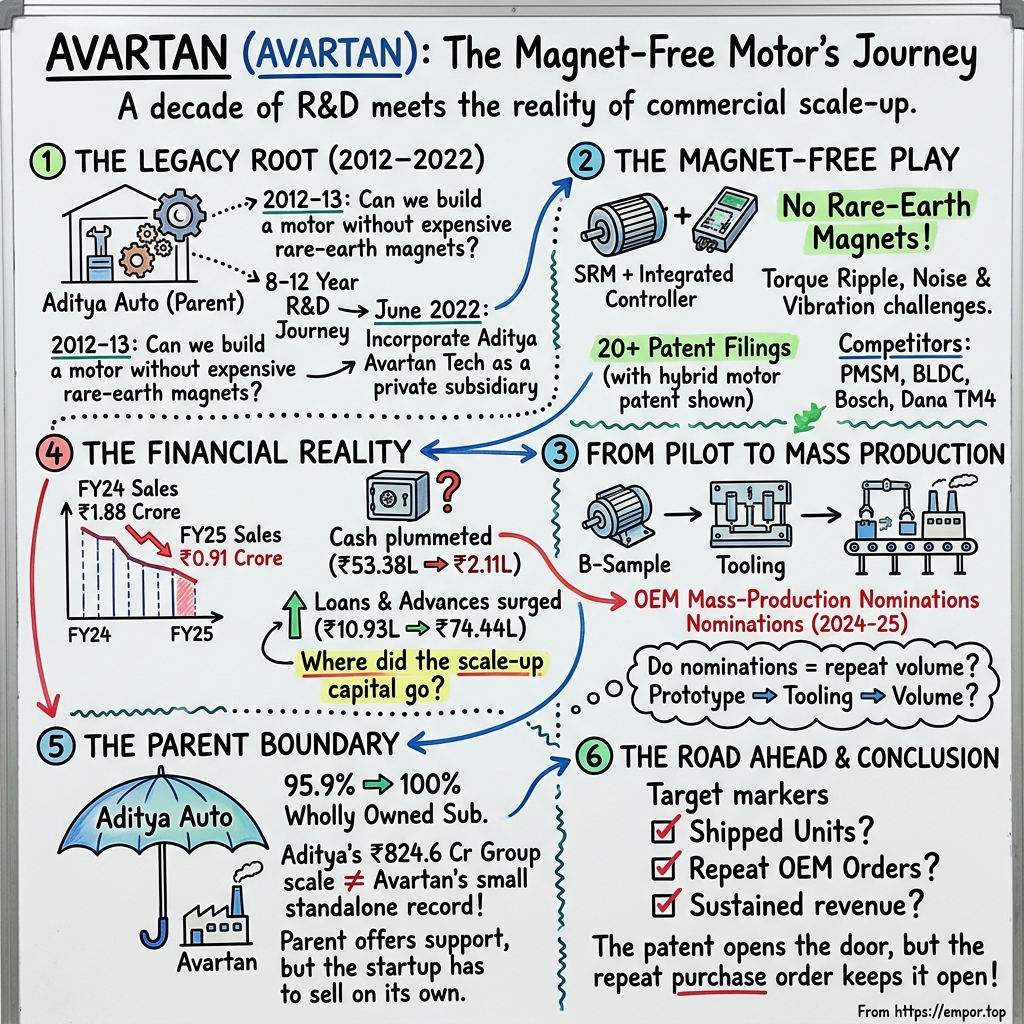
Somewhere in a supplier's calendar there is a day that every hardware founder imagines for years. A customer's purchasing team stops asking for samples and starts talking about production. For Avartan, that day falls in its own timeline under the heading "Mass production," dated 2024–25, where the company says it received a formal nomination from pilot customers for mass production and supply, and marked the start of production.1
It is the most important sentence the company has published about itself. It is also the sentence that the numbers do not yet echo.
A summary of the accounts Avartan filed with India's Ministry of Corporate Affairs shows sales of goods and services of about ₹1.88 crore in the year to March 2024, falling to about ₹0.91 crore in the year to March 2025.2 The year in which the company says its motors were nominated for mass production is, on that record, a year in which sales roughly halved.
That gap is where this story lives. An automotive nomination is a promise of a seat at the table, not a meal. Between a manufacturer saying yes and a supplier having a durable business, a great deal has to happen: tooling has to be cut and approved, the customer's vehicle or appliance has to launch, the launch has to sell, and the supplier has to ship part after part, month after month, at a price that leaves money over. Only when the second and third purchase orders arrive does a nomination become a franchise.
The company in question is Aditya Avartan Technologies Private Limited, a private company in Bengaluru that develops and makes switched-reluctance motors and their controllers, the electronics that tell a motor when and how hard to pull.3 It was incorporated in June 2022.4 Its research, however, is older than its corporate shell. Avartan's own timeline begins in 2012–13 with initial research and evaluation of switched-reluctance traction, work done inside Aditya Auto, the Bengaluru automotive supplier that still owns almost all of it.15
That double boundary matters from the first minute. Avartan has a decade-old engineering lineage but a four-year-old company record. It has a parent with hundreds of crores of revenue but standalone sales measured in lakhs. A reader who blurs those lines will flatter the business; one who ignores the lineage will miss why it exists.
Four questions carry the story. Has more than a decade of motor research become revenue that repeats? Can a reluctance motor, an old idea that engineers have long found hard to tame, win orders against the permanent-magnet designs that dominate electric vehicles? Where did the money go in the year the company says it moved into production? And who, in the end, owns the upside: an outside public shareholder, an early fund, or the parent that built it?
There is no shortcut to those answers. Avartan is not listed anywhere. It has filed no draft red herring prospectus, red herring prospectus or other offer document with the Securities and Exchange Board of India or the exchanges, and corporate registries describe it as an unlisted private company.4 There is no share price to read the market's mood, no earnings call where an analyst pressed management on volumes, and no annual report with a chairman's letter to hold against later results.
What exists instead is thinner but still revealing: the company's own website and its timeline, a handful of patent records, a submission to an industry innovation compendium, two credit-rating agencies' views of the parent group, and third-party summaries of statutory filings that, as will become clear, do not agree with each other. Read as a diligence file rather than a marketing file, that record says something specific. The engineering is real and documented. The commercial proof is not yet visible.
The nomination, in other words, is the first real test of the magnet-free motor, not its passing grade. To see why the test matters so much, the story has to begin where the motor did: inside a company that made window regulators.
 Subscribe on LinkedIn
II. The Motor Project That Outlived Its First Company
Aditya Auto was not founded to build electric motors. The promoter, C. Jayaraman, set the company up in 1996, and it began operating in 2000 by exporting wiring-harness assemblies to carmakers in Europe.5 In 2001 it bought the door-and-access business of Arvin Meritor, which moved it into window regulators and door latches, and over the following decade it pushed backward into the parts that go inside those systems.5
One of those backward steps put motors on the factory floor long before anyone at the company talked about rare earths. In 2010 Aditya Auto commissioned a plant at Doddaballapur, outside Bengaluru, that made small motors, described by ICRA in one rationale as small starter motors and in a later one as window-regulator motors.56 A company that winds copper and stamps laminations for the motor that lowers a car window has, at least, the shop-floor vocabulary for bigger motors.
The parent also learned early how to grow by bolting on capability. It built an injection-moulding, cold-forging and fine-blanking operation at Trichy in 2008; from FY2012, it integrated further backward into tools and dies by acquiring the Bengaluru facilities of the Nettur Technical Training Foundation, a former vendor.5 A company that owns its own toolroom can cut a prototype lamination die or a test fixture without waiting in a vendor's queue, which is exactly the kind of quiet advantage a motor research programme needs in its early, iterative years.
That is the soil in which Avartan's timeline plants its first seed: switched-reluctance research.1 By 2017–18 the timeline records proof of concept and the start of patent filing, with prototypes benchmarked against the brushless and induction motors already in use.1 Development of centre-drive and hub-drive battery motors and of mains-powered motors runs through 2019–23, including pilot production and validation.1
Only partway through that last phase did the work get its own company.4 The website frames Avartan as standing on Aditya Auto's legacy.1 Corporate summaries list Chandrachudan Jayaraman and Mihir Jayaraman as its directors since incorporation.4
Why would a profitable component maker carve a research programme into a separate entity a decade in? The company does not publish its reasoning, but the structure has familiar logic. A separate company can take in outside capital without diluting the parent, can hold intellectual property in a clean box, can apply for grants and recognition as a technology venture, and can be valued, sold or listed on its own one day.
Avartan did take outside money: a fund called Artha99 Investment AIF Trust appears as its second shareholder, with about 4%, as of January 2025.7 The fund's manager has described Avartan in its portfolio as a "rare earth-magnet free motor maker."8
The carve-out also leaves an unanswered diligence question. Avartan's timeline says patent filing started in 2017–18, years before the company existed.1 Whoever filed in those years, it could not have been Avartan. The patents now visible in Avartan's name were filed from 2023 onward.91011 Avartan does not publish whether earlier filings, know-how and test data were assigned to it, licensed to it, or remain with the parent. For a future public investor that is not a technicality: a subsidiary whose core intellectual property sits partly with its controlling shareholder is a different asset from one that owns its inventions outright.
The company also measures its own history inconsistently. The homepage speaks of eight years of research and development, and the product and technology pages repeat the eight-year figure.123 Avartan's 2024 entry in the Confederation of Indian Industry's innovation compendium describes products "developed through a 12 year rigorous research and development journey."13 The same entry says the company stems from a 20-year legacy at Aditya Auto; the story page refers to a 15-year legacy; and the homepage claims more than three decades of automotive experience.13112
None of that is evidence of anything sinister. Different counting conventions, one starting from the first sketch and another from a funded programme, can produce eight and twelve years for the same work. But the inconsistency is still informative, because it shows how the company presents itself: as an heir to a long engineering lineage. Every one of those numbers measures development time. None measures commercial performance, and none is audited.
Patient backing is not a luxury in this business; it is the price of entry. A traction motor is not sold like a gadget. It goes through design and simulation, prototype samples, a more production-representative "B-sample", durability and environmental testing, homologation of the vehicle it powers, production tooling and the customer's own sign-off on the line that makes it. Each stage takes months; failure at any stage can send the design back to the bench. A startup without a parent's machine shop, cash flow and customer contacts could easily run out of money between the second and fourth of those steps.
Avartan's timeline says it reached the B-sample stage after consistent advancement since 2013.1 That is meaningful: a B-sample is built with production-intent processes and is the point at which a customer starts treating a supplier seriously. It is also a reminder of how long the road has been. Ten years from first evaluation to a production-intent sample is not unusual for a new motor architecture, but it means the business case has been deferred for a very long time.
So the inheritance cuts both ways. It gives Avartan a credible origin and a reason to believe the engineers are serious. It does not give the company a decade of sales, a decade of field data, or a decade of customers who came back. The question this history hands to the rest of the story is simple to state and hard to answer from the outside: what evidence shows that the engineering effort has created something customers will reorder?
The answer starts with the motor itself, and with why a design that throws away the magnet is both an opportunity and a headache.
III. A Motor Without Magnets Has to Solve More Than the Magnet Problem
Open up the motor in most electric scooters, three-wheelers and cars sold in India and you will find magnets. Brushless DC motors and permanent-magnet synchronous motors use rotors studded with neodymium-iron-boron magnets, which give them high efficiency and a lot of torque in a small package.14 That chemistry carries a strategic bill. India imports all of its rare-earth-based magnets because it has no domestic production of them.14 One estimate put India's permanent-magnet imports at about 53,700 tonnes in 2024–25, with roughly 93% coming from China.15
A switched-reluctance motor simply leaves the magnets out. Its rotor is a stack of shaped steel with protruding teeth and no windings or magnets at all. The stator around it carries coils that are switched on and off in sequence.
When a coil is energised, the nearest rotor tooth is pulled into alignment, because a magnetic field prefers the path of least "reluctance," the magnetic equivalent of electrical resistance. Switch the next coil at the right moment and the rotor is pulled on again. The effect is like a cyclist pushing on pedals in turn, rather than a magnet-driven motor that pulls smoothly all the way around.
That analogy also explains the catch. Pulse-by-pulse pulling produces torque ripple, a small surge and sag in force as each coil hands over to the next. Ripple shows up as vibration and audible noise and, in a vehicle, as a jerk the rider can feel. RTI International's 2024 study of India's electric-vehicle supply chain put it plainly: switched-reluctance motors avoid rare-earth elements, cost less and tolerate high temperatures, but they experience torque ripple that can generate noise and produce jerks.14 The startups RTI interviewed agreed this was a challenge but said it could be solved through motor-control algorithms.14
In other words, the hard part of a reluctance motor is not the iron. It is the brain. That is why Avartan's most distinctive claim may be about the controller rather than the motor. The company describes itself as one of only a few firms in the world offering motor and controller technology together, and calls its controller "the brain behind the power."3 It says controller development has been completely localised.1 It describes a unified motor-and-controller solution and claims the motor's non-linear behaviour mimics a continuously variable transmission without the added bulk.1613
The company's other claims are generous: "zero use of magnets," an "unmatched improvement in overall efficiency," "near zero noise transmission," "comprehensive lowered costs," and a rugged, cost-effective rotor.16123 What the public pages do not contain is equally telling. They give no efficiency percentage, no power or torque ratings, no noise measurement, no cost comparison with a magnet motor of equal output, and no figure for torque ripple at all.316 Every advantage is asserted; none is quantified.
That matters because the published engineering literature is less flattering about the category. RTI's comparison found that reluctance and induction motors are cheaper, robust and low-maintenance, but relatively less compact and less efficient than magnet motors, with lower power density.14 A buyer trading magnets for steel is usually trading some weight and efficiency for cost and supply security. Whether Avartan has narrowed that trade-off further than its rivals is exactly what a customer's test bench would reveal and what the company has not published.
A patent count is not a moat
Avartan's intellectual-property claim is where a careful reader has to slow down. The company's story page says it has filed more than 20 patents, with more in progress.1 Its 2024 CII entry was more precise and more useful: it reported 12 granted patents and eight more in the pipeline.13
The public record confirms a slice of that portfolio. Indian patent 522526, for an improved structure of a hybrid switched-reluctance motor, was filed in July 2023 and granted in March 2024.9 Indian patent 547449, for a segmented construction for switched-reluctance motors, was filed in October 2023 and granted in August 2024.10
An application for an improved structure of a sintered hybrid switched-reluctance motor was filed in April 2024 and published days later; it describes E-shaped stator poles and two sets of windings that can be energised to provide redundancy and raise torque density, and it carries nine claims.11 An international application, published in August 2024, covers a converter that drives the motor through a power bridge with one more half-bridge leg than the number of phases; its stated aim is to hand energy from the outgoing phase to the incoming one so that net torque stays constant and ripple falls.17
That last filing is the most revealing, because it shows the company attacking the category's central weakness in the electronics. It is also a caution. Google Patents listed that international application's status as ceased, with an anticipated expiry date of August 2025, an assumption rather than a legal conclusion, and a common outcome when an applicant lets the international phase lapse in favour of national filings or abandons protection abroad.17 Avartan does not say which happened.
Every one of these filings names the same inventor, Srinivas Kudligi.9101117 That is common in small engineering companies and is not a weakness in itself. It does mean that much of the documented know-how sits with one engineer, and Avartan does not publish its retention arrangements or whether its key technical staff hold equity.
The deeper point is that patents in motors protect specific geometries and circuits, not the physics. Reluctance motors are an old idea, not an invention of this decade. A rival can design around a stator pole shape; a customer can buy a differently patented reluctance motor from someone else. A dozen grants show that an examiner found novelty. They do not show that the novelty translates into a cost, efficiency or reliability lead that a buyer will pay for.
The field Avartan has chosen to fight on
Avartan does not sell into an empty market. It sells into one where established suppliers already make motors at industrial scale, and where other startups are chasing the same magnet-free idea.
The incumbents are large. RTI counted several Indian motor makers producing more than a lakh units a year and named Anand Mando, Dana TM4, Sona Comstar, Varroc, Tata Prestolite and Lucas TVS as high-volume producers.14 It recorded Dana TM4 at about 165,000 low-voltage motors and 10,000 high-voltage motors and inverters a year, Varroc at about 200,000 motors, and TACO Prestolite Electric at about 180,000 units.14
Those are not reluctance-motor volumes and are not a direct comparison with Avartan. They are a measure of the manufacturing, qualification and service machine that a new supplier competes against when an Indian two- or three-wheeler maker chooses a motor.
The challengers are closer in spirit. RTI named Chara, Physics Motor Technology and Entuple E-Mobility among the startups focused on switched-reluctance designs.14 Chara is the most visible, and its own disclosures offer the closest thing to a public benchmark for what success in this niche looks like.
Chara's chief executive told EVreporter in January 2026 that the company had shipped "a couple of hundred motors" and generated about ₹2.7 crore of revenue the previous year, expected to ship roughly 2,000 motors and generate about ₹20 crore in 2026, and had about 75 customers.18 He claimed Chara's motors were about 15% cheaper, give or take five points, than comparable magnet motors, and 10–15% heavier.18 Chara had raised a ₹52 crore Series A.18
Chara's account also shows what a ramp looks like when it does arrive. The company described a facility in Peenya able to make about 2,000 motors a month, roughly 25,000 a year, and a next plant for about 100,000 motors a year planned within 12 to 18 months.18
A company-submitted profile of Chara on NITI Aayog's frontier-technology platform, updated in July 2026, said it served more than 70 customers across three-wheelers, tractors, tillers and golf carts, held ICAT and ERI certifications, and that integrators faced six to eight months of duplicate testing when they adopted its motors.15 That six-to-eight-month figure is a useful reminder of how slowly a new motor travels from a supplier's test cell into a customer's production line, even after it has been certified.
Two things stand out. The first is that even the most publicised Indian reluctance-motor startup was, by its own account, shipping hundreds rather than thousands of units a year as recently as 2025, which says something about how slow adoption is. The second is the reason Chara gave for that slowness. Large manufacturers such as TVS, Mahindra and Bajaj still show "some reluctance," he said, because the motor is a critical part, because buying from a startup is risky, and because long-term reliability and safety data is missing.18 Those are not Chara-specific complaints. They are the same hurdles any Avartan customer would weigh.
Nor is the magnet-free idea a startup monopoly. RTI's survey of the 2024 Bharat Mobility Expo recorded switched-reluctance motors on show from Napino for two-wheelers and from Sona Comstar for two- and three-wheelers, alongside Chara.14 It noted that Varroc and the new Tata Nexon had cut rare-earth content, and that Mahle was working to eliminate rare earths with commercialisation targeted for 2027.14
Sona Comstar and Napino already supply India's largest vehicle makers. If magnet-free motors become a mainstream requirement, Avartan will meet those incumbents in the same tender, armed with the same pitch and much larger factories. The rare-earth thesis can be right and still not belong to Avartan.
The awkward twist is Entuple. Aditya Auto itself formed a joint venture with Entuple E-Mobility in October 2023 to build hub motors and 48-volt mid-drive motors at Doddaballapur, with announced capacity of 270,000 hub motors and 225,000 mid-drive motors a year; Mihir Jayaraman spoke of brushless and permanent-magnet traction motors at the launch.19
ICRA listed Aditya Entuple Traction Technologies in the parent's consolidated group at 72.7% ownership, beside Avartan at 95.9%.6 So the parent group backs two traction-motor ventures: one built on magnets and announced at volume, the other built without them and still proving itself. That may be sensible portfolio thinking. It also means Avartan's sister company may sit across the table at the same customers, and that the parent's motor ambitions do not rest on Avartan alone.
Run the economics through the forces that shape any supplier's returns and the picture is sober. Buyer power is high: vehicle and appliance makers qualify alternatives, multi-source critical parts and squeeze price once a part is standard. The threat of substitutes is concrete, because brushless, permanent-magnet, induction, ferrite-assisted and synchronous-reluctance designs all compete for the same programmes, and RTI noted that Varroc and others were working on magnet-assisted reluctance designs too.14 Supplier power is, on the other hand, a genuine potential advantage: a motor without rare-earth magnets is insulated from the single most concentrated input in the industry.
That leaves switching costs as the one power that could protect Avartan once it is in. A motor and controller tuned into a vehicle's drivetrain, validated and homologated, is expensive for a customer to replace mid-programme. But switching costs only begin to bite after a part is in series production and has proved itself in the field. Avartan does not publish retention, bid-win rates, pricing, unit cost or warranty data. On the public record its moat is a hypothesis.
The elegant architecture is therefore necessary but not sufficient. It matters only if the whole system, motor plus controller plus the vehicle or appliance around it, performs and costs better in a real customer application. The only proof of that is a customer that keeps buying, and that is where the timeline and the accounts have to be laid side by side.
IV. From B-Sample to Series Production
Avartan's timeline moves from a formal nomination for mass production to a "ramp-up and scale" phase in 2025–26, with multiple vehicle and consumer variants and fresh work on motors and controllers for applications above 72 volts.1 The homepage adds that the company has built 30 variants, run more than 200 design iterations and made more than 1,000 optimisations.12
These are engineering milestones, not sales. A design iteration is an engineering cost; a variant is a product that may or may not have a buyer; a B-sample is a test article. Even a nomination is typically conditional on the customer's programme going ahead on schedule and on the supplier meeting its quality and cost targets. Avartan does not name the customers that nominated it, does not say whether they are vehicle makers or appliance makers, and does not say how many units the nominations cover.1
The parent's credit analysts noticed the milestone. In December 2024 ICRA wrote that with the launch of switched-reluctance motors and more window-lift motor capacity, Aditya Auto's motor segment was likely to see substantial improvement; in August 2025 it repeated that the recent launch of these motors was expected to strengthen the portfolio and drive growth in motors.56 That is independent confirmation that something was launched. It is not a measurement of how much, and it is an expectation about the group, not a result for Avartan.
The money is where the sequence should show up, and it is where the record becomes contradictory.
Two sets of books that cannot both be right
One data service that summarises Avartan's filings with the Ministry of Corporate Affairs also reports other income of roughly ₹7 lakh and ₹8 lakh, and a small profit after tax in both years: about ₹21 lakh in FY2024 and ₹7 lakh in FY2025.2 Another, Inc42's company database, shows revenue of ₹19 lakh in FY2024 and ₹13.8 lakh in FY2025, total expenses of about ₹4.2 crore, and a loss of about ₹4.1 crore in FY2025.20
The two series do not differ by a rounding error or by a consistent factor. They describe different companies: one a tiny, slightly profitable business; the other a pre-revenue engineering venture spending several crore a year. Inc42 also reports total assets of about ₹28.5 crore, up 28% on the prior year, while the MCA-derived balance sheet shows cash, advances, receivables and fixed assets each counted in lakhs.202
The temptation is to pick the more dramatic figure. The better instinct is to ask which picture fits the other facts. Inc42 estimates the company's headcount at about 39 people.20 A team of that size, doing motor and power-electronics engineering in Bengaluru, sits more naturally with an expense line in crores than with a business that turned a profit on under ₹1 crore of sales.
If the smaller, profitable picture is right, then someone else, most plausibly the parent, must be bearing much of the engineering cost, or the company must be capitalising it onto the balance sheet. Either explanation would itself be material, because it would mean Avartan's reported economics understate what the business really costs to run.
Neither summary is the audited statement. Avartan's signed accounts and their notes, filed with the registrar as form AOC-4, would settle the matter, and until they are read alongside the auditor's report no one outside the company can say with confidence what Avartan earned or lost in its first nominated year. What both series do agree on is direction. Each shows FY2025 revenue below FY2024.220 The year the company says mass production began was not, on either set of numbers, a year of rising sales.
There are innocent explanations for that. Production nominations often precede volume by many months; a customer's vehicle launch can slip; FY2024 revenue may have included one-off prototype or engineering-service income that did not recur. The company does not say which, if any, applies. The disconfirming evidence therefore does not reject the claim that Avartan won nominations. It narrows it sharply: on the public record, nominations had not become a revenue ramp by March 2025.
What a nomination does and does not buy
It helps to be concrete about what an automotive nomination typically includes. The customer names the supplier for a part on a programme, usually with an estimated lifetime volume and a target price, and the supplier invests in tooling and capacity on the strength of that estimate. Volumes are almost never guaranteed. If the vehicle sells poorly, the supplier ships less. If the customer adds a second source, the supplier ships less. If the customer redesigns the vehicle, the part may be dropped at the next refresh.
Avartan publishes none of the terms that would let an outsider size its nominations: contract length, minimum volumes, pricing, cancellation clauses, tooling reimbursement, or the share of its revenue any one customer represents.1 It does not say whether the nominated applications are traction motors for two- and three-wheelers, where its development started, or mains-powered motors for mixer grinders and ceiling fans, where its product pages also point.3 Those two markets have very different unit prices, volumes and qualification cycles. A ceiling-fan motor sells in vast numbers at a low price; a three-wheeler traction motor sells in far smaller numbers at a much higher one.
That distinction also shapes how to read the revenue figures. Chara's own numbers imply roughly ₹1 lakh of revenue per traction motor shipped in its current year, a rough outside reference for an Indian reluctance motor-and-controller set in the 6–30 kW range.18 At that kind of price, Avartan's FY2025 MCA-derived sales would correspond to well under a hundred traction units; at appliance prices, to many more. The company does not publish units, so the arithmetic can only illustrate the scale, not establish it. Either way, the business in FY2025 was still at pilot scale.
The peer record suggests how long the lag can be. Chara, founded about six years before its January 2026 interview, had about 5,000 more motors on order at the time.18 If Avartan follows a similar curve, the FY2025 dip could be the trough before a steep climb, and the nomination may have shown up in FY2026 or could show up in FY2027.
If it does not, the comparison becomes uncomfortable: a peer whose work began years after Avartan's would have reached commercial shipments first. Either way, the comparison makes a clear point about timing. In this niche, a ramp that is real becomes visible within one or two reporting years of production starting, which means the record should not stay ambiguous much longer.
The record from founding to today contains no customer churn, no publicised lost programme and no abandoned product line. That absence is not the same as a clean record, because a company that names no customers cannot publicly lose one. What the timeline does show is a long period, from proof of concept in 2017–18 to pilot nomination in 2024–25, in which development milestones accumulated without visible commercial conversion.1 For a company at this stage that is not unusual. It does mean that the newest milestone deserves the same treatment as the older ones: progress, pending proof.
The KPIs that would turn this from a story into evidence are not mysterious. They are the number of programmes in series production, the units shipped each year against those programmes, and the share of revenue that comes from repeat orders on programmes already won. A patent count tells you about the lab; those three numbers tell you about the business. Avartan publishes none of them.
The revenue line is not the only place where the accounts tell a story. In the same year that sales fell, the balance sheet moved in a way that demands its own explanation.
V. The Cash Moves While the Factory Ramps
On 31 March 2024, the MCA-derived summary shows Avartan holding about ₹53 lakh in cash and cash equivalents. Twelve months later the figure was about ₹2 lakh.2 Over the same year, short-term loans and advances rose from about ₹11 lakh to about ₹74 lakh.2 In plain terms, almost all of the company's cash appears to have left the bank account, and a similar sum appears to have become money owed to the company by someone else.
That someone is not identified in the summary. Short-term loans and advances can be many things in an Indian balance sheet. They can be advances paid to suppliers for tooling, machines or components still to be delivered. They can be prepaid expenses, deposits, or balances with tax authorities such as input-tax credits. They can be loans to related parties. Each of these means something different for a manufacturing startup in the middle of a claimed production ramp, and only the notes to the audited accounts say which.
The innocent reading fits the narrative. A supplier preparing for mass production pays advances to toolmakers and component vendors before the tools and parts arrive, and those payments sit as advances until delivery. If that is what happened, the March 2025 balance sheet captured a snapshot of money in transit to the factory, and the FY2026 fixed assets or inventory should show where it landed.
The less comfortable reading has to be held open too. If the advances were to the parent or another group company, then Avartan's cash would have moved inside the group without becoming productive capacity at Avartan. The summary does not say, and the company does not publish its related-party transactions on its website. Neither reading is established. The movement is a clue that the filed notes can resolve, not an accusation.
The fixed-asset line makes the puzzle sharper. The MCA-derived balance sheet shows tangible assets of roughly ₹27–29 lakh in each year from FY2023 to FY2025.2 That is the value of a modest workshop, not of a production line for automotive traction motors. The timeline speaks of tooling, manufacturing deployment and "SMART manufacturing processes."1 If those assets exist, they are not visibly on Avartan's own books at any meaningful scale.
A light balance sheet is not, by itself, a warning sign in this industry. RTI found that specialised motor-design startups such as Chara and Quanteon Powertrain outsource traction-motor manufacturing, and that Altigreen owns its motor and controller designs while contracting out production; the benefits it listed were lower upfront investment, a contract manufacturer's economies of scale, and less exposure to technology obsolescence.14
An Avartan that designs motors and controllers while someone else winds and assembles them would be following a recognised model. The difference is that Avartan's most obvious contract manufacturer is its own controlling shareholder, which turns an ordinary outsourcing decision into a related-party arrangement.
There are several ways the missing assets can be explained. The parent might own the tooling and plant and make motors for Avartan, or lease them to it. The customer might pay for tooling, as automotive buyers sometimes do. Assets might be held in capital work in progress or have been capitalised as intangible development costs, which the summary may not separate out. Or the production may simply still be very small. Each possibility changes the investment case. A subsidiary that relies on its parent's factory has a cost base that depends on intercompany pricing; a subsidiary whose tooling the customer funds has less capital at risk but less control.
Profit, cash and the missing statement
The profit line adds a further layer. On the MCA-derived figures, Avartan earned a profit after tax of about ₹21 lakh in FY2024 and about ₹7 lakh in FY2025.2 Other income, around ₹8 lakh in FY2025, was larger than the profit that year.2 Taken at face value, the operating business barely broke even and treasury or other income tipped it into the black.
Inc42's summary, by contrast, shows a loss of about ₹4.1 crore.20 A business losing that much would need funding from somewhere, and the most likely sources are equity from its shareholders or loans from its parent. The MCA-derived summary shows share capital rising from about ₹44 lakh to about ₹71 lakh between March 2024 and March 2025, and long-term borrowings of roughly ₹21–23 lakh, with no short-term borrowings in either year.2 Inc42 counts seven funding events in the company's history, without amounts or prices.7 None of that reconciles to a ₹4 crore annual burn on the summary figures alone.
A cash-flow statement would settle how profit, working capital and investment fit together. Avartan does not publish one, and the accessible summary does not include one. Without it, any explanation of the gap between profit and cash, whether working capital, non-cash charges, capitalised development or one-off items, would be guesswork. What can be said is that in FY2025 the company's own liquid resources fell close to zero, which means its runway depended on new money from shareholders, the parent, or customers.
Receivables offer the one modestly reassuring note. The same summary shows trade receivables of under ₹1 lakh at both year-ends, small against either year's sales.2 A supplier whose customers pay promptly is not financing them. But the conflicting revenue figures and the absence of ageing schedules mean even that comfort is provisional.
The capital-deployment question here is not about acquisitions. The record shows no acquisition by Avartan, so there is no premium to benchmark and no goodwill to test. The question is narrower and more important: where did the money raised and earned during the scale-up go, and on whose books does the factory sit?
The documents that answer it exist. Avartan's FY2023–FY2025 AOC-4 filings contain the advances note, the related-party schedule, the fixed-asset register, the borrowings note and the record of share allotments. Until those are read together, a public investor cannot tell whether the FY2025 balance sheet shows a company investing in production or a company whose cash moved into items it does not explain. And the place to look for the counterparty, almost inevitably, is the parent.
VI. The Parent Is the Platform—and the Perimeter Problem
In September 2026 CRISIL revised the outlook on Aditya Auto's long-term rating to positive and reaffirmed it at A-minus.21 Its rationale described a group that had grown to about ₹825 crore of operating income in FY2026, up from about ₹705 crore the year before, with profit after tax of about ₹43 crore.21 Buried in the annexure listing the companies consolidated into that group was Aditya Avartan Technologies, described as a wholly owned subsidiary.21
That one line captures both the promise and the problem of Avartan's position. The parent is a real industrial business with long customer relationships, rated by two agencies and growing. Avartan lives inside it. But the ₹825 crore and the ₹43 crore are not Avartan's numbers, and no amount of proximity makes them so.
The group's story is one of steady repair. ICRA's ratings show Aditya Auto's consolidated operating margin climbing from about 5% in FY2023 to about 9% in FY2025, helped by more content per vehicle, a richer product mix, price increases and better operating leverage.6
The parent took in ₹60 crore of private-equity money in FY2024, used largely to reduce working-capital debt and fund capex.5 ICRA upgraded it to A-minus in August 2025, and CRISIL cited an operating margin of nearly 11% in FY2026.621 ICRA records that the promoter family owns about 68% of the parent and private-equity firms hold most of the rest.6
That platform gives Avartan things a standalone startup would struggle to buy. Aditya Auto supplies Mahindra & Mahindra, Lear, Maruti Suzuki, Skoda Auto Volkswagen India and Renault Nissan, and enjoys sole-supplier status with some customers in window regulators.6 It has run motor production at Doddaballapur since 2010.5 It knows how to pass a carmaker's supplier audit, how to run a production part approval, and how to deliver to a line on time. Avartan's website leans on exactly that inheritance, citing a proven track record in global quality systems.1
The parent is also, increasingly, a portfolio of bets rather than a single business. Its consolidated perimeter includes Synedyne Systems, Rehans Graphics, the 50% joint venture Edscha Aditya Automotive Systems, the Entuple traction venture and a 51% stake in Fees Mechatronik, a German company, as well as Avartan.6 ICRA expected the group to spend close to ₹60 crore on capacity expansion and maintenance in FY2026, against consolidated free cash of about ₹10 crore and undrawn working-capital lines of close to ₹40 crore at March 2025.6
CRISIL, a year later, flagged planned debt-funded capex over the medium term and listed large debt-funded capex as a factor that could pressure the rating.21 Avartan competes for those rupees with every other part of the group. Its share is not disclosed, and the parent's lenders, not Avartan's prospects, set the outer limit on how much the group can spend.
The same platform carries risks that would travel with Avartan into any public market. The parent's top five customers contribute about 67% of revenue, raw materials consume 60–65% of operating income, and more than 90% of revenue comes from passenger vehicles.216 Those are the parent's concentrations, not Avartan's, but they shape what the parent can afford to invest in its subsidiary when the car cycle turns.
Who owns the upside
The ownership record is not quite tidy. ICRA's December 2024 and August 2025 rationales both list Avartan at 95.9% parent ownership.56 Avartan had an outside stake in January 2025, according to Inc42's cap-table summary.7 CRISIL's September 2026 rationale then calls Avartan wholly owned.21
The simplest reconciliation is that the outside stake was bought out, or converted into parent shares, sometime after August 2025. The latest rating rationale supports wholly owned status; the statutory register of members and the allotment and transfer filings would confirm it. If a buyout did happen, its price would be the single most useful valuation data point Avartan has ever generated, because it would be a negotiated price for a minority stake between an informed fund and an informed parent. Neither party has published it. Artha99's manager still named Avartan as a portfolio company in August 2025, as it launched a new fund.8
The governance picture is equally group-shaped. Mihir Jayaraman is chief executive of Aditya Auto, leads its planning, marketing, supply-chain, commercial and controlling functions, and is a director of Avartan and of Aditya Entuple Traction Technologies.22 He holds an INSEAD MBA and a mechanical-engineering degree from Visvesvaraya Technological University.22 Chandrachudan Jayaraman has also been a director of Avartan since incorporation, and the parent's board includes C. Jayaraman, Mihir Jayaraman and Tejas Jayaraman.421
That overlap is normal for a group subsidiary and practical for a startup that borrows its parent's management bandwidth. It also means the people deciding how resources move between Avartan, Aditya Auto and the Entuple venture sit on all sides of the table. Avartan does not publish executive pay, any incentive plan, independent directors, or the terms on which it uses the parent's people, plant, brand or customer relationships.
For a future public shareholder, those terms are the business. If Aditya Auto manufactures for Avartan, the transfer price decides Avartan's gross margin. If the parent guarantees Avartan's borrowings or customer contracts, that guarantee has a value and may carry a fee. If the parent's sales team wins programmes for Avartan, the question of which entity owns that customer relationship will matter the day the two companies' interests diverge. And with a sister venture selling magnet motors from the same town, the parent could, in principle, steer a customer to whichever product suits the group rather than Avartan's minority holders.
None of this is evidence of wrongdoing. It is the normal perimeter problem of a carved-out subsidiary. The parent lends Avartan credibility, capacity and customers; it cannot lend it a standalone revenue history, and the price of what it lends is exactly what an outside investor cannot see. The question that follows is what, short of a prospectus, would show that Avartan is becoming a supplier in its own right.
VII. What Would Prove the Advantage?
Avartan's website tells a story that has already moved past the hard part. The timeline's final phase, dated 2025–26, speaks of ramp-up and scale, multiple variants for vehicles and consumer goods, and research into higher-voltage motors and controllers.1 What the website does not do is name a customer, give a shipment number, or describe the economics of a single programme.
To judge whether that ramp is happening, it helps to understand how money actually flows in this business. A motor-and-controller supplier earns revenue per unit shipped against a customer's production schedule. Its volumes follow the customer's sales, not its own effort. Its price is negotiated at nomination and usually falls each year through annual productivity give-backs. Its gross margin depends on copper, electrical steel, semiconductors and labour, and on yield, the share of units that pass end-of-line testing first time. Its long-term profitability depends on warranty: a motor that fails in the field costs the supplier the replacement, the labour and, sometimes, the customer.
That last point is where a reluctance motor might, eventually, earn its keep. A design with no magnets has no risk of magnet demagnetisation at high temperature and fewer expensive materials to scrap when a unit fails test. RTI noted the category's tolerance for high temperatures.14 Avartan claims a robust, cost-effective rotor and innovative thermal management.163 If those claims hold in fleet use, lower warranty cost and simpler materials could support margins that offset some of the category's efficiency penalty. If they do not, the opposite happens.
The applications need to be kept in proportion. Mobility is central to Avartan's timeline, its research history and its patents, with battery-powered motors for two- and three-wheelers and an expansion toward light commercial trucks.13 The product pages also describe mains-powered motors for mixer grinders and ceiling fans, and the CII entry extends the ambition to washing machines, air-conditioner and industrial compressors, and induction-motor replacement.313 Those are stated markets, not disclosed revenue segments. Avartan publishes no split of sales between vehicles and appliances, and an appliance motor's economics, high volume, low price, intense competition, are a world away from a traction motor's.
The size of the prize needs the same restraint. Chara's chief executive put the global motor market at around $75 billion and suggested that $20–30 billion of it could go to rare-earth-free motors by the end of the decade.18 That is a founder's estimate of a worldwide category, not a market Avartan can reach. Avartan's reachable market today is much narrower: Indian makers of electric two- and three-wheelers and light commercial vehicles, plus Indian appliance makers, buying from a Bengaluru supplier whose reported sales are domestic.2
RTI found that more than 80% of India's traction-motor suppliers already cater to two- and three-wheelers, the most crowded part of the market, while far fewer serve cars, buses and trucks.14 Avartan's starting point is therefore the segment where competition is thickest and where buyers have the most alternatives.
Within that reachable market, share will be decided buyer by buyer. A three-wheeler maker choosing between a Dana TM4 or Lucas TVS magnet motor, a Sona Comstar or Napino reluctance motor, a Chara reluctance motor and an Avartan one is comparing landed cost, weight, efficiency, warranty terms and the supplier's balance sheet.1418
The incumbents can respond to a magnet-free challenger by cutting price, by shipping their own reluctance designs, or by reducing rare-earth content enough to blunt the supply-risk argument. A credible market-share assumption for Avartan has to survive all three responses. On the public record, no such assumption can be anchored, because the company has not published a single share, unit or price figure to start from.
That breadth can be read two ways. Optimistically, a flexible architecture that serves both appliances and vehicles lets a small supplier fill its factory while long automotive programmes mature. Sceptically, a company that lists every motor application under the sun may not yet know which one will pay. The company's 30 variants and the CII entry's plans to diversify into renewable energy and industrial automation lean toward the second reading until sales say otherwise.1213
Three numbers that would change the story
Three disclosures would do more for Avartan's credibility than any number of new patents.
The first is customer-wise shipped units and repeat orders, the clearest test of whether nominations became supply relationships.
The second is revenue and gross margin attributable to Avartan itself, prepared on a basis that shows what it pays the parent for manufacturing, services and people. Without that, a profit could be a transfer-pricing artefact and a loss could understate how much the parent already subsidises.
The third is cash conversion: operating cash flow alongside the movement in advances and capital expenditure. A supplier that is ramping should show inventory and receivables rising with sales and advances turning into tools and machines, not cash disappearing into an unexplained line.
Those KPIs line up neatly with why Avartan might win and why it might not. The case for winning is specific. A magnet-free design takes the most geopolitically exposed input out of the bill of materials; Chara's chief executive estimated that magnets account for about 40% of a permanent-magnet motor's cost.18 An integrated controller, if it genuinely tames torque ripple, removes the category's best-known weakness. A parent with automotive quality systems lowers the startup risk that OEMs cite. And the company says its rate of design iteration and digital-twin testing suggests an organisation that learns quickly.13
The case against is just as specific. Established suppliers make hundreds of thousands of magnet motors a year and can cut price as volumes climb.14 Rare-earth prices and export restrictions may ease, shrinking the cost gap. Large OEMs hesitate to adopt a critical part from a startup without long-term field data, as Chara's own experience shows.18 Torque ripple, noise and weight penalties can lengthen qualification. And a supplier inside a group that also backs magnet motors may find that its most natural champion has other priorities.
There is no earnings call or investor-day transcript in which an analyst has pressed Avartan's management on any of this. The nearest substitutes are the company's website, its CII entry and the parent's rating rationales.
They can be compared with each other, and the comparison is instructive: in 2024, the company said it would allocate a substantial portion of its revenue to research and development and expand globally through partnerships, while subsequent reported sales, on either summary, fell.13220 Prepared statements and reported numbers have not yet converged. That is common at this stage. It is also exactly the gap a skeptical public investor will measure first.
The rating agencies' language offers a second, quieter comparison. In December 2024 ICRA said the launch of switched-reluctance motors was likely to bring substantial improvement in the group's motor segment, and in August 2025 it again counted that launch among the group's credit strengths.56
The group manufactures motors among many other products, and Avartan appears in its consolidation annexure. In its September 2026 rationale, CRISIL did not single out reluctance motors as a driver of the group's improved outlook.21 Different agencies write differently, so the silence proves little. But a business that had begun to move the group's numbers would usually earn a sentence, and in the most recent independent account of the group it does not.
Avartan's own timeline is the other dated promise worth holding on to. By labelling 2025–26 as the period of ramp-up and scale, the company set the yardstick by which its next accounts will be judged.1 The year that ended in March 2026 is the first full financial year inside that window. If its sales do not show a ramp, the gap between prepared messaging and reported results will no longer be a matter of timing.
So the investment case has a plausible technical thesis and thin public proof of commercial advantage. It is, for now, optionality funded inside a parent group. That makes the balance between bull and bear unusually dependent on what each side is willing to assume.
VIII. Analysis & Bear vs. Bull Case
The optimist's Avartan is easy to draw. A decade of engineering, a dozen granted patents and an integrated controller give it a credible answer to the reluctance motor's old problems.13 A world worried about rare-earth supply chains is newly willing to try magnet-free designs, and India's complete dependence on imported rare-earth magnets gives that worry a national edge.1514 A parent with OEM relationships and quality systems helps a young supplier clear the qualification hurdles that kill most motor startups. Formal nominations and production tooling show the company has moved beyond the laboratory.1
The pessimist's Avartan is just as easy to draw, and it currently has more evidence behind it. Switched-reluctance motors have known torque-ripple and noise challenges, and lower efficiency and power density than magnet motors.14 They compete not only with brushless and permanent-magnet motors but with ferrite-assisted, synchronous-reluctance and magnet-reduced designs that other suppliers are developing.14 On the MCA-derived series, sales fell in the year of the nomination, and a second summary of the same company shows lower revenue and a substantial loss.220 The company names no customers and discloses no repeat orders.
The bull's best point, the nomination, is real but narrow. The bear's best point, the falling revenue line, is real but could be a timing artefact. The honest synthesis is that the bull case is technically plausible and strategically relevant, while the bear case is better supported by what has actually been published. Neither side can point to a public valuation or a credible standalone forecast.
The group's quality advantage deserves its own stress test. Aditya Auto's relationships with carmakers are well documented, but they are relationships in window regulators, door latches, wiring and small motors.6 There is no public evidence that Avartan's nominations came from those same customers. A carmaker that trusts Aditya Auto to make window regulators is not thereby committed to put an Aditya-affiliated reluctance motor into a vehicle's drivetrain. The parent's customer list is therefore an option on access, not a book of business.
Price, value and the numbers that do not exist
A pre-listing investor would normally start with the latest private price. Avartan does not have one in public. Artha99's stake was about 4% in January 2025; the price it paid, the round it came in, and whatever terms protected it are not disclosed.78 If the stake was later bought out, the exit price is not disclosed either. Inc42 records seven funding events without amounts.7 The parent's ₹60 crore private-equity infusion in FY2024 went into Aditya Auto, not Avartan.5
That rules out the usual shortcuts. There is no headline valuation to discount, no preferred-share terms to adjust for, no option pool to add, and no fully diluted share count on which to build a market capitalisation. Because there is no equity value, there is also no enterprise value: the bridge from one to the other needs a starting number, even though the MCA-derived summary shows the company's small cash and borrowing balances.2 Any figure that claimed to be Avartan's worth today would be invention.
A transparent scenario frame can still show what would have to be true for Avartan to become valuable, without pretending to price it. Take Chara's implied revenue of roughly ₹1 lakh per traction motor-and-controller set as an outside reference for the price point.18 At that price, a supplier needs about 10,000 traction units a year to reach ₹100 crore of revenue, a fraction of the 165,000 low-voltage motors Dana TM4 makes in India but well over a hundred times Avartan's MCA-derived FY2025 sales.142 If it also sold appliance motors, the unit count would be far higher and the price per unit far lower.
Margins frame the other half of the arithmetic. The parent's consolidated operating margin, after years of improvement, was about 9% in FY2025 and about 11% in FY2026.621 A mature motor supplier might hope for something similar, perhaps more if magnet-free materials really do lower cost, perhaps less if price competition against incumbents is fierce. At ₹100 crore of revenue and a 10% operating margin, Avartan would earn about ₹10 crore before interest and tax. That is a real business. It is also a long way from today, and it assumes the controller, reliability and cost claims all hold.
The sensitivities follow directly. Revenue depends on how many programmes convert and how well the host vehicles sell. Margin depends on transfer pricing with the parent, annual price give-backs, and copper and semiconductor costs. Capital needs depend on who owns the tooling. Cost of capital depends on how much risk a buyer sees in a single-technology supplier whose fortunes are tied to Indian two- and three-wheeler and appliance makers. None of those inputs is disclosed at Avartan level, which is why the frame yields conditions, not a range.
The peer set is equally constrained. There is no listed Indian switched-reluctance motor company with which to compare Avartan. Chara is the closest operating peer in technology, customer type and geography, but it is private and its valuation is not public; its ₹52 crore Series A is an amount raised, not a price.18
Listed motor suppliers such as Sona Comstar and Varroc are aspirational category players: far larger, mostly magnet-based, with multi-segment businesses that make their multiples a poor guide to a low-revenue subsidiary. Applying their multiples to Avartan's tiny revenue would produce a number without meaning, and applying them to a hoped-for future revenue would simply restate the hope.
A listing, if one ever comes, would also have to answer questions that no private summary addresses. Avartan has filed no offer document, so the structure of any issue, the split between fresh shares and shares sold by the parent, the use of proceeds, lock-ins, a price band and formal risk factors are all undisclosed.
A future draft prospectus would need to show the restated financial statements that reconcile today's conflicting summaries, the related-party transactions with Aditya Auto and its other subsidiaries, the ownership of patents and know-how that predate the company, any litigation or contingent liabilities, and the auditor's report and statutory annexures that are not visible today. The absence of those disclosures now is not evidence that anything is wrong. It is a list of what any public investor would have to read first.
A subsidiary listing would bring its own conflict. The parent controls Avartan, and the parent's own shareholders include private-equity firms holding most of the stake outside the promoter family.6 A public float in Avartan would create a third set of owners whose interests could diverge from both: in transfer pricing, in which group company gets a customer, and in whether magnet or magnet-free motors receive the group's next rupee. Listing would bring public scrutiny to those dealings, but their economics would be set long before any listing.
If Avartan ever files to list, the market price will reflect more than the business. Scarcity of listed magnet-free motor companies, the strategic glamour of rare-earth independence, and a small free float could all push a price above anything the cash flows justify, at least for a while. Those forces are real, but they are moods, not value. The value question remains the one the accounts have not yet answered: can this company sell a meaningful number of motors at a profit, repeatedly?
The answer, so far, is unproven rather than disproved. That distinction shapes the lessons this story offers.
IX. Business & Investing Lessons
Avartan's first lesson sits in the gap between the patent office and the purchase order. Its patent record includes grants, filings and an international application addressing the motor and its controller.9101117
Sales fell in FY2025 on both public summaries.220 A patent can open the door; the purchase order has to keep it open. For founders, the lesson is that intellectual property buys a hearing, not a habit. For investors, it is that a count of filings measures how hard a company is thinking, not how often customers are paying.
The second lesson is about borrowed credibility. Aditya Auto's scale and track record give Avartan borrowed credibility.621 Avartan did not inherit a single disclosed customer of its own. The parent can lend a factory's credibility, but it cannot lend the subsidiary a revenue history. Anyone underwriting a carved-out technology company should start by asking which assets, people and customers the child truly owns, and on what terms it uses the rest.
The third lesson is written in the FY2025 balance sheet. Cash nearly disappeared as short-term advances rose.2 Scale-up is a cash-flow event before it is a slogan. Hardware ramps consume money before they produce it, in tooling deposits, inventory and qualification costs, and the only reliable way to see whether that money is building capacity is to follow it through the notes. A ramp that cannot be traced in the accounts is a ramp that has not yet been demonstrated.
The fourth lesson belongs to the motor itself. Avartan's bet is that a better controller can tip the balance for reluctance motors.14 In hardware, though, a technically superior design can still lose.
Even Chara has said large OEMs remain reluctant, citing the need for long-term field data.18 The winner in a new motor category is not the cleverest physics; it is the supplier whose parts keep working in the ten-thousandth vehicle. Elegance earns a pilot. Reliability earns a reorder.
X. Epilogue
Tonight, Avartan stands where its timeline says it should and where its accounts say it has not yet arrived. The company says it is in its "ramp-up and scale" phase.1 Public summaries still show the gap between that claim and its FY2025 results.220 Its parent is stronger than it has been in years, with a positive outlook from CRISIL, whose latest rationale describes Avartan as wholly owned.21
The next moments that will decide the story are not dramatic. They are filings. Avartan's audited statements for FY2026, the year that ended in March 2026, will show whether sales recovered after the FY2025 decline. If they rose sharply, the nomination will have begun to convert, and the earlier dip will look like the normal lag between selection and production. If they stayed flat or fell again, the 2024–25 milestone will join the long list of technical achievements that did not yet become a business.
The same filings should explain the advances. If the ₹74 lakh turns up as tooling, machinery or inventory, the FY2025 balance sheet will read as a company investing in production. If it turns up as balances with group companies, the story becomes one about how the parent funds and charges its subsidiary, and a future outside shareholder will want those terms fixed in writing before buying in.
The register of members will settle who owns Avartan today, and whether the early fund that backed it was bought out and at what price. If there was a buyout, the price is the only market judgment ever made on this company. Any future offer document would also have to disclose what is still dark: customer concentration, related-party transactions, executive pay, contingent liabilities, the ownership of the earliest patents, and the use of any proceeds.
The group's other traction bet belongs on the same watch list: the Entuple joint venture's announced capacity for magnet-based motors.19 If that venture scales while Avartan's sales stay small, the parent's revealed preference will be visible in where it puts people and capital. If both grow, the group may have built the rare thing in Indian motors: a supplier that can offer a customer either chemistry from the same group.
The parent's next rating rationales will offer a weaker but regular signal. ICRA's earlier expectation that the switched-reluctance motor launch would lift the group's motor segment can be measured against later disclosures.56 If later rationales quantify that growth, or stop mentioning it, the change will say something about how the group itself sees Avartan's progress.
Over two full years, the evidence that would truly settle the thesis is customer-wise production: named or at least counted programmes, start dates, shipped units and repeat orders. Another award, another patent or another pilot should count as progress, not proof. Until the motors appear in shipments and the shipments appear in cash, the central question the nomination raised remains open: whether the first yes from a customer will be followed by a second.
XI. Outro
Return to the nomination in Avartan's timeline.1 It is the most convincing turn in the story, but not yet the ending, because the ledger has not caught up.
Picture a steel rotor with no magnets in it, finished, tested, and sitting on a bench in Bommasandra, waiting for a production schedule that carries someone else's name. Avartan's whole future is in the distance between that bench and that schedule. If the motor makes the trip, and makes it again, the company will have done something rare: turned an old, difficult idea into a part that customers keep ordering. If it does not, it will remain what it has been for a decade, an engineering project waiting for its business.
References
-
Our Story — Aditya Avartan Technologies ↩↩↩↩↩↩↩↩↩↩↩↩↩↩↩↩↩↩↩↩↩↩↩
-
Aditya Avartan Technologies Private Limited: MCA-derived financial statements summary — MyCorporateInfo ↩↩↩↩↩↩↩↩↩↩↩↩↩↩↩↩↩↩↩
-
Aditya Avartan Technologies Private Limited company profile — ZaubaCorp ↩↩↩↩↩
-
Aditya Auto Products & Engineering (I) Private Limited: Ratings reaffirmed; outlook revised to Positive — ICRA, 2024-12-31 (revised) ↩↩↩↩↩↩↩↩↩↩↩↩
-
Aditya Auto Products & Engineering (I) Private Limited: Ratings upgraded; outlook revised to Stable — ICRA, 2025-08-19 ↩↩↩↩↩↩↩↩↩↩↩↩↩↩↩↩↩
-
A99 to launch $100M fund targeting startups building ancillaries for sunrise industries — PMS Bazaar, 2025-08-30 ↩↩↩
-
Indian Patent 522526: An Improved Structure of a Hybrid Switched Reluctance Motor — QuickCompany ↩↩↩↩
-
Indian Patent 547449: A Segmented Construction for Switched Reluctance Motors — QuickCompany ↩↩↩↩
-
Patent Office Journal No. 16/2024, Application 202443030839: An Improved Structure of a Sintered Hybrid Switched Reluctance Motor — Indian Patent Office, 2024-04-19 ↩↩↩↩
-
CII Innovation Excellence Compendium 2024: Aditya Avartan Technologies Pvt Ltd — Confederation of Indian Industry, 2024 ↩↩↩↩↩↩↩↩↩
-
EV Aggregates Value Chain in India: Analysis and Roadmap, Volume 1 — RTI International, 2024 ↩↩↩↩↩↩↩↩↩↩↩↩↩↩↩↩↩↩↩↩↩
-
Breaking the magnet monopoly: how Chara is rewiring India's electric future — NITI Aayog Frontier Tech Hub, 2026-07-31 ↩↩↩
-
WO2024171218A1: System and method for optimally driving switched reluctance machines via improved power bridge circuit — Google Patents, 2024-08-22 ↩↩↩↩
-
Rare-earth-free reluctance motors for electric vehicles: Chara Technologies — EVreporter, 2026-01-23 ↩↩↩↩↩↩↩↩↩↩↩↩↩↩
-
Entuple E-Mobility forms JV with Aditya Auto for electric traction hub and mid-drive motors — Autocar Professional, 2023-10-09 ↩↩
-
Aditya Auto Products and Engineering India Private Limited rating rationale — CRISIL Ratings, 2026-09-24 ↩↩↩↩↩↩↩↩↩↩↩↩
-
Postal ballot notice: appointment of Mihir Jayaraman as independent director — Ador Welding Limited, 2024-11-12 ↩↩
 LinkedIn
 WhatsApp
 Reddit
 Hacker News
 Email
 Kindle
 RSS Feed
 Spotify
 Apple Podcasts
 Amazon Music
 Audible
 YouTube