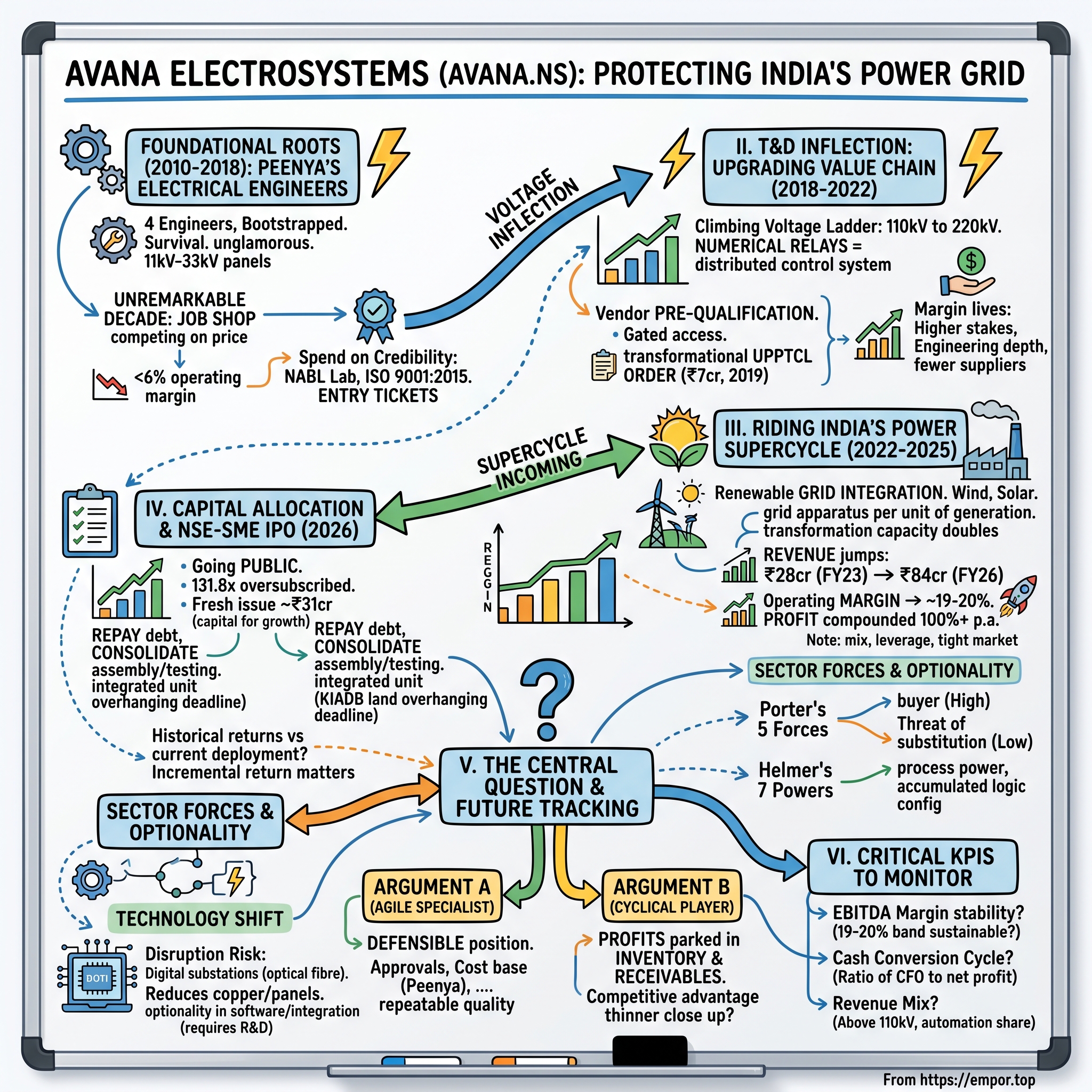
Avana Electrosystems: Protecting India's Power Grid
I. Introduction & Episode Roadmap
The forty-millisecond decision
Somewhere in Karnataka tonight, a lightning strike will hit a 220 kV transmission line. A tree branch will sag onto a conductor. A cable joint installed four monsoons ago will finally give up. In each case, a fault current tens of times larger than the normal load will surge down the wire, and somewhere in a control room a steel cabinet roughly the size of a household refrigerator will make a decision in about forty milliseconds — faster than a human eye blinks — about which circuit breaker to open, and which parts of the grid to sacrifice so the rest keeps running.
That cabinet is a Control and Relay Panel. It is not glamorous. It is a rectangular box of powder-coated sheet steel filled with protection relays, terminal blocks, meters, switches, and — this is the part that matters — several kilometres of hand-laid copper wiring, each strand landing on a specific terminal according to a schematic that the buying utility itself specified. Nobody puts a CRP on a magazine cover. But every substation in India has them, no substation is energised without them, and no solar park in Rajasthan or wind farm in Tamil Nadu can push a single electron onto the national grid until a set of them has been designed, built, tested, and approved.
The business at a glance
Avana Electrosystems Limited builds these panels. The company was incorporated in 2010 and manufactures customised Control and Relay Panels covering the 11 kV to 220 kV range, along with medium- and low-voltage panels, numerical and electromechanical protection relays, monitoring and supervision relays, panel accessories, and substation automation systems.12 Its two manufacturing units sit in Peenya Industrial Estate on the north-western edge of Bengaluru, one of Asia's densest concentrations of small and mid-sized engineering shops.3 Its registered office address — Plot No. 35, 1st Main Road, 2nd Phase, Peenya Industrial Area — reads like a thousand other Indian engineering companies, which is precisely the point.4
The numbers that changed the story
The story that makes it interesting to investors is what happened to the numbers between 2023 and 2026. In the year to March 2023, Avana did about ₹28.4 crore of revenue from operations and earned ₹0.92 crore of profit after tax — a net margin near three percent, which is roughly what you'd expect from a job-shop competing on price.5 Three years later, in the year to March 2026, revenue from operations reached ₹83.86 crore and net profit was ₹11.72 crore, on audited standalone results approved by the board on 21 May 2026.6 Operating margin went from the mid-single digits to roughly nineteen to twenty percent.1 Profit compounded at well over a hundred percent a year off a small base. And in January 2026, the four engineers who owned all of it sold a slice to the public.
A caution worth planting early, because it recurs through this story: several widely circulated summaries quote Avana's FY25 revenue as ₹62.93 crore. That figure is total income — revenue from operations of ₹61.49 crore plus other income of ₹1.45 crore.6 The distinction is small in rupees and large in habit. When a company grows this fast, the difference between the number that flatters and the number that is audited is where diligence lives.
The central question, and the route to answering it
So here is the central question this episode tests. Is Avana Electrosystems an agile, genuinely capital-efficient specialist that has earned a defensible position inside India's grid build-out — a company whose approvals, engineering depth, and Peenya cost base let it out-turn multinationals and out-qualify garage assemblers? Or is it a small hardware maker enjoying an exceptionally good cyclical moment, whose reported profits are increasingly parked in inventory and receivables owed by state utilities and EPC intermediaries, and whose competitive advantages look thinner the closer you stand?
Both readings are supported by real evidence. The route to sorting them runs through Peenya in 2010, up the voltage ladder to 220 kV, through the bureaucratic obstacle course of utility vendor pre-qualification, into the balance sheet arithmetic of the January 2026 listing, and out the other side into a set of measurable indicators that will settle the argument over the next several reporting cycles. Let's start where the company started: on a shop floor, with four engineers and no outside money.
 Subscribe on LinkedIn
II. Foundational Roots: Peenya's Electrical Engineers (2010–2018)
A grid of sheds on the north-west edge of Bengaluru
Peenya is not a technology park. There are no glass atria and no campus lawns. It is a grid of low-rise industrial sheds, roll-up shutters, and lathe noise, laid out from the 1970s onward, where a visitor can walk two hundred metres and pass a heat-treatment shop, a CNC job worker, a busbar fabricator, and a company that does nothing but powder-coat sheet metal for everyone else on the street. The ecosystem is the asset. If you need a 2 mm CRCA enclosure bent to a drawing by Thursday, someone within a kilometre will do it. This is the environment in which four electrical men incorporated Avana Electrosystems Private Limited on 16 July 2010.7
Four practitioners, one company
They were not first-time entrepreneurs in the venture-capital sense. They were practitioners who had already spent their careers inside the industry they were about to compete in.
Panish Anantharamaiah, the Managing Director, holds a Bachelor's degree in Electrical Engineering from Bangalore University and had over thirty-two years of experience in electrical engineering. Since founding, he has carried responsibility for operations, marketing, sales, testing, and servicing — an unusually wide span that tells you something about how the company has been run.4 In a firm of this size, the person who owns both the customer relationship and the test bench is the person who decides what gets promised and whether it can be delivered, and those two decisions rarely sit in the same pair of hands at a larger company.
Gururaj Dambal, Whole-time Director and Chief Executive Officer, came in with a Diploma in Electronics and Communication Engineering and more than twenty-three years in the electrical industry, overseeing product development, automation, purchase, assembly and testing.4 The detail worth noting is that the CEO title sits with the electronics and automation man rather than with the sales-and-operations man — a small structural hint that the company's own sense of where its future value lies points toward the digital side of the panel rather than the metal.
Vinod Kumar Sampatkumar, Whole-time Director and Chief Operating Officer, holds a Bachelor's in Electrical Engineering from Thapar University in Patiala plus a diploma in electrical and electronics, with roughly twenty-three years focused on production and procurement.4 Kondahalli Nagaraj Sreenath, Executive Director, brought about twenty-two years in accountancy and finance, and runs accounts, finance and HR.4
Look at that line-up as an investor would. Three of the four are hands-on engineers who divide the physical business between them — one selling and servicing, one designing and testing, one buying and building — and the fourth keeps the books. There is no professional CEO hired from outside, no marketing officer, no strategy function. All four were appointed as directors on the same day the company was born and all four remain in place sixteen years later.7 That is a striking level of continuity. It is also, viewed less charitably, a founder-shop structure that has never been tested by a leadership transition, a disagreement between partners, or an outside operator second-guessing the plan.
The unremarkable decade
The early business was not the business Avana runs today. In the fragmented world of 11 kV and 33 kV distribution panels, the buyer is usually a contractor, the specification is close to standard, and the winner is whoever quotes lowest and delivers soonest. There are hundreds of shops that can do it. Gross margins are thin because the value added — cutting, bending, wiring, and screwing bought-in components into a box — is genuinely modest.
The company's own long-run figures show the shape of that era clearly. In the year to March 2020, Avana did about ₹23 crore of sales at roughly a six percent operating margin. Then came the pandemic, and in a business that depends on site commissioning, construction labour, and utility procurement officers physically signing things, lockdowns were close to an existential event. Sales fell to ₹15 crore in FY21 — a drop of more than a third — and recovered only to ₹20 crore in FY22, with operating margins compressing to around four percent in both years.1 Twelve years after incorporation, this was a sub-₹25 crore company earning margins that rounded to nothing, in a sector where the customers were financially stressed state distribution utilities and the competition was the shop across the road.
It is worth holding that period in mind for the rest of this story, because it is the base rate. Every claim made later about Avana's competitive position has to explain not only why the company earns twenty percent operating margins now, but why the same company with the same founders, the same shop floor, and most of the same certifications earned four percent then.
Bootstrapping as a strategic choice
Which makes the financing choice the most consequential decision of the period. Avana did not raise venture money and did not lever up. It reinvested what little it made. That discipline is visible in the eventual shape of the balance sheet: at the March 2025 year-end, immediately before the listing, total borrowings across long- and short-term facilities came to under ₹6 crore against a net worth of ₹21.80 crore, and by March 2026 borrowings had been cut to under ₹1 crore.16 A company with a bank breathing down its neck in FY21, when sales dropped by a third, would have made very different choices about which orders to chase.
What the founders spent the money on instead was the unglamorous infrastructure of credibility. ISO 9001:2015 certification was obtained in 2018.8 The company built out testing capability including NABL-accredited laboratories — the national accreditation that says an in-house test report will be taken seriously by a third-party buyer.3
It is worth being clear about why an in-house accredited lab matters more here than the certificate does. Type testing a protection panel is slow and expensive, and if a manufacturer has to send every design to an external laboratory and wait in a queue, the delivery cycle stretches by weeks and the cost lands on a fixed-price order. Owning that capability converts a variable external dependency into a fixed internal one — good for margin at volume, dead weight at low volume. Avana carried that dead weight through the lean years, which is a decision that only looks smart in retrospect and would have looked like an indulgence in FY21.
These are the entry tickets, not the prize. But in a market where the customer is a government utility that must justify every purchase, a test lab and a certificate are the difference between being allowed to bid and not being allowed to bid.
The pattern that emerges from this first phase is worth naming plainly, because it recurs. Avana spent eight years being unremarkable in a market where being remarkable was not on offer. It survived, stayed solvent, accumulated approvals, and waited. The interesting question is whether waiting was strategy or whether the pivot that followed was luck — a fair reading of the evidence is that the company positioned itself for a market that then arrived on schedule from an entirely external source.
The thing that changed was the voltage.
III. The T&D Inflection: Upgrading the Value Chain (2018–2022)
What a protection relay actually does
To understand what Avana did next, you need to understand what a protection relay actually does, because the entire margin story rests on it.
Imagine the electricity grid as a national plumbing system carrying water at enormous pressure. When a pipe bursts, you do not want the whole system to drain. You want valves near the break to shut, fast, isolating the damage while the rest of the network keeps flowing. In an electrical grid, the burst pipe is a fault — a short circuit, a downed line, a failed transformer winding — and the valve is a circuit breaker. The protection relay is the brain that decides, in a fraction of a second, that a fault has occurred, where it is, and which breaker must open. Get it wrong in one direction and equipment worth crores of rupees burns. Get it wrong in the other and you trip half a state that did not need to go dark.
For most of the twentieth century, that brain was electromechanical: a disc, a spring, a magnet, calibrated so that a current above a threshold physically rotated a contact closed. Reliable, comprehensible, and dumb. From the 1990s onward it was replaced by the numerical relay, which is essentially a hardened embedded computer that samples the current and voltage waveform thousands of times a second and runs protection algorithms in software. The difference is not incremental. A numerical relay can distinguish a genuine fault from an inrush current when a transformer energises, record a waveform of exactly what happened for post-event analysis, report its own health, and communicate over a network so that a control centre a hundred kilometres away can see the substation in real time.
That shift changed what a control panel is. A panel full of electromechanical relays is a metal box with parts in it. A panel full of numerical relays is a distributed control system that happens to live in a metal box — and the value has migrated from the sheet metal to the engineering that specifies, configures, wires, and tests the logic inside. Avana's product range spans exactly this transition: it manufactures both numerical protection relays and electromechanical relays, alongside monitoring and supervision relays and full substation automation systems, and it provides testing and commissioning services up to 220 kV including bay control unit type systems, SCADA implementation, and retrofit of existing installations.2
Climbing the voltage ladder
The second, parallel move was up the voltage ladder — from 11 kV and 33 kV distribution work into 110 kV and 220 kV transmission substations. Why does that matter so much to economics? Because as voltage rises, three things happen simultaneously. The consequences of failure rise, so buyers get far more demanding about who they will buy from. The engineering content per panel rises, because a transmission bay involves distance protection, differential protection, breaker failure protection, auto-reclosing schemes and interlocking logic that a distribution feeder simply does not need. And the number of qualified suppliers falls sharply. Higher stakes, more engineering, fewer competitors: that combination is where margin lives in industrial manufacturing.
The gatekeepers
But you cannot simply decide to sell 220 kV panels. India's power sector runs on vendor pre-qualification, and it is a genuinely brutal filter. A state transmission utility such as Karnataka Power Transmission Corporation Limited, or a central body such as Power Grid Corporation of India, will publish tender conditions requiring a bidder to have previously supplied similar equipment at similar voltage, to hold specific type-test certificates from accredited laboratories, to demonstrate in-house testing capability, to meet minimum turnover and net-worth thresholds, and often to have supplied that specific utility before. Read that list again and notice the trap: you must have already done the thing in order to be allowed to do the thing.
This is the single most important structural feature of Avana's market, and it cuts both ways. It is the reason a well-capitalised newcomer cannot simply appear and undercut incumbents at 220 kV. It is also the reason the same handful of qualified names keep appearing on the same tender lists, and why an approval, once earned, has a long tail.
There is a second, subtler consequence. Because approvals are granted state by state and utility by utility, market access in this business is geographic rather than national. A firm approved in Karnataka and Uttar Pradesh has no automatic standing in Maharashtra or Gujarat; it must qualify again, often from a partial standing start. Growth therefore comes in discrete steps as new approvals land, not smoothly with capacity — which is one structural reason a company like this can be flat for years and then compound rapidly once several approvals mature at once. Avana's public materials state that the company holds approvals across more than twenty Indian states.2 Given that Indian transmission and distribution utilities are almost entirely state-owned — state entities control the overwhelming majority of distribution by revenue and volume — a multi-state approval footprint is not a marketing claim but a description of the company's actual addressable market.9
The concrete evidence that Avana got through the gate arrived in 2019, when it received an order worth ₹7 crore from Uttar Pradesh Power Transmission Corporation.8 Set against a company doing roughly ₹23 crore of annual sales at the time, a single ₹7 crore order from a large northern state transmission utility was transformative in two ways: it was material to that year's revenue, and — more durably — it created a reference. The next tender document that asked "have you supplied a state transmission utility?" now had a defensible answer.
Where the engineering value actually sits
Where does the real engineering moat sit? Not in the relays, which Avana buys or builds to established standards, and not in the enclosure. It sits in the layer between: taking a utility's specific logic schematic — every utility has its own house style for how protection should be arranged, interlocked and annunciated — and converting it into a manufacturable, testable, approvable panel. Avana employs a research and development team of nine specialised engineers, and the company operates with over a hundred skilled professionals overall.32 Nine R&D engineers is not a research institute. It is, however, the right order of magnitude for a firm whose differentiation is application engineering rather than component invention, and investors should size the claim accordingly: this is know-how and drawing-office throughput, not proprietary technology.
The honest summary of this phase is that Avana bought itself an option. It spent scarce cash on certifications, test infrastructure, and the slow grind of getting onto approved-vendor lists — investments that produced almost no visible return through FY22, when sales were still ₹20 crore at a four percent margin.1 Whether that option was worth anything depended entirely on something outside the company's control: whether India would actually spend the money it had promised to spend on its grid.
Starting in 2022, it did.
IV. Riding India's Power Supercycle & Renewable Grid Integration (2022–2025)
Why renewables multiply substations
There is a peculiar arithmetic problem at the heart of India's energy transition, and it is the reason Avana's order book changed character.
A coal plant is a few large machines in one place, running steadily, connected to the grid at a handful of points. A solar park delivering the same annual energy is spread across thousands of acres, generates nothing at night, swings violently when a cloud bank moves through, and must be gathered — from inverter to string to pooling station to substation — before it can be pushed onto a transmission line hundreds of kilometres from where anyone wants to use it. Every one of those gathering points is a substation. Every substation needs protection. Renewables do not just add generation capacity; they add grid apparatus per unit of generation, and they add it in the exact voltage band where Avana had spent a decade getting itself approved.
The scale of what the Indian state committed to is the backdrop for everything that follows. The Ministry of Power has targeted 500 GW of installed non-fossil capacity by 2030.[^10] The Central Electricity Authority's National Electricity Plan for transmission identified an investment opportunity of more than ₹9.15 lakh crore in the transmission sector through 2032 to support that build-out, of which ₹3.91 lakh crore was earmarked for the inter-state transmission system.10
Translated out of rupees and into hardware, the plan envisaged the transmission network expanding from about 4.85 lakh circuit kilometres in 2024 to roughly 6.50 lakh circuit kilometres by 2032, with transformation capacity nearly doubling from 1.25 million MVA to 2.34 million MVA, and inter-regional transfer capacity rising from 119 GW to 168 GW.10 Nearly doubling transformation capacity is the number that matters most to a panel manufacturer, because transformers do not sit alone — each one arrives inside a bay that needs differential protection, metering, control, and a cabinet full of wiring to tie it together.
Alongside that sits the distribution half of the story. The Revamped Distribution Sector Scheme has absorbed roughly sixty percent of the Ministry of Power's budget allocation, principally for prepaid smart meters and distribution loss reduction, with the ministry receiving ₹29,997 crore for 2026-27, a thirty-nine percent increase over revised estimates.9 RDSS matters to Avana less as a direct order source than as a solvency mechanism: distribution utilities that collect what they bill are distribution utilities that pay their equipment suppliers, and the health of the discom balance sheet is ultimately what determines whether a panel maker's receivables turn into cash.
From national capex to a Bengaluru order book
Numbers of that magnitude are easy to quote and hard to convert into orders, so it is worth being precise about the mechanism by which national capex reaches a Bengaluru panel shop. It does not arrive directly. Avana is a component supplier several rungs down: the utility or a renewable developer awards a substation package to an EPC contractor; the EPC contractor buys panels from an approved list. Avana's revenue therefore tracks substation bays commissioned, not gigawatts announced — and the gap between the two is where the disappointments in this sector have historically lived.
That gap is real and currently visible. As of March 2026, India had installed 283.46 GW of non-fossil capacity against the 500 GW target — genuine progress, including crossing the fifty-percent-of-installed-capacity milestone from non-fossil sources in June 2025, five years ahead of schedule, but still a long way from the destination.[^10] More pointedly for equipment makers, in 2024-25 only fifty-eight percent of targeted transmission lines were actually added, and RDSS has a documented history of underspending its budget.9 The Indian power sector reliably announces more than it builds, and it builds more slowly than it announces. An investor underwriting Avana on the ₹9.15 lakh crore headline is underwriting a number that the sector's own delivery record does not support at face value.
The financial inflection, and what caused it
With that caveat established, what actually happened to Avana's business between 2022 and 2025 was dramatic. Revenue from operations went from ₹28.41 crore in FY23 to ₹52.99 crore in FY24 — an eighty-six percent jump — and then to ₹61.49 crore in FY25.36 Profit after tax moved from ₹0.92 crore to ₹4.02 crore to ₹8.31 crore on the restated basis used in the offer document, with profit-before-tax margin expanding from 4.09 percent to 19.54 percent across the same span.3 EBITDA rose from ₹1.92 crore in FY23 to ₹7.42 crore in FY24 to ₹12.52 crore in FY25, taking EBITDA margin to 20.36 percent.11
Here is what that margin expansion actually means, stripped of celebration. Roughly fourteen hundred basis points of operating margin appeared in twenty-four months at a company whose cost base is dominated by bought-in materials. Three forces plausibly explain it.
First, mix: complex high-voltage bays carry more engineering content per rupee of steel and copper, so realisation per panel rises faster than input cost. Second, operating leverage: the drawing office, the test lab, the certifications and the senior engineers are largely fixed, so doubling revenue spreads them thin. Third — and this is the one that should make an analyst cautious — a tight market. When utilities and developers are all trying to commission substations at once and the approved-vendor list is short, price discipline improves for everyone on the list.
The first two are earned and reasonably durable. The third is a gift from the cycle, and it is revocable. Since the company does not disclose a revenue split by voltage class, an outside investor cannot currently separate the three, which means the durability of the margin is an assumption rather than an observation. That is not a criticism of the result; it is a description of the evidence available to judge it.
What the customer data does and does not prove
The customer data supports a picture of genuine commercial breadth rather than a couple of lucky contracts. Avana served 367 customers in FY25, and revenue from repeat customers amounted to ₹43.81 crore — a substantial majority of the year's business coming from buyers who had bought before.3 For a company selling engineered-to-order equipment into a sector where a failed panel means a burnt transformer, repeat purchase is the most meaningful quality signal available, and it is worth more than any certificate. The company has also begun exporting, with recent expansion into Kuwait.3
Two important qualifications belong here. Avana has not publicly disclosed the identity of its major customers, and no verified public source names its principal EPC partners; investors relying on assumptions about which marquee contractors sit behind that revenue are filling in a blank the company has not filled in. And the breadth of 367 customers is less reassuring once you look at the distribution: the top five customers accounted for 38.79 percent of revenue and the top ten for 52.00 percent as of September 2025, while 48.33 percent of revenue came from just three states.3 Broad at the tail, concentrated at the head.
There is also a capacity fact that reframes the growth story. Avana's installed annual capacity stands at roughly 70,000 relays and 600 control panels, and relay capacity utilisation was 48.07 percent as of September 2025.3 A company running its relay line at under half utilisation while doubling revenue is telling you that the constraint has not primarily been machines. It has been engineering throughput, working capital, and approvals — which is both good news for incremental margins and a reason to interrogate what exactly the post-IPO capex is meant to unlock.
That question moved from theoretical to concrete the moment the company decided to go public.
V. Capital Allocation & The NSE-SME IPO (2024–2026)
From private shop to public company
For fourteen years, four men owned one hundred percent of Avana Electrosystems.12 In December 2024, the company converted from a private limited company to a public limited company — the legal precondition for a listing and, in practice, the moment a founder shop starts becoming something else.8 The conversion is a formality. What follows it is not.
The offer that reached the market in January 2026 was small, sharply structured, and — as it turned out — wildly oversubscribed. The book-built issue opened on 12 January 2026 and closed on 14 January, priced in a band of ₹56 to ₹59 per share, for a total of ₹35.22 crore across 59.70 lakh shares.12
The great majority was primary capital: a fresh issue of ₹30.53 crore covering 51.76 lakh shares, with an offer for sale of just ₹4.69 crore covering 7.94 lakh shares.12 Anchor investors were allotted 16.90 lakh shares, about twenty-eight percent of the issue, and 3.00 lakh shares were reserved for the market maker required on the SME platform.12 Indcap Advisors acted as lead manager and Integrated Registry Management Services as registrar.12 Reservation followed the standard split of fifty percent to qualified institutional buyers, thirty-five percent to retail, and fifteen percent to non-institutional investors.13
The ratio between fresh issue and secondary sale is the first thing a fundamental investor should read, and it reads well. Roughly six and a half rupees of every seven raised went into the company rather than into the founders' pockets. Promoter holding fell from one hundred percent to 73.64 percent — meaning the four founders retained roughly three-quarters of a business they had just told the market was compounding profits at triple-digit rates.12 Whatever else one concludes, this was not an exit dressed up as a fundraising.
A hundred-times book, and what it signified
The demand response was extraordinary and, frankly, tells you more about the January 2026 SME market than about Avana. The issue was subscribed roughly 131.8 times overall — 54.97 times in the qualified institutional category, 219 times among non-institutional investors, and 137.52 times in the individual investor category — despite a minimum retail application of ₹2.36 lakh at the upper band, a ticket size that excludes most retail investors outright.12 The shares listed on 20 January 2026 at ₹77.50 against the ₹59 issue price, a 31.36 percent premium, and traded between ₹73.65 and ₹81.35 on debut before closing at ₹80.30.812 When an issue is subscribed more than a hundred times and still only pops thirty percent, the market is telling you the allocation was the scarce good, not the business.
What the money is for — and the KIADB overhang
Now the part that matters more than the pop: what the money is for. The stated objects were capital expenditure of ₹11.55 crore towards civil construction, internal electrical work and internal plumbing to set up an integrated manufacturing unit, ₹8.40 crore for working capital, and the balance for general corporate purposes.11 The logic of an integrated unit is sound on its face. Avana currently runs two separate Peenya facilities, and an engineered-to-order business that moves a part-built panel between buildings for wiring and then again for high-voltage testing is paying a real tax in time, handling damage, and coordination overhead. Consolidating assembly, wiring and testing under one roof is exactly the kind of unglamorous throughput capex that suits this business better than buying capacity it does not yet need.
But there is a specific overhang attached to it that deserves to be flagged loudly, because it is a governance and execution signal rather than a technicality. The land for the integrated unit is held on a leave-and-licence basis from the Karnataka Industrial Areas Development Board, and the lease carried a requirement to commence commercial production by 22 May 2026, with failure exposing the company to penalties or adverse consequences under the lease terms.3
More telling is the history behind that deadline. The company had originally been required to commence commercial production on that land by 1 June 2020, and did not.3 A six-year slip on a commitment to a state industrial development authority is a fact about execution, not a footnote — and it is the kind of fact that only surfaces because a prospectus forced it into the open. It also sits somewhat awkwardly beside the growth narrative: a company confident enough of demand to triple revenue held allotted industrial land for most of a decade without building on it.
The related structural point is that Avana operates entirely from leased premises and owns no manufacturing property.3 For a business whose competitive position rests partly on a low fixed-cost base, leasing is a rational choice. It also means the physical platform of the company sits on renewable agreements rather than on the balance sheet, which is a dependency worth knowing about.
Where did the project actually stand at year-end? The audited balance sheet at 31 March 2026 showed capital work-in-progress of ₹4.67 crore, against nil a year earlier, alongside property, plant and equipment of ₹5.20 crore.6 Cash spent on property, plant, equipment and capital work-in-progress during FY26 was ₹7.50 crore.6 In plain terms: the money was going in and the building was rising, but at the balance sheet date a meaningful chunk of the project still sat in CWIP rather than in productive fixed assets. Whether commercial production actually began by the KIADB deadline — and on what terms if it did not — is not something the company has addressed in publicly available results filings, and it belongs near the top of any diligence list.
The balance sheet transformation itself was clean. Net worth rose from ₹21.80 crore at March 2025 to ₹59.08 crore at March 2026, reflecting the primary raise plus retained profit, while total borrowings fell to well under ₹1 crore across long- and short-term facilities.6 Cash and equivalents stood at ₹27.83 crore at year-end, of which ₹15.02 crore sat in fixed deposits.6 Financing activities brought in ₹19.78 crore net, including ₹25.56 crore of IPO proceeds after issue expenses, offset by debt repayment.6
Note what the company did with the money in the interim: it repaid what little debt it had and parked the rest in bank deposits. That is the conservative choice, and it is consistent with the founders' fifteen-year behaviour. It also means a substantial share of the equity raised has not yet been put to work in the business, so the operating performance of FY26 was still very largely produced by the pre-IPO company. The company has never paid a dividend.1
The returns question everyone gets backwards
On capital allocation track record, the honest assessment is: promising, and short. Avana has not made acquisitions, has not diversified away from its core, and has not levered up — three ways small industrial companies most commonly destroy value, all of them avoided. Return metrics through the growth phase were genuinely high; the offer document reported return on equity of 47.11 percent and return on capital employed of 53.71 percent for FY25, and the longer-run picture shows ROCE of about fifty percent in FY24 and thirty-eight percent in FY25 with three-year average ROE around thirty-five percent.111
Those returns require an asterisk that changes their meaning. They were earned on a tiny, largely self-funded capital base — net worth under ₹22 crore. The denominator has now nearly tripled, and a large slice of it sits in bank deposits earning deposit rates. Mechanically, reported ROE and ROCE will fall, and that decline will not be evidence of deterioration. The real test is different and slower: what incremental return the company earns on the ₹30.53 crore of new equity once the integrated unit is running and the working capital is deployed. Historic returns on a bootstrapped base tell you the founders were frugal. They do not tell you the business can absorb capital well. That question is genuinely open.
Which brings us to the harder question of what, underneath all this, Avana actually sells and why anyone buys it from them rather than someone else.
VI. Deep Dive: Core Business Economics, Industry Structure & Competitive Dynamics
Three tiers at the same bid table
Picture the bid table for a 220 kV substation package somewhere in central India. Three kinds of company are trying to win the protection panels, and they are not really competing on the same axis.
At the top sit the multinationals — Siemens, ABB India, Schneider Electric, GE Vernova T&D India. Their advantages are structural and enormous. They have global R&D budgets, they own relay platforms rather than buying them, and they operate at 400 kV and 765 kV where almost nobody else can follow.
The scale gap is not subtle. GE Vernova T&D India recorded FY26 revenue of ₹6,206 crore with order intake of ₹14,776 crore and a closing backlog of ₹21,456 crore, and committed more than ₹1,000 crore of capital investment across product lines and facilities in a single year.14 That last figure alone is roughly three times Avana's entire annual revenue, and the backlog is more than two hundred and fifty times it. When a company of that size decides a segment is worth pursuing, the question of whether a Peenya specialist can hold its ground is settled by whether the large player bothers, not by whether the small one is capable.
What these firms carry in exchange is overhead, global standardisation, and decision latency. A customised panel that deviates from a global platform has to be justified through a process, and the process costs money and weeks. For a 765 kV project that is irrelevant; for a ₹40 lakh panel order at 132 kV it is decisive, and that asymmetry is the crack the middle tier lives in.
At the bottom sit the unorganised assemblers: small shops that can genuinely build a competent 11 kV distribution panel, cannot produce the type-test certificates or in-house high-voltage testing that transmission tenders demand, and are therefore locked out of the segment where money is made. They are a permanent, effective ceiling on pricing in the low-voltage band and largely irrelevant above it.
In between is the tier Avana occupies — domestic specialists who are big enough to be approved and small enough to be fast. The most instructive comparison available is Danish Power, a Jaipur-based manufacturer of transformers including inverter-duty transformers for solar and wind projects, which listed on the SME platform in October 2024. Danish did ₹425 crore of sales in FY25 and ₹521 crore in FY26, earning ₹58 crore and ₹70 crore of net profit respectively, at operating margins of nineteen and seventeen percent.15
The comparison is imperfect — transformers and protection panels are different products with different capital intensity — but it is directionally useful in three ways. It shows a domestic specialist sustaining high-teens operating margins at six times Avana's scale, which suggests the margin band Avana has reached is achievable rather than anomalous. It shows the same margin drifting down two hundred basis points as revenue grew, which is a hint about where competitive intensity leads as a firm gets big enough to be worth attacking. And Danish's debtor days of 78 against Avana's 97 in FY26 is a reminder that working capital performance in this sector varies meaningfully between operators, and is therefore something a management team can actually influence rather than merely suffer.151
Segment economics, and why customisation protects price
Now the segment economics. Avana does not publish a revenue split by product line, so any percentage breakdown circulating publicly should be treated as estimate rather than disclosure. What the company does disclose is the shape of the portfolio. Control and relay panels are the backbone — the engineered-to-order product where each substation order requires bespoke design against the buyer's schematics, and where margin scales with voltage class because engineering content, testing burden, and competitive scarcity all scale with voltage.2 Relays and distribution products sit alongside, sold both standalone and as part of panel packages, with the relay line running at under half its 70,000-unit annual capacity.3 Substation automation and SCADA form the smallest and most strategically interesting piece, offering integration work built on the IEC 61850 protocol.2
It is worth pausing on why a job-shop structure produces the margin profile it does, because it is counterintuitive. Most people assume customisation destroys margin — it kills scale economies, it fragments purchasing, it means every job is a first article. In panel manufacturing, the opposite holds within a band. Because every panel is different, there is no reference price. A utility cannot look up what a 220 kV line protection panel "should" cost the way it can look up a commodity transformer, because the specification is its own. That opacity, combined with a short approved-vendor list, is where pricing power actually comes from. It is not brand and it is not technology. It is the absence of a comparable.
Myth versus reality
Three consensus stories about this business deserve testing.
The myth that Avana is a technology company. The reality is that it is an engineering-and-assembly company whose differentiation is application know-how and approvals. Research and development spending in FY25 was ₹33.53 lakh — about half of one percent of that year's revenue.3 There is nothing wrong with that for this business model, but it disqualifies any thesis built on proprietary technology or defensible intellectual property. Avana's advantage is procedural, not patented.
The myth that approvals are a moat. Approvals are a barrier, which is not the same thing. They stop new entrants; they do not stop the fifteen other already-approved firms on the same list from bidding aggressively for the same tender. A moat protects your price. A barrier protects your seat at a table where price is still contested. Avana's own risk disclosures — buyers concentrated, three states supplying nearly half of revenue — describe a company that competes hard for every order rather than one that sets terms.
The myth that the order flow is the company's to lose. Repeat revenue of ₹43.81 crore in FY25 is real evidence of stickiness, but the switching cost for a utility buying its next panel from a different approved vendor is low: the specification belongs to the buyer, not the supplier. Stickiness here comes from execution reputation and from the buyer's own procurement inertia, both of which are worth something and neither of which is contractual.
Why it wins, and where it cannot
So where does Avana genuinely win? On evidence, in three places. Turnaround speed, because a firm where the COO and the CEO can walk the shop floor and re-sequence a job in an afternoon will beat a multinational's change-order process on any customised bay. Cost position, because Peenya overheads are a fraction of a multinational's Indian cost base and the local supply ecosystem removes the need to vertically integrate low-value fabrication. And range coverage — 11 kV to 220 kV under one roof means a customer buying a mixed substation package does not need two vendors.
Where it does not win is equally clear. It cannot compete at 400 kV and above. It does not own the relay platforms that increasingly define panel value. It has no scale advantage in procurement, with the top five suppliers accounting for 43.40 percent of purchases.3 And its share of any given customer's spend is a function of tender outcomes it does not control.
That mixed picture is exactly what makes the strategic-frameworks exercise worth doing properly rather than as decoration.
VII. Strategic Powers, Porter's 5 Forces & Emerging Optionality
Frameworks are most useful when they produce an uncomfortable answer, so let's apply them without flattery.
Hamilton Helmer's 7 Powers
Helmer's test is strict: a Power must both increase differential margin and be protected by a barrier that persists even when competitors know exactly what you are doing. Most companies have none. Avana has fragments of three.
Process Power is the most plausible. Sixteen years of building panels in the same location with the same four owners produces accumulated shop-floor practice — how a wiring loom is dressed, how a test sequence is sequenced, how a drawing revision propagates to the floor — that a competitor cannot buy off the shelf and cannot copy from a site visit, because it lives in people and habits. Helmer's condition for Process Power is that it be slow to accumulate, and this qualifies. The weakness is that Process Power is generally the weakest Power in his taxonomy, because it erodes when key people leave, and Avana's operational knowledge is concentrated in a very small number of long-tenured individuals.
Cornered Resource, partially. Approved-vendor status across more than twenty states is a resource competitors cannot simply purchase, and the pool of engineers who can design protection logic to Indian utility standards is genuinely shallow. But approvals are non-exclusive — the utility grants them to multiple vendors by design, because it needs competitive tension in its own tenders. A resource many rivals also hold is not cornered.
Counter-Positioning is the weakest claim and the one most often asserted. Counter-Positioning requires that the incumbent cannot respond without damaging its existing business. Multinationals are not structurally barred from customising panels for the Indian 132 kV market; they simply often choose not to bother, because the revenue per engineering hour is unattractive relative to their alternatives. That is a strategic preference, not a trap. If Indian mid-voltage panel margins stayed at twenty percent for a decade, a large player could build or buy a low-cost Indian unit to serve it. The barrier is inattention, and inattention ends.
There is no scale economy here — Avana is roughly one-seventieth the size of the largest domestic T&D player.14 There is no network economy, no switching cost worth the name, and no branding power in a market where the buyer is a procurement committee running a price-driven tender.
Porter's Five Forces
Applied to the actual market rather than the idealised one.
Threat of new entrants is genuinely two different markets wearing one label. In 11 kV and 33 kV work, it is high: modest capital, no exotic testing, hundreds of capable shops. Above 110 kV, it is low, and the reason is the pre-qualification chicken-and-egg described earlier. Avana's strategic direction — up the voltage ladder — is therefore also a movement toward the part of the market with the most protection, which is the right instinct.
Bargaining power of buyers is high, and this is the force that most constrains the investment case. The customer is typically a state utility or an EPC contractor procuring through competitive bidding, often with L1 lowest-price award mechanics, and it wrote the specification itself. Add the concentration data — nearly two-fifths of revenue from five customers — and buyers hold most of the cards.3 The counterweight is that panels are a small line item within a substation package, which limits how hard a buyer will squeeze relative to the cost of a delayed commissioning.
Bargaining power of suppliers is moderate and asymmetric. Copper, aluminium and cold-rolled steel are commodities with volatile prices but many sellers. Numerical relay platforms and their semiconductor content are a different matter: they come from a limited set of global suppliers, and the 2021-23 semiconductor shortage demonstrated what happens to lead times when that supply chain stresses. With the top five suppliers representing over two-fifths of purchases, Avana is meaningfully dependent on a narrow procurement base.3
Threat of substitutes is genuinely low, and this is the most reassuring force in the analysis. Protection is not optional; it is mandated by grid codes and by physics. A substation cannot be commissioned without it, and no alternative technology removes the need for a protection and control interface. Demand for the function is as secure as demand for electricity itself. What is not secure is who supplies it, or in what physical form.
Rivalry is high. A short list of approved competitors bidding repeatedly for the same tenders, with no product differentiation the buyer recognises, is the textbook setup for price competition — and it is the mechanism by which the current twenty-percent margin most plausibly reverts.
The optionality that could change the analysis
Everything above describes a business selling copper, steel and configured logic. The interesting question is what happens when the copper goes away.
In a conventional substation, every current transformer and voltage transformer in the switchyard is connected to the control room by a physical copper cable — hundreds of them, laid in trenches, terminated by hand. Think of it as a building wired with a separate dedicated cable running from every light switch to a central room, rather than a network.
In an IEC 61850 digital substation, those measurements are digitised right where they are taken, at the switchyard, and travel to the protection relays as data over optical fibre. The copper largely disappears. So do the trenches, much of the civil work, and a great deal of the hand-wiring labour that currently constitutes Avana's core value-add.
This is not speculative. Power Grid Corporation commissioned India's first 400 kV fully digital substation using IEC 61850 process bus at Malerkotla on 16 December 2020, retrofitting a station originally commissioned in 1992, and had already completed grid substation automation at over a hundred substations by July 2020.16 The stated benefits included faster commissioning, better diagnostics, easier asset management, and explicitly a reduced requirement for copper cables and civil works.16
Read that last benefit from the perspective of a panel manufacturer. The technology that grid operators want is the technology that removes a meaningful share of what Avana currently sells. This is the genuine long-term disruption risk in the business, and it is more concrete than the generic "technology change" bullet such analyses usually contain.
The optimistic framing — and it is a real one — is that the same transition moves value toward system integration, configuration, and automation software, where Avana already has a substation automation and SCADA offering built on the very protocol driving the change.2 A firm that sells the digital layer rather than the copper layer captures a smaller physical product at a higher margin. The problem is that this is precisely the terrain where multinationals are strongest, because digital substation platforms are a scale-and-R&D game, and Avana's half-percent-of-revenue R&D spend does not buy a seat in it.
The honest position is that this optionality is currently unproven. Avana has the capability listed and the certifications to sell it, but has not disclosed automation revenue separately, has not quantified the segment, and has not laid out a public roadmap for it. Investors should treat digital substation exposure as a live question to monitor, not as a component of value today. Which is a useful reminder that the lessons from this story are as much about how to read a company like this as about the company itself.
VIII. Playbook: Business & Investing Lessons
Strip away the specifics of Karnataka and kilovolts and four generalisable lessons remain — each one applicable well beyond one panel manufacturer in Peenya.
1. Operating leverage in B2B niche manufacturing is a mix story before it is a volume story. The instinctive explanation for Avana's margin expansion is that it sold more stuff and spread fixed costs. That is part of it. But the larger part is that it sold different stuff. Moving from 11 kV distribution panels to 220 kV transmission bays did not just raise the price per unit; it raised the engineering content per unit, and engineering content is where a small firm's fixed costs — drawing office, test lab, senior engineers — get monetised rather than merely absorbed. This is why a company can go from a six percent operating margin to roughly twenty percent in three years without any change in machinery, and why relay capacity utilisation could sit below half while revenue tripled.
The generalisable version: in engineered-to-order manufacturing, look for the firm climbing the specification ladder, not the one filling the shed. The corollary is a warning. Mix-driven margin can un-mix. If a slower cycle pushes Avana back down the voltage ladder to keep the factory busy, the same arithmetic runs in reverse and it runs fast — and because the shift shows up in the mix long before it shows up in the revenue line, it is invisible to anyone watching only the top line.
2. The pre-qualification flywheel is a real asset that appears nowhere on the balance sheet — and it is a barrier, not a moat. In utility and government infrastructure procurement, approved-vendor status functions as capital: it took years and real cash to acquire, it produces recurring economic benefit, and it cannot be bought. It also explains why a company can look unremarkable for eight years and then inflect suddenly — the investment was being made the whole time, it just was not being expensed anywhere visible. Avana's 2019 order from a large northern state transmission utility, small in absolute terms, was worth far more as a credential than as revenue. But the discipline required is to distinguish this from a genuine moat. Being on the list means being invited to compete, and the utility deliberately keeps several names on it. Investors who conflate "hard to enter" with "protected pricing" will misjudge how these businesses behave when the cycle turns.
3. Discipline over dilution compounds in ways that only show up later. Avana raised no outside equity for its first fifteen years and carried minimal debt. The obvious cost was slower growth. The non-obvious benefit was that when revenue fell by a third in FY21, nobody was forcing the company to take bad orders to service a loan. Bootstrapping is a working-capital education: a company that must fund every rupee of inventory and receivables from its own cash flow develops habits about customer selection and payment terms that a well-funded competitor never learns. It teaches a firm to say no to an order — the single hardest discipline in project-linked manufacturing, and the one that separates businesses that grow profitably from businesses that simply grow.
The complication is that the education has a shelf life. Post-listing, Avana has ₹27.83 crore of cash it did not raise itself and a nearly tripled equity base. The habits that produced fifty-percent returns on capital were formed under scarcity, and scarcity is over. Whether the discipline survives the abundance is one of the genuinely interesting things to watch in this story — and it is the pattern that catches out more small-cap investors than any accounting subtlety.
4. SME-platform investing has its own rules, and disclosure cadence is the one most often missed. Avana reports on a half-yearly basis, as its FY26 audited results — covering the half-year to 31 March 2026 alongside the full year, with the prior comparative being the half-year to 30 September 2025 — make plain.6 There are no quarterly results. For a company whose revenue depends on lumpy project commissioning and whose working capital swings with tender cycles, six months is a long time to be flying without instruments; a deterioration that a main-board investor would spot in ninety days can run for half a year here. Add the structural features of the platform — a mandated market maker, thin float, wide circuit limits, and a share register that at March 2026 held just 471 shareholders — and the practical consequence is that price can move a very long way on very little information.121 Avana's shares ranged between ₹60.10 and ₹168.05 over the twelve months to July 2026, and traded at ₹160 on 28 July 2026 for a market capitalisation of roughly ₹362 crore.117 That is a wide band for a company whose fundamentals were disclosed exactly twice in the period.
The other SME-specific discipline is governance maturity. Avana's board added three independent directors ahead of listing — a chartered accountant and two company secretaries, all with professional rather than industry backgrounds.4 That is a compliant board, and compliance is the floor.
What it is not is a board with deep power-sector operating experience capable of challenging four founder-executives on technical strategy. Independent directors drawn from audit, company secretarial and compliance practice are well suited to policing related-party transactions and disclosure — genuinely valuable in a company that was a family-scale private firm eighteen months ago. They are not the people who will ask why automation revenue is not being disclosed separately, or whether the relay platform strategy survives a digital substation transition. For a business whose main long-term risk is a technology shift in its core product, that is a gap worth noticing.
Those four lessons converge on the same place: the case for and against this company both rest on how a handful of specific, observable things behave from here.
IX. Investor Stress Test, Material Risk Radar & Bull vs. Bear Case
Put a skeptical investor in a room with Avana's management and the first question is not about growth. It is about cash.
The activist's three questions
The working capital interrogation. Avana reported profit after tax of ₹11.72 crore in FY26 and generated ₹7.95 crore of net cash from operating activities.6 The prior year, ₹8.47 crore of audited profit produced ₹5.73 crore of operating cash.6 Roughly two-thirds of reported profit converted to operating cash in each year. That is not a red flag — it is what a business growing revenue thirty-six percent a year while funding its own inventory and receivables looks like — but it is not comfortable either, and the composition explains why. Inventories rose ₹7.72 crore during FY26, consuming almost the entire operating cash generation on their own, while receivables were roughly flat, adding ₹1.02 crore, and payables provided ₹4.02 crore of relief.6
The balance sheet position at year-end tells the same story statically. Against ₹83.86 crore of revenue, Avana carried ₹22.43 crore of inventories and ₹22.21 crore of trade receivables — together roughly ₹45 crore, or more than half a year's sales, tied up in the working cycle.6 Inventory days ran at 164 in FY26 against 167 the prior year, debtor days improved to 97 from 126, payable days stretched to 97 from 105, and the net working capital cycle lengthened to about 105 days from 84.1
Some of that inventory is structural rather than sloppy. An engineered-to-order panel business must hold relays, meters, switches, terminal blocks and enclosure stock against orders that have been won but not yet released for despatch, and long-lead imported components have to be bought well ahead. Work-in-progress also inflates when jobs are complete but awaiting customer inspection — a common occurrence when the buyer is a utility whose inspector travels on a schedule of their own. None of that makes the cash any more available.
That last figure is the one to sit with. Debtor days improving by nearly a month is a genuine positive and suggests either better collection or a shift toward better-paying counterparties. But the overall cycle got longer anyway, because the improvement was more than offset by inventory. So the honest verdict on the activist's opening question is: the profits are real and the cash is arriving, but roughly a third of each year's earnings is being converted into stock on the factory floor rather than money in the bank, and the trend in the full cycle is going the wrong way even as the headline receivables number improves. For an engineered-to-order business, some inventory build ahead of growth is legitimate; a second consecutive year of it without a matching step-up in revenue would not be.
The concentration interrogation. Nearly two-fifths of revenue from five customers, over half from ten, and roughly half from three states is a structure in which a single EPC partner's project slippage can move a reporting period materially — and with half-yearly reporting, an investor may not learn about it for months.3
Management has not disclosed customer names or an order book figure publicly, which limits the ability to assess this independently. The absence of an order book number is the more consequential gap: in project-linked equipment manufacturing, backlog is the single most informative forward indicator a company can publish, and its absence means outside investors are reading a business that turns on future commissioning schedules entirely through the rear-view mirror. The mitigant is the 367-customer tail and the repeat-purchase evidence; the aggravant is that the tail is small in revenue terms by definition.
The tender-underbidding interrogation. The bear's sharpest question is simply: what stops an approved competitor from bidding fifteen percent below you next quarter? The honest answer is nothing structural. In a price-driven tender among pre-qualified vendors selling non-differentiated engineered products, margin is a function of how many bidders want the work. Avana's twenty-percent operating margin has existed for two years. It did not exist for the twelve years before that, when the same company with the same shop floor and largely the same certifications earned four to seven percent.1 Any thesis that treats current margins as the natural state of this business is ignoring its own history.
The material risk radar
Restricted to what is genuinely material here.
Execution on the integrated unit is the nearest-term item, given the KIADB commercial-production deadline and the company's prior six-year slip on the same land, with a meaningful portion of the project still in capital work-in-progress at the March 2026 year-end.36 A delay would not just postpone capacity; it would raise a legitimate question about whether stated timelines from this management can be relied upon.
Input cost volatility matters because Avana's cost structure is dominated by materials — cost of materials consumed was ₹53.10 crore of ₹69.03 crore of total FY26 expenses, roughly three-quarters.6 Copper, aluminium and CRCA steel are the principal inputs. Whether supply contracts contain price-escalation clauses is not disclosed.
The mechanism is worth spelling out because it is the fastest route to a bad half-year. A panel order is priced at bid, built weeks or months later, and delivered later still. In fixed-price supply arrangements without escalation, a sharp commodity move between bid and delivery lands entirely on the manufacturer. For a company operating at roughly twenty percent EBITDA margin with three-quarters of costs in materials, a ten percent adverse move in input prices is on the order of seven points of margin — enough to take the business back toward its historical profitability in a single reporting period, with no change whatsoever in demand, execution, or competitive position.
Supplier and technology dependence compound each other. Buying rather than owning numerical relay platforms means value-add is capped at the integration layer, and the top-five supplier concentration means a disruption at one vendor is not easily routed around.3 The longer-run version of this risk is the digital substation transition described earlier.
Cyclicality dressed as structural growth is the risk that subsumes several others. India's transmission spending is policy-driven and lumpy, with a documented gap between targets and delivery.9 A company that added fourteen points of margin during an upswing should be expected to give some back in a downswing.
Governance and disclosure is a lower-order but real overlay. Half-yearly reporting, no disclosed order book, no named customers, no segment revenue split, and no earnings call or investor presentation in the public domain mean the information available to a minority shareholder between reporting dates is close to zero. This is normal for the SME platform. It is still a genuine cost of ownership.
One point in the company's favour on the accounting side deserves recording, since so much of this section is cautionary: the FY26 results carried an unmodified audit opinion, there were no exceptional or extraordinary items in either year, and the only prior-period adjustment in the comparative figures was a ₹0.60 crore gratuity and leave-encashment item in FY25 — the sort of clean-up that typically accompanies a private company tightening its provisioning ahead of listing.6 There are no restatements, no going-concern language, and no unusual accounting judgments visible in the published results. For a recently listed SME, that is a better starting position than many.
The investment spine: bull versus bear
The bull case, stated fairly. India is in a multi-year transmission and distribution capital cycle with policy commitment, budget allocation, and a physical grid that demonstrably needs the investment. Avana is pre-qualified across most of the country, in the voltage band where new entry is hardest, with a cost base a multinational cannot match and an ownership structure where the people running the shop floor own three-quarters of the equity.
It has demonstrated that it can absorb rapid volume growth without breaking — revenue roughly tripled in three years while margins expanded — and it did the hard part, the approvals, before the market arrived. Relay capacity utilisation under fifty percent and a new integrated facility mean the next leg of growth does not require another equity raise. Debt is essentially nil, cash is substantial, and the peer evidence from Danish Power suggests high-teens operating margins are sustainable at multiples of Avana's current scale.15 If those conditions hold, earnings can compound for several more years without heroic assumptions.
The bear case, stated equally fairly. The margin expansion is largely a cyclical gift from a tight market and a short approved-vendor list, and the company's own twelve-year history at four to seven percent operating margins is the base rate. Working capital is absorbing an increasing share of profit, the cash conversion cycle is lengthening, and the buyer is a state utility ecosystem with a well-earned reputation for slow payment. Customer and geographic concentration make results lumpy and half-yearly reporting makes them opaque.
The company owns no land, no relay platform, and no proprietary technology; its R&D spend is a rounding error; and the technology direction the largest grid operator in the country is publicly pursuing removes copper and hand-wiring from substations — the precise activity that generates Avana's value-add. Returns on capital will mechanically fall as the enlarged equity base is deployed, and there is no track record of this management allocating externally raised capital. Finally, the market capitalisation has re-rated substantially since listing, which means expectations, not just earnings, now have to be met.1
The two cases are not equally weighted on every point, and it is worth saying where they genuinely collide. They agree that demand is strong and that the balance sheet is sound. They disagree on exactly one thing that matters: whether the twenty percent operating margin is a property of the company or a property of the moment. Everything else — valuation, capital allocation, technology risk — is downstream of that single question.
Both cases are internally consistent, which is why the resolution has to come from data rather than argument.
X. Epilogue & Key KPIs to Watch
The building in the KIADB estate is the physical expression of everything this story turns on. For six years it was a commitment Avana could not meet, because there was neither the volume to justify it nor the cash to fund it. In FY26 the company put ₹7.50 crore of capital into the ground and ended the year with ₹4.67 crore still sitting in capital work-in-progress — a factory that exists as an accounting line before it exists as a working shop floor.6 Whether it converts, on time, into panels that customers accept and pay for is a fair proxy for whether the last three years were a company being built or a cycle being ridden.
The core thesis, stated neutrally
The neutral reading of Avana Electrosystems is this. It is a small, genuinely profitable, debt-free specialist that spent a decade acquiring the credentials to serve a market that then expanded dramatically. The growth is real, the approvals are real, the returns on its historic capital base were exceptional, and the founders retained the great majority of a business they took public rather than cashing out of it. Equally, the competitive advantages are procedural rather than structural, the margin level is young relative to the company's history, the working capital cycle is lengthening, the customer base is concentrated at the top, the reporting cadence is thin, and the long-term technology direction of substations points away from the physical content Avana sells. Neither of those paragraphs cancels the other. They will be adjudicated by results.
Three KPIs to track
Three indicators will do most of the adjudicating, and an investor tracking only these will understand more about this company than one tracking twenty.
First, the operating margin. Avana's EBITDA margin has run in the nineteen-to-twenty percent band for two consecutive years, against four to seven percent for the twelve years before that. Everything about the equity case — the valuation, the return on incremental capital, the ability to fund growth internally — depends on which of those two regimes is the real one. Watch it at every half-year, and watch it alongside the materials cost line, because the mechanism that breaks it is either a commodity spike the company cannot pass on or a tender environment where an approved competitor decides to buy share. A margin that holds through a period of rising copper prices would be genuine evidence of pricing power. A margin that slips while revenue still grows would suggest the last two years were the cycle, not the company.
Second, the cash conversion cycle — inventory days and debtor days together, measured against operating cash flow relative to reported profit. Reported profit in this sector is an opinion until it becomes cash. Debtor days improving while the overall cycle lengthens is a genuinely mixed signal, and the resolution matters enormously: a company that grows revenue while holding its cycle flat is compounding, while a company that grows revenue only by extending credit and stockpiling inventory is buying growth with its own balance sheet. The specific thing to watch is whether operating cash flow's ratio to net profit moves above or below the roughly two-thirds it has held for two years.
Third, the revenue mix — the share coming from above 110 kV, and the share coming from substation automation and SCADA. This is the one that determines whether Avana is a structurally better business in five years or the same business at a larger size. Climbing the voltage ladder is what created the margin expansion, and continuing to climb it is the only mechanism that defends the margin against the eventual arrival of more competition at 132 kV. The automation share is the earlier-stage and more consequential signal: it is the company's only meaningful hedge against a digital substation transition that would erode the copper-and-cabinet portion of its value-add. Avana does not currently disclose either split. An investor's first ask of this management should be that it starts to — and a management that begins disclosing mix voluntarily would itself be a small but real signal about the transition from founder shop to public company.
References
-
Avana Electrosystems Ltd — Financial Summary, Ratios and Shareholding — Screener.in, 2026-07-28 ↩↩↩↩↩↩↩↩↩↩↩↩↩
-
Avana Electrosystems Limited — Official Company Website ↩↩↩↩↩↩↩
-
Avana Electrosystems IPO: ₹20.15 Crore Issue Opens Jan 12 for Power Equipment Manufacturer — ScanX, 2026-01-12 ↩↩↩↩↩↩↩↩↩↩↩↩↩↩↩↩↩↩↩↩
-
Board of Directors and Leadership Team — Avana Electrosystems ↩↩↩↩↩↩
-
Avana Electrosystems IPO Overview and Financials — IPO Ideas, 2026-01 ↩
-
Standalone Audited Financial Results for the Half Year and Year Ended 31 March 2026 — Avana Electrosystems, 2026-05-21 ↩↩↩↩↩↩↩↩↩↩↩↩↩↩↩↩↩↩
-
Avana Electrosystems Ltd — Board of Directors and Appointment Details — Choice India, 2026 ↩↩
-
Avana Electrosystems Ltd IPO — Issue Details, Milestones and Listing Performance — Goodreturns, 2026-01 ↩↩↩↩
-
Demand for Grants 2026-27 Analysis: Power and New & Renewable Energy — PRS Legislative Research, 2026 ↩↩↩↩
-
Centre Targets Rs 9.15 Lakh Crore Investment Opportunity in Transmission Sector by 2032 — Business Today, 2024-10-15 ↩↩
-
Avana Electrosystems IPO 2026: Dates, Financials, Strengths & Risks — JM Financial Services, 2026-01 ↩↩↩
-
Avana Electrosystems SME IPO — Issue Structure, Subscription and Listing Data — IPOJI, 2026-01 ↩↩↩↩↩↩↩↩↩
-
Avana Electrosystems IPO Date, Review, Price and Allotment — IPO Watch, 2026-01 ↩
-
GE Vernova T&D India: Order Inflow in FY26 Up 37 Per Cent — T&D India, 2026 ↩↩
-
Danish Power Ltd — Financial Summary and Ratios — Screener.in, 2026-07-28 ↩↩↩
-
PGCIL Commissions India's First 400 kV Fully Digital Substation — T&D India, 2020-12 ↩↩
-
Avana Electrosystems Ltd Share Price and Market Data — Choice India, 2026-07-28 ↩
 LinkedIn
 WhatsApp
 Reddit
 Hacker News
 Email
Email Kindle
 RSS Feed
 Spotify
 Apple Podcasts
 Amazon Music
 Audible
 YouTube