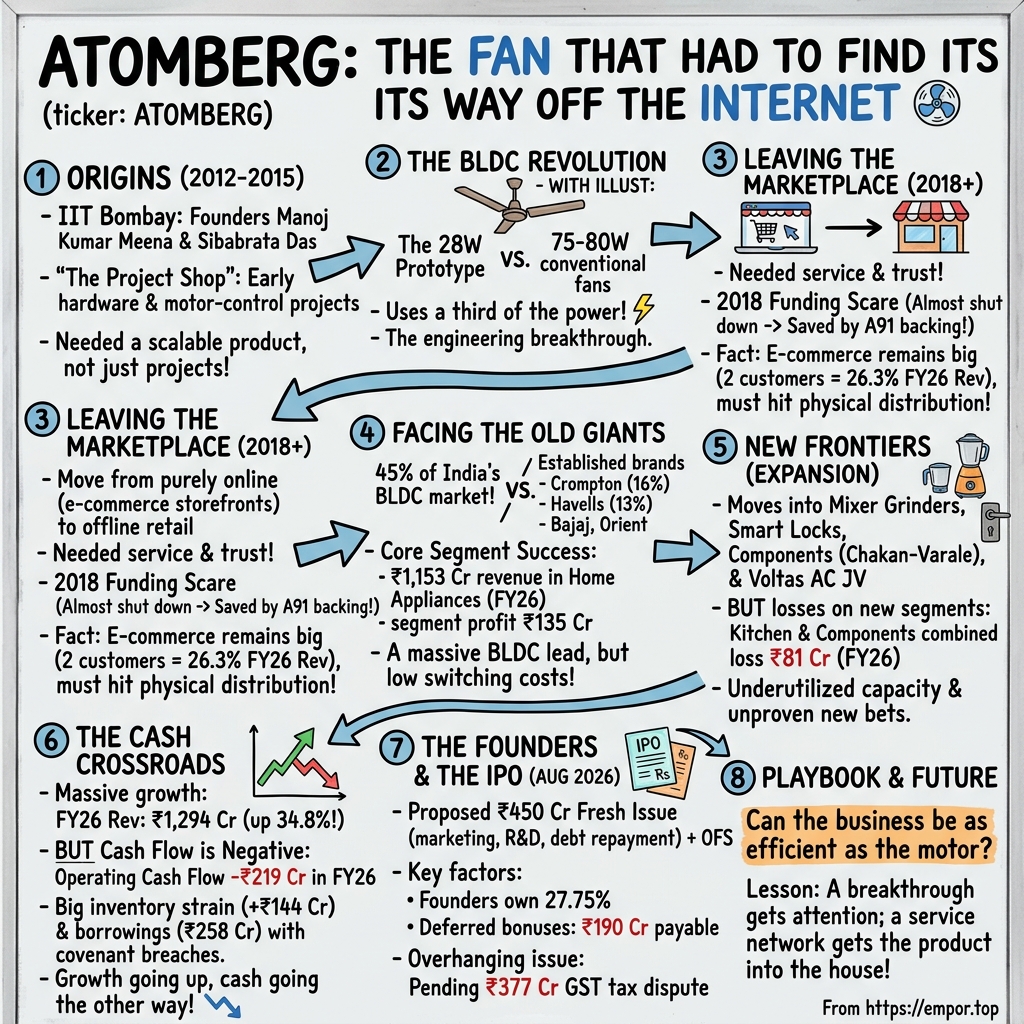
Atomberg: The Fan That Had to Find Its Way Off the Internet
I. The Fan That Used a Third of the Power
In April 2015, in a small workspace connected to IIT Bombay's incubator, a team of seven or eight engineers finished a ceiling fan that did not look like a revolution.1 It had three blades, a canopy and a regulator, like the fans that turn above nearly every bed and desk in India.
The difference was inside the hub. Where an ordinary ceiling fan of the time drew roughly 75 to 80 watts, Manoj Kumar Meena's prototype was rated at about 28.1 It used roughly a third of the power to move a similar column of air.
That gap is easy to dismiss on a single evening, but a ceiling fan is not a single-evening appliance. In much of India it runs for most of the day through most of the year, often in several rooms at once. A saving of 50 watts multiplied across thousands of hours and several fans in a household becomes a noticeable line on an electricity bill.
Multiplied across a country with hundreds of millions of fans, it becomes a power plant that does not need to be built. Meena understood that the efficiency claim was not a specification. It was a household argument.
Eleven years later, that argument has become a company with a national brand, factories in Maharashtra, a components subsidiary and a draft prospectus sitting with India's securities regulator. Atomberg Technologies filed its Draft Red Herring Prospectus with SEBI on August 20, 2026, and SEBI listed the filing a week later.2 As of late October 2026, no red herring prospectus with a price band has followed.3
The prospectus shows how far the fan travelled. In the year to March 2026, Atomberg's consolidated revenue reached about ₹1,294 crore, up almost 35% from the year before.4 The same statements show something less comfortable. The company lost about ₹149 crore, more than the year before, and its operating activities consumed about ₹219 crore of cash.4 Growth accelerated. Losses widened. The cash went the wrong way.
That contrast is the story. Atomberg found a real problem and solved it with engineering that consumers could feel in a monthly bill. The question for a public-market investor is different from the question the founders answered in 2015. It is not whether the fan works. It is whether the business built around the fan can pay for itself.
Four questions follow from that. The first is whether Atomberg's lead in efficient fans can hold as Crompton, Havells and other established brands push their own versions of the same motor technology. The second is whether the new businesses Atomberg has started, from mixer grinders to motor components, can earn back what they are absorbing.
The third is whether growth can become self-funding rather than dependent on supplier credit, bank waivers and new equity. The fourth is what a public investor should pay for a company that has not yet made money, when the company has not yet named its price.
One boundary applies throughout. Atomberg was founded in 2012, but the comparable restated financial record in its prospectus begins only in the year to March 2024.4 The earlier years survive in founder interviews, press reports and funding announcements, which are useful for understanding decisions but are not audited on the same basis.
Three years is a short window through which to judge a company asking to be owned for decades. It is the window the filing provides, and every claim of durability has to be tested against it.
 Subscribe on LinkedIn
II. The Project Shop That Needed a Product
Atomberg did not begin as a fan company. Meena founded it at IIT Bombay in 2012, and Sibabrata Das joined him as co-founder in 2013.5 What they built first was closer to a contract engineering shop. Meena later described the opening years plainly: for the first three years, he said, he was bootstrapping in a project mode.1 The work covered data acquisition, motor control and process-control systems, the kind of specialised hardware and electronics that research labs and institutions commission one job at a time.1
Project work has a particular rhythm. Each contract pays for itself, the engineers learn something, and then the next client wants something different. It can keep a small team alive and sharpen its skills. What it rarely does is compound. A firm that designs a motor controller for one lab does not get to sell the same controller to ten million households. The founders wanted the second kind of business, and project work could not give it to them.
The capability they were accumulating, however, pointed somewhere useful. Motor control is the discipline of telling an electric motor precisely how to spin, and it sits at the heart of a technology called brushless direct-current, or BLDC. A conventional ceiling fan uses an induction motor, a robust old design that works by letting alternating current create a magnetic field that drags the rotor around.
It is cheap and durable, but it wastes a good deal of energy as heat. A BLDC motor uses permanent magnets and a small electronic controller that switches current through the windings at exactly the right moments. The physics favour it. The difficulty is the electronics, which must be cheap, reliable and able to survive India's unstable household voltages for years.
That difficulty was exactly what a motor-control shop knew how to solve. In 2015 the founders decided to turn their expertise into a product, and the ceiling fan was the obvious target.1 It was a category everyone already bought, in which the motor dominates the energy bill, and where the incumbents had little incentive to rethink a design that sold well as it was. The prototype took about six months, and setting up production took another six.1 The first pilot run was about 400 fans.1
The money behind this was small. The company raised an angel round of about ₹1 crore, most of it spent on manufacturing and product development, and followed it with a seed round of about $1 million in 2016.6 Atomberg sold its fans in a price range of roughly ₹3,000 to ₹4,200 in its early years, used ferrite magnets in ceiling fans to control cost, and called its product line Gorilla.1 By late 2018, Meena said, more than 2.5 lakh Gorilla fans were running, and the team had grown to about 200 people.1
The important early skill was not only inventing a more efficient motor. Several Indian engineering startups have built clever hardware and stayed small. What Atomberg did well was recognise that its project business had no path to scale, and then find a product problem in which the engineering mattered to an ordinary household, could be expressed in one number, and recurred in every home.
The efficiency claim was easy to explain. The exact number drifted as the range grew; by 2023 the company's pitch compared about 35 watts for a BLDC fan with up to 80 for a traditional one.6 The shape of the argument never changed: the same breeze for well under half the electricity.
The technical claim still needs to stay in proportion. A lower-wattage fan is distinctive, but distinctiveness does not sell itself. Shoppers have to believe it, find it where they buy fans, trust that it will survive voltage swings, and know someone will fix it if it fails. A BLDC fan also costs more upfront than a basic induction fan, so the buyer has to accept a higher price today for savings spread over years.
In 2018 Meena described Atomberg as the number one player in BLDC ceiling fans in India and set a target of ₹500 crore of fan revenue by 2022–23.1 Whether those claims became a business depended less on the motor than on where, and how, the fan could be bought.
III. The Fan Had to Leave the Marketplace
Atomberg's first customers were not households. The company began selling to institutions, including Tata group companies, Infosys and Indian Railways, and its first order was 100 fans for a school in Mumbai.6 Bulk orders eventually reached 1,500 to 2,000 units at a time.6 Institutional buyers were a natural first market, because a facilities manager running hundreds of fans can calculate electricity savings and act on them in a way an individual buyer seldom does.
The founders soon saw the ceiling. Das later said business-to-business sales were only about a tenth of the overall fan market.6 A company that wanted to be large would have to sell to homes, and homes buy fans one or two at a time through shops and websites. Within about a year of its consumer launch, Atomberg was selling through Flipkart and Amazon.6
E-commerce suited a young brand with a technical argument. A product page could display wattage comparisons, a reviews section could build social proof, and a startup with little money could reach buyers across the country without persuading thousands of shopkeepers to stock an unknown name. For a few years, online marketplaces were where Atomberg was discovered.
They were not where most Indians bought fans. A ceiling fan is installed overhead, often by an electrician, and is expected to last a decade. Buyers want to see it, and they want to know who will come if it stops. A marketplace listing could make the product easy to find, but it could not provide the local dealer who recommends a brand, the electrician who trusts it, or the service technician who arrives when the controller fails. Discovery online did not solve trust, service and reach offline. In 2018 Atomberg began moving into offline retail.5
The move came close to arriving too late. In 2018, the founders said, they were about three weeks from shutting the company down when Abhay Pandey, a general partner at A91 Partners, answered a cold email.6 A91 went on to lead Atomberg's Series A in 2019 and to invest again in the Series B in 2020.7
The rescue changed the company's trajectory, and it is also a reminder of how fragile the business was eight years ago. The fan was already efficient. What it lacked was the capital to put that efficiency on shop shelves.
The offline push became the main engine. By 2023 the company said more than 70% of its sales came through offline channels, mostly general trade, from about 25,000 retail touchpoints and more than 400 vendors.8 It reported having sold about five million fans to roughly two million users by March 2023, half of them in that year alone.8
The pandemic years were the steepest part of the climb: revenue rose from about ₹143 crore in the year to March 2021 to about ₹358 crore a year later, while advertising and marketing spending nearly tripled to about ₹38 crore.6 Atomberg was buying awareness, and the sales followed.
Service was the slower build. By 2023 the company described a network of service centres in five cities and about 400 service partners,6 modest coverage for a brand selling millions of fans across a country of India's size. In June 2022 it opened its own plant near Pune at a cost of about ₹25 crore,6 bringing more of the manufacturing in-house.
A Steadview survey cited in 2023 found Atomberg among the top three brands at the retail counters where it was present.8 The trust problem that had held the brand back online was being solved one dealer at a time.
The shift to physical distribution brought its own costs. A retailer needs margin, credit and stock. A distributor needs payment terms. A service network needs technicians and spare parts in every region. Atomberg's product sales generally carry payment terms of 30 to 90 days.9 Each of those requirements moves cash from the company's bank account into the channel, which is part of why rising sales would later prove so expensive to fund.
The marketplace came back
The surprise in the prospectus is that the internet never let go. Two e-commerce customers each contributed more than 10% of revenue in each of the last three years.10 In the year to March 2024 they accounted for about 17% of revenue, and in the following year about 16%.10 Then, in the year to March 2026, their combined share jumped to about 26%, or roughly ₹341 crore.10
That jump explains a large part of the year's growth. Atomberg's total revenue rose by about ₹334 crore in the year to March 2026.4 Sales to those two customers rose by about ₹188 crore.10 More than half of the company's incremental revenue, in other words, came through two online platforms. The company that built its scale by leaving the marketplace grew fastest last year by going back to it.
That may be sensible. Kitchen appliances, which grew sharply last year, are bought online more readily than ceiling fans, and marketplace sales can be cheap to fulfil. But it changes the risk. Large platforms set the terms of display, discounting and payment, and two of them now control about a quarter of Atomberg's revenue. Atomberg does not name them or disclose either one's individual share.10
Its earliest consumer sales ran through Flipkart and Amazon,6 but the prospectus leaves an investor unable to say whether one platform accounts for 20% and the other 6%, or whether each sits near 13%. The difference matters: a single customer at a fifth of revenue has a level of bargaining power that two evenly split customers do not.
The retail move fixed a real weakness in the original online model, and it built the business that now exists. It did not end Atomberg's dependence on a small number of powerful channels. It changed which channels mattered, and in the latest year the balance tipped back toward the platforms where the brand began. That raises the question of how strong the brand is once a shopper sees an Atomberg fan next to a Crompton or a Havells.
IV. The BLDC Lead Meets the Old Fan Market
Picture a shopper in an electrical store in Pune, looking up at a row of ceiling fans. One is an Atomberg, sleek, with a remote control and a label promising low electricity use. Next to it hangs a conventional fan from a household name: Crompton, Havells, Orient, Bajaj or Usha.
The conventional fan costs noticeably less. The shopkeeper has sold that brand for twenty years and knows its service engineer by name. The Atomberg asks the shopper to pay more today to save money over years.
That scene is the competitive problem in one frame. Atomberg's efficiency advantage can repay its higher upfront price over time for buyers who run fans for many hours a year. But fans are not bought on a spreadsheet. Retail distribution, product availability, the shopkeeper's recommendation, seasonal demand, after-sales service and the price on the day all shape the sale.
There is evidence that shoppers have been moving Atomberg's way. Home Appliances, the segment containing fans, generated about ₹1,153 crore of revenue in the year to March 2026, roughly 89% of the group's total, and grew about 23% over the year.4 It also earned a segment profit of about ₹135 crore.4 Whatever else is true of Atomberg, its core business is profitable before group-level costs, and it is growing quickly.
The best outside estimate of Atomberg's position comes, oddly, from another company's prospectus. An industry analysis by Technopak, included in the draft prospectus of water-purifier maker Kent RO Systems, put Atomberg's share of India's BLDC fan market at about 45% by value in 2024, against about 16% for Crompton and 13% for Havells.11 Dealer surveys point the same way.
When PL Capital's analysts spoke with 50 fan dealers across India in the summer of 2025, they reported that Atomberg continued to lead in the BLDC category while Crompton and Havells dominated non-BLDC fans.12 Across the fan market as a whole, the dealers named Crompton, Havells and Atomberg as the leaders, followed by V-Guard, Orient, Kuhl and Bajaj.12
Two market shares, not one
Those figures need careful handling, because they describe two different markets. Atomberg's 45% is a share of BLDC fans, a premium slice of the category. It is not a share of all ceiling fans. The same dealer survey found that BLDC fans still saw low demand because of their higher prices and limited product awareness, and that economy fans remained the best-selling category.12
Crompton and Havells, meanwhile, sell across the whole range, from the cheapest induction fans to their own BLDC lines, alongside lighting, pumps, water heaters, wires and kitchen appliances. Crompton's broker coverage puts its overall fan market share at more than a quarter.13
Size makes the point vivid. Crompton reported consolidated revenue of about ₹8,100 crore in the year to March 2026, with earnings before interest, tax, depreciation and amortisation of about ₹817 crore.14 Its fan business alone is larger than all of Atomberg. In 2023 Meena said Atomberg was already about half the size of Crompton or Havells in fans and close to Bajaj.8
That was a remarkable claim for a company that nearly closed five years earlier. It was also a claim about one category, against rivals whose distribution, brand recognition and purchasing power span a dozen.
The incumbents have not stood still. Crompton launched new BLDC platforms and models, and in the summer of 2025 dealers reported that those launches had not yet reached many shops or changed demand.12 That gap closed quickly. In the quarter to September 2025, Crompton's BLDC fans grew by more than 50% even as its overall fan sales declined, a surge its brokers attributed to products built on its own in-house BLDC platform, called Nucleus.13
That detail matters more than the growth rate. Atomberg's early edge came from knowing how to design motor electronics that incumbents bought in or did not bother with.
A rival that has built its own platform has closed the capability gap and is now competing on brand, shelf space and price, where it is stronger. A year later, in the quarter to September 2026, its BLDC fans grew about 40% while its consumer-durables segment grew about 19% and gained market share.14
The largest incumbent is now selling efficient fans at a growth rate faster than Atomberg's own Home Appliances segment. Its fans also reach through general trade and rural channels that recorded double-digit growth, while Crompton's own e-commerce sales were subdued.14
The economics of a fan sale also leave little room for an unanswered attack. Buyers can compare fans easily, by price, wattage and star rating. Retailers and marketplaces decide what is visible and what is pushed. Once a fan is installed, the buyer has no switching cost the next time; the next purchase is a fresh contest.
Atomberg's possible advantages are its brand among efficiency-minded buyers, its product engineering and the retail network it built after 2018. Each of those can be durable, but none is automatically so.
Price is the other pressure. Crompton raised fan prices cumulatively by about 17% to 18% between January and September 2026 and passed on about 80% of its cost increases.14 That points to significant input inflation in the category, and Atomberg's exposure is sharper in one respect. It imports components, settling some payables in Chinese yuan, US dollars and Japanese yen, and it does not hedge foreign-exchange risk.15
The disclosed exposures are modest relative to revenue, but a company with thin margins and a premium price point has less room to absorb cost increases than an incumbent with pricing power across many categories.
What would show the BLDC lead weakening? The plainest signals would be Atomberg losing share within BLDC as Crompton and Havells scale their platforms, deeper discounting to keep volume, weaker support from retailers, or new rival products that close the efficiency and design gap. Atomberg's prospectus is strongest on current segment revenue and profit. It does not disclose product-level margins, repeat-purchase rates, customer retention or trends in realised prices, so an outside investor cannot yet see whether the premium Atomberg charges is holding.
The evidence supports a leading position in BLDC fans and a profitable core. It does not yet prove a durable, company-wide moat. Atomberg's lead was built in a premium niche while the incumbents were selling conventional fans that worked well enough. As the niche becomes the mainstream, those incumbents are arriving with their own motors, their own dealers and their own balance sheets. Atomberg's answer has been to stop depending on fans alone.
V. Every New Category Has to Earn Its Place
The logic of diversification at Atomberg starts with the motor. If a company can build an efficient, cheap, reliable electronically controlled motor for a fan, the same discipline could improve other appliances in which a motor does the work. A mixer grinder is essentially a powerful motor in a box. A water purifier needs pumps. An air conditioner depends on a compressor driven by a motor. Atomberg's founders saw a company that could carry its core engineering into one appliance category after another.
The timeline shows how fast that ambition moved. Atomberg entered kitchen appliances in 2022, the year it opened its Pune plant.5 It launched smart locks in 2023 and incorporated Atomberg Innovation Private Limited, a subsidiary for motors and components, the same year.5 That subsidiary began operations at Chakan-Varale in 2024, and in 2025 Atomberg entered water purifiers with a product called Intellon.5
The mixer grinder has been the most successful step so far. Kitchen Appliances revenue rose from about ₹19 crore in the year to March 2025 to about ₹124 crore in the year to March 2026, more than six times in a single year.4 That is fast growth by any standard, and it suggests the brand built in fans can carry into the kitchen.
The cost of that growth is just as visible. Kitchen Appliances lost about ₹45 crore at segment level in the year to March 2026.4 For every ₹100 of mixer-grinder and kitchen sales, the segment lost about ₹36. Some of that reflects launch costs, marketing and the inefficiency of a small production base. The question is how much falls away with scale and how much is the price of competing with established kitchen brands.
Crompton's own Butterfly kitchen business, for instance, is gaining share in mixer grinders and cooktops, while Crompton's small-appliance range grew more than 20% in the quarter to September 2026.14 Atomberg is entering a category in which a fan rival is also a kitchen incumbent.
Keep the scale in view. Home Appliances still produced nearly nine-tenths of Atomberg's revenue and was its only profitable reported segment in the latest year.4 The new categories are growth options financed by the fan business and by investors, not yet a second leg for the company to stand on.
The motor factory waiting for orders
The components bet is more strategic and less proven. Through its subsidiary, Atomberg is building motors and electronics to sell to other manufacturers, turning its core skill into a business-to-business product. The segment had seven enterprise customers in the year to March 2026, up from two a year earlier, and the company says it has not lost a key customer with a material adverse effect since the segment began in 2024–25.10
That is a short record. Industrial components buyers qualify suppliers slowly, and the real test is whether design wins become repeat orders at volumes that fill a factory.
The factory is the problem. Proprietary Components generated only about ₹17 crore of revenue in the year to March 2026 and lost about ₹37 crore.4 The segment lost more than two rupees for every rupee it sold. The Chakan-Varale components facility operated at about 15% of installed capacity in that year, and its motor-assembly line at under 2%.9 Atomberg built ahead of demand, which is a defensible choice for a components supplier that must show customers it can deliver at scale.
But a plant running at a seventh of its capacity carries fixed costs that only orders can absorb. Until utilisation rises, each new enterprise customer is a sign of interest rather than a sign of return.
The flows inside the group show how much the parent is carrying. In the year to March 2026, Atomberg Technologies bought about ₹139 crore of goods from the subsidiary and lent it about ₹161 crore for working capital at 10% interest, repayable within a year; about ₹100 crore of that loan was later converted into compulsorily convertible preference shares.16
Those amounts disappear in the consolidated accounts, but they show where the parent's cash went: into a subsidiary whose external revenue was a fraction of what it absorbed. The auditor's report for the year also noted a loan to a subsidiary that had fallen due.17
The newest component bet arrived days before the filing. On August 14, 2026, Voltas, the Tata group air-conditioner company, signed a binding term sheet with Atomberg Innovation to form a joint venture to make high-efficiency room air-conditioner compressors in India.18 Voltas would be the anchor customer, and the venture could also supply other air-conditioner makers.19
The partnership is a notable endorsement of Atomberg's motor engineering, and compressors are a far larger market than ceiling-fan motors. But the term sheet is still subject to due diligence and regulatory approvals.19 Neither company has published the ownership split, the investment or the capacity.19 It is an option, not a factory, and not revenue.
Atomberg's own history counsels caution here. Its record of converting technical partnerships into revenue is too short to judge, and the components segment it already operates, with seven customers, is losing more than twice what it sells. A compressor venture would demand far more capital and longer qualification cycles than fan motors. If it becomes a definitive agreement and produces orders, it could change the story. Until then, it belongs beside the half-empty Chakan plant as evidence of ambition rather than economics.
How has Atomberg paid for all this? Its capital history shows a sequence of preference-share and convertible-security issuances, including about ₹234 crore of compulsorily convertible debentures in the year to March 2024 and about ₹212 crore of preference shares in the year to March 2026.20 It has made no material acquisition; the diversification has been organic, through factories, research and new launches.
Research and development spending rose from about ₹40 crore to about ₹87 crore over the three years, or about 5% to nearly 7% of revenue, and research staff roughly doubled to 254.9 Additions to property, plant and equipment rose from about ₹54 crore to about ₹98 crore.9
That spending is investment rather than harvesting, and in a young appliance company it may be the right choice. But capital allocation is judged by returns. The two businesses that this money has built so far lost a combined ₹81 crore on ₹141 crore of revenue last year.4 Smart locks and water purifiers are early category extensions whose financial weight is too small to separate in the reported segments.
Atomberg is still, financially, a fan company paying for experiments. Whether those experiments can pay their way depends on something more basic: whether the fan business itself can generate the cash to fund them.
VI. Growth Accelerated; Cash Went the Other Way
In the year to March 2026, Atomberg's revenue rose by more than a third. In the same year, inventory absorbed about ₹144 crore of cash.4 Those two facts belong in the same sentence, because the second is the price of the first.
The three-year record is short, but its direction is clear. Revenue rose from about ₹797 crore in the year to March 2024 to about ₹960 crore the next year and about ₹1,294 crore in the latest year, accelerating from about 20% growth to about 35%.4 Net losses moved the other way from what a scaling story would suggest: about ₹199 crore in the first year, about ₹117 crore in the second and about ₹149 crore in the third.4
On the company's adjusted measure, earnings before interest, tax, depreciation and amortisation improved, with the loss narrowing from about ₹51 crore to about ₹37 crore.4 Adjusted figures, however, do not pay suppliers.
Operating cash flow is the cleaner test. It was negative by about ₹78 crore in the first year, positive by about ₹13 crore in the second and negative by about ₹219 crore in the third.4 The swing from a small inflow to a large outflow happened in the year revenue grew fastest. That is not an accident; it is how this kind of business works when it is not yet efficient.
An appliance company buys components and makes fans before it sells them. It stocks distributors and retailers before the summer, and extends them credit. Its suppliers, in turn, extend credit to it. When sales rise sharply, all three balances grow. If inventory and receivables grow faster than payables, the company has to find cash from somewhere else to fund the gap.
In the year to March 2026, inventory rose by about ₹144 crore and receivables by about ₹63 crore, while payables rose by about ₹65 crore and other assets absorbed another ₹41 crore.4 The company's suppliers financed only a fraction of its expansion.
The previous year's positive cash flow looks less healthy once the same lens is applied. In the year to March 2025, payables rose by about ₹96 crore.4 Without that increase, operating cash flow would have been negative by a wide margin. Atomberg's suppliers were waiting longer to be paid, and that delay produced the only year of positive operating cash flow in the record.
Supplier credit is a legitimate form of financing, but it is financing. It does not show that the company has reached a stable cash-generating model, and the reversal of the following year shows how quickly it can run out.
Receivables tell a similar story with more texture. They rose from about ₹168 crore in March 2024 to about ₹239 crore in March 2026.10 Relative to sales, collections have improved, from roughly 77 days of revenue to about 67, and almost all the good balances at March 2026 were less than six months old.10
That is a reasonable profile for a business selling through dealers on 30-to-90-day terms. Atomberg has also had real collection disputes: an alleged customer, ZAAK Mobile and Electronics, ordered 10,930 fans worth about ₹2.9 crore, paid about ₹10 lakh in advance and did not pay the rest, and a criminal complaint is pending.17
The company has four other cheque-dishonour complaints totalling about ₹1.9 crore.17 Some of its receivables are also factored or channel-financed while remaining on the balance sheet.10 None of this suggests a collapse in credit quality. It does show that selling through a sprawling trade network brings real collection risk.
The cost base has grown alongside the inventory. Permanent headcount rose from 688 to 1,003 over the three years, and in the latest year the company also used 1,973 contractual personnel.9 Depreciation and amortisation more than doubled from about ₹39 crore to about ₹71 crore as factories, leases and capitalised development came onto the books, and employee stock-option expense rose to about ₹13 crore.4
Those charges are non-cash, which is why they are added back when operating cash flow is calculated. They are still real costs. Depreciation is the slow recognition of money already spent on plant, and stock options are paid in shares that dilute the owners. A company that looks close to breakeven before those lines is further from it after them.
Interest income cushioned the losses. Other income was about ₹30 crore in the year to March 2026, almost all of it interest on bank deposits and similar financial assets.15 That income came from money investors had put in, parked while it waited to be spent. It is not a substitute for cash from operations.
Borrowing against the covenants
The balance sheet carries the consequences. At March 2026, Atomberg owed about ₹258 crore in borrowings, almost all of it current.21 Leases are a separate obligation: the company carried another ₹158 crore of lease liabilities, against total contractual lease payments of about ₹247 crore.21 Leases for factories, warehouses and offices are real commitments, but they are not funded borrowing and should not be added to it carelessly.
Cash and cash equivalents were about ₹41 crore,15 and cash together with bank deposits was about ₹216 crore.22 The company had about ₹54 crore of committed but undrawn facilities.21 By July 15, 2026, borrowings had risen to about ₹275 crore.21
The headline debt is not the main issue. The covenants are. Bank loans often carry financial tests, such as a minimum ratio of current assets to current liabilities or a maximum ratio of total liabilities to tangible net worth. Atomberg breached its current-ratio covenant in the year to March 2025 and its total-outside-liabilities-to-adjusted-tangible-net-worth covenants in the year to March 2026.23
Lenders waived or noted the breaches. But as of July 15, 2026, that liabilities ratio remained above the limits in its facilities, and the company said it expected another breach at the next test unless lenders granted a further waiver or amendment.23 HDFC Bank and RBL Bank facilities made up about 62% of its borrowings at that date.21
Waivers are common in growing Indian companies, and lenders who expect an equity raise have reason to be patient. That patience, however, is a decision someone else makes. A company whose banks must repeatedly agree to overlook its financial tests is a company whose liquidity depends on relationships as much as on results.
Put together, the cash record does not yet show self-funded growth. Each step up in sales has required more inventory, more receivables and more financing, whether from suppliers, banks or investors. The proof that would change this verdict is straightforward to state: several consecutive periods of positive operating cash flow, achieved without a large build in payables and without fresh lender waivers.
Until that appears, every rupee of growth comes with a financing question. And one of the largest claims on Atomberg's cash does not sit with its banks or suppliers. It sits with its founders.
VII. The Founders’ Incentives Are Part of the Capital Story
Two numbers in the prospectus sit uneasily side by side. Manoj Kumar Meena and Sibabrata Das together hold about 27.75% of Atomberg's pre-offer fully diluted share capital.20 And at March 2026, the company still owed them about ₹190 crore in bonuses.16
The founders' stake is the reassuring half. Founders who own more than a quarter of their company have most of their wealth tied to its long-term value, and both have spent fourteen and thirteen years respectively building it. Unlike most of its large investors, they are not selling shares in the offer for sale.24 In April 2026 the board formalised their roles: Meena became Chairman and Managing Director, and Das became Chief Executive Officer and Executive Director.25
Manish Kumar Bansal joined as Chief Financial Officer in May 2026, about three months before the filing.25 A finance chief who arrives so close to a listing has had little time to shape the numbers investors will judge.
The bonuses are the uneasy half. In the year to March 2024, Atomberg awarded Meena about ₹53 crore and Das about ₹80 crore in bonuses, together about ₹133 crore.16 That was roughly 17% of the year's revenue, in a year in which the group lost about ₹199 crore.16 Put another way, about two-thirds of that year's loss was the founders' bonus.
The awards were not paid in cash. They were deferred, and the unpaid balance has barely moved: about ₹192 crore was outstanding at March 2024 and about ₹190 crore remained outstanding two years later.16 Atomberg pays interest on that balance, which cost it about ₹13 crore in the year to March 2026, down from about ₹16 crore the year before.16
The scale of the liability relative to the company's cash is striking. Atomberg's cash and bank deposits at March 2026 were about ₹216 crore, so the founders' unpaid bonuses amounted to close to nine-tenths of them.22 The prospectus does not explain the performance criteria behind the awards or set out a settlement schedule.22 It does not say that the IPO proceeds will be used to pay them, and nothing in the stated objects of the fresh issue earmarks money for that purpose.26
Public investors will nonetheless own a company that carries a ₹190 crore claim from its two most powerful insiders, and money is fungible: every rupee the company spends on the bonus is a rupee unavailable for inventory, debt or research.
The ongoing pay is more modest. In the year to March 2026, Meena received about ₹1.5 crore and Das about ₹1.4 crore in director remuneration, plus smaller deferred amounts.25 Under their new three-year terms, each is eligible for up to ₹5 crore a year.25 That ceiling is not extravagant for founders running a company with ₹1,300 crore of revenue.
Set beside losses of ₹149 crore and a ₹190 crore bonus still owed, it is a reminder that their compensation has so far been determined by a private board and a small group of investors, not by profitability.
Part of the founders' stake is also encumbered. Their pledged shares and preference shares make up about 20% of their combined holdings, or roughly 3.7% of pre-offer fully diluted capital, securing personal loans.20 The prospectus says the pledges will be released before the statutory lock-in begins and created again afterward.20 Pledged founder shares are common in India, but they add a channel through which a fall in the share price could become a forced sale.
The founders have also taken money off the table along the way. Secondary sales by existing shareholders since 2019 total about ₹683 crore, most of it by early investors; the founders' share amounts to about ₹72 crore, with Meena selling about ₹40 crore and Das about ₹31 crore.27
That is modest relative to their remaining stake and unremarkable in a decade-long venture-backed company. It belongs in the picture because it separates the founders' personal liquidity, which they have partly achieved, from the company's liquidity, which still depends on new capital.
Promises against the record
Founders are also judged by the accuracy of what they say. In 2018, Meena set a target of ₹500 crore of fan revenue by 2022–23.1 Revenue for the whole company had reached about ₹358 crore by the year to March 2022,6 so the goal was within reach on the trajectory of the time, though the comparable record in the prospectus begins only afterward.
The later promises are easier to test. In April 2023, asked whether Atomberg would be profitable in the year to March 2024, Das replied, "Why not?"6 The company was then aiming to surpass ₹1,000 crore of revenue that year.6 In August 2023 Meena said the company was already EBITDA-positive and would be cash-flow positive by the end of that financial year.8
The record went the other way. The restated accounts show revenue of about ₹797 crore in the year to March 2024, a loss of about ₹199 crore and operating cash outflow of about ₹78 crore.4 Some of the difference reflects the restatement into Indian accounting standards and the treatment of the founders' bonuses; excluding the bonuses alone, that year's loss would have been far smaller.
But the targets were stated without those caveats, and Atomberg has remained loss-making in every year of its restated record. The contrast does not suggest bad faith. Optimistic founders of growing companies routinely miss forecasts. It does suggest that Atomberg's forward statements have been less reliable than its product claims, and investors should discount future guidance accordingly until a public track record exists.
There is one governance concern the prospectus largely clears. Sales to related parties outside the consolidated group, chiefly to a firm called Shibam Enterprize, were about ₹2 crore in the year to March 2026, roughly 0.16% of revenue, and related-party purchases were smaller still.16 The board at the time of filing had six directors, three of them independent, including one woman.25
The governance question at Atomberg is therefore not routine related-party trading. It is founder compensation, the controls that allowed a bonus of that size in a loss-making year, and whether a newly public board will hold its founders to the profitability they have promised. The IPO will put that board in front of shareholders who can vote.
VIII. The IPO Must Finance Both the Core and the Bet
The prospectus filed in August 2026 proposes two different transactions under one name. The first is a fresh issue of new shares worth up to ₹450 crore, which would bring money into Atomberg.26 The second is an offer for sale of up to about 7.65 crore existing shares by investors, which would bring money to those investors and nothing to the company.26 Atomberg may also place up to ₹90 crore of shares privately before the IPO, which would reduce the fresh issue by the same amount.26
The sellers are the investors who backed Atomberg's climb. A91 Emerging Fund, the investor that answered the 2018 cold email, is offering up to about 3.77 crore shares, roughly half of the offer for sale.20 The other sellers are V-Sciences Investments, Jungle Ventures, two Inflexor funds, Steadview Capital and Survam Partners.24
A91 has already done well. It invested about ₹143 crore, has sold about ₹445 crore of shares in secondary transactions and still holds about 21% of the company.7 The IPO gives it, and the others, a public market in which to sell the rest over time.
The fresh issue is where the company's own needs show. Atomberg plans to use about ₹90 crore to repay borrowings, about ₹150 crore for brand building and performance marketing, and about ₹100 crore for research and development, with the remainder for general corporate purposes.26 Each of those amounts should produce something measurable.
The debt repayment should relieve covenant pressure. The marketing money should defend share in BLDC fans and build awareness for kitchen appliances and purifiers. The research money should show up in products that hold a price premium or win component orders.
What the fresh issue does not obviously do is fund working capital. In the year to March 2026, operating activities consumed about ₹219 crore and capital spending about ₹98 crore, so the business used roughly ₹317 crore before financing.4 The new money is largely earmarked for debt, marketing and research.
If inventory and receivables keep growing faster than payables, Atomberg will need its banks, its suppliers or further equity to fund the gap even after listing. The IPO extends the runway; it does not, by itself, change the shape of the plane.
What could still go wrong
Several live disputes sit alongside the offer. The largest is a tax matter: two show-cause notices from the Tamil Nadu GST authorities for the years to March 2023 and March 2024 propose a combined demand of about ₹377 crore.17 Atomberg disputed the allegations in August 2026, and the matters were pending at the time of filing.17 A show-cause notice is a proposal, not a final assessment, and Indian tax authorities frequently issue large preliminary demands that are later reduced.
But this one is roughly 2.5 times the company's latest annual loss and larger than its cash and bank deposits. It is a different order of exposure from the roughly ₹0.9 crore of legal claims the restated accounts treat as a contingent liability.17
Atomberg is also fighting over its designs. It sued Stove Kraft for design infringement and won an interim injunction and seizure order, but that order was discharged in April 2026; Atomberg's appeal was pending.17 Separately, it is in a dispute with Eureka Forbes over alleged patent infringement involving the Intellon water purifier, with Eureka Forbes seeking about ₹2 crore in damages and Atomberg about ₹0.5 crore.17
The sums are small. The significance is that the company's design protection has so far proved weaker in court than its product engineering in the market, which matters for a business whose advantage rests partly on design.
The auditors added their own observations. Their reports noted cash losses in each of the three years.17 The report for the year to March 2024 cited material discrepancies in the physical verification of property, plant and equipment and an employee fraud of about ₹2 crore, which the company says it recovered.17 Across all three years, the auditors reported limitations in the company's audit trail, the accounting-system log that records who changed what, and in the latest year privileged-access changes were not covered.17 None of these is fatal. Together they describe a finance function still catching up with a company that grew faster than its controls.
What the fan is worth before the price arrives
The prospectus leaves the offer price blank.26 Atomberg's shares have never traded, so there is no market history.28 Without the price and the post-issue diluted share count, no one can calculate the IPO's valuation or a meaningful price-to-sales ratio. Reports in August 2026 said Atomberg was targeting an IPO of about ₹1,500 crore to ₹2,000 crore in total,19 but offer size is not valuation; it measures how much stock changes hands, not what the whole company is said to be worth.
The private-market history provides one observed price, with caveats. In May 2023 Atomberg raised $86 million in a Series C led by Temasek and Steadview Capital.8 While the round was being negotiated, reports put the valuation at about $425 million,6 roughly ₹3,500 crore at the exchange rates of the time.
Neither the company nor its investors published the final valuation or the split between new and existing shares. The investors also bought preference shares, which typically carry protections such as liquidation preferences and anti-dilution rights that public shareholders will not receive, and the terms of those protections have not been made public.
A mark set for protected preference shares in a partly secondary round is a pricing signal for that security, not a value for public common stock. Even so, it is a useful yardstick: ₹3,500 crore was more than four times the following year's revenue of about ₹797 crore.
The secondary market in Atomberg's shares adds a second set of signals, also incomplete. Existing shareholders have sold about ₹683 crore of shares since 2019, with buyers such as Jongsong Investments and V-Sciences Investments taking large blocks.27 None of that money reached Atomberg. The prices of those trades have not been made public, so they cannot anchor a valuation either.
What they do show is that a group of large, sophisticated investors has been willing to buy what early backers were selling, and that the early backers, A91 above all, have already turned much of their gain into cash before public investors arrive.
Across its private life Atomberg raised about $126.5 million in total funding,24 a modest sum for a company of its revenue, and a reminder that much of the capital behind its growth came from suppliers, lenders and reinvested losses rather than from equity rounds alone.
Building the share count is the other missing piece. Atomberg's capital structure has been reshaped repeatedly by conversions of preference shares, debentures and bonus preference shares into equity, and the founders' 27.75% is expressed as a share of the fully diluted pre-offer base.20 Employee stock options add to that base, at a cost of about ₹13 crore a year in the income statement.4 The fresh issue will add new shares on top, and how many depends entirely on the price.
A ₹450 crore issue at a ₹2,000 crore pre-offer valuation would dilute existing holders by about 18%; at a ₹4,000 crore pre-offer valuation, by about 10%. Until the red herring prospectus sets the price and the post-issue count, any headline market capitalisation is an estimate of total equity value, and the free float, the shares that public investors can actually trade, will be a much smaller slice of it.
The closest listed comparison shows how demanding that 2023 mark of more than four times sales was. Crompton Greaves Consumer Electricals, one of the largest fan makers in India and Atomberg's most direct rival, had a market capitalisation of about ₹14,000 crore in October 2026, on revenue of about ₹8,100 crore in the year to March 2026.14 Its enterprise value, which adds debt and subtracts cash, was about 1.6 times that year's revenue and about 16 times its earnings before interest, tax, depreciation and amortisation.14
Crompton's shares had fallen about a quarter over the previous twelve months.14 Crompton is profitable, with a margin of about 10% at that earnings line, and grows more slowly than Atomberg. Atomberg grows faster and loses money.
Apply Crompton's enterprise-value-to-sales multiple to Atomberg's revenue, and the arithmetic gives an enterprise value of roughly ₹2,100 crore. Subtracting debt-like claims takes the equity value lower. Net of cash and bank deposits, borrowings were roughly ₹40 crore at March 2026, and the founders' unpaid bonus adds about ₹190 crore of debt-like obligation, leaving roughly ₹1,850 crore before the new money, or about ₹2,300 crore after a ₹450 crore fresh issue.
That is an equity figure built from an enterprise-value multiple and adjusted for claims; it should not be compared with a price-to-sales figure on Atomberg's market capitalisation alone.
Other peers clarify the picture by contrast. Havells and Bajaj Electricals, both named in the prospectus as listed peers,28 are broader businesses; Havells, in particular, earns much of its revenue from cables and wires and from its Lloyd air-conditioner brand,12 so its multiple reflects a different mix. Bajaj Electricals, though a long-standing fan brand, spreads itself across a wide appliance range, which makes it a weaker guide to a focused fan maker.
Recent consumer IPOs could serve as a third reference point once Atomberg sets a price, but a peer only helps when it sells comparable products to comparable customers.
The comparison that matters most is with Crompton, because it sells the same products through the same shops to the same households. The case for Atomberg trading above that multiple is growth: revenue rising 35% a year against Crompton's low double digits. The case for trading below it is that Atomberg has not shown it can earn Crompton's margins at all.
An intrinsic view starts from the same tension. Suppose Atomberg grows revenue about 20% a year for five years, reaching about ₹3,200 crore, and by then earns a 9% margin at the earnings line before depreciation, slightly below Crompton's current level. That would yield about ₹290 crore of annual earnings at that line.
Valued at 16 times, Crompton's present multiple, the business would be worth about ₹4,600 crore in five years. Discounted back at 13% a year, a reasonable hurdle for an unprofitable Indian consumer company, that is about ₹2,500 crore today, before subtracting the claims and the cash the business will burn on the way.
In a weaker case, with growth of 12% a year and a 5% margin valued at 15 times, the figure today falls below ₹1,000 crore. In a stronger case, with 25% growth, a 12% margin and a 20 times multiple, it rises above ₹5,000 crore.
The range is wide because the business is young, and the sensitivity is mostly in the margin. In the central case, every percentage point of mature margin adds or subtracts roughly ₹280 crore of value today. Growth matters less than whether Atomberg can earn money on what it sells. The central range, roughly ₹2,000 crore to ₹2,500 crore of equity before the fresh issue, lands below the 2023 private mark.
Clearing that mark would require Atomberg to grow at around a quarter a year and to reach margins at or above Crompton's within five years, while its new categories stopped losing money.
The IPO market may price Atomberg above that range anyway. Listed consumer-technology companies with recognisable brands are scarce in India, a small free float can magnify demand, and an efficient-fan story is easy to tell. Those forces can lift a price on listing day. They do not change the cash the business generates. Investors who pay for the bull case will need the bull case to arrive.
IX. Analysis & Bear vs. Bull Case
Imagine an investor with the prospectus open and two numbers in mind. On one side sits the fan-led Home Appliances segment, profitable before group costs.4 On the other sit Kitchen Appliances and Proprietary Components, which together remain loss-making.4
Between them sit group costs, depreciation and interest, which turn a profitable core into a loss-making company. The investment decision is a judgement about which of those numbers will grow faster.
There are real reasons Atomberg may win. It has a distinctive efficiency proposition that customers can understand in one sentence. It holds a leading position in BLDC fans, supported by industry data and dealer surveys.1112
It has built product engineering, a design language and a retail network that took a decade and a near-death experience to assemble. And its core segment earns money before group costs, which is more than many venture-backed consumer companies can say at listing.
There are equally real reasons it may not. The broader fan market belongs to established brands with longer distribution reach, and those brands are now growing their own BLDC lines faster than Atomberg's fan segment is growing.14 Two e-commerce customers account for a substantial share of revenue.10 Switching costs for a fan buyer are close to zero. And the company provides no evidence on repeat purchase, retention or realised price trends that would show its premium holding.
The industry's structure explains why these risks matter. Rivalry is intense and rising, as Crompton, Havells, Orient and others extend BLDC ranges into the segment Atomberg pioneered. Buyer power is visible in marketplace concentration, where two platforms set the terms for a large share of sales, and in consumers who can compare fans on price and wattage in seconds.
Entry is possible for any brand with a contract manufacturer and access to dealers, since BLDC controllers are no longer exotic. Suppliers matter because key components are imported and unhedged.15 And the substitute is always the cheaper conventional fan, which dealers say remains the best-selling category.12
Hamilton Helmer's framework for durable advantage asks a sharper question: what does Atomberg have that a rival cannot copy, even with money? The evidence supports a leading product position and some branding power among efficiency-conscious buyers. It may also support process know-how, the accumulated skill of making cheap and reliable motor electronics. It does not yet support scale economies that rivals cannot match, since Crompton is several times larger. Fan buyers face no switching costs and no network effects tie them to Atomberg.
Its patents and designs have not held up reliably in court.17 The strongest claim Atomberg can make is to counter-positioning: in 2015, incumbents could not easily promote efficient fans without undermining their profitable conventional ranges. That advantage weakens as soon as the incumbents decide the conventional range is the past, and their recent BLDC growth suggests that moment has come.
The bull case, put fully, is that fan leadership and the growth of efficient fans as a category can fund the brand, retail network and engineering investment on their own. In that story mixer grinders, already growing sixfold in a year, become a second profitable franchise; component orders fill the Chakan plant; the Voltas venture turns into a large compressor business; and the IPO money repairs the balance sheet long enough for operating cash flow to turn positive. Atomberg would then look less like a fan brand and more like an Indian motor-technology company with consumer and industrial outlets.
The bear case, put fully, is that the anchor is narrow. The profitable segment depends on a premium niche that incumbents are now attacking with their own platforms, while the new segments are already loss-making and the components plant runs mostly idle. Cash conversion is weak, covenant compliance has required waivers, and a ₹190 crore founder bonus and a ₹377 crore tax notice compete for the same cash.
In that story, Atomberg grows its revenue while its rivals take the margin, and public investors provide the capital that private investors no longer wish to.
The size of the prize needs the same restraint. The broad Indian fan market is enormous, but Atomberg's reachable market today is narrower: buyers willing to pay a premium for efficiency and design, reached through the shops and platforms where it has shelf space. Dealers said in 2025 that BLDC fans still faced low demand because of higher prices and limited awareness.12 That is both the opportunity and the threat.
As BLDC prices fall and awareness spreads, the efficient fan moves from niche to mainstream, which enlarges Atomberg's market. It also turns the category into the core battleground of every incumbent. Crompton is evaluating a new greenfield plant for fans, appliances and wires and grew exports about 70% in its latest quarter, led by fans.14 The incumbents are investing to win the mainstream that Atomberg's success helped create.
The evidence between those two stories can be reduced to three measures. The first is operating cash flow after working-capital movements: whether the company can grow while generating cash, rather than borrowing from suppliers or banks. The second is segment revenue and profit in Kitchen Appliances and Proprietary Components: whether the losses shrink as revenue grows, and whether the components plant's utilisation rises with them. The third is the health of Atomberg's channels: collections, customer concentration and covenant compliance, which together show whether growth is being bought with credit.
Atomberg has no public record of quarterly earnings calls, so the comparison between what management says and what happens has to be built from interviews and filings. The 2023 statements about imminent profitability and cash generation set a benchmark that the restated accounts did not meet.68 After listing, quarterly results, prepared remarks and analyst questions will provide a sharper test: whether management explains misses candidly, and whether its guidance on cash and category economics proves more accurate than its pre-IPO optimism.
X. Playbook: Business & Investing Lessons
A breakthrough gets attention; a service network gets the product into the house. Atomberg's fan used a third of the power of the fans around it, but that was not enough to keep the company alive. The founders were weeks from closing in 2018, with an efficient product and a marketplace storefront, when an investor backed the move into shops.
The company that exists today was built through electrical stores, dealer networks and service centres. The lesson for engineering founders is that the superior product is the entry ticket. Distribution, trust and repair are what turn it into a habit.
The second product is not a strategy until its economics work. Mixer grinders have grown quickly, but their economics and the underused components plant have yet to justify the expansion.
Diversification is easy to announce and expensive to finish. An investor should count a new category only when it pays for its own growth, not when it appears in a product launch or a term sheet.
Growth funded by supplier credit is still a financing choice. Atomberg's one year of positive operating cash flow depended on rising payables; the next year, working capital consumed far more cash.
A company that looks self-funding because its suppliers are waiting longer to be paid is borrowing on different terms. The test of a scaling appliance business is not whether cash flow turned positive once, but whether it stays positive while the business grows.
Founder ownership aligns the upside; deferred pay tests the alignment. Meena and Das retain a substantial stake in Atomberg, but their unpaid bonuses remain a large claim on the company. Investors should judge founders by the claims they make on the company as well as the stake they hold in it.
A fan that saves power still needs a business that saves cash. Atomberg's story is that a better product created a brand, and the brand created growth, while the cash to sustain that growth kept coming from someone else. The best engineering in a category is a starting advantage that the operating model has to keep paying for.
XI. Epilogue
Tonight, Atomberg is a company in between. Its draft prospectus has been with SEBI for about two months, its investors have lined up to sell, and its bankers are preparing to set a price.2 The blank in the offer-price field will soon become a number, and that number will turn the questions in this story from abstractions into terms.
The first moment to watch is the red herring prospectus. It will give the price band and the post-issue share count, and only then can anyone say whether the IPO asks investors to pay Crompton's multiple, the 2023 private mark, or something else. If the price implies a valuation near the central intrinsic range, investors are paying for a fan company that improves.
If it implies a valuation well above the old private mark, they are paying for the bull case in full, before any of its milestones have arrived.
The second moment is the first set of public results. Operating cash flow, inventory and receivables will show whether the year to March 2026 was a one-time build ahead of a strong season or a pattern. Revenue growth without better conversion would leave the financing question exactly where it is. A quarter or two of positive operating cash flow without a surge in payables would be the most important evidence Atomberg could produce.
The third is the segment table. If Kitchen Appliances and Proprietary Components narrow their losses as revenue grows, and if the Chakan-Varale plant's utilisation climbs, Atomberg's diversification becomes a real second leg. If revenue grows while losses do not shrink, the diversification claim narrows to a fan company with expensive side projects.
The fourth is the lenders. Each covenant test from here on will show whether Atomberg's banks are still waiving breaches or whether the IPO money has put the company back inside its limits. Management's first answers to analysts when a number misses will also show whether the optimism of 2023 has given way to the candour public investors expect.
And the fifth is Voltas. If the term sheet becomes a definitive agreement and the venture builds a compressor plant that ships to air-conditioner makers, Atomberg's motor engineering will have found a market far larger than ceiling fans. If it stalls, it joins the list of promising announcements that never became revenue. The announcement itself proves only that a respected partner thought the idea worth exploring.
Behind all five sits the question the company has carried since 2015. Atomberg proved the product works. It has not yet proved the company works without a steady flow of other people's money. The listing will provide that money once more. What happens after it is spent will decide what kind of company the investors have bought.
XII. Outro
Go back to April 2015, to the first prototype turning above a workbench in Mumbai. Twenty-eight watts.1 Everything the company has become grew out of that small number on a label.
That fan now carries a national brand, a factory buildout, a components subsidiary, a compressor ambition, ₹190 crore of unpaid founder bonuses and an IPO. It still spins on far less power than the fans around it. The motor inside it is highly efficient. The question Atomberg must now answer is whether the business wrapped around that motor can become half as efficient as the motor itself.
References
-
Atomberg Founder Manoj Meena Tells About Their Energy-Efficient Fans — Circuit Digest, 2018-11-01 ↩↩↩↩↩↩↩↩↩↩↩↩
-
Atomberg Technologies Limited — DRHP filing page, SEBI, 2026-08-27 ↩↩
-
Public Issues: Red Herring Documents filed with ROC — SEBI ↩
-
Draft Red Herring Prospectus: restated consolidated financial statements, segment information and MD&A, pp. 315–18, 393–403 — Atomberg Technologies Limited, 2026-08-20 ↩↩↩↩↩↩↩↩↩↩↩↩↩↩↩↩↩↩↩↩↩↩↩↩
-
How Home Appliances D2C Brand Atomberg Went From Zero to $100 Mn ARR — Inc42, 2023-04-23 ↩↩↩↩↩↩↩↩↩↩↩↩↩↩↩↩
-
A91 Partners Sells INR 445 Cr Stake in Atomberg — Entrepreneur India, 2026-08-24 ↩↩
-
Disruptor-in-Chief: How Atomberg Is Taking on the Big Daddies of Electrical Appliances — The CapTable, 2023-08-28 ↩↩↩↩↩↩↩
-
Draft Red Herring Prospectus: Our Business, Human Resources and capacity utilisation, pp. 227–62 — Atomberg Technologies Limited, 2026-08-20 ↩↩↩↩↩
-
Draft Red Herring Prospectus: dependence on customers and suppliers, Note 12 (trade receivables), pp. 341–42, 405 — Atomberg Technologies Limited, 2026-08-20 ↩↩↩↩↩↩↩↩↩↩
-
BLDC Fan Market Analysis (Technopak) in the Draft Red Herring Prospectus of Kent RO Systems — BSE, 2025-01-22 ↩↩
-
Consumer Durables: Channel Checks — PL Capital, 2025-07-04 ↩↩↩↩↩↩↩↩
-
Crompton Greaves Consumer Electricals Q2FY26 Result Update — ICICI Securities, 2025-11-10 ↩↩
-
Crompton Greaves Consumer Electricals Q2FY27 Result Update — PL Capital, 2026-10-16 ↩↩↩↩↩↩↩↩↩↩
-
Draft Red Herring Prospectus: Notes 13 and 22 (cash, other income, foreign-currency risk), pp. 342–43, 346, 368–69 — Atomberg Technologies Limited, 2026-08-20 ↩↩↩↩
-
Draft Red Herring Prospectus: Note 34 (related-party transactions) and MD&A, pp. 365–66, 397–98 — Atomberg Technologies Limited, 2026-08-20 ↩↩↩↩↩↩↩
-
Draft Red Herring Prospectus: auditor's reports and Outstanding Litigation, pp. 312–14, 415–17 — Atomberg Technologies Limited, 2026-08-20 ↩↩↩↩↩↩↩↩↩↩↩↩
-
Voltas Q1 FY27 Results: Net Profit Grows 53% YoY; Firm Forms JV With Atomberg Innovation — Upstox, 2026-08-14 ↩
-
Atomberg To Form JV With Voltas To Manufacture AC Compressors — Inc42, 2026-08-15 ↩↩↩↩
-
Draft Red Herring Prospectus: Capital Structure and Risk Factors (shareholding, pledges, selling shareholders), pp. 53–54, 94–120 — Atomberg Technologies Limited, 2026-08-20 ↩↩↩↩↩↩
-
Draft Red Herring Prospectus: Financial Indebtedness and Note 16 (borrowings and leases), pp. 402–04 — Atomberg Technologies Limited, 2026-08-20 ↩↩↩↩↩
-
Atomberg IPO Investors Face ₹190 Crore Deferred Bonus Liability For Founders — Lapaas Voice, 2026-08-24 ↩↩↩
-
Draft Red Herring Prospectus: Risk Factors and General Information (covenant breaches), pp. 30, 90 — Atomberg Technologies Limited, 2026-08-20 ↩↩
-
Atomberg Files DRHP With SEBI For ₹450 Cr+ IPO — Inc42, 2026-08-21 ↩↩↩
-
Draft Red Herring Prospectus: Our Management, pp. 285–90 — Atomberg Technologies Limited, 2026-08-20 ↩↩↩↩↩
-
Draft Red Herring Prospectus: cover page and Objects of the Offer, pp. 1, 150–58 — Atomberg Technologies Limited, 2026-08-20 ↩↩↩↩↩↩
-
Atomberg IPO: Early Investors Cash Out ₹683 Crore Through Secondary Sales — Lapaas Voice, 2026-08-21 ↩↩
-
Draft Red Herring Prospectus: Stock Market Data and peer references, p. 437 — Atomberg Technologies Limited, 2026-08-20 ↩↩
 LinkedIn
 WhatsApp
 Reddit
 Hacker News
 Email
 Kindle
 RSS Feed
 Spotify
 Apple Podcasts
 Amazon Music
 Audible
 YouTube