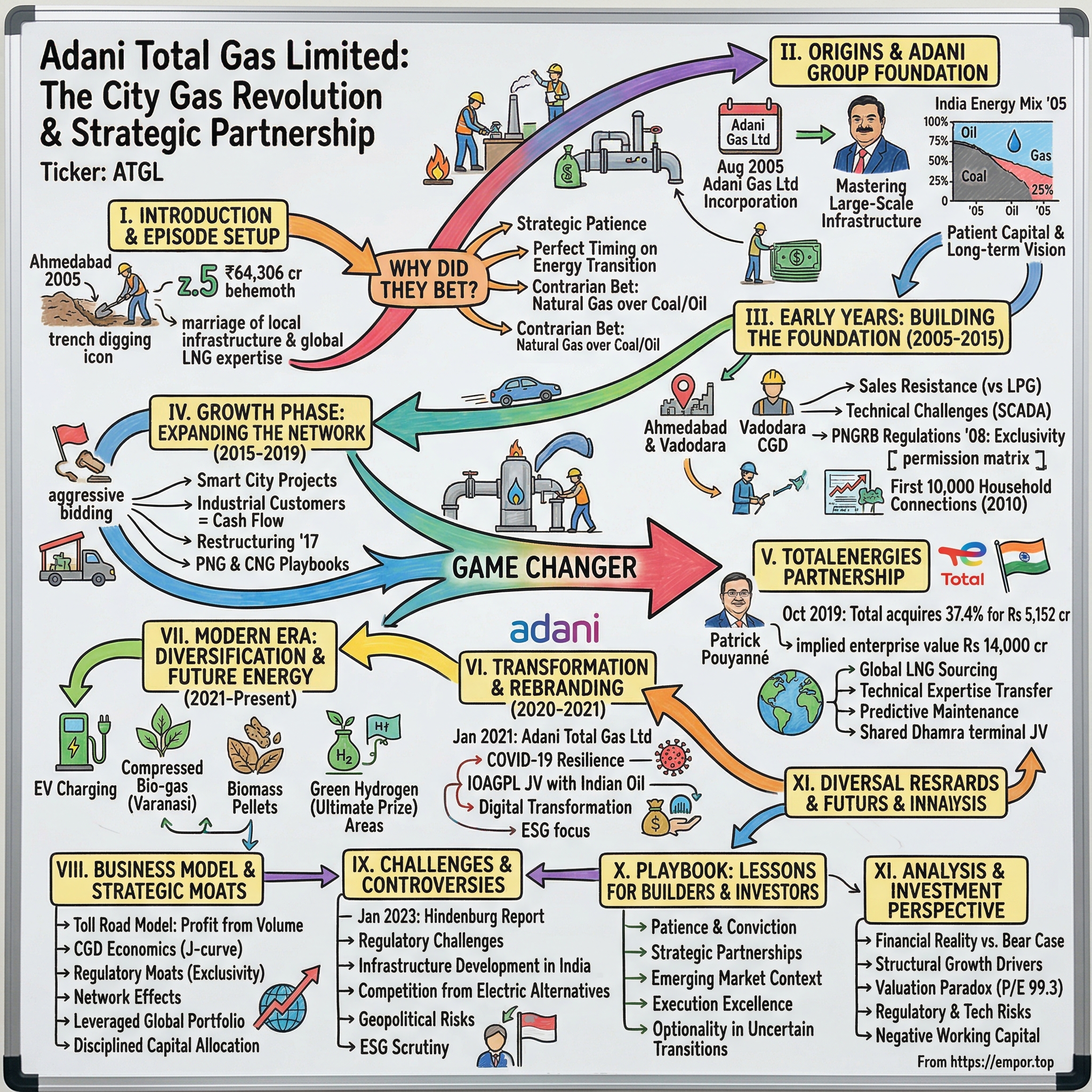
Adani Total Gas: City Gas at a Premium — Can the Growth Story Outrun the Margin Squeeze?
I. Introduction & The Central Question
There is a particular kind of Indian street corner that tells you everything about the business at the centre of this story. It is a CNG filling station on the outskirts of a tier-two city — Prayagraj, or Udaipur, or Guwahati — at six in the morning, with a queue of auto-rickshaws and small commercial vans stretching back onto the service road. The drivers are not there because they love natural gas. They are there because compressed natural gas costs meaningfully less per kilometre than petrol or diesel, and because the station is the only one within a reasonable detour. They will wait twenty minutes for that arithmetic. That queue is the product. Everything else — the pipelines, the auction wins, the joint ventures, the French energy major on the shareholder register — exists to convert that queue into a toll.
The business, stated plainly
Adani Total Gas Limited operates the largest city gas distribution footprint in India by geography. The company holds authorisations in 34 Geographical Areas directly, and a further 19 sit inside Indian Oil-Adani Gas Private Limited, a 50:50 joint venture with Indian Oil Corporation — 53 licensed territories in total across the group's ecosystem.12 Within each of those territories it sells two things: piped natural gas to homes, shops and factories, and compressed natural gas to vehicles. That is the entire business. The pipes go into the ground once and, if the density works, they collect a small margin on every cubic metre for decades.
A joint venture wearing a listed company's clothes
What makes ATGL structurally unusual among listed Indian companies is who owns it. In October 2019, TotalEnergies — then still Total SA — agreed to acquire 37.4% of what was then Adani Gas.3 The S.B. Adani Family Trust holds a comparable position. Together the two blocks make up a promoter group of about 74.8% of the shares.4 This is not a controlling promoter with a supportive institutional shareholder along for the ride. In substance it is a two-party joint venture that happens to be wrapped inside a listed company, with a free float of roughly a quarter of the equity.
And that thin float trades at a price that demands explanation. As of August 10, 2026, ATGL changed hands around ₹660 a share for a market capitalisation of roughly ₹72,600 crore.4 That works out to about 115 times trailing earnings, close to 63 times EV/EBITDA, and roughly 15 times book value.5 Its two closest listed comparables are valued on an entirely different planet: Indraprastha Gas trades near 15.6 times earnings, 8 times EV/EBITDA and 1.85 times book, and Mahanagar Gas near 15.5 times earnings, 7.8 times EV/EBITDA and 1.72 times book.67 ATGL's market value is close to three times the two of them combined, on roughly a third of IGL's revenue.
The central question
Here is the tension this piece will chase. The volume story is genuinely working. In the June 2026 quarter, ATGL sold 303 million standard cubic metres of gas on a standalone basis, up 13% year on year, with CNG volumes up 18%.8 Revenue rose 27%. Those are not the numbers of a business running out of road. But over the same quarter, EBITDA fell 7% and standalone profit after tax fell 18%, because the cost of the natural gas the company buys rose 39%.8 Zoom out and the pattern is starker: across FY26 as a whole, revenue grew 18% while profit after tax went backwards.9
The mechanism behind that decoupling is a piece of Indian energy policy that almost no equity investor outside the sector could name five years ago: the administered price mechanism, and the share of cheap domestic gas the government chooses to allocate to city gas distributors. That allocation has been cut, partially restored, and cut again inside eighteen months.10 It is not a demand problem. It is an input problem, and the input is set by a ministry.
So the question is not whether ATGL is growing. It is. The question is whether a company whose profit has been flat for three years while its equity base compounds — a company whose returns on invested capital sit at roughly 8%, against 14.5% at IGL56 — can justify a multiple that assumes a decade of flawless conversion of licences into cash flow. To answer that we need to go back to the beginning: to a conglomerate's early bet on a fuel almost nobody in India was using.
 Subscribe on LinkedIn
II. Origins: A Conglomerate Bet on the Gas Bridge (2005–2019)
In 2005, betting on natural gas in India was closer to an act of faith than a business plan. Coal ran the power sector. Kerosene and subsidised LPG cylinders ran the kitchen. The national gas grid was a few thousand kilometres of pipeline serving fertiliser plants and a handful of power stations. The idea that a middle-class household in Ahmedabad would want a metered gas line into its kitchen — and would pay a connection charge for the privilege — rested on infrastructure that did not yet exist and on a regulator that had not yet been created.
Adani Gas Limited was incorporated in Ahmedabad in August 2005 as a subsidiary of Adani Enterprises, and began by laying domestic gas connections in its home city before extending into Vadodara, Faridabad and Khurja.1 The choice of Ahmedabad was not sentimental. Gujarat had the deepest gas infrastructure in the country, thanks to the Hazira landing point and the state's early industrial demand, which meant the marginal cost of connecting one more neighbourhood was lower there than anywhere else in India. Faridabad and Khurja were the more interesting bets: dense, industrial, and outside the home state, which meant the business could learn whether its model travelled.
The regulator that made the business possible
What made this investable at all — and this is the single most important structural fact about Indian city gas — was the regulatory scaffolding that arrived shortly afterwards. The Petroleum and Natural Gas Regulatory Board awards authorisations for defined Geographical Areas through competitive bidding rounds. The winner receives infrastructure exclusivity for twenty-five years from the date of authorisation, and, critically, an eight-year exemption from common carrier and contract carrier obligations.11 In plain terms: for eight years nobody else can market gas through your pipes, and for twenty-five years nobody else can build a competing distribution network in your territory. After the marketing exclusivity lapses, the network can be declared a common carrier and third-party marketers can use it on a non-discriminatory basis.
This is worth pausing on, because it defines the shape of the whole industry. City gas distribution in India is not a market-share fight. Within a Geographical Area there is functionally one supplier, and the competitive event happens once — at the auction — rather than continuously in the market. The bidding is on committed work programmes: how many inch-kilometres of steel pipeline, how many CNG stations, how many domestic connections the bidder promises to deliver by year eight. Companies win by promising more, which means the auction is a mechanism for competing away future returns in advance. Remember that when we get to 2022.
There is a second consequence of that design that shapes everything downstream. Because the auction is a one-time event and the commitments are long-dated, the winner's returns are determined years before the first meter is installed. A bidder who wins by promising an aggressive work programme in a low-density district has locked in capital expenditure it must incur regardless of whether the demand materialises on schedule — and the penalty regime for missing committed work programmes gives it little room to slow down if conditions turn. This is the opposite of a business where a management team can adjust investment quarterly in response to demand signals. In city gas, the strategic decision is made at the auction and executed for the following decade.
The corporate plumbing caught up in stages. In 2017 Adani Enterprises moved its holding into a dedicated gas holding structure, and the gas business was demerged and listed separately in November 2018 — the moment ATGL became a standalone equity story rather than a line item inside a diversified conglomerate.1 It listed as a small, Gujarat-weighted utility with a handful of licences and no particular reason for a global investor to care.
That changed within a year. What made ATGL interesting was not what it had built by 2018; it was who decided to buy into what it might build next.
III. The TotalEnergies Deal: Anatomy of the Partnership (2019–2020)
On October 14, 2019, Total SA announced that it had signed definitive agreements to acquire 37.4% of Adani Gas Limited.3 For a French supermajor whose Indian exposure had until then been mostly about LNG cargoes and lubricants, this was a different kind of commitment: a direct equity position in a domestic Indian retail utility, with all the local permitting, right-of-way and municipal politics that implies.
How the deal was built
The structure told you something about both sides. Total did not simply buy a block from the family. It launched a tender offer to public shareholders for up to 25.2% of the equity, and acquired the balance — roughly 12.2% — directly from Adani.3 That is an important detail. Buying most of the stake through an open offer meant Total was paying a regulated, publicly disclosed price available to every minority holder, rather than negotiating a private discount or premium. It also meant the transaction expanded Total's stake without meaningfully collapsing the float, since the family retained its own large position. Total described the resulting arrangement plainly as a 50-50 partnership with Adani across a set of gas value-chain assets. The net acquisition cost to Total across 2019 and 2020 was approximately $600 million, after accounting for the earlier divestiture of its interest in the Hazira terminal.3
Was that a full price? Honest answer: the public record does not support a clean 2019-vintage EV/EBITDA benchmark against IGL and MGL, and this piece will not invent one. What can be said with confidence is what Total said it was buying, and the shape of the bet is unmistakable. Adani Gas at the time was a smaller, less penetrated, lower-volume network than either the Delhi or Mumbai incumbents. Those two ran mature monopolies over the densest vehicle fleets and the wealthiest household clusters in the country. If Total had wanted in-place cash flow, there were better and more liquid ways to buy it. What it bought instead was optionality on Geographical Areas not yet awarded and households not yet connected — a claim on India's gas penetration curve rather than on its current gas consumption.
The stated rationale was explicit about the macro. Patrick Pouyanné framed the investment around India's energy mix and the climate transition, noting that natural gas then represented only about 7% of Indian energy consumption against a government target of 15% by 2030.3 That gap — 7 going to 15 — is the number the entire equity story has been built on ever since, and it is worth being clear-eyed that it is a policy aspiration rather than a contracted demand curve.
The package extended well beyond the distribution company. Total also took an interest in LNG import and regasification infrastructure at Dhamra on India's east coast, and the two parties set up a joint venture for LNG marketing across India and Bangladesh.3 The logic reads cleanly on paper: Total is one of the largest LNG traders on earth; ATGL is a growing retail outlet for molecules; connecting the two should mean the distributor gets sourcing capability that a purely domestic peer cannot replicate, while the supermajor gets shelf space in the fastest-growing gas market of the next two decades.
Two co-equal owners, and what that structure costs
Each side also brought something the other could not buy. Total contributed global LNG sourcing, technical and safety standards from a company that operates critical hydrocarbon infrastructure across dozens of jurisdictions, and a balance sheet of a size that changes how a lender thinks about a partner. Adani contributed the thing that actually determines whether a city gas company exists: access to licences, execution on the ground, and the capacity to move through Indian permitting at speed in a business where the binding constraint is often a municipal road-cutting permission rather than capital.
In January 2021 the company was renamed Adani Total Gas Limited.1 The rebrand formalised something genuinely unusual in Indian public markets. Most listed companies have a controlling promoter and a register of financial investors. ATGL has two co-equal strategic shareholders of roughly the same size, each with its own global reputation on the line, and a public float that is a minority in every practical sense. That structure is a governance asset when the partners are aligned — two sets of eyes, two sets of standards, neither able to act unilaterally. It is a governance question mark when they are not, because there is no obvious mechanism for resolving a disagreement between two 37% holders, and minorities have limited leverage over either.
Which sets up the question this story returns to later. The 2019 deal was sold as an active strategic partnership: shared sourcing, shared technology, shared ambition. Five years and one criminal indictment later, is it still that? Or has one of the two co-equal partners quietly become a passive holder of a position it would rather not add to? Hold that thought — first, the company went on a licence-buying spree.
IV. Scaling the Network: IOAGPL, Bidding Rounds, and the Capital Deployment Story (2020–2023)
Most companies grow by buying competitors. ATGL grew by buying territory from an auctioneer, and the auctioneer was the state.
The first move was to double the surface area without doubling the capital at risk. Indian Oil-Adani Gas Private Limited — IOAGPL — was formed as a 50:50 joint venture between ATGL and Indian Oil Corporation, and it went on to hold 19 of the 53 Geographical Areas in the combined footprint.12 The territories it took are a map of where Indian gas penetration was thinnest and hardest: eight areas across Uttar Pradesh including Prayagraj, Bulandshahr and Jaunpur; a cluster across Kerala from Ernakulam to Kozhikode; Chandigarh, Mohali, Panchkula, Daman, and pieces of Uttarakhand, Karnataka, Haryana, Goa, Bihar, West Bengal and Puducherry.2
Pairing with Indian Oil was a shrewd piece of structuring rather than a financing convenience. India's largest state-owned fuel retailer brought the one asset a private city gas entrant cannot manufacture: an existing national network of retail forecourts, and the institutional standing that comes with being a Maharatna public sector company when you are negotiating with a district administration. ATGL brought capital and project execution. And because IOAGPL sits at 50%, the associated capex and the associated risk sit largely outside ATGL's own balance sheet — which flatters the parent's reported gearing while also meaning that half of the footprint investors cite in the growth story does not show up in the parent's consolidated revenue line.
The 2022 land grab
Then came the land grab. In its 108th board meeting on January 27, 2022, the PNGRB approved letters of intent for 52 Geographical Areas offered in the 11th CGD bidding round. ATGL won 14 of them — the single largest haul of any bidder, ahead of Indian Oil's eight — picking up three areas in Assam, three in Chhattisgarh, four in Maharashtra, two in Madhya Pradesh and one each in Jharkhand and Odisha.12 With that, the company vaulted from a regional operator to the largest CGD licence-holder in the country.
Days later, ATGL put a number on what winning would cost. The company announced it would invest roughly ₹20,000 crore in city gas distribution over the following eight years — about ₹12,000 crore against the 14 newly-won areas, plus ₹8,000 crore of existing commitments — targeting around 2,000 CNG stations and more than 9 million piped-gas households. Suresh Manglani, then chief executive, framed the ambition as serving 10% of the country's population.13
This is ATGL's true M&A programme, and it deserves to be understood as such. It does not buy competitors, because within a Geographical Area there are none. It buys licensed monopoly territory at auction and then spends years building organic infrastructure into it. The capital allocation question is therefore not "did they overpay for an asset" but "will the density arrive before the exclusivity clock runs down".
Did the bidding outrun the building?
Four and a half years on, the evidence on conversion is mixed and worth stating without varnish. By the end of FY26 the standalone business ran 705 CNG stations and 10.99 lakh piped-gas homes.9 Across the combined footprint including the joint venture, the counts stood at 1,167 CNG stations and 13.75 lakh domestic connections by the June 2026 quarter.8 Set the current run-rate against the 2022 ambition and the arithmetic is sobering: from roughly 700 stations toward 2,000, and from a little over one million households toward nine million, on a network that has been adding on the order of 130,000–140,000 homes and 50–60 stations a year at the standalone level.9 At that pace the 2022 targets are a very long way out. The company has not publicly retracted or reset them.
The honest read is that ATGL has been considerably better at winning licences than at filling them. That is not a scandal — new Geographical Areas in Assam or Odisha genuinely take years to reach the household density at which a distribution network stops consuming cash and starts generating it, and a company that refused to bid would simply not exist in those markets a decade from now. But it does mean the growth runway is a claim about the future rather than a demonstrated cash-flow engine, and it shows up where you would expect: in a return on invested capital of roughly 8%, well below the mid-teens returns of peers operating mature, fully-penetrated territories.56
COVID-19 interrupted the story in the obvious way. CNG is a mobility fuel, and mobility stopped. Volumes recovered with the reopening and then compounded, with combined CNG and PNG volumes reaching 993 MMSCM in FY25 and 1,133 MMSCM in FY26.149 The demand side of this business has, throughout, done what management said it would do.
The trouble came from somewhere else entirely — first from a short seller in New York, and then from a federal courthouse in Brooklyn.
V. Two Trust Shocks: Hindenburg and the US Indictment
On January 24, 2023, Adani Total Gas closed at ₹3,891.75. Nine months later, on October 23, 2023, the stock traded as low as ₹575.70 — a decline of 85% from that January close, making ATGL the first of the group's listed companies to fully complete the downside that Hindenburg Research had modelled in its report.15
Read that again, because the precision is the point. A short seller published a valuation argument, the market spent nine months arguing about it, and then the price arrived at the number in the report. Hindenburg's central claim about ATGL was not primarily an accounting allegation — it was an assertion that the stock was priced at a level that no plausible fundamental path could support. The mechanism of the collapse was therefore not a change in the business. Volumes kept growing throughout 2023. What collapsed was the multiple.
Why ATGL more than the others? Because ATGL entered the episode carrying the richest valuation in the group, on a price-to-earnings multiple above 100 times. A stock priced for perfection has no valuation cushion; when sentiment reverses, there is nothing to absorb the shock. Compounding it, the CNG business faced a live narrative threat from state-level electrification policy aimed at commercial fleets, which gave sellers a fundamental-sounding story to attach to a valuation-driven decline. The lesson generalises well beyond Adani: the amount a stock falls in a confidence shock is mostly a function of how much air was in the multiple beforehand, not how bad the news is.
Brooklyn, November 2024
The second shock was of a different character. On November 20, 2024, US federal prosecutors in the Eastern District of New York unsealed an indictment charging Gautam Adani, Sagar Adani and six other senior executives in connection with an alleged scheme to pay hundreds of millions of dollars in bribes to Indian government officials to secure solar power supply contracts, and with misleading US and international investors about the group's anti-corruption compliance while raising capital.16 The allegations centred on Adani Green Energy. The Adani Group rejected the allegations as baseless.
ATGL was not named. Its officers were not charged. The indictment concerned a different subsidiary in a different sector. The stock fell roughly 14% the same day anyway.
That reaction is the single cleanest piece of evidence in this entire story about how the market actually values ATGL. A significant portion of the share price is not underwriting city gas distribution economics at all — it is underwriting the governance and funding standing of the parent group. When group-level trust is impaired, ATGL reprices whether or not anything has changed inside its pipelines. The credit market made the same distinction with more nuance. On November 26, 2024, Moody's revised the outlook on seven Adani entities to negative and Fitch took action on several more, with Moody's noting that the indictment would likely weaken the group's access to funding and raise its capital costs.17 ATGL was not among the entities named in those actions — a reflection of where the group's rated offshore debt sits rather than an endorsement, but a distinction worth recording accurately.
The most consequential response came from Paris. On November 25, 2024, TotalEnergies stated that it would make no new financial contribution to its investments in the Adani group of companies until the accusations and their consequences had been clarified, while confirming its existing holdings.18 It was a carefully constructed position: not an exit, not a defence — a freeze.
Is the partnership still a partnership?
So has the freeze thawed? The evidence available in the public record as of August 2026 suggests it has not, and may have hardened. In late September 2025, TotalEnergies signalled it might sell part of its stake in Adani Green Energy, with the company stating an intention to focus its investments on the main deregulated markets — the United States, Europe and Brazil.19 Reports through late 2025 indicated preparation to pare a meaningful portion of the roughly 19% AGEL position.19
Two important caveats, because this is exactly the kind of place where analysis slides into assertion. First, that repositioning concerns Adani Green, not Adani Total Gas; TotalEnergies has not announced any reduction of its ATGL stake. Second, the absence of announced new joint initiatives with ATGL specifically is not the same as proof that the operational partnership has stopped functioning — technical standards and sourcing relationships do not generate press releases. But the direction of travel matters for how investors should weight the "strategic partnership" leg of the ATGL story. A partner who is publicly declining to add capital to the group, and publicly redirecting its growth capital to other geographies, is not the same partner described in the 2019 announcement. The burden of proof has shifted: investors underwriting a partnership premium should now require evidence of new joint activity rather than assuming continuity.
On management's own conduct through both episodes, the record is one of consistency rather than disclosure. Across the quarterly communications spanning the indictment period, ATGL's messaging stayed on operations — volumes, station counts, connections, ESG scores — and did not engage in detail with group-level governance questions.20 That is a defensible posture for the management of a subsidiary that was not charged with anything, and arguably the correct one legally. It is also, for an investor, a non-answer: the question of what group governance risk does to ATGL's cost of capital is a real financial question, and it has not been addressed by the people best placed to address it.
Which brings us to what management has been talking about instead — and to the mechanics of how a city gas company actually converts a queue of auto-rickshaws into profit.
VI. How City Gas Distribution Actually Makes Money
Strip away the ESG scorecards and the hydrogen ambitions and ATGL is a remarkably simple machine. It buys natural gas at a delivered cost, moves it through steel and polyethylene pipe, compresses some of it for vehicles, and sells it at a retail price it largely sets itself. The difference, less operating costs, is the business. Piped gas and CNG together account for effectively all of the revenue and all of the profit.8 Everything else in this company is, on today's income statement, a rounding error.
The two legs behave quite differently. CNG is a mobility fuel sold to a price-sensitive commercial fleet — auto-rickshaws, taxis, light goods vehicles — that fills up almost daily and switches consumption instantly when relative fuel prices move. It is the growth engine and it is volatile: CNG volumes grew 18% year on year in the June 2026 quarter.8 Piped gas splits into two very different customers. Households consume small, extremely stable volumes and essentially never leave. Industrial and commercial users consume large volumes and are genuinely price-elastic, because a ceramics factory can and will switch to alternative fuels when gas gets expensive. That elasticity shows up plainly in the numbers: while CNG grew 18% in the June quarter, total piped gas grew just 4%.8
The moat, examined rather than asserted
Now the moat, examined rather than asserted. In Hamilton Helmer's 7 Powers framework, what ATGL has is a cornered resource — a government-granted exclusive right to serve a defined geography — and not much else. It is emphatically not a network effect: an extra household in Guwahati makes the service no better for a household in Vadodara. It is not brand: nobody chooses their gas utility. It is not scale economies in the classic sense, because the cost of gas is largely set nationally and the operating leverage is geographic rather than corporate. It is a licence, with a duration attached: infrastructure exclusivity for twenty-five years, and exemption from common carrier obligations for eight.11 After that window, third-party marketers can in principle use the pipes, which converts a monopoly into a toll road with tenants.
Layered on top is a genuine switching cost, and it runs in one direction only. A household that has paid for a gas line, had its kitchen plumbed and its appliances converted almost never goes back to cylinders. The connection is sunk, the convenience is real, and the monthly bill is small relative to the hassle of switching. That gives ATGL a low-churn, base-load revenue stream that compounds quietly — but only after the household exists. The switching cost is the reward for penetration, not a substitute for it, and reaching the density at which a new Geographical Area's economics work takes years of capital going out the door before the meters start turning.
Run Porter's five forces across this and one force dominates everything. Rivalry within a Geographical Area is close to zero by regulatory design. Threat of new entrants is low for the same reason — you cannot enter without winning an auction that only happens periodically. Buyer power is weak and fragmented; a household or an auto driver has no negotiating leverage, though they do have the option of substituting away from gas entirely, which is where electric vehicles enter the picture. Threat of substitutes is real but slow-moving. And then there is supplier power, which in this industry is not really a supplier at all — it is the Government of India, which controls both the allocation of cheap domestic gas and the pricing formula that applies to it. In most industries, five forces analysis distributes pressure across several axes. In Indian city gas distribution, four forces are benign and one is close to absolute.
Where ATGL actually sits against IGL, MGL and Gujarat Gas
Against that framework, how does ATGL compare with its peers? Indraprastha Gas runs the Delhi-NCR monopoly — the densest commercial vehicle fleet in India, decades of penetration behind it, and a business that generates enough cash to pay out a dividend yielding above 3%.6 Mahanagar Gas holds the equivalent position in Mumbai, similarly mature and similarly cash-generative.7 Gujarat Gas is larger in volume but skewed toward industrial demand, which makes it more cyclical. ATGL is structurally different from all three: newer, far more geographically dispersed, much less penetrated, and still in its investment phase. That difference is the honest explanation for why it is valued on a different basis — investors are paying for a penetration curve rather than for a cash flow.
The comparison that should trouble a bull is not on ROE, where ATGL's roughly 14% and IGL's 13.9% are broadly similar.46 It is on return on invested capital, where ATGL sits near 8% against IGL's 14.5%.56 Because ATGL's capital base has been expanded by debt and retained earnings deployed into territories that are not yet dense, the company earns materially less on every rupee of capital employed than a mature peer does — and is asked to pay for it with an equity multiple roughly seven times higher. That is the crux of the bear case, and we will return to it.
One further claim deserves testing: does having TotalEnergies on the register actually lower ATGL's cost of gas? The company's own disclosure of its sourcing mix does not support a distinctive advantage. On the June 2026 quarter earnings call, management described a portfolio of roughly 40% domestic administered and new well gas, about 48% under longer-term contracts, and roughly 15% spot purchases.21 That is a sensible portfolio, but it is not visibly different in structure from what a well-run domestic peer would assemble, and the outcome has been a 39% year-on-year increase in the cost of gas.8 The more defensible version of the TotalEnergies benefit is what it does for technical and safety standards, and for how lenders and counterparties perceive the entity — real advantages, but not ones that show up in the cost line.
Myth versus reality
Four consensus statements about ATGL are worth testing against the record before going further.
Myth: ATGL is a monopoly, therefore it has pricing power. Reality: it has a monopoly on distribution within a Geographical Area, but it competes on price against petrol, diesel and LPG for every customer it serves. Raise CNG prices far enough and the auto-rickshaw driver goes back to petrol, or converts to electric. The monopoly protects the company from other gas suppliers; it does not protect it from other fuels. That is why the margin squeeze has been absorbed rather than passed through.
Myth: the TotalEnergies partnership gives ATGL a structural gas-sourcing advantage. Reality: the disclosed sourcing mix looks like a competent domestic portfolio, and the cost of gas rose 39% year on year in the most recent quarter.821 No public evidence supports a durable input-cost edge over IGL or MGL. The credible benefits are technical standards and counterparty standing.
Myth: ATGL is expensive because Indian markets misprice Adani companies. Reality: the multiple is a coherent, if demanding, expression of a real asymmetry — ATGL's territories are far less penetrated than its peers'. The question is not whether the premium has a rationale but whether the rationale is worth roughly seven times a mature peer's price-to-book while returns on invested capital run at roughly half theirs.56
Myth: the profit stagnation reflects weakening demand. Reality: it does not. Volumes have grown at 13–15% annually straight through the squeeze.1498 The stagnation is entirely a gross-margin phenomenon driven by the cost and composition of the gas basket.
Which is precisely where the story has gone wrong over the last two years.
VII. The Margin Squeeze: Administered Gas Pricing as the Live Risk
Every so often a regulatory detail buried three levels down in an industry's plumbing surfaces and takes over an entire equity story. For Indian city gas, that detail is APM gas.
Here is the mechanism in plain terms. A portion of India's domestically produced natural gas — from the legacy fields of ONGC and Oil India — is sold at a price capped by the government under the administered price mechanism. It is materially cheaper than imported LNG or gas from newer domestic fields. Because CNG for transport and piped gas for households are treated as priority social uses, city gas distributors receive a preferential allocation of this cheap pool. The rest of their requirement must be met from costlier sources: new well gas from ONGC's recent discoveries, high-pressure high-temperature domestic gas, long-term regasified LNG contracts, and spot LNG cargoes priced off global markets.
So a city gas company's gross margin is, to a first approximation, a function of one number it does not control: what percentage of its gas basket comes from the cheap pool. Raise that percentage and margins expand without a single operational improvement. Cut it and margins compress no matter how well the company executes. It is closer to a regulated input subsidy than to a commercial procurement outcome.
Three policy moves in under two years
The whiplash of the last two years has been severe. For ATGL, the APM allocation for transport CNG was cut from 63% to 51% effective October 16, 2024, and then again from 51% to 37% effective November 16, 2024 — meaning average supply through the December 2024 quarter ran at roughly 47%.20 The company covered the gap with spot purchases and new well gas at higher cost. The result was immediate and instructive: for that quarter, revenue rose 12% while EBITDA fell 10% and profit fell 17%.2022 Volume growth of 15% could not save the profit line.
Then the government partially reversed course. From January 16, 2025, the APM share for transport CNG was restored to 51%.20 Relief lasted three months. On April 15, 2025, ATGL informed the exchanges that GAIL had communicated a 15% reduction in its APM allocation with effect from the following day, with the shortfall again replaced by higher-priced new well gas. Mahanagar Gas disclosed an 18% cut and Indraprastha Gas around 20%; all three told the market that profitability would be adversely affected and that they were exploring measures to mitigate the impact.10
Trace this straight through the financial statements and the pattern is unambiguous. In FY25, revenue grew 12% while EBITDA rose just 1% and profit after tax fell 1%.14 In FY26, revenue grew 18% to ₹6,415 crore on the standalone business, EBITDA grew 5%, and profit after tax fell 2% to ₹637 crore.9 Within FY26 the pattern was not linear — the December 2025 quarter was actually strong, with EBITDA up 15% and profit up 10% as the company lapped weak comparables23 — but the nine-month picture still showed profit down 4% on revenue up 19%.23 Then came the June 2026 quarter, where the squeeze reasserted itself hard: revenue up 27%, cost of gas up 39%, EBITDA down 7%, standalone profit down 18%.8
What management says, and what it leaves out
Management has been reasonably candid about the arithmetic. On the Q1 FY27 call, chief executive Sanjay Pandita attributed the compression to market-driven gas prices and the decline in APM allocation, and acknowledged that operating margins had fallen from roughly 25% to around 15% over six to eight quarters despite consistent double-digit revenue growth.21 That is an unusually specific admission and it deserves credit — a lot of managements would have buried it.
The mitigation plan is where the credibility question sits. Asked how margins recover, management pointed to contract renewals, to reducing reliance on elevated spot purchases, and — through Ravindra Desai, who heads gas sourcing — to the expectation that once Middle East tensions ease, better rates from US and Qatari suppliers should help restore margins toward prior levels.21 On the withdrawn pooled gas mechanism, the answer was that industry representation to the government continues, with positive news expected if geopolitical tensions subside.21
Read that carefully. Three of the four levers management named — global LNG prices, the resolution of a geopolitical conflict, and a government policy decision on gas pooling — are entirely outside the company's control. The one genuinely controllable lever, contract renewal and sourcing mix, is real but slow, and the disclosed sourcing mix suggests the spot exposure that is doing the damage is still around 15% of consumption.21 What is conspicuously absent from the public commentary is the lever that would most directly protect the P&L: retail price pass-through. City gas distributors do have pricing power at the pump — they set CNG and piped gas prices — but exercising it aggressively erodes the fuel's cost advantage over petrol and diesel, which is the entire reason the auto-rickshaw queue exists. Management has consistently prioritised volume growth and affordability over margin defence. That is a legitimate strategic choice, and it is also a choice: the margin compression is partly a decision, not purely an imposition.
The framing that matters for investors is this. This is not a demand story going wrong. Volumes are growing faster now than they were two years ago, and the CNG franchise in particular is accelerating.8 It is a story in which a policy input the company does not control has decoupled revenue growth from profit growth for three consecutive years. If the APM allocation stabilises or is restored, the profit line could snap back quickly, because the volume base has been compounding the whole time. If it does not, the company grows revenue indefinitely without growing earnings — and a 115 times multiple has no defence against that.
Meanwhile, management has been building things on the side.
VIII. The New Bets: Sized to What They're Actually Worth Today
Walk through the arrivals level of a major Indian airport and you may pass an Adani TotalEnergies charging bay without registering it. That is roughly the right level of attention to give this business today — and roughly the wrong level to give it in five years, which is what makes it interesting.
Adani TotalEnergies E-Mobility operated 5,306 charging points as of the June 2026 quarter, up 100% year on year, across 26 states and union territories and 226 cities, with installed capacity of about 58 MW.8 The company has positioned itself as India's largest airport charge point operator.14 Management has indicated it is targeting 10,000 charging points and that group capex will run slightly higher than the prior year.21 The strategic logic is sound and worth naming: the threat that electric vehicles pose to the CNG franchise is real, and building the charging network is the most direct available hedge — if the auto-rickshaw goes electric, ATGL would rather sell it electrons than lose the customer entirely. It is also genuinely adjacent, because the skills involved are permitting, land access, forecourt operations and utility connections, all of which the company already has.
It is, however, immaterial to consolidated financials today. Doubling a small number produces a slightly larger small number. Treat it as real optionality with fast growth and no near-term earnings contribution — not as a segment that changes the valuation arithmetic.
The biogas business is earlier still. Adani TotalEnergies Biomass runs a compressed biogas plant at Barsana that was producing 6.9 tonnes per day as of FY25, ramping toward 9–10 tonnes per day, alongside sales of an organic manure by-product branded Harit Amrit.14 In the June 2026 quarter it sold 323 tonnes of compressed biogas.8 That is a pilot, not a business line.
Hydrogen appears periodically in company communications as a long-term ambition. As of the materials reviewed for this piece, ATGL has not disclosed a specific capital commitment, project timeline or offtake arrangement for hydrogen at the entity level. Evidence here is thin, and it should carry essentially no weight in any valuation of the company.
The reason to cover these at all is not their financial contribution. It is what they reveal about management's capital allocation instincts. A company already spending heavily to fill 53 Geographical Areas, already earning single-digit returns on invested capital, and already watching its margins compress, is simultaneously funding an EV charging network, a biogas plant and an aspirational hydrogen narrative. A charitable read: the EV build is a defensive necessity and the rest is cheap optionality. A skeptical read: this is early-stage diversification by a business that has not yet demonstrated it can earn an adequate return on its core capital deployment. Both readings are available on the current evidence, and how you weigh them depends largely on how much you trust the people making the decisions.
Which is a good moment to look at who those people now are.
IX. Management & Governance: The Pandita Transition
Start with the register, because at ATGL ownership is governance. Promoters — the Adani family trust and TotalEnergies combined — hold about 74.8% of the equity. Foreign institutional investors hold roughly 12.8%, domestic institutions about 6.3%, and the public around 6.1%.4
Sit with that for a moment. Around one share in sixteen is held by ordinary public shareholders. The genuinely tradeable float is small relative to the market capitalisation, which has two consequences investors should price explicitly. First, liquidity: large positions are difficult to build or exit without moving the price. Second, volatility: with limited float, modest flows in either direction produce outsized price moves, which is part of why ATGL has repeatedly been the most violently repriced Adani entity on group-level news. The thin float amplifies both the good days and the bad ones, and it means the quoted market capitalisation is a price set by a small share of the equity.
A competitor's operator takes the chair
On May 22, 2026, Sanjay Pandita became chief executive officer.24 His résumé is unusual for an Adani group appointment: 25 years across natural gas, LNG, LPG and low-carbon energy, with prior roles at Reliance Industries, Jio-bp Mobility Solutions, Nayara Energy, and — the detail worth dwelling on — Mahanagar Gas and Gujarat Gas.2425 He holds an engineering qualification and executive business education from IIM Calcutta.25
Hiring a chief executive who has run operations at two direct competitors is a specific kind of signal. It says the board wanted someone who knows how a mature, high-margin city gas business is actually run, at precisely the moment the company's margins are being compressed and its returns on capital are lagging exactly those peers. It also suggests the board sees the current problem as at least partly operational and commercial rather than purely political.
Equally telling is what happened to his predecessor. Suresh Manglani, who ran ATGL through the licence expansion, the two trust shocks and the APM whiplash, was not shown the door. He was re-designated Executive Director and remained on the board.24 Read plainly, this is continuity-plus-fresh-eyes rather than a repudiation: the person who built the footprint stays to protect the relationships and project pipeline, while someone with peer-company margin discipline takes the operating seat. It is a sensible design. It also means accountability for the last three years of flat profit is not being visibly assigned to anyone.
Retaining everything, returning nothing
Now the capital allocation record, which is where an outside investor should focus hardest. ATGL's dividend yield is 0.04%.5 That is not a typo and it is not a rounding artefact — it is essentially a token payment. IGL yields 3.13% and MGL 2.63%.67 Nearly every rupee ATGL earns is retained and reinvested into pipeline, stations, connections and now charging points.
Retention is the right policy for a business earning high returns on incremental capital. So the test is simple: is it earning them? The company reported a return on capital employed of 16.03% for FY25 in its annual report,1 and screens currently show ROCE around 15% and ROE around 14%.4 Those are respectable absolute numbers. But the trend and the composition are the problem. Standalone profit after tax has gone ₹648 crore in FY25 to ₹637 crore in FY26,149 while the equity base has compounded through retained earnings and the asset base has expanded through heavy capex — which drags reported return on equity down mechanically, year after year, with no operational failure required. Return on invested capital of roughly 8% sits well below the mid-teens generated by mature peers.56
Put bluntly: the company is retaining essentially all of its earnings to fund growth, and the growth so far has produced more revenue, more volume, more stations, more households — and no more profit. Three years is long enough that this is a pattern rather than a phase. It does not prove the reinvestment is value-destructive; new Geographical Areas legitimately take years to season, and a distribution network that stops investing during its build-out phase simply forfeits the terminal asset. But it does mean investors are being asked to take the payoff entirely on faith, with no cash return in the interim and no disclosed conversion metrics by which to verify the seasoning is happening on schedule.
On incentives, the honest position is that the linkage is not publicly verifiable. ATGL has not disclosed, in the materials reviewed for this piece, the specific performance metrics or weightings attached to executive compensation — whether they key off volume and Geographical Area count, which are going well, or off margin, return on capital and free cash flow, which are not. For a company asking shareholders to fund a multi-year reinvestment programme out of retained earnings, that is a meaningful gap in disclosure, and it is the kind of thing a governance-focused investor should be asking on a call.
There is one more credibility pattern worth flagging, and it is a subtle one. Management's explanation for margin compression has been consistent, specific and largely accurate: administered pricing cuts and global gas prices.21 Those are real, external and material. But across the public commentary reviewed, there is little acknowledgement of the controllable pieces — the pace of retail price pass-through, the decision to run roughly 15% spot exposure into a volatile market, the absence of disclosed hedging, and the choice to keep capex elevated while returns compress. A management team that owns only the external half of a problem is not being dishonest. It is, however, giving investors an incomplete map, and incomplete maps make it harder to judge whether the recovery plan is a plan or a hope.
All of which sets up the argument the market is actually having about this stock.
X. Bull vs. Bear: Underwriting a 110x P/E
Let us put the gap on the table in the starkest possible terms, because the entire debate lives inside it.
ATGL trades at roughly 115 times trailing earnings, 63 times EV/EBITDA and 15 times book value, generating a return on invested capital of about 8% and paying a dividend yield of 0.04%.5 Indraprastha Gas trades at about 15.6 times earnings, 8 times EV/EBITDA and 1.85 times book, generating 14.5% return on invested capital and paying 3.13%.6 Mahanagar Gas trades at about 15.5 times earnings, 7.8 times EV/EBITDA and 1.72 times book, at 11.7% return on invested capital and a 2.63% yield.7
ATGL's market capitalisation of roughly ₹726 billion compares with about ₹213 billion for IGL and ₹111 billion for MGL.567 One company is worth more than twice the other two combined while producing less than half their combined profit. Any bull case must explain that gap, and any bear case must explain why it will close.
The bull case. Start with what is undeniably true. ATGL holds the largest licensed CGD footprint in India, with 53 Geographical Areas across the group ecosystem,1 most of them nowhere near the household penetration of Delhi or Mumbai. If even a fraction of those territories mature toward the density that IGL and MGL enjoy, the volume base multiplies, and because the incremental cubic metre through an already-built pipe carries very high contribution margin, earnings would grow much faster than volume once density is reached. IGL and MGL are cheap precisely because their growth is largely behind them; ATGL is expensive because its growth is almost entirely ahead of it. Layer on a policy backdrop where the government targets 15% gas share of the energy mix,3 a genuine hedge against electrification in the fast-growing charging network,8 and a supermajor on the register whose technical standards and balance sheet remain in place even if its enthusiasm has cooled.18 On that reading, today's multiple is a duration bet: you are not paying 115 times FY26 earnings, you are paying a mid-teens multiple on an earnings base a decade out.
The bear case. Every step of that chain is an assumption, and several are already showing strain. Margins are being compressed by a policy lever the company cannot influence, and the government has pulled it in both directions three times in under two years — which means the risk is not merely that margins stay low, but that they remain unforecastable.2010 Profit has been flat or down for three consecutive years while revenue compounded at double digits,1498 and returns on capital are drifting down as the equity base grows faster than earnings. There is no dividend, so the entire return depends on either a re-rating or a profit inflection that has not yet appeared in any reported quarter. The 2022 build-out targets — 2,000 CNG stations, 9 million households13 — remain a very long way from current run-rates. Group governance risk is a live, recurring repricing event with a documented history of hitting ATGL harder than any sibling.1516 And the thin free float means any bad headline moves the price further than fundamentals justify in either direction.4
The stress test
The activist stress test. Suppose a skeptical fund were to construct a short thesis on ATGL today. It would not need to allege anything. It would simply lay out four observations side by side. One: the company earns roughly 8% on invested capital while trading at 15 times book, which implies the market expects incremental capital to earn a multiple of what deployed capital currently earns — a claim the last three years of flat profit actively contradict.5 Two: essentially 100% earnings retention with no dividend means shareholders have received nothing while waiting, and have no interim verification that the reinvestment thesis is working.5 Three: the margin structure depends on a discretionary government allocation with a demonstrated history of abrupt change, and management's stated recovery path leans on geopolitical resolution and further policy decisions.21 Four: the co-equal strategic partner whose presence underpins the "strategic partnership" premium has publicly declined to add capital to the group and is redirecting growth investment to other geographies.1819
The bull response to that stress test is not weak, and it deserves a fair hearing. New Geographical Areas genuinely do earn poor returns for years before they earn good ones; averaging seasoned and unseasoned territories together and calling the blended ROIC a verdict is analytically lazy. Flat profit during a period when the government cut the cheap gas allocation twice is arguably evidence of operational resilience rather than failure — the volumes kept compounding through it. And a partner who freezes new capital while retaining an existing 37% stake is behaving exactly as a disciplined institution should while criminal proceedings are unresolved.
What would falsify each case
The most useful discipline here is to specify in advance what evidence would settle the argument, because both sides can narrate the same facts indefinitely otherwise.
The bull case is falsified if, over the next six to eight quarters, volume growth stays in the double digits while EBITDA per unit of gas sold keeps eroding — because that would demonstrate that the margin compression is structural rather than a policy cycle, and that scale in this business does not confer pricing power. It is also falsified if new-Geographical-Area connection adds fail to accelerate as the post-2022 territories mature, since the entire duration argument depends on those areas seasoning into density on something like the pace implied by the 2022 investment plan.13
The bear case is falsified if an APM restoration or a new pooled pricing formula arrives and profit inflects sharply — because that would prove the earnings stagnation was a policy-driven interruption on top of a compounding volume base, exactly as management has argued.21 It would also be weakened by evidence of renewed joint activity with TotalEnergies specifically at the ATGL level, which would restore a leg of the story that currently rests on a 2019 announcement and a frozen shareholding.18
Note what is not on either list: quarterly revenue growth, station counts, household additions, or ESG scores. Those have all been reliably good for three years and have told investors almost nothing about the direction of earnings.
Where does that leave the analysis? The honest conclusion is that ATGL's competitive advantage is real but bounded and time-limited: a cornered resource granted by a regulator, protected for eight years of marketing exclusivity per area,11 reinforced by genuine one-way household switching costs, and undermined by a supplier — the state — that holds more power over the company's unit economics than the company holds over its own customers. Nothing in the evidence supports the idea that ATGL has a durable cost advantage over IGL or MGL, or that TotalEnergies' sourcing has translated into a visibly better gas basket.21 What ATGL has that its peers do not is unpenetrated geography. That is a genuine asset. Whether it is worth seven times the price-to-book of a mature peer is the question the multiple asks and the last three years of earnings have not answered.
XI. Risk Radar
Regulatory and policy risk — the highest-weight exposure by a wide margin. The APM allocation mechanism has been described in detail above; the essential point for a risk register is that it is a discretionary government lever affecting the largest single line in the cost structure, it has moved three times in under two years, and it is not forecastable from company disclosure.2010 No amount of operational excellence neutralises it. An investor in ATGL is, unavoidably, taking a position on Indian gas allocation policy.
Input cost and geopolitical exposure. Roughly 15% of consumption is bought on the spot market and a further large share sits in contracts linked to Brent or LNG benchmarks.21 When West Asian tensions pushed crude-linked and spot LNG prices higher during the June 2026 quarter, the effect landed inside a single reporting period: cost of gas up 39% year on year.8 Rupee weakness compounds it, since the imported portion of the basket is dollar-denominated. This is not a tail risk; it is already in the reported numbers.
Electric vehicle and technology disruption. The Delhi Electric Vehicle Policy 2026, operative from July 1, 2026 to March 31, 2030, ends fresh registration of petrol and CNG auto-rickshaws from January 1, 2027 and restricts new light goods vehicle registrations to electric from the same date, with two-wheeler restrictions following in April 2028.26 Delhi is IGL's territory, not ATGL's, but the significance is precedential: it demonstrates that a state government will legislate CNG vehicles out of new commercial registrations, and other states may follow. The CNG leg is ATGL's fastest-growing segment; a wave of similar mandates across its Geographical Areas over the medium term would attack the growth engine directly. The charging network is the hedge, but at current scale it is a small one.
Group governance overhang. The US proceedings arising from the November 2024 indictment remain unresolved as of this writing.16 ATGL is not a defendant, but its trading history establishes clearly that it reprices on group-level developments regardless.15 Any fresh development — in the criminal case, in related regulatory inquiries, or in the ratings actions that followed17 — is a live repricing risk that has nothing to do with how many households the company connected last quarter.
Execution risk in newer Geographical Areas. This is the risk to the bull case specifically. Converting a licence into paying customers requires municipal permissions, road-cutting approvals, and years of trenching. Management itself has cited permitting difficulties in certain regions and monsoon-related delays as constraints on the build.21 If penetration in Assam, Odisha or Chhattisgarh takes materially longer than assumed, the terminal earnings power that justifies the multiple arrives later and is worth less.
The metrics that matter
Three, and only three, are worth tracking closely.
First, the APM share of total gas requirement, and its direction. This is the single variable with the most leverage over near-term earnings. Every disclosed change in allocation has translated into a visible margin outcome within one or two quarters.
Second, volume growth against EBITDA per unit of gas sold. This is the decoupling metric that defines the entire current story. Volume growth alone has been misleading for three years. The question is whether contribution per cubic metre stabilises or continues to erode — and whether the two lines start moving in the same direction again.
Third, the new-Geographical-Area conversion rate — household connections and CNG stations added per quarter, and ideally the share coming from post-2022 territories. This is the proxy for whether the 53-area footprint is actually monetising or merely existing. Company disclosure aggregates this, so investors will need to infer it from the incremental adds against the stated build targets.
XII. Playbook: Lessons for Builders & Investors
A licence from the government is not protection from the government. ATGL's core competitive advantage — exclusive rights to serve defined territories — was granted by the state. So was the cheap gas allocation that made those territories profitable, and so was the decision to withdraw part of it. The same institution that creates a moat can price-regulate the water inside it. Any business whose returns depend on a regulatory grant should be underwritten with the assumption that the grantor will eventually optimise for its own objectives — affordability, subsidy budgets, fiscal room — rather than for shareholder margins. The tailwind and the risk are frequently the same lever.
Co-equal strategic joint ventures buy capability and lend credibility, but they create a dependency on the partner's own circumstances. When TotalEnergies bought in, its name was a signal of governance quality, technical rigour and balance-sheet depth. When the group came under external legal pressure, that same partner's public decision to withhold new capital became a data point about ATGL's own standing — even though ATGL was not the subject of any charge.18 Credibility borrowed from a partner is credibility that can be withdrawn, and it will be withdrawn precisely when it is most needed.
Optionality is easy to narrate and hard to monetise. Charging points, biogas, hydrogen — each is a legitimate adjacency and each is currently immaterial. The discipline for an investor is to keep two columns strictly separate: what the current profit and loss can actually support, and what the growth premium in the multiple is implicitly paying for. When a company at 115 times earnings describes an optionality portfolio, the correct question is not "is this exciting" but "how many years of flawless execution does the current price already assume before any of this contributes".
A thin free float is a valuation input, not a footnote. With roughly a quarter of the equity outside the two strategic holders and only about 6% in genuinely public hands,4 the quoted price of ATGL is set at the margin by a small pool of shares. That cuts both ways: it can sustain a premium longer than fundamentals alone would justify, and it can collapse faster on bad news than the underlying business warrants. Investors used to reading a market capitalisation as a broad market verdict should discount that reading substantially when the float is this narrow. Ownership concentration is one of the least discussed and most consequential variables in Indian mid-cap valuation.
Volume growth and margin health are different KPIs, and reporting only the first can mask deterioration in the second. This is the most transferable lesson in the story. For three consecutive years ATGL delivered exactly what a growth narrative demands — double-digit volume growth, double-digit revenue growth, expanding infrastructure — while profit went sideways.149 Every one of those headline numbers was true. None of them told you what was happening to the economics. When reading any infrastructure or utility growth story, track the unit economics per unit sold alongside the units, and treat a widening gap between the two as the signal it is.
XIII. Epilogue
Almost everything that matters to Adani Total Gas over the next two years runs through a decision made in a government office in Delhi rather than in a boardroom in Ahmedabad.
There are three plausible resolutions to the APM standoff. The government could restore allocations toward historical levels, in which case margins recover mechanically against a volume base that has been compounding at 13–15% throughout the squeeze, and reported earnings would inflect sharply upward without a single operational change. It could hold the current reduced allocation permanently, in which case city gas distributors face structurally lower gross margins and must choose between passing costs through at the pump — risking the very fuel-price advantage that drives CNG conversion — and accepting a permanently lower return profile. Or it could replace the whole arrangement with a new pricing formula, most plausibly some version of the pooled mechanism that the industry has been lobbying for.21 That single variable plausibly matters more to ATGL's near-term equity value than every EV charging point and hydrogen aspiration combined.
Behind it sits the longer arc: India's target of lifting natural gas from a low single-digit share of primary energy toward 15% by 2030.3 That target is why TotalEnergies wrote its cheque, why ATGL bid so aggressively in 2022, and why anyone tolerates a 115 times multiple in the first place. It remains a policy aspiration, and the country is now roughly four years from the deadline with penetration still well short. For ATGL specifically, the test over the next two to three years is narrow and measurable: the Geographical Areas won in the 11th round need to start showing household density and station throughput consistent with the ₹20,000 crore investment case,13 and the gap between revenue growth and profit growth needs to close.
What makes this company genuinely interesting, rather than merely expensive, is the mismatch between the two clocks running inside it. The operating clock is running fast: volumes are accelerating, the CNG franchise is compounding, the network is being built. The earnings clock has been stopped for three years. The share price reflects a narrative constructed in 2019 — a strategic energy partnership, a national gas transition, a licensed monopoly with decades of runway — and that narrative is now being tested in real time by a policy mechanism and a governance overhang that nobody wrote into the 2019 press release. The volumes are real, the licences are real, and the queue of auto-rickshaws at six in the morning is real. Whether any of that converts into the earnings the price already assumes is a question the next several quarters will begin, but not finish, answering.
XIV. Recent News
July 21, 2026 — Q1 FY27 results. ATGL reported standalone revenue of ₹1,910 crore, up 27% year on year, on volumes of 303 MMSCM, up 13%. EBITDA fell 7% to ₹281 crore and standalone profit after tax fell 18% to ₹133 crore; consolidated profit after tax was ₹142 crore. Cost of natural gas rose 39% to ₹1,454 crore. The standalone network reached 707 CNG stations and 11.41 lakh domestic piped-gas connections; the combined footprint including the Indian Oil joint venture reached 1,167 stations and 13.75 lakh connections.8
July 2026 — Q1 FY27 earnings call. Management disclosed a sourcing mix of roughly 40% domestic administered and new well gas, 48% longer-term contracts and about 15% spot purchases, and acknowledged operating margin compression from roughly 25% to 15% over six to eight quarters. Recovery was attributed to contract renewals and to expected improvement in US and Qatari supply rates once West Asian tensions ease. Capex was guided slightly higher than the prior year, with an EV charging target of 10,000 points.21
May 22, 2026 — leadership change. Sanjay Pandita took over as chief executive officer, with Suresh Manglani re-designated Executive Director and continuing on the board.24
April 2026 — Q4 and FY26 results. FY26 standalone revenue reached ₹6,415 crore, up 18%, with EBITDA up 5% to ₹1,225 crore and profit after tax down 2% to ₹637 crore. Volumes rose 14% to 1,133 MMSCM. The company added 58 CNG stations and 1.37 lakh piped-gas homes during the year.9
Late 2025 — TotalEnergies repositioning. TotalEnergies signalled it might sell part of its roughly 19% stake in Adani Green Energy, citing a focus on the United States, Europe and Brazil. No corresponding reduction in its Adani Total Gas holding has been announced.19
April 16, 2025 — APM allocation cut. GAIL communicated a 15% reduction in ATGL's administered-price gas allocation, replaced with higher-cost new well gas. Mahanagar Gas disclosed an 18% cut and Indraprastha Gas around 20%; all three warned of adverse profitability impact.10
XV. Links & Resources
- Adani Total Gas investor relations and downloads, including annual reports and quarterly results presentations: adanigas.com investor downloads27
- Adani Total Gas Annual Report 2024-25, interactive edition: connect.adani.com1
- Adani Total Gas Q1 FY27 results release: adani.com newsroom8
- Adani Total Gas Q4 and FY26 results release: adani.com newsroom9
- Adani Total Gas Q3 and 9M FY25 results release, covering the APM allocation sequence: adani.com newsroom20
- TotalEnergies 2019 announcement of the Adani Gas transaction: totalenergies.com3
- TotalEnergies statement on its Adani investments, November 25, 2024: totalenergies.com18
- US Department of Justice, Eastern District of New York indictment announcement: justice.gov16
- Indian Oil-Adani Gas Private Limited, the 50:50 city gas joint venture: ioagpl.com2
- Adani Total Gas financial summary, ratios and shareholding: screener.in4
- Peer comparison data for Indraprastha Gas and Mahanagar Gas: stockanalysis.com IGL6 and stockanalysis.com MGL7
References
-
Adani Total Gas Limited Annual Report 2024-25 (interactive) ↩↩↩↩↩↩↩↩
-
IOAGPL (Indian Oil-Adani Gas Private Limited) — About Us ↩↩↩↩
-
Total expands its strategic partnership with Adani to supply and market natural gas in India — TotalEnergies, 2019-10-14 ↩↩↩↩↩↩↩↩↩
-
Adani Total Gas Ltd — Screener (financials, ratios, shareholding) ↩↩↩↩↩↩↩↩
-
Adani Total Gas (NSE:ATGL) Statistics & Valuation Metrics — StockAnalysis ↩↩↩↩↩↩↩↩↩↩↩
-
Indraprastha Gas (NSE:IGL) Statistics & Valuation Metrics — StockAnalysis ↩↩↩↩↩↩↩↩↩↩↩↩
-
Mahanagar Gas (NSE:MGL) Statistics & Valuation Metrics — StockAnalysis ↩↩↩↩↩↩
-
Adani Total Gas Q1 FY27 Results — Adani.com, 2026-07-21 ↩↩↩↩↩↩↩↩↩↩↩↩↩↩↩↩↩↩
-
MGL, IGL & Adani Total shares tumble up to 6% on APM gas allocation cut — Business Today, 2025-04-16 ↩↩↩↩↩
-
CGD Networks: Shaping the Future, Lessons from the Past — Alaya Legal ↩↩↩
-
Adani Total Gas wins 14 out of 52 city gas licences, Indian Oil Corp 8 — Business Standard, 2022-01-28 ↩
-
Adani Total Gas Ltd to invest Rs 20,000 Cr in CGD sector in the next eight years — Adani Total Gas, 2022-01-31 ↩↩↩↩
-
Adani Total Meets Hindenburg's Predicted Valuation With 85% Plunge in Stock — Bloomberg, 2023-10-23 ↩↩↩
-
Billionaire Chairman of Conglomerate and Seven Other Senior Business Executives Indicted — US Department of Justice (EDNY), 2024-11-20 ↩↩↩↩
-
After Fitch, Moody's also switches outlook on Adani group firms to 'negative' — The Indian Panorama, 2024-11-26 ↩↩
-
TotalEnergies' Statement on its Investments related to Adani Group in India — TotalEnergies, 2024-11-25 ↩↩↩↩↩↩
-
Adani Green Energy shares in focus as report says TotalEnergies may pare stake — Business Today, 2025-09-30 ↩↩↩↩
-
Adani Total Gas Ltd Q1 2027 Earnings Call Highlights: Robust Growth Amid Margin Pressures — Investing.com ↩↩↩↩↩↩↩↩↩↩↩↩↩↩↩
-
Adani Total Gas Q3 results: Net profit falls 19% on lower gas allocation — Business Standard, 2025-01-27 ↩
-
Adani Total Gas Appoints Sanjay Pandita as Chief Executive Officer — BSE corporate filing ↩↩↩↩
-
Sanjay Pandita — Chief Executive Officer, board profile — Adani Total Gas ↩↩
-
Adani Total Gas — Investor Downloads (Annual Reports FY23–FY26) ↩
 LinkedIn
 WhatsApp
 Reddit
 Hacker News
 Email
Email Kindle
 RSS Feed
 Spotify
 Apple Podcasts
 Amazon Music
 Audible
 YouTube