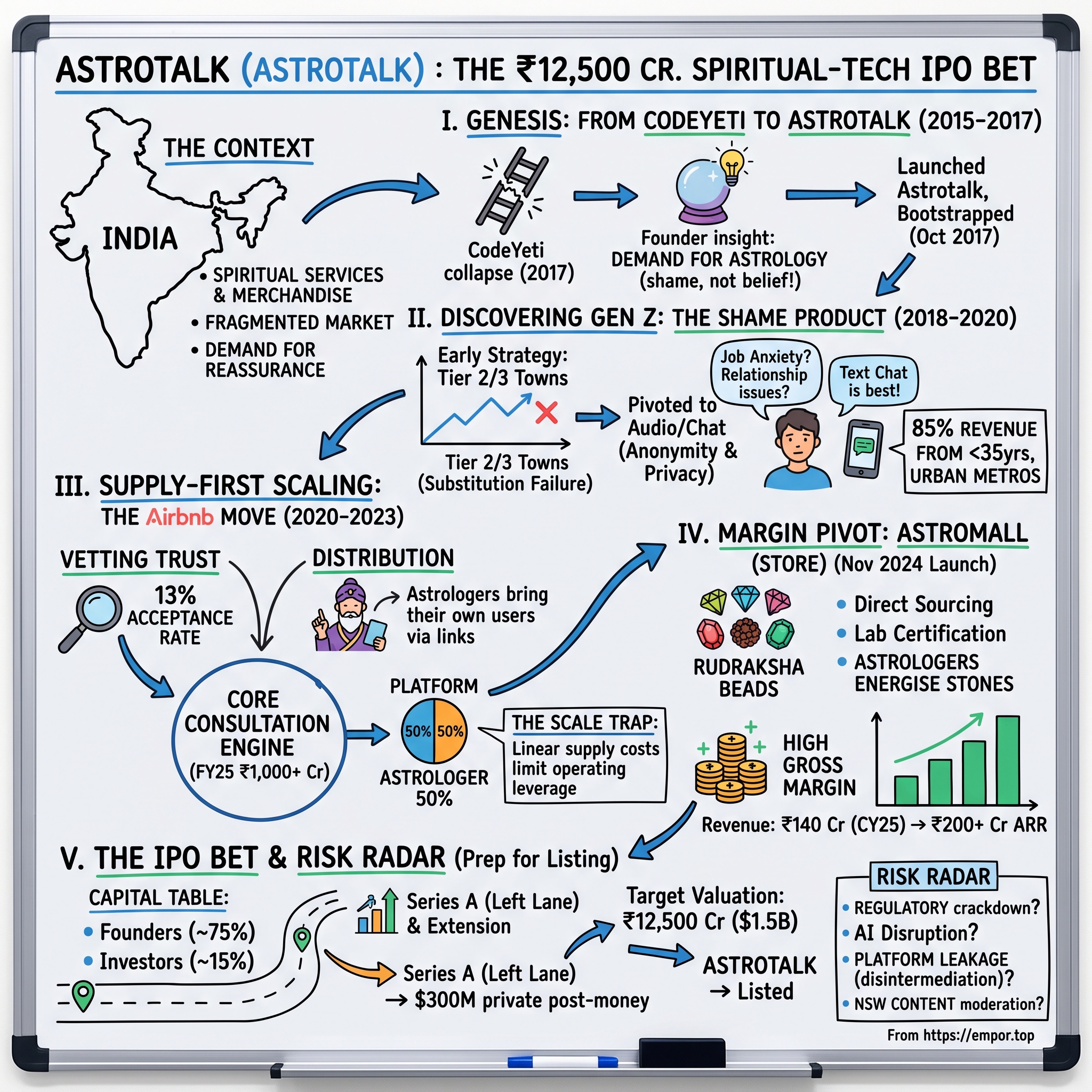
Astrotalk: The ₹12,500 Cr. Spiritual-Tech IPO Bet
I. Introduction & Episode Roadmap (0:00–10:00)
Most consumer-internet founders in India spend their first decade apologising for the absence of profit. Puneet Gupta spent his apologising for the presence of astrology. Astrotalk, the Noida-based platform he started in October 2017, has done something that the flashier cohort of Indian unicorns — the food-delivery apps, the quick-commerce warriors, the edtechs — mostly could not: it grew fast and made money at the same time. In the financial year ended March 2025, the company reported roughly ₹1,214 crore of total revenue, up about 85% year-on-year from ₹656 crore, and an adjusted profit before tax of around ₹285 crore.12 Those are the numbers of a business that has already crossed the line most startups die trying to reach.
The paradox worth sitting with from the first minute is that Astrotalk did this by digitising something a large share of its own investors probably do not believe in. Its core product is a pay-per-minute conversation between an anxious young person and a professional astrologer, billed at rates from ₹20 to ₹139 a minute, split evenly between the platform and the practitioner.1 It is, structurally, a labour marketplace — closer in economic shape to a freelancer platform than to a software company. And that is the crux of the pre-IPO question. The reported valuation ambition attached to the company's next fundraise and eventual listing has been widely described as roughly ₹12,500 crore, or about $1.5 billion.3 A services marketplace with a hard 50/50 revenue split does not, on the face of it, earn a software multiple.
So Astrotalk has been busy trying to change its own shape. It launched Astromall — later branded the Astrotalk Store — a direct-to-consumer commerce line selling gemstones, rudraksha beads, bracelets and ritual goods, which did about ₹140 crore in calendar 2025 and now runs at an annualised revenue rate above ₹200 crore.4 The strategic logic is transparent: physical goods carry no astrologer to pay, so their gross margins can behave like software even though the objects are as physical as a stone can be.
This is not an investor-relations story, and Astrotalk has not filed a prospectus — there is no DRHP, RHP or S-1 to read. What follows is an independent underwriting from the public record. We will trace the collapse of Gupta's first company and the pivot that followed; the accidental discovery that shame, not convenience, was the product; the supply-first playbook borrowed from Airbnb; the unit economics of per-minute counsel and the "services multiple trap" they create; the margin bet riding on a store full of stones; the capital table and the governance scaffolding being erected for a listing; a structural read through Helmer's 7 Powers and Porter's Five Forces; the risk radar, including a live regulatory and content-moderation exposure; and finally the bull and bear cases with the handful of metrics that will confirm or falsify the thesis after listing.
A word on method before the story, because it governs everything after. Price and value are different questions, and a pre-filing company forces the distinction to the surface. The private marks quoted around Astrotalk — the $300 million post-money of mid-2024, the $1.3–1.5 billion the company has since chased — are prices at which small parcels of preferred stock changed or would change hands, not appraisals of the whole enterprise as a public common shareholder would eventually own it.3 They are pricing signals, useful for reading sentiment and negotiating leverage, and they are not proof of intrinsic worth. Where a figure is a market price, we will treat it as one, and reason toward value from the operating evidence — revenue quality, retention, unit economics, margin structure, reinvestment needs and the credibility of the maturation path — rather than by carrying a headline mark forward unchanged. Where the evidence does not exist to compute something an investor would want — a fully diluted common-equivalent share count, an enterprise-value bridge, the terms attached to the preferred stock — we will say so plainly rather than manufacture false precision. That posture is not scepticism for its own sake; it is the only honest way to underwrite a company whose most-quoted number is a negotiation, not a fact.
 Subscribe on LinkedIn
II. The Genesis: CodeYeti's Collapse and a Prophetic Pivot (10:00–25:00)
Puneet Gupta did not set out to sell faith. He was, by training and temperament, the opposite of a believer — a Punjab Engineering College graduate who had worked as an analyst at Nomura and BNP Paribas before leaving finance to build software.5 In April 2015 he founded CodeYeti, a Noida IT-services shop building apps and websites for clients that reportedly included Yamaha and Greenply alongside a roster of startups. It scaled quickly on paper — around 45 employees, fifteen to twenty concurrent clients, roughly half a million dollars of revenue in the first year — the kind of early traction that looks like a company finding its feet.5
It was not. Services businesses of that kind live and die on utilisation and client retention, and by 2017 both were fraying. Gupta and his co-founder spent months and cash on two internal products that went nowhere, and in March 2017 the partner walked out.65 This is the unglamorous truth beneath the origin myth: CodeYeti was not a rocket that Gupta chose to abandon for a bigger idea; it was a failing consultancy that had run out of both money and partnership.
The mythology attaches to what happened next. Gupta has told, in interviews and in his own writing, the story of a colleague who practised astrology and predicted that his business would shut down — a prediction he laughed off at the time and that landed hard when it came true.57 Read as hagiography, it is a tidy conversion narrative: the sceptic humbled by the stars. Read as diligence, it matters less for its mysticism than for what it reveals about the founder's actual insight, which was commercial rather than spiritual. Gupta did not conclude that astrology was real; he concluded that millions of people behaved as if it were, that the existing supply of astrologers was fragmented and riddled with fraud, and that no one had built the trusted, on-demand layer that food delivery and ride-hailing had built for their categories.
He launched Astrotalk on 18 October 2017, bootstrapped from personal savings and, in the telling, running at first with a single astrologer.5 The early operation was a founder doing every job — customer support, quality checks, marketing — with the technical scaffolding salvaged from CodeYeti's remains. For an underwriter, the durable signal from this period is not the prophecy but the capital discipline: Astrotalk was built without institutional money for more than six years and was already substantially profitable before it raised its first venture dollar. That is a materially different risk profile from the average Indian consumer-tech IPO candidate, and it is the single most defensible fact in the entire story.
It is worth being precise about why that fact carries weight, because "profitable startup" is a phrase easily abused. Most Indian consumer-internet companies that reached the public markets in the 2021–2024 window — the food-delivery, edtech and quick-commerce cohort — arrived having consumed hundreds of millions or billions of dollars of venture capital to buy their growth, and their path to profit remained a projection at the moment of listing. Astrotalk inverts that sequence. Its first ₹100 crore of annual profit, reported for FY24, was earned before Left Lane Capital's cheque cleared, which means the profitability is a property of the business model rather than an artefact of investor subsidy that must later be unwound.8 A company that learned to make money while poor tends to keep making it when rich; a company that learned to grow while subsidised often cannot survive the subsidy's removal. The discipline also shaped the cap table in a way we will return to: because Gupta did not need to sell equity to fund operations, he did not, which is why the founders still own most of the company on the eve of a listing — an ownership structure that is simultaneously the strongest evidence of alignment and, as free float, one of the trickier features of the eventual offering.
There is a shadow side to the origin story that diligence should not skip past. The same founder who ran a services business into the ground in under three years is the one now asking public investors to underwrite a far larger enterprise, and the pivot narrative — the astrologer's prophecy, the sceptic converted — is exactly the kind of tidy, marketable myth that a communications team polishes for a roadshow. None of that is disqualifying; first-time founders fail routinely and learn from it, and the CodeYeti collapse plausibly taught Gupta the aversion to burning cash that later served him. But the underwriter's job is to weight behaviour over narrative, and the behaviour that matters here is not the story of the prediction; it is six years of running a real business to real profit without outside money. That is the fact that survives scrutiny.
III. The Beachhead Failure & The "Shame-Forward" Gen Z Discovery (25:00–45:00)
The first strategy was wrong, and it is worth dwelling on why, because the reason it was wrong is the reason the business works. Astrotalk initially aimed at the demographic that obviously consumes astrology in India: older, traditional households in Tier 2 and Tier 3 towns where consulting an astrologer for a marriage, a career move or an auspicious date is unremarkable. That market rejected the app. The rejection was not about technology or price; it was about substitution. Those households already had a trusted astrologer — a family pandit or a neighbourhood practitioner vetted across generations by word of mouth. An app offered them nothing they did not already have, from someone they had no reason to trust.
What Gupta noticed instead, as organic users trickled in, inverted his assumptions. The paying base skewed overwhelmingly young and urban: by the company's account, around 85% of revenue now comes from users under 35, concentrated in Tier 1 metros.1 These were precisely the people least likely, on paper, to consult an astrologer — educated, English-speaking, working in corporate India. The question is why they were the ones paying.
The answer the company arrived at, and the genuine strategic insight of the business, is that the operative emotion was shame, not belief. A twenty-six-year-old software engineer living alone in Bengaluru, carrying anxieties about a stalling career, a long-distance relationship or plain loneliness, is structurally cut off from the traditional astrology supply. She cannot consult the family astrologer without her parents learning what is troubling her. She cannot raise it with corporate peers who would dismiss it as superstition. The value proposition, then, is not prediction; it is anonymity — a stranger, bound by no social tie, who will listen and counsel without the risk of exposure. Anonymity is not a feature bolted onto the product; on this reading it is the product.
That reframing explains the most telling design decision in Astrotalk's history. The platform launched video-first, the format founders instinctively reach for because it feels premium and human. Users refused it: being seen defeated the entire point. The company pivoted to audio, and then to text — WhatsApp-style chat that lets a user confide the most intimate details of her life while remaining, functionally, invisible. Today chat drives roughly 65% of the business, and video demand is effectively nil.1 For an investor, this is the clearest available proof that management reads its own customers correctly: the product's shape was dictated by observed behaviour, not by the founders' aesthetic preference, and the behaviour it optimises for — the willingness to pay for a confidential ear — is durable in a way that a passing horoscope fad would not be.
The commercial implication of the shame insight is what separates Astrotalk from an entertainment app, and it deserves to be stated in plain economic terms. Novelty demand is transactional: a user tries a horoscope generator, is amused, and never pays again, which produces spiky, low-retention revenue that the market rightly discounts. Anxiety demand is recurring: a person navigating a deteriorating relationship or a stalled career returns to the same confidant week after week until the underlying worry resolves — and, human worries being what they are, a new one usually arrives to take its place. The reported ~80% share of revenue from repeat customers is the fingerprint of the second pattern, not the first.1 That is the causal chain a public-market investor has to believe: shame creates a private, recurring need; the app is the only socially safe place to meet it; and the need's recurrence, not its novelty, is what produces durable revenue. If that chain holds, Astrotalk is a subscription-like consumer franchise wearing the costume of a per-minute marketplace.
Two cautions keep this from being a victory lap. First, anonymity is a value proposition, not a moat — a competitor can offer the same confidential, text-first experience, so the defensibility has to come from supply quality and brand rather than from the feature itself, which is precisely why the vetting operation matters so much. Second, the demographic concentration cuts both ways: a business that draws 85% of revenue from urban users under 35 is exposed to that cohort's discretionary spending and its cultural attitudes, and the very sophistication that makes these users willing to pay for discreet counsel is the sophistication that could make them the first to adopt a cheaper AI substitute. The shame insight is real and, in our reading, the genuine intellectual core of the company; it is also not, by itself, something a rival is structurally prevented from copying.
IV. Supply-First Scaling: Vetting Trust at Airbnb Scale (45:00–1:05:00)
If anonymity is the demand-side moat, supply quality is the thing that can destroy it overnight. In a consultation marketplace, the product a user experiences is entirely the person on the other end of the chat. One scammy, pushy or incompetent astrologer — one practitioner who upsells a frightened user a ₹40,000 gemstone to ward off a curse — and the brand promise of a safe, vetted space collapses. The category's history is precisely a history of that fraud, which is what makes trust the scarce asset.
Astrotalk's response is the Airbnb move: solve supply quality manually and expensively before demand forces you to. Where Airbnb once sent photographers to guarantee that listings matched reality, Astrotalk built a gatekeeping operation around its astrologers. The company describes onboarding through a five-to-seven-round interview process that tests not only astrological knowledge but communication, empathy and psychological sensitivity, and it has cited an acceptance rate of roughly 13%.1 Registration is free — a deliberate contrast to competitors who monetised listing fees and thereby had an incentive to admit anyone — so the platform's revenue is aligned with keeping supply good rather than keeping it large.
Two caveats belong here, because the supply numbers do not fully reconcile across sources. In the narrative the company tells, it screens against a database of around 15,000 qualified astrologers.1 Yet other reporting drawn from its financials references more than 40,000 astrologers on the platform, who collectively earned about ₹511 crore in FY25.6 The two figures can be reconciled — a smaller pool of vetted, actively consulting practitioners inside a larger registered base — but the gap is exactly the sort of definitional ambiguity a prospectus will have to nail down, and the ₹511 crore payout is a useful cross-check: at a 50% split it implies roughly ₹1,020 crore of consultation revenue, consistent with consultations being the overwhelming majority of the ₹1,214 crore top line.
The most elegant part of the supply model is that it doubles as distribution. Rather than spending heavily to acquire users in the early years, Astrotalk let astrologers promote their own profile links across personal social media, turning the supply base into an organic acquisition engine — the practitioner markets herself, and the platform captures the user. That kept early customer-acquisition costs low and is a real structural advantage. It is worth flagging, though, that this same mechanic contains the seed of the platform's central long-term risk: an astrologer who can bring her own audience onto the platform can, in principle, take that audience back off it. We will return to that leakage problem, because it is where the bull and bear cases most sharply diverge.
The vetting operation is also the most credible single answer to the question "why can't someone just copy this?" — and it is worth testing that claim rather than accepting it. A rigorous, multi-round, low-acceptance interview funnel is expensive and slow to run; sustaining a 13% acceptance rate at the scale of tens of thousands of applicants requires an interviewing and quality-assurance organisation that a fast-follower cannot conjure overnight.1 That is a genuine operational barrier, and it compounds: a platform known for good astrologers attracts better applicants, which lets it stay selective, which keeps the product good. But the barrier has a ceiling that bears on the growth story. The same manual pipeline that protects quality is a governor on supply growth — and because consultation revenue is, as we will see, capped by the total paid hours the supply delivers, a hand-run vetting funnel that can only onboard so many practitioners per quarter is also, quietly, a cap on how fast the core business can grow. Management's answer to this tension is the proposed "Astrotalk University" — training and certifying its own supply rather than only screening applicants — which, if it works, converts the bottleneck into a revenue line, and if it does not, leaves the growth rate hostage to the throughput of a human interview process. Which of those it becomes is one of the more important unresolved questions in the file, and a skeptic is right to push on the scalability of a five-to-seven-round manual pipeline as a load-bearing part of the growth thesis.
V. The Core Consultation Engine: Unit Economics & The Scale Trap (1:05:00–1:30:00)
Strip away the spiritual framing and the core engine is a per-minute human-services marketplace, and its economics are best understood in that plain light. Consultations are the business: of the roughly ₹1,214 crore of FY25 revenue, the great majority — on the order of ₹1,000–1,100 crore — comes from paid conversations, with the store and other lines making up the rest.14 Users are billed by the minute, at rates that scale with an astrologer's rating and seniority, from about ₹20 a minute for a newly onboarded practitioner to ₹139 a minute for a top-rated one.1 The platform keeps 50%; the astrologer keeps 50%.
That 50/50 split is the whole ballgame, and it cuts two ways. On one hand it is the reason the astrologers stay: they keep half of what they generate, which is generous relative to the offline world and to fee-charging rivals, and the top practitioners — who produce a disproportionate share of repeat revenue — would walk the instant the platform tried to squeeze them, taking their most loyal clients with them. The split is, in effect, structurally non-negotiable, enforced by the mobility of the best suppliers. On the other hand it is precisely what caps the model's operating leverage. In a software business, the tenth million users cost almost nothing to serve; in this one, every incremental rupee of consultation revenue carries an almost exactly proportional rupee of supply cost. To double consultation revenue, Astrotalk must roughly double the paid hours its human supply delivers. There is no version of this segment where margins expand simply because the platform got bigger. This is what the outline aptly calls the scale trap, and it is the single most important fact a public-market investor has to price.
Against that constraint, the demand-side economics are genuinely strong, and this is where management has real proof rather than rhetoric. Blended customer-acquisition cost is reported in the range of ₹575 to ₹870, driven by micro-targeted digital ads, influencer marketing and native lock-screen widgets, with the acquisition cost recovered within roughly six to eight months.1 The retention data is the more remarkable half: the company reports that around 80% of revenue comes from repeat customers, and that roughly eight in ten users return without being prompted.1 For a category widely assumed to be transactional and novelty-driven, that repeat behaviour is the strongest single piece of evidence that Astrotalk is selling ongoing emotional support rather than one-off entertainment — a person does not return monthly to a party trick, but she does return to a confidant while a relationship or a career crisis is unresolved.
The honest investor's tension sits between these two facts. The retention and payback numbers say the demand is real, sticky and cheap to acquire — the marks of a high-quality consumer franchise. The 50/50 split says that no matter how good demand gets, the consultation business converts revenue to gross profit at a fixed, capped rate, and cannot compound margin the way the market pays software to compound it. Everything else in the Astrotalk equity story — the store, the international ambition, the education vertical — is an attempt to escape that second fact without breaking the first.
It helps to translate the 50/50 split into the vocabulary the public market will actually use, because the framing changes how the business is valued. In marketplace terms, Astrotalk's take rate is 50% of gross transaction value — extraordinarily high next to the single-digit take rates of goods marketplaces, and even generous against the 20–30% that global freelance-services platforms like Upwork or Fiverr extract. A 50% take rate is a genuine sign of pricing power: it says the platform is capturing half of everything the astrologer earns and the astrologer still considers it worth staying, which only holds because the platform supplies demand the practitioner could not economically reach alone. But the same figure that flatters the take rate indicts the contribution margin. After the astrologer's half is paid, what remains must still cover payment processing, cloud and telephony infrastructure, customer support, and — the swing factor — marketing. If blended CAC of ₹575–870 is recovered in six-to-eight months, then a repeat-heavy cohort throws off healthy contribution over a multi-year life; but the moment the cheap organic-acquisition era gives way to paid channels and CAC inflates, the gap between the 50% gross take and the true contribution margin is where the profitability lives or dies.1 This is the number a prospectus must disclose and a skeptic must demand: not the take rate, which is impressive, but the contribution margin after fully loaded acquisition cost, which is where the model is actually tested.
Revenue quality, examined honestly, is a study in mixed signals. On the favourable side, the revenue is recurring in economic substance even though it is transactional in form — a per-minute bill that repeats is, functionally, a subscription paid in irregular instalments, and the ~80% repeat share is what makes it so.1 There is no obvious customer concentration risk on the demand side: revenue is spread across a large base of individual consumers, none of whom can hold the company hostage the way a few enterprise accounts can in B2B software. The concentration risk sits instead on the supply side and in geography. The best astrologers generate a disproportionate share of repeat revenue, so the practical concentration is in a relatively small cohort of premium practitioners whose departure would hurt — the leakage risk again — and the revenue is overwhelmingly single-currency, single-country, exposed to Indian discretionary spending and Indian regulation. The growth itself also warrants a durability question: 85% year-on-year is spectacular, but a business that is still compounding off a sub-₹1,500 crore base, riding a cultural wave of smartphone-native spiritual consumption, has not yet been tested through a consumer downturn or a saturation of its core urban-under-35 cohort. High growth off a small base is not the same as proven, defensible growth, and the underwriting should not treat it as such.
The international angle is the most attractive lever on this segment precisely because it does not require breaking the 50/50 split. Diaspora users in the United States, the United Kingdom, Canada and the Gulf reportedly pay several times the domestic per-minute rate for the same consultation, which means the identical supply hour — the same astrologer, the same marginal cost — generates far more revenue when sold abroad.1 That is the one path to higher effective margin within the consultation business that does not depend on squeezing the practitioner, because the uplift comes from the customer's willingness to pay, not from the supplier's cut. It is early and unproven at scale, and it introduces its own complications — foreign-exchange exposure, local marketing costs, and competition from diaspora-focused rivals — but it is the most economically coherent piece of the bull case, and its progress is worth tracking as directly as the store's.
The path to durable profitability, not adjusted profitability
The most important discipline in reading Astrotalk's financials is refusing to be satisfied by "adjusted" profit. The company reported roughly ₹285 crore of adjusted profit before tax for FY25, but that figure is adjusted to exclude a ~₹120 crore exceptional employee-related expense and a ~₹80 crore non-cash mark-to-market swing on its CCPS instruments under IndAS accounting.2 On a fully reported basis, several accounts put net profit closer to the ₹250 crore range, still a genuinely profitable outcome.3 The two non-cash items are defensible things to adjust for — the CCPS mark is an accounting artefact of the preferred-share structure that will disappear on conversion at listing, and a one-time non-cash employee charge is not an operating cost of running the platform. But an underwriter should note the pattern: the reconciliation from reported to adjusted runs in the company's favour by roughly ₹200 crore, and that is precisely the kind of adjustment a prospectus will present prominently and a skeptic should re-derive from the audited statements rather than accept.
The deeper question is not whether Astrotalk is profitable today — it clearly is — but whether the profitability is structural and can compound. Here the evidence is genuinely encouraging. FY25 total expenses of about ₹1,129 crore against ₹1,214 crore of revenue leave real operating profit before the non-cash noise, and the company generates cash rather than consuming it, which removes the existential financing risk that hangs over most pre-IPO consumer names.2 There is no visible cash-runway problem, no burn to fund, no imminent need to raise simply to survive — the prospective round is about acceleration and founder liquidity, not solvency.3 What must improve for the profitability to deserve a premium multiple is margin structure, and that improvement can only come from mix: every rupee that shifts from the 50/50 consultation line to the high-margin store, or to higher-ARPU international consultations, or to a future software/education line, lifts the blended margin, while every rupee of incremental domestic consultation revenue holds it flat. The falsification test is clean: if, over the next several disclosure periods, the blended operating margin fails to expand even as revenue grows, that is direct evidence that the mix shift is not happening fast enough to escape the services trap — and no amount of adjusted-profit presentation should paper over it.
VI. The Margin Pivot: How Astromall Disrupted the Faith Market (1:30–1:55:00)
Here is the pivot on which the valuation rests. A consultation marketplace, however profitable, invites a labour-services multiple — the low single-digit price-to-sales that the market assigns to businesses whose costs scale linearly with revenue. To justify a valuation approaching ₹12,500 crore against roughly ₹1,214 crore of revenue — a price-to-sales ratio around ten on the reported private mark — Astrotalk needs a segment that looks like software: high gross margin, real operating leverage, and the ability to grow profit faster than revenue. That is the entire strategic purpose of Astromall, launched in November 2024 and later folded into the Astrotalk Store brand.4
The market it attacks is real and genuinely ugly. India's spiritual-merchandise trade — gemstones, rudraksha beads, metal rings, idols, puja materials — is large, fragmented and opaque, a category where a frightened buyer has little way to tell a certified stone from a dyed piece of glass and where counterfeiting is endemic. That opacity is the opportunity: in a market defined by the buyer's inability to verify, a trusted certifier can charge a premium and take share simply by being credible. Astrotalk's approach is to bypass unvetted local distributors, source raw materials directly, and wrap the goods in verification — batch testing, laboratory certification of authenticity — before they ship. It then adds the step that converts a mineral into a "spiritual product": the company's astrologers "energise" the stones in rituals before dispatch, which is the mechanism by which a low-margin commodity becomes a high-margin faith object. One can be entirely agnostic about whether energising a gemstone does anything metaphysical and still recognise that, commercially, it is a margin-manufacturing process.
The financials, from a standing start, are eye-catching. Seeded with an initial incubation of about ₹30 lakh and later backed with roughly ₹40 crore for inventory and supply chain, the store scaled to 1.6 million orders in 2025 and about ₹140 crore of revenue, running at an annualised rate above ₹200 crore, across 300-plus SKUs, with a stated repeat-purchase rate of 24%.4 Management has guided the line toward ₹400–500 crore of ARR by FY27.4 Because there is no 50% astrologer payout on a physical object, gross margins on merchandise are structurally far higher than on consultations, which is exactly the operating leverage the equity story needs.
Before pressing the skeptic's questions, the size of the prize deserves a disciplined look, because the TAM claims around Indian spiritual commerce are among the loosest numbers in the whole story. It is true that the broad category is enormous: India's astrology and spiritual-services market is variously estimated in the low-single-digit billions of dollars, and the spiritual-merchandise trade — gemstones, rudraksha, idols, puja goods — adds billions more when the entire fragmented, largely offline, largely cash economy is counted. But a category TAM is not a reachable market, and the gap between them is where careless valuations are built. Astrotalk's reachable market today is the intersection of several narrowing filters: consumers who are smartphone-native and comfortable transacting online, who skew urban and under 35, who are willing to pay premium prices for certified goods rather than buy cheaply from a local vendor, and whom the company can acquire at a CAC that preserves contribution margin. That reachable slice is a fraction of the headline category, and it overlaps heavily with the consultation user base the company already owns — which is both the store's advantage (a warm, captive audience) and its ceiling (it grows roughly as fast as that audience does). An honest market-share conversation therefore anchors not on "1% of a $10 billion category" arithmetic but on how many of Astrotalk's own consultation users convert to buyers, at what frequency, and whether the brand can pull in incremental buyers who never consulted at all. On present evidence the store is mostly monetising the former; the latter remains to be proven.
The competitive response also has to be priced in, because a high-margin, fast-growing faith-commerce line is exactly the kind of business that attracts predators. The moment gemstone-and-rudraksha e-commerce demonstrates software-like margins at scale, India's horizontal marketplaces and quick-commerce platforms — companies with vastly deeper logistics, cheaper capital and existing traffic — can enter the category, and specialist devotional-commerce startups already exist. Astrotalk's defence is authenticity and certification, which is real but imitable: a well-funded entrant can build its own lab-certification and "energising" narrative, and can undercut on price because it is not carrying the cost of a consultation business alongside. The store's durability, then, rests less on any structural moat than on brand trust and the captive cross-sell, which is a thinner defence than the consultation business enjoys. This matters enormously for valuation, because the entire multiple-expansion thesis leans on the store, and the store is the part of Astrotalk most exposed to a competitor with a bigger balance sheet deciding the faith category is worth taking.
Two skeptic's questions have to be pressed against this optimism. The first is independence of demand. Management's own framing is that only 3% of store revenue comes from direct astrologer recommendation and 97% from general brand recognition, which is offered as evidence that the store is a genuine standalone business rather than a cross-sell.1 The more natural reading is the opposite: if nearly all store buyers already know the Astrotalk brand, the store is most plausibly monetising the captive consultation base — selling stones to people who came for chats — rather than acquiring a new customer segment. That is still valuable, but it is a different, more fragile kind of value than a self-standing commerce franchise, because it grows only as fast as the consultation funnel that feeds it. The second question is durability of the margin. A 24% repeat rate on physical goods is respectable but far below the ~80% repeat behaviour of consultations, and gemstone economics can compress fast if competitors — including the marketplaces and quick-commerce platforms with far deeper logistics — decide the faith category is worth entering. The store is the most important thing Astrotalk is building for its listing, and it is also the least proven; at roughly a ₹200 crore run-rate it is one-sixth of the company, and the entire multiple-expansion thesis asks investors to underwrite what it becomes, not what it is.
VII. The Capital Table & Management Credibility (1:55:00–2:15:00)
Astrotalk's cap table is unusual in a way that cuts mostly in the company's favour, and it is where price and value most need to be separated. Start with what is genuinely rare: the founders own most of the company. Reporting puts the two founders' combined stake in the neighbourhood of the mid-70s percent — Gupta the large majority holder and Anmol Jain a smaller slice — with institutional investors holding only around 15%, an employee stock pool near 7–8%, and angels under 1%.36 The outline's precise split — 76.83% founders, 14.83% institutional, 7.55% ESOP, 0.79% angels — is directionally consistent with that reporting, though the exact figures should be treated as pre-filing estimates until a prospectus verifies them. The reason this ownership structure exists is the same capital discipline noted earlier: the company simply did not need much outside money, so it did not sell much of itself.
The funding history is short and should be read carefully rather than carried forward as a valuation anchor. Astrotalk raised its first institutional capital only in early 2024: a Series A of about $20 million led by New York's Left Lane Capital at a reported $200 million pre-money valuation, followed a few months later by a roughly $9.5 million extension — about ₹78.3 crore, split between Left Lane and Elev8 — that took the post-money mark to around $300 million.83 Total capital raised to date is on the order of $34 million.3 Two disciplines matter for an underwriter here. First, these are small rounds relative to the company: a $9.5 million extension does not "prove" a $300 million enterprise is worth $300 million; it prices a thin sliver of preferred stock. Second, and critically, the securities sold were preferred, not common — the financials explicitly reference compulsorily convertible preferred shares (CCPS), whose IndAS mark-to-market swing produced the ~₹80 crore non-cash hit in FY25.2 Preferred shares typically carry liquidation preferences, and possibly participation or anti-dilution terms, that public common shareholders will not receive. The specific terms are not disclosed, and that is itself a diligence item: the headline private valuation is a preferred-share price, and converting it into a common-equity value for a public investor requires terms no one outside the company can yet see.
The prospective next round sharpens the point. Through 2025 Astrotalk was reported to be raising fresh capital — figures around $50–100 million, and a rupee figure near ₹429 crore in one account — at a target valuation of $1.3–1.5 billion, roughly ₹11,000–12,900 crore, described as likely the last private round before a DRHP.39 That is the origin of the "₹12,500 crore" headline. It is a target price a company hopes to achieve, not a settled value, and the distinction is not academic here — because the round has a cautionary precedent. An earlier proposed investment by Hornbill Capital, of roughly $100–120 million at a $1–1.2 billion valuation, fell through; reporting attributed the collapse variously to a valuation disagreement and, more damagingly, to due-diligence discovery of NSFW content on the platform that an institutional investor was unwilling to underwrite.6 The reported plan for the next round to include secondary share sales by the founders is also worth watching: founder secondaries are legitimate liquidity, but a public investor should note when insiders are selling into the pre-IPO mark rather than only raising primary capital for the business.
On management, the record supports cautious respect rather than uncritical faith. Gupta is the domain and marketing intelligence — the person who read the shame-not-belief insight correctly and refused to run the business on outside money for six years. Jain, an IIT Delhi and IIM Calcutta alumnus with product experience at INDmoney and Wishfin, was elevated to co-founder in 2023 and is credited with importing institutional discipline — cohort analysis, product-led growth, capital-allocation frameworks.12 The governance scaffolding is being built visibly for a listing: in August 2025 the company appointed Deepak Khetan, a chartered accountant and All-India Rank 1 holder with senior finance stints at GlobalBees, YES Bank, ICICI Bank and Edelweiss, as its first CFO, with an explicit mandate covering IPO readiness, governance and investor relations.1011 Hiring a heavyweight CFO before filing is the right sequence. But an underwriter should hold two things at once: the capital-efficiency track record is real and rare, and the board independence, related-party arrangements, voting structure and executive-equity terms that a public company requires are simply not yet visible — their absence is not evidence of safety, only of the pre-filing stage.
What can and cannot be built from the public cap table
An honest capitalisation cannot yet be constructed, and saying so is more useful than pretending otherwise. What is public is a rough ownership split — founders in the mid-70s percent, institutions around 15%, an ESOP pool near 7–8%, angels under 1% — and the existence of CCPS that will convert at or before listing.342 What is not public is the fully diluted common-equivalent share count, the strike prices and vesting of the option pool, the exact conversion ratio and any anti-dilution ratchet on the preferred, warrant or SAFE positions if any exist, and the voting rights attached to founder shares. Without those, any "market capitalisation" derived from the private mark is an implied equity value, not a verified one, and the components missing from it are exactly the ones that determine what a public common share is worth relative to the preferred that priced the last round. This is not a rhetorical caveat: the ~₹200 crore CCPS mark-to-market swing that ran through FY25 earnings is direct evidence that the preferred structure has real, moving economic weight, and its conversion terms — undisclosed — sit between the headline valuation and the value of the stock a public investor would buy.2
The enterprise-value bridge is similarly out of reach and should be labelled as such rather than fudged. Enterprise value requires cash, debt and lease-like obligations, plus any planned primary proceeds — none of which is disclosed for a private company. Astrotalk is cash-generative and appears to carry little or no meaningful debt, which suggests cash and equivalents are a positive rather than a negative bridge item, but the precise net-cash position is not public, and the split between primary capital (which stays in the business) and secondary sales (which go to founders) in the prospective round has been reported only in outline. The practical consequence is a discipline the rest of this analysis obeys: because we cannot build an EV, we do not compare an equity-value multiple against an enterprise-value multiple, and where we speak of the "10x" implied by the private mark, we are explicit that it is price-to-sales on an implied equity value, not an EV/revenue figure comparable to how listed peers are often quoted.
A transparent intrinsic-value frame — a range, not a target
With those limits acknowledged, it is still possible to reason about value from the operating evidence, provided the output is treated as a wide range with visible assumptions rather than a number. Start from FY25's roughly ₹1,214 crore of revenue and ₹250–285 crore of profit, and consider three illustrative five-year paths. In a bear path, revenue growth decelerates hard as the urban-under-35 cohort saturates and CAC inflates — say to a 20–25% CAGR fading toward the teens — the store stalls near a mid-single-digit share of revenue, AI erodes the low-end funnel, and the blended net margin stays pinned around the low-20s percent by the 50/50 core; a business on that trajectory is a good, profitable company that the market would rightly value at a services-marketplace multiple, implying an equity value well below the ₹12,500 crore ambition. In a base path, growth normalises to a still-strong 35–45% CAGR for a few years before fading, the store reaches its guided ₹400–500 crore of ARR by FY27 and keeps climbing toward a fifth or more of revenue, international ARPU lifts blended economics modestly, and net margin drifts up toward the mid-to-high 20s percent as mix improves; that profile can support a valuation in the broad vicinity of the private mark, though with meaningful execution risk baked in. In a bull path, the store compounds past its guidance, international becomes a material double-digit share of revenue at multiples of domestic ARPU, an education/software line adds a genuinely high-margin layer, and the blended margin expands toward the 30s percent while growth stays elevated; only on that path does a valuation comfortably above ₹12,500 crore look like value rather than momentum. The sensitivities that move the answer most are, in order: the pace and durability of the consultation-to-store-and-international mix shift, the trajectory of blended CAC and therefore contribution margin, and the discount rate an investor applies to a single-country, regulation-exposed, founder-controlled consumer business — a rate that should sit well above what one would use for a diversified software platform. The point of the exercise is not a figure; it is to show that the reported ambition is a bull-to-optimistic-base outcome, and that the same operating facts support a materially lower value if the mix shift disappoints.
VIII. Playbook: Strategic Powers & Porter's 5 Forces (2:15:00–2:40:00)
The strategy frameworks earn their place here only to the extent they clarify where the economics are durable and where they are exposed, so it is worth being disciplined about which powers are real.
Through Hamilton Helmer's 7 Powers, the strongest claim is counter-positioning. Astrotalk built a business — anonymous, text-first, on-demand counsel — that the incumbent supply structurally cannot copy. A neighbourhood astrologer's entire asset is local, face-to-face reputation; going anonymous and text-only on a national app would destroy the very prestige that sustains him. The incumbent cannot follow without cannibalising himself, which is the textbook shape of counter-positioning and probably the most defensible power in the story. Branding is real but should not be overstated: in a category defined by fraud, "Astrotalk-vetted" is a genuine certifier that unlocks pricing power, and the vetting operation gives the brand something concrete to stand on — yet brand advantages in Indian consumer internet have proven erodible when a better-funded rival buys attention. Network effects are present but medium at best: more users draw better astrologers who draw more users, but the loop is not winner-take-all, because a user needs only one good astrologer, not all of them, and supply is not meaningfully constrained the way it is on a two-sided goods marketplace. Scale economies are the split-personality power the whole thesis turns on — essentially absent in consultations, where cost scales linearly, and potentially real in the store, where bulk sourcing and standardised certification can spread fixed cost. Switching costs are moderate and, importantly, sit at the level of the individual astrologer rather than the platform: a repeat user's stored chart history and, more powerfully, her trusted relationship with a specific practitioner are what bind her — which is precisely why platform leakage is the risk it is.
The 7 Powers read has a sobering synthesis worth stating before moving on. Of the powers Astrotalk can plausibly claim, the two strongest — counter-positioning and the vetting-driven brand — are both defences against the offline incumbents the company already beat, not against the threats coming from the front. Counter-positioning protects Astrotalk from the neighbourhood astrologer; it does nothing against a well-funded digital rival or an AI-native app, neither of which suffers the incumbent's dilemma. The brand and operational moat protect against fly-by-night copycats; they are thinner against a horizontal platform with a bigger balance sheet. The powers that would defend the company against its actual future risks — durable network effects, real scale economies, high switching costs — are exactly the ones that register as medium-to-low. That asymmetry is the strategic heart of the underwriting: Astrotalk is extraordinarily well defended against the past and only moderately defended against the future, which is a comfortable place to be for a profitable private company and a more demanding one for a public stock priced on decades of compounding.
Porter's Five Forces sharpens the same picture from the industry side. Threat of new entrants is genuinely two-tiered: building a chat app is trivial and capital-light, but aggregating, interviewing and coordinating tens of thousands of vetted astrologers on a real-time platform with a trusted brand is not, and that operational moat is Astrotalk's real barrier. Bargaining power of suppliers is high and structural — the best astrologers are mobile, generate the repeat revenue, and enforce the 50/50 split by their credible threat to leave; this is the force that caps the business model's margin and cannot be engineered away. Bargaining power of buyers is mixed: low for transactional first-time users who can trivially try a rival, but high emotional lock-in for repeat users bonded to a specific astrologer — again, lock-in to a person more than to the platform. Threat of substitutes is high and rising — free horoscope generators, the enduring family astrologer, and, most consequentially, generative-AI astrology apps that could offer instant, personalised readings for a fraction of the price. The frameworks converge on one conclusion: Astrotalk's defensibility is strongest against the old offline world it counter-positioned, and weakest against the new AI-native and supplier-disintermediation threats that attack it from the future rather than the past.
IX. The Risk Radar & Pre-IPO Stress Test (2:40:00–3:00:00)
The risks that matter for this listing are not generic; they attach to specific, identifiable pressure points, and a serious underwriter should stress each.
Regulatory and content risk is the nearest-term and most concrete. Online astrology in India operates in a grey zone under consumer-protection norms and anti-superstition statutes that exist in several states, and any crackdown on "deceptive claims" — particularly predictions touching medical or financial outcomes — would strike the core consultation business directly. This is not hypothetical: the Hornbill deal reportedly collapsed in part because due diligence surfaced NSFW content on the platform, the kind of finding that spooks institutional capital and invites regulatory attention.6 Content moderation and the substance of what astrologers are permitted to tell vulnerable users are therefore both a governance question and a valuation question, and a prospectus will have to address them head-on.
AI disruption is the most consequential medium-term threat. The consultation product is, at its lower tiers, a text conversation providing reassurance and personalised interpretation — precisely the shape of task large language models are becoming cheap and good at. A generative-AI astrology app tuned on Vedic material could plausibly serve the low-to-mid tier of the funnel at near-zero marginal cost, undercutting the ₹20–40-a-minute human practitioners. The bull's rejoinder — that users pay for the human bond and the anonymity of confiding in a real person, not for prediction accuracy — is credible and is partly supported by the retention data, but it is a thesis, not yet a proven defence, and it is the single technological risk most likely to force a reckoning.
The services-multiple trap is the valuation risk that ties the others together. If public institutions decline to price Astrotalk as a software company and instead value it as the labour-services marketplace its 50/50 core actually is, the gap between the ~10x private price-to-sales mark and a services-appropriate low-single-digit multiple is enormous, and the listing could price well below the last private round. The store is the hedge against exactly this, which is why its trajectory is load-bearing.
Platform leakage is the risk the bear case is built on, and it deserves its own line on the radar. The very mechanic that made early acquisition cheap — astrologers bringing their own audiences — is reversible. A premium practitioner who has built a book of loyal, high-LTV clients on the platform has an obvious incentive to move those relationships to a personal WhatsApp or phone line and keep the full fee rather than half of it. The platform's counter-incentives are real (payment convenience, dispute protection, the steady flow of new demand, and the risk of losing access entirely if caught), but the economics of a 50% take rate are a standing invitation to disintermediation, and the rate at which it happens is nearly invisible from outside. A prospectus that does not quantify astrologer retention and the share of gross transaction value that stays on-platform would be leaving the single most important defensibility question unanswered.
Governance and content risk is not a future abstraction; it has already cost a deal. The collapse of the Hornbill investment over NSFW content discovered in diligence is a concrete signal that the platform's content-moderation surface is a live liability, not a hypothetical one.6 For a company preparing to invite retail public shareholders, the substance of what astrologers are permitted to say to vulnerable users — particularly anything touching health, fertility, or financial outcomes — is both a regulatory exposure and a reputational one, and the moderation systems that police tens of thousands of real-time private conversations are precisely the kind of control environment a public-market diligence process scrutinises hardest. The related concentration of control compounds it: with founders holding roughly three-quarters of the equity, public shareholders will be minority holders in a founder-controlled company, dependent on governance structures — board independence, related-party oversight, the terms of founder secondaries — that are not yet visible and must be treated as diligence items for a real filing rather than assumed to be adequate.
The stress test also has a behavioural dimension worth naming. In its prepared messaging, management leans on the genuinely strong points — 85% revenue growth, real cash generation, high repeat rates. The questions a skeptical analyst should push on are the ones the marketing glides over: whether store revenue is truly independent demand or captive cross-sell; whether blended CAC is inflating as the company scales past its cheap organic-acquisition era into paid channels; and whether a five-to-seven-round manual vetting pipeline can scale supply fast enough to feed the growth the valuation assumes. Where those answers are candid and specific in a future filing, the underwriting strengthens; where they are vague, the multiple should compress.
X. The Bull vs. Bear Case & KPIs to Watch (3:00:00–End)
The bull case is that Astrotalk is an already-profitable consumer franchise with a genuine emotional moat, run by disciplined operators, and that its margin ceiling is a problem it is actively and credibly solving. In this telling, the store scales to ₹400–500 crore of ARR by FY27 and keeps going, shifting the revenue mix toward high-margin merchandise and dragging the blended corporate margin upward until the company earns something closer to a software multiple honestly.4 International expansion compounds it: diaspora users in the US, UK, Canada and the Gulf reportedly pay several times the domestic per-minute rate, so the same supply hour generates far more revenue abroad, and an "Astrotalk University" that trains and certifies its own astrologers could turn supply acquisition from a cost into an ed-tech revenue line. Stack those and the 50/50 core becomes the stable, cash-generative base beneath faster, higher-margin layers.
The bear case is that the 50/50 split is destiny. Consultations never develop operating leverage; domestic CAC rises as the cheap organic era ends and the company buys growth through paid channels, compressing the very margins the bull needs to expand. Worse, the platform's cleverest feature — letting astrologers bring their own audiences — becomes its structural leak, as the best practitioners, who own the trusted relationships, take their highest-value clients off-platform onto private WhatsApp and phone to avoid the 50% take. And AI hollows out the low-to-mid funnel, turning the entry-tier human consultation into a product people can get for free. In this telling the store is a bolt-on that grows only as fast as the consultation funnel that feeds it, and the ₹12,500 crore ambition meets a public market that prices the company as what it mostly is — a labour marketplace — at a fraction of the target.
On comparables, the exercise is unusually hard because Astrotalk has no clean listed twin, and constructing an honest peer set is mostly an exercise in explaining exclusions. There is no publicly traded pure-play online astrology company of scale, so any comparison is by analogy to one facet of the business at a time. On the consultation side, the closest operating analogues are take-rate human-services marketplaces — global freelance platforms such as Upwork and Fiverr, or on-demand consultation models — which share the structural feature that matters most: revenue scales with human supply, gross margin is capped by the payout to that supply, and the market accordingly assigns them modest revenue multiples rather than software multiples. Those are the right reference for the ₹1,000-crore-plus consultation core, and they argue for a low multiple, not a high one. On the store side, the analogues are Indian consumer and D2C listings — beauty and lifestyle commerce names and branded-goods platforms — whose multiples depend on growth and gross margin and sit well below software but above pure services. The aspirational comparables management would prefer — high-multiple SaaS and content-subscription platforms — are the ones to exclude most firmly, because Astrotalk's dominant revenue line does not share their zero-marginal-cost economics; borrowing their multiple is precisely the category error the "services trap" describes. Two cautions apply to any of these: the specific current trading multiples of these peers are not independently verified in this analysis and would need to be pulled fresh, on a like-for-like basis (same metric, period, currency, and — critically — an EV or equity-value basis stated explicitly) before being applied; and none of them carries Astrotalk's particular combination of India-only regulatory exposure, founder control and a 50% take rate, each of which argues for a discount rather than a premium to an otherwise comparable multiple.
Reconciling the two views — the intrinsic scenarios and the peer lens — points to the same conclusion from two directions. The intrinsic frame says the ₹12,500 crore ambition is a bull-to-optimistic-base outcome that requires the mix shift toward store and international to deliver; the comparable frame says that a business whose revenue is today dominated by a 50/50 services marketplace should, absent that shift, trade nearer a services multiple than a software one. What the prospective valuation therefore embeds is a specific and demanding set of beliefs: that growth stays well above the market's default fade, that the store scales into a material and durable high-margin share of revenue, that international ARPU meaningfully lifts blended economics, that AI does not commoditise the low end, and that regulatory and content risks stay contained. If those hold, the price is value; if they slip, the peer lens reasserts itself and the gap to a services multiple is large. The market may still, for a time, pay above any central intrinsic range for reasons that are not business value at all — the scarcity of a first listed astrology platform, the appeal of a rare profitable Indian consumer story, a thin free float that mechanically supports the price, and post-listing momentum. Those forces are real and can dominate the tape for quarters, but they are pricing phenomena, not evidence of worth, and conflating them with value is the specific mistake this underwriting is built to avoid.
On value versus price, the honest range is wide and the sensitivities are clear. Against roughly ₹1,214 crore of FY25 revenue and about ₹285 crore of adjusted pre-tax profit, a services-marketplace lens supports a valuation materially below the reported private mark, while a credible mix-shift-to-margin story supports something well above it; the ₹12,500 crore figure is a private, preferred-share target price that embeds aggressive assumptions about growth persistence, margin expansion via the store, international economics, and — implicitly — that AI does not commoditise the core. What the public market will actually pay depends on forces that are not business value at all: IPO scarcity (Astrotalk would be the first listed venture-backed astrology platform), the narrative appeal of a profitable Indian consumer story, a thin free float given ~75% founder ownership, and post-listing momentum. Those can push the price above or below any intrinsic range for a good while, which is exactly why the underwriting must fix on operating truth rather than the mark.
The near-term catalysts that will resolve much of this uncertainty are identifiable even before a prospectus exists. The first is the pending fundraise itself: whether Astrotalk closes its unicorn round near the $1.3–1.5 billion target, at a discount, or not at all will be a direct market verdict on the story, and the terms — how much primary versus founder secondary, and at what valuation relative to the $300 million mark of mid-2024 — will reveal what sophisticated private investors actually believe after diligence, a signal made more pointed by the Hornbill deal's collapse.36 The second is the DRHP filing itself, expected to follow the final private round, which will for the first time expose audited segment financials, the true share count and preferred terms, the contribution margin after loaded CAC, astrologer-retention disclosure, and the formal risk factors — converting most of the diligence items flagged throughout this analysis from unknowns into facts. The third is simply the passage of the next few reporting periods against the store's ₹400–500 crore ARR guidance for FY27: hitting or missing that number, and doing so at the promised margin, is the clearest scheduled test of the entire multiple-expansion thesis.5
The events that could force a public-market profitability reckoning are the mirror image of the bull case. A regulatory action against online astrological "predictions," a viral content-moderation scandal of the kind that already frightened one investor, a visible deceleration in growth as the core urban cohort saturates, a step-change in AI astrology adoption, or evidence that top astrologers are leaking off-platform in numbers — any one of these would puncture the narrative that supports a premium multiple and re-expose the services-marketplace reality underneath. After listing, the price can and will move on mood, scarcity and momentum regardless of any of this, and for a while the tape may say more about sentiment than about the business. But sentiment is borrowed time; over a full cycle the three KPIs that follow are what will actually settle whether the underwriting was sound.
Three KPIs will confirm or falsify the thesis faster than any other, and each maps to a specific fork above. First, non-consultation revenue share — the store's revenue as a percentage of the total, and the blended operating margin that moves with it — is the single cleanest readout of whether the margin pivot is real; if it climbs toward and past 20–30% while holding its margin, the software-multiple case earns its keep, and if it stalls near today's sixth-of-revenue, the services trap has closed. Second, astrologer churn and platform leakage — the rate at which premium practitioners take relationships offline — is the metric the bear case lives on, and it is the one hardest to see from outside, which makes its disclosure in a future filing a diligence priority. Third, blended CAC and payback period track whether the demand engine still runs cheap as the company scales into paid acquisition; a payback drifting out from six-to-eight months toward the mid-teens would signal the quiet erosion of the model's best current advantage. Watch those three, in a real prospectus and then in post-listing disclosure, and the story tells you whether the ₹12,500 crore bet was underwriting or hope. Astrotalk has already done the hard part that most of its peers never manage — it built a real business that makes real money doing something the world assumed could not be systematised. The open question is not whether it is a good company; it plainly is. The question is whether a good, profitable, structurally supply-capped services marketplace, with a promising but unproven high-margin store bolted on, is worth what a market intoxicated by scarcity and narrative may briefly decide to pay for it — and on that, the evidence says: not yet proven, and the burden of proof sits squarely on the mix shift.
References
-
Behind Astrotalk's ~₹12,500 Cr. IPO bet — GrowthX, 2025 ↩↩↩↩↩↩↩↩↩↩↩↩↩↩↩↩
-
Astrotalk Reports 85% Revenue Growth In FY25 as Tier I Cities Boost Platform Activity — Outlook Business, 2025 ↩↩↩↩↩↩
-
Exclusive: AstroTalk seeks unicorn valuation in new round — Entrackr, 2025 ↩↩↩↩↩↩↩↩↩↩
-
AstroTalk's e-commerce vertical posts Rs 140 Cr revenue in 2025, hits Rs 200 Cr ARR — Entrackr, 2026 ↩↩↩↩↩↩↩
-
Meet the Founder: Puneet Gupta's Inspiring Journey Behind Astrotalk — Astrotalk, 2024 ↩↩↩↩↩↩
-
Astrotalk-Hornbill Funding Deal Falls Through at Unicorn-Valued Round; Here's Why — Outlook Business, 2025 ↩↩↩↩↩↩↩
-
The Story Behind Founding AstroTalk by a non-believer in Astrology — Puneet Gupta, LinkedIn ↩
-
On-demand spiritual tech startup Astrotalk raises $9.5M led by Left Lane Capital, Elev8 Capital — Indian Startup News, 2024 ↩↩
-
Astrology Platform AstroTalk To Raise INR 429 Cr At Unicorn Valuation, IPO Plans In Motion — IPO Central, 2025 ↩
-
Former GlobalBees Executive Deepak Khetan Takes Helm As Astrotalk CFO — Inc42, 2025 ↩
-
Astrotalk appoints Deepak Khetan as CFO ahead of planned IPO — Entrackr, 2025 ↩
-
Anmol Jain Elevated to Co-Founder Role at Astrotalk — Startup Story Media, 2023 ↩
 LinkedIn
 WhatsApp
 Reddit
 Hacker News
 Email
Email Kindle
 RSS Feed
 Spotify
 Apple Podcasts
 Amazon Music
 Audible
 YouTube