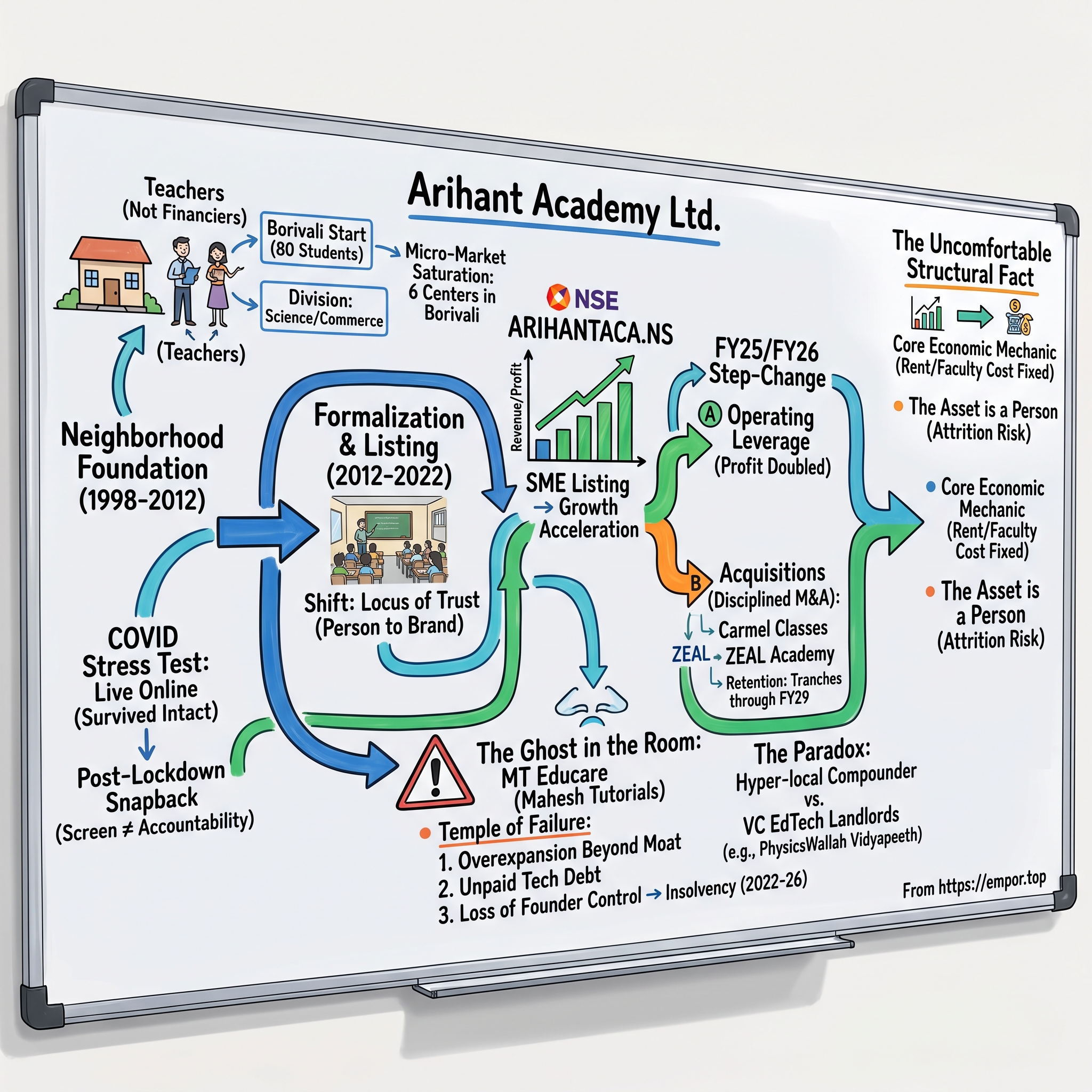
Arihant Academy: Mastering Mumbai's Coaching Playbook & Avoiding the EdTech Trap
I. Introduction & Episode Roadmap
On the morning of July 10, 2026, parents across Mumbai's suburbs woke up to a message no family wants three weeks into an academic year. Mahesh Tutorials — for two decades the most recognisable coaching brand in Maharashtra — had shut 33 branches across the city, without notice, after collecting full-year fees for the 2026-27 session. More than 800 enrolled students were left without a classroom, several hundred of them CBSE and ICSE candidates in the middle of board-year preparation. There were no refunds. A parents' foundation submitted a formal representation to the Chief Minister demanding an inquiry committee and financial audits.1
Among the people quoted in the coverage of that collapse was Umesh Pangam, chairman of a company most of India had never heard of, explaining that some of the stranded students had been absorbed into his centres without extra charges.1 That single sentence is the whole story of Arihant Academy Limited in miniature: a hyper-local Mumbai tuition business, listed on the NSE Emerge SME platform, quietly picking up the students that a far more famous competitor could no longer serve.
Here is the shape of the thing. Arihant Academy runs coaching classes for Classes 8 to 12 — state board SSC, ICSE, CBSE, plus Science streams feeding JEE, NEET and Maharashtra's MHT-CET, plus a Commerce stream feeding CA and CS. In the year ended March 2026, it reported consolidated total income of ₹64.87 crore and profit after tax of ₹9.11 crore, roughly double the previous year's ₹4.45 crore.2 It carries no debt.3 Its founders still teach, still know students by name, and still own about two-thirds of the equity.34
Now hold that against the backdrop. Between 2016 and 2022, Indian education technology absorbed billions of dollars of venture capital on the premise that the physical coaching classroom was a legacy artifact waiting to be disintermediated. It did not work out that way. The most successful survivor of that cycle, PhysicsWallah, ended up building exactly what it was supposed to replace: a physical network that crossed 150 offline Vidyapeeth and Pathshala centres by January 2025 and reached 303 centres across 152 cities by mid-2025.56 When it listed in November 2025, it was still loss-making — a net loss of ₹2.4 billion on revenue of ₹28.9 billion in FY25, though the loss had narrowed sharply.5 The disruptors became landlords.
That is the central paradox worth examining: a business whose entire competitive theory rests on second-floor classrooms near suburban railway stations has, so far, compounded profitably while the capital-rich challengers burned cash learning that physical presence was the product.
But paradoxes make bad investment theses, and Arihant is a ₹282 crore market-capitalisation SME-platform company with 371 shareholders on record and no earnings call transcripts to interrogate.7 The honest version of this story requires holding two things simultaneously: the operating record is genuinely good, and the disclosure standard is genuinely thin. Both matter.
The ghost in the room. You cannot tell the story of Mumbai test prep without MT Educare — Mahesh Tutorials' listed parent. It was the template: a Mumbai coaching brand that scaled, listed in 2012, expanded aggressively, lost promoter control to the Essel Group's Zee Learn, and was ultimately dragged into insolvency at the National Company Law Tribunal.8 Arihant's management has never framed its strategy as an explicit repudiation of MT Educare. But the shape of its choices — no debt, no national sprawl, no promoter dilution to a strategic acquirer, growth funded from accruals — reads as though someone studied that carcass carefully.
Where this goes from here. We start in the Borivali flats and second-floor commercial spaces of North Mumbai in the late 1990s, where two schoolteachers built a tuition practice one neighbourhood at a time. We then trace the corporate formalisation, the SME listing, and the awkward two-year stretch afterward when profits went down. We dissect the MT Educare failure in enough detail to extract the actual lessons. We examine the acquisition engine — Zeal, Carmel, GMS College — and ask whether the prices paid were disciplined or merely small. We rebuild the unit economics of a coaching centre from first principles, flagging clearly where the company discloses nothing. We run the business through Helmer's 7 Powers and Porter's Five Forces. And we end with the regulatory radar, the activist's list of complaints, and the two or three numbers that will actually tell you whether this is working.
The starting point is a single classroom with eighty students.
 Subscribe on LinkedIn
II. The Hyper-Local Foundations: Neighborhood Tuition Engine (1998–2012)
Picture Borivali in 1998. It is the far northern edge of Mumbai's Western Railway line, where the city thins into rows of four-storey housing societies, where a suburban train ride to Churchgate takes an hour and ten minutes on a good day, and where a generation of middle-class families had settled precisely because it was as close to the city as their money would stretch. The children of those families went to Marathi-medium and English-medium schools that were adequate and overcrowded. The parents believed, with the ferocity of people who had themselves climbed via examinations, that the difference between an average life and a good one would be settled by a board exam mark sheet.
Into that market, in 1998, Arihant Academy opened its first branch with eighty students.3
The two men behind it were not entrepreneurs in any Silicon Valley sense. Anil Suresh Kapasi holds an M.Sc. and a B.Ed. and had built a local reputation as a teacher of Algebra and Physics. Umesh Anand Pangam holds an M.Com. and a B.Ed. and was, by the company's own telling, known as one of the better teachers of History and Political Science of his generation of Mumbai tutors. Both have now spent over three decades in the coaching sector.4 They were, in other words, teachers who happened to build a company, not financiers who happened to buy a school. That distinction runs through everything that follows, and it cuts both ways.
The economics of the Indian tuition market — and why geography is destiny
To understand why a business like this can exist at all, you need to understand the funnel it sits in. Every year, roughly 16 lakh students register for the Maharashtra SSC Class 10 board examination alone. Another 2.43 lakh sit the ICSE examination. Beyond school, the competitive-exam funnel is enormous: about 13.78 lakh registrations for JEE Main in 2025, over 24 lakh for NEET-UG in 2024, and roughly 7.25 lakh for Maharashtra's own MHT-CET.3 On the commerce side, 1.62 lakh students appeared for the CA Foundation exam in 2024, and 3.92 lakh for CA Intermediate.3
These are not niche markets. They are national rites of passage, and the supplemental coaching industry exists because the school system alone does not reliably prepare students for them. Indian parents treat tuition fees the way American parents treat college savings — as non-discretionary.
But — and this is the crucial mechanism — the demand is national while the delivery is stubbornly local. A fourteen-year-old in Kandivali does not commute an hour to a mega-campus for a two-hour evening batch. Mumbai's geography enforces this brutally: the city is a north-south strip served by railway lines, road congestion is legendary, and a parent's practical radius for a child travelling alone after dark is a couple of kilometres, or one railway stop. The result is that the Mumbai coaching market fragments into dozens of micro-markets, each of which is winnable independently and none of which is winnable from outside.
This is the single most important structural fact about Arihant's business, and it explains both the moat and its ceiling. Look at where the centres actually are: I.C. Colony, Chamunda Circle, Carter Road No. 3, Saibaba Nagar, S.V. Road and Yogi Nagar — six separate locations in Borivali alone. Three in Kandivali. Two in Dahisar. Four in Andheri. Two in Virar.3 That is not a distribution strategy in the retail sense; it is a saturation strategy. The company is not trying to be near its customers. It is trying to be nearer than anyone else, in a market where "nearer" is the product feature parents actually buy.
Division of labour, and the two-teacher classroom
The founders split the academy along academic lines rather than functional ones — a telling choice. Kapasi took the Science and ICSE sections; Pangam took the State Board and Commerce sections.4 Neither took "operations" or "finance" as a primary identity. A third director, Amit Mehrotra, an M.Com. gold medallist with an MBA, heads the Commerce section and is described as a teacher of Geography and Economics.9
What emerged pedagogically was a set of practices that later became the replication template. The company runs a "two-teacher" or two-layer model in certain streams, where an assistant teacher sits in the classroom alongside the lead faculty to handle real-time doubt resolution — a way of preserving small-classroom attention at large-classroom economics.3 Students are kept with the same teachers across the year, which builds familiarity and, not incidentally, makes the relationship harder for a rival to poach mid-session. Parent orientation programmes at the start of each year, quarterly open houses, career interest aptitude tests followed by one-on-one counselling with parents present — these are the mechanics of a trust business.3
None of this is technologically clever. All of it is operationally expensive to copy at scale, because it requires a bench of teachers who are willing to be measured, trained and standardised — which, as we will see, is precisely where the industry's scarcest resource sits.
From teachers to a company
The corporate scaffolding came late and deliberately. The entity was incorporated as India Tutorials Private Limited on October 30, 2007 — nine years after the first classroom.3 By then the practice had already crossed 30,000 students taught across nine branches, having crossed 1,000 students across two branches in 2001 and added five new Western-suburb branches in 2004.3 The name changed to Arihant Academy Private Limited by shareholders' resolution in September 2012, with a fresh certificate of incorporation issued that October.3
That sequence deserves a moment. For nearly a decade, the business grew as a collection of teacher-led branches before anyone bothered to wrap a company around it. The 2007 incorporation was a plumbing decision — payroll, leases, contracts. The 2012 renaming was a branding decision, moving the customer relationship from individual teachers' reputations to an institutional one. In a business where a star teacher can walk out with a batch, shifting the locus of trust from person to brand is the single most valuable structural change a coaching company can make. Arihant made it in 2012. It was not obviously winning that fight at the time — and, as the competitive section will argue, it has not fully won it yet.
The dedicated Science vertical launched in 2011.3 By 2017 the company had coached over 50,000 cumulative students across 16 branches.3 Growth was real but unhurried — roughly one new branch a year through that stretch. What changed the tempo was not a strategy offsite. It was the arrival, from 2016 onward, of investors who believed classrooms were about to become obsolete.
III. Scaling Brick-and-Mortar: From Neighborhood Classes to Listed Company (2012–2022)
In 2016, a Bengaluru company called BYJU'S was in the middle of raising the first of the mega-rounds that would eventually make it, on paper, the most valuable education company in the world. The pitch was elegant and, to anyone who had sat through a badly taught chemistry lecture, emotionally persuasive: why should the quality of a child's education be determined by which teacher happens to work near their house? Put the best teacher in India on a phone, and the geography problem dissolves.
For an operator like Arihant Academy — whose entire asset base consisted of leases within walking distance of railway stations in the western suburbs — this was, in theory, an extinction-level argument.
The temptation, and the response
The strategically interesting thing is what Arihant did not do. It did not raise venture money. It did not launch a direct-to-consumer app with a customer-acquisition budget. It did not attempt to convert its classroom content into a national digital product.
What it built instead was the Arihant Edge App — an internal tool, not a product. The app gives students access to recorded video lectures, assignments and test scores, and gives parents attendance data, performance analytics and teacher feedback.3 It was later extended to deliver structured onboarding and training modules for non-teaching staff across branches, which the company credits with reducing early-stage attrition.3
Read carefully, this is a deliberately unambitious piece of software, and that is the point. It does not disintermediate the classroom; it makes the classroom stickier and the parent better informed. It raises retention and reduces the administrative cost of running thirty branches consistently. It does not require the company to compete for downloads against firms with a hundred times its marketing budget.
Whether this counts as strategic wisdom or as a small company simply doing the only thing it could afford is a fair question, and the honest answer is probably both. Arihant did not have the option of burning ₹500 crore on a digital land grab. What deserves credit is not resisting a temptation it never faced, but rather the discipline of building the technology that improved unit economics rather than the technology that would have looked impressive in a pitch deck.
The lockdown, and an accidental proof point
Then came March 2020, and Maharashtra — among the hardest-hit states in India — closed everything. For a business whose product is physical proximity, the pandemic was the stress test nobody designed.
The company's own timeline records 2020 as the year it was "first to start live online lectures during lockdown."3 Take the "first" with appropriate scepticism; it is a self-assessment in a corporate annual report, and thousands of coaching institutes went online that spring. What is not in dispute is that the business survived the closure with its faculty base and student relationships intact, and that it emerged into a market where parents had spent two years watching their children learn from a screen and had, in large numbers, concluded they did not like it.
That post-lockdown snapback is the most underrated event in the recent history of Indian education. The pandemic ran the disruption experiment at national scale, with no alternative, for two years. The verdict was that online delivery works for content but not for accountability — for the discipline of showing up, the peer pressure of a room, the teacher who notices a student has gone quiet. That verdict is the reason PhysicsWallah spent the following years building physical centres, and it is the reason the coaching classroom is not a legacy asset.
The state of the business at the gate
By the year ended March 2022 — the last full year before listing — Arihant Academy was running 16 centres with 9,323 students, generating gross sales of ₹15.20 crore and net profit of ₹2.01 crore.3
Those numbers describe a good small business and nothing more. Roughly ₹95 lakh of revenue per centre. About 580 students per centre. A net margin north of 13%. No debt. It was, in every meaningful sense, a family-run regional tuition chain with a decent brand in six or seven postcodes.
The question that would define the next four years was whether that model could be industrialised — whether the thing that worked in Borivali because Anil Kapasi knew the students' names could be made to work in Virar, and then in Nashik, and then in Ahmedabad, where he would not. The company chose to answer that question with public money.
IV. The Shadow of MT Educare: Lessons from the Ghost of Mahesh Tutorials
Before we follow Arihant onto the exchange, we have to walk through the graveyard — because the most instructive company in this story is one that no longer functions.
Mahesh Tutorials was founded in 1988 by Mahesh Shetty, a decade before Arihant's first classroom, and in the same city, chasing the same students. It became the dominant coaching brand in Maharashtra. Its listed parent, MT Educare, went public in 2012 — a genuine milestone, since organised, listed coaching companies barely existed in India at the time. For a stretch, MT Educare was the proof that the Mumbai tuition business could be institutionalised.
By 2022, the National Company Law Tribunal's Mumbai bench had admitted an insolvency petition against it, filed by an operational creditor over unpaid dues of roughly ₹5.5 crore for rented IT equipment.8 Not a bank. Not a bondholder. An equipment lessor, over a sum smaller than a single quarter of Arihant's current revenue.
Four years later, in July 2026, the 33 remaining Mumbai branches shut without notice, fees already collected.1
Anatomy of a failure
The public record supports three distinct failure vectors, and it is worth separating them because they carry different lessons.
First, expansion beyond the moat. MT Educare's competitive advantage was the same as Arihant's: neighbourhood density and brand trust inside the Mumbai Metropolitan Region. It pushed well beyond that footprint into other states and other test-prep verticals. The problem with the hyper-local model is that its advantages are non-portable. Parent trust in Borivali is built over fifteen years of visible board results in that specific neighbourhood; it does not transfer to a city where nobody has heard of you and where an incumbent has the same fifteen-year head start. Expansion outside the moat converts a differentiated business into an undifferentiated one, at exactly the moment when you are spending the most.
Second, capital allocation into technology that did not pay. MT Educare invested substantially in a digital and hardware-led tablet learning product during the mid-2010s. It arrived early, expensive, and into a market that would soon be flooded with venture-subsidised free content. The general lesson is not "don't invest in technology" — it is that a services business with thin margins cannot fund a product bet that requires a different cost structure and a different customer acquisition model. When your core generates 10-15% margins on fee collections, you do not have the balance sheet to lose a technology war against companies raising hundreds of millions of dollars.
Third, and fatally, the capital structure. In 2018, Zee Learn — the education arm of the Essel Group — moved to acquire control, taking a substantial stake in MT Educare. Zee Learn itself subsequently faced insolvency proceedings initiated by a lender.8 The coaching business became a subsidiary asset inside a leveraged conglomerate that had its own problems. The founder ceased to be the controlling decision-maker. In 2024, insolvency proceedings were admitted against Mahesh Shetty personally, as a guarantor on company borrowings.8
That is the sequence that matters most. Operating stumbles are survivable. Debt plus loss of founder control converts operating stumbles into terminal events, because the people making decisions are no longer the people who understand — or care most about — the classroom.
What Arihant does differently, and what that is worth
Against each vector, Arihant's structure looks like a deliberate inversion, though we should be precise about what is proven and what is merely so far.
On capital structure, the evidence is unambiguous. The company reports no debt-equity ratio and no interest coverage ratio for the simple reason that it has effectively no borrowings; the FY25 annual report leaves both line items blank.3 Growth, including acquisitions, has been funded from accruals and the modest IPO proceeds. A coaching business with negative working capital — fees collected upfront, costs paid monthly — genuinely does not need leverage to grow. Choosing not to take it anyway is a real decision.
On geography, the record is more nuanced than the neat version. Arihant did concentrate ferociously in the MMR for its first twenty-five years. But in FY26 it opened centres in Nashik, in Ahmedabad, and added two more in Rajasthan to reach five in that state.2 The company is, right now, in the middle of doing the thing that broke its predecessor. It is doing it with no debt and from a position of profitability, which is materially safer. It is not, however, exempt from the underlying problem, and the section on risk will return to this.
On founder control, Kapasi and Pangam remain Managing Director and Chairman respectively and together hold about 64.74% of equity as of March 2026.7 There is no strategic acquirer on the register. There is also, as we will see, a steady downward drift in that promoter number that deserves scrutiny rather than applause.
The instructive point is not that Arihant is virtuous. It is that the coaching business has a specific failure mode — leverage plus geographic overextension plus loss of academic control — and that this failure mode has already killed the largest player in this exact market twice over, if you count Zee Learn. Any thesis on Arihant is, at bottom, a bet that the current management continues to decline the trades that killed the last guy. In July 2026 they were absorbing his students. That is a data point, not a guarantee.
V. The Capital Deployment Engine: NSE Emerge IPO & Modern Financial Architecture (2022–2024)
The paperwork moved fast in the autumn of 2022. On September 9, shareholders passed the special resolution converting Arihant Academy Private Limited into a public limited company; the fresh certificate of incorporation arrived on September 19.3 The board was reconstituted almost immediately — Kapasi as Managing Director and Pangam as Whole-Time Director on September 25, alongside three independent directors and two non-executive family directors appointed within a day of each other.3
On December 29, 2022, the company listed on the SME platform of the NSE.3[^10]
What was actually raised, and what it bought
The issue was small by any standard: 16,35,200 equity shares of ₹10 face value at a premium of ₹80, priced at ₹90 per share — approximately ₹14.7 crore gross, against net issue expenses of ₹1.13 crore.3[^10] Post-issue, the company had 60,55,200 shares outstanding.3 It listed at a premium to the offer price.[^10]
Two observations about the money.
First, it was raised almost entirely for working capital, not for a transformative capital project.3 For a business that collects fees in advance, that is a slightly curious use of proceeds — and the deployment schedule bears out the oddity. The IPO proceeds were still being drawn down years later: ₹11.87 crore remained unutilised at the start of FY24, of which ₹4.40 crore was deployed that year and ₹5.91 crore in FY25.3 Capital sat idle for two full years after listing.
Second, and this is the more important point for anyone assessing what listing actually accomplished: the ₹14.7 crore was almost incidental. The real product of an SME listing for a business like this is not the cash. It is legitimacy. A Mumbai parent choosing between two coaching classes at ₹60,000 a year, both of which will hold their child's fees for twelve months, now has one that files audited results quarterly and one that does not. After what happened to Mahesh Tutorials' families in July 2026, that distinction stopped being abstract.
The awkward years nobody puts on the slide
Here is the part of the story that the promotional material tends to skip, and it is the part that tells you the most about how hard this business is to scale.
Net profit went down after listing. FY22: ₹2.01 crore. FY23: ₹1.49 crore. FY24: ₹1.55 crore.3 Two full years below the pre-IPO level. Net margin collapsed from a healthy 13% to 5.11% in FY24, and the operating profit margin fell to 5.94%.3 Centre count actually dipped from 16 to 15 in FY23 before recovering to 19 in FY24.3
The company's own explanation, offered in the FY25 management discussion, is that it was in a growth phase and incurred substantial expenses toward business growth and toward the fundraising itself.3 That is plausible and partially verifiable — new centres do carry a gestation drag, and listing costs are real. It is also a fairly thin explanation for a two-year halving of profitability, and it is the kind of thing that a quarterly earnings call would have forced management to unpack in detail. Arihant, as an SME-platform issuer, does not hold one. There is no transcript to read, no analyst asking why margins fell by half, no follow-up question about which centres were dragging.
That disclosure gap is not a scandal. It is a structural feature of the SME platform, and investors should price it as one: the operating narrative available to an outside shareholder is essentially the annual report plus a press release, both written by the company.
The recovery, and what it does and does not prove
FY25 broke the pattern. Consolidated revenue reached ₹42.58 crore, up about 35% year on year. EBITDA was ₹7.78 crore against ₹3.47 crore. Profit after tax was ₹4.45 crore at a 10.96% margin, against ₹1.55 crore.3 Return on equity recovered to 19.22% from 7.58%.3 Students grew to 14,506 across 23 centres.3
FY26 was the step-change. Consolidated total income of ₹64.87 crore against ₹42.52 crore, up 52.57%. Profit after tax of ₹9.11 crore against ₹4.45 crore, up 104.85%. Operating margin recovered to roughly 22%, and return on equity, on Screener's calculation, ran above 30%.27 Cash from operations was ₹10.32 crore against ₹5.91 crore — a genuinely important detail, because it means the profit is converting to cash rather than accumulating in receivables.7 The board recommended a final dividend of ₹2 per share, aggregating ₹1.21 crore.10 Balance sheet reserves stood at ₹27.49 crore with negligible borrowings.7
So what does the two-year swing actually prove?
It proves operating leverage is real in this model. Fixed costs at a centre — rent, core faculty, infrastructure — do not move much once the centre exists; incremental students at a mature centre fall through to margin with unusual efficiency. When Arihant's FY26 revenue rose about 50% and profit rose about 105%, that ratio is the mechanism.
It does not prove the model is durably high-margin. Look at the quarterly path: operating profit in the March 2026 quarter was ₹5.25 crore on ₹15.68 crore of sales — a roughly 33% operating margin, against 15-20% in the preceding three quarters.7 A margin that jumps that sharply in a fourth quarter usually reflects year-end revenue recognition of annually-billed fees, cost true-ups, or both. It is not obviously a run-rate. Anyone extrapolating Q4FY26 profitability across FY27 is extrapolating the most flattering quarter of the year.
And it does not settle the question of what happens to margins as the mix shifts toward new, immature, out-of-state centres. Revenue per centre tells that story bluntly: roughly ₹1.85 crore per centre in FY25 across 23 centres, but roughly ₹1.59 crore per centre in FY26 across 40-plus.23 The denominator is growing faster than the numerator, exactly as you would expect when a third of your network opened this year. That is not a problem — it is what expansion looks like — but it means the reported consolidated margin is now a blend of mature Borivali centres subsidising immature Ahmedabad ones, and the blend will get more dilutive before it gets better.
Which brings us to how the network grew that fast in the first place. Some of it was built. A great deal of it was bought.
VI. The M&A Strategy & Segment Architecture
In Vasai, roughly fifty kilometres north of Arihant's Borivali headquarters, a coaching institute called Carmel Classes had been operating since 1994 — four years longer than Arihant itself. Its founder, Shibu Nair, had built it into a local fixture across State Board, CBSE and ICSE streams, with programmes extending into Commerce, Arts and IELTS, and a claimed cumulative reach of over 30,000 students.1112
On April 10, 2025, Arihant Academy bought all of it, for about USD 1.2 million.11 That is roughly ₹10 crore at then-prevailing exchange rates. What it acquired: nearly 30 classrooms and a live student base of over 2,000.11
This is the acquisition playbook in its clearest form, so it is worth doing the arithmetic slowly.
What you get when you buy a coaching class
A greenfield centre costs you a lease deposit, a fit-out, faculty hired before the first student walks in, and a marketing spend into a neighbourhood that has never heard of you — and then it takes at least one full academic cycle, quite possibly two, before parents trust you with their child's board year. Meanwhile you are paying rent.
A bought centre skips the gestation entirely. Carmel handed over roughly 30 functioning classrooms, an enrolled student base, a local faculty bench, and — most valuable and least visible — thirty years of accumulated neighbourhood reputation in Vasai. At around ₹10 crore for 2,000-plus students, the implied price is roughly ₹5 lakh per enrolled student.
Now flip that against Arihant's own economics. Blended revenue per student across the group ran around ₹29,000 in FY25 and roughly ₹32,000 in FY26.23 If a Carmel student stays two years — a reasonable assumption for a Class 11-12 or Class 9-10 cohort — the acquired enrolment alone represents something in the region of ₹12-13 crore of gross revenue over the relationship, before counting a single new admission in subsequent cohorts, and before counting the classrooms and the brand.
That is a defensible price. It is not a steal, and the comparison to peak-boom EdTech valuations — where venture-backed platforms changed hands at multiples of revenue — is a comparison to a market that no longer exists and never applied to offline tuition anyway. But it is the kind of price a disciplined operator pays. Importantly, it was paid in cash from a balance sheet with no borrowings, which means a Carmel that underperforms is an earnings disappointment, not a solvency event. That distinction is the entire lesson of Section IV.
Zeal, and a structure worth reading twice
The Zeal transaction is more interesting, and its disclosure is more revealing.
On October 24, 2024, Arihant announced the acquisition of a 51% stake in ZEAL Academy — a Navi Mumbai-based institute founded in 2016 by IITians, specialising in JEE Main and Advanced, NEET, Olympiads and Science foundation courses for Classes 8-10, at a valuation of ₹17 crore.1312 Kapasi framed it publicly as "a noteworthy step in expanding our presence into new geographical markets," and a Zeal partner, Kunal Pathak, called it a milestone.13
But read the Board's Report in the FY25 annual report and a different picture appears. On that same date — October 24, 2024 — the company acquired a 25.50% stake in "Zen Education and Learning Partnership Firm," making it an associate, not a subsidiary.3 The related-party schedule records an investment of ₹433.50 lakh in Zen Education and Learning, plus ₹46.20 lakh of professional fees paid.3 At ₹4.335 crore for 25.50%, the implied 100% valuation is exactly ₹17 crore — consistent with the announcement.
Then, in the FY26 results announcement of May 2026, the company disclosed a supplementary agreement dated May 20, 2026, acquiring the additional 25.50% to reach 51% — making Zen a subsidiary effective April 1, 2026, with payments structured as performance-linked annual tranches running from FY27 through FY29.10
So the accurate description is: Arihant announced a 51% acquisition in October 2024, actually bought 25.50% then, and completed the second half eighteen months later against performance milestones.
There are two ways to read this. The charitable and probably correct reading is that this is good deal design — you buy half now, tie the rest to the founders hitting targets, and keep the IITians who built Zeal motivated to stay. In a business where the asset walks out of the building every evening, earn-outs are not financial engineering; they are retention policy. Paying in tranches through FY29 is precisely how you stop a star-faculty acquisition from becoming an expensive way to fund a competitor's next venture.
The less charitable reading is about disclosure. A press release announcing "51%" when the executed transaction conveyed 25.50% and associate status is, at minimum, a gap between the promotional narrative and the audited one. It is the sort of thing an analyst would ask about on a call. There is no call.
The wider portfolio
Alongside these sit two smaller moves. GMS College, a Mira Road institution established in 1993 serving junior-college students in Commerce and Science, was acquired in 2023.12 Arihant Junior College was launched the same year as an integrated offering combining the HSC curriculum with JEE, NEET and CA Foundation coaching under one roof — an important structural product, because it collapses the student's day from "school plus separate coaching class" into a single institution.12 Team Arihant Carmel Academy LLP appears in the FY25 related-party schedule, indicating the Carmel relationship predated the formal acquisition.3
The three engines, and what each one actually contributes
Arihant does not disclose segment-level revenue. That is a genuine limitation, and it means the following is an assessment of strategic role rather than of reported numbers.
Foundation years (Classes 8-10, across SSC, ICSE and CBSE). This is the volume base and the feeder funnel. Lower fees per student, but the student is captured at thirteen or fourteen and, if retained, flows into a two-year higher-secondary programme. The CBSE stream uses the two-teacher model explicitly.3 Critically, this segment is remedial and board-focused rather than competitive-rank coaching — a distinction that will matter enormously when we get to regulation.
Higher Secondary Commerce, CA and CS. Structurally the most attractive vertical and the least contested. Mumbai is India's financial capital; the CA and CS pipelines are deep and culturally entrenched; and — the key point — the national test-prep giants are almost entirely engineering-and-medical franchises. Allen and PhysicsWallah were built on JEE and NEET. A Borivali family preparing a child for CA Foundation is not a customer they compete hard for. Arihant has extended this vertical furthest, launching a Fintech Analytics Professionals programme with NSE Academy and, in FY26, a Certified Internal Auditor certification course with the same partner.23 Borrowing the National Stock Exchange's brand to sell professional certifications is a genuinely clever piece of positioning for a company whose own brand travels no further than the Western line.
Higher Secondary Science, JEE/NEET/MHT-CET. The highest realisation per student and the longest engagement — and the segment where Arihant faces national competitors with vastly more capital and better-known faculty. This is precisely the vertical it has chosen to reinforce through acquisition: Zeal for entrance-exam pedagogy, Carmel for Vasai-Virar Science density. The management thesis, articulated in Kapasi's FY25 letter, is expansion of Science offerings with focus on MHT-CET, NEET and JEE, targeting Pune and Mumbai.3 Note the MHT-CET emphasis. A Maharashtra state entrance exam is a local product with local syllabus quirks — the one corner of the competitive-exam market where a Mumbai specialist can plausibly out-execute a national chain.
The acquisitions, in aggregate, have been small, cash-funded, locally adjacent, and structured to retain the people. That is the disciplined version of roll-up M&A. The open question — unanswerable from public disclosure, because the company reports no acquired-entity performance separately — is whether the acquired centres are performing to the assumptions in the purchase price. Until segment or subsidiary-level numbers appear, an investor is trusting the consolidated figure and the promoters' judgment.
VII. Core Operating Mechanics & Unit Economics of a Coaching Center
Walk up a flight of stairs above a shopfront on S.V. Road in Kandivali at 7:30 in the morning and you will find the actual product. A room of perhaps sixty Class 11 Commerce students, a whiteboard, a projector, LED lighting, deeper-than-standard seating, partitions engineered for sound control, CCTV in the corner, and — in some streams — two teachers rather than one.3 By eleven the room has turned over to a Science batch. By five it belongs to Class 9. Somewhere in the building an inverter hums, installed because a power cut during a pre-board mock test is an operational failure the company has decided to design out.3
That building is the whole business, and understanding its economics is the difference between owning this company thoughtfully and owning it hopefully.
What is disclosed, and what is not
Let us be scrupulous here, because this is where analysis of small-cap companies usually goes wrong.
Arihant Academy does not disclose: average realisation per student by stream, centre-level EBITDA margins, capacity utilisation percentages, rent as a share of centre revenue, faculty cost as a share of revenue, greenfield payback periods, or student retention rates between class levels. None of it. Any figure you see quoted for those metrics is an estimate, not a disclosure.
What is disclosable and derivable from the filings is still useful.
Blended revenue per student. FY25 revenue of ₹42.58 crore across 14,506 students works out to roughly ₹29,000 per student per year.3 FY26's ₹63.43 crore of operating revenue across a reported base of approximately 20,000 students implies roughly ₹32,000.27 Two things follow. First, that blended figure is well below the headline sticker prices quoted for premium JEE or NEET coaching in Mumbai — which tells you the revenue mix is weighted toward the higher-volume, lower-ticket school-board segment rather than the marquee competitive-exam packages. Second, the blended figure rose roughly 10% year on year, which is consistent with either fee increases, a mix shift toward Science and Commerce, or both. Management attributed FY25 growth partly to "college-level programmes in Science and Commerce" driving revenue — supporting the mix-shift reading.3
Students per centre. Roughly 630 in FY25 (14,506 across 23), falling toward roughly 500 in FY26 as the network expanded to over 40 centres.23 That dilution is the arithmetic signature of a build year, and it is the number that will tell you, over the next eight quarters, whether the new centres are filling.
Revenue per centre. Roughly ₹1.85 crore in FY25 falling toward ₹1.59 crore in FY26.23 Same signal, same caveat.
Staff. Over 500 teaching professionals plus non-teaching staff as of FY25, supporting 23 centres — roughly 22 teachers per centre.3 The company introduced a minimum-experience criterion in hiring during FY25 and built digital onboarding through the Edge App.3
The cost structure, reasoned rather than reported
Since the company does not publish a centre P&L, the useful exercise is to reason about which costs behave which way, because that determines how the business responds to growth and to a downturn.
Three cost blocks dominate a coaching centre. Rent is fixed, contractual, and in Mumbai, expensive — which is why the industry standard is second-floor or upper-floor commercial space near a station rather than ground-floor retail, and why multi-shift utilisation across morning, afternoon and evening batches is not a nicety but the core of the model. A classroom used once a day and a classroom used three times a day carry identical rent. Faculty is the largest cost and is semi-fixed: core teachers are salaried and must be in place before enrolment materialises, while some capacity flexes with guest and part-time subject experts. Everything else — administration, marketing, housekeeping, technology, utilities — is smaller and largely scales with the network rather than with students.
The consequence is a business with high operating leverage in both directions. At a mature centre running near capacity, the marginal student is enormously profitable, because the room, the teacher and the rent are already paid for. At an immature centre running at half capacity, the same fixed base produces losses. This is why the FY23-FY24 margin compression happened, why the FY26 margin expansion happened, and why the single most important operating question about this company is: how full are the centres?
The working capital position amplifies the effect favourably. Fees are collected upfront or in installments while costs are paid monthly, which produces a structurally low working capital requirement — the FY25 current ratio was 1.04, down from 1.68, and the company's own commentary attributes movement in the net capital turnover ratio to new branches capitalised during the year.3 A business that collects before it delivers can fund its own growth. That is why the absence of debt is not merely prudent; it is natural to the model, and it is why leverage in this sector — as MT Educare demonstrated — is almost always a symptom of something else having gone wrong.
The uncomfortable structural fact
There is one economic feature of this business that no amount of operational excellence fixes: the asset is a person, and the person can leave.
A coaching centre's competitive advantage is not the lease. It is the teacher whose students topped the board exam, and that teacher can open their own class two streets away with a lease deposit, a whiteboard, and half of last year's batch. The company names faculty attrition explicitly as a threat in its own SWOT analysis, noting that losing experienced teachers to competitors "can negatively impact the quality of coaching."3
Arihant's mitigations are structural rather than contractual: brand-first marketing so that parents buy "Arihant" rather than a named teacher; the two-teacher model, which means no single individual owns the classroom relationship; standardised content and lesson planning across branches so that pedagogy is institutional property; faculty training pipelines and internal recognition programmes.3 These are the right mitigations. They are also, in the end, partial. Every organised coaching company in India runs this same defence, and every one of them still loses teachers.
Which is precisely why a company would pay ₹17 crore for a Navi Mumbai institute founded by IITians and structure half the payment as performance tranches through FY29. You are not buying classrooms. You are renting loyalty, and the lease has an expiry date.
VIII. Strategic Moat Analysis: Helmer's 7 Powers & Porter's 5 Forces
Strip away the narrative and ask the hard question: what, precisely, stops someone else from doing this?
Helmer's 7 Powers, applied honestly
Scale Economies — real but modest, and local rather than national. Content development, the Edge App, faculty training infrastructure, brand marketing and central administration are all fixed costs amortised across 40-plus centres. That is a genuine advantage over a single-centre tutor. But the scale that matters here is density within a catchment, not absolute size. Six Borivali centres share marketing, faculty relief cover, and a reputation; a centre in Ahmedabad shares almost nothing operationally with a centre in Borivali except an app and a logo. This is the crucial insight into why national coaching roll-ups keep disappointing: the returns to scale in tuition are step-functions within micro-markets, not smooth curves across the country. Arihant's advantage in Borivali is formidable. Its advantage in Rajasthan is, so far, unproven.
Process Power — the strongest genuine claim. The replicable centre-opening playbook is the actual intellectual property: standardised lesson plans, an academic audit function, structured feedback loops, test-series calendars aligned to Maharashtra board and college timetables, a defined faculty onboarding pipeline, and infrastructure specifications down to lighting, partitioning and power backup.3 Management explicitly credits faculty training standardisation across branches and analytics-backed academic intervention for FY25's improvement.3 Process power is hard to copy because it accretes slowly and is embedded in habits rather than documents. It is also the power that most credibly supports geographic expansion — a playbook travels even when a brand does not.
Cornered Resource — weak, and weakening as the company grows. The genuine cornered resource is a specific kind of trust: the Kandivali parent whose elder child was taught by Arihant and who therefore enrols the younger one without shopping around. This is real, and in a market where the purchase is emotional and the downside is your child's future, it is worth a great deal. But it is bounded by geography, it does not travel to Nashik, and it is partly personal to founders who are now running a 40-centre company rather than teaching every batch. The company itself lists geographical concentration as a weakness in its SWOT.3
Counter-Positioning — strong against venture EdTech in 2019, largely spent by 2026. For a stretch, Arihant genuinely occupied a position that funded rivals could not profitably copy: cash-generating physical classrooms while they subsidised app downloads. That asymmetry has closed. PhysicsWallah now runs a national physical network larger than any legacy chain and is itself publicly listed.5 The counter-positioning power was real and it worked, but claiming it as a forward-looking moat in 2026 would be fighting the last war. The disruptors have adopted the incumbent model. What remains is not counter-positioning but plain operating competition — on rent, on teachers, and on fees.
Switching Costs — moderate, and time-boxed. Mid-year switching is genuinely costly: syllabus sequencing differs, test series are calendared, and a student who moves loses continuity in a board year. But the switching cost resets to near-zero at every class transition. A family re-decides at Class 8, at Class 9, and above all at Class 11, when the child chooses a stream. Retention through those gates is the whole game — which is exactly why the company built Arihant Junior College to capture the student inside one institution rather than releasing them into the market.12
Branding — genuine within a radius, thin outside it. "Arihant" carries pricing power in Borivali. It carries approximately none in Ahmedabad, where it competes against local incumbents with the same thirty-year reputations Arihant enjoys at home.
Network Economies — essentially absent. A student does not derive value from other Arihant students being enrolled elsewhere. Peer effects within a batch exist but are a classroom quality feature, not a network effect. Anyone selling this company as a network-effect story is selling something that is not there.
Porter's Five Forces, war-gamed
Threat of new entrants: high at the unit level, low at the system level. Opening one coaching class requires a lease, a whiteboard and a reputation. Every good teacher in Mumbai is a potential competitor, and thousands of them are. Opening forty centres with standardised delivery, audited accounts and a compliance function is an entirely different problem. The barrier is not capital; it is organisation. This is why the market is simultaneously hyper-competitive and consolidating.
Supplier power — faculty — high, and rising. Discussed above, and structurally the most dangerous force in the model. It is getting worse, not better: national chains expanding into Mumbai bid for the same teachers with deeper pockets.
Buyer power — moderate, with an unusual profile. Parents are extremely price-sensitive in the abstract and remarkably price-insensitive in the specific, once they believe a particular institution will get their child a result. Demand is close to non-discretionary in the board and entrance-exam years. But buyers hold one powerful weapon: information. Board results are public, ranks are published, and a coaching class that has a weak results year in a neighbourhood finds out at the next admission season. There is no contractual lock-in beyond a term.
Threat of substitutes — moderate and, importantly, re-rated downward since 2020. Pure-online learning, YouTube tutors and free content are cheap and abundant. The pandemic ran the experiment and demonstrated their limits for the specific job coaching does, which is enforcing discipline and accountability rather than merely transmitting content. School-integrated coaching and junior colleges with in-built entrance preparation are the more serious substitute — and Arihant's response was to build one itself. The genuine new variable is AI-based personalised tutoring, which is improving quickly and could compress the value of the remedial-doubt-solving component of the offering over the coming years. It is unlikely to replace the room, the routine and the parent-teacher meeting. It may well replace the assistant teacher.
Competitive rivalry — extreme, and intensifying in exactly Arihant's markets. PhysicsWallah's founder announced a 30% discount on all offline batches for the 2025-26 academic year and a commitment to keep courses priced below ₹5,000 in 2026 — pricing that is not attempting to earn a return on a Mumbai lease.6 Its offline footprint went from 150 centres across 20 states in January 2025 to 303 centres across 152 cities within roughly six months, and it is deploying IPO proceeds specifically to expand that physical presence further.65 Add Allen, FIITJEE, Pace, the surviving regional chains and several thousand independent tutors.
This is the force that most threatens the thesis. A venture-funded, now publicly-listed national competitor that is willing to price offline coaching below cost to gain share, in the specific vertical (JEE/NEET Science) where Arihant has chosen to expand via acquisition, is a direct and well-capitalised attack on Arihant's highest-realisation segment. Arihant's defences are its Commerce and school-board verticals, which PW's model addresses less directly, and its MHT-CET specialisation, which is genuinely local.
The net assessment: Arihant possesses real process power and real local density, which together explain the operating record. It does not possess a durable structural moat of the kind that survives a determined, well-funded assault on its most profitable segment. The bull case does not require one — a well-run compounder in a fragmented, growing market can do very well without a fortress. But it does require management to keep executing, and that puts the weight of the thesis on the people.
IX. Management Stress Test, Regulatory Risk Radar, & Investment Spine
Judging management by behaviour, not by letters
Anil Kapasi's FY25 managing director's letter is a useful document precisely because it is checkable. In it he laid out a specific forward plan: expand Science offerings with a focus on MHT-CET, NEET and JEE, targeting Pune and Mumbai as key zones, with expansion "deliberate, quality-driven."3 Umesh Pangam's chairman's letter for the same year emphasised that "scale must be pursued in tandem with quality" and described expansion as "guided by strategic prudence and measured execution."3
What actually happened in the following year: seven new centres in the MMR — consistent with the stated plan — plus new centres in Nashik, Ahmedabad and Rajasthan.2 Gujarat and Rajasthan did not appear in the stated plan. Pune, which did, is not mentioned in the FY26 expansion disclosure.
This is not a scandal, and it may simply be opportunism where opportunities appeared. But it is exactly the kind of quiet divergence between stated strategy and executed strategy that a diligent shareholder should log. The letters promise measured deepening in Maharashtra; the execution includes a jump to two other states in a single year. One of those is a legitimate reading of "expansion"; the other is a change of scope. Without a call, nobody has asked which.
On the credit side of the ledger, the delivery record is real. Revenue and profit both grew faster in FY26 than in FY25 — not a modest beat but a doubling of profit.2 Cash conversion improved rather than deteriorated during a heavy expansion year, which is unusual and genuinely to management's credit.7 The company began paying dividends — 10% for FY25, raised to 20% for FY26 — while self-funding acquisitions.310 The FY25 statutory audit by G.P. Kapadia & Co. carried no qualifications, reservations or adverse remarks, and the secretarial audit likewise.3 Consolidated audit opinions for FY26 were unmodified.10
The activist's list
A sceptical investor looking at this register would raise five things, and each deserves a straight answer.
One: the promoter stake is falling. Promoter holding went from 73.00% in March 2023 to 67.54% in March 2024, 66.64% in March 2025 and 64.74% by September 2025.7 Share capital did not change during FY25 — it stood at 60,55,200 shares throughout.3 Absent dilution, the decline reflects promoter selling into the market post-lock-in. Roughly eight percentage points of the company changed hands over three years while management publicly described a long-term growth story. Selling after a lock-in expires is legal and common, and some of it may reflect meeting the minimum public shareholding requirement. It is also, unavoidably, the promoters converting equity to cash in the same period they were asking public shareholders to buy it. This is the single item most deserving of a direct question at the AGM.
Two: the board is a family board with independent trim. Of the directors as of March 2025, two were the promoters, one was Kirti Umesh Pangam and one was Harsh Anil Kapasi — family members — against three independent directors.3 Harsh Kapasi resigned as non-executive director with effect from June 4, 2025, though the company's website continues to list him as Chief Operating Officer.39 Family members also appear on the payroll in the related-party schedule: Hiral Kapasi at ₹15.00 lakh, Sejal Shah at ₹9.00 lakh and Rishika Pangam at ₹6.00 lakh in FY25.3 These are modest sums for a company of this size and none of it is improper. But it is a founder-family enterprise with public shareholders, and the governance quality rests on three independent directors — a chartered accountant who heads corporate finance at Voltas, an IT entrepreneur, and a manufacturing entrepreneur — none of whom brings education-sector operating depth.9
Three: the disclosure gap between press release and filing. The Zeal "51%" versus the audited 25.50% associate stake is the clearest example.133 It resolved honestly — the second tranche was executed — but the pattern of announcing the intended end state as though it were the completed transaction is worth watching.
Four: no segment reporting and no earnings calls. An investor cannot see which vertical is growing, which acquisition is performing, or how new-geography centres are ramping. For a business whose entire risk profile is "do the new centres fill," that is a meaningful blind spot.
Five: the fourth-quarter margin. As noted, the March 2026 quarter carried a materially higher operating margin than the three preceding quarters.7 Without a disclosed explanation, the prudent assumption is seasonality and year-end recognition rather than a new steady state.
The regulatory radar
On January 16, 2024, the Ministry of Education issued Guidelines for Regulation of Coaching Centres.1415 The provisions that matter: no enrolment of students below 16 years of age, with enrolment permitted only after the secondary school examination; coaching timings must not clash with school hours; tutors must hold at least a graduate degree; a minimum of one square metre of classroom space per student; fire and building safety certification; pro-rata fee refunds within ten days for students leaving mid-course; a prohibition on guaranteeing ranks or marks in advertising; mandatory availability of trained counsellors; separate registration for each branch; and penalties escalating from ₹25,000 for a first offence to ₹1 lakh for a second, with revocation of registration thereafter.15[^17]
For Arihant specifically, the analysis breaks into three parts.
The age rule is the headline risk and the smallest real one — probably. Arihant's Classes 8-10 business is remedial school-board tutoring, not competitive-rank coaching, and the guidelines are aimed squarely at the latter. But that distinction is a matter of interpretation and enforcement, not of clear statutory text, and the guidelines are advisory to states rather than self-executing law.15 Notably, the Zeal acquisition brought in Science Foundation programmes for Classes 8-10 explicitly framed as preparation for JEE and NEET.12 That is closer to the line. A state government choosing strict enforcement could force a repackaging of the foundation product. The company's own SWOT lists changing educational policies as a threat.3
The compliance provisions are the quiet consolidator. Per-branch registration, fire certificates, one square metre per student, mandatory counsellors, documented refund policies — every one of these is a fixed cost. A forty-centre organised chain with a compliance function absorbs them; a single-centre tutor operating above a shop may not. Regulation that raises the fixed cost of operating a classroom is, mechanically, a transfer of market share from the unorganised to the organised. Arihant's centres already run CCTV, fire safety equipment and trained response staff.3 The regulation is, on balance, more likely to help this company than hurt it — which is an uncomfortable but genuine reading.
The refund provision is the one that touches the balance sheet. A statutory pro-rata refund obligation within ten days converts upfront fee collection from a permanent working-capital float into a contingent liability. The favourable working-capital cycle that funds this company's growth depends on those fees staying collected. Enforcement of refund rules at scale would tighten it. This is not currently visible in the reported numbers, and the company does not discuss it.
The other overhangs. Geographic concentration remains the dominant structural risk, acknowledged by management itself.3 Faculty cost inflation driven by well-funded national chains bidding for Mumbai teachers is the most likely margin threat. Demographic and policy shifts in board examination structure could compress the addressable Class 8-10 market. And there is an execution risk specific to this moment: the company added more than fifteen centres in one year across three new states, which is the fastest expansion in its history, undertaken by a management team whose demonstrated competence is in a market where the founders personally know the parents.
The spine: why it wins, and what breaks it
Why it wins from here. The mechanism is straightforward and evidence-backed. The Mumbai and Maharashtra coaching market is enormous, growing, and overwhelmingly unorganised. Arihant has a replicable centre playbook and demonstrated operating leverage — a roughly 50% revenue increase converted into a roughly 105% profit increase in FY26.2 It funds growth from operating cash flow rather than debt, so a bad year is a bad year rather than an existential one.7 It buys local incumbents at prices that look reasonable against the revenue those students generate, structured to keep the acquired founders in place. Regulation is tightening in a direction that raises fixed costs for the unorganised majority. And its most defensible verticals — Commerce, CA/CS, and state-board coaching — are the ones the national engineering-and-medical chains contest least.
What breaks it. Three things, in order of probability.
The new geographies do not work. This is the live risk right now. Nashik, Ahmedabad and Rajasthan carry none of the accumulated trust that makes Borivali profitable. If those centres sit at half capacity for two or three years, the blended margin compresses and the growth story becomes an expensive one. The tell will appear in revenue and students per centre before it appears in the headline.
A price war on faculty and fees in the Science vertical. A national competitor discounting offline batches by 30% and pledging sub-₹5,000 course pricing is not competing on unit economics.6 Arihant cannot match that and remain profitable, and it should not try. If it does try, the debt-free discipline that defines the story becomes negotiable.
Founder transition. The company's cornered resource is substantially personal. Kapasi and Pangam are both past three decades in the business.9 Harsh Kapasi's presence in an operating role suggests a succession path, but succession in a trust business is genuinely difficult and there is no disclosed plan.
The numbers that matter
Three metrics, and only three, will tell an outside investor whether this is working. None of them requires calculation from a model; all of them can be read off the disclosures as they arrive.
1. Students per centre, and revenue per centre. This is the master metric. It captures capacity utilisation, expansion discipline and demand in one ratio, and it is the number that separates a company adding centres profitably from one adding them hopefully. The ratio has been falling as the network expands. The question is whether it troughs and recovers — signalling that new centres are filling — or keeps drifting down.
2. Consolidated operating margin, measured across a full year rather than a quarter. Given the fourth-quarter distortion and the seasonality of an academic-year business, only the annual figure is meaningful. Sustained margin above the low twenties while the network grows would demonstrate that the playbook travels. Sliding margin during expansion would suggest it does not.
3. Promoter shareholding. Not because of any single sale, but because in a founder-dependent trust business where the promoters both run the classrooms and own the company, the direction of that number is the cheapest available read on management's own conviction.
X. Playbook & Business Lessons
Lesson 1: The capital you decline shapes you as much as the capital you raise. Arihant never had the option of a nine-figure venture round, but it also never sought leverage it did not need. A business that collects fees before it delivers service generates its own growth capital; taking on debt in that structure usually means the underlying model has already stopped working. MT Educare's terminal event was not a bad quarter. It was an equipment lessor's unpaid invoice landing on a balance sheet that had no room for it.
Lesson 2: In services, density beats footprint. The returns to scale in tuition arrive as step-functions inside a catchment area, not as a smooth national curve. Six centres in Borivali share reputation, faculty cover and marketing; one centre each in six states shares a logo. Every coaching roll-up that has failed in India failed by mistaking the second thing for the first — and Arihant is, in 2026, running exactly that experiment on itself in three new states.
Lesson 3: Study the failures in your own market more carefully than the successes abroad. The most useful strategic document available to Arihant's management was never a Harvard case study. It was the insolvency file of the company down the road, which had already tested aggressive expansion, an unmonetisable technology bet, and the surrender of promoter control — and had failed at all three in the same market, against the same parents.
Lesson 4: Buy the incumbent, keep the founder, pay them over time. In a business where the productive asset walks home every evening, an acquisition without a retention structure is a very expensive way to fund a competitor. Half now, half against performance milestones through FY29, with the acquired founders still teaching, is not financial engineering. It is the only sensible way to buy a coaching class.
Lesson 5: Growth reveals the model; it does not validate it. Doubling profit in a year is impressive. It is also, in a business with this much operating leverage, exactly what you would see whether the expansion is working or merely early. The mature centres are carrying the immature ones. Whether the immature ones grow up is the entire question, and it will be answered in students per centre, over the next eight quarters, in a company that does not hold an earnings call to explain it.
References
-
Mahesh Tutorials Shuts 33 Mumbai Branches Without Notice; 800+ Students Left In Limbo, Parents Seek Govt Intervention — The Free Press Journal, 2026-07-16 ↩↩↩
-
Arihant Academy Ltd.'s FY26 PAT Doubles to Rs. 9.11 Crore; Total Income Grows — ANI / Business Tweet, 2026-05-29 ↩↩↩↩↩↩↩↩↩↩↩↩
-
Arihant Academy Limited Annual Report 2024-25 — Arihant Academy Limited, 2025-09 ↩↩↩↩↩↩↩↩↩↩↩↩↩↩↩↩↩↩↩↩↩↩↩↩↩↩↩↩↩↩↩↩↩↩↩↩↩↩↩↩↩↩↩↩↩↩↩↩↩↩↩↩↩↩↩↩↩↩↩↩↩↩↩↩↩↩
-
Physics Wallah enjoys a rosy IPO day, bucking the broader slowdown in Indian edtech — Reuters via Yahoo Finance, 2025-11-18 ↩↩↩↩
-
PhysicsWallah Crosses 150 Centres Across India; New Vidyapeeth Centres in Dibrugarh, Chennai and Udaipur — Elets digitalLEARNING, 2025-01-10 ↩↩↩↩
-
Arihant Academy Ltd. Consolidated Financials & Stock Overview — Screener.in ↩↩↩↩↩↩↩↩↩↩↩
-
MT Educare Insolvency & Corporate Restructuring Updates — Business Standard, 2023-01-18 ↩↩↩↩
-
Arihant Academy FY26 net profit rises 105%; board approves dividend and additional ZEAL stake — ScanX, 2026-05-29 ↩↩↩↩
-
Arihant Academy Acquires Carmel Classes in USD 1.2 Mn Deal to Strengthen Mumbai Presence — Entrepreneur India, 2025-04-10 ↩↩↩
-
Arihant Academy Acquires 51% Stake in ZEAL Academy for INR 17 Cr — Entrepreneur India, 2024-10-24 ↩↩↩
-
Press Information Bureau Circular on Regulation of Coaching Institutes — Government of India, 2024-01-19 ↩
-
Fire safety, trained counsellors & no students under 16 — govt's new guidelines for coaching centres — ThePrint, 2024-01-19 ↩↩↩
 LinkedIn
 WhatsApp
 Reddit
 Hacker News
 Email
Email Kindle
 RSS Feed
 Spotify
 Apple Podcasts
 Amazon Music
 Audible
 YouTube