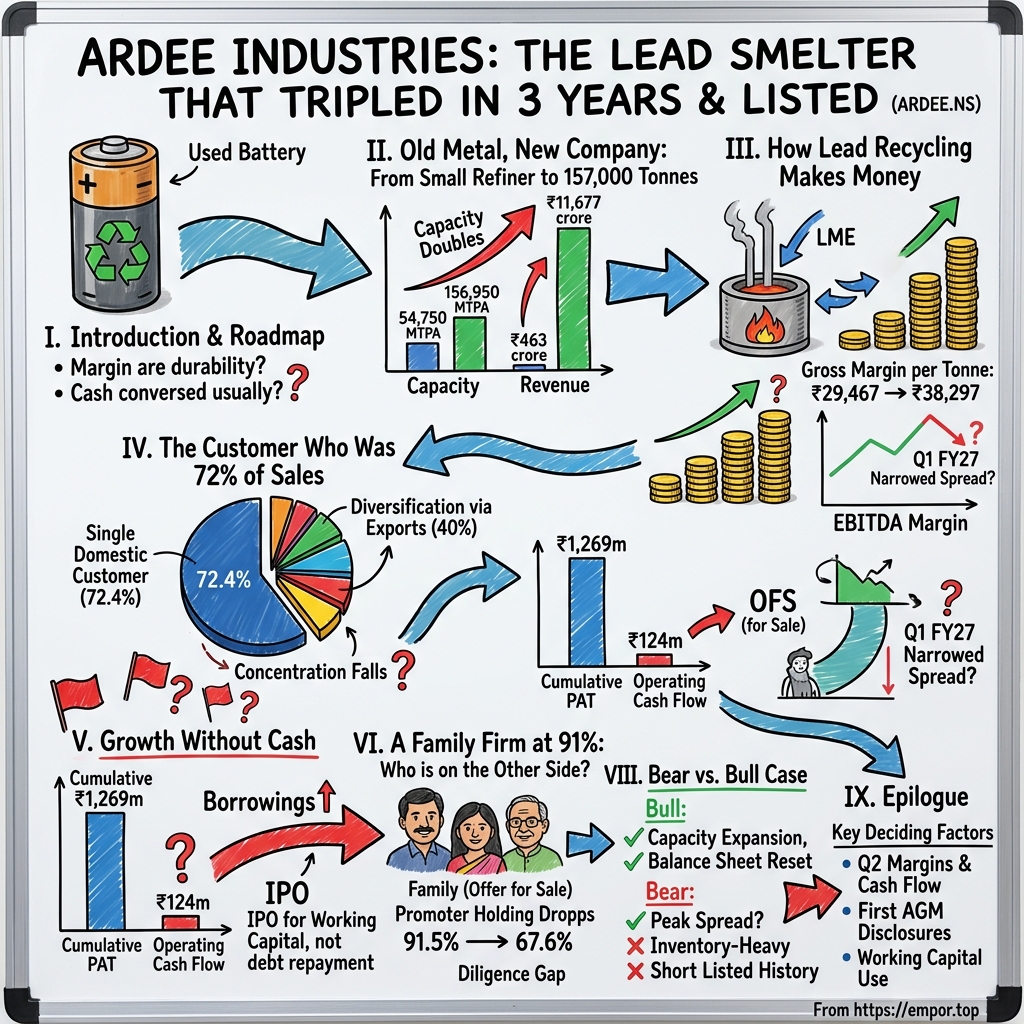
Ardee Industries: The Lead Smelter That Tripled in Three Years and Then Listed
I. Introduction & Episode Roadmap
On the morning of 12 August 2026, a company almost nobody outside India's battery trade had heard of rang the opening bell. Five days earlier, the book for its initial public offering had closed at ₹53 a share1. By the end of its first trading session, the stock had closed at ₹67.12, a gain of roughly a quarter in a single day2. It looked like a classic Indian small-cap debut: a hot issue, a quick pop, a stream of congratulatory messages from brokers.
Seven weeks later, the scene is quieter. On 29 September 2026 the shares traded at about ₹51.2, a little below the price at which the company sold them3. Everyone who bought in the IPO and held is slightly underwater. Everyone who bought on listing day is down about a quarter. The market has already given back the entire listing gain and a bit more.
The company is Ardee Industries, and what it does is about as far from glamour as Indian industry gets. At Tirupati, in Andhra Pradesh, better known to most Indians for its hilltop temple than its furnaces, Ardee runs a smelter that takes in used lead-acid batteries and scrap, melts them down, and sells refined lead and lead alloys back to battery makers and metal users at home and abroad1. Every car, inverter and telecom tower battery in the country eventually dies. Ardee is one of the places where it goes to be reborn.
Why does a six-week-old listing of a secondary-lead smelter deserve a two-hour investigation? Because the numbers behind it are extraordinary, and extraordinary numbers deserve to be interrogated rather than admired.
In the space of two years, Ardee's revenue grew from about ₹463 crore to about ₹1,168 crore, roughly two and a half times1. Profit grew faster still, from about ₹9 crore to about ₹85 crore1. At ₹51.2 a share, the market values the whole thing at about ₹1,614 crore3. That is a company that was a sleepy regional refiner three years ago and now trades at a valuation most Indian manufacturing businesses take decades to reach.
And yet there are three features of this story that make it more than "another IPO."
First, it is a young business. Ardee has existed as a corporate entity since the 1990s, but it began pure lead manufacturing only in 2021, and it describes itself in its own offer document as having a "limited operating history"15. There is no ten-year record to lean on.
Second, it is a commodity spread. Ardee does not set the price of what it sells; the London Metal Exchange does. It does not set the price of what it buys either; the scrap market does. It earns the gap between the two, and that gap moves.
Third, it is a family company. Before the IPO, the promoters and their group held about 91.5% of the shares1. After it, they still hold about two-thirds3. The promoters sold part of their stake in the IPO at a cost the prospectus records as nil1.
Those three features map onto four questions that will organise everything that follows.
Are FY26 margins a new base or a commodity-spread peak? Ardee's operating margin doubled in two years. Was that a durable improvement in the business, or a good year for the spread?
Is profit turning into cash? Over three years, Ardee reported roughly ₹127 crore of profit. Over the same three years, its operations generated only about ₹12 crore of cash1. Where did the rest go?
How dependent is Ardee on one customer and one battery cycle? In FY24, one domestic buyer took almost three-quarters of everything Ardee sold1. That share has fallen fast. Has the risk actually gone away, or moved?
Who else sits on the other side of the company's transactions? In a family business with a web of group companies, the question of who Ardee buys from, sells to and borrows from matters as much as the headline numbers.
The early verdict, which the rest of this story will test: Ardee is a promoter-run recycler with a real step-change in scale, an unproven margin base and cash that has not yet followed profit. The market seems to have reached a similar conclusion faster than the IPO's cheerleaders did. The way to understand why is to start where the company started, with a small refiner that suddenly decided to get big.
 Subscribe on LinkedIn
II. Old Metal, New Company: From Small Refiner to 157,000 Tonnes
The quiet years
For most of its life, Ardee Industries was the kind of business that does not make headlines. It was incorporated in Delhi in 1993, and its corporate identity number still carries the Delhi registration and the old industry code for chemicals1. It is controlled by the Aggarwal family. The three people who run it today are also the three promoters: Sandeep Aggarwal, the Chairman and Managing Director; Nikunj Aggarwal, a Whole-time Director; and Esha Gupta, also a Whole-time Director1.
Very little about the family's biography is published beyond those titles. What the record does show is a pattern of business behaviour: the promoter group includes other companies with automotive and industrial names, among them D.P. Auto Industries, Kanahi Buildcon and Pilot Industries, whose reports sit on Ardee's own investor page7. This is a family that has been in the auto-components and metals orbit for a long time, and Ardee is the vehicle it chose to take public.
The pure-lead business that is now Ardee's entire identity started only in 20215. Before that, the company's activity was smaller and different. It is worth holding that date in mind throughout this story. Five years is a short time in the life of a smelter, and less than one full turn of the lead price cycle.
FY24: flat profit, doubling capacity
Picture Ardee in FY24. Sales were about ₹463 crore, up only about 12% from roughly ₹412 crore the year before3. Profit was about ₹9 crore, exactly the same as the previous year3. The operating margin, before interest and depreciation, was about 6%1. This was a thin-margin, slow-growing refiner, the kind of business that exists in hundreds of Indian industrial estates.
But something was happening underneath. Installed capacity in FY24 was 54,750 tonnes a year1. By FY25 it was 104,025 tonnes, almost double1. The company had spent heavily to build ahead of demand: in FY24, it invested about ₹27 crore, close to 6% of revenue, a large bet for a business earning ₹9 crore a year1.
Then revenue followed. It grew about 60% in FY25 and another 57% in FY261. Profit went from ₹9 crore to ₹33 crore to ₹85 crore1.
What actually changed
Three things came together.
The first was capacity. A smelter that can process twice as many tonnes can sell twice as many tonnes, and in a spread business, more tonnes through the same overheads lifts margins.
The second was the London Metal Exchange. Ardee's lead is registered as an LME-empanelled brand, which is the metal world's equivalent of a quality stamp recognised in any port5. That matters because it means a buyer in Singapore or Dubai can accept Ardee's ingots without needing to trust Ardee specifically.
The third was exports. Export sales rose from under a fifth of revenue in FY24 to about 40% by FY261. The LME stamp and the export push are two halves of the same move: Ardee went from selling mostly to a local battery maker to selling into a global metal market.
Built, then filled
The cleanest way to see that the growth was built rather than borrowed is to watch how capital spending compared with sales. Investment was about 6% of revenue in FY24, about 3% in FY25 and under 2% in FY261. Meanwhile, every rupee of fixed assets produced about ₹10 of sales at the start of that period and about ₹16.5 at the end1.
Put simply: Ardee built the plant first, then filled it. That is the right order, and it is evidence of real operating execution. The step change is real.
It is also short. Two years of 55–60% growth, sitting on top of a flat year, do not constitute a track record. There is no downturn in the record, no year in which lead prices collapsed and the company had to prove it could hold margins. The durability of the base is unproven.
There is also the matter of the next expansion. The offer document states current installed capacity as 156,950 tonnes a year, while the same document's performance table shows 104,025 tonnes through FY261. That implies roughly 53,000 tonnes more capacity was added recently, taking the total to almost three times the FY24 level. On the Q1 FY27 call, management referred to working with "bigger capacity"6. The company has not published a precise commissioning date in its offer summary, which matters because a new line running at partial utilisation carries fixed cost without full volume, a plausible contributor to the margin dip discussed in the next section.
The cap table story
Behind the operating story sits a financial one. Ardee converted into a public limited company in 20251. Before the IPO, it issued bonus shares and split its face value to ₹2, which is why equity share capital jumped from about ₹3 crore to about ₹51 crore without any meaningful cash coming in1. The pre-IPO share count reached about 25.5 crore shares1.
Shortly before listing, a small club of outside investors came in. Among them were Bharat Value Fund, the well-known small-cap investor Ashish Kacholia, Shruti Gagan Chaturvedi and Winro Commercial; together, outsiders held about 8.5%1. The weighted average cost of all shares transacted in the three years before the IPO was about ₹4.41, against an issue price of ₹531. And the promoters' cost for the shares they sold in the IPO is recorded as nil1.
None of that is improper. Bonus issues and splits are standard pre-IPO housekeeping, and a promoter who built the business from scratch will naturally have near-zero cost. But it frames an asymmetry the investor should keep in view: everyone who was inside before the IPO made money at ₹53, and everyone who came in at ₹53 is now slightly behind.
Whether that price was fair depends on whether the margins that justified it are real. To answer that, it is necessary to go inside the furnace.
III. How Lead Recycling Actually Makes Money
A battery at the gate
A truck pulls into the yard at Tirupati. In the back are hundreds of dead batteries: from cars, from home inverters that powered Andhra's evenings through load-shedding, from telecom towers. Each one is about two-thirds lead by weight, locked in plates and paste, soaked in acid and wrapped in plastic.
Inside the plant, the batteries are broken, the acid drained and neutralised, the plastic separated, and the lead-bearing material fed into furnaces. What comes out the other end is refined lead, often 99.97% pure or better, and alloys blended with calcium, antimony or tin for particular battery designs. The ingots are stacked, stamped and shipped.
The price of those ingots is not set in Tirupati. It is set on a screen in London. Ardee's selling prices are linked to the LME lead price5. Its raw-material cost is set in the scrap market, which itself tracks the LME at a discount. Ardee earns the difference, minus the cost of running furnaces, paying for power, labour, compliance and interest.
A simple analogy: Ardee is a toll bridge whose toll changes every day. It does not decide how many cars come or how much they pay. It decides only how efficiently it runs the bridge.
The spread, per tonne
Ardee reports a telling number: gross margin per tonne. It rose from about ₹29,500 in FY24 to about ₹33,600 in FY25 and about ₹38,300 in FY261. At the operating level, the EBITDA margin climbed from about 6% to about 9% to about 12.6%1.
That is the bull case in one line. Every tonne became more profitable, three years running, while volumes roughly tripled.
But notice what a gross margin per tonne rising 30% over two years means in a business where the input and output prices are both set externally. Either Ardee got much better at extracting value (better yields, better mix, better timing of purchases), or the gap between lead and scrap widened in its favour, or both. The company lists its "Application of Hedging Mechanism for Commodity Price Risk" as a strength1, which suggests it locks in parts of the spread. But the prospectus does not give sales volumes in tonnes, so it is impossible to separate price from volume cleanly using the company's own disclosures.
The first disconfirming clue
The Q1 FY27 results, the first after listing, are where the story gets interesting. Revenue rose about 35% year on year to about ₹339 crore6. Profit after tax rose only about 6%, from roughly ₹18.8 crore to ₹19.9 crore6. The operating margin was reported at around 10%, down from FY26's 12.6%6.
Revenue grew six times faster than profit. In a spread business, that is exactly what a narrowing spread looks like: the company is moving more metal, but earning less on each tonne. New capacity running below full utilisation, higher scrap costs, a less favourable product mix, or simply a less generous LME market could each explain it. The company has not published a quarterly breakdown of per-tonne margin that would settle which.
The honest reading is this. Margins have come off their FY26 peak. They are still well above FY24's 6%, so there is some evidence of a higher floor. But one quarter does not make a floor, and the only test that would settle it is several quarters of EBITDA margin and gross margin per tonne set against the LME lead price. Until then, the FY26 margin is best treated as a high point rather than a base.
The mix keeps moving
Ardee sells three things: pure lead, lead alloys and a sliver of scrap. The balance between them swings a lot. Pure lead was about 53% of revenue in FY24, fell to about 42% in FY25, and bounced back to about 57% in FY261. Alloys moved the opposite way, from about 34% to 43% and back down to about 28%1.
Alloys are generally a more tailored, higher-value product, made to a battery maker's recipe. Pure lead is closer to a pure commodity, the thing an LME-registered brand sells to anyone. The FY26 swing back toward pure lead fits the export push: foreign buyers want LME-grade ingots. But it also means that the most profitable year in Ardee's history was one in which it sold proportionally more of its most commoditised product. That points toward the spread, not the product, as the driver.
The industry around it
Recycling is not a niche in Indian lead; it is the industry. More than 80% of India's lead demand is met from recycled lead, mostly from used lead-acid batteries, and recycled output was about 1.51 million tonnes in FY261. Against that, Ardee's FY26 capacity of about 104,000 tonnes was around 7% of the market1.
The best-known listed name in the space is Gravita India, a multi-metal recycler with plants in India and abroad that has spent over two decades building a scrap-collection network. Beyond Gravita sit dozens of organised and unorganised smelters, many of them private. One name demands careful handling: Pilot Industries, which sometimes appears on lists of lead processors, is a promoter-group company whose reports sit on Ardee's own investor page7. Whatever else it is, it is not an independent competitor for the purpose of judging Ardee's market position; it is part of the family web examined in Section VI.
The moat, argued once
Is there a durable advantage here? Take it through the frameworks once, carefully.
Porter's five forces. Supplier power is meaningful: scrap is a traded commodity, a large share is imported, and the top ten suppliers accounted for between roughly two-fifths and half of raw-material purchases over the last three years1. Buyer power is high: one domestic customer took 72% of sales in FY24 and still took about 41% in FY261, and there are no long-term contracts5. The threat of new entrants is moderated by the need for environmental permits, pollution-control consents and capital, though the company does not detail its permits in the offer summary. Rivalry is intense and price-based, because the product is standardised against an exchange price. And the threat of substitution is the big one: lithium-ion chemistries replacing lead-acid batteries.
Hamilton Helmer's seven powers. Scale economies are plausible: a bigger plant spreads fixed costs, and the rising fixed-asset turnover is consistent with that. Process power, the idea that a company gets better at a hard process through accumulated know-how, is possible but thinly evidenced; five years of pure-lead operation is a short learning curve. There is no network effect, no brand in the consumer sense, no switching cost for customers who can buy LME-grade lead from anyone, and no cornered resource. Counter-positioning does not apply.
The conclusion: Ardee is a price-taker on both sides. Whatever advantage it has is operational: scale, efficiency, the LME stamp and permits. Those are real but they are also available to any competitor with capital and patience. The moat, as far as the record shows, is narrow and unproven through a cycle, and the Q1 FY27 margin compression is the strongest single piece of evidence against the idea that FY26 marked a new plateau.
The currency wrinkle
One more layer. With exports now about 40% of revenue1, and a large share of scrap imported, Ardee sits on both sides of the rupee. Dollar sales and dollar purchases partly offset. But the company's offer summary describes a hedging mechanism for commodity prices, not for currency, and does not disclose annual foreign-exchange gains or losses1. The net currency position is not disclosed. For a business earning a thin spread on large gross flows, even a small unhedged mismatch can move profit meaningfully.
That brings the story to the other side of the transaction: the buyers. And in Ardee's case, for most of its history, "the buyers" meant, overwhelmingly, one buyer.
IV. The Customer Who Was 72% of Sales
One buyer, three-quarters of the business
Rewind to FY24. Ardee's total revenue was about ₹463 crore. Of that, roughly ₹335 crore came from a single domestic customer1. That is 72 cents of every rupee from one relationship, with no long-term contract behind it5.
For a supplier, that is less a customer than a landlord. The buyer can set terms, delay orders, squeeze price, or shift volume to a rival, and the supplier has almost no leverage. It is the kind of concentration that bankers and IPO investors usually flinch at.
The prospectus identifies the most likely name. It says that the "majority" of Ardee's battery revenue comes from Amara Raja Energy & Mobility, one of India's two dominant lead-acid battery makers, headquartered a short drive from Tirupati1. Geography makes the relationship intuitive: a battery giant needs a steady supply of refined lead and alloys; a nearby smelter needs a steady buyer.
A puzzle in the numbers
There is a wrinkle. In FY26, Ardee's top domestic customer accounted for about ₹475 crore of revenue, but total battery-industry revenue was only about ₹406 crore1. The top customer bought more than the whole battery segment.
That leaves two possibilities. Either the top customer is Amara Raja and it also buys product that Ardee classifies as non-battery, or the top customer is someone else entirely, perhaps in the "metal" category. The abridged prospectus does not name the top customer outright. The investor should treat "Ardee depends on Amara Raja" as likely but not established, and "Ardee depends on one buyer for about 40% of sales" as fact.
The diversification drive
What happened next is the most impressive operational feat in Ardee's record. The top domestic customer's share fell from about 72% in FY24 to about 51% in FY25 and about 41% in FY261. Andhra Pradesh, which took 74% of revenue in FY24, accounted for about 41% in FY261. Battery-industry customers fell from about two-thirds of revenue to about a third, while "metal" customers rose from about a fifth to half1.
Crucially, the top customer did not shrink in absolute terms. Its purchases rose from about ₹335 crore to about ₹475 crore1. Ardee did not lose its anchor; it grew around it. That is the right way to diversify.
Diversification at home, concentration abroad
But look at where the new growth came from. Exports rose from about 18% of revenue to about 40%1. And within exports, concentration is high. The top overseas customer was about 16% of FY26 revenue on its own; the top five overseas customers together were about 38%1.
Put the pieces together. In FY26, the top domestic buyer plus the top overseas buyer accounted for more than half of Ardee's revenue. The company went from one dominant customer to two large ones and a handful of mid-sized ones. The total customer count barely moved: 54, 54 and 52 customers across the three years1. Ardee did not build a broad base; it swapped part of one concentration for another, in a different currency and a different jurisdiction.
And the "metal" customers who drove half of FY26 revenue are not named. For an investor, that is the hole at the centre of the diversification story. Who are they? Traders? End users? Are they overseas buyers of LME-grade ingots who can switch to any other LME brand tomorrow?
Repeat is not committed
Ardee points out that repeat customers accounted for between roughly 84% and 93% of revenue over three years1. That sounds like loyalty. But with no long-term contracts on either side5, "repeat" means only that the same buyers kept buying while it suited them. In a commodity market, a buyer who buys every month is not a buyer who is committed; they are a buyer who has not yet found a better price.
Suppliers and the scrap chain
On the supply side, the picture is somewhat less concentrated. The top ten suppliers accounted for about 51% of raw-material purchases in FY24, 54% in FY25 and 38% in FY261. The decline in FY26 suggests Ardee broadened its scrap sourcing as volumes grew. Some secondary coverage has cited very large import figures that do not reconcile with the company's revenue, and those should be disregarded; the reliable reading is that Ardee imports a significant share of its scrap and that no single supplier dominates.
The lithium question
Then there is the question the prospectus summary does not address at all. What happens to a lead-acid battery recycler as India's vehicles, inverters and telecom towers shift toward lithium?
The honest answer is: probably slowly, and unevenly. Lead-acid batteries still start almost every internal-combustion vehicle, and they remain the cheapest option for stationary backup. The installed base of dead batteries that will flow back to smelters is enormous and will keep flowing for years. But the direction of travel is clear in electric two-wheelers, in data centres and increasingly in telecom.
Ardee's battery-industry share has already fallen to about a third of revenue1, which partly insulates it on the demand side. The supply side is the less obvious risk: fewer lead-acid batteries in the future means less scrap, and a scarcer input means a squeezed spread. Management has not published a view on this. A skeptic would ask why a company raising ₹320 crore of fresh capital has not told investors what it thinks the next decade of lead-acid demand looks like.
The concentration story, in short, is a genuine improvement that remains only partly proven. The top customer is down to about 40%, the base is wider geographically, but the new growth rests on unnamed buyers in a commodity market. That is a fair trade for growth. It is not yet a moat. And it raises a further question, because selling that much more metal to that many new buyers requires something else: money to buy the scrap first.
V. Growth Without Cash
The year profit and cash went opposite ways
FY24 is the year that best explains Ardee's financial DNA. The company reported a profit of about ₹9 crore1. In the same year, its operations consumed about ₹25 crore of cash1. Profit said one thing; the bank account said the opposite.
That is not fraud and not necessarily a warning sign. It is what happens when a commodity processor grows fast. To sell more lead next quarter, Ardee has to buy more scrap this quarter, melt it, refine it, and hold it as inventory until it ships. Every step ties up cash before any comes back. The faster the growth, the bigger the gap.
The three-year tally
Over FY24 to FY26, Ardee's cumulative profit after tax was about ₹127 crore1. Its cumulative cash flow from operations was about ₹12 crore1. Roughly one rupee in ten of reported profit arrived as operating cash.
FY26 was better. Operating cash flow was about ₹30 crore, around 35% of that year's profit1. That is an improvement, and the direction matters. But even the best year in the record converted only about a third of profit into cash.
Where did the money go? Not to customers who do not pay. Ardee collects its receivables in about eight days3, which is very fast and consistent with buyers who pay promptly for a commodity product. The drain is inventory: about 47 days' worth in FY263. Scrap in the yard, metal in the furnace, ingots awaiting shipment. Every tonne of extra annual capacity needs more of it.
The lenders filled the gap
If operations did not fund the growth, something else did. Financing inflows were about ₹54 crore in FY24, ₹13 crore in FY25 and ₹4 crore in FY261. Total borrowings rose from about ₹142 crore to about ₹183 crore over the period1.
At first glance, the balance sheet looks like it deleveraged dramatically. Debt was almost five times equity in FY24 and about 1.25 times in FY261. But debt did not fall; it rose. The ratio improved because equity grew from about ₹29 crore to about ₹147 crore, on the back of retained profits1. That is a flattering denominator, not repayment.
The verdict is straightforward. Ardee's profit is real, but so far it has been financed by lenders and working-capital lines. The business model consumes cash as it grows. Whether it can generate cash at scale is unproven, and FY27 is the test.
What the IPO money says
The use of IPO proceeds is the company's own answer to this question. Of the ₹320 crore of fresh money, about ₹220 crore is earmarked for incremental working capital and only ₹20 crore for repaying debt14.
Read that carefully. A company that believed its growth was becoming self-funding would direct more of its IPO money to cutting debt. Ardee is doing the opposite: it is raising equity largely to buy more scrap and hold more inventory. That is an honest admission that growth, at least for now, needs more capital, not less. The borrowings are mostly working-capital lines, and they are not going away1.
There is nothing wrong with raising equity to fund working capital; it is often cheaper and safer than bank debt. But it changes how an investor should think about returns. Every rupee of profit growth appears to require a large rupee of inventory behind it.
Who got what
The IPO had two parts. The fresh issue of about ₹320 crore went to the company. The offer for sale, about 2 crore shares at ₹53, went to the promoters: roughly ₹106 crore14. The promoters' recorded cost on those shares was nil1.
So about three-quarters of the money raised went into the business and about a quarter went to the family. That is a moderate split by Indian IPO standards, not an egregious one. But it is worth stating plainly: the promoters took out about ₹106 crore at the same time as the company told investors it needed ₹220 crore for working capital.
Returns that flatter
The offer summary shows return on net worth rising from about 31% to 57%, and return on capital employed from about 13% to 44%1. Those are spectacular numbers, and they should be read with care. They are high because the equity base was tiny: about ₹29 crore in FY24. Two good years of profit on a small base produce enormous percentages. After the IPO, with equity several times larger, those returns will mechanically fall. They say more about the timing of the IPO than about the long-run economics of the business.
Other income does not flatter the operating numbers, because Ardee's EBITDA is defined net of it and the company has no cash pile to earn treasury income on1. That is one clean point in the profit-quality ledger.
The covenant question
Two risk factors in the prospectus deserve a sentence each. One warns that the company's debt agreements carry restrictive covenants1. Another warns that a downgrade of its credit rating could hurt its borrowing costs1. Ardee's bank facilities are rated by CRISIL, which updated its rating in February 202638. The rating rationale is the best independent read of the working-capital cycle and the lenders' comfort, and it is the document a careful investor should read before anything else.
So the cash question produces an unambiguous interim answer: not yet. And a cash-hungry, family-controlled business with a web of group companies raises the final question in sharp relief. When money moves in and out of Ardee, whose hands does it pass through?
VI. A Family Firm at 91%: Who Is on the Other Side?
The ownership list
Before the IPO, the ownership of Ardee Industries fit on a single page. Three promoters and their group held about 91.5%1. One of the promoter-group holders was D.P. Auto Industries, with 0.31%1. The rest was the small circle of pre-IPO investors. Sixteen shareholders in all1.
On Ardee's investor page, alongside its own filings, sit reports for three other group companies: D.P. Auto Industries, Kanahi Buildcon and Pilot Industries7. One is an auto-components name. One is a construction name. One is a metals and industrial name. Together they sketch the outline of a family business group whose listed jewel is now Ardee.
After the IPO, promoters hold about 67.6%3. The public holds about 22%, domestic institutions about 8.4% and foreign institutions under 2%, spread across about 103,000 shareholders3. That is one quarter of data, and there is no trend yet.
The people in the room
The company is run by the family. Sandeep Aggarwal chairs the board and runs the business as Managing Director. Nikunj Aggarwal and Esha Gupta are whole-time directors1. The Chief Financial Officer is Arun Kumar Mallik, and the Company Secretary is Manish Kumar Rai1. The board has three independent directors: Archana Jain, Anand Tandon and Vivek Sarbhai1.
That is a legally compliant board: half independent. But every executive seat is held by a promoter. For all practical purposes, decisions about pricing, purchasing, capacity and capital allocation are family decisions.
The family's track record as stewards of a public company is, necessarily, blank. Ardee has been listed for seven weeks. It has issued no guidance, so there is no record of promises kept or missed. It has held no AGM as a listed company; the deadline for its FY26 AGM was extended to 31 December 20266. There is no shareholder vote on record, no dissent to measure, no pattern of behaviour to judge.
The central gap
For a business like this, the single most important diligence question is related parties. Does Ardee buy scrap from any group company? Does it sell lead to one? Does it lease land, borrow money, or pay commissions to entities the family controls? A metals group with an auto-components arm and an industrial arm is exactly the kind of structure in which such transactions are natural, and sometimes quite benign.
The answer sits in the restated financial statements in the full prospectus, which contain a related-party note2. The abridged prospectus, the summary document for retail investors, does not disclose the size of related-party transactions as a share of revenue or purchases1. Nor does it disclose executive remuneration1. Those two numbers, how much the family is paid and how much business flows between Ardee and the family's other companies, are the central diligence gap in this story. A prospective shareholder should read the related-party note and the "Our Management" section of the full prospectus before forming a view.
What is clean
The disclosed record is otherwise tidy. Outstanding litigation against the company consists of two tax proceedings totalling about ₹35 lakh1. Against the promoters there are two criminal proceedings and one tax matter, with the quantified amount at about ₹1.3 lakh1. There are no statutory or regulatory proceedings against the company and no material civil litigation1. The auditors, Nangia & Co., left no qualifications in the restated financials that have not been adjusted for1.
The criminal proceedings against promoters merit a sentence, not a section: the amounts are trivial and the prospectus does not characterise them as material.
The more significant regulatory exposure is the one the offer summary barely addresses. A lead smelter is a heavily regulated, pollution-sensitive operation. Lead emissions, slag disposal and acid handling are the subject of strict rules from pollution-control boards, and permits can be suspended. The offer summary does not detail Ardee's environmental consents or any past notices. For a smelter, that is the real licence to operate, and it is not disclosed in the summary document.
The skeptic's stress test
Imagine an activist short-seller writing about Ardee. The questions would be pointed.
Why did promoters with a nil cost basis sell about ₹106 crore of stock at ₹53, at the same moment the company said it needed ₹220 crore to fund working capital? If the business was about to compound, why sell?
Why did the small pre-IPO investor group get in at a weighted average cost in the low single digits of rupees, against an issue price of ₹531? What did they know, and what did they pay for it?
And how much business does Ardee transact with D.P. Auto, Kanahi Buildcon or Pilot Industries?
A defender would have answers. Promoters routinely sell some stock in an IPO to meet minimum public-shareholding rules. Pre-IPO investors often buy before bonus issues, making their per-share cost look artificially low. Related-party trade may be small or zero. All of those answers are plausible. None is yet documented in the summary materials.
The verdict: the disclosed litigation and audit record give no cause for alarm. The undisclosed items (related-party flows, promoter pay, environmental compliance) are exactly where risk in a family-run smelter tends to live. Until they are in plain view, the governance question remains open.
Those four questions now have provisional answers. What does the Ardee story teach beyond Ardee?
VII. Playbook: Business & Investing Lessons
1. Profit the lenders paid for is not yet profit. Ardee reported about ₹127 crore of profit over three years and generated about ₹12 crore of operating cash. The rest was locked in scrap yards and ingot stacks, financed by the bank. For a commodity processor in growth mode, the income statement is a description of what happened to the metal; the cash-flow statement is a description of what happened to the owners. When the two diverge for three years in a row, the owners should believe the second one. The lesson for founders is that fast growth in a working-capital business is a financing decision as much as an operating one. The lesson for investors is to ask not "how much did it earn?" but "how much did it have to borrow to earn it?"
2. A customer at 72% is a bank loan you cannot call. In FY24, one buyer took almost three-quarters of Ardee's sales, with no contract binding either side. Ardee's great operational achievement was to shrink that dependence to about 40% in two years without losing the customer. But the escape route ran through unnamed metal buyers and a concentrated export book. Concentration is not solved by adding customers; it is solved by adding customers who cannot easily leave. Diversification into a commodity market buys breadth, not loyalty.
3. In a spread business, the price of the input is the story. Ardee's revenue grew about 35% in Q1 FY27 and its profit grew about 6%. In a business that earns the gap between London's lead price and India's scrap price, that single quarter said more about the future than three years of annual reports. The temptation in a fast-growing commodity processor is to credit management for the good years. The discipline is to ask which part of the margin came from the furnace and which part came from the market.
4. Growth from a small base looks like a moat until the cycle turns. Ardee's two years of near-60% growth, rising margins and soaring returns on equity all came from a starting point of ₹9 crore of profit and a tiny equity base, inside five years of pure-lead operation. Nothing in that record has been tested by a collapsing lead price or a scrap shortage. A three-year record is a sample of one weather system, not a climate.
5. Read the related-party note before the pitch deck. A family that holds two-thirds of a smelter and also controls companies in auto parts, construction and industrial metals has many legitimate reasons to trade with itself, and many opportunities to do so on terms that favour the family over minority shareholders. In an Indian family-run IPO, the most important page is rarely the one with the growth chart. It is the one that lists who else is on the other side of the ledger.
VIII. Analysis & Bear vs. Bull Case
Where the stock sits tonight
At about ₹51.2, Ardee trades a little below its ₹53 issue price, well below its post-listing high of about ₹73.6 and above its low of about ₹46.53. That values the equity at about ₹1,614 crore, roughly 18.7 times FY26 earnings of ₹3.32 a share and about 3.4 times book value3.
What does that price assume? Roughly this: that FY26 profits are close to sustainable, but not the start of a rocket. A multiple in the high teens for a commodity processor with rising volumes and falling concentration is neither a bargain nor a stretch. It does not price in a margin collapse. It does not price in continued 50%-plus growth either. The market is, in effect, sitting on the fence, which is the correct posture given how little history exists.
There is no pre-listing trading history to compare against. The closest listed comparison is Gravita India, a larger and older multi-metal recycler with an international footprint and a much longer record through cycles; the market has historically been willing to pay a premium for that longevity. A careful investor would compare Ardee's multiple against Gravita and other listed non-ferrous processors, bearing in mind that Ardee's shorter record and narrower product line argue for a discount, not a premium, until it proves itself.
The bull case
The optimist's argument is coherent.
Capacity has almost tripled since FY24, to about 157,000 tonnes a year1. Even at modest utilisation, that supports continued volume growth. The company has shown it can fill new capacity: fixed-asset turnover rose sharply as sales caught up with investment.
Concentration has fallen fast, from 72% to about 41% for the top customer, and the export book provides a second leg1. The LME registration gives Ardee access to a global market that does not care about any single Indian battery maker.
The IPO resets the balance sheet. With about ₹320 crore of fresh equity, leverage falls and the company can fund inventory without leaning so heavily on banks1.
And India's lead recycling market is large, formalising and regulated in a way that favours organised players with permits and scale.
The bear case
The skeptic's argument is equally coherent.
FY26 margins were a peak. Q1 FY27 already shows the spread narrowing, and there is no multi-cycle record to show where the floor is6.
The balance sheet is inventory-heavy. Profit has not turned into cash, and the company is raising equity mainly to buy more inventory1. Every rupee of growth appears to need a large rupee of capital.
One buyer is still about 40% of revenue, and no customer is contractually bound15. The export book is itself concentrated.
Lithium substitution is a slow-moving threat to both demand and scrap supply, and management has not addressed it.
Environmental permits for a lead smelter are a binary risk that the summary disclosures do not quantify. And a family that held 91% and now holds about two-thirds controls every executive decision, with related-party flows not yet in plain view.
Weighing it
Neither case is proven. The bull case rests on a two-year record, the bear case on one quarter of margin compression and a set of undisclosed items. The evidence on each of the four central questions is best described as:
- Margins: narrowed from the peak; the new floor is unproven.
- Cash: improving but not yet sufficient.
- Concentration: falling fast, but one buyer and a few exporters still dominate.
- Related parties: not disclosed in the summary materials; the central gap.
The three numbers to watch
Out of all the figures in Ardee's record, three will do most of the work of settling the case.
Quarterly EBITDA margin, read against the LME lead price. Latest reading: about 10% in Q1 FY27, down from 12.6% in FY2616. Direction: falling. If it holds around 10% through a softer lead market, the higher base is real.
Operating cash flow as a share of profit. Latest annual reading: about 35% in FY26, up from negative in FY241. Direction: improving. If it does not approach 70–100% once the IPO working capital is deployed, the growth is still lender-funded.
Top-customer share of revenue. Latest reading: about 41% in FY26, down from 72% in FY241. Direction: falling. The next annual report will show whether it keeps falling, and whether the company names the buyer.
The risk radar
Only five risks matter materially. The LME lead price and the scrap spread, because they set the margin. Working-capital and covenant stress, because the business consumes cash as it grows. Lithium substitution, over years rather than quarters. Environmental permits, because a smelter lives or dies by its consent to operate. And related-party dealings, because they determine how much of the value created reaches minority shareholders.
Everything else, from general demand slowdowns to macro noise, flows through one of those five channels. Which makes the next few months unusually decisive.
IX. Epilogue
Tonight, at the end of September 2026, Ardee stands in an odd in-between place. It has the scale of a serious recycler and the history of a start-up. It has the balance sheet of a freshly listed company and the working-capital appetite of a much bigger one. Its shares trade almost exactly where they were sold, as if the market has decided to wait and watch.
It will not have to wait long.
Sometime around November, Ardee will report its Q2 FY27 results. That quarter will show whether the dip in operating margin to about 10% was a single soft quarter or the beginning of a slide. If margins hold around 10–12% while the LME price moves around, the case that Ardee earns a structurally higher spread than it did in FY24 becomes much stronger. If margins drift toward the single digits, the FY26 year will look like what the skeptics suspect: a good year for lead, not a transformation of the business.
By 31 December 2026, Ardee must hold its first annual general meeting as a listed company6. The annual report that accompanies it will be the first full disclosure document produced for public shareholders. It will carry the related-party note, the remuneration of the three promoter-directors, and the full cash-flow detail. The first shareholder votes will show whether institutional holders are comfortable with what they see.
Through the second half of FY27, the ₹220 crore of working-capital money will be deployed1. That money is supposed to let Ardee grow without drowning in bank debt. If operating cash flow for FY27 finally approaches reported profit, the growth has become self-funding. If borrowings keep rising alongside inventory even after the IPO money, the business is still running on credit, only with more equity absorbing the risk.
And somewhere in Mumbai, CRISIL's analysts will take another look at Ardee's bank lines8. A rating upgrade would be the lenders' way of saying the post-IPO balance sheet is sound. A downgrade would be a warning that working capital is outrunning cash.
Every one of those events maps onto the four questions this story started with. Margins, cash, concentration, the other side of the transaction. None of them is settled yet. That is what makes this moment interesting: the story of Ardee Industries is not written, only the prologue is.
X. Outro
Go back to the truck in the yard at Tirupati, and the dead battery in the back of it. It carries, in a few kilograms of lead, the whole economics of this company. Someone in Andhra or abroad paid for it once as a new battery. Someone paid a little for it again as scrap. Ardee will melt it, refine it, stamp it and sell it at a price set on a screen in London, and keep the difference.
For three years, that difference widened, and Ardee grew with it faster than almost any industrial business in its corner of the market. What the next three years will decide is whether Ardee is a better furnace or simply one that caught a good wind. Ardee turns yesterday's batteries into today's revenue. The stock will be valued on whether it can keep doing so after the price of lead stops helping.
References
-
Abridged Prospectus (RHP dated 2026-07-27) — SEBI, 2026-07-28 ↩↩↩↩↩↩↩↩↩↩↩↩↩↩↩↩↩↩↩↩↩↩↩↩↩↩↩↩↩↩↩↩↩↩↩↩↩↩↩↩↩↩↩↩↩↩↩↩↩↩↩↩↩↩↩↩↩↩↩↩↩↩↩↩↩↩↩↩↩↩↩↩↩↩↩↩↩↩↩↩↩↩↩↩↩↩↩↩↩↩
-
Ardee Industries Limited RHP filing page — SEBI, 2026-07-28 ↩↩
-
Ardee Industries share price and financials — Screener ↩↩↩↩↩↩↩↩↩↩↩↩
-
Ardee Industries Limited IPO details — Bajaj Broking ↩↩↩↩↩↩↩↩
-
Ardee Industries Releases Q1 FY27 Earnings Call Transcript — TipRanks ↩↩↩↩↩↩↩↩
-
CRISIL Ratings — Ardee Industries rating rationale landing page, February 2026 ↩↩
 LinkedIn
 WhatsApp
 Reddit
 Hacker News
 Email
Email Kindle
 RSS Feed
 Spotify
 Apple Podcasts
 Amazon Music
 Audible
 YouTube