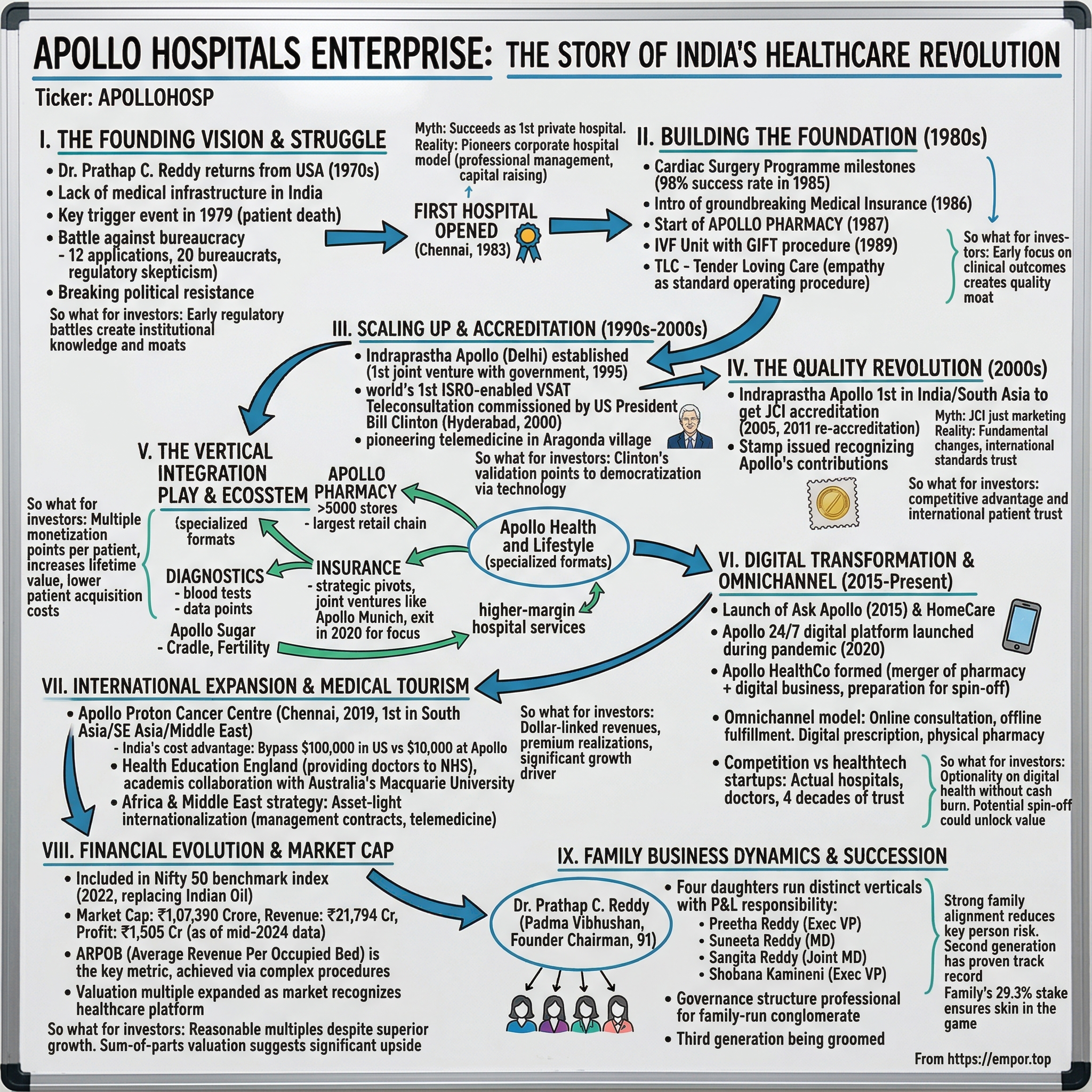
Apollo Hospitals Enterprise: The Story of India's Healthcare Empire
I. Introduction & Episode Setup
There is a particular kind of quiet that settles over a company's investor relations team in the days before a quarter that matters more than usual. Apollo Hospitals Enterprise is living in that quiet right now. On Wednesday, August 12, 2026, the board meets to approve the numbers for the June quarter, and the following afternoon Managing Director Suneeta Reddy and Group CFO A. Krishnan will take analysts' questions on a call scheduled for 3:00 PM IST.1
Most of what will be said is predictable. Hospital revenue grew. Occupancy held. A new tower opened somewhere. But there is one line item that the entire sell-side has circled in red, and it has almost nothing to do with hospitals: has Apollo's digital and pharmacy arm — the business that has burned cash for six straight years — finally crossed into cash breakeven?
Management has said it would happen in exactly this quarter. Q1 FY27. Not "sometime in FY27," not "in the second half" — this quarter.2 That is an unusually specific promise for an Indian corporate to make about a loss-making internet business, and it is the kind of promise that either builds enormous credibility or destroys a chunk of it.
Here is the frame worth holding for the next several thousand words: Apollo is not one company. It is two very different businesses wearing a single ticker, and management is in the middle of surgically separating them.
The first business is a scaled, profitable, capital-hungry hospital operator — roughly 8,131 operating beds across the network as of March 31, 2026, running at 68% occupancy, generating the overwhelming majority of group profit.3 The second is a fast-growing, historically loss-making omnichannel pharmacy and digital health platform — Apollo Pharmacy's 7,289 stores plus the Apollo 24|7 app plus a wholesale drug distribution business — that generates nearly as much revenue as the hospitals but a fraction of the earnings.4
For FY26, the combined entity reported consolidated revenue of ₹25,229 crore, up 16% year over year, with EBITDA up 25% and profit after tax up 34% to ₹1,942 crore.54 Apollo has been a Nifty 50 constituent since March 2022, when the index committee added it in a move that itself signalled how thoroughly private healthcare had become a mainstream Indian asset class.6
Four themes run through this story. The first is vertical integration — Apollo's forty-year bet that owning the hospital, the pharmacy, the diagnostic lab and eventually the app produces something more valuable than owning any one of them. The second is the economics of a hospital bed, which is a genuinely elegant piece of operating leverage that most investors get wrong. The third is related-party governance, because the transaction sitting at the centre of Apollo's current restructuring involves buying a company from the promoter family. And the fourth is a live, unresolved sum-of-the-parts unwind that will either re-rate this company or expose the story as financial engineering.
We start where every Apollo story starts: with a cardiologist who came home to a country that had almost nothing for him to work with.
 Subscribe on LinkedIn
II. Origins: Breaking the Government Monopoly (1970s–1990s)
Picture Madras in the early 1970s. A cardiologist in his early forties has just come back from the United States, where he trained at Massachusetts General Hospital and ran research programmes at the Missouri State Chest Hospital.7 He has seen what a properly equipped cardiac catheterisation lab looks like. He has watched coronary angiography performed as a matter of routine. And now he is practising medicine in a city where none of that equipment exists at any price.
Dr. Prathap Chandra Reddy had taken his medical degree at Stanley Medical College in Madras before going abroad, and returned to India in 1971 to practise as a cardiologist.7 The story that Apollo's own institutional memory has canonised — and it is worth treating as origin myth and factual account simultaneously — involves a 38-year-old patient who needed cardiac surgery, could not raise the roughly $50,000 required to have it done abroad, and died.7 For Indians who could afford it, the standard of care in 1975 was a flight to Houston or London. For everyone else, there was no standard of care at all.
What makes Reddy's response unusual is not the diagnosis but the prescription. Plenty of Indian doctors of that era concluded that the answer was more government hospitals, or charitable trusts, or subsidised medical colleges. Reddy concluded that the answer was a for-profit corporation.
This was, in the India of the late 1970s, close to heretical. Healthcare was understood as a public good delivered by the state or by charitable trusts. There was no licensing framework built for a private tertiary-care hospital because nobody had seriously proposed one. The permissions took years. The capital had to be raised from a public that had never been asked to fund a hospital as an investment. Reddy was fifty years old by the time it opened.7
On September 18, 1983, Apollo Hospital in Madras was inaugurated by President Giani Zail Singh — India's first corporate, professionally managed private hospital.87 The name came from the Greek god of healing, which was as good a signal as any that this was a project pitched at international standards rather than local expectations.
The strategy from day one was to build credibility through clinical outcomes rather than marketing, and the numbers Apollo published in its first years were the marketing. By 1985, Apollo's cardiac surgery programme reported a 98% success rate across its first 100 surgeries.8 To appreciate why that mattered, remember the counterfactual: the alternative for a middle-class Indian family in 1985 was not a competing Indian hospital with a worse success rate. It was no surgery, or a foreign hospital they could not afford. A 98% success rate did not just beat the competition — it created a market that had not existed.
Two moves in the mid-1980s reveal something about how Reddy thought that is easy to miss. The first came in 1986, when Apollo introduced a medical insurance scheme in partnership with United India Insurance — one of the earliest hospital-linked health insurance arrangements in the country.9 The insight embedded in that decision is subtle and, in hindsight, the single most commercially important idea in the whole origin story: hospital demand in a poor country is not gated by capacity, it is gated by financing. Building beds nobody can pay for is a way to go bankrupt. Reddy understood that he needed to build the payment mechanism alongside the bed.
The second came in 1987, when Apollo opened its first pharmacy outlet in Chennai — the seed of what became India's first and largest branded pharmacy chain.10 At the time this looked like a convenience for discharged patients. In retrospect it was the first thread of the vertical-integration playbook that now accounts for something close to half of Apollo's consolidated revenue, laid down decades before anyone used the phrase "omnichannel healthcare."
What the founding period really establishes, for an investor reading backwards, is a pattern: Apollo builds adjacent businesses early, cheaply, and for operational reasons rather than strategic-deck reasons — and only later discovers they were strategic. Whether that pattern still holds when the adjacencies cost thousands of crores rather than lakhs is the question the rest of this story tests.
III. Scaling Trust: Accreditation, Telemedicine, National Institution (1990s–2000s)
If the 1980s were about proving a private hospital could work, the 1990s and 2000s were about proving it could scale — and, more importantly, that its quality could be independently verified by someone other than Apollo.
The template for expansion arrived in 1995 with Indraprastha Apollo in Delhi, structured as a joint venture with the Delhi government. This was a genuinely clever piece of positioning. Apollo got land, political cover, and a foothold in the national capital region. The government got a tertiary-care facility it did not have to operate. And Apollo got something less tangible but more durable: legitimacy. A company that had spent a decade being described as the commercialisation of medicine was now the government's partner.
The credibility flywheel accelerated in 2005, when Indraprastha Apollo became the first hospital in India and South Asia to receive Joint Commission International accreditation — the American standard used to benchmark hospitals worldwide. It was re-accredited a fourth consecutive time in 2011. Today seven Apollo hospitals hold JCI accreditation.8
It is worth pausing on why accreditation is an economic asset and not a plaque. India's private hospital sector was — and largely remains — extremely fragmented, dominated by single-site operators of wildly uneven quality. A patient walking into an unfamiliar hospital has almost no way to assess whether the surgical team is competent. Economists call this an information asymmetry; in practice it means patients default to whatever signal they can find. JCI accreditation is a portable, third-party signal. For international patients in particular — the medical value travel segment that Apollo has cultivated across Africa, the Middle East, Bangladesh and Southeast Asia — it is often the only signal that matters.11
The other prescient move of this era was telemedicine. In 2000, Apollo ran a telemedicine pilot in Aragonda, Reddy's home village in Andhra Pradesh, connecting a rural facility to specialists in the cities.7 Read in 2026, that pilot looks like a twenty-year head start on Apollo 24|7. Read honestly, it was closer to a philanthropic experiment that happened to teach the organisation something. The group went on to build a network of telemedicine centres across the country, and the institutional muscle memory from two decades of remote consultation is real — but investors should be careful not to retrofit a strategy onto what was, at the time, a rural outreach project.
The recognition that followed — commemorative postage stamps marking Apollo's contribution and India's first successful liver transplant — is the kind of thing that looks like trivia in a securities filing and matters enormously in a market where brand is the primary defence against commoditisation. By the mid-2000s, Apollo was not a private hospital chain in India. It was, in the national narrative, the hospital.
It was also, increasingly, a family business in transition. Reddy's four daughters — Preetha, Suneeta, Shobana and Sangita — moved into senior operating roles across the group during this period, an arrangement that is unusual by global standards and central to how Apollo is governed today. We will come back to that in Section IX, because the governance questions it raises are not historical.
The more immediate question is what Apollo did with the trust it had accumulated. The answer was to spend it — on a decade-long attempt to build an entire healthcare ecosystem around the hospital.
IV. The Vertical Integration Thesis: Building the Ecosystem
Here is the strategic problem Apollo's management confronted, stated as plainly as possible.
A hospital is a bad asset in isolation. It consumes enormous capital up front — land, building, imaging equipment, operating theatres, ICU infrastructure. It takes three to five years to fill. It carries heavy fixed costs regardless of how many patients walk in. Its pricing is increasingly constrained by insurers and by government schemes. And its output is episodic: a patient has cardiac surgery once, and then, ideally, never returns.
A hospital plus a pharmacy plus a diagnostics chain plus a digital front door is a different animal. The pharmacy sells to the cardiac patient every month for the rest of their life. The diagnostics business runs the follow-up lipid panel. The app books the next consultation. Episodic revenue becomes recurring revenue, and the customer acquisition cost — which for a hospital is brutal — gets amortised across a decade of relationship rather than a single admission.
That is the theory. Apollo has been executing against it for nearly forty years, and the results are genuinely mixed in ways worth being precise about.
The pharmacy worked. Apollo Pharmacy grew from that single 1987 Chennai outlet into India's largest branded pharmacy network, crossing its 5,000th store in September 2022 and reaching 7,289 stores by March 2026, having added 663 in FY26 alone.104 Along the way it made bolt-on acquisitions, the most instructive being the 2014 purchase of Hetero Med Solutions — roughly 320 stores across South India for about ₹146 crore. That works out to under ₹50 lakh per store, a price that suggests Apollo was buying distribution at close to replacement cost rather than paying for a brand. It is a useful benchmark to hold in mind when we get to Keimed.
The clinics arm is real but small. Apollo Health and Lifestyle (AHLL) houses the diversified specialty formats: Apollo Clinics, Apollo Diagnostics, Apollo Sugar for diabetes management, Apollo White dental, Apollo Dialysis, Apollo Spectra for day surgery, Apollo Cradle for women and children, and Apollo Fertility. It is a sprawling portfolio and it generates genuine narrative energy on earnings calls. It is also, by revenue, the smallest of Apollo's three reporting segments — roughly ₹1,554 crore in FY25, about 7% of consolidated revenue.12
The honest framing is that AHLL is a supporting cast member, not a hidden gem. That said, FY26 was the year it stopped being a drag: AHLL revenue grew 24% year over year in Q4 FY26 with EBITDA up 58%, and in Q3 FY26 the segment posted a 10.2% EBITDA margin on ₹467 crore of revenue while adding 12 satellite labs and 239 collection centres.413 A diagnostics network that is simultaneously growing twenty-plus percent and expanding margin is a business finding operating leverage. It is just operating leverage on a small base.
The insurance bet did not work, and Apollo walked away. Apollo Munich Health Insurance was the group's attempt to own the financing layer outright — the logical endpoint of that 1986 United India insight. It was built as a joint venture with Munich Re. And in 2019 Apollo agreed to sell its stake to HDFC, with IRDAI approving the transaction on January 1, 2020 after CCI and RBI clearances; the Apollo group's roughly 50.8% holding fetched about ₹1,485 crore.14
This deserves more credit than it usually gets. Vertical integration has a gravitational pull toward escalation — each adjacent business justifies the next, and management teams that have publicly committed to an "ecosystem" story find it psychologically difficult to admit that one node isn't working. Apollo built an insurer, discovered that underwriting risk is a fundamentally different competency from delivering care, and sold it. That is evidence of a management team capable of reversing a strategic commitment, and it is the strongest single data point in Apollo's capital allocation record.
The cross-referral claim is under-evidenced. Here is where an independent reader should push back. Apollo asserts — as does every integrated healthcare operator on earth — that the hospital feeds the pharmacy, which feeds diagnostics, which feeds the clinics. Conceptually it is obviously true at the margin. But Apollo does not disclose segment cross-sell data in any form that would let an outside investor quantify it. There is no published figure for what share of pharmacy revenue originates from a hospital discharge, or what share of 24|7 users convert into hospital admissions.
What Apollo does disclose is aggregate platform scale: Apollo 24|7 has accumulated over 47 million registered users and roughly 900,000 daily active users, with FY26 gross merchandise value of ₹2,037 crore.15 Those are real numbers. They are not the same as proof that integration creates value the parts could not create separately.
The reason this matters is that the entire demerger thesis rests on the opposite assumption — that these businesses can be separated without destroying value. If cross-referral economics were as powerful as the ecosystem narrative implies, splitting the company would be value-destructive. Management is, in effect, betting that the integration benefits survive separation. That is a testable claim, and we will not know the answer for at least two years.
Which brings us to the business that actually pays for everything.
V. The Core Engine: Healthcare Services — Industry Structure, Economics & Competition
Walk into Apollo Hospitals Financial District in Hyderabad, commissioned in April 2026 as a 400-bed "smart hospital," and you are looking at roughly ₹1,000 crore of deployed capital that will take three to four years to reach maturity.11 In the meantime it will lose money. Apollo has guided that losses from new hospital units will run ₹140–150 crore in FY27.2 That is the price of admission in this business, and understanding why is the key to understanding the entire sector.
The economics of a bed
A hospital's cost structure is dominated by fixed costs. The building, the equipment, the nursing staff, the utilities — these barely move whether the hospital is 50% full or 75% full. Revenue, by contrast, scales almost linearly with the number of occupied beds and what each occupied bed generates. This creates ferocious operating leverage in both directions.
The two variables that matter are occupancy and realisation per patient. In Q4 FY26, Apollo's hospitals ran at 68% occupancy, up from 67% a year earlier.3 That single percentage point sounds trivial. It is not: at roughly 8,131 operating beds, one point of occupancy is about 81 additional beds filled every day, and the incremental margin on those beds is close to the contribution margin, not the average margin.
This is why established Apollo hospitals — the mature ones that have already climbed the ramp — posted an EBITDA margin of 25.5% in Q4 FY26, up 105 basis points year over year, while the blended healthcare services margin was 23.9%.24 The gap between those two numbers is the new-hospital drag. An investor watching Apollo should mentally separate the mature portfolio (a high-margin, high-return-on-capital business) from the growth portfolio (a temporary earnings sink that becomes the mature portfolio in three years).
On realisation, Apollo made a disclosure change in FY26 that deserves flagging. The company historically reported ARPOB — average revenue per occupied bed per day — which in Q4 FY26 rose 12% year over year to ₹71,206.3 But starting from Q2 FY26, Apollo withdrew ARPOB as a headline metric and introduced average revenue per patient instead, arguing it better reflects realisation.3 In Q3 FY26 that figure, reported as ARPP, was ₹180,917, up 11%.13
Is the switch legitimate? There is a real methodological argument for it: as length of stay shortens — which it has, thanks to minimally invasive surgery and day-care protocols — ARPOB mechanically rises even if the hospital is charging the same amount for the same procedure, because the same revenue is spread over fewer bed-days. Revenue per patient strips that distortion out. So yes, the new metric is arguably more honest.
But investors should note what changing a headline KPI mid-cycle costs: it breaks the comparability that lets outsiders benchmark Apollo against Max Healthcare and Fortis, both of which continue reporting ARPOB. When a company replaces the metric everyone uses for peer comparison with a proprietary one, the burden of proof shifts. Apollo has continued to disclose enough for reconciliation, which is to its credit. This is a disclosure judgment worth monitoring, not a red flag.
The more useful decomposition Apollo does provide is the source of growth. In Q3 FY26, healthcare services revenue grew 14%, built from 4% inpatient volume growth, roughly 3% price increase, and about 7% from case mix improvement.13 In Q4 FY26, inpatient volumes rose 7% with a 4% price increase.2
Read that carefully, because it is the single most important analytical point in this section. Most of Apollo's realisation growth is case mix, not price. Case mix improvement means doing more cardiac surgery, more oncology, more transplants, more robotic procedures — and fewer low-complexity admissions. That is a genuine capability advantage: you cannot do complex quaternary work without the surgeons, the ICU depth, and the referral reputation to attract those cases. It is also, however, a strategy with a ceiling. There are only so many transplants in a catchment area, and every competitor is running the same playbook.
The 3–4% pricing component is the more sobering number. In an economy with mid-single-digit inflation, 3–4% price growth is not pricing power. It is roughly keeping pace. Anyone arguing that Apollo's brand confers meaningful pricing power should look at that number first.
The capex cycle
Apollo has committed to adding 4,444 beds (about 3,630 census beds) through projects commissioning between FY26 and FY30, at a total project cost of approximately ₹8,200 crore, with roughly ₹5,400 crore of that still to be spent as of Q3 FY26 and about ₹5,100 crore remaining as of the Q4 print.1311 Four hospitals with roughly 855 beds were commissioned in FY26, including the Hyderabad facility and a 270-bed hospital at Sonarpur near Kolkata.411
Critically, management has stated this is funded from internal accruals with no external financing planned.11 That is a meaningful signal. A hospital chain that can self-fund a 50%-plus expansion of its bed base without raising equity or levering up is generating real cash from its existing assets — and Apollo's reported year-to-date return on capital employed of 29.5% in Q3 FY26 is consistent with that.13 It also means shareholders are not being diluted to fund growth, which is the cheapest form of value creation available.
The skeptical counterpoint: self-funding capex is a virtue only if the projects earn their cost of capital. Apollo's own guidance that new units will lose ₹140–150 crore next year is an honest acknowledgment that the returns arrive late. And a company adding beds into a market where three well-capitalised competitors are doing the same thing is making a bet on demand growth, not just on its own execution.
Who Apollo is actually fighting
The Indian hospital sector in 2026 is no longer a market where Apollo's scale is decisive. Here is the field.
Max Healthcare is the sharpest comparison in the sector. Smaller in footprint but ruthlessly focused on premium Delhi-NCR and metro assets, Max reported FY26 revenue of ₹10,538 crore, up 16%, with a bed base approaching 7,500 and a target of 10,000 beds by FY30.16 The number that should give Apollo shareholders pause is the market's verdict: as of Apollo's Q4 FY26 reporting period, Max Healthcare's market capitalisation stood at roughly ₹1.04 trillion — comparable to or above Apollo's, despite Apollo's larger bed base and more than twice its consolidated revenue.17 The market is telling you it values monetisation per bed and margin quality more than it values scale.
Manipal Health Enterprises is the newest and most disruptive presence. It listed on August 5, 2026 after a ₹9,275 crore IPO, debuting at a 10.5% premium and closing its first day valuing the chain at about ₹857.63 billion, or $9.03 billion.1718 Manipal now operates over 13,000 beds across 49 hospitals — the largest bed network in the country — and has announced plans to spend ₹40 billion adding another 2,400 beds within three to four years.17 We will return to what its valuation implies in Section VIII.
Fortis Healthcare crossed ₹9,100 crore of consolidated revenue in FY26, up 17.3%, with occupied beds rising 15% and operational capacity of 5,451 beds as of December 2025; its market capitalisation was around ₹704 billion in August 2026.1917 Narayana Health posted FY26 consolidated revenue of ₹7,896 crore, up 44% — though the headline flatters, since the growth was substantially driven by its UK acquisition, with India revenue growing about 10%.20 Narayana remains the sector's most interesting counter-model: a lower-price, higher-volume, process-engineered approach that has historically delivered strong returns on capital without competing on premium positioning.
Below the big four sit Global Health (Medanta) and KIMS, regionally concentrated but growing, and HealthCare Global (HCG), an oncology-focused specialist. HCG is worth naming because it disproves a comfortable assumption: you do not need scale to be defensible. A focused oncology network can build referral depth in a single specialty that a generalist chain struggles to match.
The five forces, applied
Barriers to entry remain high but are visibly eroding. Land, licensing, capital intensity and — most of all — assembling a network of senior clinicians take years. But Manipal's IPO demonstrated that scale capital is now available to challengers on attractive terms, and private equity has been an active builder in the sector for a decade. The moat is real; it is shallower than it was in 2015.
Supplier power is moderate and specific: star specialists have genuine bargaining leverage, since a marquee cardiac surgeon carries their referral base with them. Medical equipment vendors — imaging, robotics — have pricing power in a market with few alternatives.
Buyer power is rising, and this is the structural pressure worth watching. Insurers negotiate rates with increasing sophistication. Government schemes impose fixed prices. Price transparency, historically almost non-existent in Indian healthcare, is improving.
Substitutes are asymmetric. For tertiary and quaternary care — a transplant, a complex oncology protocol — there is no substitute for a large hospital. For routine consultation, chronic disease management and diagnostics, substitution risk from standalone clinics and telehealth is real and growing. Notably, Apollo is on both sides of that trade: AHLL and 24|7 are substituting for Apollo's own hospital outpatient departments.
Rivalry is intensifying, and the evidence is straightforward: four chains are all adding beds into the same metros at the same time.
The price control that reshaped the sector
In February 2017, India's National Pharmaceutical Pricing Authority capped the price of bare-metal stents at ₹7,260 and drug-eluting stents at ₹29,600 — cuts of up to roughly 85% against prevailing prices, in a market where drug-eluting stents held about 90% share.21 Before the cap, a Maharashtra FDA survey had found hospitals charging around ₹1.55 lakh for stents costing ₹25,000.21 Crucially, the NPPA specified that the ceiling included no margin for hospitals.21
The immediate effect was a hole in cardiac procedure profitability across every private chain in India, Apollo included. The lasting effect was strategic. Hospitals responded by rebuilding their case mix toward procedures where the value sits in clinical capability rather than in a device markup — complex surgery, oncology, transplants, robotics — and by leaning into patient segments where reimbursement is not administratively fixed: cash-pay, private insurance, and international medical travel.22
That response is precisely the case-mix strategy still visible in Apollo's FY26 disclosures nine years later. When management describes case mix improvement contributing 7% to healthcare services growth, it is describing the mature form of a defensive adaptation to a price shock. This is worth internalising: the sector's current profit architecture was substantially shaped by a single regulatory action, and the regulator has not gone away.
So what does the evidence say about the "Apollo wins" thesis?
Cautiously positive on operations, unproven on advantage. Apollo's hospitals are demonstrably well run — 68% occupancy, mature-unit margins above 25% and expanding, near-30% return on capital employed, and a self-funded growth programme. Those are the characteristics of a high-quality operator.
But the specific claim that Apollo's brand generates a durable premium is not well supported by the growth decomposition. Price is contributing 3–4%. Case mix is doing the heavy lifting, and case mix improvement is a strategy every scaled competitor is executing. Meanwhile, the market's own scorecard — Max trading at a comparable or higher market capitalisation on less than half the revenue — suggests investors do not currently believe Apollo's scale converts into superior per-bed economics.
The hospital business is the reason to own this company. It is not obviously the reason to own this hospital company rather than another one. Which is part of why management has spent the last six years building something else entirely.
VI. The Digital Gambit: Apollo 24/7 and the Healthtech War
In the spring of 2020, India shut down. Outpatient departments emptied. Elective surgery stopped. Patients with chronic conditions — the diabetics and cardiac patients who form the recurring backbone of any health system — simply stopped coming in. For a hospital chain, it was an existential revenue shock.
It was also the single greatest customer acquisition event in the history of Indian digital health, and Apollo was, by accident of prior investment, positioned to catch it.
The groundwork had been laid in October 2015 with the launch of Ask Apollo and Apollo HomeCare — modest digital consultation and home-health services that generated no particular excitement. Apollo 24|7 formally launched in 2020 into a country that had just been forced, overnight, to accept teleconsultation as legitimate medicine.
Why this segment earns real airtime
It is not a novelty line item. Apollo HealthCo — the entity housing the digital platform and the pharmacy business — generated ₹9,093 crore of revenue in FY25, roughly 42% of consolidated revenue.12 In Q4 FY26 it delivered ₹2,848 crore, up 20% year over year, with EBITDA of ₹156 crore — more than four times the year-ago quarter.4
Underneath that sits a structure most casual observers miss. HealthCo is really two businesses. The large, boring, profitable one is pharmacy distribution — moving drugs at scale — which posted ₹2,511 crore of revenue in Q3 FY26, up 21%, at a 7.8% EBITDA margin.13 The small, exciting, loss-making one is the digital platform. Apollo 24|7's platform GMV was ₹525 crore in Q3 FY26 (up 28%) and ₹528 crore in Q4 FY26 (up 20%), totalling ₹2,037 crore for FY26.13154
Note the deceleration in that pair of quarters: 28% growth, then 20%. One quarter is not a trend, but for a business whose entire investment case rests on growth justifying the losses, a decelerating GMV line is exactly the thing to watch.
The cash-burn years and the turn
The losses were substantial and sustained. What has changed is the trajectory. HealthCo EBITDA turned positive in Q3 FY25. By Q2 FY26, the digital cash loss had narrowed to ₹38.6 crore — at the time, the lowest on record. By Q3 FY26 it narrowed again to ₹29.2 crore, the narrowest quarterly loss the segment had posted.13
That is a genuine improvement, and it is worth being clear about the mechanism. Losses narrow in a business like this for two very different reasons: because unit economics improve, or because you stop spending on customer acquisition. Apollo's stated drivers are private-label expansion — higher-margin own-brand products replacing third-party drugs — and reduced digital losses.2 Private label is a real margin lever and a legitimate one; it is also the same lever every pharmacy retailer in the world pulls, and it has a natural ceiling determined by how much of a customer's basket can credibly be own-brand.
The guidance that was moved
Here is the credibility test, and it is specific.
Management guided that Apollo 24|7 would reach cash EBITDA breakeven excluding ESOP costs in Q1 FY27, with full breakeven including ESOP costs by Q3 FY27.2 But that Q1 FY27 target was itself a revision: the digital cash breakeven guidance was pushed out by one quarter, attributed to a change in insurance revenue recognition.23
How should an investor weigh that? A one-quarter slip attributed to an accounting recognition change is, on its face, a minor and technical delay — not a demand miss or a cost overrun. Management explained it specifically rather than vaguely, which is the behaviour you want. But it is also the case that this is a company with a track record of breakeven targets that move, and the guidance being tested this week is a target that has already been reset once. If it slips again — particularly for a non-technical reason — the pattern becomes the story.
The competitive reality check
Apollo does not lead Indian digital health. Tata 1mg does. After overtaking PharmEasy in 2023, Tata 1mg has held roughly 31% share of the e-pharmacy market, backed by Tata's ecosystem, while PharmEasy's share collapsed from around 33% to about 15% over the same stretch.24 Practo, Pristyn Care and a long tail of narrower players compete in adjacent slices.
Apollo's structural counter-argument is omnichannel: with 7,289 physical pharmacy stores plus hospitals plus diagnostics, it can fulfil from a store two kilometres from the customer rather than a warehouse two cities away, and it can move a patient from teleconsultation to in-person specialist to pharmacy inside one system.4 Pure-digital competitors cannot easily replicate a physical network of that density; Tata could buy one, but has not.
Is the argument supported? Partially. The FY26 evidence — 26% growth in online pharmacy transactions, GMV up to ₹2,037 crore, 47 million registered users, 900,000 daily active users — shows a platform with real engagement and improving economics.415 What it does not show is share gain against Tata 1mg, or that omnichannel fulfilment produces structurally better contribution margins than pure digital. The Ken, examining Apollo's digital cash burn, framed the core challenge as whether Apollo can convert a large registered user base into paying, recurring subscribers at meaningful scale — a monetisation problem, not an acquisition problem.25
The KPI that matters here: track Apollo 24|7's GMV growth rate against the digital cash loss, quarter by quarter. If losses narrow while GMV growth holds above 20%, the business is genuinely scaling into profitability. If losses narrow while GMV growth decays toward the teens, management is buying breakeven by cutting acquisition spend — which produces the headline but not the business.
That distinction is not academic, because Apollo is about to ask public markets to value this thing on its own.
VII. The Great Untangling: The Apollo HealthCo Demerger (2023–2027)
On April 26, 2024, Apollo announced what looked, on paper, like an unambiguously good deal. Advent International would invest ₹2,475 crore through compulsorily convertible instruments across two tranches, taking 12.1% of a merged entity combining Apollo 24|7 with Keimed, India's leading wholesale pharmaceutical distributor. The combined enterprise was valued at ₹22,481 crore — with Apollo 24|7 marked at ₹14,478 crore and Keimed at ₹8,003 crore. Apollo Hospitals would retain at least 59.2% control; Keimed's shareholders would hold up to 25.7%. Management projected ₹25,000 crore of combined revenue within three years at 7–8% EBITDA, and described the transaction as EPS accretive from year one.26
The market's response was to sell the stock down about 4%.27
That reaction is the most informative single data point in this entire section. A global private equity firm had just validated Apollo's digital business at a $3 billion enterprise value, and shareholders reacted by marking the company down. The debate, as Business Standard reported it at the time, was about the relative valuations embedded in the exchange: was Apollo 24|7 marked too cheap, or was Keimed marked too dear?27 Because those two questions have the same answer from a minority shareholder's perspective — either way, value was transferring from AHEL's public shareholders toward Keimed's owners.
And Keimed's owners were not strangers.
The scheme takes shape
On July 1, 2025, Apollo's board granted in-principle approval to a Composite Scheme of Arrangement: demerge the omnichannel pharmacy distribution business and the Apollo 24|7 digital platform out of the listed company, amalgamate Apollo HealthCo and Keimed into a new entity — Apollo Healthtech Limited — and list it separately on the NSE and BSE.2829 AHEL shareholders would receive 195.2 shares of Apollo Healthtech for every 100 shares of Apollo Hospitals held, meaning existing shareholders get direct exposure to the spun-out business rather than being diluted out of it.28 Apollo Hospitals would retain roughly 59.6% of the resulting entity.13
The targets attached: a ₹25,000 crore annualised revenue run rate by Q4 FY27 and an exit EBITDA margin of 6.5–7%, with listing guided within 18 to 21 months.28213 The new entity is also structured to qualify as an "Indian Owned and Controlled Company" — a regulatory designation that matters because India restricts foreign ownership in multi-brand retail, and pharmacy retail sits uncomfortably close to that line.13
The stock jumped to a 52-week high on the announcement.29
The approval path
The regulatory sequence has been methodical, and tracking it is the cleanest way to assess execution:
Competition Commission of India clearance came on September 23, 2025. NSE issued its no-objection on December 23, 2025.29 The National Company Law Tribunal's Chennai bench issued an order dated March 26, 2026, directing Apollo to convene meetings of equity shareholders, secured creditors and unsecured creditors.[^30] Apollo issued the shareholders' notice on May 21, 2026, convening the meeting for June 24, 2026, with remote e-voting from June 20 to June 23.30 Management has guided to full completion and listing by Q4 FY27.13
Judged purely on process, this has been well executed. Composite schemes involving a demerger, an amalgamation, a foreign investor and a related party are genuinely complex, and Apollo has hit its milestones without visible slippage. That is worth crediting.
The bull case for the unwind
The sum-of-the-parts logic is straightforward and, in principle, sound. Public markets apply different multiples to different business models. A mature, capital-intensive hospital operator gets valued on EBITDA and return on capital. A growth pharmacy-and-digital platform gets valued on revenue scale and the trajectory toward profitability. Blend them into one entity and you often get neither — hospital investors discount the loss-making digital arm as a distraction, while growth investors will not pay a platform multiple for a company that is 51% hospitals.
Separate them and, the theory goes, each shareholder base can own the asset it actually wants. Sell-side work has argued for meaningful absolute upside on exactly this basis, with JM Financial among those modelling substantial value unlock.29
There is also a governance argument for separation that management does not make explicitly but which is real: a standalone Apollo Healthtech will have to report its own numbers, defend its own capital allocation, and face its own analysts. That is more accountability than a segment inside a conglomerate ever gets.
The bear case and the governance wrinkle
Proxy advisory firm Shareholder Empowerment Services (SES) has publicly objected to Apollo's restructuring of its pharmacy business. Its stated concerns centred on a lack of transparency in the valuation, the adequacy of independent valuation, cross-holdings and conflicts of interest between the entities involved — and the dilution of existing shareholders' interests from subsequently bringing outside investors into Apollo HealthCo.[^32]
Apollo's answer is that an independent valuation was commissioned from KPMG, whose report was published alongside the scheme documents, and that the transaction was cleared by the board, the CCI, the exchanges and the tribunal.31 That is a substantive answer, not a deflection.
But the structural criticism does not go away just because a valuation report exists. Independent valuers are engaged and paid by the company. The exercise of valuing a private pharmaceutical distributor involves judgment about comparable multiples, growth assumptions and synergies — judgment that reasonable analysts can differ on by wide margins. And the specific configuration here is the one that governance specialists are trained to flag: a listed company acquiring an asset from its own promoters, at a valuation set by an adviser the company retained, inside a larger transaction whose headline framing is "unlocking shareholder value."
A skeptical long-only investor would ask three questions on this week's call, and they are the right ones. First: what arm's-length distributor comparables support the ₹8,003 crore Keimed valuation? Second: did the independent directors obtain a second fairness opinion, and was any director conflicted out of the vote? Third: what happens to the exchange ratio if Keimed's financial performance materially diverges from the projections underpinning the valuation between now and completion?
Execution risk, stated plainly
This is an 18-to-21-month, multi-regulator restructuring with a related-party entanglement at its centre, a foreign private equity investor with contractual rights, a phased 24-to-30-month integration of Keimed, and a regulatory ownership structure that must survive scrutiny. It has proceeded on schedule so far. That is not the same as being done.
The realistic risks are timeline slippage at the final NCLT sanction stage, shareholder litigation from a dissenting minority, and — the most underappreciated one — the possibility that Apollo Healthtech lists into a market that simply declines to pay the platform multiple the sum-of-the-parts thesis assumes. Demergers re-rate the parent on announcement reliably. They deliver on the underlying thesis far less reliably.
The transaction at the centre of all this deserves its own examination.
VIII. Capital Allocation & M&A: Keimed, Advent, and the Manipal Benchmark
Keimed is not a household name, and that is roughly the point. It is a wholesale pharmaceutical distributor serving more than 70,000 pharmacies across 18 states from 96 distribution centres, employing over 6,000 people.26 It is exactly the kind of unglamorous logistics infrastructure that determines whether a pharmacy chain can actually get medicines to 7,000 stores reliably and cheaply.
It was also, before this transaction, controlled by people named Reddy and Kamineni.
The transaction, precisely
In April 2024, Apollo HealthCo acquired 11.2% of Keimed's diluted share capital: ₹625.43 crore paid to Shobana Kamineni — Apollo's Executive Vice Chairperson and a member of the promoter family — for existing shares, plus a ₹99.99 crore primary investment into the company.32 That was step one of a phased plan to fold 100% of Keimed into the listed group over 24 to 30 months.26
Why this is the M&A case study
Most acquisitions are one thing. This one is three things simultaneously, and that is what makes it analytically interesting.
It is a strategic acquisition with a coherent industrial logic. If Apollo Healthtech is going to run at a ₹25,000 crore revenue run rate at 7% EBITDA, it needs distribution scale that it does not currently own. Buying a distributor with 96 centres and relationships with 70,000 pharmacies is a faster path than building one, and the operating leverage from consolidating Apollo's own volume onto that infrastructure is real. Management's claim that the deal is EPS accretive from year one is consistent with buying a profitable distribution business.26
It is a related-party transaction, with the promoter family on the selling side and the public shareholders of a listed company on the buying side.
And it is the connective tissue of the demerger — Keimed is not a bolt-on that happens to be occurring during the restructuring; it is a constituent entity of the composite scheme itself. Which means shareholders cannot approve the value-unlock story without also approving the related-party purchase. They are bundled.
Was the price right? Honest answer: an outside investor cannot definitively conclude either way from public information. Wholesale pharmaceutical distribution is a thin-margin, high-turnover business that typically trades at modest multiples relative to consumer-facing healthcare. ₹8,003 crore for a distributor is a substantial number that would require either strong standalone economics or significant assumed synergies to justify. The KPMG report is the primary document available, and it was prepared for the company.31 SES's objection is that this is not enough independent scrutiny for a transaction of this shape.[^32] That criticism stands on its own logic regardless of whether the price turns out to be fair.
The contrast with Hetero Med
Set Keimed against the 2014 Hetero Med Solutions purchase: roughly ₹146 crore for about 320 stores, an arm's-length transaction with an unrelated seller, integrated without incident into the pharmacy network. Simple, cheap, clean, and — judged by what Apollo Pharmacy became — successful.
The contrast is not that one deal was good and the other bad. It is that Hetero Med required no shareholder to take anything on trust, and Keimed requires shareholders to take a great deal on trust. As transactions grow in size and complexity, the governance premium a company must pay to keep investors comfortable grows with them.
The Manipal benchmark
Manipal's August 2026 listing produced an external datapoint that reframes how Apollo's own capital allocation should be judged. At the top of its price band, Manipal was valued at 84.65 times FY26 earnings, against a range of roughly 66.15x to 74.55x for Apollo, Fortis and Max Healthcare.17 The IPO — a ₹9,275 crore book-build — was subscribed 4.92 times overall, with qualified institutional buyers bidding 8.25 times their allocation while non-institutional investors managed just 1.02 times.18
That subscription split is telling. Institutions paid up enthusiastically for scaled Indian hospital assets; retail investors were noticeably more cautious. And the outcome — a first-day close valuing Manipal at $9.03 billion — means the country's largest bed network now has a listed currency with which to fund acquisitions and expansion.17
The strategic read for Apollo is uncomfortable. Apollo's ₹8,200 crore expansion programme is self-funded from internal accruals, which is disciplined and shareholder-friendly. Manipal's is funded by a public market willing to pay 84x earnings, which is faster. In a growth market with a long runway of unmet demand, the disciplined approach and the aggressive approach do not necessarily converge on the same outcome. Capital discipline is a virtue in a mature industry; in a land-grab, it can be a constraint.
The capital allocation report card
Three data points, weighed together rather than averaged into a verdict.
Positive: hospital capex is self-funded, non-dilutive, and generating high returns on capital in the mature portfolio. Apollo has paid dividends throughout — ₹10 per share interim for FY26 with a record date of February 16, 2026, plus a ₹10 per share final recommended alongside the Q4 results.134 Returning cash while self-funding a 50% bed expansion is a legitimate demonstration of financial capacity.
Pragmatic: the digital and pharmacy business was scaled through a mix of internal investment and outside capital rather than pure organic build, and management demonstrated with Apollo Munich that it will exit a vertical-integration bet that does not work rather than escalate commitment indefinitely.
Questionable: the Keimed structuring is the one transaction where governance quality is genuinely in dispute, and it is not a peripheral deal — it sits inside the scheme that will define Apollo's corporate structure for the next decade.
The people making these decisions have been making them, in some cases, for thirty years.
IX. Family, Governance, and the Current Management Bench
Apollo is one of the few large Indian listed companies where four sisters occupy senior executive roles in the same group. Preetha Reddy, Suneeta Reddy, Shobana Kamineni and Sangita Reddy each hold leadership positions across the Apollo enterprise, with their father remaining as Founder-Chairman well into his nineties.
Whether you regard this as a strength or a risk depends heavily on what you think family control does to a business. The case for it in healthcare is unusually strong: hospitals are long-duration assets where reputation compounds over decades and where the temptation to optimise a quarter at the expense of clinical standards is a genuine hazard. Owners with a multi-generational horizon are structurally better suited to that than professional managers on three-year incentive cycles.
The case against is equally straightforward: family control concentrates decision rights, complicates related-party oversight, and makes succession a question of biology rather than process.
Suneeta Reddy
Suneeta Reddy has served as Managing Director since 2021, and her background is finance rather than medicine — she came up through Apollo's capital raising and investor relations function, which shows in how she runs earnings calls. Her total FY25 compensation was approximately ₹8.24 crore, split roughly 61% salary and 39% bonus.12 That is broadly in line with Indian large-cap sector norms and is not an outlier in either direction. Her current term runs through approximately early 2026; renewal news is worth watching alongside the demerger timeline.
The more consequential Suneeta Reddy story of the past year happened in the market rather than the boardroom. In August 2025, she sold roughly 1.25% of Apollo — a block worth approximately ₹1,395 crore at the announced terms, with reported execution values around ₹1,489 crore — with the stated purpose of debt reduction.3334 Combined promoter family holding has drifted down to roughly 28.02% as of January 2026.35
How should an investor read this? Promoter selling for personal deleveraging is common in Indian families with holding-company structures, and Apollo's promoters have carried leverage against their shares historically. The stated rationale is plausible and specific.
The uncomfortable adjacency is timing. A promoter reducing exposure to the listed company while simultaneously selling a private family asset into the listed company is a pattern that any activist investor would build a slide about. That is not an accusation — the two transactions have entirely different logics and were disclosed properly. But governance is partly about how things look to a minority shareholder who cannot see inside the family's balance sheet, and a promoter group at 28% has meaningfully less skin in the game than one at 34%.
Sangita Reddy and the rest of the bench
Sangita Reddy serves as Joint Managing Director with responsibility for innovation and technology initiatives, and maintains a high external profile — including roles in G20 EMPOWER India and a past presidency of FICCI. Her specific compensation was not disclosed in the sources reviewed for this article; investors seeking that detail should consult the FY26 annual report's remuneration schedule directly. Group CFO A. Krishnan handles the financial narrative on calls alongside Suneeta Reddy.1 Shobana Kamineni, as Executive Vice Chairperson, is both a senior executive and the counterparty in the Keimed share purchase — a dual role that is precisely what related-party governance frameworks are designed to scrutinise.3226
Credibility assessment
Taken on operating performance alone, this management team's recent record is strong. FY26 delivered double-digit growth in revenue, EBITDA and PAT, with Q4 revenue up 18%, EBITDA up 31% and PAT up 36% — an acceleration through the year rather than a fade.436 Q3 FY26 net profit rose 35% to ₹502 crore on 17% revenue growth.37 No accounting irregularities, restatements, auditor qualifications or going-concern signals have surfaced in the materials reviewed. The disclosure change from ARPOB to ARPP is the one accounting-adjacent judgment worth monitoring, and it has a defensible rationale.
Guidance discipline is the more nuanced picture. The digital breakeven target has moved once, by a quarter, with a specific stated cause.23 Management has been unusually willing to put precise numbers on future outcomes — a ₹25,000 crore run rate, a 6.5–7% exit margin, ₹140–150 crore of new-unit losses, Q4 FY27 listing — which is admirable transparency and also creates a lot of surface area to be wrong on.213
For anyone wanting to test the narrative themselves, the highest-value documents are the July 2024 HealthCo investor presentation laying out the original Advent and Keimed terms,38 and the Q1, Q2 and Q3 FY26 earnings call transcripts, where analysts pressed hardest on breakeven timing and demerger milestones.394041 The specific thing to look for across those three calls is whether management's language about the breakeven date grew more precise or more hedged as the target approached — that drift, more than any single quarter's number, is the real read on guidance discipline.
The single best forward-looking test of this team's governance quality is not this week's print. It is whether the demerger and the Keimed integration close on terms that hold up to the objections raised — and whether management engages those objections directly rather than treating regulatory clearance as a substitute for answering them.
X. Competitive Landscape, Regulation & Industry Forces
A patient in a district town in Uttar Pradesh who needs a coronary artery bypass graft has, since 2018, had an option that did not previously exist: walk into an empanelled private hospital and have the procedure paid for under Ayushman Bharat's Pradhan Mantri Jan Arogya Yojana, at a fixed package rate. For CABG, the scheme rate has been set around ₹1.10 lakh — against private hospital list prices that ran to ₹5 lakh before the scheme.42
That single fact contains the entire structural tension of Indian private healthcare in 2026.
The two-sided force
On one side, PM-JAY expanded the addressable market enormously. Procedures that were economically unreachable for hundreds of millions of Indians became free at the point of care. Cardiac revascularisation volumes rose materially once cardiac procedures were folded into the scheme, and the pool of empanelled private hospitals absorbed a large share of that volume — private facilities have accounted for a majority of scheme treatment value.43
On the other side, the reimbursement is fixed. A hospital performing a CABG under the scheme in a Tier-1 metro receives essentially what a hospital in a Tier-3 town receives, with modest tiering adjustments introduced in the 2022 package revision.42 For an operator like Apollo — whose cost base reflects metro real estate, imported equipment and senior specialist compensation — scheme volume is, at best, contribution-margin-positive work that helps fill beds.
The rational corporate response is a portfolio strategy: accept scheme volume where it fills otherwise-idle capacity, and concentrate genuine profit generation in cash-pay, private-insurance and international patients. This is precisely what Apollo's case-mix-led growth and its medical value travel push across Africa, the Middle East, Bangladesh and Southeast Asia represent.11
The investor implication is important and under-discussed: Apollo's ARPP growth is not primarily a volume story or a pricing story — it is a mix story, and mix strategies have a natural ceiling. Once a hospital has optimised toward its highest-value case types, further realisation growth requires either genuine price increases (constrained to 3–4%) or new capacity in new markets (which is what the ₹8,200 crore capex programme is for).
Manipal as competitive threat, not just a comp
It is easy to treat Manipal's listing as a valuation datapoint. It is more useful to treat it as a competitive event.
Manipal is Temasek-backed, now operates the largest bed network in India at over 13,000 beds across 49 hospitals, has a public currency valued richer than Apollo's, and has announced ₹40 billion of further bed expansion.17 It competes with Apollo in Bengaluru, Delhi-NCR, and across South India — Apollo's home markets.
The question this poses for Apollo's thesis is direct: is a four-decade brand and an integrated pharmacy network sufficient to defend share against a competitor with more beds and cheaper capital? The honest answer is that we do not yet have the evidence. Apollo's occupancy held at 67–68% through FY26, which is not the signature of a business losing patients.313 But Manipal's listed currency is four months old. The competitive effects of a newly capitalised rival show up in years, not quarters.
The 7 Powers lens
Applying Hamilton Helmer's framework to Apollo produces a mixed but clarifying picture.
Brand is Apollo's strongest power and it is genuine. Four decades of clinical outcomes, seven JCI-accredited facilities, and a national reputation that predates every competitor's create real willingness-to-pay among international patients and cash-pay Indians. But brand as a power requires that it convert into either price premium or lower customer acquisition cost, and Apollo's 3–4% pricing suggests the conversion is weaker than the narrative implies.
Scale economies are real in procurement — a group buying drugs and consumables for 8,131 beds and 7,289 pharmacies has purchasing leverage a single-site operator cannot match — and in the fixed cost of clinical governance and IT infrastructure spread across a large network. This is Apollo's most defensible economic advantage and the one least discussed.
Switching costs are the most overstated claim. A patient with an established relationship with an Apollo cardiologist does face real friction in moving — medical records, trust, continuity. But the switching cost attaches to the doctor, not the institution, and doctors move. In pharmacy, switching costs are close to zero.
Cornered resource has partial validity: assembling a network of thousands of senior specialists, many recruited back from abroad over decades, is not quickly replicable.7
Counter-positioning is Apollo's clear weakness, and it is the source of most of the risk in this story. Apollo cannot counter-position against anyone. It is the incumbent. Manipal attacks the scale dimension with cheaper capital. Tata 1mg attacks the pharmacy dimension with no store network to defend and a lower cost structure. HCG attacks a specialty vertically. Each of these competitors can attack one piece of Apollo's model without needing to replicate the whole thing — which is the structural downside of integration nobody puts in the strategy deck.
Process power and network economies are, on the available evidence, not meaningfully present. Apollo 24|7 is a marketplace-adjacent platform but not a two-sided network in the way that a genuine network-effects business would be.
Where to stay skeptical
"Trust" and "integration" are asserted advantages across the entire Indian hospital sector. Every operator claims them. What distinguishes an actual moat from a slogan is Apollo-specific evidence: a demonstrable realisation premium over comparable case mix, occupancy that holds while competitors' falls, or disclosed cross-sell data showing the ecosystem converting.
Apollo has the first partially, the second so far, and the third not at all. That is a reasonable position for an incumbent, and a weaker one than the story usually told.
XI. Playbook: Business & Investing Lessons
Strip away the specifics and Apollo's forty-three years offer a set of transferable lessons — several of which cut against conventional strategic wisdom.
Vertical integration works where trust is the scarce resource, not where efficiency is. The standard case for integration is cost: own the supply chain, capture the margin. Apollo's pharmacy did not succeed primarily because it was cheaper. It succeeded because in a market where counterfeit and substandard drugs were a genuine hazard, a pharmacy carrying the name of the hospital that had just saved your life solved an information problem no discount could solve. The lesson generalises: in fragmented, low-institutional-trust markets, a brand built on verifiable outcomes can be extended into adjacent categories at unusually low cost. In high-trust developed markets, that same extension is much harder, which is why American hospital systems have generally failed at retail pharmacy.
Operating leverage in a fixed-cost business is decided by utilisation and mix, not by size. Nothing in Apollo's numbers is more instructive than the gap between a 25.5% mature-unit margin and a 23.9% blended margin. Bed count is a vanity metric. Filled beds running high-complexity cases are the business. Investors evaluating any capital-intensive service business — hotels, airlines, data centres, education — should look for the equivalent decomposition and be suspicious when a company reports only the aggregate.
Build, buy, or exit is a real decision, and the tell is what a company does when a bet fails. Apollo built a pharmacy, bought a distributor, and exited an insurer. The exit is the most valuable datapoint. Management teams reveal more about their capital discipline in what they abandon than in what they announce.
Financing the customer can matter more than serving them. The 1986 insurance partnership predates most of the sector's thinking about payment infrastructure by twenty years. In markets where the product is unaffordable rather than unavailable, the binding constraint is the payment mechanism. This is the same insight behind consumer credit in emerging-market retail, equipment financing in industrials, and income-share agreements in education.
Never run a related-party transaction inside a value-unlock story. This is the sharpest lesson in the entire Apollo case, and it is a lesson about sequencing rather than substance. Buying Keimed might well be strategically correct and fairly priced. But by bundling it into the same composite scheme as the demerger, Apollo forced shareholders to approve both together — which converted a governance question into a referendum on the whole restructuring, and handed critics a framing they would never otherwise have had. A company with a strong operating record can afford almost anything except a structure that makes its own shareholders uncertain whose interests are being served.
Sum-of-the-parts demergers re-rate reliably on announcement and deliver unreliably thereafter. For a demerger to actually create durable value, three things must hold: the valuation must be clean enough that nobody is fighting about the split, the regulatory path must complete, and — the one most often missed — the public market must actually want the spun-out entity as a standalone. An announcement pop is not evidence of any of these. It is evidence that the market likes the idea.
The bull and bear cases follow directly from which of these lessons you weight most heavily.
XII. Bull vs. Bear Case & Risk Radar
The bull case
Start with the part of the story that requires no faith at all. Apollo's hospital business is a genuinely good business independent of everything else. It generated the substantial majority of group profit — healthcare services delivered ₹2,701 crore of EBITDA on ₹11,147 crore of revenue in FY25, and in Q3 FY26 posted a 24.8% segment margin with year-to-date return on capital employed of 29.5%.1213 It is expanding by roughly 4,444 beds through FY30 without raising a rupee of external capital.1311 If the digital arm vanished tomorrow, shareholders would own a scaled, profitable, self-funding hospital network with a demonstrable ability to fill new capacity.
Layer on the second leg. HealthCo has moved from structural loss-maker to EBITDA-positive, with digital cash losses narrowing three quarters running to ₹29.2 crore in Q3 FY26, on a pharmacy distribution base growing 21% at 7.8% margins.13 If cash breakeven lands as guided, the demerger converts a business the market currently discounts into one it must value on its own merits.
Add the structural position: 7,289 pharmacies, 47 million registered platform users, seven JCI-accredited hospitals, and a brand that no competitor can buy.4158 Pure-digital challengers cannot replicate that physical footprint quickly, and new hospital entrants cannot replicate four decades of clinical reputation at all.
And note the recent operating record: double-digit revenue, EBITDA and PAT growth through FY26, accelerating into Q4, alongside Nifty 50 membership that guarantees a permanent institutional bid.4366
The bear case
The governance question is unresolved and it sits at the centre of the corporate structure, not at the edge. A proxy advisory firm has formally objected to the valuation transparency and conflict-of-interest characteristics of the pharmacy restructuring, and the promoter family is the counterparty to the largest related-party purchase in the group's history.[^32]32 Regulatory clearance answers whether the transaction is permissible. It does not answer whether the price was right.
Execution risk on the demerger is live. The final tribunal sanction, the completion of Keimed's phased integration, the maintenance of the required ownership structure, and the actual listing all remain ahead. Any renegotiation or delay undercuts the narrative that has driven a meaningful part of the recent re-rating.
Competitive pressure is intensifying from a better-capitalised direction. Manipal now has more beds than Apollo, a richer public multiple, Temasek behind it, and ₹40 billion earmarked for expansion.17 Meanwhile Max Healthcare's market capitalisation matches or exceeds Apollo's on less than half the revenue — the market's explicit statement that it prefers Max's per-bed economics.1716
Valuation offers thin margin for error. Apollo has traded in the range of roughly 66x to 75x FY26 earnings alongside its listed peers, with price-to-book near sector highs.17 At those multiples, a missed breakeven date or a demerger delay does not produce a modest de-rating; it produces a sharp one. And the digital breakeven guidance has already been reset once.23
Finally, the reimbursement ceiling is permanent. PM-JAY's fixed rates cap the upside on scheme volume, forcing continued dependence on cash-pay, private insurance and international patients to sustain realisation growth — a mix that is more economically attractive and more cyclically exposed.42
Risk radar
Execution and restructuring risk is the dominant near-term exposure: demerger timeline, Keimed integration governance, and the standalone credibility of Apollo Healthtech once it lists.
Competitive risk runs on two fronts that require different defences — Manipal's capital and scale in hospitals, Tata 1mg's ~31% share lead in e-pharmacy.24
Regulatory and price-control risk has clear precedent. The 2017 stent cap removed a profit pool overnight with no consultation period that helped hospitals.21 Nothing structurally prevents a similar intervention in another device or procedure category.
Concentration risk in clinical talent is under-discussed. Apollo's case-mix strategy depends on retaining senior specialists whose referral bases move with them. A competitor with fresh capital can, and will, recruit.
Data and cybersecurity risk rises with digital scale. A platform holding health records for 47 million registered users under India's Digital Personal Data Protection framework carries regulatory and reputational exposure that a pure hospital operator does not.15
What is not on this list matters too. Apollo carries no obvious refinancing stress — capex is internally funded and dividends are being paid.114 There is no auditor qualification, restatement or going-concern signal in the reviewed materials. And AI disruption, the reflexive risk item of this era, is more plausibly an opportunity in diagnostics and triage than a threat to a business whose core product requires an operating theatre.
The two or three KPIs that actually matter
One: Apollo 24|7 digital cash loss alongside GMV growth rate. Watch them together, never separately. Narrowing losses with GMV growth sustained above 20% means the platform is scaling into profitability. Narrowing losses with decelerating GMV means acquisition spend is being cut to manufacture a headline. These look identical on one line and opposite on two.
Two: mature-unit EBITDA margin versus blended healthcare services margin. The spread between them is a direct read on how the ₹8,200 crore capex programme is ramping. A widening spread means new hospitals are filling slower than planned; a narrowing spread means the growth portfolio is converting into the mature portfolio on schedule.
Three: healthcare services occupancy. In a sector where four players are simultaneously adding beds into the same metros, occupancy is the earliest and cleanest signal of whether demand is absorbing supply — and the first place competitive share loss would appear.
XIII. What's Next: Strategic Priorities
The next eighteen months contain more scheduled, dateable events than the previous five years, which is unusual for a company of this age and makes the near-term unusually legible.
The immediate catalyst is this week. Q1 FY27 results land on August 12, 2026, with the analyst call the following afternoon.1 The question is binary and specific: did Apollo 24|7 achieve cash breakeven excluding ESOP costs, as guided? A clean yes validates a guidance track record that has already absorbed one revision. A miss — particularly one explained in general rather than specific terms — resets how the market prices every other forward statement management makes about Apollo Healthtech.
Beyond the headline, the call itself is worth reading rather than skimming. Whether analysts press on the Keimed valuation, and whether management's answer is substantive or procedural, is the most direct available read on how the governance question is being handled.
The demerger enters its final regulatory stretch. With the shareholder and creditor meetings held in June 2026, the remaining path runs through final tribunal sanction to listing, guided for Q4 FY27.3013 Investors should track whether that guidance holds or drifts toward FY28 — and, if it drifts, whether the explanation is procedural or substantive.
Bed capacity build-out continues regardless. The commitment of roughly 4,444 beds through FY30, with about ₹5,100 crore of the ₹8,200 crore programme still to be spent, is the base-case growth driver whether the demerger completes or not.1311 Management has guided to mid-teens growth in healthcare services for FY27 with at least 100 basis points of margin improvement in established units.2 Those are checkable, near-term commitments and the cleanest ongoing test of guidance discipline.
Apollo Healthtech must prove it can stand alone. This is the genuinely open question. Inside AHEL, the digital business enjoys the cover of a profitable hospital parent — its losses are absorbed, its capital needs funded internally, its narrative bundled with a stronger story. As a separately listed entity targeting a ₹25,000 crore run rate at 6.5–7% EBITDA margins, it will face investors who own it for what it is rather than for what surrounds it.213 A 7% EBITDA margin business competing against Tata 1mg for a market where a well-funded incumbent holds roughly 31% share is a demanding position to defend in public.24
Succession sits underneath all of it. Suneeta Reddy's managing director term and the eventual transition of the founder-chairman role are live questions, made more consequential by a restructuring that will produce two listed entities requiring two management teams. How Apollo staffs Apollo Healthtech's board and leadership — and specifically how many independent directors versus family members it seats — will be an early and readable signal about whether the demerger genuinely creates an independently governed company or a family-controlled subsidiary with its own ticker.
XIV. Epilogue & Key Takeaways
There is a symmetry in this story that is almost too neat.
In 1983, a fifty-year-old cardiologist opened a single hospital in Madras because the Indian state's monopoly on healthcare had produced a country where a treatable heart condition was a death sentence for anyone without a foreign bank account. He was told a for-profit hospital was inappropriate, unlicensable, and probably immoral. Forty-three years later, that hospital has become a group generating over ₹25,000 crore of annual revenue, and the argument about whether private capital belongs in Indian healthcare has been settled so completely that a competitor listed at $9 billion this month and nobody found it remarkable.417
And that group is now spending eighteen months and enormous institutional energy taking itself apart.
That is the full-circle irony worth sitting with. Apollo spent four decades arguing that integration was the answer — that the hospital and the pharmacy and the lab and the clinic and the app belonged together, that the whole was worth more than the parts. Now it is arguing that the parts are worth more than the whole. Both arguments cannot be fully true, and the resolution is more interesting than either: integration created the businesses, and separation may be the only way to get them fairly valued. Building an ecosystem and owning an ecosystem inside one listed entity are different propositions.
The core lesson for long-term investors is about the arithmetic of patience. A strong core business can subsidise a long, expensive, uncertain experiment for years — Apollo's hospitals carried the digital arm through six years of losses that would have killed a standalone company. That is a genuine structural advantage of scale, and it is why incumbents sometimes beat startups in capital-intensive industries. But the subsidy has an expiry date, set not by management but by shareholders. Eventually the market stops accepting "it's strategic" and starts asking what it earns. Apollo has reached that point, and management's response — separate it, list it, let it be judged — is at least an honest one.
What remains genuinely unresolved is the question this article cannot answer and this week's earnings call will only partially illuminate. Is the Apollo Healthtech demerger a real value unlock, or a governance-clouded transaction wearing the costume of one?
Here is what would need to be true over the next eighteen months to tell the difference. If it is a genuine unlock: the digital cash loss goes to zero and stays there without GMV growth collapsing; the scheme completes on the guided Q4 FY27 timeline without renegotiation; Apollo Healthtech lists with a board that includes credible independent directors and a management team accountable to its own shareholders; and Keimed's contribution to the combined entity shows up in reported distribution margins roughly where the valuation assumed it would.
If it is not: breakeven arrives through cost cuts while growth decays; the timeline slips with explanations that grow vaguer each quarter; the new entity's board looks like the old one's; and the ₹8,003 crore paid for a wholesale drug distributor never quite reconciles with the economics it delivers.
Both paths start from the same place — a company with excellent hospitals, an improving digital business, a real brand, and an unanswered question about whose interests the restructuring serves. The evidence to distinguish them will arrive quarterly, in public, starting Wednesday.
References
-
Apollo Hospitals Q1 FY27 Results on Aug 12: HealthCo Breakeven, Demerger Update Eyed — NiftyTrader, 2026 ↩↩↩
-
Apollo Hospitals shares in focus after Q4 profit jumps 33%, HealthTech listing guidance shared — Business Upturn, 2026-05 ↩↩↩↩↩↩↩↩↩↩
-
Apollo Hospitals Q4 FY26 Profit Rises 36% To Rs 529 Crore, Revenue Up 18% — BW Healthcare World, 2026-05 ↩↩↩↩↩
-
Apollo Hospitals posts strong Q4FY26 growth — India Med Today, 2026-05 ↩↩↩↩↩↩↩↩↩↩↩↩↩↩↩↩
-
Apollo Hospitals FY26 Revenue Up 16% to ₹25,228 Cr, PAT Surges 33% — Whalesbook, 2026-05 ↩
-
Apollo Hospitals included in Nifty50 index from March 31; stock up 7% — Business Standard, 2022-02-25 ↩↩
-
The visionary who transformed private health care in India — Indian Journal of Medical Sciences ↩↩↩↩↩↩↩
-
Apollo Hospitals Enterprise Ltd: History, Latest Updates, Milestones, Subsidiaries — Enrich Money ↩↩↩↩
-
Apollo Hospitals: 40 Years of Healthcare Innovation — Shoonya ↩
-
Apollo Pharmacy opens 5000th store — Indian Pharma Post, 2022-09 ↩↩
-
Here's how Apollo is expanding its hospital pipeline — Business Today, 2026-05-21 ↩↩↩↩↩↩↩↩↩
-
Apollo Hospitals Enterprise Limited Investor Presentation Highlights Strong Q3 FY26 Performance Across Segments — InvestyWise, 2026-02 ↩↩↩↩↩↩↩↩↩↩↩↩↩↩↩↩↩↩↩↩↩
-
Regulators approve HDFC's 51% stake buy in Apollo Munich Health Insurance — Business Standard, 2020-01-02 ↩
-
Apollo Hospitals Enterprise Ltd (BOM:508869) Q4 2026 Earnings Call Highlights — GuruFocus, 2026-05 ↩↩↩↩↩
-
Max Healthcare FY26 Revenue at ₹10,538 crore, eyes 10,000 beds by FY30 — Whalesbook, 2026-05 ↩↩
-
India's Manipal Health jumps 10.5% in market debut, valued at $9 billion — Reuters via Yahoo Finance, 2026-08-05 ↩↩↩↩↩↩↩↩↩↩↩
-
Manipal Health's $960 million IPO fully subscribed on final day of bidding — Business Standard, 2026-07-31 ↩↩
-
Fortis Healthcare FY26 revenue crosses Rs. 9,100 crore — Indian Pharma Post, 2026 ↩
-
Strong finish, confident start – Healthcare's FY26-to-FY27 turn — Medical Buyer, 2026 ↩
-
Prices Of Coronary Stents Fixed, Rates Down By 80 Per Cent — Outlook India, 2017-02 ↩↩↩↩
-
Stents as Essential Medicine: India's Cap on Stent Prices Could Have Ripples Around the Globe — TCTMD, 2017 ↩
-
Apollo HealthCo eyes Q1FY27 breakeven amid group restructuring plans — Business Standard, 2026-05-21 ↩↩↩
-
Tata 1mg overtakes PharmEasy as leaders in India's e-pharmacy market — Business Standard, 2023-11-16 ↩↩↩
-
Can Apollo Hospitals fix its digital cash burn with Rs 299 from 10M users? — The Ken ↩
-
Apollo 24|7 to Raise INR 2,475 Crores from Advent International, Merge Keimed with Apollo 24|7 — Advent International, 2024-04-26 ↩↩↩↩↩
-
Deal valuations weigh on Apollo Hospitals Enterprise, stock falls 4% — Business Standard, 2024-04-29 ↩↩
-
5 Key Things Shareholders Should Know About Apollo Hospitals' Digital and Pharmacy Demerger — Equitymaster, 2025-07-03 ↩↩↩
-
Apollo Hospitals demerger: What small shareholders should know; target prices — Business Today, 2025-07-01 ↩↩↩↩
-
Notice Convening Meeting of Equity Shareholders for the Composite Scheme of Arrangement — NSE filing, 2026-05-21 (PDF) ↩↩
-
KPMG Valuation Services LLP — Independent Valuation Report, Apollo HealthCo/Keimed (PDF) ↩↩
-
Apollo HealthCo buys 11.2% stake in Keimed for Rs 625 crore — Angel One, 2024 ↩↩↩
-
Suneeta Reddy to sell 1.25% stake in Apollo Hospitals for ₹1,395 crore — Business Standard, 2025-08-21 ↩
-
Apollo Hospitals MD Suneeta Reddy sells stake worth Rs 1,489 crore for debt reduction — Business Standard, 2025-08-22 ↩
-
Apollo Hospitals Enterprise Ltd. Shareholding Pattern: Promoters, FIIs, DIIs & Public Holdings — MarketsMojo ↩
-
Apollo Hospitals posts 36% jump in Q4 net profit to Rs 529 crore — Business Standard, 2026-05-20 ↩↩
-
Apollo Hospitals Q3 Profit Jumps 35% to ₹502 Cr — Kotak Neo, 2026-02 ↩
-
Apollo HealthCo Investor Presentation on Advent/Keimed transaction — 2024-07-12 (PDF) ↩
-
Transcript of Apollo Hospitals Q1 FY26 Earnings Call — 2025-08-13 (PDF) ↩
-
Transcript of Apollo Hospitals Q2 FY26 Earnings Call — 2025-11-07 (PDF) ↩
-
Transcript of Apollo Hospitals Q3 FY26 Earnings Call — 2026-02-11 (PDF) ↩
-
Ayushman scheme: Bypass surgeries, other procedures to get cheaper — Millennium Post via PressReader, 2018-05-24 ↩↩↩
-
Ayushman Bharat: Over 6.5 mn patients have availed of Rs 9,549-cr treatment — Business Standard, 2019-12-10 ↩
 LinkedIn
 WhatsApp
 Reddit
 Hacker News
 Email
Email Kindle
 RSS Feed
 Spotify
 Apple Podcasts
 Amazon Music
 Audible
 YouTube