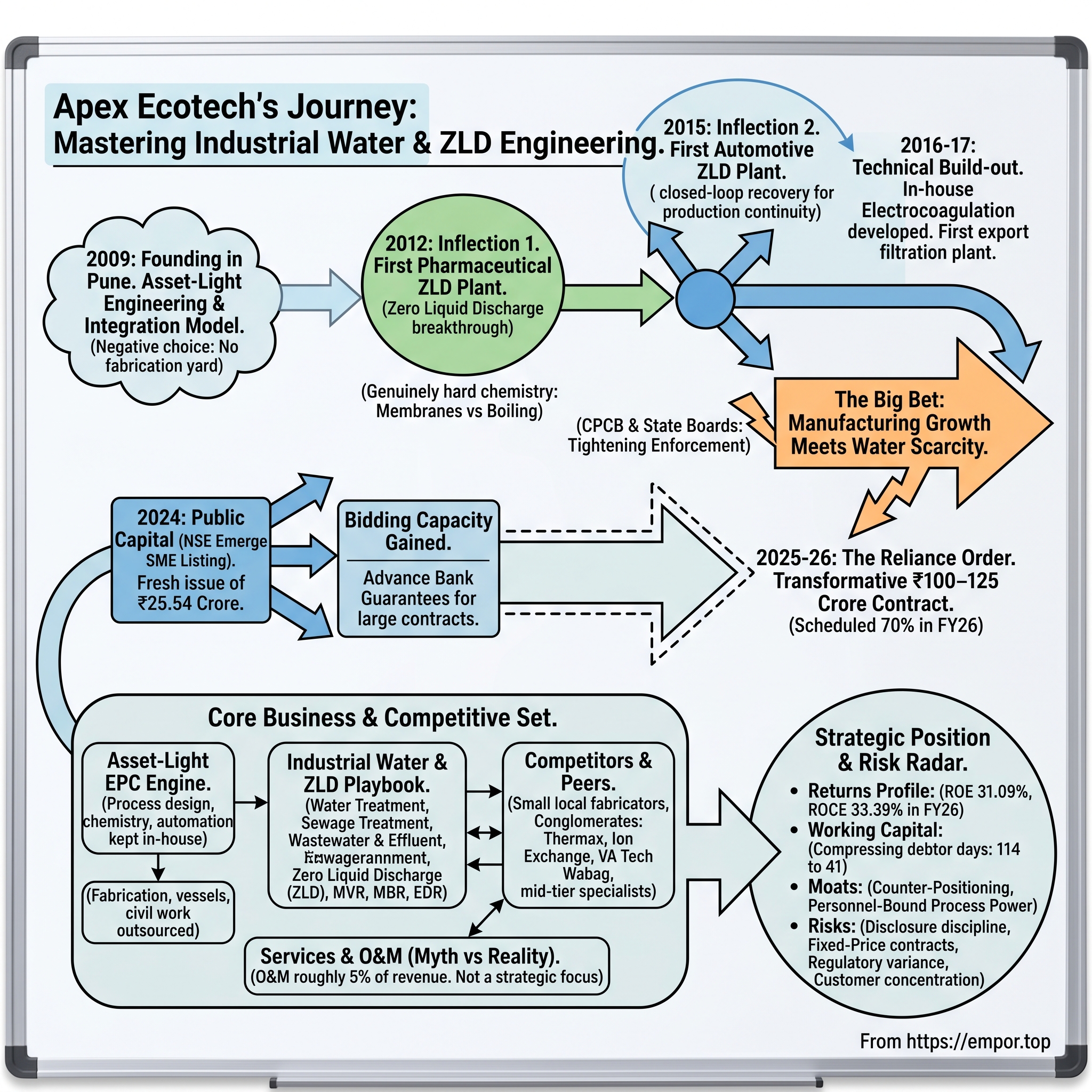
Apex Ecotech: The Industrial Water & ZLD Engineering Story
I. Introduction & Episode Roadmap (0:00 – 0:12)
On the evening of May 12, 2026, a small group of Indian retail investors and analysts dialled into a conference call hosted from an office suite in Rahatani, a residential-industrial pocket on the north-western edge of Pune. The company on the other end had a market presence most professional fund managers had never bothered to look at: a decade-and-a-half-old water engineering firm listed on the NSE Emerge SME platform, with roughly a hundred employees and no manufacturing plant of its own.
Then the numbers landed. Revenue from operations for the year ended March 31, 2026 had reached ₹148.65 crore, up 109.5% year-on-year. EBITDA rose 96.82% to ₹21.76 crore. Profit after tax nearly doubled to ₹17.02 crore.1 In the second half alone, the company had booked ₹116.08 crore of revenue — more than three-and-a-half times what it had done in the entire first half.1
One participant, an analyst named Agastya Dave, opened his question with a line that captured the mood: "In H2, I would say that you are by far the best performing water EPC / engineering company in the listed space."2
That is the kind of sentence that should make a careful investor slow down rather than speed up. Doubling revenue in a single year is not, by itself, evidence of a durable business. In engineering, procurement and construction — EPC — it is often evidence of one very large contract landing in one very convenient reporting period. The interesting question about Apex Ecotech Limited is not whether FY26 was a good year. It plainly was. The question is what kind of machine produced it, and whether that machine can produce anything like it again.
The pitch, stated plainly
Apex Ecotech designs and builds systems that take dirty industrial water and make it clean enough to use again. It does this for factories — not for municipalities, not for households. It incorporated in Pune in 2009 and has completed more than 250 turnkey water and wastewater treatment projects since, with an installed base treating over 145 million litres per day.1
The structural bet underneath the business is a collision of two Indian macro forces. On one side, manufacturing capacity is being built at pace, and modern factories are thirsty. On the other, groundwater in India's industrial belts is being drawn down faster than it recharges, and the regulator has responded by making discharge progressively harder. The Central Pollution Control Board — the CPCB — enforces effluent standards under the Water Act of 1974 and the Environment (Protection) Act of 1986, and from 2015 onward pushed Zero Liquid Discharge obligations into specific high-polluting sectors.[^9] When a factory cannot legally discharge water, it must recycle it. That converts a treatment plant from a cost line into a condition of the operating licence.
The paradox worth investigating
Industrial water EPC has historically been a mediocre place to compound capital. The reasons are structural: contracts are fixed-price, execution runs long, clients hold retention money, and steel is volatile. VA Tech Wabag — India's largest listed pure-play water company — carried 255 debtor days on its most recent reported figures.7 That is what the working-capital trap looks like when it closes.
Apex Ecotech's answer has been to refuse to own the heavy end of the value chain. It keeps process design, chemistry, automation and site integration in-house; it buys fabrication, vessels and civil work from third parties. In FY26 it produced a return on equity of 31.09% and a return on capital employed of 33.39% while carrying essentially no debt.1 Ion Exchange (India), the second-largest listed player, returned 13.4% on capital over a comparable period.8
Whether that gap reflects genuine structural advantage or simply the arithmetic of a small company riding one enormous order is the central tension of this story, and we will not resolve it in the introduction.
The roadmap
We start in the Pune industrial belt in 2009, where four technical men incorporated a company with no factory. We trace four inflection points: the first pharmaceutical ZLD plant in 2012, the automotive breakthrough in 2015, the tightening of pollution enforcement through the late 2010s, and the December 2024 SME listing that gave the business a balance sheet capable of bidding for ₹100 crore contracts. We then take the machine apart — the EPC engine, the much-mythologised services business, the competitive set, the promoter group, and the frameworks that tell us whether any of this is defensible.
Along the way we will find at least three places where the popular narrative about this company and the company's own disclosed facts do not agree. That is where the analysis actually lives.
 Subscribe on LinkedIn
II. Founding Context & The Pune Industrial Belt (2009–2012) (0:12 – 0:25)
To understand why Apex Ecotech exists, drive north out of Pune city toward Chakan.
The road runs through Bhosari and Pimpri-Chinchwad, an unbroken corridor of fabrication sheds, auto ancillary units, pharmaceutical formulation plants and logistics yards. This is one of India's densest concentrations of mid-sized manufacturing. Two-wheeler plants, tractor lines, paint shops, API blocks, food processing units — thousands of them, most employing a few hundred people, most owned by promoters rather than professional boards.
Every one of these plants uses water. And every one of them produces effluent that is chemically specific to what it makes. A paint shop's wastewater carries phosphates, heavy metals and suspended solids from pretreatment baths. A pharmaceutical intermediates plant produces streams with high chemical oxygen demand and dissolved salts that will destroy a membrane in weeks if you get the pretreatment wrong. A dairy or beverage line produces high organic loading with sharp seasonal swings.
In 2009, when the company was incorporated as Apex Ecotech Private Limited under corporate identity number U29299PN2009PLC133737, the market serving these plants was split into two unattractive halves.2
The barbell that left a gap
At the bottom sat local fabricators. They would weld a tank, install a sand filter and a dosing pump, hand over a plant, and disappear. The equipment often worked for a while. When the effluent chemistry shifted — a new product line, a changed raw material — the plant failed, and nobody knew why, because nobody had designed it from the chemistry upward.
At the top sat the conglomerates: Thermax, Ion Exchange, and later the large municipal specialists. Their economics pushed them toward large tickets — power plant water systems, municipal sewage schemes, desalination. A ₹3 crore effluent plant for a mid-sized auto component maker in Chakan was not where their engineering hours earned the most.
Between the two sat a real and unserved need: factories that required genuine process engineering but could not command a conglomerate's attention. Managing Director Anuj Dosajh described this segmentation with unusual precision on the FY26 call, dividing water into three markets — household, industrial, and municipal or infrastructure — and observing that outsiders routinely conflate them. "Very few companies are present in all the three sectors," he said, naming Ion Exchange as one that is.2 Apex chose one lane, industrial, and has stayed in it.
The founders
The company was promoted by four men: Anuj Dosajh, Ramakrishnan Balasundaram Aiyer, Ajay Raina and Lalit Mohan Datta.3
Dosajh is a chemical engineer with more than 36 years of experience, and he chairs the company as well as running it as Managing Director.1 His register on investor calls is notably unpolished for a listed-company CEO — he interrupts himself, apologises for imprecision, and occasionally admits he does not have a number to hand. On that same call he described himself as someone who believes "in spelling out what and I call spade a spade."2 Investors can read that as either refreshing candour or as a governance function that has not yet grown into the listed format. Both readings have evidence behind them, as later sections will show.
Ramakrishnan Balasundaram Aiyer serves as Executive Director for Technology and Innovation Research, with over 24 years of experience.1 Dosajh called him "the think tank of the company."2 Ajay Raina, Executive Director, is a technical sales professional with more than 22 years in the field; Dosajh's description was blunter — "a brilliant salesperson who is responsible for getting all the orders."2
That division of labour is worth pausing on, because it is the actual organisational design. One founder owns the chemistry and the technology roadmap. One owns customer acquisition. One owns the enterprise. The fourth promoter, Lalit Mohan Datta, does not appear on the leadership slide in either of the company's 2026 investor presentations, and his current operating role is not disclosed.14
Rounding out the team are Rakesh Kaul, Chief Financial Officer with more than 35 years in finance — Dosajh called him "the backbone of our company in terms of finances" — and Vishakha as Company Secretary and Compliance Officer.12
The choice that defined everything
The founding decision that matters most was a negative one. Apex did not build a fabrication yard.
For an engineering company in India in 2009, this was counter-cultural. Owning steel-cutting capacity was how you demonstrated seriousness to a client and how you captured margin on the physical content of a project. It was also how you converted a services business into a capital-intensive one with a fixed cost base that had to be fed regardless of order flow.
Apex went the other way: retain the intellectual content — process design, chemical dosing regimes, membrane configuration, automation and control panels, commissioning — and buy the metal. The company's own framing is that its in-house design team "minimizes reliance on external agencies" for engineering while its operations run "a streamlined framework that integrates in-house and outsourced systems."1
The investor consequence is visible on the FY26 balance sheet, where gross fixed assets stood at just ₹2.94 crore against total assets of ₹89.18 crore.1 A business that reached ₹148.65 crore of revenue on under ₹3 crore of fixed assets is not, in any meaningful sense, a manufacturer. It is an engineering and integration firm that happens to deliver physical plants.
That structure is why the company could survive years when orders were thin — and, as we will see, there was one such year that nearly broke it.
III. Inflection Points: From Standard ETP to ZLD Dominance (0:25 – 0:42)
Every specialist engineering firm has a moment when it stops selling equipment and starts selling the ability to solve a problem nobody else will touch. For Apex Ecotech, that moment came in 2012, in a pharmaceutical plant.
Inflection 1 (2012) — The pharma ZLD breakthrough
Zero Liquid Discharge means exactly what it says: nothing liquid leaves the site. Everything that comes in either goes into the product, evaporates, or leaves as a dry solid.
The engineering is genuinely hard, and it helps to think about it in kitchen terms. Reverse osmosis is a very fine sieve: you push water through a membrane at pressure, clean water passes, salts stay behind. That works beautifully until the leftover brine gets so concentrated that salts crystallise on the membrane surface — scaling — or organic gunk coats it — fouling. At that point the sieve clogs, pressure spikes, and the plant stops. Pharmaceutical effluent is the worst case: high salinity, high chemical oxygen demand, and a composition that changes every time the plant switches campaigns.
The last stretch of water is therefore recovered thermally rather than by membrane — you boil it. Multiple Effect Evaporators reuse the steam from one stage to heat the next, and an Agitated Thin Film Dryer takes the final sludge to a handleable solid. The real skill is not owning these machines. It is knowing precisely where to stop pushing membranes and start boiling, because boiling is expensive and membranes are cheap right up until they fail.
Apex commissioned its first ZLD plant in the pharmaceutical sector in 2012.1 Three years later, in 2015, it commissioned its first ZLD plant in the automobile sector.1 The company has since supplied complete ZLD systems achieving more than 98% overall recovery, with reclaimed water routed to boiler feed, cooling tower make-up, air washers, process applications, horticulture and toilet flushing.9
Inflection 2 (2015–2017) — Automotive adoption and the first export
Automotive was a different sale. An auto plant's paint shop is its bottleneck; if water quality drifts, paint finish fails, and the line stops. Selling a closed-loop recovery system into that environment means the client is not buying compliance, they are buying production continuity. Once a supplier is trusted at that level, they get called for the next plant.
The technical build-out through this period was steady and, importantly, internal. In 2016 the company developed an in-house electrocoagulation system based on low sacrificial electrodes to treat complex effluents.1 Electrocoagulation is a neat trick: instead of dosing chemicals to make contaminants clump together so they can be filtered out, you pass a current through sacrificial metal electrodes and generate the coagulant in situ. It reduces chemical handling and sludge volume. The "low sacrificial" qualifier matters commercially — electrode replacement is the running cost of the technique, so consuming less electrode is the difference between an elegant idea and an economic one.
In 2017, Apex commissioned its first million-litre-scale filtration plant outside India, in the steel sector.1 In 2018 it received its first ₹100 million order.1 That single order — ₹10 crore — is a useful marker of how small the company still was at the ten-year mark.
Inflection 3 (2018–2021) — Enforcement becomes the product
The regulatory arc is the part of this story most often described lazily, so it is worth being precise about what actually changed.
India's effluent standards have existed since the 1970s. What shifted through the late 2010s was enforcement and specificity. The CPCB introduced ZLD-oriented guidelines for high-polluting sectors — textiles, tanneries, distilleries, pulp and paper — from 2015, developing technical guidelines, prescribing effluent standards and requiring consistent monitoring of effluent quality under the Water Act and the Environment Protection Act.[^9] For textile units, discharge above a defined threshold triggered a ZLD obligation. For distilleries, the direction was categorical: no spent wash to land or water bodies.[^9]
The investor-relevant mechanism is not that regulation created demand out of nothing. It is that regulation changed who decides. A plant manager weighing a treatment upgrade against a capacity expansion will usually pick capacity. A plant manager whose consent-to-operate is contingent on discharge compliance has no such choice, and the decision moves up to a level where it gets funded.
Dosajh made the linkage explicitly on the FY26 call: "India is now, I feel, putting in more manufacturing units and they are focusing on that. And the water becoming scarcer is, and the compliance is getting stronger."2
The honest caveat — and it recurs in the risk section — is that enforcement in India is administered by state pollution control boards, not the CPCB alone. Consistency varies by state and by political cycle. A demand driver that depends on enforcement intensity is a demand driver with a policy beta attached to it.
Inflection 4 (2024) — Public capital
By 2024 the company had a problem that is specific to asset-light contractors: it could design projects far larger than its balance sheet could underwrite.
Winning a ₹50 crore industrial contract requires more than engineering. It requires advance bank guarantees, performance bank guarantees and retention guarantees — and banks collateralise those with cash. A company with ₹14.73 crore of net worth, as Apex had at the end of FY24, simply cannot post the security a ₹100 crore order demands.3
The company converted to a public limited company and took its IPO to the NSE Emerge platform, NSE's SME board.[^13] The issue opened on November 27, 2024 and closed on November 29, with a price band of ₹71 to ₹73 per share and a fresh issue of 34.99 lakh shares raising ₹25.54 crore.3 The retail lot was 1,600 shares — a minimum application of roughly ₹1.17 lakh, which is the structural reason SME boards attract a narrower investor base than the main board.3 Share India Capital Services acted as lead manager, KFin Technologies as registrar, and Share India Securities as market maker.3
The market's response was extraordinary and, in retrospect, not entirely about Apex Ecotech. The issue was subscribed 420.73 times, drawing bids for 105.62 crore shares against 25.10 lakh on offer.4 Allotment followed on December 2, and the stock listed on December 4, 2024 at ₹138.70 — a 90% premium to the ₹73 issue price.35
Investors should hold two thoughts here simultaneously. A 421-times subscription tells you almost nothing about business quality; Indian SME issues in late 2024 were being subscribed at those multiples across the board, and the scarcity of float mechanically inflates the number. What the IPO genuinely delivered was not validation but capacity: cash that could sit in fixed deposits and be pledged against bank guarantees.
That distinction — between the noise of the listing and the utility of the capital — is exactly what the following year tested.
IV. Core Business Mechanics: Asset-Light EPC & Engineering Playbook (0:42 – 1:02)
Picture a project handover. A treatment plant is not a product that arrives in a crate. It is a small chemical works assembled on a client's land: tanks, pumps, membrane skids, dosing systems, electrical panels, control software, and pipe runs threading through all of it. Apex Ecotech's people designed the process, specified every item, and commissioned the whole. What they did not do is cut most of the steel.
What the company actually sells
The disclosed segment structure covers a stack that runs from clean water in to dry solids out.1
Water Treatment Plants handle incoming raw water — filtration and pre-treatment, resin-based systems, ultrafiltration, reverse osmosis, demineralisation, high-pressure RO, and electrodialysis reversal. Sewage Treatment Plants come prefabricated or site-erected, using conventional activated sludge and extended aeration or advanced moving-bed and membrane bioreactors. Wastewater and effluent systems are designed, in the company's words, "with a focus on optimal design, minimizing both capital and operational costs." Membrane recycle systems take treated sewage further, to a standard fit for horticulture, toilet flushing, boiler feed and cooling tower make-up. ZLD sits at the top of the stack, combining treatment, recycling and evaporation so nothing leaves the premises.1
Alongside these sit electrical panels and automation, sludge dewatering, chemicals and spares, and operations and maintenance — grouped under "Others."1 That grouping is not an accident of slide design, and Section V returns to it.
Two acronyms deserve translation because they mark where the technical bar sits.
MBR — Membrane Bioreactor. Conventional biological treatment uses bacteria to eat organic waste, then waits for the sludge to settle out in a large tank. An MBR replaces settling with a physical membrane barrier. The footprint shrinks dramatically and the output is clean enough to feed straight into RO. Apex received the MBR Champions award from Suez Water Technologies & Solutions (India) in 2019.1
MVR — Mechanical Vapour Recompression. The most expensive part of ZLD is boiling water. MVR takes the vapour coming off the evaporator, mechanically compresses it — which raises its temperature — and uses it to heat the next batch. You are recycling heat instead of buying steam. Operating cost falls sharply; capital cost and mechanical complexity rise. Apex commissioned its first MVR-based evaporator system in 2023.1
The company also states it commissioned electrodialysis reversal on wastewater for the first time in India in 2020.1 EDR pulls salts out using an electric field rather than pressure, and periodically reverses polarity to shed scale — useful precisely where RO struggles.
The operating architecture, and its real trade-off
The asset-light model has an obvious upside and a less-discussed cost.
Upside: the FY26 return figures. ROE of 31.09% and ROCE of 33.39%, achieved with a debt-to-equity ratio that rounds to zero.1 Against Ion Exchange's 13.4% ROCE and Wabag's 24.0%, Apex earns materially more on each rupee employed.78 With gross fixed assets of ₹2.94 crore, growth does not require a capex cycle.1
The cost is subtler. When a company outsources fabrication, the metal content of the project becomes a purchased input priced at market on the day of purchase — and the contract price was fixed months earlier. A firm with its own yard has the same steel exposure but more control over sequencing and labour. Apex carries the exposure without the control. In FY26 that trade-off went against them in a way management described candidly, and Section IX examines it.
The second cost is capability concentration. If the differentiated asset is process knowledge held by three founding directors and a hundred-person team, then the asset walks out of the building every evening. Dosajh addressed this directly, framing low attrition as the moat: "with larger companies, there is a lot of iteration of people. In our company, there is not iteration of people, at least for the directives, who are very much involved in this."2 That is a genuine advantage while it holds. It is also a succession risk that has not yet been tested, given the founders' seniority.
The client roster and what it proves
The published client portfolio spans fifteen industries.1 Named references from the IPO period include the Aditya Birla Group, Ashok Leyland and Escorts Kubota.3 The FY26 order wins are more informative than the historical list, because they show a step-change in ticket size.1
The largest is Reliance Consumer Products Limited: advanced water treatment plants valued at ₹100–125 crore, with roughly 70% scheduled for execution in FY2025-26 and the balance thereafter.4 Larsen & Toubro Construction awarded WTP, ETP and ZLD scope for an automobile plant in Tamil Nadu at ₹45–55 crore, for FY2026-27 execution.4 CRD Consumer Products placed an ETP project at ₹18–22 crore, Bharatiyam Beverages a turnkey ETP expansion at ₹10–15 crore, and Pragati Power Corporation a ₹3–5 crore supply and installation of UF MBR membranes — the last notable as a rare step into government-led infrastructure.14
The Reliance order is the single most important fact in this article, and it cuts both ways. It is genuine proof: a conglomerate with the resources to hire anyone chose a Pune SME for a nine-figure water contract, and Apex delivered the scheduled portion. Dosajh's framing was that it silenced doubters — "last year when someone was mentioning that you have got a big order and enough, would you be able to, your company would be able to achieve the execution part of it and we have done it with a lot of aplomb."2 It is also concentration: a single contract that plausibly represents the majority of a year in which revenue doubled.
Project economics
Contracts run on a gestation of roughly eight to twelve months, and management stated that all ₹125 crore of the closing order book would be consumed within FY27 given that cycle.2 Billing is milestone-linked, and because Apex is "more into equipment where the invoicing is almost 90% in terms of the supply part," revenue recognition front-loads relative to a civil-heavy contractor.2
That last point is quietly important. It means Apex converts an order to cash faster than a construction-weighted peer — which is a large part of why its receivables profile looks nothing like Wabag's. It also means that if orders stop arriving, revenue falls off faster too. Short cycles cut both ways.
V. The Hidden Recurring Engine: O&M & Specialty Services (1:02 – 1:16)
Here we arrive at the most widely repeated claim about Apex Ecotech, and the one that the company's own management dismantled on a recorded call.
Myth vs reality: the recurring revenue engine
The consensus story goes like this. Apex builds a plant, then signs a multi-year operations and maintenance contract worth 15–20% of revenue. That O&M base is stickier and higher-margin than EPC, it smooths the cyclicality of project work, and it gives early sight of a client's expansion plans. It is a lovely thesis. It is the standard way investors talk about industrial services businesses.
On May 12, 2026, an analyst asked Dosajh directly how much revenue came from spares and services. His answer: "I don't have the exact figures, but then it would be maybe... It will not be very substantial. I mean, maybe 5%, I don't know. I really can't get into it. Like I said, I can talk about things which I am focusing on."2
Earlier in the same exchange he had been more explicit about intent. On chemicals: "We are not manufacturing our own chemicals or something, so these we are procuring from outside and we are supplying it to the customer wherever it is required." On O&M: "we are providing services and maintenance wherever the customer requires it, but that is not the focus of or the the the intent of our organisation as of now."2
Read that carefully, because three things follow.
First, the 15–20% recurring revenue figure is not supported by management's own account. The honest number, on the company's disclosure, is materially smaller — approximately 5%, offered with an explicit caveat that it was an estimate.
Second, and more consequentially: Apex Ecotech is a project business. Every rupee of FY26's ₹148.65 crore had to be won, engineered and executed within the year. There is no meaningful annuity underneath it. The order book is the visibility, and the order book is all the visibility there is.
Third — and this is a governance observation, not a business one — the Managing Director of a listed company could not state the revenue split of a segment his own presentation lists as a business line. For a company at ₹150 crore of revenue that may be forgivable. It becomes less so at ₹300 crore.
Why the company may be right anyway
There is a defensible strategic argument for staying out of O&M, and it deserves airing rather than dismissal.
O&M in industrial water is a people business. It means stationing technicians at client sites, managing chemical inventories, replacing membranes on schedule, and carrying the liability when an outlet parameter drifts. Margins are decent but the business scales with headcount, not with engineering leverage. For a firm whose entire competitive claim rests on scarce process-design talent, redirecting that talent toward running other people's plants is a real opportunity cost. Dosajh's stated focus — "I can talk about things which I am focusing on" — is at least internally consistent.2
The counter-argument is equally real. Without O&M, Apex has no structural insight into how its installed base performs after handover, no annuity to cushion a lean order year, and weaker lock-in than the switching-cost narrative implies. When we test Helmer's frameworks in Section VIII, this is the fact that does most of the damage.
Packaged and modular systems
The company's product literature includes prefabricated sewage treatment plants and MVR-based ZLD as distinct offerings, alongside site-erected systems.1 Standardisation is the logical response to a market where, by Dosajh's own estimate, there could be "a couple of lakh companies in this country doing this kind of water treatment" — most of them small, most of them fighting on price.2 A skid-mounted, pre-engineered unit converts a bespoke engineering exercise into something closer to a manufactured good, with faster delivery and repeatable margin.
Apex has not disclosed revenue from packaged systems separately, and no order-book split by product line is published. Sized honestly, this is optionality rather than a segment: a plausible future margin lever with no current numbers attached.
The scale of the underlying opportunity
The most striking claim on the call was about market penetration. Discussing the split between water used as a manufacturing input and water that must be disposed of or recycled, Dosajh estimated that recycling and reuse might account for "only 1% of the total industrial water being used" — while flagging his own uncertainty: "I'm just throwing a number. I may be absolutely be wrong."2
Treat that as directional colour, not data. But even discounted heavily, it frames the opportunity correctly: the recycling layer of India's industrial water stack is early, and the constraint on adoption is regulatory pressure and capital availability rather than saturation.
For investors, the practical translation is this. Apex Ecotech is not a compounding services annuity dressed as an EPC firm. It is an EPC firm — a good one, with unusually clean returns — whose revenue must be re-won every single year. Which makes what it faces competitively the next thing to understand.
VI. Industry Structure, Competitive Dynamics, & Peer Benchmarking (1:16 – 1:32)
Imagine the bid table for a mid-sized ZLD project at a specialty chemicals plant in Gujarat. Five envelopes. One from a conglomerate with a brand the client's board will recognise. One from a regional fabricator quoting 30% below everyone. Two from mid-tier specialists. One from Apex Ecotech.
What separates them is not equipment. It is who can promise a guaranteed outlet water quality on a variable effluent stream and be believed.
The structure of the market
Indian industrial water treatment is extraordinarily fragmented at the base and concentrated at the top, with a thin middle. Dosajh's "couple of lakh companies" estimate captures the base: an enormous tail of fabricators and local contractors who can build a tank and a filter.2
What is changing is the client, not the supplier. His framing on the call was that ticket sizes are inflating because factories are: "there are larger companies coming in India and therefore the ticket size in general of the total factory itself is higher. So therefore the water consumption is higher and therefore the water project in terms of numbers and quantum is more."2 He drew the consolidation conclusion directly — "The companies which were doing X amount of job need to do 10 X amount of job."2
This is the single most credible structural argument in the bull case, and it does not depend on Apex being special. It depends only on ticket sizes rising past what a tail fabricator can bond, engineer or finance. A ₹3 crore ETP is winnable by hundreds of firms. A ₹100 crore advanced water treatment package is winnable by perhaps a dozen.
Benchmarking against the listed set
The numbers make the positioning unusually clear.
VA Tech Wabag is India's largest listed pure-play, with FY26 sales of ₹3,284 crore, a 12% operating margin, net profit of ₹334 crore, ROCE of 24.0% and ROE of 17.4%.7 It is roughly 22 times Apex's revenue. Its debtor days stood at 255.7 Dosajh was direct about the overlap — or lack of it: "Wabag generally is not into the field which we are into, they are into much larger plants like desalination and into government jobs and operation and maintenance."2 The 255 debtor days is the mathematical signature of exactly that business: municipal and government counterparties pay slowly.
Ion Exchange (India) reported FY26 standalone sales of ₹2,679 crore with operating margin compressing to 7% from 12% two years earlier, and net profit falling to ₹138 crore from ₹214 crore in FY25.8 ROCE was 13.4% and ROE 11.2%.8 Ion Exchange is the genuine three-sector player — household, industrial and municipal — and vertically integrated into resin manufacturing.28 Its FY26 margin compression is a useful warning: even the incumbent with the most integrated position in the industry is not immune to pricing and cost pressure in this market.
Thermax competes from the industrial capital-goods side, where water is one franchise among several.
Concord Enviro Systems and Toshiba Water Solutions occupy the specialised mid-market where Apex actually competes.
Apex Ecotech's FY26 revenue of ₹148.65 crore places it at roughly 4.5% of Wabag's scale and 5.5% of Ion Exchange's.178 It earns more than double either peer's return on capital.1
The interpretation matters more than the comparison. High returns at this size are partly structural — no fixed assets, no resin plants, no municipal receivables — and partly a small-numbers effect. Apex's ROE was 60.38% in FY24 before the IPO doubled its equity base, then fell to 28.08% in FY25 as the fresh capital sat idle, then recovered to 31.09% in FY26 as that capital was put to work.1 Anyone extrapolating a 33% ROCE indefinitely should note that it has already moved 35 percentage points in three years.
Myth vs reality: the Veolia relationship
Apex's investor materials list "strong collaborations with global OEMs and technology providers such as Veolia, Dupont, and Grundfos," and its milestone timeline records the Global Ecological Transformation Award from Veolia Water Technologies in China in 2024 and an Innovation Award at the Veolia APAC Conference in Kuala Lumpur in 2025.1 This has been widely read as a technology partnership or joint venture conferring privileged access.
Asked on the call about order book arising "from this JV or tech transfer," Dosajh corrected the premise without hedging: "let me clarify not only to you, but to all. We are not in any partnership, any JV, any... understanding per se of this kind with any of the company in the world."2
He then defined the business model in one word: "We are integrators."2 And he removed any suggestion of exclusivity: "these products, technologies are all available to everybody in the market. All integrators, all technology partners are available in the market for everybody. So it is how you are using them, how it is, you have the understanding to use them to get the better results."2
He went further, disclosing that Apex procures components from Ion Exchange, Thermax and Pentair — competitors in certain segments — as well as from the distributor Filtra.2
Credit where due: that is a management team declining to let a flattering misconception stand. But investors must then adjust the moat accordingly. If every integrator can buy the same Veolia, DuPont and Grundfos technology, the differentiation is not access. It is application — the judgment about which technologies to combine for a given effluent, and the ability to guarantee the result. That is a real skill. It is also, by construction, harder to protect and harder to verify from outside than an exclusive licence would be.
Which raises the question of who is making those judgments, and how they have behaved with capital.
VII. Management, Capital Allocation, & SME Financial Profile (1:32 – 1:46)
The most revealing number in Apex Ecotech's FY26 disclosure is not the revenue figure. It is this: first-half revenue was ₹32.57 crore and second-half revenue was ₹116.08 crore.14 Roughly 78% of the year arrived in the final six months.
That is what executing a single transformative contract looks like inside a fiscal calendar, and it explains almost everything else about the year — including the parts management would rather discuss less.
The financial arc
Take the longer run, because it is more instructive than any single year.
FY22 was a loss-making year: roughly ₹20 crore of revenue, a negative operating margin of about 1.6%, and a net loss.5 Whatever this company is now, it was recently fragile.
FY23 brought the turn — ₹34.92 crore of revenue and ₹3.52 crore of net profit.3 FY24 delivered ₹53.08 crore of revenue and ₹6.63 crore of PAT at a 17% operating margin.15 FY25 reached ₹70.96 crore and ₹8.56 crore.1 FY26 produced ₹148.65 crore and ₹17.02 crore.1
Five-year revenue growth compounds at roughly 66% and profit at 65%.5 From a loss-making base, those rates flatter; but the trajectory from a negative-margin year to a 15% EBITDA margin business in four years is an execution record, not an accounting artefact.
What management said, and whether they delivered
Assessing credibility means checking promises against outcomes, and here the record is reasonably good.
Dosajh described the Reliance mandate's terms as unambiguous: "when we took this job in the first, this job came to us and the narration was very clear that we have to do 70% of the job within this financial year, which we did and very close to those numbers, you know, plus minus maybe 1 or 2%."2 A shareholder on the call put it more bluntly: "you have really done whatever you have guided. You have done exactly similar to that. I think even few promoters can do that."2
On forward guidance, management has been deliberately imprecise, and consistently so. Pressed on whether ₹200 crore of revenue and a 15% EBITDA margin were realistic for FY27, Dosajh declined to confirm specifics but restated a standing frame: "this is what the narration has been very beginning that we are looking for at least 30 to 40% growth overall."2 Asked separately for official guidance, he said: "I don't know, you know, that what kind of percentages we'll be growing in."2
Refusing to put a number on the future is defensible for a project business. But it also means investors have no falsifiable target against which to measure the next disappointment — and that is precisely when guidance is most useful.
The working capital story — the genuinely impressive part
If one operational achievement deserves emphasis, it is this one, because it is where EPC companies usually fail.
In FY25, Apex burned cash: net cash from operating activities was negative ₹5.24 crore.1 Debtor days stretched to 114 and the cash conversion cycle reached 105 days.5 The company had raised IPO money and was consuming it.
In FY26 — while doubling revenue, which normally makes working capital worse — operating cash flow turned positive at ₹6.77 crore.1 Debtor days compressed from 114 to 41. The cash conversion cycle fell from 105 days to 34. Working capital days improved from 89 to 65.5 Trade receivables ended the year at ₹16.76 crore against ₹148.65 crore of revenue.1
Set that against Wabag's 255 debtor days and the contrast is stark.7 Part of it is structural — supply-heavy invoicing and blue-chip private counterparties pay faster than municipalities. Part of it appears to be discipline. Dosajh's answer when asked whether the improvement would hold was characteristically plain: "I am a believer of the fact that if you have learned something, try to follow it."2
This is the strongest evidence in the entire story that the asset-light model is producing real financial quality rather than accounting optics. Growing 109% while generating positive operating cash is not something a stretched contractor can fake.
Where the IPO money actually went
The stated objects of the issue were working capital, general corporate purposes and issue expenses, with approximately ₹17 crore earmarked for FY2024-25 working capital.3 Management confirmed in the FY26 presentation that "the IPO proceeds have been fully deployed towards the stated objectives."1
The mechanics are more specific than the language suggests. Cash and bank balances stood at ₹35.06 crore at March 31, 2026.1 Asked whether this would fund technology investments or acquisitions, Dosajh explained that most of it is not available for that: "basically, most of this fund is directed towards the, you know, making fixed deposits for the... act as collaterals towards submission of a non-fund based guarantees... you need margins and collaterals."2 He added that the company is "speaking to our bankers for a higher limit."2
This is the point that a casual reader of the balance sheet will miss. Apex Ecotech does not have ₹35 crore of surplus cash. It has ₹35 crore of bidding capacity — largely encumbered as margin against advance, performance and retention guarantees. The larger the contract, the more cash gets locked. Growth in this model consumes collateral even when it does not consume fixed assets.
Two further capital-allocation observations. There has been no acquisition activity and no equity dilution since listing; promoter holding has been unchanged at 69.29% from March 2025 through March 2026, with no shares pledged.511 Net cash flow for FY26 was actually negative ₹6.84 crore, as ₹14.65 crore flowed into investing activities — consistent with cash migrating into pledged deposits.1 And when an analyst noticed that EPS grew 63% while PAT grew 99%, Dosajh confirmed the cause was the weighted-average share count following the IPO, not any fresh dilution.12
Domestic institutional holding, meanwhile, rose from 6.08% in March 2025 to 8.39% in March 2026 — modest, but a directional signal that some professional money has found the name.5
The company also decided against international diversification after trying. On Gulf expansion: "we had also thought of and made endorses in the Gulf states, but then that has turned out to be totally anti-modal to our thought process. So, I think India is quite stable."2 Abandoning a geography that did not work is better capital discipline than persisting with it — though it does concentrate the business entirely on one country's industrial capex cycle.
VIII. Strategic Frameworks: Hamilton Helmer's 7 Powers & Porter's 5 Forces (1:46 – 2:00)
Frameworks are only useful if you let them return an unflattering answer. Applied honestly to Apex Ecotech, they return a mixed one.
Hamilton Helmer's 7 Powers
Process Power — present, but unverifiable from outside. Helmer defines process power as embedded organisational capability that competitors cannot replicate quickly even when they can observe it. Apex's version is the accumulated judgment about how to treat a specific effluent: which pretreatment prevents which fouling mode, where membranes stop being economic and evaporation begins, what dosing regime handles a stream whose composition shifts with the client's product mix.
The supporting evidence is real. The in-house electrocoagulation development, the first-in-India EDR application on wastewater, the MVR evaporator, and repeat business from clients who could hire anyone all point to genuine capability.1 Dosajh's claim was assertive: "there are certain technologies which are still not being done by anybody else in India but for us."2
The problem is that process power of this kind is not separable from the people who hold it, and Apex's own defence of it is personnel stability rather than institutionalisation. There is no disclosed patent portfolio. There is no proprietary manufactured component. Dosajh himself confirmed the underlying technologies are commercially available to all integrators.2 What Apex owns is a hundred-person team and three founding directors with a combined eight decades of experience — a capability that is real today and structurally fragile across a generation.
Switching Costs — weaker than the standard narrative claims. The intuitive argument is that a factory will not risk changing its water treatment provider because a failure means a shutdown or a regulatory closure. That is true during a project, where a mid-execution switch is close to unthinkable.
After handover, it is much weaker — and Section V explains why. With services at roughly 5% of revenue and O&M explicitly not an organisational focus, Apex has no persistent commercial relationship with most of its installed base.2 The next plant at the same client is a fresh competitive bid, informed by the last one but not locked by it. What Apex has is not switching cost; it is reference advantage, which is a reputational asset, not a contractual one. Real but rankable below the standard claim.
Counter-Positioning — the most defensible of the three. Helmer's counter-positioning requires a business model the incumbent cannot copy without damaging its existing economics. A conglomerate with fabrication capacity, a resin plant and a municipal EPC division carries fixed costs that must be fed. It cannot credibly out-nimble a firm with ₹2.94 crore of fixed assets on a ₹20 crore custom ZLD job, because its overhead recovery does not permit it.1 The returns gap versus both large peers is the observable evidence.78
The limitation: counter-positioning protects against those moving down. It offers nothing against firms already at Apex's cost structure — of which India has many.
Scale Economies, Network Economies, Branding, Cornered Resource — largely absent. At ₹148.65 crore of revenue, Apex has no purchasing scale against Wabag or Ion Exchange. There are no network effects in industrial EPC. Brand exists as a reference list, not as pricing power. And on cornered resource, management explicitly disclaimed exclusive technology access.2
Score honestly: one strong power, one moderate, one overstated, four absent.
Porter's Five Forces
Bargaining power of buyers — high, and demonstrably so. Apex's clients are among the most capable procurement organisations in India. Asked about the FY26 margin decline, Dosajh conceded the point without deflection: "you do have to, you know, take some kind of a backseat when you're working with the larger conglomerates like Reliance and L&T, where they really push you for the, you know, the cost."2 Buyers also demand performance guarantees, which convert directly into locked collateral. EBITDA margin fell from roughly 15.6% in FY25 to 14.6% in FY26 even as revenue doubled.1 Scale did not deliver operating leverage; the customer captured it.
Bargaining power of suppliers — moderate, and split in two. For technology, alternatives exist across Veolia, DuPont, Grundfos, Pentair, Ion Exchange, Thermax and distributors like Filtra, and Apex uses several.2 For commodities, the picture is worse: stainless steel, piping, cabling and specialised valves are priced by global markets Apex cannot influence, on fixed-price contracts.
Threat of new entrants — bifurcated. For basic ETP and STP work, barriers are near-zero, which is why the tail runs to lakhs of firms.2 For high-salinity ZLD with guaranteed recovery, the barrier is a track record: no chemicals major awards a first-of-kind ZLD plant to a firm with no commissioned references. Apex's 250-plus completed projects and 5.5-plus million litres per day of ZLD capacity constitute that barrier.1 The barrier is credentials, and credentials accumulate — but they also transfer, since engineers move.
Threat of substitutes — genuinely low. Where ZLD is mandated, the substitute for compliance is closure.[^9] The residual substitute is not spending — deferring an upgrade, or relying on lax enforcement. That is a real substitute, and it is what makes the fourth force a policy question rather than a technology one.
Competitive rivalry — high and structurally rising. Rivalry is intense in commoditised water EPC and moderate in complex ZLD. But Ion Exchange's operating margin compressing from 12% to 7% in two years is evidence that pressure is reaching even the incumbents.8 As Apex bids larger tickets, it converges toward the segment where the conglomerates have every incentive to defend.
The frameworks converge on a consistent verdict. Apex Ecotech has a real but narrow advantage — application expertise plus a cost structure incumbents cannot match — operating in a market with genuine demand tailwinds and genuinely powerful customers. That is a good business. It is not a fortress. Which is why the risk radar matters more here than it would for a company with contractual lock-in.
IX. Skeptical Investor Stress Test & Current Risk Radar (2:00 – 2:12)
Now let us argue the other side properly.
The disclosure problem, which is the one nobody talks about
Start with something that surfaced live on the FY26 call and was never resolved.
Two separate analysts asked about the prior year's order book, and got three different numbers. Analyst Agastya Dave recalled FY25 closing at ₹55 crore. Dosajh replied that "55 CR mean means incorrect because I think they are approximate values. It was more than 55 CR." CFO Rakesh Kaul offered: "I think it was about 62 plus last year order book." Dosajh then added: "It was a higher number. We will get back to you on that if you want."2
Later, analyst Madhur Rathi noted that the May 2025 investor presentation had shown a ₹145 crore order book and asked why it had declined to ₹125 crore. Dosajh's answer: "how did we get this figure of 145 to 125? I mean, I'm not too sure about the... Out of which there were some, or maybe most of it, or maybe some part which was already booked, and not to, you know, able to recollect exactly."2
Separately, the company's own May 2025 results release described a "robust order book of approximately Rs119 crores in FY25."6 And the March 2026 presentation carried "₹130+ Cr" as order book to be executed, versus "₹125+ Cr" two months later.14
So: ₹55 crore, ₹62 crore, ₹119 crore, ₹130 crore and ₹145 crore have all been associated with roughly the same metric, and management could not reconcile them on a recorded call.
Some of this is definitional — order book received versus unexecuted balance versus to be executed in the coming year are three different quantities, and mixing them produces exactly this confusion. But that is the point. The order book is the single most important forward indicator for a project company with no annuity revenue. If its definition is unstable, its usefulness as a KPI degrades — and an investor tracking it quarter to quarter may be tracking noise.
The related weakness: Apex reports half-yearly, not quarterly. Multiple participants pressed for quarterly numbers. One called it "one perennial request... It's very, very important, sir." Dosajh pointed to a Q3 circular issued in percentage terms rather than absolute figures; the analyst pushed back: "a proper number, sir, it makes a huge difference."2 Another asked for "slightly more communication," to which Dosajh replied: "We will definitely try to be more visible in future."2 That March 2026 update was explicitly unaudited, based on internal management accounts and not reviewed by statutory auditors.4
For a company whose revenue arrived 78% in one half, semi-annual reporting means investors go six months with almost no visibility into a business that can swing by a factor of three.
Fixed-price contract risk — already realised
This is not theoretical. It happened in FY26.
Explaining the margin decline, Dosajh described the sequencing problem inherent to EPC: piping and cabling are ordered late in a project because the drawings must exist first. "Typically due to the war and other maybe geopolitical things, the cost of metal rose quite sharply" — as much as "25 to 40%" on specialised metals, alongside a spike in logistics costs — precisely when the bulk of FY26 revenue was being executed.2 The company absorbed it: "I'm glad that we have been able to absorb that cost and not still have a significant dip in our, you know, profitability."2
Two readings coexist. The favourable one: margins fell only about a percentage point despite a 25–40% input shock, which suggests estimating discipline and negotiating room. The unfavourable one: this is the permanent structure of the business. Every fixed-price contract is a short position in steel between signing and procurement, and the exposure scales with ticket size.
Management says it has repriced: "we would definitely raise our prices and we have done that already."2 That is a claim to be verified against FY27 margins, not accepted on assertion.
Concentration — acknowledged, not solved
At least two analysts raised customer concentration. Dosajh's response was that Apex is "not reliant on a single order or single company," that it works with many companies directly and indirectly, and that Reliance and L&T stood out only because of ticket size.2
The disclosed facts complicate that. Of five named FY26 order wins, one at ₹100–125 crore dwarfs the other four combined.14 In a year of ₹148.65 crore total revenue, a single contract of that magnitude — with roughly 70% scheduled within the year — plausibly constituted the majority of the business.4
Sector concentration compounds it. Apex serves industrial clients in automotive, chemicals, pharmaceuticals, FMCG and beverages — all of which spend on water infrastructure when they are expanding capacity. Water treatment demand is a derivative of industrial capex. Should India's private capex cycle cool, the ZLD mandate does not disappear, but the new-plant projects that carry it do. And the company has deliberately concentrated on one country after the Gulf attempt.2
Regulatory enforcement variance
The demand thesis rests on compliance, and compliance rests on state pollution control boards. Their enforcement intensity varies by state, by industry and by political cycle. A well-capitalised chemicals plant in a strictly enforced state has no choice. The same plant in a laxer jurisdiction has a discretionary decision. Nothing in the company's disclosure quantifies how much of its pipeline is mandate-driven versus voluntarily undertaken for water security or ESG reasons, and that distinction determines how cyclical the demand really is.
SME platform dynamics
APEXECO trades on NSE Emerge.10[^13] The consequences are practical: thinner liquidity, wider spreads, half-yearly reporting, minimal sell-side coverage, and a retail lot size that excludes smaller investors. The stock rose roughly 115% over the trailing year, so the market has already repriced the FY26 result.5 Migration to the main board typically requires sustained profitability and enhanced disclosure — and on the evidence of the order-book exchange, the disclosure discipline expected of a main-board issuer is not yet fully in place.
What an activist would press on
A skeptical investor would put three questions to this board. First: publish a standardised order-book definition and report it quarterly, since it is the only forward metric that exists. Second: state what proportion of FY26 revenue came from the single largest client, because the current disclosure allows investors to infer it but not to verify it. Third: explain the plan for what happens if a large contract slips a quarter — with no annuity and 78% of revenue in one half, a single deferred milestone materially changes reported results.
None of these is an accusation of impropriety. Promoter holding has been stable with nothing pledged, there is effectively no debt, cash flow has turned positive, and management corrected a flattering misconception about Veolia unprompted.125 These are behaviours consistent with an honest operator. But honesty is not the same as disclosure adequacy, and the gap between the two is where SME investors usually get hurt.
X. Investment Thesis: Bull vs Bear Case & Key KPIs (2:12 – 2:22)
Strip away the narrative and the case reduces to a single question: is Apex Ecotech a structurally advantaged specialist entering a long demand cycle, or a competent small contractor that had one exceptional year?
The "why win" case
The demand argument is the strongest leg, and it does not depend on management being right about anything. Indian manufacturing capacity is being added; new factories consume more water than old ones; groundwater is depleting; and discharge is regulated under a framework that has been tightening since 2015.[^9] Where ZLD is mandated, the treatment plant is not a capex line item competing against other projects — it is a precondition of operating.
The second leg is the returns profile, which is unusual and evidenced rather than asserted. FY26 ROCE of 33.39% and ROE of 31.09% with effectively zero debt, against 24.0% and 13.4% respectively at the two largest listed peers.178 The mechanism is identifiable: ₹2.94 crore of fixed assets supporting ₹148.65 crore of revenue.1 Growth here does not require a capex cycle, only working capital and bank limits.
The third leg is the one most likely to be underappreciated: FY26 proved the company can scale execution without breaking. Doubling revenue while turning operating cash flow from negative ₹5.24 crore to positive ₹6.77 crore, and compressing debtor days from 114 to 41, is the hardest thing an EPC company does.15 Most fail this test. Apex passed it in the year it was hardest to pass.
The fourth is consolidation. If ticket sizes keep inflating past what small fabricators can bond and engineer, the fragmented tail becomes progressively irrelevant, and a firm with 250-plus completed projects and blue-chip references sits on the right side of that sorting.12
Order book at March 31, 2026 stood at over ₹125 crore, which management stated would convert within FY27 given the eight-to-twelve-month cycle.12 Dosajh's floor case was memorable in its bluntness: "if we do nothing, we'll do 125."2
The "why not" case
Start with that same sentence, because it is also the bear case. ₹125 crore is below FY26's ₹148.65 crore. If nothing further were won, FY27 revenue would decline. The entire growth case rests on orders management says are "well placed" and expected to finalise "in the next three to four months" — which, as of late July 2026, is a claim now inside its own verification window.2
Second, margins are going the wrong way at the moment scale should be helping. EBITDA margin slipped from roughly 15.6% to 14.6% as revenue doubled, and management attributed it to both conglomerate pricing pressure and input costs.12 If large orders are the growth engine and large customers extract the operating leverage, then scaling makes the business bigger without making it better. Ion Exchange's margin compression from 12% to 7% shows this is not a small-company affliction.8
Third, the recurring revenue cushion that most investors assume exists does not — services are approximately 5% of revenue and explicitly not a strategic focus.2 Every year starts near zero.
Fourth, working capital could re-bloat. The FY25 experience, with negative operating cash flow and 114 debtor days, was only twelve months before the FY26 improvement.15 One year of discipline is a data point, not a track record. And growth mechanically consumes collateral: the ₹35.06 crore cash pile is substantially encumbered against bank guarantees, so larger orders lock more cash even as they generate more profit.12
Fifth, execution risk on complex ZLD is asymmetric. A membrane system that fails to hit guaranteed recovery on a marquee client's site does not just cost a project — it costs the reference list, which is the only durable asset the business has.
Where the frameworks land
Section VIII's honest scoring holds here. Counter-positioning is real and observable in the returns gap. Process power is real but personnel-bound and undocumented. Switching costs are weaker than claimed because there is no O&M annuity. Scale, network, branding and cornered resource are absent. Among Porter's forces, buyer power is high and actively compressing margins, substitutes are genuinely weak where mandates bite, and rivalry is intensifying as Apex moves up in ticket size.
The synthesis: Apex Ecotech is a well-run, capital-efficient specialist with a genuine cost-structure advantage over larger rivals and no contractual protection against smaller ones. It should do well in a rising market. It has not yet demonstrated what it does in a flat one.
The three metrics that matter
Everything above collapses into three things worth tracking. These are not calculations to perform — they are disclosures to read each reporting period.
1. Order book, on a consistent definition. For a project business with no annuity, this is the only forward indicator. It is also, as Section IX established, currently reported inconsistently.246 Track the absolute number, but track the definition just as carefully — and treat management's eventual standardisation of it as a governance signal in its own right. The reference point is FY26's closing figure of over ₹125 crore against ₹148.65 crore of revenue: a book-to-revenue ratio below one.1
2. Net working capital days, especially debtor days. This is the metric that determines whether growth generates cash or consumes it, and it is where EPC companies die. The move from 114 debtor days and a 105-day cash conversion cycle in FY25 to 41 and 34 in FY26 is the single best piece of evidence in the bull case.5 If it reverses while revenue grows, the asset-light thesis is in trouble regardless of what the income statement shows.
3. EBITDA margin at increasing scale. The core unresolved question is whether Apex captures operating leverage as it grows or hands it to its customers. FY26 answered "hands it over," at least partially — margin fell while revenue doubled.1 Management claims it has already repriced for higher input costs.2 FY27 is the test of that claim, and it is the cleanest available read on whether this company has pricing power or merely capability.
XI. Outro & Key Business Lessons (2:22 – 2:28)
Three things generalise beyond one Pune engineering firm.
Lesson 1: In project businesses, what you refuse to own determines what you earn.
The single most consequential decision in this story was made in 2009, and it was a decision not to build something. By declining a fabrication yard, Apex Ecotech's founders gave up margin on the physical content of every project and gained the ability to earn returns on capital that its far larger competitors cannot match.178
The lesson generalises, but so does its limit. Asset-light does not mean risk-light. It relocates risk from the balance sheet to the income statement — from depreciation and capacity utilisation to input-cost exposure on fixed-price contracts, which is exactly where FY26's margin compression came from.2 And it makes the enterprise's value inseparable from the people carrying the knowledge. The model buys superior returns; it pays for them in volatility and in key-person dependency.
Lesson 2: Regulation is a demand driver only where enforcement is the binding constraint.
The reason a treatment plant gets funded is that the alternative is not operating. That converts a discretionary investment into a compliance obligation and moves the decision to a level of the organisation where it gets budgeted.[^9]
But investors should be precise about what they are underwriting. A regulatory tailwind is not a moat — it lifts every competitor equally, and the tail in Indian water treatment is enormous.2 It is a demand condition, and it is contingent on enforcement intensity that varies by state and political cycle. The correct framing is that regulation determines the size of the pool. Nothing about it determines who wins the swim.
Lesson 3: SME listings buy capability, not credibility — and the two get confused.
The 421-times subscription and the 90% listing pop told investors approximately nothing about the business.34 What the ₹25.54 crore actually bought was collateral: cash to pledge against the guarantees that let a small company bid for a ₹100 crore contract.23 Within eighteen months, that capacity converted into the largest order in company history and a doubling of revenue.1 For a capital-light contractor, the constraint was never plant — it was bondability.
The unfinished part of that transition is disclosure. A company that reports half-yearly, cannot reconcile its own order-book history on a recorded call, and does not disclose its largest customer's revenue share is not yet operating at main-board standard.246 Management has acknowledged this and promised to be "more visible in future."2 Whether that promise gets kept is, for a business whose only forward indicator is a number it reports inconsistently, not a cosmetic question.
The final observation belongs to Dosajh, describing his own posture on the FY26 call: "we have to be prudently aggressive."2 For a firm that lost money in FY22, doubled revenue in FY26, and now sits on an order book smaller than the year it just delivered, that phrase is either a strategy or a tension. FY27 will show which.
References
-
Apex Ecotech Limited FY26 Investor Presentation — National Stock Exchange of India, 2026-05-11 ↩↩↩↩↩↩↩↩↩↩↩↩↩↩↩↩↩↩↩↩↩↩↩↩↩↩↩↩↩↩↩↩↩↩↩↩↩↩↩↩↩↩↩↩↩↩↩↩↩↩↩↩↩↩↩↩↩↩↩↩↩
-
Transcript of the Earnings Call on the Audited Financial Results for H2 and FY ended March 31, 2026 — Apex Ecotech Limited / NSE, 2026-05-15 (call held 2026-05-12) ↩↩↩↩↩↩↩↩↩↩↩↩↩↩↩↩↩↩↩↩↩↩↩↩↩↩↩↩↩↩↩↩↩↩↩↩↩↩↩↩↩↩↩↩↩↩↩↩↩↩↩↩↩↩↩↩↩↩↩↩↩↩↩↩↩↩↩
-
Apex Ecotech IPO subscribed nearly 2 times on day 1; check offer size, price band and other key details — Upstox, 2024-11-27 ↩↩↩↩↩↩↩↩↩↩↩
-
Apex Ecotech Limited March 2026 Investor Presentation — Q3 FY26 Business Update and H1 FY26 Performance — National Stock Exchange of India, 2026-03-10 ↩↩↩↩↩↩↩↩↩↩↩↩↩
-
Apex Ecotech Ltd — Company Profile, Financial Statements and Ratios — Screener.in ↩↩↩↩↩↩↩↩↩↩↩↩↩
-
Apex Ecotech Limited Reports a Strong 331.85% HoH Surge in EBITDA, Reaching Rs 897.78 Lakhs in H2 FY25 — The Tribune / ANI, 2025-05-27 ↩↩↩
-
VA Tech Wabag Ltd — Company Financials and Ratios — Screener.in ↩↩↩↩↩↩↩↩↩
-
Ion Exchange (India) Ltd — Company Financials and Ratios — Screener.in ↩↩↩↩↩↩↩↩↩↩↩
-
Apex Ecotech Limited — Official Website and Corporate Portal ↩
-
Apex Ecotech Limited Equity Quote and Corporate Announcements — National Stock Exchange of India ↩
-
Apex Ecotech Ltd Financial Ratios and Shareholding Summary — Trendlyne ↩
 LinkedIn
 WhatsApp
 Reddit
 Hacker News
 Email
Email Kindle
 RSS Feed
 Spotify
 Apple Podcasts
 Amazon Music
 Audible
 YouTube