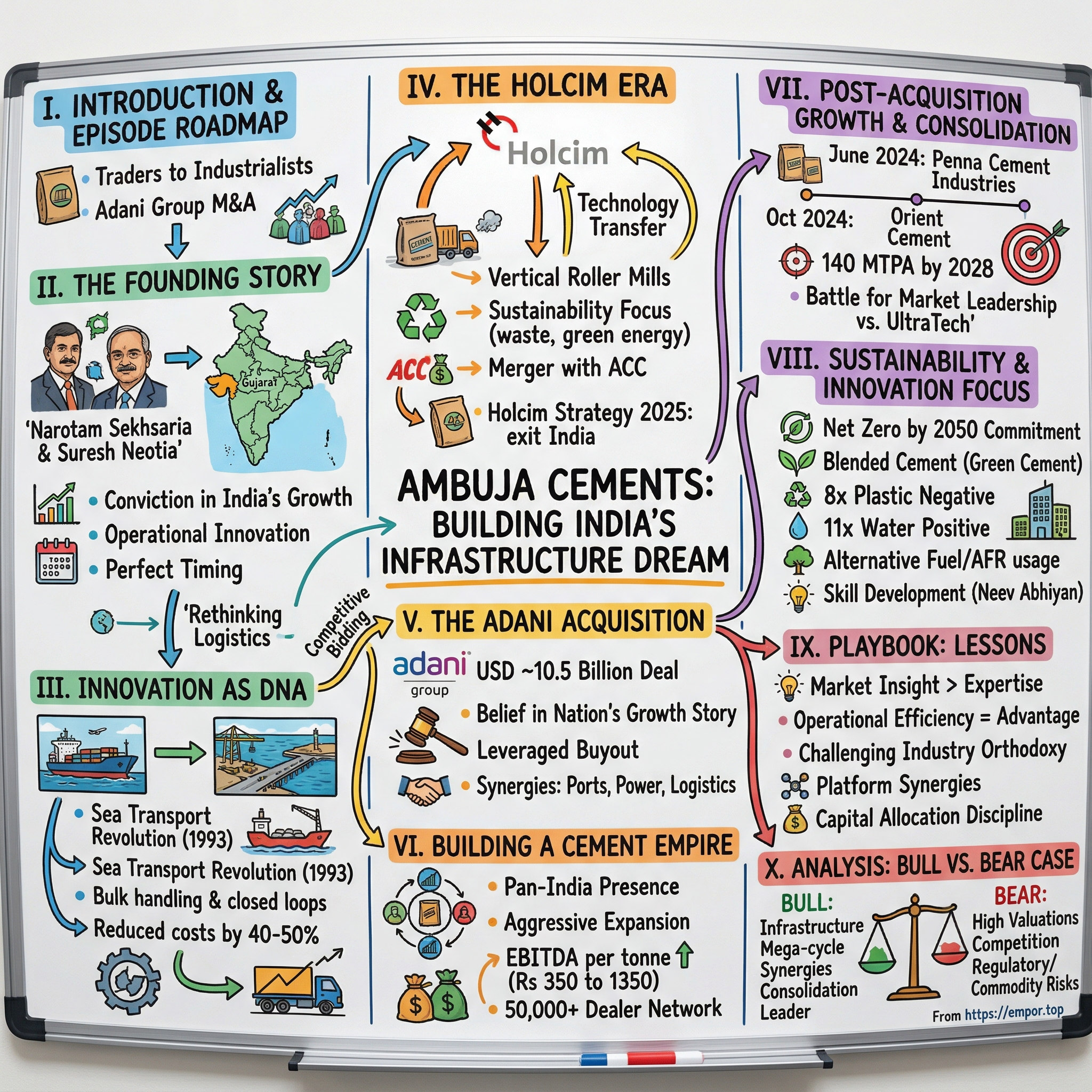
Ambuja Cements: From Trader's Gamble to Adani's Cement Empire
I. Introduction & Episode Roadmap
On a Tuesday afternoon in late July 2026, Vinod Bahety opened Ambuja Cements' quarterly earnings call with a sentence that would have sounded strange coming from almost any other commodity producer: the company had shipped seven percent less cement than a year earlier, and management wanted analysts to understand that this was the plan.1
Volumes had not fallen because demand collapsed. They fell because Ambuja walked away from roughly a million tonnes of business in South India that was generating negative EBITDA, and shrank its non-trade — bulk, institutional, low-margin — book by twenty-one percent.1 The reward showed up one line down: EBITDA per tonne rose twenty-seven percent sequentially to ₹931, and operating cost per tonne fell ₹206 to ₹4,241.48 The punishment showed up on the screen behind the analysts: the stock drifted down anyway, to about ₹426.1
That single call contains the whole argument about Ambuja Cements in August 2026. This is a company with roughly ₹40,656 crore of annual revenue, a market capitalisation near ₹1.07 lakh crore — about $12.5 billion — and 109 million tonnes of installed cement capacity across twenty-four integrated plants and twenty-two grinding units.3248 It is India's second-largest cement producer and the anchor asset in Gautam Adani's attempt to build the country's largest cement business. It is also a company whose shares have fallen from a fifty-two-week high near ₹607 to the low ₹400s, and whose own management told shareholders in May 2026 that "performance had not met shareholder commitments."45
The story that gets you from 1983 to here has two completely different halves, and the tension between them is the point of this episode.
In the first half, two commodity traders with no engineering background and no cement experience built what became, by reputation, India's most cost-efficient cement franchise. They did it not through chemistry or scale but through logistics — specifically, by noticing that in a business where freight can rival the cost of the product itself, the company that moves cement most cheaply wins. Ambuja put cement on ships when everyone else put it on trucks. That decision, made in the early 1990s, defined the company's operating culture for three decades.
In the second half, that franchise became a trophy. Holcim, the Swiss building-materials giant, bought control in stages between 2006 and 2010 and held it for sixteen years.6 Then in 2022 Holcim sold out entirely, and Gautam Adani paid roughly $10.5 billion for Ambuja and its subsidiary ACC — the largest acquisition in Adani Group history and India's largest M&A transaction in infrastructure and materials.7 Within nine months, a short-seller report alleged the acquisition vehicle was not what it appeared to be, Adani Group's listed market value fell by tens of billions of dollars in days, and the entire structure was stress-tested in public.8
What has happened since is a roll-up. Ambuja bought Sanghi Industries, Penna Cement, and Orient Cement in barely fourteen months, roughly doubled capacity, absorbed ₹20,000 crore of promoter money through warrants, and is now folding four separate companies into one listed entity under the banner "One Cement Platform."9101112
So the question this article tries to answer, with evidence rather than adjectives, is this: Adani bought a business that was already well run and did not need to be reinvented. Was the price worth paying, and is the machine he has bolted onto it actually working better — or just getting bigger? The FY26 numbers say the roll-up is not yet earning its keep. The Q1 FY27 numbers say something may be turning. Two data points is not a trend.
We start where the cost advantage was born.
 Subscribe on LinkedIn
II. Founding to Holcim: Traders Build an Efficiency Machine (1983–2006)
The founding scene of Ambuja Cements has no laboratory in it, and no engineer.
Narotam Sekhsaria came from a Marwari trading family whose enterprise history stretched across commodities, equities, and eventually technology — a lineage of people whose instinct was to look at a market and ask where the arbitrage was.13 In April 1983, with his partner Suresh Kumar Neotia, he incorporated Gujarat Ambuja Cements.13 Neither man had built a cement plant. Neither had run a kiln. What they had was a thesis: India was about to spend the next forty years building itself, and cement is the one input that cannot be imported cheaply at scale because the freight kills you. If you were early, disciplined about cost, and close to the demand, you would compound for decades.
The bet was made at an awkward moment. Indian cement had been under price and distribution control for most of the post-independence era, and partial decontrol was still working its way through the system. Capital was scarce, project execution was slow, and the incumbents were established houses with decades of head start. Two traders building a greenfield plant was, on paper, the least likely way to enter the industry.
They commissioned their first integrated plant in 1986 at Ambujanagar, near Kodinar on the Saurashtra coast of Gujarat, starting at roughly 0.7 million tonnes per annum.14 The plant was built fast — famously so, in an industry where three to four years was normal — and it was built next to limestone and next to the sea. The second choice mattered more than anyone realised at the time.
The move that became the company's DNA
Here is the problem Sekhsaria was staring at by the early 1990s. Cement is heavy, cheap per tonne, and perishable in the sense that it absorbs moisture. That combination means transport economics dominate everything. A tonne of cement trucked several hundred kilometres can carry freight costs that are a very large fraction of what the customer pays at the door. The practical consequence is that cement is not really a national market at all — it is a patchwork of regional markets, each defined by how far a truck can economically go from a plant.
Ambuja's plant sat in Gujarat. The richest cement market in western India was Mumbai. By road, the numbers did not work.
So the company did something no Indian cement producer had done: it moved cement in bulk by sea.14 It built an all-weather captive port at Muldwarka, roughly eight kilometres from the Ambujanagar plant, with mechanised jetties that could load cement out and bring coal in.14 It bought ships. It built receiving terminals and packing plants at the destination end, so bulk cement arriving by water could be bagged close to the customer.
Think of it as the difference between shipping bottled water by parcel courier and running a pipeline. The truck-based model pays a per-kilometre toll on every tonne, forever. The marine model requires a large fixed investment up front — port, vessels, terminals — and then moves cement at a marginal cost that road freight cannot approach over long distances. It converted a variable cost into a capital investment, which is exactly the trade a company makes when it believes volumes will be large and permanent.
The industry noticed. Others copied. But copying required coastal plants, port rights, and capital, and to this day only around a tenth of Indian cement moves this way.14 Ambuja also acquired a roughly fourteen percent stake in ACC — the oldest and most storied name in Indian cement — from the Tata group in 1999, later building it into a promoter position, which is how a company founded in 1983 ended up controlling a company founded in 1936.13
What this era actually proves
It is worth being precise about what the early history does and does not establish, because "Ambuja is the low-cost operator" has since hardened into a claim that gets repeated without testing.
What it establishes is that the company's founding advantage was structural rather than promotional. Coastal plants with captive jetties are a cornered resource — you cannot conjure a second Muldwarka. The operating culture that came with it, built around obsessive attention to freight, fuel, and clinker economics, was real and was documented in the company's margins for years.
What it does not establish is that the advantage is permanent or that it still holds at today's scale. A logistics edge built for a 0.7 mtpa plant serving Mumbai is a very different thing from a 109 mtpa pan-India network stitched together from five different companies' assets, most of which have nothing to do with the sea. We will test that claim directly against UltraTech's numbers later, and the answer is uncomfortable.
By 2005, Sekhsaria had built something genuinely valuable and genuinely hard to replicate. Which is precisely why a Swiss multinational came knocking.
III. The Holcim Years: Global Ownership, Local Compounding (2006–2022)
In January 2006, Holcim Ltd. — then the world's second-largest cement group — bought a 14.8 percent stake in Gujarat Ambuja Cements from its promoters for roughly ₹2,140 crore, and followed it with an open offer for a further twenty percent.6 Sekhsaria stepped into the chairman's seat of both Ambuja and ACC while divesting his economic interest.13 By December 2007 Holcim's holding had reached roughly forty-six percent, and by 2010 it had crossed sixty-one percent.6
This is the least dramatic chapter in the company's history, and that is exactly what makes it analytically interesting.
What a foreign strategic owner actually brought
Holcim did not arrive to transform Ambuja. It arrived because Ambuja already worked. The Swiss group brought three things, and it is worth separating them because investors routinely over-credit foreign ownership.
The first was technology and process transfer — kiln efficiency practices, alternative fuels handling, environmental standards, and the accumulated know-how of a company operating plants on five continents. Genuine, but incremental in a business already running near global cost benchmarks.
The second was balance-sheet credibility. A controlled subsidiary of a AAA-adjacent European parent borrows more cheaply and plans over longer horizons than a standalone Indian mid-cap. That mattered during India's mid-2010s capex slowdown, when several leveraged domestic cement players stalled or sold.
The third — and by far the most consequential for what happened later — was structural. In 2013, Holcim reorganised its Indian holdings by merging Holcim (India) Private Limited into Ambuja, which made ACC a subsidiary of Ambuja rather than a sibling.6 That single piece of corporate plumbing is why, nine years later, a buyer could acquire control of two large listed cement companies through essentially one transaction. It created the cross-holding architecture that made the Adani deal possible — and, as we will see, the structural complexity that the Adani group has spent the last few years unwinding.
Under Holcim, Ambuja compounded quietly. Capacity grew, the brand stayed premium, dividends flowed, and the company avoided the debt-fuelled expansion cycles that damaged several peers. It was, in the language of long-term investing, a good steward rather than a value creator: it protected an inherited advantage without meaningfully extending it.
Why the Swiss walked
Holcim's exit had almost nothing to do with India and everything to do with Holcim.
After its merger with Lafarge and the subsequent strategic reset under CEO Jan Jenisch, the group had committed itself to a "Solutions & Products" strategy — roofing, insulation, specialty building systems — the higher-margin, lower-capital-intensity end of building materials, concentrated in North America and Europe. It had already deployed over CHF 5 billion into that pivot.15 Emerging-market grey cement, however profitable, was capital-hungry, carbon-intensive, and structurally at odds with where the group wanted its cost of capital to sit.
When the sale closed, Holcim received cash proceeds of about $6.4 billion, having sold its Ambuja shares at ₹385 and its ACC shares at ₹2,300.15 For a Swiss group reallocating capital toward decarbonised, higher-multiple businesses, that was a clean exit at a full price.
For Indian investors, the more useful lesson is about attribution. Sixteen years of foreign strategic ownership produced steady but unspectacular results on a business that was already excellent. That should temper expectations in both directions about how much any controlling shareholder — Swiss or Indian — actually adds to a cement company. The assets, the limestone, the ports, and the cost culture do most of the work.
The question in 2022 was who would inherit them.
IV. The Adani Acquisition: India's Largest Infrastructure M&A (2022)
On 14 April 2022, Holcim confirmed it was reviewing its options in India. The auction that followed was short, competitive, and — for the Indian cement industry — existential. UltraTech, the incumbent leader, and JSW Group were both reported to have circled. Whoever won would either consolidate the industry's number one position or create a new number two overnight.
On 15 May 2022, Adani won.7
The structure and the price
The transaction gave the Adani family, through an offshore special purpose vehicle, Holcim's 63.19 percent stake in Ambuja Cements and 54.53 percent of ACC — of which 50.05 percent came bundled inside Ambuja itself.7 Adding the mandatory open offers required under Indian takeover rules, the total transaction value came to approximately $10.5 billion.7 The assets acquired amounted to roughly 70 mtpa of capacity across twenty-three cement plants and fourteen grinding stations.7
It was, at a stroke, the largest acquisition in Adani Group's history and the largest M&A deal ever done in Indian infrastructure and materials.7 It also made Adani — a group with no prior cement operations — the country's second-largest producer on day one.
Gautam Adani's public framing was characteristically expansive: the move into cement was, he said, another validation of the group's belief in India's growth story, resting on the observation that Indian per-capita cement consumption sits at less than half the global average.7 Holcim's Jan Jenisch offered the customary blessing about shared commitments to sustainability and communities.7
Strip away the ceremony and the industrial logic was straightforward, if not obviously worth a premium. Adani already owned India's largest private port network, a large private power generation and transmission business, coal and logistics operations, and a fast-growing renewables platform. Cement consumes exactly these things: bulk shipping, coal and pet coke, electricity, rail and road logistics, and — increasingly — renewable power. On paper, a cement business plugged into that stack should run at a structurally lower cost than one buying all of it in the market.
That is a testable claim, and Sections IX and XI test it. Four years in, the evidence is mixed at best.
How it was paid for
The financing is where the deal became controversial before anyone alleged anything.
The acquisition was funded substantially through share-backed borrowing at the promoter level — the Adani family pledged Ambuja, ACC, and other group shares against facilities reported to aggregate to around $12.5 billion. Layered on top, the promoters committed a further ₹20,000 crore of primary capital into Ambuja through warrants, subscribed in tranches, with roughly ₹5,000 crore paid upfront as the twenty-five percent initial instalment in 2022.16 The market's initial reaction was euphoric: Ambuja shares jumped as much as ten percent on news of the funding plan.16
The elegance of this structure was that it let a family fund a $10.5 billion purchase without selling down other assets. The fragility was that it made the entire edifice sensitive to the share prices of the very companies being pledged. In a rising market, that is leverage. In a falling one, it is a margin call.
The Adanis take their seats
In September 2022, Gautam Adani formally became chairman of Ambuja Cements, with his son Karan Adani installed as chairman of ACC.17 It was the first direct family governance presence in a business that had been run by professional managers under Swiss oversight for sixteen years.
The signal was unambiguous: this was not a financial investment to be left alone. Cement was going to be run as a core pillar of the group, integrated with ports, power, and logistics, and expanded aggressively.
Four months later, a research firm in New York published a report that put the whole structure on trial.
V. Governance Stress Test: Hindenburg, Vinod Adani, and the Ownership Question
The report landed on 24 January 2023, two days before India's Republic Day holiday and in the middle of a ₹20,000 crore follow-on share sale at Adani Enterprises. Hindenburg Research accused the group of what it called brazen stock manipulation and accounting fraud carried out over decades.18
Buried inside the broader allegations was a claim specific to this story. Hindenburg alleged that Endeavour Trade and Investment — the vehicle through which the Ambuja and ACC stakes had been acquired — was ultimately beneficially owned not by the listed Adani Group but by Vinod Adani, Gautam Adani's elder brother, through a chain of entities in Mauritius, the British Virgin Islands, and the UAE.19 Vinod Adani had long been characterised by the group as an unrelated party living abroad. If he was in fact the beneficial owner of the acquisition vehicle, then India's largest infrastructure acquisition had been executed by an entity whose ultimate ownership was not what public disclosure implied — with consequences for related-party transaction rules and minority shareholder protections.
The market's verdict, and how fast it came
The reaction was violent. Adani Group's listed companies shed roughly ₹3.86 lakh crore — about $47.3 billion — in two trading sessions.18 By 27 February 2023, the aggregate market value of the group's listed entities had fallen from roughly $228 billion to about $81 billion, a decline on the order of $140 billion.18 Ambuja and ACC, as the most recently acquired and most heavily pledged assets, were squarely in the blast radius.
What made this dangerous was not the accusation itself but the plumbing. Pledged shares plus falling prices equals forced selling. The group's own leverage had converted a reputational attack into a potential liquidity event.
What Adani did next
The response was rapid and, viewed purely as capital management, effective. Between February and mid-March 2023, the promoters prepaid $2.15 billion of margin-linked share-backed financing ahead of the committed 31 March deadline, and prepaid a further $500 million facility taken specifically for the Ambuja acquisition — a $2.65 billion prepayment programme completed inside six weeks.2021 That took total promoter equity contribution to the Ambuja and ACC purchase to roughly $2.6 billion of the $6.6 billion acquisition value.21
The deleveraging continued after the immediate crisis passed. Promoter shares pledged with lenders fell from 52.21 percent of the promoter holding to 2.16 percent.22 That is a verifiable, multi-year behavioural fact, and it is the single strongest piece of evidence in the Adani group's favour on this question. Promises are cheap; releasing pledges over three consecutive years is not.
By May 2026, Adani group stocks collectively had recovered the roughly $150 billion of market value lost after the report — although the recovery was uneven, with several group companies including ACC still trading well below their January 2023 levels.23
Where the record stands
On 18 September 2025, the Securities and Exchange Board of India disposed of the Hindenburg-related proceedings against Adani group companies, Gautam Adani, and associated entities without establishing violations, finding no evidence that related parties had been used to route funds into listed companies.24 SEBI's reasoning on the related-party question was notably technical: the regulator held that the broadened definition covering indirect transactions was introduced prospectively through the 2021 amendment to the listing regulations, and applying it retrospectively would not be legally permissible.24
An investor should read that carefully, because it is doing two different jobs at once. It is a genuine regulatory clearance — the allegations did not survive SEBI's examination and were formally disposed of. It is also, in part, a finding about the timing of a rule change rather than a finding that the underlying transactions were structured the way public markets assumed. Those are not the same thing, and treating them as identical is exactly the kind of shortcut that gets long-term holders into trouble.
The forward-looking question is whether it still matters. Ambuja is now absorbing ACC, Orient, Sanghi, and Penna into a single entity controlled by a promoter group holding roughly 67 percent of the equity.2 Structural simplification genuinely reduces the surface area for the kind of opacity Hindenburg attacked — fewer listed vehicles, fewer inter-company arrangements, one consolidated set of accounts. It also concentrates decision rights further inside one family. On the Q1 FY27 call, analysts pressed management directly on inter-corporate deposits between ACC, Orient, and the parent; management characterised them as within compliance and part of normal master services arrangements.1 That the question is still being asked in 2026, four years after the acquisition, is itself informative.
The honest summary: the allegations were serious, the market punished them severely, the leverage that made them dangerous has been substantially removed, the regulator has closed the file, and a residual discount for governance complexity persists in the multiple. Investors who require complete resolution will not find it here. Investors who require evidence of behaviour change will find a real amount of it.
With the balance sheet repaired, Adani went shopping.
VI. The Roll-Up: Sanghi, Penna, Orient — Benchmarking the Deals
Between August 2023 and October 2024, Ambuja Cements bought three companies in fourteen months. Understanding whether that was brilliant or expensive requires doing something the press releases did not: comparing the prices paid against what the same capacity costs to build, and against what the competition was paying.
Sanghi: the coastal tuck-in
The first target was almost poetic. Sanghi Industries operated a large integrated plant at Sanghipuram in Kutch, Gujarat — coastal, limestone-rich, with its own jetty. It was, in other words, the same geological and logistical logic that built Ambuja in the first place. Ambuja completed the acquisition of a controlling stake in December 2023 at a total consideration of ₹5,185 crore, adding roughly 6 mtpa.9
The industrial rationale was clean: consolidate the Gujarat coast, feed the marine network, and gain optionality on exports. The execution rationale proved harder. As of the FY26 results, Sanghi was running at just 57 percent capacity utilisation, with management targeting 65–70 percent in FY27.5 A ₹600 crore jetty expansion was planned to unlock the asset properly.1
Penna: buying the South at a discount
In June 2024, Ambuja announced the acquisition of Hyderabad-based Penna Cement Industries at an enterprise value of ₹10,422 crore — about $1.25 billion.25 Penna brought approximately 14 mtpa of capacity across peninsular India, plus infrastructure supporting a foothold toward Sri Lanka, and was funded from internal accruals.25 Analysts at the time estimated it would improve Ambuja's southern market share by 700 to 800 basis points.25
The valuation is where this deal earns its reputation. At roughly ₹7,400 per tonne of capacity — call it $89 per tonne — Penna was bought well below what comparable Indian cement assets had changed hands for. UltraTech's acquisition of Kesoram's cement business was struck at an enterprise value of about ₹7,070 per tonne; its earlier purchase of Century Textiles' cement division was around ₹6,073 per tonne, or roughly $106 per tonne; the Jaiprakash assets came in near $116 per tonne.26 Greenfield replacement cost in India is materially higher again, before you count the years lost to land acquisition, limestone leases, and environmental clearances.
So on entry price, the Penna deal looks genuinely good. The problem is what happened next: at the end of FY26, Penna was operating at 46 percent utilisation.5 Buying capacity at a discount only creates value if you can run it. A cheap asset at half utilisation is not cheap; it is a fixed-cost drag with an option attached.
Orient: the CK Birla exit
In October 2024, Ambuja agreed to acquire Orient Cement from the CK Birla group at an equity value of ₹8,100 crore, starting with a 46.8 percent stake bought from promoters and related shareholders, triggering a mandatory open offer for a further 26 percent at ₹395.40 per share, funded entirely from internal resources.11 The promoter tranche of 37.8 percent closed first, taking Ambuja's holding to 46.66 percent, and the open offer concluded on 9 June 2025.27
Orient was the cleanest of the three assets — well-invested, well-located across Maharashtra, Telangana, and Karnataka, and requiring, in management's own description, minimal additional investment. By Q1 FY27 it was running at 87 percent utilisation, comfortably the best of the acquired portfolio.1
The scoreboard
Net of everything, Adani-era Ambuja went from roughly 70 mtpa at acquisition to 109 mtpa by March 2026, crossing the 100 mtpa mark in April 2025.7283 Roughly half that growth came from acquisitions and half from organic expansion — FY26 alone added 10.7 mtpa of grinding and 7 mtpa of clinker capacity.3
Two costs deserve equal billing with the capacity number, and are frequently omitted from the "debt-free" framing.
The first is dilution. The ₹20,000 crore promoter warrant programme was funded in tranches — ₹6,661 crore converted in March 2024, taking promoter holding to 66.7 percent, followed by ₹8,339 crore in April 2024 that lifted it above seventy percent.2930 Add shares issued to Sanghi shareholders in the merger, and the equity base expanded substantially: Ambuja's share capital of ₹494 crore at ₹2 face value implies roughly 2.47 billion shares outstanding today, against a weighted average closer to 1.99 billion in FY24.2 Roughly a quarter more shares now share in the profits. Per-share value creation, not aggregate capacity, is what shareholders actually own.
The second is the integration bill. Management disclosed on the FY26 call that higher fuel consumption at acquired assets, elevated branding spend, and freight were among the drivers pushing full-year cost per tonne to about ₹4,400 — roughly ten percent above its own internal target.5 The acquisitions did not arrive margin-neutral. They arrived margin-dilutive, and fixing that is the current management priority.
That fix has a corporate structure attached to it.
VII. One Cement Platform: Merging Four Companies Into One Listed Entity (2025–2026)
There is a particular kind of corporate housekeeping that markets find boring precisely because it is overdue. When Ambuja's board approved the amalgamation of ACC and Orient Cement into the parent on 22 December 2025, one analyst summarised the sector's reaction almost dismissively: the merger changed little, because the two companies had already been operating in synergy.31
They were not wrong about the operations. They may be missing what the structure does.
The mechanics
Under the schemes, ACC shareholders receive 328 Ambuja shares of ₹2 face value for every 100 ACC shares of ₹10 face value; Orient Cement shareholders receive 33 Ambuja shares for every 100 Orient shares of ₹1 face value.32 The appointed dates were set retroactively — 1 January 2026 for ACC, 1 May 2025 for Orient.3334 Management projected margin improvement of at least ₹100 per tonne from network rationalisation, streamlined branding, and the elimination of duplicated structures.32
The Sanghi leg went first and is already done. The NCLT approved that merger on 9 February 2026; it became effective on 12 March 2026, with a record date of 6 April and allotment on 10 April, at a swap of 12 Ambuja shares for every 100 Sanghi shares.3536 Penna was likewise amalgamated during FY26.5
The remaining two are in process. The NCLT's Ahmedabad bench cleared first motion and directed shareholder meetings — Orient's on 28 September 2026 and ACC's on 29 September 2026 — while dispensing with creditor meetings on the grounds that no compromise was being offered to creditors.3433 Management expects completion within roughly a year of board approval, subject to remaining approvals.32
On swap fairness, the market's reading has been that the ratio is broadly neutral for ACC holders and modestly favourable — around nine percent — for Orient holders at prevailing valuations.3731 ACC minorities give up a separately listed, liquid, storied franchise in exchange for a proportional claim on a larger, more diversified entity. Whether that is a good trade depends entirely on whether the combined platform actually earns better returns than the parts.
Genuine simplification, or promoter convenience?
Both, and it is worth being precise about the split.
The genuine operating case: a single balance sheet removes the friction of funding capex across four entities with different minority structures, different boards, and different fiduciary duties. It permits one procurement function for coal, pet coke, fly ash, and gypsum; one logistics network optimised across all plants rather than four networks optimised separately; one pricing and channel strategy per region. In a business where a hundred rupees per tonne is the difference between a good year and a bad one, plumbing matters.
The evidence supporting real integration is physical, not theoretical: offices consolidated into Adani headquarters, Orient, Penna, and Sanghi products rebranded under the Adani Cement umbrella, and distribution channels unified over a period of months.31 Ambuja supplied three million tonnes of cement to ACC in the June 2026 quarter alone, which tells you the two networks already function as one.1 Notably, management has confirmed there is no plan to merge the consumer brands — only the companies.1 Ambuja and ACC remain distinct in the market, which preserves dealer relationships and premium positioning while consolidating everything behind the counter.
The skeptical case has two parts. First, the ₹100 per tonne synergy claim is not clearly disaggregated between ACC and Orient, and the CEO had previously described synergies as already largely optimised through existing master services agreements — which raises the question of what genuinely new saving the legal merger unlocks.31 Second, consolidation removes independently listed vehicles with their own boards, their own minority shareholders, and their own separate disclosure obligations. That is simplification from the promoter's chair and reduced independent scrutiny from a minority holder's chair. Both descriptions are accurate.
The most defensible reading is that "One Cement Platform" is real but modest as an operating event, and significant as a capital-allocation event. It gives one management team one balance sheet with which to fight a capacity war — which is precisely what the next few years require.
The people running that platform have been changing rather more than the strategy has.
VIII. Current Management, Ownership & Capital Allocation
In March 2025, Ambuja announced a leadership restructuring that read, at the time, like a thoughtful succession plan. Effective 1 April 2025, Ajay Kapur — a company man who had joined in 1993 and served as CEO and Managing Director between 2014 and 2019 — was re-designated Managing Director, while Vinod Bahety was appointed Whole-time Director and Chief Executive Officer.3839
Ten months later, Kapur was gone. His departure took effect 31 January 2026, and he stepped down from Sanghi Industries' board at the same time.4038 The company framed it as retirement on superannuation after more than three decades of service, and said the change would not affect its expansion plans.3839
Both things can be true — a genuine retirement and an awkward moment for it. Kapur was the institutional memory of the pre-Adani Ambuja: the person who had lived the cost culture rather than inherited a description of it. Losing him during the most complex integration in the company's history, four months into a fiscal year that would end with management conceding it had missed its own commitments, removes a specific kind of ballast. There is no evidence of a dispute. There is also no public succession narrative explaining what institutional knowledge was transferred and to whom.
The finance seat turned over too. Rohit Soni became CFO effective 22 November 2025, succeeding Rakesh Tiwary, who moved to a new role.41 Soni arrived from within the Adani system — CFO at Adani New Industries and Adani Green Energy — with earlier stints at Balco and Vedanta Zinc International.41 The pattern across both appointments is consistent: the company is being staffed increasingly from the group rather than from the cement industry. That accelerates alignment with Adani's operating model and reduces the weight of cement-specific institutional experience in the room. Which of those dominates is an open question the results will eventually answer.
Above them, Gautam Adani has chaired Ambuja since September 2022, with Karan Adani chairing ACC until its absorption.17 Karan Adani was the public voice on the merger, describing it as a transformational step toward a globally competitive integrated cement organisation.32
Skin in the game, and what it bought
Promoter entities held 67.33 percent of Ambuja as of June 2026, with domestic institutions at 19.44 percent and foreign institutions at 5.63 percent.2 The holding declined from the seventy-plus percent peak reached after the final warrant tranche, diluted by shares issued in the Sanghi merger.
The capital allocation record over four years is unusually legible, and worth grading honestly on three dimensions.
On funding discipline, the record is good. The full ₹20,000 crore of promoter capital was delivered, the acquisition leverage was retired early, pledges were released, and the company carries borrowings of only about ₹866 crore against reserves near ₹58,853 crore — a genuinely debt-free posture confirmed by AAA/A1+ ratings from CRISIL and CARE.23 Very few companies pursuing a roll-up of this scale finish it with a clean balance sheet.
On acquisition pricing, the record is good on entry and unproven on outcome. Assets were bought below replacement cost and below what the market leader paid for comparable capacity. But utilisation at Penna and Sanghi has lagged badly, and the FY26 cost line absorbed the consequences.
On guidance discipline, the record is poor, and management has said so itself. FY26 costs came in around ₹4,400 per tonne against internal targets roughly ten percent lower.5 The long-term 155 mtpa capacity ambition was pushed out to FY30.5 The Maratha clinker line slipped to Q1 FY28.1 Management explicitly acknowledged that performance had not met shareholder commitments and described FY27 as a reset built around five operational priorities: plant-level market allocation discipline, trade versus non-trade mix, raw material and energy cost reduction, channel network improvement, and stabilisation of acquired assets.5
That admission is the most credible thing in the file. Companies that explain misses in specific operational terms, name the assets that underperformed with their utilisation rates, and reset targets publicly are behaving differently from companies that blame the cycle. The FY27 targets are now concrete and falsifiable: ₹4,250 per tonne for the full year, a further ₹250 reduction in FY28 toward ₹4,000 or below, eight percent volume growth to roughly 80 million tonnes, and capex of ₹6,000–6,500 crore against FY26's ₹7,500 crore.15 Management also set an 18 percent project IRR hurdle and signalled a shift toward organic development over further acquisitions.5
Those are the numbers to hold management to. Which brings us to the competitor holding them to a much harder standard.
IX. Industry Structure & the Race with UltraTech
Here is the single most uncomfortable number in this entire story.
In the quarter ending March 2026, UltraTech Cement earned ₹1,253 of EBITDA per tonne. Adani Cement earned ₹735. Shree Cement earned ₹1,161. Dalmia earned ₹1,023.42
Read that again in the context of everything above. The company whose founding myth is cost leadership, whose logistics innovation the entire industry copied, and which is now plugged into India's largest private ports, power, and logistics conglomerate, earned the lowest per-tonne profit of the four largest listed cement producers in the country. Not close to the leader. Last.
That is not a rhetorical flourish; it is the central evidence problem in the bull case, and it deserves to be examined rather than explained away.
The scoreboard
UltraTech crossed 200 MTPA of domestic grey cement capacity in Q4 FY26 — 200.1 MTPA in India, 205.5 MTPA globally — generating FY26 net revenue of ₹88,512 crore and EBITDA of ₹17,598 crore.43 It holds over twenty percent share in every major Indian region: 27 percent in the North, 34 percent in Central India, 20 percent in the East, 38 percent in the West, and 23 percent in the South, for an all-India position around 28 percent.42
Adani Cement, on a combined basis, sat at roughly 16.6 percent market share as of Q2 FY26, up from about fourteen percent at the time of the 2022 acquisition, with a stated target of twenty percent by FY28.3144 Ambuja is a genuine national-scale number two — the first the industry has had — but the gap to the leader is roughly 1.7 times on share and, more painfully, roughly 1.7 times on per-tonne profitability.
The strategic divergence in 2026 is stark. UltraTech is expanding into the downturn, holding ₹10,000 crore of annual capex guidance for four to five years and targeting double-digit volume growth in FY27.42 Ambuja is doing the opposite — deferring the 155 mtpa ambition to FY30, cutting capex, walking away from negative-margin volume, and explicitly telling the market it will trade growth for value. Management's own words on the industry backdrop were that given the headwinds, it made sense to push capex out a little.42 Shree Cement has slowed capex too; Dalmia is holding to 75 mtpa by FY28.42
Both strategies are defensible. Only one of them can be right about the next three years.
Porter's five forces, applied to a bag of cement
Threat of new entrants: low, but not because of scale. The barrier is not the kiln — anyone with capital can build a kiln. The barriers are limestone leases, environmental clearances, and land, all of which take years and political access to assemble, plus the freight geometry that makes a plant worthless if it is not near demand. This is why Indian cement is a series of regional oligopolies wearing a national costume.
Supplier power: moderate and volatile. Limestone is largely captive, which neutralises the biggest input. Energy is not. Coal and pet coke are globally traded and politically exposed. In Q1 FY27, West Asian tensions added roughly ₹110 per tonne to Ambuja's costs, which management said was absorbed through operational savings and inventory buffers of one month of clinker and three months of coal.1 Industry-wide, analysts flagged fuel inflation threatening ₹250–300 per tonne of margin.42 Even a fully integrated conglomerate cannot hedge geopolitics indefinitely.
Buyer power: low individually, high in aggregate. Cement is sold through a fragmented dealer and retail network — tens of thousands of counters, no single customer with leverage. But the channel collectively determines whether a price increase sticks, and dealers can switch brands quickly for a rebate. This is why the trade mix matters so much: Ambuja's trade share rose to 78 percent in Q1 FY27, up four percentage points year on year, with premium products at 34 percent of trade sales.48 Selling to retail rather than to bulk institutional buyers is worth real money per tonne.
Substitutes: negligible. Nothing replaces concrete at India's price point and scale. This is the safest structural feature of the entire industry.
Rivalry: intensifying, and this is the crux. India has roughly 600 mtpa of installed capacity against demand growing at perhaps five percent, and Ambuja's own FY27 outlook assumed soft industry growth of around five percent.3 Persistent oversupply has prevented meaningful price increases despite reasonable demand.42 When the two largest players are both adding tens of millions of tonnes, the historical pricing discipline that protected sector margins comes under direct pressure. Capacity built to win share is capacity that eventually gets filled by cutting price.
Seven Powers: what Ambuja actually has
Applying Hamilton Helmer's framework strips away most of the comfortable language.
Cornered resource is real. Captive limestone reserves, coastal plants, and the Muldwarka and Sanghipuram jetties cannot be replicated by a competitor with more capital. This is the durable piece.
Process power is the contested claim. The cost-efficiency culture was genuine and documented for decades. The current data does not support it as a present-tense advantage: the ₹735 versus ₹1,253 gap in Q4 FY26 says the group's blended cost and realisation position is materially worse than the leader's. Some of that gap is structural — a newly assembled portfolio with two large assets running below sixty percent utilisation will always look bad on per-tonne economics. Some of it may be genuine erosion. The distinction matters enormously, because the first heals with utilisation and the second does not.
Scale economies work regionally, not nationally, in cement. Being number two nationally is worth far less than being number one in a specific cluster, which is exactly why UltraTech's twenty-percent-plus position in every single region is more valuable than a national average suggests.
Switching costs and network effects are effectively absent. A dealer switches brands for a rebate. There is no lock-in.
Branding has modest but real power at the premium end — Ambuja and ACC command a price premium, and the deliberate decision to keep both brands alive through the merger reflects an understanding that the equity is worth more than the administrative saving from consolidating them.
Counter-positioning does not apply. Nobody is disrupting cement chemistry from below.
So the honest structural verdict is that Ambuja owns a genuine cornered resource and a contested process advantage, and is competing against a leader with better regional scale and demonstrably better current unit economics. The bull case does not require Ambuja to beat UltraTech. It requires Ambuja to close a per-tonne gap that is currently more than five hundred rupees wide.
The company's answer to how it closes that gap runs largely through energy.
X. Operations, Cost Position & the Green Cement Transition
Cement making is, at heart, a heating problem. You take limestone, heat it to around 1,450 degrees Celsius in a rotary kiln, and drive off carbon dioxide to produce clinker, which is then ground with additives to make cement. Two things follow from that description, and they explain almost everything about the industry's economics and its emissions.
First, the process burns enormous quantities of fuel — which is why kiln fuel cost per thousand kilocalories and power cost per kilowatt-hour are the metrics management reports alongside revenue. Second, roughly two-thirds of cement's carbon emissions come not from the fuel but from the chemistry itself: the limestone releases CO₂ when it decomposes. You can run a kiln entirely on solar power and still emit the process carbon. That is why cement is one of the genuinely hard-to-abate industries, and why every credible decarbonisation path involves either capturing that process CO₂ or using less clinker per tonne of cement.
Ambuja is pulling all three levers, and only one of them currently moves earnings.
The lever that works today: clinker factor and blending
The cheapest decarbonisation in cement is also the cheapest cost reduction: put less clinker in the bag. Substituting fly ash from power plants or slag from steel mills for clinker reduces both fuel consumption and emissions per tonne of finished cement.
In Q1 FY27, Ambuja cut its clinker factor by three percentage points to 64 percent and raised blended cement to 85 percent of production — a meaningful driver of the ₹206 per tonne sequential cost reduction, alongside fly ash optimisation and renewable energy.1 Management identified a further ₹130–150 per tonne of savings potential from logistics, energy efficiency, and fixed-cost control.1 This is unglamorous, incremental, and by far the most reliable path to the ₹4,000 per tonne FY28 target.
The lever that is half-working: green power
The renewables build is where Adani's group capabilities should show up most directly, and the picture is genuinely mixed.
Renewable capacity reached 973 MW by Q1 FY27, up roughly 500 MW year on year, against a target of 1 GW of solar and wind.1 Waste heat recovery — capturing the hot exhaust from kilns to generate electricity, essentially free power from waste — stood at 228 MW against a 376 MW target by FY28.1 Green power share rose to 34 percent of consumption in the June 2026 quarter from 28 percent a year earlier, against a 60 percent target by FY28.481
Then comes the wrinkle. Ambuja sold 45 crore units of power in Q1 FY27, up from 24 crore in the March quarter, generating about ₹140 crore of revenue — and analysts on the call pushed hard on why generated power was being sold externally rather than consumed internally, where it would displace expensive grid electricity.1 Management's answer was grid connectivity constraints: the transmission infrastructure to route power from generation sites to plants is not yet in place, so surplus is sold in the interim, with internal consumption expected to rise above fifty percent as new capacity and grid access come online.1
That is a credible explanation and a real execution gap. Selling power at market rates is a worse outcome than consuming it at avoided cost, and it means the reported green power percentage — 48 percent on a combined consumed-plus-sold basis — overstates the cost benefit actually flowing to the cement business today.1 Investors should track consumed green power share, not total green power share.
The lever that is optionality only: process carbon
Ambuja has signed two technology partnerships aimed squarely at the process-emissions problem.
Leilac, a UK-headquartered clean technology company, uses indirect calcination — heating limestone through the walls of a vessel rather than mixing it with combustion gases — so the CO₂ released comes out as a pure stream that can be captured without expensive separation. Ambuja is running a commercial demonstration at the 6.6 mtpa Sanghi plant in Kutch, integrating carbon capture with hybrid electric heating; if successful, the company has said it could be scaled seven to eight times to capture more than one million tonnes of CO₂ annually.45
Coolbrook's RotoDynamic Heater uses renewable electricity, spun through turbomachinery, to produce the extreme heat industrial processes need without burning fossil fuel.46
Both are early-stage. Neither will move group margins in this decade. The correct way to size them is as cheap options on a regulatory outcome: if India tightens carbon pricing meaningfully, having a working pilot is worth far more than having a press release. Ambuja's net-zero-by-2050 commitment is validated by the Science Based Targets initiative, placing it among a small group of large building materials companies with validated near-term and net-zero targets.45
The unglamorous truth is that the ESG programme's near-term value is almost entirely a cost story — cheaper power, less clinker, less fuel — with the climate benefit as a genuine but secondary consequence. That is a more honest framing than either the company's sustainability report or its critics typically offer.
Whether any of it is working shows up in one place.
XI. Inside the Numbers: Recent Quarters and What They Signal
FY26 was, on the face of it, a record year. Volumes reached 73.7 million tonnes, up sixteen percent, the highest in the company's history. Revenue grew roughly fifteen percent to ₹40,656 crore. Normalised EBITDA came in at ₹6,539 crore — ₹887 per tonne — which the company reported as up 31 percent year on year on a normalised basis, and normalised PAT was ₹2,647 crore, up seventeen percent.35
Now the part that requires care.
Reported consolidated net profit for FY26 was ₹5,637 crore — more than double the normalised figure.2 The gap comes largely from one-time tax items arising from amalgamation accounting, including a deferred tax credit of ₹1,187 crore and a reversal of current tax provision of ₹750 crore booked in the March quarter.5 Reported diluted EPS of ₹19.0 therefore describes an accounting event, not the earning power of the cement business.3 Normalised, the figure is closer to ₹11.
This matters beyond the arithmetic. A company executing four mergers simultaneously will generate a stream of purchase price allocations, goodwill reclassifications, and depreciation adjustments — all of which the company disclosed as flowing through the FY26 consolidated balance sheet.5 None of it is improper. All of it makes reported earnings a poor guide to underlying performance for the next several years. Anyone modelling this company off headline PAT will get the wrong answer.
The operating story underneath is more sobering than the record volumes suggest. Full-year cost per tonne reached about ₹4,400, roughly ten percent above management's internal target, driven by higher freight, additional state-level goods taxes, elevated fuel consumption at the acquired plants, and increased branding spend.5 March quarter costs peaked at ₹4,500 per tonne, with about ₹250 of that attributed to West Asia conflict effects on packaging bag prices.5 Q4 FY26 EBITDA per tonne of ₹735 was the weakest of the peer set.42
Then the June quarter turned
Q1 FY27 was the first quarter of the declared reset, and the shape of it was unusual.
Revenue fell about thirteen percent year on year to roughly ₹9,500 crore on volumes of 17.1 million tonnes, down seven percent.247 Consolidated net profit fell 34 percent to ₹660 crore from ₹1,041 crore.47 Every headline number went backwards.
And yet EBITDA rose 8.5 percent sequentially to ₹1,589 crore, margin expanded 331 basis points to 16.7 percent, EBITDA per tonne jumped 27 percent to ₹931, and operating cost fell ₹206 to ₹4,241 per tonne — inside the ₹4,250 full-year target.481 Trade share hit 78 percent. Premium products reached 34 percent of trade sales.48 Green power consumption improved. Overall capacity utilisation, however, sat at just 65 percent, with roughly 3.5 million tonnes of capacity temporarily suspended for a six-month optimisation programme.1
Management's account of the volume decline was that it was disciplined and calculated: trade volumes fell only two percent while non-trade fell twenty-one percent, and roughly a million tonnes of negative-EBITDA business in the South was deliberately cut, to be recovered once cost improvements at southern plants make it profitable.1 Pressed by analysts on why Ambuja alone showed volume declines when peers grew, the CEO pointed to geopolitical disruption, monsoon seasonality, and the deliberate exit from low-margin business, and reiterated that the strategy was to create sustainable value ahead of volume.1 July trade volumes, he noted, had recovered to eight percent growth.1
There was one answer that deserved more scrutiny than it received. On weak net selling price relative to peers, management attributed part of the gap to accounting treatment — Ambuja nets channel investment costs off against selling price where some competitors may account differently — and expressed confidence it would normalise.1 That may well be correct. It is also the kind of explanation that is difficult for an outside investor to verify, and it appeared in a quarter where the company needed the realisation line to look better than it did.
What the two quarters together actually say
Put FY26 and Q1 FY27 side by side and the picture resolves into something specific.
The evidence supports the claim that management has a real cost programme and is executing it: ₹206 per tonne of sequential reduction is not a rounding error, the clinker factor and blending gains are structural rather than one-off, and the ₹4,241 achieved cost is consistent with the stated ₹4,250 target rather than aspirational.
The evidence does not yet support the claim that the roll-up is accretive. Two acquired assets are running near or below sixty percent utilisation. The company is deliberately shrinking volume while its largest competitor grows. The per-tonne profitability gap to UltraTech is wide enough that closing it requires several more quarters of exactly this performance, not one.
And the market has priced that ambiguity. The stock at roughly ₹431 sits nearer its fifty-two-week low of ₹394 than its high of ₹607, with a market capitalisation of about ₹1.07 lakh crore.42 Reported ROCE of 5.61 percent and ROE of 8.85 percent — depressed by a large equity base, substantial cash, and assets not yet earning — describe a company that has raised and deployed a great deal of capital and has not yet shown the return.2
One quarter of margin recovery against a full year of cost overrun is an early data point. It needs two to three more quarters before it constitutes evidence.
XII. Playbook: Business & Investing Lessons
Every long-running business story deposits a few transferable lessons. Ambuja's are unusually clean because the company has now been owned by three very different kinds of shareholder — founders, a foreign strategic, and a domestic conglomerate — while making essentially the same product.
Durable advantage in a commodity is usually a logistics advantage. Ambuja never had a better cement. It had a better way of moving cement. In products where the good is undifferentiated and heavy relative to its value, the winner is whoever solves distribution economics, and the resulting advantage compounds because it is embedded in physical assets — ports, jetties, terminals, plant locations — that competitors cannot rent. When you are evaluating any commodity business, the question is not "what is special about the product?" but "what is special about how it reaches the customer?"
A good steward is not the same as a value creator, and investors routinely confuse the two. Holcim held control for sixteen years and ran the business competently without transforming it. That is a useful benchmark, because it means anything the new controlling owner adds must be measured against a counterfactual where the business simply carries on. Much of what looks like value creation in a controlled company is inherited: the limestone was already there, the ports were already built, the cost culture already existed. The genuinely new contributions here are scale, capital, and the group's energy platform — and only the first is proven so far.
Roll-up economics in capital-intensive industries hinge entirely on the second step. Buying capacity below replacement cost is the easy part and gets all the headlines. Ambuja did it well: Penna at roughly $89 per tonne against comparable deals at $85 to $116 and greenfield costs higher still. But the value only arrives if the acquired assets run at the acquirer's cost structure and utilisation. At 46 percent and 57 percent utilisation, Penna and Sanghi are not yet doing that, and the FY26 cost overrun is the bill. The lesson generalises: judge a roll-up on the utilisation and margin of acquired assets two to three years after close, never on the multiple paid at signing.
Ownership complexity is a risk factor independent of operating performance. Nothing Hindenburg alleged had anything to do with whether Ambuja's kilns ran well. The share price fell anyway, because the financing structure transmitted a governance shock into an operational company. Structure is not neutral. A business funded by pledged shares is a different security from the identical business funded by retained earnings, regardless of what the income statement says.
Management credibility is revealed after a miss, not before one. The most informative thing Ambuja's management did in the last two years was not the acquisition spree — it was standing in front of analysts in May 2026, saying performance had not met shareholder commitments, naming the specific assets that underperformed with their utilisation rates, resetting the long-term capacity target from FY28 to FY30, and putting five falsifiable operating priorities on the table.5 Compare that with the alternative: blaming the cycle, restating the same target, and hoping. The reset does not guarantee delivery. It does establish that the company is willing to be measured.
The next four to six quarters will do the measuring.
XIII. Analysis: Bull vs. Bear Case & Risk Radar
Why this wins from here
The bull case rests on four legs, in descending order of how well the evidence supports them.
The demand base is genuinely long-duration. Indian per-capita cement consumption remains at roughly half the global average, and the country is in the middle of a multi-decade infrastructure and housing build.7 This is the least controversial claim in the entire story. Cement demand in India does not need a new technology or a change in consumer behaviour to grow — it needs the country to keep building, which it will.
The cost programme is showing measurable results. The ₹206 per tonne sequential reduction in Q1 FY27, driven by a three-point clinker factor improvement, higher blending, and rising renewable share, is concrete and repeatable.1 The ₹4,250 FY27 and ₹4,000 FY28 targets are specific enough to be checked. If delivered, roughly ₹500 per tonne of cost reduction over two years would substantially close the per-tonne gap to the leader without any help from pricing.
Capital discipline has been demonstrated under stress. The prepayment programme, the pledge reduction from 52.21 percent to 2.16 percent of promoter holding, the near-debt-free balance sheet, and the AAA/A1+ ratings constitute a track record rather than a promise.2223 The stated 18 percent project IRR hurdle and the pivot from acquisitions to organic growth suggest the discipline extends forward.5
Structural simplification has real, if modest, value. One balance sheet for a 140 mtpa build-out, one procurement function, one logistics network, and the removal of duplicate listed vehicles — with the consumer brands deliberately preserved — is a cleaner platform than the four-company structure it replaces.321
Why the case could break
The efficiency thesis is currently contradicted by the data. This is the strongest bear argument and it does not require any speculation: ₹735 of EBITDA per tonne against UltraTech's ₹1,253, Shree's ₹1,161, and Dalmia's ₹1,023 in the same quarter.42 A company whose entire identity is cost leadership finished last among its major peers. Some of that is fixable through utilisation. Some may not be.
The capacity arms race threatens the industry's pricing discipline. India's roughly 600 mtpa of installed capacity against mid-single-digit demand growth has already prevented meaningful price increases despite reasonable volumes.42 UltraTech is adding capacity into that oversupply with ₹10,000 crore of annual capex and double-digit volume ambitions.42 When the leader chases volume, everyone else either loses share or matches on price. Ambuja's decision to prioritise value over volume protects its own margins in the short run and cedes ground in the long run — a defensible trade only if the pricing environment improves before the share loss compounds.
The acquired assets remain the open wound. Penna at 46 percent and Sanghi at 57 percent utilisation are the arithmetic reason Ambuja's blended per-tonne economics look poor.5 Management targets 55–60 percent and 65–70 percent respectively in FY27, which would help but would still leave both well below the 87 percent Orient achieves.51 If Penna's southern concentration proves structurally difficult rather than temporarily weak, the cheap entry price stops being a bargain.
Dilution offsets a meaningful share of the value created. A roughly twenty-four percent increase in the share count since FY24, funding acquisitions and expansion, means aggregate growth translates into materially less per-share growth.2 The "debt-free" framing is accurate and incomplete — the capital was raised, it simply was not borrowed.
Governance complexity has not fully cleared, even after regulatory disposal. SEBI's September 2025 orders closed the matter without establishing violations, partly on the technical ground that the widened related-party definition applied prospectively.24 Analyst questions about inter-corporate arrangements between group entities persisted into the Q1 FY27 call.1 The consolidation concentrates control further under one family precisely as scrutiny continues. This is a valuation-multiple issue rather than an earnings issue, but it is real and it is persistent.
Leadership churn during peak integration complexity. Losing a thirty-year company veteran as MD ten months after his re-appointment, alongside a CFO change three months earlier, during the most operationally complex period in the company's history, is a genuine execution risk regardless of how amicably it happened.3841
An activist's line of attack
If a skeptical investor were building the short case, it would not focus on the cement. It would focus on the structure and the returns.
The argument would run roughly: this company has absorbed ₹20,000 crore of promoter capital, made three acquisitions and completed four mergers in under three years, expanded its share count by nearly a quarter, and delivered a reported ROCE of 5.61 percent while running two major acquired assets below sixty percent utilisation and finishing last among large peers on per-tonne profitability.242 Meanwhile reported earnings are inflated by amalgamation-driven tax credits that will not recur, making the headline P/E flattering.5 The capacity target has already slipped from FY28 to FY30. And the merger that management presents as operational simplification delivers, by its own prior admission, synergies that were already largely captured through existing service agreements.31
The counter is equally specific: the entry multiples were genuinely low, the balance sheet is genuinely clean, the pledge reduction is genuinely verifiable, the cost programme is genuinely working in its first quarter, and low utilisation on recently purchased assets is exactly what a mid-integration roll-up looks like. A company that had already fixed everything would not be trading at ₹431.
Both readings are supported by the same set of facts. The next several quarters determine which one is describing reality.
Risk radar
Integration execution across four simultaneous mergers is the dominant near-term risk, and it is the one management has the most control over.
Pricing power erosion from the capacity race is the dominant medium-term risk, and it is the one management has the least control over.
Energy cost volatility has already proven itself twice — ₹250 per tonne from West Asian disruption in Q4 FY26 and a further ₹110 per tonne in Q1 FY27.51 Inventory buffers of one month of clinker and three months of coal provide a quarter of protection, not a year of it.
Regulatory and carbon policy risk is a slow-moving but directional exposure. Cement is among the most carbon-intensive industries in a country tightening emissions rules; the renewables and carbon-capture programmes are partly a hedge against that trajectory.
Governance and related-party disclosure risk persists as a multiple constraint, not an earnings threat.
Notably absent from this list: technology disruption. Nobody is inventing a substitute for concrete this decade. Cement's risks are physical, financial, and political — not existential.
The three numbers that matter
Ignore almost everything else and track these.
EBITDA per tonne, and specifically the gap to UltraTech. This single metric integrates cost position, realisation, product mix, and utilisation into one number. The Q4 FY26 gap was over ₹500 per tonne. If it narrows consistently over the next four quarters, the integration thesis is working. If it does not, the efficiency story is legacy reputation rather than current fact.
Operating cost per tonne against the stated ₹4,250 FY27 and ₹4,000 FY28 targets. Management has put its own credibility on these numbers after conceding it missed FY26. Q1 FY27's ₹4,241 was a good start on a seasonally favourable quarter. Full-year delivery is the test.
Capacity utilisation at the acquired assets — Penna and Sanghi specifically. This is where the roll-up either creates value or destroys it. Penna moving from 46 percent toward the 55–60 percent target, and Sanghi from 57 percent toward 65–70 percent, would mechanically lift group per-tonne economics. Stagnation there would mean the assets were bought cheaply for a reason.
XIV. Epilogue & Final Thoughts
There is a symmetry to this story that is easy to miss.
In 1993, a company with one plant looked at a map, saw that the freight economics of reaching Mumbai by road did not work, and built a port instead. It was a capital-intensive answer to a cost problem, made by people who thought like traders rather than engineers, and it defined the business for thirty years.
In 2026, a company with a hundred and nine million tonnes of capacity is looking at a different map — one where it owns renewable generation that it cannot yet route to its own kilns because the transmission grid is not there, where it has bought plants below replacement cost that it cannot yet run at full tilt, and where the cheapest tonne of cement is produced by someone else. The problem has the same shape: physical assets, physical constraints, and a cost line that only yields to years of unglamorous work.
Forty years of Ambuja's history say something specific about building durable advantage in an unglamorous industry. It comes from geography and infrastructure, not from ideas. It compounds slowly and it does not transfer easily. And it is entirely possible for a company to own a genuine cornered resource and still be out-earned by a competitor with better scale in the regions that matter.
Has the Adani-era roll-up made Ambuja better run, or just bigger and more complicated? The evidence in August 2026 says bigger and more complicated is definitely true, and better run is not yet proven. The company is roughly fifty percent larger in capacity than the asset Holcim sold, carries no meaningful debt, has retired the leverage that once threatened it, and has assembled a genuine national challenger to a leader that had none. It has also delivered a year in which its own management conceded it missed its commitments, pushed its long-term capacity target out by two years, and finished last among major peers on the metric that matters most.
What separates those two verdicts is execution over the next four to six quarters, and the things to watch are specific rather than atmospheric. Does EBITDA per tonne keep climbing, and does the gap to the leader narrow? Does green power actually get consumed inside the plants rather than sold into the grid, moving toward the sixty percent FY28 target? Do the ACC and Orient mergers close cleanly at the September 2026 shareholder meetings and translate into the promised hundred rupees per tonne, or does that number quietly disappear from the presentations?
For long-term investors evaluating conglomerate-controlled roll-ups in emerging markets more broadly, Ambuja offers a template worth internalising. The controlling shareholder's capital and ambition are real assets — they got a business to scale in three years that would have taken a decade organically. The controlling shareholder's structure is a real cost — it introduces a governance discount that operating performance alone cannot remove. And the acquired assets are neither a triumph nor a disaster until you can see them running at the acquirer's own utilisation and cost.
Two traders bet in 1983 that India would need cement. They were right, and the machine they built survived a Swiss owner, a leveraged takeover, a short-seller attack, and four simultaneous mergers. Whether it comes out of this decade as India's most efficient cement producer or merely its second-largest is, for the first time in forty years, a genuinely open question.
References
-
Earnings call transcript: Ambuja Cements Q1 FY27 — Investing.com, 2026-07-28 ↩↩↩↩↩↩↩↩↩↩↩↩↩↩↩↩↩↩↩↩↩↩↩↩↩↩↩↩↩↩
-
Ambuja Cements Ltd — Screener.in consolidated financials, accessed 2026-08-10 ↩↩↩↩↩↩↩↩↩↩↩↩
-
Ambuja Delivered Highest Ever Annual Volume of 73.7 MnT with Annual EBITDA of Rs 887 PMT — Adani Newsroom, 2026-05-04 ↩↩↩↩↩↩↩↩
-
Ambuja Cements Ltd Share Price — Value Research Online, accessed 2026-08-10 ↩↩
-
Ambuja Cements, ACC Q4 FY26 Earnings Call: Record Volumes, Cost Pressures, and Strategic Reset — ScanX, 2026-05 ↩↩↩↩↩↩↩↩↩↩↩↩↩↩↩↩↩↩↩↩↩
-
Holcim Partial Exit — Innovative Structure — M&A Critique ↩↩↩↩
-
Adani to Acquire Holcim's Stake in Ambuja Cements and ACC Limited — Adani Newsroom, 2022-05-15 ↩↩↩↩↩↩↩↩↩↩
-
Hindenburg report wipes out over $47 billion from Adani Group market cap in 2 days — Fortune, 2023-01-27 ↩
-
Ambuja Cements completes acquisition of Sanghi Industries at Rs 5,185 crore — Business Standard, 2023-12-05 ↩↩
-
Adani group firm Ambuja Cements acquires Penna Cement at valuation of Rs 10,422 crore — Deccan Herald, 2024-06-14 ↩
-
Gautam Adani's Ambuja expands empire with Rs 8,100 crore Orient Cement acquisition — Business Today, 2024-10-22 ↩↩
-
NCLT greenlights Ambuja Cements' merger with its arm Sanghi Industries — Business Standard, 2026-02-09 ↩
-
Ambuja Cements hits new high, gains 8% on Adani's Rs 20,000-cr funding plan — Business Standard, 2022-09-19 ↩↩
-
Gautam Adani takes over as chief of Ambuja; Karan to be chairman of ACC — Business Standard, 2022-09-16 ↩↩
-
Why Hindenburg Research, short seller behind $150 billion rout in Adani stocks, decided to shut operations — Business Today, 2025-01-16 ↩↩↩
-
Adani Group Does Not Own Ambuja Cements and ACC; Ultimate Beneficiary Is Vinod Adani — The Wire ↩
-
Adani Group prepays $2.15-bn share-backed financing, $500-mn bridge loan for Ambuja acquisition — Business Today, 2023-03-12 ↩
-
Adani Group Increases Ambuja Equity with USD 2.15B Prepayment — Adani Newsroom, 2023-03 ↩↩
-
ACC promoter Ambuja Cements releases pledged shares in company — Business Standard ↩↩
-
How Adani stocks erased Hindenburg scars, reclaimed January 2023 levels — Business Today, 2026-05-28 ↩
-
Sebi gives Adani group clean chit, dismisses Hindenburg allegations — Business Standard, 2025-09-18 ↩↩↩
-
Penna acquisition could be 1st among many M&As for Ambuja Cements: Analysts — Business Standard, 2024-06-14 ↩↩↩
-
UltraTech Cement adds India Cements to its shopping cart — M&A Critique ↩
-
Ambuja Cements finishes acquisition of 37.8% stake in Orient Cement — Business Standard, 2025-04-22 ↩
-
Ambuja Cements Crosses 100 MTPA Capacity — Adani Newsroom, 2025-04-29 ↩
-
Adani family infuses Rs 6,661 cr in Ambuja Cements, raises stake to 66.7% — Business Standard, 2024-03-28 ↩
-
Adanis invest another Rs 8,339 cr in Ambuja Cements, promoter stake up to 70% — Business Standard, 2024-04-17 ↩
-
Adani's Long-Awaited Ambuja-ACC Cement Merger Arrives As An Afterthought For The Market — The Core ↩↩↩↩↩↩
-
Ambuja Cements Limited Board Approves Amalgamation of ACC Limited and Orient Cement Limited — Adani Newsroom, 2025-12-22 ↩↩↩↩↩
-
NCLT Ahmedabad orders shareholder meetings on September 29, 2026 for ACC–Ambuja Cements amalgamation scheme — ScanX, 2026-07-29 ↩↩
-
NCLT Ahmedabad Orders Shareholder Meetings for Orient Cement–Ambuja Cements Merger; Dispenses with Creditor Meetings — TaxGuru ↩↩
-
Ambuja Cements–Sanghi Industries Merger Gets NCLT Nod: Share Swap Ratio, Appointed Date — Goodreturns, 2026-02 ↩
-
Ambuja Cements' Merger with Sanghi Industries Becomes Effective After NCLT Approval — Angel One, 2026-03 ↩
-
Ambuja Cements merger: Positive for Orient Cement, slight negative for ACC shareholders — Business Today, 2025-12-23 ↩
-
Leadership Transition: Ajay Kapur Steps Down from Ambuja Cements — Devdiscourse, 2026-01 ↩↩↩↩
-
Ajay Kapur Retires As Ambuja Cements MD After Three Decades — BW People, 2026-01 ↩↩
-
Sanghi Industries Director Ajay Kapur Resigns Following Superannuation from Ambuja Cements — ScanX, 2026-01 ↩
-
Rohit Soni appointed as chief financial officer at Ambuja Cements — Global Cement, 2025-11 ↩↩↩
-
UltraTech Bets Against The Cycle As India's Cement Industry Splits — The Core, 2026 ↩↩↩↩↩↩↩↩↩↩↩↩
-
UltraTech Cement Q4 FY26 Results: Highest Ever Sales Volume, PBIDT and PAT; 200 MTPA Capacity Milestone — Aditya Birla Group, 2026-04 ↩
-
Adani Group targets one-fifth share in Indian cement market by FY28 — Business Standard, 2024-04-12 ↩
-
Ambuja Cements and Leilac Partner to Develop Commercial-Scale Low-Carbon Cement — Adani Newsroom, 2026-06 ↩↩
-
Coolbrook partners with Ambuja Cements to accelerate heavy industry's transition to net-zero — Coolbrook ↩
-
Ambuja Cements Q1 FY27 results: Consolidated net profit drops 34%; revenue declines — Upstox, 2026-07-28 ↩↩
-
Ambuja Delivers Sustainable Q1 FY'27 Performance Driven by Value-Led Growth and Operational Excellence — Adani Newsroom, 2026-07-28 ↩↩↩↩↩↩
 LinkedIn
 WhatsApp
 Reddit
 Hacker News
 Email
Email Kindle
 RSS Feed
 Spotify
 Apple Podcasts
 Amazon Music
 Audible
 YouTube