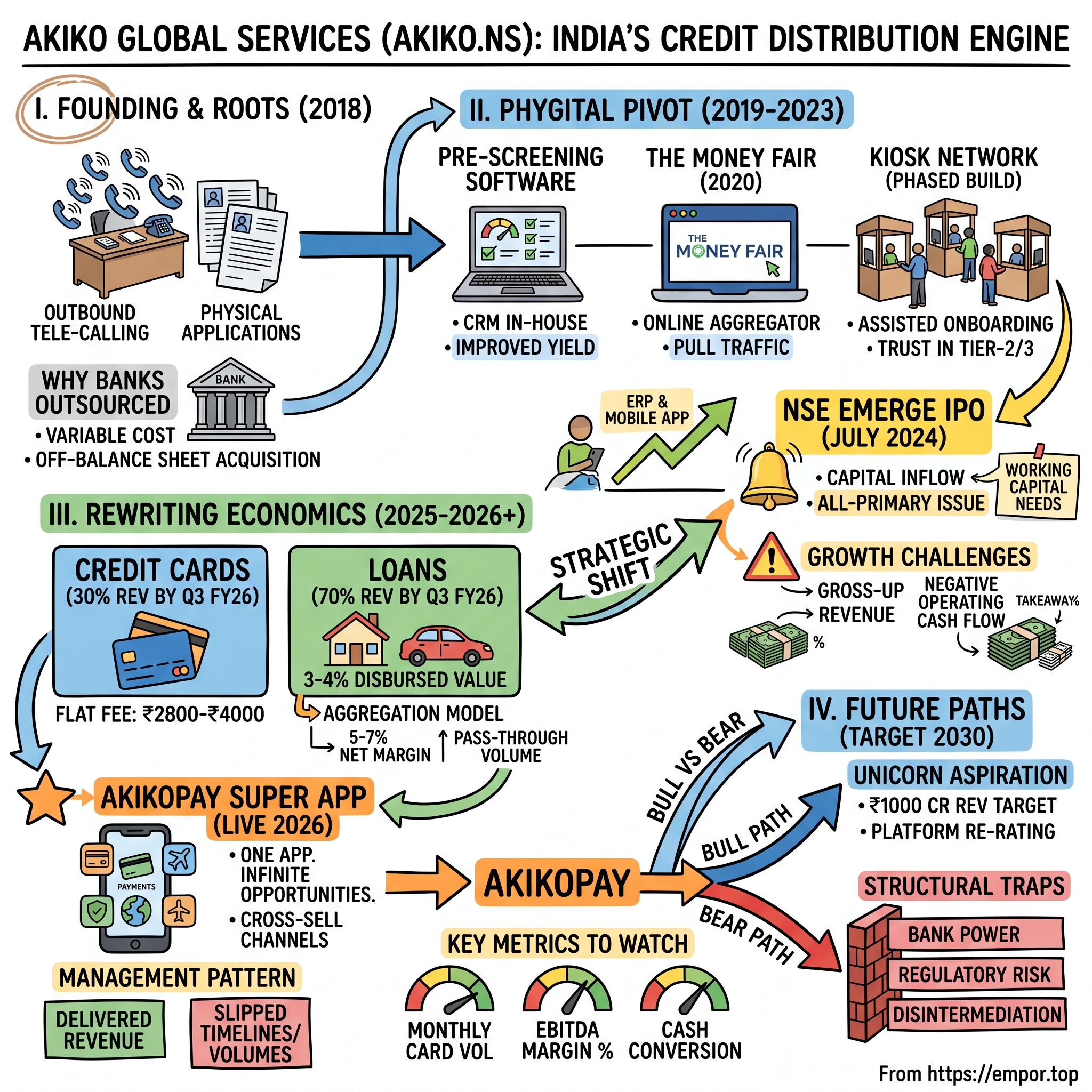
Akiko Global Services: The Story of India's Credit Distribution Engine
I. Introduction & Episode Roadmap
On a Saturday evening in February 2026 — a Saturday, which tells you something already about how a ₹380 crore company on India's SME exchange runs its investor relations — a single man sat down in front of a conference bridge to explain his company's quarter. There was no chief financial officer on the line. No investor-relations head reading prepared remarks. No analyst deck being walked through slide by slide. Just Ankur Gaba, founder and promoter of Akiko Global Services Limited, opening with a sentence that would have made a Fortune 500 IR team wince: "Today I want to share with joy our results for this quarter."5
What followed over the next hour was one of the more revealing documents in Indian small-cap capital markets: an unfiltered, occasionally rambling, frequently unguarded account of what it actually looks like to be a middleman in India's retail credit machine. Gaba disclosed that his company was sourcing roughly 16,000 credit cards a month. He conceded — when an analyst pressed him directly — that during the IPO roadshow he had promised 50,000 a month within a year. He described a customer acquisition cost of ten to fifteen rupees. He projected fifty million users within three years. And he closed by telling shareholders, without irony or hedge, "We are looking forward to being a unicorn company."5
That gap — between a business that genuinely tripled its revenue in two years and a founder whose forecasts run several orders of magnitude ahead of his disclosed operating metrics — is the story of Akiko Global Services. It is a story about the plumbing of Indian consumer finance, about who actually gets paid when a bank issues a credit card, and about whether a distribution agent can ever become something more durable than a distribution agent.
The company in one paragraph
Akiko Global Services Limited trades on the NSE Emerge platform under the symbol AKIKO. Incorporated in New Delhi on June 13, 2018, it operates as what Indian banking calls a Direct Selling Agent — a channel partner that finds customers for banks and non-banking financial companies, submits their applications, and gets paid a commission when those applications convert.9 Its consumer-facing brand is The Money Fair, launched in 2020 as an online aggregator; its newest venture is AkikoPay, a payments-and-credit "super app" that went live on Android in early 2026.12 The company sits between India's largest card issuers — HDFC Bank, SBI Cards, ICICI Bank, Axis Bank — and a retail population where credit cards in force reached 119.44 million in April 2026, growing at about 8% a year.8
For the fiscal year ended March 2026, Akiko reported consolidated revenue of ₹172.73 crore, up 126% year on year, with profit after tax of ₹17.42 crore, up 120%.2 Two years earlier the company had turned over ₹32.40 crore.3 That is a genuinely extraordinary trajectory, and any honest analysis has to start by acknowledging it rather than explaining it away.
The tension
But growth of that shape invites a specific question, and it is the question this entire piece is built around: what kind of revenue is it?
Because the answer, buried in a slide of the company's own December 2025 investor presentation, reframes everything. Akiko's fastest-growing business line is loan lead aggregation, and in that line the company discloses that roughly 90–95% of what it collects is paid straight back out to sub-channel partners, leaving a net margin of about 5–7%.4 In other words, a large and rising share of Akiko's headline revenue is a gross-up — money that passes through the P&L on its way to somebody else. Revenue can triple while the economics underneath barely move.
That is not fraud, and it is not unusual in distribution businesses. But it means the standard small-cap reflex — "revenue doubled, therefore the business doubled" — is exactly the wrong instinct here. Blended EBITDA margin fell from 17.4% in the first half of FY25 to about 13–14% by the second half of FY26, which is what a mix shift toward pass-through revenue looks like in the accounts.613
What this piece will test
Four threads run through the sections that follow. First, the mechanics of Indian retail credit sourcing — how a card gets paid for, why banks outsource it, and why the economics are structurally thin. Second, the phygital model: the combination of digital lead generation, call-centre conversion, and a physical kiosk network that Akiko claims is its differentiator, and whether the evidence supports that claim. Third, capital allocation after the July 2024 IPO — including an acquisition that the outline consensus gets exactly backwards. Fourth, the why-win-versus-why-not spine: what specific, falsifiable mechanism would let a sub-scale channel partner earn durable returns against banks that hold all the leverage and against a competitor in PB Fintech that is roughly forty times its size.
Along the way there will be an unusual amount of primary material to work with, because Akiko's management talks — a lot, and often past the point where a more disciplined company would stop. That is a gift to the analyst and, as we will see, a mixed blessing for the shareholder.
To understand how a Delhi call-centre operator ended up here, you have to start with the industry that created it.
 Subscribe on LinkedIn
II. Founding Roots & The Indian Retail Credit Explosion (2005–2018)
Picture the sales floor of a Delhi financial-products agency in the mid-2000s. Rows of young men and women in cubicles, each with a headset and a printed lead list — names harvested from telephone directories, salary databases, and word-of-mouth. The dial tone, the pitch, the objection, the hang-up. On the desk beside each caller: a stack of physical application forms, carbon-copy triplicate, and a folder of photocopied PAN cards and salary slips. When a customer said yes, a field executive got on a motorcycle and rode across the city to collect signatures and documents. The file then travelled physically to a bank's processing centre, where an underwriter would approve or reject it, often weeks later.
This was the world into which Akiko's founders came up. There was no UPI, no Aadhaar-based e-KYC at scale, no credit bureau API you could ping in three seconds. Verification meant a human being physically looking at a piece of paper. And critically — the thing that made this an industry rather than a chore — the banks did not want to do any of it themselves.
Why banks outsourced their own customers
The logic was straightforward corporate finance. In the 2000s, India's private banks — ICICI, HDFC, Axis — were in a land grab for retail customers. Building the branch and staff footprint to acquire those customers organically would have meant enormous fixed costs: leases, salaries, training, severance risk when volumes turned. Outsourcing acquisition to Direct Selling Agents converted all of that into a variable cost. Pay per approved card. Pay a percentage of each disbursed loan. If the credit cycle turned and the bank wanted to shrink sourcing by 40%, it simply cut the DSA payout schedule and the cost disappeared overnight — off someone else's balance sheet.
That asymmetry is the founding condition of the entire DSA industry, and it never went away. It is worth sitting with, because it explains almost everything about how these businesses are valued and why they trade the way they do. The DSA absorbs the volatility that the bank refuses to hold. In good years that looks like operating leverage. In bad years it looks like a business with no floor.
The commercial logic on the bank's side remains compelling even today. Credit card penetration in India is still low relative to the addressable base — around 119 million cards against a working-age population in the hundreds of millions, and many of those cards are held by the same affluent urban customers stacking three or four.8 Reaching a first-time cardholder in a tier-2 or tier-3 city requires either a branch network you do not have, or somebody else's feet on the street.
The founders
Akiko Global Services Private Limited was incorporated on June 13, 2018.9 The promoter group that emerged around it was small, unusually non-institutional, and — a detail worth flagging early — heavily interlinked.
Ankur Gaba is described by the company as Promoter and Business Development Head, with over twenty years of experience in the financial industry.4 He is not, notably, the Managing Director. That role belongs to Priyanka Dutta, described as a board director with fifteen years of leadership experience across non-profit and for-profit sectors, whose expertise the company frames in terms of organizational management, HR strategy, and compliance.4 Richa Arora serves as Promoter Director and Chief Financial Officer. Gurjeet Singh Walia is an Executive Director. Puneet Mehta, a certified professional in computer applications, rounds out the promoter group.47
There is no career banker in that list — no ex-HDFC cards head, no former NBFC credit officer. This is a sales organization built by salespeople, and the culture that follows from that shows up later in how the company communicates, forecasts, and governs itself. It is a legitimate way to build a distribution business. It is also a specific kind of risk, and we will return to it.
The early operational build in Delhi-NCR followed the template: outbound tele-calling hubs, field verification teams, physical acquisition points. Unglamorous, labour-intensive, and — for a while — quite profitable.
How the money actually works
Here is the mechanic that governs the entire business, stripped of jargon.
When Akiko successfully sources a credit card that a bank approves and the customer activates, the bank pays Akiko a flat fee. The company disclosed that fee as ₹2,800 to ₹4,000 per activated card.4 That is the gross revenue event. Against it sit the costs of generating the lead — digital ad spend, the tele-caller's salary and incentive, the field agent's commission — and whatever share goes to a sub-partner who actually sourced the customer.
Loans work differently. There, Akiko earns a percentage of the disbursed amount: roughly 3–4% of loan value, which the company illustrates as about ₹35,000 on a ₹10 lakh loan.4 The absolute rupee payout is far larger than a card. That single fact — bigger cheque per conversion — turns out to drive the most important strategic shift in the company's history, which the next sections cover.
The bottleneck that created the opportunity
The problem with the mid-2000s model was that it was structurally wasteful. A tele-caller with a cold list would generate applications from customers who had no realistic chance of approval — wrong income band, thin credit file, a recent default. Every rejected application consumed the same acquisition cost as an approved one and returned nothing. Add call-centre attrition rates that in Indian BPO-adjacent businesses routinely ran above 50% annually, and manual verification cycles measured in weeks, and you had an industry where the marginal agency could work extremely hard and earn almost nothing.
The winners in any commission business are the operators who solve for yield — the share of effort that converts — rather than for volume. That insight is not novel. But acting on it required something the industry did not yet have: cheap, programmatic access to credit bureau data and a way to score a prospect before spending money on them.
By 2019, that capability had arrived in India. And Akiko's founders made the bet that defines the company's second act.
III. The Phygital Pivot: Building 'The Money Fair' (2019–2023)
The strategic problem in 2019 was arithmetic, and it was closing in.
Consider what happens to a pure tele-calling operation as it scales. The first thousand calls a day come from the best lists — warm referrals, high-intent enquiries, salaried professionals in known income bands. The next thousand come from worse lists. By the time an agency is running a large floor, the marginal caller is dialling the marginal prospect, and the marginal prospect is not going to be approved. Meanwhile the cost side is rigid: you cannot pay a tele-caller less because their list got worse. Response rates decay, do-not-disturb registries expand, and conversion margins compress toward zero.
This is the operational ceiling that kills most DSAs. They do not fail dramatically; they simply grind down as customer acquisition cost rises to meet gross payout. The only escape routes are to acquire cheaper leads, to convert a higher share of them, or to find a product with a bigger payout per conversion. Akiko eventually attempted all three.
Pre-screening: the unglamorous innovation
The first move was to put software in front of the salespeople.
The concept is easy to explain by analogy. Imagine a job placement agency that sends every applicant to every employer, and gets paid only when someone is hired. Most of those applications waste everyone's time. Now imagine the agency first checks each applicant against each employer's published requirements — years of experience, degree, location — and only submits the ones who fit. The hire rate per submission jumps, the employer starts trusting the agency's recommendations, and the agency's cost per placement falls even though nothing about its sales effort changed.
That is what pre-screening does in credit distribution. Every bank has its own approval logic: minimum bureau score, minimum income, employer category, geography, existing-relationship rules. If you can check a prospect against those rules before submitting the file, you stop burning acquisition cost on applications destined for rejection, and you stop damaging your relationship with the bank by flooding it with junk.
Akiko describes its approach as using a proprietary customer database plus bureau data to target leads, with a CRM built in-house rather than outsourced — a design choice the company frames as letting it integrate with external systems "without the need for outsourcing any customer data."94 That last detail is more consequential than it sounds. In a business where the raw material is other people's financial information, who touches the data is both a competitive question and, increasingly, a regulatory one.
An honest caveat: the company has never disclosed an approval yield rate, a rejection rate, or any before-and-after conversion metric that would let an outsider verify that the pre-screening actually works. The mechanism is plausible and the industry logic is sound. The proof is not in the public record.
The Money Fair
In 2020, Akiko launched The Money Fair — a consumer-facing web platform designed to match a visitor's credit profile against the approval criteria of multiple lenders and present them with products they could realistically get.1218
Strategically, this was an attempt to change the direction of the funnel. A tele-calling agency pushes: it interrupts people who were not thinking about credit. An aggregator pulls: it captures people who arrived already looking. Pull traffic is dramatically cheaper to convert, because intent is the single most expensive thing to manufacture in financial services marketing.
The catch is that pull traffic is also the most contested real estate in Indian fintech. Paisabazaar, BankBazaar and every bank's own website compete for the same search queries, and the cost of a click on "best credit card India" is set by whoever is willing to bid most. A small company cannot outbid a listed unicorn on Google. Akiko's answer, visible in its own disclosures, was to route around search entirely: its stated digital channels are WhatsApp, SMS, Instagram and YouTube campaigns fed by proprietary and bureau data, not paid search.4 That is a meaningfully different play — closer to targeted direct marketing than to organic aggregation.
By the third quarter of FY26, Gaba told investors that roughly 40% of the business was coming "solely through digital marketing," which he characterised as customers arriving on their own.5 The figure is management's, unaudited, and the definition of "digital" is doing some work in that sentence — a WhatsApp campaign to a purchased list is digital marketing, but it is not the same thing as organic inbound demand. Still, directionally it suggests the funnel did shift.
The kiosks, and a disclosure puzzle
The third leg was physical. Akiko built out what it calls a kiosk network — partner locations and merchant points where a customer can get assisted onboarding rather than filling out a financial application alone on a phone.
The rationale is real and specific to India. In a tier-3 town, being asked to photograph your PAN card, your bank statement and your salary slip and upload them to an app you have never heard of is not a UX problem — it is a trust problem. Fraud in Indian digital lending has been prevalent enough that caution is rational. A physical counter with a human being who can be located tomorrow solves something no interface design can.
Here, though, the company's own numbers do not agree with each other. Akiko's December 2025 investor presentation states "2000+ kiosks" nationwide, in two separate places.4 Its November 2025 earnings release, covering an earlier period, states that the company "operates across ~20,000 kiosks."6 That is a tenfold discrepancy between two filings issued five weeks apart. Neither document defines what counts as a kiosk. The company timeline dates the 2,000-kiosk milestone to 2020.4
This is not a rounding difference, and it matters beyond pedantry: the kiosk network is the physical embodiment of the phygital thesis. If an investor cannot establish whether the number is two thousand or twenty thousand, the thesis cannot be sized. Flagging it is not an accusation — it is a statement about the quality of the disclosure an outside shareholder is being asked to underwrite.
Becoming a public company
On April 12, 2023, Akiko Global Services Private Limited converted to a public limited company.9 The mechanics are procedural — expanded board, statutory audit requirements, formalised governance — but the intent was not. This is the step a promoter group takes when it has decided to go to the equity markets.
That same year, the company's own timeline records a milestone that is arguably the best single evidence of operating scale in its history: approval for 1.6 lakh credit cards sourced through Akiko.4 At the disclosed per-card economics, a run-rate of that magnitude is a real business, not a story.
And yet FY24 — the year that ended just before the IPO — told a more complicated tale. Revenue came in at ₹32.40 crore against ₹39.59 crore the prior year, and profit fell from ₹4.53 crore to ₹3.75 crore.3 Akiko went to the public markets immediately after a year in which both its top and bottom lines had shrunk by roughly a fifth. Prospective investors were being asked to look through that decline. Most did.
IV. The July 2024 NSE Emerge IPO & Capital Deployment
The SME IPO window in India in mid-2024 was, by any historical standard, extraordinary. Small companies with modest revenues were being subscribed dozens of times over by retail investors who often had not read a page of the offer document. Into that window, on June 25, 2024, Akiko Global Services opened its book.
The deal
The offer ran from June 25 to 27, 2024, at a price band of ₹73–77 per share, with 30,01,600 equity shares on offer to raise ₹23.11 crore — an all-primary issue with no offer for sale, meaning every rupee went into the company rather than into a selling shareholder's pocket.310 The lot size of 1,600 shares set a minimum retail ticket of ₹1,23,200, which is the SME platform's deliberate design: a price of entry high enough to keep casual punters out.3 Fast Track Finsec ran the book; Skyline Financial Services was registrar.3
It was subscribed roughly 35 times.3 Shares listed on NSE Emerge on July 2, 2024 at ₹98, a 27% premium to the issue price.3
The all-primary structure deserves a moment of credit. In a period when a meaningful share of Indian SME issues were partial cash-outs, Akiko's promoters took nothing off the table at listing. Whatever one concludes about later decisions, that one was shareholder-aligned.
Where the money was supposed to go
The stated objects of the issue were specific and, for a distribution business, sensible: implementation of an ERP solution and a TeleCRM system; development of a mobile application for financial products; working capital; brand visibility spending on the "Akiko Global" and "Money Fair" names; general corporate purposes; and issue expenses.3
Two of those matter analytically. The mobile application became AkikoPay. And working capital was not a throwaway line — it addresses the single most under-appreciated feature of this business model.
Here is the mechanic. When Akiko sources a credit card, it incurs the acquisition cost immediately — the ad spend, the tele-caller's salary, the sub-partner's commission — but the bank does not pay until the card is approved, issued and in many cases activated, and then only on its own settlement cycle. The company is therefore permanently financing the gap between when it spends and when it collects. Growth makes this worse, not better: every incremental rupee of revenue requires an incremental rupee of working capital deployed weeks or months ahead of collection.
The numbers bear this out with unusual clarity. Consolidated trade receivables stood at ₹39.94 crore at March 2025 and ₹49.01 crore by September 2025.6 Debtor days for FY26 were 134.1 Most importantly, cash flow from operations was negative ₹25.56 crore in FY25 and negative ₹2.19 crore in the first half of FY26 — a company reporting healthy accounting profit while consuming cash.6 Management has explicitly acknowledged the issue, targeting a reduction in receivable cycles to 60–70 days.6 As of FY26, that target had not been met.
This is the most important thing to understand about Akiko's financial character, and it is why the "capital-light, asset-light" framing the company favours needs qualification. The business owns almost no fixed assets — true. It is not capital-light in the sense that matters, which is whether growth funds itself. It does not. Borrowings rose from effectively nil to ₹15 crore by March 2026.1
The acquisition nobody mentions
Now the part where the conventional narrative about Akiko is not merely incomplete but inverted.
The common framing of Akiko's capital allocation is that management chose organic technology investment over acquiring legacy DSA books, thereby avoiding goodwill and integration risk. The public record says otherwise. During FY25 — the year immediately following the IPO — Akiko acquired three subsidiaries: 70% of Akiko Global Commercial Broker LLC, 75% of M11 Insurance Agents Private Limited, and 51% of Lotus Broker Network Private Limited.9
The first of those deserves detailed attention, because the company's own filing with the exchange lays out something an investor ought to weigh carefully.
On September 18, 2024 — under three months after listing — Akiko disclosed the acquisition of 70% of Akiko Global Commercial Broker LLC, a UAE entity engaged in credit card DSA work for banks in the Emirates. The disclosure states plainly, in the box asking whether the transaction is a related-party transaction: "Yes, the acquisition will fall within Related Party Transaction. The Company is purchasing shares from Mr. Ankur Gaba and Rajat Arora who are Directors and also Shareholders In Akiko Global Services Limited." The company asserted the transaction was on an arm's-length basis. Consideration was paid in cash at AED 1,296 per share.11
The target's own history, as disclosed: incorporated July 16, 2022. Turnover of nil in FY2021-22, AED 56,700 in FY2022-23, and AED 16,89,200 in FY2023-24.11
So: within twelve weeks of raising ₹23.11 crore from public investors for ERP systems, a mobile app and working capital, the company deployed cash to buy a two-year-old overseas entity from its own founder and a fellow director. The aggregate consideration was not disclosed in the intimation — only the per-share price, without the share count needed to compute the total. An investor cannot determine from the filing how much of their money went to the promoters.
None of this is illegal. Related-party transactions are permitted with proper disclosure and approval, and the company did disclose. But an activist would make three points, and they are fair ones. First, the use of proceeds diverged from the stated objects almost immediately. Second, the counterparty was the promoter. Third, the disclosure omitted the one number — total consideration — that would let shareholders judge whether "arm's length" was a defensible characterisation.
The subsidiaries are not immaterial. In the first half of FY26, standalone revenue was ₹46.86 crore while consolidated revenue was ₹64.49 crore — the subsidiaries contributed roughly 27% of the group top line.6 Consolidated FY25 profit before minority interest was ₹7.91 crore; after minority interest, ₹7.39 crore.64 Minority shareholders now hold real economic claims on Akiko's reported growth.
Ownership
As of March 2026, promoters held 67.29% of the equity, with public shareholders at 30.82%, domestic institutions at 1.86% and foreign institutions at a rounding error of 0.04%. The register listed 468 shareholders.116
That concentration cuts both ways, and the honest reading is that it does not tell you much on its own. High promoter ownership aligns founder wealth with share price. It also means minority holders have no realistic mechanism to influence anything — not board composition, not related-party approvals, not capital allocation. On a platform with 468 holders and negligible institutional presence, there is no one on the register with both the incentive and the standing to push back.
Which raises the question the next section answers with numbers: what did the company actually build with the money and the two years?
V. Business Architecture, Segment Breakdown & Economics
In the third quarter of FY26, an analyst named Subhanu asked Ankur Gaba a simple question: what was the revenue split between credit cards and everything else?
The answer reframed the company. "This time 30% of our distribution is from credit cards and 70% is from the loans business," Gaba said. "Credit cards are at 30%, which used to be 65%-70% a year ago during our peak; now it has diversified towards the loan business."5
Read that again. In roughly twelve months, the segment that had defined Akiko since inception — the credit card sourcing engine — went from two-thirds of revenue to under a third. Not because card volumes collapsed, but because loans grew so much faster around them. Anyone still modelling Akiko as a credit card distributor is modelling a company that no longer exists.
Segment one: credit cards, the shrinking core
The card business remains the higher-quality half of the P&L. Akiko acts as channel partner to banks and NBFCs, earning a flat fee of ₹2,800–₹4,000 per activated card — a payout the company itself notes is "smaller in volume compared to loans but yields higher per-unit revenue."4 Translated: fewer transactions, better margin on each.
Volume ran at about 16,000 cards a month as of early 2026, and was still around that level by the FY26 results.52 At the disclosed fee range, that implies annualised card revenue in the ballpark of ₹55–75 crore — consistent with a 30% share of a ₹173 crore top line.
The strategic driver here is approval yield. Every application that gets rejected consumed acquisition cost and returned nothing, so the entire economic game is shifting sourcing toward cohorts the banks will actually approve. Higher yield means less wasted spend and, just as importantly, a better standing with the bank — issuers rank their DSAs, and the ones with clean books get better payout tiers and higher volume allocations.
The uncomfortable observation is that card volume has been roughly flat while total revenue more than doubled. Whatever is driving Akiko's growth, it is not the core franchise.
Segment two: loans, and the gross-up problem
The loan business is where the growth came from, and it is where an investor needs to be most careful.
Akiko sources personal loans, business and MSME loans, home loans and car loans, earning roughly 3–4% of disbursed value.4 Monthly loan disbursals exceeded ₹400 crore by mid-2026, up from a disclosed ~₹300 crore run rate in late 2025.24 Ninety percent of that book is unsecured; ten percent secured.5
But there are two distinct businesses inside that number, and they have radically different economics.
The first is direct sourcing: Akiko's own salesforce finds a borrower, and Akiko keeps the commission. Good margin.
The second is what the company calls the aggregation model, and here is the disclosure that reframes the financials. Akiko generates loan leads through its digital channels and distributes them to sub-channel partners who close the business. In that arrangement, per the company's own presentation, the payout to sub-channels is "approximately 90–95%," leaving a "net margin around 5–7%."4
Think about what that means mechanically. If Akiko routes ₹100 of commission through the aggregation model, ₹90–95 goes out the door and ₹5–7 stays. But — and this is the crux — the full ₹100 can be recognised as revenue. A business can double its reported top line by pushing more volume through a channel that keeps five paise on the rupee, and the reported growth rate will look spectacular while the absolute profit contribution barely moves.
That is not an allegation of impropriety. Gross versus net revenue recognition in agency arrangements is a genuine accounting judgment, governed by whether the company acts as principal or agent in the transaction, and reasonable auditors can reach different conclusions. But it is the single accounting judgment that most affects how Akiko's headline numbers should be read, and it deserves more disclosure than a bullet on a slide.
The margin trend is consistent with exactly this dynamic. Consolidated EBITDA margin was 17.3% in the first half of FY25, fell to 14.4% in the second half, and 14.1% in the first half of FY26.6 By the fourth quarter of FY26, operating margin had compressed further to 13.63%, down 316 basis points year on year and 236 basis points sequentially, with employee costs rising to 20.41% of sales from 15.19%.13 Revenue growth of 126% against EBITDA growth of 117% is the arithmetic signature of a mix shifting toward lower-margin volume.2
Segment three: The Money Fair and AkikoPay
The digital platform contributes little direct revenue today and is instead positioned as the acquisition funnel for everything else. That is a reasonable framing — the question is whether it becomes a business.
AkikoPay is the bet that it does. Announced on December 3, 2025 with the tagline "One App. Infinite Opportunities," it was pitched as a financial-and-lifestyle super app built on a claimed existing base of 25 million-plus users, integrating payments, credit, insurance, investments and travel booking.124 Phase one covered wallet, RuPay prepaid card, bills, recharges, travel bookings and a full credit suite; phase two, targeted for March 2026, added UPI and QR payments, an insurance stack, mutual funds and SIPs, and micro-credit.4
The company published a year-one revenue projection for AkikoPay of ₹60 crore — ₹48 crore of "user revenue," ₹8 crore of loan and insurance commissions, and ₹4 crore of payment processing fees — with a target of one million active transacting users within six months and "near-zero" customer acquisition cost.4
Against those projections, the disclosed traction as of February 2026: the Android app had been live about ten days with 25,000 downloads on the company's dashboard; the iOS version had not yet shipped; daily wallet deposits ran ₹1.5–2 lakh, of which roughly 60% was spent back through the RuPay card; and the wallet limit was capped at ₹10,000 pending KYC integration.5
Set those side by side. Daily deposits of ₹2 lakh annualise to roughly ₹7 crore of float, not revenue. The gap between that and a ₹60 crore year-one revenue projection is not a matter of execution risk at the margin; it is a difference in kind. The strategic logic — that a payments app owned by a credit distributor lowers acquisition cost for credit products, which is where the real money is — is genuinely sound, and Gaba articulated it well: "this is not just a payment app but a payments plus credit app."5 The economics of the user revenue line remain unexplained.
One further detail is worth pricing in. AkikoPay offers 1% flat cashback on every transaction, funded, per Gaba, out of merchant discount rate income of 1.5–1.8% — effectively handing back half the take rate to buy usage.5 That is a defensible customer acquisition strategy. It is not a high-margin payments business, and it means the app's standalone profitability depends entirely on cross-sell into credit.
The financial arc, and what it means
Put the trajectory together: ₹13.53 crore of revenue in FY22, ₹39.59 crore in FY23, a decline to ₹32.40 crore in FY24, then ₹76.30 crore in FY25 and ₹172.73 crore in FY26.362 Profit followed: ₹0.78 crore, ₹4.53 crore, ₹3.75 crore, ₹7.39 crore, ₹17.42 crore.342 Return on equity reached 29.4% and return on capital employed 37.1% in FY26.1
Those returns are real and they are high. In a business with essentially no fixed asset base, even modest profit generates impressive ratios — which is both the genuine attraction of asset-light distribution and the reason ROE is a weak signal here. It tells you the business needs little balance sheet, not that it has an advantage.
The analytical conclusion is narrower than the headline suggests. Akiko has demonstrated real distribution capability — the card franchise, the lender relationships, the ability to move ₹400 crore of monthly loan volume — and it has scaled faster than almost any peer. But the composition of that growth has shifted toward a pass-through revenue line with mid-single-digit net margins, profit growth has trailed revenue growth, margins have compressed for six consecutive half-years, and the whole thing has consumed rather than generated operating cash. That is a company growing into a thinner business, funding the growth with working capital, and betting that a super app rewrites the economics before the mix does.
Whether that bet is defensible depends entirely on the competitive terrain.
VI. Industry Structure, Competitive Landscape & Power Analysis
Set two companies side by side and the shape of the problem becomes visible immediately.
In FY26, Paisabazaar — the credit arm of PB Fintech — facilitated approximately ₹31,000 crore of loan disbursals and issued 3.5 lakh credit cards. Its parent reported operating revenue of ₹6,794 crore and profit after tax of ₹670 crore.14[^16]
In the same year, Akiko sourced roughly 16,000 cards a month — call it 1.9 lakh annually — on revenue of ₹172.73 crore.25
The card comparison is genuinely striking: Akiko sources more than half the card volume of India's best-known digital credit marketplace. On loans the gap is far wider, with Paisabazaar's disbursals running several multiples of Akiko's roughly ₹4,800 crore annualised. And on parent-company scale it is not a contest at all — PB Fintech's profit alone is nearly four times Akiko's entire revenue.
That comparison establishes two things simultaneously. Akiko is a real operator in card sourcing, not a shell. And it is competing in a market where the largest player can outspend it on brand, technology and customer acquisition by an order of magnitude, indefinitely, without noticing.
The competitive map
The field sorts into three tiers.
At the top sit the mega-cap digital aggregators — PB Fintech above all — which own high-intent organic traffic built on years of brand spending and operate direct integrations with dozens of lenders. Their advantage is that the customer arrives already looking. Their acquisition cost per high-intent visitor is structurally lower than anyone can achieve by buying that visitor's attention.
In the middle sit venture-backed niche aggregators like BankBazaar and CreditMantri, which built credit-score-led funnels and digital conversion machinery. Their competitive position has been squeezed from both directions — insufficient scale to match PB Fintech's brand, insufficient physical presence to reach customers digital funnels lose.
At the bottom sit thousands of unorganised regional DSAs: local agencies running on paper, WhatsApp and personal relationships, with no technology layer and no multi-bank integration. They are numerous, price-competitive at the margin, and collectively enormous.
Akiko positions itself between tiers two and three: a technology-enabled distributor using digital lead generation for intake, then converting through call centres, feet-on-street agents and kiosk touchpoints.4 The claim is that this captures borrowers who start a digital journey and abandon it — the ones a pure app loses at the document-upload screen.
The claim is plausible. It is also, at present, unverified in any external data, because Akiko discloses neither its conversion rates nor its funnel economics.
Seven Powers, tested rather than asserted
Running Hamilton Helmer's framework against the evidence produces an uncomfortable but clarifying result.
Process Power — moderate at best, unproven. The argument is that in-house CRM, bureau-driven targeting and pre-screening produce higher approval yields than an unorganised DSA can manage. The mechanism is credible. But process power in Helmer's sense requires something a competitor cannot replicate quickly, and bureau APIs and CRM software are purchasable. Without published yield data, this reads as an operational competence rather than a durable power.
Scale Economies — low. Volume presumably earns better commission tiers from banks, and the fixed cost of the technology stack spreads across more units. But Akiko's own accounts undercut the story: costs are not behaving like fixed costs. Employee expense grew faster than revenue in the fourth quarter of FY26.13 If scale were producing economies, margins would be expanding. They have been compressing.
Network Effects — low. More lender partners improve the match rate on The Money Fair, and more customers make the platform more attractive to lenders. But financial products are non-exclusive and lenders sit on every comparable platform. Nothing about Akiko's marketplace gets structurally better as it grows in a way a rival's does not.
Counter-Positioning — none. Akiko does not do something the incumbents cannot copy without damaging their existing business. It is the incumbents' outsourced sales arm. This is the opposite of counter-positioning.
Switching Costs — very low, and this is the central vulnerability. A consumer who gets a card through Akiko has no relationship with Akiko afterwards; the relationship is with the bank. And on the other side, a bank can reallocate sourcing quotas to a rival DSA at will, with no notice and no cost. AkikoPay is a direct and explicit attempt to manufacture switching costs where none exist — to convert a one-time transaction into a daily-use relationship. That is precisely the right strategic instinct. It is also, so far, a hypothesis with 25,000 downloads behind it.
Branding and Cornered Resource — neither applies materially. The Money Fair is not a consumer brand with pricing power, and Akiko controls no scarce asset.
Porter's five forces
Buyer power (the banks): very high, and structurally so. The banks are not customers in the ordinary sense — they are the source of essentially all revenue, they set the payout per card and the percentage per loan unilaterally, they define approval criteria, and they can change any of it. Gaba's response when asked directly about lenders becoming more selective was to point to diversification across multiple banks and NBFCs.5 Diversification genuinely reduces single-partner risk. It does nothing about industry-wide payout compression, because a DSA has no leverage against any of them.
Threat of substitutes: high and rising. Every mechanism India has built to make credit frictionless — the Account Aggregator framework for instant consented data sharing, video KYC, pre-approved offers pushed through a bank's own app, credit lines on UPI — reduces the reason a customer needs an intermediary. This is not a five-year-out risk. It is compounding now.
Rivalry: high. Organised fintechs above, thousands of local agencies below, and a product with no differentiation. The only variables are payout share and conversion efficiency, which is a definition of commodity competition.
Supplier power (advertising platforms): moderate to high. Meta and Google set the price of financial-services attention, and that price only moves one way. Akiko's use of WhatsApp, SMS and proprietary databases is a partial hedge, though WhatsApp is itself Meta infrastructure and its commercial messaging pricing is not Akiko's to control.
The composite picture is a business operating in one of the least defensible structural positions in financial services, attempting — through AkikoPay — to build the one power it lacks. The strategy is correct. The execution evidence is thin. And in a position this exposed, the quality of management judgment matters more than in almost any other kind of business.
VII. Management Credibility, Governance & Skeptical Stress Test
The most valuable minute of the February 7, 2026 earnings call came near the end, when an analyst declined to be charmed.
"Sir, in one of your roadshow calls during the IPO time, you said your monthly card volume would reach 50k per month within 1-year," Subhanu said, "but currently you are saying your monthly volume is around 16k, am I right?"
Gaba's reply: "Yes, you are 100% right sir."5
Give him credit for that. He did not deflect, did not dispute the premise, did not blame the environment before conceding the fact. He then explained: regulations tightened in the credit card business, so the company redirected effort into loans, where margins were better and the investment was lower. "That's why we focused less on taking the card volume to 50,000."5
That exchange is the single best window into how to assess this management team, because it contains both the encouraging and the concerning signal at once.
The pattern of target-setting
Look at the record over eighteen months and a consistent shape appears: aggressive targets, real delivery on near-term revenue, and repeated slippage on the operating metrics that would validate the strategy.
On revenue, management has delivered. In the November 2025 earnings release, the stated target was 90–100% revenue growth for FY26.6 Actual growth was 126%.2 On the February call, Gaba said he had committed to a ₹160 crore top line and expected ₹170–180 crore.5 Actual: ₹172.73 crore.2 Setting a target and beating it, twice, in public, is a genuine credibility asset and should be counted as such.
On operating metrics, the record is weaker. Card volume landed at roughly a third of the IPO-era promise. The receivable cycle target of 60–70 days was not achieved; debtor days ran at 134 in FY26.61 Insurance distribution, scheduled in the November 2025 release for a Q3 FY26 pilot with full rollout in the second half, was still not live in February, when Gaba said it would "start from April onwards."65
The reasonable synthesis: this is a management team that reliably hits the number the market watches most, and reliably slips on the numbers that are harder to see. That is a common pattern and not automatically damning. But it means an investor should weight the revenue guidance and heavily discount the operational timelines.
Forecasts that outrun the evidence
Where credibility becomes genuinely strained is in the long-range projections.
On the February call, asked about AkikoPay's opportunity size, Gaba described a fifty million customer base within three years and roughly ₹50 crore of PAT from the app in that window — adding, when the analyst sought to confirm it, "This is the minimum."5 By the FY26 results in May 2026, the framing had extended further: ₹300 crore of revenue targeted for FY27, and ₹1,000 crore of revenue with 12–13% PAT margins by FY2030, with AkikoPay contributing ₹50–100 crore.2
Consider the FY27 target against the run rate. April and May 2026 turnover came to ₹43.75 crore combined, which annualises to roughly ₹262 crore.2 Reaching ₹300 crore requires meaningful acceleration through the year — not impossible for a company that has grown this fast, but not the automatic outcome the framing implies. And the FY2030 aspiration embeds both a near-sixfold revenue increase and a margin expansion from roughly 10% to 12–13%, at a time when margins have compressed in every reported half-year since FY25.
The tell is not that the targets are ambitious. It is that management has not published the operating bridge — the mix, the volumes, the take rates — that would connect today's business to them. On the February call, Gaba explicitly declined to give a numeric figure when pressed on near-term aspirations, saying the focus would be on "execution, sustainability, and growth," and then, minutes later, offered a fifty-million-user, ₹50 crore PAT projection as a minimum.5 Those two postures are hard to hold simultaneously.
Then there is the closing line: "We are looking forward to being a unicorn company. I see Akiko as a unicorn company."5 For a business with ₹173 crore of revenue and a market capitalisation of roughly ₹379 crore, a unicorn valuation implies a more than twentyfold re-rating.1 Framing that on an earnings call, to retail shareholders, is a choice about how one communicates.
The stress test
Test one: bank concentration. The vulnerability is that a small number of issuers drive most card revenue, and Akiko does not publish partner-level concentration. If a major partner cut DSA payouts by a quarter or internalised sourcing, the impact would flow through immediately and Akiko would have no contractual recourse. Management's answer is diversification across multiple banks and NBFCs plus the shift into loans.5 That is a real mitigation for idiosyncratic risk. But note what actually happened: when the card environment tightened, the company's response was to pivot into a lower-margin product line. Diversification purchased revenue continuity at the cost of mix quality — which is precisely what the margin trend shows.
Test two: regulation. The RBI's digital lending framework governs how lending service providers handle customer data, disclose fees and obtain consent.15 Asked about regulatory risk on the call, Gaba's response was unusually flat: "No sir, there is no risk, I will tell you." He argued that because Akiko does not lend, the regulation applies to its partners, and that the company takes digital consent before any campaign or disbursement.5
The consent practice is a genuine mitigation and it is good that it exists. But "there is no risk" is not a serious answer for a company whose entire lead engine depends on outbound WhatsApp, SMS and tele-calling to bureau-sourced lists. India's Digital Personal Data Protection regime, tightening rules on unsolicited commercial communication, and any future restriction on bureau-data-driven marketing all bear directly on the cost of Akiko's funnel. A regulatory change that raises the cost of reaching a prospect by 30% flows straight into a business whose net margin on aggregated loan volume is 5–7%.
Test three: SME platform, governance and disclosure. NSE Emerge listings carry thin liquidity — daily volume in July 2026 ran in the low tens of thousands of shares19 — wide spreads and essentially no sell-side coverage. There is no disclosed timeline or milestone framework for migrating to the NSE Mainboard; management has not addressed it in the materials reviewed here.
More concerning is a cluster of disclosure quality signals that, individually minor, form a pattern. The kiosk count differs tenfold between two filings five weeks apart.46 Headcount is stated as "4,000+ strong workforce" across Akiko and subsidiaries in the December 2025 investor presentation, and as "950+ personnel from 350+" in the May 2026 investor meet reporting — figures that cannot both be describing the same thing without a definition neither document provides.42 A consolidated EPS figure was published incorrectly in a results presentation as ₹7.2 against an actual ₹10.05, caught by an analyst on the call rather than in review.5 Earnings calls feature the promoter alone, with no CFO present, despite the company having a CFO on its board.45
And on July 21, 2026 — one week before this writing — the company informed the exchange that a virtual analyst and institutional investor meet scheduled for July 23 had been cancelled citing "unavoidable circumstances," with no further specificity, and said it might be rescheduled depending on participant availability.17 One cancellation proves nothing. In combination with the rest, it belongs in the file.
The fair conclusion is not that management is dishonest. The evidence points to something more ordinary and more common in fast-growing founder-led SMEs: a promoter running a genuinely successful sales organisation at a scale that has outgrown its governance and disclosure infrastructure, communicating with the enthusiasm of a salesperson rather than the precision of a public-company steward. For an outside shareholder, the practical consequence is the same either way — the disclosures require more discounting than the growth rate alone would suggest.
VIII. Material Risk Radar & Critical KPIs
Every business has a risk register. Most of them are boilerplate. Akiko's is not, because the risks here are not tail events — several are already visible in the reported numbers.
The risks that are actually operating
Bank disintermediation — high, and already compounding. This is the existential one. India has spent a decade building infrastructure whose explicit purpose is to remove friction from financial transactions: Aadhaar-based e-KYC, video KYC, the Account Aggregator framework that lets a customer share verified bank data with a lender in seconds, credit lines on UPI, and pre-approved offers pushed directly through banking apps. Every one of these reduces the reason a customer needs a human intermediary.
The mechanism by which this hurts Akiko is not dramatic. Banks will not announce that they are cutting DSAs. They will simply find that their own app converts a pre-approved customer at a lower cost than a channel partner does, and quietly shift the mix. Payout per card compresses a few hundred rupees at renewal. Volume allocations tilt toward direct. Nothing breaks; the economics just erode, year after year, and the DSA absorbs it because it has no alternative buyer.
Regulatory and compliance — high. Beyond the digital lending framework already discussed, the specific exposure is data. Akiko's targeting depends on proprietary and bureau data used for outbound campaigns.4 Any tightening of consent requirements, restrictions on bureau-data-driven marketing, or enforcement under India's data protection regime raises the cost of every lead. In a business earning single-digit net margins on its fastest-growing line, that is not a compliance cost — it is a P&L event.
Margin compression from mix — already happening, not a risk but a condition. Six consecutive reported half-years of declining EBITDA margin, against management guidance of 13–15%.6 The FY26 exit rate sat at the bottom of that band.13 The bet embedded in the FY2030 target is that this reverses. Nothing in the reported data yet suggests it has begun to.
Working capital and cash conversion — high. Persistently negative operating cash flow alongside rising profit, receivables growing faster than revenue, and the emergence of borrowings where there was previously almost none.61 A distributor financing a lengthening receivable cycle out of an increasingly levered balance sheet is running a real refinancing risk if growth stalls or a large counterparty delays settlement.
Credit cycle — medium, and cyclical. Ninety percent of Akiko's loan book sourcing is unsecured.5 When the RBI raised risk weights on unsecured consumer credit and credit card receivables in November 2023, banks tightened approval criteria across the system. A repeat — or a rise in unsecured delinquencies prompting lenders to tighten independently — hits Akiko twice: fewer approvals per application, and lower payouts as banks defend their own economics. Card spending growth had already moderated to about 7% year on year by April 2026, with ICICI Bank's card spends actually declining 7.35%.8 The tailwind is not as strong as the narrative implies.
Key-person concentration — high. One promoter conducts the earnings calls, sets the targets, describes the strategy and personally negotiates the bank relationships. There is no visible bench.
The three metrics that matter
Most of what gets reported about this company is noise. Three things are signal.
One: monthly credit card sourcing volume. Akiko discloses this, and it is the cleanest available proxy for the health of the original franchise and the strength of its bank relationships. It captures approval yield indirectly — a DSA whose pre-screening works gets more cards approved from the same effort and earns better allocations from issuers. The reference points are already public: 16,000 a month currently, against an IPO-era promise of 50,000 and a stated expectation that AkikoPay would organically generate 20,000–25,000 cards a year after launch.5 If this number breaks meaningfully upward, the platform thesis is working. If it stays flat while revenue grows, the growth is coming from pass-through volume.
Two: blended EBITDA margin, read against the card-versus-loan revenue mix. This is the direct test of whether scale is producing operating leverage or whether mix is eating it. Because the aggregation model returns 90–95% of gross commission to sub-partners, a rising loan share mechanically dilutes blended margin regardless of how well the company executes.4 Watching margin alone is insufficient; watching mix alone is insufficient. The pair, together, tells you whether Akiko is becoming a better business or simply a bigger one. Management guides to 13–15% EBITDA and has been printing at the low end.613
Three: cash conversion — operating cash flow measured against reported profit, and debtor days. This is the integrity check on everything else. A distribution business that reports rising profit while consuming cash is either growing faster than its balance sheet can support, or has receivables that are not converting on schedule. Management has set an explicit, public target of 60–70 receivable days.6 That gives an outside investor a clean, management-defined benchmark to hold them to — the rare case where a company has handed shareholders the exact yardstick.
A note on what cannot be tracked. The metrics that would most directly validate the strategic story — approval yield rate, cost per acquired customer, the share of leads originating organically through The Money Fair and AkikoPay versus purchased channels — are not disclosed. Management referenced a ten-to-fifteen rupee acquisition cost for AkikoPay users on the February call, but that figure appears in no filing, carries no definition, and cannot be reconciled to reported marketing spend.5 Investors should treat the digital-transformation narrative as unverified until the company publishes numbers against it.
Which sets up the final question: given all of this, what is the honest case on each side?
IX. Bull vs. Bear Investment Case
The bull case: why Akiko could win from here
The market is genuinely large and genuinely growing. India's credit card base expanded 8.19% year on year to 119.44 million by April 2026, with FY26 card spending reaching ₹23.62 trillion.8 The unsecured lending market Akiko serves is measured in tens of lakhs of crores.4 Even a distributor with poor structural power can compound for years in a market expanding this fast, simply by holding share. Akiko does not need to beat PB Fintech; it needs the pond to keep getting bigger.
The distribution asset is real, not rhetorical. This is the strongest fact in the bull case and it deserves emphasis. Sourcing over 1.9 lakh credit cards a year puts Akiko at more than half the annual card issuance volume of Paisabazaar, a company with a parent forty times its revenue.2514 Building that takes years of bank relationships, compliance track record and operational execution that cannot be bought. Moving ₹400 crore of monthly loan disbursals through the system is not something a new entrant replicates quickly.2
The phygital model addresses a real market failure. The trust gap in non-metro India is not a marketing story — it is why digital-only funnels leak badly at document upload. A distributor that can hand a hesitant customer to a human being at a physical counter converts prospects a pure app loses. If the kiosk network is anywhere near the larger of the two disclosed figures, that is a genuinely difficult asset to replicate.
AkikoPay is the right strategic answer to the right problem. Management has correctly diagnosed that the fundamental flaw in DSA economics is the absence of a customer relationship after the transaction. A payments app that a customer opens daily creates the repeat contact that turns a one-time commission into a lifetime value. Gaba's framing — leveraging an existing credit funnel to acquire payment users cheaply, rather than burning capital on cashback wars — is strategically coherent and explicitly rejects the burn model that destroyed most Indian payment startups.512 If it works, the re-rating from distributor to platform is substantial.
The company has beaten its own revenue guidance twice. In a small-cap universe where guidance is routinely aspirational, delivering above a publicly stated target two years running is meaningful evidence of forecasting discipline on the metric that matters most.652
Financial returns are high and the balance sheet is not stretched. ROE near 29% and ROCE above 37% in FY26, with modest borrowings against a substantially larger equity base.1 There is no near-term solvency question.
The bear case: what breaks the thesis
The structural position is the weakest in the value chain, and no amount of execution fixes it. Akiko sells commodity products, sourced from counterparties who set every commercial term, to customers who form no relationship with it. Bank buyer power is not a risk factor — it is the definition of the business model. When the card environment tightened, Akiko's response was not to negotiate; it was to redeploy into a different product. That is what having no leverage looks like in practice.
The growth is lower-quality than the headline. This is the crux of the bear case and it rests on the company's own disclosure: an aggregation model returning 90–95% of gross commission to sub-partners at a 5–7% net margin.4 Revenue growth of 126% against EBITDA growth of 117% and six half-years of margin compression is what that mix shift produces in the accounts.2613 An investor paying a multiple on revenue growth is paying for gross-up.
Profit is not converting to cash. Negative operating cash flow through FY25 and the first half of FY26, receivables outgrowing revenue, debtor days at 134 against a 60–70 day target, and borrowings appearing on a previously clean balance sheet.61 For a business whose growth is working-capital-hungry by design, this is the mechanism by which fast-growing distributors fail — not through a bad quarter, but through a funding gap that opens when growth outruns collection.
Disintermediation is a slow, permanent headwind. Account Aggregator, video KYC and pre-approved in-app offers do not need to eliminate DSAs to damage them. They only need to make direct sourcing cheaper at the margin, which shifts allocation and compresses payout, indefinitely.
Competitive asymmetry on acquisition cost. PB Fintech's brand-driven organic traffic gives it a structurally lower cost per high-intent customer, and its FY26 profit exceeds Akiko's entire revenue by nearly four times.14 In any bidding war for digital attention, that ends one way.
Governance and disclosure carry a real discount. Tenfold inconsistency in kiosk disclosure, irreconcilable headcount figures, a published EPS error caught by an analyst, a promoter-only earnings call with no CFO, a cancelled analyst meet citing unspecified circumstances, and a post-IPO related-party acquisition of a promoter-owned entity whose total consideration was never disclosed.46251711 Individually explicable; collectively, a pattern that warrants scepticism about every unverified operating claim.
Projection risk. A ₹1,000 crore FY2030 target with expanding margins, set against six half-years of compressing margins, and a "minimum" ₹50 crore PAT projection for an app with 25,000 downloads.25 When management's stated floor is many multiples of demonstrated traction, the forecast is not a plan — it is an aspiration, and it should be weighted as one.
Illiquidity. Thin volumes on NSE Emerge, negligible institutional ownership, and no disclosed mainboard migration path mean an investor's ability to change their mind is constrained.119
Where the two cases meet
The bull and bear cases are not arguing about the same thing, which is why both can feel persuasive.
The bull case is about the market and the distribution asset: a large, growing pond and a company that has proven it can catch fish in it. Both are true.
The bear case is about what the company gets to keep: a structural position with no pricing power, a mix shifting toward pass-through revenue, and profit that has not converted to cash. Those are also true.
The resolution runs entirely through AkikoPay, and it is falsifiable — which is the useful thing about it. If the app converts a meaningful share of Akiko's customer base into repeat users and those users generate credit cross-sell, the company earns a relationship it has never had, acquisition cost falls, and margin expands. Card volumes should visibly inflect, and blended margin should rise even as loan revenue grows. If instead the app plateaus at low six-figure downloads while the loan aggregation line keeps expanding, Akiko will be a larger, thinner, more working-capital-intensive version of what it already is.
The evidence available as of mid-2026 does not settle it. What it does establish is exactly which numbers will.
X. Strategic Playbook & Investing Lessons
Three transferable lessons come out of this story, and none of them is specific to Akiko.
Lesson one: in emerging markets, the last mile is a trust problem, not a technology problem
The instinctive Western read on Indian fintech is that digital distribution should have eliminated human intermediaries by now. The infrastructure exists. Onboarding takes minutes. And yet a company running call centres and physical counters grew revenue 126% in a year.2
The reason is that in a tier-3 Indian town, the barrier to getting a credit card was never the interface. It was being asked to hand your PAN card, salary slip and bank statements to a screen. Verification friction is technical and solvable. Trust friction is social and is not solved by a better form.
That has a specific investing implication: in markets where formal financial inclusion is still being built, hybrid distribution models can hold economics far longer than the pure-digital thesis predicts. But — and Akiko's own numbers make this point — it does not mean the hybrid model earns good economics. It means it earns some economics, for longer than expected. The trust advantage keeps a distributor in business. It does not give it pricing power over the bank.
Lesson two: in a channel-partner business, revenue quality matters more than revenue growth
If there is one thing to take from this company's financial history, it is this.
Akiko's reported revenue grew 126% in FY26. Its EBITDA grew 117%. Its EBITDA margin fell. Its operating cash flow was negative.216 All four statements are true simultaneously, and the reconciliation sits in a single line on an investor slide: an aggregation model that pays out 90–95% of gross commission and keeps 5–7%.4
The generalisable lesson is that in any agency or distribution business, the first analytical question is not how fast is revenue growing but what fraction of that revenue does the company keep, and is that fraction stable? A business can post spectacular top-line growth by routing more volume through a channel that returns almost nothing, and the accounting will be entirely correct while the economic reality is that very little changed.
The practical test is a three-way comparison. Revenue growth versus gross-profit or EBITDA growth tells you whether mix is diluting. EBITDA growth versus operating cash flow tells you whether the profit is real. Where all three diverge, the top-line number is the least informative of the set.
The corollary for channel partners specifically: survival demands ruthless cost discipline and continuous product diversification, because single-partner leverage is fatal. Akiko diversified from cards into loans and is now pushing into insurance and mutual funds.4 That is textbook correct behaviour for this position. It is also an admission of how little leverage the position confers, since each diversification step traded margin for continuity.
Lesson three: SME IPO capital allocation is where the story meets the ledger
A company's first year as a public company is the highest-information period an outside investor ever gets. The promoter has just told the market, in a legal document, exactly what they intend to do with the money. Then they do something. The gap between those two things is the most reliable read on governance an investor will ever obtain.
Akiko told the market it would spend on ERP and TeleCRM systems, a mobile application, working capital and brand.3 Within twelve weeks of listing, it deployed cash to acquire 70% of a two-year-old UAE entity from its own founder and a fellow director, disclosed as a related-party transaction on an asserted arm's-length basis, with a per-share price published but no aggregate consideration.11
The lesson is not that the acquisition was wrong — the target was in the same line of business, and building a UAE card distribution operation from scratch would have taken years. The lesson is about what an investor should do with the observation: recalibrate. When stated use of proceeds and actual deployment diverge this early, and when the counterparty is the promoter, every subsequent forward-looking statement from that management team should carry a wider confidence interval.
Set against that, the genuinely commendable choice: the IPO was entirely primary, with no offer for sale.10 The promoters put money in rather than taking it out. Both facts belong in the same assessment, and an investor who only holds one of them is not doing the work.
The question that remains
Akiko Global Services occupies a position that thousands of businesses occupy in every emerging market: the intermediary who does the work the big institution does not want to do, paid on terms the big institution sets. Most such businesses never grow. A few, like this one, grow spectacularly for a while by finding a product line with a bigger cheque and pushing more volume through it.
The rarest outcome is the one Akiko is now attempting — converting distribution scale into an owned customer relationship, and thereby escaping the structural trap entirely. That transition, from intermediary to platform, is the most valuable move available in financial services and the one most frequently attempted and failed.
The tools management has chosen are the right ones. The strategic diagnosis is sound. What is missing, as of July 2026, is evidence — the operating metrics that would show the transition beginning rather than merely being described. Those metrics exist. The company simply has not published them yet.
References
-
Akiko Global Services Ltd — Consolidated Financials, Ratios and Shareholding — Screener.in ↩↩↩↩↩↩↩↩↩↩↩
-
Akiko Global Services turnover surges 329% in May 2026; FY26 results and FY27 guidance — ScanX, 2026-06 ↩↩↩↩↩↩↩↩↩↩↩↩↩↩↩↩↩↩↩↩
-
Akiko Global Services IPO — Issue Details, Subscription, Objects and Listing — Goodreturns, 2024-07 ↩↩↩↩↩↩↩↩↩↩↩
-
Akiko Global Services Limited — Investor Presentation "Achieving Global Excellence" — NSE filing, 2025-12-01 ↩↩↩↩↩↩↩↩↩↩↩↩↩↩↩↩↩↩↩↩↩↩↩↩↩↩↩↩↩↩↩
-
Akiko Global Services Limited — Q3 FY26 Earnings Update Conference Call Transcript — NSE filing, 2026-02-09 ↩↩↩↩↩↩↩↩↩↩↩↩↩↩↩↩↩↩↩↩↩↩↩↩↩↩↩↩↩↩
-
Akiko Global Services Limited — H1 FY26 Earnings Release Presentation — The Money Fair, 2025-11-08 ↩↩↩↩↩↩↩↩↩↩↩↩↩↩↩↩↩↩↩↩↩↩
-
India's Credit Card Spends Rise 7% to ₹1.97 Trillion in April 2026: RBI Data — Angel One, 2026-05 ↩↩↩↩
-
Akiko Global Services Ltd — Company Summary, Corporate History and Subsidiaries — India Infoline ↩↩↩↩↩
-
Akiko Global Services Ltd IPO — Issue Structure and Details — m.Stock ↩↩
-
Akiko Global Services Limited — Intimation of Acquisition under Regulation 30, SEBI LODR (Akiko Global Commercial Broker LLC) — NSE filing, 2024-09-18 ↩↩↩↩
-
Akiko Global announces the launch of AkikoPay — The Tribune, 2025-12-03 ↩↩↩↩
-
Akiko Global Services Q4 FY26: Explosive Growth Story Faces Margin Pressure — MarketsMojo, 2026-05 ↩↩↩↩↩↩
-
PB Fintech reports 115% YoY PAT growth to ₹670 Cr in FY26; total insurance premium surges 42% — ScanX, 2026-05 ↩↩↩
-
Guidelines on Digital Lending — Reserve Bank of India, 2022-09-02 ↩
-
Akiko Global Services Ltd — Financial Analytics and Shareholding — Trendlyne ↩
-
Akiko Global Services cancels analyst meet scheduled for July 23 — ScanX, 2026-07-21 ↩↩
-
Akiko Global Services Ltd — NSE India Equity Profile and Corporate Filings ↩↩
 LinkedIn
 WhatsApp
 Reddit
 Hacker News
 Email
Email Kindle
 RSS Feed
 Spotify
 Apple Podcasts
 Amazon Music
 Audible
 YouTube