AGS Health: The Fastest Flip in Indian Healthcare Outsourcing
I. Introduction & Episode Roadmap (0:00–3:00)
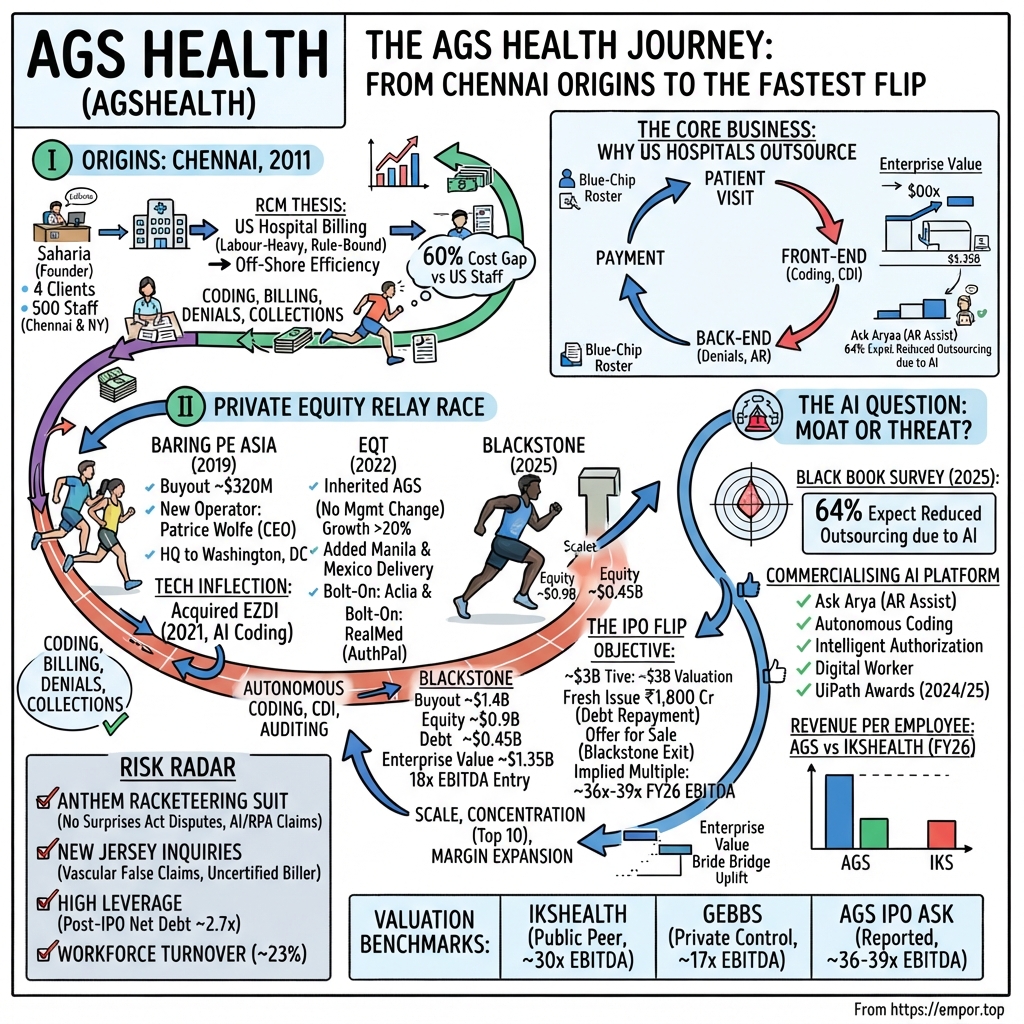
On August 7, 2026, a company that most American patients have never heard of signed the paperwork to ask Indian investors for ₹4,800 crore. AGS Health Limited, a Chennai-registered company that codes, bills and chases payment for US hospitals, dated its Updated Draft Red Herring Prospectus – I (UDRHP-I) that day, proposing a ₹1,800 crore fresh issue and a ₹3,000 crore offer for sale by its promoter, a Singapore holding company controlled by Blackstone.1 The document states that AGS served 149 customers at March 31, 2026, including 82 hospitals and health systems and, according to the Zinnov industry report the company commissioned, 11 of the 20 largest hospitals in the United States.2
The obscurity is part of the business model. Revenue cycle management, or RCM, is the plumbing between a patient visit and a hospital's bank account: checking insurance before care, translating a doctor's notes into billing codes after it, filing claims, fighting denials and collecting what is owed. When it works, nobody notices. When it fails, a hospital with a thin operating margin can lose millions to paperwork. AGS has built a business on doing that work from India, the Philippines, Mexico and the United States, and on convincing large American health systems to let an outside firm touch their revenue.
The hook is the ownership history. Baring Private Equity Asia bought AGS in 2019 for a reported $320 million.3 EQT inherited it in 2022 when it bought Baring's parent business.4 Blackstone completed its purchase from the Baring Asia fund in August 2025 in a deal reported at $1.4 billion.5 About eight months later, Bloomberg-sourced reports said Blackstone was weighing an Indian IPO at a valuation of up to $3 billion.6 Three owners in seven years, and a public listing roughly a year after the last buyout.
That raises the question this story has to answer. Is AGS a real value-creation story, a well-run offshore services company that has become more technology-led and deserves a higher multiple? Or is it a sponsor capturing the gap between what global buyers pay for a US healthcare services business and what Indian public markets will pay for the same cash flows? And under both questions sits another: can a business built on trained human coders survive a wave of artificial intelligence that its own customers say will reduce outsourced coding work?
The evidence is better than it would be for most private companies, because a real filing now exists. The UDRHP-I gives restated and proforma financials, customer concentration, retention, workforce, borrowings, litigation, executive pay and the price Blackstone paid. It does not give the price band, the final valuation, a revenue split by service line or an AI revenue number. The story below uses what the document shows, corrects several widely repeated claims that it contradicts, and keeps the remaining gaps visible.
 Subscribe on LinkedIn
II. Origins: Chennai, 2011, and the RCM Thesis (3:00–8:00)
AGS Health's own history says it started in 2011 with four clients and about 500 full-time staff in Chennai and New York.7 The legal entity that is now going public was incorporated in November 2010 and is registered in Chennai.8 Devendra Saharia founded the company and led it as chief executive.9
The founding bet was simple. American hospital billing is labour-heavy, rule-bound and badly staffed, and much of it can be done remotely by trained people working from structured records. A coder in Chennai can read an electronic chart, assign diagnosis and procedure codes, and pass the claim along at a fraction of the cost of a coder in Ohio. The UDRHP-I cites the Zinnov report's estimate that offshore resources can cost up to about 60% less than equivalent US-based staff.2 That gap was the whole thesis in 2011, and it is still the base of the company's margins today.
The business grew on that thesis for most of a decade. When Baring bought control in 2019, AGS had more than 6,000 employees worldwide, according to the press release announcing its new chief executive.9 EQT's later case study describes that pre-acquisition workforce as organically grown since 2011.10 The company's own timeline says it passed 10,000 full-time staff in 2021.7
The 2019 transaction ended the founder era. Baring acquired AGS for a reported $320 million.3 In August 2019, AGS announced that Patrice Wolfe would become CEO from September 9, 2019, succeeding Saharia. The board representative quoted in the release, Kenneth Cheong, described the choice as the result of "a thorough succession planning exercise."9 The release presented the handover as orderly, with the outgoing founder praising the incoming CEO.
The origin story is kept short here for a reason. The company going public in 2026 is not a founder-controlled business. Its promoter under Indian securities law is a Blackstone vehicle incorporated in Singapore in June 2024.1 Its strategy, pricing, capital structure and AI story were shaped mostly after 2019. The founding era matters because it created the labour-arbitrage engine that the current owners are now asking public investors to value as something more. It does not tell investors much about how the present management allocates capital.
One early fact still matters for the underwriting. AGS was built as a services business before it tried to become a technology-enabled one. Every later claim about AI, software and non-linear growth has to be tested against that starting point. A company that began by selling trained labour has to prove that its technology changes its economics, not only its marketing.
III. The Private Equity Relay Race: Three Owners in Seven Years (8:00–17:00)
The Baring years: a new operator and a new headquarters
The first change after the Baring buyout was the operator. Wolfe arrived with more than 20 years in healthcare technology, including CEO roles at Medicity and HDMS and the build-out of McKesson's Enterprise Intelligence business.9 EQT's case study says the board then created new chief revenue and chief marketing roles, added regional coverage leaders, relocated headquarters to Washington, D.C. to sit closer to US providers, and expanded delivery in the United States, the Philippines and India.10
The Baring years also produced AGS's most important technology acquisition. In September 2021, AGS announced the purchase of EZDI, an AI-based platform founded in 2014 that combined clinical documentation improvement, computer-assisted coding and auditing.11 The UDRHP-I puts the purchase consideration at $56.36 million.2 Section VI returns to what that deal did and did not prove.
The EQT years: an ownership change without an operating change
In March 2022, EQT agreed to buy Baring Private Equity Asia for $7.5 billion, completing the deal in October 2022 and later renaming the business EQT Private Capital Asia.4 AGS stayed in the Baring Asia Private Equity Fund VII, and its management stayed in place.5 For an outside investor, that continuity is a modest point in Wolfe's favour. PE-backed chief executives are often replaced when a new sponsor arrives. This one was not.
During the EQT period, AGS bought assets from Availity's RealMed business. The UDRHP-I says AGS Health LLC paid $5.32 million plus $0.50 million of deferred consideration for customer contracts, the "AuthPal" prior-authorisation software and related assets, with the deal effective in February 2023.2 AGS also opened delivery in Manila in 2023 and Mexico in 2024.7
EQT's own summary of the period is promotional but specific. It says AGS delivered organic revenue growth above 20% a year, that average deal size quadrupled during its ownership, and that the company's "Rule of 60" metrics at exit beat the software industry's "Rule of 40" benchmark.10 Those are a seller's claims. The UDRHP-I's proforma numbers broadly support the growth claim: revenue rose from ₹1,378 crore in FY24 to ₹1,780 crore in FY25, a 29.15% increase.1
The 2024–2025 sale process
On September 6, 2024, Bloomberg-sourced reports said EQT was considering a sale of AGS and had held meetings with bankers, while noting that the process was early and might not proceed.12 By the end of that month, a report cited by MarketScreener said EQT had started the sale process, was targeting a valuation of $750–780 million, and had hired JPMorgan and Bank of America.13
The timing is revealing. On September 9, 2024, three days after the first AGS sale report, EQT announced that its BPEA Private Equity Fund VIII would acquire GeBBS Healthcare Solutions, another US-focused RCM company, from ChrysCapital.14 EQT was not leaving healthcare RCM. It was selling an older fund's asset while buying a similar one for a newer fund. That is ordinary fund management, but it is also a reminder that a sponsor's decision to sell is often about fund life and returns, not a judgement that the asset has peaked.
The auction became competitive. Medical Buyer reported in May 2025 that Blackstone had outbid Vitruvian Partners and a TPG–General Atlantic consortium in a deal valued at $1.2–1.3 billion, or roughly 18 times EBITDA of more than ₹500 crore.3 Later reports put the final value at $1.4 billion.5 EQT's case study uses the same $1.4 billion figure.10 One IPO-focused blog repeats a $1.6 billion figure.15
Pinning down what Blackstone actually paid
The UDRHP-I makes it possible to reconstruct the purchase from the filing rather than press accounts. The transaction had two pieces.
First, on July 24, 2025, BCP Asia II Topco VIII bought 99.99% of the Indian company from Fort India B.V. for ₹4,228.7 crore, converted at ₹86.30 to the dollar.2 On July 25, 2025, it put a further ₹3,596.2 crore into the Indian company through a rights issue.2 Together those amounts equal the promoter's total cost: 383,493,360 shares at a weighted average acquisition cost of ₹204.04 per share, or about ₹7,825 crore.1 At the deal-date exchange rate, that is roughly $0.9 billion of equity.
Second, the Indian company, through a new US subsidiary, bought Fort Finance, Inc., the US parent of the operating business, for $607.28 million, effective August 1, 2025.2 That purchase was financed partly with the rights-issue money and partly with debt. On July 31, 2025, two US subsidiaries, AGS Health BCP LLC and AGS Health BCP Holdings, Inc., drew $155 million and $295 million of initial term loans, alongside revolving and delayed-draw facilities that brought total commitments to ₹6,247.2 crore.2 The term loans pay SOFR plus 4.25–4.50% and are due in a single bullet payment on August 2, 2032.2
Put together, about $0.9 billion of sponsor equity plus about $450 million of drawn term debt gives an enterprise value of roughly $1.35 billion at entry. That sits within the $1.3–1.4 billion range in contemporaneous reports. The $1.6 billion figure looks closer to equity plus all sanctioned credit lines, including undrawn revolvers and delayed-draw loans, though that is an inference and the filing does not reconcile press figures. Against FY25 proforma EBITDA of ₹629 crore, the entry price was roughly 18–19 times trailing EBITDA, consistent with Medical Buyer's report.1
The flip: what "double" really means
In April 2026, reports citing Bloomberg said Blackstone was exploring an Indian IPO of about $500 million at a valuation of up to $3 billion.6 AGS had pre-filed its draft offer document on March 31, 2026 through SEBI's confidential route. SEBI issued observations on June 17, 2026, and the updated public draft followed in August.8 The Ken summarised the move on September 16, 2026 as Blackstone cashing out of AGS within a year.16
Headlines described the target as roughly double Blackstone's price. That is true only at the enterprise level. At the UDRHP-I's March 2026 conversion rate of ₹94.65 to the dollar, $3 billion is about ₹28,400 crore.1 Spread across the 389.17 million shares in issue before the offer, that is about ₹730 per share, or roughly 3.6 times Blackstone's ₹204.04 cost.1 Leverage explains the gap. When a buyer funds part of a deal with debt, every rupee of enterprise-value gain goes to the equity. A two-times move in enterprise value becomes a three-and-a-half-times move in equity value.
The more important question is where the gain came from. Proforma EBITDA rose from ₹629 crore in FY25 to ₹780 crore in FY26, an increase of about 24%.1 If the $3 billion is an equity value, the implied enterprise value after IPO debt repayment is roughly ₹30,500 crore, or about 39 times FY26 proforma EBITDA. If it is an enterprise value, the multiple is about 36 times. Either way, the multiple on trailing EBITDA roughly doubles from the entry price. In simple terms, about a quarter of the value uplift comes from higher earnings and about three-quarters comes from a higher multiple. Some of the rupee earnings growth also reflects a weaker rupee, because AGS earns in dollars; the filing does not give constant-currency growth.
That does not settle the argument. A higher multiple can be deserved if the business has actually become more valuable per rupee of EBITDA: more automated, more recurring, less exposed to labour costs. It can also be pure venue arbitrage. The Ken reported that US RCM companies trade at around 11–15 times EV/EBITDA while Indian markets have priced them at 24–27 times.16 The rest of this story tests which explanation the evidence supports.
This IPO is a sponsor exit, not growth capital
The structure of the offer is clear. The ₹3,000 crore offer for sale goes to the promoter, and the UDRHP-I says plainly that the company will receive none of it.2 Of the ₹1,800 crore fresh issue, ₹1,600 crore is earmarked to repay or prepay borrowings of the two US subsidiaries, with general corporate purposes capped at 25% of gross proceeds.1 The company may also raise up to ₹360 crore in a pre-IPO placement, which would reduce the fresh issue.1
The lender list adds a detail the headlines missed. The loans to be repaid include facilities from affiliates of Jefferies and JPMorgan, two of the book-running lead managers, and from more than twenty entities that the UDRHP-I describes as part of a credit and insurance platform managed by affiliates of Blackstone Inc., including BXCI Wedelia Credit Series Fund-C SPV and Blackstone Holdings Finance Co.2 The document says these lenders are not related parties under the accounting standards and that the loans were made in the normal course of business, while acknowledging that repayment "may be perceived as a current or potential conflict of interest."2 Part of the new public money therefore goes to Blackstone the seller, and part goes to lenders that include credit vehicles managed by Blackstone affiliates.
IV. The Core Business: Why US Hospitals Outsource Their Billing (17:00–29:00)
What AGS sells
Picture a large hospital system after a single emergency visit. Someone has to confirm the patient's insurance and, for many procedures, get prior authorisation. After care, a coder must turn clinical notes into standard codes, and a documentation specialist may need to ask the physician to clarify a diagnosis so the claim matches the care. Then the claim goes out, payments are posted, denials are appealed and balances are chased. AGS sells help with nearly every step.
The UDRHP-I organises the offering into three pillars. Front-end work covers patient access, eligibility and insurance verification, financial clearance and patient financial engagement. Mid-cycle work covers care management, coding and documentation, and revenue integrity. Back-end work covers claims processing and posting, denials and underpayments, follow-up and collections, and patient billing.1 The company says this covers about 80% of the RCM value chain, citing Zinnov.1
For investors, the key disclosure gap starts here. AGS reports one operating segment, "Revenue Cycle Management."1 Its revenue note classifies all restated revenue as "service income" earned outside India and recognised over time, with no split by pillar, pricing model or software versus services.2 Without that split, investors cannot tell how much revenue comes from high-value coding and denial work versus lower-value call-centre-style follow-up, or how much comes from software subscriptions versus people. The company says the majority of its revenue is "non-FTE linked," meaning pricing is not based on headcount, but it does not give the percentage.2 That gap should be treated as missing evidence, not filled with estimates.
Why hospitals buy
The demand case is strong and well documented. Kodiak Solutions' analysis of about 2,300 hospitals found $48.4 billion of net revenue leakage from final denials and bad debt in 2025. Initial denial rates rose to 11.6% and final denial rates to 2.7%, with clinical denials such as missing prior authorisation and medical necessity driving nearly all of the increase.17 Each lost claim represents work that someone has to prevent or appeal.
Labour supply is also tight. The American Medical Association reported in 2023 that the US faced a roughly 30% nationwide shortage of medical coders, and quoted a health-system revenue-cycle executive saying many of its working coders planned to retire within five years.18 A hospital that cannot hire coders can pay overtime, outsource, automate or accept slower billing. AGS sells the second and third options.
The market sizing in the UDRHP-I, taken from Zinnov, helps separate the broad market from the one AGS can actually reach. Total US RCM spend is estimated at $234.5 billion in 2025. Hospitals and health systems account for $131.5 billion of that. About $40.3 billion is outsourced, and only $9.4 billion is delivered offshore.2 Zinnov projects offshore RCM to grow 13.7% a year to 2030, compared with 10.8% for onshore outsourcing.2
The relevant market is therefore not $234.5 billion. It is closer to the $9.4 billion offshore-delivered slice, plus part of the $18.6 billion that Zinnov says is spent on RCM technology.2 AGS's FY26 proforma revenue of ₹2,164 crore is about $230–250 million depending on the exchange rate used.1 That is roughly 2.5% of the offshore market. The share is small enough that the company can grow without exhausting demand, but the market is also crowded enough that pricing is not guaranteed.
The client roster
The customer list is AGS's strongest proof of product-market fit. The UDRHP-I names Baylor Scott & White Health, Duke Health, Sharp HealthCare, Renown Health, St. Joseph's Health and ApolloMD among its customers.2 EQT's case study adds Banner Health, Vanderbilt University Medical Center and SCP Health.10 The number of customers paying more than $1 million a year rose from 30 in FY24 to 40 in FY26 on a proforma basis.1 The company says 90.37% of revenue comes from contracts signed directly with healthcare providers rather than through intermediaries.2
The UDRHP-I also gives an expansion example. An unnamed Midwest health system hired AGS in FY24 for accounts-receivable work, then expanded into patient access within 12 months. The company says the account's revenue grew about 46 times over that period.2 That is the model when it works: win a small workflow, prove quality, then take more of the revenue cycle.
Retention is strong, but the concentration story is different from the headline
Most secondary coverage has reported rising concentration: top-five customers going from about 41% of revenue in FY24 to about 52% in FY26. That compares two different bases. The 51.82% figure is for the restated FY26 consolidated accounts, which include the US business only from August 1, 2025. The 41.49% figure is proforma.1 On a consistent proforma basis, top-five concentration was 41.49% in FY24, 40.67% in FY25 and 40.46% in FY26, so it was flat to slightly lower.1 Top-ten concentration did rise, from 54.56% to 57.87% and then 59.67%.1
The retention headline needs a similar correction. The widely cited net revenue retention figures of 126.52% in FY24 and 120.82% in FY25 belong to the Indian standalone entity. That entity had only two customers, both apparently group affiliates, and 100% top-five concentration, so its "retention" says little about hospital behaviour.1 The meaningful proforma net revenue retention was 118.58% in FY24, 123.65% in FY25 and 116.71% in FY26.1 In plain terms, existing customers spent about 17% more in FY26 than in FY25, which is healthy but lower than the previous year.
Other retention data point the same way. AGS reports proforma customer retention of 98.81% in FY26 and churn of 3.16%, 0.61% and 1.19% of prior-year revenue in FY24, FY25 and FY26.2 The average tenure of its top five customers is 8.08 years.1 Its customer count, however, moved from 144 to 142 to 149.1 Nearly all growth came from selling more to existing customers, not adding many new ones.
The contract terms limit how much comfort investors should take from retention. Statements of work typically run three to five years, some agreements allow customers to terminate without cause, and the UDRHP-I says there have been terminations in the past three years that it describes as immaterial and "cannot be quantified."2 Unsatisfied performance obligations at March 31, 2026 were only ₹16.8 crore.2 Either contracts carry little fixed commitment, or the company uses the accounting shortcut for work billed as delivered. In both cases, the accounts do not show a long, locked-in backlog.
The honest reading is narrower than either the bull or bear version. AGS's largest relationships are long-lived and growing. It is not becoming dangerously dependent on its top five customers. But it is becoming more dependent on its top ten, it is not adding customers quickly, and its expansion rate slowed in FY26. The comparison with IKS Health, the only listed peer named in the filing, makes the concentration point clear: IKS's top five customers were 21.5% of revenue in FY26 and its top ten were 37.0%.2
"Why we win" versus what the numbers prove
Management lists seven strengths, including leadership in a large and resilient market, an end-to-end platform, direct customer relationships, AI-led technology, a global delivery model, an industry-leading financial profile and a seasoned management team.1 Some are supported by evidence: the customer roster, tenure and margins are real. The claim that switching costs are high because the platform is "deeply integrated" with customer operations is supported by tenure and low churn.2 The claim that technology is the reason AGS wins is weaker, and Section VI deals with it separately.
V. Competitive Landscape: Who Else Is in the Room (29:00–37:00)
The scale players
R1 RCM is the benchmark for scale. In August 2024, TowerBrook and Clayton, Dubilier & Rice agreed to take it private at $14.30 per share, valuing R1 at about $8.9 billion, a 29% premium to its unaffected price.[^r1] R1 is largely onshore, US-domiciled and much larger than AGS. It competes for the same large health-system relationships, but its data location and labour costs are different.
Ensemble Health Partners is the other scale benchmark. In June 2026, Thoreau, an Apollo-backed platform founded by former New Mountain Capital executive Matt Holt, agreed to make a strategic investment valuing Ensemble at about $12 billion. Berkshire Partners, Warburg Pincus and Bon Secours Mercy Health remain investors. Ensemble manages revenue for more than 200 hospitals and about $55 billion of net patient revenue.19 The Ensemble deal shows how much private capital will pay for a US end-to-end RCM leader. It does not provide a direct multiple for AGS, because Ensemble's scale, onshore model and full-outsourcing contracts are different.
Consolidation is also happening among Indian-heritage outsourcing firms. Capgemini completed its acquisition of WNS on October 17, 2025, for $3.3 billion in cash, or $76.50 per share.20 WNS is a broader business-process company, but the deal shows that global IT services firms want AI-enabled operations businesses and are willing to buy them.
The direct comparables that matter for this IPO
The UDRHP-I names one listed peer: Inventurus Knowledge Solutions, known as IKS Health.2 IKS is the closest comparable because it also serves US providers from India with a mix of people and technology. On the filing's August 5, 2026 reference date, IKS traded at ₹1,877.70 per share, with a market value of ₹32,324 crore, 44.43 times FY26 diluted earnings and 29.62 times FY26 EBITDA on a market-cap basis. It reported FY26 revenue of ₹3,193.8 crore and return on net worth of 25.77%.2 By September 25, 2026, Screener showed IKS at ₹1,816, a market value of ₹31,171 crore and a trailing P/E of 40.8 times.21
IKS's own IPO history is relevant. It listed on December 19, 2024 through a 100% offer for sale at ₹1,329 per share, a pre-IPO P/E of 61.55 times. The issue was subscribed 29.46 times and closed its first day near ₹1,960.22 Since then, the stock has settled about 37% above the issue price while the P/E has fallen to around 41 times, because earnings rose.21
Sagility is a useful IPO comparable, though a weaker operating comparable. It listed on November 12, 2024 through a ₹2,106 crore pure offer for sale by its EQT-controlled parent at ₹30 per share and 61.52 times earnings. It opened at ₹31.06 and closed its first day at ₹29.36 on BSE, about 2% below the issue price.23 By September 25, 2026, it traded at ₹44.70, about 49% above the issue price, with a market value of ₹20,921 crore and a trailing P/E of 20.4 times.24 The rerating came mostly from earnings growth. Net profit rose from ₹539 crore in FY25 to ₹925 crore in FY26 while borrowings fell.24 The UDRHP-I itself notes that Sagility mainly serves the payer side of the market, meaning insurers rather than hospitals.2 It is a comparable for sponsor-led Indian listings, not for AGS's customer economics.
Sagility's history offers a possible bull-case analogy for AGS. A leveraged, sponsor-owned US healthcare services business listed at a very high P/E on depressed earnings, disappointed on day one, then rerated as deleveraging and growth lifted profit. AGS has a similar setup: heavy interest costs and acquisition amortisation depress its reported earnings. The analogy should be used carefully. Sagility's issue P/E was high, but at ₹30 per share its market value at listing was about ₹13,700 crore on a much larger revenue base.23
The private-market benchmark
GeBBS provides the cleanest control-transaction multiple. EQT agreed to buy it in September 2024 for more than $850 million, according to Scope Research, on about $200 million of revenue and $50 million of EBITDA, or about 17 times EBITDA and 4.3 times revenue. Scope described that multiple as high for RCM deals.25 GeBBS had about 13,000 employees across the US, India, the Dominican Republic and the Philippines.14 It is close to AGS in model and size. The difference in valuation is stark: a sophisticated buyer paid about 17 times EBITDA for control of GeBBS, while the reported AGS ask implies about 36–39 times for a minority stake in a listed company.
The Zinnov peer set in the UDRHP-I includes IKS Health, Omega Healthcare, GeBBS, R1 RCM and Ensemble Health. It notes that financial visibility into the private peers is limited.2 Other named competitors include Access Healthcare, Firstsource, CorroHealth, Conifer Health and Ventra Health. They matter because hospitals run competitive bids and often split work among vendors. They are excluded from the multiple analysis because they are private, part of larger groups or have business mixes that are too different.
Productivity: the peer comparison nobody headlines
The filing allows one simple comparison of operating productivity. AGS generated FY26 proforma revenue of ₹2,164 crore with a global workforce of 15,895, or about ₹13.6 lakh per person.1 IKS reported FY26 revenue of ₹3,193.8 crore with a workforce of 13,331, or about ₹24 lakh per person.2 Service mix, onshore staffing and physician-services work make the comparison imperfect. But if AGS's technology were already changing its economics, the gap in revenue per person would be smaller. On this measure, AGS still looks more labour-intensive than its closest listed peer.
The competitive read
AGS is a credible mid-sized company in a large, growing and fragmented market. It is not the category leader. It is smaller than R1 and Ensemble, more concentrated than IKS, and not clearly more productive than IKS. Its advantages are real but specific: a blue-chip hospital roster, long relationships, high margins and a low-cost delivery network. The valuation case therefore depends on growth and the credibility of the technology story, not on scale leadership.
VI. The AI Question: Threat, Tailwind, or Both? (37:00–44:00)
The bear case, from the customers
The most dangerous evidence for AGS comes from the people who buy its services. Black Book surveyed 1,303 provider-side leaders between August and October 2025. It found that 64% expected AI to reduce their external staffing needs in coding and documentation work by at least a quarter, 62% named coding and documentation automation as their top mid-cycle priority, and 34% planned not to renew at least one legacy RCM outsourcing contract within 18 months. It also found that 88% now required US data residency and auditable AI pipelines in requests for proposals.26 Black Book's Douglas Brown summarised the shift directly: "Where offshore labor arbitrage once underwrote cost-to-collect targets, AI-first, U.S.-based architectures ... are now outperforming on throughput, first-pass yield, and auditability."26
That is exactly the mechanism by which AGS's founding thesis could weaken. If a model can code a routine outpatient visit accurately, the 60% labour-cost advantage of an offshore coder matters less. If buyers want US data residency, an offshore delivery model becomes harder to sell. AGS's own UDRHP-I includes this risk, warning that its growth depends on continued offshore outsourcing and that a reversal or reduction in that outsourcing could hurt sales.1
AGS's answer: capability first
AGS's answer began with the EZDI acquisition. The UDRHP-I says AGS Health LLC agreed on August 1, 2021 to buy 100% of Mediscribes Solutions, doing business as ezDI, for $56.36 million.2 The deal required US national-security review through CFIUS, and a trade-law tracker reports that it received clearance.27 At the time, Wolfe described the goal as "minimizing human touch points and instead using people to validate system-generated data."11 That is the right strategic idea: use software to do the first pass and people to check and handle exceptions.
The deal structure also shows that AGS did not buy everything ezDI's founders had. Before closing, ezDI moved certain assets and business into a new company called Healthcare NLP and distributed that company to the sellers. ezDI's India operation was also restructured through a separate business transfer.2 The acquisition therefore gave AGS coding and documentation products and a team, but not necessarily all of the sellers' language-model ambitions.
At about $56 million, the price looks reasonable next to the 17 times EBITDA paid for GeBBS or the roughly 36–39 times implied by AGS's IPO ask. It also cost a fraction of the value now attributed to AGS's technology story. But a reasonable price does not prove the asset has become a durable advantage. The test is commercial.
Separating capability from commercialisation
The UDRHP-I describes a layered AI platform, including an Autonomous Coding engine that sends codes above an accuracy threshold straight to billing, LLM-based "AI Agents," a generative AI assistant for accounts-receivable staff called "Ask Arya," and commercial software products including Intelligent Authorization, Guided Coding, Digital Worker and "No Surprises Act AI Agents."2 AGS won UiPath AI25 awards in 2024 and 2025 for automation in document handling, denial classification and prior-authorisation checks.2 Its website cites case results such as a $12 million aged-receivables recovery for a New York health system, but gives few automation rates or accuracy figures.28
Those are signs of capability. Commercial evidence is thinner. The main metric AGS offers is "revenue from customers availing SaaS + tech-enabled services," which rose from 9.35% of proforma revenue in FY24 to 18.70% in FY25 and 19.24% in FY26.1 That metric is often described as software revenue, but it is not. The filing defines it as revenue from customers who buy both software and technology-enabled services, expressed as a share of total revenue.1 A hospital paying for a small coding tool and a large offshore collections team would count entirely in this bucket. The number measures how many large customers use some software. It does not measure how much revenue comes from software.
The trend is also less impressive than it first appears. Nearly all of the rise came between FY24 and FY25, which coincides with the integration of the Availity assets and the maturing of the ezDI products. The metric rose only 0.54 percentage points in FY26. The company says 44 customers were using hybrid software and technology-enabled services at March 31, 2026.2 It also says the majority of revenue is non-FTE linked, but gives no figure and no trend.2 No AI-specific revenue line, software gross margin, software annual recurring revenue or automation-driven margin gain is disclosed.
The workforce data points the same way. At March 31, 2026, AGS employed 4,771 coders, 245 physicians and 95 nurses and documentation specialists, against 407 technology professionals, including 47 AI and technology engineers and 108 software developers.2 That is a services company with a technology team, not a software company with a services arm.
A link to the Anthem lawsuit
One AI product sits close to the company's biggest legal risk. The UDRHP-I lists "No Surprises Act AI Agents" among its commercial back-end products and says its generative AI layer is used in production in those agents.2 Anthem's complaint, discussed in Section VIII, alleges that AGS used AI and robotic process automation, including "bots" that log into the federal arbitration portal, to help file disputes on behalf of emergency physician groups.29 Automation that makes a legitimate process cheaper is valuable. Automation that makes an alleged abuse of that process cheaper is a legal and reputational risk. The court has not decided which description is right.
The verdict for now
The history narrows the claim that AI protects AGS rather than threatens it. It does not reject it. AGS bought real capability at a sensible price, integrated it, sells software products and has won automation awards. Its EBITDA margin rose from 29.66% in FY24 to 36.05% in FY26 on a proforma basis.1 Automation may have contributed, but the filing also points to offshore cost advantages and operating leverage, so the source of the margin gain cannot be separated.2
What is missing is proof that technology has changed the unit economics. Revenue per employee is well below IKS's. The software-linked revenue metric slowed in FY26. There is no disclosed software revenue line. Buyers say they expect AI to reduce outsourced work. The claim remains possible but unproven.
After listing, two numbers would test it. The first is the share of revenue that is explicitly non-FTE-linked or software revenue, disclosed consistently over time. The second is revenue per employee. If AI is making AGS more valuable, revenue should grow faster than headcount and margins should rise without cuts to pay. If AI is taking work away, AGS will see price pressure, flat or falling revenue per customer, and a shrinking share of coding revenue.
VII. Current Management, Ownership & Capital Structure (44:00–50:00)
The operator
Patrice Wolfe has run AGS since September 2019.9 The UDRHP-I says she holds a master's degree in public and private management from Yale and was previously associated with McKesson and Aetna.2 Because she is a foreign national, her appointment as managing director of the Indian listed company required Government of India approval, which came on July 28, 2026.1 She has now led the company through a Baring-era turnaround, the EQT ownership period and the Blackstone buyout without being replaced. In a sector where sponsors often bring in their own chief executives, that continuity says something about the board's view of her performance.
Her record against public promises cannot yet be tested because there has been no public guidance. Private-market evidence is mostly favourable: revenue growth, margin expansion, falling staff attrition, the Availity and ezDI integrations, and a customer roster that includes some of the most demanding US health systems. The unfavourable points are the slowdown in net revenue retention in FY26 and the lack of AI commercial disclosure after five years of AI marketing.
Ashish Mohan has been CFO since 2020. The UDRHP-I lists previous roles at Deloitte Haskins & Sells, Agilent, KPMG, Aricent, CSS Corp and Servion Global Solutions.2 Aricent, CSS Corp and Servion were all PE-backed technology services businesses, so his background suits a company that has been through sponsor transitions and is now preparing for public-market reporting. The broader leadership team includes Cheryl Cruver as president of US markets and chief commercial officer, Ashish Aggarwal as chief delivery officer and Phillip Park as chief strategy officer.30
Pay and alignment: bigger than the 0.70% headline
The shareholding table shows Wolfe with 2,713,311 shares, or 0.70% of the company before the offer, and all ten named management holders with 1.31% combined.1 That understates management's financial exposure.
First, these shares were bought, not granted. On February 10, 2026, AGS allotted 5,679,276 shares to 17 managers in a cash preferential issue at ₹209.24 per share, just above Blackstone's ₹204.04 average cost.2 Wolfe's portion cost about ₹57 crore. Management bought in at the sponsor's price, not at a discount.
Second, AGS adopted a new stock plan in January 2026 with a pool of 43.24 million options, 34.20 million of which had been granted by the filing date at an exercise price of ₹209.24. None had vested.2 Wolfe holds 10,377,937 options. Mohan holds 1,643,173.2 At the ~₹730 per share implied by a $3 billion valuation, Wolfe's shares and unvested options would be worth roughly ₹740 crore before tax and exercise costs, or about $78 million. That is meaningful alignment.
Third, the sponsor change produced large one-time payouts. In FY26, Wolfe received $22.12 million from AGS Health LLC, including $21.00 million of one-time pay.2 Mohan received ₹46.5 crore, including ₹44.7 crore of one-time pay.2 The proforma accounts show exceptional employee-benefit charges of ₹434 crore in FY26 and ₹216 crore in FY25. The company attributes the FY26 amount to accelerated vesting and settlement of cash-settled share-based payment plans after the acquisition and says those plans have been cancelled and fully settled.2 Wolfe's ongoing contract provides $450,000 of fixed pay and up to $450,000 of performance-linked variable pay.2
The combination cuts both ways. Management has already cashed out one large incentive plan at the EQT exit, which reduces its need for a high IPO price. It also has a new option grant at ₹209.24, which gives it a strong reason to want the public share price to rise. For public investors, the new options also mean dilution: the full pool equals about 11% of the pre-offer share count.
The cap table and the free float
Before the offer, BCP Asia II Topco VIII owned 98.54% of AGS, and management owned the rest.1 There are no other institutional shareholders, no preferred shares and no founder stake. Post-offer shareholding will be finalised only in the prospectus.1
A rough illustration shows the likely shape. At about ₹700 per share, the ₹1,800 crore fresh issue would create about 25 million new shares and the ₹3,000 crore sale would transfer about 43 million shares from Blackstone to the public. Blackstone would still own roughly 82% after listing, and the public float would be around 16–17%, before any option exercise. These are estimates, not disclosed figures. Twenty percent of the post-offer capital will be locked in as the minimum promoter contribution, and the rest of the pre-offer capital will be locked in for six months after allotment.2 Public investors will buy into a thin float controlled by a seller with an obvious reason to sell more later.
Leverage, goodwill and the enterprise-value bridge
At March 31, 2026, consolidated borrowings were ₹4,238.8 crore and net debt, after cash and current investments, was ₹3,814.3 crore.1 The debt is floating-rate, dollar-denominated and due in one payment in 2032.2 Proforma FY26 finance costs were ₹351.6 crore, including ₹336.4 crore of interest on acquisition debt.2 Those finance costs consumed about 45% of proforma EBITDA. The restated FY26 consolidated revenue of ₹2,041 crore includes the US business only from August 2025, so the proforma revenue of ₹2,164 crore is the better base for leverage ratios.1 Net debt was about 4.9 times FY26 proforma EBITDA.
If the fresh issue closes and ₹1,600 crore of debt is repaid, net debt would fall to roughly ₹2,100–2,200 crore, or about 2.7–2.8 times FY26 EBITDA. Annual interest would fall by roughly ₹125–130 crore at current spreads. That is a meaningful improvement for public shareholders.
The balance sheet also carries the cost of the buyout. Goodwill was ₹7,081 crore at March 31, 2026, equal to 72.62% of total consolidated assets, with a further ₹1,377 crore of other intangibles, mainly acquired customer relationships.2 Consolidated net worth was ₹4,552 crore and net asset value was ₹116.96 per share.1 Most of the book equity reflects acquisition accounting rather than tangible assets. If growth disappoints, impairment is possible.
For the enterprise-value bridge, the filing supports only a partial calculation. Debt, cash and planned repayments are disclosed. Lease liabilities are disclosed elsewhere in the accounts but are excluded here for comparability with peer EBITDA multiples. The final share count depends on the price band, the pre-IPO placement and option exercise. The EV range of ₹30,000–31,000 crore at a $3 billion equity value is therefore approximate, not a precise figure.
The board
The nine-member board has three independent directors: Vikram Utamsingh as independent chair, Umang Vohra and Dipali Sheth. Wolfe is managing director. Five non-executive directors, Mukesh Mehta, Amit Dalmia, Anushka Sunder, Animesh Agrawal and Robert Mayer, are Blackstone nominees.1 Utamsingh is a chartered accountant with a background in accounting, business evaluation and due diligence at KPMG India and Alvarez & Marsal India.2 Vohra is the former managing director and global chief executive of Cipla.2 Sheth is an HR executive who sits on several listed-company boards, including Welspun Corp and Endurance Technologies.2 All three joined in 2026, the same year as the IPO.2
The independent directors are credible. But the board is still controlled by the sponsor, and its audit and oversight functions are new. The UDRHP-I also discloses a 2009 police case against Utamsingh under Indian Penal Code sections 354 and 509, still pending before a Mumbai magistrate, and criminal complaints against Vohra in his former role at Cipla related to drug pricing and quality rules. The complaints against Vohra are stayed or pending.2 None has been decided against them, and they are included here because the filing discloses them, not because they suggest wrongdoing at AGS.
VIII. Legal & Governance Risk Radar (50:00–55:00)
The $140 billion number is not the Anthem case
The UDRHP-I summary table shows one material civil lawsuit against a subsidiary claiming $140 billion, or about ₹13.25 lakh crore at the filing's exchange rate.1 Early coverage assumed this was the Anthem racketeering suit, with its potential triple damages. The filing contradicts that. The $140 billion claim is an employment lawsuit filed on January 28, 2026 by Krishna K. Reddy, a former Mediscribes employee from 2017, against ezDI and Mediscribes. The plaintiff seeks more than $20 billion in general damages, more than $20 billion in compensatory damages and more than $100 billion in punitive damages, and also names judges and court officials involved in dismissing an earlier suit.2 The defendants moved to dismiss in May 2026, and the case has been transferred to the Western District of Kentucky.2 The size of the claim reflects how it was pleaded, not realistic exposure.
The Anthem case: smaller headline, more important substance
The Anthem case matters more. On November 5, 2025, Anthem Health Plans of Virginia and HealthKeepers sued AGS Health and SCP Health-affiliated emergency medicine groups in the Western District of Virginia. The claims include federal racketeering (RICO), ERISA, fraud and conspiracy.31 The complaint alleges that the defendants filed more than 27,000 independent dispute resolution (IDR) cases against Anthem since 2024 under the No Surprises Act, the federal law that sends out-of-network billing disputes to arbitration, and that more than 16,000 were ineligible.29 It describes AGS as the billing and revenue cycle manager for SCP and alleges that AGS's AI and robotic process automation tools were used to submit disputes at scale.29
Why this matters: SCP Health is not a stranger to AGS. EQT's case study names SCP Health as one of AGS's major clients, and the complaint cites an AGS white paper about helping SCP Health cut costs.1029 The complaint also says SCP alone filed at least 81,010 IDR disputes in the second half of 2024.29 If automated No Surprises Act disputes are part of AGS's growth, then this lawsuit sits directly on one of the company's growth areas.
AGS's defence is substantial. In its January 27, 2026 motion to dismiss, it argues that the court lacks jurisdiction over most claims, that neutral arbitrators already decided eligibility, that the complaint "barely addresses AGS" and mentions its conduct specifically in only four of 385 paragraphs, and that the attestations Anthem calls false were signed by SCP employees, not AGS.32 It also argues that the Noerr-Pennington doctrine, which protects petitioning government processes, shields AGS for using the federal dispute system.32 A similar Anthem case against HaloMD was dismissed on its federal claims in April 2026 in the Central District of California; Anthem said it would appeal.33 As of the Georgetown tracker's latest update, briefing was still ongoing in AGS's case, and no ruling on the motions to dismiss was listed.31
The diligence issue is disclosure. A text search of the UDRHP-I's litigation chapter does not find the Anthem case, even though the company's materiality threshold for civil litigation is only ₹7.76 crore.2 The complaint may not state a specific damages amount, which could explain why it falls outside the quantitative test. But the policy also covers cases whose outcome could affect similar cases. Whether and how the Anthem case appears in the final red herring prospectus is a question worth asking the bankers.
Two government inquiries the headlines missed
The UDRHP-I discloses two regulatory matters that have received less attention. On March 3, 2026, the US Attorney's Office for the District of New Jersey issued AGS Health LLC a civil investigative demand under the False Claims Act. The investigation concerns whether a customer health system and others caused false claims to federal programmes for medically unnecessary vascular procedures. AGS responded on May 22, 2026, objecting to some requests and saying it does not bill payers or store patient records for that customer. The investigation is ongoing.2
On June 1, 2026, New Jersey's Department of Banking and Insurance opened an investigation into whether AGS Health LLC operated as a third-party biller without the required certification. The regulator noted that AGS provided such services after its authority to do business in New Jersey was revoked in August 2023 and before it was reinstated in 2025. That investigation is also ongoing.2 Neither matter is quantified. Both show the same pattern: when a vendor sits inside hospitals' billing processes, disputes about those processes can reach the vendor.
A structural risk at the sponsor level
The UDRHP-I says 100% of the shares of BCP Topco, the promoter, are subject to a security interest in favour of Goldman Sachs Private Credit Corp. as collateral agent. The risk factor describes this as linked to a financing facility availed by the promoter, while the explanatory text ties it to the term loans at AGS's US subsidiaries.2 Either way, a default under those facilities could let lenders take control of the entity that owns 98.54% of AGS, causing an indirect change of control regardless of how well the operating business is doing.1 The offer can proceed only if no event of default occurs.2 Partial debt repayment after the IPO would reduce the risk but not remove it.
Bounded assurance, not a clean bill of health
The abridged prospectus states that there are no auditor qualifications that have not been reflected in the restated financial information.1 That is a specific and useful statement, but it is not a full clean bill of health. The UDRHP-I also admits delays in some past statutory filings and says some historical records contained errors or could not be traced.2 It reports no cybersecurity breaches in the past three fiscal years, while acknowledging earlier employee processing errors that led to security breaches it says were mitigated without adverse impact.2 The FY26 accounts cover a year of change of control, and there are no historical consolidated audited accounts for the combined group before FY26.
Workforce stability
Proforma voluntary attrition fell from 33.51% in FY24 to 24.01% in FY25 and 23.28% in FY26.1 AGS says the FY26 figure is well below healthcare services industry averages, and IKS's reported FY24 attrition was 44.50%.2 The trend is good. But nearly one in four employees still leaves each year, and 27.17% of the FY26 workforce had less than 12 months of experience.2 In a business where accuracy depends on trained coders who understand each client's rules, turnover is a constant cost to quality and training.
IX. Frameworks: Five Forces, Seven Powers, and the Bull/Bear Case (55:00–62:00)
Porter's Five Forces
Buyer power is high and rising. AGS's customers are large, sophisticated health systems that run bids, split vendors and increasingly ask for AI and US data residency.26 The top ten customers account for nearly 60% of revenue.1 Supplier power, meaning the power of skilled labour, is moderate. India has a deep talent pool, but trained coders are scarce, attrition remains high and wages rise every year. Proforma employee costs rose 21.28% in FY26 to ₹1,091 crore, about half of revenue.2
The threat of substitutes is the AI question from Section VI. It is serious and unresolved. Rivalry is intense and consolidating, with R1 taken private, WNS acquired by Capgemini and IKS and Sagility public.[^r1]20 Barriers to entry are moderate. HIPAA compliance, HITRUST certification, security audits and integration with hospitals' billing systems slow new entrants.2 But GeBBS, Omega and IKS show that experienced competitors can scale.
Hamilton Helmer's Seven Powers
Of Helmer's seven sources of lasting advantage, switching costs are the strongest candidate for AGS. Deep integration into client workflows, long tenure and low revenue churn support that view.2 The evidence is limited, however, by termination-for-convenience clauses and the lack of a long contracted backlog.2 Scale economies are a possible second source if AGS's software can spread fixed development costs across more customers. That has not yet shown up in revenue per employee. Counter-positioning, meaning an incumbent cannot copy a model without hurting itself, cuts against AGS: AI-first competitors can underprice labour-based vendors that are reluctant to cannibalise their own revenue. Network effects, brand power and cornered resources are weak. Process power, meaning hard-to-copy operating know-how, may exist in AGS's quality systems, but outsiders cannot measure it.
What the ~$3 billion ask embeds
The price band has not been announced, so this is a test of the reported target, not a view on the final price.
Start with the peer multiple. At IKS's 29.62 times EBITDA, AGS's FY26 proforma EBITDA of ₹780 crore would support an enterprise value of about ₹23,100 crore.2 After post-IPO net debt, that is roughly ₹21,000 crore of equity, or about $2.2 billion. At GeBBS's 17 times control multiple, AGS's EV would be about ₹13,300 crore and its equity about $1.2 billion.25 At Sagility's roughly 12 times EV/EBITDA, the valuation would be lower still, although Sagility's payer focus makes it a weaker comparable.24 A $3 billion equity value requires AGS to trade about 30% above IKS on EBITDA, even though IKS is larger, has lower concentration, carries almost no debt, earns a return on net worth of 25.77% and produces much more revenue per employee.2
The earnings view is harsher. On a proforma basis, AGS reported a FY26 loss of ₹141 crore after ₹469 crore of exceptional items, mostly acquisition-related pay settlements.2 Its adjusted profit, which excludes exceptional items and acquisition amortisation, was ₹256.6 crore.1 Adding back roughly ₹95 crore of after-tax interest savings from the planned debt repayment gives normalised earnings of about ₹330–350 crore. At ₹28,400 crore of equity value, that is about 80–85 times earnings, compared with IKS at 40–44 times.221 The gap between the EBITDA multiple and the P/E multiple is the cost of the buyout: interest and acquisition amortisation reduce the earnings available to shareholders.
A simple scenario analysis gives another view. It uses FY26 proforma revenue of ₹2,164 crore, subtracts tax on operating profit, capex of about 3% of revenue, lease payments of about 2% of revenue and working capital of about 12% of incremental revenue, discounts rupee cash flows over ten years with a terminal value, and divides by about 448 million diluted shares.
- Bear case: Revenue growth slows from 10% to 4% over the decade as AI reduces coding volumes and prices. EBITDA margin falls from 35% to 29%. Discount rate is 12.5% and terminal growth is 4%. Equity value is about ₹4,000 crore, or roughly ₹90 per share.
- Base case: Revenue grows 17% a year for four years, then slows to 6%. EBITDA margin stays at 36%. Discount rate is 10–11.5% and terminal growth is 5–5.5%. Equity value is about ₹12,000–17,000 crore, or roughly ₹270–380 per share, which is $1.3–1.8 billion.
- Bull case: Revenue grows 22% for four years, then slows to 8%. EBITDA margin rises to 41% as software and automation scale. Discount rate is 11% and terminal growth is 5.5%. Equity value is about ₹23,000 crore, or roughly ₹520 per share.
To reach about ₹29,000 crore, the model needs rupee revenue growth of 20% a year for five years, then growth above 8% through year ten, a steady 38% EBITDA margin, a 10% cost of capital and 6% terminal growth. That means revenue more than quadruples to nearly ₹9,900 crore in a decade, with no margin damage from AI. Around three-quarters of that value would come from the terminal value. The valuation is most sensitive to the discount rate and to how long high growth lasts. A one-point change in either can move the answer by 25–35%.
These scenarios are not a price target. They show that the reported target assumes more than simply extending the current business. It assumes AGS keeps growing quickly for many years, protects its margins through the AI transition, and deserves a lower cost of capital than a leveraged, concentrated services company usually would.
Why the market might pay more, or less
Several forces could push the IPO price above what the operating evidence supports. India has only a few listed pure-play RCM companies, and The Ken argues Indian markets pay 24–27 times EV/EBITDA for them.16 Domestic investors cannot easily buy R1, Ensemble or GeBBS. A small float can support the price in the short term. IKS's first-day gain of about 47% shows the kind of demand these listings can attract.22
Other forces point the other way. A report in April 2026 said the Sensex had fallen more than 15% that year.6 The ₹3,000 crore sale is larger than the fresh issue. An 82% post-IPO shareholder will eventually sell more stock. And Sagility's first-day decline shows that sponsor-led RCM listings do not always price richly.23 Sentiment, scarcity and momentum can move the price. They do not change the value of the cash flows.
Bull case
The bull case is simple. US billing complexity is not going away. Denials and prior-authorisation burdens are getting worse, and hospitals cannot hire enough coders.1718 AGS has kept one CEO through three owners, grown proforma revenue at about 25% a year from FY24 to FY26, expanded proforma EBITDA margin to 36%, reduced attrition, and kept long relationships with some of the best-known US health systems.1 The IPO will reduce leverage, which could cut interest costs sharply and lift reported earnings, just as deleveraging helped Sagility rerate. If AI helps AGS do more work with fewer people while it prices by outcome rather than by head, margins can rise further.
Bear case
The bear case is also simple. Two-thirds of the IPO goes to the seller, and much of the rest repays acquisition debt, some of it to credit funds managed by Blackstone affiliates.2 Top-ten concentration is rising, customer additions are slow and net revenue retention fell in FY26.1 The AI story has real products but no disclosed software revenue, and the main metric used to support it slowed in FY26. Customers say they plan to use AI to reduce outsourced coding.26 A racketeering suit targets AGS's work for a major client in No Surprises Act arbitration, and the filing does not appear to describe it individually. On EBITDA, the reported target is about 30% above IKS. On normalised earnings, it is about twice IKS's multiple.
The skeptical investor's two questions
An experienced institutional investor would likely ask two questions. First, why should public shareholders pay about 3.6 times Blackstone's per-share cost, 13 months later, when most of the uplift comes from a higher multiple rather than higher earnings? The honest answer is that public markets may offer that multiple, not that the business has become three and a half times more valuable.
Second, which number proves the AI platform is a moat rather than a feature on top of labour arbitrage? The company has not yet provided one. A listing investor should want software revenue, non-FTE-linked revenue, revenue per employee and gross margin by delivery model, all reported on a consistent basis. Until those are available, the technology premium in the valuation rests on management's claims rather than published evidence.
X. Business & Investing Lessons (62:00–65:00)
The first lesson is about management quality versus financial engineering. Keeping one CEO through three sponsors is a sign that the business was run well enough that no new owner wanted to replace the team. But the biggest value jump in AGS's history, from Blackstone's entry to the IPO target, came mostly from a higher multiple and leverage, not operating change. Good operators and financial engineering can coexist. Investors should credit each for what it actually did.
The second lesson is about comparables. R1 and Ensemble are useful for understanding the scale and strategic value of US RCM platforms, but they do not set the price of a minority stake in an Indian-listed, offshore-heavy, sponsor-controlled company. IKS is the anchor peer because it has the closest business model and trades in the same market. The GeBBS deal is the best private control benchmark. When the ask is well above both, the gap should be explained with evidence rather than with the Ensemble headline.
The third lesson is about technology claims. Buying ezDI was a real technical step, and the move from 9% to 19% on AGS's software-linked customer metric is real movement. But acquisitions, awards and customer counts are not the same as software revenue, and a metric that counts all revenue from customers using some software can make a mostly services business look more technology-led than it is. The same test applies to many services companies now presenting themselves as AI companies.
The fourth lesson is about fast flips. A quick sponsor-to-sponsor-to-IPO sequence is not automatically a warning sign. Blackstone may have seen an opportunity that EQT did not, and India may simply be a better market for this asset. But when a seller asks public investors to pay several times its cost within about a year, the burden of proof shifts. The company needs to show what value was created, and investors need to see it in the numbers.
XI. Epilogue: What to Watch (65:00–67:30)
KPI 1: Technology revenue that is actually technology revenue. The existing metric, revenue from customers using both software and technology-enabled services, rose to 19.24% of proforma revenue in FY26.1 That is not enough. The key test is whether AGS publishes explicit software or non-FTE-linked revenue and shows it growing faster than headcount. If revenue per employee remains well below IKS's and margins stay flat, the AI story is mainly an enhancement to the labour model. If software revenue grows and margins rise without pay cuts, the moat argument becomes stronger.
KPI 2: Top-ten concentration and net revenue retention together. Top-ten concentration was 59.67% in FY26 and net revenue retention was 116.71%.1 Rising concentration with rising retention would suggest AGS is winning more work from its best clients. Rising concentration with falling retention would be the clearest sign that the switching-cost story is weaker than advertised. Customer additions also matter. The count has moved only from 144 to 149 over two years.1
KPI 3: Deleveraging and legal outcomes. Net debt was ₹3,814 crore at March 31, 2026, and the IPO is designed to cut it by about ₹1,600 crore.1 Watch whether operating cash flow, which was negative ₹126 crore in restated FY26, mainly because other financial liabilities fell by ₹578 crore, returns to strongly positive levels.2 Watch the ruling on AGS's motion to dismiss in the Anthem case, the outcome of the New Jersey investigations and any goodwill impairment.312
The next milestones are the red herring prospectus, the price band, any pre-IPO placement, the anchor book and the listing date. None had been announced as of September 27, 2026.8 This analysis should be updated when they are.
XII. Outro (67:30–68:00)
AGS Health started as a straightforward idea: US hospitals needed billing work done more cheaply, and Chennai could do it. Fifteen years later, the company has a blue-chip client list, 36% EBITDA margins and a management team that has outlasted three owners. It is also carrying ₹4,239 crore of acquisition debt, has an AI story that is still more capability than disclosed revenue, faces a racketeering suit tied to one of its most visible clients, and is going public at a price reportedly about 3.6 times what its seller paid per share just over a year ago.
Those facts do not make AGS a bad business. They mean that the IPO is asking public investors to pay for the future before the company has published the numbers that would prove it. The first year as a listed company should show whether the premium reflects real improvement or mainly reflects where the shares are being sold.
References
-
AGS Health Limited — Draft Abridged Prospectus (UDRHP-I) — SEBI, 2026-08 ↩↩↩↩↩↩↩↩↩↩↩↩↩↩↩↩↩↩↩↩↩↩↩↩↩↩↩↩↩↩↩↩↩↩↩↩↩↩↩↩↩↩↩↩↩↩↩↩
-
AGS Health Limited — Updated Draft Red Herring Prospectus – I — SEBI, 2026-08-07 ↩↩↩↩↩↩↩↩↩↩↩↩↩↩↩↩↩↩↩↩↩↩↩↩↩↩↩↩↩↩↩↩↩↩↩↩↩↩↩↩↩↩↩↩↩↩↩↩↩↩↩↩↩↩↩↩↩↩↩↩↩↩↩↩↩↩↩↩↩↩↩↩↩↩↩↩↩↩↩
-
Blackstone outbids two others to acquire AGS Health for USD 1.3 billion — Medical Buyer, 2025-05-21 ↩↩↩
-
Blackstone Inc. acquired AGS Health Private Limited from Baring Asia Private Equity Fund VII — MarketScreener (S&P Capital IQ), 2025-08 ↩↩↩
-
Blackstone Eyes $500 Mn India IPO for AGS Health at $3 Bn Valuation — Digital Health News, 2026-04 ↩↩↩
-
AGS Health IPO — details, financials, shareholding — Chittorgarh ↩↩↩
-
AGS Health appoints Patrice Wolfe as new CEO — PR Newswire, 2019-08-22 ↩↩↩↩↩
-
Transforming AGS into a global patient accounts platform — EQT case study ↩↩↩↩↩↩
-
AGS Health acquires AI-based clinical documentation and medical coding technology provider EZDI — AGS Health, 2021-09-21 ↩↩
-
EQT considers sale of AGS Health (Bloomberg) — MarketScreener, 2024-09-06 ↩
-
EQT has started the process to sell AGS Health (ET) — MarketScreener, 2024-09-30 ↩
-
EQT to acquire GeBBS Healthcare Solutions — EQT, 2024-09-09 ↩↩
-
Blackstone's AGS Health Files for $500M India IPO — RevCycleAI, 2026 ↩
-
How Blackstone went from buying AGS Health to cashing out in a year — The Ken, 2026-09-16 ↩↩↩
-
Hospitals lost over $48B from claims denials, uncollected bills — TechTarget, 2026-04-02 ↩↩
-
Addressing another health care shortage: medical coders — American Medical Association, 2023-04-19 ↩↩
-
Thoreau makes strategic investment in Ensemble Health Partners — HIT Consultant, 2026-06-18 ↩
-
Capgemini completes the acquisition of WNS — Capgemini, 2025-10-17 ↩↩
-
Inventurus Knowledge Solutions Ltd — Screener, 2026-09-25 ↩↩↩
-
Healthcare billing and RCM EBITDA multiples: GeBBS acquired by EQT for $850m (~17x EBITDA) — Scope Research, 2024 ↩↩
-
U.S. Hospitals Signal Pivot From Outsourced RCM to AI-Driven, On-Shore Operations — European Business Magazine, 2026 ↩↩↩↩
-
CFIUS Clearance: AGS Health LLC; AGS Health Private Limited and Mediscribes Solutions, Inc. — The Trade Practitioner, 2023-06 ↩
-
Anthem Health Plans of Virginia v. AGS Health — Complaint — Georgetown Health Care Litigation Tracker, 2025-11-05 ↩↩↩↩↩
-
Anthem Health Plans of Virginia, Inc. v. AGS Health, Inc. et al. — Georgetown Health Care Litigation Tracker, 2026 ↩↩↩
-
Defendant AGS Health LLC's Motion to Dismiss — Georgetown Health Care Litigation Tracker, 2026-01-27 ↩↩
-
Court Rejects Anthem's Attempt to Relitigate Arbitration Losses Under No Surprises Act — Healthcare Uncovered, 2026-04 ↩
 LinkedIn
 WhatsApp
 Reddit
 Hacker News
 Email
Email Kindle
 RSS Feed
 Spotify
 Apple Podcasts
 Amazon Music
 Audible
 YouTube