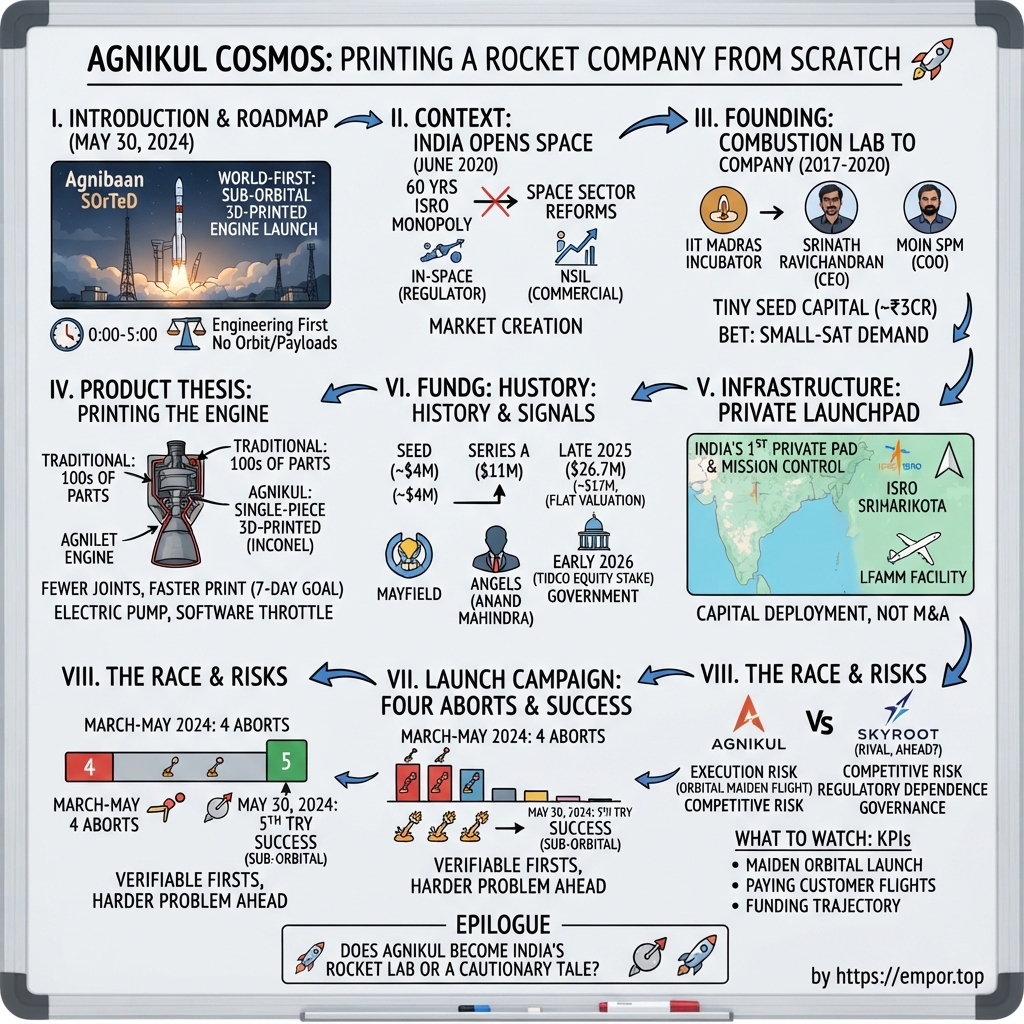
AgniKul Cosmos: Printing a Rocket Company From Scratch
I. Introduction & Episode Roadmap (0:00–5:00)
At 7:15 in the morning on 30 May 2024, a six-metre rocket lifted off from a patch of concrete at Sriharikota called ALP-01.1 It flew for a little over two minutes, reached roughly twenty kilometres, and fell into the Bay of Bengal.1 By the standards of orbital spaceflight this was a modest event. By the standards of what had been legally and institutionally possible in India four years earlier, it was close to unthinkable.
The pad belonged to a private company. The mission control centre four kilometres away belonged to the same private company.2 The engine that pushed the vehicle off the pad had been printed — not machined, not welded, not bolted — as a single continuous piece of Inconel, and it was the first engine of its kind ever to fly anywhere in the world.3 The company was nine people's worth of idea in 2017 and roughly two hundred people's worth of organisation by the time it flew.2
That is the story AgniKul Cosmos tells about itself, and the striking thing is that almost all of it is verifiable. This is not a deep-tech company whose central technical claim dissolves under inspection. The engine exists, it was ground-tested in February 2021, and it flew in May 2024.2 The pad exists. The firsts are real firsts.
The hook is what two graduates of IIT Madras concluded before any of it: that the binding constraint on cheap, responsive launch was not propellant chemistry or aerodynamics — those are solved problems, taught in textbooks — but manufacturing. A rocket engine is conventionally an assembly of hundreds of separately fabricated parts, each of which is a schedule risk and a leak path. AgniKul's founding bet was that if you could print the whole thing as one object, you would collapse both the cost curve and the calendar. Everything the company has built since follows from that single conviction.
The tension this article has to resolve is the gap between that engineering achievement and the business it was supposed to produce. As of today, 5 August 2026 — eight and a half years after incorporation — AgniKul has never reached orbit, has never flown a paying customer's satellite, and reported operating revenue of exactly zero in the last financial year for which detailed accounts are public.4 Its own website still lists two orbital missions as "Scheduled" for the first and second quarters of 2026; both quarters have closed.5 And on 18 July 2026, its principal domestic rival, Skyroot Aerospace, reached orbit on its first attempt — taking with it the "first private Indian orbital launch" milestone that AgniKul had been building toward since 2020.6
One framing note before anything else. AgniKul Cosmos Private Limited is a privately held Indian company.7 There is no DRHP, no red herring prospectus, no S-1, no F-1. There is no ticker, no free float, no audited quarterly reporting, no earnings call at which a fund manager can ask an uncomfortable question. The evidence base available here is company material, funding announcements, Indian registry filings as reported by financial-data aggregators, government statements, counterparty disclosures, and founder interviews. That is a real constraint, and this article treats it as one: where a number is not public, it is named as not public rather than estimated into existence.
What follows is an underwriting, not a profile. Sections II through V establish what was built and why it was possible. Section VI takes apart the capital structure — the part of the story most often reported as a headline and least often examined. Sections VII through XI test the operating record against the promises. Sections XII through XV state the case on both sides and identify what would actually settle it.
 Subscribe on LinkedIn
II. Why This Was Even Possible: India Opens Its Space Sector (5:00–12:00)
For roughly six decades, if you wanted something launched from Indian soil, you went to the Indian Space Research Organisation. This was not a matter of preference. ISRO was the launch provider, the vehicle designer, the range operator, and the customer, and private Indian firms participated as vendors machining parts to ISRO's drawings rather than as principals with their own vehicles.
This produced something genuinely admirable — ISRO's per-kilogram costs and mission success rates made it a credible commercial player internationally — but it also produced a market with exactly one seller and no mechanism by which a private company could build a rocket, let alone fly one. A startup could not obtain a launch authorisation, could not access a range, and could not lawfully operate a launch vehicle.
The 2020 space-sector reforms changed the category rather than the rules at the margin. India opened satellite manufacturing, launch vehicles, and ground infrastructure to private participation, and created the institutional machinery to make that participation legible.8 The centrepiece was the Indian National Space Promotion and Authorisation Centre — IN-SPACe — established as a single-window authority through which non-governmental entities could obtain authorisations, coordinate spectrum, and gain access to ISRO's own facilities.8 Alongside it, NewSpace India Limited operates as ISRO's commercial arm, marketing and selling launch services including the Small Satellite Launch Vehicle.9
It is worth being precise about what this was, because the shorthand "India privatised its space sector" gets it wrong in a way that matters for underwriting. Nothing was sold. ISRO did not shrink. What happened was closer to the reverse: the state created a legal market where none had existed, appointed itself the regulator of that market, and remained the dominant supplier within it. A private Indian launch company therefore operates in an industry where its principal regulator, its principal landlord, its principal technical adviser, and its principal competitor are all arms of the same government.
That structure has been generous to AgniKul in practice. The company operates from a pad inside ISRO's own Satish Dhawan Space Centre, entered a framework agreement with ISRO in September 2021 for facility access and technical support, and buys ISRO's flight termination system for range safety.210 Every one of those is a subsidy of sorts — a startup that had to build its own range and certify its own destruct system would have needed considerably more than the capital AgniKul has raised.
It also creates the dependency that runs underneath the entire operating story. AgniKul's launch cadence is not solely a function of how fast it can build rockets. It is also a function of range availability, ISRO's own manifest, and government coordination. A company whose thesis is "launch anywhere, anytime" currently launches at one place, when the range is free.11
The prize is large enough to explain the enthusiasm. Industry projections put India's space economy on a path from roughly $8.4 billion in 2022 to about $44 billion by 2033, of which the launch segment is expected to contribute in the region of $3.5 billion.[^12] Hold that $3.5 billion figure. It is the single most useful number in this article, and Section X returns to it, because it is the denominator against which any valuation placed on an Indian launch company has to be checked.
Without the 2020 reforms, none of what follows happens. AgniKul was incorporated three years before the sector legally opened — which means the founders were, for their first three years, building hardware for a market that did not yet exist.
III. Founding: From a Combustion Lab to a Company (2017–2020) (12:00–20:00)
AgniKul Cosmos was incorporated on 1 December 2017 and incubated at the National Centre for Combustion Research and Development at IIT Madras in Chennai.2 The registered entity is AgniKul Cosmos Private Limited, an Indian private limited company.7 It still operates from the IIT Madras Research Park, with additional facilities in Kerala.11
The founding group was four people. Srinath Ravichandran became chief executive; Moin SPM became chief operating officer; Professor Satyanarayanan Chakravarthy, whose combustion laboratory hosted the company, and Janardhana Raju complete the founding roster.2
Ravichandran's route in is the biographical detail that gets retold most often, and for once the colour is analytically useful. He came to rockets from finance, having worked in the United States before returning to aerospace as a second career.12 The relevance is not that a former financier can run a rocket company. It is that the company's central insight is an economics insight dressed as an engineering one. The claim was never that AgniKul could build a better-performing engine than ISRO — it could not, and has never argued otherwise. The claim was that the cost and cycle time of building engines was the thing standing between small satellite operators and a launch service that behaved like a service rather than like a queue.
The founding bet has been stated in essentially the same words since the beginning and has never materially changed: small satellites need a dedicated, configurable ride rather than a shared seat scheduled on someone else's timetable. The company's own formulation — "launch anywhere, anytime, affordably" — has survived eight years and multiple funding rounds without revision.11 Consistency of stated strategy is not the same as delivery, but its absence is a reliable warning sign, and its presence here is worth crediting.
The early capital was genuinely small. The initial seed round was roughly ₹3 crore, on the order of a few hundred thousand US dollars.2 That figure is worth sitting with. It funded a period in which the company had no legal path to operating a launch vehicle, no pad, no customers, and no product — only a hypothesis about additive manufacturing and access to a university combustion lab. Whatever one concludes about the valuation eight years later, the people who wrote those first cheques were taking a research risk, not a growth-equity risk.
The IIT Madras relationship deserves a flag rather than a paragraph. An incubator that hosts a company, whose faculty member is a co-founder, and whose research park remains the company's operating base, is a structure in which academic and commercial interests overlap. In a listed company this would sit in a related-party note. Here it sits nowhere, because there is nothing to sit in. It is a diligence item for whoever eventually reads a filing, not an allegation.
By 2020 the company had a design philosophy, a laboratory, a handful of employees, and a newly legal market. It did not yet have a flying engine.
IV. The Product Thesis: Printing the Engine, Not Assembling It (20:00–32:00)
Start with what a conventional rocket engine is, because the AgniKul claim only makes sense against it.
A liquid rocket engine is a machine for mixing two fluids at extreme pressure, igniting them, and channelling the result through a nozzle without melting. Doing that requires an injector head with dozens or hundreds of precisely drilled orifices, a combustion chamber lined with cooling channels through which propellant flows before it burns, a throat, a nozzle, and the plumbing to connect them. Conventionally each of these is fabricated separately — machined, brazed, welded, bolted — and then assembled. Every joint is a place where a schedule can slip and a leak can start.
AgniKul's Agnilet engine is printed as one continuous piece of Inconel, a nickel-based superalloy, with no assembled joints at all.2 The company states that a single engine can be produced in as little as seven days.2 It runs a semi-cryogenic propellant combination — sub-cooled liquid oxygen with aviation turbine fuel — rather than the deep-cryogenic or solid propellants that dominate elsewhere.2
Bundled into the same design philosophy are two further choices that matter more than they sound. The first is the electric pump-fed cycle. Getting propellant into the chamber at pressure normally requires a turbopump — effectively a small gas turbine driven by the engine's own exhaust, and historically one of the most difficult components in all of rocketry to get right. AgniKul instead uses brushless DC motors driving the pumps electrically.2 You pay a weight penalty in batteries and you give up some performance, but you eliminate an entire class of development risk and you make the engine's behaviour controllable by software rather than by fluid dynamics. The second is that the vehicle's avionics are developed in-house, and the design is deliberately configurable, with removable engines in the first stage and an optional intermediate stage that fits inside the payload fairing.10
The economic argument, if all of this works, is straightforward. Fewer parts means fewer failure modes and less inspection. A seven-day print cycle means engine production stops being the long pole in the manufacturing schedule. Configurable stages mean one vehicle family can serve missions from tens of kilograms to a few hundred without a redesign. Put together, that is the recipe for a launch company that can quote a customer a date rather than a place in a queue.
Now separate what has been demonstrated from what has been asserted.
Demonstrated: the Agnilet engine was first test-fired in February 2021.2 It flew on 30 May 2024, producing roughly 6.2 kilonewtons of thrust with a specific impulse near 187 seconds over a burn of about seventy seconds.1 That was the first flight anywhere of a single-piece 3D-printed rocket engine and the first flight of a semi-cryogenic engine in India.3 These are not marketing claims; they are events with timestamps.
Also demonstrated, more recently and more importantly: clustering. An orbital first stage does not use one engine, it uses several firing in synchrony, and getting a cluster to ignite, throttle, and shut down together is a distinct engineering problem from getting one engine to work. AgniKul fired a three-engine cluster in February 2025 and a semi-cryogenic three-engine cluster in February 2026, tested its Agnite booster engine in March 2026, and in May 2026 fired four semi-cryogenic engines simultaneously — reportedly the first such test in India.213 The technical description of that test is the most revealing thing the company has published in two years: four combustion chambers, but also eight pumps, eight electric motors, and eight independent control algorithms that had to be coordinated through ignition, steady state, and shutdown.13 The electric pump architecture that removes turbopump risk creates, at cluster scale, a software synchronisation problem instead. That is a real trade, not a free lunch, and it is a plausible explanation for why the orbital programme has taken longer than the sub-orbital flight suggested it would.
Asserted but not demonstrated: everything downstream of that. The seven-day print cycle is a company figure with no independent verification and no disclosed production volume behind it.2 Nothing in the Agnilet lineage has yet been through orbital velocities, orbital-duration thermal soaking, staging, fairing separation, or upper-stage restart. Most importantly for the investment case, "prints fast" has not yet become "launches often." The company has conducted one flight in eight and a half years. A manufacturing advantage that does not convert into cadence is a laboratory result, not a business model.
The company holds AS9100D certification, the aerospace quality-management standard, which is a necessary condition for serious customers rather than evidence of throughput.11 It operates a Large Format Additive Metal Manufacturing facility in Chennai that it describes as housing India's largest metal 3D printer dedicated to rocket parts, alongside a production site it calls Rocket Factory-1.1113 Capacity figures for either — engines per year, printer utilisation, yield rates — are not disclosed.
V. Building the Infrastructure: A Private Company Builds Its Own Launch Pad (32:00–40:00)
On 28 November 2022, AgniKul inaugurated a launch pad and a mission control centre at Satish Dhawan Space Centre, four kilometres apart, with redundant systems between them.2 It was India's first launch complex built and operated by a private company.
This is a more consequential decision than the engine, and it is underweighted in most accounts of the company.
A launch company that does not control a pad is not really a launch company; it is a rocket manufacturer selling into someone else's schedule. Range slots are the scarcest resource in the business, and a startup queuing behind a national space agency's own manifest cannot credibly promise responsiveness to a customer. By building its own pad, AgniKul bought the one thing that makes "launch anytime" even theoretically sayable.
It bought it, however, on land inside a government facility, under a framework agreement with ISRO signed in September 2021 covering facility access and technical support, and it uses an ISRO-supplied flight termination system for range safety.210 So the independence is partial and, more to the point, structurally partial. AgniKul owns the pad hardware; it does not own the range, the airspace clearance, or the destruct authority. The distinction is the difference between owning a restaurant and owning the building it rents in — real, valuable, and not the same as sovereignty.
This is also where the capital-allocation story lives. AgniKul has made no acquisitions and has bought no revenue. Every rupee of investor capital has gone into three things: people, additive manufacturing capacity, and range infrastructure. That is visible even in the fragmentary accounts. In the financial year to March 2023, depreciation and amortisation rose more than threefold to ₹3.5 crore and rental costs jumped from ₹21 lakh to ₹3 crore — the accounting shadow of a company acquiring a fixed-asset base and physical footprint for the first time.4
The forward commitment is larger still. The company is developing an integrated space manufacturing and testing campus in Tamil Nadu described as covering close to 350 acres, positioned as the infrastructure for a higher launch frequency in future years.14 No capital budget for that campus has been disclosed, no construction timeline has been published, and no financing structure — whether state land grant, debt, lease, or equity-funded capex — has been made public. For a pre-revenue company whose most recent disclosed round was roughly $17 million, a 350-acre industrial campus is a very large forward obligation of unknown size, and its absence from public disclosure is a material gap rather than a detail.
There is a third structural asset that is easy to miss: Dhanush, a transportable launch system with road-transportable liquid oxygen storage, a mobile launch pedestal, and a portable mission control centre.10 The design logic is elegant — liquid oxygen and aviation turbine fuel are both industrial commodities available almost anywhere, which is precisely why AgniKul chose them, and a launcher that needs only commodity propellants can in principle be trucked to a site rather than requiring the site to be built around it.13 If AgniKul ever genuinely delivers "launch anywhere," Dhanush is the mechanism. It has not been flown, and no customer has been announced for it.
VI. Funding the Bet: Capital, Investors, and What They Signal (40:00–50:00)
This section requires more care than any other, because the number most often attached to AgniKul — a valuation above $500 million — is a price observed in a small private transaction, and it is routinely reported as though it were a measurement of the company's worth.
The rounds, in sequence
The initial seed was approximately ₹3 crore.2 Additional pre-Series A capital was raised between 2018 and 2020, but the amounts and terms have not been consistently disclosed and no single authoritative figure exists in the public record.
In May 2021 the company raised $11 million in a Series A led by Mayfield India, with pi Ventures, Speciale Invest and Artha Ventures participating alongside a roster of Indian angel investors including Anand Mahindra, Naval Ravikant, Balaji Srinivasan and Nithin Kamath.1516 The angel list is the most-quoted feature of that round and the least informative. These are individuals with strong reputations in consumer internet, crypto, capital markets and industrials; none is a propulsion specialist. Their participation bought AgniKul visibility in the Indian technology press and credibility with subsequent investors. It should not be read as technical diligence, and it should not be read as conviction capital of the sort that funds a launch campaign.
In October 2023 the company raised $26.7 million in a Series B co-led by Celesta Capital and Rocketship.vc, with Artha Select Fund joining and existing investors Artha Venture Fund, pi Ventures, Speciale Invest and Mayfield India following on.17 The company stated that this took total capital raised to $40 million, that proceeds would fund the transition from design into production and manufacturing, and that headcount stood at roughly 225 people across four facilities.17 The valuation was not disclosed.17
That last point matters more than it appears. AgniKul has never disclosed a valuation for its Series A or Series B. The first publicly reported valuation for the company appears at the November 2025 round.
In November 2025 the company raised approximately $17 million at a valuation above $500 million, with participation from Advenza Global, Atharva Green Ecotech, HDFC Bank, Artha Select Fund, Prathithi Ventures, 100X.VC and several family offices.1814 By May 2026, reporting indicated AgniKul was in discussions to raise a further $50–75 million at a flat valuation of approximately $500 million.14
In March 2026, the Tamil Nadu government, through its industrial development corporation TIDCO, took a direct equity stake, reported at ₹25 crore.1914 The company's public response framed it as validation: "a strong sign that the TN state Govt. is fully on-board for supporting original technology developed in this ecosystem."19
What the $500 million number is, and is not
Take the November 2025 round at face value. Roughly $17 million was invested at a valuation stated as above $500 million. If that entire amount was primary capital into the company at a post-money valuation of $500 million, the new investors collectively purchased something in the region of three to three and a half percent of the equity.
A price at which three percent of a company changed hands, in a negotiated private transaction, between a specific set of counterparties, under terms that have not been disclosed, is a weak basis for asserting the value of the other ninety-seven percent. This is the core methodological problem with private marks, and it is acute here for three compounding reasons.
First, the investor set changed character. The Series A and Series B were led by venture funds with technology mandates — Mayfield India, Celesta, Rocketship.1517 The November 2025 round was populated by family offices, a commercial bank, and diversified corporates including a green-technology firm.18 That is not a criticism of the participants, but it is a different kind of capital with different underwriting standards and different motives, and it is the kind of round a company raises when institutional deep-tech investors are on the sidelines.
Second, the security is almost certainly not common stock. Indian venture rounds are conventionally structured as compulsorily convertible preference shares carrying a liquidation preference and anti-dilution protection. AgniKul has disclosed none of the terms of any round: no liquidation preference multiple, no participation rights, no anti-dilution or ratchet mechanics, no conversion terms, no side letters, no board or information rights, no tag-along or drag-along provisions. This matters directly. If the November 2025 investors hold preferred shares with even a standard one-times non-participating liquidation preference, their $17 million sits ahead of every common share in a downside outcome, and the $500 million "valuation" is the price of a security with downside protection — not the price of the common equity that would eventually list. In any exit below the preference stack, common holders receive materially less than a straight-line reading of the headline number implies. Whether that is the case here is not disclosed, which is itself the finding.
Third, the mark is flat and has been flat for at least six months. The November 2025 round priced above $500 million; the 2026 discussions were reported at approximately the same level.14 Between those two points the company fired a four-engine cluster — a genuine technical milestone — and watched its principal competitor reach orbit. A flat mark across that stretch is not neutral. Later-stage private investors are pricing execution risk rather than paying for narrative progress.
What is not known about the capital structure
A serious pre-listing analysis would build a fully diluted share count. That is not possible here, and it is worth being explicit about every missing component rather than gesturing at incompleteness.
Not disclosed: the total number of issued equity shares; the number and class of preference shares; the conversion ratio of any preference class; the size of the employee stock option pool and how much of it is granted, vested, or exercised; the existence or terms of any warrants, convertible notes, or SAFE-equivalent instruments; the founders' individual shareholdings; the shareholdings of Mayfield India, Celesta, Rocketship, Speciale Invest, pi Ventures, Artha, or any other institutional holder; the percentage stake acquired by TIDCO; voting arrangements or differential voting rights; board composition and the identity of independent directors; and any shareholder agreement provisions governing consent rights or future issuance.
As an Indian private limited company, AgniKul files annual returns and financial statements with the Registrar of Companies, and its shareholding pattern is in principle obtainable from those filings through commercial registry aggregators.7 That is the route a diligent investor would take. It is not the same as company disclosure, it lags by up to a year, and it does not reveal shareholder-agreement terms, which are where the economics of preferred stock actually live.
The practical consequence: any "market capitalisation" attributed to AgniKul is a rough implied value derived from a small primary transaction in an undisclosed security class. There is no free float, because there is no listing. And an enterprise-value bridge cannot be constructed at all — the company's cash balance following the November 2025 round is not disclosed, its debt and lease obligations are not disclosed, and there are no planned primary IPO proceeds because there is no IPO in process. Any comparison in this article between AgniKul and a listed peer therefore has to be handled carefully, and Section X states the basis of each comparison explicitly rather than mixing equity-value and enterprise-value multiples.
The operating financials, such as they are
The publicly reported accounts are sparse but they say something clear.
In the year to March 2022, revenue was ₹2.2 crore against expenses of ₹11.2 crore, producing a net loss of ₹9 crore.4 In the year to March 2023, total revenue was ₹2.9 crore — of which operating revenue was zero, the entire amount consisting of subsidies, awards and interest income — against expenses of ₹23.1 crore, for a net loss of ₹20.2 crore.4 Employee benefits accounted for ₹9.7 crore of that, of which ₹8.4 crore was salaries and stipends.4 In the year to March 2024, revenue was reported at approximately ₹9 crore, again entirely non-operating, against a loss of ₹43 crore.14 Revenue for the year to March 2025 has been reported as below ₹10 crore; the corresponding loss figure is not in the public record.
Read the shape rather than the levels. Losses roughly doubled in each of two consecutive years. Revenue is grants, awards and interest — the company has not, on the evidence of these accounts, recognised revenue from selling a launch. Reported losses also understate cash consumption at a company building a pad and a manufacturing facility, because capital expenditure is capitalised rather than expensed; the rising depreciation line is the tell.4
One further evidentiary wrinkle worth naming, because it illustrates how thin the public record is. Reporting on the FY23 accounts described AgniKul as having raised "over $60 million" in total funding, while the company's own Series B announcement the same month put cumulative capital at $40 million.417 More recent reporting places the cumulative figure at roughly $75 million or more.14 These are not reconcilable without disclosures that do not exist. When even the total capital raised cannot be pinned down to a single number, precision about anything downstream of it is false precision.
No IPO process exists. Founder and management shareholdings, executive compensation, equity incentive terms, and any insider secondary sales are not disclosed. There is no evidence of any of these being problematic; there is simply no evidence either way, and the correct treatment of an absence of disclosure is to record it as unresolved rather than as reassurance.
VII. The Launch Campaign: Four Aborts and a Quiet Fifth Try (50:00–58:00)
The SOrTeD campaign is the closest thing to a public stress test that AgniKul has undergone, and it is worth reconstructing precisely because it shows both the engineering and the management behaviour under pressure.
The vehicle was Agnibaan SOrTeD — Sub-Orbital Technology Demonstrator. It was 6.2 metres tall, weighed roughly 575 to 580 kilograms at liftoff, carried a payload of about seven kilograms, and had a single stage powered by one Agnilet engine burning sub-cooled liquid oxygen and aviation turbine fuel.1 It is important to fix these numbers, because they are frequently confused with the specifications of the orbital Agnibaan, which is a different and much larger vehicle. SOrTeD was a demonstrator, not a scaled-down commercial rocket.
The campaign did not go smoothly. An attempt on 21 March 2024 was postponed after observations from the full countdown rehearsal.1 A second, on 6 April 2024, was stood down during pre-launch checks.1 A further attempt on 28 May 2024 was called off less than a minute before liftoff.1 Indian press counted a fourth abort across the campaign, reporting the repeated scrubs of what would be India's first flight of a semi-cryogenic engine.20
Then, on 30 May 2024, it flew. Liftoff at 7:15 IST from ALP-01. The vehicle executed a pitch-over manoeuvre about four seconds in, initiated wind biasing at around thirty-nine seconds, reached apogee near one minute twenty-nine seconds at roughly twenty kilometres, and splashed down in the Bay of Bengal a little over two minutes after leaving the pad.1 The company describes the powered phase as sixty-six seconds.5
There is a management observation embedded in how the successful flight was conducted. The earlier attempts were publicised, livestreamed and attended; the fifth was conducted with substantially less fanfare. The charitable reading is operational focus. The less charitable reading — and the one a public-market investor should at least hold in mind — is that after four public scrubs the company chose to lower the stakes of the event rather than to change how it made commitments in the first place. Those are different responses to the same problem, and only one of them fixes it.
What was actually proven is genuinely impressive and should not be diminished. This was the first flight anywhere of a rocket engine printed as a single piece.3[^22] It was India's first flight of a semi-cryogenic engine.3 It was the first launch from a privately built and operated Indian pad.3 The vehicle flew its planned trajectory under autopilot, executed its manoeuvres, and validated the integrated operation of AgniKul's own avionics, mission control, and range coordination with ISRO.5 For a company that had never flown anything, achieving all of that on a first flight is a strong result.
What was not proven is the harder part, and the gap is not incremental. A twenty-kilometre sub-orbital hop and an orbital insertion are separated by roughly two orders of magnitude in kinetic energy. Orbital flight requires staging, a functioning second stage with a vacuum-optimised engine, fairing separation, precise guidance to an insertion state, and a structure that survives max-Q and the thermal environment of a full ascent. It requires clustered engines firing in synchrony — the problem AgniKul was still working on two years later.13 And it requires all of that to work with a customer's satellite on top.
SOrTeD carried about seven kilograms of instrumentation, not a customer payload.1 As of today, AgniKul has never flown a commercial mission.
VIII. The Race to Orbit: Where Things Stand Now (58:00–68:00)
On 18 July 2026, Skyroot Aerospace's Vikram-1 lifted off from Satish Dhawan Space Centre and reached a planned 450-kilometre orbit on its first attempt.6 It became the first commercial Indian rocket to reach orbit, and the first orbital launch of a rocket by a private Indian company from Indian soil.621 The countdown was held for about thirty-five minutes at T-minus five over a technical issue, and then it went.6
That single event reorganises AgniKul's competitive position, and any assessment written before it needs revising.
Vikram-1 uses three solid-fuel stages plus a liquid-propellant kick stage and carries up to 350 kilograms to low Earth orbit, with an upgraded Vikram-1U variant with strap-on boosters rated at 550 kilograms.6 The debut mission carried two cubesats — one Skyroot's own and one from Grahaa Space — plus hosted payloads from Dcubed and Cosmoserve Space.6 Skyroot has stated plans for up to two further Vikram-1 launches in 2026 and is developing Vikram-2, targeted for a first flight in 2027 with capacity around 1,000 kilograms.6
The capital position behind that is now materially different from AgniKul's. In May 2026, Skyroot raised approximately $60 million at a $1.1 billion pre-money valuation, co-led by GIC and Sherpalo Ventures with participation from BlackRock, the founders of Greenko Group, Arkam Ventures, Playbook Partners and the Shanghvi Family Office, bringing total funding to roughly $160 million.22 That valuation was up from around $519 million in 2023.22 Skyroot had earlier flown India's first private sub-orbital mission, Vikram-S, in November 2022.23
Set the two side by side as of today. Skyroot: orbital, on the first attempt, with roughly $160 million raised, a sovereign wealth fund and the world's largest asset manager on the register, and a valuation that has roughly doubled in three years.226 AgniKul: sub-orbital, with roughly $75 million raised on the most generous public tally, family offices and a commercial bank in the most recent round, and a valuation that has been flat.14 The step-up gap is the market's verdict, expressed in the only currency private markets have.
AgniKul's own path to orbit has been a sequence of receding horizons. In October 2023, before SOrTeD flew, the company said it expected a first test flight before the end of that year and described scaling from one to two launches annually toward one to two per month.17 After SOrTeD, the guidance became a rig-construction programme of six to seven months with an orbital launch three months after completion.2 The rigs work produced real results — a three-engine cluster in February 2025, a semi-cryogenic three-engine cluster in February 2026, an Agnite booster engine test in March 2026, and a four-engine semi-cryogenic cluster in May 2026 that appears to be the first of its kind in India.213
But the calendar tells its own story. AgniKul's own missions page currently lists two orbital missions as "Scheduled" — one in the first quarter of 2026 carrying up to 100 kilograms to low Earth orbit from Launchpad-01, and one in the second quarter of 2026 carrying up to 300 kilograms.5 Both windows have passed without a launch, and both entries remain on the site. That is a small thing and a revealing one: a company that has not updated its published manifest after missing it twice is not managing its public commitments the way a company subject to disclosure obligations would have to.
Management's public explanations for the delays have been technical — cluster synchronisation, booster qualification, stage testing — and the technical explanations are credible on their merits, particularly given what the four-engine test revealed about coordinating eight pumps and eight independent control loops.13 What has not appeared in the public record is an explicit accounting of the pattern: that the company has now missed its own orbital target on multiple occasions, and that the accumulated slippage is measured in years rather than quarters. In a July 2026 interview, Ravichandran framed the competitive question as economic rather than technological, discussing launch economics and a path toward high annual cadence.24 That is a defensible strategic argument — cadence and cost, not first-to-orbit bragging rights, are what determine whether a launch company survives. It is also, arriving days after a competitor reached orbit, an argument that reframes the scoreboard rather than addressing it.
The pattern-match that should worry a public-market investor is Western. Virgin Orbit reached the SPAC market in 2021 raising $228 million against a projected $483 million, flew six missions with four successes and two failures, and filed for bankruptcy on 4 April 2023 after failing to raise further funding.25 Its assets were sold at auction the following month to Rocket Lab, Stratolaunch and others.26 Astra Space, similarly, reached orbit and subsequently failed to build a viable business at small-launch economics. The instructive detail is that both companies did reach orbit. Orbital capability was necessary and nowhere near sufficient. The failure mode in small launch is not usually "the rocket did not work." It is "the rocket worked, and the economics did not."
IX. The Emerging Bets: Optionality or Distraction? (68:00–74:00)
Three commercial arrangements have been announced in the last two years, and they need to be sized correctly rather than counted.
In September 2024, AgniKul signed an agreement with Nibe Space covering a multi-sensor Earth-observation satellite constellation.2 This is the most conventional of the three — a customer-pipeline arrangement in the domestic market, small, with no disclosed contract value or committed launch count.
In July 2026, at an event in Nice, France, AgniKul and the Finnish synthetic-aperture-radar operator ICEYE signed a memorandum of understanding to explore an end-to-end sovereign SAR Earth-observation capability in India, under which satellites would be manufactured in India using ICEYE's SAR technology and launched on AgniKul's vehicles.27 Of the three, this is the one with genuine strategic weight. ICEYE is a well-funded operator with a deployed constellation and real customers, and sovereign Earth observation is a category where Indian government demand is durable and price-insensitive relative to commercial smallsat launch. If it converts into committed, priced launch contracts, it would be the most economically significant thing to happen to AgniKul since the SOrTeD flight.
It has not converted. It is a memorandum of understanding — an agreement to explore, with no disclosed contract value, no committed launch count, no schedule and no exclusivity.27 AgniKul told the press in October 2023 that it had signed memoranda with European and Japanese companies.17 Nearly three years later, none of those has produced a disclosed, priced, flown mission. That is the relevant base rate for how MoUs in this business have historically converted for this company.
In February 2026, AgniKul announced a partnership with NeevCloud to build a proof-of-concept for what the companies describe as India's first indigenous AI-powered data centre in space, deploying high-performance AI inference nodes in low Earth orbit, with launch targeted by the end of 2026.28
This one earns a paragraph and a caution rather than a section. Orbital data centres are a genuinely interesting frontier — solar power is abundant and cooling is a solved problem in vacuum only if you ignore that radiative rejection is the hard constraint — and there is no disclosed revenue, no disclosed capital committed by either party, no disclosed pricing, and no operating economics of any kind attached to it. It is also, notably, targeted for launch on a vehicle that has not yet flown to orbit. A pre-revenue company announcing an adjacent pre-revenue product line, dependent on a core capability it has not yet demonstrated, is a pattern that rewards scepticism.
The proportionality point is the whole point of this section. AgniKul has not flown a single orbital mission and has not recognised operating revenue from a launch.4 The launch vehicle business is not a large part of the story; it is the entire story. Every one of these arrangements is contingent on Agnibaan reaching orbit and demonstrating cadence. None of them is an alternative path if it does not. Treating them as diversification would be a category error — they are all leveraged bets on the same single outcome.
X. Industry Structure: What It Actually Costs to Compete in Small Launch (74:00–86:00)
To underwrite AgniKul you have to underwrite the small-launch industry, and the industry's own numbers are the most sobering evidence in this entire analysis.
The peer set, and who is excluded
The direct operating peer is Skyroot Aerospace: same country, same regulatory regime, same range, same customer base, same vehicle class, similar capital intensity, similar stage of commercialisation. It is the only true comparable, and it is now valued at $1.1 billion pre-money against AgniKul's roughly $500 million — a valuation gap that opened after Skyroot's May 2026 round and widened in substance after its July orbital flight.22614
Rocket Lab is a category leader, not a peer. Its Electron is the only dedicated small launcher with a sustained multi-year commercial flight record, and its business has diversified well beyond launch. It is included here as an economic reference point — the answer to "what does this business look like if it works" — not as a valuation comparable.
Firefly Aerospace is a useful recent-IPO comparable for how public markets price pre-scale space companies, but it is not an operating peer: different payload class, different geography, different customer mix, and a substantial lunar-lander and spacecraft business alongside launch.
Excluded deliberately: Virgin Orbit and Astra Space, which are historical cautionary evidence rather than live comparables; SpaceX, which is a different industry at a different scale; and Indian satellite-manufacturing or Earth-observation startups such as Pixxel or Dhruva, which are AgniKul's potential customers, not its competitors.
What launch actually sells for
Rocket Lab's Electron is listed around $7.5 million per mission for roughly 300 kilograms to low Earth orbit — on the order of $25,000 per kilogram.29 Firefly's Alpha, carrying roughly 1,030 kilograms to LEO, is priced in the range of $15 million to $17.6 million per launch.30 Both figures reflect the structural reality of dedicated small launch: even at maturity, price per kilogram runs several times, and at the small end close to an order of magnitude, above what a medium or heavy vehicle charges. Customers pay that premium for schedule control and precise orbital placement, and only when those are worth more to them than the money.
In India the price anchor is lower and it is set by the state. ISRO's Small Satellite Launch Vehicle carries 500 kilograms to a 500-kilometre low Earth orbit, or 300 kilograms to sun-synchronous orbit, at an expected cost per launch in the region of ₹30 to ₹35 crore — roughly $3.1 million to $3.7 million.31 That is on the order of $7,000 per kilogram at full payload, marketed by NSIL with a stated turnaround as short as 72 hours, and technology transfer to Hindustan Aeronautics Limited was signed in September 2025 with the first HAL-produced vehicle expected in 2027.319
Read that carefully, because it is the central competitive fact of the Indian small-launch market. The incumbent is not slow, is not expensive, is state-backed, and is being industrialised through a large aerospace manufacturer. AgniKul is not entering a vacuum left by an inefficient monopolist. It is entering a market where the default option is priced at roughly a quarter of Electron's per-kilogram rate.
AgniKul's own stated pricing philosophy is that dollar-per-kilogram would remain constant across payloads from 30 to 300 kilograms, rather than charging a premium for smaller missions, and that the company is "filling the gap not directly addressed by ISRO today" in the sub-300-kilogram segment.17 That is a coherent positioning statement. It is also a narrow one: the gap it describes sits underneath a state vehicle that already serves 300 to 500 kilograms cheaply, and above a rideshare market where an operator willing to accept someone else's orbit and schedule can fly for a fraction of any dedicated price.
The scale reality check
Here is the number that should reframe how anyone thinks about small launch as a business. In the first quarter of 2026, Rocket Lab — the most successful dedicated small-launch company in the world, with roughly seventy Electron missions in backlog and thirty-one booked in that quarter alone — generated $63.7 million of Launch Services revenue.32 Its Space Systems segment, which builds satellites and components, generated $136.7 million in the same quarter, more than double the launch business.32 Total revenue was $200.3 million, up 63.5% year on year, with GAAP gross margin of 38.2%, and total backlog of $2.2 billion.32
Annualise that launch line and you get roughly $255 million. That is what the global leader in dedicated small launch earns from launching things, after more than a decade of operations and a flight record no competitor approaches. The company itself has responded to that ceiling by building a satellite business that is now the larger half of its revenue, and by developing a medium-lift vehicle.
The lesson is not that small launch is worthless. It is that dedicated small launch is a modest-sized business even when executed superbly, and that the companies which have survived in it have done so by becoming something more than launch companies. Any valuation applied to AgniKul that assumes launch alone can carry it needs to reckon with the fact that the world's best operator has effectively concluded otherwise.
The public-market pricing comparable reinforces the point about how volatile these valuations are. Firefly Aerospace priced its August 2025 IPO at $45 per share, closed its first day at $60.35 for a valuation around $8.5 billion, having raised $868 million — against 2024 revenue of $60.8 million.33 That is roughly 140 times trailing revenue at the close of the first session. Within roughly two weeks the stock traded at $46.11, a market capitalisation near $6.62 billion.33 Both of those are equity values, compared with trailing revenue; neither is an enterprise-value multiple, and they are not directly comparable to AgniKul, which has no operating revenue to divide into anything. What they do establish is that public markets will pay extraordinary multiples for space companies with real flight records and real backlogs, and will reprice them by a fifth in a fortnight.
Five Forces, applied rather than recited
Barriers to entry are as high as they get in any industry: capital intensity, multi-year development cycles, regulatory authorisation, range access, and export-controlled technology. This protects AgniKul from new entrants — but the same barriers that keep others out kept AgniKul itself out for the first three years and have absorbed eight years of capital since.
Buyer power is moderate today and rising. Until July 2026 an Indian smallsat operator wanting a dedicated domestic launch had precisely one credible option, and it was governmental. Now there are two credible options and a third in development, which means the first commercial contracts AgniKul signs will be negotiated against a competitor that can point to a successful flight.
Supplier power is concentrated and partly geopolitical. Aerospace-grade metal powders, large-format additive machines, high-performance electric motors and batteries, and flight-grade electronics come from a small number of vendors, some subject to export controls. AgniKul mitigates this on the propellant side — liquid oxygen and aviation turbine fuel are ordinary industrial commodities, which is precisely why they were chosen and what makes a mobile launcher conceivable.13 It does not mitigate it on the machine and electronics side.
Substitutes are the most underrated threat. Rideshare on medium and heavy vehicles is not a partial substitute for dedicated small launch; for the large majority of smallsat payloads, which are not fussy about exact orbit or exact date, it is a superior substitute on cost per kilogram by a wide margin. The dedicated small-launch market is not "all small satellites." It is the subset of small satellites for which schedule and orbital precision are worth paying a multiple.
Rivalry is intense, well-funded, and now includes a domestic competitor with an orbital flight and a state incumbent industrialising its own vehicle.
Seven Powers: what kind of moat is actually being claimed
AgniKul's implicit claim is process power — a way of making engines that competitors cannot easily copy, embedded in accumulated organisational know-how rather than in a patent.
Process power is a legitimate and durable form of advantage, but Helmer's definition is demanding: it requires a superior process that produces a persistent cost or quality advantage, that is hard to replicate even when observed, and — critically — that is demonstrated in operation. AgniKul has the first half. The single-piece printed engine is observably difficult to copy; nobody else has flown one, five years after AgniKul first fired one on a stand.23
What is missing is the operational half. Process power is proved by unit costs and cycle times at production volume, and AgniKul has disclosed neither. It has never manufactured engines at orbital-programme rates. It has never produced a launch at a price a customer paid. Its seven-day print cycle is a company statement with no production data behind it.2 Today the evidence for the moat is a stand-test record and one sub-orbital flight — impressive as engineering, insufficient as economics.
There is a second, smaller power worth naming: cornered resource. AgniKul owns the only privately built launch pad in India.2 That is a genuinely scarce asset. It is also one that ISRO could, in principle, extend to others, and it sits on land AgniKul does not own.
XI. Management Credibility: Reading the Behavior, Not the Pitch (86:00–94:00)
Judge management by behaviour, and there is a real record to judge here, running in both directions.
Start with what is creditable. Ravichandran and Moin SPM have run this company since December 2017 without a change at the top.2 In a sector where founder departures, chief-executive rotations and strategic pivots are routine, eight and a half years of stable leadership through a period that included a legal regime that did not permit the business, a pandemic, four launch scrubs and a competitor reaching orbit first is a genuine signal. There is no unexplained churn to explain.
The stated strategy has been equally stable. Dedicated small-satellite launch, proprietary single-piece printed propulsion, owned launch infrastructure, configurable missions — the words on the company's site today are recognisably the words from the beginning.11 The company has not chased adjacent markets when the core proved hard; the ICEYE and NeevCloud arrangements are extensions of the launch thesis rather than departures from it.2728
Capital allocation has been correspondingly disciplined in direction, if not yet validated in outcome. No acquisitions, no unrelated ventures, no financial engineering. Money has gone into engines, a manufacturing base, a pad, and people.417 For a company with this profile, that is the right shape of spending.
Now the harder side.
The record on dates is poor and it is not improving. In October 2023 the company expected a first test flight before the end of that year; SOrTeD flew in May 2024 after four scrubs.17120 Post-SOrTeD guidance implied an orbital flight within roughly nine to ten months of rig completion.2 Today, more than two years after SOrTeD, the orbital vehicle has not flown, and the company's own published manifest still shows two 2026 missions as "Scheduled" after both windows closed.5 Some of that slippage is defensible engineering caution — the four-engine cluster test genuinely revealed the difficulty of the architecture.13 But defensible reasons for individual delays do not explain a repeated pattern of setting dates the company cannot meet. The pattern is the finding.
Candour about the misses is thin. The explanations that have reached the public record are technical and forward-looking rather than retrospective. There is no publicly available statement in which management accounts for the cumulative gap between what was promised and what was delivered, and the July 2026 framing of the race as economic rather than technological, arriving immediately after a competitor's orbital success, reads as repositioning.24 This is precisely the behaviour that public-market disclosure obligations are designed to force out of companies, and its absence here is a preview of the friction a listing would create.
The valuation trajectory is the market's own reading of the same evidence. The Series A and Series B never disclosed valuations.1517 The first disclosed mark, above $500 million, arrived in November 2025 and has stayed flat into 2026 discussions — through a period in which the company delivered real technical milestones.1814 Meanwhile the closest comparable roughly doubled and crossed a billion.22 Private investors are not paying for progress; they are waiting for proof.
The governance picture has one genuinely novel feature and several blanks. TIDCO's equity stake makes the government of Tamil Nadu a shareholder in a company that builds launch vehicles — dual-use technology by definition.19 This cuts both ways honestly. It is a credibility marker: a state industrial development corporation performed some form of diligence and committed capital, and it anchors the 350-acre campus project in the state's industrial policy.14 It also creates a structure in which the state is simultaneously shareholder, prospective land provider, and policy-maker for the sector — a set of overlapping roles that in a listed company would require related-party disclosure and independent-director scrutiny. The company's public framing of the investment was purely as validation.19
What cannot be assessed from outside is the alignment itself. Founder shareholdings are not disclosed. The employee option pool is not disclosed. Executive compensation is not disclosed. Board composition and the presence or absence of independent directors are not disclosed. Whether any founder or early investor has sold shares in a secondary transaction is not disclosed. Voting arrangements and consent rights are not disclosed. The honest position is that incentive alignment here is unknown, not that it is presumed to be founder-friendly and reasonable. The absence of disclosure is not evidence of a problem; it is the absence of the evidence that would rule one out — and for a company that will eventually ask public shareholders for capital, that distinction is the whole game.
XII. Bull vs. Bear (94:00–104:00)
The bull case
The engineering claim is real and it has flown. This is rarer than it sounds. The overwhelming majority of deep-technology companies at this valuation are selling a thesis validated in simulation or on a bench; AgniKul put a single-piece 3D-printed engine on a rocket and lit it, and no one else in the world has done that.3[^22] The subsequent cluster campaign — three engines in February 2025, three semi-cryogenic engines in February 2026, four in May 2026 — is exactly the progression an orbital first stage requires, and the four-engine test coordinating eight pumps and eight independent control loops is a hard problem solved.213
The infrastructure position is durable. AgniKul owns India's only privately built and operated launch pad and mission control complex, built at a time when nobody else had attempted it.2 It runs its own large-format additive manufacturing facility and holds AS9100D certification.11 Dhanush, the road-transportable launch system, gives the "launch anywhere" claim a physical mechanism rather than leaving it as marketing, and the choice of liquid oxygen and aviation turbine fuel — both ordinary industrial commodities — is what makes that mechanism plausible.1013
The capital base has broadened in a way that provides staying power. Institutional venture capital from Mayfield India, Celesta and Rocketship funded the technology phase; a commercial bank, family offices and diversified corporates funded the most recent round; and a state government has now taken direct equity.15171819 A shareholder register that includes the industrial development arm of the state hosting your 350-acre campus is not a trivial asset in Indian deep tech.1914
The policy tailwind is structural rather than cyclical. The 2020 reforms created the market and the institutions to sustain it, and India's space economy is projected to grow roughly fivefold to $44 billion by 2033.8[^12] There is no plausible scenario in which India reverses course on private space participation.
And the demand signal is real even if unconverted. ICEYE — a well-capitalised operator with a deployed SAR constellation — chose an Indian partner for a sovereign Earth-observation programme, and chose AgniKul as the launch side of it.27 Sovereign Earth observation is durable, price-insensitive demand. If Agnibaan reaches orbit and the cluster architecture proves out, the manufacturing advantage compounds in exactly the way that makes launch companies valuable: more flights amortise fixed costs, more flights generate reliability data, and reliability data wins contracts.
The bear case
Zero orbital flights. Zero commercial launches. Zero operating revenue.4 Eight and a half years and, on the most generous public tally, roughly $75 million of capital consumed to reach a twenty-kilometre sub-orbital hop with a seven-kilogram instrumentation payload.141 Every element of the bull case above is contingent on an event that has not happened.
The schedule record is the strongest single argument against the company. First flight promised for end-2023, delivered May 2024 after four scrubs.1720 Orbital flight guided to roughly nine to ten months after rig completion; not achieved more than two years after SOrTeD.2 Two orbital missions listed on the company's own website as "Scheduled" for Q1 and Q2 2026, both windows now passed, both entries still posted.5 A pattern of missed dates on an unflown vehicle is the specific yellow flag that preceded the collapse of Western small-launch peers.
The competitive position deteriorated sharply in a single quarter. Skyroot reached orbit on its first attempt on 18 July 2026, raised $60 million at $1.1 billion in May 2026 with GIC and BlackRock participating, and has flown roughly $160 million of cumulative capital into an operating orbital vehicle.622 AgniKul's most distinctive claim — the first private Indian orbital launch — is gone, permanently, and the loss is not recoverable by any subsequent execution. Meanwhile ISRO's SSLV serves 300 to 500 kilograms at roughly $3.1 to $3.7 million per launch and is being industrialised through HAL for production from 2027.31
The industry economics are unforgiving even for winners. Rocket Lab's entire Launch Services business runs at roughly $255 million annualised after more than a decade, and its satellite business is now more than twice as large.32 Virgin Orbit reached orbit four times and went bankrupt.25 Astra reached orbit and could not build a business. The historical evidence that dedicated small launch converts technical success into durable profit is weak, and it is weakest at exactly the payload class AgniKul targets.
The valuation is flat and the security is opaque. A mark above $500 million was set in November 2025 on roughly $17 million of investment — three-odd percent of the company — and 2026 discussions were reported at approximately the same level.1814 The instrument's liquidation preference, participation rights and anti-dilution terms are not disclosed, meaning the headline number may well be the price of a protected security rather than the value of the common equity. And a company burning capital toward an unflown orbital vehicle needs the next round, and the one after that.4
The honest read
The unusual feature of AgniKul is that the technology risk and the business risk have diverged, and they have diverged in a direction that is favourable to the engineering and unfavourable to the investment.
Most deep-tech companies at this stage are asking you to believe that the thing will work. AgniKul is not, really. Enough of the thing has worked, in flight, that the remaining question is not whether single-piece printed engines are possible. The remaining questions are whether the cluster architecture scales to an orbital first stage, whether the company can fly often enough to matter, whether it can do so at a price that beats a state incumbent charging $7,000 per kilogram, and whether the capital markets stay open long enough for it to find out.31
On the evidence available today, the technology claim deserves more credit than the market gives it and the business claim deserves less. A valuation above $500 million for a company with no orbital flight, no commercial revenue, an unproven cost position, a state-subsidised domestic incumbent, and a better-funded domestic rival that just reached orbit is a price that embeds a great deal of optimism about events that have not occurred. Section XIII below works through what that price actually requires.
XIII. Risk Radar (104:00–110:00)
The valuation arithmetic, and what it embeds
Before enumerating risks, it is worth making the central one quantitative, because a scenario framework says more than an adjective.
AgniKul has no operating revenue, so no revenue multiple can be computed — the denominator is zero.4 What can be done is to invert the question: what would the business have to become for a $500 million mark to make sense to the investor who set it?
Take the disclosed price anchors. ISRO's SSLV delivers up to 500 kilograms for roughly $3.1 to $3.7 million.31 Rocket Lab's Electron delivers roughly 300 kilograms for about $7.5 million.29 An Indian private launcher serving the 100 to 300 kilogram class would plausibly price somewhere between — call it $2.5 million to $5 million for a full 300-kilogram mission, consistent with the company's stated intention to hold dollar-per-kilogram roughly constant across the range.17 Nothing in the public record fixes this; it is a range built from the two nearest observable prices.
Now the scenarios, in outline rather than false precision.
In a downside case, the orbital debut slips into 2027, the vehicle requires more than one attempt, and cadence reaches two to four flights a year by 2029. At $3 to $4 million a flight, that is $6 million to $16 million of annual launch revenue against a fixed cost base that already consumed ₹43 crore of losses in FY24 alone.14 The business does not approach breakeven, the next financing prices below $500 million, and preferred-stock protections determine most of the outcome for common holders.
In a base case, the orbital debut succeeds in 2027 and cadence builds toward ten to twelve flights a year by 2030 — a rate no dedicated small launcher outside Rocket Lab has ever sustained. At $4 million average, that is $40 million to $50 million of launch revenue. Assume the manufacturing thesis works and gross margin reaches 35%, comparable to Rocket Lab's current blended figure.32 Assume operating expenses scale sublinearly and the business achieves a mid-teens operating margin at that scale, which would be genuinely good. That produces roughly $6 million to $8 million of operating profit before Indian corporate tax, sustained capital expenditure on the 350-acre campus, and any working capital drag. That is not a $500 million business on any conventional multiple.
In an upside case, cadence exceeds twenty flights a year, Dhanush opens genuinely new launch sites, and — critically — AgniKul builds a satellite or hosted-payload business alongside launch, following the path Rocket Lab has taken where Space Systems is now more than double launch revenue.32 The ICEYE and NeevCloud arrangements are the seeds of exactly that.2728 Revenue of $150 million to $250 million by the early 2030s becomes conceivable, and the current mark looks reasonable.
Now sanity-check the upside against the market's own size. India's launch segment is projected to contribute roughly $3.5 billion of the country's $44 billion space economy by 2033.[^12] A venture investor pricing at $500 million and requiring a return commensurate with pre-revenue deep-tech risk needs a multi-billion-dollar outcome within seven or eight years. At a mature space-sector revenue multiple of five to eight times, a $3 billion equity value implies somewhere between $375 million and $600 million of annual revenue. If most of that were launch, AgniKul would need to capture on the order of ten to eighteen percent of India's entire projected 2033 launch market — competing against ISRO and NSIL, against HAL-produced SSLVs from 2027, and against a Skyroot that is already flying and better capitalised.319226 And that is before dilution: a further $50 to $75 million round, plus whatever the campus requires, meaningfully reduces existing holders' share of any such outcome.14
That is what a $500 million mark embeds. It is not impossible. It is a demanding set of simultaneous conditions, and every one of them is currently unproven.
The specific risks
Execution risk is the dominant one and it is binary. The maiden orbital flight validates or invalidates the entire thesis. Success converts eight years of ground testing into a flight-proven vehicle and makes the ICEYE and NeevCloud arrangements financeable. Failure invites immediate and direct comparison to the Astra and Virgin Orbit arcs, in a funding environment where the domestic alternative has already succeeded.256 There is no partial credit available: a launch failure at this stage, with no revenue and a flat valuation, would be a financing event as much as an engineering one.
Funding risk compounds the execution risk rather than sitting beside it. The company is pre-revenue and cash-consuming, with losses that roughly doubled in each of the last two disclosed years.414 Its most recent valuation was flat, and the round in discussion is reportedly also flat.14 Reported cash position after the November 2025 round is not disclosed, so runway cannot be calculated from public information — which is itself the point: an outside observer cannot determine how much time the company has. A launch failure, a venture downturn, or simply a further six months of slippage could each close the next round or force it at a materially lower price, with preferred-stock mechanics falling hardest on whoever holds common.
Competitive risk has already partly materialised. Skyroot took the first-orbit milestone on 18 July 2026 and holds a valuation roughly double AgniKul's with roughly double the capital raised.62214 The forward risk is the commercial one: Skyroot will be signing customer contracts with a flight record while AgniKul signs them with a promise, and small satellite operators buying dedicated launch care about demonstrated reliability more than about manufacturing elegance. Underneath both sits the SSLV at roughly $7,000 per kilogram with state backing and HAL industrialisation from 2027.31
Regulatory and geopolitical risk runs in two channels. Domestically, AgniKul's cadence depends on ISRO range availability, IN-SPACe authorisation, and government coordination — meaning the company's most important operating variable is partly outside its control.82 Internationally, launch vehicles are dual-use technology, and specialised components — large-format additive machines, flight-grade electronics, high-performance metal powders — carry export-control exposure that could constrain supply or foreign partnership structures.
Governance risk is the newest and least discussed. A state government now holds equity in a dual-use technology company that expects to build a large campus on that state's industrial land.1914 In the ordinary case this is stabilising. In the case where state priorities and shareholder interests diverge — over site location, employment commitments, export decisions, or the identity of a future acquirer — the structure has no publicly disclosed mechanism for resolving the conflict, because board composition, consent rights and shareholder-agreement terms are not public.
Disclosure risk should be named separately, because it is the one that would bite hardest at a listing. A company that does not update its own published launch manifest after missing two windows would find quarterly reporting, forward-looking-statement discipline, and analyst questioning to be a substantial change in operating environment.5 That is not a prediction of misconduct. It is an observation that the habits visible in the public record are the habits of a private company, and the transition is not costless.
XIV. What to Watch: The KPIs That Matter (110:00–114:00)
Three measurable things would settle most of what this article cannot.
First: the maiden orbital launch — its date, and its outcome. This is the single event that converts eight and a half years of ground-test claims and one sub-orbital hop into a flight-proven orbital vehicle, or extends a pattern of slipped dates into a fourth year. Watch three things about it specifically. Does the four-engine cluster architecture that was tested on the stand in May 2026 perform through a full first-stage burn under flight loads?13 Does stage separation and second-stage ignition work — the Agnite vacuum-optimised engine has never flown?10 And is the announced date, whenever it is set, hit within the stated window? A successful flight on a date the company actually named would do more for the credibility of every other claim in this article than any technical milestone on a test stand.
The falsification condition is clean: if there is no orbital attempt by the end of 2026, the schedule problem is structural rather than technical, and the flat valuation will look generous rather than harsh.
Second: signed, priced, flown commercial launches — not memoranda of understanding. AgniKul disclosed MoUs with European and Japanese companies in October 2023; none has produced a disclosed, flown, paid mission in the nearly three years since.17 The ICEYE arrangement is a memorandum, the NeevCloud arrangement is a memorandum, and the Nibe Space agreement has no disclosed value or committed launch count.27282 The metric that matters is the conversion of any one of these into a contract with a price, a payload, and a date — and then into a flight. Until that happens, operating revenue remains zero and every reported revenue figure in the accounts continues to be grants, awards and interest income.4
Watch specifically whether the ICEYE relationship converts. It is the one with a serious counterparty, a durable end-customer in sovereign Earth observation, and a natural fit to AgniKul's payload class.27
Third: the pricing of the next round, and what it discloses. The next financing is the market's live verdict, and it carries more information than any company statement. An up round with institutional deep-tech leads — the kind of investor who led the Series A and Series B — would indicate that sophisticated capital has re-underwritten the thesis after Skyroot's flight.1517 Another flat round from family offices and strategic corporates would indicate the opposite. A down round, or a structured round with heavy preferences and ratchets, would indicate that the company is financing on terms that transfer value away from existing holders regardless of the headline number.
The disclosure attached to that round matters as much as the price. If AgniKul begins publishing valuation, share counts, or preference terms — as it would have to before any listing — the analysis in Section VI becomes possible rather than provisional. Continued opacity is itself information.
Two further catalysts sit outside the company's control and should be monitored anyway: whether Skyroot flies its next two Vikram-1 missions in 2026 and begins converting a flight record into commercial backlog, and whether HAL's SSLV production line comes online on schedule for 2027, which would harden the state-backed price floor precisely as AgniKul tries to establish commercial pricing.631
XV. Durable Lessons & Epilogue (114:00–120:00)
There are two lessons here that generalise well beyond one Indian rocket company.
The first is about what policy can and cannot do. India's 2020 reforms created a market where none existed — legal status, a regulator, an authorisation pathway, access to state infrastructure — and they did it essentially overnight.8 That is enormously powerful, and it is why AgniKul, Skyroot and a hundred other Indian space companies exist at all. But the reforms could not compress the physics. Building an orbital launch vehicle takes as long as it takes: the combustion has to be stable, the structures have to survive the loads, the cluster has to synchronise, the stages have to separate. A policy change can make a company legal. It cannot make a rocket work.
The investing corollary is that in industries where policy creates the market, capital arrives ahead of capability, and valuations run ahead of both. The tell is not the enthusiasm on the way up; it is the flat mark. When later investors will still fund a company but will no longer pay more for it, they are saying something precise: we believe you will get there, and we are no longer willing to pay for the belief. AgniKul's valuation has been flat from November 2025 through the discussions reported in 2026, across a period containing genuine technical progress.1814 That is patient capital repricing itself in real time.
The second lesson is about the distance between a technical first and a durable business, and it is the harder one.
AgniKul has done something no other company on Earth has done. It printed a rocket engine as one piece of metal and flew it.3[^22] That achievement is permanent and cannot be taken away by any subsequent commercial outcome. The engineering community will still cite the May 2024 flight in twenty years regardless of what happens to the company.
And yet the entire history of small launch says that this is not the hard part. Rocket Lab, the best operator the category has produced, generates roughly $255 million a year from launching things and has built a satellite business more than twice that size to sustain itself.32 Virgin Orbit reached orbit four times and went bankrupt in April 2023, its assets auctioned the following month.2526 Astra reached orbit and could not make it pay. The graveyard of small launch is full of companies that proved the vehicle. It is nearly empty of companies that proved the business.
The gap between "we made the engine work" and "we have a profitable launch business" is the gap AgniKul is standing in right now. It has crossed the first threshold with something to spare. It has not begun to cross the second: no orbital flight, no commercial mission, no operating revenue, no disclosed cost position, and a domestic price floor set by a state agency at roughly $7,000 per kilogram.431
The company that once talked about scaling from one or two launches a year to one or two a month has flown once in eight and a half years.17 That sentence is not a verdict — the cluster testing is real, the engineering is credible, and the orbital vehicle may well fly and work. But it is the sentence any underwriter has to reckon with, and it is the reason the price of the last round tells you far less than the date of the next launch will.
So the question the record leaves open is not whether AgniKul can build a rocket. It has largely answered that. The question is whether a company that spent eight years and roughly $75 million proving a manufacturing insight can now spend the next several years proving something entirely different — that it can fly often, fly cheaply, fly for paying customers, and do all three while a better-capitalised rival with an orbital flight and a state incumbent with a subsidised vehicle compete for the same small pool of Indian payloads.
Skyroot answered its version of that question on 18 July 2026 and moved on to the next one.6 AgniKul is still standing in front of its own.
References
-
Agnikul launches World's First Rocket with Fully 3D Printed Engine — Press Information Bureau, Government of India, 2024-05-30 ↩↩↩↩↩↩↩↩
-
Agnikul Cosmos' FY23 Loss Doubles To INR 20.2 Cr, Yet To Earn From Operations — Inc42 ↩↩↩↩↩↩↩↩↩↩↩↩↩↩↩
-
Agnikul Mission Details — Launch Schedules & Objectives — AgniKul Cosmos ↩↩↩↩↩↩↩
-
Skyroot Aerospace reaches orbit on first Vikram-1 launch — SpaceNews, 2026-07-18 ↩↩↩↩↩↩↩↩↩↩↩↩↩↩↩
-
Agnikul Cosmos Private Limited — company financials and registry record — Tofler ↩↩↩
-
Indian Space Policy Review: Entrepreneurship and Innovation Ecosystem — Carnegie Endowment for International Peace, 2026-05 ↩↩↩↩↩
-
From Wall Street to the Stars: The Srinath Ravichandran & AgniKul Cosmos Story — Founder Thesis ↩
-
Agnikul tests four 3D-printed rocket engines in combination — 3Druck, 2026-05 ↩↩↩↩↩↩↩↩↩↩↩↩
-
India's space-tech startup Agnikul Cosmos could raise up to $75Mn at $500Mn valuation — The Tech Portal, 2026-05-11 ↩↩↩↩↩↩↩↩↩↩↩↩↩↩↩↩↩↩↩↩↩
-
Spacetech startup Agnikul Cosmos raises $11 million from Mayfield India & Others — SiliconIndia, 2021-05 ↩↩↩↩↩
-
Funding alert: Spacetech startup Agnikul Cosmos raises Series A — YourStory, 2021-05 ↩
-
Agnikul raises $26.7 million to build 3D-printed rockets in India — TechCrunch, 2023-10-16 ↩↩↩↩↩↩↩↩↩↩↩↩↩↩↩↩↩
-
Spacetech Innovator Agnikul Cosmos Secures US$17 Million at Valuation Above $500 Million — The Machine Maker ↩↩↩↩↩↩
-
Tamil Nadu government buys equity stake in private space firm AgniKul Cosmos — The Tribune, 2026-03-16 ↩↩↩↩↩↩↩
-
Space startup Agnikul aborts launch of India's first semi-cryogenic engine rocket for 4th time — The Print ↩↩↩
-
First private orbital launch lifts off from Sriharikota — ISRO, 2026-07-18 ↩
-
Skyroot Aerospace raises $60Mn in new funding, becomes India's first space-tech unicorn as valuation hits $1.1Bn — The Tech Portal, 2026-05-07 ↩↩↩↩↩↩↩↩
-
Agnikul CEO: "We Can't Build Use-and-Throw Systems If We Want to Be a Business" — YourStory, 2026-07 ↩↩
-
Virgin Orbit files for bankruptcy after funding efforts fail — Space.com, 2023-04-04 ↩↩↩↩
-
Virgin Orbit shuts down after selling assets in bankruptcy auction — CNBC, 2023-05-23 ↩↩
-
Agnikul-ICEYE join hands to build, launch SAR satellites from India — IBC World News, 2026-07-01 ↩↩↩↩↩↩↩
-
NeevCloud and Agnikul Cosmos plan to launch data centers in space — Data Center Dynamics, 2026-02 ↩↩↩↩
-
Electron — Specs, Payload & Live Launch Stats (2026) — Orbital Radar ↩↩
-
Rocket Lab Announces First Quarter 2026 Financial Results — StockTitan, 2026-05-07 ↩↩↩↩↩↩↩
-
Firefly Aerospace soars over 30% in market debut to land at $8.5 billion valuation — CNBC, 2025-08-07 ↩↩
 LinkedIn
 WhatsApp
 Reddit
 Hacker News
 Email
Email Kindle
 RSS Feed
 Spotify
 Apple Podcasts
 Amazon Music
 Audible
 YouTube