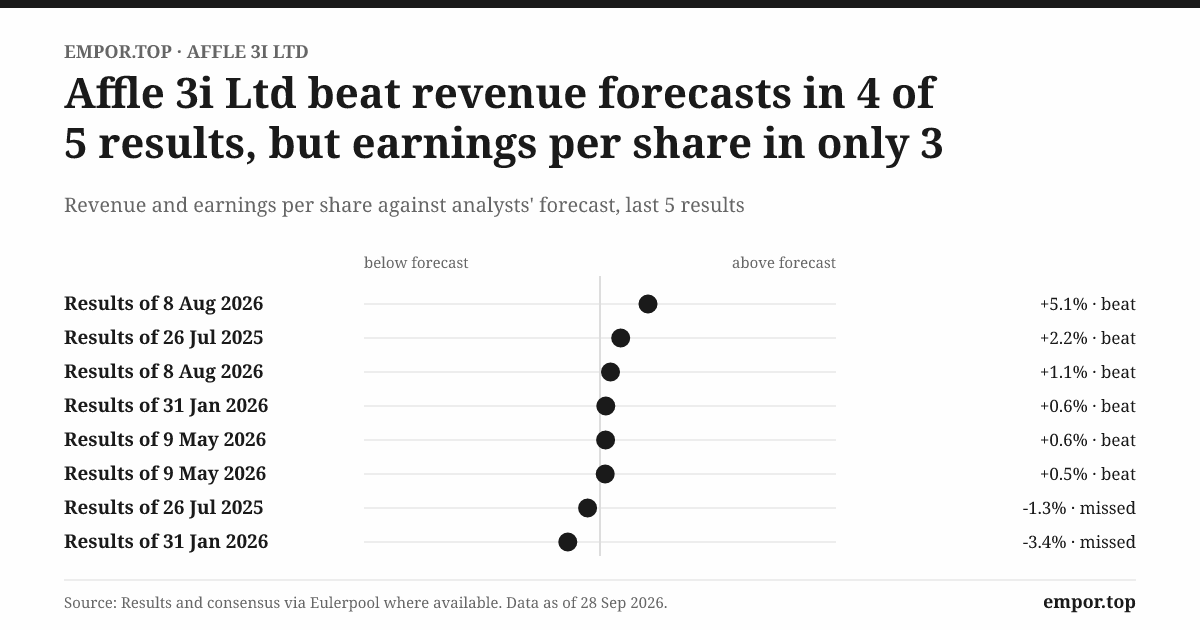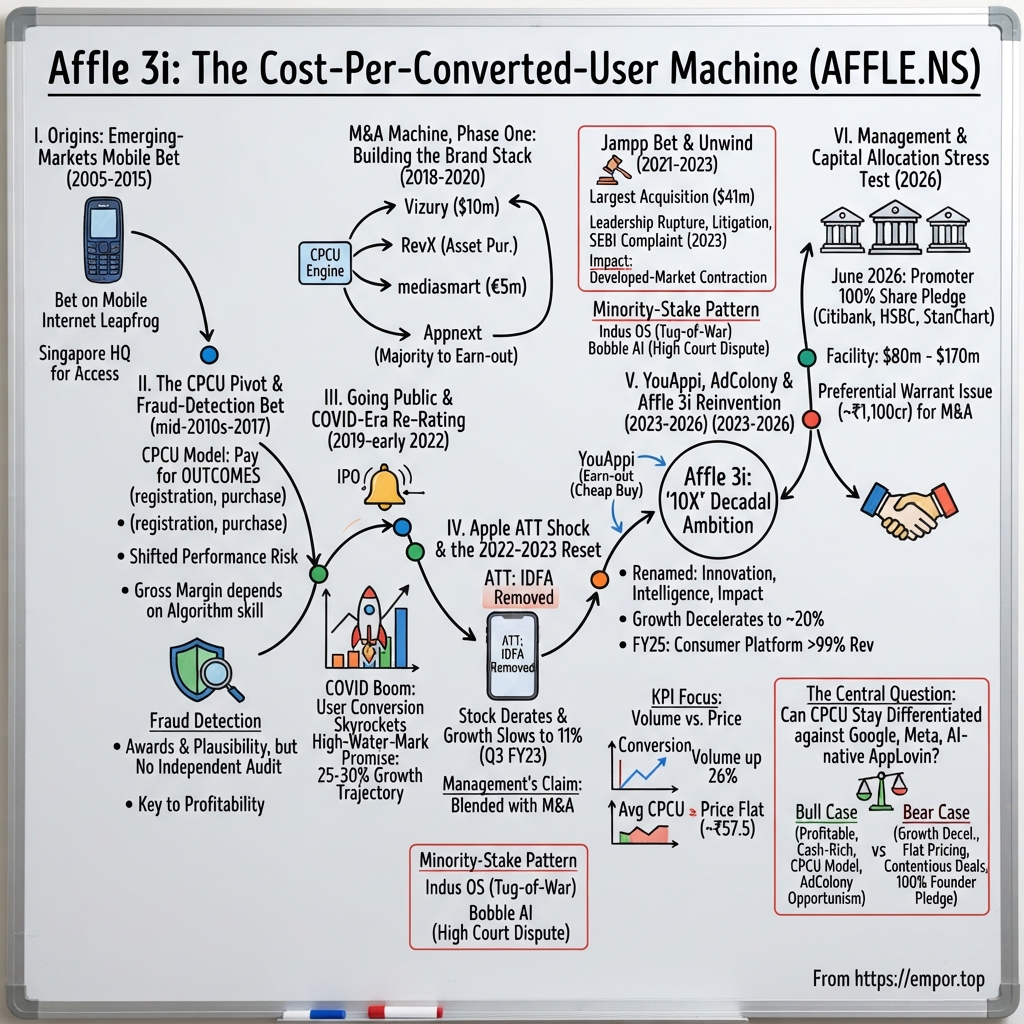
Affle 3i: The Cost-Per-Converted-User Machine
I. Introduction & Episode Roadmap — 00:00–00:06
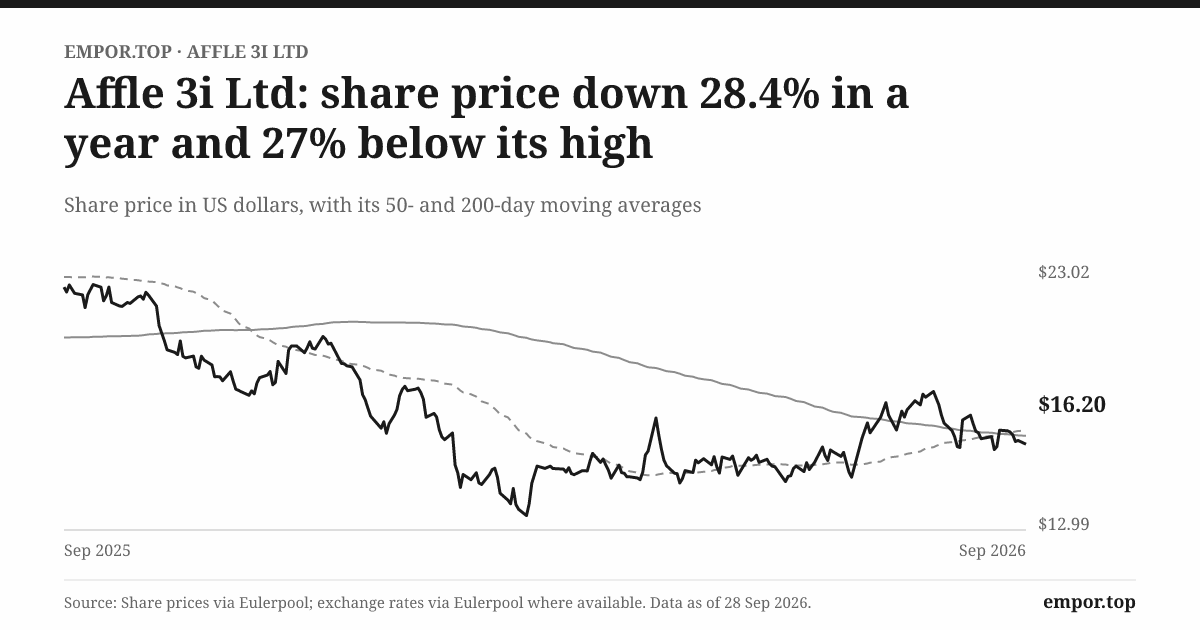
Picture a trading screen in Mumbai on a mid-January morning in 2022. The ticker AFFLE flashes green. A mobile advertising company that most global investors had never heard of, run by a founder who had spent the better part of two decades flying between Singapore and Gurugram, printed a 52-week high of roughly ₹1,510 per share on January 14, 2022, on a split-adjusted basis.15 Less than two and a half years earlier, it had listed at an IPO price of ₹745 per share, before a five-for-one split.3 For a moment, Affle looked like India's answer to the global ad-tech compounders: a founder-run, profitable, cash-rich machine riding the smartphone wave across the emerging world.
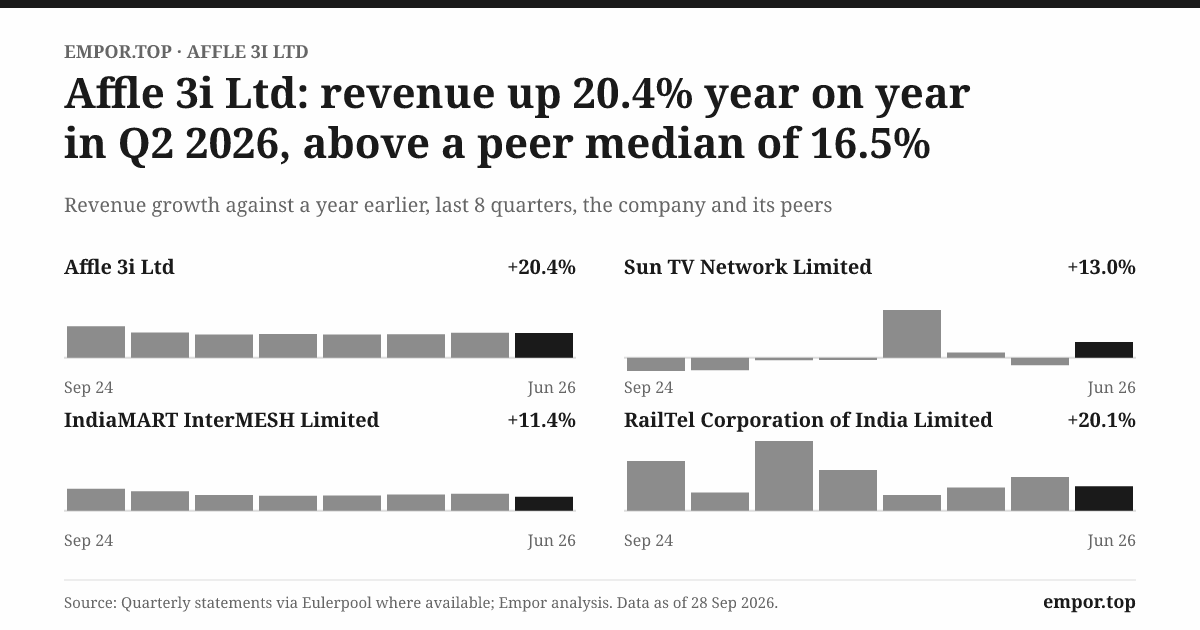
What happened next is the more interesting story. Over the following four years, the company absorbed Apple's privacy overhaul, fought with the founders of its biggest acquisition in court and in front of the market regulator, watched its valuation derate, and walked its growth guidance down step by step. Through all of it, revenue kept compounding at roughly 20% to 30% a year in most quarters.15 That combination is unusual. A business that keeps growing while the stock goes sideways is either being mispriced, or the market is seeing something the income statement is not yet showing.
The company renamed itself Affle 3i Limited in 2025 and now talks about itself as a "consumer intelligence" platform with a "10X" decadal ambition.4 Then, in June 2026, the promoter entities encumbered their entire holding to three international banks against an offshore dollar facility, in the same window as a large convertible-warrant issue to the promoter.19 That is the kind of disclosure that makes careful investors sit up.
The central question of this story is simple to state and hard to answer. Affle built its business on a pricing idea that sounds like the advertiser's dream: pay only for outcomes, not impressions or clicks. How does that model stay differentiated as Google, Meta, and a newly AI-native AppLovin close in from above? And what does a 100% pledge of the founder's own shares say about where the story goes next?
The route runs as follows. First, the origins and the Cost-Per-Converted-User pivot that became the company's identity. Then the acquisition machine, the one very public failure at Jampp, and a pattern of contentious minority investments. Then the Apple shock and the guidance reset it helped force, the 2025 reinvention, the business as it stands today, the competitive battlefield, management and the 2026 capital-structure moves, the numbers, and finally an honest bull and bear case.
Along the way, one discipline is applied throughout: management's claims are treated as claims. Where the company's own record confirms them, that is said plainly. Where the record narrows or contradicts them, that is said plainly too.
 Subscribe on LinkedIn
II. Origins: An Emerging-Markets Mobile Bet (2005–2015) — 00:06–00:14
In 2005, the phone in most Indian pockets was a Nokia candybar. Data was expensive, screens were tiny, and "mobile internet" mostly meant ringtone downloads and cricket-score SMS alerts. It was in that world that Anuj Khanna Sohum set up Affle Holdings Pte Ltd in Singapore.3 The bet was not on any particular gadget. It was on a trajectory: that hundreds of millions of people in India, Southeast Asia, the Middle East and Latin America would meet the internet first, and perhaps only, through a phone.
Khanna Sohum was an engineer-turned-entrepreneur who had studied at Nanyang Technological University in Singapore, and the choice of Singapore as the holding base was deliberate: a regional capital hub with access to foreign investors, sitting at the centre of the markets he wanted to serve.3 The Indian operating company came together in 2006, and its corporate history is worth one sentence because it rhymes with later events. According to the offer document, the Indian entity traces its roots to an earlier company, and the promoter group took control of it rather than building a clean-sheet Indian subsidiary from scratch.3 That is not unusual in Indian corporate history, but it shows a founder who was comfortable using existing corporate structures as a route to scale, a trait that reappears in the 2026 financing chapter.
The strategic thesis was clear-eyed. If mobile would leapfrog desktop in emerging markets, then advertisers selling loans, groceries, games and travel to first-time internet users would need a mobile-native way to find customers and, crucially, to get them to do something. In the desktop world, advertisers bought banner impressions and search clicks. In a market where a user might install an app, open it once and delete it to save phone storage, an install was a weak signal of value.
The long pre-2015 decade matters for today's investor mainly in two ways. First, it produced the emerging-market weighting that still defines the business: at the time of its IPO, the vast majority of revenue came from India and other emerging markets.3 Second, it produced the ownership structure, with Singapore holding companies controlled by the founder sitting on top of the listed Indian entity, which remains in place today and sits at the heart of the 2026 pledge story.19
Everything else about those early years, the SMS campaigns and early mobile-advertising experiments, is prologue. The part of the story that moves the investment case begins when Affle decided to stop charging for attention and start charging for results.
III. The CPCU Pivot and the Fraud-Detection Bet (mid-2010s–2017) — 00:14–00:26
Imagine you run marketing at an Indian food-delivery start-up in 2016. You have a budget, and a dozen ad networks promising you "installs." You pay for 100,000 of them. A month later, you discover that only a small fraction of those users ever placed an order, and some of the installs appear to have come from phone farms: racks of cheap handsets tapping ads in a warehouse. You paid for a number. You did not get customers.
That frustration is the gap Affle chose to build its business around.
Paying for outcomes, not attention
The industry's default pricing units are CPM (cost per thousand impressions), CPC (cost per click) and CPI (cost per install). Each charges the advertiser for something upstream of what the advertiser actually wants. Affle's answer was CPCU, Cost Per Converted User: the advertiser pays only when a user completes a defined action that the advertiser cares about, such as a registration, a first purchase, or a deeper in-app event.3 Think of it as the difference between paying a salesperson a retainer and paying them a commission only on closed deals.
That model became the company's centre of gravity. By the FY2025 results, CPCU business accounted for the overwhelming majority of Consumer Platform revenue, above 99%.42
Why it is a real structural difference, and why it is not a free lunch
The logic is elegant. By shifting the performance risk onto itself, Affle becomes aligned with its advertisers in a way that impression-selling networks are not. An advertiser can compare CPCU against its internal customer-acquisition-cost target and decide in minutes whether a campaign pays.
But this cuts both ways. If Affle buys inventory from publishers on an impression or click basis and sells to advertisers on a conversion basis, its gross margin depends entirely on how well its algorithms predict which impressions become conversions. Get the prediction right, and the spread is profitable. Get it wrong, or let fraud leak in, and Affle eats the cost. CPCU is a bet on Affle's own targeting skill, not a guaranteed margin.
mFaaS: the fraud engine
That is why fraud detection mattered so much. Affle built an in-house ad-fraud detection platform, mFaaS, and described it as protected by patent filings in the US and India.38 The company collected industry recognition for it, including awards from the Internet and Mobile Association of India, and claimed the system filtered out a significant share of fraudulent traffic, with broker research citing figures of around 30% of campaign traffic flagged in certain contexts.8
Evidence check
Here the evidence must be weighed carefully. Industry-association awards and self-reported detection rates are not the same as independent, peer-benchmarked audits of the kind that specialist verification firms provide for other ad-tech companies. In the sources reviewed for this story, including the IPO prospectus, the 2021 PL India initiation report and the FY2025 annual report, no independently audited, peer-comparable fraud rate specific to Affle was found.382 That does not mean the engine is ineffective. It means the claim should be carried as plausible but not independently proven.
The best indirect evidence is economic rather than technical: Affle has stayed profitable for years while pricing on outcomes, which would be hard to do if fraud were systematically eating its spread.15 That is a meaningful signal, but it proves the business works, not that the fraud engine specifically is superior to peers. The KPI that would move this claim from "plausible" to "proven" is simple: an external audit or a disclosed, stable gross-margin trend on CPCU campaigns through periods of rising fraud pressure.
With the model built and profitable, Affle was ready for the public markets.
IV. Going Public and the COVID-Era Re-Rating (2019–early 2022) — 00:26–00:38
August 2019 was not an obvious moment to list an Indian ad-tech company. Global investors had been burned by ad-tech listings for years, and the Indian primary market was cautious. Affle priced its IPO at ₹745 per share and raised about ₹459 crore, of which roughly ₹90 crore was fresh capital and around ₹369 crore was an offer for sale by existing shareholders.3 The stock listed at a healthy premium, and The Ken framed Affle as the company that had broken the "ad-tech IPO curse" by selling conversions rather than eyeballs.9
The small primary component is telling. Most of the money went to selling shareholders, not into the company. Affle did not need the cash to survive; the listing was about currency, visibility and liquidity.
COVID: a tailwind at every layer
Then the world locked down, and every metric Affle sells into went vertical. People who had never ordered groceries on an app learned to. Fintech onboarding, e-commerce, online education and mobile gaming all exploded across India and Southeast Asia. For a company paid per converted user, more users converting was pure oxygen.
The Ken reported that the stock had risen sharply through 2020, and the operating results backed the enthusiasm.9 In Q3 FY21, revenue grew about 59% year on year and profit after tax rose roughly 43%, according to the company's reported results.15 The pre-split share price reached an all-time high above ₹6,000 in early 2021.15
The board approved a five-for-one split in 2021 (face value ₹10 to ₹2), which took effect in October that year, and the post-split shares made their peak in mid-January 2022.15
The high-water-mark promise
The single most important number from this era is not a share price. It is a promise. Around the Q2 FY22 results in 2021, management spoke of a 25–30% revenue growth trajectory over the following five years, a framing echoed in the PL India initiation report published in September 2021.8 It was the boldest forward claim Affle had made publicly, and it set the yardstick for everything that followed.
For investors, the lesson of this period is that the COVID boom flattered every number at once. Growth, margins and multiples all expanded together, which makes it very hard to separate what came from Affle's model and what came from a once-in-a-generation shift in consumer behaviour. That question would be answered, uncomfortably, over the next three years. But first, Affle was busy shopping.
V. The M&A Machine, Phase One: Building the Brand Stack (2018–2020) — 00:38–00:50
A company that makes money by predicting conversions has one overwhelming need: more signal. More audiences, more inventory, more geographies, more types of in-app behaviour to learn from. In 2018, Affle began buying that signal rather than building it.
Vizury: the first real deal
In September 2018, Affle acquired Vizury, a retargeting and CRM-marketing platform, for about $10 million in cash.3 Retargeting is the technology that shows you an ad for the shoes you abandoned in your cart. It fits CPCU neatly: users who already showed intent convert at higher rates. Vizury remains an active brand inside Affle's Consumer Platform.2
RevX and mediasmart
In 2019 Affle picked up the business assets of RevX, a US-linked programmatic platform, for an undisclosed amount, structured as an asset purchase rather than a full entity buyout.2 In early 2020 it bought mediasmart, a Spanish programmatic and connected-TV advertising company, for roughly €5 million, with modest earn-outs, giving it a European foothold.2
Appnext: the earn-out template
The most instructive deal of the era was Appnext, a Singapore-headquartered app-discovery and recommendation engine that sits on Android devices and suggests apps to users. Affle bought a majority stake of about two-thirds in 2020 and acquired the remaining stake in 2022, with the second tranche tied to performance.215 Structuring the price in stages meant the sellers got paid more only if the business actually grew under Affle's ownership.
What the pattern says
This is where Affle's capital-allocation reputation was earned. The deals were small, bolt-on, in adjacent capabilities, and in the Appnext case explicitly conditioned on performance. Compared with the multi-billion-dollar consolidation that later swept ad-tech, including AppLovin's large acquisitions disclosed in its filings,18 Affle's approach looked almost frugal: prove it first, pay more later.
There is a limit to how much credit this era deserves, though. Small deals are easier to get right by construction; a $10 million mistake does not show up in a company's numbers. The real test of "disciplined acquirer" is what happens when the cheque gets four times bigger. That test arrived in 2021, and its name was Jampp.
VI. The Jampp Bet and Its Unwind — The Real Capital-Allocation Test — 00:50–01:05
In mid-2021, flush from the COVID boom and a richly valued stock, Affle announced the purchase of Jampp, a mobile demand-side platform with roots in Buenos Aires and a client base stretching into the US and Europe. The price was about $41 million, the largest acquisition in Affle's history, several times bigger than anything it had done before.13 AdExchanger placed the deal in a wave of mobile ad-tech consolidation driven by market volatility, and the strategic logic was straightforward: Jampp would give Affle a stronger programmatic engine and a door into developed-market advertisers and Latin America.13
A demand-side platform, or DSP, is software that lets advertisers bid on ad slots across thousands of apps in real time, in auctions lasting a fraction of a second. Jampp specialised in re-engagement: bringing lapsed app users back. It was a sensible fit on paper.
What happened next
Less than two years later, the relationship ended in acrimony. Jampp's founders and several senior executives were removed in 2023, and the dispute spilled into public view with the ousted founders pursuing legal action and a complaint to SEBI, India's securities regulator, alleging wrongful termination, while Affle's side accused the former leadership of breaches of contractual and fiduciary duties.20 In the sources reviewed for this article, no final resolution of the dispute was found.
Why this belongs in capital allocation, not a footnote
This is Affle's single biggest acquisition, bought at a step-change price, and it is the one deal with public evidence of a governance breakdown severe enough to reach litigation and a regulator's inbox. Management's public commentary on earnings calls has discussed Jampp mainly as part of the developed-market business and its recovery, rather than squarely reconciling the "largest acquisition ever" framing of 2021 with the leadership rupture of 2023.7[^5] That gap in the disclosure record is itself a data point.
Two questions matter for investors. The first is economic: did Jampp earn back its price? Affle does not disclose Jampp's standalone revenue or profit, so this cannot be answered from public data. What is disclosed is that the developed-market business, which Jampp anchored, was precisely the part of Affle that contracted in FY23.7 That is circumstantial but not encouraging.
The second question is behavioural: does one bad outcome overturn the "disciplined acquirer" story from Section V? Not entirely. A single miss at a company that has done many deals is within normal base rates for acquirers. But it narrows the claim. The honest version is that Affle has shown discipline at small scale, and a mixed record at meaningful scale. The evidence that would confirm or falsify a better version is the performance and integration of its next large deal, which, as it happened, was already in motion.
Before getting there, though, it is worth noticing that Jampp was not Affle's only fight.
VII. The Minority-Stake Pattern: Indus OS and Bobble AI — 01:05–01:15
In the summer of 2021, a small Mumbai start-up building an Indian-language app store for smartphones found itself caught between two giants. On one side was PhonePe, the Walmart-backed payments company, which wanted to buy Indus OS. On the other was Affle, an existing shareholder that was steadily increasing its stake. The Ken described the situation as a tug-of-war, with Affle raising its stake and the startup's cap table becoming a battlefield between a would-be acquirer, a strategic investor and an existing venture investor.10
Weeks later, The Ken followed up with a broader piece on Affle's behaviour as a strategic investor, cataloguing tensions with multiple investee start-ups and titling it "The Kerfuffle With Affle."11 Its framing was that Affle's minority stakes, made through its Singapore vehicle, came with strategic expectations that sometimes collided with the founders' own plans.
PhonePe ultimately acquired Indus OS in 2022, and Affle exited, so the saga ended commercially. But it established a pattern.
Bobble AI
The second case is ongoing and more pointed. Affle holds a meaningful minority stake in Bobble AI, a keyboard and conversational-media start-up. Inc42 reported that Affle sought full inspection of Bobble's books, alleging fraudulent activity, breaches of fiduciary duty and regulatory non-compliance including financial and data leakage, and escalated to an execution petition in the Delhi High Court.12 Bobble's side disputes the characterisation, and none of these allegations has been finally adjudicated in the sources reviewed.
Weighing the pattern
One contentious investment could be bad luck. Two contentious minority stakes plus a founder dispute at the largest acquisition, all within roughly three years, is a pattern. It does not prove that Affle behaves improperly; in the Bobble case, Affle is the party alleging wrongdoing, and investors might argue it is defending shareholder capital aggressively. But it does mean the phrase "low-drama capital allocator" does not fit the record.
There is a plausible structural explanation. Affle invests in companies whose data or distribution, whether an app store, a keyboard, or a DSP, could feed its conversion engine. That makes it a strategic investor with interests that can diverge from the founders'. Investors should expect friction to recur whenever Affle invests for strategic data access rather than purely for financial return.
All of this unfolded against a far bigger shock that had nothing to do with Affle's deal-making, and everything to do with a pop-up on the iPhone.
VIII. Apple's ATT Shock and the 2022–23 Reset — The Real Inflection Point — 01:15–01:32
In April 2021, iPhone users around the world began seeing a new prompt: "Allow this app to track your activity across other companies' apps and websites?" Most tapped "Ask App Not to Track." With that one design choice, Apple's App Tracking Transparency framework removed the identifier that the mobile ad industry had used to follow users from app to app. Meta later told investors the change would cost it around $10 billion in a single year; ad networks built on cross-app tracking were hit hard.
Think of the identifier, the IDFA, as a name tag every iPhone user wore into every shop. ATT let users take the name tag off. Advertisers could no longer easily see that the person who saw an ad in a game later bought shoes in a retail app.
Affle's claimed resilience
Management's position, repeated across calls, was that Affle was less exposed than peers because its model leaned on first-party and contextual signals, its business was heavily weighted to Android and emerging markets where iOS share is small, and CPCU pricing measures conversions the advertiser itself reports.78 The argument is credible in its structure: in India, iPhones are a small minority of devices, so an iOS-specific shock mechanically touches a smaller slice of Affle's reach.
What the numbers actually show
The stock did not crack on ATT. It kept rising through 2021 to its January 2022 peak.15 The correction came in two separate waves, and neither was simply "Apple."
The first wave, in 2022, was macro and valuation. Rising interest rates hit high-multiple growth stocks everywhere. Equitymaster attributed the slide to a combination of margin compression from cost inflation and foreign investors trimming their holdings, and the stock fell sharply from its peak, bottoming in the high-₹800s in mid-2022.1415
The second wave was company-specific and more revealing. On the Q3 FY23 call in February 2023, Affle disclosed that overall revenue growth had slowed to roughly 11% year on year.7 Emerging markets were still growing at around 23%, but developed markets, the US and Europe, had actually contracted.7 Analyst Mayank Babla pressed management on the gap between that result and the roughly 25% growth the market had been expecting.7
Management's framing
Anuj Khanna Sohum characterised the pullback in lower-margin, non-CPCU developed-market revenue as a deliberate choice, saying in essence that "when times get tough, you work on your strength," and pointed to a developed-market recovery "within the next couple of quarters."7 This is the clearest instance in the record of management reframing a growth slowdown as a strategic decision.
Was the promise met? The subsequent record is partially supportive: consolidated growth recovered to the mid-20s percent range in FY24, helped materially by the YouAppi acquisition, which added developed-market revenue inorganically.152 Because Affle does not split organic from acquired growth in the developed-market bucket, it is not possible to say from disclosures whether the underlying developed-market business recovered on the promised timeline. The recovery claim is therefore neither confirmed nor refuted; it was blurred by M&A.
The guidance walk-down
What is clear is the guidance trajectory. The 25–30% five-year framing of 20218 was not repeated at that level. By FY24, management talked of 20–25% growth, and around the FY25 results it described a "conservative" long-term framing of roughly 20% revenue growth and 25% profit growth.4 Each step down was attributed to external forces: macro softness and developed markets in FY23, "geopolitical uncertainties" delaying client spend in FY26,[^5] and, most recently in mid-2026, "regulatory headwinds" in real-money gaming and parts of fintech, following India's 2025 legislation banning real-money online gaming.6
Each explanation may be individually true. India's gaming ban, for example, is a genuine regulatory event that removed an advertiser category overnight. But three consecutive years of external attribution, with no acknowledgment that the original 2021 target was set at the top of a boom, is the pattern investors should name. The credibility test is not whether the reasons are real; it is whether the current ~20% framing holds through the next shock.
A resolved overhang
One privacy risk has since faded. Google abandoned its plan to replace third-party cookies in Chrome and retired remaining Privacy Sandbox APIs in 2025. That mattered more to web-centric ad-tech than to Affle's overwhelmingly in-app business, but it removes one item from the worry list.20
The takeaway: ATT was a real shock, but Affle's slowdown was as much about the post-COVID hangover, developed-market weakness in its acquired businesses and valuation derating as about Apple. That makes the next chapter, a new acquisition and a new name, more a strategic response than a privacy story.
IX. YouAppi, the AdColony Tuck-In, and "Affle 3i" — Reinvention or Rebrand? — 01:32–01:44
In 2023, weeks after the Jampp leadership exit, Affle wrote its largest cheque yet. It acquired YouAppi, a programmatic mobile-marketing company with operations in Israel, the US and Japan and a focus on gaming apps, for about $45 million in total, with roughly $35 million upfront and the rest contingent on performance.2
The timing is striking. Having just endured the breakdown at its previous largest deal, Affle doubled down on the same strategy, buying developed-market programmatic capability, but this time with an explicit earn-out component. That is a partial lesson learned: structure the deal so the sellers share the risk. Whether YouAppi integrates more smoothly than Jampp is the next chapter of the capital-allocation test. In the sources reviewed, no public dispute involving YouAppi was found, but the relevant period is still short.
AdColony: buying from a wounded rival
The more opportunistic move came in 2026. Affle picked up AdColony technology assets from Digital Turbine for a modest sum reported at around $4.7 million.5 Context makes the price interesting. Digital Turbine had bought AdColony in 2021 for several hundred million dollars; by FY25 its own revenue had fallen to about $490 million from roughly $544 million a year earlier, after a period that included restatements related to how it recognised revenue gross versus net.17
Picking up a once-prominent rival's technology for a single-digit-million price is exactly the kind of move a disciplined acquirer makes: buy capability cheaply from a distressed seller rather than paying top-of-cycle multiples. It is a useful counterweight to the Jampp story, though its scale is too small to change the overall record.
The rename
In 2025, the company changed its name from Affle (India) Limited to Affle 3i Limited, with the three i's standing for Innovation, Intelligence and Impact, and management began speaking of a "10X" decadal growth ambition.41
Reading the rebrand honestly: it tracks a genuine change in how management describes the company, from "India's ad-tech leader," the framing of 2021 broker coverage,8 to a "global consumer intelligence platform." The underlying CPCU mechanics, however, have not visibly changed in disclosures. What has changed is packaging and ambition-setting, at precisely the moment when growth had decelerated from its 2021 peak.
The arithmetic is worth stating. Growing ten times in a decade requires roughly 26% compound annual growth. Management's own "conservative" framing is about 20%.4 The "10X" aspiration therefore depends on either re-acceleration or acquisitions. Investors should treat it as a claim to measure against delivered growth, not a forecast.
So what does the machine actually look like underneath the new name?
X. The Business Today: What Actually Drives Revenue and Profit — 01:44–01:54
Walk into Affle's offices in Gurugram and the brand names on the walls read like a museum of the deals just described: Appnext, Jampp, mediasmart, RevX, Vizury, YouAppi. Underneath them sits one engine.
Two segments, one business
Affle reports two segments. The Consumer Platform is the CPCU engine plus a small non-CPCU performance-advertising business, running through the acquired brand stack and internal tools for audience data and attribution.2 The Enterprise Platform, mTraction Enterprise, provides app development and online-to-offline commerce enablement directly to businesses.2
The split is lopsided. In FY25, Consumer Platform accounted for well over 99% of revenue, with Enterprise under 1%.24 There is no hidden fast-growing business inside Affle. The entire investment case runs through one engine.
Volume, not price
The most important operating fact in the FY25 disclosures is the source of growth. Affle processed roughly 393 million converted users in FY25, up about 26% year on year, at an average CPCU of around ₹57.5, up only about 2%.42
In plain English: almost all of Affle's growth comes from doing more conversions, not from charging more per conversion. That tells an investor something important. It suggests strong demand for the service and genuine scale in the engine, but it also suggests limited pricing power. If Affle had a strong, defensible moat, one would expect average price per conversion to rise over time as advertisers competed for its performance. Instead, pricing has been broadly flat. Growth is therefore hostage to conversion volume, and if volume ever plateaus, there is no obvious pricing lever to fall back on.
There is a fair counter-argument: CPCU pricing depends on advertiser mix. Moving into cheaper, higher-volume verticals can hold the average down even while unit economics improve. Affle does not disclose enough to separate those effects, so the flat-price observation should be read as a caution, not a verdict.
Geography
India and other emerging markets were around 90% of revenue at the time of the IPO era; by FY25 and FY26 the share was roughly three-quarters to four-fifths, with developed markets making up the rest after Jampp and YouAppi.2[^5] That developed-market slice is exactly the part that contracted in FY23. Management wanted global diversification; what it got was diversification into the most competitive and privacy-disrupted markets in the world.
Which brings the story to the competition, where the stakes are highest.
XI. Industry Structure and the Competitive Landscape — The Deep Dive — 01:54–02:14
Every time a phone screen lights up with an ad inside a free app, an auction runs in about a tenth of a second. Dozens of bidders, some of them the largest companies on earth, compete to put their advertiser's message in that slot. Affle is one of the bidders. Understanding where it sits in that auction is the key to understanding its future.
Where Affle sits in the stack
At the top are the walled gardens: Google, Meta, Apple and Amazon. They own both the inventory, meaning the screens, and the identity data, meaning who the user is. They do not need anyone else to measure results.
Beside them are the independent measurement partners: AppsFlyer, Adjust, Singular, Branch. Think of them as referees; they tell advertisers which ad network deserves credit for an install or purchase, but they do not buy media. Adjust is now owned by AppLovin, which blurs even that neutrality.18
Affle is neither. It is a full-stack network and DSP that buys media, targets users, runs its own fraud and attribution layer, and gets paid per conversion. That is a distinct position, and it means Affle competes with both the walled gardens for budgets and with other independent networks for inventory.
Relative scale
Affle's FY25 revenue of about ₹2,266 crore translates to roughly $266 million.4 That is smaller than InMobi, the SoftBank-backed Indian ad-tech company, and about half of Digital Turbine's roughly $490 million.17 AppLovin is a different universe: its 2024 revenue was about $4.7 billion,18 and its market capitalisation runs to tens of times Affle's.
Named competitors across Affle's markets include InMobi, Digital Turbine, Mobvista, Unity's ironSource ads, Moloco, Liftoff and Vungle, Kayzen, Criteo in retargeting, and programmatic platforms like PubMatic and The Trade Desk. Among Indian listed peers, Vertoz is a much smaller comparison. Many of these rivals are private, so data are limited.
The evidence for Affle's edge
The strongest concrete proof points are named client case studies. PL India's 2021 report cited results such as a 177% increase in shopping conversions for Swiggy, an 8% lift in first-order rates across hundreds of KFC Malaysia outlets, and 46% incremental store visits for Levi Strauss in Indonesia.8 These are quantified, named results, which is more than many ad-tech companies offer.
But the caveats are real. They are self-reported, several years old, and presented through a broker initiating coverage. More important, the Forensic Investor analysis argues that the data moat is "moderate at best," notes that advertiser relationships are non-exclusive, meaning large brands run campaigns on Affle, InMobi and AppLovin simultaneously and shift budget based on return, and flags a working-capital deterioration in which receivables and contract assets grew materially and working-capital days roughly doubled from about 42 to about 82.16
That working-capital point deserves a plain explanation. In advertising, revenue is booked when the campaign runs; cash arrives when the client pays. If clients start paying later, the income statement looks fine while cash lags. It is not proof of trouble. It is, however, the kind of signal that historically precedes trouble at advertising intermediaries, and it connects directly to the weak cash conversion discussed in Section XIII.
The threat that matters more than Apple
The more dangerous disruptor is not privacy regulation. It is AI-driven targeting at scale. AppLovin's rebuilt AXON engine turned it into one of the fastest-growing, highest-margin companies in advertising, with revenue growth and EBITDA margins that its filings show far exceed anything in Affle's history.18 In 2025, AppLovin rebranded its advertising business around Axon and pushed beyond gaming into e-commerce advertisers.
Why does this matter to Affle? Because AppLovin's pitch is the same as Affle's: pay for outcomes, measured on return. The difference is scale of data and compute. A machine-learning model that sees billions of daily auctions across more apps simply learns faster. If AppLovin decides emerging-market performance advertising is worth fighting for, Affle's differentiation shrinks to local relationships and inventory.
Porter's view
Advertiser bargaining power is high and rising: relationships are non-exclusive, and CPCU already places performance risk on Affle. Large brands such as P&G and Unilever have moved programmatic buying in-house in some markets, a slow disintermediation threat. Supplier power sits with Apple and Google, which set attribution rules unilaterally, as ATT proved. Rivalry is intense but consolidating: Digital Turbine's stumble and AppLovin's purchase of Adjust suggest a shakeout. That shakeout could favour a profitable emerging-market specialist, as the cheap AdColony purchase showed, but only if the specialist can defend its niche from the consolidator at the top.
The competitive verdict: Affle's edge in emerging-market mobile performance advertising is real but narrower than management's framing, and it is untested against a well-capitalised AI-native competitor choosing to compete head-on. Whether the people running Affle are positioned to handle that is the next question.
XII. Management and Capital Allocation Today — The 2026 Stress Test — 02:14–02:26
Twenty years after he incorporated a mobile-advertising company in Singapore, Anuj Khanna Sohum is still Chairman, Managing Director and CEO of Affle 3i.1 On every call reviewed for this story, he is the dominant voice on strategy, M&A and investor messaging. His style is expansive and optimistic: long, fluent answers that emphasise vision, "consumer intelligence" and decadal ambition, with operational detail often handed to CFO Kapil Bhutani.[^5]6
Ownership
The promoter group, through Affle Holdings Pte Ltd and AGPL Pte Ltd, held about 55% of the company in recent filings.19 In isolation, that is the kind of founder alignment investors like. Secondary sources report founder compensation that looks modest for a company of this size; this should be verified against the statutory remuneration disclosure in the annual report before being relied on.2
The record to hold management to
Sections V through IX add up to a mixed record: small, performance-linked bolt-ons that appear to have worked; one large deal, Jampp, that ended in a leadership rupture and litigation; two contentious minority stakes; and a well-priced opportunistic purchase of AdColony assets. That argues for measured, not full, confidence in future large deals.
The June 2026 stress test
Then came the most consequential governance disclosure since the IPO. In June 2026, the promoter entities disclosed encumbrance of their entire shareholding, about 55% of the company, in favour of lenders including Citibank, HSBC Singapore and Standard Chartered, securing an $80 million facility with a step-up to $170 million.19 The disclosures tied the financing partly to share purchases and partly to the promoter's participation in a warrant issue.19
Alongside this, shareholders approved by postal ballot, with around 97% of votes in favour, a preferential issue of convertible warrants to a promoter entity worth about ₹1,100 crore at ₹1,487 per warrant, with the stated purpose of strengthening the company's M&A capacity.619 On full conversion, the company's disclosures indicate the promoter's diluted stake would be about 43.6%.19
The mechanics are worth unpacking. A promoter pledging shares borrows against the value of the company's stock. If the stock falls far enough, lenders can demand more collateral or sell pledged shares, which can create a self-reinforcing slide. Pledging 100% of a holding leaves no unencumbered cushion. In Indian markets, heavy promoter pledging has preceded severe share-price falls at several companies, which is why analysts treat it as a red-flag metric.
There is a benign reading. The founder is borrowing to put more money into the company through warrants at a price near the prevailing market level, which is a vote of confidence, and investment-grade global banks lent against the stock. There is also a skeptical reading. An activist would ask: why does a company with well over ₹1,000 crore of net cash need ₹1,100 crore of new equity for M&A? Why structure it as warrants, which let the promoter pay a fraction upfront and decide later? And what happens to the pledge if the stock falls sharply before conversion? None of these questions has been fully answered in public disclosures reviewed so far.
The conclusion should be calibrated: the pledge is not evidence of wrongdoing, but it materially raises the risk profile of the stock and deserves quarter-by-quarter monitoring of the encumbrance filings.
Dividends and auditors
Affle has paid no dividends since its IPO, consistent with a founder who prefers to reinvest in M&A.15 The statutory auditor changed from S.R. Batliboi & Associates to Walker Chandiok & Co at the 2023 AGM.2 In the annual reports reviewed, no qualified audit opinion was found for the periods covered.2
A founder with a large stake aligns incentives on strategy. It does not, by itself, make financial structuring shareholder-friendly. The numbers show what that strategy has actually produced.
XIII. The Numbers That Tell the Story — 02:26–02:38
Strip away the brand names and the calls, and Affle's financial history tells a story of a company growing up.
Revenue: ten times in seven years, decelerating
Revenue rose from about ₹249 crore in FY19, the IPO year, to roughly ₹1,082 crore in FY22, about ₹1,843 crore in FY24, around ₹2,266 crore in FY25 and about ₹2,709 crore in FY26.1545 That is a roughly tenfold increase in seven years, a real achievement. But the rate has stepped down, from the 25–35%+ range in the boom and M&A years to roughly 20% in FY26.155
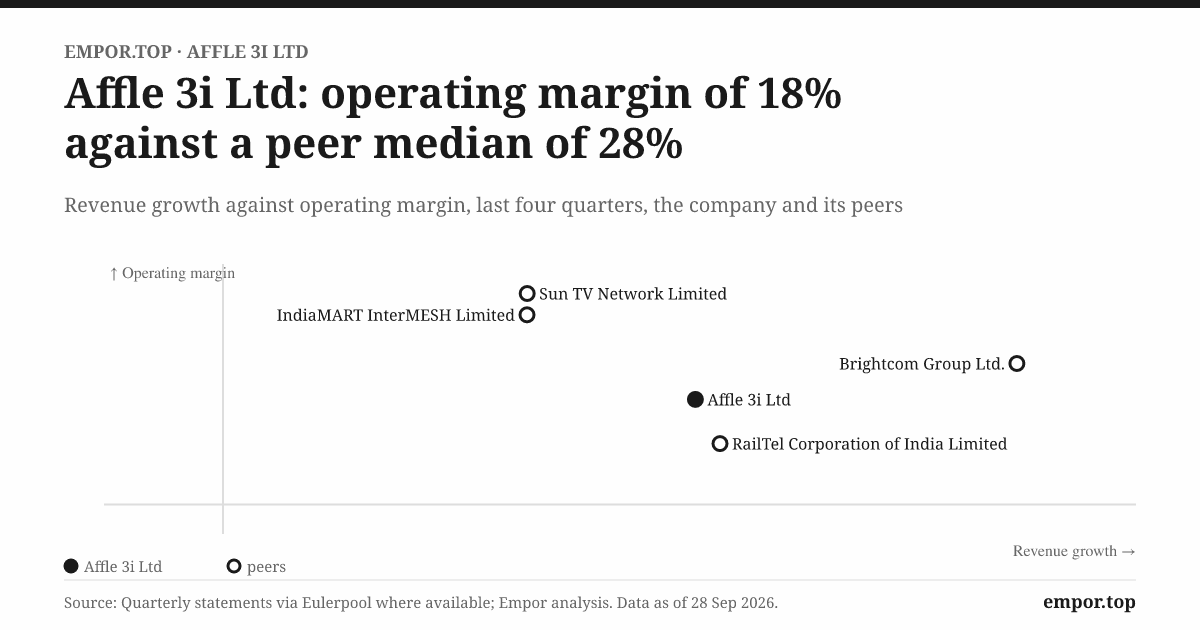
At the same time, EBITDA margins widened from the high teens toward the low twenties.515 The reading is that Affle is trading growth for profitability as it matures, a normal lifecycle transition, but one at odds with the "10X" framing.
Balance sheet: strong, but not undiluted
Affle is effectively debt-free with net cash well above ₹1,000 crore, much of it raised from equity.155 That cash is real financial strength and lets the company self-fund acquisitions. But the company has repeatedly returned to the equity markets: a qualified institutional placement in 2021, a preferential allotment of about ₹749 crore to Gamnat Pte Ltd, a GIC affiliate, in 2023, and now the 2026 promoter warrants.201519 The GIC investment was a validation from a sophisticated long-term investor; it was also dilution. "Self-funding compounder" is accurate only with an asterisk.
The KPIs that matter
Three measures matter most going forward.
First, converted-user volume growth versus average CPCU. This tells an investor whether growth is still coming only from volume, or whether pricing power is emerging. Rising price per conversion would be the single best evidence of a strengthening moat.4
Second, developed-market growth versus emerging-market growth. This is the direct test of whether the gap exposed in FY23 has closed, and whether the Jampp and YouAppi investments are paying off.7
Third, operating cash flow as a share of profit after tax. On the Q1 FY27 call in August 2026, cash conversion was weak at around 41%, and CFO Kapil Bhutani guided to normalisation toward 80–85% by Q3 FY27.6 That is a specific, checkable promise. Combined with the receivables trend flagged by the Forensic Investor,16 it is the quality-of-earnings indicator to watch most closely.
These three numbers are the spine of the bull and bear debate.
XIV. Bull vs. Bear — 02:38–02:50
Two investors can look at the same Affle and see two very different companies. One sees a profitable, founder-led compounder quietly winning the emerging world's mobile economy. The other sees a mid-sized ad network with a flat price per conversion, a messy deal record and a promoter who has just pledged every share. Both are looking at real evidence.
The bull case
Affle is profitable, cash-rich and largely debt-free, with a founder who owns a majority of the company. Its CPCU model is differentiated in an industry that mostly sells attention, and it has named client proof points. Its niche, performance advertising for emerging-market mobile users, is under-indexed by the largest global players, who earn most of their money in the US. Margins have expanded. And the AdColony deal showed a capacity to buy distressed capability cheaply during an industry shakeout. If developed markets recover and cash conversion normalises, the business could compound at around 20% for years.
The bear case
Growth has decelerated from 30%-plus to around 20%, and the only re-acceleration story is the "10X" aspiration. Pricing per conversion has barely moved. The fraud and data moat rests on awards and self-reported data. Advertiser relationships are non-exclusive, and AI-native AppLovin is far larger and faster. The capital-allocation record contains one major deal that ended in litigation and two contentious minority-stake disputes. Cash conversion is weak and receivables have grown. And the 100% promoter pledge and warrant issue add a new layer of financial risk.
Seven Powers test
Through Hamilton Helmer's framework: scale economies are modest; Affle is small against AppLovin and the walled gardens. Network effects are weak to moderate; more campaigns yield more conversion data, which improves targeting, but rivals with more data enjoy the same loop more strongly. Counter-positioning was Affle's original power: CPCU was hard for impression-selling networks to copy without cannibalising themselves. That power has eroded as AppLovin and others moved to return-based pricing. Switching costs are low, since advertisers multi-source. Branding matters little in performance advertising. Cornered resource is limited to local relationships and some Android distribution via Appnext. Process power, the accumulated craft of running profitable outcome-based campaigns in messy emerging markets, is Affle's most defensible asset, though it is hard to verify from outside.
The honest synthesis
History narrows rather than rejects the bull thesis. Affle has a credible, evidence-backed answer to why it wins in emerging-market mobile performance advertising: it has done so profitably for years. It has a much thinner answer to why it wins against AI-native scale players, and to why capital allocation outside the small bolt-on playbook should be trusted at face value.
The events that would resolve this: whether developed-market growth re-accelerates on an organic basis; whether average CPCU begins to rise; whether cash conversion returns to 80%+ as promised; whether the Jampp dispute resolves without further damage; and how the pledge and warrant programme play out over the next four to six quarters.
XV. Playbook: Business and Investing Lessons — 02:50–02:58
Outcome-based pricing is a real differentiator, not a free lunch. CPCU made Affle stand out in a commoditising industry, but it shifted risk onto the seller. It works only as long as the seller's prediction engine outperforms, which is why AI-native competitors are the real threat.
Deal size and structure matter more than deal count. The Vizury, mediasmart and Appnext deals were small and performance-linked; Jampp was large and culture-dependent. The outcomes differed accordingly. YouAppi's earn-out suggests management absorbed at least part of that lesson.
Founder ownership is not governance. A large founder stake aligns strategy, but it does not guarantee shareholder-friendly financial structuring. The 2026 pledge and warrant sequence is a reminder to evaluate the two separately.
Beware the convenient external explanation. Apple ATT, macro, geopolitics and regulation have each been offered as reasons for slowdowns. Each had substance. But the record shows the derating was also about the end of a boom, valuation and competition. No single external factor was the full explanation.
XVI. Epilogue: What to Watch — 02:58–03:05
The story of Affle 3i is still being written, and the next chapters have specific markers.
The first is the Jampp dispute. Any resolution, settlement or further regulatory action, and any fuller disclosure of what went wrong after the acquisition, would close one of the biggest open questions on capital allocation.
The second is developed-market growth. Management first promised recovery "within the next couple of quarters" in early 2023.7 Several years later, investors should look for organic, not acquired, evidence that the promise has been kept.
The third is the promoter pledge and warrant programme: whether the encumbrance declines, whether the promised share purchases materialise, whether warrants convert, and whether the promoter's economic stake lands at around 43.6% as structured.19
The fourth is AppLovin. If its AI-driven engine expands from developed-market gaming and e-commerce into emerging-market performance advertising at scale, Affle's niche will face its sternest test yet.
A company that sells certainty to advertisers, paying only when the user converts, now asks investors to accept a fair amount of uncertainty about its own future. How that tension resolves will define the next decade of Affle 3i.
XVII. Outro & Further Reading
For readers who want to go deeper, three long-form sources stand out. The Ken's investigative reporting on Affle's conduct as a strategic investor, including its Indus OS and "kerfuffle" pieces, gives the most detailed picture of the minority-stake pattern.1011 The PL India initiation report from September 2021 presents the fullest bull case from the peak of optimism.8 And the Forensic Investor analysis offers the fullest bear case, including the working-capital critique.16 Read together with the company's own annual reports and earnings-call transcripts,2[^5]56 they give a balanced view of one of India's most interesting and most debated technology companies.
References
-
Affle Integrated Annual Report FY2024–25 — Affle ↩↩↩↩↩↩↩↩↩↩↩↩↩↩↩↩↩
-
Affle (India) Limited Red Herring Prospectus — SEBI, 2019-07 ↩↩↩↩↩↩↩↩↩↩
-
Affle Reports Robust Performance for Q4 & 12M FY2025 — Affle Press Release, 2025 ↩↩↩↩↩↩↩↩↩↩
-
Affle Q4 FY2026 Earnings Call Transcript — NSE, 2026-05-18 ↩↩↩↩↩↩
-
Earnings call transcript: Affle 3i posts steady Q1 growth — Investing.com, 2026-08-10 ↩↩↩↩↩
-
Affle India Q3 FY23 Earnings Concall Transcript — AlphaStreet, 2023-02-06 ↩↩↩↩↩↩↩↩↩
-
Ride the digital wave with India's Ad Tech Leader! — PL India, 2021-09-24 ↩↩↩↩↩↩↩↩↩
-
Affle Rides on Conversions to Beat the Adtech IPO Curse — The Ken, 2020-09-29 ↩↩
-
Indus OS and the Acquisition Tug-of-War Between PhonePe and Affle — The Ken, 2021-06-02 ↩↩
-
Affle Seeks Full Inspection on Bobble AI, Files Execution Petition in Delhi HC — Inc42 ↩
-
Affle Buys Mobile DSP Jampp as Market Volatility Spurs More Mobile Ad-Tech M&A — AdExchanger, 2021 ↩↩
-
Why Affle India Share Price Is Falling — Equitymaster, 2022-12-21 ↩
-
Affle (India) Ltd Consolidated Financials — Screener.in ↩↩↩↩↩↩↩↩↩↩↩↩↩↩↩↩
-
Digital Turbine Reports Fiscal 2025 Fourth Quarter and Full Year Results — Digital Turbine, 2025 ↩↩
-
AppLovin Corporation Form 10-K FY2024 — SEC EDGAR, 2025 ↩↩↩↩
-
Affle 3i Limited — Revised Disclosure on Shareholding Encumbrance — Investywise, 2026-06 ↩↩↩↩↩↩↩↩↩
-
Affle (India) Ltd — News Topic Archive — Business Standard ↩↩↩
 LinkedIn
 WhatsApp
 Reddit
 Hacker News
 Email
Email Kindle
 RSS Feed
 Spotify
 Apple Podcasts
 Amazon Music
 Audible
 YouTube