AFCONS Infrastructure: Engineering India's Extreme Infrastructure
I. Introduction & Cold Open
Three hundred and fifty-nine metres above the Chenab riverbed, in a Himalayan gorge where mountain winds funnel through unstable rock formations, engineers faced the challenge of closing a massive steel arch. The structure could not be pre-assembled on the ground—there was no ground. Instead, two half-arches were cantilevered outward from opposite cliffs, supported by cable cranes strung across the chasm, creeping toward each other over months with a meeting tolerance measured in millimetres. The completed arch sits roughly 35 metres higher above its riverbed than the Eiffel Tower stands above Paris, engineered to withstand severe earthquakes, blasts, and the loss of a structural pier while continuing to carry rail traffic.
Roughly 1,700 kilometres to the east, a different engineering feat unfolded. Two earth pressure balance tunnel boring machines passed beneath the Hooghly River in Kolkata, driving twin metro tunnels under a live, silt-heavy waterway and beneath dense, colonial-era urban structures with unmapped foundations. While a metro train crosses the river in about 45 seconds, completing the underwater tunneling required years of continuous grouting, structural monitoring, and high-stakes execution.
This is the core business of Afcons Infrastructure: high-risk, technically demanding civil engineering projects where operational errors carry severe safety and reputational costs. Crucially, it is also a business where extreme engineering complexity must ultimately translate into cash collections from government clients who frequently delay payments.
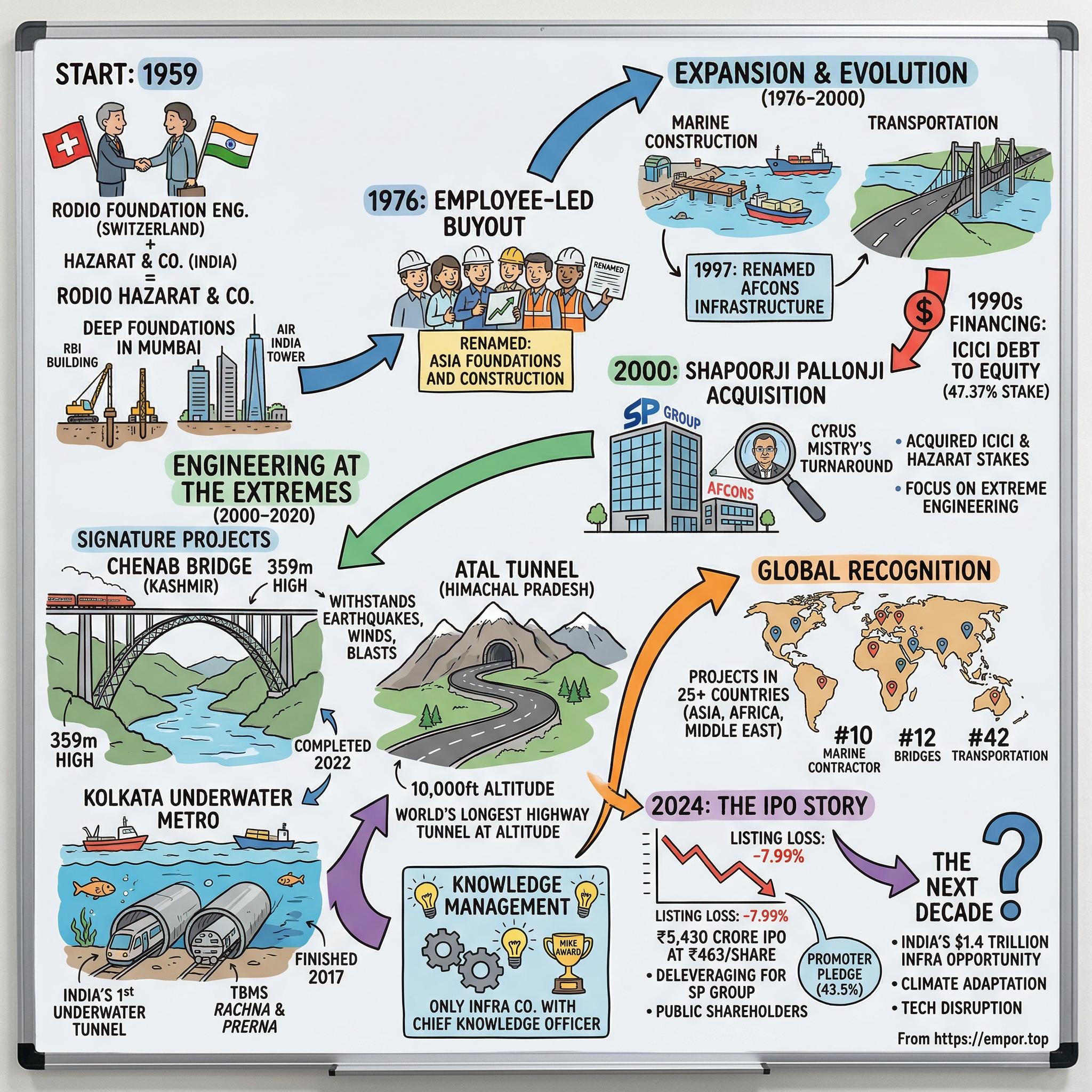
Despite its standing as one of India's premier complex civil engineering contractors, Afcons did not originate as a domestic infrastructure initiative. It began in 1959 as a joint venture between a Swiss foundation-engineering specialist and an Indian partner, established to execute complex piling work in Mumbai's challenging soil.5 The company spent sixty-five years largely out of the public spotlight—operating as a private entity, then under lender ownership, and eventually as the heavy civil engineering arm of a major Indian conglomerate. It listed publicly only in October 2024 through a ₹5,430 crore initial public offering that primarily served as an offer for sale by its parent rather than a fresh capital raise for the business.7
In the twenty-one months following its debut, performance has diverged significantly from prospectus projections. The stock listed at a discount and subsequently declined to around ₹280, well below its 52-week high of ₹479. That drop reduced its market capitalisation to roughly ₹10,300 crore—below its annual revenue of ₹12,322 crore for the fiscal year ending March 2026.42 During that same fiscal year, the company posted its first quarterly loss since initiating quarterly disclosures in 2010, missed its annual order-inflow guidance by a factor of nearly five, and recorded negative operating cash flow for the second consecutive year.24
The central question is not whether Afcons possesses technical engineering competence—the historical execution record is strong. The critical question is whether elite engineering capability in heavy civil construction translates into durable economic returns for minority shareholders when the primary client is a government treasury, the parent conglomerate is refinancing billions of dollars of debt, and the promoter's entire equity stake is pledged.
This analysis traces how Afcons built its technical moat, evaluates its structural depth, and subjects the investment case to rigorous financial examination. The story begins with a Swiss engineer and a piling rig.
 Subscribe on LinkedIn
II. Origins: The Swiss Foundation & Employee Buyout (1959–1976)
In the early 1960s, Nariman Point in Mumbai was not yet a corporate skyline—it was largely reclaimed land dominated by soft marine clay. Constructing high-rises on such ground required solving a fundamental geotechnical challenge: securing structural stability twenty to thirty metres below the surface. Addressing that subterranean risk became the foundation of Afcons' business.
As noted, the firm began in 1959 as a partnership between Rodio Foundation Engineering of Switzerland and Hazarat & Company of India, and was formally registered under the Indian Partnership Act in 1961.5 The Swiss partner provided specialized technical expertise, while the Indian partner supplied local market access and operational execution. Rather than competing as a general builder, the firm established itself as a niche specialist in subterranean foundation work—focusing on piling, diaphragm walls, and ground treatment.
That geotechnical specialization defined the firm's commercial strategy. While general contractors typically compete on price and mobilization speed, a foundation specialist competes on structural integrity under high-risk conditions. From its origin, Afcons' business model centered on absorbing technical risk that clients lacked the internal capacity to evaluate. By 1965, the firm expanded into marine construction—a logical extension of foundation engineering into underwater environments subject to severe weather.5
Regulatory changes soon reshaped the ownership structure. The Foreign Exchange Regulation Act of 1973 forced foreign entities in Indian companies to dilute their equity holdings below controlling thresholds. Faced with these regulatory limits, the Swiss partner exited the joint venture in 1976.5 The remaining Indian enterprise retained the technical methodologies established during the partnership.
A corporate reorganization followed: Asia Foundations and Constructions Private Limited was incorporated on 22 November 1976, and the partnership's entire business was transferred into the new entity via an indenture dated 22 March 1977.5 The choice of name—Asia Foundations rather than general construction—underscored its continued strategic positioning around subterranean and marine engineering.
While corporate accounts often framed this period as an employee-led buyout preserving engineering rigor, the verifiable historical record confirms the ownership transition, corporate restructuring, and technical continuity. The operational consequence was clear: spending its first two decades managing high-consequence geotechnical challenges forced the firm to institutionalize rigorous risk controls. Method statements, real-time instrumentation, and contingency planning became embedded operational practices.
For investors evaluating the business decades later, this origin established a persistent operational pattern. Afcons built its reputation in a technical niche where engineering complexity served as the primary barrier to entry. That early specialization explains how the company positioned itself for high-difficulty national projects, such as the Chenab rail arch.
However, foundation engineering alone limited scale. Expanding from a specialized niche contractor into a broad national civil engineering enterprise required both a larger project scope and substantial capital investment.
III. Expanding the Canvas: Marine, Roads, & ICICI's Financial Engineering (1976–2000)
The 1980s were a decade of waiting for Indian infrastructure. Public capital expenditure was constrained, private capital was largely absent, and a specialized contractor could either remain small or systematically acquire capabilities in adjacent disciplines while waiting for demand to arrive.
Afcons chose the second path, expanding deliberately in sequence. Bridge construction began in 1979. The company's first international project—in Ethiopia—arrived in 1987, an early export of Indian heavy-civil capability at a time when the domestic infrastructure market was moribund.5 Road construction followed in 1988. Each step was a natural extension of core skills: from subterranean foundations to marine construction, from marine structures to bridges, and from bridges to highways.
The corporate identity adapted to this broader scope in 1996, when shareholders resolved to change the name from Asia Foundations and Constructions to Afcons Infrastructure Limited, and the company became a public limited company the following year.5 Removing "foundations" from the corporate title reflected a business that had outgrown its initial niche.
Economic liberalization created new commercial opportunities, but also triggered the most consequential financial episode of the firm's pre-Shapoorji era.
Marine and heavy civil engineering is exceptionally capital-intensive. Bidding for a breakwater or a deep-water jetty requires specialized floating plant—including barges, heavy cranes, and piling spreads—that could not be easily or affordably rented in India due to the absence of a equipment leasing market. In the mid-1990s, anticipating a wave of Indian port modernization, Afcons borrowed heavily from ICICI to acquire specialized marine assets. The commercial thesis regarding market demand proved correct, but the balance sheet structure failed. The debt could not be serviced on the assumed timeline, prompting ICICI to convert its loans into equity; by 1998, the lender held 47.37% of the company.5
This episode established a structural pattern that continues to shape the business. Afcons' competitive advantage—owning specialized, capital-intensive equipment that rivals cannot easily deploy—is financed with debt against contract revenues that arrive late. When the revenue collection cycle stretches, equipment continues to depreciate and interest expenses continue to accrue. In 1998, that cash-flow mismatch cost the founding family control of the company. Twenty-eight years later, a similar working-capital dynamic weighs on the stock's public valuation. The vulnerability was not an isolated historical event; it is structural to the business model.
The resulting ownership structure created an operational impasse. A development financial institution was an ill-suited long-term owner for an active civil engineering firm. ICICI focused on protecting its financial exposure and seeking an exit rather than funding an aggressive capital expenditure cycle to chase India's emerging infrastructure expansion. Consequently, Afcons entered the post-liberalization boom with strong technical capabilities but an owner structurally unequipped to finance its growth.
That constraint set the stage for the transaction that defined the company's next quarter-century—and for a buyer seeking the exact operational franchise a lender could not fully deploy.
IV. The Shapoorji Pallonji Acquisition & Private Stewardship (2000–2020)
In 2000, Sterling Investment Corporation, an entity of the Shapoorji Pallonji Group, acquired shares in Afcons.5 Over subsequent years, the group consolidated near-total ownership, and by the eve of the company's 2024 initial public offering, promoter and promoter-group entities held roughly 99% of the equity.7
The strategic logic behind the acquisition stemmed from Shapoorji Pallonji's operational profile. Founded in 1865, the conglomerate had built a prominent legacy constructing landmark structures across Mumbai, including the Reserve Bank of India building, the Bombay Stock Exchange tower, and restoration work on the Taj Mahal Palace. However, commercial building construction carried modest barriers to entry, heightened exposure to real estate cycles, and limited technical differentiation. What the conglomerate lacked was a heavy civil engineering arm capable of competing for multi-year sovereign contracts where strict technical pre-qualification limits the field of competitors.
Afcons represented an acquisition of capability rather than mere revenue capacity. In heavy civil engineering, pre-qualification criteria demand verified historical execution: bidders must demonstrate completed projects of comparable scale and complexity to qualify for new tenders. Rather than attempting to build these credentials organically, Shapoorji Pallonji acquired two decades of established project track records.
The timing aligned with a major expansion in domestic public spending. As the National Highways Development Project accelerated, Afcons expanded into metro construction in 2000 and hydroelectric projects in 2005.5 The company's total income grew nearly thirtyfold over two decades, rising from ₹300 crore in 2001 to ₹1,000 crore by 2007, and crossing ₹10,000 crore by 2020.5 The bulk of this expansion occurred between 2007 and 2020, matching the broader build-out of India's urban metro networks and expressways. The parent group did not create this infrastructure cycle, but in acquiring Afcons, it possessed an asset well positioned to capture it.
During this era of private stewardship, governance remained closely held within the promoter family. Cyrus Mistry chaired Afcons prior to his appointment at Tata Sons, while Shapoor Mistry served on the board for over twenty-five years and held the chairmanship for more than thirteen years, from fiscal 2012 through fiscal 2025.11 During Shapoor Mistry's tenure as chairman, revenue expanded roughly fivefold to ₹13,023 crore, earnings before interest, taxes, depreciation, and amortization (EBITDA) compounded at an annual rate exceeding 14.5%, and the firm's order book grew to ₹36,869 crore.11
Under private ownership, management pursued a capital-intensive strategy of directly acquiring heavy machinery—including tunnel boring machines, jack-up barges, floating cranes, and specialized piling rigs. These long-life assets carry high upfront capital expenditures and fixed depreciation burdens during market lulls, costs that public equity markets often penalize. Unconstrained by short-term earnings volatility, the private owners built an extensive equipment bank. By the time of the initial public offering, the fleet contained sixteen tunnel boring machines, eleven marine barges, eight large-capacity jack-up platforms, 153 cranes, and 21 piling rigs.6
This equipment ownership model presented distinct operational trade-offs. Direct asset ownership provides a key competitive edge in bidding by lowering marginal mobilization costs, shortening deployment timelines, and satisfying technical tender criteria requiring verified plant access. Conversely, equipment creates fixed overhead and depreciation that require steady contract turnover to absorb; when revenue slows, the earnings drag becomes immediate. That operational arithmetic played out directly in fiscal 2026.
For nearly a quarter-century, the parent group absorbed that cash-flow volatility privately. The shift toward a public listing was ultimately driven not by changes in Afcons' core operational model, but by balance-sheet pressures across the parent conglomerate.
Before examining that market debut, the structural mechanics of the business Afcons brought to investors require closer examination.
V. Engineering at the Extremes: Signature Projects & Technical Moat
In 2018, an Afcons project team in Himachal Pradesh encountered a severe water surge—not a minor seep, but a torrent. The Seri Nallah fault zone, a saturated band of fractured rock crossing the alignment of what became the Atal Tunnel, discharged several thousand litres of water per second into the heading. Tunnelling at an elevation of roughly 10,000 feet in a mountain valley isolated by winter snow, the project team spent years overcoming the fault zone. The completed 9.02-kilometre tunnel, opened in 2020, became the world's longest highway tunnel above 10,000 feet, converting a seasonal lifeline into an all-weather road.11
This undertaking illustrates the core service Afcons provides: absorbing complex geotechnical risk under fixed-scope contracts where subterranean conditions cannot be fully determined at bid submission.
The portfolio of extremes
The Chenab railway bridge, part of the Udhampur–Srinagar–Baramulla link, serves as the company's marquee engineering reference—the world's highest railway bridge, engineered against severe seismic forces and potential blast loads.11 Yet exceptional engineering milestones do not automatically yield immediate financial returns. In the third quarter of fiscal 2026, Afcons recognised ₹165 crore of revenue from a Chenab-related arbitration award, with management estimating the EBITDA contribution at 23% to 24% of that total, while disclosing that an additional ₹115 crore remained under arbitration for the same project.3 A landmark structure completed years earlier remained subject to prolonged legal proceedings to collect contract payments.
Similarly, the Kolkata East–West Metro river crossing established Afcons' underground franchise as India's first underwater metro tunnel, driven through riverbed silt beneath historic urban structures.11 The underlying technical barrier relies on Earth Pressure Balance (EPB) tunnelling. In soft or waterlogged soils, unpressurised excavation risks face collapse and ground subsidence. An EPB machine counters this by retaining excavated soil inside a sealed cutter chamber under controlled pressure, matching surrounding ground and water pressure in real time as the shield advances. Precise pressure calibration prevents both ground settlement and surface heave.
The marine and energy division represents a lower-profile but higher-margin segment of the business. In June 2019, a consortium of Afcons and Japan's IHI Corporation secured a contract to construct two 200,000-kilolitre full-containment liquefied natural gas (LNG) storage tanks at Chhara Port in Gujarat for HPCL Shapoorji Energy—at the time, the largest LNG tanks in India.17 In fiscal 2026, the company commissioned the HRRL crude oil terminal at Mundra, serving one of India's largest integrated refinery and petrochemical complexes.2 Combined with deep-water port projects in Mauritius, Gabon, Bangladesh, and the Maldives, these operations benchmark Afcons' marine capabilities against international standards.
That standing is reflected in global industry rankings. Engineering News-Record ranked Afcons 8th globally among international marine and port facility contractors and 12th among international bridge contractors in its 2025 rankings—metrics management frequently highlights to investors.316
Myth vs reality: how wide is the moat, actually?
The primary investment thesis relies on technical pre-qualification criteria—the rigorous operational and financial standards clients mandate before evaluating bids—to shield Afcons from broad market competition and protect pricing power. While substantial, this barrier is often overstated.
In highly specialized niches, pre-qualification creates a narrow competitive field. Executing major breakwaters or driving underwater metro tunnels requires verified project track records and specialized owned equipment. Few domestic contractors meet both criteria.
However, pre-qualification has not insulated the company from pricing pressure across its broader portfolio. On the third-quarter fiscal 2026 earnings call, management acknowledged "rising competitive intensity in several segments, including metros, where bids have become increasingly aggressive."3 With urban metro projects accounting for 21% of the order book, competitive erosion in this core segment highlights the limits of the technical moat.14
Furthermore, technical pre-qualification does not mitigate the primary drivers of working-capital strain. Afcons' operational challenges in fiscal 2026 stemmed not from lost tenders, but from delayed client disbursements, tunnel boring machine shipments stuck in transit for months, overseas site fuel shortages, and delayed contract awards on projects where the firm held lowest-bidder (L1) status.2 Pre-qualification secures bidding access; converting awarded contracts into timely cash flow remains a distinct operational challenge.
Evaluating the durability of this franchise requires examining the broader competitive landscape and how industry dynamics influence long-term shareholder returns.
VI. Industry Structure, Competitive Landscape, & Segment Breakdown
An Indian infrastructure tender opening often reveals two distinct competitive dynamics within the same industry. For technically demanding packages, a narrow field of six to eight pre-qualified firms submit bids with tight price spreads. For standard road packages, dozens of contractors compete heavily, with contracts frequently awarded to the lowest—and often most optimistic—cost bidder. Afcons operates across both tiers, and the balance between these two project types serves as a primary driver of its overall operating margins.
The five verticals
As of the June 2026 quarter, the company's ₹43,290 crore order book was led by urban infrastructure at 37%—comprising 21% in metro projects and 16% in bridges—followed by surface transport at 24%, marine and industrial at 22%, hydro and underground at 16%, and oil and gas at 1%.14 By client profile, government entities represented 69% of the backlog, multilateral agencies accounted for 25%, and private clients held 6%. Geographically, domestic contracts accounted for 74% of the order book, with overseas markets representing the remaining 26%.14
This structural mix highlights key operational vulnerabilities. With government entities representing more than two-thirds of the backlog, Afcons remains heavily exposed to delayed payment cycles from state treasuries, as experienced during fiscal 2026. Conversely, the 25% allocation to multilateral-funded projects—including institutional support from the World Bank, Asian Development Bank, and Japan International Cooperation Agency across the African portfolio—provides more predictable cash flows, given that project funds are committed prior to tendering and disbursed under standardized rules rather than subject to government treasury constraints.
Management has consistently described a clear margin hierarchy across its business lines: marine and industrial projects yield the highest returns due to stringent technical qualification barriers, urban infrastructure and hydro/underground work occupy the middle tier, and surface transport generates the lowest margins due to intense bidding competition. However, Afcons does not disclose segment-level EBITDA, leaving investors unable to independently verify whether individual contract wins enhance overall profitability. The primary disclosed margin differential is geographic: management notes that overseas projects yield approximately 200 to 300 basis points higher margins than domestic contracts.1
That geographic premium reflects higher risk exposure rather than unearned pricing power. Unlike domestic contracts, which typically include inflation escalation clauses, overseas projects are generally structured as fixed-price contracts without cost pass-through mechanisms.2 When geopolitical conflicts caused fuel and logistics costs to surge during the fourth quarter of fiscal 2026, the international portfolio—which generated roughly 30% of turnover despite representing only about 13% of the order book at the time—absorbed the margin pressure directly.2 Consequently, unexpected cost shocks can quickly offset the higher nominal margins targeted in foreign markets.
The war-game
Larsen & Toubro operates at a scale roughly an order of magnitude larger than Afcons, supported by a balance sheet capable of absorbing extended working-capital cycles that would strain smaller contractors. On mega-projects, L&T's capacity to warehouse receivables functions as a structural competitive advantage. Unable to match that balance-sheet scale, Afcons adopted a more constrained capital approach in fiscal 2026. As the Chief Financial Officer noted, management made a deliberate decision to fund project execution "up to a limit but we had not gone beyond a point to avoid overexposure to any customer," acknowledging that this constraint "limited our turnover in some projects."2 This policy confirms that balance-sheet capacity operates as a direct ceiling on revenue growth.
ITD Cementation India represents the closest peer in marine and underground civil engineering, sharing a similar technical profile and marine-weighted order book. The firm competed directly against Afcons for the Vadhavan port breakwater project.10 Its recent operational trajectory serves as a useful benchmark: ITD entered fiscal 2026 projecting revenue growth above 25% supported by an order book equal to 2.1 times prior-year revenue, whereas Afcons experienced flat-to-declining execution despite holding a comparable order book multiple. This performance divergence suggests that Afcons' fiscal 2026 operational slowdown was not entirely attributable to broader macroeconomic or sector-wide pressures.
KEC International and Kalpataru Projects enter the civil market from power transmission, competing primarily across Afcons' surface-transport and water segments rather than in complex marine or deep subterranean projects. Meanwhile, high-volume developers such as NCC and Dilip Buildcon focus on rapid throughput in standard civil construction, driving aggressive pricing competition across general highway tenders.
This landscape reveals that Afcons maintains strong technical differentiation across roughly 38% of its order book—spanning marine, industrial, hydro, and underground projects—while competing as an established but non-exclusive contractor across the remaining 62%. This positioning offers meaningful competitive protection without guaranteeing pricing power. The company's financial results reflect this reality: EBITDA margins compressed from 12.8% in fiscal 2025 to 11.7% in fiscal 2026.2 While solid for heavy civil construction, these returns underscore the limits of the firm's commercial moat.
Evaluating whether this technical positioning remains durable requires examining the executive leadership and governance framework guiding the enterprise.
VII. Current Management, Governance, & Incentives
On 19 May 2026, during an investor conference call, Afcons' Managing Director opened his prepared remarks with an uncommonly direct admission in Indian corporate disclosures: "First of all, I apologize to all the investors that we have made a loss in the quarter for the first time since we started publishing quarterly numbers from 2010." He added that he was "personally deeply upset with the results."2
While investors treat executive apologies as data points rather than performance absolution, the presentation stood out for its directness. Management disclosed the quarterly loss upfront without attempting to mask it behind adjusted performance metrics or external industry headwinds. The apology preceded the operational explanation, offering an initial indication of management's willingness to acknowledge execution failures.
The people
Srinivasan Paramasivan, the Managing Director, serves as the primary operational voice during investor briefings, directly addressing granular project-level details such as tunnel boring machine assembly timelines, state-level land acquisition delays, and re-bidding prospects for lowest-bidder (L1) contracts. Asked in February 2026 about twenty-two Maharashtra road packages where Afcons had secured L1 status, he noted that the entire program was headed for re-bidding due to incomplete land acquisition and "therefore a repackaging could be done"—while clarifying that the client had not officially communicated this.3 This practice of explicitly separating verified operational facts from inference reflects a structured communication style.
Krishnamurthy Subramanian was elevated to Executive Chairman on 29 August 2025, after more than twenty-two years at Afcons, including fifteen years leading the company as Managing Director and later Vice Chairman.11 As part of the same leadership transition, Shapoor Mistry stepped into the honorary role of Chairman Emeritus, while Pallon S. Mistry joined the board as a non-executive director, marking the entry of the promoter family's next generation into corporate governance.11
On 18 May 2026, the board reappointed both Subramanian as Executive Chairman and Paramasivan as Managing Director for a two-year term from 1 July 2026 to 30 June 2028, subject to shareholder approval. Chief Financial Officer Ramesh Kumar Jha manages financial commentary, routinely prefacing quarterly reviews with the observation that construction margins fluctuate based on execution mix and "may not be indicative of the annual result or trend."23 Establishing this caveat consistently across earnings cycles provides a standard framework for interpreting quarterly volatility rather than serving as an ad-hoc explanation for weak periods.
Credibility, tested against the record
Evaluating executive credibility requires testing management's disclosures against actual financial execution, where a pronounced gap has emerged between communication tone and forecasting accuracy.
The February 2026 earnings call illustrated this divergence. Executive management stated that a 5% full-year revenue growth target looked "definitely achievable." When analysts noted that this target implied fourth-quarter revenue growth of 19% to 20%, the Managing Director highlighted that Afcons had completed nearly one-third of the quarterly target in the first forty days, adding, "That should convey you the level of confidence."3 Concurrently, the CFO projected that the full-year EBITDA margin "should be better than what generally the guidance we give of around 11%."3
Subsequent results fell significantly short of these projections. Fourth-quarter revenue declined 18% year-on-year, full-year revenue contracted 5.4%, and the company recorded a ₹89 crore loss for the quarter.2 While the full-year EBITDA margin of 11.7% met the threshold of being above 11%, that margin benchmark survived primarily because cost structures held while top-line execution contracted.
When questioned during the subsequent earnings call regarding the factors that emerged in the final fifty days of the fiscal year, management cited late-quarter supply-chain disruptions, energy shortages at overseas project sites, vendor demands for advance payments, and instances where government clients certified invoices but delayed treasury disbursements.2 While these factors represented verifiable operational constraints, the underlying forecasting error stemmed from relying on historical seasonal trends. Management assumed a traditional fourth-quarter volume surge—where revenue typically expands 15% to 20% over prior quarters as clients settle fiscal year-end accounts—despite evidence that government payment behavior had deteriorated across the preceding three quarters.2
A similar forecasting disconnect affected order-inflow targets. Management had repeatedly affirmed a fiscal 2026 order-inflow guidance of ₹20,000 crore, maintaining confidence in February, but secured only ₹4,125 crore in actual new orders for the full year.32
Following these shortfalls, management withdrew revenue and margin guidance for fiscal 2027, stating that it "would be prudent to wait for greater visibility."2 While pausing forward guidance avoids further forecasting mismatches, it leaves investors without a clear benchmark—even as management maintained its long-term order-inflow target of ₹30,000 crore, the specific area of its largest prior guidance miss.
Executive compensation disclosures in the annual report detail individual remuneration but omit the specific weighting of variable pay tied to EBITDA margins, safety metrics, or working-capital recovery. In an enterprise where cash conversion represents the central operational risk, the absence of public disclosure on whether executive incentives depend on cash collected rather than revenue booked remains a key governance gap.
This operational context directs attention to the broader governance environment—shifting the primary analytical focus from internal management execution to the capital requirements of the controlling parent entity.
VIII. The 2024 IPO: Capital Allocation, Debt Overhang, & Promoter Pledging
A useful way to evaluate any initial public offering is to ask a fundamental question: which entity required the capital?
Afcons had operated profitably and expanded for two decades under private ownership. It maintained established banking relationships and an owner with substantial resources, meaning the operating business did not require public equity to sustain its core operations. Its parent company, by contrast, was in the midst of one of the largest and most closely monitored deleveraging exercises in Indian corporate finance.
The structure
The public offering ran from 25 to 29 October 2024, priced in a band of ₹440 to ₹463 per share, with allotment on 30 October and listing on 4 November.6 Of the ₹5,430 crore total capital raised, only ₹1,250 crore represented a fresh issue of shares to the company; the remaining ₹4,180 crore was an offer for sale by Goswami Infratech Private Limited, the Shapoorji Pallonji entity holding the shares.7 Consequently, roughly seventy-seven paise of every rupee raised flowed to the selling parent entity rather than into Afcons' balance sheet.
The company earmarked its ₹1,250 crore in fresh proceeds primarily for balance-sheet repair: allocating ₹600 crore to repay debt, ₹320 crore for long-term working capital, ₹80 crore for new construction equipment, and roughly ₹250 crore for general corporate purposes.7 For an enterprise whose primary competitive asset is a direct-owned machinery fleet, allocating just 6% of new capital toward equipment purchases underscored the nature of the issue. The capital raise served primarily to reduce liabilities rather than fund aggressive asset expansion.
Public markets responded cautiously. Anchor investors committed ₹1,621.49 crore on 24 October, but the overall book closed only 2.63 times subscribed—driven by 3.79 times coverage from institutional investors and 5.05 times from high-net-worth individuals, while retail investors subscribed for only 0.94 times their allocated portion.6 The stock debuted on the National Stock Exchange at ₹426, a 7.99% discount to its ₹463 issue price.[^8] By August 2026, the stock had fallen roughly 40% below its issue price.4
The pledge problem
Following the listing, promoter holding stood at 50.17% as of the June 2026 quarter, with institutional investors holding approximately 32% across foreign and domestic funds, and public shareholders holding the remainder.4
However, public governance data highlights a significant structural vulnerability: promoter equity in Afcons is 100% pledged.4 The operational mechanics of this encumbrance became explicit on 21 July 2026, when Goswami Infratech pledged 9,20,72,053 shares—representing 25.03% of Afcons' total share capital of 36,77,84,631 shares—to Axis Trustee Services as debenture trustee, serving as collateral for a debenture issuance by Eqyizen Investment Private Limited.8
Eqyizen served as the vehicle through which the Shapoorji Pallonji Group executed its approximately $2.7 billion refinancing, raising funds to restructure roughly ₹14,500 crore of debt sitting at Goswami Infratech from institutional investors including Deutsche Bank ($644 million), Sageoak Capital, Cerberus Capital Management, Burlington Loan Management, and Varde, with the group's 18.37% stake in Tata Sons pledged alongside as security.13
This structure defines the position of minority shareholders. Afcons is not merely owned by a leveraged parent; its equity functions as a pledged asset within the parent group's broader refinancing package, pledged alongside the Tata Sons holding as collateral for creditors whose primary focus is security enforcement rather than Afcons' operational growth.
The activist stress test
Evaluating this investment case requires examining four specific structural risks.
First, the transmission mechanism. Does parent leverage directly harm Afcons' day-to-day operations? No disclosed evidence points to unapproved cash extraction upward, and dividend distributions in fiscal 2026 remained modest at roughly ₹92 crore.4 The primary exposure is not direct cash diversion, but secondary market overhang and constrained capital support. If credit conditions tighten, pledged shares could be liquidated by lenders, creating market supply that depresses valuations. Furthermore, a fully encumbered parent entity lacks the financial flexibility to inject fresh equity if Afcons requires balance-sheet support. The parent entity represents a source of risk rather than financial backing.
Second, the divergence between capital raised and debt levels. Afcons raised ₹1,250 crore in late 2024 to repay debt and fund working capital. However, by March 2026, gross debt expanded to ₹3,538 crore, compared to ₹2,343 crore of borrowings a year before operational performance deteriorated.24 The initial public offering proceeds failed to achieve lasting deleveraging, as working-capital absorption outpaced the new capital provided.
Third, disclosure asymmetry. The company provides no segment-level profitability metrics and limited working-capital disclosures during analyst calls; on one occasion, the Chief Financial Officer was unable to provide a precise breakdown of receivables, inventory, and retention money when questioned, referring analysts back to the slide presentation.3 For an infrastructure contractor where cash conversion represents the core financial risk, this disclosure gap limits visibility for external investors.
Fourth, accounting methodology changes. In the fourth quarter of fiscal 2026, Afcons modified its expected credit loss (ECL) methodology, transitioning from case-by-case management assessments to a standardized aging and category-based provisioning matrix, which required additional provisions.2 Total fiscal 2026 provisions reached approximately ₹325 crore, with roughly ₹160 crore recognized in the March quarter alone; management estimated aggregate one-off items for that quarter—including the ECL shift, an uncontested arbitration-related provision, and additional marine operational costs—at ₹260 crore to ₹265 crore.2 While adopting an objective provisioning matrix establishes tighter accounting standards, it also indicates that prior disclosures relied on discretionary evaluations, raising questions regarding how receivable values would have appeared under the updated framework in fiscal 2024 and 2025.
These factors do not render Afcons uninvestable, but they require public shareholders to underwrite two distinct risks simultaneously: an operational civil engineering contractor, and a promoter capital structure over which minority investors exert no control.
The interaction between management execution and parent capital structure is demonstrated most clearly in the company's quarterly earnings discussions.
IX. Earnings Call & Transcript Deep Dive: Guidance vs. Execution Reality
If you want to understand what happened to Afcons, read three consecutive transcripts in one sitting. The arc is unusually legible.
February 2026: confidence
The nine-month numbers looked defensible. Total income of ₹9,545 crore was down just 0.9% year on year, EBITDA rose 1.8% to ₹1,269 crore, and the nine-month margin improved 35 basis points to 13.3%.3 The third quarter itself showed income of ₹3,025 crore, down 9%, but with margin of 14% — up 50 basis points.3 Profit after tax for the quarter was ₹97 crore, after a ₹76.51 crore one-time provision for India's new Labour Code.3
Management's framing was that revenue softness was timing and margins were structurally fine. The CFO decomposed the margin story into three parts — a threshold margin embedded at bid stage, savings against risk-and-contingency provisions through design and method improvement, and arbitration awards — and argued the first two were the bulk of it.3 That decomposition is analytically useful and, on its face, credible: releasing contingency because a job went well is real value creation, not an accounting trick.
The order book stood at ₹32,635 crore against inflows of only about ₹3,700 crore for the year to date, and management reaffirmed a ₹20,000 crore full-year inflow target, expecting ₹16,300 crore in a single quarter.3
May 2026: the reckoning
Full-year revenue came in at ₹12,322 crore, down 5.4%. EBITDA of ₹1,439 crore held the margin at 11.7%. Profit after tax fell to ₹251 crore from ₹487 crore — ₹327 crore excluding the Labour Code item. The fourth quarter delivered ₹2,777 crore of income, EBITDA of just ₹170 crore, and the ₹89 crore loss.2 Return on capital employed fell to about 12% and return on equity to about 5%, the latter described by the CFO himself as "quite low."2
The mechanics of the loss are worth spelling out because they illustrate how operating leverage works in this industry. Three separate things compounded. One: one-off provisions and costs of ₹260–265 crore. Two: under-recovery of fixed costs, because the equipment fleet and overheads sized for ₹3,400 crore of quarterly turnover were absorbed by ₹2,777 crore. Three — and this is the subtle one — Afcons only begins recognising profit on a project once cumulative turnover crosses roughly a 10% threshold, and several recent projects "fell short marginally" of reaching it by March.2 So the revenue shortfall did not just reduce profit proportionally; it delayed the point at which entire projects start contributing profit at all. That is a convexity most investors underestimate in contracting businesses: a 10% revenue miss can produce a far larger earnings miss.
Order inflow for the year was ₹4,125 crore, excluding roughly ₹3,800 crore of variation and change orders on existing projects.2 Against a reaffirmed ₹20,000 crore target, that is a miss of a magnitude that demands explanation. The explanation offered was deferral rather than loss: the two Croatian road tenders where Afcons was L1 were cancelled by the client for budgetary reasons, and the Maharashtra packages went to rebid.23 Both are verifiable, and both are client decisions rather than competitive defeats — but the distinction matters less than it sounds, because an order that does not arrive does not build turnover regardless of whose fault it is.
Brokerages split. Elara Capital downgraded to Sell from Buy, cutting its target from ₹443 to ₹282. ICICI Securities held, trimming from ₹340 to ₹315. Nuvama kept a Buy at ₹398 while cutting FY2027 earnings estimates by 24%, describing Afcons as "a sterling EPC player."12 That dispersion — a Sell and a Buy on the same quarter — is a reasonable proxy for how genuinely uncertain the situation is.
August 2026: the order book turns, the P&L does not
The June 2026 quarter, reported on 10 August, showed total income of ₹2,727 crore, down 20.3%; EBITDA of ₹263 crore at a 9.6% margin, down from 13.0%; and profit after tax of ₹30 crore, down 78%.1 EPS came in below consensus and the stock fell.1 By 10 August the shares had touched a 52-week low of around ₹264.
But the order line inverted. Q1 inflows were ₹13,219 crore, taking the order book to ₹43,290 crore — a book-to-bill of roughly 3.8 times — with ₹15,700 crore secured year to date by the call.141 The two anchors: the Croatian railway modernisation contract at €677.07 million, announced 11 May 2026, the largest single order in Afcons' history and its entry into the European market; and the ₹5,301 crore Vadhavan Port main breakwater, awarded in June 2026, a 10.14 km structure described as the world's second-largest breakwater opportunity.910
Management held the ₹30,000 crore FY2027 inflow guidance and presented a nine-month bid pipeline of ₹1,50,681 crore and a two-year pipeline of ₹3.96 lakh crore.141
What the Q&A revealed
Three exchanges are worth isolating.
On revenue timing, an analyst pushed back on the refusal to guide: with ₹43,000 crore of backlog, isn't withholding revenue guidance misleading? The Managing Director's answer was the most useful technical explanation on any of the calls. Heavy civil projects generate almost no revenue in their first months — design, mobilisation, approvals — and "revenue starts accumulating in the heavy civil infrastructure project, by and large, from the second year onwards only." He then named the specifics: four dams of roughly five-year duration, and the Mumbai–Ahmedabad high-speed rail package originally at 62 months, now extended by an estimated 12 to 15 months because of the tunnel boring machine delay.2 Management confirmed on the August call that both TBMs for that package had commenced initial drives, with tunnelling turnover expected from November 2026.1
This is the crux of the near-term investment question. A record order book that is weighted toward long-gestation projects does not fix FY2027 revenue. It largely fixes FY2028 and FY2029.
On cash, the picture stayed poor. Operating cash flow was negative in the June quarter, collections were described as "moderate," and elevated receivables and uncertified work were driving funding needs.1 The Uttar Pradesh Jal Jeevan Mission dispute continues, with the client insisting on 100% completion before releasing payment — which management explicitly characterised as contrary to the contract terms.2 Approximately 11% of the order book is slow-moving or problematic, comprising Bangladesh orders at around 2% and Jal Jeevan Mission work at around 3%.1
On asset intensity, an analyst floated the obvious question: why not go asset-light? Management rejected it, arguing that rentals are prohibitively expensive in marine work and overseas markets, and that asset turnover improves as revenue ramps.1 Whether that holds is testable, and it takes us into the unit economics.
X. Strategic Optionality: Hidden & Future Growth Vectors
By 2026, corporate presentations across the infrastructure sector routinely highlight energy-transition initiatives. For investors, the critical task is distinguishing between promotional positioning and contracted backlog.
In its first-quarter presentation for fiscal 2027, Afcons reported that 43% of its revenue qualified as "green revenue," a classification covering clean mobility, water systems, and renewable energy infrastructure.14 However, that definition is broad—a standard metro viaduct, for instance, is classified under clean mobility. As a result, market participants view this metric primarily as an ESG-reporting framework rather than evidence of a newly established operational segment.
The company's genuine technical optionality lies in narrower, specialized applications. Offshore wind turbine foundations share structural similarities with Afcons' core marine business, requiring large-diameter seabed piling deployed from open-water jack-up platforms. Similarly, green ammonia export terminals rely on marine jetties and cryogenic storage facilities—capabilities Afcons previously demonstrated through its construction of full-containment LNG storage tanks.17
Despite these technical overlaps, Afcons holds no disclosed order book in either segment. Management has not quantified an offshore wind project pipeline during investor briefings, and official reporting includes no separate line item for the sector.14 Consequently, while the technical capability exists, there is no contracted backlog to support revenue projections. Should India's offshore wind tendering expand at scale, Afcons' marine credentials position it among the few domestic contractors qualified to bid, offering long-term strategic optionality rather than immediate financial visibility.
By contrast, international expansion represents a concrete strategic driver. Overseas projects generated 16% of total revenue in the June 2026 quarter, up from 13% in the March quarter, with management targeting an eventual 30% revenue share as the backlog shifts globally.1 Securing the €677.07 million Croatian railway modernization contract served as a key benchmark, validating Afcons' technical qualifications against European contractors under stringent EU procurement standards rather than solely within regional markets.9
This international push provides two distinct financial mechanisms. First, management targets a 200 to 300 basis point margin premium on overseas work relative to domestic projects. Second, several international contracts include interest-free mobilizing advances. By contrast, approximately 40% of Afcons' domestic client advances carried interest charges as of mid-2026, up from roughly 20% in September 2024.21 In a working-capital-intensive business, interest-free advances provide non-dilutive project financing that mitigates balance-sheet stress.
However, international operations introduce specific structural risks. Fixed-price overseas contracts lacking cost-escalation clauses contributed to margin compression in fiscal 2026. Under the Croatian railway contract, cost protection is partial, requiring Afcons to absorb cost overruns of up to 10% before price adjustment mechanisms trigger.2 Additionally, international projects carry heightened legal and counterparty risks. In Gabon, a project entity encashed a bank guarantee of approximately ₹191 crore after French courts refused to issue an injunction, ruling that the guarantee operated independently of the underlying EPC contract; while International Chamber of Commerce arbitration remains ongoing, the cash outflow has already increased the firm's net debt burden.3
In summary, core civil engineering verticals will continue to generate the vast majority of near-term earnings, while international expansion provides a key mechanism for margin expansion and cash-flow support. Conversely, energy-transition initiatives represent long-term technical optionality that has yet to yield contracted revenue.
This leads directly to the mechanics of the operating model itself—specifically, how the enterprise converts awarded contracts into realized cash collections.
XI. Business Model & Unit Economics
There is a moment in every EPC investor conversation where someone says "but they have a ₹43,000 crore order book" as though that settles something. It does not. An order book is a claim on future revenue, not on future cash. Understanding the difference is the whole game here.
Contracting philosophy
Afcons contracts primarily on EPC and item-rate terms. It has deliberately avoided equity-heavy BOT concessions, where a contractor puts its own capital into a toll road or port and takes twenty years of traffic risk. That choice is correct for a company with this balance sheet — BOT would compound an already-strained working capital position with long-dated equity commitments — and it is a discipline the company has actually maintained rather than merely stated.
The critical contractual variable is escalation. Domestic contracts generally include a pass-through mechanism, so when steel, cement or fuel prices rise, the client absorbs it. International contracts typically do not, and Afcons instead prices a risk-and-contingency buffer into the bid. When input costs stay within the buffer, the unspent contingency drops to margin — this is a genuine and recurring source of the outperformance the CFO described in February.3 When costs blow past the buffer, as they did in the March 2026 quarter, the contractor eats it. Management was candid that they were "not very sure to what extent those risks and contingencies will be able to take care of the escalated costs."2
The equipment question
The fleet is the balance sheet's largest strategic bet, and FY2026 gave us an unusually clean read on it. Capital expenditure was ₹1,069 crore for the year, of which roughly ₹700 crore landed in the fourth quarter alone as the long-delayed high-speed-rail tunnel boring machine consignment finally moved.2 Guidance is ₹725 crore for FY2027 in the May framing, revised to ₹700–800 crore in August, tapering to ₹600–650 crore in FY2028.21
Depreciation ran to ₹454 crore in FY2026, of which around ₹289 crore was normal depreciation and the balance accelerated depreciation on tunnel boring machines.2 The accelerated policy is conservative and worth crediting: TBMs are frequently project-specific and hard to redeploy, so writing them down faster than the accounting minimum is a defensible reflection of economic reality rather than a stretch.
The strategic argument for ownership is genuine — mobilisation speed, qualification credentials, and the near-absence of a rental market for jack-ups and marine spreads in Afcons' geographies. The financial cost is equally genuine and is precisely what the loss quarter exposed: roughly ₹450 crore of annual depreciation is a fixed charge against a revenue line that just fell 5.4%. Asset ownership is a competitive weapon in an upcycle and a leverage amplifier in a downcycle. Both statements are true simultaneously, and management's blanket rejection of asset-light alternatives sidesteps the second one.1
The cash flow waterfall
Here is where the business gets uncomfortable, and where an investor should concentrate.
Start at the top: FY2026 income of ₹12,322 crore. Apply an 11.7% EBITDA margin and you get ₹1,439 crore. Subtract depreciation of ₹454 crore and rising finance costs — driven not by the interest rate, which actually improved on the back of a credit rating upgrade, but by higher average borrowings caused by working capital lock-up plus interest on the 40% of client advances that now carry interest.2 Add the ₹325 crore of provisions and the Labour Code charge, and you arrive at ₹251 crore of profit after tax on an effective tax rate of around 35% — inflated by joint-venture taxation and by turnover-based taxes in Bangladesh and Gabon, which are levied whether or not the project makes money.2
Now the part that matters more than any of it. Cash from operations was negative ₹127 crore in FY2026, following negative ₹132 crore in FY2025.4 Two consecutive years in which a profitable contractor generated no operating cash at all. Working capital absorbed the entire earnings stream and more, which is why borrowings rose from ₹2,343 crore to ₹3,627 crore over the year even as reported profit stayed positive.4
The receivables picture explains it: debtor days of roughly 105, but a days-sales-outstanding measure that stretches far higher once unbilled and uncertified work is included.4 In contracting, "uncertified work" is the silent killer — work physically completed, cost incurred and paid to vendors, sitting on the balance sheet waiting for a government engineer to sign a certificate. It funds itself with borrowed money at every step.
Management's stated targets are working capital days back toward 120, roughly ₹1,000 crore of receivables unlocked, gross debt around ₹3,500 crore by March 2027, net debt of ₹2,700–2,800 crore, and net debt to equity of about 0.68 times.21 Note that the last figure represents a deterioration from the 0.49 times reported at March 2026 — management is guiding, in effect, to a year in which leverage rises before the new order book starts converting.21
The unavoidable conclusion: Afcons' economics are not determined by whether it can build difficult things. It has proven that. They are determined by the payment behaviour of Indian state governments, central agencies and multilateral-funded overseas clients. That is the variable, and it is largely outside management's control.
XII. Strategic Frameworks: Porter's 5 Forces & Hamilton Helmer's 7 Powers
Frameworks are useful primarily when they can produce a negative verdict. Applied rigorously, both frameworks do.
Helmer's 7 Powers
Process Power—tacit organizational knowledge that competitors cannot quickly replicate—represents the company's strongest strategic claim, backed by external recognition. Afcons was named a Most Innovative Knowledge Enterprise for eight consecutive years at both national and global levels—the only infrastructure company to achieve that distinction—and received the CII Grand Award for top innovative company across all sectors.3 Operationally, the project team on the CIDCO water supply project completed a 5.5-kilometre tunnel boring machine drive a month ahead of schedule, setting an internal record of 777 metres of tunnelling in a single month.3 While knowledge management awards offer soft evidence, completing a complex drive early and breaking internal speed records provides concrete proof. Yet this operational advantage delivers cost savings and schedule efficiency—which manifest as contingency releases—rather than pricing power during contract bidding.
Cornered Resource is only partially evident. Owning a specialized equipment fleet alongside a verified execution track record creates real barriers to entry for marine and deep tunnelling tenders. However, a cornered resource under Helmer's framework requires preferential access to a scarce asset on favorable terms. Afcons purchases its equipment at market prices, bears continuous depreciation, and faces rivals willing to deploy capital for similar machinery, as demonstrated by ITD Cementation in marine engineering. The historical project track record remains the harder component to duplicate, eroding far more slowly.
Scale Economies are weak, marking a clear area where the framework yields a negative assessment. While deploying heavy machinery across global projects resembles scale, operational evidence from fiscal 2026 points to the contrary: fixed-cost under-recovery during a 5.4% revenue decline contributed directly to the quarterly loss.2 A business benefiting from true scale economies becomes increasingly efficient with growth and degrades gracefully during downturns. Afcons' cost structure compressed sharply when turnover slowed. That vulnerability reflects operating leverage rather than structural scale economies.
Counter-Positioning is frequently asserted but lacks analytical support. Pursuing high-difficulty contracts that competitors avoid reflects strategic positioning rather than counter-positioning, which requires that incumbents cannot enter without harming their core business. Larsen & Toubro routinely bids on complex civil engineering packages without structural impediments. Afcons operates as a specialist among generalists rather than a disruptor insulating itself from incumbent response.
With two powers partially present, one weak, and one absent, the business model exhibits solid technical strengths rather than an impenetrable economic moat.
Porter's Five Forces
Buyer power: very high. With government entities accounting for more than two-thirds of the order book, operational experience in fiscal 2026 demonstrated the practical impact of client dominance: public authorities certified invoices while delaying treasury disbursements, and in Uttar Pradesh, the client unilaterally introduced a 100% completion requirement before releasing payments contrary to contractual terms.2 When clients can alter payment schedules at will, buyer power operates as an active financial constraint.
Supplier power: moderate, but prone to sharp spikes. While markets for cement, steel, and basic equipment remain competitive, recent disruptions exposed critical supply bottlenecks: fuel shortages at remote overseas project sites required vendor advances without guaranteeing delivery, while tunnel boring machine imports faced extended geopolitical clearance delays.2 The Indian government's initiative to domesticate tunnel boring machine manufacturing, which management welcomed, represents a direct attempt to mitigate that supplier dependency.3
Threat of substitutes: low. Physical infrastructure cannot be virtualized or substituted. Breakwaters, underwater rail tunnels, and mountain bridges remain indispensable civil assets, making this force consistently favorable.
Threat of new entrants: low in specialized segments, high in commoditized ones. Standard road packages attract dozens of bidders, whereas underwater metro drives face minimal entry. Overall threat levels depend directly on project mix, with surface transport representing 24% of the backlog—an exposure subject to low barriers and aggressive pricing.
Rivalry: moderate to high, and intensifying. Management's acknowledgment of heightened competitive intensity across metro tenders offers direct evidence of margin pressure in core segments.3
Evaluating these structural forces reveals an industry defined by strong buyer leverage, a defensible technical niche, and a contractor whose operational returns are dictated less by competitive displacement than by client payment discipline.
XIII. Investment Case: Bull vs. Bear Thesis & KPIs
Why Afcons could win from here
The bullish thesis begins with backlog depth. At ₹43,290 crore compared with fiscal 2026 revenue of ₹12,322 crore, the company's book-to-bill ratio stands at roughly 3.8 times—a historically strong multiple within the Indian engineering and construction sector.142 Beyond the top-line multiple, project composition drives the thesis: major wins such as the Croatian railway modernization contract and the Vadhavan Port breakwater represent high-difficulty, large-ticket projects where Afcons' technical pre-qualification provides a distinct bidding advantage, while the Croatian project establishes an entry point into European public procurement.910
Second, core margins demonstrated resilience despite severe top-line headwinds. An EBITDA margin of 11.7% in fiscal 2026—down from 12.8% in fiscal 2025—during a period marked by a quarterly loss, ₹325 crore in provisions, and a 5.4% revenue decline suggests that underlying project pricing remained stable while volume compression and legacy provisions drove the earnings drop.2 Management's assertion that an 11% EBITDA margin represents a structural floor maintained over more than a decade remains supported by historical results.3
Third, public sector infrastructure spending provides a supportive backdrop. India's national budget allocated ₹12.12 lakh crore toward capital expenditure, maintaining policy emphasis on high-speed rail, dedicated freight corridors, and urban transit across regional centers.3 Against this backdrop, Afcons tracks a bid pipeline of ₹1.5 lakh crore over nine months and ₹3.96 lakh crore over two years, indicating that achieving its annual order-inflow target of ₹30,000 crore does not require an unrealistic win rate.14
Fourth, expanding international exposure offers structural benefits, combining a targeted margin premium of 200 to 300 basis points over domestic projects with non-dilutive working-capital financing through interest-free client advances.1
Why the case could break
The counter-thesis begins with prolonged revenue stagnation. Top-line revenue measured ₹11,019 crore in fiscal 2022 and ₹11,948 crore in fiscal 2026, representing a five-year compound annual growth rate of approximately 5%, with fiscal 2026 turnover trailing fiscal 2024 levels.4 This multi-year trajectory indicates that execution constraints have constrained revenue expansion over several cycles, casting doubt on whether record backlog alone can trigger near-term acceleration.
Second, severe cash-flow friction weighs on the balance sheet. Recording negative operating cash flow for two consecutive fiscal years alongside a 55% year-on-year surge in total borrowings highlights a core financial vulnerability.4 When reported operating profits fail to generate cash, the contractor effectively funds client payment delays through increased leverage.
Third, management's forecasting track record exhibits substantial gaps. In fiscal 2026, an initial order-inflow target of ₹20,000 crore yielded only ₹4,125 crore in realized bookings, while a projected 5% revenue expansion converted into a 5.4% contraction.32 Consequently, market participants treat forward guidance—including the ₹30,000 crore order-inflow target for fiscal 2027—with caution, even as early bookings provided partial visibility.2
Fourth, promoter leverage creates significant capital structure risk. With 100% of promoter equity pledged to secure debt obligations linked to parent-level refinancing, minority shareholders face secondary market supply overhang and structural constraints on parent financial support.48
Fifth, international expansion increases execution and inflation risks. Fixed-price overseas contracts without comprehensive cost-escalation clauses, combined with logistics and fuel supply disruptions, drove international margin compression in fiscal 2026—a risk profile that expands as management targets a 30% international revenue share.1
Sixth, operational tail risks remain concentrated across multiple contracts. The encashment of a ₹191 crore bank guarantee in Gabon, ongoing legal proceedings over Chenab railway claims, payment disputes on the Uttar Pradesh Jal Jeevan Mission project, and an 11% allocation of backlog designated as slow-moving collectively demonstrate that a material share of contracted backlog remains subject to execution or payment friction.31
In summary, while Afcons possesses a validated engineering franchise operating within a growing infrastructure market, the operational mechanism converting contract execution into cash collections has faced persistent pressure. Ultimately, restoring shareholder value depends less on engineering capability than on normalizing working-capital cycles and client payment discipline.
The three KPIs that matter
1. Net working capital days. Working-capital efficiency represents the central determinant of financial recovery. Management has targeted reducing working-capital duration toward 120 days while unlocking approximately ₹1,000 crore in receivables, aiming for a 5% to 10% improvement in the metric.21 Deleveraging, return on equity, and the capacity to fund backlog execution depend directly on achieving this cash conversion target.
2. Order book conversion into revenue. With order inflows restored, execution pace serves as the primary operational variable. Monitoring quarterly revenue throughput against the ₹43,290 crore backlog will indicate whether long-gestation projects begin generating meaningful revenue contributions starting in fiscal 2028.
3. Promoter pledge trajectory. Market focus remains centered on equity encumbrance rather than nominal ownership percentages. Reductions in pledged shares would indicate progress in parent-level debt restructuring, whereas additional pledges or structural modifications would signal persistent capital pressures.
XIV. Playbook: Lessons for Builders & Investors
Deep specialization builds a barrier to entry, but investors must verify what that barrier protects. Decades of specialized geotechnical and marine engineering experience earned Afcons placement on pre-qualification shortlists out of reach for general civil contractors. However, technical expertise failed to grant the firm bargaining power over government clients or insulate it from delayed payment schedules. This distinction applies across project-based industries: technical differentiation secures access to revenue opportunities far more reliably than it protects contract terms or operating margins. When evaluating specialized contractors, investors must examine whether a technical moat protects pricing power or merely bidding eligibility.
A leveraged parent creates a persistent valuation overhang on a public subsidiary. Afcons' operational challenges in fiscal 2026 stemmed from internal execution and client payment cycles. However, its stock market valuation remains depressed partly because the entire promoter stake is pledged inside a parent-level refinancing package unrelated to core civil construction. Public shareholders in subsidiaries of highly leveraged conglomerates effectively underwrite the capital structure of two separate entities while exercising control over neither. For investors, parent-level encumbrance does not preclude investment, but it demands a higher margin of safety and a valuation discount to compensate for corporate structure risk.
Direct asset ownership acts as a double-edged operational lever. Owning specialized equipment such as tunnel boring machines, jack-up barges, and heavy marine spreads secures bidding qualifications and accelerates project mobilization. However, direct ownership converts variable equipment rental expenses into fixed overhead and annual depreciation. While this fixed cost structure expands profit margins during cyclical expansions, it compresses profitability sharply during downturns. The strategic question for asset-heavy contractors is not whether to own equipment, but how much volume contraction the fixed cost base can absorb. In fiscal 2026, a 5.4% drop in annual revenue was enough to trigger fixed-cost under-recovery and drive Afcons into a quarterly loss.
Institutional knowledge serves as a critical risk-mitigation tool. Systematically capturing execution data and engineering lessons across complex subterranean projects allows a contractor to refine method statements and avoid costly technical failures. In heavy civil construction, where geotechnical errors cause catastrophic project delays or severe financial liabilities, disciplined operational procedures function as a tangible risk-management asset. Specialized engineering processes accumulated over decades represent one of the few competitive advantages that rivals cannot quickly replicate through capital expenditure alone.
The withdrawal of forward guidance requires evaluating management's operational transparency. Withholding revenue and margin forecasts following a significant earnings miss can reflect either operational prudence or a lack of visibility. The key test lies in whether management isolates unquantifiable external variables while maintaining commitments where operational control exists. Following its fiscal 2026 shortfall, Afcons attributed its guidance suspension to unmapped client payment timelines, overseas fuel availability, and delayed tender awards, while continuing to provide targets for order inflows and capital expenditure.21 Providing targeted metrics while pausing broad top-line forecasts offers a pragmatic middle ground, but it leaves future market performance dependent on verified cash collections rather than forward projections.
XV. Epilogue & Looking Forward
The evolution of Indian infrastructure is shifting toward projects that theoretically align with Afcons' technical capabilities. The initial build-out of greenfield highways across open terrain is largely complete. What remains is technically complex civil engineering: underground metro networks beneath densely populated urban centers, high-speed rail corridors through mountain ranges, deep-water ports for container vessels, and marine infrastructure for offshore energy. In each of these verticals, pre-qualification criteria remain stringent and institutional execution track records serve as a meaningful barrier to entry.
Afcons has positioned itself for this transition, entering late 2026 with the largest order book in its history, an entry into European public procurement, and the contract for what would be the world's second-largest breakwater.
Yet equity markets value the enterprise at roughly ₹10,300 crore—less than a quarter of its order book and approximately 40% below its initial public offering price twenty-one months ago.4 Investors are not questioning the firm's capacity to complete complex engineering structures; they are questioning whether that technical capability translates into reliable cash flow.
That remains an open question for the years ahead. If working capital normalises and the ₹43,290 crore backlog converts on schedule, the current market valuation will appear as a cyclical mispricing of a durable franchise. Conversely, if state payment cycles remain stretched, overseas fixed-price contracts absorb further cost shocks, and parent-level debt obligations remain unresolved, the discount will reflect the reality of an enterprise executing high-risk engineering on constrained cash returns.
A fundamental strategic tension underlies this market transition. For sixty-five years, private ownership allowed Afcons to maintain a long-term operational horizon: accepting short-term earnings volatility to secure strategic contracts, investing in specialized heavy machinery with multi-year payback periods, and rejecting tenders with unfavorable risk parameters. Public capital markets operate under a different cadence. Management must now justify long-gestation civil engineering projects in ninety-day reporting increments to public investors evaluating sequential top-line growth. Whether an organization built on multi-year engineering cycles can thrive under quarterly market scrutiny represents the ultimate test of its public listing.
References
-
Earnings call transcript: Afcons Infrastructure Q1 FY27 — Investing.com, 2026-08-10 ↩↩↩↩↩↩↩↩↩↩↩↩↩↩↩↩↩↩↩↩
-
Transcript of Q4 & FY'26 Earnings Conference Call — Afcons Infrastructure Limited (BSE filing), 2026-05-22 ↩↩↩↩↩↩↩↩↩↩↩↩↩↩↩↩↩↩↩↩↩↩↩↩↩↩↩↩↩↩↩↩↩↩↩↩↩↩↩↩↩↩↩↩
-
Transcript of Q3 & 9M FY'26 Earnings Conference Call — Afcons Infrastructure Limited, 2026-02-16 ↩↩↩↩↩↩↩↩↩↩↩↩↩↩↩↩↩↩↩↩↩↩↩↩↩
-
Afcons Infrastructure Ltd — consolidated financials, shareholding and cash flows — Screener.in ↩↩↩↩↩↩↩↩↩↩↩↩↩↩
-
History of Afcons Infrastructure Ltd. — Goodreturns ↩↩↩↩↩↩↩↩↩↩↩
-
Afcons Infrastructure Ltd IPO: dates, price band, lot size, subscription and allotment details — m.Stock ↩↩↩
-
Shapoorji Pallonji Group's Afcons Infra to Float Rs 5,430-Crore IPO on Oct 25 — Outlook Business, 2024-10-19 ↩↩↩↩
-
Afcons Infrastructure: Promoter Entity Pledges 25.03% Stake to Axis Trustee — Whalesbook, 2026-07-21 ↩↩
-
Afcons forays in Europe, with a major railway project in Croatia — PR Newswire, 2026-05-11 ↩↩↩
-
Afcons Wins Rs 53.01 Billion Contract for Vadhavan Breakwater — Construction World, 2026-06 ↩↩↩
-
Afcons elevates Shapoorji Mistry as Chairman-Emeritus, Krishnamurthy Subramanian as Executive Chairman, and inducts Pallon S Mistry to its Board — PR Newswire, 2025-08-29 ↩↩↩↩↩↩↩
-
Afcons Infrastructure shares extend decline after weak Q4 earnings; brokerages mixed — Business Today, 2026-05-20 ↩
-
Inside Shapoorji Pallonji's $2.7 Billion Debt Deal and the Tata Sons Connection — Outlook Business ↩
-
Afcons Q1 FY27 slides: order book hits ₹43,290 Cr despite weak quarter — Investing.com, 2026-08 ↩↩↩↩↩↩↩↩↩
-
Afcons Infrastructure Limited Red Herring Prospectus — SEBI, October 2024 ↩
-
ENR 2023 Top 250 International Contractors — Engineering News-Record ↩
-
HSEPL has awarded the EPC Contract for two LNG tanks for a LNG receiving terminal in India to the Consortium of IHI and AFCONS — IHI Corporation, 2019-06-29 ↩↩
 LinkedIn
 WhatsApp
 Reddit
 Hacker News
 Email
Email Kindle
 RSS Feed
 Spotify
 Apple Podcasts
 Amazon Music
 Audible
 YouTube