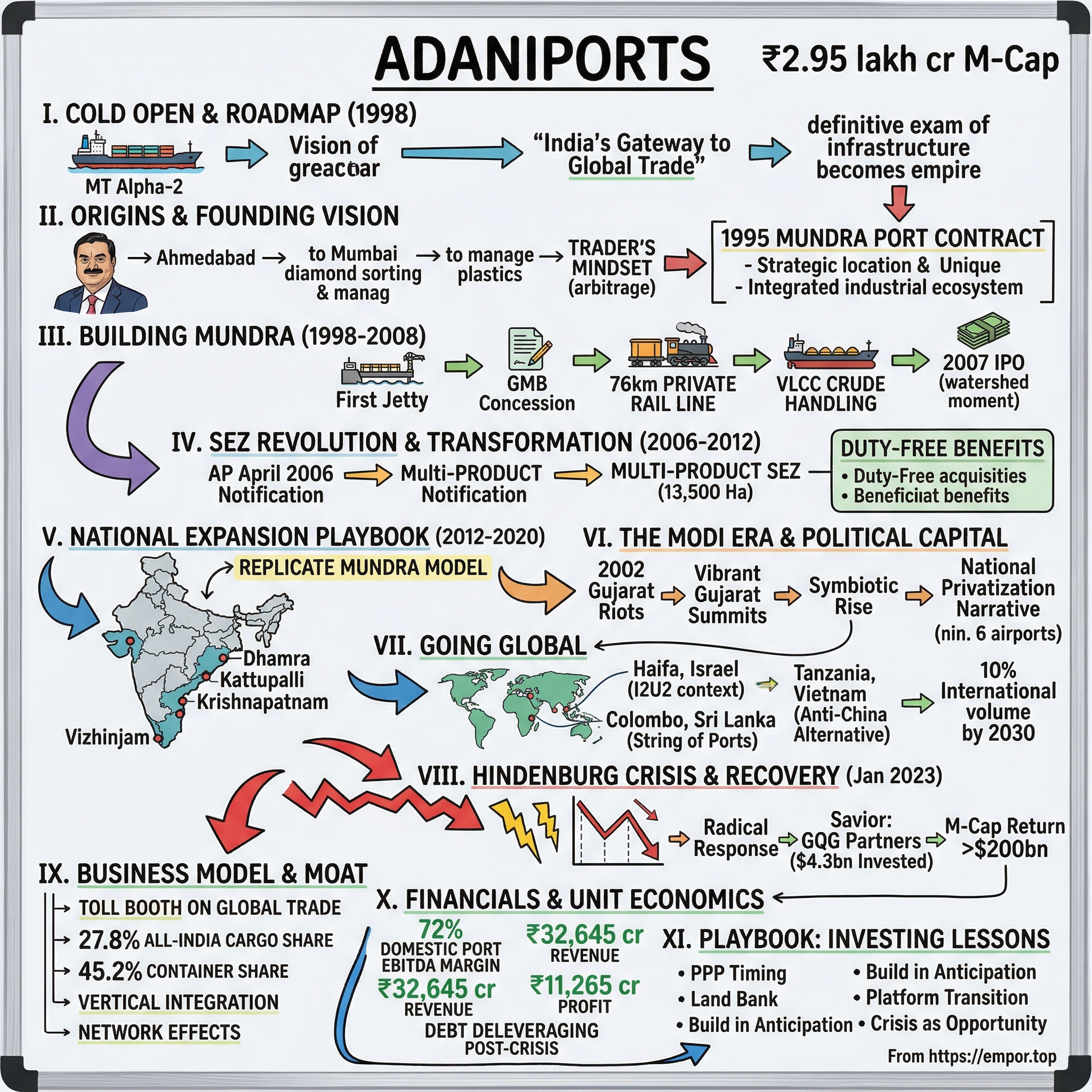
Adani Ports and Special Economic Zone: The Making of India's Infrastructure Gateway
I. Cold Open & Episode Roadmap
On the morning of October 7, 1998, a bulk carrier named Alpha eased alongside a single, lonely berth jutting out of a salt marsh on the Gulf of Kutch. There was almost nothing else there. The Kutch district of Gujarat is one of the least hospitable coastlines in India — flat, saline, sun-blasted, prone to cyclones, and, in 2001, the epicentre of an earthquake that killed tens of thousands. There was no city. There was no highway worth the name. There was a jetty, a trading company's ambition, and a very specific piece of oceanographic luck: deep water close to shore, and no tidal restriction on when ships could come and go.2
Twenty-eight years later, that jetty has become the anchor of a company that moved 500.8 million metric tonnes of cargo in the financial year ended March 2026 — more than a quarter of everything that passes through every port in India, public or private.1 Adani Ports and Special Economic Zone Limited runs terminals on both Indian coasts, in Israel, in Sri Lanka, in Tanzania and in Australia. It owns a fleet of 136 marine vessels, a container-train business, grain silos, and inland container depots. In FY26 it generated ₹38,736 crore of revenue and ₹22,851 crore of EBITDA — a margin near 59% on a business that is, at its core, the mundane work of moving coal, containers and crude from one place to another.1
That is the "what." The interesting question is the "how," and it is genuinely strange. India's ports were, for most of the twentieth century, the province of the state: twelve "major ports" run by trusts under the central government, unionised, chronically congested, and famous for the number of days a ship might wait at anchorage. Adani was a commodity trading house. It had no port-engineering pedigree, no dredging fleet, no terminal-operating heritage of the kind DP World or PSA or APM Terminals inherited from decades of practice. And yet it out-built the state, and then bought a good deal of the private competition too.
Then, in January 2023, it faced something no Indian infrastructure company had faced before: a coordinated short-seller attack from a firm most Indian investors had never heard of, which erased tens of billions of dollars of group market value in a matter of days and forced the cancellation of a fully-subscribed ₹20,000 crore equity raise.1214 The company that emerged three years later is larger, less levered, more international, and — depending on which evidence you privilege — either genuinely reformed or simply better at outlasting news cycles.
This is the story of how a trader's instinct about cargo flows became a national logistics utility. It runs through five acts: the Mundra bet and why the location mattered more than the engineering; the special economic zone that turned a terminal into a platform; the decade-long roll-up of India's coastline; the Hindenburg shock and what the bond market — not the press release — revealed about resilience; and the current, unfinished chapter, in which Karan Adani and an ex-Nissan operations executive are trying to convert a domestic monopoly-adjacent position into a global ports network, while the company still earns a large and undisclosed share of its money from moving coal.
Along the way we will keep returning to one uncomfortable question that any long-term investor in this business has to answer for themselves: how much of the moat is geography, capital and operating skill — and how much of it is proximity to political power in a country where a port is worth exactly as much as its concession says it is?
 Subscribe on LinkedIn
II. Origins: From Commodity Trading to a Captive Jetty (1988–1998)
Start with a young man who dropped out of college and took a train to Mumbai to sort diamonds.
Gautam Adani's early biography is the kind of thing that becomes myth by repetition, so it is worth stripping to the load-bearing parts. He came from a Jain trading family in Ahmedabad. He left for Mumbai in his late teens, worked in the diamond trade, came back to help run a family plastics business, and in 1988 founded what became Adani Enterprises as a commodity trading operation — polymers, agricultural products, and eventually coal. This matters not for its romance but for what it taught him. A trader does not think about assets. A trader thinks about flows: who wants what, where it has to come from, what the chokepoints are, and where the margin leaks out along the chain.
India in 1991 changed the rules under him. The balance-of-payments crisis forced the liberalisation programme that dismantled industrial licensing, opened trade, and — critically for this story — began admitting private capital into infrastructure that had been state-reserved. Ports were among the first. India's coastline was administered in two tiers: the central government's major ports, and "non-major" or minor ports under state maritime boards. The states, chronically short of capital and freshly empowered, were suddenly willing to hand long concessions to anyone who would actually build something.
Gujarat was the most aggressive of them. And Adani, as a coal and polymer trader, already had a problem the state could solve: his cargo had to enter India through somebody else's congested port, on somebody else's schedule, at somebody else's tariff. The logical move for a trader with volume is to own the chokepoint.
In the mid-1990s the Gujarat Maritime Board granted approvals for a captive jetty at Mundra. "Captive" is the important word — it was originally a facility to serve the promoter's own cargo, not a public commercial port. That framing lowered the political and regulatory bar considerably. Nobody was handing a trading house a national gateway; they were letting a company build a berth for its own imports on a stretch of coastline no one else wanted.
Which brings us to the single most underrated fact in this entire company's history: the site.
Mundra sits on the Gulf of Kutch, where the seabed drops away close to shore. In port economics, draft is destiny. A port with 17 metres of natural depth can berth the largest bulk carriers and container ships afloat without dredging a 20-kilometre approach channel and then re-dredging it forever as silt fills it back in. Mundra also has negligible tidal restriction, meaning ships are not queued waiting for a high-water window. Compare that to India's east coast, where several ports require long, expensive, maintenance-hungry approach channels — Dhamra's is 18 kilometres.6 Every rupee not spent on dredging at Mundra was a rupee of structural cost advantage, compounding for thirty years.
And the land. The Kutch coastline around Mundra was saline waste — low-value, sparsely populated, and available in enormous contiguous blocks at prices that would be unthinkable near Mumbai or Chennai. Adani did not just lease enough land for a terminal. He leased enough for a city. That decision, made when the company had no obvious use for most of it, is the foundation of everything in Section IV.
The founding story, then, is not really about ships. It is about a trader who understood that in a country where land acquisition is the single hardest thing to do, the scarcest asset is not a crane. It is a large, contiguous, deep-water-adjacent parcel with a long concession attached — and the willingness to buy it two decades before you need it.
III. Building Mundra and the First Public Test (1998–2008)
The decade from 1998 to 2008 is the proof-of-concept chapter, and it is best understood as a sequence of decisions that each look small in isolation and enormous in aggregate.
Gujarat Adani Port Limited was incorporated in 1998, and the Alpha berthed that October.2 For the first few years the port was what its licence said it was: a captive facility handling the group's own cargo, with a trickle of third-party business. The transformation came in 2001, when the arrangement with the Gujarat Maritime Board was converted into a concession giving the company the exclusive right to develop and operate Mundra port and its related facilities for thirty years, beginning February 17, 2001.3 Thirty years of exclusivity on a deep-water site is not a contract; it is an annuity with construction risk attached.
Then came the move that separates Mundra from every other greenfield port that has been built and quietly failed. Adani built a rail line.
Here is the thing about ports that people outside the industry consistently underestimate: a port is only as good as what happens after the crane puts the box down. A container sitting on a quay in Kutch is worthless. A container sitting in a yard in Delhi is worth something. The distance between those two states — roughly 1,200 kilometres of northern India — is where the actual economics of a port live. Mundra's natural hinterland is the entire agricultural and industrial north-west of India, plus the National Capital Region, and none of it is reachable by truck at competitive cost.
So the company built a captive line connecting Mundra to the Indian Railways network at Adipur, and later integrated it into the national system. This is the origin of a pattern that recurs, with variations, at literally every port APSEZ has acquired since: buy or build the terminal, then immediately fix the landside connectivity, because that is where the competitive differential is created and where the switching costs are eventually manufactured. Competitors can copy a crane. Copying a rail corridor requires land acquisition across hundreds of kilometres of a democracy.
The third leg was cargo diversification. In 2002 the company signed crude-handling arrangements with Indian Oil Corporation, adding liquid cargo to what had been a dry-bulk operation. Liquid terminals are, in engineering terms, a completely different business — pipelines, tank farms, safety regimes — but in economic terms they are the same trick: long-term contracts with counterparties who cannot easily move, generating volume that is far less cyclical than commodity trading. By the time the company came to public markets, Mundra was handling bulk, liquid and containers, with a rail spine and an industrial hinterland taking shape around it.
Which brings us to the first public test. Mundra Port and Special Economic Zone Limited opened its initial public offering on November 1, 2007 and closed it on November 7, pricing at ₹440 per share at the top of a ₹400–440 band, raising roughly ₹1,771 crore.4 The reception was, by the standards of the time, extraordinary: the offer drew bids of well over ₹3 lakh crore, one of the heaviest books Indian markets had seen, with institutional demand alone in the region of ₹2.6 lakh crore.4 The stock listed on both the NSE and BSE.
What did the IPO actually accomplish? Not, primarily, the money. ₹1,771 crore was not going to fund the next two decades of construction. What it accomplished was structural: it gave Adani a permanently listed, index-eligible, rated infrastructure vehicle with continuous access to equity and — far more importantly — to the domestic and international bond markets. Every acquisition in the next chapter was financed against that platform. A privately held port company in India in 2010 could not have bought Dhamra, Krishnapatnam and Gangavaram. A listed one could.
The honest analytical read on this decade is that Adani built a very good port in a very good location, on land and concession terms that would be impossible to replicate today, and then did the unglamorous connectivity work that most greenfield promoters skip. The state contributed the concession and the regulatory permission; the capital came from private equity and public markets rather than government capex. That is a genuine achievement, and it also depended on a set of approvals that a company without political access might have waited far longer to obtain — a tension we will not resolve, but will not pretend away either.
What Adani did next with the leftover salt marsh is where the model stops being a port story and starts being a platform story.
IV. The SEZ Model: Turning a Port Into a Platform (2006–2012)
Imagine you own a toll bridge. You can raise the toll, or you can build a town on the far side.
On April 12, 2006, Mundra received approval as the developer of a multi-product Special Economic Zone at Mundra and the surrounding area — India's first port-based multi-product SEZ, and by land area its largest.3 Special Economic Zones were the Indian government's attempt, borrowed loosely from the Chinese playbook, to create pockets of export-oriented industry insulated from the country's tax and customs frictions. Firms operating inside got duty-free imports of capital goods and inputs, income-tax holidays on export profits, and a single-window clearance regime instead of the usual multi-agency obstacle course.
For most SEZ developers this was a real-estate play with a tax wrapper. For Adani it was something considerably cleverer, and understanding why is the key to the entire company.
A port's fundamental vulnerability is that it does not control its own demand. Cargo goes wherever the shipper's economics say it should go. Ports compete on tariff, turnaround time and connectivity, and if a rival forty kilometres up the coast undercuts you, your very expensive, very immovable asset sits idle. Utilisation risk is the whole game.
An SEZ attached to a port inverts that. If you can persuade a power plant, a petrochemical complex, an edible-oil refinery, a copper smelter or a car factory to locate inside your zone — on your land, connected to your jetty by a conveyor or a pipeline — then that facility's imports and exports are not contestable. They are yours by construction. The tenant is not choosing your port every quarter; the tenant's plant is physically wired into it. The port stops being a service provider bidding for freight and becomes the circulatory system of an industrial estate it owns the ground beneath.
This is why the cheap salt marsh mattered. Land banked at agricultural-waste prices in the 1990s became the inventory for an industrial park in the 2000s. The company monetises it three ways at once: an upfront or annualised land lease, a utilities and infrastructure charge, and — the big one — a permanent, captive cargo stream at the port. That last piece never shows up as "SEZ revenue." It shows up as port volume, at port margins, in perpetuity. Analysts consistently under-model it because it is invisible in the segment disclosure.
There is a discipline in this that is easy to miss. The company did not primarily chase the highest-bidding land tenant. It chased the tenant whose business generated tonnage. A warehouse pays rent; a thermal power station pays rent and imports millions of tonnes of coal a year through your berth. Once you see the model this way, a lot of subsequent Adani Group structure — power generation, transmission, edible oils, cement, copper — reads less like unrelated conglomerate sprawl and more like a deliberate strategy of manufacturing your own cargo. Whether that is brilliant vertical integration or an uncomfortable web of related-party volume depends on how the transactions are priced, which is precisely the question that would be litigated a decade later.
The identity change followed the strategy. On January 6, 2012, Mundra Port and Special Economic Zone Limited became Adani Ports and Special Economic Zone Limited, dropping the single-asset name and formalising the ports-plus-zone construct as the company's definition of itself.5
The template that emerged is worth stating plainly, because it explains every acquisition in the next section: buy or build the marine infrastructure, secure or create the landside connectivity, then capture as much of the hinterland's industrial activity as the land bank permits. Adani was not accumulating ports. It was accumulating catchments.
And in 2012, with the model proven at one site, the company went shopping for more coastline.
V. The National Roll-Up: Buying India's Coastline (2012–2022)
Here is the situation Adani looked at in the early 2010s.
India's coastline was littered with private ports that had been built during the post-liberalisation enthusiasm by promoters who were good at one of the three things required and bad at the other two. Some had the concession but no capital. Some had the capital but no cargo. Almost none had the landside network. Several had been financed with debt on assumptions about volume growth that the 2012–2015 industrial slowdown demolished. India's bankruptcy code, enacted in 2016, then created an orderly mechanism for the worst of these to change hands at prices that reflected reality rather than the promoter's hopes.
Adani's playbook was disciplined and repeatable. Find a port with structurally good geography that is being run below its potential. Buy the whole thing rather than a terminal within it, so that you control the master plan. Immediately spend on mechanisation and rail. Plug it into the group's commercial relationships so that cargo that was previously routed elsewhere gets re-routed. Then let the operating leverage do the work: a port at 40% utilisation and a port at 80% utilisation have almost the same cost base, so the incremental tonne drops through to EBITDA at extraordinary rates.
Dhamra (2014). The east-coast beachhead came from an unlikely pair of sellers. Dhamra Port in Odisha was a fifty-fifty joint venture between L&T Infrastructure Development Projects and Tata Steel, commissioned in May 2011 with an 18-kilometre approach channel and a dedicated 62.7-kilometre rail link to Bhadrak. In FY14 it handled 14.3 million tonnes. On May 16, 2014, Adani agreed to buy 100% for ₹5,500 crore, completing the deal on June 24 that year.6 Both sellers were deleveraging; Adani was buying a mostly-built asset with a rail link already in place and a mineral-rich hinterland. This is the acquisition that established the east-coast leg of what would become a genuinely national network — and note the sequencing: the rail connection was already there, which is exactly the characteristic Adani screens for.
Krishnapatnam (2020). The most consequential deal of the decade, and the one to interrogate hardest on price. On October 5, 2020, APSEZ completed the purchase of a 75% controlling stake in Krishnapatnam Port Company from the CVR Group and other investors at an enterprise value of ₹12,000 crore, which the company itself characterised as approximately 10 times estimated FY21 EBITDA of ₹1,200 crore.7 It later bought out the remaining 25%. The deal came with more than 6,700 acres of waterfront and land — the SEZ logic again — and management said at the time it would take the company's all-India cargo share from around 21% to roughly 25%.7
Ten times EBITDA for an Indian port asset is not a distressed price. Global port transactions in that era clustered across a wide range depending on concession length and contracted volume, and a genuinely stressed Indian asset could be had for considerably less. What Adani bought at Krishnapatnam was scale and geography on the east coast plus a very large land parcel, and the bet was explicitly on ramp: management targeted doubling EBITDA by FY23. Investors judging the deal should judge that ramp, not the headline multiple.
Karaikal (2023). The counterpoint, and a much cleaner piece of capital allocation. Karaikal Port in Puducherry went through the corporate insolvency resolution process, and APSEZ was declared the successful resolution applicant, with the NCLT's Chennai bench approving the plan. The price was ₹1,485 crore, which the company described as roughly 8 times FY23 estimated EBITDA, for an all-weather deep-water port with 21.5 million tonnes of built capacity that had handled only about 10 million tonnes in FY23, five operational berths, three railway sidings and over 600 hectares of land.8 Buying built capacity at half utilisation for eight times earnings, with ₹850 crore of planned follow-on investment, is the acquisition profile that actually creates value in this industry — you are paying for the earnings and getting the spare capacity free.
The timing is worth pausing on. Karaikal was announced in April 2023, roughly ten weeks after the short-seller report that had supposedly frozen the company's access to capital. Whatever else was happening, APSEZ was still able to write a cheque.
Gopalpur (2024). The east-coast network was rounded out in March 2024 with a 95% stake in Odisha's Gopalpur Port — 56% from the Shapoorji Pallonji Group and 39% from Orissa Stevedores — at an enterprise value of ₹3,080 crore and an equity value of ₹1,349 crore, plus contingent consideration of ₹270 crore payable after five and a half years.9 Gopalpur handles 20 million tonnes a year of iron ore, coal, limestone, ilmenite and alumina. Small in isolation; significant as the third Odisha node in a mineral-export corridor.
Vizhinjam (2015 onward). And then the outlier: not a purchase but a bid, not brownfield but greenfield, and not a cargo port at all in the conventional sense.
In 2015 APSEZ won the concession to build Vizhinjam International Seaport near Thiruvananthapuram in Kerala, under a public-private partnership with the state government. The strategic logic was distinct from everything else in the portfolio. Vizhinjam sits roughly ten nautical miles from the main east–west shipping lane connecting Europe and the Far East, with natural depth around 20 metres. That combination makes it suitable for transshipment — the business of a giant ocean-going ship dropping thousands of containers at a hub where smaller feeder vessels collect them for onward distribution. For decades, Indian transshipment cargo was handled in Colombo, Singapore, Salalah and Jebel Ali, meaning Indian exporters paid a foreign hub a fee, and Indian ports never saw the box.
Vizhinjam received its first container ship, the San Fernando, in July 2024, and was formally inaugurated in May 2025 — a decade from bid to commissioning.10 Hold that number. Ten years, through land protests, a cyclone that damaged the breakwater, litigation, and a fishing-community agitation. It is simultaneously evidence that APSEZ will grind through execution risk that would break most sponsors, and evidence that the company's stated timelines on greenfield infrastructure deserve heavy discounting.
By FY26 the roll-up had produced something without precedent in India: a single private operator handling 500.8 million tonnes, with 27.1% of all-India cargo and 45.5% of the country's container volumes, and domestic capacity of 653 million tonnes.130 The genuine competitive mechanism here is not "scale" in the abstract. It is that a shipper moving cargo from Ludhiana to Rotterdam can, uniquely, buy the train, the terminal and the berth from one counterparty with one contract and one accountable party for delay. That is a real service differential, and it is why the roll-up mattered more than the sum of the ports.
But a network built this fast, in a country where every port is a state concession, invited a question that the company has never fully escaped.
VI. Politics, Capital, and the Adani Playbook
Every emerging-market infrastructure story eventually arrives at the same awkward room, and it is better to walk into it deliberately than to be dragged.
Mundra grew up alongside a specific political configuration. Gujarat under BJP state governments from the mid-1990s pursued an explicitly business-first industrial policy, and Narendra Modi's tenure as chief minister from 2001 to 2014 coincided almost exactly with Mundra's transformation from captive jetty to national-scale port. Gautam Adani was a visible participant in and beneficiary of that ecosystem, and the relationship is long-standing and well documented in Indian business coverage. When Modi became prime minister in 2014, the Adani Group's principal patron effectively moved from the state to the centre.
There are two lazy readings available here and both should be resisted.
The first lazy reading is that the whole thing is crony capitalism and the operating achievement is illusory. This does not survive contact with the assets. Somebody actually built the deepest-draft port in India, actually laid the rail, actually dredged the channels, actually got Vizhinjam's breakwater rebuilt after a cyclone, and actually ran Mundra at world-competitive turnaround times. Political access does not unload a Capesize vessel.
The second lazy reading is that the political question is noise invented by short-sellers. That does not survive contact with the business model. In a port business, essentially every asset is a concession — a licence from a government to operate for a defined period on defined terms, with tariffs that in parts of the sector are set or influenced by regulation. Land acquisition, environmental clearance, coastal-zone permissions and rail linkages all require state cooperation. Speed of approval is a competitive weapon in this industry, and a company that gets approvals faster than its competitors earns real returns from that. That is a genuine, if unquantifiable, component of the moat.
The honest framing is that political proximity is a real asset with a real, correlated liability attached, and investors should treat it exactly as they would treat any concentrated dependency. It plausibly compressed timelines and eased land access. It is also the single largest tail risk in the equity: a durable change in India's political weather would not damage the physical assets at all, but it could damage the rate at which new concessions, expansions and clearances arrive — which is to say, the growth algorithm. It also guarantees that every governance question about this company will be litigated in a supercharged political atmosphere, where neither critics nor defenders are disinterested.
The peak arrived in 2022. Adani Group companies re-rated ferociously through the pandemic recovery, and by late 2022 the combined group market capitalisation had pushed past $200 billion, briefly making it India's most valuable conglomerate and Gautam Adani, at moments, the second or third richest person alive. Adani Enterprises had just been added to the Nifty 50. The group had announced enormous commitments to green hydrogen, airports, cement, data centres and roads. Leverage across the group had risen alongside the ambition, and several sell-side and credit-research shops had already flagged it.
For a company whose equity had compounded at a rate more usually associated with software than with jetties, the setup was combustible. All it needed was a match.
VII. The Hindenburg Shock and the Recovery (January 2023–2025)
On January 24, 2023, a New York short-selling research firm run by Nathan Anderson published a report titled with the accusation that the Adani Group was pulling "the largest con in corporate history." It alleged brazen stock manipulation and accounting fraud, described a web of offshore entities in Mauritius and the Gulf that it claimed were used to round-trip funds and support share prices, questioned related-party disclosures, and flagged group leverage. The timing was surgical: Adani Enterprises was in the middle of a ₹20,000 crore follow-on public offer.
The market reaction was violent. Within two trading sessions, listed Adani Group companies lost roughly ₹3.86 lakh crore — about $47.3 billion — of market value, and the decline continued for weeks, ultimately running well past $80 billion at the trough.12 On January 25 the group issued a media statement calling the report "a malicious combination of selective misinformation and stale, baseless and discredited allegations."13 A 413-page rebuttal followed, framing the attack not merely as an attack on one company but as "a calculated attack on India, the independence, integrity and quality of Indian institutions, and the growth story and ambition of India."
Then came the moment that told you the market had not been persuaded. On February 1, 2023, the board of Adani Enterprises withdrew the follow-on offer — even though it had been fully subscribed the previous day — and returned the money, citing unprecedented volatility in the share price.14 A company that cancels a completed equity raise is telling you something about its assessment of its own share price that no rebuttal document can offset.
The call that mattered
Six days later, on February 7, APSEZ held its Q3 FY23 earnings call, and the transcript is one of the most revealing primary documents in this entire story — not for what management said, but for the shape of the conversation.
It began with the analyst hosting the call asking participants "to please restrict your questions to quarterly results or only strategic and business related questions, and request participants to reserve their group related questions to a separate interaction with the group team."15 Karan Adani, then CEO, opened by saying he would keep his remarks brief so there would be enough time for questions.15 The call ran to 33 pages — roughly two and a half times the length of the following quarter's call — and the questioner list reads like a credit committee rather than an equity roadshow: Lombard Odier, Deutsche Bank, Seaport Global, MetLife Investment Management, Calamatta Cuschieri.
What they asked about was not cargo. They asked about the exact composition of cash balances, whether cash on the balance sheet could be pledged for secured borrowing, what the negative-pledge covenant in the dollar bonds permitted, how much of the asset base was already encumbered, whether the company could buy back its own bonds in the open market with prices under pressure, and — pointedly — what the rating agencies were now demanding. One analyst noted that S&P had moved its outlook to negative the previous day and asked whether any conditions had been imposed. The CFO, D. Muthukumaran, replied that there was "no particular condition that has been put or a metric that has been communicated to us," and pointed to cash flow and leverage.15
Management's substantive response was to commit publicly to deleveraging: ₹5,000 crore of scheduled and unscheduled debt repayment and prepayment during FY24, targeting net debt to EBITDA of around 2.5 times by March 2024, with capital expenditure guided down to ₹4,000–4,500 crore.15 Asked repeatedly about the long-rumoured acquisition of Container Corporation of India — a large state-owned rail logistics operator then slated for privatisation — Karan Adani gave an answer that, for once, was unambiguous: "our priority and our first order of preference is to deleverage to 2.5x net debt to EBITDA."15
By the FY23 results call on May 30, 2023, the tone had changed materially. The company reported its strongest full year to that point — operating revenue of ₹20,852 crore and EBITDA of ₹12,833 crore, both up around 22%, on cargo of 339 million tonnes, with profit after tax of ₹5,393 crore after absorbing a ₹1,273 crore write-off on the sale of its Myanmar asset.16 It disclosed that it had invested roughly ₹27,000 crore during FY23 across six acquisitions plus ₹9,000 crore of organic capex, financed predominantly from internal accruals and existing cash, and that gross debt to fixed assets had fallen from 80% in FY19 to about 60%.16 Net debt to EBITDA sat at 3.1 times. Total cash on the balance sheet at March 31 was ₹9,800 crore, and asked directly about fundraising plans, management said flatly: "we have no sort of requirement."16
The bond buyback programme launched in April 2023 was the real signal. Buying back your own dollar notes when they are trading at distressed levels does two things: it retires debt at a discount, and it demonstrates to the market that you have surplus liquidity precisely when the bear case says you do not. The first tranche completed was $130 million of notes due June 2024.16 This is what the capital-markets test actually looked like — not the rebuttal document, but a treasury operation.
What the auditors flagged
One item from that call deserves to be pulled out, because it is the kind of thing that gets lost in the noise and matters more than most of the noise. A Deutsche Bank analyst asked about a qualified opinion in the auditor's note, relating to an engineering, procurement and construction contract with a fellow subsidiary of a group company which the group represented was not a related party. Management confirmed the contractor's name, said the relationship went back about a decade, and framed the qualification as the auditors' reaction to the pending SEBI and Supreme Court proceedings rather than a finding of substance.16 Whatever one concludes, a qualified audit opinion on a related-party determination is a documented accounting judgment, and it is the sort of item a skeptical investor should track across subsequent annual reports rather than assume away.
The other governance datapoint from those calls was promoter share pledging. Investors had been worried about it since 2020, and management disclosed that pledges had fallen from 17% to 4% by March 31, 2023, with a stated intention to reach zero.16
The regulatory resolution — and its limits
The legal process ground on for nearly three years. In January 2024 the Supreme Court of India declined to transfer the investigation to a special investigation team, leaving the matter with SEBI, and subsequently dismissed a review petition. Then, on September 18, 2025, SEBI issued orders closing proceedings, finding no violation established in the matters examined — including the allegation that funds had been routed through intermediate entities to disguise related-party transactions. The regulator's reasoning turned substantially on the fact that the transactions in question did not meet the definition of related-party dealings under the rules as they stood at the time, since that definition was broadened only by a 2021 amendment, and on findings that the loans had been repaid with interest and no funds misappropriated.1718 SEBI's examination spanned the 24 matters the Supreme Court had been tracking.18
This is a genuine legal resolution and it should be reported as such. It is also narrower than the headlines suggested, and investors should hold both thoughts. "No violation established under the regulations as they existed" is a different statement from "the underlying commercial arrangements were arm's-length and fully transparent." A finding that a transaction was not legally a related-party transaction in 2019 does not tell you whether it was economically one. The offshore shareholder-concentration allegations — which were always the hardest to prove or disprove from outside — depended on beneficial-ownership information that regulators in multiple jurisdictions would have needed to share. What SEBI's order removes is the overhang of enforcement risk. What it does not remove is the underlying disclosure question, which remains a matter of judgment rather than of settled fact.
The money that came back
The clearest market vote arrived early. On March 2, 2023, barely five weeks after the report, US-based GQG Partners bought ₹15,446 crore of shares across four Adani companies from the promoters in block deals — a concentrated, public, career-risking bet by Rajiv Jain at the point of maximum fear.19 GQG added materially over the following years. It also, notably, reversed course: in the June 2026 quarter GQG sold more than ₹12,000 crore of Adani Group shares, including trimming its Adani Ports position, even as other foreign funds and domestic institutions were adding.20 That is a datapoint worth holding without over-reading. A concentrated manager taking profits after a three-year triple is ordinary portfolio behaviour; it is also the exit of the single most visible external validator of the post-crisis thesis, and it deserves monitoring rather than dismissal.
The durable investor question from this whole episode is the one to carry forward: how much of the recovery was operational change, and how much was simply time passing? The evidence for genuine change is specific — leverage came down and stayed down, the bond buybacks were real cash, the pledge overhang was cleared, and the guidance discipline that emerged after 2023 has a track record you can check. The evidence for the null hypothesis is also specific: the SEZ-adjacent related-party architecture that raised the questions has not been fundamentally restructured, and the promoter still owns roughly two-thirds of the company.
Which makes the people running it, and how they allocate capital, the next thing to examine.
VIII. Current Leadership and How Capital Gets Allocated
There is a particular kind of succession that Indian family conglomerates attempt and rarely execute well: the founder's child who is genuinely an operator rather than a placeholder. Karan Adani is the most credible current example.
He took an economics degree at Purdue University and then, in 2009, did something slightly unusual for an heir — he went to Mundra and learned the port from the operational floor up, working across levels of the business rather than parachuting into strategy. He became chief executive of Mundra Port in 2016, ran APSEZ as CEO through the roll-up and the crisis, and was elevated to Managing Director in the board reorganisation announced on January 3, 2024, when Gautam Adani was redesignated Executive Chairman.2122
The relevant analytical point is not the family name; it is the institutional memory. The person setting capital allocation policy at APSEZ has personally lived through Mundra's ramp, the Dhamra and Krishnapatnam integrations, the Vizhinjam construction saga, and a short-seller attack, and he answered the bondholders' questions himself on the February 2023 call. Compare that to the typical listed infrastructure company where the CEO arrived four years ago from another sector. Seventeen years of continuity in a business whose assets have thirty-year concessions is a genuine, if unglamorous, advantage. It is also, obviously, the opposite of independent oversight.
Alongside him, effective January 4, 2024, the company installed Ashwani Gupta as Chief Executive Officer and Whole-Time Director for a three-year term.2223 Gupta's résumé is unusual for an Indian ports company: born in Dehradun, engineering degree from Jawaharlal Nehru Engineering College, a diploma from INSEAD, and then a career built almost entirely inside the Japanese and French automotive complex — Honda in India and Japan from 1996, Renault from 2006, then senior roles across the Renault–Nissan–Mitsubishi alliance, culminating as Nissan's global Chief Operating Officer from December 2019, where he was central to the Nissan NEXT restructuring.23
Hiring an automotive turnaround operator to run a ports company is a specific bet: that the next decade of value creation comes from manufacturing-style operational rigour — throughput per crane hour, asset utilisation, standardised processes across geographies — rather than from acquiring more coastline. It also imports a very different disclosure and governance culture, which may be the actual point.
Two second-layer notes belong here, neither decisive. First, on incentives: Gupta's disclosed remuneration has been reported at roughly ₹125 million, of which salary is a minority share, and APSEZ has not historically run the large equity-linked compensation programmes that global port and logistics peers use.23 For investors who believe pay-for-performance alignment matters, the incentive architecture at the top of this company is worth reading in the annual report's remuneration section rather than assumed. Second, on background: Japanese media reported in 2024 that Nissan paid Gupta ¥582 million, about $3.7 million, in connection with his departure, amid allegations of misconduct that were the subject of an internal process; the reporting is from The Japan Times.24 It is a matter of public record and a reasonable diligence item; it is not a finding by any Indian authority and has not been reflected in any disclosed APSEZ proceeding.
The capital structure question
The S.B. Adani Family Trust and associated promoter entities held 68.02% of APSEZ as of March 31, 2026 — 1,567,196,238 shares — with foreign institutional investors at 13.25% and domestic institutions at 13.86%.25 More important than the level is the encumbrance: the promoter group formally declared that no encumbrance had been created over APSEZ shares, directly or indirectly, during the year ended March 31, 2026.25 The pledge overhang that terrified investors in 2023 — the mechanism by which a falling share price could trigger margin calls and force further selling, the classic emerging-market doom loop — has been closed out on this entity. That is the single cleanest piece of evidence that the post-crisis balance-sheet promises were kept.
Does the capital allocation record hold up?
Follow the leverage. Net debt to EBITDA was 3.1 times at the FY23 results, against a guided target of 2.5 times.16 It reached 1.9 times at the end of FY26.1 At the June 2026 quarter it stood at 1.9 times reported, or 1.8 times on a pro-forma basis including a trailing twelve months of NQXT earnings, against gross debt of ₹56,776 crore and cash of ₹12,428 crore.30
That deleveraging was not achieved by starving the business. Over the same period the company spent ₹15,320 crore of capex in FY26 alone, funded the Vizhinjam build-out, and absorbed a $2.5 billion Australian acquisition.1 It simultaneously retired dollar debt through two buyback programmes: $386.03 million completed in August 2025, and $199.57 million completed in March 2026.261 The leverage ratio fell because EBITDA grew faster than debt — which is the healthy way for it to fall, and distinguishable from the alternative of selling assets or issuing equity.
The rating agencies followed rather than led, which is normal, but the direction is unambiguous. Moody's revised its outlook to stable from negative while reaffirming its Baa3 investment-grade rating on January 15, 2026.28 Japan Credit Rating Agency assigned an A-/Stable issuer rating — a notch above India's sovereign rating, which is unusual and reflects the dollar-linked, offshore-diversified character of part of the cash flow.27 And on June 26, 2026, S&P Global upgraded the long-term issuer credit rating outright to BBB from BBB-, citing operating performance, a disciplined leverage policy, and the ability to fund an ambitious expansion programme without materially weakening the balance sheet.29 Domestically, CARE and ICRA have reaffirmed AAA.30
The skeptical framing — that deleveraging was timed around rating reviews — is worth testing but does not fit the pattern well. Cosmetic deleveraging typically shows up as year-end window dressing that unwinds in the following quarter. This has been a three-year, multi-quarter trend visible in reported gross debt, with cash buybacks that permanently retired principal.
The guidance test
The most useful behavioural evidence on management credibility is guidance discipline, because it is checkable. In the pre-crisis era, APSEZ set the sort of targets that generate headlines — 500 million tonnes by FY25, prominently. That target was missed; the company crossed 500 million tonnes in FY26, roughly a year late.43
The post-crisis pattern has been different. At the Q3 FY26 results on February 3, 2026, with nine-month revenue of ₹27,998 crore and EBITDA of ₹16,832 crore already booked, management raised the upper end of full-year EBITDA guidance by ₹800 crore — a raise made on delivered results rather than on hoped-for ones.27 The full year then came in above the guided ₹38,000 crore revenue and ₹22,800 crore EBITDA.1 Guiding conservatively and beating is a materially different behaviour from announcing a number five years out and missing it, and it is the strongest single argument that something in the management process actually changed.
The caveat, and it is a live one, is that the same management has just re-entered large-scale acquisition mode. Which requires understanding where the money actually comes from today.
IX. The Core Business Today: Ports, Logistics, and Where the Money Actually Comes From
Walk the Mundra waterfront today and you would not recognise the salt flat. Container gantries, coal conveyors, liquid tank farms, a shipyard, an SEZ full of industrial tenants, and a rail yard dispatching trains north. But the balance of this company's earnings is not obvious from the skyline, and getting the proportions right is the difference between understanding the business and being sold a narrative.
Four segments, one profit engine
In the June 2026 quarter, APSEZ reported group revenue of ₹10,821 crore and EBITDA of ₹6,541 crore, both up 19% year on year.30 Here is how that actually splits.
Domestic ports produced ₹6,964 crore of revenue and ₹5,152 crore of EBITDA — a margin of 74%.30 That is the whole company. Roughly two-thirds of revenue and nearly four-fifths of profit come from Indian terminals handling 115.3 million tonnes in the quarter against domestic capacity of 653 million tonnes.30 A 74% EBITDA margin on infrastructure is a statement about fixed-cost leverage: once the breakwater and the cranes are paid for, the marginal tonne costs very little to handle. It is also a statement about pricing that has not been competed away — and the durability of that margin is arguably the most important single thing to watch in this business.
International ports are the fast-moving story: revenue of ₹1,747 crore, up 80%, with EBITDA of ₹730 crore, up 256%, as the margin jumped from 21.1% to 41.8% and volumes went from 7.7 to 22.8 million tonnes.30 Most of that step-change is the consolidation of the Australian terminal plus the Colombo ramp — a mix effect as much as an operating improvement, but the margin trajectory is real and is the clearest evidence that overseas assets are becoming earnings contributors rather than prestige purchases.
Marine — towage, pilotage, dredging, and vessel services — generated ₹901 crore of revenue and ₹404 crore of EBITDA in the quarter, having grown 134% in revenue across FY26 to ₹2,681 crore on a fleet that reached 136 vessels.301 Marine is small but strategically clever: every port needs tugs and dredging, these services were historically bought from third parties at good margins, and owning the fleet converts a cost line into a profit line while removing a dependency.
Logistics is the problem child, and this is where the independent read diverges most sharply from the growth narrative. In the June 2026 quarter, logistics revenue was ₹1,173 crore — essentially flat year on year, up 0.3% — with EBITDA of ₹219 crore, up 3%.30 That implies a margin under 19%. On the FY23 call, management had highlighted logistics EBITDA margin rising 150 basis points to 28%, "higher than most of the listed peers in India."16 Segment definitions have shifted since — marine was separated out — so the comparison is not clean. But the direction is not encouraging, and FY26 disclosure shows the logistics business earning a return on capital employed of about 10% against 16% for the company as a whole.1 Rail volumes have also wobbled: July 2026 logistics rail volume was 51,020 TEUs, down 16% year on year even as port cargo rose 15%.45
The plain-English conclusion: logistics is a strategically necessary business that manufactures switching costs at the ports, and it is currently earning below the company's cost-of-capital-adjusted hurdle while consuming capital. Investors should watch whether that is early-stage scaling or structural — it is the most obvious "diworsification" flag on the page.
The competitive map
India's port market has four kinds of participant, and APSEZ competes differently with each.
Against the state-run major ports — Jawaharlal Nehru Port, Chennai, Paradip, Deendayal — APSEZ competes on turnaround time, mechanisation and single-window landside service. These ports remain enormous in aggregate and are improving, but they carry legacy labour structures and capital-approval processes that make them slow to respond.
Against JSW Infrastructure, the clear number two among domestic private operators, the scale gap is stark and worth stating in numbers. JSW handled 122 million tonnes in FY26, up 4%, on operational capacity of 183 million tonnes, generating revenue of ₹5,361 crore, EBITDA of ₹2,604 crore and adjusted profit of ₹1,644 crore; it has targeted 400 million tonnes of capacity by FY30 backed by ₹30,000 crore of capex.31 Against APSEZ's 500.8 million tonnes and ₹38,736 crore of revenue, that is roughly a four-to-one throughput gap and a seven-to-one revenue gap.1 JSW's growth rate in percentage terms is comparable and its origin is different — it began as captive infrastructure for the JSW steel and energy businesses, which is precisely the model Adani used at Mundra, so the strategic DNA is similar. It is a real competitor for new concessions, not a rounding error.
Against the global terminal operators — DP World, APM Terminals, PSA, and MSC's terminal arm — the competition is specific to containers, and it is competition inside APSEZ's own ports as often as against them. These operators run terminals at Indian ports under their own concessions, and they bring the thing APSEZ cannot manufacture: shipping-line relationships and control of the vessel's routing decision. This is why the MSC relationship discussed below matters so much.
Why APSEZ wins, and where the argument is weakest
The strongest, most defensible edge is the one built in Section IV and hardest to see: land and concession scarcity. Every acre of coastal industrial land adjacent to deep water in India that was cheap and available in 1995 is now expensive, occupied or politically impossible to acquire. A new entrant cannot replicate Mundra at any price, because the input no longer exists on those terms. This is close to a pure counter-positioning advantage in the Helmer sense — a resource acquired under conditions that cannot recur.
The second edge is integrated landside connectivity. APSEZ holds a Category-1 freight licence, runs its own container trains, owns inland container depots, multi-modal logistics parks and agricultural silos, and connects them to its own berths. For a shipper, the switching cost is not a penalty clause; it is the operational nuisance of decomposing an integrated service back into four separately-managed contracts. That is real but not absolute — it binds mid-sized shippers far more tightly than it binds a global container line with its own logistics arm.
The third is scale economics in marine services and dredging, where owning the fleet lowers unit cost and, more importantly, removes a supply constraint that competitors must bid for.
Now the counter-argument, honestly stated. Port pricing in India is not entirely free. Tariff frameworks and concession terms constrain what can be charged at parts of the sector, and the largest customers — global container lines and big commodity importers — negotiate hard and have alternatives. Management disclosed on the FY23 call that tariff increases in the range of 3–4% per tonne were being negotiated for the following year.16 That is not the pricing power of a business with no substitutes; it is roughly inflation. The margin story at APSEZ is therefore better read as a cost and mix story — high-margin fixed assets running at improving utilisation with a shift toward containers — than as a pricing-power story. If volumes ever stop growing, that 74% margin will be tested in a way it has not been since the company listed.
Two KPIs deserve permanent attention: cargo tonnage against the 2030 target, and domestic ports EBITDA margin. The first tells you whether the growth algorithm is intact; the second tells you whether the economics of the core are being preserved as the mix shifts.
The third thing to track is where the growth is being manufactured now — and increasingly, that is outside India.
X. Going Global: NQXT, Haifa, and the Multi-Country Ports Network
In July 2022, in a bidding process that drew intense geopolitical attention because a Chinese state-linked operator already held a terminal concession at Israel's other main port, a consortium of APSEZ and Israel's Gadot Group won the tender to privatise the Port of Haifa. The offer was NIS 4.1 billion, roughly $1.18 billion, and the consortium was structured 70:30 in APSEZ's favour, with the concession running to 2054.36 The purchase completed in January 2023 at approximately $1.15 billion.37 Israeli media at the time characterised it as a strategic purchase where price was not the primary consideration, and the winning bid was reported at a very large premium to the next one.
It is fair to say the transaction closed at the worst possible moment — into the short-seller crisis, and then into a regional war. What has happened since is genuinely informative. Haifa handles roughly half of Israel's container throughput in a market of about three million TEU a year.38 In the June 2025 quarter, with a twelve-day operational slowdown caused by the Iran–Israel exchange, the port still posted its highest-ever quarterly revenue and operating EBITDA since the acquisition, with container throughput up 28% to 191,986 TEUs, general cargo up 27% and bulk up 45%.38 Cargo flows rebounded strongly in the following month.
The analytical conclusion is not "Haifa is a great asset." It is narrower and more useful: an Adani-managed terminal in an active conflict zone kept its customers and grew volumes through a shooting war. That is evidence of operating competence transferring outside India, which was the open question when the deal closed. It is also a reminder that the international portfolio carries geopolitical risk that the domestic portfolio does not.
The Australian deal, and why it is the most contested capital allocation decision in years
In April 2025, APSEZ announced the acquisition of the North Queensland Export Terminal — a 50 million tonne per annum coal export facility at the Port of Abbot Point, about 25 kilometres north of Bowen in Queensland — at an enterprise value of about A$3.98 billion, roughly $2.5 billion.39 The structure was the notable part: an entirely non-cash transaction, with APSEZ issuing about 143.8 million equity shares to acquire the whole of Abbot Point Port Holdings.39 The deal completed in December 2025.42
Three things make this the most interesting capital allocation decision of the current era, and none of them are flattering by default.
First, it was a related-party transaction in substance. The seller was an entity within the Adani family's private holdings — Gautam Adani was, in effect, selling an Australian asset he controlled to the listed company he also controls, a framing Forbes and trade press stated plainly at the time.4041 The company disclosed it as such and used an independent process, but the optics for a group that had spent three years rebuilding credibility on precisely this issue are difficult, and a skeptical investor is entitled to ask whether the valuation was tested the way an arm's-length auction would have tested it.
Second, the non-cash structure was defensible and clever. Paying in stock rather than cash meant leverage did not rise, which preserved the deleveraging narrative and the rating trajectory. It also meant existing shareholders were diluted to buy an asset from the controlling shareholder — the classic construction in which the promoter's ownership percentage is topped up by the transaction itself. Whether that was good for minority shareholders depends entirely on whether the terminal was worth what was paid.
Third, the asset is a coal terminal. NQXT handled 35 million tonnes in FY25 and generated revenue of A$349 million, exporting to fifteen countries in Asia and Europe.39 The company's stated growth case includes a pathway to 120 million tonnes per annum and future commodities including potential green hydrogen exports.39 That last part is, at this stage, an aspiration with no disclosed contracted volume. What is not aspirational is that a company narrating diversification away from coal just added a large, single-commodity, coal-export asset to its international portfolio.
The multiple comparison is instructive. Karaikal was bought at roughly 8 times forward EBITDA and Krishnapatnam at roughly 10 times.78 APSEZ has not published an equivalent EBITDA multiple for NQXT in its acquisition materials, which itself is a disclosure gap worth noting — on the revenue base disclosed, the enterprise value represented a high multiple of sales, and investors are left inferring rather than verifying the earnings multiple.
The rest of the map
Colombo West International Terminal in Sri Lanka received its first commercial vessel in February 2025, and by March 2026 had handled its one-millionth TEU — the fastest ramp to that milestone in the Port of Colombo's history, achieved with only eight quay cranes while civil works continued, on an $800 million facility designed for roughly 3.2 million TEU of annual capacity.3435 In February 2026 the terminal averaged 25 container moves per hour.34 That is a hard, checkable operating datapoint, and it is unambiguously good.
Tanzania's Dar es Salaam container terminal adds an East African node. Vietnam's Da Nang has been discussed for years and remains, on management's own account, work in progress — on the FY23 call the company said it did not anticipate anything in that financial year, and it should still be sized as optionality rather than earnings.16
The framing the company and much Indian commentary applies to all this is a "string of ports" — an Indian answer to China's Belt and Road maritime network, positioning APSEZ as strategic infrastructure for Indian trade. That framing should be handled carefully. It is partly a genuine commercial logic: terminals along the Europe-to-Asia trunk route create relay and transshipment opportunities that a purely Indian operator cannot access. It is partly geopolitical positioning that serves Indian foreign policy and, conveniently, serves the company's access to government support. And it is partly a narrative that makes a coal terminal in Queensland and a container berth in Colombo sound like a coherent portfolio rather than two unrelated deals. Investors should evaluate each asset's returns on its own numbers.
XI. Financials, Guidance Discipline, and the Numbers That Matter
Strip away the narrative and the financial arc of this company since the crisis is simple to state and worth stating carefully, because the causation is more interesting than the levels.
FY25 was the first fully "normal" post-crisis year: revenue of roughly ₹30,475 crore, up about 14%, EBITDA of roughly ₹19,025 crore, and profit of about ₹11,092 crore, up 37%, with fourth-quarter cargo of 118 million tonnes.4950 FY26 then accelerated: revenue of ₹38,736 crore, EBITDA of ₹22,851 crore, profit of ₹12,782 crore, cargo of 500.8 million tonnes, return on capital employed of 16%, and a dividend of ₹7.5 per share.1
Two things are doing the work in that acceleration, and they should not be conflated.
The first is genuine organic volume and mix improvement. Container volumes grew 9% in FY26 to 12.3 million TEUs, and containers are structurally better business than dry bulk — higher revenue per tonne, less commodity cyclicality, stickier shipping-line relationships. Cargo momentum has continued into FY27: 46.8 million tonnes in June 2026, then 46.3 million tonnes in July, up 15% year on year, with year-to-date volume of 184.4 million tonnes, also up 15%.45
The second is consolidation. A meaningful part of the FY26 revenue step-up and a very large part of the international segment's growth came from bringing NQXT onto the books. Consolidated growth that is partly acquired growth is not lower quality by definition, but it is not the same as organic growth, and the year-on-year percentages flatter the underlying business until the acquisition anniversaries.
The forward guidance is specific and checkable: FY27 revenue of ₹43,000–45,000 crore, EBITDA of ₹25,000–26,000 crore, capex of ₹12,000–14,000 crore, and net debt to EBITDA of up to 2.5 times.1 That last number deserves emphasis. Management has explicitly given itself room to re-lever from 1.9 times to 2.5 times. That is not a company promising to stay deleveraged; that is a company telling you it intends to spend.
The KPI that matters most
The single number to track is cargo volume against the stated one billion tonnes per annum by 2030 target — roughly a doubling from FY26's 500.8 million tonnes in four years.4347 Behind it sits a capital plan: roughly ₹50,000 crore toward domestic port development, about ₹20,000 crore for logistics capability, and around ₹5,000 crore for technology and decarbonisation, with the company also targeting revenue of about ₹65,500 crore and EBITDA of about ₹36,500 crore by FY29 and stating an ambition to more than double revenue and EBITDA by FY31.441
Doubling tonnage in four years implies a sustained growth rate in the high teens. FY26 delivered 11% cargo growth, and the first four months of FY27 have run at 15%.145 The target is therefore ambitious but not fantastical — and, critically, it is falsifiable every single month, because APSEZ publishes monthly cargo data. That is a rare gift to investors: a headline strategic target with a monthly scoreboard. Track it against the run-rate required, and remember the company's own history of missing the 500-million-tonne-by-FY25 target by about a year.
Alongside it, watch net debt to EBITDA against that 2.5 times ceiling, and domestic ports EBITDA margin against the 74% level.
The coal question, stated honestly
Here is where disclosure falls short of what a serious investor needs. Coal — thermal and coking, imported and coastal — has historically been the largest single component of APSEZ's cargo mix, and the company has never published a clean, consistent breakdown of coal-linked revenue as a share of total revenue in its quarterly releases. From Q3 FY26 the company began splitting dry cargo disclosure into coking coal and thermal coal, with thermal coal further split between coastal and EXIM, which is an improvement.27 The precise coal share of FY26 revenue is not disclosed in the quarterly materials.
What is observable: dry cargo grew 21% year on year in July 2026, faster than the overall book.45 And the largest international acquisition in the company's history is a pure coal export terminal. Any thesis built on "APSEZ is transitioning to a diversified, container-led, decarbonising infrastructure platform" has to be reconciled with the fact that the company keeps adding coal-linked volume because coal-linked volume is where the tonnage and the returns currently are. That is a commercially rational choice. It is also a growing mismatch between the narrative and the cargo manifest, and it creates real long-term risk if global thermal coal demand rolls over faster than Indian import demand grows.
XII. Business and Investing Lessons
Five things this story teaches that generalise beyond ports.
Buy the land before you know what it is for. The single highest-return decision in this company's history was made before anyone could have modelled its return: leasing enormous quantities of low-value saline coastline in Kutch in the 1990s. Two decades later that land was the SEZ, the industrial tenants, the captive cargo, and the reason a competitor cannot replicate Mundra at any price. In capital-intensive businesses, the option value of optionality on scarce physical inputs is systematically underpriced, because it does not appear in any cash flow model at the time of purchase. The same logic explains why Krishnapatnam's 6,700 acres mattered as much as its berths.7
Vertical integration compounds, but only downstream of a chokepoint. Every piece of APSEZ's integration — the rail line to Adipur, the container trains, the inland depots, the agricultural silos, the 136-vessel marine fleet — started as a bolt-on solving an immediate operational problem and became, in aggregate, a service bundle competitors cannot cheaply assemble. The reason it worked here and fails at many conglomerates is that each piece was attached to an asset that already controlled a chokepoint. Integration around a commodity position destroys value; integration around a scarce, licensed, physical bottleneck creates it. The current logistics segment's sub-19% margin and 10% return on capital is the live test of where that boundary sits.301
In distressed infrastructure M&A, the multiple is the whole thesis. Compare the three benchmarks in this story: Karaikal at roughly 8 times forward EBITDA for a port running at under half its built capacity; Krishnapatnam at roughly 10 times for scale and geography; and NQXT at a price whose earnings multiple the company did not publish, paid in shares, to a related party.7839 These are not variations on a theme — they are three quite different risk propositions. Buying half-empty built capacity cheaply is the highest-return move in this industry because you are buying operating leverage for free. Paying a full multiple for a strategic asset can still work, but it converts an M&A return into an execution return. Treating all of a serial acquirer's deals as uniformly smart is how investors get hurt.
Crisis survival in leveraged businesses is decided in the credit market, not the press. The 413-page rebuttal did not save this company. What mattered was that the treasury could keep rolling and retiring debt, that rating agencies stayed investment grade, that the deleveraging commitment made on a February call was actually delivered, and that surplus cash was visible enough to fund open-market bond buybacks at distressed prices.1516 When a levered infrastructure company comes under attack, read the bond prices, the rating actions and the refinancing calendar. The equity narrative is a lagging indicator of the credit reality.
Political capital is an asset with an embedded short option. In emerging-market infrastructure, proximity to power genuinely compresses approval timelines, and approval speed is worth money. It also means the company carries a permanent, correlated risk that is not hedgeable and not diversifiable, and it guarantees that every accounting question will be argued in a political register. The right way to hold this is not to ignore it or to treat it as disqualifying, but to size the position understanding that a specific, identifiable political change would impair the growth rate without touching a single crane.
XIII. Bull vs. Bear: The Investment Case Today
The bull case, with the evidence attached
Scale that is measurable, not asserted. APSEZ handled 27.1% of all Indian cargo and 45.5% of Indian containers in FY26, on 653 million tonnes of domestic capacity, against JSW Infrastructure's 122 million tonnes handled on 183 million tonnes of capacity.13031 The gap is roughly four to one on throughput. No other private operator is within reach, and the state ports are not organised to close it quickly.
International assets now earn. The June 2026 quarter's international EBITDA of ₹730 crore, up 256%, at a 41.8% margin, is the first quarter in which overseas operations were a material profit line rather than a rounding error.30 Colombo's million TEU in twelve months and Haifa's growth through a regional war are operating proof points, not announcements.3438
Deleveraging is externally confirmed. Net debt to EBITDA at 1.9 times, cash bond buybacks totalling nearly $600 million across two programmes, zero promoter encumbrance, an S&P upgrade to BBB, Moody's outlook to stable, and a JCR rating a notch above the Indian sovereign.12526282930 Rating agencies are not oracles, but three independent upgrades in eighteen months is corroboration rather than assertion.
A long, testable runway. Indian seaborne trade grows with Indian GDP and manufacturing, and the one-billion-tonne-by-2030 target is publicly checkable every month.4347
The bear case, argued at full strength
The coal problem is getting worse, not better. The largest international acquisition in company history is a coal export terminal, added precisely while the diversification narrative was being told.39 Coal's share of revenue is not disclosed cleanly enough for an outsider to model the transition. If a bear is right that thermal coal volumes face structural decline within the asset lives being underwritten, both the tonnage target and the terminal-value assumptions are exposed.
"No violation established" is not "fully transparent." SEBI's closure removed enforcement risk, and it turned substantially on the state of the related-party definition before the 2021 amendment.1718 The related-party architecture that generated the questions — including the EPC contracting relationship that drew a qualified audit opinion — has not been publicly restructured.16 Governance risk here is a disclosure-quality risk, not a legal-liability risk, and disclosure-quality risk is exactly what re-rates violently when sentiment turns.
Discipline promised, acquisition delivered. Management told bondholders in February 2023 that deleveraging was the first order of preference and that even a strategic asset like Container Corporation would wait.15 Three years later the company has bought an Australian terminal from its own promoter, guided leverage back up to as much as 2.5 times, and — as of late July 2026 — has been reported to be weighing a bid for Associated British Ports at a valuation above £10 billion.146 There is nothing improper about any of this. But the pattern is a return to acquisition-led growth after a period of promised discipline, and it is the correct thing for a skeptical investor to be watching.
Execution risk is not theoretical. Vizhinjam took a decade from bid to commissioning. The 500-million-tonne target slipped roughly a year. Phase II at Vizhinjam is a ₹16,000 crore project targeted for completion in December 2028.32 Long-gestation greenfield infrastructure in India carries land, environmental, litigation and community risk that no spreadsheet captures well.
The logistics segment is not working yet. Flat revenue, sub-19% EBITDA margin, 10% return on capital, and rail volumes down 16% year on year in the most recent month.30145
Porter's Five Forces, applied
Barriers to entry: very high. Deep-water sites with contiguous land and long concessions are effectively unavailable in India on the terms that created Mundra. New entry requires a state concession, which requires political access and a decade of patience.
Supplier power: moderate. Crane and equipment makers, dredging contractors and port labour have some leverage, but APSEZ's owned marine fleet and internalised dredging capacity blunt it materially.
Buyer power: moderate to high, and rising. Global container lines are consolidating and have their own terminal arms. Large commodity importers negotiate on tonnage. The 3–4% tariff increases management described are not the behaviour of a price-setter.16
Substitutes: low for the core. Bulk seaborne trade has no substitute. Inland waterways and rail-to-port alternatives shift which port, not whether a ship is used.
Rivalry: moderate, and asymmetric. JSW competes hard for new concessions; global operators compete specifically for container terminals; state ports compete on price at the low end.
Helmer's 7 Powers, applied
APSEZ has clear claims to three. Cornered resource is the strongest — the land bank and concession portfolio acquired under conditions that cannot recur. Scale economies are real in marine services, dredging, procurement and the fixed-cost absorption visible in that 74% domestic margin.30 Switching costs exist for shippers embedded in the integrated rail-to-berth service, though they bind smaller customers far more than large lines.
It has a partial claim to process power — the repeatable acquire-mechanise-connect-ramp playbook, executed enough times to be a genuine organisational capability, and arguably the reason the Gupta hire was made. It does not have network economies in the strict sense; more ports do not directly make each port more valuable to other users, though the pan-India footprint does create a bundling advantage that resembles one. It has neither counter-positioning against incumbents at this point — it is the incumbent — nor meaningful branding power; no shipper pays a premium for the Adani name on a berth.
The most important structural relationship in the portfolio today may be the MSC one. In June 2026, MSC's terminal arm Terminal Investment Limited agreed to acquire 49% of Adani Vizhinjam Port Private Limited for $1.397 billion, valuing the port at $2.85 billion — the third collaboration between the two after joint ventures at Mundra's Container Terminal 3 and at Ennore.33 Read that carefully in both directions. It is a powerful validation: the world's largest container line put $1.4 billion of its own capital into an asset that handled 1.3 million TEUs in FY26 and is being expanded to 5.7 million TEUs by December 2028.3332 It also tells you where the power sits. Vizhinjam only works if the lines route ships there, and APSEZ has now sold half of it to secure that routing. That is a rational trade, and it is also an admission that a transshipment hub without a carrier partner is a very expensive breakwater.
XIV. Epilogue: What to Watch From Here
Four questions will settle whether the current version of this company is what it claims to be, and none of them will be answered by a press release.
Can Vizhinjam actually take share from Colombo and Singapore, or has India built expensive capacity into a crowded regional market? The early evidence is better than skeptics expected: two million TEUs within eighteen months of starting operations, the fastest ramp of any Indian port, more than 950 vessel calls including 67 ultra-large container vessels, and a monthly record above 130,000 TEUs in May 2026.11 The MSC partnership makes the volume path more credible. But note the peculiar structure of the bet: APSEZ also owns a large terminal in Colombo, so it is, in a real sense, competing with itself for the same relay boxes. The right measure is not Vizhinjam's throughput in isolation but whether the combined Vizhinjam-plus-Colombo position grows total Adani-handled transshipment faster than it cannibalises. That is trackable and almost nobody is tracking it.
Does the coal share of revenue actually fall? Management's narrative says diversification. The cargo manifest and the acquisition record say coal keeps being added because coal keeps paying. The honest test is a published, consistent disclosure of coal-linked revenue as a percentage of total, quarter after quarter, showing a downtrend. The improved coking/thermal split introduced from Q3 FY26 is a step toward that; a clean revenue-share series would be better.27 Until that exists, the diversification claim is unverifiable from outside.
Does the Gupta hire change anything observable? An automotive COO was brought in to industrialise operations across a multi-country network. Two and a half years in, the observable evidence is mixed-to-positive: international margins have expanded sharply, marine has scaled, and guidance has been set conservatively and beaten.3027 The things that would confirm the thesis are better disclosure quality on the international assets, visible standardisation of operating metrics across geographies, and — the hardest one — an acquisition that gets walked away from on price. The things that would falsify it are continued opacity on deal multiples and a logistics segment that stays sub-scale.
And the credibility question underneath all of it. The next 12 to 24 months of earnings calls are the actual test. Watch three things: whether FY27 guidance of ₹43,000–45,000 crore revenue and ₹25,000–26,000 crore EBITDA is delivered rather than revised;1 whether capex pacing against the 2030 tonnage target stays inside the stated leverage ceiling if the ABP bid or something like it proceeds; and whether related-party and governance disclosure keeps improving now that the regulatory pressure that prompted the improvement has been formally lifted. That last one is the real tell. Companies that reform under duress and keep reforming after the duress ends are different from companies that wait it out.
XV. Recent News
Q1 FY27 (June 2026 quarter), reported late July 2026. Revenue of ₹10,821 crore and EBITDA of ₹6,541 crore, both up 19%, with profit after tax of ₹3,650 crore, up 10%.30 Ashwani Gupta framed the quarter around the diversified model, saying international ports and marine were transitioning "decisively toward profitability scaling."30 Analysts on the call pressed on the composition of other income — which included a ₹518 crore dividend from joint-venture companies, against a steady-state run rate around ₹335 crore — and on M&A appetite, where management said it continues to explore opportunities including international expansion because the balance sheet supports it.53 Full-year guidance was reaffirmed.
Monthly cargo momentum. July 2026 volumes of 46.3 million tonnes were up 15% year on year, led by dry cargo up 21%, taking year-to-date FY27 volumes to 184.4 million tonnes, up 15%. Logistics rail volume of 51,020 TEUs was up 5% sequentially but down 16% year on year.45
The 500-million-tonne milestone and the 2030 target. FY26 marked the first year APSEZ crossed 500 million tonnes, and management reiterated the one billion tonne per annum ambition by 2030.4347
Vizhinjam. The definitive agreement signed on June 30, 2026 for Terminal Investment Limited to take 49% of the port at a $2.85 billion valuation is the largest single foreign private investment into Indian port infrastructure and remains subject to regulatory approvals.33 Phase II, at roughly ₹16,000 crore, targets completion by December 2028 and will extend the container berth into a continuous two-kilometre quay with the breakwater expanded to 3.88 kilometres.32 The port took its 1,000th vessel in June 2026.33
A possible UK entry. Reports in late July 2026 indicated APSEZ was weighing a bid for Associated British Ports, which owns and operates 21 ports across England, Scotland and Wales — including Southampton, Immingham and Hull — handling around a quarter of UK seaborne trade, in a transaction that could value ABP above £10 billion.4654 Vehicles linked to Canada Pension Plan Investment Board and OMERS hold a combined 63.88% of ABP's B ordinary and preference shares, and earlier reporting indicated preliminary interest from KKR, Global Infrastructure Partners, Brookfield and DP World.54 Discussions were described as early-stage and possibly involving a partner, with completion unlikely before the end of 2026. APSEZ has declined to confirm. A deal of that size would be transformative and would test the leverage ceiling management has guided to.
Ownership. GQG Partners reduced its Adani Group holdings by more than ₹12,000 crore during the June 2026 quarter, including trimming Adani Ports, even as other foreign and domestic institutions added.20
Ratings. S&P Global's upgrade to BBB with a stable outlook on June 26, 2026 followed Moody's outlook revision to stable in January 2026 and JCR's A-/Stable assignment, with CARE and ICRA reaffirming AAA domestically.29282730
Regulatory. No new material regulatory development has been disclosed since SEBI's September 18, 2025 closure orders.17
XVI. Links & Resources
For investors building an independent view, the primary materials matter more than the coverage.
The company's investor relations hub and downloads section carry the annual reports, quarterly investor presentations, operational highlights decks and monthly cargo disclosures — the last of these being the most useful high-frequency dataset any Indian infrastructure company publishes.5251 The quarterly earnings call transcripts are archived in the same place; the Q3 FY23 and Q4 FY23 calls are the essential pair for understanding the crisis period, and the Q1 FY26 and Q1 FY27 calls for the current strategy.15164853
SEBI's September 2025 order closing the Hindenburg-related investigations is publicly available and is worth reading in the original rather than in summary, precisely because its reasoning is narrower than the headlines.1718
Rating agency commentary from Moody's, S&P, Fitch and Japan Credit Rating Agency provides the credit-side view that equity coverage tends to miss, and the agencies' stated triggers are the best available guide to what would change the leverage story.282927
For the international assets, the operational updates from Vizhinjam and Colombo West International Terminal, and the terms of the MSC/TiL transaction, are the pieces of evidence most likely to move the medium-term thesis.11323334
References
-
APSEZ FY26 revenue grows 25%, outperforms guidance — Adani Group, 2026-04-30 ↩↩↩↩↩↩↩↩↩↩↩↩↩↩↩↩↩↩↩↩
-
One of the World's Biggest Ports, Adani Group's Mundra Port In Gujarat, India Turns 25 — Marine Insight ↩↩
-
Mundra Port and Special Economic Zone Limited Prospectus — SEBI, 2007-11-14 ↩↩
-
Mundra Port IPO Date, Price, Review, Details — Chittorgarh ↩↩
-
M/s. Adani Ports and Special Economic Zone Limited (formerly M/s. Mundra Port and SEZ Ltd) — Special Economic Zones in India, Ministry of Commerce & Industry ↩
-
Adani buys Dhamra Port from Tata Steel, L&T for Rs 5,500 crore — Business Standard, 2014-05-16 ↩↩
-
Adani Ports and SEZ Ltd completes Rs 12,000 cr acquisition of Krishnapatnam Port Company Ltd — Adani Ports, 2020-10-05 ↩↩↩↩↩
-
Adani Ports & SEZ acquires Karaikal Port for Rs 1,485 crores — Adani Ports, 2023-04-03 ↩↩↩
-
Adani Ports buys 95% stake in Gopalpur Ports for an enterprise value of Rs 3,080 crore — Business Today, 2024-03-26 ↩
-
Vizhinjam, India's First Transshipment Port, Receives Its First Container Ship — Adani Group ↩
-
Vizhinjam Port Hits 2-Million TEU Milestone in Record Time — Logistics Insider ↩↩
-
Hindenburg report wipes out over $47 billion from Adani Group market cap in 2 days — Fortune, 2023-01-27 ↩↩
-
Media Statement on the Report Published by Hindenburg Research — Adani Group, 2023-01-25 ↩
-
Adani Enterprises FPO: Adani's decision to call off FPO after Hindenburg rout — Outlook Business, 2023-02 ↩↩
-
Q3 FY2023 Earnings Conference Call Transcript — Adani Ports and Special Economic Zone Limited, 2023-02-07 ↩↩↩↩↩↩↩↩
-
Q4 FY'23 Earnings Conference Call Transcript — Adani Ports and SEZ Limited, 2023-05-30 ↩↩↩↩↩↩↩↩↩↩↩↩↩↩
-
Order in the Matter of Adicorp (Hindenburg-related investigations closure) — SEBI, 2025-09-18 ↩↩↩↩
-
SEBI dismisses Hindenburg Research's allegations against Gautam Adani, Adani Group firms — The Week, 2025-09-18 ↩↩↩↩
-
Adani sells Rs 15,446 crore stake to US equity boutique GQG Partners — Business Standard, 2023-03-02 ↩
-
GQG Partners Sells Over ₹12,000 Cr Adani Group Shares in June Quarter — Outlook Business, 2026 ↩↩
-
Karan Adani — Managing Director, Adani Ports & SEZ Ltd — Adani Group ↩
-
Adani Ports board rejig: Gautam Adani redesignated as executive chairman, Karan Adani named MD, Ashwani Gupta CEO — Business Today, 2024-01-03 ↩↩
-
Nissan Motors' former global COO Ashwani Gupta appointed CEO of Adani Ports — Autocar Professional ↩↩↩
-
Nissan paid ex-COO $3.7 million to quit after sexual harassment claims — The Japan Times, 2024-05-31 ↩
-
Adani Ports Promoters Declare No Encumbrance On Shares For FY26 — ScanX ↩↩↩
-
APSEZ Q2 FY26 Net Profit ₹3,120 Cr, +29% YoY; Revenue ₹9,167 Cr, +30% YoY — Adani Group, 2025-11 ↩↩
-
APSEZ Q3 FY26 EBITDA up 20% YoY to ₹5,786 Cr, increases FY26 EBITDA guidance by ₹800 Cr — Adani Group, 2026-02-03 ↩↩↩↩↩↩↩
-
Moody's Ratings upgrades outlook on Adani Ports to stable, reaffirms Baa3 — IBTimes India, 2026-01-15 ↩↩↩↩
-
Adani Ports gets a rating upgrade from S&P, outlook stable — Business Today, 2026-06-26 ↩↩↩↩
-
APSEZ delivers 19% EBITDA growth in Q1 FY27; International Ports EBITDA jumps 256% — Adani Group, 2026-07 ↩↩↩↩↩↩↩↩↩↩↩↩↩↩↩↩↩↩↩
-
JSW Infrastructure May 2026 Investor Presentation: 122 MT Cargo Handled, Revenue Rises 20% in FY26 — ScanX, 2026-05 ↩↩
-
APSEZ Accelerates Vizhinjam Phase II Amid Transshipment Boom — Maritime Gateway ↩↩↩↩
-
APSEZ and MSC Group deepen long-term partnership; MSC's terminal arm, TiL, to invest in 49% share in Vizhinjam port in total deal value of USD 2.85bn — Adani Ports, 2026-06-30 ↩↩↩↩↩
-
Colombo West terminal handles 1m TEU — WorldCargo News, 2026-03 ↩↩↩↩
-
Adani's Colombo Terminal Commences Operations — Adani Ports, 2025-04 ↩
-
Adani and Gadot win tender to privatise Israel's Haifa Port — Adani Ports, 2022-07 ↩
-
Adani Group Completes $1.15B Purchase of Haifa Port Company — The Maritime Executive ↩
-
Haifa port achieves record Q1 growth — Maritime Gateway, 2025-08-09 ↩↩↩
-
Adani Ports strikes $2.5bn deal for Australian coal terminal — Splash247, 2025 ↩↩↩↩↩↩
-
Adani Ports buys northern Queensland coal terminal in related party deal — Shipping Australia ↩
-
Billionaire Gautam Adani Selling Australian Port Operations To His Company In Deal Valued At $2.6 Billion — Forbes, 2025-04-20 ↩
-
Adani Ports acquisition NQXT closes for Abbot Point terminal — Railway Supply ↩
-
APSEZ Crosses 500 Million Tonnes Cargo Milestone, Reinforcing Its Role in India's Growth Story — Adani Group, 2026-04 ↩↩↩↩
-
Adani Ports plans ₹75,000cr till FY29 for organic expansion — Logistics Outlook ↩
-
Adani Ports records 15% growth in handled cargo volumes in July'26 — Business Standard, 2026-08-03 ↩↩↩↩↩↩
-
Adani said to be weighing bid for UK port operator ABP — WorldCargo News, 2026-08 ↩↩
-
Adani Ports Targets 1 Billion Tonnes Cargo by 2030 After Crossing 500 Million Tonnes — Angel One, 2026 ↩↩↩
-
Q1 FY26 Earnings Call Transcript — Adani Ports and SEZ Limited, 2025-08 ↩
-
Adani Ports' profit jumps 48% in Q4FY25; cargo volume grows 8% to 118 mmt — Business Standard, 2025-05-01 ↩
-
Adani Posts Stellar FY25 Performance; EBITDA Hits All-Time High — Adani Group, 2025-05 ↩
-
Investor Downloads (annual reports, presentations, transcripts) — Adani Ports ↩
-
Adani Ports & Special Economic Zone Ltd (BOM:532921) Q1 2027 Earnings Call Highlights — Investing.com, 2026-07 ↩↩
-
UK Next? Adani Ports Weighs Potential Bid for Associated British Ports — Outlook Business, 2026-07 ↩↩
 LinkedIn
 WhatsApp
 Reddit
 Hacker News
 Email
Email Kindle
 RSS Feed
 Spotify
 Apple Podcasts
 Amazon Music
 Audible
 YouTube