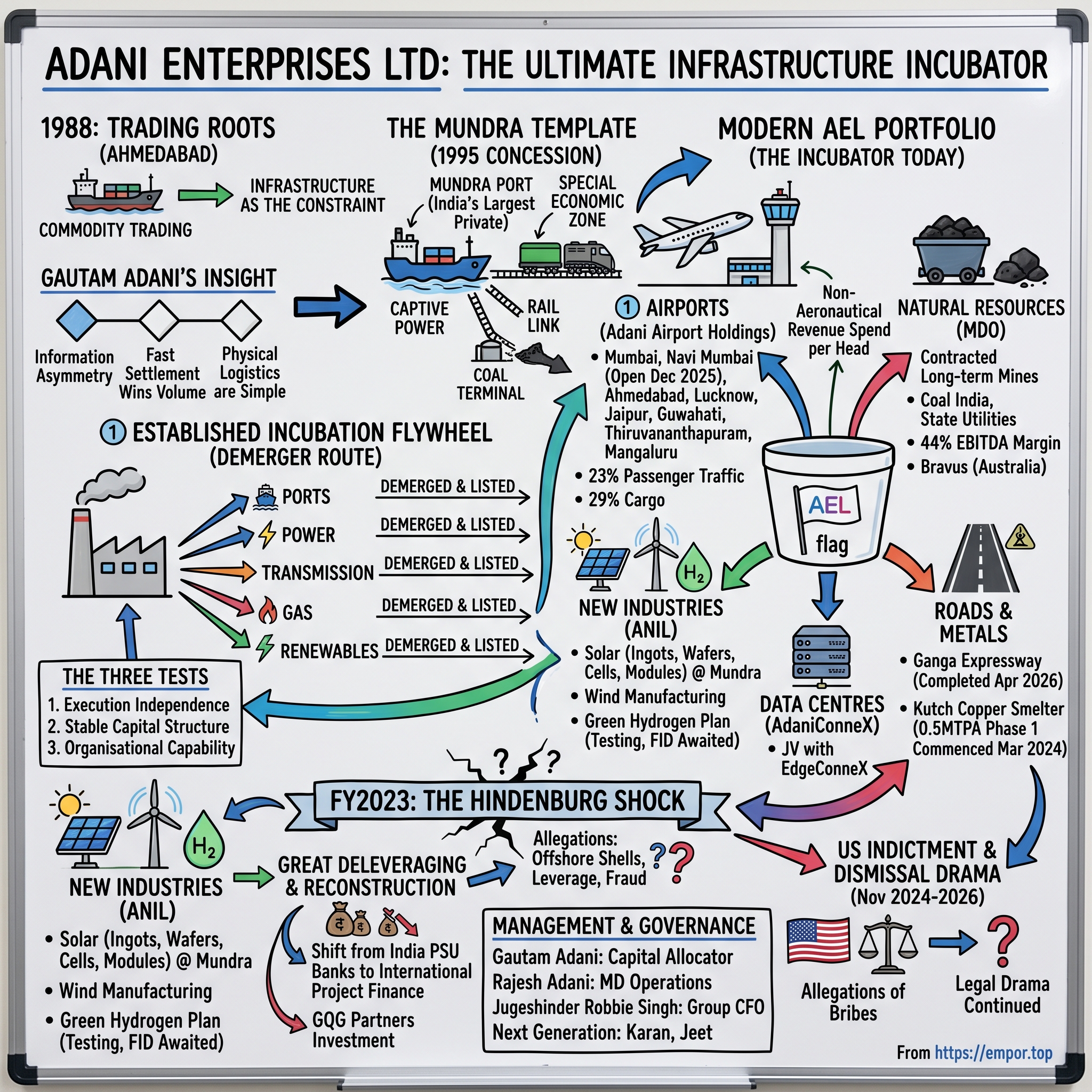
Adani Enterprises Limited: The Ultimate Infrastructure Incubator
I. Introduction & Episode Roadmap (0:00–0:10)
On the evening of April 30, 2026, a conference call hosted by Antique Stock Broking opened with an unusual admission. Arun Bansal, the chief executive of Adani Airport Holdings, was standing in for the usual opening act at Adani Enterprises Limited, and he did not begin with the quarter. He began with a five-year arc. "AEL's EBITDA profile has once again transformed into an Infra-Utility portfolio-style as we close this financial year with 80% of the EBITDA share coming from core infrastructure and services businesses," he told analysts.1
That sentence is the whole company in one line. Adani Enterprises does not really have a product. It has a metabolism. It eats capital, converts it into airports, expressways, copper smelters, solar factories and coal-handling contracts, holds them until they can stand on their own balance sheet, and then — in theory — hands them to public shareholders as separate listed companies.
The origin is almost comically small relative to what it became. A commodity trading house founded in Ahmedabad in 1988, capitalised with a sum that in today's terms would barely fund a seed round, run by a college dropout who had learned arbitrage sorting diamonds in Mumbai. Today the same legal entity sits at the top of a group that reported all-time-high portfolio EBITDA of ₹94,834 crore in FY26 and spent roughly $16 billion of capital expenditure in a single year — a figure the group itself claims is the highest ever by an Indian corporate.2
Adani Enterprises (ADANIENT.NS, National Stock Exchange of India) is the flagship. It is also the hardest of the group's listed companies to value, because at any given moment a large share of its assets produce no earnings at all. They are under construction.
Which sets up the paradox that has followed this company for a decade and a half, and that no amount of quarterly reporting fully resolves. One reading: AEL is a debt-fuelled empire whose returns depend on privileged access to state concessions, land, clearances and policy tailwinds — a business that would not exist in its current form under a different government. The other reading: AEL is one of the most effective heavy-infrastructure project execution machines anywhere in the world, operating in the fastest-growing large economy on earth, and its critics keep mistaking political proximity for the absence of engineering competence.
The honest answer is that both readings can be simultaneously true, and an investor's job is to work out which one dominates the cash flows from here.
Here is the route this story takes. First, the origin — Gautam Adani, the Mundra salt pans, and the moment a trader realised that the binding constraint on trading was not price but berth space. Second, the mechanics of the incubation model: what AEL actually does with capital, and the three tests the group says a business must pass before it gets spun out. Third, a walk through the modern portfolio as it stood at the close of FY26 — the coal trading and mining-services businesses that pay the bills, and the airports, green-energy manufacturing, copper and data-centre businesses that are supposed to pay for the future. Fourth, the Hindenburg shock of January 2023 and the deleveraging and capital-markets reconstruction that followed. Fifth, governance, the promoter family, and succession. Sixth, the US indictment of November 2024 and the extraordinary, still-unfinished legal drama unfolding in a Brooklyn courtroom right now. Then the competitive war-game, the bull and bear cases stress-tested against evidence rather than rhetoric, and finally what the whole thing teaches about building conglomerates.
Start where the company started: with a young man who did not want to be in the plastics business.
 Subscribe on LinkedIn
II. The Genesis: Gautam Adani and the Mundra Blueprint (0:10–0:25)
The founding myth is well-worn inside India and almost unknown outside it. Gautam Adani was born in Ahmedabad in 1962 into a Gujarati Jain family of modest textile traders. He dropped out of Gujarat University after a couple of years and, in the late 1970s, took a train to Mumbai with almost nothing to sort diamonds in the Zaveri Bazaar trade.3
Diamond sorting is a strange apprenticeship for a man who would end up pouring concrete for a living, but it was the right one. The diamond trade taught him three things that never left: that margin lives in information asymmetry, that a trader who can settle faster than his competitors wins volume, and that the physical logistics of moving small high-value goods are trivially easy compared with everything else in commerce. He was reportedly running his own diamond brokerage in his early twenties.
Then his elder brother called him back to Ahmedabad to help run a plastics unit, and the second lesson arrived: importing polymer into India in the 1980s was miserable. The licence-permit regime rationed imports, ports were congested, and turnaround times were measured in weeks. Adani Exports Limited — the entity that later became Adani Enterprises — was incorporated in 1988 as a commodity trading house, timed almost perfectly against the liberalisation wave that arrived in 1991.3
For a few years, trading worked beautifully. It also revealed its own ceiling. A trader in a commodity with global reference pricing has no pricing power; his only durable edge is cost-to-deliver. And in India in the mid-1990s, cost-to-deliver was dominated by one variable: the state of the port. Ships waited offshore. Cargo sat. Working capital died on the water.
This is the pivot on which the entire subsequent empire turns, and it is worth stating plainly because it is the most transferable idea in this story: Adani did not decide to become an infrastructure developer because infrastructure was attractive. He decided to become one because infrastructure was his single largest input cost, and nobody else was going to fix it.
In 1995 the group secured the concession to develop a port at Mundra, on the Gulf of Kutch in Gujarat — a stretch of salt flats with deep natural draft, minimal habitation, and effectively no economy.4 It was, on paper, a terrible place to put a port. It was also close to the Middle East shipping lanes, backed by a Gujarat state government actively courting private capital, and — critically — it was empty. Empty meant land could be assembled at scale without the acquisition nightmares that strangle Indian infrastructure elsewhere.
Mundra became India's largest private commercial port. But the more important thing it became was a template. Around the port, the group built a special economic zone, then a captive power plant, then a rail link to the national network, then coal import terminals, then — decades later — a copper smelter and a solar and wind manufacturing complex. Each new asset made the previous ones more valuable, because each one added throughput to the same fixed infrastructure.
That is the system-level cost advantage the group has never stopped exploiting: Adani coal moving on Adani rail through an Adani port into an Adani power plant, with each leg's margin invisible to an outsider trying to benchmark any single leg. It is genuinely hard to compete with. It is also, as later sections will show, genuinely hard to audit.
The corporate structure evolved to match. Adani Exports was renamed Adani Enterprises in 2006, and over the following decade the group systematically carved the mature businesses out of it. Ports went first. Power, transmission, gas and renewables followed. What remained inside AEL was not a residual — it was the deliberate design: a permanent construction site, always holding whatever the group was building next.
For investors, the genesis matters for one reason above all. AEL's competence was never trading and was never any single sector. It was the ability to take a greenfield site with a government concession attached and turn it into an operating asset faster than anyone else in India. Everything that follows — the airports, the expressways, the smelter — is a test of whether that competence still holds at ten times the scale, and whether the returns on it justify the capital consumed.
III. The Incubation Flywheel: How the AEL Model Actually Works (0:25–0:45)
Imagine a venture capital fund that does not buy minority stakes in software companies but instead owns 100% of pre-revenue steel-and-concrete projects, funds them with debt rather than equity, and holds them for eight to fifteen years before exit. The exit is not a sale to a strategic buyer. It is a demerger — the business is carved out and its shares distributed to the same shareholders who already owned it inside AEL.
That is Adani Enterprises. On the FY26 call, CFO Jugeshinder "Robbie" Singh's colleague described the sequence in four words: "build, stabilize, scale and unlock," adding that the company considers itself "already past first 3 phases."1
The track record is real and unusually large. Five businesses have been incubated inside AEL and separately listed: Adani Ports & Special Economic Zone, Adani Power, Adani Energy Solutions (formerly Adani Transmission), Adani Green Energy, and Adani Total Gas.[^5] Between them, they account for the bulk of the group's listed market value. There is no serious dispute about whether the model has produced listed entities. The dispute is about what it produces for the AEL shareholder who stays.
The economics of being the incubator
The uncomfortable arithmetic sits in the FY26 numbers. AEL reported total income of ₹1,02,943 crore and consolidated EBITDA of ₹16,464 crore — EBITDA down about 2% year on year, on income up 3%.5 Reported profit after tax rose 31% to ₹9,339 crore, but profit before tax was ₹4,309 crore excluding an exceptional gain of ₹9,215 crore.1 Strip the exceptional item out and FY26 was, on an operating basis, a flat year.
Against that flat year, the company spent close to its full capex target and guided to roughly ₹40,000 crore of capex for FY27.1 An entity generating ₹16,464 crore of EBITDA and spending ₹40,000 crore is, by construction, deeply free-cash-flow negative. That gap is the business model, not an accident. But it is also the reason AEL's equity value is a function of two things an investor cannot observe directly: whether the assets under construction will earn their cost of capital, and whether the debt funding them can be rolled at a tolerable price.
The three tests
The group has articulated a specific standard for when an incubated business graduates. First, execution independence — the business must operate without parent support. Second, a stable, self-sustaining capital structure with its own investment-grade debt capacity. Third, organisational capability: dedicated management, governance and board oversight.[^5]
On the April 2026 call, an analyst from Jefferies pushed directly on when Airports would be separated. The answer was carefully hedged: the airport management team "would be ready by — they are comfortable around, say, '27, '28. And then — after that, it's very much for AEL Board to determine."1 Asked whether the airports business needed outside investors, the answer was that its plans are fully funded, that outside investors are certainly interested "because it's a premier business of its type in AEL," but that the business does not need them.
Read carefully, that is a management team keeping optionality open rather than committing to a date. It is consistent with what the group has said publicly since 2024 — that demergers of the incubating portfolio begin from FY28 onward, with airports first, and reports of a wider listing wave from 2027 covering airports, roads, metals and data centres.[^5]6 Consistency across two years of communication is a genuine credibility marker. Absence of a firm date is a genuine execution risk.
Why the structure is defensible — and where it strains
The intellectual case for the incubator is strong. Traditional conglomerates trap capital: mature cash cows subsidise weak divisions forever, and the market applies a holding-company discount. AEL's design forces a terminal event. If a business is good, it leaves; if it never leaves, that is itself information.
The strain shows in three places. The first is that the shareholder never gets cash — they get shares in the spun-out entity, and AEL immediately redeploys into the next construction cycle. Value is real only if the spun-out entities compound. The second is leverage. AEL's own net-debt-to-EBITDA sat at 3.9x at the FY26 close, versus 3.3x for the group portfolio.12 The incubator is, correctly, the most levered entity in the family, because it holds the assets not yet earning. The third is measurement. When a portfolio is perpetually mid-construction, reported EBITDA understates run-rate economics — and management knows it. Asked about weak fourth-quarter conversion, Singh called it "largely an accounting artifact," arguing that on a run-rate basis the year's EBITDA would be closer to ₹19,000 crore, "just under 20% higher than the number that we have, accounting number we have."1
That may well be true. It is also exactly the kind of adjustment a sceptical investor should insist on seeing validated in subsequent reported quarters rather than accepted on assertion. The next section examines whether the assets themselves justify it.
IV. Inside the Incubator Today: Sizing the Modern Empire (0:45–1:20)
To understand AEL as it exists in mid-2026, separate it into two piles. One pile pays for things. The other pile is the thing being paid for.
The businesses that pay: coal trading and mining services
Integrated Resource Management — the group's coal import and trading operation — is the oldest surviving business in the building, and it is shrinking. FY26 volumes were 44.6 million tonnes, down 21% year on year, generating ₹29,112 crore of revenue and ₹2,767 crore of EBITDA.1
Do the division and the character of the business becomes clear: this is a roughly 9-10% EBITDA-margin operation on very large volumes. It is a logistics and working-capital business dressed as a commodity business, and its earnings track Indian thermal coal import demand, which in turn tracks domestic Coal India output, monsoon-driven hydro, and the pace of renewable additions. The 21% volume decline is not obviously a company-specific failure; it is what happens when domestic supply improves. But it is a clear signal that IRM is a melting ice cube in the long run, and investors should stop underwriting it as a growth engine.
Mining Developer and Operator services are the more interesting half. Here AEL does not own the coal. It wins long-term contracts to develop and operate mines on behalf of state-owned utilities and other licence holders, taking a per-tonne fee. FY26 dispatch was 49.4 MMT, up 14%, on revenue of ₹4,536 crore and EBITDA of ₹1,986 crore — up 18%.1
That is a 44% EBITDA margin on contracted, index-linked service revenue with minimal commodity price exposure. It is the single highest-quality cash flow inside AEL, and it is the one investors talk about least. The runway is unusually visible: management described a portfolio of 18 MDO service agreements with total peak capacity of 145 MMTPA, of which seven contracts were operational at the FY26 close, with peak capacity of 86.6 MMT from mines already operating against roughly 50 MMT actually produced.1 Guidance was for "close to 20%" growth in the coming year.
The honest caveat: this is a business whose growth depends entirely on Indian state electricity boards and central PSUs continuing to award mine-operating contracts to a private group whose political relationships are themselves a matter of national controversy. The cash flows are contracted; the pipeline is political.
Bravus and the world's most litigated coal mine
Then there is Australia. The Carmichael project in Queensland's Galilee Basin — operated under the Bravus banner — was conceived at 60 million tonnes a year and became the most protested mining project in the developed world, targeted by a global divestment campaign that successfully pressured dozens of banks, insurers and contractors into refusing to touch it.
What actually got built was a fraction of the original vision, and that turned out to be the smart outcome. Bravus announced in August 2025 a staged expansion from roughly 12 Mtpa toward 16 Mtpa over four years, backed by an initial A$50 million tranche within a broader A$500 million programme.78 A right-sized mine with a dedicated rail line and export terminal, in a high-CV coal market with structurally constrained new supply, is a good asset. A 60 Mtpa mine financed on the assumption of permanent Chinese and Indian import growth would have been a catastrophe.
FY26 also delivered a reminder of why commodity mining sits in a different risk bucket. Fourth-quarter commercial mining earnings fell sharply, and the CFO attributed it to two things: an exceptional rain event at Carmichael that constrained production for close to a quarter, costing "over INR300 crores," and a non-cash mark-to-market currency loss of "about INR600 crores."1 Weather and FX. Neither is a strategy problem. Both are reasons this segment is capitalised conservatively — management said net external debt in metals, materials and mining is around $2 billion against roughly $6 billion of operating assets, deliberately lower leverage than the infrastructure side.1
The businesses being paid for: airports
Adani Airport Holdings is the asset everyone points at. At the FY26 close it operated a platform of eight airports — Mumbai, the new Navi Mumbai, Ahmedabad, Lucknow, Jaipur, Thiruvananthapuram, Guwahati and Mangaluru — handling approximately 23% of India's passenger traffic and 29% of its air cargo.1
FY26 was the year the segment's economics inflected. Passenger traffic was 95.3 million, up only 1%. Total income was ₹13,081 crore, up 28%. EBITDA was ₹5,394 crore, up 55%.15 Aeronautical revenue grew 26% and non-aeronautical 31%.
Read that carefully, because it is the most important operating fact in the company this year. Traffic was flat. Revenue grew 28%. Profit grew 55%. Growth came almost entirely from tariff revision and commercial monetisation, not from more passengers. That is the airport business working exactly as it is supposed to: a regulated aeronautical base that resets tariffs on a defined cycle, plus a largely unregulated retail, duty-free, advertising, parking, lounge and real-estate layer whose margins are far higher and whose growth is a function of execution rather than macro. The group leaned into it during FY26 by acquiring a ground-handling business and an airport advertising and media company.1
The centrepiece was Navi Mumbai International Airport, inaugurated by Prime Minister Narendra Modi on October 8, 2025 and opening to commercial flights on December 25, 2025 with IndiGo, Air India Express, Akasa Air and Star Air.[^10]9 First-phase capacity is 20 million passengers a year.10 Management has put roughly ₹20,000 crore into phase one and says peak EBITDA from the airport alone will approach ₹3,000 crore — and that phase two must begin immediately, because Mumbai metropolitan traffic projections suggest "we will be filled with Navi Mumbai already in next 12 to 18 months."1
Building a greenfield international airport in India and opening it is a genuinely rare achievement. Whether it earns a return on ₹20,000 crore depends on a variable nobody can yet observe: how much a passenger spends between security and the gate. More on that in the KPI section.
ANIL: the green manufacturing complex, and what it is not
Adani New Industries Limited is the group's most-hyped and least-understood segment. Strip away the marketing and it is, today, a solar and wind equipment manufacturer at Mundra.
FY26 total income was ₹15,563 crore, up 9%, with EBITDA of ₹4,532 crore, down 5%.5 The CFO broke it down on the call: solar contributed roughly ₹12,000 crore of revenue and about ₹3,700 crore of EBITDA; wind roughly ₹3,700 crore of revenue and ₹760 crore of EBITDA.1 Module sales were 4,904 MW, up 15%, and 231 wind turbine sets shipped, up 41%.5
A detail from the Q&A is revealing. A Jefferies analyst pointed out that AEL sold 4.9 GW of modules against 4 GW of nameplate capacity, when peers typically sell less than rated capacity. The answer: tolling. "The participants in the market who are unable to utilize their capacity. So we have you can say a tolling type, presumably we use that capacity to sell higher than our capacity."1 In plain English, Adani is buying spare production from struggling competitors and selling it under its own brand — a sign of demand strength and channel power, but also a reminder that reported volumes are not all internally manufactured value-add.
The manufacturing ladder matters. AEL operates 2 GW of ingot and wafer capacity and 4 GW each of cell and module capacity, expanding toward 10 GW.1112 The reason ingot and wafer capacity is strategically important is regulatory: India's approved-list rules extend to wafers from mid-2028, meaning modules made from imported Chinese wafers will lose access to the protected domestic market. Adani's ability to move upstream is therefore not a nice-to-have; it is the condition of continuing to sell into its home market at current prices. Asked whether the 2 GW of ingot-wafer capacity would scale to 10 GW, Singh said there is "no specific planning" yet but roughly 20 months of ramp time if required.1
And now the part where the popular narrative and the disclosed reality diverge most sharply. The green hydrogen ecosystem — the multi-billion-dollar ambition that has anchored a thousand headlines about Adani — remains, on management's own account, pre-decision. Asked directly for a directional update, the CFO said the current focus is completing the integrated manufacturing complex and preparing sites for renewable power, that "the electrolyzer testing is underway," and then, unambiguously: "Beyond that, we have not made any final investment planning and decision on that."1
That is not a criticism of the company; capital discipline on an unproven technology is exactly what a shareholder should want. It is a criticism of how the story is told in the market. As of the FY26 results, green hydrogen is an option, not a project. Investors should value it as such.
Copper, roads and data centres
Kutch Copper commissioned the first unit of its greenfield Mundra refinery on March 28, 2024, a roughly $1.2 billion investment for 0.5 million tonnes per annum in phase one, targeting 1.0 MTPA.[^15]13 Management now guides to peak EBITDA "just over INR2,000 crores" from the copper business, and told analysts that copper would be reported as a separate segment from the first quarter of FY27 — it only crossed the revenue threshold requiring separate disclosure in Q4 FY26.1 India imports most of its refined copper; every gigawatt of solar, every kilometre of transmission and every electric vehicle needs it. The strategic logic is unimpeachable. The economics depend on treatment and refining charges, which are set globally and have been brutal for smelters worldwide.
Roads had a difficult year — construction volumes fell 40% — but delivered the group's showpiece: the Ganga Expressway, India's largest greenfield expressway project, completed in under three and a half years with a 27-year concession and just over ₹15,000 crore invested, inaugurated on April 29, 2026.51 Management promised a fuller briefing on road economics after the asset had operated for five months. That is a reasonable request for patience; it is also a segment where the reported numbers have been distorted by construction accounting and will only become interpretable from FY27.
AdaniConneX, the 50-50 data centre joint venture with EdgeConneX, is the smallest and possibly the most optionality-rich piece. FY26 brought a 358 MW hyperscale order in Hyderabad, taking cumulative tied-up capacity past 560 MW against just over 55 MW operational across four centres.5 Execution on the new order runs about 40 months.1 The gap between 560 MW contracted and 55 MW live is the entire investment case — and the entire risk.
Put the piles side by side and the picture is coherent. Roughly 80% of EBITDA now comes from mature, contracted infrastructure and services. Three newly commissioned assets — Navi Mumbai, Kutch Copper and Ganga Expressway — are expected to add over ₹3,000 crore of EBITDA in FY27 and, at peak, ₹6,000-6,800 crore by the end of FY28.1 If that lands, AEL's earnings base changes shape entirely. If it slips, the leverage does the talking. Which brings us to the last time the leverage did exactly that.
V. The Short-Seller Shockwave: The Hindenburg Crisis & The Great Deleveraging (1:20–1:50)
The timing was surgical. On January 24, 2023, with Adani Enterprises days away from opening a ₹20,000 crore follow-on public offer — at the time the largest equity raise in Indian corporate history — Hindenburg Research published a 106-page report titled with a phrase that immediately entered the Indian financial lexicon: an accusation that the group was "pulling the largest con in corporate history."14
The report made three broad allegations. That a network of offshore shell entities, largely in Mauritius and the UAE, had been used to manipulate the share prices of listed Adani companies and to circumvent minimum public shareholding rules. That the group's leverage was far more precarious than headline figures suggested. And that the family had used related parties to move money in ways that inflated reported earnings and asset values.
The market reaction was violent and almost unprecedented in scale. More than $100 billion of group market value evaporated within weeks. The group's formal response ran to 413 pages and framed the report as "a calculated attack on India," arguing the allegations were recycled, previously adjudicated, or simply wrong.[^18][^19]
Then came the decision that defined the crisis. The FPO was fully subscribed on its final day — a technical success achieved substantially through institutional and family-office anchor participation. On February 1, 2023, the board withdrew it anyway and returned the money.15
That decision has been read two ways ever since. The generous reading, and the one management offered, was investor protection: allotting shares at a price already invalidated by a 28% single-day collapse would have handed retail subscribers an instant loss. The sceptical reading was that proceeding would have invited exactly the scrutiny of who had subscribed, and why, that the group could least afford. Both interpretations survive the available evidence.
The reconstruction
What followed over the next twenty-four months was, whatever one thinks of the underlying allegations, a genuinely impressive piece of balance-sheet engineering.
The immediate problem was not solvency; it was reflexivity. Promoter shareholdings had been pledged against loans. Falling share prices triggered margin calls, which forced selling, which lowered prices further. The group broke the loop by prepaying share-backed facilities, in some cases well ahead of maturity, removing the mechanical link between the stock price and the group's liquidity. That was the single most important operational decision of the crisis.
The second move was structural: shifting the group's funding away from Indian public-sector bank lending — politically exposed, headline-sensitive, and concentrated — toward international bilateral facilities, offshore bonds, private credit and asset-level project finance. The strategic point is that a lender secured against a specific airport's cash flows behaves very differently in a crisis than a lender exposed to "the Adani Group" as a concept.
By FY26 the results of that reconstruction were visible in credit metrics rather than press releases. Group net debt to EBITDA stood at 3.3x against a stated ceiling of 3.5x, cash and equivalents of ₹55,852 crore covered about 15% of gross debt, average borrowing cost had fallen to 7.8% from around 9% two years earlier, and the group stated that all its assets carried domestic ratings of A- or higher with liquidity sufficient to cover at least 17 months of debt service.2 A falling cost of debt during a period of record capital spending is the most credible single piece of evidence that lenders re-underwrote the group on its assets rather than its headlines.
The GQG trade
The moment the narrative broke was March 2023, when GQG Partners — the Florida-based emerging-markets manager founded by Rajiv Jain — bought approximately $1.87 billion of shares across four Adani companies in a single set of block trades.[^21]
Jain's public reasoning was almost aggressively simple. These were irreplaceable physical assets in a country that needs them, run by a team with a demonstrated ability to build, trading at prices that assumed something close to structural impairment. He was not underwriting the governance. He was underwriting the concrete, and betting that the discount had overshot.
Whatever one thinks of the analysis, the trade worked and its signalling effect was enormous. A US-domiciled institutional manager with a public reputation to protect putting nearly $2 billion into the name gave every other institution permission to re-examine its position.
But the story did not end there, and the ending is the part that gets omitted. GQG publicly stated it was reviewing its Adani holdings after the US indictment in November 2024.1617 It subsequently increased exposure in 2025, and then began trimming: in September 2025 it reduced its Adani Power stake after the position had roughly doubled, and in May 2026 it sold 58.92 lakh shares of Adani Enterprises for approximately ₹1,435 crore, cutting its stake from 1.59% to 1.14%, with SBI Mutual Fund on the other side.1819
The correct investor takeaway is not that GQG lost faith. It is that GQG behaved like a value investor: bought a dislocation, held through the recovery, and sold into strength. Anyone who treated the 2023 purchase as a permanent seal of institutional approval misread it.
The regulatory endgame
The legal and regulatory unwinding took two and a half years. The Supreme Court of India constituted an expert committee which reported in May 2023 that it could not conclude there had been a regulatory failure by SEBI, while noting the difficulty of establishing beneficial ownership of the offshore funds in question.[^26] In January 2024 the Court declined to transfer the investigation to a special investigation team or the CBI, leaving it with SEBI.
The resolution arrived on September 18, 2025, when SEBI closed its proceedings against the group, Gautam Adani and associated entities, dismissing allegations of fund diversion, related-party violations and fraud. The regulator's reasoning was technical rather than exculpatory in spirit: it found the transactions in question did not meet the related-party definition applicable at the time, that definition having been broadened only by a 2021 amendment, and that the loans concerned had been repaid with interest.2021
That distinction matters and deserves to be stated without spin. SEBI concluded there was no violation of the rules as they stood. That is not the same as concluding the arrangements were what a shareholder would have wanted. Investors should hold both facts at once: the legal overhang in India is closed, and the underlying governance questions about how a promoter-controlled group of this complexity manages intra-group flows were resolved on the narrowest available grounds. Hindenburg Research itself shut down in January 2025.
The Indian chapter closed. The American one had already opened.
VI. Capital Allocation, Governance, & the Management Architecture (1:50–2:15)
Sit with AEL's shareholder register for a moment, because it explains a great deal about how this company behaves. Promoter entities — principally family trusts including the S.B. Adani Family Trust — hold roughly three-quarters of the equity, with foreign institutions around 11-12%, domestic institutions around 6-7%, and retail investors under 8%.22
A public float of roughly a quarter of the company has three consequences. It concentrates decision rights almost entirely with the family, which is why AEL can commit to decade-long projects that no quarterly-earnings-driven board would approve. It creates extreme alignment of economic interest — the family's wealth is the stock. And it makes minority shareholders structurally passive: there is no activist campaign, no proxy fight, no realistic path to forcing a strategic change. Investors in AEL are underwriting a family's judgement, and should price that accordingly.
The people
Gautam Adani is the capital allocator, and his style is legible from his record: he takes concentrated, irreversible bets on physical assets in sectors the Indian state has designated as national priorities, funds them with debt, and compresses timelines aggressively. He has been consistently right about the direction of Indian infrastructure demand and consistently willing to accept far more construction and financing risk than peers. Both halves of that sentence matter.
Rajesh Adani, his younger brother and Managing Director, is the operations counterweight — the executive who ran the trading business's day-to-day machinery and whose domain is logistics, procurement and throughput rather than vision.
Jugeshinder "Robbie" Singh, the Group CFO, is arguably the most consequential hire in the group's modern history. A chartered accountant with an investment-banking and equity-research background, he joined in 2019 and re-architected the group's financing from a domestic bank-led model into a structured, asset-level, international project-finance model — the change that made the post-2023 recovery mechanically possible.
Singh's communication style is worth studying because it is unusual for an Indian CFO. He is dense, technical, occasionally impatient, and notably willing to give specific forward numbers. On the FY26 call he committed to more than ₹3,000 crore of incremental EBITDA from three named assets in FY27 and, when an analyst asked whether he was sure, replied: "We will close to 100% probability have that."1 He also volunteered the segment-level split of ANIL's solar and wind EBITDA on request, and declined to give a data-centre capex figure rather than improvise one — "So I don't want to just give you a number."1
That combination — specific where he has conviction, explicitly refusing where he does not — is a reasonable credibility signal. The test is falsifiable and arrives soon: FY27 results will show whether the ₹3,000 crore materialised.
The next generation is being installed in the operating businesses rather than at headquarters. Karan Adani, the elder son, runs the ports business. Jeet Adani, the younger, has taken a leadership role spanning the group's finance function and the airports and digital verticals. Both are in their thirties. Succession at family conglomerates is where value most often leaks, and the group's approach — giving each heir a discrete P&L rather than an ambiguous group role — is at least structurally sensible. It is unproven.
The governance ledger
An investor should keep an honest ledger here rather than a verdict.
On the negative side: in August 2023, Deloitte Haskins & Sells resigned as statutory auditor of Adani Ports & SEZ, citing a difference of opinion. The specifics were substantive — Deloitte had flagged ₹3,871 crore recoverable from an EPC contractor which the company did not treat as a related party but which the Hindenburg report had identified as one, and noted that the company had declined an independent external review of the allegations while the SEBI probe was ongoing.23 An auditor resignation over related-party classification and scope of inquiry is one of the more serious qualitative signals in equity analysis, and it happened at the group's flagship infrastructure company, not a peripheral subsidiary. It was not at AEL, but it belongs on the ledger.
Also on the ledger: the historical use of complex offshore holding structures, the concentration of promoter control, and the sheer number of related-party flows inevitable in a group where one entity's customer is another entity's supplier.
On the positive side: disclosure has genuinely tightened. Segment reporting has expanded — copper becomes a separate reported segment from FY27, and the airports business now gets its own CEO and CFO on the earnings call, an unusual level of granularity for an Indian holding company.1 The group publishes periodic credit compendia with asset-level detail.24 Cost of debt has fallen, which is a market verdict on disclosure quality as much as on asset quality. And the SEBI proceedings closed without adverse findings.
An activist looking at AEL today would not lead with fraud allegations, which have been legally exhausted. They would lead with three structural arguments. First, complexity discount: a company containing coal trading, mine operating, an Australian mine, airports, expressways, solar and wind manufacturing, a copper smelter, data centres and a PVC plant has no natural shareholder base and no clean comparable — and management's own answer to this is that demergers will fix it, which concedes the point. Second, capital intensity without a stated hurdle: ₹40,000 crore of annual capex is disclosed by segment but not accompanied by public project-level return targets. Third, the accounting-artifact framing: when management explains a weak result by pointing to a run-rate number 20% above the reported number, an activist would ask why the reported number should not simply be the number.
None of these are accusations. They are the things a serious sceptic would press on, and they set the frame for the legal drama that has consumed the group's international standing for the past twenty months.
VII. The US Indictment & Dismissal: A 18-Month Geopolitical Drama (2:15–2:30)
On November 20, 2024, the United States Attorney's Office for the Eastern District of New York unsealed a criminal indictment naming Gautam Adani, his nephew Sagar Adani and six others. The allegation: a scheme to pay roughly $250 million in bribes to Indian state officials to secure solar power supply agreements, and then to raise capital from US investors while concealing that conduct.
The immediate consequences were severe and immediate. Group dollar bonds sold off. A planned bond issue was pulled. Kenya cancelled infrastructure deals. A US investor whose portfolio manager had famously defended the group publicly announced a review of its position.1617 The group's response was categorical: the allegations were "baseless" and would be contested through every available legal avenue. No Adani executive was ever arrested; the individuals named are Indian nationals resident in India, and India does not extradite its citizens for offences of this character absent an unusual set of circumstances.
Then, in 2026, the case took a turn that no one modelled.
On May 18, 2026, the Department of Justice filed a motion to dismiss the indictment — with prejudice, meaning the charges could not be refiled.25 The rationale offered was that the prosecution was legally flawed, that the conduct was centred in India, that it was diplomatically counterproductive, and that it was inconsistent with the current administration's enforcement priorities. In a later filing the department went further, describing the case as a "name and shame" indictment brought by the previous administration "without any realistic prospect of a trial," and arguing it "should have been dropped a year ago — or never brought in the first place."2526
Here is where the story departs sharply from the version circulating in Indian markets. The case has not been dismissed. Judge Nicholas G. Garaufis of the Eastern District of New York declined to grant the motion, holding that the government's explanation was "terse, bland, and conclusory" and afforded the court no basis to conduct any analysis of the request. He ordered the DOJ to explain itself in detail by July 13, 2026.25
The government's response created a further problem. Principal Associate Deputy Attorney General R. Trent McCotter told the court he was the "final and sole decision maker" behind the dismissal request and rejected reporting that linked it to any Adani commitment to invest in the United States. The court read that filing as raising, for the first time, what it called "the specter of a possible agreement" connected to the dismissal — an arrangement neither recorded nor previously disclosed to it.27
On July 8, 2026, Garaufis ordered Gautam Adani personally to file a sworn affidavit stating whether anything had been promised or exchanged for the dismissal.27 Adani filed it, categorically denying any such agreement and stating he was unaware of anything promised or received.[^35] His counsel separately disclosed something more awkward: that Adani's lawyers had in fact floated a $10 billion US investment during discussions with the Justice Department, and produced a May 2026 email in which DOJ officials "categorically rejected" resolving the criminal charges on that basis.28
As of today, July 20, 2026, the motion remains pending before Judge Garaufis. The US Attorney for the Eastern District has indicated they will not dispute the department's decision to drop the case.29
What an investor should actually take from this
Three things, none of them comfortable.
First, the underlying asset economics were essentially untouched by the entire episode. Airports kept adding passengers and tariffs, the copper smelter kept ramping, the expressway got built. Twenty months of criminal exposure in the world's most important legal jurisdiction moved the group's cost of capital and its access to certain investor pools, but it did not move a single tonne of throughput. For a business whose value derives from physical Indian assets serving Indian demand, that separability is real and it is a genuine argument for the resilience of the model.
Second, the resolution — if it comes — will not be a finding of innocence. A dismissal on prosecutorial-discretion grounds, granted by a visibly sceptical judge, settles legal exposure without settling the factual question. Anyone treating a dismissal as vindication is making the same category error as those who treated the GQG purchase as an endorsement.
Third, and most important for underwriting: this episode demonstrated that a significant component of AEL's risk profile is not operational or financial but geopolitical, and that it can change direction with an election in a country where the company has almost no revenue. That is an unhedgeable exposure, and it is a permanent feature of owning a nationally-strategic emerging-market infrastructure developer with global capital markets access.
With the legal frame established, the question becomes whether the underlying business is actually defensible.
VIII. Strategic Moat Analysis: 7 Powers & 5 Forces (2:30–2:45)
Strip away the drama and ask the only question that matters over ten years: what stops someone else from doing this?
Applying Hamilton Helmer's 7 Powers
Cornered Resource is the strongest of AEL's powers and also the most contested. The group controls things that cannot be replicated: coastal land banks assembled at Mundra decades ago at pre-industrial prices, port and airport concessions with multi-decade tenors, environmental clearances that take years and often never arrive, and rail linkages connecting private assets to the national network. In infrastructure, the scarce input is not capital or engineering. It is permission plus land, and Adani has more of both than anyone else in India.
The bear counterpoint is precise: a cornered resource obtained through state allocation is only as durable as the state's disposition. Concessions can be renegotiated. Tariff orders can be adverse. New clearances can slow. The group's answer, implicitly, is that it now holds so many long-dated concessions across so many states with so many different governing parties that no single political change threatens the portfolio. That argument has not been tested by a change of national government since the portfolio reached its current scale.
Scale Economies operate in two places. In green manufacturing, a giga-scale integrated complex at a single location — ingots through modules, plus wind nacelles — spreads fixed cost and logistics across enormous volume. In airports, an eight-airport platform amortises the same commercial, retail, security, technology and ground-handling capability across 95 million passengers, and lets the operator negotiate with duty-free and F&B partners as a network rather than as a single terminal.
Process Power is the one Adani has that is hardest for competitors to copy and hardest for analysts to credit. Building India's largest greenfield expressway in under three and a half years, or opening a greenfield international airport, is not a matter of capital. It is a matter of institutional muscle memory in land acquisition, contractor management, regulatory sequencing and construction logistics. This is the evidence-backed core of the bull case: the delivery record is public, dated, and physically verifiable.
System-backed cost advantage — the vertically integrated chain from mine to rail to port to smelter to power plant — is a genuine structural edge and a genuine transparency problem, for the reason noted earlier.
Notably absent: Network Economies, Switching Costs in any meaningful consumer sense, and Branding. A passenger does not choose an airport. A discom does not pay more for Adani electrons. This is not a business with pricing power in the consumer sense; its returns come from regulated tariffs, contracted fees and asset scarcity.
Porter's Five Forces
Rivalry varies dramatically by segment, and the airports comparison deserves correction because the popular framing is wrong.
Adani Airports handled 95.3 million passengers in FY26. GMR Airports handled 114.6 million, roughly 27% of Indian traffic, growing revenue about 40% against Adani's 28%.3031 GMR owns Delhi — India's largest and among its most profitable airports — and Hyderabad. Adani owns Mumbai, which is slot-constrained, and has now added Navi Mumbai, which relieves that constraint and gives Adani something GMR does not have: a brand-new, uncongested, expandable asset in India's richest catchment. The strategic read is that GMR currently has the better airport portfolio by earnings power, and Adani has the better growth vector, contingent on filling Navi Mumbai. "Dominance" is not the right word for either.
In green manufacturing, the domestic rivalry with Reliance Industries is real but the two approaches differ. Reliance has pursued a technology-acquisition strategy, buying capability in cells, batteries and electrolysers, and building at Jamnagar. Adani has pursued an execution-and-integration strategy at Mundra. Reliance has vastly more internal cash flow to fund losses; Adani has more experience delivering physical infrastructure on schedule. Neither has yet demonstrated globally competitive green hydrogen production, and neither has taken a full-scale final investment decision on it.
The more serious competitive threat in solar is not domestic. Chinese manufacturers led by 隆基绿能 LONGi operate at a scale and cost point Indian producers cannot match on a level playing field; 金风科技 Goldwind occupies a similar position in wind. Adani's Indian solar margins — roughly 30% EBITDA in FY26 on the disclosed split — exist substantially because of import duties and approved-list rules. That is a policy moat, not a cost moat, and management effectively conceded the margin sensitivity when it noted that selling primarily domestically "compresses the margin" with productivity gains expected to offset over time.1
Buyer power is high and often state-controlled: state distribution companies, central PSUs, and airlines negotiating airport charges under a regulator. Supplier power is generally low given scale, except in specialised imported equipment. Substitutes are the live threat to the legacy businesses — every gigawatt of Indian renewable capacity added is a marginal tonne of imported thermal coal not required, which is precisely what showed up in IRM's 21% volume decline. Barriers to entry are among the highest of any industry on earth, which is why the incumbent set barely changes.
The synthesis: AEL's moat is real, concentrated in execution capability and cornered physical and regulatory assets, weak in anything resembling consumer pricing power, and materially dependent on Indian industrial policy remaining supportive. That is a defensible position. It is not an unassailable one.
IX. The Bull vs. Bear Case: Why Win and Why Not? (2:45–3:00)
Why this wins from here
The strongest bull argument is not about ambition. It is about a mix shift that has already happened.
Five years ago AEL was predominantly a coal trading business with a collection of construction projects attached. At the FY26 close, roughly 80% of EBITDA came from mature, long-term contracted infrastructure and services — airports, roads, mining services and the ANIL ecosystem — with management noting this mirrors the wider group at 82-85% core infrastructure.1 Investors who still model AEL as a coal trader are modelling a company that no longer exists.
The second bull argument is the near-term earnings step. Three assets commissioned within roughly a year — Navi Mumbai airport, Kutch Copper and the Ganga Expressway — are guided to contribute over ₹3,000 crore of incremental EBITDA in FY27 and ₹6,000-6,800 crore at peak by the end of FY28.1 Against an FY26 base of ₹16,464 crore, that is a material re-rating of the earnings base from assets that are built, paid for, and operating. The capital risk on these three is behind the company; only the ramp risk remains.
The third is the demerger catalyst. If Airports separates around FY28 and Roads and metals follow, AEL shareholders receive direct ownership in businesses whose standalone comparables — GMR in airports, listed road concessionaires, listed metals producers — trade on visible multiples. The conglomerate discount that exists precisely because nobody can value this collection would compress.
The fourth is execution, evidenced rather than asserted. Ganga Expressway in under 3.5 years. A greenfield international airport opened. A copper smelter commissioned. Solar volumes growing faster than nameplate capacity. Group borrowing cost falling to 7.8% during a record capex year.2 These are dated, checkable facts, and collectively they describe an organisation that does what it says it will do on physical projects.
What could break it
Free cash flow is deeply negative and will remain so. FY27 capex is guided at roughly ₹40,000 crore — ₹17,000 crore for airports, around ₹9,000 crore for the PVC project, roughly ₹4,000 crore for natural resources and metals, and about ₹10,000 crore for the new-industries businesses — against an EBITDA base under ₹17,000 crore.1 This is a company that must access capital markets continuously for years. Management stated it has no plans for specific equity issuance and will fund through cash generation and debt.1 That is a bet on debt markets remaining open and cheap.
AEL's own leverage is higher than the group's. Net debt to EBITDA sat at 3.9x, with core infrastructure guided to a 3.5-4.5x range during the growth phase, and management expects it to remain "flat or slightly down."1 The group ceiling of 3.5x is a portfolio-level number; the incubator runs hotter by design. A refinancing window that closes — from a global rate shock, an India-specific risk premium, or another headline event — is the single most dangerous scenario for this equity.
Political dependency is not diversifiable. Concessions, clearances, tariff orders, MDO awards, import duties and approved-list rules all sit with the Indian state. The solar business's margin structure in particular is a direct function of trade policy. This is the bear case's sharpest edge, and there is no management action that neutralises it.
The green hydrogen story is not yet a business. Restating what management itself disclosed: electrolyser testing is underway, and no final investment decision has been made.1 Any valuation that ascribes present value to a green hydrogen platform is valuing an option on an option.
Segment-level fragility is real. IRM volumes fell 21%. Road construction volumes fell 40%. Q4 commercial mining earnings were hit by weather and currency. Airport passenger growth was 1% — all the airport growth came from tariffs and commercial monetisation, which means the segment's FY27 growth depends on repeating a monetisation trick rather than riding traffic. Copper economics depend on globally-set treatment charges the company does not control.
And the governance discount is unlikely to disappear. Three-quarters promoter ownership, a past auditor resignation over related-party classification, extreme structural complexity, and a US criminal matter resolved — if it is resolved — on discretionary grounds rather than merits. Some pool of global institutional capital will simply never own this, and that permanently affects the multiple.
Myth versus reality
Three consensus beliefs deserve direct correction.
Myth: the US case is over. Reality: as of July 20, 2026, the DOJ's motion to dismiss remains pending before a judge who has publicly questioned it and compelled a sworn affidavit from the chairman.
Myth: Adani dominates Indian aviation. Reality: GMR handled more passengers in FY26 and grew revenue faster. Adani has the better greenfield growth asset; GMR has the better installed portfolio.
Myth: AEL is a $50 billion green hydrogen bet. Reality: AEL is currently a solar and wind equipment manufacturer with an integrated complex under expansion and a hydrogen project awaiting a final investment decision.
The three things to actually track
One: non-aeronautical revenue per passenger. With traffic growth at 1% and the airport segment's FY26 result driven by 31% non-aero growth, the entire airports investment case now rests on spend-per-head. Navi Mumbai is the purest test — a brand-new terminal designed for commercial density, in India's wealthiest metropolitan region, with phase-two capex contingent on it filling. If this metric rises as Navi Mumbai ramps, the ₹20,000 crore phase-one investment works and management's ₹3,000 crore peak EBITDA claim becomes credible. If it stalls, the segment is a regulated-return utility being valued as a growth business.
Two: ANIL's shipped volumes and realised margin against capacity. Solar delivered roughly 30% EBITDA margins in FY26 on volumes exceeding nameplate capacity via tolling. Watch two things together: whether the 6 GW of additional module and cell lines come online as guided, and whether margin holds as sales concentrate domestically. Margin compression alongside volume growth would confirm the policy-moat thesis; margin stability would suggest a genuine cost position. The wafer and ingot decision ahead of the mid-2028 rule change is the tell.
Three: net debt to EBITDA at AEL, tracked against the incremental EBITDA promise. These are one metric, not two. Management has committed to over ₹3,000 crore of new EBITDA in FY27 while spending ₹40,000 crore. If the new assets deliver, the ratio holds near 3.9x or falls even through heavy capex — the incubation model working. If EBITDA disappoints while capex proceeds, the ratio climbs, and every other part of the story becomes contingent on refinancing conditions. This is the clean scoreboard on the incubator thesis, and FY27 results will settle it.
X. Epilogue & Playbook Lessons for Investors (3:00–3:10)
Return to the salt flats for a moment. In 1995 a commodity trader who had been irritated by port congestion took a concession on an empty stretch of Gujarat coast. Thirty-one years later, that same coastline holds a copper smelter, a solar and wind manufacturing complex, a special economic zone and the country's largest private commercial port, and the entity that started it all is preparing to hand another set of businesses to public shareholders.
Three lessons survive the retelling.
Solve your own logistics constraint and you may accidentally build the moat. Adani did not enter infrastructure because infrastructure had attractive returns. He entered because his own cost structure was hostage to somebody else's bottleneck. The generalisable insight is that the most defensible businesses are frequently built out of a founder's largest internal cost line, because the founder understands the requirement precisely and can size the solution to real demand rather than a forecast. This is the same logic that produced Amazon Web Services out of Amazon's own server problem. The pattern is not Indian; it is structural.
The in-house incubator is a real alternative to the traditional conglomerate — with a real cost. Conventional holding companies accumulate. AEL is designed to shed, and the discipline that imposes is genuine: a business that must eventually stand alone with its own credit rating and its own board cannot be permanently subsidised. But the model demands something from shareholders that most equity investors are poorly equipped to give — the tolerance to own a permanently cash-consuming entity for years, accepting that reported earnings will chronically understate the asset base, and trusting that construction risk is being correctly priced by people they cannot audit. Investors who cannot hold that position should not own the incubator; they should wait and buy the spin-offs.
Anti-fragility under attack has a specific playbook. The 2023 crisis produced a template that will be studied for a long time: break the reflexive link between the share price and liquidity by prepaying share-backed debt; shift funding from a concentrated, politically exposed domestic lender base to diversified asset-level international finance; secure a credible anchor institutional investor to reset the narrative; and then let physical, cash-generating assets accumulate evidence quietly while the legal process runs its course. It worked. It should also be noted that it worked in an environment where the domestic regulator ultimately found no violation and the domestic political configuration remained stable throughout. The playbook is real; so are its preconditions.
Which leaves the position as it stands in mid-2026. Adani Enterprises has completed the hardest phase of its most recent cycle — the assets are built, the earnings step is imminent, the Indian regulatory overhang has cleared, and the cost of debt is falling. What it has not yet done is prove that this generation of incubated businesses earns its cost of capital, that the demergers arrive on the timeline described, or that the political and legal risk premium attached to the name is a temporary artefact rather than a permanent feature.
The evidence on execution is strong and checkable. The evidence on returns is not yet in. FY27, with three major assets in their first full year of operation and roughly ₹40,000 crore going back into the ground, is the year the two get tested against each other.
References
-
Adani Enterprises Limited Q4 FY'26 Earnings Conference Call Transcript — Adani Enterprises, 2026-04-30 ↩↩↩↩↩↩↩↩↩↩↩↩↩↩↩↩↩↩↩↩↩↩↩↩↩↩↩↩↩↩↩↩↩↩
-
Adani Portfolio Reports Highest Ever Capex by Any Indian Corporate — Adani Group, 2026 ↩↩↩↩
-
Adani Enterprises Ltd announces Q4 and FY26 results — Adani Group, 2026-04-30 ↩↩↩↩↩↩
-
Adani's next IPO wave may begin in 2027 with airports and metals in focus — Business Today, 2025-11-11 ↩
-
Bravus to boost Carmichael production to 16Mtpa — Australian Mining, 2025-08 ↩
-
Bravus Mining and Resources to increase Carmichael mine production — Mining Technology, 2025-08 ↩
-
Navi Mumbai Airport operational; IndiGo, Akasa Air, Air India Express and Star Air launch flights — Live From A Lounge, 2025-12-25 ↩
-
Navi Mumbai International Airport starts flight operations with 4 airlines — Aviation A2Z, 2025-12-25 ↩
-
Solar Manufacturing — Adani Enterprises Annual Report FY2025 ↩
-
Adani to hit 10 GW of solar cell, module manufacturing capacity by mid 2026 — pv magazine, 2024-10-04 ↩
-
Adani's copper unit in Mundra begins operations — Adani Enterprises, 2024-03-28 ↩
-
Adani Group: How The World's 3rd Richest Man Is Pulling The Largest Con In Corporate History — Hindenburg Research, 2023-01-24 ↩
-
Adani Enterprises calls off Rs 20,000 cr FPO, money to be returned to investors — Business Today, 2023-02-01 ↩
-
GQG Partners says it is reviewing Adani holding after US indictment — Reuters, 2024-11-21 ↩↩
-
GQG Partners reviews $5bn Adani bet after US bribery charges — Financial Times, 2024-11-21 ↩↩
-
GQG Trims Holding in Adani's Largest Unit After 100% Gain — Bloomberg, 2025-09-22 ↩
-
GQG Partners Sells Major Stake in Adani Enterprises — Devdiscourse, 2026-05 ↩
-
Indian regulators dismiss stock manipulation allegations on Adani Group — Al Jazeera, 2025-09-18 ↩
-
Intimation regarding SEBI Order in the Hindenburg matter — Adani Enterprises, 2025-09 ↩
-
Adani Enterprises Ltd latest shareholding pattern — Trendlyne ↩
-
Adani Ports auditor Deloitte resigns 2 days before SEBI probe deadline — ThePrint, 2023-08-14 ↩
-
US court refuses to immediately drop Adani indictment, says DoJ didn't give adequate reasons — Bar and Bench, 2026 ↩↩↩
-
'Adani case should never have been brought': US Justice Department urges judge to permanently drop charges — Business Today, 2026-07-05 ↩
-
Judge orders Gautam Adani to answer questions on whether there was a quid pro quo — CBS News, 2026-07 ↩↩
-
In Affidavit, Adani Admits Lawyers Floated $10 Billion US Investment During DOJ Talks — The Wire, 2026-07 ↩
-
Top US prosecutor will not dispute DOJ decision to drop Gautam Adani's criminal case — KELO, 2026-07-17 ↩
-
GMR vs Adani: Who Really Controls India's Airports? — Trade Brains, 2026 ↩
-
GMR Airports Q4 FY26 result: Net profit at ₹400 crore, revenue rises 36% — Business Standard, 2026-05-28 ↩
 LinkedIn
 WhatsApp
 Reddit
 Hacker News
 Email
Email Kindle
 RSS Feed
 Spotify
 Apple Podcasts
 Amazon Music
 Audible
 YouTube