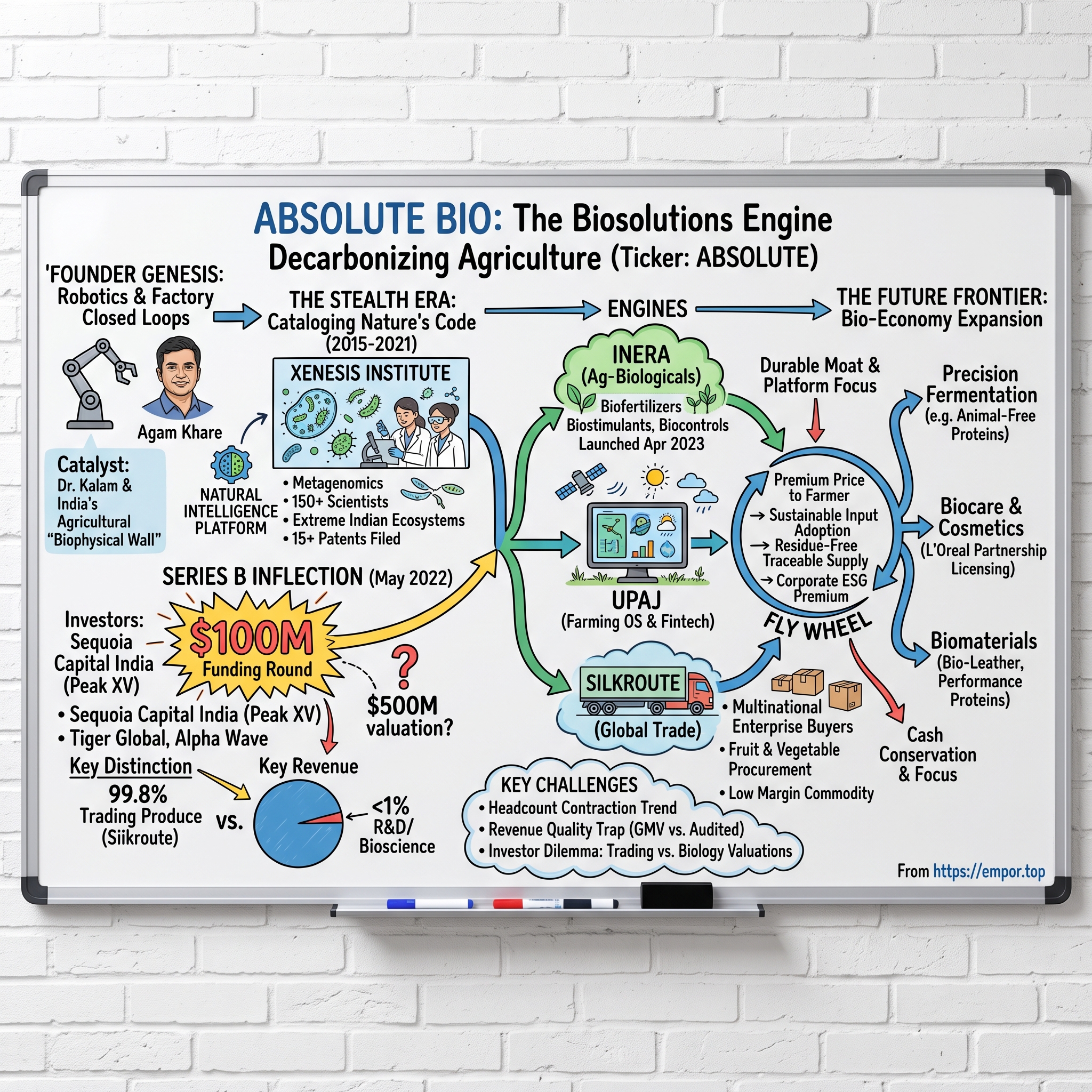
Absolute Bio: The Biosolutions Engine Decarbonizing Agriculture
I. Introduction & Episode Roadmap [00:00 - 00:15]
In May 2022, a company almost nobody in Indian technology circles had heard of announced a $100 million funding round. The investor list read like a roll call of the era's most aggressive growth capital: Sequoia Capital India (since renamed Peak XV Partners), Tiger Global Management, and Alpha Wave Global.[^1] The company was called Absolute. It was headquartered in the Delhi capital region, it had been incorporated six years earlier, and it had spent essentially all of that time saying nothing publicly at all.1 The reported valuation was roughly $500 million — a number that made a company with no consumer brand, no household product, and no prior institutional round one of the more valuable private agriculture businesses in the country overnight.2
What made the round unusual was not the size. In 2022, $100 million rounds were common enough in India that they barely disrupted a news cycle. What made it unusual was the thing being bought. Absolute described itself as a bioscience company: a research organization that had spent years sequencing microbial genomes collected from extreme Indian ecosystems, building a database of what it called nature's own intelligence, and translating that into agricultural inputs.3 But when a reporter went looking at the company's registry filings, the picture that emerged was different in character. In the financial year ended March 2021, Absolute's operating entity spent roughly ₹40 lakh — about $48,600 — on research and development, against ₹28 crore of revenue.4 Research was 1.4% of the top line. The rest of the business was, in substance, buying and selling farm produce.
That gap between the story and the ledger is the reason this company is worth a careful look four years later, and it is the organizing tension of everything that follows. Absolute is not a fraud and this is not an exposé; the company has since built a real biologicals business with a real product portfolio, real manufacturing, and a real distribution partnership signed as recently as June 2026.5 But it is a company whose headline valuation was set at a moment of extraordinary capital abundance, on a revenue base whose composition was fundamentally different from the business the narrative described, and whose subsequent operating trajectory has been considerably harder to observe than its founding story.
The core question. Why did some of the world's most sophisticated growth investors put hundreds of millions of dollars behind a company that sells biofertilizers and also, at scale, trades vegetables? There are two honest answers and they lead to very different underwritings. The generous answer is that the trading business was never the point — it was a distribution mechanism, a way to solve the hardest problem in Indian agriculture, which is getting a risk-averse smallholder to trust you enough to change what they put in their soil. The skeptical answer is that a low-margin commodity trading book grew 12.7x in a single year, that growth optics of that magnitude were worth a great deal in 2022, and that the biology was the framing rather than the engine.
The three-pronged structure. Absolute organizes itself around three businesses that, on paper, feed one another:
- Inera (ag-biologicals) — climate-adaptive biofertilizers, biostimulants, biocontrols, and seed coatings, launched commercially in April 2023 and built on research from the company's Xenesis Institute.6
- Upaj (ecosystem software and fintech) — a farm operating system offering satellite crop monitoring, soil diagnostics, advisory, and credit-linked insurance.7
- Silkroute (global trade) — the physical procurement and export business connecting growers to multinational buyers.3
Episode roadmap. We will walk through founder Agam Khare's route from industrial robotics into agricultural biology, his formative period working under Dr. A.P.J. Abdul Kalam, the long stealth research build at Xenesis, the 2021–2022 commercial launch and the Series B, and then the part that matters most for anyone underwriting this as a future public company: a segment-level look at where the revenue actually comes from, what the $500 million mark does and does not tell us, how the capitalization is structured, what the comparable set says, and whether a business assembled this way can mature into something a public investor could own with conviction. We will also confront a data point that has received almost no attention and deserves a great deal: the company's headcount, by third-party estimate, has collapsed.
 Subscribe on LinkedIn
II. Founder’s Genesis & The Presidential Catalyst [00:15 - 00:35]
Agam Khare did not come to agriculture from agriculture. He came to it from machines.
Before Absolute, Khare ran an industrial robotics and factory-automation business in India — a domain that rewards a particular cast of mind. Automation engineering is the discipline of closed loops: you measure a system, you model it, you intervene, you measure the response, and you tighten the loop until the output converges on a target. It is optimization applied to physical processes. That intellectual grounding shows up everywhere in Absolute's later architecture, sometimes helpfully and sometimes not. The company's persistent instinct is to treat a farm as a controllable system — sensors in, data through a model, prescription out, yield measured, loop closed. The bet embedded in the entire enterprise is that Indian smallholder agriculture, historically the least instrumented and least controllable system imaginable, can be made to behave like a factory floor.
The Kalam period. Between roughly 2010 and 2012, Khare worked alongside Dr. A.P.J. Abdul Kalam, India's eleventh President and, before that, one of the country's most consequential aerospace scientists.8 Kalam's post-presidential public life was organized around a document called Vision 2020, a developmental blueprint for Indian self-sufficiency in which agricultural productivity was a central pillar. Working within that orbit put Khare in contact with the national-scale version of the agricultural problem rather than the market-scale version.
The conclusion Khare drew from that period — as he has framed it consistently in interviews since — was that Indian agriculture had run into a biophysical wall rather than a technological one.9 The Green Revolution's chemistry-first model delivered enormous yield gains and then began delivering diminishing ones. Decades of heavy synthetic nitrogen and phosphate application depleted soil organic carbon. Groundwater tables fell under irrigation-intensive cropping. Pest populations built resistance to the pesticide chemistries deployed against them, forcing higher application rates for the same effect. The unit economics of chemistry were deteriorating for the farmer even as the subsidy regime kept the sticker price artificially low.
From that diagnosis came the founding thesis: if chemistry has reached its practical limit, the next productivity step-change has to come from biology. Not from inventing new molecules in a lab, but from cataloguing molecules and organisms that four billion years of evolution had already optimized, and then figuring out how to deploy them in a field.
It is worth being precise about what this thesis is and is not. It is a genuinely defensible scientific position — the global agricultural biologicals market has grown into a roughly $7 billion category and is forecast to compound at around 14.7% annually through 2030, which is not a rate you see in mature agrochemicals.10 It is also, importantly, a thesis that hundreds of other companies hold. Pivot Bio in the United States, Indigo Ag, Bioceres in Argentina, and the biologicals divisions of Syngenta, Bayer, Corteva, FMC, and UPL are all operating from some version of the same premise.11 The thesis does not differentiate Absolute. What would differentiate Absolute is execution against it, and that is a question of evidence rather than conviction.
The Kalam association and how to weigh it. Khare's connection to Dr. Kalam is real and it is a legitimate part of the origin story. It is also, from an underwriting perspective, a narrative asset rather than an operating one. Kalam died in 2015, the year Absolute was founded. He was not an investor, adviser, or director. The association explains where the founder's convictions came from; it tells a public-market investor nothing about whether the company can generate free cash flow. Empor's view is that the Kalam framing has done real work in fundraising and in recruiting — it is a mission story that attracts scientists and capital — and that a disciplined reader should mentally separate its motivational value from its economic value. This is a distinction worth holding onto, because a great deal of Absolute's public communication operates in the register of mission rather than the register of results.
The co-founder. Prateek Rawat joined the company as co-founder and was appointed a director of the operating entity in February 2019, roughly two and a half years after Khare's own appointment in June 2016.12 Rawat's background is corporate operations rather than science — his career prior to Absolute ran through Adobe and the consultancy Zinnov. The pairing is a familiar and generally healthy one for a deep-technology company: a founder carrying scientific and narrative conviction, and an operator responsible for turning that into repeatable process, hiring structure, and commercial discipline. Rawat and Khare together sit on the boards of the group's main entities, including Inera Cropscience and the Upaj software entity, which tells us the group is tightly held at the top and that governance is concentrated in two people.12
Judging management by behaviour rather than biography. The fairest way to assess a founding team pre-filing is to compare what they said they would do with what subsequently happened, and to note their candour about the gap.
On that test, the record is mixed and the mixture matters. Absolute said in 2022 that it would deploy the $100 million across three platforms — bioscience, the farm operating system, and global trade.3 It did launch all three: Inera went commercial in April 2023, Upaj exists as a product, and the trade business scaled.6 That is execution against a stated plan, and it should be credited.
Against that, three behaviours warrant scrutiny. First, the company has consistently communicated growth on a gross-revenue basis that is roughly 2.6 times its audited operating revenue for the same year, without, in the material Empor reviewed, prominently reconciling the two.204 Second, it has described itself as an R&D-first bioscience company while its statutory R&D expense ran at 1.1–1.4% of revenue, and has not publicly addressed the discrepancy despite it being raised in the trade press as early as 2023.417 Third, its public communication has continued to emphasise the breadth of the platform — pharmaceuticals, bio-leather, precision fermentation — during a period in which third-party data suggests headcount contracted severely.2516
Candour about misses is the single most predictive management trait for a public-market investor, and Empor could find no instance of Absolute publicly discussing a setback, a missed target, a discontinued programme, or a downward revision. A decade-old company with a research organization and a commodity trading book has certainly had all four. The absence of any such acknowledgment in the public record is itself a data point about how this management team communicates, and it is the behaviour that would need to change most before a listing.
This concentration of control matters for a pre-IPO assessment and we will return to it. A two-person board across a corporate group with more than ₹100 crore of secured bank borrowings is a governance structure appropriate to a private company and inadequate to a listed one.13
III. The Stealth Era: Cataloging Nature’s Code (2015–2021) [00:35 - 01:05]
Here is the fact that most distinguishes Absolute from its Indian agritech contemporaries: while DeHaat, Ninjacart, WayCool, and AgroStar were racing to acquire farmers, sign retailers, and post gross merchandise value, Absolute did essentially nothing visible for six years.1
The Xenesis Institute. The vehicle for that period was the Xenesis Institute, the company's research arm. By the time Absolute described it publicly in 2023, Xenesis employed more than 150 scientists across disciplines including plant biology, molecular biology, transcriptomics, metagenomics, metabolomics, proteomics, strain engineering, and bioprocess engineering, with recruits drawn from Syngenta, Bayer, FMC, and Corteva, and from Israel, the United States, South Korea, and Africa.14 The company described R&D facilities spanning approximately 5 million square feet across sites in Karnal, Indore, Trichy, and Dhamda, with headquarters at the Xenesis Institute in New Delhi, eight research stations in India, and trial stations covering six agroclimatic zones.6
The scientific programme, as described, was metagenomics at scale. Teams isolated wild-type microbial strains from extreme and relatively undisturbed Indian ecosystems — arid desert soils, high-altitude Himalayan sites, saline wetlands — on the logic that organisms which have naturally evolved to survive drought, heat, UV exposure, and osmotic stress carry genetic machinery that could be useful to a crop plant experiencing the same stresses. Those strains were sequenced and catalogued alongside data on plant-microbe interactions, secondary metabolites, and signalling molecules. Absolute calls the resulting asset its Nature Intelligence Platform.
The lab-to-field chasm, explained plainly. The reason this work is genuinely hard is worth stating in non-technical terms, because it is the single most important technical fact about the biologicals industry. A biological input is, in most cases, a living thing — a bacterium or a fungus — that has to survive being manufactured, bottled, warehoused in a shed in Vidarbha at 45°C, transported on a truck, stored by a retailer for months, diluted in whatever water a farmer has, and then sprayed onto a field where it must compete against the billions of microorganisms already living there. Petri dishes are climate-controlled and sterile. Fields are neither. The industry is littered with products that worked beautifully in a laboratory and did nothing measurable in a farmer's soil.
Absolute's stated answer to this is STREAC, which the company has publicly expanded as Signal Triggered Regenerative Activation Complex, a set of natural encapsulation and formulation technologies intended to keep the biology viable through storage, transport, and field conditions.6 Formulation is genuinely where much of the durable intellectual property in biologicals sits — it is less glamorous than genomics and more commercially decisive.
Where the evidence gets thin. This is the point at which an independent reader has to be careful, because the Xenesis description is largely a company self-description and the third-party corroboration is limited.
The most uncomfortable data point is the R&D line in the statutory accounts. In FY21, R&D spend was approximately ₹40 lakh against ₹28.4 crore of revenue — 1.4%.4 In FY22 it rose to roughly ₹4 crore, but revenue rose to ₹362 crore, so the ratio fell to about 1.1%.4 Separately, the company stated in 2023 that it had invested more than $12 million in R&D since inception.6 Those two disclosures are difficult to reconcile within a single entity, and the likely explanation is that research spending was capitalized, booked in a different group entity, or defined more broadly by the company than by the auditor. That is not necessarily improper — R&D accounting genuinely varies — but it means the most important input to the "we are a research company" claim cannot be verified from the public record. For a company that intends one day to file a prospectus, this is a first-order diligence item: a consolidated, audited, multi-year R&D expense line, segmented by programme.
On patents, the company said in 2023 that it had more than 15 patents in the pipeline.14 "In the pipeline" means applications, not grants. Empor found no public record of a granted patent portfolio of consequential size. A cornered-resource claim built on proprietary IP requires granted, enforceable, jurisdiction-specific patents; applications establish intent, not exclusivity. Microbial strains isolated from the wild also occupy a complicated patentability space, and access-and-benefit-sharing regimes under India's Biological Diversity Act add a further layer that a future filing would need to address.
There is a further, subtler problem with the stealth narrative as an investment argument. Six years of quiet research is presented as evidence of seriousness, and it may well be. But stealth also means six years without external validation — no peer-reviewed publication record that Empor could locate, no independent field-trial data published by a third party, no regulatory approval milestones announced along the way, no partnership with a public agricultural research institution disclosed for that period.
Deep-technology companies that emerge from long research periods with genuinely defensible science usually leave a trail: papers, patents granted rather than filed, collaborations with universities, government grants. Absolute's trail from 2015 to 2021 is essentially the company's own subsequent description of it. That is not disqualifying — plenty of commercially valuable industrial research is deliberately unpublished, and formulation know-how in particular is often better protected as trade secret than as patent. But it inverts the burden of proof. An investor is being asked to accept the depth of six years of work on the strength of a retrospective account by the party that benefits from it being believed.
None of this means the science is not real. The 150-scientist figure, the recruitment from global agrochemical majors, and the eventual launch of a commercial product portfolio are all consistent with genuine research capability. It means the scale of that capability, and therefore the durability of any advantage it confers, is asserted rather than demonstrated.
IV. The Three Engines: Commercialization & Hyperscale (2021–2022) [01:05 - 01:40]
The commercial problem Absolute faced when it emerged from stealth was not scientific. It was behavioural.
The trust deficit. An Indian smallholder farming two hectares operates on thin cash margins and near-zero tolerance for downside. A failed crop is not a bad quarter; it is a debt event. That farmer buys inputs from a local retailer they have known for years, often on informal credit, and that retailer's recommendation carries more weight than any brand. Selling a novel biological product into that channel — a product whose benefits are partly invisible, partly delayed by a season, and whose failure mode is a lost crop — is close to impossible on a pure over-the-counter basis. This is precisely why so many technically sound biologicals companies have stalled at distribution.
Absolute's answer was to try to own the farmer's entire economic relationship rather than one transaction within it.
Inera. The biological input business was formally incorporated as Inera Cropscience Private Limited in December 2022 and launched commercially on 28 April 2023, covering 16 Indian states including Andhra Pradesh, Karnataka, Tamil Nadu, Punjab, and Haryana.615 The portfolio spans biofertilizers, biostimulants, biocontrols, and seed coatings, manufactured across two facilities at launch with expansion planned.14 At launch the company stated an ambition to capture 20–30% of industry market share as biologicals adoption accelerated.6 That is an extremely aggressive stated target for a new entrant in a market containing Syngenta, Bayer, UPL, Corteva, and a long tail of domestic manufacturers, and it should be read as an aspiration rather than a plan.
Upaj. The digital layer offers satellite-based crop monitoring, weather forecasting, digital soil health testing, and advisory, with credit scoring feeding tailored crop insurance.7 Upaj is offered to farmers at low or no direct cost, which is the tell: it is a customer-acquisition and data-capture instrument, not a revenue line. In FY22 the entire services revenue line of the operating company was ₹1.3 crore against ₹359.6 crore of product sales.4 Software and services were, at that point, approximately 0.4% of revenue. Anyone valuing Absolute on a SaaS logic in 2022 was valuing something that did not yet materially exist.
Silkroute. The trade business procures produce from the farmer network and sells it to enterprise buyers domestically and for export. Absolute has publicly named PepsiCo, Bayer, Unilever, Olam, and L'Oréal among its partners.16 By 2023 the company was reported to be running a fruit-and-vegetable procurement operation with monthly volumes approaching ₹80 crore, across a claimed precision-farm network of 100,000 acres in 12 states.17
The integrated loop, and where it leaks. The designed flywheel is elegant. A farmer joins Upaj for free advisory and soil diagnostics. The diagnostics identify deficiencies. The platform recommends Inera biologicals. Using biologicals produces residue-free, certifiable output at competitive cost. Silkroute buys that output at a premium because multinational buyers with net-zero and ESG sourcing mandates will pay for traceable, residue-free supply. The premium flows back to the farmer, who now has a financial reason to stay.
Each link is plausible. But the loop has two structural leaks that a public investor has to price.
The first is that the premium has to be real and persistent. Corporate sustainable-sourcing budgets are discretionary in a way that raw-material budgets are not. When input costs rise or a procurement head is under margin pressure, the ESG premium is among the first things renegotiated. A flywheel whose torque comes from a voluntary premium paid by a counterparty with far more bargaining power than you is a fragile flywheel.
The second is that the loop's lock-in is asymmetric. The farmer's switching cost is low — they can sell the same crop to a mandi trader tomorrow. Absolute's switching cost is high, because it has invested in acquisition, advisory, and diagnostics for that farmer. When the party with the sunk cost is also the party without the lock-in, the economics favour the other side.
The Series B, analysed as a transaction rather than a headline. In May 2022, Absolute raised $100 million from Sequoia Capital India, Tiger Global, and Alpha Wave Global at a reported valuation of approximately $500 million.[^1]2 Third-party trackers put total funding across all rounds at approximately $116 million.18 Several details deserve emphasis.
This was described as the company's first institutional round.[^1] A first institutional round of $100 million is unusual and consequential: it means there was no prior priced round to anchor against, no established preference stack to layer on top of, and no earlier institutional investor whose diligence the new investors could lean on. Price discovery had a single data point.
The round was raised in May 2022 — within weeks of the peak and turn of the global growth-capital cycle. Tiger Global and Alpha Wave were, in that period, deploying at a velocity that structurally compressed diligence. This is not a criticism of either firm's judgment in general; it is a statement about the information environment in which this particular price was set.
It is also worth asking what each investor was buying, because their motives were not identical. Sequoia Capital India — now Peak XV — was the lead and the only one of the three with a deep, resident Indian franchise and the ability to sit on a board and shape the company over a decade. Tiger Global's model in that period was explicitly index-like: high velocity, minimal governance involvement, a bet on the category rather than the individual company. Alpha Wave Global's participation was similarly financial. None of the three was a strategic investor — there was no agrochemical major, no seed company, no downstream food buyer taking a position. That absence is telling. A strategic investor with domain expertise would have valued the strain library on technical merit and might have brought distribution. Their absence from a $100 million round in an agricultural bioscience company is a piece of negative evidence that a careful reader should register.
Critically, the terms of the round are not public. Whether the $100 million bought preferred shares carrying a 1x liquidation preference or something greater, whether participation rights were attached, whether anti-dilution was broad-based weighted-average or full-ratchet, whether investors hold redemption rights, board seats, protective provisions, or side letters governing an IPO — none of this is disclosed.19 This is not an incidental gap. A $500 million post-money valuation on preferred shares with downside protection is not the same thing as $500 million of common equity value. If the preference stack is $116 million with a 1x non-participating structure, the common equity is worth the enterprise value less $116 million in any downside scenario. If it is participating or multiple-preference, the gap widens materially. Any reader who carries $500 million forward as the value of the company is making an assumption the disclosure does not support.
V. Financial Architecture: Sizing the Segments & The Revenue Trap [01:40 - 02:10]
This is the section that determines the underwriting, so let us be concrete about what the public record actually contains.
The FY22 statutory accounts. For the year ended 31 March 2022, ECSO Global Private Limited — the group's principal operating entity — reported operating revenue of ₹360.9 crore, up 12.7x from ₹28.4 crore in FY21.4 Total revenue including other income was ₹361.5 crore.4 Net loss was ₹37.4 crore, up 12.5x from ₹3 crore.4 Total expenses were ₹397.9 crore.4
The composition is where the analysis lives. Product sales were ₹359.6 crore, of which domestic sales were ₹333.4 crore and exports ₹26.2 crore.4 Services revenue was ₹1.3 crore.4 Against ₹359.6 crore of product sales, cost of materials was ₹359 crore.4
Read that last sentence again. Cost of materials consumed was 99.8% of product revenue.
What that number means. A gross margin of approximately 0.2% on the product line is not a biotechnology margin, a specialty-chemicals margin, or even a distribution margin. It is the margin profile of a pass-through commodity trading book operating at, or very near, breakeven on the goods themselves. There is a legitimate caveat — inventory movements, a rapidly scaling procurement operation, and the classification of freight below the materials line can all distort a single year's ratio. Miscellaneous expenses of ₹18.9 crore covering freight, R&D, and quality claims sit below that line.4 But even generous adjustment does not move a 0.2% materials margin into a range that supports a biotech valuation.
The other costs tell the same story. Employee benefits were ₹22.6 crore, of which wages and salaries were ₹19 crore.4 Against ₹361 crore of revenue, that is a payroll ratio of about 6% — normal for a trading and logistics operation, far too low for a company running a 150-scientist research institute out of the same P&L. Either the research organization was largely housed elsewhere in the group, or its scale in FY22 was smaller than described.
The FY23 presentation shift. Absolute subsequently reported gross revenue of ₹1,700 crore for FY23, against ₹927 crore for FY22.20 But the audited operating revenue for FY22 was ₹361 crore, not ₹927 crore.4 The company is using a gross transaction value or gross merchandise value concept alongside — and in public communication, sometimes in place of — statutory revenue. GMV is a legitimate operating metric for a marketplace. It is not revenue, and the difference here is roughly 2.6x. When a company's most-quoted growth figure is measured on a basis 2.6 times larger than its audited top line, an investor should insist on the audited line and treat everything else as context.
Segment economics as best they can be estimated. Inera Cropscience reported revenue of approximately ₹54.4 crore for the year ended 31 March 2025.21 That is the biologicals business — the high-margin, IP-driven core of the entire thesis — at roughly $6.5 million of annual revenue three years after commercial launch, against a group that was describing itself as a $100 million-plus revenue business.16 Inera's paid-up capital stands at ₹9.9 crore against ₹10 crore authorized, and it carries an open charge of ₹20.5 crore in favour of HSBC.15 Its EPFO-reported headcount is 69.15
Biological input businesses of this type plausibly earn gross margins in the 50–65% range at maturity, consistent with specialty agrochemical economics — though Absolute has never disclosed Inera's gross margin, so that range is an industry inference and not a company disclosure. Even taking the upper end, ₹54.4 crore of revenue produces roughly ₹35 crore of gross profit. That is not enough to fund a 150-scientist research institute, let alone service a valuation.
So the picture is this. The overwhelming majority of the top line comes from a trading business earning a low-single-digit gross margin at best. The high-margin business exists, is real, and is growing quickly off a very small base. The software business is economically immaterial as a revenue source. Group profitability has never been demonstrated at any scale.
The agritech valuation mirage. The specific risk here is a well-known one and Absolute is a clear case of it. When a company blends a large, low-margin, working-capital-hungry trading business with a small, high-margin research business and reports a single consolidated top line, a revenue multiple becomes meaningless. Applying a biotech multiple to trading revenue overstates value by an order of magnitude. Applying a trading multiple to research revenue understates the option value of the science. The only defensible approach is to value the segments separately, and the disclosure required to do that does not currently exist in the public record.
At the reported $500 million valuation against roughly ₹361 crore (about $46 million) of FY22 audited revenue, the multiple was approximately 11x revenue.24 Commodity trading businesses in India do not trade at 11x revenue; they trade at fractions of revenue, because revenue at a 0.2% materials margin is nearly economically empty. The investors were plainly not paying for the trading revenue. They were paying for the biology, the farmer network, and the possibility that the trading book was a distribution moat rather than the business. Whether that was correct is the entire question, and four years of subsequent evidence has been ambiguous at best.
Capital deployment and balance-sheet structure. To the company's credit, Absolute did not follow the 2021–2022 agritech playbook of debt-funded roll-up acquisitions — the strategy that contributed to WayCool, a peer that raised over $280 million, ultimately shutting down.22 Capital appears to have gone into research facilities, strain library expansion, manufacturing, and domestic distribution. That is a defensible allocation pattern.
But the group carries meaningful secured leverage. ECSO Global shows open charges of ₹114.25 crore, comprising HSBC at ₹71.75 crore, Citibank at ₹17.50 crore, and others at ₹25 crore, with ₹15 crore of charges satisfied.13 Charges of this shape — multiple banks, working-capital scale — are consistent with trade finance facilities supporting a procurement business. That is exactly the right instrument for the job, and also exactly the exposure that turns a receivables problem into a liquidity problem. A trading business funded by bank working-capital lines has no cushion if enterprise buyers extend payment terms in a soft commodity market.
One further capitalization oddity: ECSO Global's authorized capital is recorded at ₹14.1 lakh and paid-up capital at ₹3.32 lakh — approximately $4,000.13 Those are equity share capital figures only. A company that raised $100 million necessarily holds that capital as preference shares, securities premium, or at another group entity. The point is not that something is amiss; it is that the public capitalization record is fragmentary, and a fully diluted common-equivalent share count for the group simply cannot be constructed from what is disclosed.
What is missing from the capitalization, specifically. An underwriter needs seven things to build a share count, and Absolute discloses none of them: the number of common shares outstanding; the number and class of preference shares issued to Sequoia India, Tiger Global, and Alpha Wave, together with their conversion ratios; the size and vesting profile of the employee option pool; any warrants issued to lenders alongside the ₹114 crore of secured facilities; any convertible instruments or SAFEs from the pre-2022 period; the voting arrangements between the founders and the preferred holders; and any planned pre-listing issuance. Because none of these are public, the frequently quoted $500 million figure is not a market capitalization in any sense a public investor would recognize. It is a post-money price tag attached to a single round of preferred stock. Free float — the portion that would actually trade — cannot be estimated at all, since it depends entirely on how much primary versus secondary a future offering contains.
The enterprise-value bridge cannot be built. Equity value plus net debt minus cash equals enterprise value, and Absolute discloses neither cash nor drawn debt. The ₹114.25 crore of open charges is a registered security interest, which tells us the ceiling of certain facilities and nothing about utilization.13 Lease obligations across five million square feet of stated R&D space, four manufacturing and research sites, and multiple offices are entirely undisclosed. Any figure presented as Absolute's enterprise value would be fabricated. This matters practically: it means the only multiples one can construct for Absolute are equity-value-to-revenue multiples, and those cannot legitimately be compared against the enterprise-value multiples at which listed agricultural biologicals companies trade.
Building an honest comparable set
The temptation with a company like this is to reach for the most flattering comparable — a US biologicals pure-play at a high revenue multiple — and apply it. That would be analytically worthless. A comparable set has to match business model, customer type, monetization, geography, growth, gross margin, unit economics, and capital intensity. On those criteria Absolute is genuinely awkward to compare, because it is two businesses.
Direct operating peers for the trading and platform segment. DeHaat and Ninjacart are the closest analogues: Indian, full-stack, farmer-facing, monetizing primarily through physical agricultural throughput, capital-intensive in working capital rather than fixed assets. DeHaat crossed roughly ₹3,000 crore of FY25 revenue with a reported net profit of ₹369 crore on more than $270 million raised; Ninjacart reported approximately ₹1,634 crore of FY25 revenue on more than $407 million raised.22 These are the businesses whose revenue quality most resembles Silkroute's, and their private marks are the relevant reference for that portion of Absolute. The critical asymmetry is that DeHaat has demonstrated profitability at roughly eight times Absolute's disclosed audited revenue base, which sets a demanding bar for what scale is required before an Indian full-stack agri platform earns money.
Direct operating peers for the biologicals segment. Bioceres Crop Solutions is the most useful listed comparable — an emerging-market-headquartered agricultural biologicals and crop-nutrition company operating across seed, crop protection, and crop nutrition segments, publicly reporting under a full disclosure regime.27 Bioceres is instructive precisely because it is not a fairytale: a listed biologicals specialist trades on visible margins, working capital, and debt, and the market has priced it accordingly rather than on platform narrative. For unlisted comparison, Pivot Bio is the reference point — approximately $697 million raised, roughly $100 million of 2022 revenue, and a stated ambition to reach $1 billion of revenue by 2030 — but with a $2 billion mark set in September 2021, at an even more extreme point in the cycle than Absolute's.23
Aspirational category leaders, explicitly separated. Indigo Ag has raised approximately $1.98 billion and is frequently cited as the category's flagship.23 It should not be used as a comparable for Absolute. Its capital base, US row-crop customer profile, carbon-credit monetization model, and scale are different in kind. Citing it inflates rather than informs. The same applies to Syngenta, Bayer, and Corteva: they are relevant as competitors and as a source of industry margin benchmarks — Syngenta's 2025 gross margin of 38% is a useful reference for what a diversified agricultural input business actually earns — but not as valuation comparables for a subscale private company.24
Exclusions and why. Indian listed agrochemical companies such as Dhanuka Agritech and Best Agrolife share Absolute's geography and customer but sell synthetic chemistry through a traditional distributor network, with fundamentally different margin structures and no software or trading component. Cropin is excluded as a valuation comparable because it is a pure enterprise software business at roughly $95.6 million of FY22 valuation on $68.9 million raised — the right comparable for Upaj in isolation, but Upaj is economically immaterial.22 WayCool is excluded from the live peer set but retained as a cautionary reference: a company that raised more than $280 million on a similar full-stack thesis and shut down.22
What the comparables actually say. If Silkroute's trading revenue is valued the way physical agricultural trading revenue is valued — fractions of a turn on revenue, because 0.2% materials margin is nearly economically empty — then almost the entire $500 million mark was attributed to Inera, Upaj, and the platform option value. Against Inera's ₹54.4 crore of FY25 revenue, that is an implied multiple in the region of 60–90 times revenue on the segment that carries the thesis.21 Even granting that the segment is early and fast-growing, that is a multiple the public market has not paid for an agricultural biologicals business in any recent period.
A scenario frame, not a target
The purpose of an intrinsic exercise here is to show what the price requires, not to produce a number. Absolute's disclosure supports only the crudest version, and the honest output is a wide range with explicit sensitivities.
Downside. Inera compounds at 25–35% from ₹54 crore, reaching perhaps ₹150–200 crore by the end of the decade at a 45–55% gross margin. Silkroute remains a low-single-digit-margin book consuming working capital, and is either shrunk deliberately or wound down. Upaj remains immaterial. Group operating losses persist; further financing is required at a lower price. The preference stack — at least $116 million if structured as a simple 1x — absorbs most of the residual, and common equity is worth a fraction of the 2022 mark. The falsifying evidence for this path would be an Inera revenue print materially above ₹150 crore with margin intact.
Base. Inera compounds at 45–60% off a small base, aided by the CropNXT channel, reaching ₹400–600 crore by the early 2030s at a 50–55% gross margin — roughly ₹200–330 crore of gross profit. Silkroute is restructured toward contribution margin rather than volume, shedding perhaps half its revenue but ceasing to consume cash. Operating expenses are held near current, sharply reduced levels. The group approaches operating breakeven late this decade and generates modest free cash flow in the early 2030s. On a discount rate appropriate to an Indian private growth company with commodity exposure — plausibly in the high teens — the present value of that cash flow stream lands in a range that brackets, rather than clearly exceeds, the 2022 mark. The sensitivity that dominates everything is the gross margin assumption: a ten-point move in Inera's realized gross margin swings the base-case value by roughly a third, because at this scale gross profit is the entire equation.
Upside. Inera compounds above 60% as biologicals adoption inflects, aided by regulatory pressure on residues in export crops; one adjacency — most plausibly a cosmetic or performance-ingredient licensing arrangement with a partner like L'Oréal — converts into a high-margin royalty stream; and the trading book proves to be a genuine distribution moat that lets Absolute price above the market. In that world the 2022 mark is conservative. The path requires three independent things to go right in sequence, which is why it belongs at the tail of a distribution rather than at its centre.
Dilution and reinvestment, which the scenarios cannot ignore. None of these paths is self-funding today. A company at Absolute's disclosed scale with a manufacturing build-out, a research institute, and a working-capital-hungry trading book requires further capital, and further capital at a flat or lower price is heavily dilutive to common. The 2022 round's anti-dilution terms — undisclosed — would determine how that dilution is distributed between founders, employees, and preferred holders. If any ratchet exists, common absorbs disproportionately. This is the single most underappreciated risk in valuing a 2021–2022-vintage private company today.
The path to durable profitability
Adjusted profitability is not the question; a company can adjust its way to almost any number. The question is what has to be true for Absolute to produce sustainable free cash flow.
Start with the arithmetic. Group gross profit in FY22 was, on the disclosed lines, close to nothing: ₹359.6 crore of product revenue against ₹359 crore of materials cost, plus ₹1.3 crore of services.4 Employee costs alone were ₹22.6 crore.4 There is no version of that structure that converges to profit through volume growth, because scaling a 0.2%-margin business scales the working capital and the freight without scaling the gross profit. Growth in the trading book makes the cash position worse, not better.
Profitability therefore has to come almost entirely from Inera. Take the base-case ₹400–600 crore of biologicals revenue at 50–55% gross margin. That yields ₹200–330 crore of gross profit. Against that, the company must fund: research at a level that justifies the platform claim — which, if the $12 million-plus cumulative figure is directionally right and is to be sustained annually, means something in the order of ₹80–100 crore a year; a field sales and agronomy organization, which in Indian agricultural inputs typically runs 10–15% of revenue even with a channel partner; manufacturing depreciation; and corporate overhead. That is a tight but not impossible box. It is achievable at ₹500 crore of biologicals revenue with disciplined cost control. It is not achievable at ₹100 crore.
The implication is stark and worth stating plainly: Absolute needs roughly a ten-fold increase in Inera's revenue before the group can plausibly be self-sustaining. At a 50% compound growth rate that is about six years; at 30% it is roughly nine. The company's cash runway across that period is undisclosed, and the answer determines whether the base case is reachable without another round.
The evidence that would falsify this path is specific and observable: Inera revenue growth decelerating below 30%; a gross margin print materially below 45%, indicating that biologicals in India are being sold on price rather than performance; a sustained rise in receivable days at Silkroute; or a further contraction in headcount without a corresponding improvement in the biologicals line. The evidence that would confirm it is equally specific: Inera above ₹200 crore with margin intact, a declining cash conversion cycle, and disclosed repeat-purchase rates.
Sizing the market with restraint
Absolute has invoked a very large number — the Indian biotechnology industry forecast to reach $150 billion by 2025 and $300 billion by 2030.14 That is a category statistic that includes pharmaceuticals, vaccines, industrial enzymes, and bioinformatics. It has approximately no bearing on Absolute's addressable market and should be discarded.
The relevant chain is narrower. The global agricultural biologicals market is roughly $7 billion, growing at approximately 14.7% annually.1011 India's share of that is a modest fraction — the country's agricultural input spend is overwhelmingly chemical and heavily subsidized. Within India, Absolute's reachable market is narrower still: it is bounded by the crops its products are formulated for, the states where it has registration and distribution, the price point a smallholder will accept, and the channel it can access. The CropNXT partnership defines that boundary with unusual clarity — five states, paddy, maize and vegetables, 2 million acres, an approximately $50 million opportunity over a multi-year period.5 That is the company's own sizing of its most significant distribution expansion, and $50 million spread across several years is a useful corrective to $300 billion.
Market-share assumptions have to be connected to who else is selling. In those same states, UPL, Coromandel, Bayer, Syngenta, and dozens of domestic biologicals manufacturers are calling on the same retailers with broader portfolios, longer relationships, and the ability to bundle biologicals with the chemistry the farmer is buying anyway. The 20–30% market share Absolute stated as an ambition at Inera's launch would require displacing all of them.6 A more defensible frame is that Inera is competing for shelf space and agronomist recommendation, one district at a time, against companies that got there first.
VI. Strategic Deep-Dive: Hamilton Helmer’s 7 Powers & Porter’s 5 Forces [02:10 - 02:45]
Frameworks are useful only insofar as they force a claim into contact with evidence. Applied honestly to Absolute, they mostly reveal how early the moat is.
Cornered resource — claimed strong, evidenced weak. The Nature Intelligence Platform is the company's headline defensibility claim: a proprietary genomic library and strain collection built over six years that a competitor cannot replicate. The logic is sound in principle. Microbial strain libraries genuinely are cumulative assets, and access to India's specific agroclimatic extremes is not trivially reproducible.
But a cornered resource has to be both exclusive and economically productive, and neither is demonstrated. Exclusivity would require granted patents; Absolute discloses applications in the pipeline, not a granted portfolio.14 Wild-type microbial isolates are also in a genuinely contested patentability zone globally. Economic productivity would require the library to generate revenue at a scale that reflects its uniqueness; ₹54.4 crore in FY25 does not.21 The honest verdict is that this is a potential cornered resource whose corner has not yet been proven to enclose anything competitors cannot reach. Pivot Bio, by comparison, raised $697 million and reached roughly $100 million of revenue by 2022 on a much narrower and more scientifically legible claim — nitrogen-fixing microbes for corn — which is what a productive cornered resource in this field looks like at scale.23
Counter-positioning — real, but overstated. The argument is that Syngenta, Bayer, and UPL cannot fully embrace biologicals without cannibalizing profitable synthetic chemistry franchises. There is truth in this; incumbents do face an internal-margin conflict.
The problem is that they are not behaving as the theory predicts. UPL, Bayer, Syngenta, Corteva, and FMC have all built biologicals businesses, through acquisition and internal development, and biologicals are among the sectors' explicitly prioritized growth categories.11 Syngenta reported a 2025 gross margin of 38%, up five points — the profile of a company managing portfolio transition, not one paralyzed by it.24 Counter-positioning works when the incumbent's response would be economically self-destructive. Here, incumbents are simply adding biologicals alongside chemistry and cross-selling both through distribution networks Absolute cannot match. That is not counter-positioning; that is a well-capitalized incumbent absorbing an adjacent category.
Switching costs — moderate in theory, unproven in practice. Upaj's embedding into a farmer's workflow — historical crop data, credit scoring, insurance — would create friction if the farmer valued the accumulated record. There is no public disclosure of Upaj retention, active-user counts, cohort persistence across crop cycles, or credit-book performance. Absent that, this is a hypothesis. And the third-party headcount data for the Upaj entity — 167 employees as of December 2024, roughly 62% below the December 2023 level — is not what a business compounding switching costs typically looks like.25
Network effects — genuinely weak. The trade-feedback loop (more farmers → more residue-free supply → more enterprise buyers → better terms → more farmers) is real in structure but weak in strength. It is a scale economy dressed as a network effect. A tenth farmer does not make the platform better for the ninth. The buyer side is highly concentrated, so its bargaining power grows faster than the platform's does. Directionally helpful, not defensively decisive.
Scale economies and process power. Not yet present. At ₹54.4 crore of biologicals revenue, manufacturing scale is subcritical relative to global competitors. Fermentation and formulation process expertise may become a genuine process power over time — it is one of the few places in biologicals where accumulated know-how is hard to buy — but it takes years of production volume to develop, and Absolute has not disclosed the volume.
Porter, on the industry Absolute has chosen.
Threat of substitutes: very high. This is the defining structural problem. Indian synthetic fertilizer is subsidized at a scale that distorts every downstream economic decision. Urea reaches farmers at a fraction of its economic cost. Biologicals receive nothing comparable. A biological product must therefore beat a competitor whose price has been artificially cut by the state, while also asking the farmer to accept slower, less visible results. Chemistry offers immediate visible greening; biology offers soil health over seasons. For a farmer with a one-season planning horizon and a loan repayment, that trade is unattractive regardless of the science.
Bargaining power of buyers: moderate-to-high, and structurally adverse. PepsiCo, Unilever, Nestlé, and Olam are among the most sophisticated procurement organizations in the world, buying commodities with deep alternative supply. Absolute's counter — certified, traceable, residue-free supply that these buyers need for ESG disclosure — is genuine and does confer some pricing power. But it is thin protection. There is nothing proprietary about traceability; it is a service that competitors can and do offer.
Bargaining power of suppliers: low. Smallholder farmers are fragmented and individually powerless. This is one of the few forces working in Absolute's favour, though it is offset by the acquisition cost of reaching them.
Competitive rivalry: high and well-capitalized. Domestically: DeHaat, which reported roughly ₹3,000 crore of FY25 revenue and — critically — a net profit of ₹369 crore on over $270 million raised; Ninjacart at approximately ₹1,634 crore of FY25 revenue on over $407 million raised; Cropin; AgroStar.22 Globally in biologicals: Pivot Bio, Indigo Ag (approximately $1.98 billion raised), Bioceres, and every major agrochemical company.23 DeHaat's profitability is the most instructive datapoint in that list, because it demonstrates that an Indian full-stack agri platform can reach profitability — and that Absolute has not shown it has.
Threat of new entry: moderate. Trading and software have negligible barriers. Biologicals research has real barriers. The company's defensibility is concentrated in its smallest segment.
VII. The Next Frontier: Xenesis & The Multi-Vertical Bio-Economy [02:45 - 03:05]
Absolute has publicly described ambitions well beyond agriculture. The Xenesis platform is positioned as a general-purpose biological discovery engine feeding biomaterials, biocare and pharmaceuticals, and precision fermentation.26 The company's own portfolio description encompasses biofertilizers, biocontrols, biomanufactured performance proteins, mother's milk analogues, and engineered bio-leather, across agriculture, food, pharmaceuticals, and fashion.16
Sizing this correctly is the analytical task. Every one of these adjacencies is a large market. None of them is currently generating disclosed material revenue for Absolute. The discipline required is to weight them by present economic contribution, which is approximately zero, while acknowledging their option value, which is not zero.
Biomaterials. Bio-based alternatives to synthetic polymers, bio-leather, and packaging. The market opportunity is real and regulatory pressure on fossil-derived plastics is genuine. But this is a manufacturing business with heavy capital intensity, long qualification cycles with brand customers, and entrenched competition from both petrochemical incumbents and specialist startups with a decade's head start. There is no disclosed Absolute revenue, capacity, or customer contract in this category.
Biocare and pharmaceuticals. Using the genomic platform to discover active pharmaceutical ingredients, bioactive peptides, and cosmetic ingredients. Absolute names L'Oréal among its partners.16 This is the most credible of the adjacencies in one narrow sense — cosmetic ingredient discovery has shorter regulatory cycles than pharmaceuticals and genuinely rewards novel natural molecules, and a large brand partner is a meaningful validation signal. But the nature, size, exclusivity, and duration of the L'Oréal relationship are not disclosed. A named partner is not a contract, and a contract is not revenue. Pharmaceutical API discovery, meanwhile, is a decade-long, capital-devouring endeavour in which an Indian agricultural biologicals company has no demonstrated capability, no clinical infrastructure, and no disclosed programme.
Precision fermentation. Animal-free proteins and novel sweeteners.26 This is the most speculative. The global precision fermentation sector has spent the past three years contracting sharply as unit costs failed to converge on commodity parity and consumer demand for alternative proteins softened. Companies far better capitalized and more focused than Absolute have struggled. Absolute's inclusion here reads as platform-narrative extension rather than a resourced commercial programme.
A note on how platform claims should be read. There is a recurring pattern in deep-technology companies that is worth naming, because Absolute exhibits it clearly. A company builds a genuine capability in one domain, then describes that capability in the most general terms available — a "platform," an "intelligence layer," an "engine" — and enumerates the adjacent industries the general capability could theoretically serve. The enumeration is not dishonest; the underlying biology genuinely does have applications across agriculture, cosmetics, and materials. But the enumeration is free, and it systematically converts a specific, subscale business into the appearance of a general-purpose one.
The test is resourcing. A genuine multi-vertical platform shows up as separate P&Ls, named business leaders, disclosed capital allocation by programme, and at minimum a pilot customer per vertical. Absolute discloses none of that for biomaterials, biocare, or fermentation. What it discloses is a list. A reader should weight the list at approximately the resourcing evidence behind it, which here is close to zero, while remaining genuinely open to the possibility that one of these becomes significant later.
The materiality verdict. These verticals should be valued as call options with unknown strike prices and no disclosed premium paid. They add narrative optionality and, plausibly, some recruiting and partnership value. They do not add to a defensible valuation today, and there is a real risk they subtract from it — because a company with 150 scientists, a subscale core biologicals business, and a collapsing headcount cannot afford serious parallel programmes in polymers, cosmetics, pharmaceuticals, and fermented protein. Focus is the scarcest resource at Absolute's current scale, and this portfolio is the opposite of focus.
Agriculture is the cash-generating engine — such as it is. Everything else is a research narrative until a customer contract, a capacity number, or a revenue line makes it something more.
VIII. Activist/Skeptical Investor Stress Test & Risk Radar [03:05 - 03:30]
The datapoint that should be at the centre of any current assessment. Third-party employment tracking indicates that Absolute's headcount stood at approximately 52 as of February 2026, roughly 66% below the February 2025 level.25 The Upaj entity showed 167 employees as of December 2024, roughly 62% below December 2023.25 The group had approximately 410 employees as of April 2024 by another registry-linked estimate, and the company was categorized in the 201–500 band on its investor-facing profile.1316
Third-party headcount estimates are imperfect — they can miss entity reorganizations, subsidiary transfers, and contractor arrangements, and the 52 figure may capture only one entity within a restructured group. They should not be treated as audited. But a decline of this magnitude across two separate entities, over two separate periods, is not a data artifact one can wave away. It is consistent with severe cost reduction, a strategic retrenchment toward the Inera biologicals business, or both. It is not consistent with a company scaling toward a public listing.
That reading gains support from the June 2026 CropNXT partnership. Inera signed a multi-year agreement with CropNXT Solutions to distribute biological inputs across Uttar Pradesh, Bihar, Chhattisgarh, Jharkhand, and Odisha — a stated opportunity of approximately $50 million over the partnership's duration, targeting 6.5 million farmers, roughly 2 million acres, and more than 5,000 channel partners and retail outlets.5 Read strategically, this is Absolute outsourcing distribution rather than owning it. The original thesis was that controlling the farmer relationship end-to-end was the moat. Handing distribution to a partner is a rational, capital-light move for a company conserving cash — and it is a retreat from the integrated-loop thesis that justified the valuation. It also means the $50 million figure is a projected opportunity over an unspecified multi-year period, not a contracted backlog. It should not be modelled as revenue.
The bear case, assembled.
Behavioural friction. Farmer adoption of biologicals is slow, seasonal, and reversible. One bad monsoon, one pest outbreak, and a farmer reaches for the cheap synthetic spray that works visibly in 48 hours. Absolute has disclosed no repeat-purchase rate, no season-over-season retention, and no acre-level renewal data. Without those, adoption is an assertion.
Subsidy distortion. Structural, permanent, and outside the company's control. India's fertilizer subsidy is politically untouchable. Biologicals compete against a state-subsidized price.
Working capital. A procurement business at ₹80 crore of monthly volume against ₹114 crore of secured bank charges is a business where a receivables delay becomes a covenant conversation quickly.1713 Commodity trading consumes cash in growth and releases it in contraction — the opposite of a software business, and a profile public markets historically discount.
Revenue quality. The revenue is transactional, not recurring. It is priced against commodity benchmarks the company does not set. Buyer concentration is undisclosed but almost certainly high given the named counterparties. Contract duration is undisclosed. Channel dependence is now increasing with the CropNXT arrangement. Every dimension of revenue quality that a public investor would test is either weak or unmeasurable.
The disclosure gap itself. The most recent audited financials Empor could locate in the public record are FY22, supplemented by an FY25 revenue figure for the Inera subsidiary and gross-revenue statements the company has made itself.42120 For a company that raised $100 million from institutional investors four years ago, that is a thin record. It may reflect nothing more than the normal opacity of Indian private companies. It is nonetheless a condition an underwriter has to price, and the direction of that adjustment is not favourable.
The current risk radar.
Biological performance under climate stress. The core product is alive. Extreme heat or flooding can degrade efficacy in the field. A visible failure across a region does not cost one season of revenue — it costs the farmer trust that took years to build, permanently, through a word-of-mouth channel the company does not control.
Key-man risk. Absolute's narrative, scientific direction, investor relationships, and public identity are concentrated in Agam Khare. The board of the principal entity comprises Khare and Rawat.12 There is no disclosed independent director, no disclosed audit or remuneration committee, and no disclosed succession plan. For a listing, this would have to change materially and would be a substantive item in any regulator's review.
Governance and related-party structure. The group spans multiple entities — ECSO Global, Inera Cropscience, Upaj AI Solutions — with the same two directors across them.12 Inter-company transactions between a trading entity, a product entity, and a software entity under common control can move margin between segments. Consolidated audited accounts with full related-party disclosure would resolve this. They are not public. Auditor S.R. Batliboi & Co. LLP — an EY member firm — signing Inera's accounts is a credible signal on audit quality, and worth noting on the positive side.15
Governance items a listing would force into the open. Empor found no public evidence of wrongdoing at Absolute, and nothing in this section should be read as an allegation. But the list of things a public-market investor would ordinarily be able to check, and here cannot, is unusually long.
Founder control and voting rights. The distribution of voting power between Khare, Rawat, and the preferred holders is undisclosed. Whether the founders retain control after conversion, whether the preferred holders have protective provisions over an IPO, a sale, or further issuance, and whether any dual-class structure is contemplated — all unknown. In India, differential voting rights for listed companies are tightly constrained, so a founder-control structure that works privately may have to be unwound before listing, and how that is negotiated with the 2022 investors would be a material event.
Board independence. Two directors, both founders, across the group's principal entities.12 Indian listing rules would require independent directors and functioning audit, nomination, and remuneration committees. Building that from a two-person board is not merely a compliance exercise; it changes how decisions get made at a company where they have plainly been made by one or two people for a decade.
Executive compensation and equity incentives. Not disclosed. Neither founder remuneration, nor the existence or size of an ESOP pool, nor any performance conditions attached to it. For a company whose headcount appears to have contracted sharply, the state of employee equity — whether options are underwater, whether a repricing has occurred, whether departing employees were able to exercise — is a live question about the company's ability to retain the scientists on whom the entire thesis rests.
Insider selling and secondary transactions. No secondary component to the 2022 round has been disclosed, and no subsequent founder or employee liquidity event is public. That is neutral information, not reassuring information.
Related-party dealings. The group's three principal entities share two directors.12 Where a trading entity buys from farmers, a product entity sells inputs to those same farmers, and a software entity provides the advisory that recommends the product, the transfer pricing between them determines what each segment appears to earn. Consolidated audited accounts with a full related-party note would settle this. Their absence is the single most consequential disclosure gap in the entire file.
Legal and regulatory exposure. Biological products in India require registration under the Fertiliser Control Order or the Insecticides Act depending on classification, and the boundary between a biostimulant, a biofertilizer, and a biopesticide has been a moving regulatory target. Absolute has not disclosed its registration status by product and state. Separately, a business built on microbial strains isolated from Indian ecosystems sits within the access-and-benefit-sharing regime of the Biological Diversity Act, which governs commercial use of Indian biological resources. Neither exposure appears in any public company material. Both would need to appear in a prospectus.
The bull case, stated at its strongest. Regulatory and corporate pressure toward decarbonized agricultural supply chains is genuine, durable, and compounding. The EU's deforestation and green-deal regimes, corporate net-zero commitments with Scope 3 obligations, and tightening residue standards in export markets all mean that multinational buyers face rising structural demand for traceable, low-input, residue-free raw materials. India is one of the largest agricultural producers on earth and one of the least served by this infrastructure. A company that combines proprietary biological inputs, farmer-level data, and export-grade traceability into a single stack is genuinely rare, and Absolute is one of a small number attempting it. If the biologicals business compounds from ₹54 crore at anything close to its recent rate, and if the trading book converts from a margin drag into a distribution moat with real pricing power, the current private mark could look inexpensive in retrospect.
That case requires believing that the science is deeper than the disclosed R&D spend suggests, that the headcount decline is disciplined refocusing rather than distress, and that the biologicals business can scale twenty-fold. Each is possible. None is evidenced.
IX. Playbook & Key Investing Lessons [03:30 - 03:45]
Lesson 1: The IP accumulation arbitrage is real — but the arbitrage has to show up in the accounts. Absolute's central strategic insight was correct: in agriculture, pure software and pure marketplace models have almost no barrier to entry and get commoditized within a few seasons. The Indian agritech graveyard — WayCool's shutdown after raising more than $280 million is the starkest example — is populated overwhelmingly by companies that tried to win on distribution and operations alone.22 Enduring a long, expensive, unglamorous research period genuinely can produce something a competitor cannot copy.
But the arbitrage only exists if the research spending is real, sustained, and eventually visible in a product margin. R&D at 1.1–1.4% of revenue is not a deep-technology cost structure; it is a distribution business with a laboratory attached.4 The lesson for investors is not "back companies with long research periods." It is: verify the research intensity in the audited accounts before paying a research multiple. The narrative of stealth R&D is easy to construct and expensive to check, which is precisely why it deserves checking.
Lesson 2: Margin blending is a double-edged sword, and the edge that cuts is usually the investor's. When a company reports one consolidated revenue line spanning a 0.2%-materials-margin trading book and a 50%-plus-margin product business, the consolidated number carries almost no information. Growth in the trading line looks identical to growth in the product line on a revenue chart and is worth perhaps one-fiftieth as much.
The discipline is to strip out low-margin logistics and trading revenue entirely and value what remains. Do that with Absolute and you are valuing roughly ₹54 crore of FY25 biologicals revenue plus an unproven software business plus an unquantified option portfolio.21 That may still be a good business. It is a very different one from a "$100 million-plus revenue" bioscience company, and the difference is entirely a matter of which line you read.16
There is a broader version of this lesson. Any time a company's most-promoted growth metric is measured on a different basis than its audited revenue — GMV, gross revenue, transaction value, annualized run-rate — the gap between the two is where the analysis should concentrate. Absolute's 2.6x gap between stated gross revenue and audited operating revenue for the same year is a large gap.204
Lesson 3: Decarbonization scales through abundance, not restriction — and the price gap is the whole game. The strategically correct observation buried in Absolute's thesis is that no smallholder will adopt a green input out of environmental conviction. Adoption happens when the biological alternative is cost-competitive and yield-enhancing at the farm gate, in the current season, against a subsidized incumbent. Everything else is marketing.
That reframes the KPI that matters most. It is not acres covered or farmers onboarded — both are vanity metrics that measure trial rather than value. It is the per-acre cost-and-yield delta versus the subsidized chemical alternative, sustained across seasons, and demonstrated by repeat purchase. Absolute has not disclosed it. Neither, in fairness, have most of its competitors. The company that does disclose it credibly will have said more about its business than a decade of platform narrative.
A fourth lesson, unstated in the outline but earned by the evidence: a first institutional round of $100 million is a structural risk, not just a milestone. With no prior priced round, there is no independent price history, no earlier investor whose diligence provides a second opinion, and no staged validation of the thesis. Combine that with a market peak, an accelerated diligence environment, and a company emerging from six years of deliberate opacity, and you have the conditions under which a price gets set on narrative. The subsequent four years have not confirmed that price. They have not definitively refuted it either — but the burden of proof has shifted decisively toward the company.
X. Epilogue & What to Watch [03:45 - 04:00]
Absolute is, in July 2026, a company in a materially different position than the one it occupied in May 2022. The valuation mark is four years stale, set at a cycle peak, in a first institutional round, with undisclosed terms. The audited financial record effectively ends at FY22. The biologicals business that carries the entire investment thesis was generating roughly ₹54 crore of annual revenue as of March 2025.21 Headcount, by third-party estimate, has fallen sharply across the group's entities.25 And the most recent major strategic action — the CropNXT distribution partnership — is a sensible capital-light move that is also a partial retreat from the integrated model that justified the price.5
Three KPIs that would confirm or falsify the underwriting.
First, Inera's revenue and gross margin, disclosed separately and audited. This is the single most decisive number. If Inera compounds from ₹54 crore toward ₹500 crore at a gross margin above 50%, the bioscience thesis is validated and the trading business becomes an interesting distribution asset rather than a valuation problem. If Inera stalls in the low hundreds of crores, the group is a moderately sized agri-trading company with a research cost centre, and the private mark is unsupportable. Nothing else comes close in importance.
Second, evidence of farmer retention across crop cycles. Not acres, not registered users, not farmers reached — repeat purchase by the same farmer across consecutive seasons, and the per-acre economic delta that drives it. This is what distinguishes genuine product-market fit in agricultural inputs from subsidized trial. Absolute's entire switching-cost and network-effect argument stands or falls here, and the company has never disclosed it.
Third, working-capital intensity and the cash conversion cycle. For a business with over ₹114 crore of secured bank charges against a procurement operation, the relevant question is how many days of cash are tied up in inventory and receivables, and whether that number is improving.13 A trading business that shortens its cash cycle while growing is building something. One that lengthens it is buying revenue with the balance sheet.
Catalysts and milestones that would move the assessment. Several are foreseeable. The first FY26 statutory filings for ECSO Global and Inera Cropscience will become available through the Ministry of Corporate Affairs in the ordinary course, and will provide the first hard read on whether the biologicals business kept compounding and whether the group's cost base fell as sharply as headcount estimates suggest.28 Early commercial results from the CropNXT channel across the five eastern and northern states will begin to appear over the next two kharif and rabi cycles, and will test whether outsourced distribution converts to volume.5 Any new financing round — its price relative to 2022, and whether it is primary or a structured instrument — would be the most direct market verdict available. A granted patent, a published field-trial dataset, or a disclosed multi-year offtake contract with a named FMCG buyer would each materially strengthen a case that currently rests on assertion.
Where the eventual profitability reckoning comes from. Private companies can defer this indefinitely; listed ones cannot. If Absolute lists, the reckoning arrives through a specific mechanism: consolidated segment reporting. The moment a quarterly filing shows biologicals revenue and gross margin on one line and trading revenue and gross margin on another, the blended narrative that has carried this company since 2022 stops working in either direction. If the segments are as management implies, the disclosure is a gift. If they resemble the FY22 accounts, the market reprices immediately and sharply. That single disclosure event, more than any macro condition or sector sentiment, is what would settle the question.
What a real filing would have to resolve. There is no DRHP, RHP, S-1, F-1, or prospectus for Absolute, and consequently no disclosed lock-up terms, no use-of-proceeds statement, no final accounting policy set, and no formal risk factors. Their absence is not evidence of safety; it is simply absence. When and if a filing appears, the items that would most change the analysis are: consolidated audited accounts for FY23 through FY26 with segment reporting; the full preferred share terms including liquidation preference, participation, and anti-dilution; a fully diluted common-equivalent share count including ESOP pool and any convertibles; related-party transaction disclosure across ECSO Global, Inera, and Upaj; the granted patent portfolio by jurisdiction; customer concentration by revenue; and a genuine R&D expense line reconciling the statutory figures with the $12 million-plus cumulative claim.6
On price versus value, one last time. The $500 million figure is a price observation from a single transaction, in a specific market environment, for a specific security — preferred shares with protections that a future public common shareholder will not receive.219 It is not a valuation conclusion, and it cannot be carried forward unchanged. An enterprise-value calculation is not possible from the public record: cash balances are undisclosed, the ₹114 crore of secured charges represents facility limits rather than confirmed drawn debt, and no primary-proceeds plan exists.13 Any multiple quoted for this company is therefore an equity-value multiple against a partially disclosed revenue base, and should never be compared against the EV-based multiples at which listed comparables like Bioceres or Syngenta trade.
A defensible intrinsic range would have to be built on scenarios rather than a point. In a downside case, biologicals plateau, the trading book stays a low-margin cash consumer, and the equity is worth materially less than the last round — with the preference stack absorbing most of what remains. In a base case, Inera compounds at a strong but decelerating rate toward a few hundred crore of revenue at 50%-plus gross margin, the trading business is restructured toward contribution rather than volume, the group approaches breakeven late this decade, and the equity is worth something in the vicinity of — but not obviously above — the 2022 mark. In an upside case, the platform genuinely does what the company says, one adjacency converts to a licensed revenue stream, and the mark proves conservative. The width of that range is the honest answer, and the width is a function of disclosure rather than of the business being unusually uncertain.
Public markets, when they eventually get the chance to price this, will add their own distortions in both directions. Scarcity value for a genuine Indian bioscience listing, a small free float, and a compelling decarbonization narrative can push a price well above what the operating evidence supports. Equally, a first reported quarter that reveals the trading-margin reality can push it well below. Neither movement would be information about the business. The business will be settled by whether a farmer in Bihar buys an Inera product for a third consecutive season because it made them money — and by whether the company is willing to tell anyone how often that happens.
Agam Khare's journey — from industrial robotics, through the developmental blueprint of a rocket scientist turned President, into a genomics laboratory and then into the mandi — is a genuinely remarkable story, and the ambition behind it is not small. Rewriting the biological code of global agriculture would be an achievement of a rare order. But an ambition of that size is underwritten by numbers of a matching size, disclosed on a basis a stranger can verify. That is what a public listing demands, and it is the one thing Absolute has not yet supplied.
References
-
Absolute — 2026 Company Profile, Team, Funding, Competitors & Financials — Tracxn ↩↩
-
Agritech firm Absolute raises $100 million from Sequoia, Tiger Global — Business Standard, 2022-05-03 ↩↩↩↩
-
Funding alert: Precision agritech startup Absolute Foods raises $100M from Sequoia, Alpha Wave, Tiger Global — YourStory, 2022-05-03 ↩↩↩
-
Agritech Startup Absolute's Loss Widens 12X To INR 37.4 Cr In FY22 As Business Expands — Inc42 ↩↩↩↩↩↩↩↩↩↩↩↩↩↩↩↩↩↩↩↩↩↩
-
India: INERA Crop Science and CropNXT Partner to Expand Biological Agri-Input Access Across Five States — Global Agriculture, 2026-06-29 ↩↩↩↩↩
-
Absolute launches its biological agri-input business Inera CropScience — Global Agriculture, 2023-04-28 ↩↩↩↩↩↩↩↩↩
-
Agam Khare, Founder and Group CEO, Absolute — Forbes Business Council ↩
-
The Turning Point: A conversation with a world-renowned bioscience startup founder — YourStory, 2022-06 ↩
-
Top Companies in Agricultural Biologicals Market — MarketsandMarkets ↩↩
-
New Biologicals Business Development of UPL, Bayer, Syngenta, Corteva, FMC — AgroPages ↩↩↩
-
Ecso Global Private Limited — FY 2025 Insights — The Company Check ↩↩↩↩↩↩
-
ECSO Global Private Limited Indian Corporate Registry Data — Tofler ↩↩↩↩↩↩↩↩
-
An 'Absolute' Revolution In Bioscience Sector — Entrepreneur India ↩↩↩↩↩
-
Inera Cropscience Private Limited — FY 2026 Profile — The Company Check ↩↩↩↩
-
Absolute — an Unreasonable company — Unreasonable Group ↩↩↩↩↩↩↩
-
The $500mn enigma that is Sequoia-backed agritech Absolute — The Ken ↩↩↩
-
Sequoia-backed Absolute's agritech claims continue to baffle — Green Margins by The Ken ↩↩↩↩
-
INERA CROPSCIENCE PRIVATE LIMITED — 2026 Company Profile & Financials — Tracxn ↩↩↩↩↩↩
-
Pivot Bio — 2025 Company Profile, Team, Funding & Competitors — Tracxn ↩↩↩↩
-
UPAJ — 2026 Company Profile, Team & Competitors — Tracxn ↩↩↩↩↩
-
Bioceres Crop Solutions — About Us, General Overview — Bioceres Investor Relations ↩
-
Ministry of Corporate Affairs Portal (ECSO Global filings) — Government of India ↩
 LinkedIn
 WhatsApp
 Reddit
 Hacker News
 Email
Email Kindle
 RSS Feed
 Spotify
 Apple Podcasts
 Amazon Music
 Audible
 YouTube