Kratikal Tech: From Phishing Workshops to a Product-Led Bet
I. The Order Book—and the Unfinished Bet
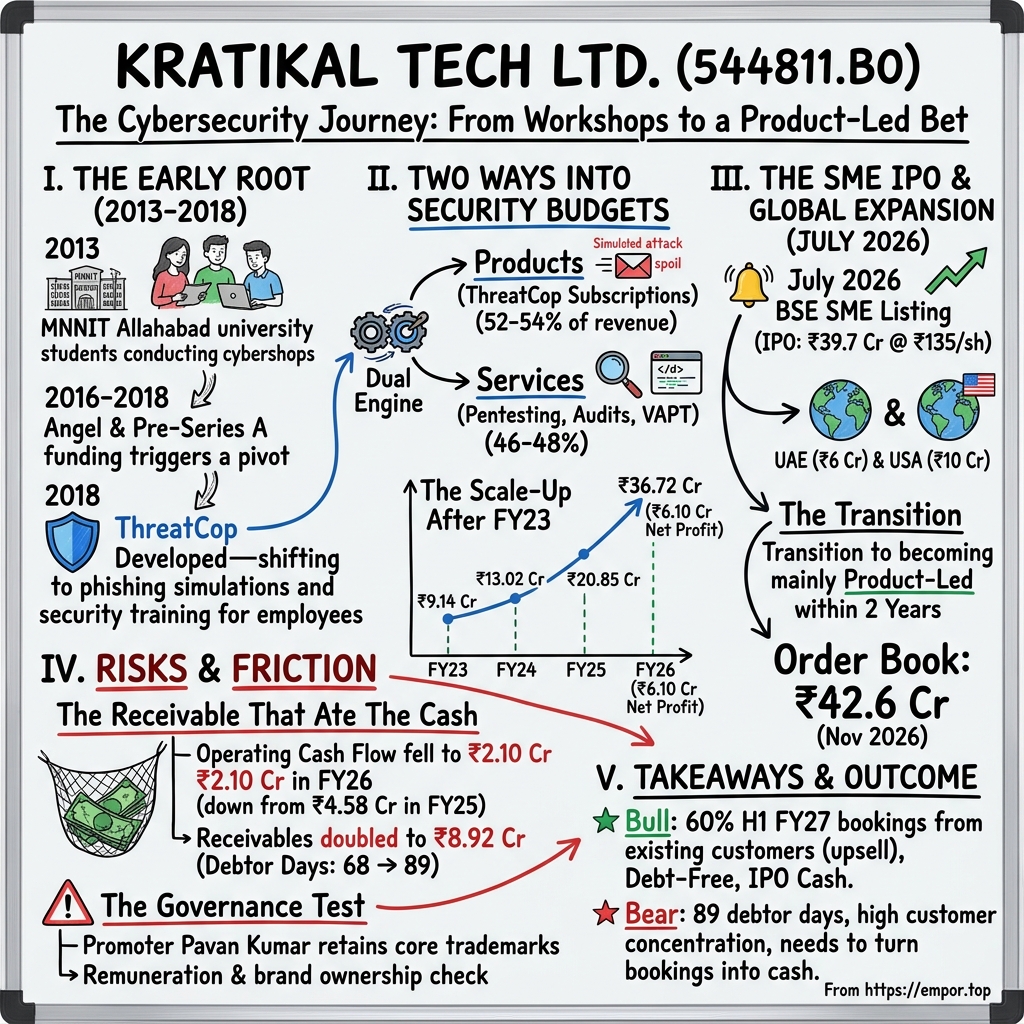
In the first week of November 2026, a small cybersecurity company from Noida published its first half-year results as a listed business, and the headline number was not revenue. It was the order book. Kratikal Tech told shareholders that bookings had roughly doubled and that signed work waiting to be delivered had reached about ₹42.6 crore.1 For a company whose entire revenue in the year to March 2026 was about ₹36.7 crore, that is a striking claim: more work under contract than the business had ever billed in a full year.2
The revenue line was strong too. In the six months to September 2026, Kratikal reported revenue of about ₹22.3 crore, up roughly 65% on the same period a year earlier.3 Put another way, the company did in half a year what it had needed most of FY25 to do. And alongside the numbers came a sentence that frames this entire story. Management said it wants Kratikal to become predominantly product-led within two years.1
That ambition is the reason to look closely, because the same presentation showed how far the company still has to travel. Threatcop, the software brand that sells subscriptions to train employees against phishing and social engineering, accounted for about 52% of first-half revenue. Services, meaning the experts who test networks, audit systems and advise clients, accounted for the other 48%.1 Bookings had doubled. The mix had barely moved. Kratikal is still half a software company and half a team of skilled people billing for their time and judgment.
There is a second contrast, quieter but more important to a long-term owner. In FY26, the year that set up the IPO, Kratikal reported net profit of about ₹6.1 crore. Its operating cash flow was about ₹2.1 crore.2 For every rupee of profit on the income statement, roughly a third of a rupee arrived as cash from running the business. The rest was tied up, mostly in money customers owed but had not yet paid.
So the stakes of this episode come down to three questions. The first is whether Threatcop can become the repeatable core of the company, the part that renews every year without a salesperson starting from zero. The second is whether the overseas push, now funded by public-market money, can earn its keep in the United States and the Gulf. The third is the plainest: will reported growth turn into cash in the bank?
Before going further, it helps to be precise about what investors actually own. The listed company is Kratikal Tech Limited, which floated a fresh issue of shares on the SME platform of BSE and began trading on July 7, 2026.4 It has subsidiaries abroad, including entities in the US and the UAE, and their results flow into the consolidated accounts.2 Those subsidiaries matter to shareholders only through what they add to group revenue, profit and cash. There is also a promoter-group company called Threatcop Inc. that sits outside the listed perimeter and has dealt with the listed business, a detail that will return when the story reaches governance.5
The order book is a promise of future revenue, not revenue itself, and certainly not cash. A booking becomes a sale only when the work is delivered or the subscription period passes, and a sale becomes valuable only when the customer pays. That chain has three links, and Kratikal has so far shown investors the first one most clearly.
None of this makes the order book unimportant. For a company of Kratikal's size, ₹42.6 crore of contracted work gives management real visibility into the next year, and the fact that it doubled suggests customers are buying more, not less. But visibility is not durability. A durable software company is one whose customers come back without being re-sold, whose prices hold, and whose cash arrives on time. Kratikal has not yet published the renewal or retention figures that would prove the first two, and its most recent full year raised a question about the third.
The irony is that a company now talking about global infrastructure and product-led growth did not begin with software at all. It began in lecture halls, with students teaching other students how attackers think. To understand what Kratikal is trying to become, and why the transition is harder than a slide can make it look, the story has to go back to those workshops.
 Subscribe on LinkedIn
II. The Company That Started With Workshops
Allahabad in 2013 was not an obvious place to start a cybersecurity company. The city, now Prayagraj, is better known for its university, its courts and its pilgrims than for software. But it is also home to the Motilal Nehru National Institute of Technology, and that year a group of students there began running workshops on cybersecurity.6 The format was simple and cheap: gather a room of students or employees, show them how hacking actually works, and teach them how to defend themselves.
The spark, as the company tells it, was personal. Pavan Kumar, then a student in the second year of his degree, received a phishing email carrying fake documents. He typed in his password. His email account was taken over, and then his social media accounts were misused.7 A 2020 newspaper profile would later headline his story as that of a techie who started a cybersecurity firm after he got hacked.8 It is the sort of origin story every security company wishes it had, and it happens to explain the company's entire product philosophy. The breach did not come through a flaw in the code. It came through a human being who trusted the wrong message.
Pavan Kumar did not start alone. He joined two college mates from the same institute, Paratosh Kumar and Dip Jung Thapa, and the three founded Kratikal to promote cybersecurity awareness and training.7 At first it was a weekend effort.7 The company was incorporated in November 2013, and its own timeline describes the early business as a training institute running cybersecurity workshops across India.6 Those three names recur through the whole story. Pavan Kumar would become chairman, managing director and chief executive; Paratosh Kumar remains a whole-time director; and Dip Jung Thapa would join the listed company's board in 2026.29
The founders drew a lesson from their workshops that became the company's thesis. They concluded that the large majority of successful cyberattacks, more than 90% by their reckoning, exploit the human factor rather than a purely technical weakness.7 Industry studies have long made a similar point, but for a tiny team in Allahabad the conclusion was strategic, not academic. Around 2015 they pivoted the business toward defence against social engineering, the con-artist side of hacking, and moved the head office to New Delhi.76
That insight sounds obvious now. In 2013 it was still unfashionable in a market that sold security mostly as boxes and software: firewalls, antivirus, intrusion detection. The human layer was treated as a training problem for the HR department, not a product category. Kratikal's early bet was that the human layer could be measured and improved, and that companies would pay to do it.
Workshops, however, are a hard business to scale. Every session needs a trainer in a room. Revenue stops the moment the trainer stops talking. There is no compounding, because each new customer is a new event to organise rather than a new subscription that renews. The founders needed a way to turn what they taught into something that could run without them.
The financing came in steps, and the timeline shows how much the company leaned on India's startup scaffolding to get through its early years. In 2016 Kratikal was recognised under the government's Startup India programme and raised angel investment.6 By January 2017, Mint reported that the startup had raised close to $500,000 in seed funding.10 Later in 2017 it was incubated under a telecom-ministry programme, the Telecom Centres of Excellence.6 In 2018 came a pre-Series A round from Yes Bank, ART Capital, Equentia and angel investors.611 These were small sums by the standards of global security startups, which routinely raise tens of millions of dollars before they have meaningful revenue. Kratikal was building on a much thinner cushion, which helps explain why services, which pay as they go, stayed central to the business for so long.
The product moment arrived in 2018. Kratikal developed ThreatCop, a platform that simulates attacks and trains employees to recognise them.7 The easiest way to picture it is a fire drill for the inbox. Instead of waiting for a real phishing email, the company sends employees a realistic fake one, records who clicks, who enters credentials and who reports it, and then delivers short training to those who fell for it. Run the drill every month and the security team gets a score that should, if the training works, improve over time.
That turned the workshop into software. A customer could license the platform per user, run campaigns without a Kratikal trainer present, and renew the following year. It is a far better business model in principle, because the cost of serving the hundredth customer is mostly the cost of the servers and the support desk, not another trainer's salary.
The early years brought a shelf of recognition. Kratikal says ThreatCop was named among the ten most innovative products by DSCI and Nasscom in 2017, that the company was ranked among the top three startups at the Nasscom Product Conclave in 2018, and that it collected further startup awards from chief-information-security-officer forums in 2019 and 2020.6 There is a small wrinkle in those claims: the company dates the product's recognition to 2017, while its own brand story says ThreatCop was developed in 2018, which suggests an earlier version existed before the commercial launch.67
Recognition is worth noting and worth keeping in proportion. An award says a jury liked the technology or the pitch. It does not say customers renewed, paid on time or paid more the following year. Even the company's customer claims need care: its website says more than 1,875 enterprises and small businesses trust Kratikal, while its prospectus counted 677 clients in FY26.62 The two figures likely measure different things, cumulative relationships against active billing clients, but the gap is a reminder that marketing counts and audited disclosures are different kinds of evidence. The financial record is the better judge, and for most of the first decade that record was modest.
The available history shows the company running at a loss or close to break-even through FY23.5 In that year revenue was about ₹9.1 crore, roughly a decade after incorporation.12 That is a respectable small business. It is not a hypergrowth software story. Whatever Kratikal became later, the first ten years were a slow grind of building products, keeping the services arm busy and staying solvent on modest outside capital.
The defining shift of those years was a change of identity. Kratikal moved from training and awareness work toward two things that larger customers buy with real budgets: software subscriptions and enterprise security services. The services side meant hiring specialists who could do more than teach, people who could break into a client's network on purpose to find weaknesses before criminals did.
That combination, software for the human layer and experts for everything else, is the proposition Kratikal took to market in the years before its IPO. It is also the proposition investors are now asked to judge. Whether selling both is a competitive advantage or simply two smaller businesses sharing a logo is the question that decides how much of the recent growth is likely to last.
III. Two Ways Into the Customer’s Security Budget
Picture the security head of a mid-sized Indian bank or software firm in early 2026. Her board wants proof that employees will not hand over their passwords to the next convincing scam email. Her regulator, or her largest customer, wants evidence that her web applications and networks have been tested by a qualified outside party. Those are two separate line items in her budget, usually bought from two separate vendors. Kratikal's pitch is that it can be both.
The first engine is Threatcop. Its products are sold mostly on annual or multi-year subscriptions, priced per user or per module.2 The flagship is security awareness training built around simulated attacks, the fire drill described earlier. Kratikal has extended the family with other tools, including AutoSecT, a vulnerability-management product whose subscriptions are linked to the number of assets a customer protects and how much it is used.2 Subscription software is attractive because, once installed, it tends to renew unless something goes wrong.
The second engine is people. Kratikal's experts run vulnerability assessment and penetration testing, usually shortened to VAPT, along with audits, compliance work, advisory projects and managed security services.2 Penetration testing is easiest to understand as hiring a professional burglar to try every door and window of your house, then hand you a report of how they got in. It is skilled, valuable work. It is also priced by deliverable or by engagement, sold through work orders and statements of work, and it ends when the report is handed over unless the customer signs again.2
How big is each engine? In FY26, the product side contributed about 54% of revenue, with services making up the balance.5 Within that, two lines dominate. Threatcop's security-awareness training alone accounted for about 43% of total revenue, and VAPT for about 35%.2 Put those together and nearly four-fifths of the company rests on one product and one service. That is focus, which is good, and concentration, which is a risk. If phishing-simulation pricing comes under pressure, or if penetration-testing work becomes commoditised, there is not much else in the portfolio to absorb the hit.
The market Kratikal sells into is large and crowded. The Data Security Council of India, the industry body set up by Nasscom, estimated India's domestic cybersecurity market at about $2.3 billion in its 2023 study, with services forming a substantial share of it.13 The same study names the large IT services houses, among them TCS, Infosys, HCL and Wipro, among the service providers serving Indian enterprises.13 Global security platforms compete for the product budget, and dozens of specialised Indian firms compete for testing and audit work.
Kratikal's size against that backdrop needs to be stated carefully. Its FY26 revenue of about ₹36.7 crore is roughly $4 million.2 That is a rounding error inside the IT majors, whose security practices are tiny parts of businesses many thousands of times larger. Kratikal does not publish a market share, and there is no close listed peer of similar size and mix that would allow a clean comparison. The honest description is a niche specialist with a few hundred customers in a market dominated, by spending, by much bigger names.
Those few hundred customers are real evidence of reach. Kratikal served 677 clients in FY26, up from 424 two years earlier.2 That growth in the customer count is one of the stronger signals in the record, because it says the company is winning new logos rather than merely selling more to the same handful of buyers.
The competitive question, though, is not whether Kratikal can win customers. It is whether it can keep them on good terms. Consider the forces at work. Buyers in security routinely multi-source: a bank might use one vendor for phishing simulation, another for application testing and a third for audits, and switching a phishing-training tool is not a heart transplant. Large global platforms bundle awareness training into broader suites. IT integrators can wrap testing into much larger contracts. And the key input on the services side, skilled security staff, is scarce and mobile, which pushes up costs and limits how quickly a small firm can grow its delivery bench.
Against those pressures, Kratikal has credentials that matter in procurement. It is empanelled by CERT-In, India's national computer emergency response team, to conduct security audits, and it reports SOC 2 compliance, the American standard for how a service provider protects customer data.2 Those are gates. Without them, many Indian government-linked and regulated buyers would not even consider a vendor, and many American buyers would not get past the security questionnaire. But a gate is not a moat. Every serious competitor has to clear the same gates, so the credentials prove eligibility rather than advantage.
The timing of those gates is revealing. Kratikal's own timeline places its CERT-In empanelment in 2021, GDPR compliance in 2022 and SOC 2 compliance in 2023, the same year it introduced AutoSecT.6 Read alongside the financial record, the sequence makes sense of the step-up that followed. The credentials arrived first; the sharp revenue acceleration came in the years immediately after. That does not prove cause and effect, but it fits a simple story: a small vendor could not sell to regulated Indian buyers or cautious American ones until it held the right certificates, and once it did, the addressable market widened. It also cuts the other way. If certification opened the door, it opened it for every rival who holds the same paper.
The real evidence of a moat would be retention, renewal and pricing data: what share of last year's subscription revenue renewed, whether customers expanded, whether prices rose. Kratikal does not disclose renewal rates, net revenue retention or the share of revenue that is contractually recurring.2 Without those numbers, switching costs and pricing power remain plausible but unproven. The full weighing of competitive position belongs with the bull and bear case later in this story; here the point is simply that the company has not yet shown the data that would settle it.
There is also a small but telling signal in the product table. Threatcop has launched several products over the years, and the prospectus shows that one of them, TPIR, a tool for employees to report suspicious emails and for security teams to respond, generated no revenue in FY26.2 That is a minor line, and its disappearance does not mean the core product is failing. It does show that product launches and commercial traction are different things, and that Kratikal's history includes products that did not become meaningful businesses. Investors should hold every new launch announcement to the same standard.
Where the combination might genuinely help is cross-selling. A customer that already trusts Kratikal's testers is a warmer prospect for Threatcop, and vice versa. The first half of FY27 offered an early proof point: bookings from existing customers made up about 60% of the total, and management said cross-sell bookings increased.1 That is the right shape for a company trying to build a land-and-expand model, where the first contract is a foothold rather than the whole relationship.
The caution is the one that runs through this entire story. A booking from an existing customer is encouraging, but it says nothing yet about whether the work recurs next year, whether it is recognised as revenue on schedule and whether the invoice is paid. The two-engine model gives Kratikal two ways into a customer's budget. Whether either engine is building lasting loyalty is still a matter of inference.
What is not a matter of inference is that something changed sharply after FY23. A business that had spent a decade near break-even suddenly began growing fast and earning real profits. Understanding that step-up is the key to understanding what investors bought at the IPO.
IV. The Step-Up After FY23
For ten years, Kratikal looked like many Indian technology startups: technically capable, well regarded in its niche and financially small. Then, in FY24, the curve bent. Revenue rose from about ₹9.1 crore to about ₹13 crore, an increase of roughly 42%.12 The company was profitable that year, earning around a quarter of revenue as net profit.2 It was the first clear sign that the two-engine model could do more than sustain itself.
FY25 accelerated the pattern. Revenue rose about 60% to roughly ₹20.9 crore.2 Then FY26 went faster still: revenue grew about 76% to ₹36.7 crore, and net profit grew about 61% to roughly ₹6.1 crore.2 In three years, a ₹9 crore business had become a ₹37 crore business, roughly a fourfold increase. Few small listed technology companies in India can show that kind of run, and it is the core of the bull case.
What makes the run more convincing is that it was not confined to one engine. In FY26, products were about 54% of revenue and services the rest.5 Both sides grew. That matters because a growth spurt built entirely on one large services contract would be fragile, while one spread across subscriptions and projects suggests broader demand. The rise in client numbers, from 424 to 677 over two years, points the same way.2
Exports were a major part of the acceleration. Revenue from customers outside India rose from about ₹2.75 crore in FY25 to nearly ₹11 crore in FY26, lifting its share of revenue from about 13% to about 30%.2 Put simply, roughly half of the ₹16 crore increase in FY26 revenue came from overseas customers. That is a remarkable shift in a single year, and it is the foundation on which the company would later justify spending IPO money abroad.
Behind the numbers stand people. Kratikal's workforce grew from 124 at the end of FY24 to 165 a year later and 200 at the end of FY26.2 Revenue grew faster than headcount, so revenue per employee rose from roughly ₹10.5 lakh to about ₹18 lakh over two years. That is a meaningful improvement, and it is consistent with more of the growth coming from software, which does not need a new employee for every new customer.
It also keeps the company in perspective. About ₹18 lakh of revenue per employee, roughly $21,000, is far below what pure software companies achieve and in the range of an Indian services firm. Kratikal remains people-intensive. Its testers, trainers, developers and sales staff are both its product and its main cost.
The margin story follows from that. Employee expenses fell from about 43% of revenue in FY25 to about 38% in FY26.2 Sales grew faster than the salary bill, and that operating leverage is a large part of why profit rose so sharply. The question is how much further it can go. A services business at full utilisation can only push margins so far before it has to hire again, and the company's own plans call for more hiring abroad. If the next wave of growth comes from expensive overseas salespeople and engineers, the cost ratio could rise again before revenue catches up.
There is a subtler point about the margin, too. Net margin actually fell over these three years, from roughly 25% in FY24 to about 18% in FY25 and about 17% in FY26.2 Part of that was tax: the effective rate rose from around 19% in FY24 to around 27% to 30% in the next two years.2 Part of it reflects the cost of growth. Either way, the story of these years is profitable scale-up, not expanding profitability. Kratikal became much bigger and stayed comfortably profitable; it did not become dramatically more profitable per rupee of sales.
The first half of FY27 suggests the momentum did not stop at the IPO. Revenue grew about 65% on the prior-year half, and product revenue about 68%, a touch faster than the company as a whole.31 That is consistent with the product side slowly gaining weight, but only slowly: at roughly 52% of first-half revenue, Threatcop was still close to where it had been in FY26.1 Seasonality may play a part, since security budgets and subscription renewals tend to cluster around customers' financial year-ends, so a single half-year is a weak basis for judging mix.
Another accounting choice flatters reported profit slightly. Kratikal capitalises part of its software development spending, recording it as an asset on the balance sheet rather than charging it against profit as it is spent.2 The company added about ₹4.6 crore of development cost in FY26 and carried about ₹8.6 crore of intangible assets under development at year-end.5 Capitalisation is legitimate and common for software companies, because the product should earn revenue for years. But it means the income statement understates how much the company is spending on its products today. A reader who wants to know the true cost of building Threatcop has to look at the balance sheet as well as the profit line, and Kratikal does not publish a research and development expense line that separates the two.2
So how should the step-up be judged? It is real. The growth is broad across products, services and geographies, it came with profits, and it continued into the first half of FY27. It is also short. Three years of profitable growth after a decade of near break-even do not establish what the business earns through a slowdown, a lost major customer or a price war. The record supports a smaller and more careful claim: Kratikal has found a formula that works in current conditions and has been executing it well.
That leaves a puzzle that the income statement alone cannot solve. If FY26 was the best year in the company's history, with profit up about 61%, why did cash from operations fall by more than half? That question would hang over the IPO, and the IPO itself was designed to fund a bigger leap.
V. The IPO Funds the Next Geography
On July 7, 2026, Kratikal Tech's shares began trading on the SME platform of BSE.4 The SME boards were created to let smaller companies raise public equity with lighter requirements than a main-board listing, and they have become one of India's busier corners of the capital market. Kratikal arrived with a straightforward offer: about 29.4 lakh new shares at ₹135 each, raising roughly ₹39.7 crore.2
The most important feature of that offer was what it did not include. There was no offer for sale.2 No founder, angel or early investor sold shares into the IPO. Every rupee raised went to the company. That is the clearest signal of intent available in an IPO: the insiders wanted capital for growth, not an exit. It is worth contrasting with the many SME listings where existing holders sell a large slice on day one.
The price of that capital was dilution. Promoters and the promoter group held about 72.6% before the issue and about 53.4% afterwards.2 They gave up nearly a fifth of the company's ownership to fund the next stage but kept a clear majority, and with it control over strategy, the board and the use of the proceeds. Before the IPO, the share capital had been reshaped through a 600-for-1 bonus issue, a private placement and allotments under the employee stock option plan, the usual housekeeping before a small company goes public.2 The prospectus reported no outstanding warrants or convertible instruments and no promoter pledges.2
Where was the money meant to go? The prospectus earmarked about ₹9.2 crore for product development, with other allocations for sales capacity and for investment into the overseas subsidiaries in the US and the UAE.2 In plain terms, the plan was to build more software and hire more people abroad to sell it. That is a direct bet on the two trends visible in the step-up years: the rising share of product revenue and the jump in exports.
The geography was not new. Kratikal's timeline records an expansion into the UAE and Saudi Arabia in 2024 and an extension into the US in 2025, and the Threatcop brand now lists an American address in Cupertino, California, alongside a presence in Oman, Indonesia and Germany.67 The export surge of FY26 was the first financial evidence that those early forays were producing customers. The IPO was meant to turn a toehold into a sales operation.
The logic for going abroad is easy to see. Indian enterprise security budgets are growing but price-sensitive, and an Indian vendor competing against the IT majors at home often competes on cost. In the Gulf, many large buyers are banks and state-linked companies with growing security programmes, and a vendor with an Indian cost base can price competitively against Western rivals. In America, the market for security awareness training is far larger, and a subscription sold in dollars is worth several times the same seat sold in rupees. The obstacle is equally clear. American buyers already have established awareness-training vendors, and an Indian challenger has to win on product, price and trust from a standing start.
The board moved quickly after listing. In August 2026 it approved investments of up to roughly ₹6 crore in the UAE subsidiary and up to ₹10 crore in the US subsidiary.9 For a company with FY26 net profit of about ₹6 crore, those are large commitments. Together they amount to more than two and a half years of current profit, directed into markets where Kratikal is a newcomer competing against well-funded local vendors.
There were early commercial signals to point to. In July, the company disclosed its first order from a US financial institution, worth about ₹21 lakh.9 That is a modest sum, a little over half a percent of FY26 revenue, but a first order from an American bank-type customer is a credential that can be used in the next sales meeting. By the first-half presentation, management reported that the number of US orders had grown from three to fifteen.1
The right way to read those numbers is with both enthusiasm and arithmetic. Going from three to fifteen orders shows a sales motion beginning to work. It does not say how large those orders are, whether they are subscriptions that will renew or one-off projects, or how much they cost to win. A US salesperson's salary can easily exceed the value of several small orders. The test of the American bet is not the order count. It is when the US subsidiary's revenue covers its costs and starts sending cash back.
The international push also changes the risk profile. Kratikal earns its export revenue mainly in US dollars and UAE dirhams, while most of its costs are rupee salaries in India.2 When the rupee weakens, each dollar of revenue buys more rupees of cost, and margins improve. When the rupee strengthens, the reverse happens. With exports now around 30% of revenue, currency moves have become material to profit. The company says it manages the exposure through internal policies but does not describe a specific hedging ratio or instruments.2 Small overseas compliance matters have also appeared: the company has disclosed a possible AED 10,000 late-registration penalty in the UAE.5 It is trivial in money terms, but it is a reminder that building legal entities abroad brings administrative risk for a small finance team.
By September, the IPO proceeds monitoring report from CARE showed that about ₹4.25 crore had been used and about ₹35.4 crore remained unutilised.9 That is unsurprising two months after listing; companies rarely spend IPO money that fast. But it frames the investment case. Most of the capital is still a plan. Shareholders who bought in the IPO, or since, are paying for a deployment that has largely not happened yet, and whose returns cannot be measured for some time.
It is worth being explicit about what is absent. Kratikal has not announced an acquisition programme.2 The expansion is being built organically, through subsidiaries, hiring and product investment. That is lower risk than buying companies, which can bring integration failures and inflated goodwill. It is also slower and harder to measure, because organic investment shows up as cost long before it shows up as revenue.
The listing therefore did two things. It gave Kratikal a pool of capital large relative to its size, enough to fund an expansion that the business could not have paid for from its own cash flow. And it left the founders firmly in charge of spending it. The capital-allocation test is now simple to state and hard to pass: do the US and UAE investments and the new products generate revenue, profit and collected cash within the two-year window management has set for becoming product-led?
That last word, collected, is where the story turns. Because before the company had spent much of its IPO money, its own FY26 accounts had already shown that growth was consuming cash faster than profit suggested.
VI. The Receivable That Ate the Cash
Close the books on March 31, 2026, and look at a single line on Kratikal's balance sheet: trade receivables, the money customers owe for work already invoiced. A year earlier it stood at about ₹4.1 crore. Now it was about ₹8.9 crore, more than double.2 Revenue had grown about 76% in the same year. The amount customers owed had grown faster than the amount they were billed.
That one line explains most of the puzzle left hanging by the step-up years. Operating cash flow, the cash the business generated from running itself, fell from about ₹4.6 crore in FY25 to about ₹2.1 crore in FY26, even as net profit rose to about ₹6.1 crore.2 When a company's profit climbs and its operating cash halves, the gap usually sits in working capital, and that is exactly where it sat here.
The reconciliation is easier to follow as a story than as a statement. Kratikal earned its profit in FY26. But about ₹4.9 crore of that profit was not collected; it remained on the balance sheet as money owed by customers.2 Another roughly ₹1 crore went into loans and advances, payments made ahead of time or amounts advanced to others.2 Some cash came back the other way, because other liabilities rose by about the same ₹1 crore, which means the company itself owed more to others at year-end.2 Add the non-cash charges back, subtract tax, and the result was an operating inflow of only about ₹2.1 crore.
A useful way to measure the strain is debtor days: how many days of revenue are sitting uncollected at the year-end. Kratikal's figure was about 68 days in FY24 and 71 in FY25. In FY26 it jumped to 89.2 Put plainly, at the end of FY26 Kratikal was waiting about three months for its money, nearly three weeks longer than a year before.
There are innocent explanations, and they matter. A company growing at 76% will naturally carry more receivables, because the invoices from the busy final quarter have not had time to be paid. If a large share of that quarter's billing came from new, larger or overseas clients, collection cycles could lengthen without anyone being in trouble. Customer concentration also rose sharply in FY26, with the top ten customers supplying about 32% of revenue compared with about 22% a year earlier.2 Bigger customers often negotiate longer payment terms, and a few large invoices raised late in the year can move the year-end balance a great deal.
There are less innocent explanations too, and an investor cannot rule them out from the outside. Receivables can grow because customers dispute work, because revenue is recognised aggressively, or because some clients simply struggle to pay. The best defence against those worries is an ageing schedule, which shows how long each rupee has been outstanding. Kratikal's FY26 annual report shows about ₹0.65 crore of receivables older than six months.5 That is about 7% of the total. It is not alarming, but it is not nothing either, and it is the bucket to watch, because old receivables are the ones most likely to become write-offs.
Kratikal does not separately disclose unbilled revenue or contract assets as material lines in its financial statements.2 That means the receivables figure is the main window into how much revenue is waiting to become cash. It also means the order book, the hero number of the first-half results, sits entirely outside these balances. Bookings, receivables and cash are three different stages of the same journey, and the company has so far published much more about the first than about the last.
It helps to understand why profit and cash can drift apart in a business like this. On the services side, Kratikal's testers and consultants do the work first. Their salaries are paid every month. The invoice goes out at a milestone or at the end of the engagement, and payment follows weeks or months later. A fast-growing services firm is, in effect, lending money to its customers in the form of unpaid labour. Subscriptions can be better, because many are billed in advance, but that advantage only shows up when renewals are collected on time.
Capitalised development adds a second layer. Because part of Kratikal's software spending goes to the balance sheet rather than the income statement, reported profit is higher than it would be if every rupee of development were expensed. The cash still leaves the company, recorded under investing activities rather than operations. Combine the two effects and FY26 free cash flow, operating cash minus capital spending, was negative, at roughly minus ₹3 crore.2 The IPO money arrived after the year ended, so the business, for one year at least, needed outside capital to fund its growth.
Over a longer window, the picture is more reassuring. Across FY24 to FY26, cumulative operating cash flow was about ₹10.9 crore against about ₹13.2 crore of cumulative net profit, a conversion rate of roughly 83%.2 For a growing services-and-software company, converting four-fifths of profit into operating cash over three years is reasonable. The problem is not the three-year average. The problem is that the trend is moving the wrong way, and that the latest year is the weakest of the three.
Was the company ever short of money during this squeeze? No. The balance sheet carried essentially no borrowings, and finance charges were a rounding error at about ₹2 lakh in FY26.2 The FY26 annual report shows about ₹4.8 crore held in fixed deposits.5 Other income, mostly treasury returns, fell to about ₹0.14 crore in FY26 against profit before tax of about ₹8.3 crore, so the earnings were not propped up by interest or one-off gains.2 The receivables problem is therefore not a solvency problem. It is a quality-of-growth problem: a test of whether the customers Kratikal is adding pay as reliably as the ones it already had.
So the verdict on the cash question is narrower than either a bull or a bear would like. The cumulative record does not suggest the profits are fictional. FY26 does show clear deterioration, and the deterioration is concentrated in receivables and advances rather than in some one-off event. The business now needs to prove that its growth is collectible, not just billable.
The forward test is unusually concrete. During FY27, Kratikal should collect most of the ₹8.9 crore it was owed at March 2026, including much of the ₹0.65 crore that had already aged past six months. If it does, operating cash flow should recover and debtor days should fall back toward the 70s. If receivables keep outgrowing revenue, the gap between reported profit and real cash will become the central issue for anyone valuing the company.
Questions about cash eventually lead to questions about the people controlling it. In a founder-led company that has just raised public money, the next thing a skeptic asks is who owns what, who gets paid, and on what terms.
VII. The Founder Still Owns the Brand
Deep in the risk factors of Kratikal's prospectus sits a disclosure that most retail investors will never read. The trademarks the company trades under are registered in the name of Pavan Kumar, the founder, and the company uses them under a no-objection letter from him.2 The business that shareholders own sells its products under a brand that, legally, belongs to its chief executive.
That arrangement is not unusual in Indian startups. Founders often register trademarks personally in the early years, before there is money or reason to move them, and many never get round to the transfer. But in a listed company it creates a real governance question. If the founder and the company ever disagreed, or if the founder's personal circumstances changed, who would control the name on every product? A no-objection letter is a courtesy, not a perpetual licence with defined terms.
Pavan Kumar is the central figure in this story, and his role has grown with the company. He became chairman, managing director and chief executive in March 2025.2 His co-founder Paratosh Kumar remains a whole-time director, the second operating founder on the board.2 In July 2025, ahead of the IPO, the company appointed Vimnay Singh as chief financial officer.14 And in August 2026, shortly after listing, Dip Jung Thapa, the third of the college friends who founded the company, joined the board as an executive director.97 The founding trio, in other words, now runs the listed company much as it ran the weekend workshop: together, and with control. Three independent directors sit on the board, and an independent director chairs the audit committee.2
The incentive picture starts with ownership. The promoter group held about 53.4% after the IPO, and the September 2026 shareholding pattern showed a similar 53.4%.5 The founders therefore have most of their wealth tied to the share price, which aligns them with minority shareholders on the big question of whether the company becomes more valuable. Kratikal also runs an employee stock option plan, which gives staff a stake in the outcome.2
Pay is where the alignment gets more complicated. Pavan Kumar and Paratosh Kumar each received about ₹0.50 crore in FY26.14 Combined, that is about ₹1 crore, or roughly 16% of the year's net profit. In absolute terms, ₹50 lakh for the chief executive of a growing technology company is not extravagant. Relative to the size of the business, it is substantial. And the company's directors' report states that the remuneration exceeded the limits specified under Section 197 of the Companies Act, while also saying it was approved in accordance with the applicable provisions.14
That needs careful handling. Section 197 caps managerial pay as a share of profit, but the law allows companies to exceed those caps with shareholder approval. Exceeding the limit is therefore a governance question about whether shareholders were properly asked and agreed, not a finding of improper payment. The more useful question is whether outside shareholders actually endorsed it. Kratikal's 2026 annual general meeting reported approval of its resolutions with full support.5 With promoters holding a majority and only a few hundred shareholders on the register, broad approval is not surprising. It does not tell an investor much about how independent holders voted.
Related-party dealings form the other strand. In FY26 Kratikal paid about ₹0.10 crore to Threatcop Inc., a promoter-group company, and advanced it another ₹0.06 crore.5 It paid about ₹0.26 crore to Easenode Tech, a company the offer document associates with relatives of Pavan Kumar.5 Against FY26 revenue of about ₹36.7 crore, these sums are small, together under 1.2% of sales. The prospectus says the transactions were conducted on an arm's-length basis.2
The size of the payments matters less than their structure. The existence of an entity called Threatcop Inc. outside the listed group, while the listed group sells under the Threatcop brand and the Kratikal trademarks sit with the founder, is the kind of arrangement a skeptical investor will want simplified. The prospectus itself warns that more favourable terms might have been available from unrelated parties.2 That is standard risk-factor language, but it is also an admission that the company cannot prove otherwise.
The shareholder register itself is still taking shape. A secondary summary of the exchange filings shows domestic institutions holding about 10% in the July 2026 pattern, just after listing, and foreign investors well under 1%.5 By September, the number of shareholders on the register had fallen from 815 to 562.5 That is a very small base for a listed company, typical of SME boards where trading lots are large and many IPO allottees sell early. It also means that votes, liquidity and price discovery are concentrated in few hands, and that the founders' majority faces little organised scrutiny from outside holders.
The external checks offer some comfort. Kratikal's FY26 auditor report carried no qualification.15 Contingent liabilities were trivial, a few lakh rupees of indirect-tax, regulatory and bank-guarantee items, and the company has disclosed three GST scrutiny notices awaiting a response.25 Kratikal carries no issuer credit rating, which is common for a debt-free company of its size but means no rating agency has independently assessed its liquidity or customer risk.2 None of this suggests misconduct. It suggests a young listed company still carrying the informal arrangements of its private years.
How should management credibility be judged at this stage? The record is short. The founders delivered the growth they described in the prospectus, at least through the first half of FY27. They raised capital without selling their own shares. Against that, they have committed a large amount of the IPO money to overseas subsidiaries within weeks of listing, and their two-year product-led goal has no numerical target attached. Credibility will be earned in the next two years by how clearly they explain capital deployment and cash conversion, especially if either goes badly.
The practical test is concrete. Will Kratikal transfer the trademarks to the listed company, or formalise a licence on disclosed terms? Will it simplify or explain the role of Threatcop Inc.? Will future annual reports set out related-party balances and executive pay clearly enough that a minority shareholder can judge them? A founder-led company that grows beyond founder scale usually has to answer those questions eventually. Doing it early is one of the cheapest ways to earn trust.
With the business, the cash and the governance laid out, the remaining question is the one every public shareholder ultimately faces: what is the market already paying for?
VIII. Analysis & Bear vs. Bull Case
On November 13, 2026, Kratikal's shares closed at ₹160.85.5 That is about 19% above the ₹135 IPO price, four months after listing. Based on the shares outstanding after the IPO, the market value works out to roughly ₹180 crore, about five times FY26 revenue.2 At the November 9 close, one analysis put the shares at about 30.7 times FY26 profit, against a median of about 16.2 times for ten other listed SME software companies.5
That premium needs context. The comparison group is not a close match: it includes software businesses with different margins, scale, growth and customer types, few of them in cybersecurity.5 Kratikal's growth rate is far higher than most SME software peers, which partly explains the gap. The multiple is information about what the market currently assumes, not a valuation conclusion. What it appears to assume is that recent growth continues, that the product share rises and that the IPO money earns a decent return. None of those is yet proven.
One adjustment sharpens the picture. A large part of that market value is cash the company has only just raised. Strip out the roughly ₹35 crore of IPO money still unspent at September, and the market is valuing the operating business at something closer to ₹145 crore, roughly 24 times FY26 profit.9 That is less demanding than the headline multiple suggests. It also assumes the unspent money is worth its face value, which is true only if it is eventually deployed at a decent return or returned to shareholders. Cash earmarked for overseas expansion is not the same as cash in a shareholder's pocket.
Start with the strongest version of the bull case. Threatcop already generates about half of revenue on subscription terms, and product revenue grew about 68% in the first half of FY27.1 Existing customers supplied about 60% of bookings, which is what a company with a working land-and-expand engine should show.1 The order book reached about ₹42.6 crore, more than a full year of FY26 revenue. If even a large part of that converts on schedule, FY27 revenue growth looks well supported.
The bear has a clean answer. FY26's top ten customers supplied about 32% of revenue, up from about 22% the year before, and the largest single customer about 9%.2 Debtor days rose to 89. And the metrics that would prove the subscription engine is durable, renewal rates, net revenue retention and the share of revenue that is truly recurring, are not disclosed.2 A doubling of bookings driven partly by a few larger customers can look identical to a doubling driven by broad, sticky demand until the renewals come due.
The second bull argument is international. Overseas revenue has risen to about 30% of sales, US orders have multiplied, and the company has a debt-free balance sheet and a fresh pool of IPO capital to fund the push.21 Few Indian SME technology companies have built meaningful American revenue at all, and Kratikal has done so with a product rather than with offshore staff augmentation.
The bear's response is about evidence rather than ambition. The two-year product-led goal comes with no numerical revenue, mix or margin target.1 About ₹35.4 crore of IPO proceeds remained unspent at September.9 Overseas sales teams are expensive, sales cycles with American financial institutions are long, and the first disclosed US order was worth about ₹21 lakh. Spending capital to build capacity is easy. Earning a return above the cost of that capital is the hard part, and none of it has happened yet.
The competitive analysis promised earlier fits here. Through Michael Porter's lens, the forces are mostly against a small vendor. Buyer power is meaningful: security teams multi-source, and the rising share of the top ten customers increases Kratikal's dependence on a few relationships. Substitutes are plentiful, because awareness training is bundled by large email and security platforms. Rivalry is intense, with global product companies on one side and Indian IT majors and specialist testers on the other. Supplier power shows up in the labour market, where skilled security professionals are scarce. The threat of new entrants is moderate: credentials like CERT-In empanelment and SOC 2 take time to acquire, but many firms already hold them.
Hamilton Helmer's seven powers give a sharper test of whether Kratikal has any durable advantage. Scale economies are absent at its size. Network effects do not apply to phishing simulation or penetration testing. Brand matters in security, but Kratikal's brand is known mainly within its niche, and, as the trademark arrangement shows, is not even owned by the company. Cornered resources are hard to see; the credentials are shared with competitors. Process power, the accumulated know-how of running thousands of simulations and tests, is plausible but unmeasured. Counter-positioning against the IT majors, by being a specialist they cannot easily match without cannibalising larger contracts, is a reasonable argument for the services side.
The power that matters most is switching costs, because it is the one Kratikal's strategy depends on. If customers who run Threatcop for a few years accumulate training histories, risk scores and integrated workflows that make leaving painful, then the subscription base is genuinely sticky and pricing power follows. That is the thesis. The evidence for it would be retention and renewal data, and Kratikal does not publish them. The honest verdict is that switching costs are plausible, partly supported by the rise in existing-customer bookings, and unproven until disclosed.
One risk sits across both engines and deserves its own mention: artificial intelligence. Generative AI makes phishing emails more convincing, more personalised and cheaper to produce, which should, in principle, increase demand for exactly the kind of training Threatcop sells. The same technology also lowers the cost of building simulation tools and automates parts of vulnerability scanning, the routine end of penetration testing. Kratikal's prospectus treats rapid technology change as both an opportunity and an obligation to keep updating its offerings.2 The net effect is uncertain. A company of Kratikal's size can move quickly, but it cannot outspend the global platforms that are embedding AI into security suites, so its advantage has to come from focus and service rather than research budgets.
An activist-minded skeptic would push on four points. Why does the founder still own the trademarks? Why commit up to ₹16 crore to overseas subsidiaries within weeks of listing, before demonstrating returns from the first orders? Why not publish renewal and retention figures if the subscription engine is as strong as the product-led goal implies? And why did cash conversion fall so sharply in the year the company prepared to ask public investors for money? Each question has a possible good answer. None has yet been answered in the record.
For an investor following the company, three measures matter more than the rest. The first is product share of revenue, now about 52% in the first half of FY27, slightly below FY26's roughly 54%; the product-led claim requires this to rise clearly.15 The second is debtor days and operating cash conversion, where the latest reading of 89 days is the worst of the three years on record. The third is overseas revenue and its cash collection, measured against IPO money spent abroad.
Stress-test those measures against the plausible bad scenarios. If the product mix stays stuck near half, Kratikal remains a hybrid services firm, and a hybrid deserves a services-firm multiple, closer to the peer median than to the current premium. If customer concentration keeps rising, the business becomes more exposed to a single lost contract. If the order book does not convert into collected cash, the headline growth will have been funded by the balance sheet rather than by customers. Any one of those would challenge the assumptions embedded in a roughly 30-times earnings multiple.
The bull case is real, and the first half of FY27 strengthened it. The bear case rests less on bad news than on missing proof: retention, collections and returns on the IPO money. That leaves Kratikal with high execution risk, and with a share price that already gives it credit for executing well.
IX. Playbook: Business & Investing Lessons
Go back to the workshop in Allahabad, a room full of students learning how a phishing email fools its victim. Then jump thirteen years forward to a balance sheet line where customers owe twice what they owed the year before. Between those two images sits most of what Kratikal has to teach.
The first lesson comes from ThreatCop. Kratikal did not invent a market category from scratch; it took one specific, observable failure, people clicking on the wrong thing, and built a product that measures it. That is the best way for a small company to start, with a problem sharp enough that a customer can see the before and after. But the proof of such a product is never the launch, the award or the first sale. It is whether the customer signs again next year without being chased. A product begins with a sharp problem; it becomes a business only when the customer renews.
The second lesson comes from the two engines. Services gave Kratikal what software alone could not: revenue while the product matured, credibility with regulators and a way into customers who would never have bought a phishing simulator from an unknown startup. Services opened the door. But services also tie growth to headcount and keep the company people-intensive. The company's own goal to become product-led is an admission of that. Services can open the door; only software makes the relationship repeat.
The third lesson comes from FY26. Kratikal had its best year on record and still collected only about a third of its profit as operating cash. Nothing in the record suggests the profits were false. They were simply unfinished. A company that bills faster than it collects is lending its customers money, and the faster it grows, the larger that loan becomes. For founders, that is a reminder to manage payment terms as carefully as pricing. For investors, it is a reminder to read the cash-flow statement before the profit line. Growth is not finished when the invoice goes out.
The fourth lesson comes from the IPO. Kratikal raised about ₹40 crore and kept almost all of it in reserve, ready for products, salespeople and subsidiaries in two new countries. That money buys the company time and options. It does not prove the strategy. A fresh capital raise often creates a sense of validation, because sophisticated buyers participated and the share price rose. The validation that matters comes later, when the money spent produces revenue and cash that the business could not have generated without it. New capital buys time to prove a strategy; it is not the proof.
A fifth lesson sits in the governance record, in the trademarks registered to the founder and the small payments to promoter-linked companies. None of it is large. All of it is the residue of a startup that grew up on weekends among friends, where the line between the founders and the firm was never drawn because it never needed to be. Listing draws that line whether the founders like it or not. The informal habits that build a startup become the questions that price a public company.
Put together, those lessons describe a company that has done the hard first part, turning a specific security problem into a profitable, fast-growing business. The second part, scaling products, deploying capital and collecting cash all at once, is harder, because each of those tasks competes for the same management attention and the same limited finance team.
X. Epilogue
Tonight Kratikal stands at an odd and interesting point. It is four months into public life, with a half-year of strong growth behind it, an order book larger than any previous year's revenue, and about ₹35 crore of IPO money still in the bank waiting for a purpose. It is, by any reasonable standard, a better business than it was three years ago. It is also a business whose central claims remain untested.
The next results cycle, covering the full year to March 2027, will be the first real exam. The cleanest signal will be product share. Threatcop products contributed about 52% of revenue in the first half of FY27.1 If that figure moves well above half, toward 60% or more, the product-led claim gains substance. If it hovers near half, Kratikal remains a hybrid, however fast it grows. Better still would be a first disclosure of renewal rates or net revenue retention, which would turn the switching-cost argument from inference into evidence.
The second signal is the balance between bookings and revenue. An order book of about ₹42.6 crore should translate into recognised revenue over the coming quarters, particularly from the international contracts that drove the bookings jump.1 If the order book keeps rising while recognised revenue lags, investors will want to know why, and whether multi-year contracts are inflating the headline figure.
The third signal is cash. The FY27 annual report will show whether the company collected the receivables that had built up at March 2026, how much of the old aged balance was recovered, and whether operating cash flow recovered toward profit. Against the three-year conversion rate of about 83% and the 89 debtor days of FY26, an improvement would answer the most concrete worry in this story. A further decline would make it the dominant one.
The fourth signal is capital. CARE's monitoring reports will track how the ₹39.7 crore of IPO proceeds reaches product development and the overseas subsidiaries.9 As the money is spent, the useful comparison is not the amount deployed but what it produced: revenue from the US and UAE subsidiaries, their losses or profits, and the cash they collect.
The quieter signal is governance. A transfer of the trademarks to the listed company, a clearer account of Threatcop Inc. and a fuller related-party schedule in the FY27 annual report would cost the founders little and would remove a discount that skeptical investors are entitled to apply. Silence would not prove anything wrong. It would simply leave the question open for another year.
There is one outcome to watch for in particular. If revenue and profit keep growing, but the company still does not disclose retention or collection data, the core questions will remain unanswered even as the headline numbers improve. Good results with thin disclosure would extend the uncertainty rather than end it, because the thing being tested is not whether Kratikal can grow but whether its growth is the durable kind.
The opposite surprise is also possible. A year in which revenue growth slows, but renewals are disclosed and strong, collections improve and the overseas subsidiaries begin to cover their costs, would be a better year for the long-term thesis than one more headline of doubled bookings. For a company trying to become a software business, the most valuable result is not the fastest growth. It is the most predictable growth. That is the tension Kratikal carries into its second half as a public company: a business that has proved it can sell, asking investors to believe it can also keep, collect and compound.
XI. Outro
It started with a room full of students and a simple lesson: attackers succeed through people as much as through technology. Thirteen years later, the company those students built sells that lesson as software to hundreds of customers, sends its testers into networks in India and abroad, and has raised public money to carry the idea into America and the Gulf.
Kratikal made the hardest leap first, from teaching people to spot an attack to building a business that earns real profit doing it. The next leap is different. A company built on expert judgment now has to show that its insight can become software customers keep paying for, year after year, and cash that arrives on time. The workshop proved the idea. The next two years will show whether it scales.
References
-
Kratikal Tech H1 FY27 results and investor-presentation filing summaries — ResultsIQ, 2026-11-05 ↩↩↩↩↩↩↩↩↩↩↩↩↩↩
-
Kratikal Tech Limited Red Herring Prospectus — Kratikal Tech, 2026-06-22 ↩↩↩↩↩↩↩↩↩↩↩↩↩↩↩↩↩↩↩↩↩↩↩↩↩↩↩↩↩↩↩↩↩↩↩↩↩↩↩↩↩↩↩↩↩↩↩↩↩↩↩↩↩↩↩↩↩↩↩↩↩
-
Kratikal Tech H1 FY27 results press-release filing summary — ResultsIQ, 2026-11-05 ↩↩
-
SME IPO Kratikal Tech lists today — Business Standard, 2026-07-07 ↩↩
-
Kratikal Tech share price, results, shareholding and key points — Newboard, accessed 2026-11-15 ↩↩↩↩↩↩↩↩↩↩↩↩↩↩↩↩↩↩↩
-
About Kratikal: company history and milestones — Kratikal Tech ↩↩↩↩↩↩↩↩↩↩↩
-
The techie who started a formidable cybersecurity firm after he got hacked — Business Standard, 2020-01-28 ↩
-
Kratikal Tech exchange announcements: AGM, subsidiary investments and IPO-proceeds monitoring — Trendlyne ↩↩↩↩↩↩↩↩
-
Kratikal Tech raises close to $500,000 in seed funding — Mint, 2017-01-16 ↩
-
Cybersecurity startup Kratikal raises pre-Series A funding — VCCircle ↩
-
Draft Red Herring Prospectus, Kratikal Tech Limited — Beeline Capital Advisors, 2025-12-31 ↩↩
-
India Cybersecurity Domestic Market 2023 — Data Security Council of India, 2023-12-29 ↩↩
 LinkedIn
 WhatsApp
 Reddit
 Hacker News
 Email
 Kindle
 RSS Feed
 Spotify
 Apple Podcasts
 Amazon Music
 Audible
 YouTube