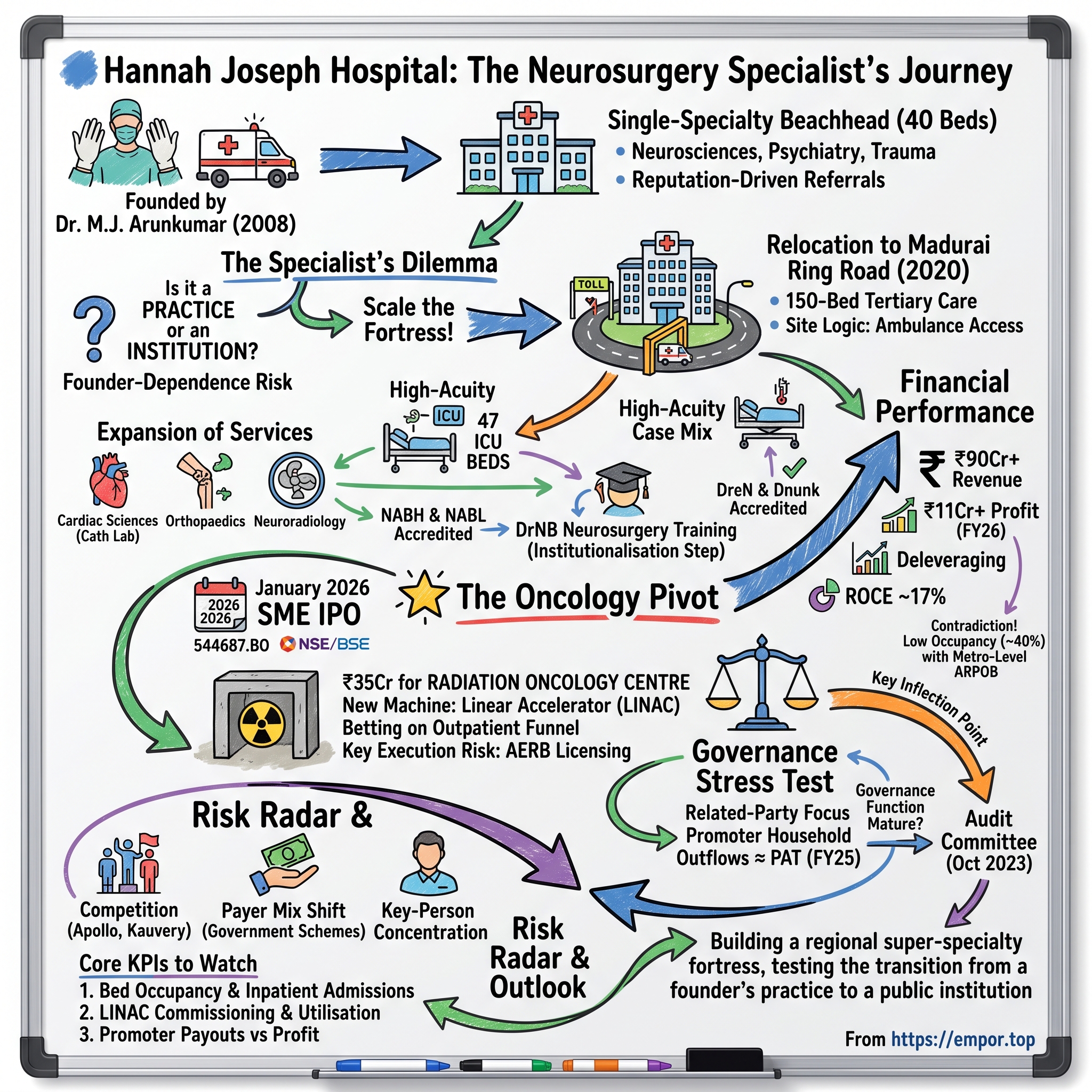
Hannah Joseph Hospital: Building a Regional Super-Specialty Fortress in Tier-2 India
I. Introduction & Episode Roadmap
There is a particular kind of phone call that defines the economics of a neurosurgery hospital. It comes at two in the morning. A motorcycle has gone under a lorry on the Madurai–Tuticorin highway, or a fifty-year-old schoolteacher in Virudhunagar has collapsed mid-sentence with a bleed in her brain. The family has perhaps ninety minutes of useful time. In those ninety minutes, nobody is comparison-shopping. Nobody is checking Google reviews or negotiating a package rate. Someone in the ambulance says a name — a surgeon's name, usually, not a hospital's — and the driver turns the vehicle toward it.
For roughly eighteen years, in the southern districts of Tamil Nadu, that name has often been Dr. M.J. Arunkumar. And in January 2026, the hospital he built around that name did something unusual for a single-campus, single-city, physician-owned Indian hospital: it sold shares to the public. Hannah Joseph Hospital Limited raised ₹42 crore through a fresh issue of 60 lakh equity shares at ₹70 apiece on the BSE SME platform, with bidding running from January 22 to January 27, 2026, and the shares beginning trading on February 2, 2026 under the code 544687.56 The issue was subscribed 1.5 times overall — retail 1.62x, non-institutional 1.72x, and qualified institutions a bare 1.08x.6 That is not the subscription profile of a hot deal. It is the profile of an issue that just barely got done.
What the company is now is a 150-bed tertiary hospital on a two-acre campus on the Madurai ring road, holding NABH accreditation for the hospital and NABL certification for its laboratory, generating ₹92.56 crore of revenue and ₹11.18 crore of net profit in the year ended March 2026.27 It carries a market capitalisation of roughly ₹250 crore, a return on equity around 15%, and a promoter group holding of 71.28% as reported for the March 2026 quarter.2 The board declared a final dividend of ₹2 per share on May 29, 2026, approved by shareholders at the annual general meeting on July 15, 2026 — the first dividend in the company's history as a listed entity.27
The core question this story tests is deceptively simple: what exactly is the asset here? Is Hannah Joseph a hospital — an institution with systems, protocols, a bench of surgeons, and a brand that outlives any individual — or is it a practice, a very well-capitalised container for the surgical hands of one 58-year-old man? The answer determines almost everything about what the equity is worth, because a practice is worth a multiple of near-term cash flow and an institution is worth a multiple of a franchise.
Four threads run through what follows. The first is the specialist's dilemma: whether a hospital built on the clinical reputation of one neurosurgeon can institutionalise itself as it pushes into cardiac sciences, psychiatry, and now oncology. The second is the true unit economics of a Tier-2 super-specialty hospital, which — as the prospectus data shows — turn out to be considerably stranger and more concentrated than the standard "high volume, low cost" story about non-metro Indian healthcare. The third is capital allocation: the entire IPO exists to fund one project, a ₹43.24 crore radiation oncology centre with a ₹34.98 crore call on net proceeds, and the credibility of that project is the credibility of the equity story.1 The fourth is governance, which is where an independent reading of the prospectus gets genuinely uncomfortable.
Because here is the fact that ought to frame everything else. In fiscal 2025, Hannah Joseph Hospital earned ₹7.21 crore of profit after tax. In that same year, it paid its Chairman and Managing Director ₹4.95 crore in remuneration, ₹10.07 lakh in perquisites, and ₹72.15 lakh in professional charges; paid its Whole-time Director ₹59.39 lakh in professional charges; and paid ₹1.59 crore in rent to the Managing Director for properties he owns and the company occupies.1 Add it up and the promoter household drew roughly ₹7.9 crore from a business that reported ₹7.2 crore of net income for shareholders. That is not, by itself, evidence of wrongdoing — a rainmaking neurosurgeon who personally generates a large share of the hospital's high-acuity revenue has a real claim on economics. But it is the single most important number in the file, and any investor who does not have a view on it does not have a view on this company.
The story starts, as these stories usually do, with a man who walked away from a very good job.
 Subscribe on LinkedIn
II. The Tier-2 Healthcare Landscape: Madurai as South Tamil Nadu's Medical Capital
Drive south from Madurai on the Tuticorin road and the medical geography of a hundred kilometres reveals itself in reverse. There are primary health centres. There are nursing homes above pharmacies. There are district headquarters hospitals that can set a fracture and deliver a baby and stabilise a patient. What there is very little of, until you get back to Madurai, is a CT scanner running at 3 a.m. with a neurosurgeon within twenty minutes of it. Madurai is where the ambulances turn around and come back to.
That is the structural fact underneath this entire business, and it is worth being precise about why it exists rather than treating it as a slogan. India's doctor-to-population ratio stood at roughly 1:811 as of April 1, 2025, counting 13.86 lakh registered allopathic doctors alongside 7.52 lakh AYUSH practitioners.1 But an aggregate ratio conceals the thing that actually matters: super-specialists do not distribute themselves evenly. A neurosurgeon requires a decade of post-MBBS training, a functioning neuro-ICU, an interventional suite, an anaesthesia team comfortable with intracranial pressure, and — critically — enough case volume within driving distance to keep skills sharp and income adequate. Those conditions cluster in metros. Which means the supply of complex neurosurgical capability in a district like Theni or Sivagangai is not merely thin; it is often zero.
This produces a referral funnel with unusual physics. In ordinary healthcare, patients choose the nearest adequate provider. In high-acuity neuro and trauma care, the geography inverts: patients travel toward concentration, because concentration is the only place the capability exists. The hospital that assembles a critical mass of neurosurgeons, neuro-intensivists, interventional neuroradiologists, and round-the-clock imaging in a Tier-2 city does not compete with the district hospitals in its catchment — it becomes their escalation path. Referring physicians in peripheral towns are not customers to be won on price; they are a distribution network held together by whether the patients they send back come back alive and functional.
The cost side of Tier-2 operation is genuinely advantageous, though less romantically so than the standard narrative suggests. Land and construction are dramatically cheaper — Hannah Joseph acquired the land for its oncology block for a total capitalised cost of ₹7.72 crore, of which the base consideration for both parcels was ₹6.22 crore.1 Try buying buildable land adjacent to an existing hospital campus in Chennai or Bengaluru for that. Nursing and support wages are lower. Municipal overheads are lower. What is not lower is the cost of the equipment, because a linear accelerator costs the same in Madurai as it does in Manhattan, and it is quoted in dollars.
That asymmetry — cheap land and labour, expensive machines — is the defining constraint of Tier-2 tertiary care, and it dictates strategy. If your fixed capital is dominated by imported equipment priced in hard currency, then your return on capital is determined almost entirely by utilisation, not by cost control. A CT scanner running eight studies a day and a CT scanner running thirty studies a day cost identical amounts to buy. This is why the occupancy and throughput numbers examined later in this story matter far more than any margin comparison against metro chains.
On the revenue side, the payer mix is a three-way split with genuinely different behaviour in each channel. Out-of-pocket cash pays immediately and at full tariff. Private insurers and third-party administrators pay at negotiated rates on a lag. And the state schemes — Tamil Nadu's Chief Minister's Comprehensive Health Insurance Scheme, which covers eligible families up to ₹5 lakh per year and is identified through the Socio-Economic Caste Census database, and the Tamil Nadu New Health Insurance Scheme covering state government employees and a long list of public bodies — pay at fixed, capped tariffs.1 Hannah Joseph is empanelled in both, working through MDIndia Healthcare Services as third-party administrator and, for CMCHIS, alongside United India Insurance.1
The scheme business is a genuine double-edged instrument, and management says so plainly in the risk factors: government schemes are "an important source of new patient registrations and revenue," and if tariffs are revised downward, coverage limits reduced, or payment terms lengthened, revenue and profitability suffer directly.1 Schemes fill beds that would otherwise be empty and, more valuably, introduce a family to the institution. But they cap the price of the procedure while the cost of the implant, the consumable, and the ICU day floats with inflation. Every year a scheme tariff stays flat is a year of silent margin compression.
Why have the national chains not simply rolled into these markets and taken them? They have tried, and the partial answer is instructive. Apollo has been in Madurai for decades. Kauvery has expanded regionally. What corporate chains find difficult is not building the building — it is that in high-acuity specialties, the demand attaches to a person, not a logo. A family choosing where to take a father with a subarachnoid haemorrhage is not buying a brand; they are buying a specific pair of hands, recommended by a specific local doctor they trust. A chain that opens a Madurai unit without a locally revered clinical figurehead has bought a building and a cost structure without buying the referral network. That reality is Hannah Joseph's protection. It is also, precisely inverted, its greatest vulnerability — because a moat made of one person's reputation is a moat with an expiry date attached to a human being.
III. Origins & Founding Story: Dr. M.J. Arunkumar's Blueprint (2008–2011)
In 2000, a neurosurgeon in his early thirties left a consultant post at Christian Medical College, Vellore — arguably the most respected clinical training institution in India — and moved to Madurai to build a neurosurgery department from nothing.
The invitation came from Dr. Prathap C. Reddy, chairman of the Apollo group, and the man who accepted it was Mosesjoseph Arunkumar, who had completed his MBBS in 1985 at CMC Vellore, taken his M.Ch. in neurosurgery in 1998 and his DNB in neurosurgery in 1999, and who credits Professors Mathew J. Chandy and V. Rajshekhar as the mentors who formed him.3 What he did over the following seven years at Apollo Madurai established the clinical foundation everything else rests on: in December 2000 he performed what the hospital records as the region's first endonasal excision of a pituitary tumour, and in 2001 the region's first microsurgical clipping of a brain aneurysm.3
Those two procedures deserve a moment of translation, because they explain the nature of the asset being built. An endonasal pituitary excision means reaching a tumour at the base of the brain by going through the nostril rather than opening the skull — less trauma, faster recovery, but requiring a surgeon comfortable operating through a narrow corridor millimetres from the carotid arteries and optic nerves. Aneurysm clipping means opening the skull to place a tiny titanium clip across the neck of a ballooned, about-to-burst artery, with essentially no margin for error. These are not procedures a hospital acquires by purchasing equipment. They are procedures a region acquires when one person capable of doing them decides to live there. For seven years, the capability existed in southern Tamil Nadu because one man had chosen to relocate.
In April 2008, he left and started his own — a 40-bed facility devoted to neurosurgery, neurology, psychiatry, and trauma, established as a sole proprietorship in Madurai, which became a member of the Nursing Homes and Hospital Board of the Indian Medical Association Tamil Nadu on September 9, 2008.13
The choice of specialty mix at founding was not sentimental; it was an unusually shrewd piece of business design, though it created a dependency that persists to this day. Neurosurgery has three properties that make it exceptional as the foundation of a small hospital. It is emergent, so demand does not need to be marketed into existence. It is high-acuity, meaning each case generates substantial billing across imaging, theatre, ICU, and consumables — a small number of patients can support a large fixed-cost base. And it is trust-dominated to an extreme degree, so a surgeon with a reputation carries his demand with him when he leaves an employer. A cardiologist leaving a corporate hospital loses some patients to the institution's brand. A neurosurgeon known regionally as the person for aneurysms loses far fewer.
Which is exactly what makes the psychiatry component so interesting, and it is not a rounding error in the story. Dr. Fenn Kavitha Fenn Arunkumar — co-promoter, Whole-time Director, and Dr. Arunkumar's wife — took her MBBS from the University of Madras in 1991, a Diploma in Psychological Medicine, and her DNB in psychiatry in 2000, having done her psychiatry postgraduate training at CMC Vellore.14 She has been involved in management since inception and works alongside the human resources function.4 Pairing neurosurgery with psychiatry inside one small hospital is clinically coherent in a way most Indian hospitals never bother with: the aftermath of a severe head injury or a stroke is very often cognitive and psychiatric, and the rehabilitation pathway for neuro-trauma patients runs through exactly the specialty the co-founder practises. It also, incidentally, produces a second revenue stream with completely different economics — long-duration, low-intensity, recurring — sitting inside a hospital otherwise dominated by episodic, capital-intensive surgery.
The corporate structure caught up with the clinical reality slowly. The proprietorship was incorporated as Hannah Joseph Hospital Private Limited on October 24, 2011 by the Registrar of Companies, Tamil Nadu.1 Conversion to a public limited company came much later, with a fresh certificate of incorporation dated July 29, 2022.1 The eleven-year gap between incorporation and the corporatisation push tells you what the priority was during those years, and the compliance record from that era — examined in detail later — confirms it. This was a clinical enterprise that happened to have a company wrapped around it, run by two doctors, and the administrative infrastructure lagged badly behind the medical infrastructure. That lag has consequences that are still being resolved in front of public shareholders.
IV. Scaling the Fortress: 40 to 150 Beds & Specialty Expansion (2011–2023)
The decision that turned a successful practice into a capital-intensive company was made sometime before 2020, and it was a bet on geography.
Recognising demand for more beds and a lack of space, the hospital relocated in 2020 to a two-acre campus on the Madurai–Tuticorin Ring Road at Chinthamani, near the tollgate — a centrally air-conditioned building with central water heating and a combined capacity of 150 beds.18 The move happened in August 2020, in the middle of a pandemic.3
The site logic is worth dwelling on, because it is the least glamorous and most durable competitive decision in this company's history. A ring road is where ambulances travel. Trauma cases arriving from Tirunelveli, Thoothukudi, Virudhunagar, Theni, or Dindigul reach a ring-road campus without crossing Madurai's interior, where a temple city's traffic can consume the difference between recovery and permanent disability. In stroke and head injury, outcomes degrade by the minute. Siting a neuro-trauma hospital on the arterial road is, in effect, buying clinical outcomes with real estate — and better outcomes reinforce the referral network that supplies the cases. It is a slow-compounding advantage that no amount of marketing replicates.
The building itself is a study in what a neuro-dominant hospital actually looks like inside, and the floor plan is more revealing than any strategy statement. Of 150 sanctioned beds, 133 are operational and 17 are non-operational — the latter being outpatient consulting couches, operation theatre beds, and a physiotherapy tilt bed.1 Of the 133 operational beds, 47 sit in intensive care units spread across floors one and two, plus nine emergency beds on the upper ground floor, two operation-theatre recovery beds, and four cath-lab recovery beds.1 Roughly half the operational capacity is critical or peri-procedural care. Only nine beds are general ward. The rest are single rooms, deluxe, and super-deluxe.
That configuration is the physical expression of the business model. This is not a hospital designed to process a high volume of ordinary illness. It is designed to hold a modest number of very sick people for a long time, at a high daily rate, in a private room or an ICU bed. Every operational and financial characteristic that follows descends from that architectural choice.
The clinical scope broadened deliberately. Cardiac sciences arrived with a catheterisation laboratory and cardiac operation theatres, enabling complex coronary angioplasties and open-heart surgery; the neuroradiology department was built to interventional standard.1 The current departmental list runs to neurosciences, cardiac sciences, trauma care, orthopaedics, neuroradiology, psychiatry, general medicine, dental, anaesthesiology, emergency, nutrition and dietetics, and critical care.1 The hospital has publicised technology adoption aggressively — a hybrid neuro cath lab with 3D imaging, intraoperative tumour fluorescence, and, in September 2024, what The Hindu reported as the first adoption in South Asia of BrainLab's AI-enabled Fibertracking Navigation 3.0 system.89
Fibertracking deserves plain-language explanation because it is central to the clinical differentiation claim. The brain's white matter is organised into bundles of fibres — the cables connecting the region that plans speech to the region that produces it, or the motor cortex to the spinal cord. A tumour sitting next to those cables looks, on a conventional scan, like a mass in a homogeneous grey field. Fibertracking uses diffusion imaging to map the cables themselves, so the surgeon can see which bundles run where before cutting. The clinical payoff is not primarily survival; it is function — whether the patient can still speak or move a hand afterwards. In a referral market driven by word of mouth among families and referring physicians, functional outcomes are the currency that compounds.
Accreditation followed the infrastructure. NABL certification came in February 2022 and NABH accreditation in March 2023, and in July 2023 the hospital launched a six-year DrNB neurosurgery training programme.13 The teaching programme is more strategically significant than it appears. A hospital that trains neurosurgeons has a mechanism for recruiting them, a reason for senior consultants to stay, and — over a horizon of years — a partial answer to the founder-dependence problem. It is the single most credible institutionalisation step in the file, and it is early.
Recognition accumulated in parallel: Outlook India ranked the hospital among the top three neurosurgery hospitals in India in June 2025; the Confederation of Indian Industry gave it a healthcare excellence award in neurology in the 100-bed hospital category during MedClave 2025; and the AHPI Tamil Nadu chapter recognised it on November 8, 2025.19 Investors should read these carefully rather than dismissively. Media rankings in Indian healthcare are of uneven rigour and frequently commercially entangled. What they reliably demonstrate is not clinical superiority but marketing intensity — and it is notable that business promotion expenses rose from ₹29.52 lakh in FY23 to ₹1.24 crore in FY25, more than quadrupling.1 That is a hospital actively building brand equity beyond its founder's name, which is either sound institutional investment or an expensive substitute for it.
V. Financial Deep Dive: The Mechanics of a ₹90 Cr+ Revenue Engine
Here is where the story diverges sharply from the standard narrative about this company, and it does so because the prospectus discloses operating data that most retail commentary never opened.
Start with the headline trajectory. Revenue from operations was ₹54.62 crore in FY23, ₹63.41 crore in FY24, and ₹77.53 crore in FY25 — but that FY23 figure represented a decline of 5.98% over the prior year, followed by growth of 16.08% and 22.27%.1 Profit after tax moved from ₹1.01 crore to ₹4.07 crore to ₹7.21 crore across those three years.1 In the first half of FY26, revenue was ₹42.55 crore with PAT of ₹5.12 crore.1 For the full year ended March 2026, revenue reached ₹92.56 crore, up 18.82%, with profit of ₹11.18 crore, up 55.08%, and earnings per share of ₹4.93.27
A tenfold increase in profit over three years on a 70% increase in revenue looks like textbook operating leverage. It mostly is not, and the distinction matters enormously for forecasting.
EBITDA margin actually fell over the period — 29.99% in FY23, 28.35% in FY24, and 26.47% in FY25, recovering to 27.38% in the September 2025 half.1 In absolute terms EBITDA rose from ₹16.38 crore to ₹20.52 crore, an improvement of ₹4.14 crore. But profit before tax rose from ₹1.02 crore to ₹10.35 crore — an improvement of ₹9.33 crore. The gap is explained almost entirely below the EBITDA line: finance costs fell from ₹6.43 crore to ₹3.47 crore, and depreciation fell from ₹9.35 crore to ₹7.24 crore.1 Those two lines contributed ₹5.07 crore of the ₹9.33 crore improvement — more than half.
What that means in plain terms: the profit explosion is substantially the arithmetic of a 2020 building coming off its steepest depreciation curve while the debt taken to build it gets repaid. Total borrowings declined from ₹42.95 crore in FY23 to ₹31.64 crore by September 2025, and to roughly ₹27 crore by March 2026.12 That is real deleveraging and genuinely creditable capital discipline. But it is a one-time normalisation, not a repeatable engine. Once interest and depreciation have finished falling, incremental profit has to come from operations — and operationally, margins have been drifting down, not up. Any model that extrapolates recent profit growth needs to explain where the next ₹5 crore comes from, and the honest answer is that it has to come from the oncology block or from higher throughput, not from the balance sheet.
Now the operating data, which is the most revealing disclosure in the entire prospectus and the part that flatly contradicts the conventional description of this business.
Bed occupancy stood at 34.63% in March 2023, 37.21% in March 2024, 42.49% in March 2025, and 38.14% as of September 30, 2025.1 Management states this directly: "Although the occupancy rate has improved over time, we are still underutilizing the existing capacity."1 This is not a hospital running at 65–75% occupancy. It is a hospital running at roughly four beds in ten, in a business where the beds are the fixed cost.
Average revenue per occupied bed was ₹21,927 in FY23, ₹24,100 in FY24, ₹25,255 in FY25, and ₹30,118 in the September 2025 half.1 Those are not Tier-2 discount rates. They are firmly in the range one would associate with a mid-tier metro hospital, and the trajectory is steeply upward.
And now the number that reframes everything. Inpatient admissions were 1,329 in FY23, 1,372 in FY24, and 1,413 in FY25.1 Over two years in which inpatient revenue grew 41%, from ₹36.86 crore to ₹52.09 crore, the number of patients admitted grew by 6.3%.1
Where did the growth come from? Total patient days rose from 16,812 to 20,627, a 22.7% increase, because average length of stay lengthened from 12 days to 15 days.1 The remaining 15% came from the rise in revenue per bed-day. Decompose it cleanly: roughly 6% more patients, each staying about 25% longer, each billing about 15% more per day.
This is the crux of the investment case, and it cuts both ways. The benign interpretation is that the case mix has genuinely intensified — that the hospital is taking on harder cases requiring longer ICU stays and more complex intervention, which is precisely what a maturing tertiary neuro centre should look like, and which is corroborated by an ICU-heavy floor plan and a 15-day average stay that is roughly three times the Indian tertiary norm. The uncomfortable interpretation is that a business whose patient count is essentially flat is not gaining share, is not deepening its funnel, and is growing by charging more for longer stays — a mechanism with a natural ceiling, and one that becomes harder to sustain as the scheme-funded share of patients rises. Both readings fit the data. Only future disclosure resolves it, which is why occupancy and admission counts, not revenue, are the metrics that matter here.
The revenue mix adds one more layer. Of FY25 revenue, ₹57.36 crore came from healthcare services, ₹19.66 crore from pharmacy, and ₹0.52 crore from food sales.1 Pharmacy is a quarter of the top line — a captive, high-turnover, low-margin business selling to the hospital's own inpatients. Within healthcare services, inpatient billing contributed 67.19% of total operating revenue in FY25 and 65.72% in the September 2025 half.1 Outpatient revenue, at ₹5.26 crore in FY25 against 7,487 outpatient visits, is almost trivially small.1 There is no meaningful outpatient funnel feeding the inpatient business — a structural weakness for a hospital hoping to launch oncology, which is an overwhelmingly outpatient-led service line.
On costs, the structure is unusual and worth decoding. Employee benefit expenses were only ₹9.12 crore in FY25, under 12% of revenue — implausibly low for a hospital until you find the doctors elsewhere.1 Consulting charges to doctors ran ₹11.78 crore, and remuneration to the Managing Director ₹4.95 crore, both booked under other expenses.1 Combined clinical compensation therefore approximates ₹25.85 crore, or about a third of revenue — entirely normal for a specialty hospital, but structured through consultancy arrangements rather than employment. As of November 30, 2025 the hospital engaged 64 professional consultants, of whom 24 were full-time doctors, 15 duty medical officers, and 25 visiting doctors, supported by around 300 nursing and administrative staff, with 274 employees registered under EPF and 231 under ESIC.1
Working capital has improved markedly, which is a genuine positive and one of the more reassuring signals in the file. Debtor days compressed from 46 in FY24 to 25 in FY25 to 16 in FY26.2 For a hospital carrying government-scheme exposure, where claim cycles are notoriously slow, that is strong collections discipline. It comes with a caveat: bad debts of ₹1.32 crore were written off in FY25, roughly 1.7% of revenue.1 Fast collections partly reflect writing off what will not be collected. Operating cash flow of ₹19 crore in FY25 and ₹21 crore in FY26 against ₹7.21 crore and ₹11.18 crore of reported profit confirms that the cash is nonetheless real — depreciation-heavy businesses convert well, and this one does.2
VI. Capital Allocation & The January 2026 SME IPO: The Oncology Pivot
Every IPO is an argument. The argument Hannah Joseph made to investors in January 2026 was unusually narrow and, to its credit, unusually specific: give us ₹42 crore, and we will build one thing.
The structure was a pure fresh issue — 60,00,000 shares of ₹10 face value at a band of ₹67 to ₹70, no offer for sale, meaning no promoter sold a single share.56 Capital Square Advisors was book-running lead manager, Bigshare Services the registrar, with 5% of the issue reserved for the market maker.610 The lot size of 4,000 shares meant a minimum retail application of ₹2.80 lakh — a deliberate gate that restricts the register to investors able to write large cheques and, incidentally, guarantees thin secondary liquidity.12 Of ₹42 crore raised, ₹34.98 crore was earmarked for capital expenditure on a radiation oncology centre and the balance for general corporate purposes.511
The reception was tepid and honest about it. Overall subscription of 1.5x with institutional demand at 1.08x is the market saying "adequately priced, not compelling."6 The register as of March 2026 showed promoters at 71.28%, public at 19.11%, domestic institutions at 9.05% and foreign institutions at 0.56%, spread across just 376 shareholders — pre-issue promoter holding had been 93.57%.212 Over the following twelve months the shares traded between ₹55.99 and ₹128.80, and stood at ₹111.20 on July 27, 2026, implying a market capitalisation of about ₹250 crore, a trailing P/E of roughly 22 and a price-to-book of about 2.6.7 Investors who bought at ₹70 and held through the low were, at one point, sitting on a 20% loss against the issue price. That is the SME market functioning normally, and it is a reasonable proxy for the volatility this listing carries.
The project itself is documented with a level of granularity that deserves credit and invites scrutiny in equal measure. Total estimated cost is ₹43.24 crore, comprising ₹7.72 crore of land already acquired and paid for from internal accruals, ₹13.73 crore of construction and civil work, and ₹21.79 crore of medical equipment.1 Of that, ₹34.98 crore comes from net issue proceeds and ₹8.26 crore from internal accruals.1 The land was bought under binding sale agreements dated January 6 and January 9, 2025 for two parcels adjacent to the existing campus at Chinthamani village, Madurai South Taluk.1
The centrepiece is one machine: an Elekta Infinity digital linear accelerator with triple photon energies of 6MV, 10MV and 15MV and five electron energies, with Agility multi-leaf collimator, VMAT capability, the Monaco treatment planning system and Mosaiq oncology information system, quoted at USD 1,725,000 by Elekta Solutions AB of Stockholm.1 The prospectus is candid that as of filing, no order had been placed and no payment made, and that the rupee cost estimate had already been revised from an assumed ₹88 per dollar to ₹90.7 per dollar.1 Deployment was scheduled at ₹5 crore in FY26 and ₹29.98 crore in FY27.1
For readers unfamiliar with the technology, a linear accelerator is a machine that accelerates electrons to near light speed and slams them into a metal target, producing a high-energy X-ray beam that is then shaped and aimed at a tumour from multiple angles. The techniques the machine enables — IMRT, VMAT, IGRT, stereotactic radiosurgery and stereotactic body radiotherapy — are essentially different ways of sculpting the radiation dose to the tumour's three-dimensional shape while sparing the tissue around it.1 Because the beam is generated by electricity rather than a radioactive source, the machine must live inside a "bunker": walls of concrete metres thick, built to a specific design, because the beam's stray radiation must not escape.
This is where the honest risk in this project lies, and it is not the risk most commentary identifies. The prospectus lists four approvals applied-for-but-not-received or not-yet-applied: hospital approval under section 17(2)(ii)(b) of the Income Tax Act, applied September 9, 2024; the municipal building sanction from Madurai Corporation, requiring provisional NOCs from the fire service and the pollution control board plus final building plan approval and a soil testing report; the fire brigade licence; and — critically — the licence for LINAC and Gamma Knife from the Atomic Energy Regulatory Board along with the licence for storage, use and disposal of radioactive materials.1 The AERB licence had not been applied for as of the prospectus date.
That sequencing creates a specific execution risk with a specific shape. Bunker design must be approved before construction; the machine cannot be commissioned until AERB clears the installation; and every month between the ₹21.79 crore equipment payment and the first billable fraction is a month of depreciation and financing cost with zero revenue. Radiation oncology projects in India routinely slip by six to eighteen months against plan, most often on civil works and regulatory clearance rather than equipment supply. Investors should treat the FY27 deployment schedule as an aspiration to be verified, not a commitment to be assumed.
Is the project strategically sound? The clinical logic is real and specific. Radiation oncology sits directly adjacent to the hospital's existing strength: brain tumours and spinal cord tumours are among the most common indications for stereotactic radiosurgery, and management frames the centre as serving exactly those patients while attracting cancer patients from other specialties requiring radiation and chemotherapy.1 A neurosurgeon who currently operates on a glioma and then refers the patient elsewhere for six weeks of daily radiation is watching a substantial revenue stream walk out of the building — and, more importantly, losing continuity of care. Capturing it is coherent.
The economic case is more demanding than the enthusiasm suggests. A linear accelerator is close to a pure fixed-cost asset: the marginal cost of one additional treatment fraction is very small, so gross margins are high once volume arrives, and catastrophic when it does not. Typical machines can deliver perhaps 30 to 50 fractions per day at full utilisation; a typical course runs 20 to 30 fractions over several weeks. The break-even point is a function of daily throughput, and throughput requires a referral base of newly diagnosed cancer patients that Hannah Joseph does not currently possess. Its oncology practice today is essentially an extension of neurosurgery. Building a comprehensive cancer programme means recruiting medical oncologists, radiation oncologists, and medical physicists, establishing a tumour board, and competing for cancer referrals against Madurai institutions with existing oncology services and far larger outpatient funnels.
Which brings the analysis back to the outpatient weakness identified earlier. A hospital with 7,487 outpatient visits a year and ₹5.26 crore of outpatient revenue is attempting to enter a service line where the patient arrives ambulatory, returns daily for weeks, and is recruited through screening, diagnostics and oncology consultation — the exact funnel this hospital has never built. The oncology bet is not a capacity expansion of an existing business. It is a new business, in a new specialty, requiring a new referral network, funded by roughly 40% of the company's pre-IPO net worth. That is not a reason to dismiss it. It is a reason to hold management to specific, dated, verifiable milestones — and to treat the first year of the centre's operation as the real test of whether this management team can allocate capital outside the specialty it knows.
VII. Competitive Landscape & Industry Benchmarking
To understand Hannah Joseph's competitive position, picture the Madurai medical market as four fundamentally different animals occupying the same watering hole.
The largest is Meenakshi Mission Hospital and Research Centre, a trust hospital with over a thousand beds and decades of community penetration across southern Tamil Nadu. Trust hospitals are the most underestimated competitor in Indian healthcare because their objective function is different: they do not need to earn a return on capital, they enjoy tax advantages, and they can price close to cost on high-volume procedures. In any procedure where the clinical outcome is broadly comparable across providers — a routine appendectomy, a standard hernia repair, a straightforward delivery — a trust hospital wins on price and a private hospital cannot profitably follow. Its weakness is the mirror image: institutions that large and that consensus-driven adopt new technology slowly and are correspondingly harder to differentiate on the frontier.
Apollo Hospitals Madurai is the metro chain's regional outpost, carrying national brand recognition, multi-specialty depth, and a referral network reaching into Chennai and beyond. It also carries corporate overhead and a cost structure calibrated to metro pricing. There is a personal dimension here that no comparative table captures: the neurosurgery department at Apollo Madurai was built by the man who now runs the hospital across town.3 Whatever that department is today, it began as his.
Kauvery Hospital represents the most direct strategic threat — a regional multi-specialty chain expanding through acquisition and brownfield addition, with the capital to buy capability and the multi-location scale to spread procurement, back office, and clinical talent costs. Velammal Medical College Hospital brings the teaching-hospital model: large bed capacity, resident labour, and low-cost volume care.
Against these, Hannah Joseph is small. Its entire operational capacity is 133 beds, against Meenakshi Mission's thousand-plus. Its edge is not scale but concentration — it does a narrow set of very difficult things, and it does them with a clinical figurehead whose regional standing has been repeatedly externally validated.19
The prospectus itself chose an unusual peer set, and the comparison is more instructive than flattering. Management benchmarked against Asarfi Hospital Limited and Maitreya Medicare Limited, both small listed Indian hospitals.1 On FY25 numbers: Asarfi generated ₹120.57 crore of revenue with 42.85% growth, a 19.78% EBITDA margin and 14.46% return on average equity; Maitreya generated ₹44.41 crore with revenue declining 4.55%, a 19.09% EBITDA margin and 7.50% ROAE; Hannah Joseph generated ₹77.53 crore with 22.27% growth, a 26.47% EBITDA margin and 14.77% ROAE.1
Read that carefully, because it contains the strongest genuine evidence in the file for the quality thesis. Hannah Joseph's EBITDA margin exceeded both peers by roughly seven percentage points, and its ROCE of 17.03% beat Asarfi's 16.31% and Maitreya's 14.32%.1 A hospital running at 42% occupancy that still earns a 26% EBITDA margin is telling you something real about case-mix economics: high-acuity neuro work generates enough revenue per occupied bed to cover a substantially underutilised asset base. That is a genuine structural advantage of the super-specialty model, and it is measurable rather than rhetorical.
But the same comparison contains the warning. Asarfi grew revenue 42.85% while Hannah Joseph grew 22.27%.1 A competitor with lower margins growing at twice the rate is, in a fragmented market, taking share. The margin advantage is real; the growth position is mid-pack.
Where does Hannah Joseph reliably win? In emergency neurosurgery and acute head injury, where the decision is made in minutes on the strength of a name, and in complex elective neuro cases where families travel to a specific surgeon. Where does it structurally lose? In price-sensitive, high-volume general surgery, where the trust hospital's cost base is unbeatable. In multi-organ transplantation and the most capital-intensive tertiary services, where scale is prerequisite. In medical tourism and out-of-region referral, where the metro chains own the distribution channels. And — the newest exposure — in oncology, where it will be the challenger rather than the incumbent for the first time in its history.
The most credible medium-term competitive risk is not a rival opening in Madurai. It is a rival opening closer to the patient. If Kauvery or another chain establishes credible neuro and trauma capability in Tirunelveli or Thoothukudi, it intercepts the referral before it ever reaches the ring road. Hannah Joseph's catchment advantage is built on the absence of alternatives between the districts and Madurai. That absence is a market condition, not a moat, and market conditions get arbitraged.
VIII. Strategic Frameworks: Hamilton Helmer's 7 Powers & Porter's Five Forces
Frameworks are useful precisely because they force uncomfortable answers. Applied honestly here, they produce a portrait of a business with one genuinely strong power, several moderate ones, and a structural vulnerability that the strong power itself creates.
Cornered Resource — strong, and dangerously so. Helmer's cornered resource is preferential access to a coveted asset on attractive terms. Dr. Arunkumar is that asset: elected President of the Tamil Nadu Association of Neurological Surgeons for 2019–20, featured in India Today's "Eminent Doctors South 2024" and Outlook's "Best Doctors South 2025," recipient of the Dr. A.P.J. Abdul Kalam Inspiration award in 2023.1 Twenty-five years of practice in a region where the alternative supply of comparable capability is thin constitutes a genuine cornered resource. But note the terms on which the company accesses it: ₹4.95 crore of remuneration, ₹72.15 lakh of professional charges, and ₹10.07 lakh of perquisites in FY25 alone.1 The resource is cornered — but the company does not access it cheaply, and it does not own it. It rents it, annually, from a shareholder who could stop renting.
Branding — moderate, and improving faster than the founder's tenure is shortening. "Hannah Joseph" carries real local equity as the destination for brain and spine emergencies, reinforced by heavy award publicity and business promotion spending that more than quadrupled between FY23 and FY25.1 The strategic question is whether the brand is accumulating independently of the founder or merely amplifying him. Every award publicised in the company's own materials names the surgeon at least as often as the hospital.9 That is a brand still fused to a person.
Scale Economies — weak. A single 133-bed campus generates local operating leverage in nursing rosters and equipment utilisation, but at 42% occupancy the company is not even harvesting the scale it has, and it lacks multi-hospital procurement leverage entirely. Concentration among suppliers is notable: the top ten suppliers accounted for 71.55% of medicine and surgical purchases in FY25.1 That is a small buyer, not a scaled one.
Switching Costs — low for most of the business. Emergency and elective surgery are episodic transactions; the patient does not have an ongoing relationship to abandon. The exceptions are meaningful but small: chronic psychiatric patients under long-term management, and oncology patients mid-protocol, who cannot practically switch providers partway through a radiation course. The oncology build therefore adds switching costs the existing business largely lacks — a genuinely underappreciated strategic argument for the project.
Counter-Positioning — absent. There is no business model here that incumbents cannot copy. A physician-founded super-specialty hospital in a Tier-2 city is a well-established Indian template, replicable by anyone who recruits the right surgeon.
Network Effects — weak. The referring-physician network has mild two-sided characteristics: good outcomes bring more referrals, more referrals build volume and skill, better skill produces better outcomes. But the loop is slow, geographically bounded, and mediated through individual relationships rather than a platform. Calling it a network effect overstates what is really reputation compounding.
Process Power — moderate and partially demonstrated. The organisational capability to run a door-to-imaging-to-theatre pathway at neuro-trauma speed, staff a 47-bed ICU complex, and hold NABH and NABL accreditation is real and not trivially replicable.1 The DrNB training programme is the mechanism by which process knowledge could become institutional rather than personal. It is the most important thing the company is doing that is not the oncology block, and it receives a fraction of the attention.
On Porter's five forces, the picture is mixed rather than uniformly favourable.
Threat of new entrants — genuinely low. Building comparable capability requires substantial capital and, harder, a super-specialist willing to relocate permanently to a Tier-2 city. The scarcity is human, not financial, and human scarcity is slower to arbitrage.
Supplier power — moderate to high, and rising with the oncology pivot. The linear accelerator quotation is denominated in dollars from a single Swedish manufacturer, and the rupee cost had already risen before the order was placed.1 Once installed, the hospital is locked into that vendor for service contracts, software licences and parts for a decade or more. Concentrated medical-supply purchasing compounds the point.
Buyer power — moderate and structurally increasing. Individual patients in an emergency have essentially no bargaining power, which is the source of the pricing environment that produced a ₹30,118 ARPOB. But state schemes set tariffs unilaterally, and the more the hospital leans on CMCHIS and TNNHIS to fill its empty 58% of beds, the more of its revenue is priced by a payer that does not negotiate.1 Occupancy growth and pricing power are, in this model, partially in conflict.
Threat of substitutes — low. There is no alternative to craniotomy for an expanding haematoma. Radiation therapy has partial substitutes in surgery and systemic therapy, but for most indications the modalities are complements.
Competitive rivalry — high. Four capable institutions compete in one mid-sized city for the same scarce clinical talent and the same insured patients, and at least one is growing considerably faster.1
The synthesis is uncomfortable but clear. The strongest power in this business is a person, the weakest structural characteristic is scale, and the strategic pivot is into a service line where the company holds none of its existing powers. Whether that pivot works is largely a management question — which is where the analysis turns next, and where the file gets harder.
IX. Management Credibility, Governance & Skeptical Investor Stress Test
An SME-listed company has no earnings calls, no analyst Q&A, no investor day. The only place management's behaviour over time is documented in detail is the prospectus. Fortunately, prospectuses are legally obliged to be thorough about the things companies would prefer not to discuss — and this one is.
Start with the alignment case, which is real. The IPO was entirely a fresh issue with no offer for sale, meaning promoters diluted from 93.57% but took nothing off the table.12 They subsequently held 71.28% as of March 2026, retaining overwhelming economic exposure.2 Debt was reduced steadily. The daughter of the promoters, Arunkumar Nalina, aged 29, holds an MBBS from CMC Vellore and was admitted to CMC's six-year neurosurgery programme — a succession signal that is credible precisely because it cannot be faked, since one does not obtain a neurosurgery training place at CMC through nepotism.1 And the company began paying dividends in its first year as a listed entity.2 Those are not the actions of promoters extracting and exiting.
Now the stress test.
The remuneration question is the central governance issue and deserves no euphemism. Managerial remuneration paid to Mosesjoseph Arunkumar was ₹3.60 crore in FY23, ₹3.48 crore in FY24, and ₹4.95 crore in FY25, with a further ₹2.50 crore in the six months to September 2025.1 In FY25 that single line equalled 69% of the company's net profit. Add professional and consultancy fees of ₹1.32 crore across both promoter-directors, rent of ₹1.59 crore, perquisites, and ₹18.14 lakh of salary to the Chief Financial Officer, Daniel Dayanand Fenn, disclosed as a relative of the promoter-directors, and related-party outflows in FY25 approach ₹7.9 crore against ₹7.21 crore of PAT.1 The prospectus further discloses that ₹21.75 lakh of excess perquisites paid to the Managing Director in FY24, above the limits prescribed under Section 197 and Schedule V of the Companies Act, were refunded by him on December 2, 2024.1
There is a defensible reading. A neurosurgeon who personally performs a large share of the hospital's highest-value procedures is generating revenue, not merely governing. If he were a non-owner consultant, he would be paid substantial professional fees regardless. The economics of a physician-founded hospital genuinely blur the line between compensation for labour and extraction of profit.
There is also a reading a skeptical investor is entitled to hold. Minority shareholders bought into a business whose reported profit is what remains after the controlling family's compensation is set by a board the controlling family dominates. If remuneration rises in step with profit, minorities capture a fixed slice of growth rather than the incremental economics. The relevant test is behavioural and observable: from FY26 onward, does managerial remuneration grow slower than profit? That is the single cleanest read on whether this management treats public shareholders as partners.
The compliance record from the pre-listing years is poor, and the company says so. The prospectus discloses a series of Companies Act non-compliances for which suo moto compounding applications were filed with the Regional Director, Southern Region, Chennai on March 22, 2025: failure to maintain cost records from fiscal 2022 to 2024; failure to file DIR-12 for the appointment of both promoters as Managing Director and Whole-time Director in fiscal 2016; failure to reappoint them on expiry of their five-year terms under Section 196(2); failure to appoint the required number of independent directors under Section 149(4) following conversion to a limited company, with consequent failure to constitute the audit and nomination-and-remuneration committees until October 10, 2023; and delayed appointment of a Chief Financial Officer and Company Secretary under Section 203.1 Separately, deposits were raised in fiscal 2019, 2020, 2022 and 2023 in violation of Section 73, with a compounding application filed October 31, 2025.1 The Regional Director levied a compounding fee of ₹2.50 lakh on the company and ₹40,000 each on both promoters by order dated November 11, 2025, disposing of the cost-records matter on November 20, 2025; the remainder were pending as of the prospectus date.1
The company characterises these as procedural, arising from "the absence of professional guidance," and supported that characterisation with a practising company secretary's opinion dated November 17, 2025.1 That is probably accurate — these are the failings of doctors running a company without adequate corporate infrastructure, not of financial engineering. But the pattern spans a decade and touches the most basic architecture of corporate governance: independent directors, audit committee, CFO, company secretary. An investor buying a company that only constituted an audit committee in October 2023 is buying a governance function that is under three years old.
There is an unresolved tax overhang. A survey under Section 133A of the Income Tax Act was conducted at the hospital on February 20, 2020. The subsequent scrutiny assessment for AY 2020-21 disallowed ₹3.23 lakh claimed as referral fees paid to doctors, on the ground that Indian Medical Council regulations prohibit doctors from receiving such fees; a demand of ₹1,21,510 was paid on October 14, 2022 and a penalty of ₹44,928 on November 28, 2023.1 The amounts are immaterial. What is not immaterial is the disclosure that the Principal Commissioner of Income Tax, Central-2, Chennai approved further retention of books and documents seized during the survey until October 31, 2026, with the prospectus acknowledging "potential for the case to be reopened."1 That is a live overhang extending past the date of this writing. Separately, the company received letters regarding delayed responses on Statement of Specified Financial Transactions filings for AY 2021-22 and AY 2022-23, exposing it to potential penalties under Section 271FA.1
The referral-fee item is small in rupees and large in signal. Referral incentives are a well-known grey practice in Indian private healthcare and are prohibited by medical council regulation. The prospectus's own description of marketing strategy lists a "Referral Network" and "Incentive Programs" among its patient-referral activities.1 An investor should want to understand precisely what those incentives are and how they are accounted for.
Related-party property is a persistent structural feature. The pharmacy premises — 1,514 square feet of medicine godown and sales area on the hospital campus — are leased from Mosesjoseph Arunkumar at ₹82,500 per month with a 10% increase every two years, under an agreement dated December 1, 2025 for an eleven-month term. The registered office and nursing staff hostel at 134 Lake View Road, K.K. Nagar — 7,102 square feet across three floors — are leased from both promoters at ₹2.75 lakh per month on the same escalation, under an agreement dated October 20, 2025, also for eleven months.1 Eleven-month terms are standard Indian practice for avoiding registration requirements, but they mean the company's registered office, its nursing accommodation, and its pharmacy — a business generating ₹19.66 crore of annual revenue — sit on premises the controlling family can decline to renew.1 Management names this as a risk factor itself.1
Litigation is genuinely light, which deserves noting in a sector where it often is not: no criminal, tax, statutory or regulatory proceedings against the company, directors, promoters or key management, and no proceedings by or against promoters or directors. The only outstanding matters are ten civil suits filed by the company involving ₹16,10,122 in aggregate — almost certainly recovery actions against defaulting patients.1 There were no contingent liabilities as of September 30, 2025 or the three preceding year-ends.1 For a hospital, the absence of medical negligence litigation is a meaningful data point.
Finally, the SME platform itself is a governance and liquidity fact, not merely a listing venue. With 376 shareholders, no research coverage, a ₹2.80 lakh minimum lot at IPO and a 52-week range spanning ₹55.99 to ₹128.80, price discovery is thin and volatile.2712 The company updated its corporate identification number from U74999TN2011PLC082860 to L74999TN2011PLC082860 to reflect listed status, communicated to BSE on March 11, 2026 — the administrative marker of a transition that is, in every substantive sense, still underway.13
X. The Investment Spine: Bull vs. Bear Case & Risk Radar
Strip away the narrative and the debate reduces to a single disagreement about what the empty beds mean.
The bull case begins with the occupancy gap, and it is the strongest argument available. A hospital operating at 42.49% occupancy has already paid for the building, the theatres, the imaging, and the 47 ICU beds.1 The incremental cost of admitting one more patient into an existing bed is consumables, drugs, and marginal nursing — a fraction of the revenue that patient generates. If occupancy moves from roughly 42% toward 60%, the incremental revenue flows through at contribution margins far above the reported 26–27% EBITDA margin. That is not speculation; it is the arithmetic of a fixed-cost business with 58% of its capacity idle, and it is the single largest identifiable source of value in this equity.
The second pillar is the oncology optionality. If the linear accelerator is commissioned on schedule and reaches meaningful daily throughput, it adds a service line with high incremental margins, genuine switching costs, and a natural clinical bridge from the existing neurosurgery franchise.1 It would also, for the first time, give the hospital a reason for patients to visit repeatedly over weeks rather than episodically over years — the beginning of an outpatient funnel it currently lacks.
The third is that the operating evidence is better than most SME healthcare listings. Margins exceed both listed peers named in the company's own comparison; ROCE of 17.03% beats both; debtor days have compressed from 46 to 16 in two years; operating cash flow exceeds reported profit; borrowings have fallen from ₹42.95 crore to roughly ₹27 crore; and the company began paying dividends immediately upon listing.12 These are not the financial characteristics of a company that listed to bail out its promoters.
The fourth is durability of demand. Neuro-trauma and stroke volumes in a region of this size do not depend on the economic cycle, on discretionary spending, or on technology adoption. They depend on roads, demographics, and hypertension — all of which trend in one direction.
The bear case begins with the same occupancy number, read differently. Occupancy did not rise steadily; it improved to 42.49% in FY25 and then fell back to 38.14% by September 2025.1 Admissions grew 6.3% over two years while revenue grew 41%.1 A hospital whose patient count is roughly flat is not a hospital gaining share — it is a hospital extracting more from a stable base through longer stays and higher daily rates. That mechanism has a ceiling, and it is the sort of ceiling that becomes visible abruptly rather than gradually.
Second, the profit growth that attracted investors was substantially a balance-sheet effect. With more than half of the FY23-to-FY25 pre-tax improvement coming from falling interest and depreciation rather than operating gains, and EBITDA margin having declined over the same window, the underlying operating trend is considerably less impressive than the PAT trend.1 Once deleveraging is complete, that tailwind stops — and the oncology capex will reintroduce depreciation and, quite possibly, interest.
Third, key-person concentration is not a theoretical risk. The founder is 58.1 Revenue is concentrated in neurosciences, interventional neuroradiology, trauma and radiology, which management identifies as a specific risk factor.1 The hospital does not disclose the share of surgical volume performed by non-promoter surgeons, which is precisely the disclosure that would resolve the question. Any reduction in the founder's operating schedule — for health, age, or the demands of being a listed-company chairman — flows straight into the highest-margin revenue line.
Fourth, the oncology project carries stacked execution risk: an AERB licence not yet applied for at the time of filing, a municipal building sanction still pending, a dollar-denominated equipment order not yet placed with the rupee cost already revised upward, and a deployment schedule concentrated in FY27.1 Each delay converts a growth asset into a depreciation and interest drag on a company earning ₹11 crore a year.
Fifth, the governance and remuneration structure means minority shareholders are exposed to allocation decisions made by a family that consumed roughly as much cash from the business in FY25 as it earned for shareholders.1
The risk radar, restricted to what is material to this specific business:
Regulatory and commissioning risk is the highest-probability, highest-timeline-impact item. AERB licensing and municipal sanction sit on the critical path of the company's only major capital project.
Clinician concentration risk is the highest-severity item. It is not hedgeable by the company in the short run, only mitigated over years through the DrNB programme and senior recruitment.
Payer-mix and tariff risk is the most insidious. Filling empty beds means leaning on schemes that set prices; margin compression from that route arrives quietly and shows up as a falling EBITDA margin on rising revenue — exactly the pattern already visible between FY23 and FY25.
Working capital and receivables risk has been well managed, evidenced by 16 debtor days, but ₹1.32 crore of bad debts in FY25 indicates the collections improvement carries a write-off cost.12
Currency and import risk is specific and quantified: the linear accelerator is priced at USD 1,725,000 with the rupee assumption already moved from ₹88 to ₹90.7 per dollar before ordering.1
Tax reopening risk remains live, with seized documents retained until October 31, 2026.1
Liquidity and platform risk is structural to SME listing and does not resolve until a mainboard migration, for which no timeline has been disclosed.
What would falsify the bull case? Occupancy failing to break decisively above the mid-40s over the next two years; admissions remaining flat while average length of stay lengthens further; the oncology centre slipping past FY27; or managerial remuneration continuing to grow in line with profit. What would falsify the bear case? Rising admission counts alongside rising ARPOB; the linear accelerator commissioned and ramping on schedule; a visible bench of senior neurosurgeons and oncologists recruited and retained; and remuneration growth decoupling from profit growth. Each of these is observable in the annual report. Neither case requires faith.
XI. Key Business & Investing Playbook Lessons
The generalisable lessons here are more interesting than the specific stock, and they apply well beyond one hospital in Madurai.
The beachhead has to be defensible before it is broadened. Dr. Arunkumar did not open a general hospital and add neurosurgery. He opened a neurosurgery hospital and added everything else, over twelve years, in an order dictated by clinical adjacency: trauma, then psychiatry, then cardiac, then orthopaedics, now oncology. The sequence matters because each addition borrowed credibility from the core rather than diluting it. The counter-example is everywhere in Indian healthcare: the multi-specialty hospital that is second-best at eleven things and first at none, competing entirely on price and location.
Fixed-cost businesses are utilisation businesses, and everything else is commentary. A 133-bed hospital at 42% occupancy earning a 26% EBITDA margin has enormous latent operating leverage — and enormous latent disappointment if the beds never fill. When analysing any asset-heavy business, the first question is not margin or growth; it is what fraction of installed capacity is working, and what specifically has to change for that fraction to rise.
Decompose growth before believing it. Revenue growing 41% while patients grew 6% is a completely different business than revenue growing 41% on 40% more patients, even though the income statement looks identical. Volume, price, and duration are three different stories with three different durabilities. Any company that reports only revenue growth is, deliberately or not, hiding which one it has.
Below-the-line improvement is not operating leverage. Falling depreciation on an ageing asset and falling interest on a repaid loan can double reported profit without a single operational improvement. Both are finite, both are predictable, and both should be modelled separately from margin.
In physician-led enterprises, the hardest problem is transferring trust from a person to a system. The neurosurgery training programme, the accreditations, the protocol standardisation, the recruitment of consultants with independent reputations — these are the actual institutionalisation work, and they are slow, unglamorous, and rarely featured in investor materials. The award-winning surgeon is the story management tells. The bench behind him is the story investors should ask about.
And in SME-listed, promoter-controlled companies, related-party arithmetic is a primary analytical input, not a compliance footnote. Reading a related-party table and comparing its total against net profit takes ten minutes and reframes the entire investment. It is the single highest-yield piece of diligence available in Indian small caps, and it is available free in every prospectus and annual report.
XII. Epilogue & Core KPIs to Watch
In the end, Hannah Joseph Hospital is a company caught precisely at the hinge between two identities. Behind it is eighteen years as one of the more admired clinical practices in southern Tamil Nadu — a place patients travel to because a specific surgeon works there. Ahead of it is an ambition to be something structurally different: a capital-allocating public institution with a cancer centre, a training programme, a bench of specialists, and a claim on public capital that must be justified in returns rather than in outcomes alone.
The evidence that it can make that transition is genuine but incomplete. The margins are better than its listed peers'. The balance sheet has been repaired. Collections are tight. The cash is real. The promoters diluted without selling a share and started paying dividends immediately. The founder's daughter is training to be a neurosurgeon at the same institution that trained him. These are the behaviours of people building something intended to outlast them.
The evidence that it may not is equally concrete. More than half the capacity sits empty and the occupancy trend wobbled in the most recent disclosed period. Admissions have barely grown. The profit surge was substantially financial rather than operational. The controlling family drew roughly as much from the business in FY25 as shareholders earned. The governance apparatus is under three years old, a tax file remains formally open, and the company's one major capital project awaits a regulatory licence that had not been applied for when the prospectus was signed.
Both sets of facts are true simultaneously. That is what makes this a genuine analytical problem rather than a story to agree or disagree with, and it is why the resolution will come from disclosure rather than argument.
Three metrics, all of them published in the annual report, will settle it.
First, bed occupancy together with the inpatient admission count. Not revenue, not ARPOB — the two raw operating numbers. Occupancy tells you whether the fixed-cost base is being harvested. The admission count tells you whether growth is coming from more patients or merely from longer, costlier stays of the same patients. Rising occupancy driven by rising admissions is the bull case validating itself. Rising ARPOB on a flat admission count is a business running out of room.
Second, the commissioning and utilisation of the radiation oncology centre. The sequence to watch is specific: municipal building sanction, AERB licence application and grant, equipment order placed, bunker completed, first patient treated, then treatment fractions per day. Each milestone slipping past FY27 converts ₹43 crore of capital into a drag. Once running, daily fraction count is the only number that determines whether the economics work.
Third, total related-party outflows — managerial remuneration, professional and consultancy fees, rent, and perquisites — measured against profit after tax. This is not a moral test; it is a test of whether minority shareholders participate in incremental growth. If profit grows faster than promoter payouts, the alignment case strengthens materially and much of the governance discount is earned back. If they grow in lockstep, public shareholders own a fixed fraction of a business whose distribution is decided elsewhere.
The 2 a.m. phone call will keep coming. Whether the equity compounds depends on questions the phone call cannot answer.
References
-
Red Herring Prospectus dated January 14, 2026 — Hannah Joseph Hospital Limited, 2026-01-14 ↩↩↩↩↩↩↩↩↩↩↩↩↩↩↩↩↩↩↩↩↩↩↩↩↩↩↩↩↩↩↩↩↩↩↩↩↩↩↩↩↩↩↩↩↩↩↩↩↩↩↩↩↩↩↩↩↩↩↩↩↩↩↩↩↩↩↩↩↩↩↩↩↩↩↩↩↩↩↩↩↩↩↩↩↩↩↩↩↩↩
-
Hannah Joseph Hospital Ltd — Company Overview, Financials and Shareholding — Screener.in ↩↩↩↩↩↩↩↩↩↩↩↩↩
-
Dr MJ Arunkumar M.Ch., D.N.B — Hannah Joseph Hospital ↩↩↩↩↩↩
-
Hannah Joseph Hospital IPO — Dates, Price Band, Objects and Financials — Zerodha, 2026-01 ↩↩↩
-
Hannah Joseph Hospital Ltd IPO Details — Subscription, Listing, Registrar and Lead Manager — Kotak Securities, 2026-01 ↩↩↩↩↩
-
Hannah Joseph Hospital Ltd Share Price, Market Cap, Dividend and FY26 Results — Groww ↩↩↩↩↩
-
Hannah Joseph Hospital — Centre of Excellence for Neurosciences, Cardiac Sciences, Trauma Care and Psychiatry ↩↩
-
Hannah Joseph Hospital to Open INR 42 Cr IPO for Oncology and Tertiary Care Expansion — Digital Health News, 2026-01 ↩
-
Hannah Joseph Hospital's ₹42-Crore IPO Signals a New Phase of Growth in South Tamil Nadu Healthcare — Drug Today Online, 2026-01 ↩
-
Hannah Joseph Hospital IPO 2026 — Lot Size, Financials, Promoter Holding, Strengths and Risks — JM Financial Services, 2026-01 ↩↩↩↩
-
Hannah Joseph Hospital Limited Updates Corporate Identification Number Following BSE SME Listing — ScanX, 2026-03-11 ↩
 LinkedIn
 WhatsApp
 Reddit
 Hacker News
 Email
Email Kindle
 RSS Feed
 Spotify
 Apple Podcasts
 Amazon Music
 Audible
 YouTube