GRE Renew Enertech: The Gujarat Solar EPC Engine and the Pivot to Power-Selling
I. Introduction & Episode Roadmap
On the morning of January 21, 2026, a small Gujarati company that had spent twenty-seven years being almost entirely invisible got its first real audience — and the audience did not applaud.
GRE Renew Enertech Limited listed on the BSE SME platform at ₹96 per share against an issue price of ₹105, an 8.57% discount before a single trade had cleared.1 Within hours the stock touched its 5% lower circuit at ₹91.20, roughly 13% below where allottees had bought in days earlier.2 This was not a company nobody wanted. The book had been subscribed 16.53 times overall, with non-institutional investors bidding nearly 25 times their allocation.2 Investors had queued for it, won it in the lottery, and then, on the first morning of price discovery, decided it was worth less than they had paid.
That gap — between enthusiastic demand in a book-built primary market and immediate scepticism in the secondary market — is where this story begins. It is also, as it turns out, a badly aimed verdict. In the six months since, the company delivered a financial year that few of its listing-day sellers appear to have anticipated: consolidated revenue from operations of ₹122.9 crore for FY26 against ₹83.7 crore the year before, and profit after tax of ₹13.6 crore.3 The stock has since traded around ₹192, giving a market capitalisation near ₹274 crore.4
So what is this business, and why did the market misread it twice in six months?
The elevator pitch. GRE Renew Enertech is a Mehsana- and Ahmedabad-based solar engineering, procurement and construction contractor with a legacy LED lighting arm, incorporated in 1999, that has spent the last four years converting itself into a builder — and now an owner — of solar power plants.5 It designs, procures, builds and commissions solar plants for industrial and commercial customers under fixed-price turnkey contracts, and it has begun financing and owning some of those plants itself, selling the electricity under long-term power purchase agreements.
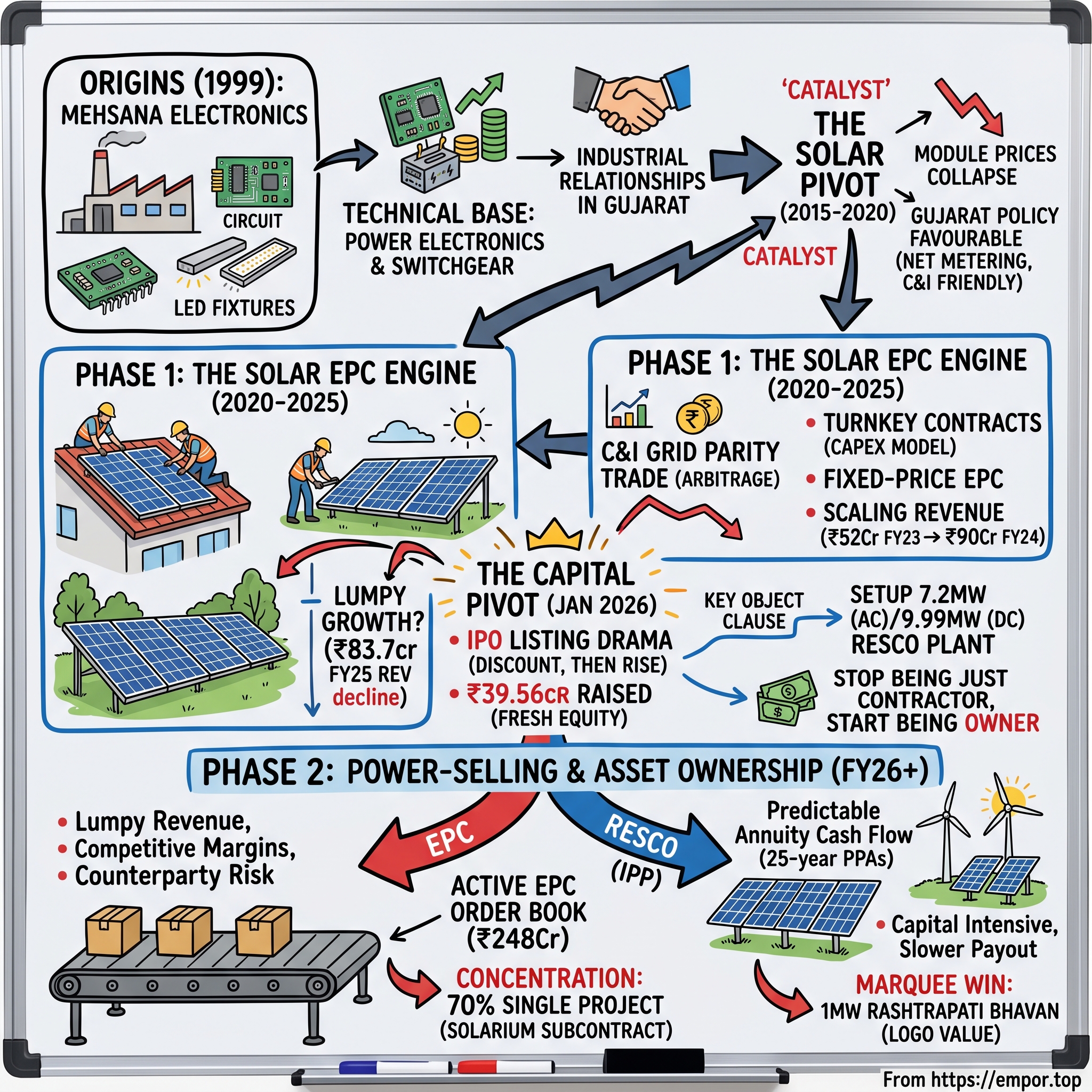
The narrative arc has three phases. First, the hardware roots: a first-generation entrepreneur building control panels and LED fixtures for the industrial belt of North Gujarat, learning power electronics the slow way. Second, the EPC surge: riding the collapse in module prices and the widening gap between Gujarat's industrial grid tariffs and the cost of self-generated solar, scaling consolidated revenue from ₹52.2 crore in FY23 to ₹123 crore in FY26.63 Third, the capital pivot: raising ₹39.56 crore of fresh equity in January 2026 explicitly to stop being purely a contractor and start being an owner of generating assets.2
The marquee proof points are real, and they need calibrating. In December 2025, weeks before the IPO, GRE won a Solar Energy Corporation of India tender to build and operate a 1 MW rooftop solar system at Rashtrapati Bhavan under the RESCO model, with operations and maintenance obligations stretching twenty-five years.78 In June 2026 it signed its largest-ever contract, a ₹175 crore turnkey EPC agreement with Solarium Green Energy for a 50 MW AC / 65 MW DC ground-mounted plant.9 By June 2026 cumulative installations had crossed 100 MWp.3 Each of these is genuine. Each also carries a caveat that most coverage skipped, and this article will spend time on those caveats.
The themes worth holding onto. The first is the commercial-and-industrial grid parity trade — the structural arbitrage between what an Indian factory pays a distribution company for power and what the same factory can generate on its own roof or on leased land. That arbitrage is the entire demand engine here, and it is not a permanent gift. The second is the EPC-versus-IPP dilemma: contracting is capital-light but lumpy, low-margin and endlessly competitive; owning plants is capital-hungry but produces annuity cash flow. Every small Indian solar company eventually faces this fork, and most of them get the transition timing wrong. The third is the reality of the SME platform itself — thin liquidity, negligible research coverage, disclosure that meets the letter of the rules and rarely more, and a management team with roughly two reporting periods of public track record against which to be judged.
That last point deserves emphasis at the outset. GRE Renew Enertech has been a listed company for six months. It has published one full-year result as a public entity. Almost everything an investor would normally use to assess management — guidance discipline, consistency of narrative across quarters, how they explain a miss — simply does not exist yet. What exists instead is a set of promises made in a prospectus in late 2025, and the beginnings of a record of whether those promises were kept. That is where the analysis has to start.
 Subscribe on LinkedIn
II. The Origins: From Mehsana Electronics to the Solar Pivot
Drive north out of Ahmedabad on the highway toward Mehsana and the landscape does something distinctly Gujarati: it alternates, almost rhythmically, between cotton fields and industrial estates. The GIDC zones — government-developed industrial clusters — appear every few kilometres, low-slung sheds housing chemical processors, ceramic makers, pharmaceutical formulators, textile units, and the endless supporting ecosystem of fabricators, panel builders and electrical contractors that keeps them running. It is not glamorous manufacturing. It is the kind that generates cash, hires locally, and pays its electricity bills every month without much discussion.
This is the world GRE was born into. The company traces its incorporation to April 1, 1999, when Kamleshkumar Dahyalal Patel established what would become GRE Electronics in Mehsana.5 Patel is a first-generation entrepreneur with an electronics engineering background, and the business he started was unremarkable by design: conventional electrical products, control panels, and — as the technology matured through the 2000s — LED lighting fixtures for industrial and institutional customers.10
It is tempting to skip past this era. Twenty-odd years of selling light fittings and switchgear in North Gujarat does not make for compelling narrative. But the LED business matters for a reason that has nothing to do with revenue, and everything to do with what a solar EPC contractor actually is.
What an LED business teaches you that a solar business needs. A rooftop or ground-mounted solar plant is, from a customer's perspective, a power generation system. From an engineer's perspective it is a low-voltage direct-current array feeding an inverter that must synchronise its alternating-current output precisely with a grid it does not control, through protection equipment that must trip within milliseconds when something goes wrong, across cabling and earthing that has to survive twenty-five years of Gujarat summers. Roughly half the ways a solar plant fails are not solar problems at all. They are electrical problems — bad terminations, undersized cables, protection coordination errors, earthing faults, inverter-grid synchronisation issues.
A firm that has spent two decades building control panels and lighting systems for industrial customers has, without intending to, built exactly the competency base that solar balance-of-plant engineering demands. It knows how to get a Chief Electrical Inspector to General's approval. It knows which distribution company officer signs which form. It knows how to terminate a cable so it does not cook itself in year four. This is deeply unsexy knowledge, and it is also the reason regional electrical contractors, rather than software-flavoured energy startups, dominate India's distributed solar installation market.
Today the legacy lighting and electricals business is a rounding error in the group's revenue — GRE describes itself to investors as engaged in solar energy solutions and LED lighting products, but the economics are overwhelmingly solar.4 The company does not disclose a segment-level revenue split in its public results, so any precise share is an estimate rather than a fact. What the legacy arm provided was not sales; it was a technical starting position and a customer list of industrial buyers who already trusted the firm with their electrical infrastructure.
The catalyst arrives from outside. Between roughly 2015 and 2020 two things happened that had nothing to do with Mehsana and everything to do with GRE's future. Global solar module prices collapsed — driven by Chinese manufacturing scale, polysilicon capacity expansion, and relentless cell efficiency improvement — to the point where distributed solar no longer required subsidy to clear an industrial customer's hurdle rate. Simultaneously, Gujarat established itself as India's most policy-friendly state for commercial and industrial renewables, with net metering, wheeling and banking frameworks that let a factory generate power in one place and consume it in another.
For a company like GRE, the strategic read was straightforward and, in hindsight, correct. LED lighting was becoming a commodity assembly business, squeezed between Chinese imports on cost and national brands like Havells and Bajaj Electricals on distribution. A regional player had no structural place in that fight. Solar EPC, by contrast, was a business where local presence, permitting relationships and execution speed genuinely mattered — where a firm two hours from the customer's factory could win against a national giant on responsiveness rather than price alone.
The decision to redirect corporate bandwidth toward solar was, in that sense, less a bold bet than a recognition that the company's actual advantage — proximity, electrical competence, industrial relationships in a specific geography — had more value in a new market than in the old one. That is the pragmatic version of a pivot: not abandoning what you know, but relocating it to where it earns more.
What the pivot did not solve. It is worth naming the limitation early, because it shapes everything that follows. Moving from LED assembly to solar EPC swapped one commodity business for another. In lighting, GRE bought chips and drivers from Asia, assembled fixtures, and competed on price and service. In solar, it buys modules and inverters from third-party manufacturers, assembles plants, and competes on price and service. The value chain position is structurally the same — a middle-layer integrator with no control over its principal input cost and no proprietary technology at either end.
What changed was the size of the market and the growth rate of demand, which is not nothing. A commodity integrator in a market growing 30% a year earns far better returns than a commodity integrator in a market that is shrinking, because in a growing market there is more work than there are competent hands to do it, and pricing holds up. But the underlying vulnerability travels with the company. This is why the eventual move into asset ownership matters so much: it is the first step GRE has taken that changes its position in the value chain rather than just its address within it.
What followed the pivot was a five-year sprint that took the company from local contractor to something the public markets would eventually pay attention to.
III. The Solar EPC Surge and the C&I Boom in Gujarat
Imagine you run a mid-sized textile processing unit in the Ahmedabad industrial belt. Your electricity bill is one of your three largest line items, and the tariff you pay a state distribution company includes not just the cost of generation but a layer of cross-subsidy that funds cheaper power for agricultural and residential consumers. You are, in effect, subsidising your state's farmers through your own power bill. Now someone walks in and offers to build you a solar plant on your roof — or on a patch of land you lease — that will produce electricity at a fraction of that tariff for the next twenty-five years, and to do it as a fixed-price turnkey job so you carry no execution risk.
That conversation, repeated across thousands of GIDC sheds, is the entire commercial-and-industrial solar market. It is not a technology sale. It is an arithmetic sale.
Why the arithmetic works so well in India specifically. In most developed markets, industrial power is cheap and residential power is expensive — the industrial customer gets a volume discount. India inverts this. Distribution companies have historically recovered their losses on subsidised agricultural and household supply by charging commercial and industrial users well above cost. The result is that the single customer segment best equipped to self-generate — the one with capital, roof space, land, daytime load, and a finance team that can model a payback period — is also the segment with the strongest incentive to do so. Layer in accelerated depreciation, which lets a company write off a large share of a solar asset's cost against taxable income in the early years, and the effective payback on a captive plant compresses further.
This is the tailwind GRE rode. It is worth being precise about what kind of tailwind it is: a policy-created price distortion, not a technological breakthrough. That distinction matters for the risk section later, because price distortions can be legislated away.
Building the playbook. GRE's positioning through this period was as a full-scope turnkey contractor for projects roughly in the 100 kW to 10 MW range — the band that is too large for a two-person installer and too small to interest a Sterling and Wilson. Turnkey means the customer signs one contract and receives a commissioned, grid-synchronised plant: site survey, civil foundations, mounting structure fabrication, module and inverter procurement, cabling, protection, transformer and evacuation work, statutory approvals, and grid synchronisation with the distribution licensee.
The competitive differentiation here is not proprietary. GRE has no patented technology, no module manufacturing, no software moat. What it has is execution density in a defined geography — the ability to have engineers on site quickly, established relationships with local fabricators and cable suppliers, and familiarity with Gujarat's specific permitting sequence. Against a national contractor, that translates into faster cycle times and lower overhead recovery. Against a two-person local installer, it translates into bankability: a customer signing a fixed-price contract for a ₹5 crore plant wants a counterparty that will still exist in year three when something needs fixing.
The company today reports ISO 9001:2015 certification, operations spanning corporate offices in Ahmedabad and manufacturing in Mehsana, more than 1,200 customers served, and a team of over 100 people.10 By June 2026 it had crossed 100 MWp of cumulative installations.3 These are respectable numbers for a regional contractor. They are also, in the context of Indian solar, small — a point we will return to when comparing GRE with its listed peers.
The unglamorous part nobody sells. There is a stage in every Indian solar project that has nothing to do with panels and everything to do with paperwork. Before a plant can feed a single unit into the grid, it must clear an electrical inspectorate approval confirming the installation is safe, secure a synchronisation agreement with the distribution licensee, have its meters tested and sealed, and pass a joint inspection. Each of these involves a different office, a different form, and a different queue.
For the customer, this is the part of the project where a promised commissioning date quietly slips by three months. For the contractor, it is where working capital sits idle — the plant is built, the money is spent, and the final payment milestone has not been reached because a signature is outstanding. A contractor that navigates this reliably in its home state has a genuine, if unglamorous, operational advantage over one that does not. It is also an advantage that does not travel: the officers, the forms and the queues are different in Maharashtra than in Gujarat, which is a small but real reason to watch how the Solarium project executes.
The financial inflection. The numbers tell a story of a business that found its market and then hit a wall, twice.
On a consolidated basis, revenue moved from ₹52 crore in FY23 to ₹90 crore in FY24 — a jump of roughly 73% in a single year.6 More importantly, the profit profile transformed. FY23 operating margin was 4.2%, with profit after tax of ₹0.89 crore on revenue of ₹52.2 crore — a net margin under 2%, which is to say the company was working very hard for almost nothing.611 In FY24, operating margin expanded to about 13% and profit after tax reached ₹9.9 crore.611
What drove that? Three things, and they are worth separating because they have different durability. Scale in procurement is real but modest — a contractor buying tens of megawatts of modules gets better terms than one buying five, though nothing close to what a gigawatt-scale developer commands. Operating leverage on fixed engineering overhead is real and durable — the same design team and project management function can supervise materially more megawatts. Mix shift toward larger ground-mounted turnkey projects is real but cyclical — it depends entirely on what the order book happens to contain in a given year.
The third driver is the one that unwound. FY25 revenue fell to ₹83.7 crore from ₹90.3 crore, operating margin compressed to roughly 11%, and profit after tax dropped to ₹7.03 crore.611 A 7% revenue decline and a 29% profit decline in a year when Indian solar installations were booming is not a market problem. It is an execution or order-timing problem, and it is exactly the kind of lumpiness that makes fixed-price contracting a difficult business to own.
What this says about the business. Contracting revenue is recognised as work progresses. A contractor whose revenue falls in a growing market has either failed to win enough work, or won it and not been able to start it. Either explanation points at the same underlying constraint: for a company of GRE's size, the binding limit on growth is not demand — demand is abundant — but the capital and bonding capacity required to take on larger contracts. Bigger projects demand bigger bank guarantees, more working capital, longer retention periods, and more balance sheet to absorb a delayed payment.
There is a second reading, less charitable and equally consistent with the evidence. Fixed-price contracting rewards discipline in bidding, and a contractor that refuses to chase work at unattractive margins will periodically report a down year. If FY25's decline reflected a decision to walk away from underpriced tenders rather than an inability to win them, it is a mark in management's favour rather than against. GRE has never publicly said which it was — and in the absence of that disclosure, an investor is left holding two very different interpretations of the same number.
Either way, the constraint on growth was capital, and a public listing is what solves that. Which brings us to the two years in which GRE decided to stop being a private contractor.
IV. The Pivot to RESCO and the Public Listing Drama
Somewhere in 2023, the company changed its name. GRE Electronics — a name that told the world it sold electronics — became GRE Renew Enertech, a name that tells the world it sells renewable energy. The company has not publicly disclosed the exact date of the rebranding or the conversion to public limited status, so precision here is unavailable. But the direction of travel was unambiguous, and the name change was the least consequential part of it.
The consequential part was a decision about what kind of company GRE wanted to be.
The two business models, explained plainly. Under the CAPEX or EPC model, a customer pays GRE to build a solar plant, the customer owns it, and GRE's involvement ends at commissioning — except for an annual maintenance contract. GRE takes construction risk and earns a construction margin. Cash comes in over months and then stops.
Under the RESCO model — Renewable Energy Service Company, sometimes called OPEX — GRE finances and builds the plant, GRE owns it, and the customer simply buys the electricity it produces under a long-term power purchase agreement, typically at a discount to what they would otherwise pay their distribution company. The customer spends no capital. GRE spends all of it, and then collects a monthly cheque for fifteen to twenty-five years.3
The analogy that works: EPC is building houses and selling them. RESCO is building houses and renting them. The first turns your capital over quickly and pays a modest margin each time. The second consumes enormous capital upfront and then produces rent for decades. A homebuilder who becomes a landlord does not get richer immediately — the accounting looks worse before it looks better, because you have spent the capital and are only beginning to collect.
For a company with a ₹31 crore net worth at the end of FY25, becoming a landlord required outside money.11
The Rashtrapati Bhavan win. In December 2025, with the IPO already in motion, GRE won a Solar Energy Corporation of India auction for a 1 MW grid-connected rooftop solar system at Rashtrapati Bhavan in New Delhi, structured under the RESCO model.7 The scope covers design, installation, and operations and maintenance for twenty-five years — preventive and breakdown maintenance, module cleaning, replacement of defective components, insurance, online monitoring and joint meter readings.8 Mercom India reported the winning tariff at approximately ₹2.7 per kWh.7
The strategic signalling value is obvious. Executing inside the President of India's residence requires security clearance, zero-defect installation standards, and the credibility to be trusted with a national landmark. For a Mehsana contractor pitching corporate clients, that reference is worth more than its contract value.
And the contract value is where the calibration comes in. One megawatt is one percent of GRE's cumulative installed base.3 At a tariff near ₹2.7 per kWh, this is a low-return asset by RESCO standards — competitive government rooftop auctions are bid down aggressively, and ₹2.7 is a long way below the ₹4-plus tariffs typical of a negotiated C&I power purchase agreement. This is a marketing asset that happens to generate electricity, not an earnings asset that happens to be prestigious. Investors who bought the stock because of the Rashtrapati Bhavan headline bought a logo, not a cash flow.
The IPO. GRE filed its offer document in September 2025 and received in-principle approval from BSE in late December 2025.5 The issue opened January 13, 2026 and closed January 16, comprising 37,68,000 fresh equity shares of ₹10 face value in a price band of ₹100 to ₹105, priced at the cap for a total raise of ₹39.56 crore.2 It was entirely a fresh issue — no promoter shares were sold, meaning every rupee went into the company rather than into a founder's pocket. Share India Capital Services acted as book running lead manager, with Maashitla Securities as registrar.211
The object of the issue was unusually specific for an SME offering: ₹3,158.31 lakh — roughly ₹31.6 crore, or about 80% of the gross raise — earmarked for setting up a 7.20 MW (AC) / 9.99 MW (DC) ground-mounted solar power plant, with the balance for general corporate purposes.112 Not working capital. Not "general expansion." A single, named, measurable asset.
That specificity is itself an analytical signal. A prospectus that promises to build one identifiable plant creates a binary test that anyone can check in twelve months. Managements who intend to be vague do not write objects clauses like that.
The book, and the break. Demand was strong: 16.53 times overall, with qualified institutional buyers at 14.69 times, non-institutional at roughly 24.67 times, and retail at 14.10 times.2 Grey market indications in the days before listing pointed to a modest premium.
Then the stock listed at ₹96 and fell to ₹91.20.21 Several forces were at work. Consolidated revenue had declined in FY25 and profit had fallen by nearly a third, so the most recent full-year data point available to a listing-day buyer showed a business going backwards.6 The interim numbers for the six months to September 2025 showed revenue of ₹43.98 crore and profit of ₹4.00 crore — an improving run-rate, but not obviously enough to reverse the narrative.2 And the broader SME platform was in a period of valuation digestion after two years in which SME listings had been priced on momentum rather than fundamentals.
The lesson of the listing-day break is not that the market was wrong, though it was. It is that a company with declining trailing financials, no research coverage, and a story that depends entirely on future capital deployment has no defence when sentiment turns. SME investors were being asked to underwrite a transition they could not yet verify.
Six months later they could.
V. Core Business Deep Dive: CAPEX EPC versus Power-Sell Economics
On July 16, 2026, GRE issued a press release with a sentence in it that changes how the whole company should be read: the 7.20 MW (AC) / 9.678 MW (DC) ground-mounted solar power plant had been commissioned under the RESCO model.3
That is the IPO object clause, delivered. Roughly eighteen months from prospectus to a generating asset, and about six months from receiving the money to producing electricity. For a first-time issuer on the SME platform, where a meaningful share of IPO objects quietly become "general corporate purposes" over subsequent years, this is the single most important data point in the company's short public life.
It comes with a footnote worth noticing. The prospectus promised 9.99 MW DC.11 The commissioned plant is 9.678 MW DC — a shortfall of about 3%.3 Small, plausibly explained by final design optimisation or land constraints, and not disclosed with an explanation. It is not a scandal. It is the kind of detail an investor should file away and watch for a pattern, because how a company handles small deviations tends to predict how it handles large ones.
The two engines, and how differently they behave.
The EPC engine is what produces essentially all of GRE's current revenue. Its economics are dictated by the bill of materials: in a typical Indian ground-mounted solar EPC contract, photovoltaic modules represent the largest single cost block, with inverters, mounting structures, cabling, transformers, evacuation infrastructure and civil work making up the rest. The contractor's margin sits on top of a cost base it does not control, in a contract price it fixed months earlier. GRE does not disclose its EPC gross margin separately, but the group's consolidated operating margin has ranged between roughly 4% and 13% over four years — a band that tells you how much this business can swing.6
The mechanics of that swing are simple and brutal. A contractor signs a fixed-price agreement today for a plant it will build over six to twelve months. If module prices rise between signature and procurement — because of a polysilicon shortage, a change in basic customs duty, or enforcement of domestic content rules that shrink the supplier pool — the entire increase lands on the contractor's margin. There is no escalation clause in most C&I contracts because customers will not accept one. A contractor with an eight-point margin can lose all of it on a modest adverse move in one line item.
This is why GRE's stated shift toward larger, higher-value ground-mounted contracts cuts both ways. Bigger contracts spread fixed engineering cost over more megawatts, but they also concentrate procurement risk into fewer, larger bets.
The RESCO engine is almost the mirror image. Once a plant is built and grid-connected, its costs are close to fixed and mostly non-cash: depreciation, module cleaning, insurance, monitoring, an occasional inverter replacement. Revenue is contracted, indexed or fixed, and lasts fifteen to twenty-five years. A well-sited Indian solar plant runs at a capacity utilisation factor in the low twenties as a percentage — meaning it produces roughly a fifth of what it would if the sun shone at full intensity around the clock — and that figure is remarkably predictable year to year.
The result is an operating margin structure fundamentally different from contracting: the majority of each revenue rupee drops through to operating profit, because there is almost nothing to spend it on. GRE has not disclosed the expected annual generation, tariff, or revenue from the newly commissioned RESCO plant, so any specific revenue figure would be speculation. What can be said with confidence is directional: a plant of roughly 7.2 MW AC in Gujarat generates on the order of ten to twelve million units a year, and at C&I power purchase tariffs the resulting revenue is a single-digit-crore annuity with very high incremental margin and a payback measured in years, not months.
The strategic logic, and its cost. The reason to make this pivot is that it converts a volatile, competed, working-capital-intensive earnings stream into a predictable one. A business with 100% of revenue from fixed-price contracting is worth less per rupee of earnings than a business with a growing base of contracted twenty-year cash flows, because the second is more forecastable.
The cost is that it consumes capital at a ferocious rate. Building roughly 9.7 MW DC absorbed approximately ₹31.6 crore of the ₹39.56 crore raised.112 To build a RESCO portfolio large enough to genuinely diversify a business now doing over ₹120 crore of revenue would require several multiples of that — which means either debt against project cash flows, further equity dilution, or a decade of retained earnings. GRE ended FY26 with borrowings of about ₹2 crore against reserves of ₹65 crore, so the balance sheet capacity exists.6 The willingness to use it is the open question.
The order book, and what it is made of. As of mid-July 2026 the consolidated active EPC order book stood at approximately ₹248 crore, following orders of about ₹24 crore secured in the first half of July across captive, third-party-sale and distributed renewable energy structures, with execution windows of six to twelve months.12 That book is roughly double FY26 revenue — genuinely strong visibility for a company this size.
But its composition tells a subtler story. The dominant component is a single contract: the ₹175 crore agreement executed on June 30, 2026 with Solarium Green Energy for a 50 MW AC / 65 MW DC ground-mounted plant, split ₹170 crore of EPC works and ₹5 crore of three-year O&M.9 GRE confirmed it is not a related-party transaction and that neither promoters nor group companies have any interest in it.9
Here is the part that deserves attention. Solarium Green Energy itself won that project as a subcontractor for a 50 MW AC / 65 MW DC solar plant in Maharashtra associated with Maharashtra State Power Generation Company, at a value of ₹186.525 crore, awarded on June 22, 2026.13 Eight days later, Solarium subcontracted essentially the same scope to GRE for ₹175 crore.9
Read that chain carefully. The ultimate offtaker is a Maharashtra state generator. The intermediary is Solarium — itself a listed Gujarat solar company with FY26 revenue of ₹368 crore and a 1.2 GW module manufacturing facility in Ahmedabad.14 GRE is third in line. The spread Solarium retains on the pass-through is roughly ₹11.5 crore, or about 6% — though Solarium may also supply modules into the project separately, which would change that picture.
What this reveals about competitive position is more useful than any framework. GRE's largest single contract is a subcontract from a company that is nominally a competitor, on a project GRE did not win directly, for an end customer GRE does not have a relationship with, in a state outside its home geography. That is not evidence of brand power or customer intimacy. It is evidence that GRE has become a credible, cost-competitive execution subcontractor — which is a real and valuable thing to be, and a fundamentally different thing from being a developer with its own pipeline. It also means the largest chunk of the order book carries counterparty risk to an intermediary rather than to a state generator.
Myth versus reality, on three consensus claims.
Myth: GRE is "the Rashtrapati Bhavan solar company." Reality: that project is 1 MW out of more than 100 MWp installed, won at a reported tariff near ₹2.7 per kWh in a competitive government auction — one of the lowest-yielding assets a RESCO developer can own.37 It is a credential, and credentials are genuinely useful in a business where customers are buying twenty-five years of counterparty reliability. But it will not move an earnings line.
Myth: the ₹248 crore order book proves customer demand for GRE's brand. Reality: about 70% of it is a subcontract from another solar company on a project that company won from a state generator.91213 What it proves is that GRE's execution cost is competitive enough that a peer preferred hiring it to doing the work in-house. That is a compliment about cost and capacity, not about brand.
Myth: the RESCO pivot de-risks the business. Reality: it changes the risk rather than reducing it. Contracting risk — margin volatility, working capital, counterparty payment — is replaced by asset risk: capital locked up for twenty-five years against a tariff fixed today, exposure to regulatory changes in open access charges, and generation performance that must actually match the model. The pivot makes cash flows more predictable. It does not make them safer in every dimension, and it makes the balance sheet considerably less flexible.
The pivot to owning assets is, among other things, an attempt to escape a subcontractor's position in the value chain. Whether it succeeds depends on the people making the capital decisions.
VI. Management, Governance, and Capital Allocation Track Record
Every SME listing comes with a governance question that mainboard investors rarely have to ask: is this a company, or is it a family business wearing a company's clothes?
The honest answer for GRE Renew Enertech is that it is a family-controlled business with a professionalising structure and a very short public record — and that the early evidence, such as it is, leans favourable.
The promoter group. Three individuals are named as promoters: Kamleshkumar Dahyalal Patel, who serves as managing director, Kirtikumar Kantilal Suthar, and Mukeshkumar Prahladbhai Trivedi.2 Before the IPO they collectively held 95.06% of the equity; after the fresh issue diluted them, 69.99%.2 That post-issue figure has held exactly steady through the June 2026 shareholding disclosure — no promoter selling, no creeping reduction.4
Ninety-five percent pre-issue ownership across three people tells you this was never a venture-funded company. There is no private equity investor, no institutional pre-IPO round, no external board that shaped strategy along the way. GRE was built with retained earnings and modest bank borrowings — borrowings sat at roughly ₹5 crore in FY23 and FY24, falling to ₹2 crore by FY25 and staying there.6 For a contracting business scaling revenue at a compound rate above 30%, running at essentially zero net leverage is a genuinely conservative choice, and an unusual one in an industry where competitors routinely lever their balance sheets to chase order books.
Patel's visible style. There is not a great deal of public material on how the managing director operates — no earnings call transcripts exist for a company that has reported once as a listed entity, and GRE has not held an investor call that is publicly available. What exists is a management interview and factory interaction the company circulated through a retail-facing platform, covering the business model, EPC operations and solar park development.15 The choice of venue is itself informative: a company courting retail SME investors through video interviews rather than institutional conference calls is following the standard playbook for the segment, and investors should read the resulting content as promotional material rather than disclosure.
The one substantive quoted remark on record came with the July 2026 milestone release, where Patel framed the order book achievement in terms of customer trust: that the active order book had outpaced the entire previous year's consolidated revenues reflected the confidence customers placed in GRE's execution capability.3 It is a reasonable line. It is also worth noting what it elides — the single largest component of that book came from a peer contractor subcontracting a state utility project, which speaks to price competitiveness at least as much as to customer trust.
The capital allocation record, such as it is. GRE has made exactly one significant capital allocation decision as a public company, and it made it well. Given ₹39.56 crore of fresh equity, it spent roughly 80% on the specific asset it said it would build, and commissioned that asset within about six months of receiving the money.113 It did not divert the proceeds to working capital. It did not announce an unrelated acquisition. It did not sit on the cash.
Against that, the cash flow statement raises a flag worth watching. In FY26, consolidated cash from operations was approximately ₹5 crore against profit after tax of roughly ₹14 crore — a materially lower conversion than FY25, when operating cash flow of ₹11 crore exceeded profit after tax of ₹7 crore.6 The mechanics are visible in the working capital ratios: inventory days more than doubled from 24 in FY25 to 51 in FY26, while receivable days actually improved from 39 to 29 and payable days extended from 25 to 43.6 Overall working capital days rose from 49 to 64.6
Interpreted plainly: GRE collected from customers faster and paid suppliers slower — both good — but tied up substantially more capital in inventory, which is consistent with stocking modules and equipment ahead of a much larger execution year. That is a defensible operational choice going into a ₹248 crore order book. It is also exactly how contracting businesses get into trouble if the order book slips: inventory bought against contracts that do not execute becomes a write-down risk, and module prices decline structurally over time, so held inventory loses value while it sits.
The company has not commented publicly on the inventory build or the cash conversion gap. For a business whose entire investment case rests on converting a large order book into cash, that silence is the most notable disclosure gap in the FY26 reporting.
Governance markers, positive and unresolved. On the positive side: no promoter share pledging is reported; the promoter stake is undiluted since listing; the fresh-issue structure meant no founder cashed out; and domestic institutional investors held 8.79% as of June 2026, with foreign institutions at 0.38% — modest, but a meaningful institutional presence for a BSE SME company, and evidence that at least some professional money has done work here.4
Unresolved: GRE pays no dividend despite consistent profitability, which is defensible while it is funding RESCO assets but should be revisited if the asset build slows.4 Board independence standards on the SME platform are lighter than mainboard requirements, and the company's public disclosures do not provide the granularity on related-party transactions that a mainboard investor would expect. The group operates at least one subsidiary, GRE Green Energy Private Limited, for which a separate audit report exists.16 Consolidated versus standalone figures diverge meaningfully — FY26 standalone revenue of about ₹115 crore against consolidated ₹123 crore — and understanding what sits in the subsidiary, particularly whether it houses the RESCO assets, is material to assessing the pivot.43
A note on what "credibility" means at this stage. Assessing management normally means comparing what they said three years ago with what happened, and watching how the story shifts when results disappoint. None of that is available here. GRE has made precisely one public promise with a checkable deadline — build a named plant with named proceeds — and kept it.113 That is one data point, and it is the right kind of data point, but a single kept promise is not a track record.
What an investor can reasonably infer from behaviour rather than from statements is narrower but still useful. The company ran at near-zero net leverage while growing revenue at over 30% compounded, which is a revealed preference for balance sheet safety over reported growth.6 It structured its IPO as pure primary issuance rather than selling promoter stock, which is a revealed preference for funding the business over personal liquidity.2 It has not diluted or sold down since listing.4 And it spent the money on the asset it named rather than on the softer, easier alternative of working capital.
Set against that: it has not explained a down year, has not published a segment split, and communicates with retail investors through video interviews rather than through a call where analysts can ask uncomfortable questions.15 The pattern that emerges is of a conservative operating team that is comfortable running a business and not yet practised at being a public company. Those are different skills, and the second one is usually learned under pressure.
Which leads naturally to the harder question: does any of this add up to a defensible competitive position?
VII. Strategic Position: Porter's Five Forces and Helmer's Seven Powers
Here is an uncomfortable way to frame the strategic question. In FY26, GRE Renew Enertech generated ₹123 crore of consolidated revenue.3 KPI Green Energy, based in the same state, doing broadly the same thing, generated consolidated revenue of ₹2,742 crore and profit after tax of ₹509 crore, with a renewable portfolio of 4.74 GW.17 Solex Energy, also Gujarat-based, grew FY26 revenue 143.9% to ₹1,621 crore.18 Solarium Green Energy — GRE's largest customer — did ₹368 crore with an order book of ₹852 crore and its own 1.2 GW module plant.14
GRE is not a small player in a big market. It is a very small player in a market where its neighbours are ten to twenty times its size and growing faster. Any assessment of competitive advantage has to start from that fact.
Porter's Five Forces, applied honestly.
Threat of new entrants: high. The capital and technical barriers to entering C&I solar EPC at small scale are close to trivial. Modules, inverters and structures are all bought from third parties. Design software is commodity. The skilled labour is available. Hundreds of regional contractors compete for sub-2 MW rooftop work in Gujarat alone. Barriers begin to appear at larger project sizes — bonding capacity, bank guarantees, balance sheet strength, track record for utility-scale tenders — which is exactly why GRE is moving up the size curve. But at the base of the market, entry is essentially free.
Bargaining power of suppliers: high. Module manufacturers set prices against global polysilicon and wafer cycles and, in India, against the Approved List of Models and Manufacturers regime, which restricts which manufacturers can supply government-linked projects. That policy narrows the effective supplier pool and hands pricing power to approved domestic manufacturers. Note the asymmetry embedded in GRE's largest contract: Solarium holds ALMM approval and operates its own module manufacturing.14 GRE does not manufacture. In a supply-constrained module market, an EPC contractor without captive module supply is structurally the more exposed party.
Bargaining power of buyers: moderate to high. C&I customers compare bids on rupees per watt-peak. Switching costs at the point of tender are nil. Loyalty exists only where a contractor bundles something the customer cannot easily get elsewhere — financing, a performance guarantee, or a RESCO structure that removes capital expenditure entirely. This is precisely the strategic argument for the RESCO pivot: it converts a price-shopped transaction into a twenty-year contractual relationship. But it converts only the projects GRE is willing to fund itself, which is a small fraction of what it builds.
Threat of substitutes: low. The substitute is grid power from a distribution company, and it is more expensive for the target customer. Wind, hybrid and battery storage compete for the same capital budget rather than substituting outright. Decarbonisation commitments from large corporates push in the same direction. This force is genuinely favourable and likely to remain so.
Competitive rivalry: high. Rivalry runs on two levels. In the home market, GRE competes against a long tail of regional contractors on price and speed. In the larger ground-mounted segment it now targets, it competes against — and, as the Solarium deal shows, sometimes works for — considerably better-capitalised players. Rivalry in EPC contracting is fundamentally about who will accept the thinnest margin, and the participant with the strongest balance sheet usually wins that contest.
Helmer's Seven Powers, applied sceptically. The test of a real power is whether it lets a company sustain returns that competitors cannot compete away. Most of GRE's candidate advantages fail that test.
Scale economies: absent. At roughly 100 MWp cumulative installations against peers operating in gigawatts, GRE has no procurement scale advantage. It almost certainly pays more per watt for modules than KPI Green or a vertically integrated player. This is a disadvantage, not a power.
Cornered resource: weak. Permitting familiarity and distribution company relationships in North Gujarat have real operational value, but they are not exclusive, not transferable to Maharashtra where its largest project sits, and replicable by any competitor willing to hire the same people.
Process power: possibly emerging. The one genuine candidate. If GRE can consistently execute ground-mounted projects faster and at lower cost than competitors, that is a durable advantage — process power is hard to copy because it lives in accumulated organisational routine. The circumstantial evidence is suggestive: a peer with its own EPC capability chose to subcontract a 50 MW project to GRE rather than build it in-house, which implies GRE's execution cost or capacity was attractive.9 But one contract is not proof, and the company discloses no project-level cost or cycle-time metrics that would let an outsider verify it.
Counter-positioning: partial, in RESCO. Selling power directly to industrial customers under a PPA counter-positions the distribution company, which cannot respond by cutting industrial tariffs without unwinding the cross-subsidy that funds its other customers. That is a genuine structural bind for the incumbent. But it is a bind shared by every RESCO developer in India, not one specific to GRE, and distribution companies fight back through cross-subsidy surcharges and open-access charges rather than through tariff cuts.
Switching costs, network economies, branding: not present in any meaningful form.
The honest synthesis. GRE Renew Enertech does not currently possess a durable competitive advantage in the sense Helmer means. What it has is a favourable market, a competent and capital-disciplined operating team, a clean balance sheet, and a strategy — asset ownership — that could over time create one, because a portfolio of contracted twenty-year cash flows is a genuinely defensible asset base even if the contracting business around it never is.
The peer comparison, and what it actually implies. It would be easy to read the size gap against KPI Green, Solex and Solarium as simply damning. That is too quick. Each of those companies took a different structural path, and each path carries a different risk.
KPI Green scaled by becoming a developer and independent power producer at genuine scale, which required aggressive balance sheet expansion — its FY26 profit growth came alongside rising debt.17 Solex scaled through manufacturing, which requires continuous capital reinvestment to stay on the efficiency curve and exposes the business to the brutal module pricing cycle.18 Solarium built module capacity and won ALMM approval, positioning itself as an integrated supplier and developer.14 All three chose capital intensity as the route to differentiation, because in this industry there is no other route.
GRE has chosen the same destination and is arriving late, small, and with a fraction of the capital. That is a disadvantage in the race. It is also, paradoxically, the reason its balance sheet is clean — it has not yet made the large, leveraged bets that its larger peers have made and that will define whether their strategies worked. A company with ₹2 crore of debt and a ₹248 crore order book has more strategic freedom per rupee of equity than one that has already committed itself.612
The realistic ceiling on this business, absent a step change, is a well-run regional contractor with a modest owned-generation portfolio. The realistic floor is a business whose margins are competed away as it moves into larger projects against better-funded rivals. Neither outcome involves a moat.
The investment question is therefore not "does GRE have a moat." It plainly does not. The question is whether a well-run business with no moat, operating in a structurally growing market with a long runway, deploying capital sensibly, is worth owning — and what happens to it when the market stops growing.
VIII. The Skeptical Investor Stress Test and Current Risk Radar
Put a short-seller in a room with GRE's FY26 results and the ₹248 crore order book, and here is what they would attack.
Challenge one: "This is a pass-through contractor with no control over its own cost base."
The stress case is precise. Roughly half or more of an EPC contract's value is modules, bought from third parties at prices set by global polysilicon cycles and Indian policy. Contracts are fixed-price. If module costs rise 10% mid-execution on a portfolio of contracts with a 10% margin, the margin does not fall — it disappears. And GRE has a ₹175 crore contract, larger than its entire FY26 revenue, to execute in a state where it has no established supply relationships.93
The rebuttal is partial. Module prices in India have trended structurally downward, which works in a contractor's favour if procurement follows contract signature. GRE's inventory build in FY26 — inventory days rising from 24 to 51 — is consistent with locking in materials early against known contracts, which is the correct defensive behaviour.6 But that same behaviour creates the mirror risk: if module prices fall sharply while GRE holds stock, or if the contracts against which the inventory was bought slip, the inventory carries a valuation problem. The company has not disclosed how much of its order book is procurement-hedged, and without that disclosure the risk cannot be sized.
Challenge two: "Why did revenue and profit both fall in FY25?"
This is the single most important unanswered question about management. In a year when Indian solar installations grew strongly, GRE's consolidated revenue fell from ₹90.3 crore to ₹83.7 crore and profit after tax fell from ₹9.9 crore to ₹7.03 crore.611 Operating margin compressed from about 13% to about 11%.6
The company has not published a public explanation. There is no earnings call, no management discussion available to retail investors that addresses it directly. The prospectus-era materials characterised it as a revenue decline of about 7% without a detailed causal account.11 For an investor assessing management credibility, the absence of an explanation is itself the finding: this is a management team that has not yet been tested on explaining a miss, because it has not been asked to.
FY26 answers the question commercially — revenue rose 47% and profit roughly doubled — but does not answer it analytically. If FY25 was a timing artefact of contract phasing, then lumpiness is the permanent condition of this business and investors should expect it again. If it was a competitive loss or an execution failure, that is a different and more concerning read. Both explanations are consistent with the published data.
Challenge three: "The order book is one customer."
Approximately ₹175 crore of a ₹248 crore book sits with a single counterparty, Solarium Green Energy, on a single project.912 That is roughly 70% concentration. If that project is delayed, descoped, or if the intermediary encounters a payment problem, GRE's FY27 and FY28 revenue trajectory changes materially. Solarium is itself a listed, profitable, growing business with a ₹852 crore order book, so the counterparty is not weak.14 But it is an intermediary, not the end offtaker, and payment flows down a chain rather than direct from a state generator.
Challenge four: "Cash is not following profit."
FY26 operating cash flow of approximately ₹5 crore against profit after tax of ₹14 crore is the most concrete near-term concern.6 One year does not make a trend, and the explanation — inventory build ahead of a large execution year — is plausible and even prudent. But it means the company funded its FY26 growth from IPO proceeds rather than from operations, and financing activities contributed ₹35 crore of inflow while investing consumed ₹15 crore.6 The IPO money has now been spent on the RESCO plant. FY27's growth has to be funded by operating cash flow or new borrowing.
The material risk radar.
Working capital and contracting risk. The mechanism, stated plainly: a contractor's cash is tied up between buying materials and getting paid, and that gap widens with project size. Retention money — typically a percentage of contract value held back until performance is proven — can sit uncollected for a year or more. Bank guarantees consume credit limits. GRE's working capital days rose from 49 to 64 in FY26 while the order book doubled, which is the direction you would expect and the direction that eventually forces either borrowing or slower growth.6
Regulatory and policy risk. Two specific exposures. Open access charges — the cross-subsidy surcharge and additional surcharge that distribution companies levy on industrial customers buying power from third parties — directly determine whether a RESCO project's economics work for the customer. State regulators can and do raise them, and they do so precisely because open access erodes the distribution companies' most profitable customer base. Separately, ALMM enforcement determines which modules can be used in which projects, constraining supply and pricing for a contractor without captive manufacturing.
Geographic and sector concentration. GRE's institutional knowledge, supplier relationships and permitting familiarity are concentrated in Gujarat's industrial belt, serving textile, chemical, ceramic and pharmaceutical customers. A regional downturn in those sectors — or a policy change specific to Gujarat's banking and wheeling rules — hits demand and the balance sheet simultaneously. The Maharashtra project diversifies geography but does so through a subcontracting relationship rather than through building a local presence.
Execution risk on the pivot itself. The RESCO plant was delivered, which retires much of this risk for the first asset. The forward risk is different: scaling a RESCO portfolio requires land, evacuation infrastructure, grid connectivity approvals and — critically — capital that GRE has now largely spent.
Disclosure risk. No public earnings call, no investor presentation deck in the public domain, no segment reporting, no order book breakdown by customer or geography, no explanation of the FY25 decline. Every one of these is permitted for an SME issuer. Collectively they mean an investor is underwriting management's competence with substantially less information than a mainboard equivalent would provide.
Liquidity and ownership structure risk. With promoters holding 69.99% and institutions a further 9%, the genuinely tradable float is roughly a fifth of the equity.4 On the SME platform, where lot sizes are large and market-making is thin, that produces price behaviour driven by order flow rather than by fundamentals — the mechanism visible on listing day, when the stock hit a lower circuit within hours of debut.2 For a long-term holder this is mostly noise. For anyone who might need to exit in size, or who marks a position to market, it is a real cost that does not appear in any ratio.
The accounting judgements worth watching. Two areas carry genuine estimation risk in this business model. The first is revenue recognition on long-duration EPC contracts, which depends on management's assessment of stage of completion — a judgement that determines how much of a multi-year contract's revenue and margin lands in which year, and one that is difficult for an outsider to test. The second is inventory valuation, given the FY26 build and the structurally declining price of solar modules.6 Neither is a red flag today. Both are the places where, in this industry, problems tend to surface first.
What is genuinely not a risk here. Worth stating for balance, since risk sections tend toward completeness over relevance: GRE carries essentially no refinancing risk with ₹2 crore of borrowings, no meaningful foreign currency exposure, no technology disruption risk of the kind facing software or hardware businesses, and no obvious cybersecurity or data-privacy concentration.6 The risks that matter here are old-fashioned and industrial — cost inflation, customer payment, regulatory tariffs, and execution.
Set against all of that, what is the case for owning this?
IX. The Playbook: Business and Investing Lessons
Strip away the specifics and GRE Renew Enertech is a case study in four ideas that recur across small-cap industrial India.
Lesson one: the pragmatic pivot beats the visionary one. GRE did not abandon LED lighting because someone had an epiphany about climate change. It abandoned it because the economics of commodity assembly against Chinese imports and national brands were unwinnable, and because the electrical engineering competence built over two decades happened to be transferable to a market with better structural economics. The pivot worked because it moved existing capability into a better market, not because it required the company to learn something new.
The generalisable point: the best pivots are lateral, not vertical. A company redeploying a proven capability into an adjacent market with better economics has a far higher success rate than one attempting to acquire a capability it does not have. Investors evaluating a strategic shift should ask what the company is actually carrying across, and be sceptical when the answer is "ambition."
Lesson two: capital allocation transitions are where small companies are made or broken. The EPC-to-IPP transition is the defining decision in GRE's history, and its structure is instructive. Public equity was raised at a valuation the company judged attractive and converted directly into a physical, cash-generating asset. That is the textbook use of equity capital — issuing a claim on future earnings to buy a stream of contracted future earnings.
The counterfactual matters. GRE could have used ₹39.56 crore to fund working capital and chase a bigger order book. That would have grown revenue faster, produced better-looking near-term headlines, and left the business exactly as competitively exposed as before. Choosing the slower, asset-heavy path is the less flattering option in the short run. Whether it was the right one depends on whether the RESCO portfolio scales beyond one plant — and one plant, however well delivered, is not a portfolio.
Lesson three: the SME listing is a real trade-off, not a free upgrade. GRE gained permanent capital, currency for future raises, a governance discipline it did not previously have, and a public profile that plausibly helped it win larger contracts. It also acquired thin liquidity, negligible analyst coverage, a shareholder base that reacts violently to sentiment, and a public market that valued it at a discount to its issue price within hours of listing.
For investors, the lesson is that SME price signals carry far less information than mainboard price signals. The listing-day break at ₹96 conveyed almost nothing about the business and everything about a market with no research infrastructure and no marginal buyer. The subsequent move to around ₹192 conveys, mostly, that the business delivered a good year and a small float responded.4 Neither price was a considered judgement.
Lesson four: arbitrage-driven business models have expiry dates. GRE's demand engine is the gap between what Indian industrial customers pay for grid power and what solar costs to generate. That gap exists because of a cross-subsidy structure, not because of physics. Every megawatt of C&I solar installed shrinks the distribution companies' most profitable customer base and increases their incentive to defend it — through surcharges, through banking restrictions, through tighter net metering caps.
This does not mean the opportunity closes tomorrow. India's C&I solar penetration remains low, and state governments face competing pressure to support industrial competitiveness. But an investor should understand that the tailwind is a regulatory choice being continuously renegotiated, not a permanent condition — and should watch state regulatory orders on open access charges as closely as they watch the company's order book.
Lesson five: in contracting, the order book is a promise and cash flow is the truth. Every project-based business has the same structural temptation. Announcing a contract win is free, immediate and moves the stock. Converting that contract into collected cash takes eighteen months, several rounds of procurement, a commissioning inspection, and a retention release that the customer has every incentive to delay.
The gap between those two events is where contracting businesses fail — not dramatically, but gradually, as each incremental contract consumes more working capital than the last one released. GRE's FY26 numbers show the first visible instance of this dynamic: profit rose sharply while operating cash flow did not follow, because inventory absorbed the difference.6 There is a benign explanation and a concerning one, and only time separates them.
The generalisable discipline for investors: in any order-book business, read the cash flow statement before the press release. A company that announces contracts faster than it collects cash is growing its balance sheet risk, not its franchise. The reverse — a company converting a stable book into consistent operating cash — is the one that survives the cycle.
X. Bull versus Bear Case and Key KPIs to Watch
The bull case.
It starts with something concrete. GRE told the market in a prospectus it would build a specific plant with the money, and it built it, roughly on schedule.113 In a market segment where objects clauses frequently dissolve into general corporate purposes, delivering the promised asset within six months of receiving the funds is a real credibility deposit — the first entry in a track record that did not previously exist.
The financial trajectory supports the case. Consolidated revenue rose 47% in FY26 to ₹123 crore, profit after tax roughly doubled to about ₹14 crore, and the company achieved this with borrowings of ₹2 crore against reserves of ₹65 crore.36 Return on capital employed has run in the low thirties as a percentage, which is what you would expect from an asset-light contractor generating real economic profit rather than accounting profit.6 Growth funded without leverage, at high returns on capital, in a growing market, is a rare combination at this size.
The order book gives visibility that most contractors of this scale do not have. At approximately ₹248 crore against FY26 revenue of ₹123 crore, GRE enters FY27 with roughly two years of work in hand.123 Executing the Solarium contract on time and at acceptable margin would establish GRE as a credible utility-scale subcontractor and open a market segment — 50 MW-plus ground-mounted projects — that was previously beyond its reach.
The RESCO portfolio provides the optionality. One commissioned plant is not a portfolio, but it is proof that the company can finance, build, own and operate rather than merely contract. If GRE can add RESCO capacity using project debt against contracted PPA cash flows rather than fresh equity, the model compounds: each plant generates annuity cash flow that supports the next. The Rashtrapati Bhavan project, whatever its economics, gives the RESCO business a reference that no competitor can replicate.7
And there is the structural runway. India's C&I solar market remains under-penetrated, corporate decarbonisation commitments are tightening, and grid tariffs for industrial users continue to rise. A competent regional executor with a clean balance sheet in a growing market does not need a moat to compound for a decade — it needs the market to stay open and management to avoid unforced errors.
There is also an ownership signal worth registering. Domestic institutions held 8.79% as of June 2026 and foreign institutions a further 0.38% — small in absolute terms, but a genuine institutional presence on a platform where most listings have none at all.4 Someone with a research process has looked at this company and taken a position. That is not a recommendation, and institutional money is wrong regularly. But on the SME platform, where the marginal buyer is usually a retail investor reacting to an order-book headline, the presence of any professional holder raises the quality of the shareholder base and, in time, the pressure on management to disclose more.
The bear case.
It also starts with something concrete: FY26 operating cash flow of about ₹5 crore against profit after tax of ₹14 crore.6 A contracting business whose profit does not convert to cash is a business borrowing growth from its balance sheet. One year of this is explicable. Two would be a pattern, and a pattern would mean the order book growth is being purchased with working capital the company will eventually have to fund externally.
The competitive position does not improve with scale in the way the bull case implies. GRE will not out-purchase KPI Green or out-manufacture Solex.1718 As it moves into larger ground-mounted projects, it moves into direct competition with better-capitalised firms in a business where the lowest bidder wins. Margin compression is the natural end state of that competition, and GRE has no cost advantage to defend with.
Concentration is acute in both directions. Seventy percent of the order book sits with one counterparty on one project outside the home state.912 The remaining business is concentrated in Gujarat's industrial clusters. There is no diversification here in any meaningful sense — just two different single points of failure.
The RESCO economics are unproven at the company level. The commissioned plant's generation, tariff and revenue contribution have not been disclosed, so no external party can verify the return.3 The one RESCO tariff that is publicly known — approximately ₹2.7 per kWh at Rashtrapati Bhavan — sits well below typical C&I power purchase levels, and if that is indicative of the pricing GRE must accept to win competitive RESCO mandates, the return on capital in the asset-owning business may be considerably lower than the return in contracting.7 Building a lower-return business with equity raised against a higher-return business is value-destructive if sustained.
The regulatory bear case is straightforward: an increase in cross-subsidy or additional surcharges on open access in Gujarat, or tighter ALMM enforcement raising module costs, hits both engines simultaneously — demand for new projects and returns on owned assets.
And the disclosure bear case underpins all of the above. There is no earnings call to interrogate, no segment reporting, no explanation on record for the FY25 decline, and no commentary on the FY26 inventory build or cash conversion. An investor here is largely taking management on faith, and six months of public history is not enough to have earned it.
The three KPIs that matter.
One: owned RESCO capacity commissioned, and the share of revenue that is PPA-contracted. This is the entire strategic thesis expressed as a number. If owned capacity moves from roughly 7 MW AC toward multiples of that over the next two to three years, and contracted power sales become a visible and growing share of the revenue mix, the pivot is real and the business is becoming structurally more valuable. If owned capacity stays at one plant while EPC revenue grows, GRE remains a contractor that happens to own a solar farm — a different and less interesting proposition.
Two: operating cash flow relative to profit after tax, and the working capital cycle. This is the survival metric for any contractor. FY26 showed a meaningful gap. Watch whether operating cash flow converges back toward profit after tax as the inventory build unwinds into executed projects, and whether working capital days stabilise or continue climbing from the FY26 level of 64 days.6 Persistent divergence is the leading indicator of trouble in this industry, and it usually shows up in cash flow well before it shows up in the profit and loss account.
Three: order book conversion and the margin at which it converts. The book is the asset; conversion is the test. Track how much of the ₹248 crore is recognised as revenue over the following four quarters, and — critically — what operating margin comes with it. A large book executed at 6% margin is worth less than a smaller book at 13%. Given that the dominant contract is a subcontract from a peer who has already taken a spread, the margin GRE reports on the Solarium execution will be the clearest available evidence on whether it has genuine process advantage or is simply the cheapest available pair of hands.
XI. Outro & Conclusion
There is a particular kind of Indian business story that rarely gets told well: the first-generation entrepreneur in a second-tier industrial town who builds something unremarkable for twenty years, notices that the world has moved, and moves with it.
GRE Renew Enertech is that story in its early public chapter. A control panel and lighting business in Mehsana turned into a solar contractor, turned into a company that owns a power plant. Along the way it raised ₹39.56 crore from public markets that immediately marked it down 8.57%, then spent the money on exactly what it said it would, then reported a year that made the listing-day scepticism look misplaced.2113
What it has not yet done is prove that any of this is durable. The order book is concentrated. The competitive position rests on execution rather than on structure. The RESCO portfolio is one plant. The cash conversion in the most recent year was weak, and unexplained. And the management team has been publicly accountable for two reporting periods, which is not enough time for anyone — investors or the managers themselves — to know how they behave when things go wrong.
The next two years will settle the central question. If GRE executes the Solarium contract at a respectable margin, converts its order book into cash rather than receivables, and adds owned generating capacity funded by project debt rather than dilution, it becomes a small but genuinely durable regional independent power producer with a contracting arm attached. If instead the order book converts at thin margins, working capital keeps absorbing profit, and the RESCO business stalls at one plant, it remains what it has always been — a competent contractor in a crowded market, whose earnings belong to whoever bids lowest next quarter.
Both outcomes are live. The evidence for distinguishing between them will arrive quarter by quarter, in cash flow statements and margin lines rather than in press releases about order book milestones. That is the discipline this particular story demands.
References
-
GRE Renew Enertech Limited Makes Weak Debut with 8.57% Decline, Lists at ₹96.00 — 5paisa, 2026-01-21 ↩↩
-
GRE Renew Enertech IPO — Date, Lot Size, Price, Listing Details — IPOJI ↩↩↩↩↩↩↩↩↩↩↩↩↩↩↩
-
GRE Renew Enertech Reports 100 MWp Solar Portfolio and Consolidated EPC Order Book of 75 MWp Worth Approximately INR 224 Crore — pv magazine India, 2026-07-16 ↩↩↩↩↩↩↩↩↩↩↩↩↩↩↩↩↩↩↩↩
-
GRE Renew Enertech Ltd — Stock Profile and Financial Data — Screener.in ↩↩↩↩↩↩↩↩↩↩
-
GRE Renew Enertech Gets BSE In-Principle Nod for IPO — Mercom India, 2025-12-30 ↩↩↩
-
GRE Renew Enertech Ltd — Consolidated Financials, Balance Sheet, Cash Flow and Ratios — Screener.in ↩↩↩↩↩↩↩↩↩↩↩↩↩↩↩↩↩↩↩↩↩↩↩↩↩↩↩
-
GRE Renew Enertech Wins SECI's 1 MW Rooftop Solar Auction — Mercom India, 2025-12-23 ↩↩↩↩↩↩
-
GRE Renew Enertech Secures SECI-Backed 1 MW RESCO Rooftop Solar Project at Rashtrapati Bhavan — SolarQuarter, 2025-12-23 ↩↩
-
GRE Renew Enertech Executes ₹175 Cr EPC Agreement With Solarium Green Energy for 50 MW Solar Project — ScanX, 2026-06-30 ↩↩↩↩↩↩↩↩↩
-
GRE Renew Enertech IPO — Date, Price, GMP and Details — StockGro ↩↩↩↩↩↩↩↩↩↩↩↩↩↩
-
GRE Renew Enertech Ltd Secures ₹24 Crore Orders in First Half of July — Whalesbook, 2026-07-16 ↩↩↩↩↩↩
-
Solarium Green Energy Secures ₹186.525 Crore Solar EPC Subcontract Under MAHAGENCO in Maharashtra — ScanX, 2026-06-22 ↩↩
-
Solarium Green Energy FY26 Income Jumps 60% to ₹368 Crore; PAT ₹20.5 Crore — Whalesbook, 2026 ↩↩↩↩↩
-
GRE Renew Enertech Publishes Management Interview on Business Model — ScanX, 2026 ↩↩
-
GRE Renew Enertech Limited — Financials, Audit Reports and Annual Returns ↩
-
KPI Green Energy FY26 Results: Consolidated PAT ₹509 Cr, Revenue ₹2,742 Cr — ScanX, 2026-05-06 ↩↩↩
-
Solex Energy FY26 Revenue Rises 143.9% to INR 16.21 Billion — pv magazine India, 2026-05-18 ↩↩↩
 LinkedIn
 WhatsApp
 Reddit
 Hacker News
 Email
Email Kindle
 RSS Feed
 Spotify
 Apple Podcasts
 Amazon Music
 Audible
 YouTube