Workmates Core2cloud: Building an AWS Premier Powerhouse from Kolkata
I. Introduction & Episode Roadmap
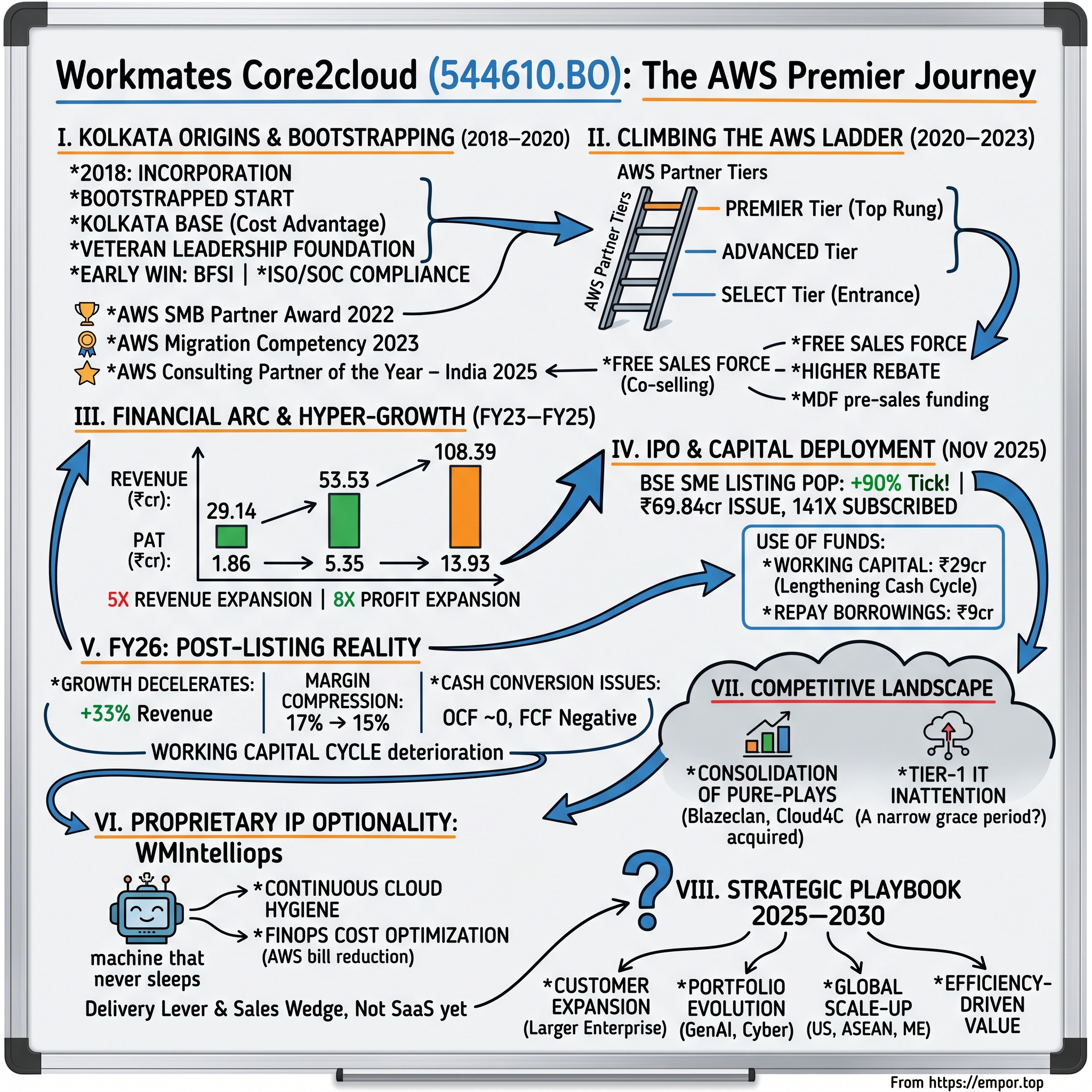
On the morning of November 18, 2025, a small company from a lane in east Kolkata — Rammohan Mullick Garden Lane, a street most of India's technology press had never heard of — watched its shares open on the BSE SME platform at ₹387.60 against an issue price of ₹204.12 Ninety percent, in the first tick. The grey market had been signalling a 41–43% premium; the actual open roughly doubled that.3 By the close of the debut session the stock settled at ₹368.25, still up more than 80%.3
Listing pops on India's SME exchanges are not, in themselves, evidence of anything. The BSE SME segment is structurally illiquid, lot sizes are enormous by retail standards — the minimum application here was 1,200 shares, or ₹2,44,800 — and a ₹69.84 crore offer subscribed 141 times leaves an enormous pool of disappointed bidders chasing a tiny float on day one.45 What makes Workmates Core2cloud Solution Limited interesting is not the pop. It is the seven years that preceded it.
The company was incorporated in November 2018.5 It was bootstrapped — no venture round, no private equity anchor, no founder with a Silicon Valley exit funding the runway. It was headquartered not in Bengaluru, Hyderabad, or Gurugram, the three cities that absorb the overwhelming majority of India's enterprise technology capital, but in Kolkata, a city whose reputation in Indian technology circles is politely described as "legacy." And within six years it had climbed to AWS Premier Tier Services Partner status — the top rung of Amazon Web Services' global partner hierarchy, held by a small minority of the tens of thousands of firms in the AWS Partner Network.6
The financial arc is genuinely unusual for an Indian IT services firm of this vintage. Consolidated revenue went from ₹29.14 crore in FY23 to ₹53.53 crore in FY24 to ₹108.39 crore in FY25.57 Profit after tax over the same window moved from ₹1.86 crore to ₹5.35 crore to ₹13.93 crore.5 In FY26 — the first full year as a listed company, which closed on March 31, 2026 — consolidated revenue reached roughly ₹144 crore and net profit ₹15.92 crore.78 That is a five-fold revenue expansion in three years and roughly eight-fold on profit, achieved with almost no external capital until the IPO.
The central question this story tries to answer is whether that arc is repeatable or whether it was a one-time ride on a specific wave. Workmates is, at its core, a specialist that has bet almost everything on a single hyperscaler's ecosystem, in a single country's mid-market, at a moment when cloud adoption in India was compounding at over 20% a year.9 The bull framing is that it has built a durable, high-return, asset-light services annuity with an emerging software layer on top. The bear framing is that it is a highly capable but ultimately dependent channel partner whose economics are set upstream by Amazon, whose talent can be poached by anyone with a bigger balance sheet, and whose recent numbers have already begun to show the strain of scaling.
Both framings deserve a real hearing, and the FY26 numbers — which arrived after the IPO documents were written — give us the first genuine post-listing evidence to test them against. There are things in those numbers that management's narrative does not fully explain.
Three themes run through everything that follows.
The bootstrapped crucible. A company that never took outside money until year seven develops a different metabolism than one that did. Every hire had to pay for itself. Every project had to convert to cash. Those constraints shaped the firm's early economics in ways that were enormously flattering — and that have started to unwind now that the company is trying to grow at a scale bootstrapping cannot fund.
The hyperscaler treadmill. Almost everything Workmates has — its lead flow, its credibility, its pre-sales budget, its rebate economics — flows through a partner programme designed and controlled by Amazon. Understanding how that programme works is not optional background. It is the business model.
The gap between the story and the disclosure. The equity narrative rests on a transition from one-off project revenue to durable recurring managed-services revenue, plus an emerging software layer. Both claims are plausible. Neither is currently verifiable from published financials, because the company does not disclose the numbers that would settle them.
Here is how the story unfolds.
We start in Kolkata in 2018, with a set of founders whose average age and résumé length were wildly atypical for a startup. We then climb the AWS partner ladder — a mechanism most public-market investors have never had explained to them properly, and which turns out to be the single most important thing to understand about this business. We work through the financial anatomy, including the parts that don't add up neatly. We size WMIntelliops, the proprietary software layer, honestly rather than optimistically. We war-game the competitive set, which has been consolidating aggressively around Workmates. We examine the IPO and what has happened to the shareholder register since. We run the strategy through Helmer and Porter. And we end with the small number of things that actually matter to track from here.
 Subscribe on LinkedIn
II. Kolkata Origins & Bootstrapping in the Shadow of Metros (2018–2020)
Picture the founding meeting that most Indian technology startups have. Two engineers in their late twenties, a whiteboard, a term sheet conversation scheduled for the following week.
Now picture the one that actually happened at Workmates. The man who would become Chief Executive Officer, Kamal Nath, had already spent more than thirty years in business management and technology leadership, including senior leadership roles at Sify Technologies and HCL Technologies.10 The man who would become Chief Financial Officer, Debasish Sarkar, was a chartered accountant with close to four decades of financial experience.11 The combined leadership team's experience was later described in IPO marketing materials as approaching a hundred years across cloud, IT, digital, enterprise technologies and finance.6 These were not people who needed to learn what an enterprise sales cycle looked like. They were people who had run them.
The exception — and the person who arguably shaped the company's technical destiny most — was Basanta Kumar Rana, the Managing Director. A graduate of Gopabandhu Science College under Utkal University in Odisha, Rana came in with roughly a decade in cloud computing, managed services and enterprise solutions, and became the architect of the AWS partnership strategy that defines the firm.12 The pairing is worth pausing on: a veteran executive layer that knew how to sell to Indian CIOs, and a younger technical layer that actually understood what a well-architected AWS landing zone looked like. Most Indian systems integrators of this size have one or the other. Having both, at founding, is the closest thing to a structural advantage this company had on day one.
The other founding decision was geographic, and it was not accidental. Workmates registered its office in Kolkata and built its early delivery capability there, later adding centres in Hyderabad and Bhubaneswar.11 The conventional reading — the one the company itself has encouraged — is a cost story. West Bengal and Odisha produce large volumes of engineering graduates who, absent a local employer of consequence, migrate to Bengaluru, Pune or the NCR. A firm that can offer them a serious technical career without the relocation captures talent at a materially lower loaded cost than a Bengaluru-based competitor bidding for the same person.
That logic is real, but it is worth being precise about what it does and does not buy you. Lower salaries lower your cost base only for as long as the employee has no better local alternative. The arbitrage is not a moat; it is a rent, and rents get competed away when a market develops. What it did buy Workmates was time — the ability to survive its first two or three years without burning venture money, and the ability to price aggressively into deals where a metro-based competitor's overhead made the same margin impossible. The company has never raised a venture round; the entire pre-IPO capital base was retained earnings and modest bank debt.11
That constraint shows up unmistakably in the early balance sheet. As of March 31, 2023 — nearly five years in — total assets stood at just ₹11.14 crore and net worth at ₹3.61 crore.4 This was a company running a real business on almost no capital. Its working capital cycle in FY23 was negative eight days, and it went to negative thirty-four days in FY24.7 For a services business, a negative working capital cycle means customers were effectively funding operations: cash came in from clients faster than it went out to vendors and payroll. That is either exceptional collections discipline, or a revenue mix with significant pass-through billing where the client pays before the vendor does, or both. We will return to that question, because it turns out to be the hinge on which a lot of the FY26 story swings.
The founding thesis itself was straightforward, and it was correct. India's mid-market — companies too large to run on a spreadsheet and a colocation rack, too small to employ a fifty-person internal cloud team — wanted to move to a hyperscaler and had no realistic way to do it alone. Hiring a certified cloud architect in 2018 meant competing with startups and multinationals for a scarce profile at metro salaries, to do a job that was intense for eighteen months and then largely maintenance. The economically rational answer for that customer was to rent the capability. Someone had to build the firm that rented it.
The early service mix was unglamorous. Traditional IT infrastructure support. Straightforward lift-and-shift migrations. The kind of work that pays the salaries but does not build a brand. What it did produce were the first reference customers in Banking, Financial Services and Insurance and in healthcare — verticals where the compliance burden is heaviest and the switching friction highest. By the time of the IPO, financial services accounted for 30.40% of revenue and IT/ITeS for 37.41%, with manufacturing at 8.74%, e-commerce at 6.02% and media at 4.58%.6 The BFSI concentration is not a coincidence; it is the compounding effect of early wins in a vertical where every subsequent prospect asks who else in banking you have done this for.
Why the compliance-heavy verticals mattered more than the revenue they produced. Financial services and healthcare are the hardest first customers a young infrastructure firm can take on, and that is precisely their value. A bank will not let a vendor near its production systems without documented change control, audited access management, encryption at rest and in transit, data residency guarantees and evidence trails that satisfy an external auditor. Doing that work once forces a firm to build an operating discipline that a general e-commerce client would never have demanded — and once built, that discipline becomes reusable across every subsequent deal.
It is also the reason the company later invested in formal certifications: ISO 9001:2015 for quality management and ISO/IEC 27001:2022 for information security, alongside reported SOC 2 compliance.36 For a firm bidding against competitors with larger brands, an auditable compliance posture is often what gets a small vendor past the procurement gate at a regulated buyer. This is unglamorous infrastructure-of-the-business investment, and it is the single most transferable thing the early BFSI wins produced.
The customer names the company has been willing to disclose publicly reflect this mix — including registrar and financial services firm KFintech, building materials manufacturer Century Ply, and the Bengali-language streaming platform Hoichoi, spanning fintech, manufacturing and media.13 What is notable about that list is its heterogeneity: these are not variations on a single workload type. A media streaming platform's cloud problem — unpredictable traffic spikes, content delivery cost, transcoding pipelines — has almost nothing in common with a registrar's, which is about compliance, uptime and audit. Serving both requires genuine architectural range rather than a single repeatable template, which is harder to scale but also harder for a narrower competitor to replicate.
The founding team's composition also tells you something about the kind of company this was designed to be. Beyond Nath, Rana and Sarkar, the co-founder group included Anirban Dasgupta, who took the Strategy and Growth brief, and Anindya Sen, who built the cybersecurity practice — a functional split that is notably more corporate than the typical two-founder startup, with Arunava Mukherjee later joining as Chief Technology Officer.11 Five or six people dividing a small company into strategy, delivery, security, finance and technology is what you do when you have all previously worked inside organisations that were structured that way. It brings discipline. It also brings overhead, and it means a larger group of people who must agree before anything changes.
The values the company later articulated publicly — customer obsession, innovation, agility, trust — are close enough to Amazon's own leadership principles that the resemblance is unlikely to be coincidental.11 That is a small detail with a larger implication: from very early on, this was an organisation that consciously modelled itself on the ecosystem it intended to join.
For an investor, the founding period matters less for what it produced financially than for what it selected for. A bootstrapped firm in a non-metro city with a veteran leadership team and compliance-heavy early customers develops a particular set of habits: obsessive cash conversion, conservative hiring, and a willingness to do unfashionable work. Those habits are assets. They are also, as we will see, exactly the habits that get tested when a company decides to grow at triple digits.
The thing that made triple-digit growth possible was a bet the founders made around 2020 — a bet to stop being a generalist.
III. The AWS Monotheism & The Hyperscaler Escalator (2020–2023)
Every Indian systems integrator of a certain size faces the same fork in the road, and almost all of them take the wrong turn.
The tempting path is multi-cloud. Your customers ask about Azure. Your customers ask about Google Cloud. Your sales team, quite reasonably, does not want to walk away from deals. So you staff a small Azure practice, a smaller GCP practice, and you tell prospects you are cloud-agnostic. What you have actually done is fragment your engineering depth across three ecosystems, dilute your certification density in all of them, and guarantee that you will never reach the top partner tier of any of them.
Workmates went the other way. It anchored its entire strategy on Amazon Web Services from inception and refused to dilute.11 To understand why that was the single most consequential decision in the company's history, you have to understand how hyperscaler partner programmes actually work — and this is genuinely under-explained in Indian equity research, so it is worth doing properly.
The escalator, explained in plain terms. Think of AWS not as a vendor but as a landlord with an enormous property and no staff to help tenants move in. Amazon sells compute, storage and services; it does not want to sell consulting hours. So it delegates the labour-intensive work — assessing a customer's existing servers, planning the migration, rearchitecting the applications, then running the resulting environment — to an ecosystem of partner firms. In exchange, it grades them.
The grading is a ladder. At the bottom sits the Select tier, which is essentially a registration. Above it, Advanced. At the top, Premier. Movement up the ladder is gated by things that are expensive and slow to accumulate: a minimum number of AWS-certified individuals on staff at particular certification levels, a minimum count of verified customer references where AWS itself has validated the outcome with the customer, demonstrated annual AWS revenue influenced or generated, and passage through structured technical audits. Layered on top of the tier system are Competencies — vertical or technical specialisations such as Migration, DevOps, Security, Data & Analytics, or Generative AI — each of which requires its own separate audit and reference set.
Workmates worked this ladder methodically. It secured the AWS SMB Partner of the Year award for India in 2022, added the AWS Migration Services Competency in 2023, reached Premier Tier Partner status in 2024, and was named AWS Consulting Partner of the Year – India for 2025.11 It has accumulated seven AWS competencies, including a Generative AI competency that places it among a relatively small global set of partners with that designation, and lists more than 120 AWS-certified professionals.1113
Why the top rung is worth so much more than the one below it. Premier status is not a badge for the website — or rather, it is that, but the badge is the least valuable part. The economically meaningful benefits are three. First, co-selling: an AWS enterprise account executive whose own compensation depends on driving customer consumption will introduce a Premier partner into a deal, because Premier partners are the ones AWS trusts not to blow up the account. This is, functionally, a free enterprise sales force. Second, rebate economics: partner margin on influenced or resold AWS consumption scales with tier, so the same rupee of customer cloud spend is worth more to a Premier partner than to an Advanced one. Third, Market Development Funds — AWS co-funding for proof-of-concepts, migration assessments and joint marketing, which lets a partner do expensive pre-sales work at Amazon's expense rather than its own.
Put concretely: the same engineer, doing the same migration, generates more total economics for a Premier partner than for an Advanced one, and the Premier partner spent less to find the customer in the first place. Tier is not a vanity metric. It is a direct input into the P&L.
That third mechanism is the one investors most often miss. In a normal services business, the cost of winning a large migration deal — the discovery workshops, the assessment, the pilot — is borne by the vendor and shows up as sales and marketing expense, depressing margins. In the hyperscaler channel, a meaningful portion of that cost can be pushed onto the platform owner. A partner that is good at harvesting MDF can therefore run a structurally lighter go-to-market cost than its reported margins would suggest is possible. Workmates does not disclose its MDF receipts, and there is no public figure for how much of its growth was platform-subsidised. That is a genuine gap in the disclosure, and it is the first question a serious analyst should put to management.
The wave they surfed. Timing helped enormously. The 2020–2023 window compressed roughly a decade of Indian enterprise cloud adoption into three years. Remote-work infrastructure had to be stood up in weeks rather than quarters. Digital-native startups flush with 2021 funding built cloud-first from day one. Established mid-market manufacturers and financial firms, who had been treating cloud migration as a five-year roadmap item, moved it to the current budget. India's public cloud services market was $10.9 billion in 2024 and is forecast by IDC to reach $30.4 billion by 2029, a 22.6% compound growth rate.9 A specialist partner sitting in the middle of that flow, with a hyperscaler sales team feeding it leads, did not have to be brilliant to grow fast. It had to be competent and available.
That distinction matters for the investment case. Between 2020 and 2025, market growth, channel subsidy and specialist positioning were all pushing in the same direction. Disentangling how much of Workmates' revenue compounding came from company-specific execution versus from simply being a well-certified AWS partner during India's cloud land-grab is not possible from the public disclosure. The honest answer is that it was substantially both, and that the second component is not repeatable at the same intensity — the Indian cloud market is still growing at over 20%, but it is no longer trebling.
A myth worth correcting. The most common framing of Workmates in Indian retail commentary is that Premier Tier status is a moat. It is not. It is a licence. The distinction matters enormously. A moat is something that prevents a competitor from doing what you do; a licence is something a competitor can also obtain by meeting the same published criteria. Persistent Systems reached Premier Tier in September 2023.20 Blazeclan held it before being acquired.16 Every large Indian IT services firm either holds it or could obtain it within a defined period by allocating budget to certifications and reference-building. What Premier status genuinely provides is qualification — access to shortlists, co-sell motion, better rebate economics — and that is valuable. But treating it as a durable competitive advantage confuses a barrier to entry into the process with a barrier to competition within it. The real question is not whether Workmates has Premier status; it is what the firm does with the deal flow that status generates, and whether the resulting customer relationships are stickier than the certification that opened the door.
This is not a semantic quibble. It determines how much of the business's value should be attributed to something the company owns versus something it holds at another party's discretion.
The second myth is the certification count itself. Seven competencies and 120-plus certified professionals sound like a fortress until you remember what a certification is: an individual credential, held by an individual, portable to any employer. The company's competency portfolio is an aggregation of its people's credentials. It is not, in any accounting or legal sense, an asset the company owns. It is an asset the company rents from its staff, renewable annually, at a price set by the labour market. That is a more accurate mental model, and it explains why attrition disclosure matters so much more here than in a capital-intensive business.
Which brings us to the numbers themselves, and to the parts of them that reward close reading.
IV. Financial Anatomy & Segment Economics: Projects vs. Recurring MSP
There is a specific moment in the life of a fast-growing services company when the income statement stops telling you the truth and the cash flow statement starts. Workmates reached it in FY26.
Start with the headline arc, because it is genuinely impressive. Consolidated revenue: ₹29.14 crore in FY23, ₹53.53 crore in FY24, ₹108.39 crore in FY25, roughly ₹144 crore in FY26.57 Net profit: ₹1.86 crore, ₹5.35 crore, ₹13.93 crore, ₹15.92 crore over the same four years.58 Operating margin expanded from 9% in FY23 to 14% in FY24 to 17% in FY25 — the classic signature of operating leverage, where a largely fixed engineering and management overhead gets spread across a rapidly widening revenue base.7 In FY25 the company reported EBITDA of ₹19.05 crore on revenue from operations of ₹107.65 crore, an EBITDA margin of 17.58%, with a PAT margin of 12.85%.614
The return profile in those years was extraordinary — and that is not a compliment so much as a description. Return on capital employed was reported at 119% in FY23 and 92% in FY24; return on equity for FY25 came in at 67.44% on the restated basis used in the offer documents.714 Numbers like those do not indicate a fantastically profitable business. They indicate a business running on almost no capital. When your entire net worth is ₹8.96 crore and you earn ₹5.35 crore, the ratio is arithmetically spectacular and economically close to meaningless. What it does tell you is that the model was, at that stage, genuinely asset-light: no data centres, no significant capex, just people and software subscriptions.
Now the part that requires attention. In FY26, revenue grew about 33% and profit about 14%.78 Operating margin fell from 17% to 15%. Split by half, the deceleration is sharper than the annual figure suggests: consolidated revenue in the first half of FY26 was approximately ₹75 crore against ₹48 crore in the corresponding prior half — around 56% growth — while the second half came in at roughly ₹69 crore against ₹60 crore, growth of about 15%.7 Second-half revenue was lower than first-half revenue, and second-half operating margin fell to 13% from 17%.7
Half-yearly reporting on the SME platform makes it impossible to know whether that was a single lumpy project rolling off, a seasonal pattern, or the beginning of a trend. But the direction is clear: the hyper-growth phase decelerated in the first full year as a public company, and it decelerated on margin as well as on revenue. That is a materially different picture from the one the IPO marketing conveyed, and it happened fast.
The cash conversion problem. More important than the margin dip is what happened beneath it. Cash from operating activities was approximately ₹10 crore in FY24, fell to about ₹5 crore in FY25 despite profit nearly tripling, and was approximately zero in FY26 against reported profit of ₹15.92 crore.7 Free cash flow was negative in both FY25 and FY26.7
The mechanism is visible in the working capital metrics. Debtor days went from 37 in FY24 to 84 in FY25 before easing to 74 in FY26.7 The working capital cycle swung from negative 34 days in FY24 to positive 11 days in FY25 to positive 59 days in FY26 — a 93-day deterioration across two years.7 In plain terms: the company that once collected from clients before it had to pay its own bills now finances roughly two months of its own operations. Every rupee of incremental revenue now consumes cash rather than releasing it.
There are benign explanations. Moving upmarket to larger enterprise clients almost always lengthens payment terms — a ₹50 crore bank does not pay like a ₹5 crore startup. Larger managed-services contracts require the provider to carry more inventory of committed capacity. Growth itself mechanically consumes working capital. Management framed the asset-light model and financial prudence as core to the story in pre-IPO materials, with the CFO describing growth as "built on strong fundamentals best reflected in our financial prudence, an asset-light model, and deep customer focus."11 Asset-light and working-capital-light are not the same thing, and the FY26 statements make that distinction concrete. This is the single most important disclosure gap to press management on, and there is no public transcript in which they have been pressed.
What the segment split actually is — and isn't. The company markets three broad service families: cloud consulting and migration; managed services on AWS delivered on an annuity basis; and specialised work spanning cybersecurity, data and generative AI.13 What it does not publish is a revenue split across those families. Any specific percentage attributed to migration versus managed services versus GenAI in secondary commentary is an estimate, not a disclosure. Management has consistently characterised managed services as the annuity engine and stated an intent to expand it, but the actual mix is not disclosed.11 For a business whose entire equity story rests on the shift from project revenue to recurring revenue, that is a conspicuous omission — and it means investors currently have no way to verify the thesis they are being sold.
The revenue-per-employee puzzle. Here is a number worth sitting with. As of March 31, 2025, Workmates had 129 employees.4 FY25 consolidated revenue was ₹108.39 crore. That is roughly ₹84 lakh of revenue per employee — approximately $100,000 at prevailing rates. India's largest IT services firms typically run in the $45,000–$55,000 range. Workmates is reporting roughly double the revenue intensity per head of TCS or Infosys, while earning a lower EBITDA margin than either.
There are two readings, and investors should hold both. The generous one: a small, senior, heavily certified team doing high-value architecture work genuinely can out-produce a pyramid-shaped delivery organisation stuffed with junior engineers. The sceptical one: a material portion of reported revenue is not services at all but resale of AWS consumption — the partner bills the customer for the cloud bill and books the gross amount as revenue, earning a thin spread. That would simultaneously explain very high revenue per head, mid-teens rather than high-twenties EBITDA margins, and the historically negative working capital cycle, since cloud resale is typically collected from the customer before the settlement to the hyperscaler falls due.
If the resale reading is substantially correct, then "revenue growth" and "services growth" are different things, the margin profile is more fragile than it looks, and the reported revenue base is partly a function of AWS's pricing rather than Workmates' own. The company has not disclosed a gross-versus-net revenue breakdown. Until it does, the honest position is that the quality of the revenue line is unverified.
The customer concentration question. Workmates has described serving more than 300 customers, with over 350 projects completed and, per its own website, more than 750 delivered engagements.413 A base that wide should mean low dependency on any single account. But wide client counts in services businesses routinely coexist with severe revenue concentration — a hundred small accounts and five large ones that together produce half of revenue is the normal shape. The offer document contains the top-customer disclosure that would settle this; the summary materials available publicly do not reproduce it, and no post-listing update has been published. Given that the second half of FY26 saw revenue fall sequentially, the possibility that a large engagement rolled off is exactly the kind of thing concentration disclosure would illuminate. It is unresolved.
What the balance sheet does well. It is worth being explicit that the criticisms above are about revenue quality and cash conversion, not solvency. Debt was fully repaid — borrowings stood at ₹9 crore at the end of FY25 and zero at the end of FY26.7 Reserves built to roughly ₹75 crore against equity capital of ₹13 crore, giving a book value per share of about ₹68.7.17 Total assets roughly doubled to ₹108 crore.7 And the company declared an interim dividend of ₹2 per share with an ex-date of May 22, 2026 — an unusual and creditable signal from a company barely six months listed, and one that is genuinely at odds with the stereotype of the SME-platform issuer that raises money and goes quiet.8
Reading the two halves together: this is a debt-free, dividend-paying, profitable company whose reported earnings are real but whose earnings quality has deteriorated meaningfully as it scaled. Those are not contradictory statements. They are the normal condition of a services firm moving upmarket faster than its collections function can follow. Whether it is temporary is the question, and the answer arrives in the FY27 numbers.
One of the proposed answers to the margin question is software. It deserves a careful look.
V. Proprietary IP Optionality: Sizing WMIntelliops
Every services firm eventually has the same conversation in a conference room. Someone points out that the team has now done the same thing eighty times. Someone else asks why they are still doing it by hand.
For Workmates, the eighty-times problem was cloud hygiene. When you manage a few hundred AWS environments for a few hundred clients, you are performing the same audits over and over: which storage buckets are exposed to the public internet, which servers have been sitting idle for six weeks burning money, which databases are running unencrypted, which reserved instance commitments the customer bought and is not using. Doing this manually is expensive, tedious, and — critically — impossible to do continuously. A human consultant audits an environment quarterly. Cloud environments change hourly.
So the team built the machine that never sleeps.
WMIntelliops was the answer. The product, hosted at wmintelliops.com, combines automation, governance, security and FinOps tooling aimed specifically at maximising the value a customer extracts from AWS.15 The outcomes it claims are the ones you would expect from a mature cloud operations platform: faster incident resolution, AI-assisted root cause analysis, continuous alignment with the AWS Well-Architected Framework, intelligent cost optimisation, and reduced operational overhead.15
What that means without the jargon. Two analogies help. On the security and governance side, think of it as a building inspector who never leaves the building — instead of walking through once a quarter with a clipboard, the system watches every door and window continuously and raises an alarm the moment someone props one open. On the cost side — the FinOps function — think of it as an energy audit that runs permanently: it finds the lights left on in empty rooms, notices you are paying peak rates for off-peak usage, and flags the bulk-purchase contract you signed and are only half using. In cloud terms, that translates to identifying idle compute instances, right-sizing over-provisioned servers, and making sure Reserved Instances and Savings Plans — AWS's discount-for-commitment products — are actually being consumed rather than sitting unused.
The strategic logic is elegant and worth spelling out, because it explains why a services firm builds software at all. Cloud cost optimisation is the ideal sales wedge. A prospect does not have to believe anything about your architecture credentials to be interested in a free scan of their AWS bill. Run the tool, produce a report showing 18% of their monthly spend is waste, and you have converted an abstract vendor pitch into a concrete number with the CFO's name on it. That is a materially easier conversation than "we are a Premier partner." From there, the managed services contract follows.
Now the honest sizing. WMIntelliops does not appear as a disclosed revenue segment anywhere in the company's public financial reporting. There is no published figure for licences sold, annual recurring revenue attributable to the platform, standalone customers, or gross margin. The company describes itself as having developed twelve-plus proprietary solutions, which suggests WMIntelliops sits within a broader internal tooling portfolio rather than standing alone as a product line.13
The realistic characterisation, based on what is disclosed, is that WMIntelliops currently functions as a delivery-cost lever and a sales accelerant, not a software business. It makes each managed-services engagement cheaper to run — fewer engineer-hours per client environment — and it makes prospects easier to convert. Both are real economic benefits. Neither shows up as software revenue, and neither commands a software multiple.
The bull case for it as genuine optionality rests on a transition that has not yet happened: packaging the platform for standalone sale, to customers who are not Workmates managed-services clients, at a gross margin materially above services economics. That transition is hard, and it is where most services-to-product stories die. The reasons are structural. Selling software requires a fundamentally different motion — product management, a roadmap, support tiers, competitive feature parity — and the competitive set for cloud FinOps and governance tooling is brutally crowded, populated by well-funded specialists and, critically, by AWS's own free and low-cost native services. Amazon ships Cost Explorer, Compute Optimizer, Trusted Advisor, Security Hub and its own well-architected tooling. A partner-built layer has to be meaningfully better than free, permanently, in a domain where the platform owner ships new capability every quarter.
There is also an uncomfortable strategic tension. The better WMIntelliops gets at cutting a customer's AWS bill, the smaller that customer's AWS consumption becomes — and a partner's tier standing, rebate economics and co-sell access are all a function of driving consumption. A tool that is genuinely excellent at FinOps is, in a narrow sense, working against the interest of the ecosystem that gives Workmates its distribution. In practice partners resolve this by arguing that cost-optimised customers migrate more workloads, and there is truth in that. But the tension is real and it caps how aggressively the product can be positioned.
There is one further consideration that cuts in Workmates' favour, and it deserves acknowledgement. Cost-optimisation tooling in a managed-services relationship does not have to beat AWS's native tools on features. It has to beat them on attention. AWS Cost Explorer will faithfully report that a customer is wasting money; it will not call the customer's engineering lead, negotiate the change window, and execute the shutdown. The service wrapper around the software is what converts a report into a saving, and that wrapper is exactly what a managed-services provider sells. Judged that way, WMIntelliops is less a competitor to AWS's native tooling than a delivery layer on top of it — which is a more defensible position than a head-to-head product fight, and also a smaller one.
The disciplined way to hold WMIntelliops in an investment case is as free optionality with a small positive expected value: it is almost certainly improving delivery margins today by some undisclosed amount, and it might one day become a revenue line. It should not be capitalised in a valuation until the company discloses a number. Management has not provided one, and until it does, any valuation premium ascribed to "SaaS IP" is an act of faith rather than analysis.
It is also worth noting what the IPO documents chose not to fund, since that is management's own revealed preference. If the leadership team genuinely believed WMIntelliops was on the cusp of becoming a product business, the natural use of a ₹59 crore fresh issue would have included a product engineering allocation. It did not.2 That is not a criticism of the capital allocation — funding working capital and repaying debt were defensible priorities — but it is informative about how the people closest to the asset actually rank it.
Faith is in shorter supply when you look at who Workmates is actually competing against — and at what has been happening to that peer group.
VI. Industry Structure, Named Competitors, & Competitive Dynamics
Here is a fact that should focus the mind of anyone holding this stock: over the eighteen months before Workmates listed, two of the most credible independent cloud specialists in India ceased to be independent.
In April 2024, ITC Infotech announced the acquisition of 100% of Blazeclan Technologies, a Pune-headquartered born-in-the-cloud consultancy founded in 2010, an AWS Premier Partner and Snowflake Elite Partner, with cloud competency centres across Australia, Singapore, Malaysia and India.16 The deal was reported at approximately ₹485 crore.17 In August 2025, Capgemini announced its intention to acquire Cloud4C, the Hyderabad-based multi-cloud managed services provider, closing the transaction on November 3, 2025 — fifteen days before Workmates listed.1819 Cloud4C brought a 1,600-strong team specialising in automation-driven managed services for hybrid and sovereign cloud.18 Earlier, Persistent Systems had acquired MediaAgility, a Google Cloud Premier Partner with 500-plus employees across the US, Mexico, the UK and India, and had itself achieved AWS Premier Tier Services Partner status in September 2023.2021
Read that sequence as a market signal rather than as trivia. It tells you three things. First, the standalone cloud-specialist model in India has a well-established exit path, and strategic buyers will pay real money for certified capability and reference customers — ₹485 crore for Blazeclan is a meaningful benchmark for a firm of that profile. Second, the large IT services firms concluded it was cheaper to buy this capability than to build it, which is a genuine endorsement of the scarcity of the asset. Third, and less comfortably, Workmates now competes against the same specialists it used to face, except those specialists are now backed by Capgemini's and ITC's balance sheets, brand, and global client relationships. The playing field the company grew up on has changed underneath it.
The competitive set, in three tiers.
The tier-1 Indian IT giants — TCS, Infosys, Wipro, HCLTech, LTIMindtree — operate multi-billion-dollar cloud practices with certified populations orders of magnitude larger than Workmates'. But their commercial model is built for Fortune 500 global accounts with multi-year, multi-hundred-crore engagements. The economics of assigning a senior partner and an account team to a ₹2 crore migration for a mid-sized Indian manufacturer simply do not work for them. This is the gap Workmates occupies, and it is a real gap — but it is a gap defined by the inattention of larger players, not by any barrier preventing them from entering. Inattention is not a moat. It is a grace period.
The boutique pure-play cloud partners are the genuine head-to-head competition: Minfy Technologies, which holds the AWS MSP designation and competes directly for Indian mid-market AWS work22; ShellKode; Locuz Enterprise Solutions; and now the acquired-but-still-operating Blazeclan and Cloud4C franchises. In a competitive bid for a ₹5 crore migration-plus-managed-services deal at an Indian mid-market enterprise, these are the names on the other side of the table. Differentiation between them is thin and increasingly hard to sustain — all of them are AWS-certified, all of them have reference customers, all of them can build a landing zone. Price becomes the variable.
The IT distributors and cloud resellers — Redington, Rashi Peripherals, Ingram Micro — sit further down the value chain, moving cloud credits at volume with minimal professional services attached. They rarely win engineering-led deals, but they exert steady downward pressure on the resale spread component of the market. If a meaningful portion of Workmates' revenue is indeed resale-linked, this is where the margin pressure comes from.
How deals are actually won and lost. Workmates wins when the customer is an Indian mid-market enterprise, the workload is AWS-native or AWS-destined, speed matters more than global footprint, and the buyer needs a partner whose senior people will actually show up. Premier Tier status and seven competencies function as pre-qualification — they get the firm onto shortlists it would otherwise never see — and the cost structure lets it price under a metro-based or global competitor while preserving margin.13
It loses in three recognisable situations. The first is genuine multi-cloud mandates, where the customer runs material workloads on Azure or Google Cloud and wants equal depth across all three. Workmates' single-platform focus, its greatest strength in AWS deals, is a disqualifier here — and this is precisely where the newly-acquired Blazeclan and Cloud4C franchises, both explicitly multi-cloud, have the advantage. The second is complex legacy modernisation — mainframe, large-scale SAP transformation, deep industry-vertical application rewrites — where the required domain depth sits with the tier-1s.
The third is global delivery: a multinational needing follow-the-sun support across a dozen countries will not award that to a firm whose international presence, as disclosed, spans India, Singapore, Australia, the US, Bangladesh and the UAE with a workforce measured in the low hundreds.611
The consolidation cuts both ways. There is a genuinely optimistic reading of the same facts, and intellectual honesty requires stating it. When Capgemini absorbs Cloud4C and ITC Infotech absorbs Blazeclan, those franchises do not simply get stronger — they also get slower, more expensive, and more focused on their new parents' large-account priorities. Integration is disruptive. Senior people leave. Deal approval chains lengthen. Pricing discipline tightens, because a Capgemini subsidiary cannot quote at a Hyderabad boutique's rate card without cannibalising the parent.
For an Indian mid-market CIO who wants a partner that will answer the phone and quote a sensible number, the pool of credible independents just shrank by two — and Workmates is one of the few remaining. Consolidation is a threat to the competitive landscape and simultaneously a gift to whoever stays independent and competent.
Which of those effects dominates is an empirical question that will resolve over two or three years. The tell will be in Workmates' own win rates and pricing, neither of which it discloses. But the structural point stands: the scarcity of independent, Premier-tier, India-focused AWS specialists is rising, and scarcity has value both operationally and, eventually, as an acquisition candidate.
The strategic conclusion an investor should draw is therefore uncomfortable but not fatal. Workmates occupies a defensible niche today, defined by certification density, cost position and mid-market focus. But the niche is narrowing at both ends — from above, as consolidated competitors bring global balance sheets to the same customers, and from within, as the specialist peer group standardises. The company's answer has been to try to grow out of the niche: upmarket into larger enterprises, outward into new geographies, and eventually toward multi-cloud. Executing that requires capital, and capital is what November 2025 was about.
VII. The BSE SME IPO & Capital Deployment (Nov 2025)
The anchor book opened on November 10, 2025. The public issue ran from November 11 to 13. Allotment was finalised on November 14. Listing followed on November 18.24 Eight days, start to finish, for a company that had spent seven years without a rupee of outside equity.
The structure was a book-built issue of 34,23,600 equity shares of ₹10 face value at a price band of ₹200–204, aggregating ₹69.84 crore at the upper end.45 Of that, 29,08,800 shares constituting ₹59.34 crore was a fresh issue, with the remaining 5,14,800 shares — approximately ₹10.50 crore — sold by existing shareholders as an offer for sale.45 Horizon Management Private Limited acted as book running lead manager, MUFG Intime India as registrar, and Giriraj Stock Broking as market maker.2 Allocation followed the standard SME split: 50% to qualified institutional buyers, 15% to non-institutional investors and 35% to retail.4
The subscription data is worth reading carefully, because it says more about market conditions in late 2025 than about the company. Total subscription was 141.45 times. QIBs bid 147.03 times. Retail came in at 111.64 times. And the non-institutional book — the high-net-worth segment, which in Indian SME issues is the most leverage-driven and most listing-pop-oriented cohort — subscribed 203.31 times, with the large-HNI category above ₹10 lakh reaching 245.41 times.5 When the HNI book is bid at nearly twice the institutional multiple, the marginal buyer is not underwriting a seven-year business plan. They are underwriting a listing-day trade.
The valuation the company accepted. At ₹204 per share, the issue implied a post-issue market capitalisation of approximately ₹263.54 crore, a post-issue price-to-earnings ratio of about 15.2 times on FY25 earnings and a price-to-book of roughly 8.9 times.5
Fifteen times earnings for a business that had just grown revenue by more than 100% is, on its face, a modest ask. Two things explain it. The first is the SME platform itself, which carries a structural discount for illiquidity and lighter disclosure. The second is that the price-to-book of 8.9 times tells the more honest story: the company had almost no book value to price, because it had almost no capital. Pricing a firm on earnings when those earnings sit on a ₹22.89 crore net worth is a different exercise from pricing an established business, and the market's willingness to bid the stock to ₹387.60 on day one had far more to do with a 141-times-subscribed book chasing a small float than with any considered view of terminal value.35
By mid-2026 the stock had traded a 52-week range of ₹264 to ₹514 and settled near ₹333, valuing the company at roughly ₹431 crore on a trailing P/E of about 26 and a book value per share of ₹68.7.18 In other words: the multiple roughly expanded from 15 to 26 while earnings growth decelerated from triple digits to the mid-teens. That is a re-rating driven by scarcity of supply, not by improving fundamentals — a distinction that matters a great deal for anyone considering the stock at these levels.
Where the money went. The disclosed objects of the fresh issue were narrow and specific: ₹860 lakh toward prepayment or repayment of secured borrowings from banks and financial institutions, and ₹2,920 lakh toward funding working capital requirements, with the balance for general corporate purposes.25
That allocation deserves attention because of what it does not contain. There is no line item for WMIntelliops product development. There is no line item for acquisitions. There is no line item for building an Azure or GCP practice. Roughly ₹29 crore of a ₹59 crore fresh issue — the largest single use — went to working capital.
In light of the FY26 cash flow statement discussed earlier, that allocation now looks less like growth capital and more like a necessary correction: the company raised equity substantially to fund the lengthening cash cycle that its own growth had created. The debt repayment was executed — borrowings went from ₹9 crore at March 2025 to nil at March 2026, and financing activities contributed approximately ₹38 crore of inflow in FY26, consistent with the net IPO proceeds.7
Whether that is prudent or disappointing depends on what an investor thought they were buying. It is unambiguously prudent balance-sheet management. It is also not the aggressive product-and-geography investment the surrounding narrative implied. The stated growth agenda — the "Growth Playbook 2025–2030" with its four pillars of customer expansion into larger enterprises, portfolio evolution into cybersecurity and GenAI, global scale-up across ASEAN, the Middle East, the UK, the US and Australia, and efficiency-driven value — is real as an intent, but the IPO did not fund it as a line item.11
Promoter economics and governance. Promoter holding stood at 98.10% before the issue and 72.03% after — a substantial retained stake that keeps founder and shareholder incentives broadly aligned, and one that has remained unchanged through March 2026 with no pledging or selling disclosed.47 The offer for sale component was modest at roughly 15% of the total issue, meaning the great majority of what investors paid went into the company rather than into founders' pockets. On the standard governance checklist for Indian SME listings, where promoter cash-outs and post-listing stake reductions are chronic problems, this is a clean result so far.
One structural detail is worth flagging without over-reading it. IPO documentation identified seven promoters — Debasish Sarkar, Kamal Nath, Anindya Sen, Anirban Dasgupta, Prajnashree Mohapatra, Shilpa Mohta and Anjali Awasthi — a list that does not correspond exactly to the operating leadership team, and which notably does not include Managing Director Basanta Kumar Rana in the versions of the offer summary available publicly.4 Promoter classification under SEBI rules is a technical determination and there may be an entirely ordinary explanation. But for a company where the Managing Director is publicly described as the architect of the AWS partnership that constitutes the core asset, an investor should verify from the offer document itself how his economic interest is structured and how it is aligned over time. Key-person dependency in a firm of this size is not a theoretical risk.
What the register has done since. The most telling post-listing data is in the shareholding pattern. In the period immediately following listing, domestic institutions held 10.84% and foreign institutions 1.73%, with 1,322 total shareholders. By March 2026, domestic institutional holding had fallen to 6.60%, foreign institutional holding was no longer separately reported, and the total shareholder count had declined to 986.7 Institutional money that came in at the IPO has been reducing, and the shareholder base has narrowed.
For a stock that traded between ₹264 and ₹514 over the following year against an issue price of ₹204 and settled around ₹333 by mid-2026 — a market capitalisation of roughly ₹431 crore at a trailing P/E near 26 — that combination of institutional exit and thin register is the defining liquidity characteristic of the SME platform.18 It is not a comment on the business. It is a comment on what it costs to own a business that trades this thinly.
Understanding whether the business itself has durable advantages requires stepping back from the tape.
VIII. Strategic Frameworks: Hamilton Helmer's 7 Powers & Porter's 5 Forces
Frameworks are only useful if you are willing to score honestly, including the zeroes. Applied to Workmates, most of the boxes come back weaker than the narrative suggests, and one comes back stronger.
Hamilton Helmer's 7 Powers.
Switching costs — the strongest claim, and it is real. Once a client's production infrastructure, deployment pipelines, monitoring, alerting and security posture are operated inside a managed-services provider's framework, replacing that provider is not a procurement exercise. It is a migration. The incumbent has accumulated undocumented knowledge — which alerts are noise, which application misbehaves under load, which compliance evidence the auditor wants — that a competitor must rebuild from scratch at the customer's risk. This is why cloud MSP contracts renew at high rates across the industry. It is a genuine power, and it is the load-bearing element of the recurring-revenue thesis. The caveat is that it only applies to the managed-services book, and Workmates does not disclose how large that book is.
Process power — plausible but unproven. Standardised migration frameworks and WMIntelliops automation should mean fewer engineer-hours per client environment than a competitor achieves. The FY25 revenue-per-employee figure is consistent with unusually high throughput. But as discussed, that figure has an alternative explanation in revenue mix, and the FY26 margin compression argues against efficiency gains that are actually compounding. Process power should show up as margins that rise with scale; FY26's did the opposite.
Counter-positioning — mislabelled. A lower cost base from operating outside metro hubs is a cost advantage, not counter-positioning. Helmer's concept requires that the incumbent cannot respond without damaging its existing business. Nothing prevents TCS or Infosys from opening a Kolkata or Bhubaneswar delivery centre; several tier-1 firms already operate in tier-2 Indian cities. The correct label is a modest, contestable cost position that persists only while larger firms find the mid-market segment uninteresting.
Scale economies — currently absent. With a workforce in the low hundreds, Workmates has no scale advantage against anyone in the tier-1 set, and limited advantage against the consolidated specialists. AWS rebate tiers do scale with volume, so there is a path here, but it runs through revenue levels several multiples above current.
Network economies, branding and cornered resource — not applicable, or partial. There is no network effect in cloud consulting. Brand exists within the AWS ecosystem — Consulting Partner of the Year for India in 2025 carries real weight in a competitive bid — but it does not extend to end-customer preference the way a consumer or even a tier-1 IT brand does.11 The nearest thing to a cornered resource is the certified engineering population and the seven competencies, which took years to build. But certifications sit with individuals, and individuals can resign.
Porter's 5 Forces.
Supplier power — very high, and this is the defining risk. Amazon is not a supplier in the ordinary sense; it is simultaneously the platform, the primary demand generator, the arbiter of partner tier, the setter of rebate economics and the allocator of market development funds. It sets these terms unilaterally and revises them periodically.
A change in Premier tier qualification criteria, a reduction in partner margin, a shift in MDF policy, or a decision to route more mid-market business through a different partner cohort would each hit Workmates' economics directly, with no negotiating leverage available. There is no publicly disclosed contractual protection against any of this, and no realistic near-term diversification given that single-platform focus is the source of the qualification in the first place. This is a genuine, structural, unmitigated dependency, and it is the reason a business growing this fast trades at a modest multiple.
Competitive rivalry — high and intensifying. Covered above; the acquisitions of Blazeclan and Cloud4C by ITC Infotech and Capgemini respectively have raised the resources deployed against the same customer set.
Threat of new entrants — moderate, and asymmetric. Starting a cloud consultancy requires almost nothing. Reaching Premier Tier with seven competencies requires years, a certified population and validated customer references. The barrier is therefore low at the bottom and high at the top — which protects Workmates from price-only entrants but not from a funded entrant willing to spend three years climbing, and certainly not from an established firm that acquires its way in.
Buyer power — moderate and rising. Mid-market Indian enterprises are price-sensitive by nature, and the maturation of cloud spending has made them more so: the CFO who approved an open-ended cloud migration budget in 2021 now scrutinises the monthly bill. Rising demand for FinOps is, from the buyer's side, a demand for lower spend. Since a partner's rebate and tier economics scale with customer consumption, sophisticated buyers exert pressure on both the fee line and the resale line simultaneously.
Threat of substitutes — low to moderate. The primary substitute is the customer building an in-house cloud team, which for a mid-market Indian enterprise is expensive and hard to staff. But the substitute is getting cheaper. Cloud platforms have spent five years making their own tooling more automated and more self-service, and AI-assisted operations tooling is compressing the labour content of exactly the routine monitoring, patching and optimisation work that constitutes a managed-services contract. This substitute is not urgent, but it is directionally adverse.
The framework exercise resolves to a specific conclusion: Workmates has one real power — switching costs on its installed managed-services base — sitting inside an industry structure where the most powerful actor is its own most important partner. That is a coherent business. It is not a fortress. What it means for the investment case deserves its own reckoning.
IX. The Investment-Story Spine: "Why Win / Why Not Win" & Skeptical Stress Test
Strip away the narrative and the case comes down to three arguments on each side. It is worth stating both as strongly as the evidence allows, and then testing which claims are actually supported.
Why Workmates wins from here.
First, the scarcity of the position. There are not many firms in India that combine AWS Premier Tier status, seven competencies including Generative AI, a mid-market cost structure, and an owner-operator management team with three decades of enterprise experience.1113 The strategic buyers have demonstrated with cash what that combination is worth — ITC Infotech paid roughly ₹485 crore for Blazeclan, and Capgemini bought Cloud4C's 1,600-person franchise outright.1718 Workmates' entire market capitalisation was around ₹431 crore in mid-2026.8 The scarcity argument is the strongest single element of the bull case because it is corroborated by third-party transactions rather than by management assertion.
Second, the annuity transition. If managed services genuinely become the dominant share of revenue, the business changes character — from lumpy project work with visible half-to-half volatility to a subscription-like base with high renewal rates and predictable capacity planning. Switching costs make that base defensible once established. The evidence supporting this is directional rather than quantitative: management has consistently described the annuity model as central across pre-IPO materials, and the service portfolio is structured around it.11 But the mix is not disclosed, so the claim is untested.
Third, the AI-driven modernisation cycle. Indian enterprises building generative AI applications on AWS Bedrock and SageMaker need partners who understand data architecture, security and cost governance — and Workmates' GenAI competency puts it in a narrow qualified set.11 India's public cloud market compounding toward $30.4 billion by 2029 means the addressable pool is expanding regardless of share.9
Why it might not.
First — and this is the one that matters most — the platform dependency is absolute. Every advantage described above is denominated in AWS. Premier status, competencies, co-sell access, rebate economics, market development funds, and the technical specialisation of the engineering base all derive from one company's partner programme. Amazon can revise the terms of that programme at any time and has done so repeatedly across its history. The company has no disclosed hedge. Building an Azure or GCP practice of comparable depth would take years, cost real money that the IPO did not allocate to it, and would dilute the very focus that produced Premier status. This is not a risk that can be managed; it is a condition of the business model.
Second, the FY26 numbers already show strain. Revenue growth decelerated from roughly 102% in FY25 to 33% in FY26, second-half revenue fell below first-half revenue, operating margin compressed, and — most seriously — operating cash flow collapsed to approximately zero against ₹15.92 crore of reported profit.78 A company can grow while consuming cash; a company cannot do so indefinitely without either raising more equity or slowing down. The IPO already directed its largest single tranche to working capital. If the cycle does not normalise in FY27, the question of a second raise becomes live, and a second raise from an SME-platform company with an institutional base that has been shrinking is not a comfortable position.
Third, talent is the asset and it walks. The entire enterprise value rests on a certified engineering population reported at 129 employees as of March 2025 and roughly 160-plus professionals by late 2025.411 AWS-certified solutions architects with production migration experience are among the most portable professionals in Indian technology. Global capability centres, which have proliferated across Indian cities including tier-2 locations, hire exactly this profile and pay above local market. The Kolkata cost advantage that funded the early years erodes precisely when the local market develops — and a company that has just achieved national visibility through a well-publicised IPO has made its own staff easier to find. The company does not disclose attrition, which for a business whose primary asset is people is a significant reporting gap.
Fourth, the hyperscaler is also a competitor. AWS ships increasingly capable native tooling for migration assessment, cost optimisation, security posture management and operations automation — much of it free. Every capability Amazon automates removes billable work from the partner channel. Generative AI accelerates this: code conversion, infrastructure-as-code generation, log analysis and incident triage are all being automated by AI-assisted tooling, and those are the labour-intensive middle of a managed-services engagement. A partner's defence is to move up the value chain toward architecture and industry-specific solutions faster than automation eats the base. Whether Workmates can run that race is genuinely unknown.
Fifth, the SME platform itself. Wide bid-ask spreads, a register that has contracted to 986 shareholders, and reduced institutional participation together mean price discovery is unreliable and exit is expensive.7 Migration to the BSE mainboard would address this, but it requires meeting eligibility thresholds and is not automatic.
Sixth, a risk the sector rarely discusses openly: security incident exposure. Workmates holds administrative credentials to the production cloud environments of hundreds of enterprises, including a client base roughly 30% weighted to financial services.6 It maintains ISO 9001:2015 and ISO/IEC 27001:2022 certifications and reports SOC 2 compliance, which is the appropriate posture.36 But the structural exposure is asymmetric in a way that certifications do not neutralise: a single compromise of a managed-services provider's credential store can cascade across every client environment it touches, and the reputational consequence for a firm whose entire proposition is trusted access would be severe and immediate. Managed service providers have been a favoured target vector globally for precisely this reason. This is a low-probability, high-severity risk that does not appear in most retail analysis of the name, and it is worth holding in mind for any business whose product is administrative access to other people's infrastructure.
The activist's questions. A sceptical investor with a seat across the table would ask five things, and none of them currently have public answers. What percentage of revenue is AWS resale versus own services, on a gross and net basis? What is the split between project and annuity revenue, and what is the renewal rate on the annuity book? What was employee attrition in FY25 and FY26, and what is the certified-engineer headcount trend? Why did operating cash flow diverge so sharply from reported profit, and what specifically is management doing to restore the cycle? And what proportion of pre-sales cost has been funded by AWS market development funds — because that number determines how much of the reported margin is genuinely the company's own.
The absence of a public earnings call or investor presentation cadence makes these questions difficult to press. Under SME platform norms the company reports half-yearly rather than quarterly, and no earnings call transcript is publicly available. For a business at this stage of transition, that disclosure gap is itself a material consideration — not because it implies anything is wrong, but because it means the thesis cannot be verified in either direction.
What the record does show, on the credibility side, is a management team that has done what it said on the specific, checkable items: it reached Premier Tier as it set out to, it repaid the debt the IPO proceeds were earmarked for, and it declared a dividend within six months of listing rather than hoarding cash.711 Those are small tests, but small tests passed early are how track records begin. The larger tests — restoring cash conversion, disclosing the mix, and proving the annuity thesis — are still ahead.
X. Playbook: Business & Investing Lessons
Four lessons generalise beyond this company, and each has a limiting condition worth stating alongside it.
Lesson 1: Geographic arbitrage buys time, not permanence. Building outside the primary technology hubs gave Workmates a lower loaded cost per engineer and let it survive years of bootstrapping without external capital, funding growth from operations rather than from investors. That is a genuine and underappreciated strategy for services businesses in large countries with concentrated talent markets. But the arbitrage is a rent on a market inefficiency, and inefficiencies close. The moment enough employers arrive in a location, local wages converge toward national wages. The right way to use the window is to convert cost advantage into something more durable — certifications, customer relationships, proprietary tooling — before it closes. Workmates has partially done this. Whether it did enough is the open question.
Lesson 2: Ecosystem alignment is the fastest distribution available, and the most expensive dependency. Attaching yourself deeply to a platform owner gives a small company something it could never buy: an enterprise sales force, a trusted brand to borrow, co-funded pre-sales, and qualified lead flow. Workmates reached scale faster because AWS's account teams introduced it to customers it could not have reached alone. The bargain is that the platform owner sets your terms, can change them, and captures the majority of the economics. Every ecosystem-native business — Salesforce ISVs, Shopify app developers, Apple developers — eventually confronts the same asymmetry. The lesson is not to avoid the strategy; it is to be clear-eyed that you are renting distribution, and to invest the proceeds in something you own.
Lesson 3: The services-to-IP bridge is real, and it is much longer than it looks. Consulting engagements surface repetitive friction. Building software to eliminate that friction improves delivery margins immediately. That much is straightforward and Workmates has executed it with WMIntelliops. What is not straightforward is the second half — turning an internal tool into a saleable product with its own customers, roadmap and gross margin. Most services firms stop at the first half and describe it as if it were the second. Investors should insist on the distinction, and the test is simple: is there a disclosed revenue number? If not, treat the IP as a cost lever, which is valuable, rather than as a software business, which it is not yet.
There is a corollary here that applies to how investors read any company's IP claims. Internal tooling is nearly always described in the language of products — platforms, engines, accelerators — because that language is free and flattering. The discipline is to ask what would be true if the claim were real. A genuine software business has customers who are not services customers, a price list, a renewal rate, and a line in the segment reporting. Absent those, the honest label is "operating leverage," which is worth something, and worth a services multiple.
Lesson 4: In micro-cap services, cash conversion is the whole ballgame. The most important thing that happened to Workmates in FY26 was not the revenue number or the margin number. It was that a business which once ran a negative working capital cycle now runs a positive one approaching two months, and that reported profit stopped converting into operating cash.7 Growth that consumes cash is not free; it is a claim on future financing. For companies of this size, with limited access to capital markets and thin trading liquidity, the discipline that matters is not growth rate but the rate at which growth is self-funding. The bootstrapped years instilled that discipline. The listed years will show whether it survived contact with ambition.
Lesson 5: The bootstrapping that makes a company admirable also makes its early ratios useless. Return on capital in the triple digits, as Workmates reported in FY23, is not a signal of extraordinary business quality. It is a signal that the denominator is small. When a firm has almost no invested capital, every profitability ratio built on capital explodes upward, and any investor extrapolating those ratios forward will be badly disappointed the moment the company raises equity and the denominator normalises. That is precisely what happened here: return on capital fell from 119% to 37% between FY23 and FY25 without the underlying business getting materially worse.7
The general point is that capital-light businesses should be judged on absolute profit growth, cash generation and the durability of the customer relationship — never on ratios whose denominators are rounding errors. This is one of the most common analytical errors made with newly listed Indian SME companies, and it is worth naming plainly.
The final lesson is one about narrative itself. This company's public story is coherent, well-told and largely accurate. It is also incomplete in ways that happen to be favourable, and the gaps sit exactly where verification would be most useful. That is not evidence of bad faith — it is the normal condition of a young listed company with light disclosure obligations. But it does mean the burden of proof still sits with management, and it points directly at what to watch.
XI. Epilogue, Key KPIs to Watch, & Verdict
On July 17, 2026 — nine months after listing, and eight days before this was written — the board approved the incorporation of Workmates US Inc., a wholly owned subsidiary in Delaware, for cloud services operations.78 It is a small announcement and it would be easy to skip past. It should not be skipped past, because it is the first concrete evidence of the "global scale-up" pillar moving from a slide into a legal entity.
It also raises the stakes. A Delaware subsidiary means competing for American cloud customers against a partner ecosystem an order of magnitude deeper than India's, without the cost advantage that works at home, and with none of the reference density that opens doors in Mumbai or Chennai. Indian mid-market IT firms have attempted US expansion many times; the failure rate is high and the cash consumption is front-loaded. For a company whose operating cash flow was approximately nil in the year just closed, the sequencing of this move is worth watching closely. It may be exactly right — following existing clients offshore, or building a delivery presence for AWS-referred US accounts. Or it may be an expensive detour taken because the domestic growth rate slowed. The FY27 numbers will distinguish between those two readings.
The three things that actually matter to track.
First: the split between annuity managed-services revenue and project revenue, and the disclosure of it. Everything in the bull case — margin durability, switching costs, predictability, the eventual case for a re-rating — depends on the managed-services book becoming and remaining the majority of revenue. Today that split is not published. The most important single event for this equity would be management beginning to disclose it, followed by the trajectory it reveals. Until then, investors are buying a recurring-revenue story with no recurring-revenue data.
Second: operating cash flow as a percentage of reported net profit. This is the metric that separates real earnings from accounting earnings in a services business, and it is the one that broke in FY26. A company converting a healthy majority of profit into operating cash is compounding; one converting near zero is financing its own growth from the balance sheet. Watch it alongside the working capital cycle, which moved 93 days in the wrong direction across two years.7 Normalisation would substantially strengthen the case. Continued deterioration would make the FY26 result a trend rather than a stumble.
Third: evidence that the AWS relationship is deepening rather than merely being maintained. Competency count, tier standing, partner awards and — if the company will disclose it — co-sell-sourced revenue and market development fund receipts. Premier Tier status is not permanent; it must be re-qualified. Because the entire distribution model and a meaningful share of the go-to-market cost structure sit inside this one relationship, any weakening here would be the most consequential single development the company could face, and it would show up in these indicators before it showed up in revenue.
These three are chosen because each one, if it moves, changes the conclusion rather than merely decorating it. The mix disclosure settles whether the business is what it claims to be. Cash conversion settles whether the earnings are real. The AWS relationship settles whether the distribution engine still runs.
Three metrics. Not ten. The rest is commentary.
It is worth being explicit about what deliberately did not make the list. Headline revenue growth is not on it, because without the annuity split it does not distinguish durable revenue from lumpy project wins, and because if a portion of the revenue line is cloud resale then growth partly reflects Amazon's pricing rather than Workmates' execution. Reported EBITDA margin is not on it as a standalone metric, because margin can be flattered by hyperscaler-funded pre-sales that will not persist at the same intensity. Employee headcount is not on it, though attrition would be if the company disclosed it. And the share price certainly is not on it: on a platform where the register has thinned to under a thousand holders, price movement carries very little information about the business.7
A note on what would change the picture quickly. Three developments would each materially alter the analysis, and all three are plausible within a couple of years. A migration to the BSE mainboard would widen the investor base, force quarterly reporting, and likely bring analyst coverage — which would resolve several of the disclosure gaps discussed here as a matter of course. A meaningful multi-cloud capability, whether built or acquired, would soften the single-platform dependency that is the largest structural risk. And an approach from a strategic acquirer, given what ITC Infotech and Capgemini have recently paid for comparable Indian cloud specialists, is not a remote scenario for an independent Premier-tier firm of this profile.1719 None of these are predictions. They are simply the branches on which the next chapter is most likely to turn.
Where the evidence sits. For anyone doing primary work, the offer document filed ahead of the November 2025 issue remains the single richest disclosure the company has produced, containing the risk factors, related-party transactions and business description at a level of detail nothing since has matched.14 Beyond that, the half-yearly results and corporate announcements filed with BSE are the running record.23 There is no quarterly reporting obligation, no earnings call transcript, and no investor presentation cadence yet established. Investors accustomed to mainboard disclosure standards should calibrate expectations accordingly.
The verdict, such as it is. Workmates Core2cloud is a real business that did something genuinely difficult: it reached the top tier of the world's largest cloud platform's partner programme from a standing start, in a city no one was watching, without outside capital, in six years. The scarcity of that position is corroborated by what strategic acquirers have paid for comparable assets. The management team has, on the small number of checkable commitments made so far, delivered.
Against that, the company enters its second listed year with growth decelerating, margins compressing, cash conversion broken, an unhedged dependency on a single platform owner that controls its economics, a peer group being absorbed into far larger balance sheets, and a disclosure regime that makes the central claim of its equity story — the shift to durable recurring revenue — impossible to verify from the outside.
Both of those things are true simultaneously. Which one dominates over the next three years will be determined less by the cloud market, which will keep growing, than by three specific outcomes: whether the annuity book is as large and as sticky as implied, whether cash conversion recovers, and whether AWS remains as good a landlord as it has been. None of those are knowable today. All three are observable as they happen — which is the most useful thing that can be said about a company at this stage of its life.
References
-
Workmates Core2Cloud Solution Limited Announces IPO to Expand Cloud and Digital Transformation Capabilities — The Tribune, 2025-11 ↩↩↩↩↩
-
Workmates Core2Cloud IPO Date, Review, Price, Allotment Details — IPO Watch, 2025-11 ↩↩↩↩↩↩↩↩↩↩↩
-
Workmates Core2Cloud Solution IPO — Check IPO Date, Lot Size, Price, GMP, Details — IPOJI, 2025-11 ↩↩↩↩↩↩↩↩↩↩↩↩
-
Workmates Core2Cloud Solution Limited IPO details and business overview — The Tribune, 2025-11 ↩↩↩↩↩↩↩↩
-
Workmates Core2cloud Solution Ltd — consolidated financials, ratios, shareholding and announcements — Screener.in ↩↩↩↩↩↩↩↩↩↩↩↩↩↩↩↩↩↩↩↩↩↩↩↩↩↩↩
-
Workmates Core2Cloud Solution Ltd. Share Price and Company Data — Zerodha Markets ↩↩↩↩↩↩↩↩↩
-
Indian Public Cloud Services Market to Reach $30.4 Billion by 2029, Growing at 22.6% CAGR — IDC, 2025 ↩↩↩
-
Kamal Nath — Co-Founder, CEO & Whole-time Director — Workmates Core2Cloud Solution ↩
-
Workmates' growth playbook — Business India ↩↩↩↩↩↩↩↩↩↩↩↩↩↩↩↩↩↩
-
Basanta Kumar Rana — Managing Director, Workmates Core2Cloud — LinkedIn ↩
-
Workmates Core2Cloud Solution Limited — Red Herring Prospectus ↩↩↩
-
WMIntelliops — AWS intelligence, automation, governance and FinOps platform ↩↩
-
ITC Infotech to acquire specialised Cloud services company Blazeclan Technologies Private Limited — PR Newswire, 2024-04-18 ↩↩
-
ITC Infotech Acquires Blazeclan Technologies for ₹485 Crore to Boost Cloud Services — India Infoline ↩↩↩
-
Capgemini to acquire Cloud4C — Capgemini press release, 2025-08-26 ↩↩↩
-
Capgemini announces the closing of the acquisition of Cloud4C — Capgemini, 2025-11-03 ↩↩
-
Persistent Achieves Premier Tier Services Partner Status in the AWS Partner Network — PR Newswire, 2023-09 ↩↩
-
Persistent Announces the Acquisition of MediaAgility, a Google Cloud Premier Partner — Persistent Systems ↩
-
Minfy Achieved AWS Managed Service Provider Designation — Minfy Technologies ↩
-
Workmates Core2cloud Solution Limited — stock quote and corporate filings — BSE India ↩
 LinkedIn
 WhatsApp
 Reddit
 Hacker News
 Email
Email Kindle
 RSS Feed
 Spotify
 Apple Podcasts
 Amazon Music
 Audible
 YouTube