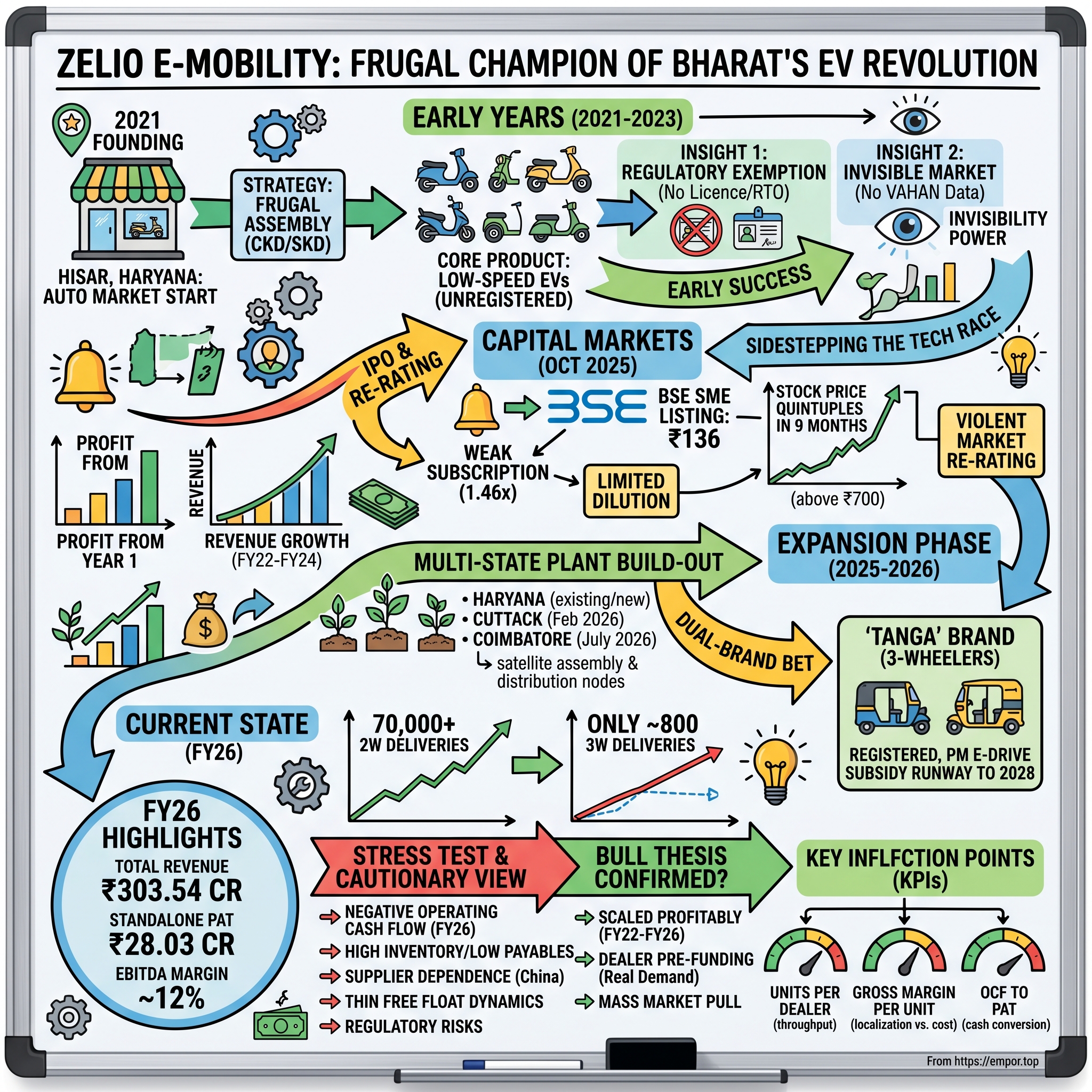
Zelio E-Mobility: The Frugal Champion of Bharat's EV Revolution
I. Introduction, Theme & Episode Roadmap
On the morning of October 8, 2025, a small electric-vehicle company from Haryana rang the bell on the BSE SME platform. Its shares had been priced at ₹136. They opened at ₹154.90 — a 13.9% premium that, by the standards of India's frothy small-cap listing market, barely qualified as a party.1 The book had been subscribed just 1.46 times, with retail investors putting in a limp 1.32 times their allotted portion.2 For a company selling electric scooters in a country that had spent five years being told electric two-wheelers were the next great consumer story, this was a distinctly muted reception.
Nine months later, that same stock trades north of ₹700, and the company carries a market capitalisation of roughly ₹1,650 crore against a book value of about ₹53 per share — a price-to-book of nearly fifteen times and a trailing price-to-earnings ratio near 59.3 Somewhere between the tepid IPO and the present, the market changed its mind, violently.
Here is the riddle at the centre of this story. Between the financial year ending March 2022 and the year ending March 2026, Zelio E-Mobility grew revenue from ₹12.89 crore to ₹303.54 crore on a standalone basis — a roughly 24-fold increase in four years — while reporting a profit in every single one of those years.34 It did this without a single venture capital mega-round. It did it without building a battery cell. It did it without a gigafactory, without a proprietary operating system, without a celebrity founder, and without ever selling a scooter that could legally be driven on a highway.
Meanwhile, the companies that dominated every EV headline in India were doing the opposite. Ola Electric — the most heavily capitalised, most publicly celebrated electric two-wheeler company in the country — reported consolidated revenue from operations of ₹2,253 crore for FY26, with fourth-quarter revenue down 57% year-on-year and a quarterly loss of ₹500 crore.5 Ather Energy, the engineering-led premium player, was still narrowing losses rather than eliminating them, posting an ₹85 crore loss on ₹954 crore of revenue in the December 2025 quarter.6
The core thesis, and what would falsify it
The argument this article will test is straightforward: Zelio did not win a technology race. It sidestepped one. While the marquee EV brands spent hundreds of millions of dollars building fast, connected, software-heavy scooters for metro consumers who could afford ₹1.2 lakh price tags, Zelio built a business selling slow, simple, unregistered vehicles for ₹50,000–₹75,000 to customers in Tier 2, Tier 3 and Tier 4 India — a market segment that does not even appear in the official vehicle registration statistics everyone uses to measure the Indian EV industry.
That is the bull framing. The bear framing is equally simple, and it is the same set of facts read differently: Zelio is a low-capital assembly operation, buying components — nearly three-quarters of its purchases sourced from China as of its IPO disclosures7 — bolting them together, and selling them through independent dealers into a segment with essentially no barriers to entry. It owns eight trademarks and one registered design.7 Its competitive position rests on a regulatory exemption that a single gazette notification could remove.
Both readings are defensible on the current evidence. The purpose of what follows is to work out which mechanisms are actually load-bearing and which are narrative.
The roadmap
The story runs in six movements. First, the structural quirk in Indian motor vehicle law that created a parallel two-wheeler market invisible to the industry's own data. Second, the founding of the company in 2021 and the deliberate decision to be an assembler rather than a manufacturer. Third, the two product and geographic expansions — the "Tanga" three-wheeler brand and the multi-state plant build-out — that management has positioned as the next leg of growth, and what the numbers say about whether they are working yet. Fourth, the capital markets chapter: a small, weakly-subscribed IPO followed by a violent re-rating, and what management has actually done with the money. Fifth, a war-game of the competitive position using Porter's Five Forces and Hamilton Helmer's 7 Powers. And finally, the stress test — the case a skeptical investor would build, and the small number of operating metrics that will settle the argument over the next eight quarters.
We begin, as most Indian business stories eventually do, with a rule.
 Subscribe on LinkedIn
II. The "Bharat" EV Context: The Low-Speed Commuter Gap
Consider two Indian consumers standing in two different showrooms on the same afternoon.
The first is in Bengaluru, comparing a ₹1.4 lakh connected scooter with a touchscreen dashboard, a 90 km/h top speed, over-the-air software updates and a mobile app that shows ride analytics. The second is in a small town in western Uttar Pradesh, looking at a machine that costs less than half as much, tops out at 25 km/h, and requires no driving licence, no registration plate, no road tax and no insurance policy to operate.
These two people are not competing for the same product. They are barely in the same industry. And for most of the last decade, only the first one showed up in the data.
The rule that built a market
Under India's Central Motor Vehicles Rules, an electric two-wheeler whose motor has a thirty-minute continuous rated output below 250 watts and whose maximum speed is under 25 km/h is not treated as a motor vehicle at all. It is, in legal effect, a bicycle. No registration with the Regional Transport Office. No driving licence. No mandatory third-party insurance. No road tax.8
It is difficult to overstate what this exemption does to the addressable market. Consider who is excluded from conventional two-wheeler ownership in India: teenagers below the licensing age; adults without a licence, which in rural districts is a very large number; homemakers making short daily trips; small shopkeepers; delivery workers on hyperlocal routes. For all of them, the barrier to personal mobility was never purely the price of the vehicle. It was the entire administrative apparatus that came attached to it — the RTO visit, the paperwork, the annual insurance renewal, the fear of being stopped.
Remove that apparatus, and a ₹55,000 vehicle stops being a cheaper scooter and becomes something closer to a household appliance. That reframing is the actual product insight.
The invisible market
Here is the analytical consequence that most India EV commentary misses. Because low-speed vehicles are not registered, they do not appear in the VAHAN registration database. When Indian trade publications reported that electric two-wheeler sales hit a record 1.40 million units in FY26, up about 22% year-on-year, with TVS Motor at roughly 24% share and Bajaj Auto at roughly 21%,9 they were counting registered vehicles only. Every low-speed unit Zelio sold that year sat outside that number.
This matters in both directions. On the bullish side, it means the conventional market-share tables understate the size of the electric two-wheeler market in India and misrepresent who the participants are. On the bearish side, it means there is no reliable independent data source against which to verify volume claims made by low-speed manufacturers. An analyst can check a TVS or Bajaj number against government registration data. There is no equivalent audit trail for a Zelio unit. Investors are, to a meaningful degree, taking the company's word for it — a point worth holding onto.
The charging problem nobody solved, and the one nobody needed to
The second structural feature of this market is infrastructure, or rather the assumption of it.
The premium urban EV thesis was built on a charging network — fast-charging points at malls, offices and highway plazas, tied to an app. That thesis works in Bengaluru, Pune and Gurugram. It does not work in a district town in Odisha, where the number of public fast-charging points is, for practical purposes, zero.
The low-speed segment's answer was not to build infrastructure. It was to make infrastructure unnecessary. Removable battery packs — historically lead-acid, increasingly lithium-ion — that a customer lifts out of the scooter, carries into the house, and plugs into an ordinary 5-amp wall socket overnight. The same socket that runs a ceiling fan.
The engineering trade-off is real and worth stating plainly. A low-voltage, low-capacity pack charging off a household socket takes six to eight hours and delivers modest range. That is a genuinely inferior technical outcome to a fast-charged high-voltage pack. But it is available everywhere, immediately, with no capital expenditure by anyone. In a market where the alternative is not a fast charger but no charger, the inferior technology wins on availability. This is a recurring pattern in emerging-market technology adoption, and it is the single most important thing to understand about why this segment exists.
A word on the batteries, in plain language
One technical point is worth explaining carefully, because it sits underneath most of the risk in this business.
The cheapest way to store energy on a two-wheeler is a lead-acid battery — the same chemistry that sits under the bonnet of every petrol car, refined over a century, manufactured at enormous scale in India, and cheap enough that a replacement pack costs a fraction of a lithium equivalent. Its drawbacks are weight, a short cycle life measured in a couple of years of daily use, and steadily degrading range as the pack ages.
Lithium-ion packs cost substantially more up front but last several times longer, weigh far less, and hold their range better. The catch is that lithium packs are only as safe as the battery management system governing them — the small circuit board that decides how fast the pack charges, when to stop, and what to do when a cell overheats. Cheap cells with a cheap management system are the recipe behind essentially every electric two-wheeler fire India has seen.
This is why Indian regulators tightened battery safety standards for electric two-wheelers under the AIS-156 framework, imposing requirements around cell quality, thermal management and pack construction. For the registered high-speed segment, compliance is mandatory and enforced through the homologation process. For the unregistered low-speed segment, the enforcement position is considerably looser — which is precisely the sort of gap that closes suddenly after a bad news cycle.
The commercial implication for a company like Zelio is a permanent tension. Migrating the portfolio toward lithium improves the product, extends the value proposition, and pre-empts regulatory tightening. It also raises the bill of materials in a segment where the customer is choosing largely on sticker price. Every low-speed manufacturer in India is managing that same trade-off, and none of them has a cost advantage in doing so.
The subsidy asymmetry
There is one final piece of context, and it has become unusually topical as of this writing.
India's flagship EV incentive programme, the ₹10,900 crore PM E-DRIVE scheme, pays demand subsidies on registered electric vehicles. From April 1, 2025 the two-wheeler incentive was halved to ₹2,500 per kWh, capped at ₹5,000 per vehicle, down from ₹5,000 per kWh capped at ₹10,000.10 The two-wheeler component of the scheme was subsequently extended only to July 31, 2026 — four days from the date of this writing — after the programme had already supported more than 27 lakh electric two-wheelers against an original target of 25 lakh. Three-wheeler support, including e-rickshaws and e-carts, runs to March 31, 2028.1011
Low-speed vehicles, being unregistered, were never eligible for any of this. Zelio's entire revenue base was built without a rupee of purchase subsidy.
The strategic implication is asymmetric and underappreciated. For every subsidised competitor, the expiry of the two-wheeler incentive represents a price increase of up to ₹5,000 per unit that must either be absorbed into margin or passed to the customer. For Zelio, it represents nothing at all — except a narrowing of the price gap between its products and the registered vehicles one rung above it. A company that never took the subsidy has no subsidy cliff.
That is the market Zelio walked into. The question is how a family in Hisar with no automotive background decided to walk into it.
III. Founding Zelio: Frugal Assembly in Hisar (2021–2023)
The registered office of Zelio E-Mobility is Shop No. 542, Auto Market, Hisar, Haryana.
Read that address again. Not a technology park. Not a campus. A shop number in an auto parts market — the kind of dense, chaotic commercial cluster found in every mid-sized North Indian industrial town, where two hundred small businesses trade in bearings, chains, batteries, gaskets and the accumulated inventory of the internal combustion age. The company was incorporated in July 2021, in the aftermath of India's brutal second Covid wave, by Neeraj Arya, Kunal Arya and Deepak Arya.712
The location is not incidental colour. It is the strategy.
Trading logic applied to manufacturing
The promoter group came out of industrial trading and regional distribution, not out of automotive engineering. Kunal Arya, who serves as Managing Director, has consistently framed the company's ambition in distribution language rather than technology language — the company's internal slogan, as he has described it publicly, is "Har Ghar Zelio": a Zelio in every home.13 That is a tagline a consumer goods distributor writes, not one an engineering firm writes.
This background produced a specific and consequential decision at the outset. In 2021, the fashionable move in Indian EV was vertical integration: build the cells, or at least the packs; design the motor; write the firmware; own the stack. The argument was that in a hardware business, margin and defensibility accrue to whoever controls the critical component.
Zelio did the opposite. It adopted a completely-knocked-down and semi-knocked-down assembly model — buying motors, controllers, battery packs and frames from specialist suppliers, largely Chinese, and assembling finished vehicles in Haryana.
The financial logic of this choice is worth spelling out for readers unfamiliar with manufacturing economics. Building a battery cell plant in India requires several hundred crore of capital before a single cell ships, and years of process engineering to reach acceptable yields. Assembling a scooter from purchased components requires a shed, jigs, fixtures, hand tools, a small trained workforce and working capital for inventory. The first path buys you cost advantage and defensibility if you survive the learning curve. The second path buys you speed, and lets you convert every rupee of capital into revenue almost immediately.
The evidence that Zelio chose the second path deliberately, and that it worked mechanically as intended, sits in the pre-IPO disclosures: raw material costs represented 79.73% of revenue, and imports — overwhelmingly Chinese — accounted for 73.72% of purchases.7 Those are not the ratios of a manufacturer. They are the ratios of an assembler with a very thin value-add layer. What Zelio adds is design specification, quality control, brand, warranty and — critically — distribution.
The trade-off, stated honestly
The obvious objection is that a business which buys 74% of its inputs from Chinese vendors has no technology moat and no cost moat, because every competitor can buy from the same vendors at similar prices. That objection is correct, and it will recur throughout this story. There is no serious argument that Zelio's assembly process constitutes proprietary intellectual property. The company held eight trademarks and a single registered design at the time of its listing.7
What the asset-light choice bought was not defensibility. It was return on capital and the ability to reach breakeven at trivially small scale — which meant Zelio never had to raise dilutive equity to survive its first three years, and never had to explain a cash burn to anyone.
Building the channel
The second founding decision was distribution, and it mirrored the first in spirit.
The metro EV brands built company-owned experience centres in high-rent urban locations — showrooms with polished floors, product specialists, and lease costs that had to be amortised across every unit sold. Zelio recruited independent dealers in small towns across Haryana, Punjab, Uttar Pradesh, Rajasthan and eastward, offering attractive dealer margins and low initial inventory commitments.
The commercial genius of this model — and it is genuinely clever — shows up in an unlikely place: the receivables line. As of March 2026, Zelio's debtor days stood at approximately three.3 Three days. The dealers pay essentially on delivery. The company is not financing its channel; the channel is financing itself.
This is the single most important operating fact in the early Zelio story, and it contradicts a common assumption about how aggressive Indian distribution expansion is funded. Zelio did not buy dealer loyalty with credit. It bought it with margin and with product that turned over. A dealer who pays cash up front and still wants more stock is telling you something about retail demand that no company presentation can.
Product as merchandise, not as engineering
The product line itself reveals the same commercial DNA. The names — Gracy, Eeva, Legender, X-Men, Logix, Mystery, Little Gracy — are not the naming convention of an engineering firm working through platform generations.[^20] They are the naming convention of a consumer goods company generating shelf variety. Several of these models share substantially similar underlying architecture, differentiated through styling, colour, seat configuration, battery capacity and accessory content.
For a Western reader, the closest analogy is a consumer electronics brand that buys reference designs from a contract manufacturer and differentiates through industrial design, packaging and channel. That is not a criticism — it is a legitimate and often highly profitable way to build a consumer business. But it does clarify where the value is being created. Zelio's engineering effort goes into specification and cost, not into invention.
The company has paired this with two customer-facing commitments that matter more in this segment than any specification sheet: a warranty process management describes as paperless and hassle-free, and after-sales service availability through the dealer network.13 In a category where the dominant customer anxiety is "what happens when the battery dies and the shop that sold it to me has disappeared," a credible service promise is arguably the most valuable thing the brand owns. It is also, conveniently, the hardest thing for a new entrant to replicate quickly — a point that will matter in the competitive analysis later.
The first proof points
The numbers from the early years are small enough to be quoted in full and interesting precisely because of their shape.
FY22, the company's first partial year, produced ₹12.89 crore of revenue.7 FY23 produced ₹51.25 crore of revenue and ₹3.06 crore of profit after tax.7 FY24 roughly doubled again, to ₹94.43 crore of revenue and ₹6.31 crore of profit, with EBITDA margins expanding from 7.84% to 12.34%.7
What matters here is not the growth rate — plenty of Indian companies have grown revenue fast from a small base. What matters is that the margin expanded while the revenue quadrupled. In a business scaling this quickly, the normal pattern is margin compression: you overpay for capacity, you discount to fill the channel, you carry stranded overhead. Zelio's margin went the other way, which suggests that the incremental units were being sold at healthy realisations rather than dumped, and that the fixed cost base was genuinely small.
The counter-reading, which a skeptic should hold in mind, is that margin expansion off a ₹13 crore base tells you very little about margin durability at ₹300 crore, and even less at ₹1,000 crore. Early operating leverage in a light-assembly business is close to arithmetic. It is not evidence of pricing power.
By March 2024, Zelio had a functioning product line, a growing dealer base, a profitable P&L and one plant. What it did not yet have was any geographic diversification, any second product category, or any real scale. All three arrived in a compressed and eventful eighteen months.
IV. Multi-State Assembly & The Dual-Brand Expansion (2023–2024)
There is a specific problem with shipping electric scooters across India that does not exist for most consumer products: the ratio of volume to value is terrible.
A low-speed electric two-wheeler is a bulky object — roughly the footprint of a full-size scooter — with an ex-factory value of perhaps ₹40,000. A truck carrying these from Haryana to Tamil Nadu is moving a large volume of air and steel across 2,500 kilometres to deliver a modest amount of value. Add transit damage, add the working capital tied up in goods sitting on a highway for a week, and the economics of serving South India from a North Indian plant deteriorate quickly.
Management's answer to this problem, and the parallel decision to open a second product category, define the company's current shape. But the chronology matters, and it needs correcting against the popular telling.
What actually happened, and when
Through FY24 and FY25, Zelio operated from a single manufacturing location in Haryana, with an installed capacity of 72,000 units a year on a single shift. As of March 31, 2025, utilisation of that plant was approximately 52%.14
That last figure deserves a pause. A company growing revenue at 80%-plus per year was running its only factory at barely half capacity. This tells you two things. First, the constraint on Zelio's growth was not manufacturing — it was demand generation and distribution reach. Second, and more subtly, it means the capacity expansions that followed were not driven by a physical bottleneck. They were driven by logistics geography and by product diversification. Those are different, and weaker, justifications for capital deployment.
The Chief Financial Officer, Shubham Garg, was explicit about the reasoning ahead of the IPO. The new facility was expected to support diversification, the three-wheeler line would likely need a dedicated unit, and operating multiple plants could reduce reliance on a single location and help manage operational risk. On the underused existing capacity, his answer was that as utilisation increased, the company might add shifts to optimise output.14
That is a candid and internally consistent explanation — the plants were about geography and product, not about running out of room. Investors should hold management to that framing, because it sets a clear test: if the new plants are justified by freight savings and regional service, then gross margins and working capital should improve as they ramp, not merely revenue.
The build-out
The physical expansion arrived in a rush, and almost all of it after the IPO.
The Cuttack plant in Odisha — a modest 30,500 square feet — was commissioned in February 2026, lifting installed capacity from 72,000 to 180,000 units per annum and establishing an eastern India base.412 The Coimbatore facility in Tamil Nadu, 39,000 square feet, commenced operations on July 13, 2026, adding a further 60,000 units of annual capacity and taking the total to 240,000 units — a 33% increase.15 Alongside these sit the two large Haryana facilities: Ladwa at 263,450 square feet and Patan at 252,301 square feet, the latter dedicated to the three-wheeler business.15
Note the asymmetry in those numbers. The Haryana plants are enormous — a quarter of a million square feet each. The regional plants are small, at 30,000 to 39,000 square feet. Coimbatore opened with thirty direct employees and an initial run rate targeted at 24,000 to 30,000 two-wheelers a year, against its 60,000-unit nameplate.15 These are satellite assembly and distribution nodes, not integrated factories. That is exactly what the freight-cost logic implies, and it is a sensible, cheap way to solve the problem. It is also, transparently, not a barrier to entry — anyone with ₹5–10 crore can replicate a 39,000 square foot assembly shed.
The Tanga bet
The second expansion is the more interesting one, and the more uncertain.
Electric three-wheelers — cargo loaders and passenger e-rickshaws — are a fundamentally different business from consumer scooters. The buyer is not a household; it is a small operator making an income-generating investment. Unit realisations run several times higher than a low-speed scooter. The vehicles run all day, which means service and spares become a recurring revenue stream rather than an afterthought. And critically, three-wheelers are registered vehicles, which means they remain eligible for PM E-DRIVE support through March 2028, long after the two-wheeler tap closes.10
Zelio branded this business "Tanga" — after the horse-drawn carriage that served exactly this last-mile passenger role in Indian towns for a century before the internal combustion engine, and then the e-rickshaw, replaced it. The portfolio includes the Tanga Butterfly and Tanga SS, and in April 2026 the company unveiled the Tanga Nine+ at the RideAsia EV Expo in New Delhi: an eight-passenger vehicle with a claimed 150 km range, a 45–50 km/h top speed, a 2.5 kW motor and battery options of 7.8 kWh and 10 kWh, with commercial launch guided for the second quarter of FY27.16
Management's ambition for this category has been stated clearly and repeatedly. Ahead of the IPO, the company projected that three-wheelers could represent 30–40% of total revenue within a couple of years.14
The number that punctures the narrative
Here is where an independent reading has to diverge sharply from the promotional one.
In FY26, Zelio delivered more than 70,000 two-wheelers — comfortably ahead of its stated target of over 60,000. In the same year, it delivered approximately 800 three-wheelers, against a target of 1,000.4
Eight hundred units. Against an internal ambition, articulated by the Managing Director in mid-2025, of 500 to 600 three-wheelers per month during FY26 — which would have been six to seven thousand units for the year.13
At a realistic realisation of ₹1.2–1.8 lakh per three-wheeler, 800 units is somewhere between ₹10 crore and ₹14 crore of revenue — roughly 3–4% of the FY26 total. Zelio does not publish audited segment-level revenue or profit splits, so any precise segment mix quoted for this company should be treated as an estimate rather than a disclosure. What is disclosed is the volume, and the volume says the three-wheeler business, as of March 2026, was a rounding error.
This is the most important thing an investor can know about the Tanga story right now: it is a plan, not a business. The dedicated Patan plant is built. The product line has been refreshed. The subsidy window is open until 2028. The strategic logic is genuinely sound. But the execution has, so far, missed management's own targets by roughly an order of magnitude, and there has been no detailed public explanation of why. When a company builds a 252,301 square foot facility for a product line that shipped 800 units last year, the burden of proof sits squarely with management.
Financial scaling through the period
Against that backdrop, the two-wheeler engine kept compounding. Revenue moved from ₹94.43 crore in FY24 to ₹172.19 crore in FY25, with profit after tax rising from ₹6.31 crore to ₹15.98 crore.717 Operating margins settled in the 11–12% band and stayed there.3
The read-through is that the core low-speed scooter business demonstrated something rare in Indian EV: it scaled without breaking its unit economics. Margins neither expanded materially — arguing against pricing power — nor compressed — arguing against destructive discounting. That stability is itself informative. It suggests a business where price is set by a competitive market and cost is set by a component supply chain, and where the company's job is simply to move volume through a widening funnel efficiently.
Which raises the obvious question: what happens when you hand a business like that ₹63 crore of fresh capital?
V. Capital Allocation & The BSE SME IPO (2025)
The Zelio IPO was, by any reasonable measure, a small and unglamorous affair.
The offer opened on September 30, 2025 and closed on October 3, raising ₹78.34 crore in total — ₹62.83 crore of fresh issue and ₹15.50 crore of offer for sale by the promoters — at a price band of ₹129 to ₹136, with a lot size of 1,000 shares.7 Hem Securities ran the book. Maashitla Securities handled the registry. There was no anchor fanfare, no marquee institutional cornerstone, no billboard campaign.
The book closed at 1.46 times subscribed. Retail came in at 1.32 times, the institutional portion at 1.61 times, and the non-institutional segment at 1.56 times.2 For context, SME issues in the Indian market during that period routinely saw subscription multiples in the tens or hundreds. A 1.46x book is the market saying: fine, but not exciting.
What the money was for
The stated uses of proceeds were unglamorous in a way that is, on the evidence, a point in management's favour: repayment or prepayment of existing borrowings, funding a new manufacturing facility, working capital, and general corporate purposes.7 Approximately ₹20 crore was earmarked for the new three-wheeler facility, with roughly ₹19–20 crore across debt repayment, working capital and research and development.14
No acquisition. No "strategic investments." No brand-building war chest. For a promoter group taking a company public for the first time, that is a restrained list.
The follow-through is visible in the balance sheet. Total borrowings fell from ₹31 crore at March 2025 to ₹19 crore at March 2026, while shareholders' equity rose from ₹26.67 crore to ₹111.17 crore, and cash and bank balances stood at ₹26 crore.317 Financing activities contributed roughly ₹42 crore of inflow during the year.3 Management said it would deleverage and it deleveraged. That is a small promise kept, but in a market where promoters frequently repurpose IPO proceeds within a year, small kept promises are worth noting.
The return-on-capital picture, before and after
The pre-IPO capital efficiency figures were arresting. The offer documents showed a return on equity of 83.99% and a return on capital employed of 34.84%, with a PAT margin of 6.68%.7
An 84% return on equity is not, in itself, evidence of a wonderful business. It is arithmetic: a company with almost no equity base and a modest amount of profit will produce a spectacular ratio. Zelio's equity at March 2025 was ₹26.67 crore against ₹172 crore of revenue. The high ROE was a statement about how little capital the business consumed, not about how much economic profit it generated per unit sold. That distinction gets lost constantly in Indian small-cap commentary.
Post-IPO, the ratio behaved exactly as arithmetic predicts. With the equity base more than quadrupled by fresh issue proceeds and retained earnings, FY26 return on equity fell to roughly 41%, while return on capital employed stayed strong at approximately 38%.3 The dilution of ROE here is not a deterioration in business quality. It is the mechanical consequence of holding IPO cash that has not yet been deployed into revenue-generating assets.
The genuinely important efficiency metric for a business like this is asset turnover, and it remains extraordinary. Total assets at March 2026 stood at ₹153 crore supporting ₹303.54 crore of revenue — roughly two times, and materially higher if measured against the pre-IPO asset base.317 Employee benefit expenses for the full year were ₹7.23 crore — about 2.4% of revenue.17 That is a startlingly lean organisation for a company operating four manufacturing locations across three states.
Which cuts both ways. A cost structure that lean is an advantage in a price war. It is also a fragility: there is very little organisational depth to absorb a scaling shock, and very little in-house engineering capacity to respond if the product requirements change.
Peer benchmarking, honestly framed
The comparison that flatters Zelio most is against the venture-funded cohort. Against Ola Electric's FY26 revenue collapse and continuing large quarterly losses,5 and Ather's persistent though narrowing deficits,6 a company earning ₹28 crore of real accounting profit on ₹304 crore of revenue looks like a different species.
But that comparison is somewhat unfair to both sides. Ola and Ather are attempting a far harder thing — building integrated, registered, high-speed vehicles with proprietary technology, in a segment where the incumbents are Honda, TVS, Bajaj and Hero. They are burning capital in pursuit of a durable position. Zelio is earning modest returns in a segment where a durable position may not be achievable at all.
The more instructive comparison is against the listed low-speed and value-segment peer set. Wardwizard Innovations & Mobility, the closest listed analogue, reported December-quarter FY26 revenue of ₹62.72 crore, down 27% year-on-year, with net profit collapsing to ₹0.03 crore from ₹3.82 crore.18 That is what this segment looks like when execution slips: revenue and profit fall together, fast, because there is nothing structural holding either up.
Zelio's outperformance against that peer is real and is the strongest available evidence for the bull case. But it is evidence of superior execution, not of a superior structural position. Those are different assets with very different half-lives.
Skin in the game — and the governance question
The promoter group held 100% of the company before the offer and 75.77% immediately after.7 By March 2026, promoter holding stood at 72.77%, with domestic institutions at 2.13%, foreign institutions at a token 0.09%, and a total shareholder count of 816.3
Eight hundred and sixteen shareholders. That number tells you almost everything about the market structure of this stock. With more than seven-tenths of the equity closely held and a shareholder base in the hundreds, the free float is thin. A thin float in a company delivering 80% revenue growth is a mechanically explosive combination — it explains how a stock priced at ₹136 in a 1.46x-subscribed book could quintuple within nine months without any single dramatic announcement.19
The honest framing is that the re-rating reflects both genuine operating delivery and a supply-demand imbalance in the shares themselves. Investors should not confuse the two, and should be clear-eyed that thin-float dynamics work symmetrically in both directions.
Concentrated promoter ownership also has a governance dimension. On the positive side, the Aryas own the overwhelming majority of the value they are creating, which aligns them with long-term compounding. On the cautionary side, at 72.77% there is no realistic external check on promoter decisions, related-party arrangements, or capital allocation. The company has paid no dividend.3 For a business generating profits while consuming cash, that is defensible — but it is a choice that minority shareholders have no vote over.
VI. Current State & Financial Segment Breakdown
Every fast-growing business eventually reaches the moment where the income statement and the cash flow statement start telling different stories. For Zelio, that moment was FY26.
The headline year
On a standalone basis, revenue from operations reached ₹303.54 crore in FY26, up 76.3% from ₹172.19 crore. Standalone profit after tax rose 75.4% to ₹28.03 crore from ₹15.98 crore. On a consolidated basis, revenue was ₹310.71 crore and profit after tax ₹28.39 crore.17 The company's own release headlined a figure of ₹313.68 crore, which reflects consolidated revenue including other income of roughly ₹3 crore.12 Reported EBITDA was ₹38.01 crore, a 12.2% margin.12
The half-yearly split shows the acceleration clearly: H1 FY26 delivered ₹133.32 crore of revenue and ₹11.82 crore of profit; H2 delivered ₹170.22 crore and ₹16.21 crore, against ₹96.91 crore and ₹8.96 crore in the prior-year second half.17 Sequential growth of 28% in revenue and 37% in profit, half over half, with operating margins holding around 11%.3
The read is that this was a clean beat on the company's own guidance, which had pointed to ₹260–280 crore.4 Beating your own guidance by roughly 10% in your first full year as a listed company is a credibility deposit, and management should get credit for it.
The cash flow problem
And then there is the other statement.
Despite ₹28.03 crore of standalone profit, cash flow from operations in FY26 was negative ₹7.39 crore.17 On a consolidated basis, the operating outflow was approximately ₹11.20 crore.4 Free cash flow was around negative ₹15 crore.3
This is the single most important line item in the FY26 results, and it deserves to be understood mechanically rather than treated as an alarm bell.
Working capital days rose from 43 at March 2025 to 78 at March 2026. The composition is revealing: inventory days of 87, debtor days of 3, and payable days of 24.3 The company is still collecting from dealers almost instantly. It has not started financing its channel. What it is doing is holding a great deal more inventory — components in transit and in stock, plus finished goods staged at four locations instead of one — while paying its suppliers within three and a half weeks.
So the cash drain is not a receivables quality problem, which would be genuinely worrying, and it is not a demand problem. It is the arithmetic of a company that grew revenue 76% while simultaneously opening plants in Odisha and preparing Tamil Nadu, importing the majority of its components from overseas suppliers who require prompt payment, and stocking a dealer network across 25-plus states.
That said, calling it "just growth working capital" would be too comfortable. Three things make this line worth watching closely. First, inventory days of 87 in a business whose components are imported means a long, exposed pipeline — currency moves, port delays, or a demand air-pocket all land directly on the balance sheet. Second, the payables position, at 24 days against 87 days of inventory, tells you Zelio has limited negotiating leverage with its suppliers; it is not using vendor credit to fund its stock the way a scaled OEM would. Third, if operating cash flow stays negative through FY27 while capacity expands further, the company will need either debt or equity, and the IPO cash — ₹26 crore on the balance sheet at year end — does not fund many more years of this.
What the company actually sells, and what it does not disclose
The revenue base remains overwhelmingly low-speed two-wheelers under the Zelio brand: Eeva, Gracy and Gracy Pro, Legender and Legender Plus, X-Men, Logix, and the more recently introduced Little Gracy, generally priced in a ₹50,000 to ₹75,000 band.4[^20] The portfolio also includes the Mystery, a high-speed model claiming a 70 km/h top speed and 100 km range, which sits in the registered-vehicle category.13
Zelio does not publish audited segment-level revenue or profit disclosures. Any figure attributing a specific percentage of revenue or profit to two-wheelers, three-wheelers or spares should be understood as an inference, not a company disclosure. What can be stated from disclosed data: with more than 70,000 two-wheelers and roughly 800 three-wheelers shipped in FY26,4 the business was, in that year, a two-wheeler company with a three-wheeler option attached.
The aftermarket question is similarly opaque. A company claiming more than 200,000 customers16 has, in principle, a large and growing installed base needing replacement batteries — the shortest-lived and most expensive consumable in a low-speed EV — plus controllers and body panels. That should become a high-margin recurring stream over time. Zelio has not disclosed spares and service revenue separately, so the size of that stream is, at present, not disclosed. It is a plausible source of future margin, and nothing more than that today.
The live version of the story
Zelio's engagement with public markets is still in its infancy, and the texture of that engagement is worth noting because it shapes how much an outside investor can actually verify.
The company held an investor connect conference call on the evening of June 17, 2026,20 and management has appeared at investor conferences since listing. What emerges from those appearances and the accompanying releases is a consistent and confident narrative: 75% to 80% year-on-year revenue growth described as a structural trajectory rather than a one-off, framed as a repeatable engine underpinned by wider distribution and a broader portfolio; FY27 volumes of more than 125,000 units; a target of crossing 10% market share in FY27 with an ambition of 20% to 30% within two to three years; two high-speed model launches; and FY27 as the first full year of simultaneous revenue contribution from North, East and South India.4
Two observations about that framing, offered neutrally.
The first is that describing 75–80% growth as a "structural trajectory" is an unusually strong claim. Growth rates are outputs, not inputs; a company can commit to opening dealerships and launching products, but committing to a growth rate for an indefinite period implies a level of demand predictability that a four-year-old company in a fragmented consumer category cannot reasonably possess. Investors should treat it as an ambition rather than a forecast, and note that management has beaten its own numeric revenue guidance once — in FY26 — while missing several of its volume and dealer-count ambitions.
The second is the market share target. Because low-speed vehicles are unregistered and therefore uncounted, the denominator in any "10% market share" claim is not independently verifiable. Management has not published the market-size estimate it is measuring against. Until it does, the share target is not a testable statement, and the more useful proxy for the same underlying question is absolute unit volume — which is at least internally auditable and, in the three-wheeler case, has already proven capable of falling well short.
Consistency of narrative across documents has, to be fair, been reasonable on the important items: the asset-light assembly model, the Tier 2/3 distribution focus, the low-speed core, and the regional plant logic have been described the same way in the offer documents, in media interviews and in post-listing releases. The inconsistencies cluster in the operating metrics rather than in the strategy.
Distribution and organisation
The dealer network stood at 400-plus across 25-plus states at the FY26 results, with a target of 550-plus by the end of FY27.1215
That number requires care, because the company's public statements on it have not been consistent. In a June 2025 interview, the Managing Director described 400 dealerships across 23 states with a target of 1,000 outlets by the end of 2025.13 The IPO documents from roughly the same period disclosed a 280-dealer network across 20-plus states.7 An April 2026 press release cited 350 dealerships across 20 states.16 The FY26 results cite 400-plus across 25-plus.12
Those four figures cannot all be describing the same metric. The likeliest explanation is that "dealers," "dealerships" and "outlets" are being used loosely and inconsistently across formal disclosures and media appearances. But the discrepancy is material, because dealer count is the primary externally-visible proxy for this company's distribution reach — and the 1,000-outlet target has quietly disappeared, replaced by a 550 target eighteen months later. That is a target missed by a wide margin without public explanation, and it belongs in any honest assessment of management's forecasting discipline.
On the organisational side, the company appointed Divyanshu Agarwal as Chief Executive Officer effective April 15, 2026,17 and has said it is targeting an employee base of more than 500 during the current financial year.15 Bringing in a professional CEO alongside a promoter Managing Director is the standard institutionalisation move for an Indian family-founded business crossing ₹300 crore of revenue. Whether it changes anything is an FY27 question.
For investors, the FY26 picture nets out to this: the operating engine delivered more than it promised, the balance sheet absorbed the cost of that delivery, and the disclosure quality has not yet caught up with the company's size. Those three facts frame everything that follows.
VII. Strategic Mechanics: Porter's 5 Forces & Helmer's 7 Powers
Strip away the growth rates and ask the only question that matters over a decade: what stops someone else from doing this?
Helmer's 7 Powers, applied without charity
Hamilton Helmer's framework asks whether a company possesses a benefit that its competitors cannot replicate at acceptable cost. Run Zelio through all seven, and the results are lopsided.
Counter-positioning — moderate, and the strongest card in the hand. This is the power Zelio genuinely appears to hold. The established two-wheeler OEMs — Hero MotoCorp, TVS, Bajaj, Honda — operate high-overhead national distribution networks, homologation-heavy engineering organisations, and brand promises built around registered, insured, serviced vehicles. For any of them to sell a ₹55,000 unregistered 25 km/h scooter through low-cost regional dealers would mean accepting far lower absolute margin per unit, potentially cannibalising their entry-level ICE commuters, and attaching their brand to a category with a mixed safety reputation. It is not that they cannot. It is that the calculus for them is genuinely unattractive.
That said, counter-positioning as a power is only as durable as the incumbent's reluctance. It protects against the giants. It does nothing against the hundreds of small assemblers who face no such calculus at all — and those, not Hero, are Zelio's real competition.
Process power — weak to moderate. Zelio has demonstrably built a repeatable playbook: standardised assembly of purchased components, satellite plants sized to regional demand, and rapid dealer onboarding. Executing that consistently across four locations is not nothing. But process power in Helmer's sense requires a process that is hard to copy even when observed, typically because it is embedded in tacit organisational knowledge accumulated over years. Bolting a Chinese motor and controller into a frame does not meet that bar.
Cornered resource — weak. The dealer relationships in North and East India have real value; a dealer who has been selling Zelio profitably for three years is not costlessly replaced. But these are non-exclusive relationships with independent businesspeople in a segment where multi-brand dealerships are common. There is no locked-up supply, no exclusive licence, no irreplaceable talent.
Scale economies — largely absent. At 70,000 units a year, Zelio is not buying components at prices unavailable to a competitor at 20,000 units. Real purchasing scale in this supply chain sits with entities buying millions of cells, and those are the Chinese cell manufacturers, not their Indian customers.
Network economies — absent. A Zelio scooter is worth no more to its owner because other people own one. There is no platform, no exchange, no shared infrastructure.
Switching costs — near zero. A customer replacing a three-year-old low-speed scooter faces no data migration, no ecosystem lock-in, no accessory incompatibility that matters. They will walk into whichever dealership offers the best price and the most convincing service promise. The one partial exception is service proximity: a customer in a small town may stay with the brand whose dealer is closest. That is a local, fragile advantage, not a structural one.
Branding — weak but non-zero. In a category populated by anonymous assemblers, a recognisable name with ISO 9001, 14001 and 45001 certifications7 and a stated warranty process does carry some willingness-to-pay premium among cautious buyers. It is not Royal Enfield. It might, in time, be worth a few thousand rupees per unit.
The honest scorecard: one moderate power, one weak-to-moderate, and five that are weak or absent. This is a company whose returns currently come from execution and market growth, not from structural protection.
Porter's Five Forces: an inhospitable industry
Threat of new entrants — very high, and this is the defining feature. The capital required to open a low-speed EV assembly operation is measured in single-digit crore. Zelio's own Coimbatore plant — 39,000 square feet, thirty employees, 60,000 units of nameplate capacity15 — is a demonstration of exactly how cheap entry is. India has seen well over a hundred EV startups enter in the past several years.21 Nothing prevents the hundred-and-first.
Bargaining power of suppliers — high. With imports at roughly three-quarters of purchases and raw materials at approximately 80% of revenue,7 Zelio's gross margin is a residual left over after its supply chain has taken its cut. The company holds 87 days of inventory but only 24 days of payables,3 which is a quantitative statement that it is not the powerful party in those negotiations. Add the geopolitical layer — Chinese export controls, rare-earth magnet restrictions, port disruptions, rupee depreciation — and this is the most acute structural risk in the business.
Bargaining power of buyers — high. The end customer is buying on price in a category with abundant alternatives and no switching friction. Dealers, meanwhile, pay cash and can carry competing brands. Neither party is captive.
Threat of substitutes — medium to high. The used ICE two-wheeler market is vast, liquid and cheap. A three-year-old Hero Splendor can be had for a price comparable to a new low-speed EV and offers unlimited range, universal service and instant refuelling. Public transport, shared autos and simple bicycles fill the rest of the gap. Zelio's product wins on running cost and on the licensing exemption; it loses on range, speed and resale value.
Competitive rivalry — intense. The named field includes Komaki, which claims 25-plus models and more than 1,000 dealer locations,21 Wardwizard's Joy e-bike, Kinetic Green, Greaves-owned Ampere, Lectrix and a long tail of regional assemblers. Beneath the branded players sits an unorganised segment whose scale is genuinely unknown, because — as established earlier — these vehicles are not registered anywhere.
The synthesis
Put the two frameworks together and the conclusion is uncomfortable but clear: Zelio operates in a structurally unattractive industry from a position of limited structural advantage, and is nonetheless earning a high return on capital.
That combination is not a contradiction. It is a description of a company capturing the returns available during a market's growth phase, when demand outruns organised supply and execution quality is the differentiator. Those returns are real. They are also, historically, the least durable kind. The relevant question for a long-term investor is not whether Zelio has a moat today — on the evidence, it does not have much of one — but whether the company is using this window to build one: through brand, through service density, through backward integration into packs, or through the three-wheeler business where regulation and financing create genuine barriers.
Nothing in the FY26 disclosures resolves that question. Which brings us to the arguments on either side.
VIII. The Bear vs. Bull Case & Skeptical Investor Stress Test
Imagine a skeptical fund manager reading the FY26 results for the first time. Here is the case they would build.
The short case, stated at full strength
The screwdriver problem. Zelio does not make the motor, the controller, the battery cells or the pack chemistry. It buys them, predominantly from Chinese vendors, and assembles them. Roughly 80% of revenue leaves as raw material cost.7 Every unit of gross margin the company earns is, in effect, rent on a distribution and brand position rather than on a technology position. If a larger, better-capitalised player decides to buy the same components and undercut on price, Zelio has no structural cost defence — its lean employee base is a genuine advantage, but a 2.4% payroll ratio can only be cut so far.
The regulatory cliff. The entire low-speed category exists because of a specific exemption in the Central Motor Vehicles Rules.8 That exemption is a policy choice, not a law of nature. Road safety advocates have long argued that unregistered, uninsured vehicles operating on public roads, ridden frequently by unlicensed users including minors, represent a policy gap. If the Ministry of Road Transport and Highways were to bring low-speed EVs into the registration and licensing net — or mandate insurance, or tighten battery safety requirements to AIS-156-equivalent standards for this class — the category's core value proposition would be materially impaired overnight. Zelio has no ability to influence this outcome and limited ability to hedge against it beyond diversifying into registered vehicle categories, which it has begun but not completed.
The localisation squeeze. Indian industrial policy has moved steadily toward domestic value addition through phased manufacturing programmes attached to incentive schemes. A company sourcing 74% of its purchases from imports is on the wrong side of that direction of travel. It currently escapes the immediate consequence because it does not claim subsidies. But policy pressure on Chinese component imports — whether through tariffs, quality control orders, or approval delays — would hit Zelio's cost base directly.
The cash conversion question. Reported profit of ₹28.03 crore against negative operating cash flow of ₹7.39 crore in the same year17 is precisely the pattern that makes experienced investors slow down. The explanation — inventory build to support 76% growth and a multi-plant footprint — is credible and consistent with the disclosed working capital composition. But it is an explanation that only works once. If FY27 delivers another year of profit without cash, the working capital story stops being growth and starts being a business model.
The disclosure gap. No audited segment reporting. Dealer counts that vary between 280, 350 and 400-plus depending on the document.71216 A three-wheeler target missed by roughly 90% with no detailed public explanation.413 A 1,000-dealership goal that was stated publicly and then silently replaced with a 550 target.1315 None of these individually is disqualifying for a company this size, and SME-platform disclosure norms are genuinely lighter than mainboard norms. Collectively, they establish that management's public forecasting has been directionally optimistic, and that the company's reporting infrastructure has not scaled at the pace of its revenue.
The valuation. At roughly 59 times trailing earnings and nearly 15 times book,3 the market is pricing several more years of 75%-plus growth into a business with weak structural defences, in a stock with 816 shareholders and a free float below 30%.3 The re-rating from ₹136 to above ₹700 in nine months19 is not principally an earnings story — earnings roughly doubled; the price rose more than fivefold.
The long case, stated at full strength
The market is real, large and structurally underserved. The customers buying these vehicles are not making an environmental choice or a technology choice. They are making an economic one: a machine that costs a fifth of a car, runs at a fraction of petrol cost, requires no licence, and charges off a wall socket. That value proposition does not depend on subsidies, charging infrastructure, or battery technology improving. It works today, at today's costs.
The subsidy expiry is a relative tailwind. With the PM E-DRIVE two-wheeler incentive scheduled to lapse on July 31, 2026 after already exceeding its unit target,1011 every registered-vehicle competitor faces a per-unit economic headwind that Zelio does not. Simultaneously, three-wheeler support continues to March 2028, supporting the category Zelio is trying to enter. The policy calendar, as it currently stands, is more favourable to Zelio's mix than to most of the industry's.
Profitability at every scale, which is the rarest attribute in this industry. Zelio has reported a profit in each of its five reported financial years, from ₹12.89 crore of revenue to ₹303.54 crore.37 Set against a peer landscape where the best-funded player's revenue fell 57% year-on-year while losing ₹500 crore in a quarter,5 and the closest listed low-speed comparable saw quarterly profit fall to near zero,18 this is a meaningful demonstration of operating discipline. It is not a moat. It is evidence that this management team can run a business.
The dealer economics are validated by behaviour, not by claims. Debtor days of three3 means dealers pay before they sell. A distribution channel that pre-funds its inventory is voting with its cash. This is the strongest available third-party evidence of genuine retail pull, and it directly refutes the most common bear objection to fast-growing Indian consumer-durable companies — that the growth is channel stuffing. You cannot stuff a channel that pays you in advance.
Optionality that is currently valued at close to nothing. Three separate call options sit inside the business: the Tanga three-wheeler line, with a dedicated plant already built and a subsidy runway to 2028; the aftermarket spares and replacement-battery stream attached to a claimed installed base of over 200,000 vehicles;16 and the high-speed registered segment, where management has said it will launch two models.4 Each is unproven. Each is also cheap to attempt given the existing manufacturing footprint and dealer network.
Capacity is in place ahead of demand. With installed capacity at 240,000 units against FY26 volume of roughly 71,000,415 and prior-year utilisation running near half,14 the company can more than triple output without further major capital expenditure. That means FY27 and FY28 growth, if it comes, should be far less capital-hungry than FY26 was — which is the specific condition under which the negative operating cash flow would reverse.
The current risk radar
Three risks are material and mechanism-specific, and they deserve naming over the generic macro list.
The first is supply chain and geopolitics. Import dependence at roughly three-quarters of purchases, combined with 87 days of inventory,37 means a China supply disruption or a sharp rupee move transmits into Zelio's cost of goods with a lag of about a quarter and no offsetting hedge disclosed.
The second is safety and reputation. Low-speed electric two-wheelers, particularly those using older battery chemistries and low-cost battery management systems, have been the subject of recurring fire and quality concerns in India. A single high-profile incident traced to a Zelio product — or a regulatory sweep of the category — would damage a brand whose primary asset is a cautious buyer's trust.
The third is execution at scale. Running four plants in three states with a payroll of a few hundred people and a professional CEO in the seat for three months is a genuinely demanding operating challenge. The FY26 three-wheeler shortfall is the first public evidence that this organisation's execution capacity has limits.
What resolves the argument
The bull and bear cases here are not arguing about different facts. They are arguing about whether execution quality in a growing market is worth paying a premium multiple for in the absence of structural protection. That is ultimately an empirical question, and it will be answered by a small number of observable numbers.
IX. Key Investor KPIs, Playbook Lessons & Episode Wrap
There is a version of this story where Zelio E-Mobility becomes the Maruti of Indian micro-mobility: the brand that got to the mass market first, built service density in a thousand small towns, and turned a commodity assembly business into a consumer franchise. There is another version where it becomes a case study in how competitive intensity eventually finds every profitable niche, and margins that looked structural turn out to have been temporary.
Neither outcome is determined yet. But the fork is observable, and it will show up in three places.
The three metrics that matter
First: units per dealer per month. Total dealer count is the metric management promotes, and it is the metric most easily inflated — a "dealer" can be a signboard. The meaningful number is throughput: total units divided by active dealers. FY26 produced roughly 71,000 units across a network described as 400-plus outlets,412 which implies something in the region of fifteen units per dealer per month. If the FY27 target of 125,000-plus units is achieved on a 550-dealer network,12 throughput per dealer rises meaningfully — which would be strong evidence that the brand is pulling customers into showrooms rather than merely adding showrooms. If unit growth tracks dealer growth one-for-one, the story is geographic expansion, not brand strength, and it has a natural ceiling.
Second: gross margin per unit alongside the share of domestically sourced components. These two must be watched together, because they trade against each other. Localising away from the 73.72% import share disclosed at IPO7 would reduce geopolitical and currency exposure and align the company with the direction of Indian industrial policy — but domestic components typically cost more, at least initially. Whether Zelio can localise without compressing its 12% EBITDA margin12 is the clearest available test of whether it has any real pricing power, or is simply passing through a supply chain's costs with a distribution markup.
Third: operating cash flow relative to reported profit. The FY26 gap — ₹28.03 crore of profit against negative ₹7.39 crore of operating cash17 — has a credible growth explanation. That explanation has a shelf life of exactly one more year. With capacity now built out to 240,000 units and the plant investments largely behind it, FY27 is the year in which operating cash flow should turn positive if the working capital build was genuinely about growth. If it does not, the correct conclusion is that this business consumes cash structurally as it scales, and every subsequent growth year will require external funding.
Everything else — revenue growth rates, market share claims, product launches, dealer announcements — is downstream of these three.
What the story teaches
Distribution can substitute for technology, but only for a while. Zelio's genuine insight was that in a mass emerging market, the binding constraint is not product capability but access: price point, licensing friction, charging practicality, and a dealer within a reasonable ride. Solving access with unremarkable technology beat solving capability with excellent technology, comprehensively, over five years. The unresolved question is what happens in the next five, when the access problem has been solved by everyone and the differentiator reverts to product.
Operating below the incumbent's radar is a real strategy with a real expiry date. Counter-positioning worked because Hero, TVS and Bajaj had good reasons to ignore a segment that was small, low-margin and reputationally awkward. Segments that grow stop being ignorable. Zelio's window is defined not by its own capabilities but by when the calculus flips for a company with a thousand dealerships and a fifty-year-old brand.
Capital-light scaling is a starting position, not a destination. Minimal fixed investment let a company with no venture backing reach ₹300 crore of revenue while remaining profitable throughout — an outcome essentially unavailable to the vertically integrated approach. But the same lightness that enabled the ascent is what leaves the position exposed. The strategic task now facing management is to convert cash flows generated by a low-barrier business into something with barriers: service density that competitors cannot match, a brand that commands a premium in a commodity category, an installed base that generates recurring aftermarket revenue, or a three-wheeler franchise where financing relationships and regulatory compliance create genuine friction for new entrants.
Watch what management does after a beat, not during one. The FY26 guidance beat was real, and the deleveraging was real. So was the quietly abandoned 1,000-dealership target and the three-wheeler line that shipped 800 units against an ambition of thousands. The most useful information about this management team over the next several years will not come from the years when everything works. It will come from the first year when something breaks, and from whether the explanation offered is specific, quantified and accompanied by a plan — or whether it is vague.
For a company four years old, selling 25 km/h scooters out of an auto parts market in Haryana to customers the Indian EV industry spent a decade not counting, the results so far have been considerably better than the strategy's structural strength would predict. Whether that gap closes by the strategy getting stronger, or by the results getting worse, is the whole investment question.
References
-
Zelio E-Mobility IPO Jumps 19.5%; Lists at ₹154.90 — HDFC Sky, 2025-10-08 ↩
-
Zelio E-Mobility IPO Subscription Status — Chittorgarh, 2025-10-03 ↩↩
-
Zelio E-Mobility Ltd — Financials, Ratios and Shareholding, Screener.in ↩↩↩↩↩↩↩↩↩↩↩↩↩↩↩↩↩↩↩
-
Zelio E-Mobility FY26 Result: PAT up 77%, 75%+ Growth Guidance — Money Muscle, 2026 ↩↩↩↩↩↩↩↩↩↩↩↩
-
Ola Electric Q4 FY26 loss narrows 43% to ₹500 crore; revenue falls 57% — Business Standard, 2026-05-20 ↩↩↩
-
Ather Energy's loss narrows as revenue jumps 50% to Rs 954 crore in Q3 FY26 — Indian Startup News ↩↩
-
Zelio E-Mobility IPO — Issue Details, Financials, Strengths and Risks, Angel One ↩↩↩↩↩↩↩↩↩↩↩↩↩↩↩↩↩↩↩↩↩
-
Do You Need a Licence for an Electric Scooter in India? Complete Guide — Ampere, Greaves Electric Mobility ↩↩
-
Record 1.4 million electric 2Ws sold in FY2026, command 57% share of India EV market — Autocar Professional ↩
-
PM E-Drive subsidy extended until July 31 for electric two-wheelers — Autocar India, 2026 ↩↩↩↩
-
PM E-DRIVE Scheme — Ministry of Heavy Industries, Government of India ↩↩
-
Zelio E-Mobility FY26 revenue surges to ₹313 crore — Autoguide India, 2026 ↩↩↩↩↩↩↩↩↩↩
-
Inside Zelio E-Mobility's Vision: Affordable EVs, Dealer Expansion, and a Green Future — EV Mechanica, 2025-06-17 ↩↩↩↩↩↩↩
-
Zelio E-Mobility Plans Three-Wheeler Expansion Under Tanga Brand — Autocar Professional, 2025 ↩↩↩↩↩
-
Zelio E-Mobility Opens New Manufacturing Plant in Coimbatore to Strengthen South India Expansion — Analytics Insight, 2026-07-13 ↩↩↩↩↩↩↩↩
-
Zelio E-Mobility unveils Tanga Nine+ Electric 3-Wheeler at RideAsia Expo 2026 — Autoguide India, 2026-04-27 ↩↩↩↩↩
-
Zelio E-Mobility reports 76% revenue growth, PAT rises 75% in FY26 — Indian Startup News, 2026 ↩↩↩↩↩↩↩↩↩↩
-
Wardwizard Q3 FY26 Profit Plunges 99% to ₹0.03 Cr as Revenue Declines — Whalesbook ↩↩
-
Zelio E-Mobility Share Price, Market Cap and Returns — INDmoney ↩↩
-
Zelio E-Mobility to attend investor conference on June 17 — ScanX, 2026 ↩
 LinkedIn
 WhatsApp
 Reddit
 Hacker News
 Email
Email Kindle
 RSS Feed
 Spotify
 Apple Podcasts
 Amazon Music
 Audible
 YouTube