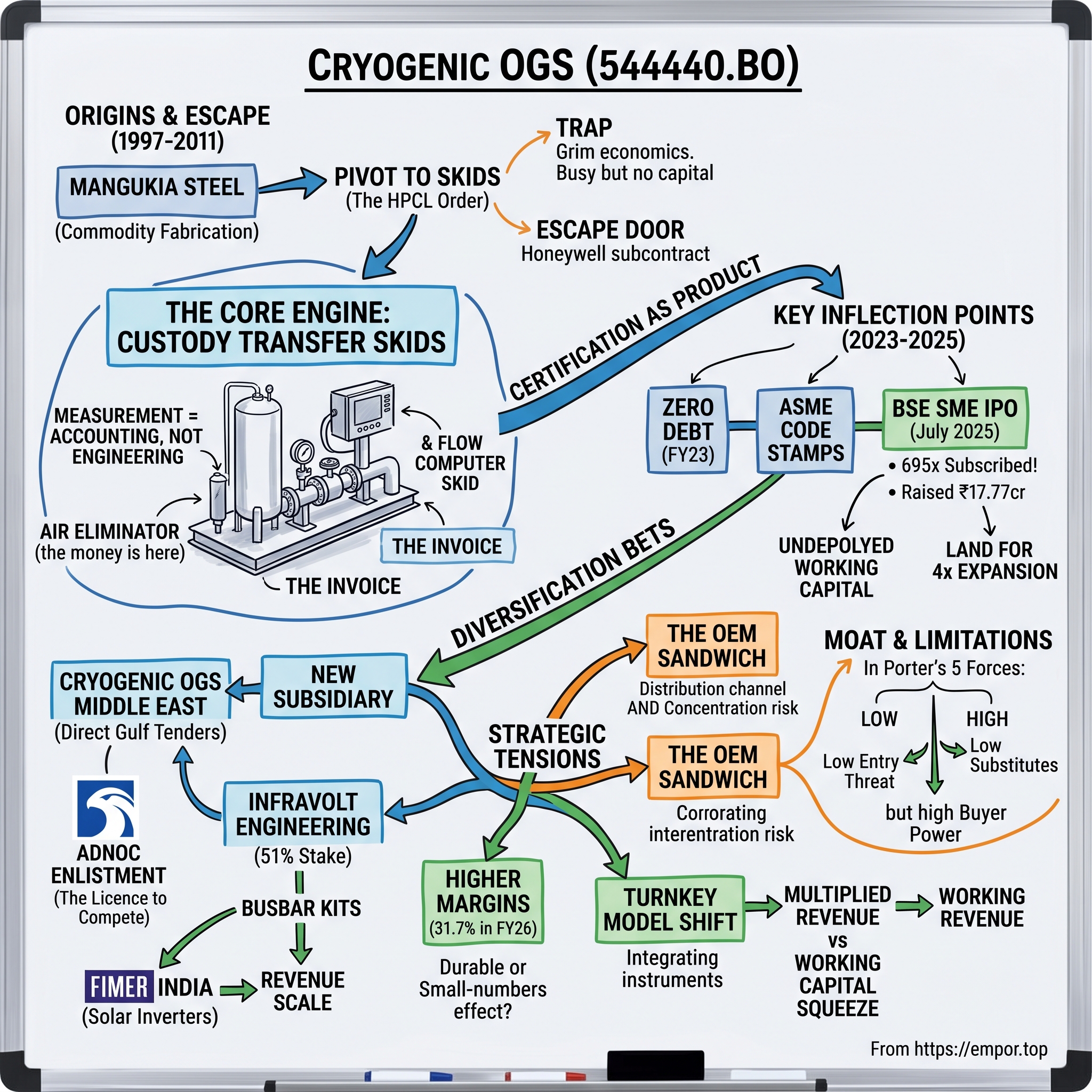
Cryogenic OGS: The Precision Engine of Energy Measurement
I. Introduction & Episode Roadmap
On the morning of July 10, 2025, a company that almost nobody in Indian public markets had heard of a month earlier opened for trading on the BSE SME platform at ₹89.30 a share — exactly 90% above its ₹47 issue price, which happens to be the ceiling the exchange imposes on SME listing-day premiums.1 It didn't drift there. It gapped straight to the cap and stayed. The issue had raised ₹17.77 crore. Applications had poured in for something close to seven hundred times that.1
The company was Cryogenic OGS Limited, and its business is fabricating steel-and-instrument assemblies in a shed in Vadodara, Gujarat. Not software. Not semiconductors. Welded pipe, flanges, valves, filters and flow meters, bolted onto skid frames and shipped on flatbed trucks to oil terminals.
A year later, on July 28, 2026, the stock trades near ₹292 and the market values this business at roughly ₹417 crore.2 That is about forty times the ₹10.18 crore of consolidated profit the company reported for the year ended March 2026.3 The float is thin — promoters hold 74.29% and the register listed 682 shareholders as of March 2026.4 This is, in every mechanical sense, a micro-cap.
But the reason it is worth eight thousand words is not the price action. It is the question sitting underneath: how does a 31-person engineering shop in Gujarat end up as an approved vendor to Abu Dhabi National Oil Company?56
Why measurement is accounting, not engineering
Here is the premise the whole story rests on. In the global hydrocarbon trade, physical possession changes hands constantly — a refinery hands diesel to a tanker fleet, a pipeline operator hands gas to a city distributor, a state oil company hands crude to a trading arm. At every one of those handoffs, somebody has to decide how much. That decision is the invoice.
The equipment that makes the decision is called a custody transfer metering skid. Think of it as a cash register with no cashier: a pre-assembled steel frame carrying flow meters, filters, air eliminators, pressure controls, sampling systems and a flow computer, plumbed and wired so that a fluid entering one end is measured to a contractually agreed tolerance before it exits the other. Get it wrong by a tenth of a percent on a large pipeline and the arithmetic error, compounded over a month of continuous flow, is enormous. Which is exactly why buyers of this equipment behave less like equipment buyers and more like auditors — they want code stamps, third-party witnessed testing, and a supplier who has been doing it long enough that the welds can be trusted.
That auditor-like buying behaviour is the source of whatever advantage Cryogenic OGS has. It is also the source of its biggest problem, which we will get to.
The five threads
This story runs on five threads, and they pull against each other in interesting ways.
One: the escape from commodity fabrication. The company was incorporated on September 5, 1997 as Mangukia Steel Private Limited — a name that tells you everything about the original business.7 Getting from there to code-stamped metering skids took roughly fourteen years and one crucial order.
Two: the economics of the skid. This is a project business with no meaningful economies of scale, no proprietary technology in the measuring instruments themselves, and — remarkably — an EBITDA margin of 31.7% in FY26.3 Understanding why margins are that high, and whether they are durable, is the central analytical task.
Three: the OEM sandwich. Cryogenic OGS's most important customers are the global automation companies — Honeywell, Emerson, Endress+Hauser, ABB — who sell the control systems and subcontract the mechanical integration.7 That relationship is simultaneously the company's distribution channel and its greatest concentration risk.
Four: the diversification bet. In 2026 the company set up two subsidiaries: one in Dubai to bid Gulf tenders directly, and one in India making copper busbars for solar inverters.3 The second one has already won more order value than the parent's entire annual revenue would suggest is normal for a new venture. It is either brilliant adjacency or classic small-cap sprawl.
Five: the cash. Between FY23 and FY25, Cryogenic OGS reported ₹20.87 crore of cumulative profit before tax and generated ₹5.30 crore of operating cash flow.7 That gap is the bear case, stated in two numbers.
Let's start with the shed.
 Subscribe on LinkedIn
II. Origins & Evolution: From Steel Fabrication to Code-Stamped Engineering (1997–2017)
Vadodara in the late 1990s was a company town for process engineering. The Gujarat Refinery sat at Koyali on its northern edge. IPCL's petrochemical complex was down the road. Larsen & Toubro, ABB, Siemens and a dense mesh of instrumentation firms had all planted engineering offices there, and around them had grown a supporting ecosystem of a few thousand small fabrication workshops — job shops with a lathe, a bending machine, a welding bay and a proprietor who knew which purchase manager to call.
Nilesh Natvarlal Patel graduated with a Bachelor of Engineering in Mechanical from The Maharaja Sayajirao University of Baroda in 1995.8 Two years later, in September 1997, he registered Mangukia Steel Private Limited with the Registrar of Companies in Gujarat.7 For the next thirteen years, that is what the business was: a metal fabricator among metal fabricators.
The trap nobody escapes
The commodity fabrication business has a specific and brutal shape. You bid against a dozen workshops within a twenty-kilometre radius on drawings the client has already produced. Your inputs — steel plate, pipe, welding consumables — are quoted daily and priced identically for everyone. Your labour is skilled but not scarce. Your differentiation is delivery reliability, which buyers assume rather than pay for.
The economics that result are grim in a specific way: you can be busy and profitable and still never accumulate capital, because every rupee of margin gets competed away on the next tender. The Indian capital goods landscape is littered with forty-year-old fabrication shops doing ₹5 crore of revenue at 6% margins, run by the founder's son, going nowhere.
What is genuinely interesting about the Cryogenic OGS story is not that it grew. It is which door it walked through.
2011: the order that changed the category
In 2011 the company received its first order from Hindustan Petroleum Corporation Limited, routed through Larsen & Toubro. In the same period it landed its first metering skid order — for the HPCL-Mittal refinery, routed through Honeywell Automation India Limited.7
Read that sentence carefully, because the structure of it is the whole strategy. Cryogenic OGS did not win HPCL. It won L&T, who had won HPCL. It did not win the refinery's metering contract. It won Honeywell, who had won the metering contract.
That is not a lesser achievement. It is a different and arguably better one. The automation majors have a structural problem: their competitive advantage sits in flow measurement physics, control software and global service networks, none of which involve welding pipe to a tolerance in a humid shed. Mechanical integration is low-return, labour-intensive, geographically-bound work that they would rather subcontract. But they cannot subcontract it to anyone, because their name goes on the performance guarantee.
So they qualify a small number of fabricators, audit them relentlessly, and then keep using them. The relationship is not glamorous. It is, however, sticky in a way that a direct end-user relationship at this scale would never be.
In 2011 the company also changed its name — first to Cryogenic Liquide Private Limited, following a shareholder resolution passed on March 21, 2011 and a fresh certificate of incorporation dated April 27, 2011.7 Mangukia Steel could not credibly quote a metering skid. Cryogenic Liquide could.
Certification as the actual product
The pivot required buying credibility, and credibility in this industry is sold by standards bodies.
The company built its compliance stack over the following decade: ISO 9001 for quality systems, ISO 14001 for environment and ISO 45001 for occupational safety; design and fabrication to API standards, ASME codes and IS 2825 for pressure vessels; ATEX conformity for equipment operating in explosive atmospheres; and a DNV fabrication certification attesting to manufacturing process standards.3
To a reader outside industrial manufacturing this looks like a list of acronyms. It is better understood as a list of permissions. Without an ASME-compliant design and the documented welding procedures and non-destructive testing records to back it, a refinery's inspection department will not accept a pressure-containing part, full stop. The certifications do not make the product better in any way a customer can feel. They make the product biddable. And because acquiring them takes years of audits, documented weld-procedure qualifications, welder certifications and a paper trail of completed jobs, they function as a queue that new entrants must join at the back of.
This is the least romantic moat in business and one of the more reliable ones. It is also, importantly, not exclusive — every serious competitor has the same stamps. The stamps keep out the unorganised shops. They do not keep out other certified fabricators.
Slow money, then faster money
The numbers from this era are modest and worth stating plainly because they establish the base the later growth came off. In 2012 the company turned over ₹2.82 crore and earned ₹15.94 lakh of profit.7 Seven years later, in 2019, turnover had reached ₹21.20 crore with net profit of ₹1.52 crore.7 Along the way, in 2018, it booked a ₹4.5 crore order from Endress+Hauser for pipeline transfer metering skids destined for IOCL terminals — a single order worth more than the company's entire revenue six years earlier.7
Two things happened in that stretch. Revenue grew roughly sevenfold. And margins moved from around 5.6% net to around 7.2% net — improvement, but nothing like the current profile.
The margin transformation came later, and it came from a change in what the company was selling rather than how much. Hold that thought.
Two further renamings completed the identity shift: to Cryogenic OGS Private Limited following an annual general meeting on September 30, 2023 and a fresh certificate dated October 20, 2023, and then to Cryogenic OGS Limited on conversion to a public company on November 10, 2023.7 The last change was administrative housekeeping with a purpose — you cannot list a private limited company.
By then, management had already assembled something more valuable than a name.
III. The Core Engine: Custody Transfer Skids & High-Spec Process Infrastructure
Picture a fuel terminal at four in the morning. A tanker backs into a loading bay. A driver swipes a card, an arm drops into the tank hatch, and product begins to flow. Ninety seconds later a printer spits out a docket stating the volume to two decimal places, temperature-corrected to standard conditions, and that docket becomes an invoice, an excise entry, and an inventory adjustment in three separate systems.
Nobody at the terminal thinks about the assembly that produced the number. It sits between the storage tank and the loading arm: a rectangular steel frame roughly the size of a large refrigerator, carrying a strainer, an air eliminator, a flow meter, a control valve, a set of pressure and temperature transmitters, and a junction box. That is a truck loading skid, and Cryogenic OGS has shipped them into more than 300 IOCL terminals, around 200 HPCL terminals and around 200 BPCL terminals.7
The physics, in plain language
Two components on that frame deserve explanation because together they were 57% of FY25 revenue.7
The flow meter measures volume. Cryogenic OGS does not make it — that is Emerson's or Honeywell's or Endress+Hauser's business, and it involves ultrasonics, Coriolis-effect mass measurement or precision-machined turbine rotors.
The air eliminator is the humble one, and it is where the money is. Liquid arriving from a pipeline carries entrained air and vapour pockets. A flow meter cannot distinguish a litre of diesel from a litre of diesel-plus-bubbles; it measures displaced volume. So the bubbles get billed as fuel. An air eliminator is a vessel that slows the flow, lets gas separate upward by buoyancy, and vents it through a float-operated valve before the liquid reaches the meter.
It is a pressure vessel with a float in it. Conceptually, a toilet cistern. And it is critical, because without it the world's most accurate flow meter produces a number that is systematically wrong in the seller's favour — which is precisely the kind of error that gets discovered during a contract audit and ends commercial relationships.
Air eliminators represented 27.31% of FY25 revenue; oil and gas metering skids 29.65%.7 The company's own risk disclosure flags this concentration explicitly.7
What the portfolio actually contains
Beyond those two, the range extends into basket strainers and duplex filtration systems that protect downstream pumps and valves from debris; prover tanks in capacities from 50 to 5,000 litres, used to verify a flow meter against a known volume — calibration equipment for calibration equipment; additive dosing skids that inject precise quantities of performance additives, dyes and fiscal markers into fuel streams; pressure reduction skids; aviation turbine fuel metering and filtration skids; natural gas metering skids; and LNG metering skids.3
Two newer lines matter for where the story goes. The company launched the aDENS series of resonant-vibration density probes in collaboration with a European technology partner — in-line instruments that measure liquid density in real time, which is essential for custody transfer of anything whose volume changes with temperature and for fuel blending control.3 This is the first time Cryogenic OGS has sold an instrument rather than an assembly, and instruments carry different economics and different competition.
The other is nacelle lifting jigs for on-site wind turbine installation.3 Precision-engineered heavy lifting fixtures. Adjacent in fabrication capability, entirely unrelated in end market.
The competitive map
The landscape splits three ways, and Cryogenic OGS sits in a specific gap.
At the top are the global automation majors — Emerson, Honeywell, Endress+Hauser, ABB. They own the measurement technology and the customer specification. They are not competitors. They are the channel, and Cryogenic OGS has been recognised as an approved vendor to Honeywell Automation India, Emerson Process Management, ABB India and Endress+Hauser.7
At the other end sit the unorganised regional fabricators, hundreds of them, competing on price for non-code work. They cannot bid custody transfer because they lack the stamps and the documented track record. They can, and do, bid basic vessels — which is why the low end of Cryogenic OGS's portfolio is permanently price-competitive.
In between are the certified specialists, and this is the real competitive set. It is also the least visible, because most of these firms are private and unlisted.
The useful listed comparison is INOX India, which reported FY26 revenue of ₹1,632 crore and profit after tax of ₹261 crore.9 That is roughly forty times Cryogenic OGS's revenue. But the businesses barely overlap: INOX India makes large cryogenic storage tanks, transport trailers, regasification systems, beverage kegs and cryo-scientific equipment. Its LNG segment rose to 28% of FY26 revenue from 17% in FY25.9 It is a capital-intensive tank fabricator with heavy asset yards. Cryogenic OGS is an assembler of purchased instruments onto purchased steel.
The distinction matters for economics. INOX India needs tank yards, pressure-vessel rolling capacity and inventory of expensive alloy plate. Cryogenic OGS needs an 8,300 square metre shed, a testing bay, and skilled welders.3 Fixed assets on the balance sheet were ₹15.62 crore as of March 2026 — against ₹40.82 crore of revenue.3 That is genuine asset efficiency, and it is the mechanical reason ROCE ran at 26.9%.4
Where the margin actually comes from
Now the important question. Why does a fabrication business earn a 31.7% EBITDA margin?3
Three plausible mechanisms, in descending order of durability.
Engineering content, not steel content. The company explicitly declines to report capacity or capacity utilisation, arguing that every project has different fluid properties, installation environment, size, material and design, so there is no standardised unit of output.7 That disclosure is convenient — it removes a metric investors would otherwise use to test the growth story — but it is also substantively true of custom skid work. And it points at the margin source: the customer is paying for design, documentation, testing and certified assembly, not for kilograms of steel. Engineering hours priced at Vadodara cost, sold into specifications written for European or Gulf fabrication economics.
Position in the value chain. When Honeywell subcontracts a skid, Honeywell is not shopping the job to fifteen bidders on price. It is placing work with one of a handful of qualified shops, on a schedule, with its own reputation exposed. That is a materially better negotiating position than an open tender.
Small-numbers effect. On ₹40 crore of revenue, one well-priced export order can move the consolidated margin by hundreds of basis points. FY26 EBITDA margin expanded 481 basis points and PAT margin 643 basis points in a single year.3 Margins that move that fast in one direction can move that fast in the other. This is the least comfortable of the three explanations, and investors should weight it heavily until several more years of data exist.
Which brings us to what changed in 2026 — and to a business model shift management made deliberately.
IV. Key Inflection Points & Middle East Expansion (2021–2025)
There is a version of this story circulating in market commentary that goes: obscure Indian fabricator quietly builds an export business across the Middle East and Africa, wins ADNOC approval, and re-rates. It is a good story. It is also, in its chronology, wrong — and the correction is genuinely useful for understanding what an investor is buying.
Myth vs reality: the export business is brand new
Here is the disclosed fact. In FY25 — the last full year before listing — Cryogenic OGS's export sales were ₹20.45 lakh, against domestic product sales of ₹3,256.04 lakh. Exports were 0.62% of product revenue. In FY24 they were 1.80%, and in FY23, 1.37%.7
Meanwhile 46.72% of FY25 revenue came from Gujarat and 34.95% from Maharashtra — 82% of the business from two states.7 The company's own prospectus lists this geographic concentration as a distinct risk factor.7
So through FY25, this was an almost entirely domestic business selling to PSU terminals and Indian arms of global automation firms, with a scattering of small shipments to Singapore, Nigeria, Malta, the United States, UAE, Mauritius, Kenya and Oman.7 The international footprint existed as a set of references, not as revenue.
That is not a criticism. It is a repricing of the thesis: the export story is not a proven engine being extrapolated. It is a bet being placed, starting in FY26. Everything that follows should be read in that light.
The clean-energy positioning
The domestic tailwind is real and does not depend on the company at all. Government policy targets raising natural gas from roughly 6.7% of India's primary energy mix in 2024 toward 15% by 2030, with domestic refining capacity expanding from about 258 MMTPA toward 310 MMTPA over the same period, and the small-scale LNG ecosystem scaling from roughly 0.5 MTPA in 2026 toward 3–5 MTPA by 2030 — figures the company attributes to the Ministry of Petroleum and Natural Gas, PNGRB and industry research.3
Every kilometre of new city gas pipeline, every new LNG truck-loading bay, every new refinery unit needs measurement at the boundary. This is about as clean a demand mechanism as industrial equipment gets: it is regulatorily mandated, it is not optional, and it scales with infrastructure build rather than with commodity price.
Cryogenic OGS began manufacturing LNG and hydrogen metering skids in 2023.7 The hydrogen positioning deserves a caveat: green hydrogen at industrial scale in India remains largely at the announcement stage, and a metering skid rated for hydrogen service is a capability, not a revenue line. Management lists strengthening LNG and green hydrogen capability among its forward priorities — as an ambition, not as current business.3
Building the Gulf channel, slowly
The Middle East push started as a distribution arrangement, not an export operation. In 2023 the company signed an agreement with KMC Oil and Gas Equipment LLC in Abu Dhabi for sales and marketing across the GCC.7 The same year it was audited by Endress+Hauser jointly with Arrow Energy Australia for gas skid requirements, securing approval for the Australian market.7
Then, in March 2026, it took the more consequential step: incorporating Cryogenic OGS Middle East F.Z.E in Dubai on March 16, 2026, wholly owned, to enable direct participation in GCC, African and American markets and to handle import-export of heavy equipment and spares.35
This is worth pausing on. Selling into the Gulf through a local agent means giving up margin and, more importantly, giving up the customer relationship. A UAE-registered entity can be enlisted directly with ADNOC, Saudi Aramco, Kuwait Oil Company and Petroleum Development Oman — management explicitly cites better margin retention as the rationale.3 Whether that materialises depends entirely on execution, and the entity is four months old.
Inflection Point 3: ADNOC, and what an enlistment actually is
On May 25, 2026, Cryogenic OGS announced that it had received enlistment approval from Abu Dhabi National Oil Company under category code 146080 — Metering Skids, Liquids and Gases — with manufacturer identification code 20037655. The stock rose 4.99%, hitting the daily limit.5
Note the date. The company had applied for ADNOC approval as of its May 2026 investor presentation, alongside applications for EIL metering skid approval, and had already secured EIL approval for piping spools.3 The enlistment landed weeks later.
What does enlistment mean? It means Cryogenic OGS is now permitted to receive tender documents in that category. It does not mean it has won anything. Gulf national oil companies run vendor registration as a multi-year gauntlet — document review, shop audits, quality system verification, reference checks on completed projects of comparable scope. Passing it is a real signal about manufacturing quality, and it is a barrier competitors must clear independently.
But an enlistment is a licence to compete, not a revenue event. The honest framing is that ADNOC approval expands the addressable opportunity set and tells you something credible about shop-floor standards. It tells you nothing yet about win rates or realised pricing. The falsifiable test arrives when — or if — the first ADNOC purchase order is disclosed.
The model change that actually explains the margin
Buried in the FY26 investor presentation is a strategic shift more consequential than any single approval.
The old model: Cryogenic OGS did engineering, fabrication and assembly, while the client supplied the high-value items — the flow meters, valves, pumps and instruments. Revenue per project was therefore limited to the labour-and-steel portion of a much larger project value.3
The new model: Cryogenic OGS procures and integrates all key equipment itself and delivers a complete turnkey scope — engineering, design, procurement, manufacturing, testing, delivery and installation.3
The consequence is arithmetic. If a metering package costs ₹1 crore all-in and the flow meters and valves are ₹60 lakh of it, moving from fabrication-only to turnkey multiplies your recognised revenue on the same job by roughly two and a half times. Management cites better sourcing control and higher value addition as margin drivers, plus single-point responsibility as a customer benefit.3
The proof point is Honeywell Nigeria — the company's first full-scope international project, completed and in shipment as of the FY26 presentation, where Cryogenic OGS handled 100% of procurement, coordination and execution.3
Here is the trade-off nobody should skip. Turnkey scope means you now carry the working capital for expensive imported flow meters, take the foreign-exchange and lead-time risk on them, and absorb any input cost escalation between quote and delivery on a fixed-price contract. You capture more revenue and you finance more of the project. Which is exactly what the cash flow statement shows — and exactly the tension that shows up in Section VII.
The trajectory, and what it says
Revenue moved from ₹23.33 crore in FY22 to ₹22.02 crore in FY23 — a decline — then ₹24.25 crore in FY24, ₹32.90 crore in FY25, and ₹40.82 crore in FY26.43 Profit after tax went ₹3.28 crore, ₹4.08 crore, ₹5.38 crore, ₹6.09 crore, ₹10.18 crore across the same years.43
Two observations. First, profit grew every single year including the year revenue fell — meaning mix improvement, not volume, has been the earnings driver throughout. That is consistent with the up-the-value-curve narrative and it is the more encouraging read.
Second, the FY26 step-change is heavily weighted to the first half. Second-half FY26 revenue was ₹19.76 crore against ₹19.49 crore in the prior-year second half — growth of 1.37%.3 Second-half profit still rose 35.24% to ₹4.67 crore on margin expansion.3 So the top-line acceleration that produced the full-year 24% growth number happened in H1 FY26 and did not continue into H2. For a company reporting only twice a year, that is a meaningful lumpiness signal, and it is the kind of detail that gets lost when a headline says "revenue up 24%."
The market, however, was not reading half-yearly splits in July 2025. It was reading a subscription book.
V. Capital Deployment: The July 2025 BSE SME IPO & M&A Philosophy
The Indian SME IPO market in mid-2025 was in one of its periodic states of collective abandon. Issues were routinely closing at two hundred, four hundred, six hundred times subscription; grey market premiums were quoted before prospectuses were read; and the binding constraint on listing-day gains was not valuation but the exchange's own 90% circuit cap.
Into this walked a ₹17.77 crore fresh issue from a Vadodara fabricator.
The mechanics
Cryogenic OGS offered 37,80,000 fresh equity shares of ₹10 face value in a price band of ₹44 to ₹47, finally priced at ₹47, with a lot size of 3,000 shares. The book opened July 3, 2025, closed July 7, allotment was July 8, and the shares listed July 10.10 Beeline Capital Advisors was book-running lead manager; MUFG Intime India was registrar.1
The demand curve tells its own story. Day one closed around 11 times subscribed. By the end of day two it was 92.78 times.11 Final tallies put qualified institutional demand at 209.59 times, non-institutional at 1,155.38 times and retail at 773.70 times, for a combined figure near 695 times.1
An investor should read those category numbers carefully, because they are not equally informative. Non-institutional bids at four figures of oversubscription in a hot SME market are substantially a lottery-ticket phenomenon: with allotment odds near zero and a near-guaranteed listing pop, the expected value of applying is positive almost regardless of the business. Institutional demand at 210 times in a ₹17 crore issue involves a handful of anchor participants and equally tells you little about long-run conviction.
What the book genuinely proves is that the SME primary market in July 2025 was indiscriminate. It does not prove anything about Cryogenic OGS. The listing at ₹89.30 pinned to the exchange cap1 and the subsequent run to ₹296 by mid-2026 — a 109% gain over twelve months, against a 52-week range of ₹103.55 to ₹3102 — reflect a genuine earnings step-up and a market willing to pay 40x for a ₹40 crore-revenue engineering shop. Both things are true.
Where the money went — and didn't
The stated objects were straightforward: ₹1,150 lakh for working capital, plus general corporate purposes and issue expenses.7 No debt repayment, because there was no debt to repay — the company had reached zero-debt status by March 31, 2023 and stayed there.73
That absence matters more than it sounds. A large share of SME issues exist to refinance promoter guarantees or clean up a leveraged balance sheet, meaning the proceeds fund the past. Here, every rupee was available to fund the future.
Then look at the deployment statement filed for the half-year ended March 31, 2026, approved by the audit committee and board on April 30, 2026 with no adverse auditor comment and no deviation from stated objects. Against the ₹1,150 lakh earmarked for working capital, ₹240.12 lakh had been utilised. Against ₹396.47 lakh of general corporate purposes, ₹284.31 lakh. Issue expenses of ₹230.13 lakh were essentially fully absorbed at ₹228.29 lakh.12
So roughly nine months after listing, about 21% of the working capital allocation had been drawn.
There are two readings and an investor should hold both. The charitable one: management is not spraying capital, and drawing working capital only as orders require it is exactly what disciplined behaviour looks like. The sceptical one: the company raised money specifically because working capital was the binding constraint on growth, and left four-fifths of it undeployed while total assets nearly doubled from ₹33.85 crore to ₹66.72 crore and fixed assets went from ₹6.61 crore to ₹15.62 crore.3
Fixed assets more than doubled while the working capital object sat 79% unspent. That capital went into plant and — per management's own disclosure — land, with land acquired for a facility of 3,52,776 square feet, roughly four times current scale, to be built in phases.3 Screener data shows borrowings of about ₹8 crore appearing on the FY26 balance sheet against zero previously, and investing outflows of roughly ₹21 crore in FY26.4
That is a defensible sequence — build capacity ahead of the order book you are trying to win in the Gulf. It is also a change in the capital allocation story from the one told at IPO, executed without a conference call to explain it. Investors are entitled to ask why a company that raised money for working capital, and had barely touched it, took on its first borrowings in three years to fund land and plant. The answer may be entirely sound. It has not been publicly given.
On M&A: the road not taken
The outline for this story poses the question of whether management overpaid for legacy fabricators at bull-market valuations. The answer is clean: there has been no M&A. Capital has gone to organic capacity, shop-floor upgrades, certifications, and two newly incorporated subsidiaries.3
In an environment where every Indian small-cap with a re-rated stock has been tempted to issue paper for acquisitions, not doing so is a genuine data point on discipline. It is also a lower-variance path — greenfield capacity in a business you already understand carries execution risk but not integration risk or hidden-liability risk.
The one place where capital allocation gets genuinely interesting, though, is the subsidiary that has nothing to do with oil and gas.
VI. The Hidden Growth Engine: Infravolt Engineering & Power Transition
In June 2026, a company whose entire annual revenue was ₹40.82 crore announced that a subsidiary nobody had heard of had won an order worth ₹12,58,59,980.
The subsidiary was Infravolt Engineering Private Limited. The customer was Fimer India Private Limited. The product was busbar kits for power modules destined for solar inverters, to be executed in 18 to 21 weeks.13 On July 8, 2026, a second Fimer order followed at ₹5.27 crore, scheduled for completion by November 30, 2026.14
Two orders, roughly ₹17.9 crore combined, from a venture with no operating history — against a parent that opened FY27 with a ₹31 crore executable order book as of April 1, 2026.3
First, a correction on the ownership
This deserves precision because the public record is inconsistent. Several news reports describe Infravolt as a wholly-owned subsidiary. The company's own investor presentation filed with BSE in May 2026 states Infravolt is held 51%, with the balance in the hands of co-promoters who contribute technical and operational execution, while it is the Dubai entity — Cryogenic OGS Middle East F.Z.E — that is 100% owned.3 Contemporaneous reporting of the incorporation approval also cited a 51% stake.
The distinction is material for a shareholder. At 51%, Cryogenic OGS consolidates Infravolt's revenue and reports a minority interest, meaning roughly half the economics of any success accrue elsewhere. It also means the venture has partners whose identity, contribution and terms have not been prominently disclosed. That is a legitimate governance question — a joint venture with unnamed co-promoters, consolidated into a listed entity, winning orders that are large relative to the parent, is precisely the structure that a sceptical investor should want more disclosure on. Not because anything is wrong, but because nothing has been shown.
What a busbar is, and why it isn't crazy
A solar inverter converts direct current from panels into grid-quality alternating current. Inside it, currents of hundreds of amperes must move between switching modules, capacitors and terminals. Ordinary cable would be bulky, lossy and would run hot.
The solution is a busbar: a shaped bar of copper — sometimes laminated, sometimes insulated, precisely formed and drilled — that carries high current with low resistance and predictable thermal behaviour. Getting it right is a matter of forming tolerance, surface finish, plating quality and dimensional repeatability, because a busbar that flexes a millimetre out of spec will not seat correctly on a module terminal, and a poor contact at 400 amperes becomes a hotspot and then a failure.
So: precision metal forming, tight tolerances, a demanding OEM customer, quality documentation, and no proprietary technology of your own. That is structurally the same business as a metering skid, with copper instead of stainless steel and an electrical spec instead of a pressure spec.
The synergy claim, in other words, is not fabricated. The capability transfer is real: quality systems, inspection discipline, OEM-qualification experience, project execution.
Who Fimer is, and why the customer matters
Fimer S.p.A. is an Italian power electronics firm that became one of the world's larger solar inverter suppliers by acquiring ABB's solar inverter business, a transaction ABB completed in 2020 that included manufacturing operations in Italy and India.15
That lineage explains the fit precisely. Cryogenic OGS has been an approved vendor to ABB India for years.7 Fimer India inherited ABB's Indian inverter manufacturing. A supplier that had already passed ABB's audits was, in effect, pre-qualified for the entity that took over ABB's factory.
This is the single most persuasive element of the Infravolt case, and it is not the busbar. It is that the diversification was routed through an existing, audited OEM relationship rather than through a cold sales effort into an unfamiliar market. Management's stated ambition extends further — railway traction systems and battery-adjacent power electronics — targeting domestic and global OEM demand.3
The stress test
Now the sceptical case, which is not trivial.
Concentration inside the diversification. Infravolt's entire disclosed order book is from one customer. A venture built to reduce dependence on oil and gas cycles has, so far, created dependence on a single solar inverter OEM's procurement decisions.
Margin unknown. Busbar kits for a global inverter OEM sound like a volume component business, and volume component businesses supplying large OEMs do not typically earn 31.7% EBITDA margins. If Infravolt scales meaningfully at lower margins, consolidated margins compress even as revenue grows — and a market paying 40x earnings for a high-margin niche may not enjoy that mix shift.2 Infravolt's margin profile has not been disclosed.
Working capital, again. Copper is expensive and price-volatile. A ₹12.59 crore order executed over 18 to 21 weeks requires financing copper inventory in a business that already converts profit to cash slowly.
Attention. The parent runs an ADNOC-approved metering skid operation with 31 permanent employees as of March 20257, a first Gulf subsidiary, a first turnkey international project, a new instrument product line, and a four-times capacity expansion. Adding a second industry is either efficient use of a fabrication platform or the classic small-cap error of chasing whatever sector the market is rewarding.
The evidence available today genuinely supports the charitable reading — the customer relationship is not accidental, the capability overlap is real, and the orders are disclosed with execution timelines. But the honest verdict is that Infravolt is optionality, not a proven engine, and it should be valued as such until it reports a full year of revenue and margin.
Which raises the question of who is making these calls.
VII. Current Management, Incentives, & Credibility Stress Test
There is no chief executive brought in from a multinational here, no professional management layer, no investor-relations veteran. As of the prospectus, Cryogenic OGS was a family company with 31 permanent employees and a board of five.78
The founder
Nilesh Natvarlal Patel, aged 50 at the time of the prospectus, is Chairman and Managing Director. Mechanical engineering from MS University Baroda, 1995. More than 22 years of experience specifically in designing and engineering equipment for oil and gas metering, project management and implementation.8
That biography is narrower than it looks, and the narrowness is the point. He is not a general industrialist who happened into metering. He has spent his entire adult working life on one problem, in one city, in one industry — which in a business where credibility is granted by audit rather than by pitch is close to the ideal profile. It also explains the sequencing of the company's history: a fabricator who understood measurement well enough to know that the certification stack was worth a decade of investment.
The company's own presentation credits him with pioneering product innovations and quality certifications and guiding the company through the IPO and international expansion.3 That is management's self-description and should be read as such. The independently verifiable version is more useful: he took a commodity fabrication shop to a 31.7% EBITDA business with zero debt, which is a real result whatever adjectives are attached to it.
The successor
Dhairya Patel was 24 years old at the time of the prospectus. Bachelor of Technology in Petroleum Engineering from the School of Petroleum Technology at Pandit Deendayal Energy University, class of 2022. Roughly three years with the company at the time, engaged in sales, marketing and development initiatives, and a promoter in his own right.8
A 24-year-old whole-time director on a listed board is exactly the succession structure that governance-minded investors treat carefully — not because youth disqualifies anyone, but because the role was not competed for. The observable record so far is that the period of his involvement coincides with the Gulf channel build, the turnkey model shift, and the diversification into power electronics, and the company positions him as driving new-age operational initiatives and brand presence.38 Whether he is the author of those moves or the executor of his father's is not something an outside investor can determine. What can be said is that the strategic direction changed materially in the two years after he joined full-time, in ways that fit a petroleum-engineering graduate's worldview more than a fabricator's.
Kiranben Nileshbhai Patel, 47, is a Non-Executive Director and promoter, associated with the company since 2001, with a Bachelor of Science from South Gujarat University and more than 13 years of experience in human resources and logistics.8 Two independent directors complete the board: Prerana S Bokil, a company secretary and law graduate with roughly eight years in secretarial and regulatory compliance, and Shashank Garg, a practising chartered accountant with around twelve years in taxation and audit.8
That is a compliance-competent independent slate. It is not a slate with deep industry, capital-allocation or international-business experience to challenge the promoters on strategy — a common and unremarkable feature of Indian SME boards, and a real limitation on the quality of oversight.
Alignment, and its edge
Pre-issue, the three promoters held 1,04,91,600 shares — 99.92% of paid-up equity.7 Post-issue and as of March 2026, promoter holding stood at 74.29%, with domestic institutions at 1.65% and public at 24.06% across 682 shareholders.4
The alignment is about as tight as it gets. It also has a flip side that matters at this ownership level: at 74%, minority shareholders have essentially no mechanism to influence anything. Every question below is a question about promoter judgment, because promoter judgment is the only judgment operating.
The record, tested
Where management has delivered. Zero debt achieved in FY23 and maintained through FY26.73 No litigation and no tax proceedings against the company, its promoters or directors as disclosed at IPO.7 IPO proceeds spent within stated objects with no deviation and no adverse auditor comment.12 Certifications and approvals delivered roughly as flagged — EIL piping spool approval secured, ASME U Stamp audit completed with certification pending, ADNOC enlistment applied for in May 2026 and received later that month.35 A prospectus that discloses customer concentration, product concentration and geographic concentration plainly rather than burying them.7 Profit growth in every year of the last five, including a year of revenue decline.4
That is a coherent record of doing roughly what was said, which is more than can be said for many companies of this size.
Where the record raises questions.
The cash flow divergence. This is the central one. In FY23 the company earned ₹5.48 crore of profit before tax and generated ₹1.84 crore of operating cash. In FY24, ₹7.12 crore of PBT against ₹1.53 crore of operating cash. In FY25, ₹8.27 crore of PBT against ₹1.94 crore.7 Three consecutive years in which operating cash flow ran at roughly a quarter of pre-tax profit.
The mechanism is visible in the prospectus line items: inventories rose ₹1.86 crore in FY25 and ₹2.02 crore in FY24; receivables rose ₹1.28 crore in FY25 and ₹2.50 crore in FY23; payables fell in all three years, meaning the company was paying suppliers faster while collecting from customers slower.7 Add income tax paid on the reported profit, and the cash simply never arrived.
For a custom project business this is structurally explicable. Long-lead imported instruments must be bought and held. PSU customers retain a portion of contract value until commissioning and performance verification. Work-in-progress on partly built skids sits as inventory for months. None of this is fraud or aggressive accounting. It is what happens when a business grows project scope faster than it grows its ability to finance it — and moving to a turnkey model where the company now buys the flow meters makes it structurally worse before it makes it better.
FY26 shows genuine improvement: operating cash flow of roughly ₹8 crore against ₹10.18 crore of profit, with debtor days falling to about 43 from 73.43 Trade receivables actually declined in absolute terms, to ₹4.80 crore from ₹6.62 crore, while revenue grew 24%.3 That is a real and creditable improvement in collections.
But inventory days rose to about 138 from 112, and the cash conversion cycle lengthened to roughly 138 days from 128.4 So the improvement was in collecting from customers, not in the overall cash cycle — inventory absorbed what receivables released. On a business executing 143 truck loading skids for Egypt and an LNG skid for Honeywell USA, that is not surprising. It does mean one good year does not settle the question.
The accounting correction. In April 2026 the company revised its previously reported half-year results for the period ended March 31, 2026, citing a clerical error in deferred tax expense; half-year profit after tax was restated upward to ₹4.67 crore from ₹4.47 crore, with the board approving the revision on April 30, 2026 and the auditor, Maloo Bhatt & Co, issuing an unmodified opinion.16
The direction is favourable and the amount is small — about ₹19 lakh. But a restatement of a reported figure within months of publication, in the company's first full year as a listed entity, is a financial-controls signal rather than an accounting scandal. It is the sort of thing to note and watch for recurrence, particularly as the entity structure gets more complex with a UAE subsidiary and a 51%-held joint venture consolidating in.
The disclosure gap. Cryogenic OGS reports half-yearly, as SME norms permit, and holds no earnings conference call. Investor communication runs through periodic presentations and an outsourced investor-relations desk.3 The practical consequence is that there is no forum in which an analyst can ask why borrowings appeared, what Infravolt's margins are, who its co-promoters are, or what the pipeline behind the ADNOC enlistment looks like. Every judgment in this section had to be assembled from filings because there is no transcript to read.
That is legal and normal for the format. It is also a real information deficit, and investors paying 40x earnings are paying that multiple with materially less ability to test management's narrative than they would have in a mainboard company.
Customer concentration, quantified. The top customer was 25.45% of FY25 revenue, the top three 56.34%, the top five 70.27%, and the top ten 89.01%.7 Those are FY25 figures — the most recent disclosed at that granularity. A business where three customers are more than half of revenue, and where several of those customers are the same global automation firms that could qualify an alternative fabricator, does not control its own destiny. Supplier concentration is milder but present: the top supplier was 17.28% of FY25 purchases and the top ten 54.35%.7
The composite picture is a competent, conservative, technically credible promoter group that has built something real and disclosed its weaknesses honestly — operating with governance and communication infrastructure appropriate to a much smaller and less complex company than the one it now is.
Whether the business itself has a durable edge is a separate question, and the frameworks help.
VIII. Strategic Frameworks: Helmer's 7 Powers & Porter's 5 Forces
Frameworks are useful here precisely because the intuitive answer — "it's a fabrication shop, there's no moat" — is too quick, and the promotional answer — "certifications create an unassailable moat" — is too generous.
Helmer's 7 Powers
Process Power — present but modest. Helmer's test for process power is that the advantage must be slow to build and hard to copy even with intent. Cryogenic OGS's accumulated welding procedure qualifications, non-destructive testing protocols, hydrostatic and calibration testing discipline, and the documentation trail that satisfies ASME, API, IS 2825 and ATEX requirements3 do meet the slow-to-build test. A determined competitor needs years, not months.
But the qualification is important: every certified competitor has already built it. This is a barrier against the unorganised segment, and it is table stakes among the specialists. Process power that your peer group also possesses is a barrier to entry, not a source of relative advantage.
Switching Costs — moderate, and real where it counts. The genuinely valuable friction is not with end users, it is inside the OEM channel. When Honeywell has audited a fabricator's shop, qualified its welders, verified its quality system and executed jobs with it, replacing that fabricator means repeating the audit, absorbing the schedule slip, and putting Honeywell's own performance guarantee behind an unproven partner. That is why approved vendor status persists.
The counter-evidence to weight: the top customer share moved from 18.66% in FY23 to 29.37% in FY24 to 25.45% in FY25, and the top-three share swung from 49.78% to 62.57% to 56.34%.7 Composition that volatile is consistent with project timing rather than with locked-in annuity relationships. These are not contracts. They are repeat purchase orders, revocable in practice.
Counter-Positioning — absent. Helmer's counter-positioning requires a business model incumbents cannot copy without damaging their existing business. Cryogenic OGS is not counter-positioned against the automation majors; it is their subcontractor. The turnkey model shift moves it slightly up the value chain, but into procurement and integration, not into anything Emerson would be structurally unable to do.
Scale Economies — largely absent, and honestly so. The company itself argues that capacity and utilisation metrics do not apply because every project is bespoke.7 That admission is also an admission that there is no volume-driven cost curve. Fixed costs are low, so operating leverage on the way up is limited to overhead absorption. The forthcoming facility at four times current scale3 should improve throughput and reduce constraint, but it will not create a unit-cost advantage a competitor cannot match.
Cornered Resource — arguably one, narrowly. The ADNOC enlistment, EIL approvals and the roster of approved-vendor statuses with four global automation firms537 function as cornered access rather than cornered inputs. They are individually revocable and individually replicable. Directionally, though, the combination is not something a new entrant assembles quickly.
Branding and Network Economies — not applicable. Nobody specifies a metering skid by brand, and there is no network effect in pressure vessels.
The framework verdict: a real but modest moat, resting on certification, OEM entrenchment and a cost position derived from Indian engineering labour. Not the kind of structural advantage that protects pricing indefinitely.
Porter's Five Forces
Buyer power — high, and this is the binding constraint. The customer set is state oil companies, global automation majors and large EPCs. Every one of them is orders of magnitude larger than the supplier. They write the specification, set the payment terms, retain money against performance, and can qualify alternatives. The evidence is in the cash flow statement discussed above: payables fell while receivables rose across FY23–FY257, which is the balance-sheet signature of a supplier with no negotiating leverage on terms. High reported margins coexisting with weak cash conversion is precisely what buyer power looks like when the buyer cannot squeeze your price but can squeeze your working capital.
Threat of new entrants — low. Multi-year vendor enlistment, code stamps, welder qualification records, and a documented track record in custody transfer applications. A new shop can start tomorrow; it cannot bid an ADNOC metering skid tender for years.
Supplier power — moderate, rising with the model shift. Stainless and alloy steel are commodities with volatile pricing and no supplier concentration. But the turnkey model means Cryogenic OGS now purchases flow meters, valves, pumps and instruments — often from the very automation majors that are also its customers, and sometimes imported, with the company disclosing raw material imports from the United States.7 Buying critical high-value components from your customer is a genuinely unusual dependency, and it means input cost escalation and lead-time slippage now land on Cryogenic OGS's P&L rather than the client's.
Threat of substitutes — low. There is no alternative to measuring fluid at a custody boundary; the requirement is contractual and often regulatory. The long-term energy transition changes the molecule, not the need — LNG and hydrogen both require metering, and hydrogen arguably requires more stringent metering. The real substitution risk is not technological but sequencing: if Indian oil and gas capex slows while hydrogen infrastructure has not yet arrived, there is an air pocket.
Rivalry — bifurcated. Intense in basic vessels and strainers, where unorganised shops compete on price. Materially lighter in code-stamped custody transfer skids. The company's mix is deliberately weighted toward the second, which is the strategy working. The risk is that as it scales, growth increasingly has to come from segments where rivalry is stiffer — a structural reason to expect margin normalisation over time even if execution is good.
Composite. A defensible niche with low entry threat and manageable substitution, permanently squeezed by buyer power that shows up as working capital rather than as pricing. The margin is real. The cash flow is the tax the buyers levy on it.
IX. Current Risk Radar & Guidance for Downstream Analysis
Not every macro risk deserves airtime. For a ₹417 crore engineering company with two customers accounting for a third of revenue, four risks carry real mechanism, and one deserves a mention that the outline does not anticipate.
1. Working capital and cash lockup — the primary risk. The mechanism has been laid out: long-lead imported instruments held as inventory, PSU retention money released only on commissioning, work-in-progress on partly built skids, and now the turnkey model transferring component procurement onto Cryogenic OGS's balance sheet. FY26 showed collections improving while inventory absorbed the benefit, leaving the cash conversion cycle at roughly 138 days.4
The specific failure mode is not insolvency — the balance sheet carries ₹54.65 crore of net worth against modest borrowings34. It is that growth becomes self-limiting. A company that ties up 138 days of cash to generate revenue can only grow revenue as fast as it can finance the cycle, and the ₹1,150 lakh raised for working capital funds a finite amount of that. If order intake accelerates faster than cash converts, the choice is between borrowing, diluting, or declining work.
2. Customer and OEM concentration. With the top three customers at 56% of FY25 revenue and the top ten at 89%7, and with the most important of those being global automation firms that maintain multiple qualified fabricators, a single procurement reorganisation at Honeywell or Emerson could remove a fifth of revenue. Concentration in a project business is normal; concentration where the customer is also increasingly a supplier of critical components, as under the turnkey model, compounds it.
3. Input cost volatility on fixed-price contracts. Stainless and alloy steel prices move, copper moves more, and the imported instrument content in a turnkey skid carries both price and currency exposure. Contracts in this business are typically fixed-price with execution windows of 10 to 21 weeks based on the company's own disclosed order timelines.1713 A sharp input move inside an execution window compresses margin on already-booked work with no recourse. This is the most likely mechanism by which the current 31.7% EBITDA margin normalises.
4. Execution risk in diversification and expansion. Simultaneously: a four-times capacity expansion on newly acquired land, a first Gulf subsidiary, a first turnkey international project, a new instrument product line, and a 51%-held venture in power electronics.3 Any one of these is a reasonable stretch for a 31-person organisation. Together they represent an organisational load well beyond what the company has previously carried, managed by a promoter team of three.
5. Liquidity and market structure — worth naming. With 682 shareholders on the register4 and reported daily volumes in the low thousands of shares2, the stock's price is set by very few trades. A 40x multiple on an SME platform with that float is not a considered market judgment about business quality; it is what a thin book does in a rising market. This cuts both ways and is a risk of the security, not the business — but it is the risk most likely to be experienced first.
What is not on this list, deliberately: AI disruption (irrelevant to physical metering hardware), cybersecurity (immaterial at this scale), refinancing risk (near-zero net debt), and litigation overhang (none disclosed7). Padding a risk section with generic macro items obscures the four that matter.
Where to read next
For anyone following this story forward, the primary sources are specific and the useful ones are not the ones aggregators quote.
The Red Herring Prospectus of July 2025 remains the only document containing the granular disclosures used throughout this piece: customer and supplier concentration by tier, product-wise and state-wise revenue splits, the three-year operating cash flow reconciliation, and the explicit statement that capacity metrics are not reported.7 Nothing published since has replaced it.
BSE corporate filings are where the operating news actually lands, typically before any commentary — the ADNOC enlistment5, the Fimer orders1314, the Endress+Hauser order17, and the IPO fund utilisation statements12 all appeared there first. The half-yearly investor presentations filed under Regulation 30 carry the segment colour, subsidiary structure and management commentary.3
Because there is no earnings call, the substitutes for a transcript are the presentation's forward-looking sections read against the prior period's. Three specific comparisons will be informative: whether the ADNOC enlistment converts to a disclosed purchase order and at what value; whether Infravolt's revenue and margin are broken out separately once it has a full year; and whether the ₹31 crore opening order book grows or is simply consumed. Management stated its forward focus as project execution, scaling the aDENS instrument line, expanding GCC presence and building LNG and green hydrogen capability.3 Each of those is testable against the next presentation.
X. Playbook, Bull vs. Bear Case, & Key KPIs
The three numbers that matter
Most metrics for this company are noise on a ₹40 crore revenue base. Three are not.
1. Operating cash flow as a proportion of profit after tax. This is the single most informative number Cryogenic OGS publishes. Reported profit in this business is a claim about a project's economics; operating cash flow is the confirmation. Three consecutive years of operating cash at roughly a quarter of pre-tax profit through FY25, followed by a sharp improvement in FY2674, means the question is genuinely open. If the FY26 improvement persists across the Egypt, Nigeria and Libya execution cycle, the business is fundamentally better than its history suggests. If it reverts, then reported margins were always a working-capital-funded accounting outcome, and the growth is not self-financing.
2. Order book, and its conversion. The ₹31 crore executable order book disclosed as of April 1, 20263 is roughly nine months of revenue at the FY26 run rate. Two things are worth tracking, not one: whether the absolute number grows — because a book being consumed without replacement is a revenue cliff — and how long disclosed orders take from announcement to revenue recognition. The company helpfully publishes execution windows with individual order announcements, which makes this checkable.
3. Export and international revenue share. This is the falsifiability test for the entire investment case. Exports were 0.62% of product sales in FY25.7 The Gulf subsidiary, the ADNOC enlistment, the Egypt and Libya and Nigeria projects, and the margin-retention argument all imply this number rises materially. If international revenue is still in single-digit percentages two years from now, the strategy did not work, regardless of how many approvals were announced.
Three numbers. Not a dashboard.
The bear case
The bear case does not require anything to go wrong. It requires only that the current situation persist.
Strip away the narrative and this is a ₹40 crore revenue custom fabricator with 31 employees, three customers accounting for more than half of sales, essentially all historical revenue from two Indian states, no proprietary technology in the components that do the actual measuring, and a structural inability to negotiate payment terms with any of its buyers. It converted roughly a quarter of pre-tax profit into operating cash for three straight years and required an IPO to fund the working capital that growth demands.
For that, the market pays roughly 40 times earnings and 7.8 times book value.24 The implied expectation is not that the business does well. It is that it transforms — that a domestic subcontractor becomes an international turnkey supplier at maintained margins while simultaneously building a power electronics business, all managed by three family promoters with two compliance-focused independent directors and no earnings call.
The specific ways this breaks: input costs move against fixed-price contracts already booked; one automation major reorganises its vendor panel; the Infravolt busbar business scales at component-supplier margins and drags consolidated profitability; the capacity expansion consumes cash before the Gulf orders arrive; or the ADNOC enlistment simply never converts, because being permitted to bid against established European and Korean fabricators is not the same as winning. And beneath all of it, an SME-platform security with 682 shareholders where the exit is as thin as the entry was.
The bull case
The bull case is that the certification stack and the OEM entrenchment are worth more than they look, and that the turnkey shift is a genuine change in the unit economics rather than a repackaging.
The supporting evidence is not rhetorical. Profit grew in every one of the last five years including a year revenue declined — mix improvement, not volume, has driven earnings throughout.43 Zero debt was achieved in FY23 and maintained while funding growth.7 The certifications and approvals promised at IPO have been delivered on roughly the stated schedule.35 Receivable days improved sharply in FY26 even as revenue grew 24%, and receivables fell in absolute terms.34 IPO money was spent where it was said it would be, and conspicuously not on acquisitions.12 And the Infravolt diversification was routed through an OEM relationship the company had already earned, not a cold market entry.715
If the turnkey model holds, each project carries multiples of the revenue the same job would have generated three years ago at comparable or better margins.3 If the Dubai entity converts even a modest share of GCC tenders, the export share moves from a rounding error to a material segment against a demand backdrop — Indian gas share targets, refining expansion, small-scale LNG scaling3 — that requires metering at every new boundary. And a fabrication platform that can hold tolerance in copper as well as stainless has more addressable markets than an oil and gas equipment maker does.
The realistic reconciliation is that both cases are live and the evidence to distinguish them arrives on a half-yearly cadence. What is not honestly available today is confidence — the international business is four months old as a structured operation, the diversification has no reported revenue, and the cash conversion improvement has exactly one year of data behind it.
The lessons
Escaping the commodity trap costs a decade, not a quarter. The interesting decision in this company's history was not any order or any product. It was choosing, around 2011, to spend years and money acquiring certifications that would generate zero incremental revenue until the day a purchase manager needed them. Regulatory and code compliance are among the few barriers a small manufacturer can actually build — because they are earned through time and audit, which capital cannot compress.
Embedding in someone else's channel is an underrated distribution strategy. Cryogenic OGS never had to build a sales force to reach ADNOC or Arrow Energy Australia. It got there by being the fabricator Honeywell and Endress+Hauser were willing to put their guarantee behind. The cost is dependence. The benefit is reach that a 31-person company could not otherwise buy.
In high-margin micro-caps, cash conversion is the audit. A 31.7% EBITDA margin on ₹40 crore of revenue is either evidence of a genuinely differentiated position or evidence that profit is being recognised faster than it is being collected. The two look identical on an income statement and completely different on a cash flow statement. Reported margin is a hypothesis; operating cash flow is the test.
And a thin market is not a valuation. Six hundred and ninety-five times subscription proved something about the SME primary market in July 2025 and nothing about the company. Two years of half-yearly filings will prove considerably more.
XI. Outro
The story of Cryogenic OGS is, at its core, a story about the difference between being needed and being powerful.
Every barrel of refined product loaded onto a truck at an Indian terminal, every cubic metre of gas handed from a pipeline to a city distributor, has to be counted. The counting is not optional, it is not going away, and the transition to LNG and eventually hydrogen changes the fluid, not the requirement. Cryogenic OGS makes the thing that does the counting, and it has spent nearly three decades earning the permissions that allow it to be in the room. That is genuinely needed.
Powerful is a different question. A company whose customers are twenty times its size, whose measuring instruments are made by those same customers, and whose reported profits have historically converted into cash at roughly a quarter of book rate is not in a position of strength. It is in a position of usefulness — which is a good business, at a price.
What happens next is unusually legible for a company this small, because management has staked out testable positions. The ADNOC enlistment either converts to orders or it does not. The turnkey model either lifts revenue per project at maintained margin or it does not. Infravolt either becomes a second engine or becomes a distraction with a minority partner attached. The cash conversion improvement of FY26 either holds through the Egypt and Libya execution cycle or reveals itself as timing.
The company has done what it said it would do, at a scale small enough that everything still depends on three people in Vadodara and a market that has already priced the good outcome. The next two half-yearly filings will say a great deal.
References
-
Cryogenic OGS SME IPO GMP, Details, Price, Dates & Subscription Status — IPOJI ↩↩↩↩↩
-
Cryogenic OGS (BOM:544440) Stock Price & Overview — StockAnalysis.com ↩↩↩↩↩
-
Cryogenic OGS Limited Investor Presentation, H2 FY26 — BSE India corporate filing, 2026-05-07 ↩↩↩↩↩↩↩↩↩↩↩↩↩↩↩↩↩↩↩↩↩↩↩↩↩↩↩↩↩↩↩↩↩↩↩↩↩↩↩↩↩↩↩↩↩↩↩↩↩↩↩
-
Cryogenic OGS Ltd share price, About Cryogenic OGS, Key Insights — Screener.in ↩↩↩↩↩↩↩↩↩↩↩↩↩↩↩↩
-
Cryogenic OGS Receives ADNOC Vendor Approval for Metering Skids Category — ScanX Trade, 2026-05-25 ↩↩↩↩↩↩↩
-
Cryogenic OGS ADNOC Approval Drives Shares Up 4.99% — HDFC Sky, 2026-05 ↩
-
Cryogenic OGS Limited Red Herring Prospectus — 2025-07 ↩↩↩↩↩↩↩↩↩↩↩↩↩↩↩↩↩↩↩↩↩↩↩↩↩↩↩↩↩↩↩↩↩↩↩↩↩↩↩↩↩↩↩↩↩↩↩↩
-
Cryogenic OGS Limited Red Herring Prospectus, "Our Management" — 2025-07 ↩↩↩↩↩↩↩
-
INOX India Q4 FY26 Results: FY26 PAT Rs 261 Crore, Revenue Rs 1,632 Crore — Univest, 2026 ↩↩
-
Cryogenic OGS IPO Subscribed 92.78x by Day 2 — HDFC Sky, 2025-07-04 ↩
-
Cryogenic OGS Limited Reports No Deviation in IPO Fund Utilization for FY26 — ScanX Trade, 2026-04-30 ↩↩↩↩
-
Cryogenic OGS subsidiary wins ₹12.59 crore order from Fimer India — ScanX Trade, 2026-06-02 ↩↩↩
-
Cryogenic OGS subsidiary Infravolt Engineering secures ₹5.3 crore busbar kit order from Fimer India — ScanX Trade, 2026-07-08 ↩↩
-
ABB completes divestment of solar inverter business to FIMER SpA — ABB News Center, 2020 ↩↩
-
Cryogenic OGS revises FY26 half-year results; full-year profit up 67% — ScanX Trade, 2026-04-30 ↩
-
Cryogenic OGS wins ₹1.49 crore order from Endress and Hauser — ScanX Trade, 2026-05-21 ↩↩
 LinkedIn
 WhatsApp
 Reddit
 Hacker News
 Email
Email Kindle
 RSS Feed
 Spotify
 Apple Podcasts
 Amazon Music
 Audible
 YouTube