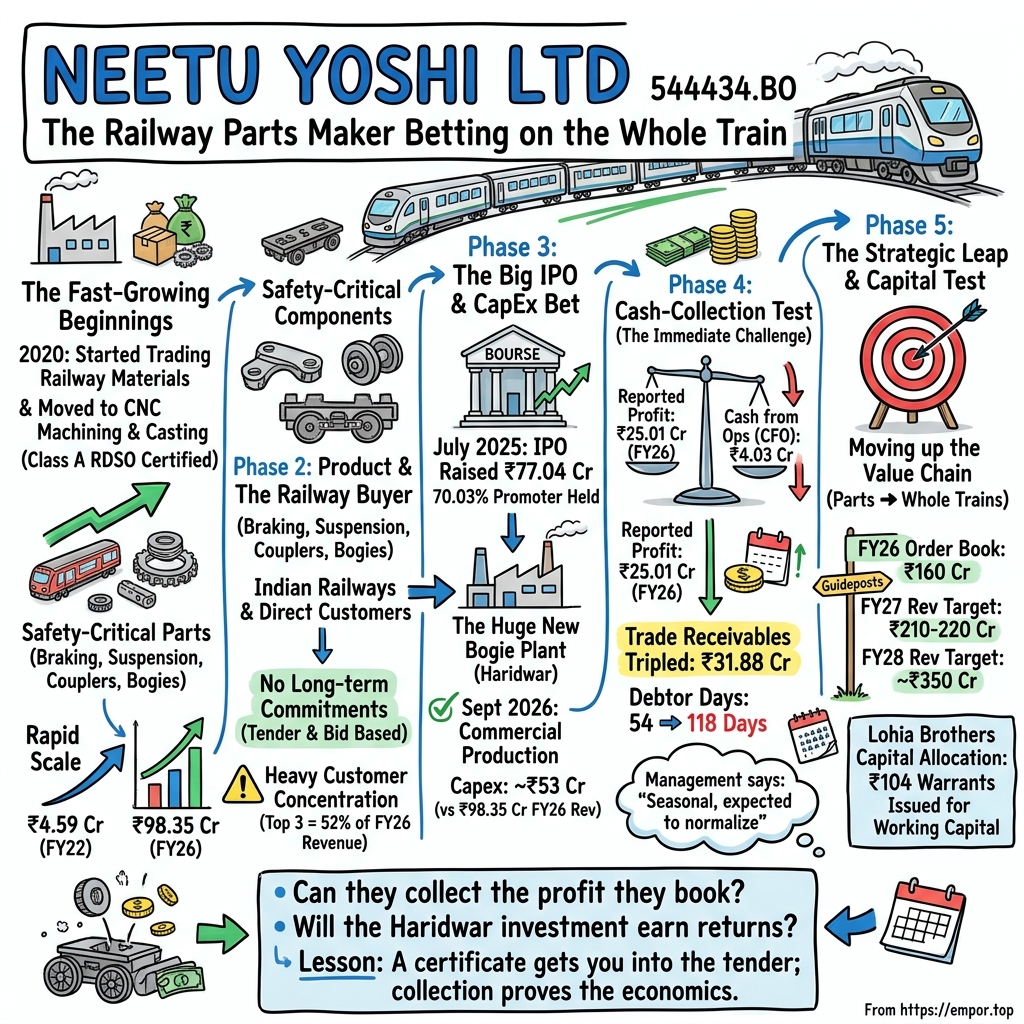
Neetu Yoshi: The Railway Parts Maker Betting on the Whole Train
The Receivables That Became the Story
The last day of March is closing day for an Indian company's financial year, and on 31 March 2026 Neetu Yoshi Limited closed the best year of its short life. The railway parts maker, which had been on the stock exchange for less than nine months, earned about ₹25 crore in net profit on just under ₹100 crore of revenue.1 By the standards of a small manufacturer listed on the SME platform of the Bombay Stock Exchange, those are striking numbers. A quarter of every rupee of sales came out as profit after tax. For most foundries and machine shops that would be a fantasy.
Then came the line that makes accountants lean forward. Cash generated by operations that year was about ₹4 crore.1 Out of roughly ₹25 crore of profit, about one rupee in six had turned into cash. The rest went into customer bills that had not yet been paid. Trade receivables, the money customers owed the company, had more than tripled in twelve months, from about ₹10 crore to about ₹32 crore.1 Put the same fact another way: in FY2025 the average customer settled up in about 54 days, and by FY2026 the receivables on the books equalled about 118 days of sales.1 The company was waiting more than twice as long to be paid.
Nothing in those figures says the profit is fictional. Revenue grew about 39% and net profit about 52% in FY2026, an auditor signed an unmodified opinion on the accounts, and the expected-credit-loss allowance against the receivables was small.12 What the figures do say is that this story has moved to a new chapter. For its first few years, the question about Neetu Yoshi was whether it could grow. It answered that one loudly. Revenue went from about ₹4.6 crore in FY2022 to about ₹98 crore in FY2026, more than twenty times in four years.31 The question now is different and harder: can a young supplier to India's railways turn booked sales into cash from customers, and can a much bigger factory make that growth last?
The company's ambitions make the question sharper. The company says it does not want to stay a maker of individual castings and machined parts. It used the money from its July 2025 initial public offering to build a new facility at Haridwar designed for bogies, the wheeled frames that carry a railway wagon, and its management has spoken of couplers, coach components, track parts, exports and, eventually, complete wagons.34 The title of this episode is not a metaphor. A business that started out selling raw materials to railway manufacturers is now betting that it can supply much more of the train.
Four questions hang over that bet, and they run through every section that follows. The first is the one the March accounts forced: can the company collect the profit it books? The second is about competitive position. Neetu Yoshi holds approvals from the railways' standards body and runs its own foundry, but its largest end customer is the state, which buys through tenders and has every reason to keep several qualified vendors in the race. Do those approvals and that manufacturing know-how add up to an advantage when the buyer sets the terms? The third is about capital. A company with under ₹100 crore of revenue spent about ₹53 crore on capital projects in a single year.1 Will the Haridwar plant earn a return on that money? The fourth is about the people. Neetu Yoshi is run by two promoter brothers, Himanshu and Subodh Lohia, who still control about 70% of the shares and who returned to shareholders in 2026 with a fresh issue of convertible warrants.15 Does their record so far support the size of the plans?
One boundary is worth setting before the story begins. Neetu Yoshi's consolidated accounts include a small subsidiary, Neetus' Delight Private Limited. In FY2026 it had revenue of about ₹11 lakh and a loss of under ₹2 lakh, against a parent with nearly ₹100 crore of sales.1 When this story talks about Neetu Yoshi's economics, it is talking about the listed operating company and its railway business. The subsidiary is a footnote, and it will be treated as one.
There is also no long corporate past to lean on. No founding-era archive, no decade of cycles, no earlier management team whose record can be compared with today's. The company was incorporated in 2020.3 Every judgment about it rests on four or five years of results, a prospectus, one annual report as a listed company, a few disclosures and two earnings calls. That is not a reason to dismiss the story. It is a reason to be precise about what the evidence can and cannot prove.
So the place to start is not the receivables ledger. It is the decision that made the company what it is: a trader of railway materials choosing to make the parts itself. What did it learn on the way up, and what did that move cost?
 Subscribe on LinkedIn
From Railway Materials to Safety-Critical Parts
In 2020, while much of Indian industry was shutting its gates for the pandemic, Neetu Yoshi began with a narrow and unglamorous business plan. Its first trade was railway-grade raw material: it bought metal that met the railways' specifications and sold it to the original-equipment manufacturers who turn such material into wagon parts.3 A trader in that position earns a thin spread. It learns who buys, what grades they need, how the specifications read and how slowly the bills get paid. It does not own the margin that comes from turning metal into a finished, certified component.
The company's history, as it told it in its prospectus and later in its annual report, is a sequence of steps up that ladder.31 First it added CNC machining, the computer-controlled cutting that shapes a rough metal part into one with exact dimensions. Then it built a foundry, where molten metal is poured into moulds to make castings, and earned Class A certification from the Research Designs and Standards Organisation, the Indian Railways body that writes technical standards and approves the vendors allowed to supply safety-related items.31 By the time it listed, the company described itself as an integrated manufacturer that could melt, mould, machine, heat-treat and finish its own parts under one roof.1
What it makes is easy to overlook and hard to replace. Neetu Yoshi produces customised ferrous castings and machined components that go into the braking, suspension, coupling and propulsion systems of railway wagons.31 A freight wagon is, at heart, a large steel box sitting on two bogies, each a frame holding wheelsets, springs and brake rigging; at each end is a coupler that joins it to the next wagon and absorbs the shocks of a heavy train starting and stopping. Every one of those systems contains castings that must not crack, warp or wear out early, because a failure is not a returned product. It is a derailment. That is why the railways insist on approvals before a supplier's part can go into service, and why a buyer cares about consistency at least as much as price.
That is also why this is not a subscription business, despite the repeat orders. Neetu Yoshi recognises revenue when finished goods are handed over to the customer, one delivery at a time.1 Its prospectus gives no standard pricing unit, contract length or minimum purchase commitment, and the annual report adds none.31 The relationships can be sticky, but each order is still a fresh order.
It helps to picture what happens inside such a plant, because each step is a place where a supplier can earn or lose money. Scrap and alloys go into a furnace and are melted to a precise chemistry; a casting that is a fraction off on carbon or manganese can pass inspection and still fail years later under load. The molten metal is poured into sand moulds shaped like the part, cooled, broken out and cleaned. The rough casting is then heat-treated, heated and cooled on a controlled cycle, much as a blacksmith tempers a blade, so that the steel is tough rather than brittle. Only then does it go to the machine shop, where CNC tools cut the surfaces that must mate with other parts to tight tolerances, before final inspection and finishing.1 A company that buys castings from an outside foundry and only machines them is at the mercy of someone else's furnace. A company that owns every step can trace a defect back to its source, run rush orders without waiting in another firm's queue, and keep for itself the margin that each step adds. That is the promise of integration, stated in the plainest terms.
The financial curve of the integration years is remarkable. Revenue continued to climb through FY2026.31 Profit tells an even sharper story. In FY2022 the company earned about ₹7 lakh, essentially breakeven. In FY2023 it earned under half a crore. In FY2024, the year the integrated operation hit its stride, net profit jumped to about ₹12.6 crore, and it rose to about ₹16.4 crore in FY2025 and about ₹25 crore in FY2026.31
The shape of that curve is the clearest evidence for what integration did. A trader passes material through and keeps a sliver. A manufacturer that controls its own melting and machining keeps the value it adds at each step: it does not pay an outside foundry's margin, it can schedule its own furnaces, and it can fix a quality problem in its own shop rather than arguing about it with a subcontractor. The jump from almost no profit to double-digit crores in a single year is what happens when a company stops reselling inputs and starts selling the finished, approved product.
But the economics of integration cut both ways, and the cut that matters most here is capital. A trader needs little more than working capital and relationships. A foundry needs furnaces, moulding lines, heat-treatment ovens, machining centres, inspection equipment, power and skilled workers. It needs to keep those assets busy, because a furnace that stands cold for a month still costs money. And it needs more working capital, not less, because raw metal must be bought before castings can be poured, and castings must be delivered before customers pay. Integration converts a company from a pass-through into a capital-intensive manufacturer, and capital-intensive manufacturers live or die by utilisation and collections.
That is the uncertainty to carry forward. The growth from FY2022 to FY2026 demonstrates that customers placed orders and that the company could produce enough approved parts to fill them. It does not yet show that the margins it earned in a small, newly integrated operation will hold as it multiplies capacity, nor that the cash conversion of its early listed years will return. Consider the cash record that exists. In FY2025, when profit was about ₹16.4 crore, operating cash was about ₹12.5 crore, a respectable three-quarters.1 In FY2026, cash conversion weakened sharply. Two data points are not a pattern, but they point in the wrong direction at the very moment the company is scaling up.
It also matters what kind of track record this is. There is no older management regime to compare against, no decade-long base rate, no previous downturn in which the company proved it could survive a slump in railway orders. Its whole operating life has coincided with a period of heavy public investment in Indian rail, a backdrop the government's own promotion arm describes in terms of record capital outlays, network expansion and wagon and coach procurement.6 A rising tide flatters young suppliers. The real test of a component maker comes when budgets tighten and the buyer starts pushing on price.
Which brings the story to the buyer, because in this industry the buyer does not simply place orders. It writes the rules.
The Railway Buyer Sets the Terms
On a results call in August 2025, about a month after the listing, an analyst put a deceptively simple question to management. Did Neetu Yoshi's RDSO certification mean the company could make every railway part? Himanshu Lohia, the managing director, answered that it did not. Each product needed its own approval. And when the conversation turned to competition, he said there were four or five other Class A players making similar components.7
It is an unusually candid answer from a newly listed company, and it is the right place to begin a section about competitive advantage, because it punctures the most tempting myth about railway suppliers: that the approval is a moat. The popular version goes like this. Indian Railways is a vast, safety-obsessed buyer; it only buys from approved vendors; approvals take years; therefore an approved vendor sits behind a wall that newcomers cannot climb. Some of that is true. The part that does not hold is the conclusion. An approval lets a company bid. It does not stop other approved companies from bidding against it, and it does not decide who wins.
To see why, follow how the railways buy. Indian Railways and its production units, the large state-owned factories that build coaches and locomotives, set the specifications for each part and keep lists of approved vendors.3 Orders arrive through tenders and direct inquiries. The prospectus is explicit that the company has no long-term purchase commitments from its customers, and that orders can fall if it loses tenders, loses its price competitiveness or loses its approvals.3 That is not boilerplate. It is a description of how the business works. Each tender is a fresh contest in which price and delivery schedule matter, and the buyer has a clear interest in keeping several qualified vendors alive so that no single one can dictate terms.
The approval system itself is a ladder, and management walked through it on the June 2026 call.4 A vendor typically starts as a developmental source for a product, receives small trial orders, proves its quality in service and only then graduates to a fuller status that allows larger shares of tenders. Each rung takes time and each product has its own ladder. For a young company that is both a barrier and an opportunity. It is a barrier because a competitor cannot simply buy its way onto the approved list for a safety part; it has to build capability and wait. It is an opportunity because a company willing to climb many ladders at once can widen the range of tenders it is allowed to enter. What the ladder does not provide is protection once a rival reaches the same rung.
Who actually pays the bills
The customer mix shows how concentrated the business has been, and how it is changing. In the prospectus, Indian Railways represented 99% of revenue in both FY2023 and FY2024, and the top ten customers made up 94% of FY2024 sales.3 That 99% needs a careful reading. Much of the company's early business ran through wagon builders and other manufacturers who supply the railways, so the railways were the ultimate customer even when the invoice went to a private company. In other words, whether Neetu Yoshi sold directly or through an intermediary, the spending decision almost always sat with one buyer.
By FY2026 the picture had shifted in a telling direction. The company sold about ₹74 crore directly to the railways and about ₹24 crore to private customers.1 In other words, roughly three-quarters of sales now went straight to the railway system rather than through intermediaries. The growth of that direct channel had been steep: the company reported direct railway sales of under ₹2 crore in the first half of FY2025 and more than ₹13 crore in the first half of FY2026.8 At the same time, three customers each contributed more than a tenth of FY2026 revenue, and together they accounted for about 52% of it, with the largest alone at about ₹28 crore.1 The annual report identifies these customers only by code, and its note even lists the same code twice, so it is not possible to say from the company's disclosure which railway units or manufacturers they are.1
Read together, those facts tell a two-sided story. Selling directly to the railways is a step up. It means the company has earned approvals in its own name rather than relying on a manufacturer to carry its parts into the system, and it means it keeps margin that might otherwise go to an intermediary. But direct sales also mean dealing directly with the buyer that has the most bargaining power, on its payment schedule. It is no coincidence that the year direct railway sales surged was the year receivables tripled.
The competitive set is named, but its economics are not laid out side by side. The prospectus lists domestic RDSO-approved competitors in the castings and components niche.3 The four or five similar Class A companies Himanshu Lohia mentioned in August 2025 are the closest rivals. The company's June 2026 investor presentation also places itself alongside much larger listed railway manufacturers such as Jupiter Wagons, Titagarh Rail Systems and Texmaco Rail.8 That comparison flatters by association more than it informs. Those companies build complete wagons, coaches and, in some cases, much more, with revenue many times Neetu Yoshi's; they are as much potential customers for parts as they are competitors. The company does not publish its market share in any product, its win rate in tenders, the share of orders that come from repeat customers, or how its realised prices compare with peers'.31 Those are exactly the numbers that would prove or disprove a moat, and they are absent.
What the price of a bogie reveals
There is one piece of evidence on pricing, and it comes from management itself. On the June 2026 call, the company discussed the price of a bogie, and management described a decline from roughly ₹3.25 lakh to about ₹2.70–2.80 lakh.4 That is a fall of somewhere around 15% in the price the market pays for one of the very products the new plant is built to make. Management also pointed to price variation clauses in railway contracts, which adjust the price for movements in raw-material costs, so that a surge in the cost of steel scrap or alloys can be passed through, with a lag, rather than absorbed entirely.4
Both facts matter for the moat question. Price variation clauses are a real protection: they mean a casting maker is not taking a naked bet on commodity prices every time it signs a contract. But they protect against input costs, not against competition. A decline in bogie prices of that size is what buyer power looks like in practice. When a large buyer runs open tenders among several qualified vendors and capacity in the industry grows, prices drift toward the cost of the efficient bidder. A supplier with a true advantage would be able to hold price; a supplier competing on the same terms as everyone else would see its realisations fall. Management did not present the decline as a crisis, and the company's EBITDA margin held up in FY2026. But it is the clearest signal in the record that the railways, not the vendors, set the price.
Management's account of the seasonality of railway payments deserves similar care. On the same call, the company explained that railway maintenance budgets can run out late in the financial year and reset in April, which delays payments made in the final weeks of March.4 That is plausible. Government budgets in India do run on an annual cycle, and late-year spending squeezes are well known. But it is a claim about why the receivables rose, offered by the people who benefit if investors accept it. It belongs in the story as a hypothesis to test against the next collections data, not as a settled explanation.
Where does that leave the competitive question? The approvals are real and they took work. The integrated foundry and machine shop are real, and they let the company control quality and delivery in a way a trader or pure machinist cannot. The widening of approvals into coach, track and locomotive products could broaden the franchise. But the record narrows the moat claim to something smaller than a cornered market. Neetu Yoshi is one of a handful of qualified vendors selling to a buyer that runs tenders, keeps multiple sources, pays on its own schedule and has recently pushed prices down on at least one key product. The KPI that would change that verdict is not another certificate. It would be evidence of repeat wins at stable prices: a rising share of tenders won, or realisations holding while capacity in the industry grows.
Every new approval opens a door. The company's next big decision was to build a much larger room behind it.
The IPO Turned the Factory into a Bet
On 4 July 2025, Neetu Yoshi's shares began trading on BSE SME.1 The listing was the payoff of a long paperwork journey: a draft prospectus filed with the exchange in September 2024, an addendum in February 2025 and a red herring prospectus dated 19 June 2025.9103 The SME platform is a separate board for smaller companies, with lighter listing requirements and, for investors, larger minimum lot sizes and thinner trading. For a five-year-old company with a few dozen crores of revenue, it was the natural route to public money.
The terms were simple. The company sold 1,02,72,000 new shares at ₹75 each, raising about ₹77 crore before expenses.3 There was no sale by existing shareholders: every rupee went into the company. The promoters' stake fell from about 95% before the issue to about 70% after it, purely through dilution.31 At the issue price, the company's market value was roughly ₹290 crore, which was a little under eighteen times its FY2025 profit. That multiple shows what the first public investors were buying: not a cheap foundry, but a growth story priced for continued expansion.
This was not financial engineering in the usual sense. There was no acquisition, no exit for a private-equity backer, no complicated holding structure. The prospectus earmarked most of the proceeds for a single, physical purpose: a new manufacturing facility at Haridwar, in Uttarakhand, intended to make bogies and related assemblies.3 The IPO, in other words, turned the factory into the bet. Public shareholders were asked to fund capacity before the demand to fill it had fully shown up in the accounts.
Follow the money and the bet becomes concrete. In FY2026 the company's investing cash outflow was about ₹53 crore, almost all of it capital expenditure, plus a smaller amount placed in term deposits.1 By the end of March 2026 it reported using about ₹58 crore of the IPO proceeds.1 It used part of the money and its cash flow to retire borrowings, which fell from about ₹14 crore to under ₹4 crore, all of it short-term; at year-end the company had no term loan outstanding and a debt-to-equity ratio of just 0.03.1 An independent monitoring agency, Infomerics, tracks how the proceeds are spent, and the company files periodic statements on any deviation from the stated uses, the most recent in August 2026.311
Now put the scale of that spending against the business that was doing it. Capital expenditure of about ₹53 crore was about 54% of FY2026 revenue. In FY2025 the equivalent was about 23%.1 For a mature industrial company, capex of more than half of sales would be extraordinary; for a young one doubling its capacity, it is a declaration that the next phase depends almost entirely on the new plant working.
The ratios show the cost of building ahead of demand. Asset turnover, the amount of revenue the company generates for each rupee of assets, fell from about 1.1 to about 0.7.1 Return on equity fell by half, from about 37% to about 18%.1 Neither decline is a sign of failure in itself. The equity base roughly tripled because of the IPO, and much of the new money was sitting in a plant that had not yet produced anything or in deposits waiting to be spent. When a company raises capital, its returns fall mechanically until that capital starts earning. But the fall is a reminder that the returns of the pre-IPO years were earned on a small base, and the company has not yet shown what returns it can earn on a large one.
A plant that opened three months late
The schedule offers the first small test of execution. In the FY2026 annual report, the company said the Haridwar bogie facility was expected to begin operations in June 2026.1 In a filing to the exchange in August 2026, it set 13 September 2026 as the date of commercial production, and said the new facility could nearly double its manufacturing capacity.12 The plant started about three months later than the timetable in the company's own most recent annual report.
Three months is not a scandal. Industrial projects slip for mundane reasons: equipment delivery, power connections, inspections, approvals for a new site. The point is not that the delay is damning. It is that a young company's credibility is built precisely on small promises like this one, and the first one tied to the IPO money arrived late. That makes the ramp-up evidence, which no one outside the company has seen yet, more important than it would otherwise be.
It also matters to separate capacity from economics. Management described the revenue the new plant could support in large numbers, and those figures appear in the calls and presentations.78 Capacity, though, is an upper bound, not a sales forecast. A bogie plant can make a certain number of bogies a year if it is fully staffed, supplied and ordered. Whether it makes them depends on tender wins and on the price the railways pay, which, as the bogie example showed, has been falling. Until the company reports output, utilisation, incremental revenue and the margin on that revenue, the plant's potential remains a potential.
There is no acquisition story to weigh here. In the prospectus, the FY2026 annual report and the company's 2026 exchange disclosures, there is no material purchase of another business.31 Capital allocation at Neetu Yoshi so far comes down to three things: the IPO-funded plant, the working capital tied up in receivables and inventory, and the convertible warrants issued in 2026, which come later in the story. The absence of acquisitions is not a virtue on its own. It means the record for judging management's capital decisions is short and centred on a single project.
Which returns the story to the March accounts. A new plant can only support growth if the business can fund the working capital that growth requires, and that depends on collecting from customers. That is the pressure the March accounts revealed.
The Bigger Order Book Meets the Cash-Collection Test
Picture the balance sheet as it stood on 31 March 2026. On one side, the company was celebrating. It had booked orders of more than ₹150 crore during the year and closed with an order book of about ₹160 crore, more than one and a half times its annual revenue.1 On the other side sat a single line that had swollen faster than anything else in the accounts: trade receivables, which had more than tripled in a year.1 Order book and receivables are both promises of future cash. The order book says customers want more parts. The receivables say customers had not yet paid for the parts they already had.
Work the cash bridge in plain terms. Start with the profit after tax of about ₹25 crore. Add back the non-cash charges: depreciation of about ₹2 crore and a small provision for expected credit losses.1 Then subtract what the business absorbed. The largest single drag was the increase in trade receivables, about ₹22 crore.1 Another roughly ₹5 crore went into other financial assets.1 After those and smaller movements, about ₹4 crore of operating cash was left.1 Almost the entire increase in profit, and then some, was sitting in customer balances.
That changes how to read the growth. Imagine a shop that doubles its sales by letting customers take goods home and pay later. Its income statement looks wonderful. Its bank account does not. In Neetu Yoshi's case, the growth came at the same moment the company shifted toward selling directly to the railways. Whatever the cause, the company effectively extended a large amount of credit to its customers in a year when it was also spending heavily on capacity. It could afford to do both only because the IPO had filled its coffers.
The ageing of those receivables tells you what you can and cannot conclude. Of the gross balance of about ₹32 crore, roughly ₹30 crore was less than six months old, about ₹2.4 crore was between six and twelve months, and a sliver was older than a year.1 The company's ageing schedule places the entire balance in past-due buckets rather than showing any portion as not yet due.1 The allowance for expected credit losses rose from about ₹5 lakh to about ₹32 lakh, roughly 1% of the balance, and the company reported no disputed or credit-impaired receivables.1 Read fairly, that is not a picture of bad debts. Most of the money is recent and owed by customers, ultimately the railway system, that are unlikely to default. But it is a picture of slow money, and slow money is expensive for a company that wants to grow, because every month a bill goes unpaid is a month in which the company has to fund its raw materials, wages and power from somewhere else.
Management had an explanation ready, and it is worth hearing in full before testing it. On the June 2026 call, the company attributed the year-end receivables spike to the railway maintenance budget reset.4 It added that around half of the March dues had been collected within the first 15 days of April.4 If that is right, the year-end receivables figure is a snapshot taken at the worst possible moment, and the underlying collection cycle is far healthier than 118 days suggests.
The explanation is plausible and partly checkable. It is also a management statement about a period after the audited balance sheet date, made on a call rather than in the audited accounts. It cannot yet substitute for the audited record. Two pieces of evidence would settle it. The first is the half-year balance sheet for the period ending September 2026, which should show whether receivables fell back as the April collections suggest. The second is the FY2027 annual cash-flow statement and ageing schedule. If the seasonal story is right, operating cash in FY2027 should run close to profit, and debtor days should fall back toward the levels of FY2025. If receivables keep climbing in line with or faster than sales, the problem is structural: either the company is extending more credit to win business, or its new direct-railway customers simply pay slowly all year round.
There is a second puzzle inside the profit line, and it is worth resolving because it affects how to read the margin. Net margin rose from about 23% to about 25% in FY2026.1 It would be easy to read that as pricing power, but the operating business did not get more profitable. Consolidated EBITDA margin, which measures profit from operations before interest, tax, depreciation and amortisation, stayed almost flat at about 33%.1 Raw-material costs grew faster than revenue, about 45%, as did employee costs, about 52%; other expenses grew more slowly, at about 31%.1 The core business, in other words, held its margin while growing quickly, which is respectable, but did not expand it.
What lifted the bottom line was other income. It rose from about ₹0.2 crore in FY2025 to about ₹3.2 crore in FY2026, which equalled roughly a tenth of profit before tax.1 About ₹1.9 crore was interest income, largely earned on IPO money parked in term deposits while the plant was being built, and about ₹1.3 crore was miscellaneous income.1 The interest income is real cash, but it is temporary by nature: as the IPO proceeds are spent on the plant and working capital, the deposits shrink and so does the interest. Part of FY2026's headline profit growth came from the IPO itself, not from selling more castings at better prices.
Receivables are the loudest part of the working-capital story, but not the only part. Measure everything the business ties up in day-to-day operations, current assets other than cash less what it owes its own suppliers and staff, and the figure rose from the equivalent of about 59 days of revenue in FY2025 to about 177 days in FY2026.1 Some of that increase is receivables; some is the other financial assets that rose during the year, and some reflects the build-out itself. The direction is what matters. In the year before the plant opened, the company needed roughly three times as many days of sales locked up in its operations as it had the year before. A manufacturer that doubles its capacity will usually need more inventory and more credit to customers before the new output pays for itself, so some of this is the ordinary cost of growth. The question is whether it is a one-time step up that the plant will grow into, or a new normal in which every extra rupee of revenue arrives with a heavier working-capital bill attached. On top of that, the company carried capital commitments of about ₹4.8 crore at year-end, money already promised to suppliers of equipment and construction.1
The verdict on this section is the clearest in the story. The receivables surge is the single most important financial counterweight to the growth narrative. It does not prove that the growth is unsound. It does prove that the growth has not yet been converted into cash, and that the company's own explanation for the gap is still awaiting verification. Three measures will tell the tale: operating cash flow as a share of profit, debtor days, and the share of March 2026 receivables that turns out to have been collected by the next reporting date.1
Those measures matter all the more because the company is not standing still. It is trying to change what it sells.
From Parts to Bogies—and Promises to Proof
In August 2025, a month after listing, management made one of its boldest statements. On that first call, the company said the new bogie plant could support around ₹120 crore of revenue in the following financial year.7 That figure was larger than the company's entire revenue at the time. It was the clearest statement yet of the strategic shift: Neetu Yoshi wanted to be more than a supplier of individual castings. It wanted to sell assemblies, then complete sub-systems, and eventually something close to the whole wagon undercarriage.
The logic is easy to follow. A bogie is a high-value assembly built from castings, forgings, springs, wheelsets and brake gear. A company that already makes many of the castings and machined parts that go into it can, in principle, capture more of the value by assembling the whole thing. It also becomes more important to its customers: a buyer can swap one casting vendor for another without much trouble, but a supplier of complete, approved bogies is harder to replace quickly. This is the classic move up the value chain, and in principle it fits the company's history of moving from trading to machining to casting.
The evidence for the shift is real but early. During FY2026, the company broadened beyond wagon parts into coach, track and locomotive components and won approvals from two of the railways' big production units. The Integral Coach Factory in Chennai listed Neetu Yoshi as a developmental vendor for a coach buffer assembly, the spring-loaded device at the end of a coach that cushions it against the next.1 The Rail Coach Factory gave the company a capacity-cum-capability assessment approval for a brake support product.1 In July 2026, the company announced an order worth about ₹17 crore for railway track and coach components.13 The direct channel also widened. These are the most material growth vectors the company has, because they build on its existing approvals, foundry and railway relationships rather than on a leap into an unrelated market.
But a developmental vendor listing is the bottom rung of the ladder Himanshu Lohia described. It allows the company to receive trial orders. It is not a promise of volume. A capacity-cum-capability approval says the plant can make the product; it does not say the railways will buy it in quantity, or at what price. The record so far shows the company climbing new ladders. It does not yet show large, repeat revenue from the products at the top of them.
What happened to the ₹120 crore
The best test of management's credibility is to set the August 2025 promise against what happened. The plant that was supposed to support about ₹120 crore of revenue in FY2027 began commercial production on 13 September 2026, almost halfway through that financial year.12 Even if it ramps quickly, a plant that runs for under seven months cannot deliver a full year's worth of output. By the June 2026 call, the framing had moved from the plant's own revenue to the company's total: management discussed revenue of about ₹210–220 crore for FY2027 and an ambition of about ₹350 crore for FY2028, with an executable order book of about ₹140–150 crore.4 Those numbers imply that revenue would more than double in FY2027 from about ₹98 crore, and then grow by more than half again the year after.
Two things stand out in the comparison. First, the targets became broader. Instead of a plant-specific number, management guided to company-wide revenue, which is harder to map to any single execution milestone. Second, the order book used for guidance in June 2026, about ₹140–150 crore of executable orders, was smaller than the ₹160 crore year-end figure in the annual report.41 The two numbers may simply measure different things, one counting what can be executed within the year and the other everything outstanding. But the gap between a guided revenue of over ₹200 crore and an executable order book of under ₹150 crore means the company must win a large volume of new orders and deliver them within the same year to meet its own target. That is possible for a business whose orders turn over quickly. It is also the definition of a stretch goal.
What the record does not show is an explicit reckoning with the earlier timetable: no public reconciliation of the ₹120 crore plant figure with the September start, and no revised plant-specific target. Guidance moves. What builds credibility is explaining why.
The ambitions beyond the plant
Management's ambitions extend further. On the June 2026 call, the company talked about starting exports by FY2028, manufacturing complete wagons in roughly three years, and pursuing opportunities in mining and thermal power, where private operators buy their own wagons, as well as possible leasing or maintenance businesses.4 Each of those would change the company's profile. Each is, for now, a sentence on a call. There are no export orders, no wagon-building approval, no announced investment in a wagon line and no revenue from mining or thermal customers in the company's disclosures. Complete-wagon manufacturing in particular would put Neetu Yoshi in direct competition with the large listed wagon builders it currently places itself beside, and it would require far more capital than the Haridwar plant. Until those ambitions are attached to orders, approvals and capital commitments, they are options, not plans.
Exports, if they come, would also introduce a risk the company has never had to manage at scale. In FY2026 its revenue came entirely from India, and the company reported no dollar or euro balances in its foreign-currency note, even though its policy text describes exposure as primarily to the US dollar and says that exposure is unhedged.1 Today that mismatch is a drafting oddity with no money attached. A company selling railway castings abroad, quoting in dollars and paying for scrap and power in rupees, would need a real hedging policy, and the first export orders would be the moment to show one.
The smaller pieces deserve smaller space. The subsidiary, Neetus' Delight, remains tiny and loss-making at the margin, and the company has described defence and broader engineering as longer-term possibilities with no material contribution expected soon.14
So the commercial test of the "complete solutions" strategy is not whether the company can describe it. It is whether the Haridwar plant ships bogies at a profitable price, whether the new coach and track approvals turn into repeat orders, and whether the company is paid for them on time. Plant output, utilisation, the mix of sales and operating cash will show whether this is a transition that customers are paying for, or mainly a new capacity story waiting for customers to arrive.
Those outcomes rest on two people. And in 2026, they asked shareholders for more money before the first answer was in.
The Lohia Brothers' Capital-Allocation Test
In August 2026, a few weeks before its new plant began commercial production, Neetu Yoshi allotted 26,42,400 convertible warrants at ₹104 each.5 One of the buyers was Subodh Lohia, the company's whole-time director and one of its two promoter brothers, who took 6 lakh of them.5 Each warrant can be converted into one share within 18 months, and buyers paid a quarter of the price upfront.5 It was a vote of confidence from an insider, and a request for more capital from outside investors, at the same moment.
To understand that decision, start with the two men who make the decisions. Himanshu Lohia is the managing director and also the chief financial officer. Subodh Lohia is the whole-time director. They are brothers and promoters, and the promoter group remained the company's majority shareholder at March 2026.1 Their public biographies are thin, and their company's disclosures describe their roles more than their backgrounds. What is visible is their behaviour, and the behaviour tells a coherent story: a small, founder-run company in which the people who own the business also run every important part of it.
That concentration of roles cuts both ways. Himanshu Lohia holding both the managing director's and the chief financial officer's titles is not unusual in a small Indian company, but it means the executive who sets the strategy also signs the numbers that judge it. The board had five directors at year-end, two of them independent.1 The company secretary's seat changed hands during FY2026: the incumbent resigned in August 2025 and a successor was appointed in December 2025.1 None of this is a red flag in isolation. It is the profile of a company whose governance has not yet caught up with its public-market ambitions.
The alignment case is real. The promoters' share count was essentially unchanged after the IPO.1 Promoter shares were not pledged in the September 2026 shareholding pattern.14 When the brothers own most of the company, a rupee of value created or destroyed falls largely on them. That is a stronger alignment than any stock-option scheme could provide.
The rest of the register has been moving in an interesting direction. Between September 2025 and September 2026, foreign institutional investors cut their holding from about 1% to almost nothing, and domestic institutions roughly halved theirs, from just under 5% to about 2.6%.14 Retail and other public holders took up the slack, rising from about 24% to about 27%, and the number of shareholders grew from roughly 1,800 to roughly 2,700.14 On an SME board, where institutions are few to begin with, a couple of fund decisions can move these percentages. Still, the pattern is that the professional money that came in around the IPO has mostly stepped back in the first year, while individual investors have stepped in. That is a shareholder base more likely to react to headlines than to ageing schedules, which makes clear disclosure on collections all the more important.
Pay is modest by the standards of the profits. Each brother received ₹60 lakh in FY2026, unchanged from FY2025, even as net profit rose from about ₹16 crore to about ₹25 crore.1 There was no one-off bonus.1 But there is also no visible variable pay tied to the measures that now matter most, such as cash collection, the return on the new plant or growth in value per share. With the brothers' wealth so concentrated in the stock, fixed salaries may be a minor factor. Still, an outside shareholder might reasonably prefer to see the board link part of executive pay to the metrics that the receivables surge has put in play.
Related parties and small blemishes
The related-party transactions belong in this section because they bear directly on how the company's money is spent. In FY2026 they totalled about ₹2.1 crore, roughly 2% of revenue.1 The largest items were the brothers' combined remuneration of ₹1.2 crore. The rest were payments that flow between the company and entities associated with the promoter family: about ₹7 lakh of rent and about ₹29 lakh of facility-service charges paid to Himanshu Lohia, ₹25 lakh of hire charges and about ₹16 lakh of construction costs paid to Neetu Realty, and about ₹24 lakh of corporate social responsibility spending routed through the Neetu Lohia Foundation.1 The company also lent about ₹17 lakh to its subsidiary during the year, with about ₹35 lakh outstanding, and reported about ₹13 lakh of advances to a related party.1 No guarantees were given.1
The company describes all of these as ordinary-course and at arm's length.1 That is the required description, and nothing in the audited accounts contradicts it. But it is the company's assertion, not an independent valuation of the rent or the construction work. The amounts are small relative to revenue, which limits the damage any mispricing could do. The pattern matters more than the sum: the company pays a promoter for the facilities it operates in, and pays a promoter-linked realty firm for construction in a year of heavy building. An investor watching capital discipline should keep an eye on whether those flows grow as the company builds more.
The auditor's picture is clean with minor marks. The FY2026 opinion was unmodified, and the auditor's report on the Companies (Auditor's Report) Order had no qualifications or adverse remarks.1 The standalone annexure did note delays in depositing some statutory dues, including tax deducted at source, advance tax, provident fund and employee state insurance, though none was outstanding for more than six months at year-end and none was disputed.1 The company also paid a fine to BSE for filing its investor-complaints statement for September 2025 late, and filed its AGM proceedings a day after the deadline.1 These are housekeeping lapses, not evidence of financial wrongdoing. They are also the kind of lapse a company stops making as its back office matures, and their recurrence or absence is a fair test of whether it is maturing.
Shareholders approved the warrant issue at an extraordinary general meeting in May 2026, and the company filed the voting results with the exchange.5 It held its sixth annual general meeting in October 2026 and filed the scrutiniser's report on that vote.15 The record does not show a shareholder revolt; with the promoters holding about 70%, the outcome of any ordinary resolution was never really in doubt. The more informative number, the share of non-promoter votes cast against particular resolutions, is the one to watch in future meetings.
Now the skeptic's question. Why issue warrants so soon after an IPO that raised about ₹77 crore, and while the company reports a balance sheet that is effectively free of debt? If all the warrants convert, they would bring in about ₹27 crore and add roughly 7% to the post-IPO share count. On the June call, management described the proceeds as supporting working capital in the track business.4 That answer connects directly to the receivables. A company that collects its bills on time funds working capital from its operating cash. A company whose customers are slow to pay has to find the money elsewhere, and equity is the most expensive place to find it. If the receivables come back down as management says they will, the warrant money will look like a cushion. If they do not, it will look like the first sign that growth requires a steady stream of new shares.
The brothers' alignment is real, and it is the strongest point in their favour. The test of their capital allocation is narrower and sharper: whether the plant and the working capital already committed earn returns before the company asks for more.
Analysis & Bear vs. Bull Case
The company's own June 2026 investor presentation tells its story in confident terms: an integrated, RDSO-certified manufacturer with orders of around ₹140 crore on its books.8 A few months earlier, the annual report had put the year-end order book at about ₹160 crore.1 Neither number, on its own, proves that the company will execute those orders profitably and collect the cash. The job here is to put the whole case together, give the bull and the bear their strongest forms, and decide what the evidence actually supports.
The bull case starts from a credible foundation. Product-specific approvals take years and cannot be bought; a company that has climbed several of those ladders has done real work that a newcomer would have to repeat. The integrated foundry and machine shop let the company control quality, delivery and a share of cost that a pure assembler or trader cannot. The order intake of more than ₹150 crore in FY2026 shows that customers kept placing business.1 The direct railway channel and the new coach and track approvals could diversify both the customer base and the product range. The Haridwar plant gives the company room to nearly double its output.12 And the backdrop is supportive: Indian public investment in railways has been running at historically high levels, with sustained spending on wagons, coaches and track.6 If the company executes, the next two years could look like the last four, with a larger base.
The bear case is just as specific. Railway tenders come with no long-term volume guarantee, and the company's prospectus says plainly that losing tenders, price competitiveness or approvals would cut orders.3 Three customers produced about half of FY2026 revenue, so the loss of a single large award would hurt.1 The bogie price decline shows that realisations can fall when the buyer pushes.4 Receivables tripled and debtor days doubled in the same year, and operating cash covered only a sixth of profit.1 The new plant was paid for before its returns were known, and opened late.12 And the company sought fresh equity soon after its IPO.5 The bear case does not require railway demand to collapse. It requires only that tender economics, slow collections and underused capacity keep reported growth from earning an adequate return on the capital now invested.
The forces and the powers
Five forces explain the economics. Buyer power is the dominant one: a single public system writes the specifications, approves the vendors, runs the tenders and sets the payment calendar. The threat of new entrants is moderated product by product, because safety approvals take time and capability, but not eliminated: the ladder is open to anyone willing to climb it, and the railways have reasons to want more vendors rather than fewer. Rivalry is real, with management itself counting four or five similar Class A companies.7 Supplier power is moderate: scrap, alloys and energy are commodity inputs whose price swings matter for a foundry, though price variation clauses pass part of those changes through with a lag.4 The threat of substitutes is low in the near term; there is no software replacement for a steel coupler, and the more plausible technology risk is that automation shifts costs and capacity across the industry rather than replacing the product.
Run the same evidence through Hamilton Helmer's seven powers and the picture is consistent. Scale economies are limited: the company is small compared with the larger wagon makers. There are no network effects. Switching costs exist at the margin, because a buyer must qualify a new vendor, but the railways deliberately keep multiple qualified sources, which lowers them. There is no consumer brand. Counter-positioning does not apply; the incumbents are not hampered by Neetu Yoshi's model. The closest thing to a cornered resource is the portfolio of approvals, but those are held by several rivals as well. Process power, the hard-to-copy operational know-how that lowers cost or improves quality, is the one power that could develop, if integrated casting and machining prove to deliver better quality at a lower cost over many years. The company does not publish the data, such as rejection rates or realised prices relative to peers, that would show it.
The moat conclusion follows. RDSO approval, manufacturing integration and customer qualification are credible barriers to entry. Public evidence does not show a durable cost advantage, meaningful switching costs, above-peer win rates or superior price realisation. Management's own count of similar Class A competitors is the most useful counterweight to any narrative of monopoly. The competitive position is best described as a qualified, integrated vendor in a contested niche, with a real but unquantified edge in control of its own production.
The margin story reinforces that reading. The operating margin held at about a third, which shows the company has not had to buy growth with lower prices across its portfolio. But the extra percentage points of net margin came from interest and miscellaneous income, not from the product business.1 That is not pricing power.
The risks follow from the mechanisms. Railway budget and tender decisions drive orders, so any slowdown in procurement flows straight to the company. Customer concentration makes a single lost award material. Casting inputs and energy affect margins, with only partial protection from price clauses. A slow ramp at Haridwar would leave fixed costs without matching revenue and push asset returns lower. And delayed collections constrain the cash available to fund all of the above, which is why the receivables are not a side issue but the central one.
One outside check that many companies carry is missing here. Neetu Yoshi has no lender credit rating; its annual report describes a rating as not applicable, and its prospectus notes that an equity issue does not require one.13 With almost no debt, that is understandable. It also means there is no rating agency's assessment of strengths and weaknesses, no outlook to be upgraded or downgraded, and no independent analyst who has looked through the receivables on behalf of creditors. The balance sheet is strong because it is mostly equity, which is protective. But it shifts the whole burden of scrutiny to shareholders.
Three measures can settle most of the debate. The first is operating cash flow relative to profit, which fell from about three-quarters in FY2025 to about a sixth in FY2026. The second is debtor days, together with the ageing and the collection of the March 2026 balance; the latest reading is 118 days, up from 54. The third is the new facility's utilisation, with the incremental revenue and margin it brings, which has no reading yet because the plant has only just begun commercial production.112
On valuation, the honest statement is that current market data is thin. There is no reliable current price-to-earnings ratio or peer comparison to hand, and the price and market value printed in the June 2026 investor presentation are already months old. The annual report shows the monthly trading range on BSE from August 2025 to March 2026 of roughly ₹71 to ₹143, which means the stock at times traded below its IPO price and at times at nearly twice it.1 That swing is itself information: the market has not settled on what this business is worth. Without current figures, any judgment of what the price assumes would rest on stale data, and it is better left unmade.
The evidence weighed in this section points to lessons that reach beyond the numbers.
Business & Investing Lessons
The first lesson goes back to the step from trading to making. Integration drove a sharp rise in profit, but FY2026 exposed the cash-conversion test. For founders, integration is a way to capture value; for investors, it is a promise that has to be paid out in cash. Integration can win the order; collections prove the economics.
The second lesson is that certification is a ticket into the tender; it does not win the tender for you.
The third lesson is the Haridwar plant, built with IPO money and opened three months after the date in the annual report. Capacity is an option until customers fill it, and a cost until cash pays it back.
The fourth lesson belongs to the brothers. Their alignment is real, but ownership tells you who wins if the bet pays off; disclosure and execution show how well it is placed. The late filings, the dual role of managing director and chief financial officer, and the quick return to shareholders to raise money through warrants are all part of the same picture.
Epilogue
Tonight, in mid-November 2026, Neetu Yoshi stands at the most revealing moment in its short public life. The Haridwar plant has been in commercial production for about two months. The order for track and coach components announced in July is being worked through. The warrants allotted in August are sitting with their holders, a quarter paid, the rest due on conversion. And the half-year results for the six months to September 2026 are due any day, the first set of numbers that will cover both the new plant's opening weeks and the period in which management said the March receivables would be collected.
The first thing to look for is the receivables. If the seasonal explanation offered on the June call is right, the September balance sheet should show the March pile of customer bills largely cleared, and debtor days falling back from 118 toward the levels of FY2025. That would turn the most worrying number in the FY2026 accounts into a timing story. If instead receivables keep growing in step with sales, then the company is financing its customers as a condition of winning their business, and the warrants and IPO deposits will be doing work that operating cash should be doing.
The second is the plant. Output, utilisation and the first revenue from Haridwar bogies will show whether the new capacity is filling with paying orders, and at what price. The bogie price decline management described in June means that volume alone is not enough; the margin on that volume will matter as much.
The third is guidance against outcome. Management has set out about ₹210–220 crore of revenue for FY2027 and about ₹350 crore for FY2028.4 The annual numbers in the spring of 2027 will show how close the company comes, and whether it explains the gap, if there is one, as plainly as it explained the approval ladder. The earlier ₹120 crore plant figure, made before the plant started late, is part of that record.
The fourth is the capital itself. Watch whether the warrants convert, what the money is actually spent on, and whether the company seeks more capital before the plant has a full year behind it.
Each of those moments maps onto one of the four questions this story began with: collection, competitive position, the return on the plant, and the judgment of the people running it. The stated ambitions are hypotheses. The results will strengthen or weaken them, one filing at a time. For now, the tension is unresolved: a company growing fast enough to need more capital, in an industry where the customer decides when it gets paid.
Outro
Go back to 31 March 2026. Somewhere in a foundry, molten metal is being poured into moulds for parts that will hold a freight train together. The gap between record profit and operating cash was the most honest picture of Neetu Yoshi there was.
Its bet is that a supplier of parts can become a partner in building the train. The proof will be in what the new plant ships and what customers pay.
References
-
Annual Report 2025-26 — Neetu Yoshi Limited, 2026-09-09 ↩↩↩↩↩↩↩↩↩↩↩↩↩↩↩↩↩↩↩↩↩↩↩↩↩↩↩↩↩↩↩↩↩↩↩↩↩↩↩↩↩↩↩↩↩↩↩↩↩↩↩↩↩↩↩↩↩↩↩↩↩↩↩↩↩↩↩↩↩↩↩↩↩↩↩↩↩
-
Audited Results for FY2025-26 — Neetu Yoshi Limited, 2026-05-30 ↩
-
Red Herring Prospectus — Neetu Yoshi Limited, 2025-06-19 ↩↩↩↩↩↩↩↩↩↩↩↩↩↩↩↩↩↩↩↩↩↩↩
-
Earnings Call Transcript — Neetu Yoshi Limited, 2026-06-04 ↩↩↩↩↩↩↩↩↩↩↩↩↩↩↩
-
Preferential Warrant EGM Voting Results — Neetu Yoshi Limited, 2026-05-26 ↩↩↩↩↩↩
-
Indian Railways Industry Overview — India Brand Equity Foundation ↩↩
-
Earnings Call Transcript — Neetu Yoshi Limited, 2025-08-07 ↩↩↩↩
-
Statement of Deviation in IPO Proceeds — Neetu Yoshi Limited, 2026-08-14 ↩
-
Haridwar Facility Commercial Production Announcement — Neetu Yoshi Limited, 2026-08-08 ↩↩↩↩↩
-
₹17.12 Crore Order Announcement — Neetu Yoshi Limited, 2026-07-23 ↩
-
Scrutinizer's Report, Sixth AGM — Neetu Yoshi Limited, 2026-10-05 ↩
 LinkedIn
 WhatsApp
 Reddit
 Hacker News
 Email
 Kindle
 RSS Feed
 Spotify
 Apple Podcasts
 Amazon Music
 Audible
 YouTube