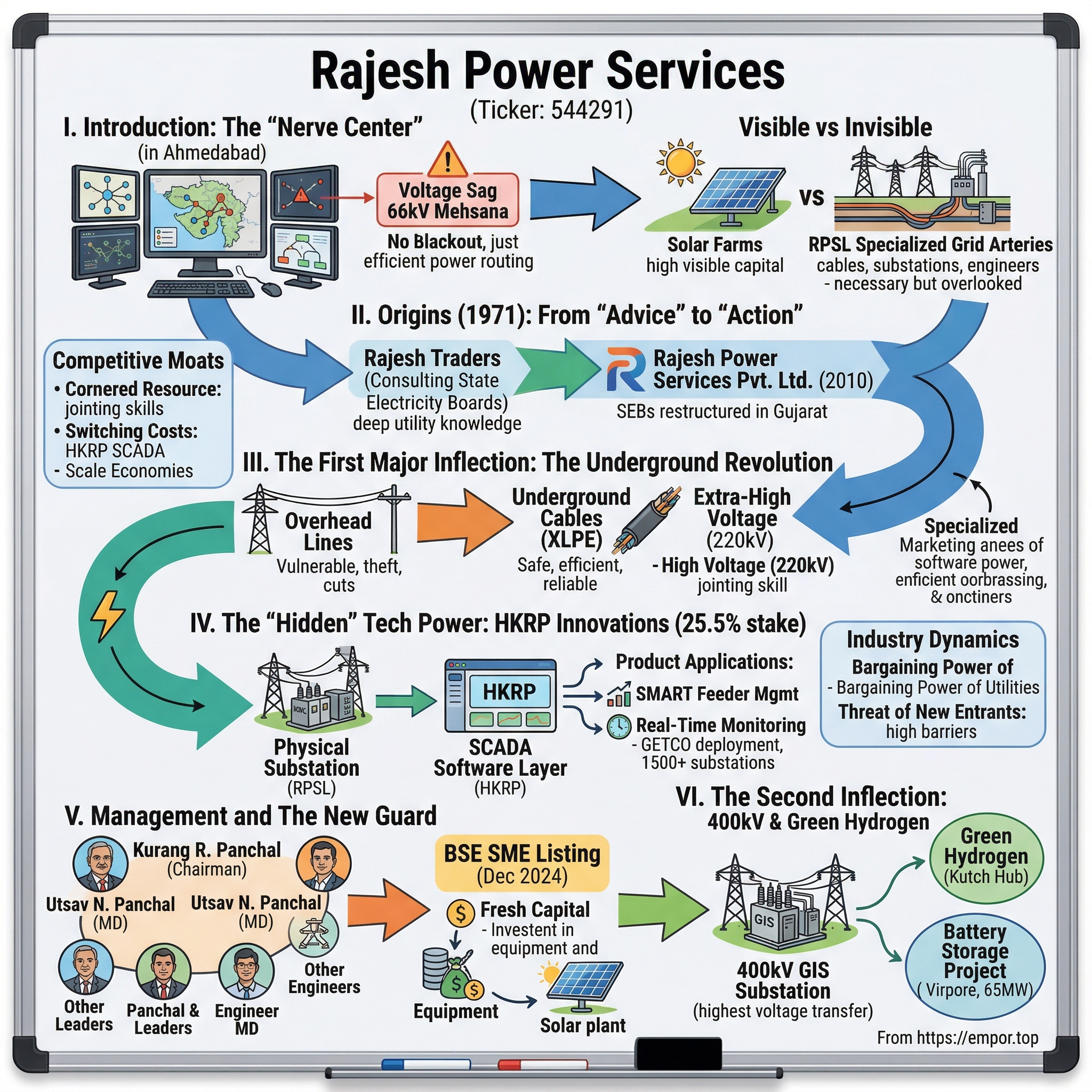
The Invisible Grid: The Rajesh Power Services Story
I. Introduction: The Power Surgical Team and the "SME Platform Discount" (0:00 – 12:00)
Somewhere under a road in Bhavnagar, at a depth of about one and a half metres, there is a trench. Inside it runs a cable roughly as thick as a man's forearm, wrapped in cross-linked polyethylene and sheathed in aluminium. It carries eleven thousand volts. Above it, a fruit vendor sets up his cart, a school bus turns the corner, and the monsoon arrives in June and floods the street. Nobody looks down. Nobody thinks about the cable. And that is precisely the point — the entire multi-thousand-crore project of burying Gujarat's power network exists so that nobody ever has to think about it again.
The company that dug that trench, jointed that cable, and will be liable if it fails is Rajesh Power Services Limited, a fifty-five-year-old Ahmedabad firm that most Indian investors have never heard of and that trades, as of late July 2026, at roughly eleven times trailing earnings on the SME platform of the BSE.1
Start with the paradox, because it is genuinely strange. In the financial year ended March 2026, Rajesh Power reported revenue of ₹1,628 crore, up 52% year on year, on top of a year in which revenue had already roughly quadrupled. EBITDA came in at ₹197 crore, a 12.1% margin, and profit after tax at ₹143 crore, an 8.8% margin.2 Three-year revenue compounding, on the company's own calculation, ran at 99% a year between FY23 and FY26.2 Net worth rose 53% to ₹406 crore. Return on capital employed, annualised for the second half, was 43.65%.2 These are not the numbers of a sleepy regional contractor. They are the numbers of a business that has been standing in front of a firehose.
And yet the market capitalisation sits near ₹1,500 crore against a share price of around ₹838, implying a price-to-earnings multiple of roughly 10.9 and a price-to-book of about 3.9.3 The stock has fallen from a fifty-two-week high near ₹1,639.4 For a company growing at fifty percent with forty-percent returns on capital, that is a valuation that demands an explanation. Either the market is asleep, or it is pricing something the headline numbers do not capture.
This episode is an attempt to work out which.
The first thing to understand is what Rajesh Power actually does, because "power EPC" is one of those phrases that flattens enormous differences into a single label. There is a version of this industry that involves erecting steel lattice towers across farmland and stringing conductor between them — a commodity business, fought on price, hostage to right-of-way disputes with landowners. Rajesh Power does almost none of that. Its specialty is the surgical end of the grid: extra-high-voltage underground cable systems, gas-insulated substations, and the conversion of overhead distribution lines into buried networks. On the transmission side it works across the voltage spectrum from 1.1 kV up to 220 kV underground cable, with substation capability now extending to 400 kV.5
The distinction matters more than it sounds. An overhead line is civil engineering. An underground extra-high-voltage cable is closer to microsurgery. The cable arrives in drums weighing several tonnes, is pulled through a duct without exceeding a bend radius that would fracture its insulation, and is then jointed — the point where two lengths meet is stripped, cleaned, stress-cones fitted, and rebuilt by hand in conditions that must be near-surgically clean, because a single grain of dust in a 220 kV joint becomes an electrical fault under stress. Get it wrong and you do not get a minor defect. You get an explosion in a trench under a city street. There is no software patch for a failed cable joint.
That is the business. Rajesh Power's own framing on the FY26 earnings call was more prosaic but points the same way: because underground cabling is "primarily right-of-usage in nature," it carries far less right-of-way risk than overhead transmission, which lets projects be delivered in eighteen to twenty-four months rather than the longer timelines of conventional transmission EPC.2 Faster turns on the same balance sheet is, in a working-capital-hungry industry, an economic advantage and not merely an engineering one.
So why the discount? Three candidate explanations will run through this episode, and they are not mutually exclusive.
The first is structural and has nothing to do with the business: the BSE SME platform is a thin, retail-dominated venue with limited institutional participation. Domestic institutions hold 3.52% of Rajesh Power and foreign institutions 0.68%; the promoter group holds 72.7%.3 A stock that most funds cannot buy, in size, at all, is a stock whose price is set by a narrow pool of capital. Compare Advait Energy Transitions, a Gujarat neighbour in the transmission supply chain that generates ₹715 crore of revenue and ₹55 crore of profit — less than half of Rajesh Power's earnings — yet carries a market capitalisation of about ₹2,490 crore at roughly 48 times earnings.6 Something other than earnings is being priced.
The second explanation is that the discount is rational and reflects concentration. Between 85% and 90% of Rajesh Power's order book, by management's own admission on the April 2026 call, sits in a single Indian state.2 Gujarat has been the best power state in India for two decades. It will not necessarily be the best forever, and a company whose entire pipeline depends on one state's utility capital expenditure budget is, in a real sense, a leveraged bet on one procurement department.
The third is cash. In a business that reports 43% returns on capital, operating cash flow in FY26 was negative ₹41 crore.3 Growth of this speed in contracting is funded by suppliers, banks, retentions and, in this case, by loans from the promoters themselves. Whether that gap is a timing artefact or a structural feature is the single most consequential question an investor in this company has to answer.
Over the next two hours we will trace how a family trading firm dealing in cable jointing kits in 1971 turned into the contractor that GETCO calls when a 220 kV substation needs building at GIFT City; why the company bought a quarter of a software business rather than building one; what a ₹4,754 crore memorandum of understanding with the Government of Gujarat is actually worth; and what would have to go wrong for the whole thing to unravel. We begin, as these stories usually do, with two men and a product almost nobody has heard of.
 Subscribe on LinkedIn
II. The 1971 Genesis & Transition: From "Consultancy" to "Action" (12:00 – 22:00)
In 1971, in Ahmedabad, two men named Ramchandra Panchal and Baldevbhai Patel started a small business. According to the company's own history, they did not begin as consultants advising state electricity boards on network design. They began as traders — specifically, dealing in electrical joining kits.7
It is worth sitting with that for a moment, because the founding product turns out to be the seed of everything that followed.
A cable jointing kit is an unglamorous box of components: heat-shrink sleeves, stress-control tubing, connectors, mastic tape. Its entire purpose is to let two cable ends be joined, or a cable terminated into a switchgear, without the electrical field concentrating at the discontinuity and eating through the insulation. In the India of 1971 — an economy of licences, shortages and state electricity boards — selling these kits meant one thing above all: you had to be in the room when a utility's cable failed. You were the person the lineman called at two in the morning.
That is a distribution business, but it is also an apprenticeship in a very specific problem. Over three decades, a firm that sells jointing kits and helps utilities use them accumulates something no balance sheet records: an understanding of where cables fail, why, and what it costs the utility when they do. The company's own description of its services still lists cable fault location and rectification alongside the marquee EPC work.7 The trading business was not a detour from the EPC business. It was reconnaissance.
The formal transitions came slowly and are worth laying out because the compounding is visible in them. The firm set foot in the extra-high-voltage business in 2001. In 2009 it completed its first 11 kV distribution undergrounding project for Uttar Gujarat Vij Company Limited — the moment the company stopped being a servicer of the network and became a builder of it. In 2011 it moved into EPC work on EHV substations. In 2012 it built its own solar power plant. In 2014 annual turnover crossed ₹100 crore for the first time. In 2015 came the first 220 kV turnkey job, and in 2019 the first 220 kV gas-insulated substation.7 The corporate wrapper caught up along the way: the entity that lists today was incorporated in 2010, and remained a private limited company until it converted ahead of the IPO.8
Read that timeline as a ladder of technical qualification rather than a list of dates, and the strategy becomes obvious. Each rung was a permission slip for the next one. You cannot bid a 220 kV GIS tender without having executed 132 kV. You cannot bid 400 kV without 220 kV. In Indian utility procurement, this is not a soft advantage — pre-qualification criteria are written into tender documents, and a contractor without the reference project is not outbid, it is ineligible. The forty-three years between the first jointing kit and the first ₹100 crore of turnover were not wasted years. They were the years spent buying tickets.
The outline of this episode, and much of the sell-side framing around the company, describes the pre-2010 business as a high-margin, asset-light consultancy that gave Rajesh Power an "information advantage" over the grid it later built. The company's own annual report does not support that framing — it describes a trading business that grew into engineering and utility services.7 The distinction is not pedantic. A consultancy accumulates drawings; a jointing and fault-rectification business accumulates people who can do the work with their hands. As we will see when we get to the moat, it is the second kind of accumulation that turned out to matter, and it is the harder one to replicate.
What changed after 2010 was ambition and, eventually, capital structure. For most of its life the company had been financed the way Gujarati family firms are financed: retained earnings, bank limits, and money from the family. As late as March 2025, after a successful IPO, the consolidated balance sheet still carried ₹46.0 crore of unsecured long-term loans from directors and their relatives, carrying interest at 10% and with no specific repayment schedule beyond an undertaking to repay after March 2028.9 More than a dozen family members appear individually in that schedule. This is not a criticism — it is a fact about what kind of company this was until very recently, and it explains why the 2024 listing was less a financing event than an identity change.
By FY23 the company was turning over ₹207 crore with a debt-to-equity ratio of 1.02 and net worth of ₹58.67 crore.7 By FY24 revenue was ₹285 crore, gearing 0.92, net worth ₹84.30 crore.7 These are the metrics of a competent, capital-constrained regional contractor. The order pipeline in Gujarat was accelerating faster than the balance sheet could carry it, and the binding constraint was not skill or relationships. It was money — specifically, the bank guarantees, earnest-money deposits and retention money that a contractor must fund before a rupee of revenue is recognised.
Which brings us to November 2024, and the decision to sell a piece of a fifty-three-year-old family business to strangers.
The initial public offering was a book-built issue of ₹160.47 crore: a fresh issue of 27.90 lakh shares raising ₹93.47 crore, plus an offer for sale of 20 lakh shares totalling ₹67 crore, at a price band of ₹320–335.10 The book was oversubscribed 59 times overall, with the non-institutional segment at 138.46 times.7 The shares listed on the BSE SME platform on 2 December 2024 at ₹636 — a 90% premium to the issue price — and traded up to ₹668.30 shortly after.7
A 90% listing pop is usually a sign that the underwriters mispriced the issue. In this case it is also a sign of something more interesting: the market had no idea what it was looking at. Rajesh Power went public in the same month it was about to report a year in which revenue would rise nearly fourfold. The IPO priced the past. Within six months, the past was irrelevant.
The proceeds went where the constraint was. Gearing fell from 0.92 to 0.21 within a single year, and net worth roughly tripled to ₹263.46 crore.7 The stated uses were cable testing equipment, a 1,300 kW DC solar power plant, developing green hydrogen expertise including electrolysers, working capital and general corporate purposes.10 We will come back to the hydrogen line item, because it is the one part of the capital plan that deserves genuine scepticism.
For now, the important point is this: a company that had spent five decades acquiring technical qualifications finally acquired the balance sheet to use them. What happened next is the actual story.
III. The Core Engine: Turnkey EPC Solutions (22:00 – 50:00)
Here is a number that should govern how you read everything else about this company. In FY25, revenue from the sale of EPC contracting services was ₹1,071.45 crore. Other operating revenue was ₹0.61 crore.11
Ninety-nine point nine four percent.
Rajesh Power is a turnkey EPC contractor. It is not a clean-energy platform, a storage developer, or a software company. Everything else in this story — the battery project, the hydrogen research, the SCADA associate — is a rounding error against the core, and any thesis that lets the rounding errors do the narrative work is a thesis about the wrong company. We will size each of them honestly when we get there. First, the engine.
Why Gujarat became the world's best laboratory for this
Gujarat is where India's power sector went to grow up. The state unbundled its electricity board early, its distribution companies actually collect their bills, and its transmission utility, Gujarat Energy Transmission Corporation, has run a continuous capital expenditure programme for two decades. Management sized GETCO's forward capital plan at roughly ₹96,000 crore spread over ten years, implying annual capex of ₹9,000–10,000 crore, of which the underground cable and substation slice addressable by Rajesh Power is 40–50%, or ₹4,000–4,500 crore a year. On the distribution side, largely under Gujarat's robust infrastructure scheme, they put the addressable market at a further ₹5,000 crore a year.2
Those are management's numbers, not audited ones, and the correct posture toward a contractor's estimate of its own addressable market is polite scepticism. But the underlying driver is verifiable and it is not a Gujarat story at all — it is a physics story.
Indian distribution networks were built as overhead lines because overhead is cheap. Overhead is also where India's aggregate technical and commercial losses live. A bare 11 kV conductor strung between poles can be hooked. It falls in storms. It arcs against tree branches. It kills people. The fix has two stages: first, replace bare conductor with medium-voltage covered conductor — essentially, insulate the overhead wire so a hooked tap does not work and a branch does not cause a fault. Second, where density justifies it, bury the network entirely with ring main units that let a utility isolate a fault to a single segment rather than blacking out a feeder.
The economics are what make this a multi-decade programme rather than a fashion. On management's account of DISCOM feedback, covered conductor and underground installation have produced a 70–80% reduction in interruption duration, with faster fault isolation via ring-main sectionalisation, and DISCOMs increasingly report that the incremental revenue and efficiency gains exceed the lifecycle cost of the cabling.2 That claim comes from the contractor selling the cable, so treat the precise percentages as directional. But the direction is corroborated by the buying behaviour: Gujarat's utilities have kept awarding this work for a decade and a half, and other states are now copying the model.
The scale Rajesh Power has already deployed is the real evidence. Roughly 50,000 kilometres of medium-voltage covered conductor, 11,000 ring main units, 5,000 distribution transformers, and more than 10,000 kilometres of underground HT and LT cable installed or in progress as of the H1 FY26 disclosure.5 By the April 2026 call, the covered-conductor number had risen to over 51,000 kilometres under execution, which management described as among the largest such deployments in the country.2 In FY26 alone, the company strengthened the network with over 350 feeders serving more than 15 lakh consumers, installed over 4,000 ring main units and 1,200 distribution transformers, and laid more than 1,300 kilometres of cable — in a single year.2
Set that against FY26 revenue of ₹1,628 crore and the picture is of a company that has stopped being a project contractor and become something closer to industrial plumbing at scale.
The order book, and the discipline of what gets counted
At 31 March 2026 the unexecuted order book stood at ₹3,326 crore: 71% (₹2,365 crore) power distribution, 29% (₹961 crore) power transmission. Order inflows during FY26 were ₹2,743 crore.2 By 30 June 2026 the unexecuted book had risen to ₹3,741.79 crore, helped by ₹864.8 crore of Q1 wins including a ₹653.12 crore underground distribution contract from Paschim Gujarat Vij Company Limited across four circles and a ₹211.68 crore 220 kV underground cable and GIS contract from Odisha Power Transmission Corporation — the company's first order in that state.12
There is a small but revealing episode buried in how that number came to be reported. On the H1 FY26 call in November 2025, an analyst from Indus Equity Advisors pointed out that a CRISIL report had described a gross order book of ₹3,800 crore of which ₹2,026 crore was unexecuted, which implied that roughly ₹1,174 crore should have been executed in the half — against reported revenue of ₹640 crore. The company's finance manager conceded the point: earlier investor presentations had included projects already commenced and under execution in the "gross" figure, "that is why the figure appeared higher," and going forward the company would report only the unexecuted book.5
That is the right answer, arrived at under pressure. It is also a reminder of how young this company's investor-relations muscle is. Fourteen months into life as a listed entity, an analyst had to force a definitional cleanup on the single most important operating metric the company discloses. Investors should file that as evidence about process maturity rather than about integrity — the disclosure did get better — but it is the kind of thing worth watching for recurrence.
From L1 to Q1: what actually protects the margin
The received wisdom about Indian government contracting is that it is a race to the bottom: the lowest bidder, L1, wins, and margins go to zero. That is true in road building and in commodity civil work. It is much less true here, and the reason is technical pre-qualification.
Utility tenders for extra-high-voltage cabling and gas-insulated substations run a two-envelope process. The technical bid must clear a threshold — reference projects at the relevant voltage class, certified jointers on the payroll, financial capacity to post bank guarantees — before the price envelope is opened at all. L1 still wins. But L1 is selected from a set that may contain three bidders rather than thirty.
Management has quantified this. In the distribution segment they see four to six competitors on an average bid; in transmission, three to four. Competitive intensity is rising, but at a rate of "one or two players each year" in each segment, against an addressable market that has grown far faster.2 The named competitor set is instructive: in Gujarat distribution, Monte Carlo, Kashmiri Lal Construction, Power and Instrumentation, and Lumino Industries; in transmission cable work, Om Power Transmission, KEI Industries, Finolex J-Power, Universal Cables, Polycab India and Vasudev Power; outside Gujarat, Kalpataru Projects International, Salasar Techno Engineering, Kanohar Electricals, Kintech-Synergy, BNC Power and Rahul Cables.5
Note who is on that list: cable manufacturers. KEI, Polycab, Universal and Finolex do not merely supply Rajesh Power, they occasionally bid against it. That is worth holding onto when we assess the scale-economies argument later, because the procurement leverage a contractor has over a supplier is different when the supplier is also a competitor.
What does the pre-qualification barrier deliver in economics? A remarkably stable, remarkably ordinary margin. EBITDA was 12.1% in FY26 and 12.1% in FY25.27 Management's stated project-level underwriting standard is 11–12% EBITDA and 8–9% PAT, and they have repeated it consistently across both post-listing calls.25 The company's own bid win rate is around 40–50% of tenders entered.5
An analyst from Saltoro Investment Advisors pushed on exactly the right point in April 2026: if the work is niche, the qualified bidder set small, and the track record already established, why is the margin only 11–12%? Management's answer was notably unambitious and, to their credit, not oversold: "what we are committing is not a decrease in margin, but a stabilized margin."2
That answer tells you something important. The pre-qualification barrier is not a pricing-power moat. It is a volume moat. It does not let Rajesh Power charge more; it lets Rajesh Power be one of a handful of firms allowed to compete for a market growing at 30–40% a year, at a margin the utility considers fair. The value creation comes from throughput on a modest margin, not from expanding the margin. Any investment case built on future margin expansion is arguing against management's own guidance.
There is one genuine cost-structure advantage, and it is operating leverage on overhead. Employee costs rose from ₹43.9 crore in FY25 to ₹59 crore in FY26 while revenue rose 52%, because project managers absorb more projects as scale rises — direct execution labour sits in cost of goods and services, not employee expense.2 That is the kind of leverage that is real but bounded; you cannot run a ₹5,000 crore order book on the same corporate team forever.
Two further structural protections deserve mention because they defuse risks investors would otherwise assume are present. First, input costs: aluminium and copper prices rose sharply through the second half of FY26, and margins held, because essentially all contracts carry price escalation clauses that move back-to-back with no material time lag.2 Second, supply: after the 2020 notification barring bidders and manufacturers from countries sharing a land border with India, the qualified supplier set for GIS equipment narrowed to a handful of multinationals — Siemens, 효성 Hyosung, 日立 Hitachi, 東芝 Toshiba and GE.5 That restriction cuts both ways: it insulates Rajesh Power from Chinese-partnered competition, and it concentrates its own equipment supply chain into a small number of very large vendors with pricing power of their own.
The valuation gap, examined
Now put the peer set on the table properly, because this is where the "SME discount" thesis either earns its keep or does not.
Advait Energy Transitions — the renamed Advait Infratech, also Gujarat-based — did ₹715 crore of FY26 revenue and ₹55 crore of net profit, with ROCE of 27.9%, and trades at about ₹2,490 crore, or 48 times earnings.6 Viviana Power Tech did ₹502 crore of revenue and ₹50 crore of profit at 50.7% ROCE, and trades at ₹766 crore, or 15.3 times.13 Kay Cee Energy & Infra reported FY26 revenue of ₹165.6 crore and PAT of ₹18.8 crore, and its managing director openly attributed a revenue shortfall to geopolitical disruption delaying roughly ₹50–60 crore of emergency restoration system shipments.14
Rajesh Power earned more profit in FY26 than all three combined, and is valued at less than Advait alone.
Is this mispricing? Partly, and the mechanism is not mysterious: SME-platform listing restricts the buyer pool, and the lot-size and liquidity constraints matter even after the company halved its market lot from 400 shares to 100 to improve accessibility.5 But the gap is not purely a venue artefact. Advait's premium is attached to a manufacturing business — it makes stringing tools, ACS wire, OPGW and optical fibre cable, and claims a 35% share of India's emergency restoration systems market — plus a green-hydrogen and solar materials narrative.6 Products carry higher multiples than projects, everywhere, always, because product businesses have inventory turns and repeat customers while contractors have tenders. Viviana at 15 times, with a comparable asset-light T&D contracting model, is arguably the more honest comparison, and against that benchmark Rajesh Power's discount is real but far less dramatic — roughly 30%, not 75%.
The remaining discount, then, is the market's price for three things: concentration in one state, cash conversion, and the SME venue itself. Sections VI and VII deal with the first two. The third resolves itself only if and when the company migrates to the main board, and management has not announced any such plan.
For an investor, the practical conclusion from this section is narrower than the headline growth suggests. Rajesh Power is not a company that will earn its return by getting more profitable. It is a company that will earn its return, if at all, by pushing an ever-larger volume of work through a fixed 12% margin without letting the working capital or the execution quality break. Which raises the obvious question: what stops the whole thing from being a treadmill? Management's answer involves a piece of software.
IV. Capital Allocation, M&A, & The Software Brain: HKRP Innovations (50:00 – 68:00)
Picture a room in Gujarat with a video wall. On it, in near-real time, sit the operating states of more than 1,500 distribution substations — breaker positions, load, voltage, alarms. When a feeder trips at 3 a.m. in a town two hundred kilometres away, an operator in that room sees it before the first customer complaint is logged, and can isolate and restore remotely rather than dispatching a van to find the fault by driving the line.
That system is one of the largest SCADA deployments in India, and it was built under GETCO by a company called HKRP Innovations Limited, in which Rajesh Power holds 25.48%.515 Six such command-and-control centres have been deployed for three of Gujarat's major distribution companies.5
For a hardware contractor, this is the most strategically interesting thing on the balance sheet — and also the one that requires the most careful reading, because the ownership structure is not simple.
What HKRP is, in plain terms
SCADA stands for supervisory control and data acquisition, and the concept is easier than the acronym. Think of the grid as a body. Rajesh Power lays the arteries — cables, substations, transformers. HKRP installs the nervous system: sensors at thousands of points, a communications layer to carry the signals, and a control room where a human can both see the state of the network and act on it. The product line runs to smart feeder management, virtual feeder segregation, solar energy data management and advanced distribution management systems, built on IoT and cloud infrastructure.5
Why does a utility care? Because a distribution company's central problem is that it cannot see its own network below the substation level. It knows how much power went in and how much was billed; the gap is loss, and the loss is a mixture of technical resistance, theft, and metering failure that it cannot decompose without instrumentation. Virtual feeder segregation, for example, lets a utility distinguish agricultural from non-agricultural load on a shared feeder without physically rebuilding it — which matters enormously in a state where agricultural power is subsidised and the subsidy bill depends on the split.
The economics, and what is actually disclosed
HKRP closed FY25 with roughly ₹170 crore of revenue at 18–20% PAT margins, and carried an order book of ₹350–400 crore.5 Those margins are roughly double Rajesh Power's own. In FY26, the associate contributed ₹9.75 crore to the consolidated profit and loss — a little under 7% of the ₹143 crore consolidated PAT.2
That contribution was slightly below the prior year, and management's explanation on the April 2026 call was specific and checkable rather than evasive: billing scheduled for February–March slipped because of customer site-readiness issues, pushing commissioning out by a couple of months.2 In a project business where revenue recognises at go-live, that is a credible answer. It is also the kind of answer that becomes a red flag if it recurs for three halves running.
Here is where the analysis has to be honest about a limit. The FY25 consolidated accounts do not present HKRP as a simple equity-accounted associate with a stated carrying value; the interest is reflected through proportionate "share of joint venture" lines running across the balance sheet and profit and loss, and non-current trade investments in unlisted shares total only ₹0.30 crore.11 A precise carrying value for the HKRP stake, and a clean comparison of that carrying value against attributable net worth, is not separately disclosed in the annual report reviewed here. Claims circulating that Rajesh Power holds the stake at a large discount to book therefore cannot be verified from the primary filing, and this write-up will not assert them. What can be said is narrower and still meaningful: a 25.48% stake generating ₹9.75 crore of attributable profit is, on any plausible carrying value, contributing a return well above the company's cost of capital.
The part that requires scrutiny
Three facts about HKRP need to sit next to each other.
First, ownership. Rajesh Power Services the listed company owns 25.48%. Approximately another 25% is held by the Rajesh Power promoters personally, and the remaining 50% by the Harikrupa Automation group and its promoters.2 So the promoters of a listed company hold, directly and in a personal capacity, a stake in an unlisted associate roughly equal to the one the listed company holds.
Second, trade. In FY25, Rajesh Power purchased ₹120.09 crore of goods from HKRP and sold ₹4.18 crore of goods to it, under five-year arrangements running to 31 March 2028 approved by the board on 8 April 2024.16 Against FY25 revenue of ₹1,107 crore consolidated, ₹120 crore of purchases from an associate part-owned by the promoters personally is not a trivial related-party flow. The company classifies these as arm's-length ordinary-course transactions, and the auditors reported no key audit matters.17
Third, direction of travel. Asked in November 2025 whether the company planned to raise its stake, the CEO said flatly there was no such plan and that HKRP "as of now, is an independent entity."5
None of this is evidence of wrongdoing. Related-party supply arrangements between a contractor and a specialist technology affiliate are common in Indian promoter-led groups, and the structure predates the listing. But an investor should understand what it means economically: a meaningful share of the value created by the hardware-software combination accrues outside the listed vehicle, to the promoters directly and to a third-party group. If the "Trojan horse" thesis works — if HKRP's SCADA architecture locks utilities into an ecosystem that keeps pulling Rajesh Power's cabling and substation work along with it — minority shareholders in the listed company capture roughly a quarter of the software economics and all of the hardware economics. That is a perfectly reasonable deal. It is simply not the same deal as owning the software outright, and it deserves to be stated plainly rather than folded into a moat narrative.
Does the switching-cost argument hold?
The theoretical case is strong. Once a utility's control room, alarm logic and operating procedures are built on a specific SCADA architecture, replacing it means retraining operators, re-integrating thousands of field devices, and accepting operational risk on a live network. The cost of switching is not the licence fee; it is the institutional memory.
The evidence for it, however, is thin at this stage and mostly circumstantial: six command centres, three DISCOMs, 1,500-plus substations, and a customer relationship with GETCO that stretches back to the early 2000s.5 What we do not have is renewal data, contract tenure disclosure, or any instance of a competitor attempting displacement and failing. Until those appear, "switching costs" should be treated as a plausible mechanism with real but unproven strength, not as a demonstrated moat.
The more defensible version of the argument is simpler and does not need software at all. A utility awarding a 220 kV GIS substation is buying insurance against catastrophe, and its cheapest form of insurance is a contractor whose previous work in the same network has not failed. That is a reputational moat, it is measurable in tender outcomes, and it exists whether or not the SCADA thesis proves out.
Meanwhile, capital allocation elsewhere has been notably restrained. Asked directly about backward integration into manufacturing — the obvious empire-building move for a contractor with a growing order book — the CEO said the company was "not looking at anything in particular."5 Asked about fundraising, he said existing limits plus enhanced bank facilities would suffice, and that no equity raise was contemplated in the immediate future.5 For a company growing at 50% with negative operating cash flow, choosing not to raise equity is either discipline or denial, and section VII will test which.
There is, however, one area where the company has chosen to spend money on optionality rather than execution. It involves batteries and, more speculatively, hydrogen.
V. Sizing the Speculative Segments: BESS & Green Hydrogen (68:00 – 82:00)
On 6 March 2026, a wholly owned subsidiary called Rajesh Power Projects signed a battery energy storage purchase agreement with Gujarat Urja Vikas Nigam Limited for a 65 MW / 130 MWh standalone battery storage facility at Virpore in Gujarat. The project was won through tariff-based competitive bidding under GUVNL's Phase VII standalone BESS tender, supported by viability gap funding from the Power System Development Fund. The contracted tariff is ₹1.89 lakh per MW per month over a twelve-year term from commissioning, with commissioning expected within eighteen months of signing.18
This is a genuine technological milestone for the company and a genuinely small number, and both halves of that sentence matter.
The arithmetic, done out loud
The revenue mechanics are unusually transparent because an analyst on the FY26 call did the multiplication with management on the line. ₹1.89 lakh per MW per month, times 65 MW, times twelve months, gives roughly ₹14–15 crore of annual billing.2 Operating expenditure, management said, will be "very minor" — the asset is closer to a rental than a contract, with monthly invoices to the utility.2 Capital expenditure for BESS infrastructure runs ₹1.5–2.5 crore per MW, and the company will fund the project 70–80% with bank debt and the rest with equity.2 The targeted project internal rate of return is 10–12%.2
Set ₹14–15 crore of annual revenue against FY26 revenue of ₹1,628 crore. It is under one percent. Over the full twelve-year term, undiscounted, the project bills roughly ₹175 crore — about six weeks of current run-rate revenue, spread over more than a decade.
A 10–12% project IRR is also worth pausing on. That is a perfectly respectable infrastructure return. It is materially below the returns the core EPC business generates on capital employed. Deploying equity into a twelve-year annuity at 10–12% when the contracting business earns north of 40% on capital is, on the arithmetic alone, value-dilutive at the margin.
So why do it?
The actual strategic logic
Management's answer is the honest one and, once you hear it, the project makes sense. The point is not the annuity. The point is the qualification.
"The idea of this BESS project was to understand the entire ecosystem of the BESS," the CEO explained, "so that we can bid higher and more strongly in the BESS EPC projects."2 Elsewhere on the same call: the company is not looking to bid for more BESS developer projects, but is very interested in BESS EPC projects, "where we see a lot of value addition. This is exactly what we do in Transmission at Rajesh Power."2
And then the sentence that explains everything: "if you see, majority, 30% of a BESS project accounts to the AC side. AC side means the substation that is to be constructed along the BESS site. So, substation is basically Rajesh Power's expertise."2
Decoded: a grid-scale battery installation is not mostly batteries. Roughly a third of the project cost is the alternating-current side — the transformers, switchgear, protection and substation that connect the direct-current battery blocks to the grid. That is Rajesh Power's existing business wearing a different hat. Management sized the emerging pipeline of PSU-led BESS EPC packages — from NTPC, GIPCL and others — at ₹400–500 crore per project, aggregating toward ₹10,000 crore, against a national tendered storage capacity that has already crossed 102 GWh.2
So the Virpore project is best understood as a paid apprenticeship. Rajesh Power is spending roughly ₹100–120 crore of project cost, mostly debt-funded, to become one of the few Indian contractors who can say in a technical bid that it has procured, built, commissioned and operated a utility-scale battery system. In an industry where the binding constraint is pre-qualification, that is the same move the company made in 2015 with its first 220 kV turnkey job and in 2019 with its first GIS. Judged as a project, it is mediocre. Judged as a ticket, it may be cheap.
The falsifiable test is straightforward and investors should hold management to it: within roughly twenty-four months of the September 2027 commissioning date, does Rajesh Power win third-party BESS EPC packages of meaningful size? If yes, the apprenticeship worked. If the Virpore asset sits alone on the balance sheet as a ₹15 crore-a-year annuity, it was a distraction. Management would not commit to a revenue-mix target — asked whether BESS could reach 15–20% of revenue in three years, the reply was that an accurate percentage "would be difficult to give right now."2 That is appropriate humility, and it is also an admission that nothing has been proven.
One further note of caution appears in the same exchange. Asked about project cost, management said the team would be "visiting China" to get better quotes and firm up battery vendor selection.2 Cells are the one part of this value chain where India has minimal domestic capacity, and where the 2020 land-border procurement restrictions that protect Rajesh Power in GIS work provide no comfort at all. Battery supply is a real dependency on a geography that has been a source of policy volatility, and it sits outside the price-escalation protection that covers the core EPC book.
The hydrogen line item
Which brings us to the smallest and least defensible item in the capital plan. Among the stated objects of the IPO was setting up a 1,300 kW DC solar power plant and developing in-house technical expertise in green hydrogen, including alkaline electrolyser technology.10 The annual report's own risk section frames this as a hedge against technological disruption, alongside the HKRP investment.19
Investors should size this for what it is: a pre-commercial research initiative with no disclosed revenue, no disclosed order pipeline, no disclosed capital committed beyond a fraction of a ₹160 crore issue, and essentially no presence in either post-listing earnings call. Green hydrogen in India in 2026 remains a policy-dependent industry whose economics have not converged. If it works, it is upside nobody is currently paying for. If it never works, nothing in the investment case changes. The honest treatment is one paragraph, which is what it has received.
The pattern across both ventures is consistent and, on balance, reassuring: Rajesh Power buys small options on adjacent technologies while keeping essentially all of its capital and attention in the business it knows. Whether the people running it can keep making that distinction as the balance sheet grows is a question about them, and that is where we go next.
VI. Management, Incentives, and Credibility Stress-Test (82:00 – 98:00)
On 14 November 2025, Utsav Panchal opened Rajesh Power's first-ever earnings conference call — nearly a year after listing — with a line that sounds like boilerplate and is not: "We are delighted to have you join us today."5
A year is a long time to go without talking to shareholders. It is also, for a family firm that had never had shareholders before, a fair indication of how steep the learning curve was. What has happened since is the substance of this section: two calls, roughly five months apart, in which analysts asked increasingly pointed questions, and management answered with a mixture of specificity, occasional deflection, and one clear inconsistency.
The people
The board that took the company public is a two-generation structure. Kurang Ramchandra Panchal, the managing director, carries more than four decades in transmission and distribution and, before Rajesh Power's rise, built the electrical goods business in Gujarat for firms including 3M, ABB, Sintex and Universal.20 He is the son of one of the two founders, and his letter in the FY25 annual report is notable mostly for what it does not do: it makes no attempt at visionary language, and instead commits to expanding into other states, building capability in solar, green hydrogen and smart grids, "while maintaining financial discipline through careful debt management and efficient use of working capital."7
Rajendra Baldevbhai Patel, whole-time director, represents the other founding family. The operating layer is second-generation: Utsav Nehal Panchal, appointed chief executive officer with effect from 10 July 2024 though a director since April 2021, and Kaxil Prafulbhai Patel, appointed chief financial officer on the same date though a director since February 2019.16 The finance function on calls is fronted by Nikita Shah, finance head, with Adhish Patel as senior finance manager; investor relations is outsourced to Ernst & Young.52 Three independent directors — Sujit Gulati, Viral Ranpura and Pankti Shah — receive sitting fees only.16
The pre-IPO reshaping of the board is visible in the FY25 disclosures and worth noting: four executive directors — Praful Baldevbhai Patel, Nehal Ramchandra Panchal, Vishal Hemantbhai Patel and Daxesh Ramchandra Panchal — ceased to be directors on 10 July 2024, immediately before the listing.16 Several remain substantial shareholders. Daxesh Panchal held 8.09% and Vishal Patel 6.82% at March 2025.15 This was a family board being professionalised for public markets, with the exiting members retaining their economics.
Skin in the game, and what the pay data actually shows
Promoter and promoter-group holding stood at 72.7% in March 2026.3 Individually, at March 2025, Kurang Panchal held 10.00%, Rajendra Patel 8.49%, and Utsav Panchal and Kaxil Patel 8.33% each.15 These are meaningful personal stakes; at the current market capitalisation, the managing director's holding alone is worth roughly ₹150 crore. Alignment is not in question.
Compensation is where the picture gets more textured. The FY25 disclosures give ratios rather than absolute figures. The managing director's remuneration was 173.28 times the median employee's, rising 6.51% in the year. The whole-time director sat at 64.52 times, up 20.43%. The chief financial officer was at 47.49 times, up 38.68%. And the chief executive officer was at 46.74 times, up 106.86%.16
Now set those against the workforce. Headcount rose from 1,033 in FY24 to 1,323 in FY25. Median employee remuneration rose 9.67%. But the average annual increase in employee remuneration, excluding directors and managerial personnel, was negative 4.15% — total remuneration rose while average remuneration fell, because the company hired heavily at the bottom.21
There is nothing improper here, and the mechanical explanation is sound: a contractor that adds nearly three hundred people in a year of fourfold revenue growth is adding site staff, not vice presidents. But an investor should be clear-eyed that in a year when average employee pay declined, executive-director pay rose between 6% and 107%. This is a family-controlled company where the compensation committee's independent members are paid in sitting fees. Governance-focused investors will want to watch whether the ratio of managerial to median pay stabilises now that the growth spurt has normalised, and whether any of it is ever put on a performance-linked, disclosed basis. Currently, none of it is.
Testing the narrative across calls
The most useful discipline for assessing a newly listed management team is to line up what they said last time against what happened.
Guidance. In November 2025, asked for revenue guidance, the CEO said the company anticipated "a CAGR of around 40% across all key metrics over the next few years." An analyst from Sapphire Capital immediately pushed back that this looked conservative given 104% growth in the first half; the CEO declined to raise it.5 FY26 revenue growth came in at 52%.2 In April 2026, offered another opportunity to raise guidance because the addressable market had grown, management said: "No, we are sticking with our previously committed guidance. No revision."2 Two calls, two invitations to over-promise, both declined, and delivery above the number. That is the single strongest piece of evidence on management credibility in the public record so far.
Order book targets. Here the record is weaker. In November 2025 the CEO said the closing FY26 unexecuted order book would be "somewhere around INR 4,500 crore."5 It closed at ₹3,326 crore — a 26% shortfall. Confronted twice on the April call, management's answer was: "There is no shortfall. It's just the tender results are not out. So what we were targeting, we had bid in Q4, but the results are taking time to get out. If you consider the orderbook it's a time issue. It's not a target issue or any slowing down issue."2
That explanation is plausible and partially corroborated — ₹2,200 crore of bids were awaiting results at the time, with conclusions expected by end-May.2 But "there is no shortfall" when the number missed by ₹1,174 crore is a linguistic move, not an accounting one. A more confident management team would have said: we missed our own target because tender timing slipped; here is the evidence it is timing. The subsequent Q1 FY27 inflow of ₹864.8 crore lends the explanation credibility.12 Investors should keep the receipt and check the FY27 target — management is now guiding to a closing order book above ₹5,000 crore for FY27, with order inflows of ₹4,000–5,000 crore.2
Working capital. This is the one place where the two calls do not reconcile. In November 2025, asked directly for current working capital days, the finance head answered: "The working capital days will be around 90 days to 100 days and working capital cycle will be approx. 25% of the total project value."5 In April 2026, asked whether elevated payable days were sustainable, management answered: "usually, working capital cycle of 30 to 40 days is something which is sustainable."2 Those are different questions — gross current asset days versus a net cash conversion cycle — and both answers can be technically correct. But no one on either call clarified the definition, and an investor reading the two transcripts side by side gets a range of 30 to 100 days for the most important operational metric in a contracting business. Screener's computed working capital days for FY26 is 7.3 Three sources, three numbers, no reconciliation. The company should fix this in its disclosure; until it does, investors should model from the underlying balance sheet rather than from any of the three.
Credit. Here management's claims are independently verified. CRISIL rated the company BBB+ with a Stable outlook and revised the outlook to Positive in April 2025, citing revenue growth, a robust order book and expanding margins, on ₹193 crore of rated facilities.22 By mid-July 2026 the long-term rating stood at CRISIL A− with the outlook revised again to Positive, the short-term rating at A2+, and rated bank facilities enhanced to ₹363 crore.12 Two notches of improvement and a near-doubling of rated limits inside fifteen months is an outside party's verdict on the same trajectory management describes. It is the most credible single data point in the bull case, because CRISIL has no incentive to flatter.
The company also adopted Indian Accounting Standards effective 1 April 2025, restating both the half-year to September 2025 and the full year to March 2025, triggered by net worth crossing ₹250 crore.5 That is a mandatory transition rather than a discretionary upgrade, but it does mean the FY26 numbers are prepared on a materially different and more rigorous basis than everything that came before — which is worth remembering when comparing FY26 with FY23. Separately, the statutory auditor changed from Naimish N Shah & Co to Dinesh R. Thakkar & Co with effect from 15 May 2025.23 The FY25 audit report contained no key audit matters and only an emphasis of matter noting the SME listing.17 An auditor change immediately after a first listed-company audit is not by itself concerning, but it is the sort of event a diligent investor logs and watches.
The overall read: a technically excellent operating team, learning public-company disclosure in real time, with a clean record on the thing that matters most — setting a number and beating it — and a messier record on definitional consistency. Which is a reasonable place to be fourteen months in, and a reason to read the next four calls closely.
VII. The Skeptical Investor's Risk Radar (98:00 – 110:00)
Every March, something strange happens to Rajesh Power's balance sheet.
Consolidated trade receivables at 31 March 2026 stood at approximately ₹348–350 crore, against ₹181 crore a year earlier — a jump of nearly 2.5 times against second-half revenue growth of 30%.2 Short-term borrowings rose from ₹29 crore to ₹82 crore. Trade payables roughly doubled, with days outstanding rising from 26 to around 58. Amounts owed to MSME vendors went from ₹5 crore to ₹87 crore. And operating cash flow for the year was negative ₹41 crore, against ₹197 crore of EBITDA.3
Analysts on the April 2026 call went at this from four different directions, and the answers are worth examining because this is where the investment case is decided.
The March bullet invoicing defence
Management's explanation is that Indian state utilities approve project milestones in large blocks at the end of their fiscal year, producing a concentration of invoicing in March. Because payment terms are 45–60 days, invoices raised in March are simply not yet due at 31 March. Debtor days spiked to roughly 78; management said that once billing evens out, "these numbers will again fall back to the genuine around 60 days for debtors," and stated there was no delay in any payment receivable from any client.2
Two pieces of evidence support this. First, when a Ratnatraya Capital analyst asked how much of the ₹348 crore had been collected by the time of the call in late April, management said almost ₹150 crore — roughly 43% inside a month.2 That is consistent with a timing story and inconsistent with a distressed-receivable story. Second, the counterparty quality is genuinely high: Gujarat's distribution companies are among the healthiest DISCOMs in India, and management stated explicitly that the deliberate decision to keep distribution work concentrated in Gujarat is because payment cycles elsewhere are weaker, while transmission work is being taken pan-India only because state transmission utilities have healthy payment profiles that the company checks before bidding.2
An Agastya Dave of CAO Capital pressed the sharpest version of the challenge: receivables nearly doubled while H2 revenue rose from ₹760 crore to ₹990 crore, so "it is not proportionate. The number of days has definitely increased." Management's response was to repeat the March-billing explanation without engaging the disproportionality.2 That is the weakest answer on either call.
What is structurally, permanently cash-consumptive
Strip out the March effect and a hard core remains. EPC contracting in India requires the contractor to fund the utility's risk in three ways simultaneously. Retention money is withheld from every bill — Rajesh Power's contracts carry retention in three tiers of roughly 10%, 20% and 30%, with a typical 30% retention released as 20% on installation and the final 10% on commissioning against a bank guarantee.2 Security deposits and earnest-money deposits must be posted to bid at all. And performance bank guarantees must be maintained through warranty periods, with fixed deposits pledged as margin.
The scale is visible in the accounts. At March 2025, non-current retention money alone was ₹121.77 crore, non-current fixed deposits ₹26.63 crore, and fixed deposits held as margin money against guarantees a further ₹26.85 crore — against cash and cash equivalents of ₹0.14 crore.11 Retention money outstanding was ₹160–170 crore as at September 2025.5 Other financial assets rose from ₹155 crore in FY25 to ₹305 crore in FY26, a 96% increase that management attributed principally to retention money.2
That is the machine. Every rupee of incremental revenue drags roughly a quarter of its value into locked-up cash before the customer has done anything wrong. CRISIL captured it in the language of ratings: gross current assets exceeded 215 days at March 2024, with receivables around 146 days and inventory 53 days against a 55-day payables cycle.22 The finance head's own summary in November 2025 was blunt: "from operating the cycle, we are getting only the 80% or 70% to 80%" of a bill raised, with the balance in retention, plus security deposits and performance guarantees, so "cash blockage is there looking to the nature of industry."5
Two developments partially offset this. The first is supplier credit: management described FY26 as "a good win for us" in negotiating up to thirty days of credit terms from vendors who previously demanded advance payment, which is what drove payable days from 26 to 58.2 That is real working-capital improvement, though it also means growth is now partly financed by suppliers — including ₹87 crore of MSME payables, which management said are all covered by specific agreements permitting terms beyond the statutory 45 days.2 Investors should verify that claim against future MSME disclosures, because the statutory 45-day mandate is not a soft norm.
The second is insurance surety bonds, which allow a contractor to guarantee an amount through a small premium rather than by locking cash in a bank guarantee. Rajasthan introduced the clause in some tenders; Odisha and other states are following. Management said this currently covers only 8–10% of the order book — "a very minor portion" — but expects it to increase.2 If surety bonds become standard across state tenders, they would materially reduce the capital intensity of this entire industry. That is a genuine, non-obvious optionality worth tracking.
Geographic concentration, and the honest version of it
Management's own numbers: 85–90% of the current order book is Gujarat, with a stated ambition to move toward 80/20 in the near term.2 The bid book of roughly ₹6,000 crore is 75% Gujarat and 25% other states.2 The company operates in five states and is pursuing Rajasthan, Maharashtra, Odisha, Jharkhand, Uttarakhand, Madhya Pradesh and Bihar, plus railway electrification tenders requiring traction substations and sectioning posts.25
The diversification is real but slow, and the strategy is deliberately asymmetric: distribution work stays in Gujarat because DISCOM payment cycles elsewhere are weaker; transmission goes pan-India because state transmission utilities are financially healthier.2 That is a sophisticated risk filter and it deserves credit. It also means the higher-margin, higher-volume distribution business — 71% of the order book — remains almost entirely exposed to a single state's political and budgetary cycle.
The Rajasthan precedent is the best evidence that expansion works: entry with a ₹10–12 crore order in 2021, growing to a ₹200–250 crore state order book by late 2025.5 Four years to build a meaningful position in one adjacent state is the realistic pace. At that rate, the concentration risk is a decade-long problem, not a two-year one.
The remaining radar items, briefly
Financing. Management has stated it does not intend to raise equity in the immediate future and expects enhanced bank limits — from ₹270 crore toward ₹400 crore including non-fund-based facilities — to suffice.5 With CRISIL rated limits now at ₹363 crore and a rating of A−, this looks achievable.12 But growing revenue 40% a year on a business that consumes a quarter of incremental revenue in working capital, without new equity, requires either the surety-bond shift to arrive, or the payables stretch to hold, or debt to rise. If all three disappoint, the equity raise management has ruled out becomes the outcome — at a valuation set by an SME-platform multiple.
Execution and labour. Asked about manpower constraints at ₹5,000 crore of order inflow, management pointed to site-based labour camps, agency tie-ups and exploration of automation such as automated cable winch machines, while conceding "the rest will have to be manual."2 Cable laying does not scale like software.
Customer concentration by counterparty type. Effectively all revenue derives from competitive bidding, which CRISIL flags as a standing vulnerability.22 There is a private-sector offset — under Gujarat's "Option 3" deposit-work model, industrial customers building or expanding plants must apply to the utility and have the work executed by a GETCO-approved contractor, and Rajesh Power counts SRF, UPL, Coca-Cola, Grasim and Asian Paints among clients preferring it as execution partner.5 But the company could not provide the private-versus-government revenue split when asked directly on the November call, promising to revert.5 That split has still not been disclosed, and it is a genuine gap.
Receivable quality. The FY25 accounts carried ₹8.06 crore of allowance for credit losses and ₹7.82 crore of credit-impaired receivables, including ₹4.27 crore outstanding more than three years.11 Small against the book, but not zero, and worth tracking as the base grows.
VIII. Hamilton's 7 Powers & Porter's Five Forces (110:00 – 118:00)
Frameworks are only useful if you let them fail. Applied to Rajesh Power, three of Hamilton Helmer's seven powers hold up under pressure, one is plausible but unproven, and one is claimed more often than it is earned.
Cornered Resource: the strongest, and the least discussed
The scarce input in this business is not capital or equipment. It is a person.
A certified extra-high-voltage cable jointer is someone who can rebuild the insulation system of a 220 kV cable by hand, in a trench, to a tolerance where a contaminant the size of a grain of sand is a defect. India produces very few of them, and produces them only through apprenticeship — there is no classroom substitute for having done it a hundred times under a supervisor who has done it a thousand.
Asked specifically about attrition among EHV cable jointers and GIS commissioning engineers, management gave the most striking answer on either call: attrition of "probably 2% or 3%," with jointers who joined in 2002 and 2003 still with the company and now training the next generation.2 Twenty-four-year tenure in a skilled trade, in an economy where skilled construction labour churns constantly, is not a statistic a company can fake in a live Q&A.
This is a textbook cornered resource, and it compounds in a way capital does not. A competitor can raise money, buy equipment and hire a project manager in six months. It cannot conjure a 2003-vintage jointer, and it cannot train one without first winning work it is not qualified to win. Circular barriers of this kind are the durable ones. If there is a single asset that justifies a premium for this company, it is the composition of its trade workforce — and it is the asset least visible in any financial statement.
Switching Costs: plausible, unproven
Covered in section IV, and the verdict there stands. The mechanism is real, the evidence is circumstantial, and no displacement attempt has been observed. Rate it as optionality, not as a moat, until renewal data exists.
Scale Economies: partial, and weaker than claimed
The bull framing is that a ₹3,326 crore order book gives procurement leverage with cable and transformer manufacturers. There is something to it — management describes bulk procurement as a core capability with an established vendor base and "a very comfortable gap between our consumption capacity and the overall manufacturing capacity available in the industry."2 The payables extension from 26 to 58 days is direct evidence that vendor terms improved with scale.2
But the limits are severe. Polycab, KEI, Universal Cables and Finolex J-Power are each vastly larger than Rajesh Power and, as noted, occasionally bid against it directly.5 A ₹1,600 crore contractor does not dictate terms to a ₹20,000 crore cable manufacturer. Moreover, the price-escalation clauses that protect Rajesh Power's margin also mean input-cost savings pass through to the customer.2 Procurement scale here buys availability and credit terms, not a structural cost advantage over similarly qualified competitors. Rate it as modest and mostly defensive.
Process Power: the underrated one
The power Helmer's framework fits best here is arguably the one the outline does not name. Delivering an eighteen-to-twenty-four-month underground cabling project inside a live city, coordinating municipal permissions, utility outage windows, cable drum logistics and jointing crews — and doing it repeatedly enough that a utility's own engineers prefer your team — is embedded organisational capability that cannot be bought. The company's own framing of why private multinationals choose it is instructive: not price, but timeline certainty, because "power availability is critical for starting operations," and because "this entire industry works on references."5
Counter-Positioning and Branding: absent
There is no counter-positioning — Rajesh Power does what its competitors do, better and in more places, not differently in a way incumbents cannot copy. There is no consumer brand. Investors should not be sold either.
Porter, quickly and honestly
Bargaining power of buyers: high, and structurally so. GETCO, UGVCL, PGVCL, OPTCL, RRVPNL and GUVNL are monopsonists in their territories. They set tender terms, retention percentages, payment cycles and technical specifications. The offset is not negotiating leverage — it is scarcity of qualified counterparties: three to four bidders in transmission, four to six in distribution.2 Buyers can dictate terms; they cannot easily dictate to nobody.
Threat of new entrants: low in the near term, rising slowly. The barrier is the pre-qualification ladder plus the trade workforce plus balance-sheet capacity to post guarantees. Management observes one or two new players entering each segment per year.2 That is a slow leak, not a flood, and it is running well behind market growth. But it is not zero, and margins already reflect it.
Threat of substitutes: low and, unusually, negative. The substitute for underground cable is overhead line, and policy is moving decisively away from it — the Draft National Electricity Policy 2026 explicitly targets single-digit AT&C losses and underground networks in urban areas.2 Rajesh Power sells the substitute, not the thing being substituted.
Bargaining power of suppliers: moderate to high, and rising. A shortlist of five global GIS manufacturers post-2020, plus large domestic cable makers who are also competitors, plus battery cells sourced from China. The escalation clauses transfer price risk to the customer, but they do not transfer availability risk.
Rivalry: moderate, and the key variable to watch. Rivalry is currently suppressed because the addressable market has grown faster than the qualified bidder set. Margins have been flat at 11–12% for two years. If the bidder set expands faster than the market — the most likely path to a permanent de-rating — that stability breaks, and there is no pricing-power mechanism in this business to defend it.
Net: this is a company with one genuinely powerful, hard-to-replicate advantage in its people, a second in its execution process, one interesting unproven option in software, and an ordinary position on everything else. That is a good business. It is not an extraordinary one, and the current multiple does not require it to be.
IX. The Balanced Bull vs. Bear Case & Epilogue (118:00 – 120:00)
The bull case
Start with the largest number on the table and treat it correctly. In October 2025, at the Vibrant Gujarat Regional Conference at Ganpat University in Mehsana, Rajesh Power signed memoranda of understanding with the Government of Gujarat representing cumulative investment of ₹4,754 crore, to convert existing overhead high-tension lines into underground cable networks across the state, with the documents exchanged between the company's chief financial officer and the managing director of Gujarat Power Corporation Limited.[^24]
That is roughly three times the FY26 revenue base. It is also a memorandum of understanding signed at an investment summit, and Indian investment summits generate MoUs the way weddings generate photographs. Nothing in it is a contract. Notably, the order book at 31 March 2026 — five months later — was ₹3,326 crore, well short of what a converting ₹4,754 crore pipeline would have produced. The MoU is best read as a statement of intent about the direction of Gujarat's distribution capital plan, not as booked work.
The real bull case does not need it. It is this: India's underground and covered-conductor distribution programme is a decade-long, physics-driven, policy-mandated rebuild; Gujarat is furthest along and other states are copying it; Rajesh Power has more executed reference kilometres than anyone in the country in its niche; the qualified bidder set is three to six firms deep and growing at one or two per year against a market growing at 30–40%; the company converts that position into 12% EBITDA and 40%-plus returns on capital; CRISIL has upgraded its view twice in fifteen months; and the whole thing trades at eleven times earnings because it is listed on a platform institutions largely cannot access. Management has guided to 40% growth in FY27, a closing order book above ₹5,000 crore, and stable margins — and has beaten its own revenue guidance once already.2
If that guidance holds for even two years, the business roughly doubles. Whether the multiple follows is a separate question entirely, and no one should assume it does.
The bear case
The bear case has three legs, and they reinforce each other.
The first is that the cash never arrives. Operating cash flow was negative ₹41 crore in FY26 against ₹197 crore of EBITDA.3 Receivables, retentions, deposits and margin money absorb roughly a quarter of every incremental rupee of project value, and cash and equivalents at March 2025 were effectively nil.11 Growth is currently financed by bank limits, stretched supplier credit, and — historically — ₹46 crore of promoter loans.9 Management has ruled out an equity raise. If receivables do not normalise to the promised 60 days, if the payables stretch reverses, or if surety bonds do not spread, then the choice narrows to slowing growth or raising equity at a depressed multiple. In contracting, this is not a theoretical failure mode; it is the standard one.
The second is concentration. Between 85% and 90% of the order book, and the entirety of the higher-volume distribution franchise, depends on one state's utilities. A change in Gujarat's capital plan, a tariff-order shift, or a budgetary squeeze at GETCO or the DISCOMs would hit the pipeline directly with no offsetting geography for years. Diversification is happening at the pace of roughly one meaningful new state every four years.
The third is that the moat is narrower than the growth. Margins are 12% and management has explicitly declined to promise expansion. Pricing power does not exist. The genuine advantages — the jointing workforce, the reference base, the process capability — protect the right to compete, not the price. If one or two new qualified entrants a year eventually outrun the market's growth, the terminal state of this business is a competent contractor earning single-digit net margins on a large revenue base. At eleven times earnings, that outcome is arguably already priced. At thirty, it would not be.
The activist's question, if one ever showed up, would not be about strategy. It would be about structure: why does the listed company own 25.48% of HKRP while the promoters personally own roughly another 25%, and why did the listed company buy ₹120 crore of goods from that affiliate in a single year?216 Followed by: why is executive-director compensation not disclosed against performance metrics in a year when average employee pay fell 4.15%?21 Followed by: why did the most important operating definition in the business — working capital days — receive three different answers in nine months? None of these is a scandal. All three are the kind of thing that keeps institutional capital away, and institutional absence is a large part of why the multiple is what it is.
The one, two, three things to track
Everything above compresses into three metrics a shareholder should follow, and only three.
One: order inflow versus revenue — the book-to-bill ratio. FY26 inflow of ₹2,743 crore against ₹1,628 crore of revenue is a ratio of 1.68, which is what 40% growth looks like before it appears in the income statement. If that ratio falls below one for two consecutive periods, the growth story has ended regardless of what the order book says.
Two: operating cash flow as a percentage of EBITDA. This is the whole bear case in a single line. Management says the March receivable spike is timing; the H1 FY27 accounts, and the FY27 cash flow statement, will settle the argument. Sustained conversion above half of EBITDA would neutralise the largest objection to owning this company.
Three: the share of the unexecuted order book outside Gujarat. Management has committed to moving from 10–15% toward 20% in the near term.2 It is the cleanest available measure of whether this is a Gujarat contractor or a national platform, and it cannot be spun.
Epilogue
There is an old distinction in resource booms between the people who dig for gold and the people who sell the shovels. Rajesh Power is neither, exactly. It does not build power plants and it does not take merchant price risk on electrons. It does something narrower and less romantic: it connects things.
Every solar park in Kutch, every battery installation at Virpore, every new factory in Dahej, every metro line in Ahmedabad, every data centre that will eventually get built in GIFT City — each of them is worthless until it is physically joined to the grid, at the right voltage, to a standard that will not fail. Somebody has to dig the trench, pull the cable, build the substation and make the joint. That job is unglamorous, capital-hungry, margin-capped and geographically constrained. It is also, in a country rebuilding its entire distribution network underground over the next two decades, close to non-optional.
The question this company poses to an investor is not whether the work exists. It plainly does, at a scale that dwarfs the current order book. The question is whether a family firm from Ahmedabad that spent fifty years learning to joint cables can now do three difficult things at once: scale execution without losing the trade workforce that makes it special, finance that scale without diluting the shareholders who backed it, and travel outside the one state that has made it what it is.
The first fifty-five years suggest the engineering is not in doubt. The next three years will be about the balance sheet.
References
-
Rajesh Power Services Ltd. H2 FY26 Earnings Conference Call Transcript — Rajesh Power Services, 2026-04-23 ↩↩↩↩↩↩↩↩↩↩↩↩↩↩↩↩↩↩↩↩↩↩↩↩↩↩↩↩↩↩↩↩↩↩↩↩↩↩↩↩↩↩↩↩↩↩↩↩↩↩↩↩↩↩↩↩↩↩↩↩↩
-
Rajesh Power Services Ltd share price | About Rajesh Power | Key Insights — Screener ↩↩↩↩↩↩↩
-
Rajesh Power Services enters Odisha market as order book crosses Rs 3,741 crore; credit outlook turns Positive — Business Upturn, 2026-07 ↩
-
Rajesh Power Services Limited H1 FY26 Earnings Conference Call Transcript — Rajesh Power Services, 2025-11-14 ↩↩↩↩↩↩↩↩↩↩↩↩↩↩↩↩↩↩↩↩↩↩↩↩↩↩↩↩↩↩↩
-
Advait Energy Transitions Limited share price | About Advait Energy | Key Insights — Screener ↩↩↩
-
Rajesh Power Services Limited Annual Report 2024-25 — Corporate Overview ↩↩↩↩↩↩↩↩↩↩↩
-
Rajesh Power Services Limited Annual Report 2024-25 — Corporate Information (CIN L31300GJ2010PLC059536) ↩
-
Rajesh Power Services Limited Annual Report 2024-25 — Notes to Consolidated Financial Statements, Note 5 Long-term borrowings ↩↩
-
Rajesh Power Services IPO Date, Price, GMP, Review, Details — Chittorgarh ↩↩↩
-
Rajesh Power Services Limited Annual Report 2024-25 — Notes to Consolidated Financial Statements, Notes 13–24 ↩↩↩↩↩
-
Rajesh Power Services Q1 FY27 business update: Revenue at Rs 436.62 crore, order book at Rs 3,741.79 crore — Business Upturn, 2026-07 ↩↩↩↩
-
Viviana Power Tech Ltd share price | Key Insights — Screener ↩
-
Kay Cee Energy & Infra Limited Announces H2 & FY26 Results — The Tribune ↩
-
Rajesh Power Services Limited Annual Report 2024-25 — Notes to Consolidated Financial Statements, Note 3 Share Capital ↩↩↩
-
Rajesh Power Services Limited Annual Report 2024-25 — Board's Report, Annexure E and Annexure F (Form AOC-2) ↩↩↩↩↩↩
-
Rajesh Power Services Limited Annual Report 2024-25 — Independent Auditor's Report on the Standalone Financial Statements ↩↩
-
Rajesh Power signs BESPA with GUVNL for 65 MW/130 MWh battery storage project in Gujarat — pv magazine India, 2026-03-06 ↩
-
Rajesh Power Services Limited Annual Report 2024-25 — Risk Management ↩
-
Rajesh Power Services Limited Annual Report 2024-25 — Board's Report, Annexure E, employee remuneration disclosures ↩↩
-
Rating Rationale — Rajesh Power Services Limited — CRISIL Ratings, 2025-04-25 ↩↩↩
-
Rajesh Power Services Limited Annual Report 2024-25 — Statutory Auditors, Corporate Information ↩
 LinkedIn
 WhatsApp
 Reddit
 Hacker News
 Email
Email Kindle
 RSS Feed
 Spotify
 Apple Podcasts
 Amazon Music
 Audible
 YouTube